




Abstract
Within organizations, there are occasions where a contract negotiation is recognizable, e.g. a job offer. However, that situation is already embedded in other structures and negotiations. This article explores the nature of such embeddedness. We extend negotiation theory by adding an analysis of the multiplicity of contexts that inform the process of continuous positioning in the organization. We organize the various kinds of influences on the stakeholders along the lines of Boje’s antenarrative paradigm, in order to show how the web of issues, positions and constraints come to form the bases of argumentation that underlie negotiation. We study a case of New Public Management in a university, as an organization with several layers of decision-makers and distributed responsibility for resource allocation. By examining the dynamic development of antenarrative, we contribute a theory of embeddedness that helps to develop strategic ‘bets on the future’ that practitioners can use as a preparation tool before negotiations.
Introduction
This article aims to demonstrate what goes on beneath and around contract negotiations when they are studied in their dynamic context. In this case the contracting is done within an organization, which imposes particular restrictions because of the long-term relationships involved, the history, and the influences that the parties react to, etc.
We contribute through showing that the ability to understand, and chart, such embeddedness can have practical value for negotiators. We suggest that the embeddedness can be understood as a system of influences that makes up the ‘antenarrative’, which has been defined by Boje (2001) as processes ‘before’ narrative coherence is developed, and prospective ‘bets’ on the future.
We develop our suggestion through the use of a case where one particular contract negotiation turns out to be an end product of a long series of unrecognized or emergent negotiations that makes the final one possible. Our data stems from the public sector, from university administration in Denmark, and concerns the complex intra-organizational relationship between a Dean of Research, who, as the employer’s representative, appears in the role of ‘Buyer’ of academic services, i.e. research and teaching, and a Head of Department, who acts in the role of ‘Seller’, in her attempt to secure permanent positions for a set of promising young academics in her department. As this kind of resource allocation is of strategic importance to the institution, the possible final job contract negotiations for the individual young researchers are in practice insignificant, compared to the process that embeds them.
Finally, we suggest a theory of embeddedness that shows how the divergent antenarratives of the parties are integrated as argumentation for the propositions that underlie the negotiation, in order to make them attractive, legitimate and credible to the other party (Fisher, 1969). For this purpose, the antenarrative model is developed as a tool that negotiators can use for planning and preparation.
Storytelling and sensemaking
In an organization where management plans to make appointments, they do this on the basis of their understanding of: who they are; how they came to be what they are; and what they want.
There is an illuminating research tradition for examining retrospective sensemaking narratives in and around organizations in management studies (Weick, 1995, 2012): ‘People think narratively rather than argumentatively or paradigmatically’ and ‘most organizational realities are based on narration’… ‘the experience is filtered by “hindsight” … typically searching for a causal chain’, ‘the plot follows either the sequence beginning-middle-end or the sequence situation-transformation-situation. But sequence is the source of sense’ (Weick, 1995: 126–128).
Such research has helped clarify how ‘storytelling organizations’ make sense of and to themselves retrospectively. Organizations that pride themselves on such narratives seek to spread that view to the widest possible audience of stakeholders in their corporate communication, and research shows that ‘grand’ or ‘petrified’ narratives, i.e. ‘finished’ stories of the past with a plot, retold, can function as strategic branding or as myth-making (Czarniawska, 2004); typically, a dominant narrative with linear plot points the past to a linear goal, and characters function in specific agentive roles, retrospectively explaining, for example, the growth of a corporate culture, or how management achieved their success or who was responsible for a failure, etc. One use of such managerial retrospective narrative is to facilitate actions like resource allocation.
Complementarily, more recently research has encompassed the wider web of interrelated, prospective sensemaking or antenarrative (Boje, 2014; Rosile et al., 2013; Vaara and Tienari, 2011). For example, Boje et al. (forthcoming) examine how in multinational enterprises, such as Burger King (BKE) ‘antenarratives provide glimpses into negotiated, emergent sensemaking that could change BKE’s coherent grand narratives of global strategy’. Rather than just retrospective narrative of strategic backward causation, the future is already arriving, making antenarrative sensemaking ‘bets’ on the future a strategic necessity. The implication is that antenarrative speculations about the future can be distilled from discourse fragments in the organization, from collected stories of various kinds, opinions, extracts from strategic texts, etc. in ways that affect strategic negotiation contexts, practices and outcomes.
The antenarrative theory is summarized as follows: first, antenarratives emerge before grand narratives cohere into form; second, antenarratives constitute the deeper structure beneath grand narratives; third, antenarratives recur in the cyclic bets on the way events unfold in the future; and finally, antenarratives serve as the between of participants’ localized living stories and organizations’ more long-lived grand narratives (Boje et al., forthcoming).
For our purposes, the most important feature of antenarrative is that it operates at the level of organizational discourse, where the interacting parties construct their identities and their own interests and those of the opposition. According to this model, the discourse fragments are grouped in clusters around the ‘living story’, the ongoing, always developing story from the individual’s point of view. There is a ‘before’ the ongoing story, because all ‘petrified’ or ‘dominant’ narratives come out of a history; a ‘between’ that collects the relationships and agentive forces which the living story responds to; a ‘beneath’ that encompasses the norms and assumptions that shape the interpretations of actions; and finally, ‘bets’ on many ensuing ‘futures’, which are not necessarily projected from a linear logic; in negotiation, the bets represent the goals that the negotiator works for. The model is shown in Figure 1, with terms from Boje et al. (forthcoming). In its totality, this conglomeration is the dynamic context that embeds the period of running negotiation that we describe below.
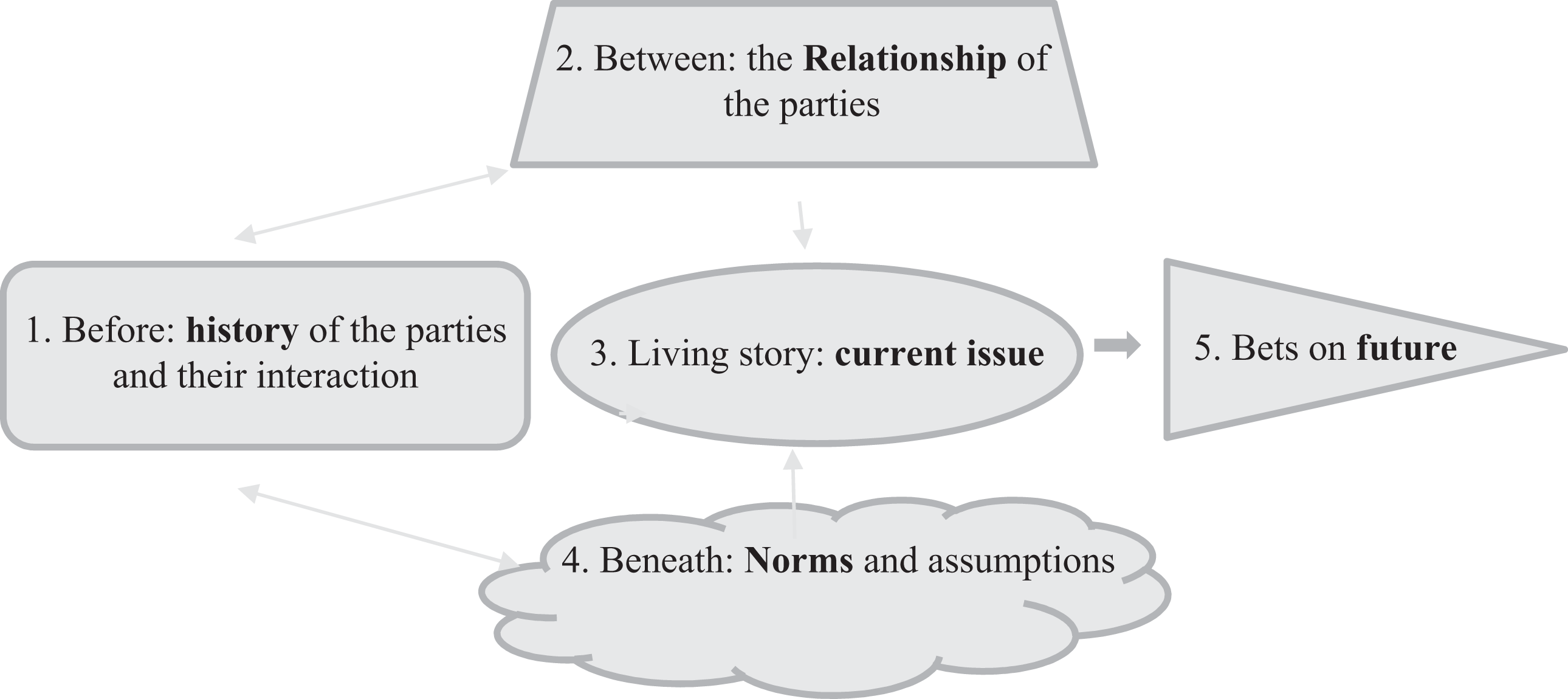
The antenarrative framework.
Negotiation research, too, is full of storytelling, probably related to the fact that the idea of negotiation lends itself to visualization as drama, game or fight, with actors taking intentional roles and steps to accomplish a goal with more or less success. When instances of storytelling are encountered in the negotiation research literature, they can often be classified as either grand narratives (e.g. central argumentation from myths) or living stories (anecdotes and justifications).
First, grand narratives, petrified narratives and mythopoesis (Vaara and Tienari, 2008), which are terms for purposefully nurtured scripts or myths that pre-exist the negotiation and are known to both parties. They are used by a party to frame their version of reality, and to create a halo effect that is useful for bringing to the table. For example, a company may cherish a myth that it always and invariably takes to litigation if it feels in any way encroached upon, and normally wins (examples include Lego and Louis Vuitton). It could also be a widely publicized brand narrative from an international chain with such negotiating muscle that it can afford to let new partners, and simultaneously their own stakeholders, know that local bribing habits do not apply (a practice reported from IKEA).
Some grand narratives constitute shared ideology that seems to come from nowhere in particular, but they are repeatedly quoted as uncontroversial when the occasion arises, often fleshed out with characters and causally related action after the Aristotelian model of beginning, middle and end. In Denmark, where the case is set, examples would be well-known sentiments like ‘We are a small country without raw materials, so we utilize our only natural resource: human ingenuity, and so we must invest in education’, or ‘With a well-developed welfare system and free education, it is too easy for young people to swan through five years of liberal education at the public’s expense, leading to highly educated youth unemployment and waste of public money’. Both these narratives have been heard repeatedly in the media in the neighbourhood of political negotiations dealing with university funding, where they serve as legitimation for a political position.
Secondly, living stories of negotiations, which are the stories that participants report or collect from a particular set of unfolding events; some are found in textbooks, e.g. the story reported in Lax and Sebenius (2006) about the Kennecott Copper mining company and the Chilean government that wanted to nationalize the mine. In such cases, a veritable web of living stories contains a set of events, relations and actions, which are only partially assimilated into a generalized textbook narrative. At any given time, the story will have looked different to the actors. In the case of Kennecott Copper, the reconstructed model would be: (a) threat (the host country declares that the mine will be nationalized, which is a very poor negotiation position for the American company); (b) action taken (the mining company creatively enlarges the pie by offering to invest heavily, thereby also involving the Chilean government in long-term guarantees, and takes steps to sell the future enlarged produce overseas, involving a very large set of foreign investors); and (c) effect (the Chilean owner is attracted by the offer, and simultaneously spun into an international set of contracts that it would be hugely expensive to sabotage). The story is ‘living’ also in the sense that it did not really finish where the problem was successfully tackled; Lax and Sebenius add a terse comment to the effect that the victory was temporary, for the mine was nationalized after all some years later.
Anecdotes come out of the parties’ or observers’ experience, i.e. retrospective narratives about a particular move, such as the now widely shared story of two presidents going off for a walk in the woods in the middle of stalled disarmament negotiations to talk man-to-man without the aides and all their caveats. For the local Danish case, the leaders of the universities have been called in for meetings with government representatives to negotiate contracts that tied funding to delivered results, and here the President of the focal university has been observed to make a point of always wearing the university’s emblem, normally embroidered on a jersey – a gesture to set him apart among pro-vice chancellors and presidents of similar institutions in a country that generally objects to gowns, uniforms and other academic branding. The uncharacteristic symbolic gesture signals his identification and loyalty to his institution rather than to his political masters.
In all these cases, such sensemaking elements of narrative are used by observers to shed light on principles that can be lifted out of the multifaceted dynamic setting, in order to deliver a single moral applicable to future negotiation, e.g. the principle of ‘3-D negotiation’ in Lax and Sebenius (2006) about the effect of involving parties that were not at the original table, or the importance of personal trust and integrity.
In the narrative understanding of negotiations, such as the Kennecott case above, the parties are perceived as actors in a drama who take strategically chosen steps to surmount a difficulty. Stories of participants’ negotiations may include expressions like ‘timing the next move correctly’ or ‘pulling a rabbit out of a hat at the last moment’. This is possible because the ‘drama’ view of negotiation is circumscribed and finite, told after the event, when retrospection allows the observer to distinguish the normal phases of preparation, claims, option generation, problem solving and working out the details of the contract with a view to implementation, or violations of this pattern (Bryant, 2010). In other words, this kind of story relates to whole negotiations.
Since negotiators in the middle of a living, dynamic context do not yet have a whole story, the best they can do is keeping track of the antenarrative elements that they are conscious of in the context. Thus the recognition of shared interests or values is a common element in argumentation, and if they represent a coherent position, it will constitute an argumentation base from which a negotiator can seek to persuade the partner.
Stories as argumentation for a ‘yesable’ proposition
However, there is a crucial difference between keeping track of the antenarrative for argumentation purposes on one hand, and persuasion on the other.
Contrary to untrained negotiators’ belief, persuasion is sometimes an indicator of deadlock; an experimental study by Roloff et al. (1989) illustrates this seeming paradox: The more bargaining dyads engaged in persuasive argumentation, the more likely they deadlocked. In fact, persuasive argumentation was the strongest predictor of deadlocking of any communication variable measured in this study. Second, the degree of persuasive argumentation was negatively related to attaining integrative outcomes. Importantly, this relationship dissipated when controlling for deadlocks. Thus, increasing levels of persuasive argumentation were positively associated with deadlocking which in turn resulted in less integrative agreements. Among dyads not deadlocking, there was no relationship between persuasive argumentation and reaching an integrative agreement […]. (Roloff et al., 1989: 117)
In the same way as stories are framed in response to an implied question or need, persuasion is found in the face of opposition; one can be said to ‘persuade’ only with regard to something that the target was not going to do anyway. The result from Roloff et al. (1989) would not be surprising if it reflected unsuccessful persuasive argumentation on the part of a negotiator with a bad case, but in the described experiment, as in many negotiation simulations, the task was constructed in a way that made the parties interdependent, so that both had an incentive to explore the opponent’s underlying interests, to secure a pay-off. Therefore, what it illustrates is that prolonged attempts at persuasion reflect a failure to think along with the opponent, the factor classically described as Perspective Taking Ability by Neale and Bazerman (1983). Negotiators who can take the other party’s perspective tend to obtain integrative results; the issue of persuasion in negotiation is more fully discussed in Bülow-Møller (2005).
Perspective taking is at the heart of what Fisher (1969) termed ‘a yesable proposition’, which he characterized as an offer that was attractive, and legitimate, and credible.
To be attractive, the proposition must be seen to meet some important need or goal. Fisher’s (1969) advice is to let the partner draft as much as possible, to avoid any sense of dictation, i.e. to protect the partner’s face and to let him or her frame the solution as a gain, in the discourse that reflects the values and interests closest to the preferred version of his or her ‘living story’ of the negotiation. An attractive offer is one that can be justified also to the partner’s stakeholders, which is why arguments may cross over from the other side in the course of a negotiation; thus, Putnam et al. (1990) show how a negotiator representing teachers ends up using the employer’s team’s arguments to his own side to justify the compromise. It follows that the ‘between’ category encompasses all stakeholders in the context, and the relationship with the opponent may not even be the most important one.
Legitimacy is achieved by appeals to common ground. Arguments in this category build on the shared norm ‘beneath’ the story. This could apply to norms of fairness like equity, equality or precedent, or a culturally valued concept that is very difficult to object to (e.g. peace, health or safety), or a more locally accepted negotiation norm (like mutual benefits from infrastructure development). When such a norm functions as a principle for decisions, it is very widely found that it legitimizes the outcome for both parties (among others, the point is made by early theorists like Bacharach and Lawler, 1981; Fisher and Ury, 1981; Lax and Sebenius, 1986; Pruitt, 1981; Walton and McKersie, 1965). Tension over legitimacy has its own literature where moral values are concerned (see Erkama and Vaara, 2010; Harmon et al., 2015, for recent overviews). The problem, of course, is that two mutually exclusive values may both be current, like the desire for ‘less pollution’ and ‘more prosperity’.
Lastly, credibility for Fisher (1969) has two elements: trust that the offer can materialize in its present form, which is achieved by detailed plans and visible contingency planning; and trust in the partner’s good intentions. Again, the latter element builds on the relationship between the parties and the care they can be assumed to have for each other’s interests, i.e. also ‘between’ the parties and the living story.
In situations where all three elements work for the negotiator, his or her goals become an acceptable future vision that is shared with the partner, and the cluster ‘bets on the future’ will encompass shared elements. We now present a case study to show how the future is ‘already present’ in the argumentation of the parties when they formulate narrative positions.
The case study
We use an explorative case study to develop our suggested model (Yin, 2013) so as to retain the context that is important for the point.
The background to this study is a wave of New Public Management thinking that has hit higher education in Denmark, where all university education is public and free. It has spread much as the virus metaphor developed by Røvig (2011), and the idea that has the infectious properties is Utility. In higher education (across the board), this means Efficiency for Business. The idea has arrived top-down as a demand from funding authorities and has been particularly noticeable for the universities during the recent economic downturn. University management has therefore been compelled to adapt their raison d’être to this demand in terms of business-relevant efficiency in research, publication, and teaching.
The target institution for our investigation is a business university (i.e. one that teaches at all academic levels, not just MBAs) which spent the last twenty years developing business studies in new directions. From a core of economics and management, serving the country’s need for managers, accountants, etc. that are immediately employable in industry, a wider field has been developed, including business-related humanities like languages, communication, culture, psychology and philosophy. There are now many degree programmes with hyphenated names that allow the 20,000 students to combine ‘harder’ economic disciplines with ‘softer’ socio/humanist ones.
But along with other universities, it now faces cuts. In a climate of reduction and efficiency, a publicly funded institution is susceptible to political demands, which translates as pressure from the board of governors onto the leadership team to show excellent figures in sought-for areas to secure government funding. Evidence of the pressure is found in the strategy documents of the university, the updated mission, and in the allocation of major internal research funding to initiatives focusing on business competitiveness, sustainability solutions, biobusiness and strategic partnerships with big business.
As a member of top management, the Dean of Research will of necessity seek to pass on the narrative of Serving Industry to the Heads of Department, whose departments are to produce the desired results, in terms of measurable goals of how to improve the departments’ teaching and research so that they are visibly useful to industry needs. This also means that the Dean will think of future job openings in terms of the same grand narrative when the time comes to balance all the departments’ needs for young faculty members. Priority will logically go to the ‘harder’, traditional business disciplines when the distribution session comes up.
However, expecting employees to live by an imposed grand narrative normally engenders resistance in some quarters. In the departments that represent the newer humanities aspects, they think in terms of a different grand social narrative, viz. one of Education for Personal Development and Creativity, in line with Zakaria (2015). The staff consider themselves as scholars and teachers that further knowledge, and this creates a dilemma for the Heads, for when they wish to secure new faculty positions in the face of cuts, they do so in competition with the other departments, and they need excellent arguments for it. Such a Head (we shall call the Head ‘she’) is therefore in the position of the Seller of an idea that the Buyer (whom we shall call ‘he’) does not necessarily see a need for, being satisfied with the status quo. A negotiation where one party seeks to persuade the other that a change is desirable, is asymmetrical, unless the Seller has some sort of power that makes the parties interdependent, e.g. when a workers’ union presents wage claims.
To document the antenarrative context of this upcoming negotiation from the Head’s point of view, we collected evidence from observation of departmental meetings, the circulated documents and slides and a one-hour interview with very little prompting, which allowed her to tell her story in relation to past history, relationships between stakeholders and organizational norms and values. All documentation is in English, the corporate language of the university, so quotations are verbatim. In the following, recurrent themes in the Head’s story relating to projected attractiveness, legitimacy and credibility of the goals have been isolated and grouped according to the five clusters of the model presented above. The story remains ‘living’ in the sense that at the time of the interview (August 2015) the Head was still in the pre-contract-negotiation phase.
There is a political imperative governing developments in the public sector, including universities – once sacrosanct, beyond political reach. – [But] looking for the truth, the Humbolt way, became less and less valid [and] four or five years ago we all learnt the term ‘license to operate’. We need to serve the political interest of the powers that be, to keep our license to operate in Danish society.
This acceptance governs her view of legitimacy. To qualify as a worth-while department in the eyes of the Dean, the measuring stick is performance, not values:
Academic excellence is essentially counted in publications, we have an academic output that we can measure, and we now have a system in place that can send that message back through the system – what you feed back in terms of KPIs [key performance indicators], a set of deliverables in competition with the other 14 departments. Negotiations with management became negotiations of deliverables: research, teaching good programmes, and our interface with society. For me to be able to show that we have the goods, we need partnerships with industry, funded PhDs, and external funding - so how strong are we in that landscape? But we are also committed to the strength of the university as a whole. Establishing the case is difficult when resources are scarce, so we have the KPIs, but we also have the narratives that we develop on a day-to-day basis, in a very conscious manner, part of the overall branding of the department. It’s an ongoing development.
In other words, the grand narrative is shared between the parties as a common condition, imposed from above and treated as uncontroversial, because of the recognized need to prioritize the few available job openings.
There are relatively few spontaneous encounters with the Dean of Research and the Dean of Education, so we always just use the pre-planned narrative. You always know what you need for that particular encounter. Every other Tuesday the 15 heads meet without management and talk strategy and current issues, income flow, etc. and that is an opportunity where we position ourselves and develop legitimacy with each other, and every other Tuesday with management present – I have important relations with other HoDs [heads of departments], those who are also more peripheral compared to the core business area. I try to build alliances with those similar to us, but also with the others, to gauge how they perceive our department, and what might they need to get a fuller picture of why we are here. There is always a translation process. I try to stick with the positive evidence.
Two things are noticeable here. Firstly, the Head sees the relationship with her competitors as relevant to her central negotiation; the good standing of her department and a shared sense of belonging across the institution is a way of insuring against a bad reputation, a narrative of uselessness which could get back to the Dean. Secondly, any sense of competition is suppressed, as only positive evidence is allowed in the context; she does not argue against anybody else, only for her own department’s quality and relevance. Nowhere in the documentation is there any hint of animosity in the stakeholder relationships – including the department’s internal papers. It seems, then, that credibility as a partner is nurtured through relationships beyond the primary negotiation.
We have seminars, external events, we give them as much publicity as we possibly can, and invite the top management to participate. We also pass on external evidence, business people saying ‘if we didn’t have that cultural insight, if we didn’t have those linguistic skills, we would not succeed’, we feed that back into our day-to-day story: we cannot expect to succeed in doing business in a global community if we don’t have the cultural, linguistic and communication insights, both for personal encounters, but also for markets, how local and regional markets see things – I try to amass evidence and peg that evidence to the deliverables that we talked about before.
The story is one of positioning, for the activities are seen as the ‘evidence’ that it takes to build legitimacy and make the department an attractive site of investment for top management.
The general assumption out there is that language and culture competencies are not key competencies to business people, they are nice to have but you can acquire them on the fly – way down the list of priorities when it comes to resources. It is a legitimate discussion [but] It makes sense for [the university]: we are front runners in developing a platform for culture and languages in a business school setting. And in traditional universities people may be feeling the ground getting hotter under their feet. We are a business university of over 20,000 students. Where the competition has stayed focused on key areas, we have a much broader portfolio. The strength of [this institution] follows from being able to be versatile, with the many ‘hyphenated’ programmes.
It is apparent that the value of culture and other humanist disciplines, which need no justification internally in the department, has been translated into a value for the grand narrative, thus supporting the effort to position the department as: (a) an important player in terms of global competitiveness and general business utility; (b) a site of innovation and creativity if the department is strong; and (c) a means of attracting excellent students (of the sort who fit the grand narrative of employability). In other words, argumentation takes place exclusively on the employer’s territory.
It is equally apparent that there is a glaring absence in the written or transcribed documentation, but not in oral interaction in the department, viz. the moral obligation to the young faculty whose jobs are on the line. From the organizational context it is clear that human interest and the wish to retain competent staff is the same for all the departments. This suppresses the argument or makes it inadmissible in public. While it is widely recognized that the young people in question contribute substantially to the aforementioned key performance indicators (KPIs), they make no appearance at all in the Head’s narrative.
People at all levels are betting on our future. We need top management to say to themselves, ‘we need to build a strong department in this area’.
The expression ‘we need to build’ signals that this is not the case at the moment. In fact, one of the internal documents that is shared in the department, and also a key argument for the final allocation round, is a list of people currently employed, adjusted for agreed retirement, in the relevant areas that the department is responsible for. It clearly shows an ageing department that will develop serious gaps in competencies if new positions are not available.
Thinking in terms of embedded conditionals
Bets on the future are an essential part of negotiation theory. As Cummins showed in this journal (2015), most people worry about defending themselves against the vicissitudes of responsibility, indemnity, etc. when they get to the stage of actual contracting. To fend off the worry, negotiators have to think in terms of conditions and conditional bets. But over and above due diligence concerning costly eventualities, there are other uses for the ‘if–then’ construction, notably the formulation of forward-pointing visions of common ground. To get at them, we shall need to discuss the Head’s bet in terms of conditional propositions.
We assume that the Head’s proposition is “The next few permanent job openings should go to my department”. To make it attractive, legitimate and credible, it can be translated into a series of conditionals which have the property that it demonstrably takes the partner’s concerns seriously, by defining a problem for him that addresses his narrative universe, and suggesting a solution. The material is lifted from the five clusters discussed above, but it is schematized as logical form: Starting from the shared history of interaction in the institution (1), and from the good professional relationships (2), the Head recognizes the good intentions of the common narrative, so that she attributes nothing but acceptable motives to the partner. Formulating a living story for him that tallies with hers (3), her version will draw on shared norms (4), so that logically, the bet (5) should be the same. The argument takes the form of a forward-pointing story: As a responsible Dean, you want to safeguard (a) the institution’s international reputation for fostering different kinds of high-level business research, - which also safeguards ‘hard’ business research, and (b) our students’ interests, to keep the enrolment levels high and attractive for us, - for the best students face no danger of unemployment, and (c) our department’s need to stay lively and productive - for scholarly production affects the funding of the whole institution, so:
(a) if our department has too few members to teach innovatively, and (b) when faculty are too old to keep up innovation and productivity,
(a) more faculty will keep up the reputation that is now endangered, and (b) younger faculty, with different networks, promise creative innovation, as witnessed by their excellent publication records.
Discussion
Two questions call for discussion: the status of the dispersed antenarative as negotiation; and the usefulness of the approach as a generalizable practice.
First, then: To what extent can the antenarrative outlined above be called a negotiation? We argue that the Head’s reality, pieced together by discourse fragments in a shifting organizational context, contains at least two layers: on one level, her story is of perpetual positioning, in the same category as lobbying, branding and impression management; but on another level, it qualifies as the negotiation process itself. This is to do with the one-sidedness of this particular kind of ‘selling’, where the practical goal is to ‘sell’ an ideological position to somebody who has reward power.
In this sense, the Head’s situation is different from that described in other treatments of argumentation in negotiation, e.g. in Erkama and Vaara (2010) or Putnam et al. (1990). In the latter study, which follows teachers as employees negotiating with the council that employs them, the parties are properly interdependent: they want something from each other that they cannot obtain without the partner’s consent. In Erkama and Vaara (2010), the process is that of shutting down a plant, so here the parties have asymmetrical power. But in both cases the argumentation base differs between employers and employees, particularly around ‘harm’ arguments, i.e. arguments that rely for their effect on the social norm that the partner wishes to be fair to people and cause no harm to their welfare. In both cases, this allows for passion and arguments drawn from the Aristotelian category of Pathos on the part of the employees.
This is not the case for the Head: her argumentation has been adapted so completely to her employer’s that sensemaking Logos arguments are not only prevalent, but embraced with a certain amount of enthusiasm. As for Ethos, her efforts are to prove her own standing as a credible partner, rather than appeal to the employer’s good will and responsibility. In all relevant aspects, the antenarrative is, in this case, an exercise in perspective taking ability that permeates all aspects of the negotiation.
The second question is central to our goal. We set out to explore the contribution of a ‘storying approach’ to negotiation studies. We have found that stories about finished negotiations can be used to prove a point (e.g. as examples of a successful tactic), but that different insights can be brought to light if the focus is the complex, dynamic context of on-going negotiation processes. We are aware that in this article, the light has been trained on one side of the table only, and that the Head’s reality, as told to us, is of course a version that is suitable for public perusal. But we can also see that compared with internal departmental documents, the account is remarkably consistent: the story of Why We Matter is the same when it is produced for the Dean and used in the department for auto-communicative purposes to strengthen morale (and encourage KPIs).
This leads us to argue that collecting the discursive fragments that constitute the antenarrative is not only useful for the analysis of negotiations, but a practical skill that negotiators can and should acquire; thus, we argue that negotiators who are capable of tracing the discourses that are in play, can recognize the partner’s complex base of values, beliefs and positions. They therefore find it easier to defuse objections by accounting for those of their own positions that the partner may see as unhelpful; they can visualize through adequate examples, and describe agential roles that include both speakers and hearers as contributors to a common venture. Keeping track of the antenarrative not only legitimizes argumentation, it keeps the partner’s position actively in focus; this is crucial to a lasting agreement, as we argue together with many scholars of the field, most recently Tomlinson and Lewicki (2015).
Conclusion
We hope to have shown that awareness of dynamic context is an asset for negotiators. However, we would like to take the point one step further and claim that the model of the antenarrative can serve all negotiators as a list to keep in mind when they prepare for a negotiation, order their priorities, and decide on the positions they want to argue for.
Planning and preparation for negotiation are regularly treated in the textbook literature as extremely important (see e.g. Fells, 2012; Lewicki et al., 2014; Thompson, 2014), but there is not a great deal of study in the area. Peterson and Lucas (2001) make recommendations in the central areas of preparation, which they define as: intelligence gathering about the other organization; formulation of position, best alternative, and strategy; and rehearsing the presentation. This leaves a gap around the context.
Our point is that preparation of the central proposition (in whatever form) should examine the context closely in order to foresee what story the partner is bringing to the table, and what elements in the antenarrative can be expected to form part of the common ground that can be worked into a shared vision for the future. Elements from all five clusters should be considered. It is not enough to imagine the partner’s concern for indemnity, or competitive offers from a third party; good preparation should see the coming negotiation round as: emerging from a history (about which opinions may be divided, if the partners have had different experiences); as the product of a dynamic relationship (about which group members may have different feelings); as striving for a coherent, sensemaking story (that can be made credible to the constituents); as anchored in norms, hopefully shared but otherwise adapted (for the sake of legitimation); and all in order to create some forward-pointing momentum.
In all, this adds up to an approach that can be called a ‘theory of effective embeddedness’, and this, we suggest, is a useful tool for thinking around any on-going negotiation.
Narrative research is strong in many organizational fields, especially where reputations matter. Future research might be suggested that sought to link organizational narratives to local, ongoing negotiations, in order to show the complex links between embeddedness and results.
At the time of writing, we have not yet seen the result of the process we have observed. But on behalf of the university, we hope the shared vision will end up with a story some day of young researchers that pushed the boundaries of usefulness in creative humanist thinking in business.
Footnotes
Conflict of interest
The author(s) declared no potential conflicts of interest with respect to the research, authorship, and/or publication of this article.
Funding
The author(s) received no financial support for the research, authorship, and/or publication of this article.
References
Supplementary Material
Please find the following supplemental material available below.
For Open Access articles published under a Creative Commons License, all supplemental material carries the same license as the article it is associated with.
For non-Open Access articles published, all supplemental material carries a non-exclusive license, and permission requests for re-use of supplemental material or any part of supplemental material shall be sent directly to the copyright owner as specified in the copyright notice associated with the article.
