




Abstract
This paper explores how individuals living within high-stakes precarious categories navigate their identity within online spaces. Using Membership Categorisation Analysis, we investigate how categorical inferences are indexed by those individuals within online biosocial communities in everyday speech, as part of their construction of identities. More specifically, we analyse online interactions of women who have been identified as carrying a BRCA gene mutation in an online biosocial community. Our findings show how (1) the online spaces participate in constituting and sustaining a form of collective responsibility, where those who are within a high-stakes precarious identity category are expected to not only support and educate each other, but also monitor the compliance to category predicates, and (2) the tensions and conflict in making sense of, belonging to, resisting and sustaining a category membership often occur when there are clashes with the socio-moral order. Overall, this paper’s contributions are twofold, first, methodologically, the use of Membership Categorisation Analysis provides an insightful analytic approach to identities, online communities and their organisation. Second, the emerging tensions identified provide insight into the complex ways in which online communities offer a forum in managing precarious identity as individual and collective life intersect.
Keywords
Introduction
BRCA1 and BRCA2 (BReast CAncer) are two examples of human genes that significantly raise breast cancer risk if they become altered. When the gene becomes altered, or broken, it does not function properly, and is no longer effective at repairing DNA and helping the body to prevent breast cancer. The average woman in the United States displays a 12% risk (or 1in 8 chance) of developing breast cancer across the course of her life. With BRCA1 or BRCA2 (or both), this risk rises sharply to circa 72% for a positive cancer diagnosis (CAT, 2019). This places these women in a precarious, high-stakes category whereby, following Butler (2009), their identities are intrinsically linked to feelings of anxiety, insecurity, and fragility.
Predictive genetic testing for BRCA1 and BRCA2 mutated genes is well established globally. Yet, there is a significant understanding that despite the advantages that being tested affords, such as the ability to take proactive steps to reduce the risk of developing cancer, there are also notable disadvantages for those in precarious, high-risk categories. For example, the UK’s National Health Service (NHS) states that one such drawback to predicative testing is the potential for ‘permanent anxiety’ caused by a positive result (NHS, 2018), whilst U.S. medical commentators suggest depression and anger can be triggered from an abnormal positive result, as well as having material negative consequences if negating access to life and further medical insurance (National Breast Cancer Foundation Inc, 2020). In such cases, prospective patients are warned that knowing a positive BRCA result may be ‘too hard [to take] emotionally’ (National Breast Cancer Foundation Inc, 2020) – that some patients may feel guilt and worry with the knowledge they have passed an abnormal gene to their children.
For those living within this precarious, high-risk category, feelings of insecurity, fear, inequality, isolation, disempowerment and discrimination have been documented across both the online and the global press (see e.g. O’Donoghue, 2019). One way for those who have tested positive to solve their problems surrounding their precarious situation is to organise around an online community (Barros, 2018; Ma and Agarwal, 2007; Ren et al., 2007, 2012) – what we term an ‘online biosocial community’ as the shared ‘communality’ is their specific biomedical categorisation of being BRCA positive. Indeed, we hope to further our understanding of how such communities become organised and how do the members within them channel their thoughts, concerns, and notions of legitimate identity amongst those who turn to them.
Research focusing on commonalities and shared membership identity within online communities has been at the forefront of organisation studies for some time. Briefly, some examples of such research include: a focus on shared, occupational safe spaces for community and identity formation (Vaast and Levina, 2015), online communities as holding a sense of shared features or common interest (Faraj et al., 2011, 2016), or where communication and reciprocity are linked to a common identity (Ren et al., 2007, 2012). Kane and Ransbotham (2016) demonstrate how communalities of content posted within an online community act as boundaries (e.g. Carlile, 2002) thus creating opportunities for collective identities. Elsewhere, Faraj et al. (2016) point to positive and negative tensions within online communities and the possibility of greater fluidity in category membership definition where socially ambiguous identities are created.
Notwithstanding this growing body of work combining identity and the online space, we still know relatively little about how individuals make sense of their membership identity category (BRCA1 and BRCA2) in online spaces. In this paper, using Membership Categorisation Analysis (MCA) (Hester and Eglin, 1997; Housley and Fitzgerald, 2009, 2015; Sacks, 1972, 1992; Stokoe, 2012), we seek to add to the current body of knowledge, a different perspective on those individuals, and their management of identities, who find themselves within the precarious, high-stakes category which has stemmed from a particular regime of knowledge; the knowledge of the specific biosocial marker, BRCA1 or BRCA2. Indeed, we know much about how identities come into being (see e.g. Alvesson et al., 2008; Beech, 2008; Brown, 2015, 2020; Caza et al., 2018; McDonald et al., 2008; Watson, 2008), and what they can provide individuals with in terms of information that allows them to understand and navigate the social worlds they inhabit (Brown, 2020). Additionally, in a recent ethnographic study, Giazitzoglu (2022) highlights the relationship between embodiment and gender in relation to identity threats in a hegemonic organisation. However, less is known about what happens in relation to individuals’ sensemaking of their own identities in relation to inclusion in biomedical membership categories in an online space, and the mutual shaping of identity and community in this way.
In order to shed light on this, we utilise MCA as a means through which we can explore how membership to an identity category (BRCA1 and 2) is constructed, made sense of, negotiated and contested in online spaces by those who have been categorised by their genetic biomarker. These online spaces are of significant interest as they have been created by, and are specifically for, those women who have tested positive for BRCA 1 or BRCA2. These spaces thus act as a means of for those coping with a precarious, high-stakes situation and for them to relate themselves in some way as members of a category to which they are relatively new: that of a BRCA defective genetic person.
In our analysis, we focus our attention on an online biosocial community called ‘FORCE’ (Facing Our Risk of Cancer Empowered) and, through MCA, we centre on two forms of category: (1). ‘belonging to a previvor category’ (previvor is defined by FORCE as ‘individuals who are survivors of a predisposition to cancer, but who haven’t had the disease’); and (2). ‘sustaining and protecting a category membership’. As researchers, we are acutely aware of the precarious nature (Butler, 2004, 2009) of lives within the online biosocial community under study, and wider discussions on the relationships between notions of identity, self and reflexivity (Brown, 2019). As such, we acknowledge the role of anxiety, of insecurity, and understand that identities can well be. . . ‘imperilled, menaced and fragile’ (Brown and Coupland, 2015: 1316).
Below, to ground our empirical analysis, we first present a contextualisation of the online biosocial community by reviewing the literature on online communities in management and organisation studies. Next, we present a theoretical overview of Membership Categorisation Analysis (Hester and Eglin, 1997; Sacks, 1972, 1992), and highlight its relevance to the negotiation of high-stakes precarious identities in online communities. We then detail the methodology that we followed and present our findings. We conclude this study by discussing how our findings contribute to identity research in organisation studies (Brown, 2020).
Online identity and community construction
Over the past 20 years, the accelerated development of new information technology has been a key force in how we live, share, contemplate, communicate and think (Haas et al., 2015). The increase in online communities, allowing groups of hitherto relative strangers to come together in technological spaces through a desire for shared features or common interests is one consequence of this rapid technological drive (Faraj et al., 2011, 2016; Kraut and Resnick, 2011; Ren et al., 2007, 2012; Sproull et al., 2007). Although no firm definition exists, a widely accepted definition of online communities suggests a ‘virtual space where people come together with others to converse, exchange information or other resources, learn, play, or just be with each other’ (Kraut and Resnick, 2011: 1).
The complex, interactional nature of these online spaces holds much value for researching engagement and interaction in new and emerging contexts and domains. Specifically, online communities have bestowed clear opportunity within the field of organisation studies to reconsider issues of identity. Previous research has explored boundary logics of identity and power (Jarvenpaa and Lang, 2011), the ‘dark side’ of online communities (Barros, 2014; Massa, 2017), and the generation of common identity in online communities through content-driven boundary setting (Ransbotham and Kane, 2011). These studies exemplify critical efforts to unpack the nature of online identity, revealing, for example, the role of blogs in dynamic corporate identity construction (Barros, 2014) and the role of identity in shaping community boundaries (Jarvenpaa and Lang, 2011).
From a top-down perspective, identity has also taken theoretical centre stage in some of the more information technology-orientated work on the construction of online communities. Faraj et al. (2011) sought to consider identity and socially ambiguous identities (as well as time, and social disembodiment) as resources that created positive and negative tensions in such communities, noting interestingly the entwining of both identity and fluidity over time and the idea of the fluid online community. For members, then, there is a constant accomplishment or construction of their social identities over time.
While studies of online discussion and interaction span many online contexts, open spaces, such as Twitter for example, and more private spaces, such as FORCE, impact identity and community construction differently. Here, the likes of FORCE can be seen as a safe space online, where members can share issues and come together to solve shared problems (Vaast and Levina, 2015). The safe space is, we believe, of particular significance as it exemplifies the precarious and even existential form of community in the online space. In terms of identity formation, the role of the safe space is one that endeavours to protect its members by challenging identity threats and creating spaces for members to ‘express their support for one another and jointly construct an [. . .] identity’ (Vaast and Levina, 2015: 77). One such sub-category of online community spaces for precarious situations used to create safe spaces is the forum (where the texts analysed herein stem from), which we believe is worth unpacking.
Internet forums constitute an ‘asynchronous’ mode of communication. This feature has important implications for the practice of talk and identity formation in online communities organised through such a medium. Asynchronous online communities involve on-real-time, online interactions. Similar to the case of FORCE message boards, discussions or threads start with a post from a forum contributor, and other participants interact and contribute to the thread at their own pace. The virtual space is the same for all participants, but there are no constraints for being there at the same time. This makes the genre of writing different from the one of synchronous communication, as the contributions are crafted more carefully, with usually a higher level of detail than say a chatroom (Montero-Fleta et al., 2009). Messages are traditionally stored within the website domain.
The genre of ‘talk’ in internet forums further differs from traditional written texts by including more humour, the substitution of everyday conversation being substituted by paralinguistic clues, embedded within the writing, for example use of bold face, italics, and other prosodic elements of texts, as well as a tendency towards a greater level of intimate personal disclosure and emotional expression (Montero-Fleta et al., 2009). This electronically mediated text is very often sent unedited, with a high proportion of typing mistakes and contractions of the words within, which accentuates the informal dimension of this genre (Baron, 1998). Fairclough (1995) defines this genre of writing as characterised by the processes of informalisation and technologisation of discourse. He describes modern discursive practices as a blending of ‘formal and informal styles, technical and non-technical vocabularies, markers of authority and familiarity, more typically written and more typically spoken syntactic forms’ (Fairclough, 1995: 79).
While clear work on both online identity and online community construction has demonstrated the complexity of the online space for shaping identities and communities, some key perspectives on how this takes place are worthy of further investigation. For example, little has been done to investigate the interactional or the situated ongoing building of identity in online safe spaces and the impact of this on online community construction. Further insight into the mutual shaping of identity by community and community by identity would add a valuable perspective into how online communities, particularly in our case, those of a precarious nature, organise themselves broadly, as well as developing further understanding of the role of the individual therein.
In our attempt to understand how categorical inferences are indexed by actors in the construction of identities in online communities via fora, we seek to uncover the tensions and the conflict in making sense of, belonging to, resisting, and sustaining a category membership in an online community, where precariousness is inherent. Essentially, we wish to shed light on the strategies themselves used by those members of the community in the creation and sustaining of their online identities. In order to move beyond a focus on individual identity and towards a complex view of a collective membership identity, we draw on MCA, and it is to this which we now turn.
Membership Categorisation Analysis
When studying identity construction in biosocial online communities, membership identity categorisation plays a critical function as it contributes to the processes of framing and scripting interactions (Whittle et al., 2015). To explore this function, we turn to Membership Categorisation Analysis, as initiated by the work of Sacks (1972, 1992), and fully fledged in Hester and Eglin’s (1997) seminal work ‘Culture in Action: Studies in Membership Categorization Analysis’. MCA engages in a fine-grained analysis of the situated organisation of taken-for-granted categories in relation to social and moral orders (Garfinkel, 2002; Jayusi, 1984). In effect, MCA offers a framework for making sense of the social and discursive construction of identity and group membership, so in essence, MCA can be helpful in developing a situated and fine-grained study of identity as a site of intersection of individual and collective lives. The notion of ‘membership’ is core to understanding this intersection, and particularly its relation in-situ to ‘the categories of culture and society that form the stock in trade for the routine accomplishment and co-ordination of social life’ (Housley and Fitzgerald (2015: 1). This is notably relevant to our study of online communities, as we seek to explore how identities form when individuals organise as a collective in online spaces around specific social and cultural categories.
Typically, MCA focuses on verbal and textual cues (though visual cues in interaction have also been studied through MCA) as a means to identify individuals as members of a specific social category. From a moralistic perspective, the positionality of this membership offers insight into group expectations and evaluations. Indeed, MCA allows for a granular analysis of the moral organisation of accountability in collectives (Jayusi, 1984). Within such framing, questions of moral action constitute ‘matters of practical relevance for members of society’ (Evans and Fitzgerald, 2016: 206) – including when breaches in the socio-moral order occur (Larsson and Knudsen, 2022; Stokoe, 2003). Recognising the fluidity inherent in identity construction and the need to navigate, construct, and deconstruct identity, the moralistic dimensions of MCA allow us to capture tensions in identity play. In turn, this gives us a more comprehensive picture as to what it means to be a member of the BRCA1 and BRCA2 category.
In essence, MCA allows us to perceive of categorisations undertaken by individuals while also affording a critical, analytical framework to articulate and systematise these categorisations. Categories have an ‘inference-rich’ nature (Stokoe, 2012), which draws on common-sensical knowledge systems surrounding a category. As Stokoe (2012: 300) puts it, categories ‘short-cut and package common-sense knowledge about category members and their actions’. What is of interest in this study is that inferences inscribed within categories are strongly connected to matters of morality, accountability and politics, which are central in the analysis of the situated organisation and display of identity categories in online spaces (Housley and Fitzgerald, 2009).
Another important notion within MCA in relation to the current study is ‘category predicates’, which refer to the features that can ‘conventionally be imputed on the basis of a given membership category’ (Watson, 1978: 106). These can refer to predicates of rights, duties, obligations, actions, and competencies, which are associated with the practices of individuals within specific categories. The interplay between category predicates and inferences ‘enable[s] each to accept/confirm/validate the other’s self-categorization and to produce, via their own actions, activities that are congruent with the other’s self-categorization’ (Psathas, 1999: 139). Thus, MCA provides tools to study categorical issues, which makes it ideal for our empirical case’s focus on the negotiation of high-stakes precarious identity categories in online communities (Stokoe, 2012). Indeed, MCA allows for an in-depth investigation of how members of a particular category use ‘methodical practices in describing the world, and displaying their understanding of the world and of the common-sense routine workings of society’ (Fitzgerald et al., 2009: 47).
While MCA has been gaining a wider interest in social sciences (e.g. Hester and Eglin, 1997; Housley and Fitzgerald, 2009; Leudar et al., 2004; Stokoe, 2010; Watson, 1994), its use in organisation and management studies remains limited. Examples include the following topics: categories as resources for leaders for activities such as descriptions, decision making and judgements (Fairhurst, 2007), the function of categorisation as a device for resource allocation (Samra-Fredericks, 2004, 2010), the processes of ‘frame-breaking’ and ‘re-framing’ of sensemaking about organisational structure categories, as performed by discursive leadership (Whittle et al., 2015), the relationship between negotiation practices and interactional identities in banking (Larsson and Lundholm, 2013), and the contestation of the category ‘leader’, and the destabilisation of the common sense knowledge surrounding it, in the analysis of the discourse of political leaders (Whittle and Mueller, 2020a, 2020b).
This paper aims to extend this literature by discussing how categorical inferences are indexed by actors in everyday language use, as part of the construction of identities in online communities – with a particular focus on high-stakes precarious identities. Using MCA, we aim to unearth the contestation and the subsequent discursive strategies employed by those making sense of their category membership as they engage in a process of identity construction and deconstruction (see Whittle and Mueller, 2011; Whittle et al., 2015; Whittle and Mueller, 2020a). In so doing, this paper demonstrates that identity membership is not given, but is fluid – constructed and constituted in a continual process of contestation (Brown, 2019; Karreman and Alvesson, 2001). By using MCA, we are able to demonstrate the tensions and conflict in making sense of, belonging to, resisting, and sustaining a category membership, thereby contributing to a clearer understanding of the complexities and tensions of precarious identities (Clarke et al., 2009; Collinson, 2003; Coupland and Spedale, 2020; Knights and Clarke, 2014; Knights and Willmott, 1999).
Our empirical focus is an online biosocial community for women with a genetic propensity for breast and ovarian cancers. MCA has previously been used for the study of digital identities and online interactions, for example in the study of ‘digital wildfires’ on the social media platform Twitter (Housley et al., 2017), and abuse in online media (Sambaraju and McVittie, 2020). This body of work has highlighted the importance of digital interaction culture-in-action as an important site for MCA-focused ethno-inquires (Housley, 2020). Our study seeks to unleash the potential of MCA to add to an understanding of the intersection of individual and collective identities in online spaces. In studying everyday online interaction in our chosen biosocial community, our subsequent analysis of them allows us to address more specifically the following research question: what strategies do individuals deploy to legitimise and sustain a category membership in online communities? Through our use of MCA in the study of online communities, we therefore aim to contribute to an understanding of ‘categorisation as a visible and publicly accountable social practice’ (Whittle and Mueller, 2020a, emphasis in original). In doing so we hope to contribute to the use of a novel form of analysis of membership identity work via MCA in teasing out hitherto hidden discursive strategies inherent in the ‘situated practices of language use’ (Brown, 2019: 9).
Data and methodology
In order to explore the tensions and conflict in making sense of, belonging to, resisting, and sustaining a category membership, this paper focuses on the analysis of naturalistic data of interactions from an online biosocial community of women with a genetic propensity for breast and ovarian cancers. Taking a qualitative perspective, our focus on hereditary breast and ovarian cancers leads us to focus primarily on a specific set of genes labelled the BRCA genes (BRCA1 and BRCA2). The inheritance of a BRCA gene mutation is associated with an increased risk of developing breast and ovarian cancers over a lifetime, and constitutes one of the primary loci of attention for this online biosocial community.
Data
The online biosocial community from which we draw our data is called FORCE (Facing Our Risk of Cancer Empowered). FORCE is a national non-profit organisation in the USA devoted to hereditary breast and ovarian cancers, and was created in 1999. The organisation is involved in support, education, advocacy, awareness, and research specific to the genetic propensity for breast and ovarian cancers. All the extracts copied in this paper from the message board are the property of FORCE (Copyright © FORCE-Facing Our Risk of Cancer Empowered, Inc., Tampa, Florida. All rights reserved). The researchers, however, obtained permission to use the data for academic purpose from the executive director and founder of FORCE. As one would expect, access to such sensitive and personal accounts was enabled and premised by a clear set of ethical guidelines and agreements in accordance with the researchers’ academic institutions, with the final agreement and sanctioning of these by the executive director and founder of FORCE.
Overall, the data sampling followed a very similar method to that elaborated by Holtz et al. (2012) and, in the case of this study, the data were retrieved from the ‘young previvors’ forum. There were two main reasons for this choice: first, the title of the forum reserved it to the category of interest in the present research, that is, Previvors. Second, the ‘young previvors’ forum was the most popular forum after the ‘main’ forum in terms of number of topics, posts and replies. This in itself suggested a significant level of interaction between the participants. After access was granted, we were given the official go-ahead to copy and securely store the data from the archives of the FORCE forum, starting our selection from the beginning of the ‘young previvors’ forum, September 2008; and finishing February 2015. We excluded the threads within the last 6 months prior to the data collection, in order to have well-advanced narratives with sufficient interactions. We excluded all posts with less than 20 replies to focus on ‘rich’ conversations with a high level of interaction. This selection process and criteria narrowed down the selection to a relevant corpus of 49 threads from the forum, and a total of 1387 posts.
Considering the sensitivity of the research topic, and fully recognising the position of extreme anxiety from which many must contribute, the forum participants’ profiles are completely anonymised, in doing so, we assigned further pseudonyms rather than using the virtual names from the forum. Following the recommendations outlined in the Ethics Guidelines for internet-mediated Research (British Psychological Society, 2017), we treat virtual usernames and pseudonyms with the same respect as for a person’s real name, in order to prevent the risks related to the traceability of quotes online and their association with participants’ virtual identity.
Analytical procedure
In our analysis, we illustrate our findings by analysing excerpts from the threads from FORCE’s message board. We analyse the speech at the interactional level, and connect it to wider considerations of the social, cultural and historical contexts. We start by investigating the functions of discursive devices within their context of use, and then connect these to the broader contexts. Following Mueller and Whittle (2011: 189), we use the term ‘discursive devices’ to refer to: ‘the micro-linguistic tools that people use in interaction in order to construct a particular version of the world and their relationship to it’ (Mueller and Whittle, 2011: 189). The analysis was an iterative process moving between the data, the social, cultural and historical contexts, and linguistics foundations.
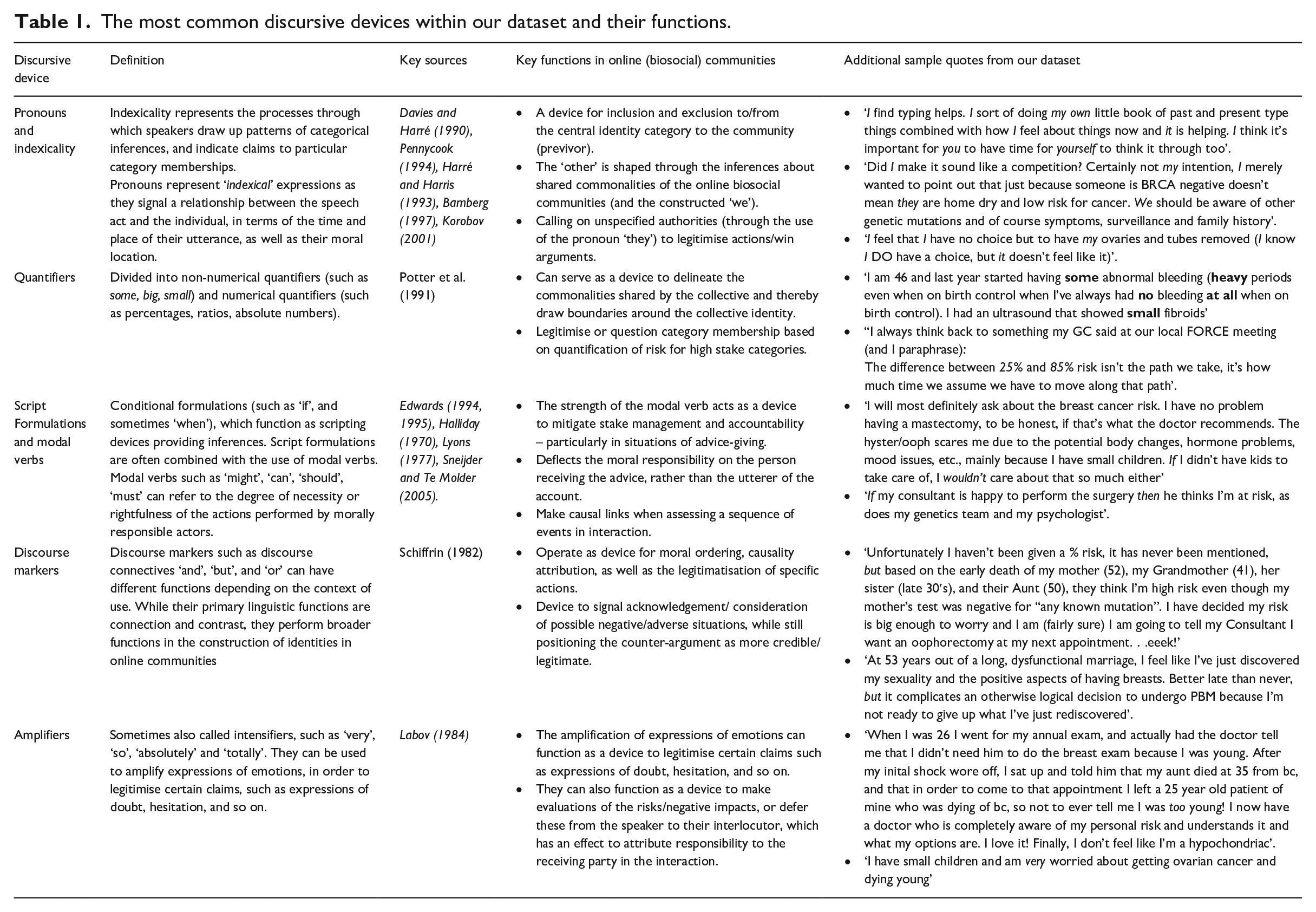
We present below a short number of extracts from various conversations within the online biosocial community FORCE in order to explore the politics of the at-genetic-risk category membership in everyday speech. We summarise in Table 1 below the most common discursive devices within our dataset and their strategic functions. As this is a qualitative study which involves bottom-up coding of threads and a top-down application of MCA, these specific discursive devices were chosen specifically, owing to their saturation within and across the data (Fusch and Ness, 2015). There were several identity categories at display throughout our dataset. Nevertheless, two identity categories were pervasive: the ‘at-genetic-risk’ woman, and the ‘previvor’. The former category refers to the state of having a genetic predisposition to develop breast and ovarian cancer, and frequently referred to women who tested positive for the BRCA gene mutation. This category represents the embodiment of the genetic risk, and performs a qualification as well as a quantification of the body carrying the genetic mutation. The latter category is centred on the practices to take charge of reducing the genetic risk for women who have been previously positioned within the former category (at-genetic-risk women). Furthermore, ‘previvor’ is strongly associated with the identity category ‘survivor’ in breast cancer narratives, but moves its components in time and space: from the context of illness to pre-illness, and from the diseased to the pre-diseased body. The FORCE website defines the label ‘previvor’ as ‘individuals who are survivors of a predisposition to cancer but who haven’t had the disease’.
The most common discursive devices within our dataset and their functions.
The analysis is presented in the following section.
Analysis: FORCE as a space for Membership Identity Categorisation
Our analysis revealed two core themes that show (1) how members of the FORCE online community legitimise themselves as members and (2) how members of FORCE negotiate their roles within the online community. To elucidate these core findings, in Section 5.1, we discuss the ‘belonging to a previvor category’ with a view to demonstrating how those members of FORCE who are at risk owing to family history and not genetics are categorised as pre-vivors in order to avoid exclusion from the community and legitimise their presence therein. Subsequently, in Section 5.2, we discuss ‘sustaining and protecting a category membership’ and demonstrate how members feel obliged to be categorised and reject exclusion on the grounds of other conditions, such as menopause.
Belonging to the previvor category
Despite FORCE’s definition including ‘other cancer-predisposing mutation’, the category membership to the identity ‘previvor’ often presumed the carriage of a mutation of the BRCA gene. The reduction of the term to a specific gene resulted in excluding women who tested negative for a BRCA mutation, but still had a strong predisposition to develop the disease. These women sometimes utilised the category device ‘uninformative’ to position their ‘previvor’ category membership. The following extracts present such cases, and the uninformatives’ efforts to belong to the previvor category.
In these extracts, we investigate pronoun use in making sense of, belonging to, and resisting a category. In so doing, we analyse how collective identities are constructed in speech and focus on the use of the first and third-person plural pronouns. This allows us to demonstrate how the first person plural pronoun ‘we’ functions simultaneously as a device for inclusion and exclusion. It is also noteworthy that the ‘other’ is also shaped through the inferences about shared commonalities of the constructed of ‘we’. As such, we also explore other ways of constructing the ‘other’ through the use of ‘they’ to call to an unspecified authority. The analysis focuses on the following extracts and demonstrates how these members legitimise their membership of the communities.
(1)
‘My aunt underwent treatment at her practice and because she now had an actual breast cancer diagnosis, she was retested for the BRCA gene mutation. A full sequencing test was utilised and still this test came back negative for any gene mutation. However, this time, taking into consideration her family history of breast cancer,
(2) ‘Basically, what your gynaecologist meant was your risk percentage has nothing to do with when you will be affected by it. Just because someone has an 85% risk doesn’t mean they will get breast cancer before the individual that is only 25% risk. So, whether you’re a 25% or 85% person, you still need to consider the options available as far as prophylactic treatment and surveillance. And in relation to the risk of an uninformative, it depends on the person and their particular risk factors. My GP said my risk was 24%, but my gynaecologist who is heavy into research think it is higher’. Celine
(3) ‘Completely understand your thought process and I am in the 25% risk category. The only problem is in many of our cases, while we are BRCA negative, there is something going on. . .and yes, we have two good copies of the genes that are tested, but not necessarily another gene that could be the culprit. In my case, I was given a percentage completely based on family history with no other potential risks calculated into it’. Katia
(4) ‘Just because someone is BRCA negative doesn’t mean they are home dry and low risk for cancer. We should be aware of other genetic mutations and of course symptoms, surveillance and family history’. Ivy
(5) ‘I agree with you about % risk. I just look at my family history and have to ask myself if I really want to take the risk? So, they haven’t found a mutation, and haven’t given me a % risk to go on, but can I ignore history? I don’t think so. Besides, if my consultant is happy to perform the surgery then he thinks I’m at risk, as does my genetics team and my psychologist. It’s hard though not to have something in black and white telling you, I guess that’s why we go around in circles thinking about it!!’ Ivy
In the extracts above, the different uses of ‘we’ and ‘they’ are noteworthy. When looking at extract (3), Katia is constructing a new collective identity through the use of ‘we’ and the possessive pronoun ‘our’, while responding to Celine’s explanation (in extract 2) of the nuances of uninformatives’ risk calculation. Katia, who tested BRCA negative, has a strong family history. Participants, facing similar scenarios such as in the extracts above (and throughout our dataset), were qualifying their test results as uninformative.
Katia is questioning the process of quantification of her risk, which has been estimated at a 25% chance of developing breast cancer in her lifetime. One of the strategies she uses to undermine the arguments behind the calculation process is the construction of a collective identity around that number, as well as other shared characteristics. Therefore, this construction of the collective identity starts with some shared features: a risk calculated at 25%, a BRCA negative status, and strong family history. Katia starts this construction of the risk percentage as a category with the use of first-person singular pronoun ‘I’ in ‘
The sequencing of the use of such pronouns allows Katia to discursively position herself within the group and construct her identity in a number of ways. In the first instance, Katia positions herself within a particular collective: the 25% category. Following that, she adds the second shared commonality of the collective, which is the negative BRCA status. This second shared commonality is positioned as highly problematic, as Katia describes how this diagnosis draws attention away from potential unknown genetic mutations. This, in turn, is used to question the whole categorisation; and in so doing, legitimises the questioning of the quantification of the risk at 25% and her membership of this online community. Risk percentage appears to be an important predicate of the previvor category. However, instances such as the ‘uninformative’ status challenged its prominence in confirming and validating one’s category membership. This was particularly the case when the reliability and validity of the risk calculation process were put in question.
The use of ‘we’ and ‘ours’ in this extract also contains some inferences about the shared commonalities of the category. For instance, the utterance ‘the only problem is in many of our cases, while we are BRCA negative, there is something going on’ contains some inferences about individuals within the said category, such as an inclination of individuals within this category to rely on the negative BRCA status and the calculation that derives from it in their decision process, as well as a tendency to consider themselves in the ‘safe’ category. In this extract as well, the movement from the use of the singular to plural, ‘I’ to ‘we’, within the speech emphasises the separation between the two statuses. The responsibility to take action is individual, while the knowledge is collective (but specific to the uninformative community).
The use of ‘We’ also implies an ‘authority to speak for others’ (Pennycook, 1994: 176). For instance in extract (2), when Ivy utters ‘we should be aware of other genetic mutations and of course symptoms, surveillance and family history’, she is not only giving some advice to her fellow ‘uninformatives’, but also claiming a right to speak and recommend a course of action for a larger group. Provided the focus of the hereditary breast and ovarian cancer discourse on the BRCA mutation, this utterance stresses the importance of vigilance for the individuals excluded from the category ‘BRCA mutation carrier’. The act of delineating the communalities of a ‘we’, involves making inferences about a ‘you’ or a ‘they’, and therefore performs an act of othering.
For instance, the statement ‘just because someone is BRCA negative doesn’t mean they are home dry and low risk for cancer’ contains some inferences about the other. In this instance, Ivy is positioning the ‘other’ as perceiving the BRCA negatives as being ‘home dry’, or low risk for cancer. This ‘other’ includes BRCA-positive individuals, the biomedical gaze, family members questioning the radical preventive procedure while testing negative, and so on. These inferences about the ‘other’ have some implications with regards to matters of responsibilities and accountability, such as the responsibility of education regarding the ‘uninformative’ status, as well as the accountability of science due to the current limitations of the field of genetics. Within this statement, the dichotomy ‘we’ versus ‘they’ can ‘produce different antonymic contrasts’ (Wales, 1996: 61), which participates in the construction of these collective identities within the online community.
The construction of the ‘other’ can have different functions as well. For instance, when looking closely to extract (3), Ivy’s use of ‘they’, in ‘so
Further in the interactions within the forum thread, Ivy refers to specified authorities that she interprets as agreeing that she is at risk: ‘
Although she is only making an inference about the risk evaluation by her consultant, genetics team and psychologist, based on the agreement of the consultant to perform the surgery, the reference to specified authorities may be seen to have been used here as a discursive strategy to undermine the evaluation performed by the unspecified authority responsible for the former calculation process. The specification of authorities goes beyond a merely informative or descriptive function in this context, as it calls onto these specified authorities as a device to counter various, otherwise plausible, recommendations of not undertaking the preventive surgery. By doing so, Ivy aligns the course of action she intends to follow with the previvor’s category-bound activities – in a further attempt to legitimise her membership.
The ‘other’ can therefore be constructed in different manners. It can be constructed within the ‘We/They’ dichotomy. As we demonstrated earlier, the inferences about shared commonalities within the construction of ‘we’ imply further inferences about the ‘other’. The pronoun ‘they’ functions in this case as the signifier of an assumed other. It can also be constructed through other uses of ‘they’. In the example of extract (3), the use of ‘they’ operated as a device to question the process of calculation and undermine the conclusions subsequent to that process. In other cases within our dataset, the call of an unspecified authority was deployed to formulate the statements as given, common knowledge, which increases their credibility and makes their truth harder to question.
To summarise, the cases discussed in this section presented women who were attempting to make sense of what it means to be ‘at-risk’ for hereditary breast and ovarian cancers. While risk percentage appears to be an important predicate of the previvor category, the case of ‘uninformative’ status challenged its prominence as a predicate, by questioning the reliability and validity of the risk calculation process – particularly when risk factors, other than the BRCA gene, were present. Furthermore, the uninformative status was functioning as a device through which our participants were asserting their belonging to the identity category ‘previvor’ and legitimising their presence within this biosocial collective. Here, the identity category ‘previvor’ is centred on the celebration of the preservation of the body, and entails moral expectations that bear some similarities to the identity category ‘survivor’. For these women, the enactment of the previvor category bound activities (such as undertaking preventive and reconstructive surgery) was essential to assert their category membership.
Sustaining and protecting a category membership
In this section, we focus on the practices of advice-giving within the online biosocial community under study, and how these practices are intertwined with the safeguarding of the category membership of the advice provider. In so doing, we analyse how the identities of the advice provider and the receiver are constructed in a dialogical manner. More specifically, we focus on how the dichotomy ‘I/You’ shapes both sides of the conversation, as well as how interest, responsibility, and accountability are managed throughout the construction of these identities. In essence, this analysis demonstrates how members legitimise their membership to the community and reject exclusion on the grounds of conditions such as menopause.
(6) ‘I have small children and am very worried about getting ovarian cancer and dying young. However, I’m also terrified of the hysterectomy. I keep reading that it will cause dramatic changes in my body, in my psychological state, in sleeping, etc. I’m afraid the hysterectomy (including ovaries) will ruin my life and I might not even have a real risk of getting cancer. Will my quality of life be that bad after hysterectomy?’ Megan
(7) ‘I’m curious about how others have felt physically after total hysterectomy. The oncologist pretty much said that I’m about to go through menopause anyway, so the hot flashes and other issues are going to happen sooner or later regardless. I have a friend who has gone through natural menopause and says it’s the best thing that ever happened to her! But it seems like having the ovaries removed makes the whole thing harder, physically speaking (as far as after-effects)’. Megan
(8) ‘Menopause SUCKS but you should still have the risk-reducing surgery’. (Capitalisation in original) Leah
(9) ‘It’s also a quality of life decision. . . if menopause is kicking your ass so badly then you might be willing to take the risk of higher chance of cancer in order to take hormones’. Joyce
In extracts (6) and (7), Megan expresses her fear about undertaking preventative surgery – particularly afraid of the post-surgery induced menopause, its side effects on her overall quality of life and the interactions with her children, partner, and friends. This is therefore affecting her decision-making process, as to whether to undertake the preventive surgery in the first place, and align with the normative category-bound activities.
In extracts (8) and (9), Leah and Joyce are giving advice to Megan in relation to her concerns about surgery-induced menopause. Both hold two contrasting positions, and articulate these in very different ways. The first important aspect is that the pronoun ‘you’ is followed by a different modal verb in both extracts. Also, the strength of the modal verb varies from extract (9) to extract (9). When recommending to undertake the preventive surgery, Leah uses the modal verb ‘should’. On the other hand, when considering the option of not undertaking it, Joyce opts for a weaker modal verb, ‘might’ (in addition to ‘be willing’). The strength of the modal verb indicates the amount of accountability the advice-giver is willing to take following the application of advice – this is particularly the case when said advice contradicts normative expectations of the courses of action in relation to the previvor category. Joyce assumes less responsibility than Leah, with regards to Megan’s decision-making when it comes to ‘risking’ a higher chance of getting cancer by not undertaking the ‘menopause-inducing’ preventive surgery.
We now look closer at the combination of the use of the pronoun ‘you’ in conjunction with the formulations discourse marker/modal verb on one hand, and script formulation/modal verb on the other hand. In the first extract, Leah is advising for undertaking the preventive surgery. She starts by acknowledging the negative effects of menopause on the quality of life in ‘menopause SUCKS’ (capitalisation in original). The use of capitalisation emphasises this act of acknowledgement. Provided the issue here is the post-surgery induced menopause, the statement ‘menopause SUCKS’ is in favour of not undertaking the surgery. However, Leah follows it straight after by ‘but you should still have the risk-reducing surgery’. The discourse marker ‘but’ does not only have a referential contrast function here, but also operates as a device to reposition the preventive surgery as the ‘right’ decision and re-align with the normative course of action. Despite the acknowledgement of the negative effects of menopause, preventive surgery remains the action to follow within this particular formulation. The use of the discourse marker ‘but’ works as a device to increase the credibility of the argument, by signalling that both fears have been taken into consideration in the decision process making. The use of the modal verb ‘should’ adds a layer of moral indexicality to the argument. The use of ‘should’ in ‘you should still have the risk-reducing surgery’ attributes the moral responsibility of undertaking the decision to Megan. In other words, the non-occurrence of the negative event (appearance of cancer) depends on the individual’s act of making an informed choice to reduce the known risk (genetic risk) by undertaking preventive surgery. The use of ‘still’ is to acknowledge the negative effects of menopause, while further stressing the responsibility of Megan in taking action in reducing her risk in order to reduce the risk of appearing in breach of the socio-moral order of previvorship.
In extract (2), the modal verb is combined with the use of the script formulation ‘if-then’ (Edwards, 1994). When looking closely at the claim ‘if menopause is kicking your ass so badly then you might be willing to take the risk of higher chance of cancer in order to take hormones’, the first observation is that script formulation functions as a device here to shift the focus of the fear from the risk of the occurrence of cancer to the risk of deterioration of the quality of life following the surgery-induced menopause. As Edwards (1997: 288) elaborates, conditional formulations can be understood as general scripting devices that provide for inferences ‘in which temporal sequence, causality, and rational accountability are mutually implicative’. Since the formulation is hypothetical, Joyce is less likely to be asked to legitimise her version of the events, and taken as accountable for Megan’s decision (in case Megan follows the recommendation of not undertaking the preventive surgery). Also, the recommendation of not undertaking the surgery is linked to Megan’s own evaluation of the effect of menopause. This is emphasised by the use of the amplifier ‘so’ in ‘if menopause is kicking your ass
A final stress (with regards to Megan’s responsibility) is achieved by the choice of using a weak modal verb ‘might’. More specifically, it is the formulation ‘might be willing’ that functions as a device to suggest that Megan has full responsibility to decide not to undertake the surgery, and should subsequently be willing to accept the trade-offs (higher chance of getting cancer). There is an expectation of rational obligation of the recipient (Megan) to decide what is more dangerous (i.e. What fears to be acted upon?), which subsequently determines the course of action that is in line with the previvor category bound activities. This particular formulation also allows the process of attribution of responsibility to be performed in an indirect way. By presenting a factual relationship between quality of life and taking hormones, Joyce avoids presenting herself as anti-preventive surgery, therefore managing any potential stake or interest in presenting her particular position on the preventive procedure (Edwards and Potter, 1993). Joyce uses these discursive strategies to sustain and protect her ‘previvor’ category membership from any accusation of breach of the socio-moral order.
Across the section above, we have outlined a number of extracts chosen from our wider dataset taken from various online conversations posted within the biosocial community FORCE. In our analysis, we have hoped to shed light on the politics of the at-genetic-risk category membership in everyday speech, and to highlight how members of a particular category go about their belonging to this category. Our analysis of a second series of extracts from the same biosocial community has also attempted to investigate how other members of the same category go about sustaining and protecting a category membership by reducing the risk of appearing in breach of the biomedical socio-moral order. The careful crafting of advice giving, through the use of a range of discursive devices outlined in this section, allows for the members to remain compliant to category predicates. In the discussion which follows, we will now turn attention to developing our theoretical understanding and contributions in line with broader thinking on membership categorisation analysis and online identities.
Discussion
In this paper, we set out to shed light on the strategies used by members of an online community in the creating and sustaining their online identities and thus to understand more about how an online community and its participants become organised. We have based our work within the FORCE community – focusing on ‘pre-vivors’ who are genetically at risk of breast cancer and who may take surgical actions to avoid disease. In our study, we have applied a close reading of limited textual examples of this online community in a Membership Category Analysis. This has allowed us to take a complex view beyond that of individual identity to that of collective identity. We sought to understand the intersection of the individual and collective life by attending to membership through ‘the categories of cultures and society that form the stock in trade for the routine accomplishment and co-ordination of social life’ Housley and Fitzgerald (2015: 1). However, to make sense of this collective identity, it is important that we consider how such identities have been documented elsewhere in the literature.
It has previously been argued that socially ambiguous identities, such as we would find in a precarious group, are resources that create positive and negative tensions in online communities. For members, the construction of social identities over time is therefore a constant accomplishment Faraj et al. (2011). Online communities can provide a safe space for this accomplishment as they protect members by challenging identity threats and creating spaces for members to ‘express their support for one another and jointly construct an [. . .] identity’ (Vaast and Levina, 2015: 77). Linguistically, the genre of forum talk and use of paralinguistic clues is highly relevant to communities involving precarious identities as it lends itself to substantial levels of intimate personal disclosure and emotional expression (Montero-Fleta et al., 2009). Building on this work, our analysis has demonstrated how inferences inscribed within categories are strongly connected to matters of morality, accountability and politics, which are central in the analysis of the situated organisation and display of identity categories in online spaces (Housley and Fitzgerald, 2009). We elaborate on these features in our discussion firstly of accountability and compliance and then of competing modes of responsibility.
The layering of accountability and monitoring of the compliance to category predicates
We explored how individuals living within high-stakes precarious categories (Butler, 2004, 2009) navigate, construct, and deconstruct their identity within online biosocial communities. This revealed how, with the precarity pegged to health, the construction of health categories according to genetic risk enables the organisation of online ‘biosocial’ collectives. This is an important element in identifying and agreeing on what is legitimate and reasonable at a collective level, and permits individuals to contribute to a process of auditing peers.
We have demonstrated how risk becomes an important predicate in allowing the individual to assimilate within the pre-vivor category and in the collective. Thus, members discuss their risk levels by negotiating and refuting specified and numeric levels of risk alongside their more qualitative and circumstantial assessments of risk. An unspecified ‘other’, implied to be a technical expert is often refuted through more tightly specified and contradicting medical authorities. The online community provides a safe space where sometimes confusingly argued narratives of risk can be tested and validated by members of the category who are assumed to possess a level of expertise through experience of the category. Once risk definitions have been navigated and category membership endorsed then courses of action associated with the previvor’s category-bound activities further legitimise membership.
Throughout our broader dataset, we observed that individuals deployed various strategies of self-surveillance and self-assessment (such as keeping a diary or focusing on oneself through exercise) in order to ‘tick boxes’ from the auditing checklist. The practice of self-surveillance suggests that notions of responsibility underpin ‘a form of reflective prudence’, and it is from an informed position of self-understanding and appropriate conduct of responsibility that the individual moves on to ask for advice and help (and at once offer advice and help) to other members of the online biosocial community (Trnka and Trundle, 2014: 139). Here, individuals, but within the collective, conduct moral evaluations of their actions – and design life courses to mitigate risk, and maximise the benefit to themselves and others. Thus, individuals who are categorised as ‘at-genetic-risk’ are expected by their online peers to act responsibly and follow a course of action associated with the previvor’s category-bound activities, when capacitated through genetic knowledge and education. These expectations stem from above and below: they are individual (personal fight against the disease), and collective (moral acceptance of the membership to the online biosocial community and the normative biomedical establishment of the course of action in relation to the previvor category). The expectations are framed within a broader socio-moral order, of course, fuelled by the logics of responsibility of self-care and preservation of the body.
By adopting an MCA approach, we argue that online biosocial communities and communities relevant in situations of precarity play an important role in organising social responsibility at the level of the collective. Individuals participate in this form of organisation and are expected, or even mandated, to support and educate each other. We have demonstrated this through showing how membership identities engage in attributing and monitoring each other’s adherence to the previvor category’s predicates, especially through the politics of advice seeking, giving and taking. We note that whilst there is a strong conduct of responsibility, the collective also engages in attributing blame and responsibility back to the state and science – processes through which, the validity and reliability of certain prominent category predicates, such as risk, are questioned. This is demonstrated in the identification of the limitation of science (cases of ‘uninformatives’ for example in section 5.1), difficulties of access to a preventive solution (case of genetic test pricing due to the patenting), and discrepancies within the prescriptions of different experts (cases of contradictory advice from oncologists and geneticists – for instance in section 5.1).
These online collectives construct new spaces and forms of social inclusion (Epstein, 1998) that reinforce and resist biomedical social and moral orders, thereby participating in destabilising the associated categories. It is here, in the highlighting of this process of destabilisation where MCA reveals how online spaces create a state of constant (re)negotiation of identities in relation to categories, and thereby contribute to a study of categorisation in online biosocial communities as a ‘publicly accountable social practice’ (Whittle and Mueller, 2020a).
Competing modes of responsibilities clashing with the socio-moral order
Through the reproduction and adaptation of membership identity categories, women within the online biosocial community FORCE were indexicating particular common-sensical notions, which in turn shape the locations of their identities. These identity categories are both ephemeral and exclusionist, as each location entails the exclusion of the ‘other’. For example, the extracts we analyse in our study highlight processes of inclusion and exclusion in the discussion around the ‘uninformative’ status, through particular usages of the pronouns ‘we’, ‘our’ and ‘they’, as well as careful and strategic use of quantification.
However, the use of MCA has allowed us to extend notions of social construction of membership identity, to focus on notions of moral construction. The remnants of the previous categorical locations, evident in our broader dataset, (such as the categories ‘woman’, ‘mother’, ‘carer’, ‘girlfriend’ and so on) still continue to exist, and can sometimes clash with the new moral location. That is, courses of action endorsed in the community may be problematic against other and previously prominent categorical locations. Not only does this process of displacement and replacement apply to online identities, but also sensemaking practices, as they feed into each other through indexication. By indexicality, we refer to the ‘micro-discursive way of demonstrating how the interactive use of language forms index (or draw-up into a kind of communicative space) versions or perspectives that in turn index certain [. . ..] social acts/social identities’ (Korobov, 2001: 10 emphasis in original). The broader sociocultural context does not exist outside the text, but is rather constantly being indexed in the ‘say’ and ‘do’. In MCA, categories and predicates constitute indexical expressions, and are constituted through their use in a particular context. Their meaning is a ‘situated, contextually embedded sense’ (Hester and Eglin, 1997: 11), and constitutes ‘locally assembled objects’ Hester and Eglin (1997: 46, emphasis in original).
The construction and deconstruction of membership identity in this way can result in tensions and conflict when the various moral domains clash. These tensions are also exacerbated through the clashes between the individual practices and the normative moral order, when the application of biomedical rationalities on the individual body misfires. This study therefore sheds light on the linkage and tensions between individual and collective precarious identities in online biosocial communities, where shared commonalities (Faraj et al., 2011, 2016) both construct and constrict identity formation within these spaces. We see that this is accomplished by providing the necessary boundaries to make sense and navigate the precarious category, but also by monitoring the compliance to risk mitigation strategies as attached to the said category. Thus, by adopting an MCA approach, we contribute to a nuanced and sophisticated understanding of the complexities of precarious identities in online communities (Clarke et al., 2009; Collinson, 2003; Coupland and Spedale, 2020; Knights and Clarke, 2014; Knights and Willmott, 1999). We do not claim to provide a singular explanation, and believe this to be impossible, but we do think that we provide insight into the complex ways in which online communities offer a forum that has a role in managing precarity, at least where this applies to significant questions of health.
Within such framing, questions of moral action constitute ‘matters of practical relevance for members of society’ (Evans and Fitzgerald, 2016: 206) – including when breaches in the socio-moral order occur (Larsson and Knudsen, 2022; Stokoe, 2003). Recognising the fluidity inherent in identity construction and the need to navigate, construct, and deconstruct identity, the moralistic dimensions of MCA allow us to capture tensions in identity play. This gives us a more comprehensive picture as to what it means to be a member of the BRCA1 and BRCA2 category – it also is suggestive of relevance in other bio-social fields.
Conclusion
We have contributed through this paper in two areas. (1): to make a series of contributions to the field of identity in organisation studies and more specifically within the realm of particular online spaces and communities using MCA as a novel approach and (2): to bring to a wider audience an increased awareness of the complexities, emotional and otherwise, of managing identities within a specific precarious category, brought into being by a regime of biomarker knowledge. We hope our research has enabled the ‘troubling’ of this hitherto under-investigated category of those coping with, and living under, the Damoclean Sword of BRCA 1 and 2 and to create room for a more sophisticated understanding of this category, and the associated contestations of identity within it. Given the prevalence of various health-related online communities, we suggest that this is an important area for management and organisational researchers to consider since health provision is a significant area economically as well as socially.
By invoking fine-grained analysis within MCA in relation to moral and social orders (Jayusi, 1984), our research has explored how individuals living within high-stakes, precarious categories navigate and manage their identities within an online space. The situated contestation we analyse through the use of categorical inferences, bolsters the view that identities, in the face of vulnerability and insecurity, can be seen as ‘temporary fixes’, instigated to provide some form of consistency (Brown, 2019). We find that identities (and to some extent the strategies underpinning them) are ‘rarely consistent and generally fluid’ Karreman and Alvesson (2001; cited in Brown, 2019). What we have provided is an understanding of how online spaces participate in constituting and sustaining a form of collective responsibility in which those in the precarious identity category help, support and educate one another, while also monitoring the compliance to category predicates. Further, we demonstrate the tensions and conflict in making sense of, belonging to, and resisting a precarious category membership and how these tensions occur when there are schisms and clashes between various moral locations that the individual occupies.
We suggest that the online space is significant; this acts as a means through which the identities of those within it are contested, are negotiated, and in doing so, it creates a safe space for coping. In turn, our analysis suggests in line with Karreman and Alvesson (2001) and Brown (2019) amongst many others, that identities are not given, but are fluid, providing evidence to the notion of ‘temporary fixes’ to allow those within the relief of consistency (Brown, 2019) when analysed within such a high stakes and precarious identity membership. We would suggest that when in highly precarious situations the attraction of a temporary fix, backed by community support, should not be underestimated.
We have emphasised the precarious context in our study, and in doing so, we hope this provides an impetus to further investigation across a range of situations. We are unable to relate our study accurately, however, to other forms of online communities such as those organised around hobbies or professional groups. Nevertheless, in extending the use of MCA in the field of organisational studies, we seek to highlight connections between inferences inscribed within categories, and matters of morality, accountability and politics, which we suggest are central to the display of identity categories in online spaces (Housley and Fitzgerald, 2009). We propose that MCA contributes to a fruitful understanding of the discursive devices (Whittle and Mueller, 2011) of pronouns and indexicality, quantifiers, script formulations and modal verbs, discourse markers, and amplifiers which are deployed within online communities to manage identity, at least in bio-social online space, and possibly more broadly.
Footnotes
Funding
The author(s) received no financial support for the research, authorship, and/or publication of this article.
