




Abstract
As the LGBTQ (lesbian, gay, bisexual, transgender and queer) lifestyle has gained increased acceptance among mainstream consumer groups, companies are recognising the need to tailor their marketing strategies to align with this consumer segment. The purpose of this study is to determine the influence of consumer innovativeness and personal identity on gay consumers’ online engagement and attitude toward cosmetic brands. By means of an empirical analysis, a quantitative method was used, and 494 online surveys were distributed among members of the LGBTQ community in South Africa to gain insight into their online buying behaviour for cosmetic brands. Data analysis was conducted using SPSS 27 and AMOS 27 software for the descriptive and inferential statistics, respectively. The key findings indicated that all five hypotheses were supported. In other words, consumer innovativeness has a significant influence on personal identity, brand attitude and online engagement, while personal identity significantly influences both online engagement and brand attitude. Consumer innovativeness and personal identity are therefore strong predictors of online brand engagement and attitude towards cosmetic brands among LGBTQ consumers. Implications from the research were presented while further research opportunities were explored.
Keywords
Introduction
Individuals that identify with the lesbian, gay, bisexual and transgender (LGBTQ) community are individuals that engage in same-sex acts and do not conform to heteronormative ideals of gender and sexuality (Meer et al., 2017; Müller & Hughes, 2016; Muller, 2017; Pega & Veale, 2015). The LBGTQ community is one of the new lucrative market segments that have amplified the attention of organizations with a spending power of US$3.7 trillion (Ram et al., 2019). In the USA, the homosexual market is estimated to be between 14 and 25 million consumers, portraying a valid indication that this market is seen to be ‘affluent, with expensive taste and a hedonic lifestyle’ (Braun et al., 2015). And although the ‘gay’ segment is simply a part of the broader LGBTQ community, they make up a large part of this consumer market.
Rigdon (1991) used the term ‘Dream market’ to define the gay market. It is largely due to the fact that they have above-average educational standards and earnings, have no children and have the propensity to spend their disposable income in pursuit of hedonistic lifestyles (Schofield & Schmidt, 2005). According to Bulford, the LGBTQ market is malleable and can provide organizations with opportunities to grow. It is therefore important for companies to recognize the need to tailor their strategies to align with this consumer segment. Gay men place a higher value on image, appearance and fashion consumption than their heterosexual counterparts (Altaf et al., 2012; Dodd et al., 2005). Thus, it is not surprising that consumption of grooming and fashion products is higher within the LGBTQ community as opposed to the heterosexual community (Sha et al., 2007; Strubel & Petrie, 2016; Vandecasteele & Geuens, 2009).
The role of personality in buying behaviour has received significant attention. In this study, we focus on two intrinsic traits: consumer innovativeness and personal identity.
These traits are known to have a significant influence on consumers’ buying behaviour. Considering that the majority of research on consumer innovativeness has focused on heterosexual consumer markets, with an emphasis on female innovativeness (Aiden, 2018), there is a need for research to explore this in the LGBTQ market. There is a widely shared view that females are more innovative when it comes to products that shape their physical appearances like clothing and cosmetics, therefore, the question remains on the innovativeness of LGBTQ consumers. According to Aiden (2018), fashion innovativeness is positively correlated with online shopping among the gay consumer segment.
In addition, studies concentrating on self- or personal identity, indicated that the gay community chooses products that are symbolically congruent with their self-concept (Oakenfull, 2012). Therefore, heterosexual or gay consumers use apparel and grooming-related products that reflect their identity and self-image (Kim, 2005; Malhotra, 1988; Sirgy, 1982). With this said, heterosexual individuals tend to be more dissatisfied with their physical appearance and are therefore more likely to consume appearance-modifying products like clothing and grooming products (Chattaraman & Rudd, 2006; Tiggemann & Lacey, 2009). A study conducted by Men’s Personal Care (2014) indicated that majority (82%) said they felt more attractive when they were well groomed, and half reported experiencing increased pressure to look attractive and maintain a youthful appearance, therefore motivating them to invest more in beauty products. LGBTQ individuals use social media to locate online communities, create new friendships and use these media platforms as safe spaces for identity formation and exploration (Adkins et al., 2018; Jenzen, 2017; McConnell et al., 2017).
Social media platforms allow them to manage their social media spaces in terms of privacy and security controls, monitor self-expression and manage friendship networks (Mkhize et al., 2020; Scheuerman et al., 2018), in an attempt to refrain from experiencing discrimination. Of course, this does not negate the fact that social media spaces can be hostile towards LGBTQ people (Talbot et al., 2020), as they often experience online hate-speech, harassment and threats of physical or sexual violence (Mkhize et al., 2020; Scheuerman et al., 2018). Therefore, the LGBTQ community uses social media to explore and express their identities, and it provides them with a space where they feel more comfortable with being their authentic selves (Talbot et al., 2020).
Research Problem and Gap
Although a significant amount of research on the LGBTQ market has been conducted, there is a relatively under-researched area in South Africa, an emerging economy that is often overlooked in a global context. Madinga et al. (2020) conducted a study that investigated fashion clothing involvement among gay consumers in South Africa. This research focused on the antecedents of consumer confidence and fashion leadership within the South African gay community. The results indicated that gay men portray high levels of social anxiety (thus low levels of confidence) and high levels of fashion innovativeness. The study further found that gay men are 1.8 times more interested in receiving advertising via their mobile phones, two times more connected by hours in a day and one and a half times more likely to engage in online consumer-generated content. In another study that was conducted by Madinga et al. (2021) that investigated luxury consumption patterns of LGBTQ consumers in South Africa, it was found that this market portrayed high levels of materialism, perceived brand quality and brand consciousness when making luxury consumption decisions.
Both of the aforementioned studies considered the LGBTQ market’s buying behaviour; however neither focused on the role of personality when making buying decisions for cosmetic products. Furthermore, these studies do not investigate the influence of such personality traits on online engagement among the LGBTQ community. From a global perspective, several studies have been conducted that explore the LGBTQ market’s engagement in online brand communities (OBC; however few studies have been done within the context of cosmetics among the South African LGBTQ+ community. The present study aims to fill this gap in the literature by gaining insight into the role of consumer innovativeness and personal identity on the LGBTQ market’s online engagement and brand attitude within the context of cosmetic products.
Literature Review
Congruity Theory (Osgood & Tannenbaum, 1955)
Different theories have been applied to explore consumer engagement, like the Relationship Marketing theory (Bowden, 2009; Brodie et al., 2011; Cambra-Fierro et al., 2015) and the S–D logic theory (e.g., Breidbach et al., 2014; Brodie et al., 2013; Chathoth et al., 2014; Hollebeek, 2011; Hollebeek et al., 2016). Both of these theories consider the customer to be an active contributor to brand interactions (Brodie et al., 2011; Fournier, 1998; Vargo & Lusch, 2008, 2016), therefore indicating a theoretical fit with the interactive nature of a customer’s engagement (Brodie et al., 2011; Hollebeek, 2011). However, this study applies the Congruity theory that is explicitly orientated towards fostering communication and persuasion (Osgood & Tannenbaum, 1955). The Congruity theory postulates that consumers are likely to express a positive attitude towards an object they perceive to be consistent with their beliefs in some salient respect (Osgood & Tannenbaum, 1955).
Therefore, in an attempt to refrain from experiencing cognitive dissonance, consumers evaluate self-brand congruency by evaluating their identity in relation to that of the brand (Islam et al., 2018). As a result, the more congruent (i.e., consistent) the two beliefs, the greater the individual’s preference is for that object (e.g., a particular brand, product or event) (Islam et al., 2018). By adopting a congruity theory perspective, consumers are expected to display positive behaviours toward the OBC with which they have had positive experiences (Islam et al., 2018).
Conceptual Model and Hypotheses Development
By means of a proposed conceptual model, five hypotheses were tested.
Brand Attitude
Brand attitude is one of the most researched areas in marketing because it acts as a significant predictor of consumers’ behaviours and actions towards a brand (Raajpoot & Ghilni-Wage, 2019). Brand attitude has generally been understood as consumers’ summary evaluation of ‘goodness or badness’ towards the brand (Eagly & Chaiken, 1993). It is generally believed that attitudes are shaped by a combination of cognition, affect and experience (Vakratsas & Ambler, 1999). The conceptualization of attitude is based on the expectancy-value model, where a consumer’s attitude towards a brand is shaped by the value delivered by the brand attributes and the strength of the beliefs about the attributes associated with the brand (Raajpoot & Ghilni-Wage, 2019).
Consumer innovativeness is the extent to which a new idea is accepted by an individual (Kuswati, 2018). It is often more closely associated with the early adopters than the later adopters, and these consumers tend to be the first with information on new products (Rasool et al., 2017).
The foundation of consumer innovativeness is therefore linked to new product adoption (Kuswati, 2018).
Consumer Innovativeness and Brand Attitude
It is postulated by Kaushik and Rahman (2014) that consumer innovativeness and brand attitude are related. Furthermore, Sanayei et al. (2013) suggest that consumer innovativeness and brand attitude are related. A review of consumer innovativeness revealed that it is associated with brand attitude (Nasution & Garnida, 2010). It is suggested that consumer innovativeness is not only linked to attitude toward a brand but also perceived innovativeness (Fort-Rioche & Ackermann, 2013). Furthermore, consumer innovativeness impacts attitudes and behavioural intentions (Hwang et al., 2021). According to Truong (Truong, 2013), consumer innovativeness is indirectly linked to brand attitude. This is because the relationship is mediated by perceived value. In addition, consumer innovativeness is also related to brand attitude through perceived risk (Truong, 2013). Based on the abovementioned evidence, the following hypotheses are proposed:
Personal Identity and Brand Attitude
Wassler et al. (2019) suggest that there is a relationship between self-identity and brand attitude. Wassler et al. (2019) further state that self-identity influences brand attitude. Furthermore, de Groot (2022) suggests that a link between an individual’s personal information and attitude toward a brand exists. Bozbay et al. (2018) state that their personal identity and brand attitude are associated; however, brand love is also involved. Additional support is also provided by Swaminathan et al. (2007), who imply that personal identity is closely connected to brand attitude.
Swaminathan et al. (2007) point out that group identity is also linked to brand attitude but has a less prominent effect in comparison to personal identity. Based on the abovementioned evidence, the following hypotheses are proposed:
Online Engagement
The expression engagement infers that the consumers are active participants in the production and co-creation of a marketing strategy and in creating a relationship with the brand (Kanu, 2021). Recent advances in digital technologies have introduced new platforms for interaction and information sharing (Jang et al., 2008; Wirtz et al., 2013), thus presenting opportunities for consumers to connect with and engage with others. OBCs allow consumers to join specific brand-related, online groups to share (brand-related) information or experiences and express their feelings toward the brand (Bowden et al., 2017; Zaglia, 2013). From a marketing perspective, OBCs provide brands with a platform to build valuable relationships with customers that can foster consumer engagement (Habibi et al., 2014; Hollebeek et al., 2017; Okazaki et al., 2015; Schau et al., 2009; Zhang & Luo, 2016; Zhou, 2011).
Consumer Innovativeness and Online Engagement
Consumer innovativeness is the actual adoption of information, ideas and products or services perceived as new by the user (Lassar et al., 2005), while online engagement is reacting to content from the brand on social media (Van Doorn et al., 2010). It is therefore suggested that consumer innovativeness is associated with online engagement (Lassar et al., 2005), who go on to further suggest that a direct and positive relationship exists between the two constructs. Engagement or the desire to purchase a new product is a result of consumer innovativeness (Gold-smith et al., 2015). This assertion is supported by Fowler and Bridges (2010), who imply that consumer innovativeness is heavily involved in engagement with products and services.
Aldás-Manzano et al. (2009) postulate that consumer innovativeness is associated with online engagement; however an element of risk is involved. Based on the abovementioned evidence, the following hypotheses are proposed:
Personal Identity and Online Engagement
Personal identity is closely associated with the online engagement of consumers (Davis Mersey et al., 2010). This assumption has been supported by Calder et al. (2009), who also suggest that personal identity and online engagement are related. As far as social media is concerned, personal identity is a driver of online engagement behaviour (Vale & Fernandes, 2018). An individual’s sense of identity is directly associated with online interaction and engagement (Purarjomandlangrudi & Chen, 2020). It is further added by Khalid (2019) that the personal identity of individuals is related to their engagement with online content. Personal identity plays a central role in online activity, and an individual’s personal identity may not always conform to an online community’s norms and values (Ray et al., 2014). Members of online brand communities view their association with brands online as key to asserting their personal identity. Based on the abovementioned evidence, the following hypotheses are proposed:
Personal Identity
Personal identity focuses on the set of goals, values and beliefs that an individual has developed and represents the answer to the question, ‘Who am I’? (Jensen, 2003). Personal identity is largely rooted in one’s values that guide one’s life choices as part of the nomological network of self (cf. Roberts & Dohanue, 1994) and is often assigned through social roles and group membership (Hitlin, 2003).
The groups to which one belongs—by choice or ascription—direct and restrict the personal identity options available to the person (Phillips & Pittman, 2003; Yoder, 2000) and influence the way in which they negotiate with their social environment (Cote, 1996, 2000). As a result, consumers will engage with (and purchase) brands that are congruent with their personal identity (Lee & Jeong, 2014).
Research Methodology
The research was quantitative in nature, adopting the survey method. The study made use of convenience sampling, a form of non-probability sampling as it was not possible to determine the exact size of the LGBTQ community in South Africa. Participants willingly provided feedback on their online consumption of cosmetic brands. Data was collected from 494 members of the LGBTQ community residing in South Africa. In terms of justifying the sample size, Malhotra (2007) suggests that using sample sizes from past similar studies is an acceptable approach to estimating the sample size.
Based on the suggestion by Malhotra (2007), the sample size is supported by prior studies on LGBTQ consumers in South Africa, which include Madinga et al. (2020), who used a sample of 150, and Madinga et al. (2021), who used a sample of 157, which both used as samples smaller than the present research in question. Since the size of the LGBTQ consumer community in South Africa is unknown, further support is provided by Smith (2015), who proposed the following formula for determining sample sizes for unknown populations:
Sample Size = (Z– score)2 * StdDev * (1 − StdDev)/(margin of error)2
This applies to the assumptions of a 95% confidence level (Z score = 1.96), 0.5 standard deviations and a margin of error (confidence interval) of +/−5%, which lead to the following calculation.
(1.96)² × 0.5(0.5)/(0.05)² = (3.8416 × 0.25)/0.0025 = 0.9604/0.0025 = 384.16. The recommended sample size would therefore be 385. The present sample size of 494 surpasses the recommended sample size of 285. The questionnaire was based on a 7-point Likert scale. A 7-point Likert scale has proven to be more accurate, easier to utilize and more precisely measure respondent’s honest evaluation. Therefore, even when compared to higher-order items, 7-point items appear to be the best solution for questionnaires (Kandasamy et al., 2020). It was developed by Kravets and Zhou (2015) for the consumer innovativeness scale, while the personal identity scale was adapted by Rosenberg (2015). Furthermore, scales from Venter (2016) and Wang and Lin (2007) were adapted for brand attitude and online engagement, respectively. Collected data were processed in the Statistical Package for the Social Sciences (SPSS) 27 and Analysis of Moment Structures (AMOS) 27 for descriptive statistics and hypotheses testing, respectively. The results of the study are presented in the following section.
Results of the Study
The results of the study are presented in two main sections. First, the descriptive statistics involve generating frequencies for age, online cosmetic brand purchase behaviour and social media platforms most frequented for receiving content on cosmetic brands. The sample profile is presented in Table 1 below.
Sample Profile.
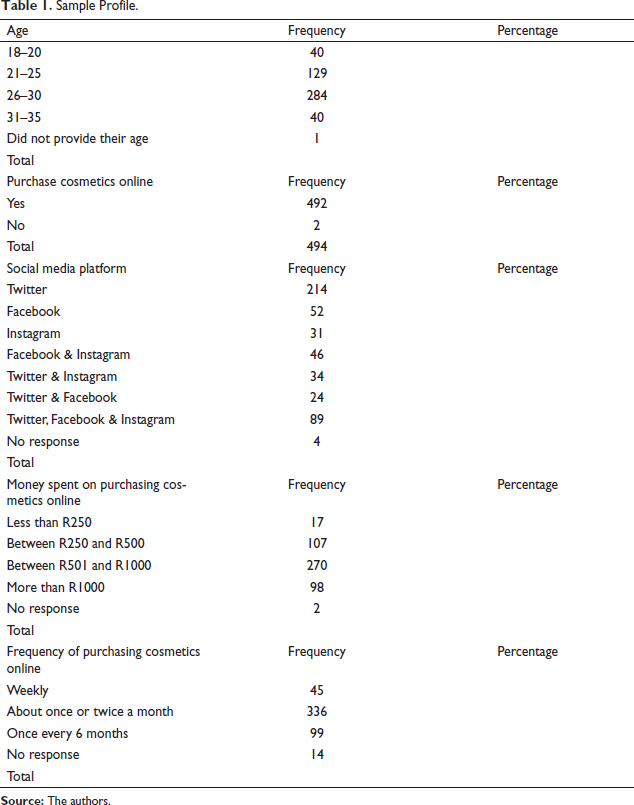
The sample profile in Table 1 above presents the age and online purchase activity of LGBTQ consumers of cosmetics brands that were surveyed in South Africa. Most of the participants were young adults, aged 21–30, and out of the 494 participants, only two did not purchase cosmetic brands online. This could mean that even though these consumers consume content about cosmetic brands online, they do not purchase them online. Twitter is overwhelmingly the most used social media platform by LGBTQ consumers on cosmetic brands in South Africa. Furthermore, money spent on these brands mainly ranges from R250 to R1000, and these purchases occur at least once or twice a month. The inferential statistics were done through structural equation modelling, which is explored in the following section.
Structural Equation Modeling
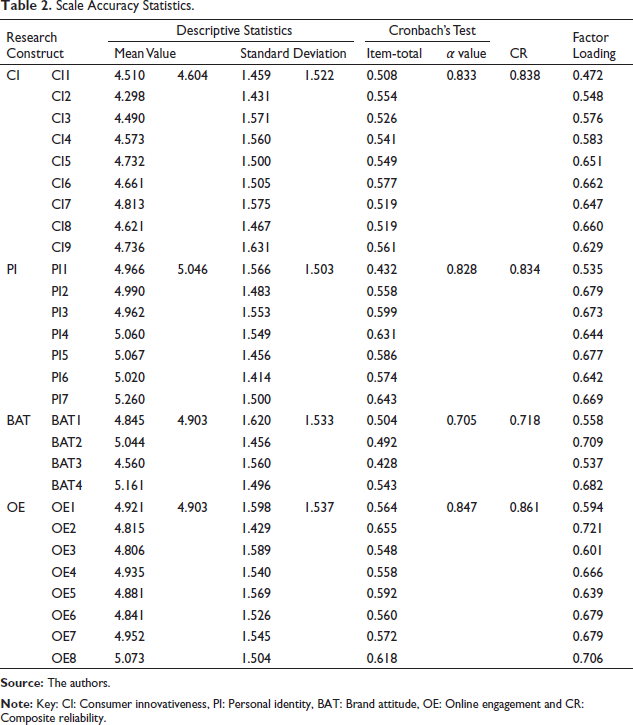
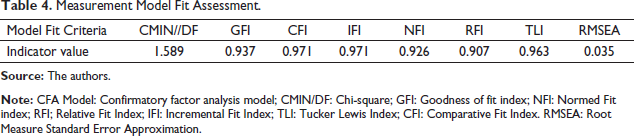
Structural equation modelling was conducted using the two-step procedure proposed by Anderson and Gerbing (1988), which assesses model fit comprising of confirmatory factor analysis (CFA) and hypotheses testing. CFA was primarily performed to examine the scale accuracy (including reliability and convergent validity) of the multiple-item construct measures using AMOS 27. The following tables, Tables 2–4, present the scale accuracy statistics, inter-construct correlation matrix and measurement model fit assessment.
Scale Accuracy Statistics.
Inter-Construct Correlation Matrix.
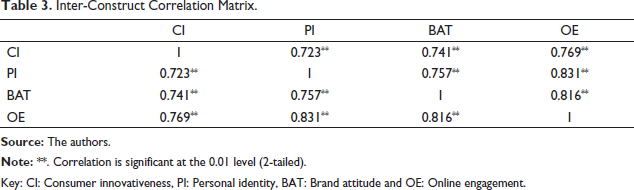
Key: CI: Consumer innovativeness, PI: Personal identity, BAT: Brand attitude and OE: Online engagement.
Measurement Model Fit Assessment.
Discussion of Scale Accuracy Statistics
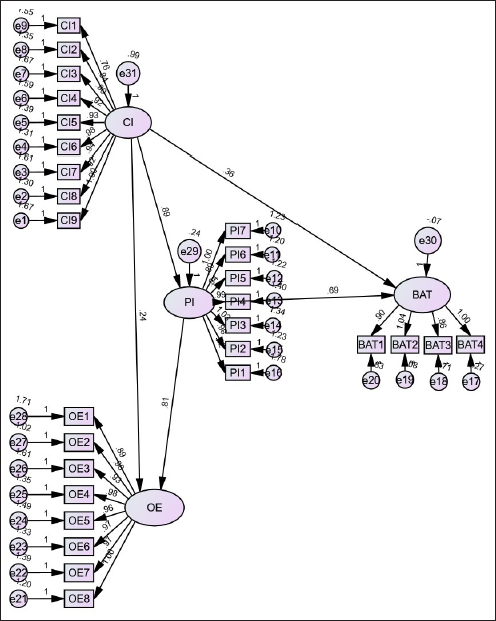
Results of scale reliability are presented in Table 3 above, where the standard deviation values ranged between −2 and +2, confirming that the data was normally distributed. Furthermore, the mean was generally between 2 and 3, and this close proximity therefore reinforced that the data were normally distributed. As for reliability, Cronbach’s alpha coefficients were above 0.8, exceeding the expected value of 0.7 as proposed by Nunnally & Bernstein (1994). The CR values ranged from 0.718 to 0.861. The item totals all exceeded the acceptable threshold of 0.5. Validity was confirmed through the inter-construct correlation matrix presented below in Table 3. In the following section, the proposed conceptual model is represented in Figure 1, followed by the results of the hypothesis testing that are presented through the structural model in Figure 2, and the hypothesis results in Table 5.
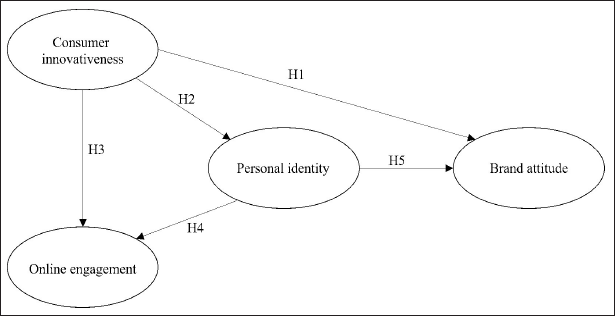
It is observed that in Table 3 above, there is the existence of data validity, as all correlations between constructs were below 1. The following section presents the measurement model fit assessment in Table 4.
The measurement model produced a ratio of chi-squared value over degree of freedom of 1.589, which is acceptable as it falls below the recommended value of 3 (Ullman, 2001). Other model fit indices that included the GFI, CFI, IFI, NFI, RFI and TLI were 1.589, 0.937, 0.971, 0.971, 0.926, 0.907 and 0.963, respectively. All these model fit measures were above the recommended threshold of 0.9. The RMSEA was 0.035, which fell below the recommended threshold of 0.08 (Hooper et al., 2008). In the following section, the results from hypotheses testing are presented through the structural model in Figure 2 and the hypotheses results in Table 5.
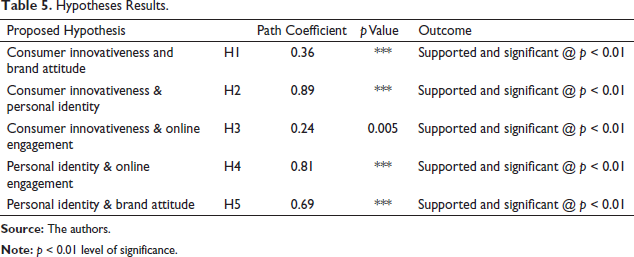
Hypotheses Results.
Discussion of Results
Derived from the table above, it is evident that all five hypotheses are supported. In other words, all five relationships are significant. The first hypothesis is H1 (consumer innovativeness and brand attitude). This relationship has a path coefficient of (β = 0.36) and a p-value of below 0.01 as indicated by ***. This suggests that consumer innovativeness indeed influenced consumers’ attitudes toward brands they consumed online. The more innovative a consumer is, the more their attitude towards the brand is impacted. The second hypothesis is H2 (consumer innovativeness and personal identity). This relationship has a path coefficient of (β = 0.89) and a p-value of lower than 0.01 as indicated by (***). This suggests that consumers’ innovativeness is linked to their personal identity in terms of their level of online brand engagement. It is important to note that this was the strongest relationship of all the proposed hypotheses that were tested.
The third hypothesis is H3 (consumer innovativeness and online engagement). This relationship has a path coefficient of (β = 0.24) and a p-value of 0.005, lower than the 0.01 required to confirm significance. This result suggests that LGBTQ consumers’ innovativeness in terms of online engagement with cosmetic brands is associated with their level of online engagement; however the relationship is relatively weak. In other words, this finding suggests that the level of online engagement that LGBTQ consumers have with cosmetic brands does depend on how innovative they are, but not greatly. It is imperative to note that this relationship is the weakest of all the proposed hypotheses that were tested.
The fourth hypothesis is H4 (personal identity and online engagement). This relationship has a path coefficient of (β = 0.81) and a p-value of lower than 0.01 as indicated by (***). This suggests that LGBTQ consumers’ personal identity is related to their innovativeness when it comes to online brand engagement. This relationship was the second-most powerful relationship of all the hypotheses tested for the study. The last hypothesis is H5 (personal identity and brand attitude). This relationship has a path coefficient of (β = 0.69) and a p-value of lower than 0.01 as indicated by (***). This suggests that the personal identity of LGBTQ consumers is a predictor of their attitude towards cosmetics brands. The following sections discuss the managerial implications and provide the conclusions, respectively.
Managerial Implication
The findings of the study provide valuable insights into cosmetic brands. Of most importance is that cosmetic brands identify potential innovators (consumers with high levels of innovativeness) and target them with cutting-edge campaigns and innovative product offerings. For example, a brand like Mac cosmetics, who is positioned as a fashion-frontline cosmetic brand, should select a fashion-forward celebrity who represents the ethos of the brand and appeals to the target market, for example, a fashion-forward celebrity from the LGBT community. This will have a positive effect on consumers’ attitudes towards the Mac brand and ultimately have a positive influence on their buying behaviour. By using cutting-edge campaigns, innovative consumers within the LGBT community are more likely to participate in online engagement. Cosmetic brands should use their campaigns and other touchpoints to persuade consumers to engage with the brand in an online context. Further, cosmetic brands should engage in conversation with innovators from the LGBT community to get insight into the demand for and feasibility of potential new products. This will also have an overall positive effect on their buying behaviour for cosmetic products. Cosmetic brands should therefore clearly position themselves in line with their target market’s personality or identity for consumers to relate to the brand on a personal level. This is specifically relevant to the innovators, who are the trendsetters and craft the way for the rest of the market to follow. Innovative consumers are more likely to have a favourable personal identity, which positively influences their attitude and online brand engagement. It is commonly found that members of the LGBT community more explicitly convey their identities by employing branded products. Cosmetic brands should therefore not be afraid to ‘push the boundaries with their campaigns and use creative narratives to target the LGBT market.
Conclusion
To conclude, this study sheds light on the LGBT community and their online engagement with cosmetic brands. It specifically focuses on literature in the field of congruency theory that emphasizes the power of effective marketing campaigns to influence online brand engagement. More specifically, it provides insight into consumer innovativeness and the role of innovators in influencing consumers’ buying behaviour. It also touches on the role of consumer identity in encouraging online engagement that leads to favourable attitudes towards the cosmetic brand. The findings of this study contribute to the literature on South Africa, an emerging economy that is often overlooked by researchers.
Suggestions for Further Research
This research, like any other, was not immune to challenges and limitations. First, the research adopted a quantitative approach, which typically overlooks in-depth information on consumers’ beliefs and buying preferences. Future research can adopt a qualitative approach or incorporate open-ended questions into the survey instrument. Second, this study made every attempt to investigate the social media usage of LGBTQ consumers in South Africa, but this was only one single product category, cosmetic brands. The use of a single product category might have created biases both from the researcher’s and participant’s perspectives. Future research on LGBTQ consumers in South Africa can incorporate other product categories like fashion and music. And third, this study simply looked at four constructs, which give a narrow overview of factors that influence online engagement and favourable attitudes.
Footnotes
Declaration of Conflicting Interests
The authors declared no potential conflicts of interest with respect to the research, authorship and/or publication of this article.
Funding
The authors received no financial support for the research, authorship and/or publication of this article.
