




Abstract
Management has long concerned itself with controlling workers’ bodies, with organisational wellness discourses being its latest fixation. This article’s purpose is to introduce and understand ‘whose body counts’ – a discourse of bodily exceptionalism in performative organisational cultures. Using ethnographic methods, this article presents an analysis of a CrossFit workplace health promotion at an underperforming US corporation, to identify a complex process of empowerment, self-exploitation and disciplinary regulation to produce performative outcomes. This research illustrates how the workplace health promotion generates a pervasive discourse of exceptionalism underpinned by workers’ reflexive exploitation, overarched by peer-surveillance and reflexively embraced through extreme individualised performativities. Critically, it is revealed how individuals competitively engage in communicative labour to demonstrate devotion to self-care that is translated into organisational commitment. Specifically, unquestioned discursive ambiguities are shown to cunningly empower limitlessness meritocratic striving that pits workers against each other, creating constant negotiation of ‘whose body counts’ by subjugating others.
Keywords
Introduction
Management’s history of controlling the body and its functions has remained a consistent theme within organisational strategies (Hassard et al., 2000). Techniques of bodily control continue to evolve with the most recent shift linked to the use of physical fitness to promote employee wellbeing (Conn et al., 2009; Parks and Steelman, 2008). A key feature of contemporary organisational wellness initiatives is incentivising workers to exercise as part of a healthy lifestyle via workplace health promotions (Marshall, 2004). Extreme fitness regimens go further – enticing workers to push beyond perceived physical and mental limits (Meyer et al., 2017) through new popular workouts such as CrossFit®. Importantly, organisational cultures of extreme fitness provide participants with resources to enhance their organisational status and career prospects (James and Zoller, 2018). Yet they also create, for many, new sources of stress and anxiety linked to meeting intense expectations – ones which encompass not simply being a ‘good worker’ but also being physically exceptional.
Whereas some studies have suggested fitness/sport as a means to market a professional self (Costas et al., 2016), this study suggests extreme fitness at work increases hierarchical ordering, where exceptionalist discourse informs and ultimately transforms what it means to be professional. Extreme fitness work cultures reflect an emerging form of managerial control and self-disciplining that combines neo-normative strategies of personal expression (see Butler and Harris, 2015; Fleming and Sturdy, 2009; Riach and Cutcher, 2014).
This article extends current critical understandings of organisational wellness, offering a novel approach to reflecting on its problematic potentialities by highlighting the transformation of bodily fitness into a discourse that combines professional and personal empowerment with commodified forms of embodied capital, exploitation, and managerial control – linked to specific capitalist discourses of personal exceptionalism. On the one hand, extreme fitness workplace health promotions are indicative of problematic societal discourses of exceptionalism that promote body reconfiguration in pursuit of idealised lifestyles (see Ford and Brown, 2006); on the other, they provide valuable resources for workers to engage in self-care that can empower them professionally (James and Zoller, 2018). In this respect, this research will show how workers exemplify the exceptionalist discourses of capitalist empowerment (Bloom and Cederström, 2009), while also permitting them access to quantifiable work-based resources (Moore and Robinson, 2016) for enhancing their organisational status. In doing so, extreme fitness workplace health promotions serve as competitive forces exacerbating existing inequalities as well as producing new ones between workers, while offering management fresh resources for strengthening its authority.
To critically examine this sophisticated fitness phenomenon at work, a conceptual framework is developed by implementing Cremin’s (2010) concept of reflexive exploitation to show how employees participate in organisationally encouraged extreme fitness regimens to maximise their professional status. The research attempts to further understand the bodily dimension of contemporary strategies of neo-normative control that rely upon moralistic discourses of exceptionalism. It asks: how do workplace health promotions further neo-normative control systems through self-regulating projects of bodily discipline associated with values and desires of exceptionalism?
Theoretically, this research reveals the increasingly complex ways in which workers are incentivised to demonstrate their professional value through processes of bodily self-discipline. Empirically, it extends understandings of the extremes to which contemporary workers go to reshape their bodies to be perceived as valuable to an organisation. The subject of this research is the extreme fitness lifestyle, CrossFit, implemented as a workplace health promotion by a US sports apparel manufacturing and retail organisation. By ethnographically investigating how workers in that performative organisational culture discuss their bodily entanglements with extreme fitness, this article specifically addresses the aim of this special issue to trace lines of flight beyond managerial versions of wellness, to provide original insights into how such workplace health promotions afford certain workers a sense of professional empowerment by communicating moral belief in fitness as central to organisational and individual success through their bodies. Yet, as with any form of escapism that subscribes to mass-consumerism, these ‘intensely lived’ lines of flight are shown to be fantastical (Bloom and Cederström, 2009; Wood and Brown, 2011: 518). These cultures of exceptionalism, paradoxically, help strengthen the limits of organisational possibility and personal wellness linked to their labour. While promoting the ability to push oneself beyond one’s physical limits, they reinforce a culture of managerial control and capitalist self-disciplining. Completely marginalised are non-capitalist lines of flight and potentially more emancipatory organisational relationships fostering more democratic and holistic forms of wellness that could subvert or even directly challenge these exploitative regimes of workplace exceptionalism.
This article first explores the rise of extreme wellness and the intensification of individual labour through organisational wellness. It will be followed by critical analysis of the underexplored corporeal dimension of reflexive exploitation that is specifically linked to discourses of bodily exceptionalism. The subsequent section will introduce CrossFit as a paradigmatic case of extreme wellness associated with bodily exceptionalism. The research methodology is then discussed to elucidate the reflexivities and analytical specificities in studying this case, before presenting findings that illustrate how bodily reflexive exploitation is discursively negotiated. These findings are then explored to better understand the seemingly limitless disciplining possibilities for workers to reimagine their bodies as a key means for career success. The article concludes with a broader critical discussion of how this reflects an emerging form of bodily control, reinforcing both managerial authority and capitalist values that equate success and worth with hard work and competition while masking deeper structural inequalities.
Extreme wellness at work
Workplace health promotions are a response to an increasingly unhealthy 24/7 work environment (Zoller, 2003), reportedly offering ways for employees to cope emotionally and physically with intense pressures, competition and precarities in contemporary work (Pronk and Pronk, 2017). Ostensibly, the goal is ‘enhancing the quality of our working lives’ (Hillier et al., 2005: 419). Workplace health promotions are an outcome of the privatisation of public health (Kristensen et al., 2016; Zoller, 2003). Critically, the incorporation of extreme fitness regimes such as CrossFit reveals, though, how these strategies extend far beyond the promotion of basic health. Instead, it facilitates an organisational discourse for identifying workers who go the extra mile (Nash, 2018). Total commitment to the CrossFit ‘lifestyle’ includes extreme workouts and dietary regulation through high protein, low fat consumption via the Palaeolithic diet, leveraging workers’ desires to promote their embrace of it, which in turn disciplines and rewards their bodies (James and Zoller, 2018).
Employers have traditionally promoted various forms of workplace health regimes to ensure a healthy – and, therefore, more ‘sustainable’ – workforce. These have been bolstered by the harsh realities of the capitalist workplace which have necessitated ongoing struggles for greater health and safety regulations for employees. Because all work is embodied and reproducing (Wolkowitz, 2006), the social production of workers’ bodies is a site for power, discipline and discrimination at work (French et al., 2019). Dominant employment ideologies become manifest in and through corporealities. Specifically, bodies are organised to conform to prevailing managerial values such as productivity and profitability (see Hassard et al., 2000). Hence the body is a means for modelling organisational success – the successful managerial body modelled as athleticism, for example, which foregrounds idealised performativities like sportiness, health-mindedness and fitness (Johansson et al., 2017).
The recent focus on wellness at work reflects the need to create more resilient employees who can mentally and physically cope with the greater economic insecurity and intensified work cultures associated with neoliberalism. Cederström and Spicer (2015) connect this with contemporary embodiments of puritanism, citing departure from the protestant work ethic and the rise of the ‘workout ethic’ as the ‘price of today’s secular heaven’ – continued employment (p. 40). Their insights suggest how values of hard work and thrift are appropriated as contemporary management expectations to produce a ‘wellness syndrome’ that represents a pathological desire for bodily alignment with organisational goals (Cederström and Spicer, 2015), which can be traced to the precarities that stem from work intensification (Boxall and Macky, 2014). The absence of physical toil in contemporary post-Fordist communicative labour instigates management to occupy the body through organisationally provided leisure, sporting or fitness activities under the guise of wellness to produce the docile, conformist, competitive subjectivities it requires. Put differently, the need to be fit becomes an internalised demand on workers, thus overcoming and ameliorating themselves for withstanding the ‘sickening’ labour conditions of neoliberalism and a means for obtaining advantage over co-workers in an ever more competitive hyper-capitalist marketplace (Cremin, 2010).
Costas et al. (2016) point to such commitment to sport as a way for the professional body to be the disciplinary site not only for displaying the ambiguous professional self, but also for enacting an autonomous self. In other words, having a sporting outlet can be a medium through which employees can burn off steam and ready them for what professional obstacles come next. In this sense, sport functions to simultaneously take care of two competing discourses that when combined serve one another. And yet, importantly, Costas et al. (2016) note that there is a limit – when the embodied ideals become more of ‘an aspirational fantasy rather than an accomplishable state’ (p. 18) that renders the subject hopeless and more ‘aware of how their well-being is compromised at work. . .’ (p. 18). Hence, the duality of sport unlocks possibilities for empowerment/constraint. Workers ‘manage and shape the way they look to fit the desired image of their organisation or profession’ (van Amsterdam et al., 2017: 339). A complex process of normalising conformance through reflexive exploitation and bodily judgements is at play, necessitating closer examination.
Communicative labour and organisational wellness
Performing wellness at work is entangled in organisational branding (Endrissat et al., 2017; Land and Taylor, 2010). In post-Fordist organisation, where the circulation of information about brands, products and services are the most distinctive organisational preoccupation, communicative labour to reinforce brand identity has evolved as a key concern (Mumby, 2016). Such branding strongly influences contemporary occupational dialectics of exclusion/inclusion within a given profession (Ashcraft et al., 2012). Here then, the performativity of wellness is crucial to perceived individual success and marketability within organisations. Significantly, the branding of oneself as physically fit is core to gaining a wider sense of professional empowerment and a key source, therefore, for contemporary employee disciplining (Endrissat et al., 2017). These discursive practices, furthermore, bring together the ways that work intensification becomes foundational to neoliberal consumption. There is expectation that individuals not only complete job tasks but are also demonstrating a commitment to an insatiable appetite for self-improvement and wellness.
What emerges are increasingly extreme workplace health promotions. They can be considered extreme in several senses. The first is that they are never completed – in that health just like work-life balance (see Bloom, 2016) is an always unobtainable and unfinished ideal. Fitness lends itself to be constantly intensified – as both organisations and individuals compete to demonstrate their commitment to wellness. The second is that this ever-expanding and intensifying dimension of organisational wellness translates into actual marketing outputs often based on ever more extreme forms of non-economic bodily labour. The adoption of athletic and physically demanding regimens is a visible way to display commitment to health and, as such, investment in the organisational brand. The next section critically explores this neoliberal intensification of workplace health promotions and its entanglements with disciplining discourses of bodily exceptionalism.
Bodily exceptionalism and extreme wellness
Organisational wellness is a contested space in which neo-normative discourses produce dialectically opposed subjectivities of being ‘well’ versus ‘unwell’ and therefore fit or unfit for work (Bloomfield and Dale, 2015; Cederström and Spicer, 2015). Dale and Burrell (2014) note how wellness discourses engender a self-responsibilisation to fit in at work – lest it be morally judged and relegated for having a ‘deviant’ body. What counts as a deviant body purposefully remains ambiguous to empower individuals to strive not to be so, to fit into organisational culture (van Amsterdam et al., 2022). Such conspicuous consumption of wellness produces idealised subjectivities such as ‘the corporate athlete’ (Costas et al., 2016; Johansson et al., 2017; Kelly et al., 2007: 269). The fit body at work embodies professionalism, and importantly a normative way to distance itself from bodies perceived unhealthy or unfit. This trend seems most prevalent in regional contexts where exceptionalist discourses prevail, notably in the US and the Nordic regions (see, e.g.: Costas et al., 2016; Johansson et al., 2017; Kelly et al., 2007). This research therefore introduces the concept of extreme wellness by critically examining the discursive overlaps between organisational wellness discourses and discourses of exceptionalism, to understand how together they problematically generate hyper-competitive organisational cultures.
As discussed, aesthetic transformation of the body has become a means to communicate individual employability and marketability. Cremin (2003) frames this as reflexive exploitation in which individuals utilise resources and talents for their own competitive advantage. Connecting this argument with that of exceptionalism, the body is therefore viewed as an object to invest in and communicate belief in something beyond the everyday, echoing Fleming and Spicer’s (2005) notion of ‘how objects believe for us’, whereby ‘belief does not only reside inside the individual subject but also in an external economy of objects and rituals’ (p. 181). However, those perspectives risk missing the profound corporeal aspect of such self-exploitation. Individuals do not just inhabit a workplace but a relational bodyscape, which:
‘. . .alerts us to the entanglement of landscape, embodied dispositions of the habitus, pathos and practice, in other words to the integration of body work, “body appearance” work, objects and spatial displays as well as to some of the contextually based power dynamics and tensions involved’ (Simpson and Pullen, 2018: 182).
Significantly, Wacquant (1995) develops the concept of bodywork to show how boxers sculpt their bodies to produce surplus value – new value in excess of their labour cost that can be profited from – necessary to improve their professional standing. Such accumulation of bodily capital (Pedersen and Tjørnhøj-Thomsen, 2016; Wacquant, 1995) reveals how the body functions as a means for maximising one’s value, exploiting physical appearance and existing bodyscapes to enhance upward mobility. This understanding of bodywork critically reflects the corporeal aspects of professional employment. Organisation Studies scholars have long noted that discourses of empowerment can be used as a force for organisational self-disciplining (Bloom, 2013; Hardy and Leiba-O’Sullivan, 1998; Trethewey, 1997). These are commonly associated with ideas of personal exceptionalism – belief in individuals’ ability for self-improvement to gain a meritocratic sense of achievement over others (Hughes, 2015).
By understanding how empowerment serves as a function of exceptionalist discourses, this analysis will explore how extreme workplace health promotions such as those linked to CrossFit are promoted not just as sporting pursuits but as organisationally sanctioned lifestyles that demand self-alignment with exceptionalist discourses to be seen to be mastering their extreme regimens and therefore the self. For example, managers who perform elite athletic ideals at work conflate their talk about work with their workouts as lifestyle discourses (Johansson et al., 2017). Although their athletic pursuits may be dismissed as alleviating their frustrations with work (Costas et al., 2016), the fitness ideals manifested in their bodies visibly promote discourses of authenticity and personal self-hood interpreted as representations of organisational goals (Fleming and Sturdy, 2011). Equally, such discursive idealisation of specific bodies informs executive recruitment practices, privileging particular embodiments (e.g. the sporty body or the ‘corporate athlete’) (Meriläinen et al., 2015). Hence, fitting in to an organisational bodyscape determined by managers that associate extreme bodily transformation with professional subjectivities, workers’ reflexive exploitation can be dangerously pushed to its limits.
Discourses of exceptionalism are commonly understood in political science as being mobilised by those in positions of power to exempt themselves from laws and norms that others abide by (Crozier, 2020; Hughes, 2015). They are historically constituted in relation to perceptions of power, moral superiority and exemption (Hughes, 2015). Everyday self-perceptions of individual exceptionalism are therefore informed by entrenched moral attitudes to how society is governed and by whom (Crozier, 2020; Hughes, 2015).
With specific relevance to this research, US exceptionalism is generally retraced to the founding of the US constitution to show how contemporary moral attitudes are informed by dated puritanical ideals (Hughes, 2015; Konings, 2018). Moralistic protestant puritanism is written into US law and thus embodied in the everyday but cannot be ontologically verified – ‘US exceptionalism rewrites history to produce US identity as something innately virtuous and incorruptible in the name of which all suspensions of domestic and international law can be justified’ (Hughes, 2015: 534). Hence, Konings (2018) shows how exceptionalism reinforces neoliberalism in the US, where authoritarian governmentalities bypass the normal rules of democracy via moral justification alone. ‘US exceptionalism is routinely defined in terms of a set of values that go under the banner of ‘the American creed’ (Hughes, 2015: 548).
Discourses of exceptionalism are thus rooted in mythologised beliefs entangled in rhetorics of power, rather than in historical fact – they are empty signifiers produced by and generative of collective self-actualisation around a certain political will rather than a rational decision (Hughes, 2015; Konings, 2018). Hence, US exceptionalism courses through the veins of contemporary American society, as moralising political manifestos and speeches are translated into everyday acts of empowerment guised as lifestyle choices. For example, Greg Glassman, founder and previous CEO of CrossFit, makes clear that to do CrossFit, is to enter an exclusive club:
‘Virtuosity is defined in gymnastics as “performing the common uncommonly well”. Unlike risk and originality, virtuosity is elusive, supremely elusive. It is, however, readily recognised by audience as well as coach and athlete. But more importantly, more to my point, virtuosity. . .is always the mark of true mastery (and of genius and beauty)’ (Glassman, 2005: 1).
The puritanical virtuosity of Glassman’s exceptionalist rhetoric has two features that this research will explore. Firstly, CrossFit is not grounded in the true materialities of what a body is capable of but in a belief that the body can achieve an exceptional moral standing by gaining a mastery over itself not to render it docile, but to empower it. Secondly, that empowerment felt by the CrossFit body is elusive in so much as it is an empty signifier. What constitutes mastery can easily change through adjustment of the discourse by those with the power to alter it. Discourses of exceptionalism circulate in ways that both include and exclude (Hughes, 2015). They must be inclusive enough to gain support and control, and sufficiently exclusive so as not to become the norm (Patman, 2006 cited in Hughes, 2015: 52). Discursive shifts are therefore critical to the maintenance of exceptionalist discourses. Their material effects are not deemed salient; all that matters is that they are believed in (after Hughes, 2015).
What makes these exceptionalist discourses so dangerous, furthermore, is that they put veritable limits on organisational relations, confining them within specific ideological and disciplining boundaries. The emphasis is on personal transcendence, an insatiable drive to always push oneself beyond their existing limits, ironically, dictated by prevailing societal and managerial norms. In effect, a person becomes centred on their own self-exploitation rather than exploring and struggling for alternative and potentially more emancipatory workplace wellness outlets. The complete and obsessive absorption with extreme wellness at the very least blinds them to the possibility of adopting holistic strategies for coping with the pressures of capitalist work. Fundamentally, it traps them in a narrow view of what it means to be well that leads them away from exploring different types of workplace relations, such as those of worker-owned cooperatives or collectives, that put values of egalitarianism, democracy, and radical care for one another at the core of wellbeing (see Kruse, 2020; Resch and Steyaert, 2020).
CrossFit as a case of extreme wellness at work
CrossFit demands extreme bodily exertions through intense workout regimens, occupying the body with desires to prepare for and perform athletic excellence. Enthusiasts believe they can achieve exceptional levels of fitness by following strict dietary regimens and lifestyle choices that privilege the workout in their everyday (Dawson, 2017). CrossFit is a process of intense bodily regulation and transformation that aims to produce exceptional physiques.
The CrossFit ‘box’ – where workouts happen – is sparse, stripped back and without decor or mirrors to construct a pseudo-industrial workout contrasted as counter-cultural functional fitness against conventional, supposedly less authentic gyms (Dawson, 2017). CrossFit fetishises industrial labour through repetitive high-intensity functional exertions and competitive group dynamics (Dawson, 2017). Coaches programme intense daily workouts. As individual goals come within reach, additional extreme goals are created. Significantly, coaches ‘mandate for participants to commit to the CrossFit philosophy which emphasises neoliberal physical and psychological self-improvement as a pathway to ‘health’ and ‘fitness’ (Nash, 2018: 1448).
In the CrossFit bodyscape specifically, the intensities of the workout combined with a nuanced dietary regime can rapidly render the body distinguishable by its lean yet muscular contours. The CrossFit body receives greater external validation the more it reflexively exploits itself. Extreme rituals create rites of passage and camaraderie (Dawson, 2017). To workout to the point of vomiting is applauded (Dawson, 2017). Mastery over the body is valorised as virtuous. Glassman’s rhetorical notion that CrossFit is common invites anyone to uncritically engage in its disciplinary regimens. In society, we have a choice whether or not to participate in such reflexive exploitation. In extreme fitness work cultures, workers do not necessarily have that choice.
Crucial for this analysis is a deeper understanding of how the body can be shaped and disciplined by organisational culture in dialogue with broader societal discourses of exceptionalism. Specifically, the next sections will examine how discursive embodied subjectivities conform to, contest and complicate organisational wellness when implemented as workplace health promotion, to understand how individuals negotiate the CrossFit discourse and explore their material bodily limits.
Research methods
This research analyses how participants discuss their bodies in relation to a CrossFit workplace health promotion. Anonymised data are drawn from an ethnographic case study to analyse managers’ and workers’ accounts of workplace health promotion participation to understand how they engage in reflexive exploitation.
Entrée for critical scholars
Gaining access to large organisations is difficult, particularly for critical scholars. To negotiate access, Eric contacted SportsCo (a pseudonym for a large sports apparel manufacturing and retail organisation), but attempts at contacting coaching staff proved unsuccessful. However, Eric spoke with a friend who knew someone at SportsCo about their proposal. From there, Eric was put in contact with senior management and human resources who reviewed the research proposal and gave consent. As per Institutional Review Board guidelines, Eric confirmed that the organisation’s name would not appear in any official publications and would be represented as a pseudonym. Interestingly, one member of the task force seemed disappointed that SportsCo’s name would not appear in publications, wanting to market SportsCo’s fitness culture.
Drawing from principles of engaged scholarship (Dempsey and Barge, 2014), Eric asked what problems or dilemmas the organisation was hoping to understand better, and management responses pointed to a need to increase participation in the CrossFit workouts. During the fieldwork, Eric worked out and ate lunch with various employees and CrossFit coaches in SportsCo’s fitness and dining spaces. Upon completion of the data collection, he compiled a critical report describing unintended consequences of the extreme workplace health promotion, to promote dialogue. SportsCo did not respond to the report nor repeated attempts by Eric to schedule a discussion. The ethnographic case study conducted by Eric, was used, in part, for a larger research project investigating managerial control and workplace health promotion.
Reflexive practice
Eric encountered challenges in the research process, namely, how he was perceived as an outsider to the organisation – sentiments expressed similarly by Kunda (2009). However, he had attended a CrossFit coaching seminar and was well-versed in the CrossFit methodology, which is perhaps one reason why he gained access to SportsCo. Having been working out and eating a low-carbohydrate diet for some years, Eric’s body had been sculpted accordingly and he was fluent in the nutritional talk that tended to initiate every CrossFitter’s lunch hour.
Eric’s distinguishable embodiments were both a privilege and a curse. Managers viewed him as an ally with a rapport around health and fitness evidenced by their active participation in workouts. Yet, the impetus behind the study was to focus on managerial control through organisational wellness discourses. Building trust with employees that could offer critical perspectives took time and came later in the fieldwork. While Eric initially recruited participants from the CrossFit box by asking when they could talk in more depth after a workout, that approach did not work with more resistant employees.
A realisation occurred 2 weeks into the research when Eric recognised that the time spent exercising with CrossFit advocates and evangelists may have isolated them from the group they wished to interview. So, instead of doing CrossFit workouts, he proceeded by working out in the traditional gym and wellness centre. Yet his body bore the scars typical of CrossFit, such as shin burns from climbing and sliding down. Attempting to distance himself from the CrossFit box was not sufficient to gain the necessary rapport with participants – time proved to be the key factor, as this transcribed voice memo by Eric illustrates:
‘. . .just in general it seems like it has taken six weeks to generate some element of rapport with the coaches and other employees there. I don’t know why it has taken so long. Today was probably the first day that I felt comfortable, and it was apparent that other folks felt comfortable too, in that [a coach], talked with me for over an hour. . .’.
This relationally reflexive approach (Hibbert et al., 2014) did eventually diversify the population sample.
Later, it became clear that initially unresponsive employees were stigmatised by being labelled as resistant to CrossFit or for living a more sedentary lifestyle and were attempting to distance themselves from controversy. After interviewing two of the more reticent employees, Eric exchanged contact information and requested their assistance in the recruitment process via snowball sampling (Lindloff and Taylor, 2017) to gain a breadth of perspectives and give voice to their (anonymised) concerns.
Eric’s situating himself in the same communicative labour as SportsCo employees was crucial to critically understanding how different participants made sense of their unfolding shared somatic experiences (after Cunliffe, 2008). Entering into intimate dialogue with individuals enabled Eric to understand their sense impressions, gestures, emotional expressions and responses, not just intellectual interpretations (Cunliffe, 2008; van Amsterdam et al., 2017). The research therefore engages with participants’ lived experiences to provide a rich picture of the process through which they experienced CrossFit. For example, after each interview, Eric made detailed notes and created voice memos at the end of the day that reflected on salient events. Memos assisted him in formulating connections during axial coding of the data, as well through conceptual conversations with Tim and Peter.
Research context
SportsCo’s head office spanned 500,000 square-feet near a major Northeastern US city. The CrossFit box was located just 100 yds from the main building. Besides conference rooms, showrooms and product testing labs, the campus contained a 400 m running track, tennis courts, football pitch, softball field, Zumba/Yoga/Spin studios, a basketball court, locker rooms, traditional exercise equipment, employee apparel store, coffee bar and cafeteria with multiple food stations. SportsCo introduced the CrossFit-based workplace health promotion 2 years prior to fieldwork. Eric collected ethnographic data for two months using a contractor badge that granted unrestricted access to all fitness areas, cafeteria and general employee gathering locations. Before each workout, they were announced as a researcher and employees were informed of the observations.
SportsCo employed more than 1000 workers on-campus at that time. Significantly, it had experienced declining sales, including the loss of major contracts with professional sporting leagues. Despite being acquired by a larger sports apparel group, anonymised as Nakatomi, SportsCo continued to lose significant partnerships. Consequently, Nakatomi considered SportsCo to be an underperforming asset. In response, SportsCo implemented a new marketing strategy centred specifically on fitness, rather than mainstream sports. CrossFit remained essential to SportsCo’s strategy, hence why it formed the basis of its workplace health promotion. Eric was also invited to business meetings, which shed light on SportsCo leveraging employees’ participation in CrossFit to enhance the branded consumer experience.
Data collection
Besides immersion in workouts, in situ conversations and making fieldnotes and memos, Eric conducted 28 semi-structured interviews with 13 female and 15 male employees, ranging in age from 19 to 68, from executives to interns. Interviews were designed to ask open-ended questions about employees’ understandings of wellness discourses at SportsCo, to draw out specific themes (Johansson et al., 2017). Interviews were digitally recorded and transcribed verbatim. Questions like, ‘What has changed since the wellness initiative began?’ and ‘In what ways has the introduction of the CrossFit workplace health promotion affected work and personal life?’ gained participant perspectives on the workplace health promotion and its impact on their lives. Hence, the data exhibit a wide range of attitudes to the SportsCo workplace health promotion.
Data analysis
Empirical data analyses drew out themes that reflect and reproduce characteristics of the organisational discourse (Fairhurst and Putnam, 2004). Two phases of coding and thematic analysis were conducted (Bryman and Bell, 2015). The initial phase – open coding – yielded 180 categories through constant comparison between data. The second phase – axial coding (Lindloff and Taylor, 2017) – identified relationships between sets of codes and data, which informed conceptualisation of how wellness discourses were negotiated at SportsCo. It was here when Tim and Peter joined the project to provide conceptual illumination of the relationships between the empirical data and extant debates in the discipline. By engaging in discussions of the data, all authors participated in the final round of analysis and argument development.
Each participant had the opportunity to edit or clarify the typed transcript from their interviews, providing trustworthiness of findings (Lincoln and Guba, 1985). Eric solicited personal emails to avoid using SportsCo’s email server to review transcripts. Several participants clarified comments but, overall, content remained the same.
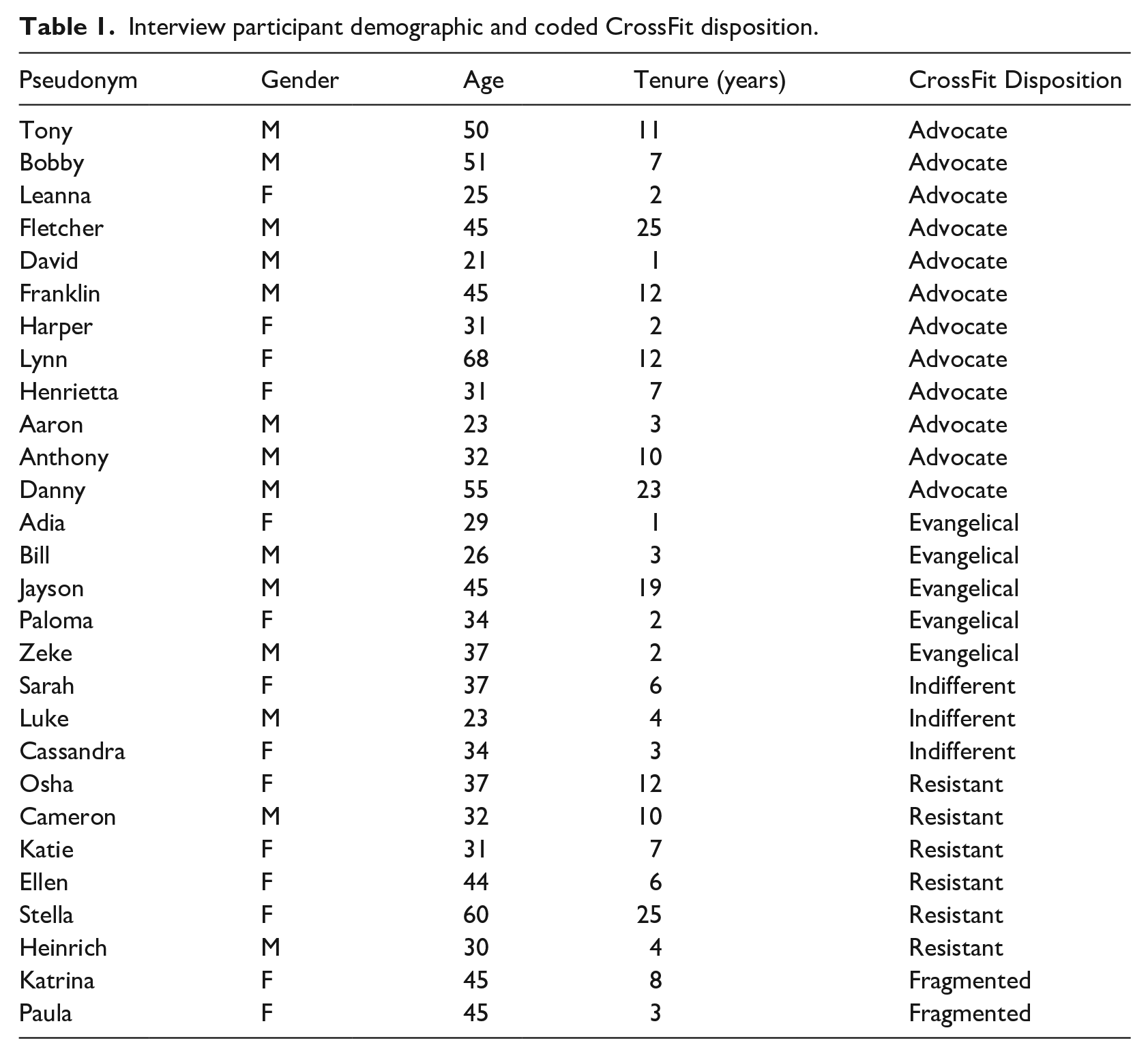
Eric coded participants based on their self-perceived predispositions to the SportsCo CrossFit workplace health promotion (see Table 1). Twelve participants were coded as advocates for CrossFit. Five were coded as CrossFit evangelicals – those who, for example, were CrossFit trainers, opened their own CrossFit gym, competed in tournaments, or stressed the nutritional-lifestyle components to friends/family. Such moralistic zeal has been described in previous studies of normative control systems (see Barker, 1999; Kunda, 2009), and connects with the puritanism within exceptionalist discourses described above. Meanwhile, six employees were openly resistant to the programme for various reasons, three were indifferent, two had mixed feelings (coded as fragmented) about CrossFit.
Interview participant demographic and coded CrossFit disposition.
The CrossFit body at work and its discursive implications
The following findings represent the discursive tensions in extreme wellness discourse at SportsCo, to show participants’ complex moral and embodied entanglements in self-exploitative communicative labour. Three intersecting discursive tensions (i.e. themes) emerge from analysis of coded participant perceptions such as: authenticity, body colonisation and health (underpinning/entrenching discourses); evangelism, paternalism and surveillance (overarching/inescapability disciplining discourses); body image, gender and elitism (embracing/performing discourses) – see also Table 2. These themes are delineated to draw out how empowerment and exploitation are experienced but they are understood as intersecting, overlapping, and indicative of the ‘messiness’ of the dialectics (Johnson and Long, 2001: 30).
Discursive entanglements of extreme Workplace Health Promotion.
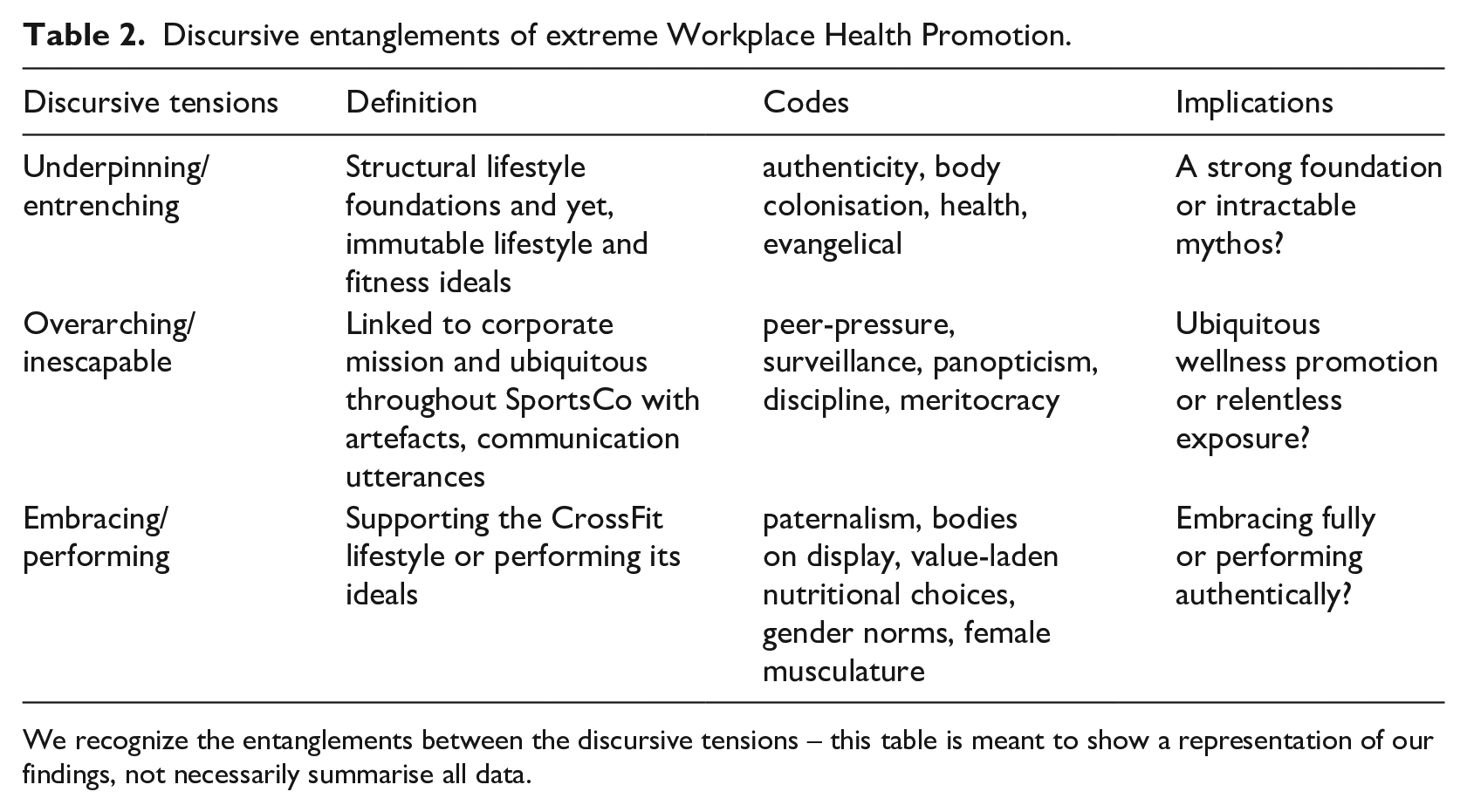
We recognize the entanglements between the discursive tensions – this table is meant to show a representation of our findings, not necessarily summarise all data.
Underpinning/entrenching discourses
The entrenched moralistic CrossFit ideal of ‘performing the common uncommonly well’ was pervasive at SportsCo. This included racing upstairs instead of taking the elevator, and recording fastest times on the whiteboard provided, for example. Every moment held potential to climb or slide down a leaderboard. Such competitive opportunities colonised bodies with notions of constantly honing them into archetypal physiques representative of authentic functional fitness.
When Harper (who also owned a CrossFit gym) applied to SportsCo, she was concerned that her body belied her CrossFit commitment and worried that she would not be hired because her body’s appearance did not conform to the bodyscape:
‘I said to my parents, “I don’t know if they’re going to hire me.” And they’re like, “Why?” “Well, because I don’t look like a CrossFitter.” That’s really what I said even though I’ve been CrossFitting for almost two years at that point. “I don’t look like a CrossFitter.” And they’re like, “What’s a CrossFitter look like?” I’m like, “. . .it’s someone who doesn’t have a lot of body fat and someone who’s toned. That’s what people think a CrossFitter should look like.”’
Harper was hired, but the concerns of this CrossFit advocate are indicative of how exceptionalist CrossFit discourse is. Harper jokingly (but heard with some truth) wondered whether her body would fit into an organisational culture underpinned by its extreme bodyscape.
Exceptionally ‘authentic’, healthy bodies were often on-campus. On at least two occasions, Eric observed sponsored athletes (from CrossFit and other professional sports) in the hallways, there to test or endorse products but also to entrench the competitive bodyscape, giving employees something exceptional to strive for. Yet, presenting a sculpted body was not always enough for potential employees. SportsCo’s lead CrossFit coach, Bill, recalled his hiring an intern:
‘We have the type A [personality]. . . which [are] the go-getters. . . I think you have both introverts or extroverts that come in, but I think it’s the type of people who realise that they really have the power to really do what they need to do to make a change, . . .a perfect sample is [the intern]. [They] came up here, to ask if they could interview. . . like drove up and slept in their car! They figured it out. . . you’re going to work here, you’re going to intern – done!’
The intern was hired on the spot because of his risk-taking, ambition and demonstrated commitment to CrossFit. His ‘go-getting’ was, for Bill, the ultimate demonstration of a moral belief in CrossFit, where exertion and tolerance of fatigue were embodied in the interview.
Overarching/inescapable discourses
There was no place to hide from CrossFit at SportsCo. Any space on- and off-campus could potentially be a site of puritanical judgement. Eating in the cafeteria invited conversation about individuals’ nutritional choices. Hence, some employees preferred to eat at their desks. However, even being seen with a sugary beverage in the corridors, as observed by Eric, invited ridicule (veiled in humour). Conformance to the Palaeolithic diet was surveilled by all. One meeting started with an in-jest comment about sweetening coffee and turned serious when one employee boldly declared the healthiest choice was simply black coffee. Such evangelical rhetoric led to critical reflections on self. Sarah, for example, reflected on learning to conform during a meeting at a restaurant with brand ambassadors:
‘. . . It was our global marketing meeting [with Nakatomi] . . .we had a lot of [CrossFit] staff on their end. Two guys from Europe were on the [Nakatomi] staff [and] they’re just gorgeous, buff guys . . .good representatives of CrossFit. . . I remember we all went up to dinner and . . . – it was all sort of that Paleo [diet] and not Paleo and everyone . . . started to learn the language . . .’.
Here, ‘good representatives of CrossFit’ appeared to embody a moral standard set by the parent company for SportsCo to follow. Sarah and other SportsCo employees saw Nakatomi employees’ bodies as cues to conform to the bodyscape signified by their dietary choices.
The dietary dogma that valorised protein-rich foods and shunned carbohydrates proved inescapable. Cameron remembered feeling belittled for ordering bread at a company function:
‘. . .we went to dinner at this beautiful steakhouse and I like bread, [another colleague] likes bread, so we got bread. And [other SportsCo employees] were like, “you guys can’t eat bread, that’s ridiculous”. They were. . .belittling us for eating bread’.
Such taken-for-granted utterances were common. Pointing to others’ non-conformity enabled individuals to identify their own choices as virtuous and those like Rob’s as not.
Meanwhile, employees on-campus would drag their exhausted bodies back to the main office from the CrossFit box – some bearing fresh cuts or popped callouses from the workout that invited commentary. Employees like Danny would ask ‘what was the WoD [workout of the day]?’ and conversation would ensue:
‘. . .I always kid with the new hires, “Congratulations on your new jobs” because when you work with SportsCo, you usually have, two or three jobs. . . I pretty much take probably an hour and a half out in the middle of my day between working out and lunch, but I’m here ten, eleven hours a day so I make up for it’.
Danny’s surveillance of others combined with his own self-disciplining is indicative of how employees’ bodies were colonised not through managerial directives but by each other’s moral judgements. Opportunities to work out on-campus overlapped with daily work tasks, with employees working harder for longer. Moreover, some committed further. For Zeke, discussing CrossFit was a way to connect to his colleagues. The daily workout was so important that he ritualistically prepared himself for each WoD before bed each evening:
‘I check [the next day’s workout] out every night before I go to bed, and I think about it a little bit, but I didn’t really think about it too much yesterday going into it. . . It is funny. My performance yesterday in the WoD probably wasn’t on par with where I would rate my top performances. That doesn’t mean I [was], you know, never one, two, or three, you know, in my class or in the company; [I] just didn’t [know] how hard I actually put out. I feel like I kind of took it easier on myself, and it could have been partly a result [of] the fact that I, you know, was distracted or focused on. . . other stuff, work’.
Zeke’s puritanical commitment was in the name of camaraderie. He sought to fit in with other CrossFit enthusiasts. Harper and Sarah did too, while Cameron felt excluded. The inclusive-exclusive functioning of exceptionalist discourse was at play in how individuals made sense of their bodies in relation to others, knowingly or not. Danny’s jokes did not explicitly include or exclude, but how they were received arguably did. SportsCo’s campus was ostensibly panoptic, in the sense that the moralising gaze of colleagues, not necessarily management, was inescapable.
Embracing/performing discourses
Although management did not formally monitor the bodyscape, that did not stop employees demonstrating to them their commitment. In one interview, Tony mentioned, ‘[The CEO] noticed when I’ve been in [a] couple of classes. . . [they were] thrilled that I was joining CrossFit and. . . I really aligned myself with [them]’. Later, when Tony applied for promotion, he remembered:
‘. . .if I interviewed and was a finalist for the position with [the CEO], I probably would start going to that 6:30am class for a couple of reasons. . . there are couple of. . . subtext messages about going to that class.’. . . ‘in the sense that the 6:30 class has tangible networking but also has kind of a subtext of – I’m able to do CrossFit because I’m inventing the time by coming here at 6:30 instead of oh, yes, in the middle of the day I’m going to go at 11, but I’m in a transition phase. So, I don’t have anyone watching me. . .’
Tony clarified that attending the 6:30am class might imply that he was too busy to workout during work hours but could come in before work as a way to communicate his moral commitment to CrossFit and, by proxy, his dedication to SportsCo.
Exceptionalist discourse was also embraced during meetings but not always rewarded. A fieldnote excerpt from one meeting noted:
‘The manager forgot his notebook on his desk. [Zeke] springs up: “I’ll get it. . .time me, I will be fast” Upon returning, he asks his time, but nobody set their stopwatch. He is assured he was fast’.
Zeke appeared proud of his elite performance, but his eyes drooped showing disappointment that the moment had passed, and his colleagues had already moved on.
In another interview, SportsCo fashion designer Leanna recalled being at a market, when the cashier asked if she was ‘here for the CrossFit thing?’ Leanna replied, yes, to which the cashier nodded, ‘I can tell’. Eric asked Leanna if it was because of the food she was buying and she replied, ‘No, by looking at me’. That exchange undoubtedly emboldening Leanna’s commitment to CrossFit. Leanna recalled another flattering encounter:
‘It’s like you want to stay in a certain size jeans and now it’s strong and muscles are beautiful and they’re good looking so being curvy as long as it’s that muscular tone, it’s different. I think that’s attractive. I think that’s more impressive than a model, skinny look’.
‘. . .sounds like you’re saying that your conception of body image has changed since doing CrossFit?’
‘Totally! It’s great. Just like the other day I went into LensCrafters to get some sunglasses and right when I walked in someone said, “You have an amazing body” [Laughter]. It made me blush, it’s great to hear those compliments’.
Unlike Tony and Zeke, Leanna was not explicitly performing, but her embrace of CrossFit was identifiable from her body.
However, not all employees embraced the discourse. Those who felt comfortable discussing their contempt for the workplace health promotion lamented its introduction. Stella remembered being told, ‘if you don’t do CrossFit, you don’t exist’. She clarified, “I’ve actually been told by higher-ups, ‘If you want to get ahead, you need to do CrossFit. You need to lose weight’. Eric never witnessed explicit threats during fieldwork but heard more implicit gendered neo-normative control. For example, Sarah recalled that management did not take everyone’s circumstances into consideration; she was told: ‘you have to make this work’ – indicating the importance of the first workout. Sarah explained a multitude of reasons for not working out at work, including someone ‘not want[ing] to shower in front of her colleagues’ but saw both sides to the workplace health promotion, admitting she was happy that some employees were able to enjoy it, but she remained sceptical of its ‘one-size-fits all lifestyle approach’.
Not all could achieve CrossFit’s elusive bodily ideals, and some did not wish to; yet everyone was subjected to them. Huge posters of CrossFit athletes on corridor walls complemented the performativities to reinforce the exceptionalist discourse – idealised body images were inescapable. Individuals sought to find their place in its puritanical social strata by deciphering how to communicate and perform extreme fitness. Both complex and ambiguous, the indecipherability of how exceptional their commitment needed to be was at once empowering and disempowering, as Zeke’s efforts in the meeting show. Discourses at SportsCo about otherwise mundane things such as Rob’s eating bread or Danny’s banter created arbitrary moral distinctions between those seen to be virtuous and those who were not, which could shift and change. The empty signifier of the CrossFit body was a lens through which SportsCo employees were hired, monitored and managed.
In the 2 years since its introduction, CrossFit ideals had become so embedded in SportsCo culture that CrossFit bodies offered Zeke a way to infer employee’s commitment to hard work:
‘[CrossFitters are] just the type of people that would be willing to roll up their sleeves and get dirty. . .. . .which are the type of people I want to work with. [CrossFit] exposes those types of people that – I’m not saying folks that don’t CrossFit wouldn’t. . . but someone who does CrossFit, if they’re committed and consistent with it, are the types of people that you want to get into a foxhole with and into projects with. . . because they’re willing to grind it out. They’re willing to deal with that discomfort and anxiety. . . I have more confidence in my co-workers that CrossFit because I know what that entails’.
SportsCo needed to turnaround its flagging business performance, focusing on fitness products. A preliminary objective of implementing its CrossFit workplace health promotion may have been to leverage the communicative labour of employees such as Leanna, to promote its lifestyle products. What these findings draw out is that the reflexive exploitation embodied in CrossFit subjected employees to intersecting moral and discursive tensions, which produced a performative organisational culture that found new ways to empower employees to be seen to be capable of being more productive.
Concluding discussion: Empowering extreme bodily exploitation
This article aimed to reveal the deep and often overlooked relationship between wellness discourses and organisational strategies on the one hand, and reflexive strategies of bodily exploitation and managerial control on the other. In this case, the expectation for engaging in extreme fitness produced a form of bodily empowerment and moral discipline within the organisation through which personal physical health was made into a tangible organisational commodity that could be used for career advancement or maintaining individual organisational status. Here, the imperative to perform wellness, or more precisely to embody exceptional physical capacity through an intensive fitness regime was a common source for individual employees to exploit for their own professional advantage. Yet like all forms of capital accumulation, it reproduced inequalities based on problematic pre-existing cultural tropes of individual achievement through competition and toil that are embedded in meritocratic societies informed by discourses of exceptionalism. The organisational expectation and increasingly viewed demand to be bodily exceptional was ultimately a potent means for reinforcing and expanding managerial authority and control within the organisation.
This research asks: how do workplace health promotions further neo-normative control systems through self-regulating projects of bodily discipline associated with values and desires of exceptionalism? Wellness initiatives have the potential to produce and reproduce narrow, yet limitless fitness ideals, where self-regulation becomes extreme moralised attention to self-care. Cremin (2010) observes that there is little choice in such an exploitative system, noting that workers subscribe to the conditions or risk being unemployable. The contribution of this research is to show how bodily exceptionalism becomes a means of showcasing one’s potential and discipline – a moral commitment to self-care that is translated into a visible and performative commitment to the organisation overall. What makes this such a dangerous discourse is that self-care is a rarely questioned universal good. Neo-normative control systems can therefore operate under a guise of wellness, while exploiting working bodies to extents that know no bounds.
Organisationally, The CrossFit workplace health promotion offered SportsCo a means through which to develop its performative organisational culture at a time when it was considered an underperforming asset by its parent company. With CrossFit apparel being core to its business, SportsCo had a vested interest in promoting it as the lifestyle choice of its employees. In doing so, it produced an on-campus prototype for how to become immersed in that lifestyle. The institutionalised discourse of bodily exceptionalism served to foster a neo-normative culture of control in which people were morally judged by other employees and their managers on the degree to which they performatively engaged in this extreme fitness regime and to what extent they were physically transformed by it.
While there was resistance to the culture, its totalising effect came from the complexities and ambiguities of conflating workouts with work and in doing so physical fitness with professionalism. Employees preoccupied with being seen to embrace the organisational culture became engrossed in assessing their relative value against each other, based on comparisons of their bodies. Critically, this ethnographic case draws out how communicative labour and neo-normative control combine in cunningly taken-for-granted ways to produce individualistic forms of bodily reflexive exploitation in the hope of organisational recognition and reward. Hence, this research extends the findings of previous studies that problematise workplace health promotions and claims of inclusive wellness practices while promoting the often-deleterious conditions embraced by exclusivity (James and Zoller, 2018; Zoller, 2003).
More specifically, this research seeks to understand how workers engaged in embodied forms of reflexive exploitation linked to workplace health promotions. While complex neo-normative inculcations were at play, the empirical findings illustrate how workers consistently engaged in discourses of exceptionalism in order to ultimately determine ‘whose body counts’ and ‘whose does not’ at SportsCo. It provided workers a concrete and visible form of empowerment to assess themselves and each other, in this respect. Rather than just being understood to be inscriptive or disciplining, it also paradoxically provided a clear and all too transparent way to judge one’s success and status within an organisational climate that is marked by ambiguity with respect to decision-making.
This research reveals how individuals feel empowered to constantly compare, contrast and comment on their bodies to negotiate their overall value to the organisation. These are presented as thoroughly meritocratic encounters in which anyone can believe they will become successful if they work hard enough on their own self-improvement. It is precisely, here, that discourses of exceptionalism come critically into play as they represent both the hierarchical manner in which subjects reflect their agency and the masking of the inherent genetic and societal structural inequalities that actually determine these disparities. The over-arching goal was to show how one is physically, and therefore professionally, exceptional.
The outcome of SportsCo employees’ agency is conceptualised as bodily exceptionalism. With health/fitness promoted as a universal good, employees’ bodies became artefacts for demonstrating their belief in SportsCo organisational values of extreme physical fitness to promote their individual value. While Thompson and van Den Broek (2010: 9) point to neo-normative control as possibly being ‘dangerous’, this research shows it may be more embodied and more dangerous than previously thought. Whereas previous understandings of neo-normative control draw on Foucault’s (1995) docile bodies to emphasise individual consent to discursive health practices, the introduction of extreme workplace health promotions and bodily forms of reflexive exploitation reflect how such disciplining is actively and inexorably associated with feelings of empowerment and moral agency. In a wellness-based performative organisational culture, the body is always on display and communicates its relative organisational value to other members, potentially creating a spectrum far broader and less decipherable than simply healthy versus unhealthy bodies (after Dale and Burrell, 2014).
Bodily exceptionalism becomes a key means through which individual value and power are communicated. It knows no bounds and its reach is far. The extent to which workers can discipline their bodies may counter-intuitively cause more harm than health benefits. Lamb and Hillman (2015: 81), for example, observe extreme obstacle race enthusiasts crawling under barbed-wire and sprinting through live electricity wires to emphasise a ‘rhetorical proof of fitness’. Completing the obstacle race is simply not enough; one must have the scarred body and torn shirt to communicate its accomplishment. Yet as Bauman (2013) discusses, ‘the pursuit of fitness is a chase after a quarry which one cannot describe until it is reached; however, one has no means to decide that the quarry has indeed been reached, but every reason to suspect it has not’ (p. 78). Bodily exceptionalism or ‘whose body counts’ is, therefore, a dangerous rhetorical practice of workers going well-beyond perceived limits of what constitutes work. While this case may currently seem extreme, such bodily horse-trading is indicative of ever more competitive standards being set in innumerable organisational contexts as markets become more volatile and working conditions more precarious.
New approaches to understanding not only wellness but exceptionalism in organisational cultures are therefore encouraged to enable not only further critical questioning of the shifting limits of organisational expectations of working bodies but also to explore the potentialities of the lines of flight through which workers feel empowered to redefine the relationship between the body and work. Workplace wellness offers opportunities for experimentation. In NGO and non-profit contexts, holistic models emphasising structural change via employee leadership in workplace health promotion has increased wellness participation, avoided surveillance and elitist/managerialist ideals from promulgating (Zoller et al., 2022). And so there is scope to move beyond consumerist demands to be individually ‘exceptional’, to discover new more emancipatory forms of personal and organisational wellness.
Footnotes
Acknowledgements
We wish to acknowledge the generous comments offered by Heather Zoller on an early draft.
Funding
The author(s) disclosed receipt of the following financial support for the research, authorship, and/or publication of this article: This research was supported by a Texas A&M Liberal Arts Vision 2020 Grant.
