




Abstract
The catastrophic consequences of climate change are now evident with extreme weather events impacting communities and ecosystems. Against calls within civil society for dramatic decarbonisation, the continued expansion of the fossil fuel industry is constructed by governments and business as ‘common sense’. By analysing the political process surrounding the 2016 and 2017 coral bleaching of the Great Barrier Reef, we show how a fossil fuel hegemony has been upheld against the counter-hegemonic forces of environmental critique and the catastrophic bleaching events. By distinguishing between politics (i.e. strategies, practices and discourses) and the political (i.e. the antagonism constitutive of societies), we explain what different hegemonic practices achieve in the process of establishing and defending hegemony. In our case, this resulted in downplaying emissions mitigation and emphasising local climate change adaptation. Through the political process, business solutions and self-regulation were presented as the logical response to the climate crisis.
Business is a central actor in the construction of political responses to climate change. Most of this involvement has been studied in relation to mitigation – reducing the flow of heat-trapping greenhouse gases into the atmosphere – with scholars exploring how concerted efforts from carbon intensive industries have stymied efforts to legislate emissions reduction (see e.g. Levy and Egan, 2003; Oreskes and Conway, 2010). However, as the climate crisis has worsened with extreme storms, floods, droughts and wildfires threatening communities and populations, political responses have increasingly shifted from climate mitigation to climate adaptation (Bowden et al., 2019; Sovacool and Linnér, 2016). Adaptation refers to adjustment to actual or expected climate change by reducing the vulnerability of societies, communities and habitats (Adger et al., 2009; IPCC, 2014). However, these necessary adaptation measures also provide further space for businesses to influence climate responses in ways that benefit their vested interests.
The inordinate influence of business on climate policy and the limited adoption of meaningful emissions mitigation have been explained through the term ‘fossil fuel hegemony’ (Kraushaar-Friesen and Busch, 2020; Phelan et al., 2013; Wright et al., 2021), which comprises a coalition of actors with aligned interests supporting carbon-dependent economic growth. Hegemony is established by providing moral and political leadership and it refers to the ways in which public justification and support for a political order is maintained beyond the use of coercion (Gramsci, 1971). Fossil fuel hegemony is achieved through public political campaigns discursively outflanking arguments for renewable energy (Wright et al., 2021), lobbying and funding politicians (Brulle, 2018), and founding supportive conservative think tanks and social movements (Dunlap and McCright, 2011). These activities have established a political frontier, encapsulating major political parties in a state-capital nexus defending the expansion of fossil fuels (Mitchell, 2013). This ensures that the reliance on fossil energy is articulated as the ‘collective will’ and ‘common sense’ (Gramsci, 1971).
However, public recognition of the worsening climate crisis has also resulted in the growth of social and environmental movements attempting to destabilise the fossil fuel hegemony (Paterson and P-Laberge, 2018). In a Gramscian sense, these social movements can succeed through co-optation of fossil-fuel interests or a direct contestation about the future of fossil fuels (Paterson, 2021). The former includes NGOs providing reformist critiques in promoting a ‘greening’ of the economy through ‘market-based’ solutions without confronting the fossil fuel industry, while the latter consists of movements such as Extinction Rebellion and Greenpeace reinforcing the political frontier by framing the fossil fuel industry as ‘the enemy’ and mobilising for the end of fossil energy (Mangat et al., 2018). Climate change politics is thus increasingly a source of antagonistic politics and a ground of contestation (Machin, 2013).
Within organisational studies, this antagonistic politics has been investigated employing a neo-Gramscian framework to understand how political activities build (Levy and Egan, 2003) and defend fossil fuel hegemony (Ferns and Amaeshi, 2021; Nyberg et al., 2018). This feeds into a broader discussion of political dominance by winning the active and passive consent of key actors in establishing a ruling bloc that forges what is seen as ‘common sense’ (see e.g. Contu et al., 2013; Dey et al., 2016; van Bommel and Spicer, 2011). These studies detail the practices constructing and defending hegemony, however, as Nyberg et al. (2017: 148) note, this ‘mainly takes the politics into account, not the playing field in which politics take place’. Thus, in this article we are interested in explaining how the politics ground a particular reality as ‘common sense’ in supporting hegemony, as well as how politics conceals the underlying antagonism; an antagonism that requires reactivation if the hegemony is to be challenged.
We investigate hegemony through an analysis of business and government responses to the catastrophic coral bleaching events on Australia’s Great Barrier Reef (GBR) during the summers of 2016 and 2017. These climate-induced extreme weather events contributed to the death of up to half of the Reef’s shallow-water coral (Dietzel et al., 2020), and represented an existential threat to the reef tourism industry and coastal communities. In analysing these events, we ask how implicated industries and governments defend the hegemony against critique when climate impacts threaten communities and ecosystems? Our findings show how after the first bleaching event, businesses and government downplayed the severity of the threat and denied the link to climate change. However, a second bleaching the following year forced businesses to acknowledge climate impacts while defending the importance of fossil fuel extraction. In responding to climate change, implicated industries sought to shift the emphasis from emissions mitigation to the need to adapt to the on-going threat of coral bleaching and the potential demise of the GBR.
By following this shift – from mitigation to adaptation – we contribute to recent discussions of hegemony in organisational studies (Contu et al., 2013; Tregidga et al., 2014; van Bommel and Spicer, 2011). In particular, by analytically separating politics (i.e. the ontic political strategies, practices and discourses) and the political (i.e. the ontological antagonism constitutive of societies) (Laclau, 1996; Laclau and Mouffe, 1985; Mouffe, 2005), we outline different types of hegemonic practices and explain their political functions in defending hegemony. This also contributes to the discussion of fossil fuel hegemony in organisational studies (Ferns and Amaeshi, 2021; Levy and Egan, 2003; Nyberg et al., 2018) and associated fields (Kraushaar-Friesen and Busch, 2020; Phelan et al., 2013; Wright et al., 2021) by showing the construction of a ‘common sense’, but also how extreme weather events assist in dislocating hegemonic orders. Second, we contribute to the literature on climate adaptation (Clément and Rivera, 2017; Linnenluecke et al., 2013) by explaining this political shift and offering a forewarning of future business encroachments in climate politics. This contribution provides further insight into the concept of ‘disaster capitalism’ (Klein, 2007), in which the ‘impossibility’ of a radical decarbonisation of the global economy to avoid climate collapse is translated into local practices which maintain business as usual. This, we conclude, has disastrous consequences for the possibility of both mitigating the worst effects of climate change, let alone adapting to a climate changed world.
Constructing and defending hegemony
In an influential article on hegemony, Levy and Egan (2003) illustrate how during the 1990s the US oil and automobile industries defended their dominant position and weakened the regulation of greenhouse gas emissions by coordinating three hegemonic strategies: organisational strategies of building a dominant coalition within the business sector; economic strategies of advertising campaigns, donating money, and commissioning reports; and discursive strategies of first denying climate change and then emphasising a ‘win-win’ position aligned with the dominant market ideology. In explaining how the fossil fuel industry preserved its hegemonic position, Levy and Egan (2003: 816) show how the important ‘organisational and discursive strategies clearly rest on material and economic foundations’. They reject Marx’s deterministic theorisation by suggesting that the hegemonic social structure, or ‘historical bloc’ (Gramsci, 1971), rests on ‘insecure foundations’, which creates ‘the potential for instability and change’ (Levy and Egan, 2003: 807). However, without clarifying what these foundations are, further theorising is required to explain the basis of the historical bloc or foundation that exercises hegemony.
Building upon Levy and Egan (2003), organisational studies scholars have engaged with Laclau and Mouffe’s (1985) theory of hegemony to explain the logics underlying hegemonic strategies (see e.g. Contu et al., 2013; Nyberg et al., 2018; Roux-Rosier et al., 2018; Spicer and Sewell, 2010; van Bommel and Spicer, 2011). These scholars argue that processes of hegemony are based on two hegemonic practices: (i) a construction of equivalence between heterogenous demands and interests, and (ii) a construction of difference in the form of exclusion. For example, Nyberg et al. (2018) show how the shale gas industry and the UK government linked together demands and interests for employment, cheaper energy, secure energy, and even emissions reduction in support of shale gas fracking. There was no common ground for these demands, however, their equivalence was achieved through promoting difference with opponents – such as environmentalists (Nyberg et al., 2020) – that served as a common and outside reference point in establishing a political frontier.
These studies have detailed the political practices forming the hegemonic order in linking together actors and interests (Ferns and Amaeshi, 2019; van Bommel and Spicer, 2011), as well as establishing a political frontier in demonising an other – for example, opposing politicians or environmental groups (Ferns and Amaeshi, 2021; Murray et al., 2016). The hegemonic practices of equivalence and difference become sedimented and given as ‘a semblance of order’ (van Bommel and Spicer, 2011: 1721) or accepted as the ‘natural order’ (Dey et al., 2016: 1453), with ‘nodal points’ uniting or anchoring the chain of equivalence (Ferns and Amaeshi, 2021). These nodal points temporarily fix or bind together the meaning – that is, construct a common sense – around a discourse of, for example, ‘entrepreneurship’ (Dey et al., 2016; Kenny and Scriver, 2012) or ‘sustainability’ (Ferns and Amaeshi, 2021; Tregidga et al., 2014).
These empirical studies have convincingly shown how hegemony is constructed, maintained and even temporarily stabilised. However, there is limited discussion of the possible foundations of these hegemonic practices or nodal points. If there is no conceptual separation between hegemonic practices and the hegemonic order – between the empirical practices and the political institution – the hegemony would be final or closed. How then are different political institutions or changes possible?
Our review of neo-Gramscian organisational studies literature suggests two different positions on the basis of hegemony. The first, staying closer to the original work of Gramsci, suggests that there is a ‘material base’ dialogically interacting with an ‘ideological superstructure’ (Levy and Scully, 2007: 977; see also Levy and Egan, 2003; Levy et al., 2016). However, it is not clear how this seemingly positive ontological content can change through discursive politics. The second, post-foundational conceptualisation of hegemony, points to the stabilising factor of nodal points that lack a fixed or final ground (see e.g. Dey et al., 2016; Ferns and Amaeshi, 2021; van Bommel and Spicer, 2011). However, while recognising the lack of a firm grounding or principle in antagonistic politics, how the contingent foundation shapes politics is not accounted for.
This is not a strong critique of these two streams; rather it is an observation that the foundation of politics, or the lack thereof, is not yet accounted for in explaining the construction or defence of hegemony. In fact, both streams recognise antagonism as underlying hegemonic struggles and conflicts. Developing this line of thinking further, we argue that antagonism is inherent in political relations. In doing this, we distinguish between ‘the politics’ of hegemonic practices, and ‘the political’, as the antagonistic constitution of the hegemonic order. This is crucial in analysing the function of different hegemonic practices and, more importantly, the possibility to undermine fossil fuel hegemony in constructing a radically different ‘common sense’ in addressing climate change.
Politics and the political
In elaborating on Gramsci’s (1971) concept of hegemony, Laclau and Mouffe (1985) replaced Gramsci’s ‘positive’ essence of social totality with a ‘negative’ emphasis on antagonism. For Gramsci, the group is the starting point to understand antagonistic politics, but, for Laclau (2005), the group is the outcome of the discursive articulation. This means that it is not commonality of, say, class interests that holds together hegemonic projects in changing the economic structure: it is instead difference. To be meaningful, a hegemonic project constructing equivalence also requires a limit. In other words, the differences within the project require a negation or another difference that is not within the relation of equivalence (Marchart, 2018).
Social antagonism emphasises the constitutive role of difference or negativity in political life (Howarth, 2015). It is the Other that blocks or impedes the hegemonic project; it is the ‘outside’ necessary for an ‘inside’ or construction of equivalence. This ontological basis is what constitutes ‘the political’ (Laclau, 2014; Mouffe, 2005). For a hegemonic system to be meaningful, it demands a ‘limit’ and ‘negation’ (of what it is not). It is through the concept of antagonism that Laclau and Mouffe (1985) distinguish between the political and politics. In explaining the terms, Mouffe (2005: 9) makes the following distinction: ‘by “the political” I mean the dimension of antagonism which I take to be constitutive of human societies, while by “politics” I mean the set of practices and institutions through which an order is created, organizing human coexistence in the context of conflictuality provided by the political.’
This position proposes that the political is the ontological institution of society, while politics is the ontic practices of conventional politics – ‘the plural, particular and, eventually, unsuccessful attempts at grounding society’ (Marchart, 2007: 5). Since there is no firm ground in the form of class or superstructure/base, there are continuous antagonistic struggles to supplement this lack of ground with a social foundation. These struggles are played out as politics in creating boundaries and stabilising a societal order – a hegemonic formation.
The hegemony as ‘common sense’ or ‘natural’ order is established through hegemonic practices of equivalence and difference. The politics of strategies, practices, and discourses sediments this order so that it becomes taken for granted as the foundation of society. Within the hegemony, certain actors, practices and values are privileged and there are limits to what can be ‘realistically’ said and done (Nyberg et al., 2017). For example, the multinational corporation is a privileged actor with financial resources, practices and monetary valuations of a range of goods that support corporate involvement and solutions. It thus becomes ‘common sense’ that the market can deal with climate change, corporations are the most meaningful actors to address climate change concerns, and alternative politics is viewed as ‘unrealistic’.
The hegemony, acting as the natural ground, is thus contingent upon the politics continuously instituting it and actors ‘forgetting’ that the ground is not natural or failing to imagine an alternative. However, there are always alternatives and possibilities that have been excluded. These can be reactivated and, hence, every hegemonic order is susceptible to counter-hegemonic forces. The sedimented practices can be dislocated and, in the section below, we explore how the consecutive bleaching of the GBR reactivated the political.
Research context
The GBR, located in the Coral Sea off the coast of north Queensland, is made up of over 2900 individual reefs and 900 islands. It is the world’s largest single structure made by living organisms and extends over 2300 km with an area of about 344,000 km2. The Reef’s size and scale make it one of the most recognised ecosystems in the world, having been included in the UNESCO World Heritage List in 1981.
During the Australian summer of early 2016, the GBR suffered an unprecedented severe coral bleaching event due to a major El Niño weather pattern and a global trend of warming ocean temperatures resulting from climate change. Bleaching results from exposure of coral to unseasonal warm water temperatures (around 1°C–1.5°C above the seasonal maximum mean temperature). In these circumstances, corals become heat stressed and expel the algae (single celled zooxanthellae) that live within their tissues and provide them with food, leaving the white coral skeleton. In extreme bleaching events, corals will fail to recover and die. The 2016 bleaching event caused the death of two-thirds of corals along a 700 km northern section of the reef – the single greatest loss of corals ever recorded on the reef (Hughes and Kerry, 2017).
The following summer of 2017 resulted in a further coral bleaching event, this time effecting corals in the mid-section of the Reef where reef tourism is primarily located. This unprecedented back-to-back bleaching meant affected corals had little chance of recovery and the extended range of the two events meant that around two-thirds of the Reef were affected by coral bleaching, with the most severe impacts occurring in the northern and central sections of the Reef and mortality rates as high as 60% of coral (Hughes and Kerry, 2017; Hughes et al., 2019). Media reporting of the bleaching events resulted in extensive political and community debate not only within the affected communities of tropical north Queensland, but also nationally and internationally with UNESCO considering adding the GBR to a list of world heritage sites ‘in danger’ and growing social opposition to proposed new coalmines in the nearby Galilee Basin.
The broad question guiding the research is thus: how do implicated industries and governments defend the hegemony against critique when climate impacts threaten communities and ecosystems? Australia’s fossil fuel hegemony is well-established. As one of the world’s largest exporters of coal and gas, the Australian fossil fuel sector has carefully crafted a narrative as the backbone of national economic prosperity and well-being (Wright et al., 2021). This was recognised by many of our interviewees who either reinforced the idea that coal mining as essential to Australia’s national interest, or in challenging fossil fuel expansionism, noted the sector’s significant political power. Thus, we attend to how hegemony is defended and reinforced in the face of critique.
Data collection and analysis
In exploring business and government responses to the coral bleaching, we undertook a detailed qualitative study of media coverage and conducted interviews with key informants. This involved the collection of media articles published on the coral bleaching events during 2015–2018 (media reporting of anticipated bleaching began in late 2015 and analysis of responses to the back-to-back bleaching events continued well into mid-2018). Using the Factiva database we retrieved all media articles mentioning the terms ‘coral bleaching’ and ‘Great Barrier Reef’ from a range of local (Queensland), national and international newspapers and media outlets. This was supplemented by an internet search of statements, videos and reports from tourism and mining industry associations, local and national politicians, local chambers of commerce, environmental NGOs and environmental activists. In total over 1200 documents were collected (see Table 1).
Summary of document source material.
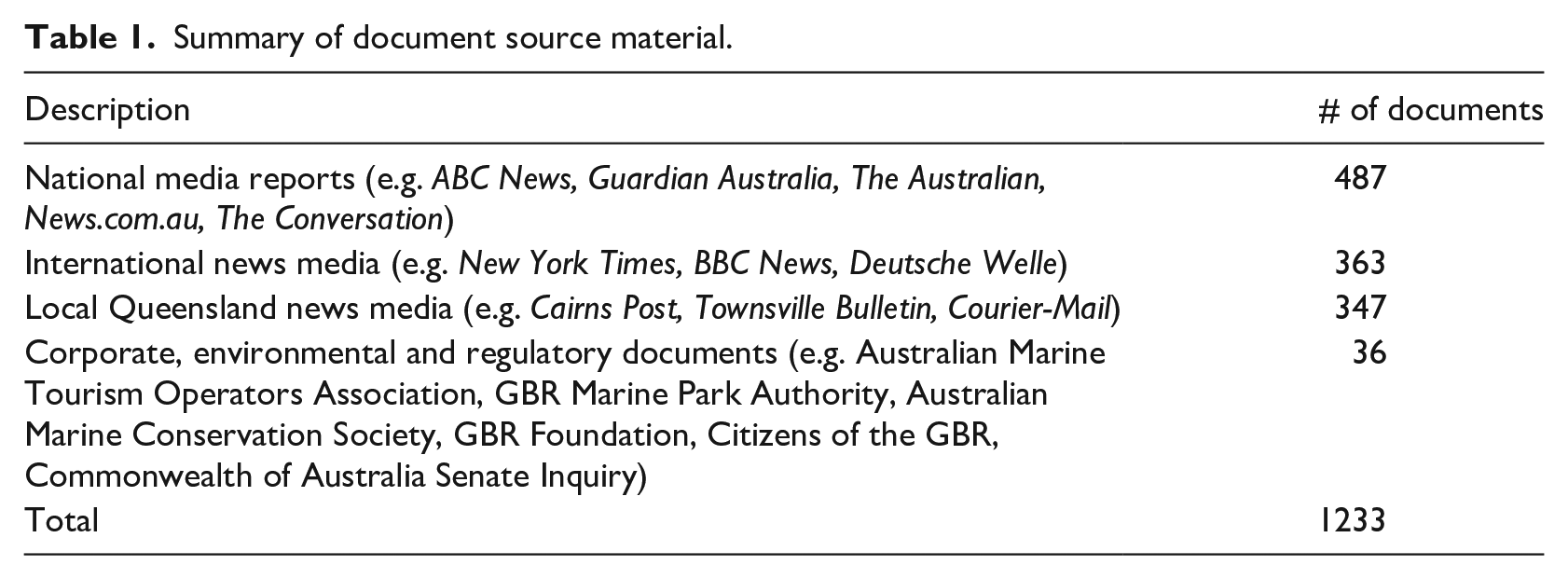
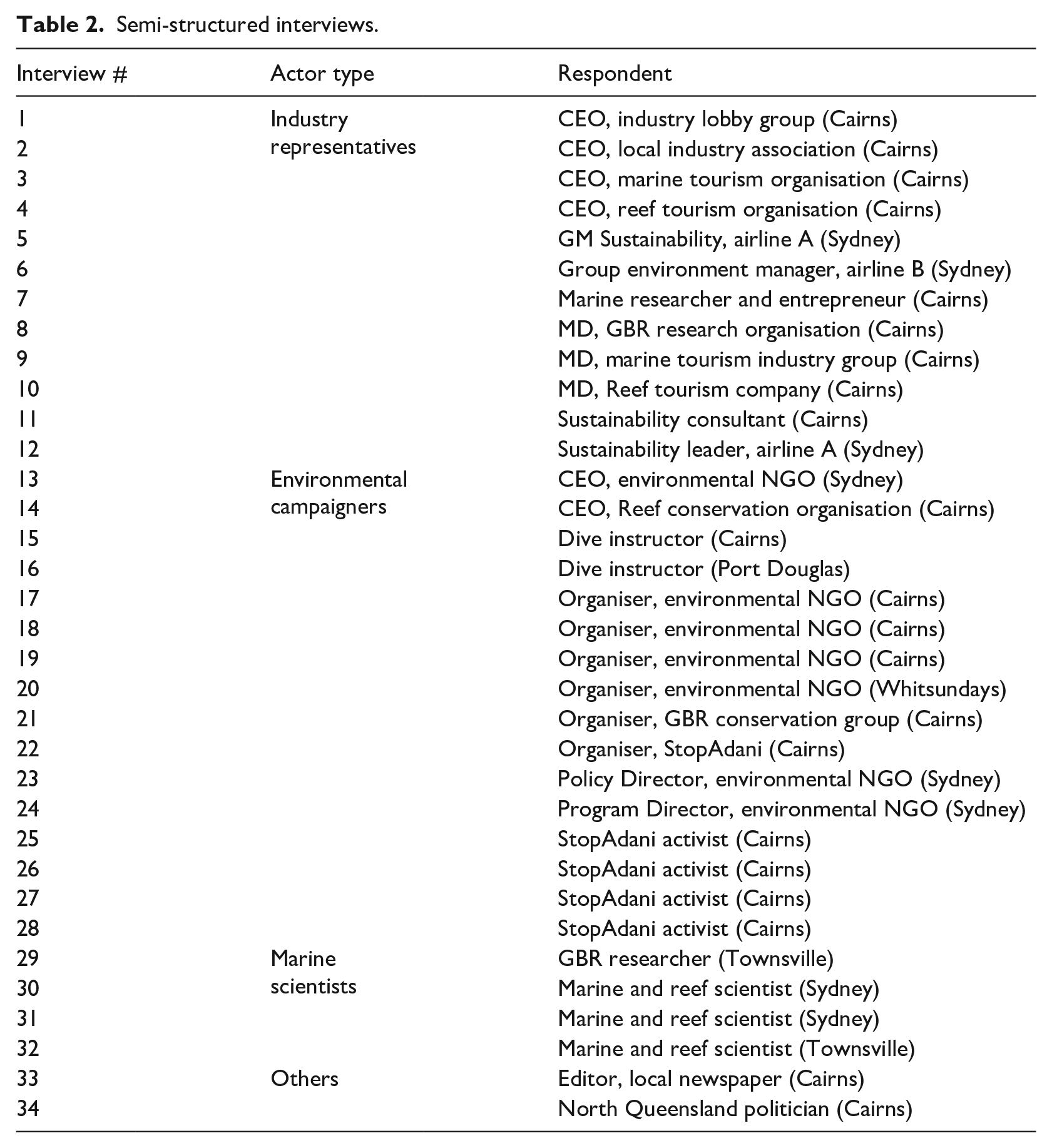
To supplement the media and textual data, we also conducted 34 interviews with key informants during 2017 and 2018. These included representatives from the marine tourism industry, airlines, state and local politicians, industry representatives, marine and coral reef scientists, dive instructors, as well as national and local environmental campaigners. All interviews were recorded and transcribed, resulting in 34 further substantial texts reflecting on the bleaching events and stakeholder responses (see Table 2).
Semi-structured interviews.
These texts were then imported into the qualitative data analysis software QSR NVivo. Through a process of ‘open coding’ (Corbin and Strauss, 1990), we combined segments of text reflecting similar wording or activities into first order categories, resulting in the classification of over 100 primary nodes. These nodes represented actors (e.g. ‘politicians’, ‘tourism operators’, ‘industry associations’, ‘community groups’), discourses (e.g. ‘loss’, ‘mortality’, ‘denial’, ‘adaptation’, ‘resilience’), phenomena (e.g. ‘coral bleaching’, ‘ocean temperatures’, ‘fluorescence’, ‘currents’) and practices (e.g. ‘advocacy’, ‘partnerships’, ‘research’, ‘protests’).
In a second stage of analysis, we searched for patterns and relationships within and between the first-order categories. One key theme that emerged from this process was the way in which businesses and politicians responded to criticisms from environmentalists and marine scientists by enlisting a range of discourses and practices that sought to deflect and downplay the severity of the bleaching events and climate change as its central cause. The continued support for fossil fuels and the lack of argument for mitigation from both government and businesses, led to the research question of how hegemony was defended. Thus, using an abductive approach to data and theorising, we engaged with the literature on hegemony to understand how industries and government shifted the emphasis from climate mitigation to adaptation.
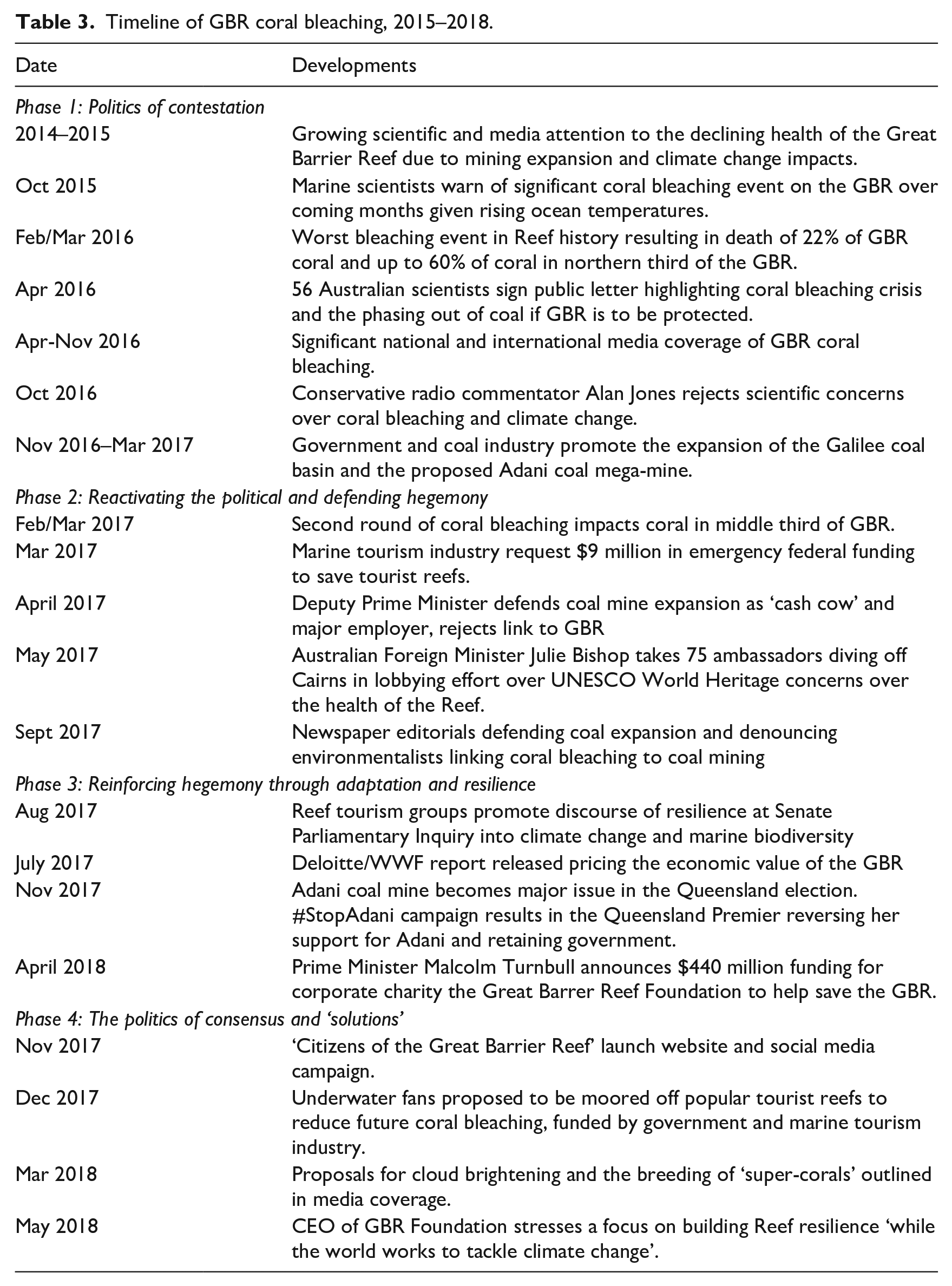
In the final stage of the data analysis, we used axial coding across the texts to identify different type of responses to critique. It was from this analysis, we categorised four phases in the political dispute (see timeline in Table 3). While the discourse and practices overlap, the analysis indicated changes in how the hegemony responded to critique. The first phase involved politics of contestation in which government and industries questioned the severity of coral bleaching, the link to climate change, and even denial of the issue altogether. In the second phase, the recurrence of bleaching played into politics that reactivated the political, with business and government defending hegemony by stressing climate change as a global issue and emphasising the importance of coal mining for national prosperity. The third phase focussed on reinforcing hegemony elevating the role of business in proposals for adaptation. Finally, in a fourth phase the hegemonic order found expression in a range of corporately funded adaptation measures that concealed the underlying antagonism in a politics of consensus. In the following sections we outline each of these phases in the response to the coral bleaching events.
Timeline of GBR coral bleaching, 2015–2018.
Phase 1: Coral bleaching and the politics of contestation
While the declining health of the GBR had been a source of political debate for many years given coal port expansion and pollution (Australian Government, 2015; Milman, 2015), the materialisation of the worst coral bleaching event in the Reef’s history in February 2016 led to a renewed focus on the threat of climate change and Australia’s role as one of the world’s largest exporters of coal and gas and highest per capita carbon emitters. Coral bleaching attracted widespread media attention with both local and international newspapers outlining the dire future for the Reef accompanied by images of bleached and dying coral (Innis, 2016; Slezak, 2016b).
Environmental campaigners and marine scientists made the bleaching meaningful in stressing the link between coral bleaching, climate change and coal mining through a growing nationwide protest against a proposed mega coal mine by the Indian conglomerate Adani in the nearby Galilee Basin. The Adani Carmichael mine was planned to become not only one of Australia’s largest coal mines but also open-up the Galilee coal basin to further mines providing a significant new source of global carbon emissions. For the #StopAdani movement, coral bleaching and the GBR became central themes at large public protests around the country, epitomised in the tagline ‘Coral Not Coal!’ which dominated protest banners and social media feeds (Newlands, 2016).
In response to this growing public concern, business and government sought to downplay the severity of coral bleaching and any link to climate change. For instance, the tourism industry’s early reaction was to seed doubt about the extent of bleaching and continue to promote tourism growth. As the head of the North Queensland tourism association proclaimed after news broke of the first bleaching event: ‘. . .the Reef is actually coping very well under the current circumstances. If you look at all of the tourism operations . . . a majority aren’t experiencing any significant bleaching at all.’ (Bateman, 2016)
This position from the hegemonic nexus of government and business was echoed in local newspapers and conservative media outlets which argued the focus on coral bleaching was alarmist and being used by climate change activists to pursue an ideological agenda opposed to coal mine expansion.
Coral bleaching thus fed into the on-going divided politics in Australia over climate change; a political frontier between supporters of coal and gas extraction and environmentalists advocating for an end to fossil fuels. For instance, some months after the first bleaching event, a new government-funded website was launched in Cairns by conservative radio commentator Alan Jones, who after a short helicopter flight over local waters, declared to the media that: ‘The global warming alarmists will stop at nothing. . .They want to talk about climate change and shut down everything. . .Like much associated with the global warming hoax, truth was the casualty. . ..The Barrier Reef’s fine – there are any number of reputable entities who will be looking after it and making sure it continues to be fine and looked after.’ (Slezak, 2016a)
Indeed, following the Queensland Government’s approval of the controversial Adani coal-mine in April 2016, the peak mining association, the Queensland Resources Council (QRC) praised the decision and stressed the economic benefits and employment that would flow from coal mine expansion (Ludlow, 2016). The hegemonic coalition between implicated industries and levels of government was further emphasised in senior politicians’ public support for coal mining, with the Queensland Premier proclaiming the approval of the Adani mine as a ‘new era of the resources sector’ (Vogler, 2016). As the editor of a local newspaper argued: ‘we love the Reef. . .But we also have to realise that if people want to come here, well we have to have the infrastructure to uphold that and we have to have jobs for people to live here’. (Interview #33)
Thus, during the public debate following the 2016 bleaching event, the hegemonic nexus of business and government was maintained by denying the link between coral bleaching and climate change, attacking the forces behind environmental critique, and promoting current tourism and mining practices. Politics remained tied to a business-as-usual agenda, with the contestation feeding into existing politics around climate change in Australia. The politics of contestation emphasised constructing an equivalence of industries that supported Australia’s economic interests and differentiated the hegemonic order from environmental protesters who were presented as ideologically driven and factually inaccurate.
Phase 2: Reactivating the political and defending hegemony
Nevertheless, the unprecedented recurrence of coral bleaching the following summer in February 2017 reactivated the political antagonism by laying bare the contradiction between supporting fossil fuels and acting on climate change. It was no longer possible to disassociate the coral bleaching with climate change and, as such, the bleaching acted as a catalyst for a counter-hegemonic force challenging business-as-usual. This compelled a reassessment of mining and tourism industry responses. As one tourism industry insider outlined: ‘I went into a meeting with most of the big tourism operators and GBRMPA [Great Barrier Reef Marine Park Authority] in early Feb and the data looked horrific. . .I think there was a sea change at that moment in that room where the key players went “oh f*ck, this is not a one-off!”‘ (Interview #14)
Following the second bleaching, tourism operators increasingly acknowledged climate change as a threat to the Reef, with a noticeable shift in the industry rhetoric from denial to public acknowledgement that bleaching was occurring, and that remedial action was needed. As the head of one marine tourism group argued, ‘We have to act locally now!’ (Geiger, 2017).
Moreover, environmental protests against coal mine expansion increased, targetting financial institutions and the Queensland government in the lead up to a state election (Slezak, 2017). The underlying antagonism was laid bare, with Greens politicians displaying lumps of dead coral in the Federal Senate and declaring that ‘Coal kills coral. It’s that simple, but don’t try telling the government that!’ (Barlow, 2017b). The recurrence of mass bleaching thus reinforced the link to climate change, challenging fossil fuel expansion.
In defending the fossil fuel hegemony, business responses in this second phase sought to distinguish between the local effects of coral bleaching and the global nature of climate change. This included the assertion that Australia contributed a modest component of total global greenhouse emissions. As one Reef tourism spokesperson argued, ‘If we were going to be really accurate, we can stop all coal mining, we can decarbonise Australia’s economy and we affect the world by one to two per cent’ (Interview #4). Government and industry also explicitly rejected claims that coral bleaching and threats to the Reef should limit the expansion of new coal mines like the Adani project. As one Cairns business leader reasoned: ‘If they don’t get the coal from us, they’ll find it in another coal mine somewhere else right, in Indonesia or Brazil or wherever. . . But you don’t link a mine and the prospect of 5,000 jobs to the death of the Great Barrier Reef if that’s opened. This is the dilemma that we face in this debate about coral bleaching.’ (Interview #2)
This type of hegemonic practice denied the protesters’ construction of equivalence between the impact of climate change in the form of coral bleaching and the Australian fossil fuel industry. The expansion of coal and gas extraction would continue upon the excuse that if Australia did not export these resources, other countries would.
Indeed, the ‘common-sense’ view of the importance of mining now required active defence and corporations and industry associations became more vocal in advocating the continuation of mining on the grounds of jobs and growth. As the CEO of the peak mining association declared in response to growing protests: ‘The [coal] sector continues to be a mainstay of employment and economic growth in Queensland, ensuring that every Queenslander benefits from this great industry’ (Queensland Resources Council, 2017). This was a position reinforced by state and federal governments which strongly supported coal mine expansion. In March 2017 as the GBR bleached for a second time, the Queensland Premier and the mayors from eight regional electorates undertook a highly publicised trip to India to signal their support for the Adani coal mine in Australia (Bennett, 2017). The federal government also acted as a strong backer, with the Deputy Prime Minister arguing the development of the Galilee Basin would be a ‘cash cow’ for Australia and ‘directly employ about 3000 people, with a further 10,000 indirect jobs’ (Barlow, 2017a). This equivalence between the fossil fuel industry and economic well-being was echoed by editorials in regional newspapers where the threat of coral bleaching was rejected in favour of the benefits of a new coal boom: ‘The community has been on its knees for a very long time, waiting for the next big thing to help it up off the canvas. . .coal is not dead, Adani is not the devil and the Great Barrier Reef won’t die if we extract coal from the Galilee’ (Tomlinson, 2017).
Moreover, for the tourism industry and associated businesses, continued growth was viewed as essential. For the airline industry, highly reliant on the GBR as a key marketing icon, mitigation measures were limited to carbon offsetting programs and the promotion of future biofuels (Pond, 2016). As an executive from one of the major airlines outlined: ‘Aviation is not going away. The predicted growth rates are astronomic. . .it’s not our desire to see people flying less’. (Interview #5)
The dramatic reductions in carbon emissions required to avoid the destruction of fragile ecosystems like the GBR challenged dominant political and economic assumptions of business growth and profitability. Following the second bleaching event and the reactivation of the political, the debate shifted from contestations over the facts about climate change, to defending the hegemonic order. The defence emphasised taken for granted assumptions around jobs and growth, and, thus, excluded any notion of climate mitigation hampering economic growth. However, if mitigation was not possible then a vision of the future needed to be crafted within which the threat of climate change could be contained. For government and corporate elites this involved the emerging discourse and practice of climate adaptation.
Phase 3: Reinforcing hegemony through adaptation
For government and industry, the idea of adaptation to climate impacts was immediately appealing as it promoted local, small-scale measures which demonstrated concern and action in response to the degradation of the Reef. As the head of the state’s tourism industry association stated in the media, ‘Our tourism operators work as guardians of our natural environment, including the Great Barrier Reef – it’s important that the community gets behind their efforts to protect and preserve Queensland’s famous natural icons’ (Anon, 2018). During this third phase of the dispute, a broader coalition of corporations and industries became increasingly involved in the public debate over the future of the Reef through philanthropic and advocacy activities. By focussing on adaptation and resilience, implicated businesses could claim they were being environmentally responsible while at the same time obfuscating the antagonism between fossil fuel energy and climate change.
In particular, the Great Barrier Reef Foundation, a charity consisting of the executives of the country’s largest corporations, became the favoured choice for government funding for the Reef, with a grant of $440 million in mid-2018 directed to the organisation over traditional academic research and regulatory organisations. While critics noted the irony of an organisation run by executives from major fossil fuel companies seeking to limit the impact of climate change, the Foundation’s Chairman (a former Managing Director of oil giant Esso) argued their role was to improve the Reef’s ability to adapt and not to advocate for emissions reduction: ‘while the world works to tackle climate change on a global scale, there are many things we can and must do to build the resilience of the Great Barrier Reef right now’ (Rebgetz and Gartry, 2018). By sidestepping mitigation and focussing on adaptation, the contradiction between fossil fuels and climate change was addressed and the hegemony could be reinforced.
The Foundation stressed its role in fund-raising within corporate Australia and encouraging public education about the Reef. This included hosting corporate retreats at luxury reef resorts (Ludlow, 2018), employee-engagement programs and a website promoting the organisation’s conservation projects. As the Foundation’s strategy document outlined, donations could help partner companies ‘drive employee engagement, position them as an employer of choice, and contribute positively to reputation scoring or social licence to operate’ (Smee, 2018).
These strategies promoting corporate friendly practices were aligned with the dominant assumptions of corporate environmentalism: a ‘win-win’ scenario in which there is no antagonism between what is good for business and environmental well-being. Adaptation plans emphasised corporate reputation and ‘social licence’, with business engagement with reef conservation justified upon an essentially economic logic. In a widely reported analysis in 2017 commissioned by the GBR Foundation, accountancy firm Deloitte estimated the ‘economic, social, icon and brand value’ of the Reef at $56 billion, generating $6.5 billion dollars in revenue per annum and providing up to 64,000 jobs in reef tourism, fishing and associated activities. Justifying this economic exercise, the report authors noted that ‘At a time when the global natural environment is under threat from the pressures of humankind, particularly climate change, it has never been more important to understand the value of nature’ (Deloitte Access Economics, 2017). The monetisation of the Reef in the language of the market thus provided the justification for further business involvement, albeit limited to small-scale local adaptation measures which neatly skirted around the fundamental issue of radical cuts in greenhouse gas emissions and the end of fossil fuel extraction and use.
Thus, the reinforcement of the dominant hegemonic order excluded mitigation efforts. The promoted strategies instead emphasised the monetary value of the Reef and the jobs that coal mining and tourism supported. The direction of the debate then turned towards activities and practices within this hierarchy of values and the importance of business and corporations to ‘save’ the Reef through their promotion of local adaptation practices.
Phase 4: The politics of consensus, ‘resilience’ and ‘solutions’
The focus on adaptation allowed business and government to return to the politics of what should be done within the hegemony of continued fossil fuel extraction and use. A powerful discourse within this discussion was the idea of building ‘resilience’ to future climate impacts. The concept of ‘resilience’ within ecology management emphasises the capacity of natural systems to resist shocks and disasters and recover quickly from them (Standish et al., 2014). For business-funded groups like the GBR Foundation and governments, the idea of building the Reef’s resilience was immediately appealing as it promoted a positive message that recovery was possible based around local action irrespective of broader climate change dynamics. This was differentiated from the mitigation of carbon emissions which was framed as ‘doom and gloom’. As a reef tourism spokesperson outlined at a Senate inquiry into climate change impacts: ‘The talk these days should not be about trying to save the reef, it should be more about assisting the reef to recover. That needs to be the message that gets out there. We’ve got to get rid of the doom and gloom and say we want to be proactive. We’re going to help. We want to help the reef recover.’ (Commonwealth of Australia, 2017: 26)
The positive messages from actors supporting adaptation measures indicated a shift towards building consensus. While there was debate about which type of adaptation strategies should be implemented, the hegemonic formation promoted a consensus around the message of resilience and adaptation.
To make this discourse meaningful, business and government promoted a range of local initiatives. These included projects aimed at limiting sediment run-off and agricultural pollution from nearby rivers, new techniques to control the coral-denuding Crown-of-Thorns starfish, and the reconstruction of cyclone-damaged reef and coral farming (Great Barrier Reef Foundation, 2017). As a senior airline executive argued of his firm’s involvement in one such a program: ‘So, the idea of being able to click your fingers and fix climate change is not available to us. But here you have a major threat to the health and resilience of the Reef [sediment control] that you can take off the table. So that was attractive. So we put our energies into that partnership.’ (Interview #6)
In the aftermath of the second bleaching event, reef tourism operators even floated the idea of an engineering response to lessen future coral bleaching by pumping cooler ocean water onto tourist reefs. While dismissed by marine scientists as an impractical ‘band-aid solution’, the proposal won government funding for a program of so-called ‘reef havens’ involving underwater fans to better circulate water on popular tourism reef sites (Knaus, 2017). Other proposals for reef resilience included coral farming, genetically engineering ‘super corals’, coral shading, and potential geo-engineering responses such as cloud brightening (Great Barrier Reef Foundation, 2017).
Importantly, the government and industry promotion of resilience and adaptation occurred within the dominant hegemony of market capitalism and any contestation of this was absent from the on-going political discussion. The politics returned to hegemonic practices of expanding the chain of equivalence with new actors and subject positions for citizens. While there were critical voices such as marine scientists who continued to publicly criticise the government over its failure to address climate change (Gannon, 2018), the shift of government funding towards corporate charities like the GBR Foundation led other researchers to embrace the Reef adaptation agenda (Braverman, 2017). Corporate-funded charities promoted the idea that citizens could best help to ‘save the Reef’ by purchasing ‘green’ products, committing to avoid the use of plastic bags and straws, and reducing their food waste (McKinnon, 2018). There was no antagonism and, as one tourism-sponsored charity website declared, ‘United we will inspire collaboration and collective impact on a global scale. From ditching single-use plastics to citizen science and world-leading research – everyone has a part to play’ (Citizens of the Great Barrier Reef, 2019). Thus, while acknowledging climate change as the key threat to the Reef, these appeals to consensus sought to enlist the public via social media as concerned consumers rather than politically active citizens pressuring government for meaningful emissions mitigation.
Discussion
Our focus in this article has been to explore the political process through which fossil fuel hegemony is defended and constituted in the face of obvious material threats. Our analysis of business and government responses to the coral bleaching of the GBR established four distinct phases: (i) the politics of contestation, (ii) defending hegemony, (iii) reinforcing hegemony, and (iv) the politics of consensus. Theses phases show how hegemony is implicitly reproduced through interpretation and action when the hegemonic order is not overtly challenged – phases (i) and (iv); while explicitly defended and instituted when the assumptions underlying the hegemony are challenged – phases (ii) and (iii). The sections below explains what this difference achieves and outlines how our analysis of the political process contributes to the literature.
Defending and constituting fossil fuel hegemony
In the initial phase, business and government employed the familiar tactics of denying or seeding doubt about climate change and the links to extreme weather events (Dunlap and McCright, 2011; Oreskes and Conway, 2010). These tactics represent politics, whereby a contestation is upheld through what appears to be free and rational discussion amongst individuals and groups of different opinions. The public debate is considered (i) free, in that the underlying political order – the political – is not considered, and (ii) rational, given the focus on arguments about how to interpret events. Thus, this first phase of response focussed on the demobilisation of the population by seeding doubt about the impact and re-emphasising the status quo.
However, with the second bleaching event, the materiality of climate change reactivated the political and the material effects of climate disruption could no longer be contained within the debate. The dominant discourses were called into question and the antagonism of climate change and fossil fuels was laid bare. Consecutive coral bleaching events became a challenge to the constituted political order and business and government responses shifted to defending the hegemony. The political strategy moved to emphasising that climate change was a global (rather than local) issue and stressed the importance of the resources sector and coal mining for the Australian economy in terms of economic growth and jobs. Existing business practices were shored up within the coalition of industry and government, and emissions mitigation was presented as failing to make economic sense. The political activities in the public debate defended a ‘common-sense’ view of a global world with nations dependent on a strong economy and fossil energy.
The defence of the hegemony was reinforced in the third phase by shifting the discussion from climate mitigation to adaptation. This shift, as critics noted, ‘seems to fly in the face of any anticipatory action, instead scientifically justifying forms of inaction’ (Braverman, 2017: 12). This was done by reinforcing the market ideology through corporate solutions to climate change concerns. Here, government and business actively campaigned for ‘practical’ solutions based on corporate practices to ensure that the hegemonic positions of implicated industries were reinforced. The shift to adaptation sedimented a ‘natural’ political ground by establishing corporations and industry associations as the key players in responding to the health of the Reef.
The last phase involved returning to the politics of discussing different activities in response to climate change. This involved a politics of consensus around the importance of restoring or even ‘saving’ the Reef – something even few counter-hegemonic forces could disagree with. The politics here was rather about which of the many adaptation measures should be implemented and which technical ‘solutions’ should be invested in. The ground for this discussion – the political – was now disavowed in addressing climate change through economic rationality (Wainwright and Mann, 2015). Through this process, the issue of reducing carbon emissions (mitigation) was sidelined and emphasis was placed on coping with the physical impacts of climate disruption that were now seen as inevitable (adaptation). Alternatives to business solutions were rarely discussed and the assumptions underlying the politics were ignored.
Together these four phases explain the movement from mitigation to adaptation as the dominant response to climate change, and while the findings are unique to this particular case, the four phases in the process assist in explaining climate change responses elsewhere. For example, during California’s and Australia’s record-breaking wildfires the initial political response was to question the link to climate change and emphasise local responses such as forest management and hazard reduction (Fuller, 2018; Readfearn, 2019). Similarly, political leaders have downplayed the link between climate change and severe hurricanes and floods, while promoting the benefits of privatised disaster relief and local preparedness (Newkirk, 2018). This focus on local adaptation to climate impacts happens at the same time as business and governments weaken environmental protections and open up new regions of the world for fossil fuel extraction (Klein, 2014).
Contributions
Our study of the political response to coral bleaching on the GBR suggests a four-phase process of reproducing the hegemony and concealing the political ground. In the opening and closing phases of the politics of contestation and consensus, the debates are about facts and decisions with the hegemonic order rarely challenged. Here the play of politics conceals the assumptions around ‘common sense’ on which the public debate takes place. In contrast, the two middle phases of defending and reinforcing the hegemony focus on shoring up the hegemonic order; these tactics construct the ‘reality’ of the world and dismiss alternatives as ‘unrealistic’ or naïve. There is no alternative and the antagonism of the political is dismissed. By explaining how these four phases influence the political process of shifting from mitigation to adaption, we make two key contributions.
First, our study contributes to discussions of hegemony in organisational studies by identifying separate forms of hegemonic practices. The emphasis, to date, in organisational studies has focussed on how political contestation constructs equivalence and difference in a war of positions (Contu et al., 2013; Murray et al., 2016; van Bommel and Spicer, 2011). These studies have explained how the hegemonic order is constructed and defended. However, there is limited differentiation between hegemonic practices articulating facts (e.g. climate change denialism) and constructing a natural order (e.g. capitalism as the social order). Our findings point to an important difference between the politics of contestation or consensus over facts and values (see e.g. Islam et al., 2022; MacKay and Munro, 2012) and the naturalised social order (Contu et al., 2013; Levy et al., 2016). It is only the latter that is counter-hegemonic in showing the antagonism of the naturalised order.
Here, it is important to distinguish between strategies at the level of ‘politics’ and those challenging ‘the political’ in explaining how hegemony is reproduced and antagonism concealed. In our case, observing the considerable shift in rhetoric between the first (the politics of contestation) and the final phase (the politics of consensus) might suggest a destabilised hegemony, since climate change is later acknowledged and solutions put forward to address the problem (Ferns and Amaeshi, 2021; Levy and Egan, 2003). However, in attending to the middle two phases (defending and reinforcing hegemony), it becomes evident that the hegemonic order was actually reinforced and even expanded, with climate change adaptation now capitalised. Thus, the key to understand the reproduction of the hegemonic order is not the truth about particular facts or events, but rather that any problem or challenge is addressed by market mechanisms supported by the capitalist order.
This contributes to the discussion on hegemony by showing how public contestations can reproduce and ground a broader political arena, ensuring that the social order appears inevitable and natural (Fleming and Spicer, 2014). What are often seen as counter-hegemonic discourses are then rather the ‘politics of contestation’ (Ferns and Amaeshi, 2021; MacKay and Munro, 2012), where the antagonism of climate change and economic growth fails to be considered. This leads to an incorporation of critique, since even activists rarely critique the dominant economic order (Nyberg et al., 2013), and a dialogue of possible actions occurs within the established hegemony. This politics of consensus conceals the antagonism by grounding the hegemonic order within consensual procedures operating within an established framework. This type of politics has been referred to as ‘post-politics’, since political contradictions are reduced to policy problems to be managed by established elite actors and the scope of outcomes narrowly defined in advance (Wilson and Swyngedouw, 2015).
This also contributes to the literature on fossil fuel hegemony in organisational studies (Ferns and Amaeshi, 2021; Levy and Egan, 2003; Nyberg et al., 2018), and social science more broadly (Kraushaar-Friesen and Busch, 2020; Phelan et al., 2013; Wright et al., 2021), in accounting for material climate impacts and their capacity to potentially dislocate the hegemonic order. Coral bleaching, momentarily, showed what was lacking in the contingent political order (Cederström and Spicer, 2014) – the hegemony could not convincingly explain the events. The fragility of the political was on display, revealing the lack of a solid ground on which the fossil fuel hegemony rests. The devastating effects of climate change as counter-hegemonic events thus disrupted the political order. The failure to domesticate the events within the existing hegemony was recognised by the industry and it required hegemonic practices, such as investing in adaptation measures, to conceal antagonism. This suggests limits to the naturalisation of fossil fuels and the possibility for future climate impacts to further dislocate the hegemonic order.
Second, we contribute to the literature on adaptation by highlighting how businesses are using the language of ‘adaptation’ and ‘resilience’ as a way of responding to critique. While a range of studies have identified how different industries are applying climate adaptation to their operations and risk management (Linnenluecke et al., 2013), the business focus on climate adaptation also has a political role, particularly for high carbon industries subject to increasing social criticism. As our study has shown, promoting adaptation and resilience provides a response to critics by suggesting that businesses are taking action to respond to a worsening environmental threat, while at the same time deflecting attention from mitigation measures that would endanger their business models. This expands the insights of Adger et al. (2009) who identify a range of social limits to climate change adaptation including diverse values, knowledge and culture. We suggest this also needs to take account of the hegemonic order within which such considerations are framed and developed. Climate adaptation is a broad concept that can be enacted in a range of ways and, as our study has demonstrated, can be readily turned to serve political agendas which depart markedly from the original goal of seeking to maintain the future well-being of natural and human systems.
This shift from mitigation to adaptation also sheds light on the role of ‘disaster capitalism’ in the political economy of climate change. Environmental catastrophes are increasingly exploited by economic and political elites to further expand capitalist agendas of privatisation, corporate deregulation and the marketisation of social relations (Klein, 2007, 2014). As demonstrated in the case of coral bleaching, climate change impacts paradoxically provided further spaces for the expansion of the very hegemonic order that has created the climate crisis. Here, the movement from climate mitigation to adaptation allows for an expansion of business interests in the determination of climate response. For vulnerable communities reeling from record-breaking storms and floods, wildfires, droughts or the destruction of local ecosystems, the political response refuses to countenance the dramatic decarbonisation required to avert worsening climate impacts and rather advocates the expansion of corporate and market ‘solutions’ which facilitate further emissions growth.
Conclusion
Our analysis of the bleaching of the GBR provides a bleak picture; while coral reefs die and entire ecosystems are endangered, corporate and political leaders focus on limited ‘band-aid solutions’. This policy shift from climate mitigation to adaptation is problematic for several reasons. First, focussing solely on adapting to climate impacts does not address the problem and diverts attention from much-needed mitigation measures such as decarbonisation and renewable energy. Second, this reframing of climate adaptation is firmly based on corporate entrepreneurism and individual action. These ideas obscure the ideological and political contents of adaptation (Wainwright and Mann, 2015). We are not suggesting that climate adaptation is pointless; just that it needs to be combined with a dominant focus on dramatic emissions mitigation. This points to the obvious problem of the unequal distribution of responsibility and consequences in terms of those actors who benefit from continued fossil fuel use, compared to those who suffer the consequences and do not have the resources to adapt to future climate impacts. Indeed, in the time since this research was conducted, the GBR has undergone a number of further major coral bleaching events, reinforcing the precarious state of the world’s coral reefs in an age of climate disruption (Readfearn, 2020).
And yet, the analytical separation between politics and the political does provide possibilities for meaningful mobilisation in response to climate change. It is clear from our case that policies focussed on the individualisation and marketisation of climate responses are futile since these strengthen the dominant hegemony. Of far greater impact is the emerging countermovement within society that now questions the dominance of the fossil fuel economy and through civil disobedience, divestment and blockades demands the rapid decarbonisation of the climate-threatened world.
Footnotes
Funding
The author(s) disclosed receipt of the following financial support for the research, authorship, and/or publication of this article: Funding for this research was provided by the University of Sydney Business School and the Sydney Environment Institute.
