



Abstract
Studies of corporate citizenship have considered how corporations shape the delivery of basic rights. While liberal commentators argue that corporations can act as protectors of citizenship rights where state regulation is lacking, more radical commentators claim that corporations seek to obstruct the rights of citizens. In this article we build on theories of hegemony to argue that corporate citizenship can be more fruitfully understood as an attempt to incorporate citizenship activities in order to benefit corporate agendas. To explore how this process plays out, we examine how companies have sought to influence the political debate over climate change in Australia. Through analysis of corporate documents, media coverage and interviews with senior managers, we identify how corporations use practices of campaigning and exemplifying to build a common identity with citizens and synchronize corporate and citizen interests. This involves the recasting of citizens as active constituents, responsible consumers, ethical employees and ecopreneurs. Through this process, citizenship becomes increasingly incorporated within the value creating activities of corporations.
With the increasing fashion for corporate social responsibility (CSR), business ethics and organizational sustainability, corporations are under growing pressure to at least appear to be contributing to the improvement (rather than diminution) of social and environmental well-being (Hart, 2010). One way in which this broader social role has been represented is the concept of ‘corporate citizenship’ (Matten and Crane, 2005). While echoing earlier traditions of welfare capitalism (Jacoby, 1997), corporate citizenship has been compared with CSR (Carroll, 1998), as well as providing a more critical understanding of the modern corporations’ role in the ‘administration of citizenship rights’ (Matten and Crane, 2005: 175). There is thus a recognized role for corporations to solve political problems where the state is lacking, or has withdrawn from the provision of legal and economic infrastructure (Scherer and Palazzo, 2011; Valente and Crane, 2010).
However, critical scholars have raised concerns about companies replacing the state as the new guarantor of citizenship rights. They argue that the drive of corporations to take up such a role often entails the pursuit of narrow business interests and the curtailing of many citizenship rights (see e.g. Banerjee, 2008; Barley, 2007, 2010; Levy and Egan, 2003). This has the potential to ‘undermine representative democracy and the public good’ (Barley, 2007: 201). Such views highlight a tension at the heart of debates about corporate citizenship. On the one hand, more liberal commentators see corporations as ‘artificial citizens’ which potentially enable and protect the rights of citizens in the void left by governments (e.g. Scherer and Palazzo, 2011). On the other hand, more critical commentators point out that corporations vigorously pursue their own interests, often through obstructing the rights of citizens (e.g. Banerjee, 2008). In this article, we offer a different perspective by suggesting that corporations engage in a process of incorporating citizenship activities in order to benefit their political agendas within societies. Corporations achieve this by a) building a common identity with citizens and b) synchronizing corporate and citizen interests. This might include inviting citizens to engage in corporate political campaigns as constituents, linking the consumption of products and services with personal and group identities or encouraging individuals to apply their personal and political concerns at work. In this sense, corporate citizenship programmes are a way that large organizations seek to craft and shape the ways in which people understand and exercise their rights as citizens; in short, corporate citizenship assists in developing a hegemonic form of social relations.
To explore how corporations seek to incorporate citizenship activities, we examine the case of the climate change debate in Australia. Studies of corporate citizenship have typically focused on traditional citizenship rights such as social, civic and political rights (e.g. Matten and Crane, 2005). Climate change provides a more complex context to the consideration of citizenship rights in that the harm to our ecosystem resulting from climate change does not only threaten the rights of present, but also future, generations (Howarth, 2011). Moreover, the global effects of climate change cannot be limited within the boundaries of the nation state. This means non-state actors, such as corporations are both key contributors to greenhouse gas emissions through their economic activities, technologies and financial resources, as well as powerful political actors. Climate change therefore provides a perfect ‘test’ for the concept of corporate citizenship, in that we have a broad issue of significant social consequence, which governments worldwide have largely failed to address. However, what role corporations should play in regard to climate change remains highly contested.
To investigate how corporations engage in civil society, we draw upon a qualitative analysis of Australian corporate engagement with the issue of climate change. By identifying different corporate practices developed in response to climate change, we analyse how corporations have sought to incorporate citizenly activities. We find that corporations do this by engaging in a range of practices we term ‘campaigning’ and ‘exemplifying’. These practices seek to forge linkages between the interests and identities of the corporation and wider stakeholders. By doing this, corporations have been able to recast understandings of citizenship in ways which align citizenship activities with corporate interests. This leads us to claim that corporate citizenship programmes are less about protecting (Scherer and Palazzo, 2011), or obstructing, citizenship rights (Barley, 2010). Rather they pre-emptively reshape our understandings of citizenship rights and activities in a way which furthers the longer term interests of the corporation.
In the sections that follow we review the existing literature on corporate citizenship and outline our analytical framework, which engages with a neo-Gramscian theory of hegemony (Laclau and Mouffe, 2001; Levy and Egan, 2003). This is followed by an outline of our research method. We then go on to illustrate the practices Australian corporations have developed in engaging with the political debate surrounding climate change, and how this results in the creation of hegemony through building common identities and synchronizing interests with citizens. In the discussion and conclusion, we consider what implications this has for our understanding of corporate citizenship, hegemony and citizenship more generally.
Corporate citizenship
Corporate citizenship has become a cliché of business discourse. Corporate annual reports and websites often contain reference to being a ‘responsible’ or ‘good corporate citizen’, and many of the world’s major companies are participants in corporate citizenship initiatives such as the United Nations (UN) Global Compact and the Global Reporting Initiative (GRI). However, while the term ‘corporate citizenship’ has been widely adopted, its definitional meaning has been subject to significant debate (Crane and Matten, 2008; De George, 2008; Néron and Norman, 2008; van Oosterhout, 2008).
In a review article on the topic, Matten and Crane (2005) distinguish three different connotations of corporate citizenship (see also Néron and Norman, 2008). First, they identify a ‘limited view’ in which the corporation relies upon philanthropic contributions to the broader community through voluntary giving of money, resources or expertise. These activities may benefit the social environment within which the business exists, or may be strategically targeted at developing the company’s reputation. A second broader interpretation of corporate citizenship expands the definition to a corporate focus on the ‘economic, legal, ethical and discretionary responsibilities imposed on them by their stakeholders’ (Maignan and Ferrell, 2000: 284). Here, corporate citizenship becomes largely ‘equivalent’ to CSR (Carroll, 1998). Hence, the ‘good’ corporate citizen can be distinguished from the ‘bad’ in terms of the extent to which corporate activities and processes indicate a concern for social needs. Here, corporate citizenship is used as a metaphor by claiming that corporations share some similar qualities to citizens and that they should seek to act in a similar way (Moon et al., 2005).
While studies which see corporations as citizens have been influential in practitioner circles, they have been called into question by Matten and Crane (2005: 169–174), who offer a third ‘extended’ view of corporate citizenship. Through engagement with the political science literature on citizenship, they argue that rather than viewing corporations simply as citizens, the term corporate citizenship actually ‘describes the role of the corporation in administering citizenship rights for individuals’ (Matten and Crane, 2005: 173). This could include providing social rights (such as supplementing education or welfare provision); enabling civil rights (through corporate intervention where the state lacks or abrogates such rights) and where the corporation acts as a channel for citizens to exercise their political rights (e.g. consumer campaigns and anti-corporate protests) (Matten and Crane, 2005: 172–174). Other writers have also stressed how the discontinuities of globalization and growing public scrutiny of business have led corporations to greater political engagement in seeking to maintain their legitimacy (Palazzo and Scherer, 2006; Scherer and Palazzo, 2011). Furthermore, corporations can undertake activities associated with political citizenship including: lobbying of government; involvement in public debate over contested social issues; as a partner with government in the delivery of social and economic services and in solving social problems (Moon et al., 2005; Valente and Crane, 2010). Indeed, as Crane and Matten (2008: 28) aptly note, ‘corporations might play an active role in reconfiguring the whole notion of citizenship itself’.
An emerging strand of more radical work explores this reconfiguration of citizenship by investigating how corporations have sought to expand their political participation and influence when engaging in citizenship. For instance, Barley (2007: 201) argues we now live in a ‘corporate society’ where corporations ‘wield inordinate political power’. This includes the active promotion of self-serving legislation often at the expense of ordinary citizens; corporate intrusion into and ‘capture’ of regulatory agencies and the privatization of governmental functions across all levels of society (Barley, 2007). Similarly, Banerjee (2008) highlights how concern with corporate citizenship is bound up with attempts by companies to provide legitimacy for the extension of corporate power. Corporations which seek to extend their citizenship role typically do so in an attempt to find new potential sources of innovation and opportunities to extend their market (Hanlon and Fleming, 2009). Thus, rather than acting as a kind of substitute leviathan which aids the extension of political rights for all, these more critical accounts view corporations as seeking to extend their own political rights (to free speech in the case of lobbying for instance), often at the expense of the rights of citizens.
Hanlon and Fleming (2009) argue that this involves the capture, or what we will call incorporation (see also Crane and Matten, 2008), of broader social and citizenly activities that had previously existed outside of the realm of the corporation. This process of incorporation of citizenship entails an attempt to align the exercise of citizenship rights with the interests and identities of the corporation itself. For instance, much anti-corporate sentiment has been drawn upon by corporations who promise their employees a socially responsible workplace (Fleming, 2009). Similarly much of the ‘green’ discourse which had challenged corporate environmental practices has increasingly been co-opted via corporate greening programmes (MacDonald, 2008). Indeed, attempts to incorporate citizenship activities is crucial for corporations which have progressively taken over aspects of public life and state functions (Crouch, 2011). By engaging in CSR programmes and helping individuals to pursue citizenship rights, corporations can pre-empt more radical demands from disenfranchised or disgruntled populations. To understand how this process of incorporation occurs and the effect of this on reconfiguring the idea of citizenship, some researchers have focused on the issue of hegemony (e.g. Shamir, 2005). It is to this concept which we now turn.
Hegemony
Hegemony is a concept developed by the Italian Marxist, Antonio Gramsci (1971). It entails attempts to ensure that the interests and identities of dominant groups are identified with, or overlap with, the interests of others in society. Hegemony is typically contrasted with violence as a mechanism for advancing one’s interests. Establishing hegemony involves what Gramsci has called a ‘war of position’ that involves reshaping the broad interests and values evident within society. This is manufactured within the realm of civil society. Church, schools, the media and universities are central institutions in which hegemony is manufactured. The result of attempts to create hegemony in these civil society institutions results in what Gramsci called a ‘historic bloc’. This is a group of actors who understand themselves as having a set of similar interests and are linked together in particular and enduring ways. There are a range of competing interpretations of Gramsci in contemporary organization theory. Some place more emphasis on material interests and the institutional bases of hegemony (e.g. Levy and Scully, 2007), while more post-structural approaches focus on the discursive dynamics involved in the construction of hegemony (e.g. van Bommel and Spicer, 2011). Here we follow a more post-structural approach, focusing on the development of ‘chains of equivalence’ that forge common identities among what are often disparate groups (Laclau and Mouffe, 2001). The central means through which this is achieved is the articulation of discourse. Thus, hegemony entails forging common identities and interests among disparate groups through the articulation of discourse in civil society.
Much of the initial work on hegemony focused on how states were able to secure dominance (e.g. Cox, 1983). However, in recent years scholars have increasingly recognized that corporations have become significant actors which also seek to establish hegemony (e.g. Levy, 2008; Shamir, 2005). There is now a strand of research that shows that private sector actors such as corporations have sought to secure hegemony through the manipulation of civil society as well as government institutions (Edward and Willmott, 2008). For instance, Levy and Egan (1998, 2003) note how corporations, in response to challenge, engage in a ‘war of positions’ which included some limited accommodation as a way of capturing political agendas and maintaining their economic and social hegemony. In the pertinent case of how the automobile and oil industries responded to climate change policy in the United States (US) and Europe, they outline three political strategies these industries employed to weaken mandatory reduction of greenhouse gases (GHGs): political strategies in building associations, such as the Global Climate Coalition, and lobbying regulatory agencies to counter regulatory challenges; discursive strategies, such as questioning the climate science and scientists themselves and to transform ‘popular beliefs’ in climate change and, economic strategies, such as the donation of money, industry consolidation, and even investment in reducing GHG emissions. Through these mechanisms, the fossil fuel industry preserved their hegemonic position, expanding their political influence over climate change policy.
The rationale for corporations to engage in corporate citizenship is then prompted by challenges to established corporate hegemony (Shamir, 2005). This can result from social protests against corporations or particular issues in which they have interests, or from changes in state regulation. For instance, voluntary reporting initiatives like the UN Global Compact have been used by many corporations in an attempt to avoid mandatory reporting enforced by states or international organizations (Chatterji and Listokin, 2007). Once corporations have begun to engage in corporate citizenship activities, they typically undertake different forms of engagement with civil society ranging from philanthropic programmes, to information campaigns, to lobbying governments. According to theorists of hegemony, these civil society campaigns are attempts by corporations to ensure that broader social interests and identities coincide with their own (Shamir, 2005). For instance, corporations are now routinely involved in forms of stakeholder dialogue which are often less about ensuring increased accountability, and more about incorporating potential critics into their own strategy formulation processes and thus closing down radical challenges (Edward and Willmott, 2008; Unerman and Bennett, 2004). One of the central outcomes of corporations seeking to establish hegemony around an issue is that subject positions are constructed which are more amenable to corporate activities. For instance, researchers have demonstrated how attempts to establish hegemony can produce amenable working identities (e.g. Mumby, 2005), as well as new subject positions outside the corporation such as the citizen shareholder (Roberts, 2003).
As we have argued above, existing work has identified how CSR policies can play a role in reconstructing hegemonic relations (e.g. Shamir, 2005). Moreover, studies exploring corporate political responses to climate change policy have highlighted the use of accommodation and conflict in reconstructing this hegemony (Levy and Egan, 2003). What remains less certain are the precise kinds of practices which corporations engage in to reconstruct these hegemonic relationships in regard to climate change. Furthermore, we have little sense of how these corporate practices shape notions of citizenship more broadly. In order to explore these lacuna, we focus on three key research questions: (a) what practices do corporations use to engage with civil society in relation to climate change?; (b) how do these practices lead to the (re)construction of hegemony? and (c) what implications does this have for the subject positions of citizens?
Method
Setting
To explore how corporations engage in citizenship activities we focus on the public debate around climate change in Australia. Climate change has emerged as the defining challenge of this century, with current GHG emissions likely to result in average global temperature increases of up to 6 degrees Celsius by 2100 (IPCC, 2007; Richardson et al., 2009). The implications of such dramatic change include large swathes of the Earth in which human habitation is no longer viable, rising sea levels, catastrophic storms, droughts and floods and the acidification of oceans. Future generations are likely to face agricultural crisis, shortages in water supply, the spread of diseases, mass mobilization of climate refugees and geopolitical conflicts over dwindling resources (Dyer, 2010; New et al., 2011).
However, despite strengthening scientific evidence of this threat, the politics of climate change has become ideologically polarized (Crowley, 2007; Dunlap and McCright, 2008; Harrison, 2007). In particular in the US, Canada and Australia, debates between conservative and progressive political parties revolve not so much around policy responses to climate change, but indeed whether climate change is an issue at all. For a growing neo-conservative movement, symbolized in the US by the so-called ‘Tea Party’ movement and corporations like Exxon Mobil, Koch Industries and Fox News, the science of anthropogenic climate change is now rejected as a hoax or socialist conspiracy (Dunlap and McCright, 2011). Within this embattled political environment corporations have undertaken different practices in seeking to shape climate policy outcomes.
Australia provides a good example of the divisive politics of climate change and a prime setting to explore the practices and effects of corporate citizenship in public debate. Australia is one of the world’s largest exporters of coal and natural gas. Moreover, Australia has one of the highest levels of GHG emissions per capita amongst developed economies (Garnaut, 2008). While an active participant in early international climate change meetings, from 1996–2007 under the conservative Howard government, Australia adopted a minimalist approach to carbon emissions reduction, and in line with the US refused to ratify the UN Framework Convention on Climate Change (Kyoto Protocol) (Crowley, 2007; Griffiths et al., 2007). The government viewed emissions regulation as a threat to economic growth and the country’s competitive advantage as a fossil fuel exporter (Pearse, 2007, 2009).
A change in government in 2007 signalled a reversal in climate policy, with the incoming Labor government led by Kevin Rudd committing to the introduction of a carbon emissions trading scheme. However, failure to reach a global agreement at the 2009 UN Copenhagen Climate Summit, conservative political opposition and growing resistance from industry led to the deferral of the scheme. Narrowly scraping back into power at the 2010 federal election, the minority Labor government in an alliance with the Greens Party and with a new leader, Julia Gillard, announced the introduction of a ‘carbon tax’ as a prelude to a carbon trading system. Championing a ‘people’s revolt’, the conservative opposition political parties, supported by the media, right-wing think tanks and industry groups, questioned the validity of climate science (ABC, 2011b; Manne, 2011). Despite continued declines in popularity, in July 2012 the government’s climate change legislation came into force with the 500 largest GHG emitters forced to pay a fixed price per tonne of CO2 emitted (Commonwealth of Australia, 2011).
Data collection
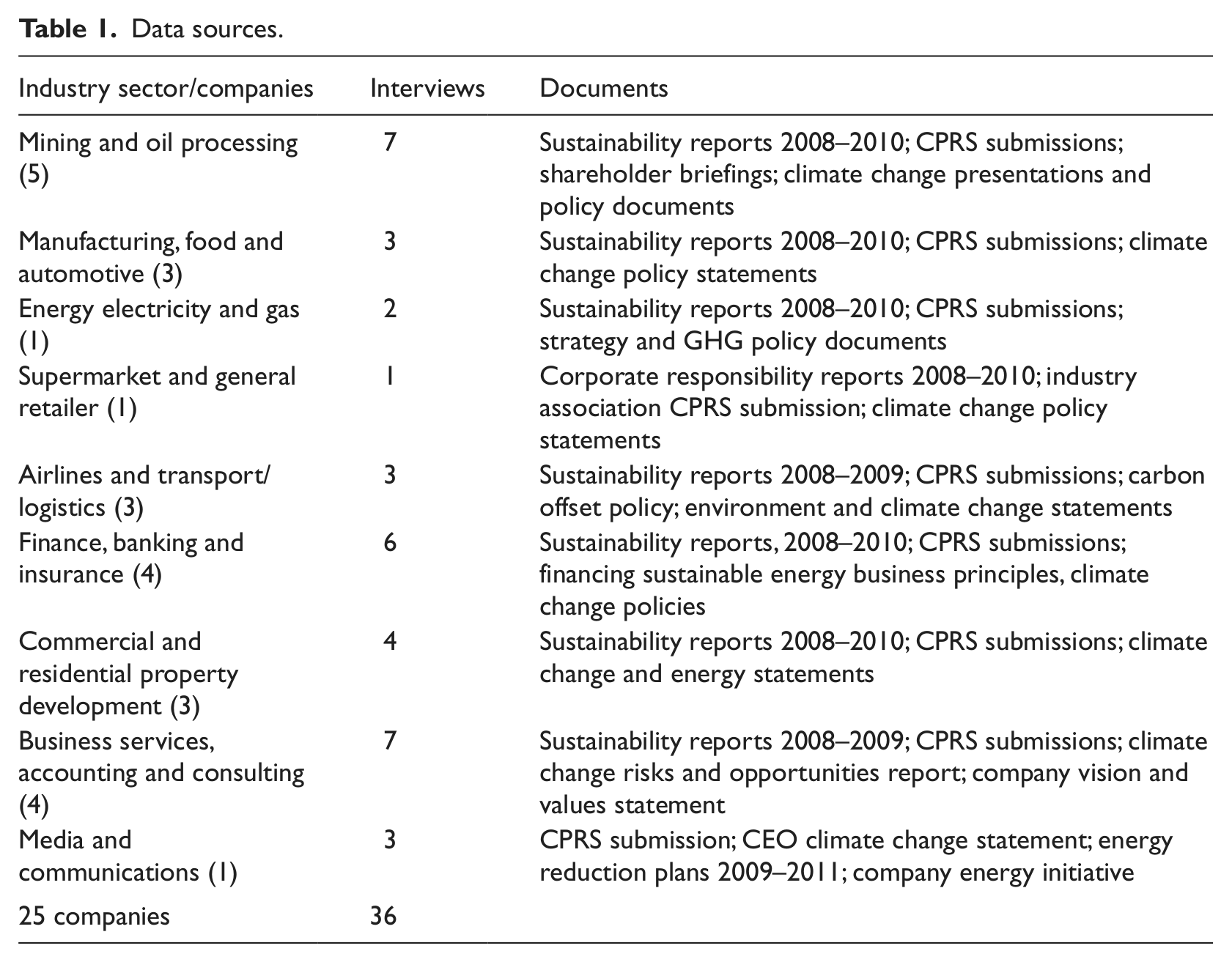
To explore corporate citizenship activities in response to climate change, we used a combination of secondary media sources as well as interviews and company documents. To contextualize corporate activities in civil society debates, we analysed media coverage of business attitudes to climate change and carbon regulation from major national and suburban newspapers, focusing on the period from 2007 to the enactment of the ‘carbon tax’ in July 2012. This secondary data was supplemented with interviews and documentary data from 25 corporations in the resources, energy, manufacturing, transportation, finance and retail industries (see Table 1). We focused on major corporations in these industries and conducted interviews with 36 individuals who worked as sustainability managers or consultants advising over environmental sustainability and climate change. These interviews were supplemented with corporate documents including; sustainability strategies, internal communications materials, submissions to government inquiries and media and press releases. This provided further detail on company practices, as well as insights into the public representation of corporations’ engagement with climate change.
Data sources.
Data analysis
In an initial stage of analysis, we identified corporate practices targeted at civil society. This consisted of corporate actions such as lobbying of government, business partnerships with civil society actors, ‘governance through everyday activities’ and corporate participation in civil deliberations (e.g. Moon et al., 2005). We then grouped these into two higher order sets of practices that corporations used in the policy debate over climate change: campaigning and exemplifying. Building on these categories, we then sought to draw out in what ways these practices helped to establish hegemony. We did this by focusing on how the various practices that we identified in the previous step were linked to the production of a sense of consensus between different parties. We found that these practices enabled corporations to craft common identities and synchronize the interests of other groups with their own. The final step of our analysis involved asking how this led to the reconstruction of citizens and incorporation of citizenship activities. Here we considered the role of citizens that was implied by campaigning and exemplifying practices. We focused on the particular representations of the ideal citizen that were encoded within our data. This led us to identify four subject positions; active constituent, responsible consumer, ethical employee and ecopreneur. In the sections that follow we outline these findings.
Practices of corporate citizenship
Campaigning
A key way that Australian corporations engaged with the issue of climate change was through campaigning for specific legislative outcomes. Practically, this involved direct attempts to shape public policy through formal submissions to government, lobbying of ministers and bureaucrats, media releases, interviews and conference presentations, as well as indirect activities such as building alliances with like-minded companies, industry associations, opposition politicians, think-tanks and NGOs.
Corporate campaigning was evident in the Australian climate policy debate through submissions to government in relation to the Carbon Pollution Reduction Scheme (CPRS) and later ‘carbon tax’. Here corporations set out their formal responses to the proposed legislation, which took various positions including support for the pricing of carbon emissions, proposed variations to the legislation, and in some cases, opposition to emissions regulation. In doing this, corporations stressed the link between their competitiveness and broader national economic well being; between theirs and society’s interest. As the coal industry argued, ‘Coal is vital to Australia’s prosperity … it’s our largest export earner, over $55 billion last year’(ACA, 2009).
Corporations also engaged in more informal practices such as lobbying of government ministers and bureaucrats for preferred policy outcomes. For example, Pearse (2007: 227–287) documents how during the 1990s and 2000s a powerful group of corporate lobbyists representing the coal, oil, mining and electricity industries (known as the ‘greenhouse mafia’) held sway in the corridors of government, arguing against international commitments to reduce GHG emissions. As one of our respondents confided, in contrast to the progressive public positions some companies adopted on climate policy, this backroom lobbying often involved a far more hostile position to emissions regulation. As one industry insider noted: … in certain circles there are a lot of people who are very angry about that. There’s a public persona that ‘yes climate change is important, we need to act’ but they then undermine it through public policy in Canberra.
Hence, while corporate websites and CSR reports might publicly promote action on climate change, behind the scenes, high carbon emitting companies intensely lobbied for more accommodating regulatory outcomes.
Beyond these traditional paths of political influence, as the Australian climate debate intensified corporations and industry groups engaged in more explicit public campaigning through media, public relations and advertising activities. For instance, in the debate surrounding the Labor government’s CPRS and later ‘carbon tax’ legislation, mining and manufacturing groups funded television and newspaper advertisements opposing the legislation, emphasizing the threat to jobs and arguing that pricing carbon emissions would do little to solve climate change (Manufacturing Australia, 2011; Taylor, 2011). The coal industry in particular mounted community campaigns targeting electorates where they claimed jobs would be lost as a result of carbon pricing (ACA, 2009). Peak industry bodies and mining magnates also financed visits by prominent climate change deniers which generated significant media attention and further undermined public support for climate action (ABC, 2011a).
However, public campaigning was not only limited to companies opposing carbon regulation. For instance, during the mid-2000s a number of Australia’s most prominent corporations, including Westpac (banking), IAG (insurance), Visy Industries (manufacturing), BP (resources) and Origin Energy (utilities), formed the Australian Business Roundtable on Climate Change. These companies viewed climate change as a threat to their businesses and funded research and published reports in an effort to build broader community support for government action to reduce GHG emissions (Hawker, 2007; Preston and Jones, 2006). In these cases, the science of climate change was emphasized as revealing a clear and urgent threat, with respondents emphasizing the ‘leadership role’ their companies had adopted on this issue. Hence one sustainability manager in a large communications company argued that businesses had led the fight in responding to climate change: ‘ … so far business has done more than government, I believe, in Australia definitely. I mean, anything that’s happened in Australia has generally been because business has done something’. Here, the good corporate citizen was presented as acting in the ‘national interest’ in providing leadership on climate change, with the decline in government capabilities compensated by corporate practices.
Corporations’ campaigning on climate change also extended to engagement with industry associations, business coalitions and NGOs as a way to shape the broader social debate. Many companies had for instance established external boards of advice including representatives from environmental NGOs who advised senior managers about their social and environmental performance and could provide insight into public responses to corporate activities. As the sustainability manager of a major retail chain explained, ‘ … they (NGO representatives) challenge us on certain things but they’re likely to do that confidentiality and help you develop your processes and policies’. Publicizing such links through co-authored reports and funded initiatives also served to bolster a corporation’s social legitimacy which further assisted in influencing government policy. As the sustainability manager in a major energy utility outlined: We get a lot of support for the different policy work that we’ve done. They [NGOs] obviously want to see the uptake of large scale renewable energy, so making sure that the messages that they’re selling to government are in alignment with us. So we’re finding those points of common policy objectives help to strengthen the message because if government is hearing the same thing from multiple different camps they’re more likely to listen.
Beyond these direct campaigning efforts, corporations also developed more indirect practices to shape the climate change debate. For those companies opposed to carbon regulation, one approach was the funding and support of proxy organizations which could influence public attitudes through organized campaigns in the media and the formation of aligned social movements (so-called ‘astroturfing’) (Cho et al., 2011). For instance, corporate funding was critical to right-wing think-tanks such as the Institute of Public Affairs, which played a central role in the rejection of climate science, the promotion of climate change denial and email campaigns targeting political parties and marginal electorates (Cubby and Lawes, 2010). In the lead-up to a parliamentary vote on carbon regulation, the Australian Trade and Industry Alliance funded by corporate donations took out full page newspaper advertisements proclaiming: ‘Carbon Tax Pain but no Climate Change Gain … Australia produces less than 1.5 per cent of the world’s carbon emissions but will pay the world’s largest carbon tax’. The success of these proxy campaigns was evident in mass rallies during 2010–2011 at which crowds of mostly older citizens voiced their hostility to the government’s ‘carbon tax’ and denounced climate change as a hoax and conspiracy (ABC, 2011b; Godfrey and Tranter, 2011).
Exemplifying
A second way in which corporations sought to engage in civil society was by promoting themselves as responsible organizations concerned about the environment and future generations; a practice we termed ‘exemplifying’. This involved companies presenting themselves as role-models which embodied many of the ideal practices and innovative capabilities required to ensure the well-being of present and future generations. In sustainability reports, webpages and other documentation, corporations promoted their own voluntary initiatives (sometimes linked to a market-based mechanism of pricing carbon emissions), as well as new products and technologies, as the best response to climate change. Corporate legitimacy was hence claimed through self regulation, marketing and public relations.
The practice of voluntary reporting was a common way in which corporations exemplified their role as good ‘corporate citizens’. Through engagement with international institutions and ratings agencies such as the GRI and the Carbon Disclosure Initiative, companies produced extensive public reports which detailed their initiatives in social and environmental sustainability. As a senior manager in a mining company outlined, ‘That’s where you can stand up accountable to your industry peers and to NGOs and say that [X] has got world’s best practice in risk management or in a climate change response’. Companies used their sustainability reporting as a form of public relations through which they could proclaim their environmental friendliness, reporting for example how they had achieved a ‘carbon neutral’ status through energy efficiencies (and the purchase of ‘carbon off-sets’). As one respondent who worked in a major resource company noted: Our sustainability reports are a vehicle that we use to engage with stakeholders, showcase our values, and disclose our performance. So the look and feel of the message we deliver in our report is important; it says a lot about who we are as a company.
The practice of exemplifying was also evident in the marketing and branding of corporations’ products as environmentally-friendly and their broader social contribution. Examples included advertisements featuring hybrid or electric vehicles as responses to melting icebergs, or smiling children playing against the background of green energy wind turbines. In this way, corporations engaged with public concern over climate change while at the same time using this public stance to further profitability and shareholder return. Often such a stance was framed within the business discourse of a ‘win-win’ outcome for business and society, what one manager characterized as ‘building a better world and a better business at the same time’. In these cases, corporations acted as citizens through their traditional value creation activities, albeit targeted at environmentally and socially-beneficial outcomes. So as the sustainability director of a major manufacturer highlighted, ‘ … if we’re going to talk the talk on sustainability we have to walk the talk as a company. So our factories should be showcases in terms of environmental efficiency’. Such benefits included reducing companies’ GHG emissions (‘putting our own house in order’), as well as fostering innovation in new technologies and energy production, and promoting national competitiveness. As noted earlier, a number of companies had also developed alliances with environmental NGOs and used this branding and the imagery of endangered species such as orang-utans or polar bears in their advertising for customers to identify with and highlight their ‘green’ credentials. Highlighting their citizenship claims, as the tagline to an advertisement by one major resource company stated: ‘Yes, we are an oil company, but right now we’re also providing natural gas, solar, hydrogen, geothermal, because we live on this planet too’.
Exemplifying their role as a ‘good’ corporate citizen was also one way in which companies could respond to public criticism of their activities. For instance, as one of the world’s largest exporters of coal, the Australian economy benefited significantly from the continued expansion of coal mining, however as a major contributor to escalating global GHG emissions (as well as local environmental degradation), coal was also the subject of increasing public criticism (Pearse, 2010). In response, the coal industry launched a major public relations campaign aimed at rejuvenating coal’s blighted public image. Through media releases, advertisements and an interactive website, the coal industry sought a new green image, by acknowledging the science of climate change and then promoting the industry’s financial investment in new technologies like Carbon Capture and Storage (CCS; so-called ‘clean coal’) (ACA, 2010). As one senior industry insider explained of the motivation behind this public relations campaign: You’ve got this fabulous coal resource which has given you low-cost electricity, how do you keep that resource in a carbon-constrained world? And that’s where the technology comes in, carbon capture and storage. At the same time, you’ve got an industry that’s been cast as anti-climate change policy and anti-emissions trading. So there’s a job there to change people’s attitudes.
In exemplifying sustainable business, corporations presented themselves as concerned corporate citizens while framing appropriate responses around self-regulation and/or market-based solutions in which the answer lay in continued economic growth and green consumerism. In this view, the role of government became one of supporting the interests of ‘green’ capitalism, by introducing the appropriate market mechanisms to price carbon, but also allow continued economic growth. Here, the ‘win-win’ rhetoric of the corporation was extended with the good corporate citizen as both actor and benefactor. This created essentially an opportunistic position for corporations which used the call for citizenly behaviours to extend commercial interests.
Crafting hegemony
Our analysis demonstrates that there was no single corporate position, or organized ‘historical bloc’ (Gramsci, 1971), in the political debate surrounding climate change. Rather, corporate responses were continually negotiated and corporations shifted their positions as the political debate evolved and regulatory proposals changed. For example, while an energy company might actively campaign for government regulation of carbon emissions and stress its leadership in renewable energy, the political uncertainty over carbon pricing also lead it to expand investment in fossil-fuel energy sources such as coal-seam gas and coal-fired power stations. With the shifting public discourse surrounding climate change reflected in opinion polls and the changing fortunes of political parties, so corporations also adapted their positions. Indeed, while the progressive corporations that formed the Australian Business Roundtable on Climate Change were initially highly vocal in their support for government action on climate change, these organizations adopted a far lower profile following the ascendancy of climate change denial within mainstream public discourse. In seeking to establish political and moral leadership corporations even articulated antagonistic positions. Corporations could for example agree with progressive parties that climate change should be taken seriously, while linking their interests with conservative voices opposed to the carbon tax as a solution. These positions were possible to uphold by connecting their particular interests to empty universals such as the ‘national interest’, ‘Australian economy’ or ‘working families’. Thus, corporate claims to represent the interests of all Australians supported contradictory positions that were incommensurable with mitigating carbon emissions.
Despite the apparent lack of a common corporate position, we identified two hegemonic strategies operating within the practices of campaigning and exemplifying. First, corporations focused on building a common identity with like-minded organizations and groups. This entails an attempt to build a common sense of subjectivity between differing groups, where people are enticed to identify with hegemonic corporate projects (Laclau and Mouffe, 2001). For instance, corporations supporting action on climate change developed relationships which included green (but market friendly) NGOs, as well as progressive think-tanks and even parts of the academic community in building a ‘chain of equivalence’ to support a price on carbon through a market mechanism. This was bound up with corporations seeking to gain ‘buy in’ and legitimacy from a range of stakeholders not just for their actions, but for a larger set of ideas. So for example, building alliances with NGOs contributes to corporate legitimacy (Yaziji and Doh, 2009). In a similar manner, those opposing carbon regulation enrolled conservative think-tanks and media commentators to proselytize doubt and scepticism about climate science and legislative change. This strategy of building a common identity extended corporate influence in shaping the public discourse and provided broader political frontiers in opposing or supporting climate policy implementation. Moreover, corporations through their connections with the media, NGOs, industry groups and ratings agencies, emphasized that creating and selling green products and services enabled (at least rhetorically) the virtuous circle of ‘building a better world and a better business at the same time’. These connections were also evident amongst those corporations opposed to carbon regulation (such as coal mining and manufacturing companies), which emphasized their links to employees, local communities and those ideologically opposed to carbon regulation (ACA, 2010; Clarke, 2011).
Beyond building coalitions as a means of connecting others to corporate objectives, a second strategy involved persuading government and citizens of the correctness of corporate positions on climate change. Here, corporations sought to synchronize their interests with broader national or societal principles. This strategy sought to ensure a concrete link—at least in the short term—between the interests of the corporation and subordinate groups—such as workers or citizens (Burawoy, 1979). In the present case this involved going beyond narrow self-interest and appealing to broader reasons for their policy positions including regional impacts (e.g. loss of jobs or new ‘green’ opportunities), as well as national economic and sometimes environmental interests (e.g. enhancing economic competitiveness, ensuring a sustainable environment). Even those firms less accepting of climate science stressed how their activities contributed to social well-being through employment and economic development. Environmental costs or problems where acknowledged, were presented as best solved through improved management and new technologies (e.g. CCS). Indeed, for the more progressive companies, the problem of climate change itself was seen as presenting business ‘opportunities’ through new green products and services, improved efficiency and reduced costs. In this way the public justification of being a concerned and responsible corporate citizen could be linked to more traditional market justifications of profitability and shareholder value (Nyberg and Wright, 2012). Here, the particular interest of the corporation was encompassed within the unchallenged principles of capitalism.
Reconstructing citizens
These corporate hegemonic strategies also implied changes in the appropriate roles and activities of citizens. By building common identities and synchronizing interests, corporations mobilized particular subject positions for citizens to enact. Rather than obfuscating citizen’s rights, corporate strategies encouraged and provided ‘spaces’ for citizenship activities which promoted corporate interests. As established above, there is often no clear frontier in which corporations and citizens choose sides in a war of positions. To the contrary, just as corporations’ positions are at times contradictory, so citizens can enact multiple roles in promoting and identifying with opposing interests.
In the political debate surrounding climate change, corporations engaged in public campaigns which reached out to individuals and groups in support of their agendas. This provided space for citizens to engage with the political ideas promoted by corporations as active constituents. Corporations offered competing discourses to government proposals to which ‘believers’, and ‘non-believers’, could link their interests and identities. So for instance, in framing the public campaign against the government’s ‘carbon tax’, coal industry advertisements emphasized the voices of citizens such as factory workers, miners, small-business owners and consumers opposing the government’s pricing of carbon emissions as a threat to their jobs, businesses and the economy (ACA, 2009). In a similar manner, major manufacturers stressed how carbon regulation would lead to the closure of factories and harm local communities. Indeed, appealing to conservative and nationalist identities these corporations claimed it was ‘ … un-Australian to hide the carbon in someone else’s backyard’ (Clarke, 2011: 24). In ensuing public rallies outside parliament, crowds of older citizens highlighted their role as active constituents in this corporate political campaign by proudly holding placards demeaning the Prime Minister and chanting ‘No Carbon Tax!’ (ABC, 2011b). Corporate funded campaigns thereby served to protect conservative citizens’ cultural identity by supporting and reinforcing the sanctity of the industrial capitalist order (see also McCright and Dunlap, 2011).
Another, more common way through which corporations incorporated citizen activities was by channelling citizens as responsible consumers. Here citizens exercised their political rights by buying into the fantasies and ideologies which companies produced through the images and simulated information of their advertising and PR initiatives. For instance, we identified an energy company which created a green image for itself through careful construction of a green brand, a resource company that used reporting to push its positive environmental credentials and a media company which used its ‘carbon neutral’ status as a way of articulating its environmentally responsible actions. In each of these instances, citizens were positioned as consumers who could enjoy the ‘citizenly spectacle’ created by companies as concerned environmental citizens. For instance, several companies in our study used their green image as a way of attracting a niche of new consumers (often who would be willing to pay a higher price). Exercising one’s citizenship rights then became equated with purchasing products (voting with your dollar).
A third way in which businesses incorporated citizenship activities was by linking employees’ personal environmental concerns with corporate sustainability initiatives (Tams and Marshall, 2011; Wright and Nyberg, 2012). This subject position of the ethical employee was evident in many firms which sought to develop a ‘green culture’ as a means of better attracting and retaining staff. As the sustainability manager in one global manufacturer noted: We’ve now got groups of employees suggesting new ideas and it’s great for employee buy-in and it’s great from an HR perspective of the employee value position. Where these days graduates come in and interview us on what we’re doing (about sustainability and the environment), we’ve got a bloody good story, better than most. You can get the best people without paying best dollars.
Exemplifying and role-modelling ‘green’ values thereby ensured that not only were staff motivated, but they also acted as corporate advocates both within their organizations and outside within their families and communities. As another sustainability manager in the finance industry noted: I think the high levels of engagement kind of speak for themselves. People generally as employees identify that it is something that the organisation prioritises and works on and I think most of them feel quite proud about that.
Finally, citizens were also repositioned as ecopreneurs. This entailed connecting people’s environmental passions with a belief in corporate and technological innovation (see also Phillips, forthcoming). For instance, several companies highlighted how their focus on reducing carbon emissions had led to a broad range of suggestions from employees and communities about how they could be more efficient in their energy use. In one instance this had involved an internal employee competition titled ‘How Eco Can You Go?’ and the establishment of ‘carbon councils’ across the company’s different business divisions vetting employee suggestions for improved environmental performance. Another company had launched a public competition (with significant prize money for the winning entry) seeking ideas and technologies for reducing carbon emissions which could be commercialized (Chesbrough, 2012). This form of ‘open innovation’ or ‘crowdsourcing’ highlighted the new position of the citizen as ecopreneur, combining their environmental concerns with their business and entrepreneurial acumen.
The incorporation of citizenship activities then took many forms. However, what tied each of these subject positions together was that corporations sought to recast citizenship activities into potential sources of profit. This included citizens acting as advocates for corporate policy agendas, brand-loyal consumers, motivated employees, as well as enterprising and entrepreneurial eco-innovators.
Discussion
The emergence of climate change as a key social and political issue has led to increased corporate engagement with civil society. We have argued that corporations have sought to influence the political debate over climate change principally through the practices of campaigning and exemplifying. These practices have helped to entrench the hegemonic positions of large corporations in the climate change debate by building a common sense of identity and synchronizing interests with other actors. By doing so, corporations were able to reconstruct the role of citizens as potential constituents, consumers, employees and/or ecopreneurs whose activities benefited the corporation.
Fractured hegemony
In their attempt to harness claims around citizenship activities we have argued that corporations were able to forge some degree of hegemony. This involved creating ‘chains of equivalence’ (Laclau and Mouffe, 2001) between the interests and identities of different groups and individuals in society, and linking these to those of corporations. Crafting these chains of equivalence required significant work on the part of corporations and their various allies. However, what was striking in this case was that this did not involve the creation of a complete ‘hegemonic bloc’ or singular corporate position on climate change. Rather, we observed a range of rival or contesting blocs of loosely affiliated corporate actors which continuously changed over the period of the debate on climate change. Indeed, the fortunes of progressive and reactionary coalitions on climate change has waxed and waned during the period we studied. Even within particular corporations there appeared to be often contradictory ideas and positions. For instance, one large media company publically promoted climate change denial in its national and international media outlets, while at the same time pursuing a progressive agenda of carbon emissions reduction within its internal operations (McKnight, 2010). This suggests that far from being a tightly knit set of relations, hegemony around concepts like climate change is fractured, divided by internal antagonism and characterized by ambiguity in which actors articulate contradictory positions.
These different stances were not simply the result of strategic miscalculations, endogenous forces or the success of counter movements by NGOs and other ‘green’ activists (Levy and Egan, 2003). Rather, successful corporate citizenship requires dynamism and pragmatism in order to avoid being caught out by changing political dynamics. By having industry associations, affiliated interest groups and NGOs linked to their interests, corporations can support multiple positions without being seen as contradictory. Indeed, in building chains of equivalence, corporations are not trying to eliminate differences (Laclau, 2005). To the contrary, just as citizens have multiple (and often competing) interests and identities, as constituents, employees, consumers and even ecopreneurs, so corporations need to maintain pragmatic and flexible positions on issues of social and political concern. Indeed, it is by upholding the tensions between equivalence and difference of interests and identities that corporations can continue to expand in the face of criticism.
Indeed, responding to criticism and engaging in debates in civil society allows corporations to defend corporate capitalism more generally as the central horizon in which issues can be imagined and dealt with (Jessop, 2010). So the central point in the corporate engagement with climate change is not so much to create a hegemonic understanding about whether climate change is important and what action needs to be taken. Rather, it involves establishing the corporation and the market as the central mechanisms through which climate change should be addressed. In that sense, both progressive and conservative corporate practices serve to limit antagonistic imaginaries which might challenge corporate solutions. Indeed, the idea of fractured hegemony around climate change can be extended to other aspects of corporate citizenship behaviour, where it is evident that corporations engage in activities that often move in fundamentally different directions. Sometimes environmental sustainability may be emphasized. At other times social agendas may be placed at the forefront. Although these differing citizenly commitments may appear haphazard—they are underpinned by a more vital dynamic. Corporate citizenship activity rarely seeks to create a hegemonic understanding of a particular issue (such as climate change, animal welfare, etc). Rather, the central focus of crafting hegemony is legitimating the corporation as the central organizational form through which these ‘market failures’ might be corrected. By doing this, corporations are able to pre-empt any serious considerations of other mechanisms to limit their activities. In particular, this reinforces corporate self-regulation in place of more stringent state regulation or attempts to wind back the dominance of large corporations more generally (see also Shamir, 2005).
Reconfiguring citizenship
Our study also builds upon Crane and Matten’s (2008) observation that corporations contribute to the reconfiguration of the concept of citizenship itself. As we have shown, this involved the recasting of citizenship around subject positions which favoured and reinforced corporate value creation. Moreover, by establishing links with civil society groups like NGOs, and also suggesting that they were acting in the interests of the broader public, corporations were able to represent themselves not just as narrow, self-interested actors, but as champions of the common good. By engaging in practices like public reporting of environmental data and green marketing, corporations presented themselves as ideal examples of what this common good might be.
However, these practices of campaigning and exemplifying are by no means limited to the debate around climate change. Broader corporate citizenship programmes have a similar theme of seeking to harness the interests of a wider citizenry in order to legitimate corporate activities and interests. Indeed, this often takes the form of corporations representing themselves as being at the vanguard of advancing the broader social good; what Fleming and Jones (2012: 33) refer to as the ‘multinational corporation to the rescue’. What is striking here is how corporations represent themselves not just as benevolent guarantors of citizenship rights, but actually as idealized champions of these rights. By narrowing down the scope of political action to forms of activity that are largely economic, it then becomes difficult to maintain other modes of political action. It also means that different forms of political action—some of which may be explicitly anti-corporate—come to be potential sources of value for the corporation (Hanlon and Fleming, 2009). Clearly, this does not necessarily ensure that citizens are passive vehicles for value creation and capture (they can after all choose not to consume or engage as employees). However, agency is likely to be expressed in a constrained sense through subterranean political action, such as constituents acting against corporate interests (e.g. the Occupy movement), consumers giving unexpected meaning to the products they consume and employees engaging cynically with their company.
While commentators have highlighted how traditional representative political structures are increasingly ineffective in limiting corporate power (e.g. Barley, 2010), social movements offer an alternative means for individuals to reclaim their citizenly role by building a platform for novel forms of political action (Spicer and Bohm, 2007; Tarrow, 1994). For instance, in the conflict around climate change, groups such as ‘Plane Stupid’ have appeared which seek to reclaim an active citizenly role (rather than positioning themselves as corporate constituents or consumers). However, as we have seen, corporations can also harness and prompt social movements which bolster their own position. For instance, major corporations in the US have been highly successful in fostering the neo-conservative climate change denial movement on a platform of government deregulation and opposition to climate change action (Dunlap and McCright, 2011). In this sense, social movements can prove to be both a tool for empowering citizens, as well as avenues for further corporate influence.
Conclusion
In this article we sought to build on critical readings of corporate citizenship that engage with hegemonic politics (e.g. Banerjee, 2008; Barley, 2010; Hanlon and Fleming, 2009; Levy and Egan, 2003; Shamir, 2005). In order to further this project we asked what practices corporations use to influence civil society, how this leads to the (re)construction of hegemony, and what implications this has for our understandings of the subject position of citizens? We explored these questions in the context of corporate engagement within the heated political debate surrounding climate change in Australia. In this empirical setting we found that corporations undertook a range of practices linked to their campaigning for particular policy outcomes, as well as exemplifying themselves as ‘good corporate citizens’. By doing this, corporations were able to craft hegemony by building common interests and identities with other stakeholders. The result of these practices was a narrowing of the role of citizens as corporate constituents, ethical consumers, loyal employees and ecopreneurs who exercise citizenship through activities of value creation. By creating these constrained roles for citizens, many of the usual activities we would normally associate with citizenship (such as rights and responsibilities) are reconfigured into commercial activities. That is, through campaigning and exemplifying, corporations alter the nature of citizenship by incorporating citizenly activities to their advantage.
By making this argument, we contribute to the debate about corporate citizenship in several ways. In particular, we have noted that in the context of debates about climate change regulation, corporations use their extended political role in the pursuit of their own interests (Levy and Egan, 2003). However, unlike existing radical approaches, we noticed that corporations did not seek to curtail citizens from exercising their own political rights (cf. Barley, 2010). Rather, corporations sought to configure, harness and incorporate the exercise of these citizenship activities in ways which were amenable to their own interests by building political coalitions and linking their interests to the identities of citizens. We argue that citizens are increasingly positioned in this way through activities such as consumption, co-creation, as well as by becoming constituents of corporations in their political campaigning. In this sense, citizens did not lose their political rights. Rather, their role as citizens was constructed in a way which was amenable to the activities of large corporations. Corporations thus aim not so much to marginalize or silence citizens, but rather they seek to engage them. However, in doing so, they reconstruct what it means to be a citizen.
The broader implication of our study is that it is insufficient to view corporations as citizens (as limited approaches assume), as administrators of citizenship rights (as extended accounts of corporate citizenship assume) or even curtailers of citizenship rights (as many critical accounts assume). Rather, corporations can more accurately be understood as incorporating citizenship activities. By this we mean that corporations as mediating institutions shape the expression of citizenship in ways that are advantageous to their own interests and longer-term position. This ultimately increases their own role and scope of action within political life. This fits into a broader context whereby understandings of citizenship have shifted and changed throughout history.
We see the rise of the ‘corporate citizen’ as a part of the broader story of the reconstruction of the state and growing influence of large corporations (Crouch, 2011). By seeking to manipulate and shape citizenship activities, the corporation has come to play an increasingly dominant role—just as Gramsci (1971) argued the state played in the 19th and 20th centuries as it sought to capture the institutions of civil society and turn these into supporting elements of state power. While the closer observation of corporate politics suggests fragmentation, in fact, a historical bloc has been produced to avoid radical politics. The ideology underlying the corporate practices we have explored took ‘for granted the ideological terrain which has been created as a result of years of neo-liberal hegemony, and transforms what is a conjunctural state of affairs into a historical necessity’ (Laclau and Mouffe, 2001: xvi). Indeed, it is telling that the neo-liberal agenda was rarely questioned and when groups (such as environmental NGOs and Green political parties) did speak up for the environment, they were inevitably demonized for wanting to ‘destroy the economy’. While corporations competed for influence within the political system (Levy and Egan, 2003), the market as the solution to the problem of climate change was never questioned. Paradoxically, while climate change has been identified as ‘the biggest market failure the world has seen’ (Stern, 2008: 1), corporate (and government) solutions revolve within a neo-liberal hegemonic closure (Torfing, 2009). Within this dominant perspective, the only solution to the problems of capitalism is more capitalism!
Footnotes
Notes
Author biographies
Daniel Nyberg is Professor of Sustainability in the International Centre for Corporate Social Responsibility (ICCSR) at Nottingham University Business School. His research focuses on political activities in and by organizations. He has pursued this interest in projects on how organizations respond to climate change, adaptations of sickness absence policies, and the implementation of new technologies. Address: Nottingham University Business School, Nottingham NG8 1BB, UK,
André Spicer is Professor of Organizational Behaviour at Cass Business School, City University London. He holds a PhD from the University of Melbourne. His research focuses on the political dynamics of organizations. Address: Department of Management, Cass Business School, City University, London EC1 8TZ, UK,
Christopher Wright is Professor of Organisational Studies at the University of Sydney Business School. His research focuses on the diffusion of management knowledge; identity, emotion and justification in organizational life and the role of consultancy in organizational change. He is currently researching how businesses and managers interpret and respond to climate change. Address: Discipline of Work and Organisational Studies, The University of Sydney Business School, 2006 NSW, Australia,