




Abstract
This paper interrogates the phenomenon of boredom at work by considering Ernst Jünger’s potential contribution. We contend that Jünger offers an important yet overlooked alternative to the dominant perspectives of boredom in Management and Organization Studies (MOS), which are largely composed of ‘simple’ psychological diagnoses and managerial prescriptions. Such studies largely understand boredom as a localised experience at work which can be overcome by targeted managerial prescriptions, techniques and interventions. In contrast we show how Jünger understands boredom from a ‘profound’ perspective as a central feature of modernity. This is premised on Jünger’s broader critique of the bourgeois values that define 20th and 21st century managerial work and organization. Jünger’s cultural-historical perspective is therefore aligned to the discrete field of Boredom Studies. By addressing how Jünger understands ‘work’ as the defining feature of the modern age, his critique situates the phenomenon of boredom at work within the broader social, institutional and cultural order of the 21st Century. While Jünger does not set out to provide a theory of boredom as such, we reconstruct such a theory through an exegesis of his writing on ‘work’ and ‘danger’. This reveals boredom and danger as phenomenologically intertwined concepts, which is an understanding of boredom that has not been considered in MOS or Boredom Studies. It is through this, we argue, that Jünger’s conception of work holds the potential for a powerful critique and understanding of boredom at work under the contemporary regime of neoliberal managerialism.
‘In a time when the drives to novelty and innovation, speed and progress that have always defined modernity have become the foundation of a process of continuously accelerating transformation, boredom haunts the Western world’. (Goodstein, Experience without Qualities, 2005). ‘One of the best objections that has been raised against [rational] valuation is that under such circumstances life would be intolerably boring’. (Jünger, On Danger, 1931). ‘One must know that in an age of the worker . . . there can be nothing not understood as work’. (Jünger, The Worker, 1932).
Preamble
With the beginning of the fall of the Berlin Wall on the 9th of November 1989, the 21st Century was ushered in with a spirit of euphoria marked by the triumph of liberal-democratic capitalism. The significance of this was perhaps articulated most succinctly in the title of a contested book by the American political scientist, Francis Fukuyama – The End of History and the Last Man (2006 [1993]). Fukuyama had published the central thesis of this book in condensed form during the political turmoil that led up to the Wall’s ultimate fall as a question, ‘The End of History?’ (Fukuyama, 1989). Fukuyama ended this piece by concluding that with the ‘end of history’ we were to expect ‘centuries of boredom’ to come. On September 11th 1989, The New York Times summarised Fukuyama’s thesis with an opinion piece entitled, Awaiting the Great Boredom (Anon, 1989). The implication of this title was based on Fukuyama’s conclusion that the price of liberalism’s triumph over the 20th century’s dangerous and often violent experiments with communism, fascism and national socialism, would be an age defined by a ‘great’ and ‘pervasive’ state of ‘boredom’. This idea was not entirely new, but one anticipated at the start of the 20th Century by a number of thinkers, social theorists and critics. While Georg Simmel (1858–1918), Walter Benjamin (1892–1940) and Martin Heidegger (1889–1976) addressed boredom respectively as the totalising malaise of the modern age, their lesser-acknowledged contemporary, Ernst Jünger (1895–1998), also addressed the phenomenon with what can be understood with the benefit of nearly a century of hindsight. In 1931, Jünger wrote that one of the best objections raised against bourgeois liberalism’s preoccupation with safety, security, rational valuation and personal individuality (i.e. ‘bourgeois freedom’) was that ‘under such circumstances life would be intolerably boring’ (Junger, 1993c [1931]: 29, emphasis added). Jünger extended this critique in his philosophical essay The Worker: Dominion and Form (2017 [1932]) in which he articulated his vision of a new ‘type’ of ‘worker’ and world order (‘Dominion’) that would replace that of the ‘bourgeois’ type and its values. Although the extent to which Jünger’s ultimate vision has come to pass remains contested, the values he critiqued still constitute a strong societal presence. Jünger’s contention that bourgeois values are ‘intolerably boring’ renders his critique a vital, overlooked and lasting contribution to understanding the phenomenon of boredom at work under 21st Century managerialism, and the ‘great boredom’ that continues to prevail throughout the Western work-world in general.
Introduction
This paper interrogates the phenomenon of boredom at work from a cultural-historical perspective by considering Ernst Jünger’s potential contribution. We contend that Jünger offers an important yet overlooked alternative to the dominant perspectives of boredom in the field of Management and Organization Studies (MOS), which are largely composed of ‘simple’ psychological diagnoses and managerial prescriptions. In spite of boredom constituting a feature of modern work and a persistent problem for management and organisation theory for over a century, such studies sustain a conception of boredom at work as an aspect of organisational life which is localised rather than endemic in (or symptomatic of) work in the age of management and mechanistic organisation. The experience of boredom, whether fleeting or sustained, is one which this mainstream literature understands as remediable and can ultimately be overcome through its own recipes. In other words, this conception of boredom is often qualified in the sense that it implies a set of ‘applied’ and targetted managerial prescriptions, techniques and interventions, bound up with the conviction or promise of overcoming the identified problem. Examples abound: ‘away days’, ‘team-building’ exercises, ‘motivational’ talks, ‘performance’ reviews, ‘development’ opportunities, ‘cultural alignment’ projects, ‘mindfulness’ sessions, job redesign, ‘psychological’ profiling, ‘job satisfaction’ surveys, ‘wellness’ and ‘play’ initiatives of various kinds, as well as ‘coaching’ and ‘mentoring’ support mechanisms.
Indeed, since management’s ‘cultural turn’ in the 1980s, we have witnessed a rise of various managerial interventions, initiatives, rhetorics, fads and fashions that seek to frame work as ‘exciting’, ‘attractive’, ‘life-affirming’, ‘engaging’ and ‘meaningful’. In this context, where the working subject is impelled with a ‘duty to be happy’ (Bruckner, 2010; Costea et al., 2005), it would seem increasingly counter-intuitive to invoke the notion of being bored at work at all. Who could possibly be bored in the workplace of today? And yet, despite the entrenchment process of ‘soft capitalism’ (Thrift, 1997) there is a sustained and growing research focus that continues to highlight the monotonous, meaningless and repetitive aspects of work (c.f. Fisher, 1993) – its causes, effects and individuals’ ‘proneness’ to it (c.f. Farmer and Sundberg, 1986; Wallace et al., 2003). These studies remain steeped in the assumption that it is possible to transform bored employees into manageable and motivated human resources of work productivity and performativity. Very rarely do such studies address the contradiction that despite the determined and perpetual efforts of managerialism to make work ‘valuable’, ‘meaningful’ and ‘purposeful’, the monotony of various tasks remains ostensibly boring.
In light of this context we consider how Jünger introduces boredom as a concept for critiquing the modern world, which is premised on the rational imperatives that define 20th and 21st century industrial work and organisation. Jünger places boredom in light of a deeper analysis by emphasising its status as a fundamental experience of modernity. Therefore, Jünger’s approach can be read as being in alignment with the discrete field of Boredom Studies (Gardiner and Haladyn, 2016; Goodstein, 2005; Spacks, 1996), whose interdisciplinary value and ‘profound’ understanding of boredom – a form derived from Martin Heidegger’s analysis of boredom between 1924 and 1930 (Heidegger, 1992, 1998, 2001) – has recently been brought to attention in MOS (Johnsen, 2011, 2016).
By addressing Jünger’s particular conception of ‘work’ as the defining activity of the modern world, we show that his critique opens up new avenues for understanding the phenomenon of boredom at work as part of the broader social, institutional and cultural order of the 21st Century. While Jünger did not set out to provide a theory of boredom as such, our close reading of his work shows that it can be thought of in relation to some of the central themes he affords theoretical status to across his oeuvre; principally, as the other of ‘danger’, but also in relation to ‘pain’, ‘adventure’, ‘safety’ and ‘security’. Through these associated themes Jünger can be interpreted as situating boredom as central to the fundamental experience of work in the modern bourgeois world, of which the workplaces of today remain of utmost relevance.
Map of paper
Our paper begins with a review of current literature on boredom at work. We review this literature with the aim to position Jünger’s potential contribution as one that aligns with Boredom Studies’ foremost conceptualisation. This draws extensively on Martin Heidegger’s ‘profound’ conception. Following Johnsen’s (2016, 2011) recent identification of the shared affinities between Boredom Studies and MOS, we argue that Jünger offers a clear contribution to both fields. We explain the reason for this by first accounting for MOS’ engagement with ‘simple’ boredom and later through a close reading of Jünger’s work. Our suggestion is that Jünger can be understood as a novelty to both fields because he addresses boredom through its thematic opposite, ‘danger’. This locates him among the thinkers of ‘profound’ boredom. Through Jünger we can appreciate that both ‘boredom’ and ‘danger’ constitute the unintended consequences of modernity’s fundamental concern with security, progress, and innovation. This, in turn, allows us to see how boredom can be understood as the negative character of modern bourgeois power and managerial rule.
Simple and profound boredom in management and organisation studies (MOS): A literature review
As a ubiquitous contemporary term, the modern concept of boredom is of psychological, sociological, philosophical and historical interest. The term can, perhaps, generally be said to designate at least two forms of understanding: ‘simple’ and ‘profound’. While the existential notion of ‘profound’ boredom was developed by Martin Heidegger and is theory-laden, the ‘simple’, psychological understanding of boredom is more common-sensical and intuitive: it describes an experience resulting from ‘predictable circumstances that are hard to escape’ (Toohey, 2011: 4). A typical workplace example of ‘simple’ boredom would be a long meeting that drags on indefinitely, or a series of administrative tasks that are repetitive, monotonous and undertaken with no sense of ultimate purpose or end. This type of boredom is therefore ‘characterized by [its] lengthy duration, by its predictability, by its inescapability – by its confinement. And, when you feel like this, time seems to slow, to the point that you feel as though you stand outside of these experiences’ (Toohey, 2011). This feeling of standing outside of one’s experience describes the ‘depersonalised detachment’ of alienation, also known as ‘self-estrangement’ (Blauner, 1964: 26–31). This experience of boredom at work has therefore become a key signifier that work remains intrinsically exploitative, meaningless and/or degrading (c.f. Braverman, 1974: 23–24). This understanding is typically associated with the alienating experience of factory work under industrial capitalism (as Marx described in his Economic and Philosophical Manuscripts of 1844). For example, those working on Fordist assembly-lines have described their experience as,
“. . . the most boring job in the world. It’s the same thing over and over again. There’s no change to it, it wears you out. It makes you awful tired. It slows your thinking right down. There’s no need to think. It’s just a formality. You just carry on. You endure it for the money. That’s what we’re paid for – to endure the boredom of it”. (Ford car worker, quoted in Beynon, 1973: 118)
In Heidegger’s (2001 [1929/1930]) understanding these ‘simple’ forms of boredom constitute ‘becoming bored by something’ (Heidegger, 2001: 78–101) or, perhaps, ‘being bored with something and the passing of time associated with it’ (Heidegger, 2001: 106–131 emphasis added). However, Heidegger’s contribution to studies of boredom relate to a type of boredom he calls ‘profound’ boredom. This is associated with understanding boredom in more complex, intellectual terms as an existential and metaphysical concern (Lauri, 2014). ‘Profound’ boredom is differentiated from being bored by or with something, as it names that which is ‘Boring for One’(Heidegger, 2001: 132–159). As a mood of Dasein – the term Heidegger used for ‘human existence with respect to its openness to being’ (McNeill and Walker, 1995: xix) – profound boredom refers to an experience of meaninglessness before all things and actions and a ‘timeless experience of the futility of human existence’ (Goodstein, 2005: 414). Profound boredom therefore refers to the ‘prevailing ennui of life itself’ (Thiele, 1997: 491).
Until recently (Johnsen, 2011, 2016), studies of boredom in MOS have mostly focussed on boredom’s ‘simple’ designation. This has involved a range of studies that address boredom at work from the perspective of various managerial and organisational focuses: from managerial concerns that bored workers are unproductive (Bruursema et al., 2011; Fisher, 1993; Gemmill and Oakley, 1992; Loukidou et al., 2009), through to questions of identity (Costas and Kärreman, 2016), creativity and play (Butler et al., 2011; Jackson and Carter, 2011), strategy (Rehn, 2019), HRM (Game, 2007) and leadership (Carroll et al., 2010). While a number of these studies are ‘critical’ in orientation and contextually nuanced in their diagnoses, they all understand boredom as a ‘simple’ concern for being bored by or with various elements of contemporary work. We have summarised these in Table 1.
Indicative themes relating to the study of boredom from a ‘simple’ and ‘profound’ perspectives.
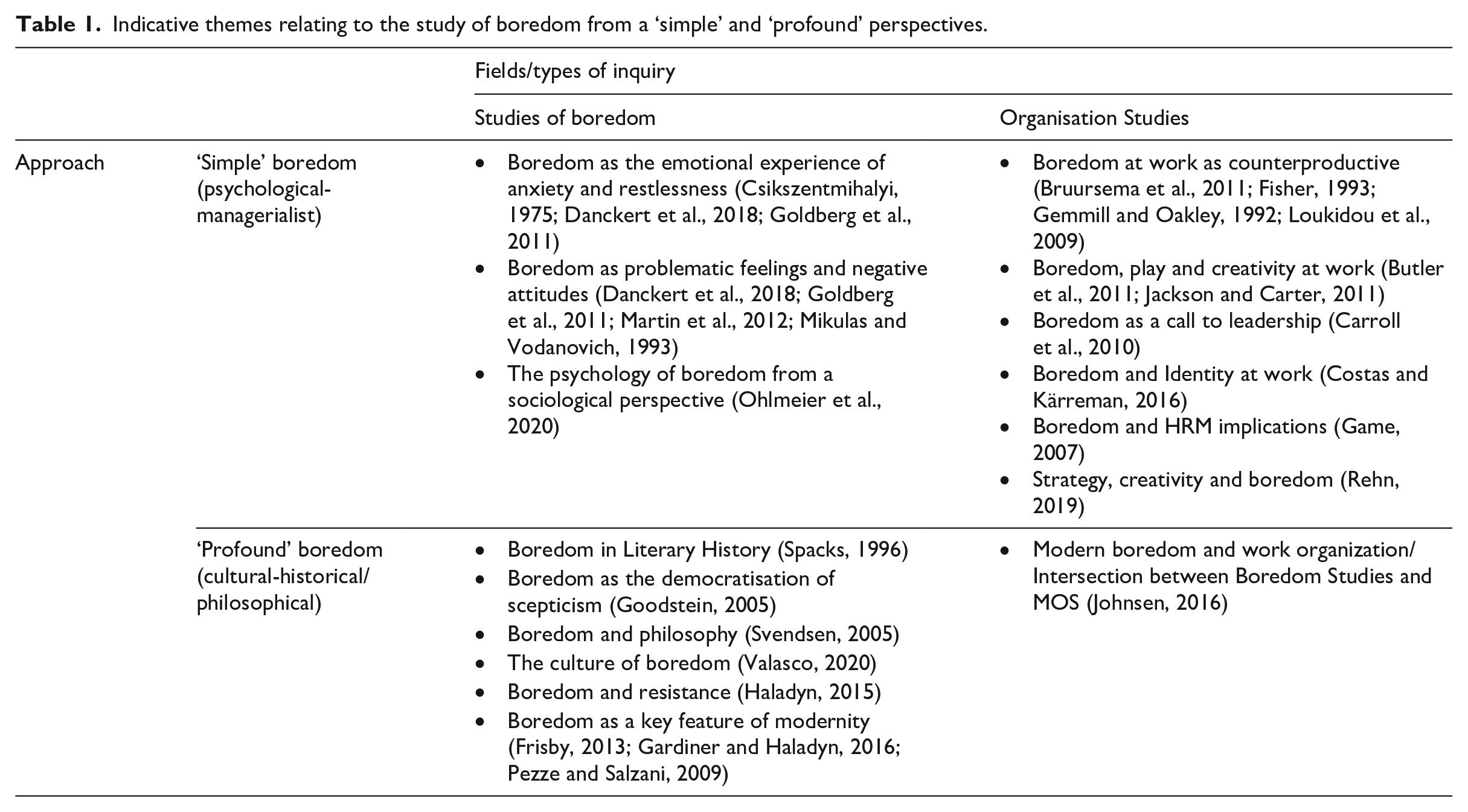
As our table shows, the particular and overt attention to boredom at work of these studies appear to have surfaced with heightened impetus around the early 1990s. A key paper from this period is Fisher’s ‘Boredom at work: A neglected concept’ (1993). Fisher observed that the annual frequency of psychology articles between 1926 and 1980 were ‘less than one. . .on any aspect of boredom . . .’ In a later paper (Fisher, 2018), it is noted that the frequency of ‘talk about boredom has changed dramatically over the last few years’ (Fisher, 2018: 68).
Table 1 is not exhaustive but indicates how questions relating to ‘boredom at work’ have proliferated from a ‘neglected concept’ in the early 1990s to a recurring and emphatic concern. In a comprehensive review of boredom in MOS (Loukidou et al., 2009), four major themes are identified: boredom in relation to jobs; individual differences; social context; and goals and coping. All of these are ‘simple’ concerns. Indeed, Fisher recognises the distinction between simple and profound boredom and explicitly accepts that her concern is with the former. Furthermore, Fisher sides with Toohey (2011) in dismissing ‘profound’ boredom ‘as an academic concept rather than an emotion’. She claims that ‘this supposed chronic state of extreme meaningless [sic] and ennui has attracted rather self-indulgent writing and discussion by theologians, philosophers, and literary figures for centuries’ (Fisher, 2018: 68). She defends the simple form on account of its prevalence as a human emotion in everyday life.
However, it would be a mistake to think that what Fisher describes as her ‘new approach to understanding boredom’ (1993: 406) marks the first attempt to study boredom from a ‘simple’ perspective in MOS. In fact, ‘simple’ boredom has been a key preoccupation for (industrial) psychology and managerial techniques throughout most of management’s history and the industrialised 20th Century. Given managerialism’s preoccupation ‘with the social-psychological aspects of work’ (Barley and Kunda, 1992: 363; see also Hollway, 1991; Rose, 1999; Townley, 1994) perhaps this concern is unsurprising. Indeed, boredom as a psycho-managerial problem appears as a key concern in some of management’s foundational texts, practices and formative contributors.
Notably, boredom plays a central role in F.W. Taylor’s Principles of Scientific Management (1911) in which one of the key concerns behind his time and motion studies was to ‘reduce . . . fatigue and boredom’ and ‘to establish pay based on the studies’ (Taneja et al., 2011). This was even more pronounced in Henri Fayol’s general theory of industrial management, in which he ‘appreciated that benefits derived from dividing work must be balanced against obvious disadvantages associated with such negatives as boredom and monotony’ (Wren, 2005: 217). Likewise, Mayo attended to boredom and its effects in his The Human Problems of an Industrial Civilization (2004 [1933]: 31–32, 38, 40, 43), linking it to work with high degrees of repetition, stating that ‘boredom and monotony are the factors to be taken into account rather than fatigue’ (Mayo, 2004: 27–28, emphasis added). Specifically, Mayo refers to Wyatt and Fraser’s (1929) study, which found that ‘the experience of boredom is fairly prevalent among operatives employed on repetitive processes’ and ‘is largely dependent on individual characteristics and tendencies’ (Wyatt and Fraser, 1929; referenced in Mayo, 2004: 31). In other words, we can see how this amounts to the ‘simple’ experience of an alienated detachment from the experience of work at hand. From within Fisher’s ‘new approach’ such prior studies of boredom are criticised for their focus on ‘vigilance and industrial monotony’ and are therefore deemed ‘unable to explain boredom on any but the simplest of tasks’ (Fisher, 1993: 395). However, a constructionist account of ‘boredom at work’ would offer an altogether different take on this history. Notably it would attend to how this history has itself helped construct the very emotional concept that Fisher and others assume to be ‘fixed and inevitable’ (Hacking, 1999: 2). That is to say that the history of conceptions and managerial interventions targetting the problem of boredom at work is not a neutral history. Instead, it is central to the development of discourses which both construct and maintain this emotion. Indeed, within MOS, Nikolas Rose has brought attention to the way in which ‘the psy disciplines and psy expertise have had a key role in constructing “governable subjects”’ (Rose, 1999: vii). The naming and submission of certain attributes as ‘boring’ or ‘monotonous’ through ‘psy’ knowledge can here be read as having ‘played a constitutive role in shaping the ways in which we think of ourselves and act upon our selves’ (Rose, 1999). Furthermore, Rose helps us see that simple boredom has become pervasive in MOS, because contemporary with Mayo’s Hawthorne Studies was the British psychiatry of the inter-war period. The National Institute of Industrial Psychology and its director, C.S. Myers (1873–1946), played a key role in constructing a new ‘view of the nature of [the] productive subject’ (Rose, 1999: 67). Extending the ‘principle of industrial betterment’ (Rose, 1999: 62) helped form a subject intelligible beyond mere economic replaceability and instead as a ‘key element of social economy’ (Rose, 1999). As Rose explains, this worker
‘was neither a mindless brute nor a psycho-physiological machine, but an individual with a particular psychological make-up in terms of intelligence and emotions, with fears, worries, and anxieties, whose work was hampered by boredom and worry, whose resistances to management were often founded in rational concerns, and whose productive efficiency was highly dependent upon sympathy, interest, satisfaction, and contentment’. (Rose, 1999: 67, emphasis added).
What is identified in this passage is what Hollway described as the production of ‘the sentimental worker’ (1991: 76–79). Indeed, ‘boredom’ itself plays a crucial role in Myers’ influential book Industrial Psychology in Great Britain, which he describes as ‘monotony in work’ (1926: 51–55; 64, 68, 71, 78–79). This transpired as part of studies that showed that industrial ‘fatigue, inefficiency and accidents’ (Rose, 1999: 65) were only partly due to physiological factors. Myers argued ‘the effects of mental and nervous fatigue, monotony [i.e. boredom], want of interest, suspicion, hostility’ (Rose, 1999: 66) warranted considerable attention, leading him to contend that ‘[t]he psychological factor must therefore be the main consideration of industry and commerce in the future.’ (Myers, N.D.; cited in Rose, 1999: 66).
The implication of this for Fisher’s so-called ‘new approach’ is that it highlights how ‘boredom’ (‘monotony’, ‘listlessness’ etc.) seems to point to the general problem in mainstream research that this category is itself a psychological construct (often applied to managerial concerns) and is therefore ‘manageable’. This has been conveniently forgotten as the construct has been reified and become increasingly referred to as something that exists ‘out there’, in the ‘real world’, without applied-psychological theorising. When boredom is ‘discovered’ in contemporary work situations, what this ultimately amounts to is the very channelling and furthering of the vocabulary that has made up the construct in the first place.
Notwithstanding critiques of managerialism’s rise and extension into the personal, emotional, and spiritual aspects of life (c.f. Heelas, 2002; Roberts, 2012), it is only very recently that boredom has been considered in line with the conceptualisation offered by the field of Boredom Studies (Johnsen, 2016): that is, in its ‘profound’ conception. A key insight from what Johnsen identifies as the common affinities between Boredom Studies and MOS is that studies of boredom at work need not be limited to prescriptive and managerialist concerns, which (counter to its proponents’ claims) rarely address the experience of boredom itself (Johnsen, 2011: 482). Instead, and in keeping with what we have outlined above, Johnsen (2016) emphasises the shared roots of boredom and organisation as bound to the industrial workplace and its mechanical administration of time (p. 1406). This means that the rise of boredom as a central feature of modernity can be understood as not merely ‘a passing fancy’ but rather ‘a name for the loss of meaning in the everyday activities that make out the fabric of a meaningful life’. (Johnsen, 2016: 1410).
Johnsen shows that the exclusion of historical and phenomenological accounts of boredom is a particularly emphatic oversight for MOS given the field’s notable shared affinities with Boredom Studies. One of Boredom Studies’ leading scholars, Elizabeth Goodstein – whom Johnsen draws on extensively (see also Johnsen, 2011) – opens her seminal study, Experience without Qualities: Boredom and Modernity (2005), by aligning boredom to the experience of time. Likewise, Johnsen explains that ‘the rise of boredom is the rise of a conflict associated with the artificial administration of time. While this conflict arises as a distinct malady around the 19th century, it has its roots in the gradual historical emergence of a conscience of human beings as subjects of organisation’ (Johnsen, 2016: 1406).
Following Johnsen, we contend that Boredom Studies’ prevalent conception of ‘boredom’ as a ‘profound’ and ‘totalising’ experience of modernity, allows us to understand boredom’s relation to work organisations as more complex than ‘simple’ managerialist accounts suggest. As a profound condition of the age, experiences of boredom at work might not be so easily overcome as mainstream ‘psy’ perspectives and managerial thinking often assume. Rather, ‘simple’ approaches and understandings often risk constituting more of the very process of industrial, rational and urban modernisation that created and sustained the phenomenon which contemporary considerations are preoccupied with mitigating, managing and overcoming. Profound boredom helps us understand the paradox of this, which is crucial for understanding Jünger’s potential contribution.
Boredom and danger in the work of Ernst Jünger
In this section we consider the themes of ‘boredom’ and ‘danger’ as they relate to ‘work’ in the thought of Ernst Jünger. We begin by considering some details in Jünger’s biography as it plays an important role in appreciating his unique approach. We then explain the significance of his overlooked contribution to Boredom Studies and the relevance of this to MOS. We do this by highlighting a key instance in which Jünger relates a ‘profound’ understanding of boredom to what we identify as its conceptual other – namely, ‘danger’. This shows, firstly, that boredom and danger are intertwined concepts in our times; and secondly, that both ‘boredom’ and ‘danger’ elucidate his historical theorisation of ‘work’. We suggest that the combination of these concepts provides the heuristic potential of Jünger’s thought for understanding boredom at work in the 20th and 21st Centuries.
Ernst Jünger (1895–1998): A brief introduction to his life and work as it relates to boredom
Jünger’s contribution to understanding boredom at work requires a grasp of some biographical details. This is because his status as a serious philosophical thinker has been contested on account of its proximity to his personal experiences (c.f. Hemming, 2008: 250). We attempt to show why a dismissal of Jünger in this sense would be an oversight.
Despite first gaining recognition as a writer for his personal account of the First World War from his perspective as a front-line soldier, Jünger is not a straight-forward war writer. Rather, he was a key 20th Century thinker whose experience of mechanised warfare and reading of Nietzsche combined to shape a specific philosophical perspective.
From his experiences on the battlefields of the First World War, he came to understand war as the ultimate expression of human existence. Central to this conception was Nietzsche’s notion that life is fundamentally premised on struggle (‘agon’). After publishing his war memoirs, In Storm of Steel in 1920 and Copse 125 in 1930 he went on to develop what has been described as his own ‘philosophy of war’ in such works as ‘Fire and Blood’ (1925) ‘War as an Experience of the Soul’ (1929) and Total Mobilisation (1931) (Stirk, 1941: 91). However, for Jünger, war was not understood as a means towards some political end – he was not fighting for nation, soil, blood, God or any ‘cause’ as such – but rather for war’s intrinsic sake. In the period before the Second World War he conceived of war as an l’art pour l’art (Presner, 2001: 104), an adventure for the sake of adventure which contained a transcendent potential on account of war constituting an experience of closeness to danger and death.
The theme of boredom therefore relates to Jünger’s experience of war in two ways. First, as a young man Jünger sought adventure in war. As a teenager he was ‘a bored and frustrated schoolboy [who] remained lost in his dreams of escape from the discipline of bourgeois life’ before running away from home and joining the French Foreign Legion (Bullock, 1998: 567). However, it would be a mistake to dismiss Jünger’s early sense of boredom as the reactionary nihilism of a restless youth, or to reduce his adolescent sense of boredom in the ‘simple’, psychological, sense. Even in his youthful expression of rebellion, Jünger was concerned with a more profound sensibility:
‘. . . Jünger understood very early on, perhaps even while a teenager, that Nietzsche’s intuition of the movement of European nihilism was no abstract speculation; rather, that intuition was completely founded in an astute vision of modernity’s horizon in its very coming to be’. (Costea and Hemming, 2017: xiii)
As a self-proclaimed disciple of Nietzsche, a key concern of Jünger’s extensive oeuvre is the problem of nihilism and the means of its overcoming (cf. Bousquet, 2016). 1 As Wolin puts it, Jünger ‘viewed the energies unleashed by the Great War as a heroic countermovement to European world-weariness’ (i.e. profound boredom) which he understood as undermining traditional religious and chivalric orders, military discipline, and ‘warrior-virtues’ at the hands of an ‘effete, decadent, and materialistic bourgeois Zivilisation’ (Wolin, 1992: 119).
Indeed, as Martin Heidegger put it in an essay dedicated to Jünger in 1955, Jünger’s The Worker provided
‘a description of European nihilism in its phase after the First World War . . . the phase of “active nihilism” (Nietzsche). The action of the work consisted – and in a transformed function still consists – in making “total work character” of all actuality visible through the figure of the worker’. (referenced in Costea and Hemming, 2017: xii)
We attend to The Worker in greater detail below. However, for now, it is worth noting that Heidegger and Jünger developed an intellectual exchange between 1949 and 1975 (Heidegger and Jünger, 2016). Although not in direct reference to The Worker, in his notebooks from 1936 to 1939 (Heidegger, 2012), Heidegger engaged with the Jüngerian themes on the totalising experience of work in our times with a focus on boredom. In these notebooks, Heidegger names ‘total boredom’ as so central to the ‘age of the machine’, that he considered it as technology’s ‘hidden goal’ (Heidegger, 2012: 109). He also considered boredom as a ‘fundamental mood’ (Grundstimmung) 2 and thus situated it in the same work-technological age that Jünger addresses in The Worker. Analysed as such, this profound boredom is ‘the most adequate, and yet also widespread, form of response to the lack of responsibility that allegedly marks the consummate nihilism of the machine age’ (Hammer, 2004: 277). As one of Boredom Studies’ central thinkers, coupled with his close relation to Jünger, Heidegger’s diagnosis of what Jünger calls the ‘age of the worker’ in relation to boredom is important. As we will show later, although Jünger does not address boredom within The Worker, Heidegger’s position here adds further credence to considering Jünger’s thought in this regard.
In Jünger’s 102 years in the heart of Europe (Wachtmeister, 1998), he saw clearly – both as a witness, participant and intellectual – the various movements that related to the ‘bourgeois discourse of security’ (Gil, 2010: 74). As a key thinker among the conservative ‘critics of modernity’ – notably, Martin Heidegger, Oswald Spengler, Carl Schmitt and Ludwig Klages –Jünger’s keen historical sensibility and optics perceived the bourgeois claim to power and rule over modern ‘society’ as deeply misguided (‘illusory’), and its insistent demand for security as a weak and desperate affront to life. Following Nietzsche, whose ‘critique of Western modernity [had] been outlined some 40 years earlier’ (Wolin, 1992: 2), Jünger offered a radical critique of the modern values and institutions belonging to the bourgeois epoch (in both the 19th and 20th Centuries). This took shape through what he conceptualised and understood as the bourgeois’ negative relation to ‘danger’. Crucially, he considered the bourgeois as ‘. . .perhaps best characterised as one who places security among the highest values and conducts his life accordingly. His arrangements and systems are dedicated to securing his space against danger’. . . (Jünger, 1993c: 27). In what follows we show that although ‘danger’ is the central phenomenon that Jünger focussed on – as the utmost item that bourgeois society was preoccupied with avoiding – he did this with an implicit reference to boredom. This will be addressed in greater detail in our discussion, where we seek to show and explain how it relates to boredom, Boredom Studies, and boredom at work.
Boredom as a recurring theme in Jünger’s Work
Although Jünger has been mentioned in studies of boredom previously (c.f. Kustermans, 2016; Svendsen, 2005), there has yet to be a concerted effort to consider his work’s significance for this field. This is despite the term ‘boredom’ (‘langweile’) appearing with some frequency across his extensive oeuvre. Although it is beyond the economy of this paper to list every single mention, some examples provide a sense of the theme’s centrality. For example, in his first memoir, Storm of Steel (1920) he describes ‘the monotony of trench life’ in simple terms, reflecting that ‘[t]here’s nothing worse for a soldier than boredom’ (Jünger, 2016: 88–89). References in his literary fiction are most pronounced in his novella A Dangerous Encounter (1993a [1985]) where the trope is employed a handful of times, as it is in his novel, Eumeswil (1993b [1977]). However, the most overt and conceptually nuanced instances are in two of his philosophical essays from the 1930s: On Danger (1931) and On Pain (1934). In both essays boredom is invoked as a secondary theme to those that give the essays their titles. In On Danger Jünger makes a singular reference to boredom, explaining that one of the best objections to the bourgeois preoccupation with security (against ‘danger’) as its ‘highest value’ is that ‘under such circumstances life would be intolerably boring’ (Jünger, 1993c: 29). In On Pain (2008 [1934]), he gets closer to a definition of the term, describing boredom directly as ‘nothing other than the dissolution of pain in time’ (Jünger, 2008: 77). While Jünger’s engagement with boredom can be gleaned from these examples, it is understandable why they may be deemed an insufficient basis to justify focussed scholarship for studies of boredom. However, there are at least two instances that warrant special attention for considering his potential contribution. The first concerns his influence on Walter Benjamin (which we will attend to now); and the second concerns Jünger’s invocation of ‘boredom’ in relation to one of his most significant philosophical themes (danger) and his understanding of work (as articulated in The Worker). This will form the main discussion of the paper.
Jünger’s influence on Walter Benjamin
Alongside Heidegger (which we have attended to above), Walter Benjamin is one of Boredom Studies’ central and foremost thinkers for conceptualising boredom as a central subjective experience of modernity (Goodstein, 2005; Moran, 2003; Salzani, 2007; Torbett, 2009). Gardiner and Haladyn (2016) describe Benjamin – alongside Goethe, Dickens, Delacroix, Baudelaire, Schopenhauer, Kierkegaard, Nietzsche, Simmel, Heidegger, and Arendt – as one of Boredom Studies’ ‘noteworthy, cultural and intellectual figures’ (Gardiner and Haladyn, 2016: 5). This is largely because his Arcades Project (written between 1927 and 1940 and first published in 1982) is a seminal text for the field. In this unfinished text, Benjamin makes the claim that what he calls ‘deep’ boredom ‘began to be experienced in epidemic proportions in the 1840s’. (Benjamin, 1999: 108). Despite this, Boredom Studies appears to have overlooked the crucial influence that Jünger had on this work, as it was inspired by Jünger’s collection of fragments of surrealist prose, The Adventurous Heart: Figures and Capriccios (Jünger, 2012 [1929]). As the translators of the 2012 English edition explain, Benjamin was ‘inspired by the volume’ claiming ‘to have been unable to “read more than two or three pages at a time, for my heartbeat became so strong that I was forced to lay the book down”’ (Bures and Neaman, 2012: xvii–xviii). Even Benjamin, who opposed Jünger’s politics and aesthetics of war, found his vision resonated (Hillach et al., 1979). These indirect connections to Benjamin alone justify recognition of Jünger as a contributor to analyses of profound boredom.
Additionally, a further contribution that has been previously overlooked concerns how Jünger directly connects ‘boredom’ to his central philosophical themes of ‘danger’, ‘pain’ and ‘work’, which are central to his critique of modernity in terms of its bourgeois ‘rule’ and preoccupation with security. We turn to this next.
The Worker: Dominion and Form: Jünger’s theory of work as a critique of bourgeois rule and boredom
This section considers Jünger’s contribution to understanding the phenomenon of boredom at work by focussing on his philosophical essay, The Worker: Dominion and Form (Der Arbeiter: Herrschaft und Gestalt) (1932). An overview of the text’s key ideas, themes and terminology is provided to give an account of Jünger’s theory of work, and how this contributes to understanding the profound nature of boredom at work in the 21st Century. The Worker is the culmination of ideas that Jünger developed in other writings during the inter-war period (notably his respective essays from 1931 and 1932, On Danger and Total Mobilisation). By reading The Worker alongside these essays, we show that a theory of boredom can be reconstructed by noting the term’s omission in The Worker. It is through this, we argue, that Jünger’s conception of work holds the potential for a powerful critique and understanding of boredom at work today under contemporary regimes of neoliberal managerialism.
Jünger’s vision of work in the ‘age of the worker’
The Worker: Dominion and Form is considered Jünger’s philosophical magnum opus. First published in 1932 on the eve of the Nazi seizure of control, the text’s premise is that ‘work’ is an axial concept and defining feature of our age. Jünger’s vision in The Worker is that work has the potential to constitute a ‘new age’ replacing that of the 19th Century’s ‘bourgeois age’, and its values of safety, security, enlightened subjectivity and the steady acquisition of material comfort and progress.
In The Worker Jünger thinks through the coming into being of this new epoch. To do this he uses the term Gestalt, which in the English version is translated as Form. Gestalt refers to a particular kind of understanding about the world and the self which determines the nature and arrangements of a historical epoch. The German term Gestalt refers to the capacity to give shape or form to something. It also refers to a ‘figure’ or ‘shape’. Jünger uses the term to refer to the historical trajectory, or destiny, of a comprehensive range of human affairs in a specific period of time. As he explains in an essay from 1963, ‘Gestalt is the metaphysical expression of power – we might say power’s capacity to give form’ (Costea and Hemming, 2017: xvii). As the ‘supreme meaning-giving reality’ (Jünger, 2017: 189), it refers to a prevailing worldview that has the ‘power’ to inform or shape the direction of human affairs along particular paths, but not other paths. When Jünger refers to ‘the worker’ it is as such a Gestalt (Form): ‘To be a worker, the representative of a great form entering history, means to take part in a new humanity destined for dominion’ (Jünger, 2017: 40).
Jünger uses the term Dominion to describe a historical epoch in terms of legitimate power. This term, which in its original German, Herrschaft, 3 means ‘lordship’, ‘retains the sense of the Latin root dominus (lord) but is more abstract and thus avoids making power the possession of a personal figure or political organisation’ (Hemming and Costea, 2017: xvi). In Jünger’s usage, Herrschaft ‘[. . .] is what we call a condition in which the limitless space of power is referred to a single point from which it appears as a space of justice’ (Jünger, 2017: 42). In contrast to the common use of ‘worker’ in our everyday usage this ‘single point’ refers to the worker in terms of the modern prevailing view of the world that emerges after the ‘death of god’ and in which a system of ideas and values develop towards a human world fully resembling a ‘workshop’ (Jünger, 2017: 127).
Jünger’s theorisation of work is premised on his understanding of the figure of ‘the worker’ which he positions in relation to that of ‘the bourgeois’. While his characterisation of these two familiar representatives of modern capitalist society might at first glance seem commonplace, their relation appears in a particularly different way in Jünger’s unique historical thinking (Sokel, 1993: 35).
Jünger describes the worker as a ‘typus’, which is contrasted with the opposing figure of the bourgeois ‘individual’ (Jünger, 2017: 75–96). A speculative figure, the typus is a form of Nietzsche’s ‘overman’ and one which Jünger compared with Prometheus (Jünger, 1981: 168, 175) and linked to the tragic ‘proximity to relentless power’. The typus reveals the ‘individual’s’ mistaken understanding of power as something that can be possessed. By using the concept ‘typus’ Jünger importantly does not ‘name a subject position’ (Costea and Hemming, 2017: xiv). Instead, the ‘typus is the historical manifestation of a historical movement, the movement of an epoch whose very existence depends on continuous and ever-accelerating production. . .in a world-historical process in which the place of any “one” can only be understood and determined in relation to “work” (Costea and Hemming, 2017: xv).
In Jünger’s view, the relationship between typus and individual is fundamentally a hierarchical one – a ‘difference in rank’ (Jünger, 2017: 9) – whereby the worker is the superordinate to the bourgeois (Jünger, 2017: 86–96). This may seem counter-intuitive, especially given the dominant Marxian understanding of ‘worker’ and ‘bourgeoisie’ as social categories expressed in terms of socio-economic ‘class’. However, Jünger rejects a view of the worker as a ‘representative of a new estate, a new society, or a new economy’ because ‘he is more: namely, the representative of a proper form acting in accordance with its own laws, following its own calling. . .’ (Jünger, 2017: 40). Thus, the worker represents more than a ‘new political or social stratum seizing power’ (Jünger, 2017: 40). The typus is nothing less than a ‘new humanity’ or ‘new man’ that reflects and is an expression of an entire age. The worker is therefore to be understood as ‘equal to all great historical forms’ of the past (Jünger, 2017: 40). To explain the magnitude of the worker’s status as a ‘great historical form’ Jünger provides a contrasting example through ‘the age of chivalry’:
‘Just as chivalric life was expressed in every detail of a way of life unfolding in a chivalric manner, so is the life of the worker either autonomous, an expression of himself and thereby of dominion, or nothing other than mere striving for a share in dusty rights, in the now insipid pleasures of a bygone age.’ (p. 40)
In this regard, ‘the knight’ can be understood as the figure that manifests the form of the age that pertains to it, that is, the feudal age. Thus, we can understand the knight’s foremost values – piousness, the warrior ethic, conformity to the chivalric code, courtly manners, abidance to principles of honour, nobility and service – to correspond with the social organisation of feudalism and its system of ‘estates’. In this sense, the knight’s relation to the feudal age is what Jünger’s ‘worker’ is to ‘the age of work’. In turn, this notion of ‘estates’ becomes central to Jünger’s critique of ‘the bourgeois’ as it relates to ‘the worker’. The distinction between ‘estates’ and ‘class’ is attended to in the beginning of The Worker, where the ‘age of the third [i.e. ‘bourgeois’] estate’ is described as an age of ‘illusory dominion’ (pp. 5–11). This follows because by conceiving of ‘the worker’ as a great historical form he shows that the bourgeois’ claim to power (Dominion) is ‘illusory’. This illusion is based on the notion of ‘class’, which is ultimately a concept ‘invented’ by the bourgeoisie. For Jünger, the ‘bourgeois age’ is therefore historically understood and situated at an intermediary stage between the ‘feudal age’ and the ‘age of the worker’. In ‘the worker’ Jünger saw the advent of a new age in which bourgeois values would be abandoned in favour of a new and higher ‘dominion’ and ‘form’. Here, work is described as ‘the rhythm of the fist, of thoughts, of the heart; it is life by day and night, science, love, art, faith, religion, war; work is the oscillation of the atom and the force that moves stars and solar systems’ (Jünger, 2017: 41).
In historicising the ‘bourgeois’ as an ‘illusory’ dominion and ‘interim’ age he offers a fundamental, and polemical, critique of bourgeois life and values. Alongside other German ‘critics of civilisation’, Jünger abhorred bourgeois institutions and their ideals of safety, security, democracy, liberalism and the pursuit steady material progress (i.e. the enlightened hallmarks of modernity). Jünger felt these sacrificed the dynamism of life; romanticism, adventure, courage, fear, pain and danger, which he associates with what he calls the ‘elemental’ (das Elementare). The ‘elemental’ refers to the ‘realm beyond human control and command, a realm of primaeval force, unbounded and infinite, which irrupts into, and decides for, the human world, from beyond and outside human reckoning, craft and cunning’ (Costea and Hemming, 2017: xvii). Crucially, Jünger sets up the parameters of this critique in a section of The Worker entitled ‘The Irruption of Elemental Powers into Bourgeois Space’ (2017: 18–27). This section is a revision of his essay On Danger (1931), 4 which is crucial for our thesis because it introduces and situates boredom in a central way and allows us to see boredom in a new light. Moreover, it is in On Danger that Jünger first articulates the essential difference between ‘the bourgeois’ and ‘worker’, although he does not name ‘work’ or ‘the worker’ in this essay. On Danger provides an early semblance of the very critique he would employ to account for his vision of ‘the age of the worker’. He does this by critiquing the bourgeois worldview on account of its relation to ‘the elemental’, i.e., danger. It is this that provides us with the conceptual entry-point to begin reconstructing a theory of boredom from Jünger’s thought.
Boredom and danger as a relation to ‘the elemental’
In On Danger Jünger addresses the theme of danger as a means of critiquing bourgeois liberalism. The bourgeois, he explains, is ‘perhaps best characterised as one who places security among the highest values and conducts his life accordingly. His arrangements and systems are dedicated to securing his space against danger. . .’ (Jünger, 1993: 27 emphasis added). It is in response to this that Jünger invokes the notion of boredom (langweile). Having accounted for the values of the bourgeois, he remarks that one of the ‘best objections’ to a life lived in conformity with bourgeois rule and valuation is that ‘under such circumstances life would be intolerably boring’ (Jünger, 1993: 29 emphasis added). He gestures towards an alternative to the bourgeois’ negative relation to the elemental by describing those ‘who, in the foggy dark of night, left their parental home to pursue danger in America, on the sea, or in the French Foreign Legion’ (Jünger, 1993, 29). In contrast to the bourgeois, he understands such figures as ‘elemental’ or ‘adventurous’, who do not seek to secure themselves against danger, but rather seek out the elemental in life, embrace it despite (or even because of) the dangers it represents. In a bourgeois world, such people enact a ‘revolutionary protest against the values of the bourgeois world’ (Jünger, 1993). 5 Rather than security, they seek a ‘profitable life’ by departing for ‘distances symbolised by strange lands, intoxication, or death’ (Jünger, 1993). It follows that, for the bourgeois, such ‘adventurous’ or ‘elemental’ figures are deemed dangerous, which results in a struggle between ‘rule’ and ‘spirit’. In Jünger’s writing, the dangerous ones include ‘criminals’, ‘believers’, ‘artists’, ‘warriors’, ‘detectives’, ‘solitaries’, ‘lepers’, ‘lovers’ and ‘beasts of prey’ – everything that stands against bourgeois values and its ‘rational-moral world order’ (Jünger, 2017: 118). The bourgeois possesses a ‘monotonous spirit’ (Jünger, 2017: 57) and goes to great pains to ‘[convince] those with an adventurous heart that danger is not at all at hand and that the world and its history is governed by laws of economics’ (Jünger, 2017: 32). For the adventurous, to seek danger is to avoid boredom: to avoid danger – and secure one’s life against fate (‘that mother of great danger’ (Jünger, 1993: 23) – is ‘intolerably boring’. The adventurous are life-affirming, whereas the bourgeois are life-denying (in their securing of life against the dangers of fate).
In contrast to the bourgeois’ ‘will to security’ and fear of what Jünger variously calls ‘fate’, ‘danger’, ‘Nature’ and the ‘elemental’, those with adventurous hearts possess a ‘will to danger’. This is ultimately in attunement with the elemental and a rejection of the ‘intolerably boring’. He explains this further in The Worker when he clarifies that:
‘[t]he sources of the elemental are two kinds. On the one hand, they lie within the world, which is always dangerous, just as the sea, which, even when utterly becalmed, harbors danger within itself. On the other hand, they are located in human hearts, yearning for play and adventures, for hate and love, for triumphs and falls, feeling the need for danger just as much as for security, and for whom a situation of basic security rightly appears as incomplete’. (Jünger, 2017: 30)
It is this comportment that leads him to describe work in the ‘age of the worker’ as ‘the rhythm of the fist, of thoughts, of the heart; it is life by day and night, science, love, art, faith, religion, war; work is the oscillation of the atom and the force that moves stars and solar systems’ (Jünger, 2017: 41). Indeed, unlike the illusory dominion of the bourgeois, Jünger’s ‘worker’ affirms his ‘dominion’ because it harnesses ‘the elemental’.
Towards a theory of boredom: Boredom’s omission in The Worker
Of utmost significance for Jünger’s thesis in The Worker is that this relation to the elemental – comprehensively elaborated on in the book – is a fundamental constituent in the new world of the ‘Typus of the worker’. While this affirmative aspect is recognised in Jünger’s analysis in On Danger, in this essay he also articulates a negative feature, which he names ‘boredom’. This is not named in The Worker but implied in the section, ‘The Irruption of Elemental Powers into Bourgeois Space’ (2017: 18–27). Indeed, boredom’s constitution as the other of danger is central to his understanding of the ‘adventurous’ alternative to bourgeois values. When Bures and Neaman (2012) ask ‘What kind of humans have adventurous hearts?’ in their introduction to Jünger’s The Adventurous Heart (2012 [1929]) they answer with Jünger; precisely because he understands them as ‘[p]ersons for whom to avoid danger is to accept boredom. . .’ (Bures and Neaman, 2012: xiv).
When Jünger expanded on the ideas he developed in On Danger for The Worker he omitted the reference to boredom. Whether this was intentional or not, the fact that Jünger only mentioned this term once and omitted it later should not obscure its significance. Crucially, it appears as the negative counterpart to his focus on ‘danger’. It is therefore only by reading these two texts alongside each other that one can fully appreciate that the affirmative concept of ‘danger’ has a negative correspondence to the concept of ‘boredom’.
In On Danger, he writes:
One of the best objections that has been raised against this [bourgeois] valuation is that under such circumstances life would be intolerably boring. This objection has never been of a purely theoretical nature but was applied practically by those young persons who, in the foggy dark of night, left their parental home to pursue danger in America, on the sea, or in the French Foreign Legion. (Jünger, 1993c: 29 emphasis added)
In contrast, when this is rewritten in The Worker, it reads:
‘The bourgeois almost succeeded in convincing those with an adventurous heart that danger is not at all at hand and that the world and its history is governed by laws of economics. Young people who leave the parental home under the cover of darkness and fog feel they must travel far and wide to seek out danger, across the sea, to America, to the Foreign Legion, to the back of beyond’. (Junger, 2017: 32)
In no uncertain terms, Jünger explains that it is against the prospect of boredom that those with ‘adventurous hearts’ ‘pursue’ and ‘seek out’ danger. And, crucially, through these words, Jünger introduces boredom as a concept for critiquing the modern bourgeois world. He does this by suggesting that ‘boredom’ can be thought of as the other of danger. This provides the conceptual entry-point for appreciating the elemental person’s experience of bourgeois life and organisation. Their pursuit of danger (as attended to in The Worker) is only one part of this experience; the other, boredom, forms the second part, as it constitutes the response to the illusory dominion of the bourgeois period. Thus, Jünger’s analysis of ‘the worker’ as an elemental type can be fully appreciated by boredom’s relation to danger and modern work.
Boredom and danger at work: An illustration of Jünger’s potential contribution
In this section we employ our reconstructed theory of boredom (emphasising it as a negative counterpart to danger) to illustrate Jünger’s potential for conceptualising boredom at work today. We do this by explaining how his critique of bourgeois values (which were first named in On Danger and later extended through The Worker) still apply to work under 21st Century managerialism. We will attempt to show how Jünger’s understanding of boredom allows us to see why boredom remains a prevalent phenomenon in the contemporary workplace, despite managerialism’s intensified efforts to problematise, counteract and overcome it. Specifically, Jünger allows us to see how the foremost discourses of 21st Century managerialism superimpose a constructed reality that is not natural or elemental, but one that conceals its true, boring nature.
Boredom at work today: Managerialism as the new expression of bourgeois values
In the context of the contemporary workplace it would seem that profound boredom is a redundant concept. Contemporary discourses of managerialism suggest that work is not a site of boredom at all, but one that allows and encourages ‘freedom’, ‘play’, ‘creativity’, ‘innovation’, ‘wellness’, and a host of activities and experiences deemed counter to the experience of boredom. Indeed, managerial discourse’s reorientation towards such ‘soft’ aspects of work is what Thrift (1997), Heelas (2002) and others (Ray and Sayer, 1999) have discussed in terms of ‘soft-capitalism’, ‘the self-work ethic’ and capitalism’s ‘cultural turn’. In this context, one might legitimately ask who could possibly be bored in work organisations today, given how work is increasingly framed as anything but boring. However, as the literature on boredom at work suggests (reviewed above), questions concerning the experience of boredom at work today are rooted in an apparent contradiction. On the one hand, work is framed as anything but boring; on the other, there is continued concern with boredom at work by academics and practitioners alike which suggests a sustained ‘need’ to overcome this negative experience at work. This contradiction might be explained in light of the established literature within MOS which highlights how the normative and ‘soft’ aspects of work are underpinned by a rational, ‘hard’ managerial agenda (e.g. Barley and Kunda, 1992; Bendix and Guillén, 2001; Ezzamel et al., 1996; Fleming and Sturdy, 2011; Hanlon, 2015). One particularly useful approach for considering Jünger’s analysis in relation to this is Costea et al. (2005, 2007) who equate the ‘cultural turn’ in management with what they describe as managerialism’s ‘Dionysian’ turn. This is particularly useful because it employs the same Nietzschean vocabularies that correspond with Jünger’s recurring interest in the distinction between the elemental and the rational.
Following Nietzsche, Jünger’s critique against the constraints of the human subject under the regime of bourgeois liberalism can be understood as recognising the spirit of Dionysus. As a spirit of danger, disorder, adventure, intoxication and the ‘elemental’ it is a positive counterpart to the Apollonian spirit that values harmony, progress, rationality, and order (i.e. bourgeois values). Thinking in these terms, the authors contend that through the managerial mobilisation of vocabularies of play ‘management itself has entered into a kind of “Dionysian” mode, a spirit of playful transgression and destruction of boundaries. . .’ (Costea et al., 2005: 141). As others have pointed out, following the increased focus on elements such as ‘culture management’, ‘self-management’ and ‘Human Resource Management’ in the 1980s, a new mixture of play and work has appeared on the managerial horizon (Andersen, 2009, 2013; Roberts, 2012). It is in relation to these focuses that, in the early 21st Century, ‘self-assertion seems to have produced a new cultural order in which Dionysian modulations have come to replace the rational, productive, ascetic, self-sacrificial “Prometheus” of early capitalism’ (Costea et al., 2005: 146). This might be read in terms of a linear progression from bourgeois capitalism evolving into a new and altogether different managerial capitalist order. However, this has not been a simple movement from one set of practices and values to another. Despite claims announcing ‘the end of history’, from the 1990s onwards, through managerialism, the bourgeois has demonstrated its sustained capacity to recuperate and assimilate an expanded range of conceptual structures into its wake. The managerialism of today – with its particular forms of self- and world-understanding – should therefore not be interpreted as a distinct break with the bourgeois worldview that Jünger critiqued. To the contrary, managerial thought, discourse and practice, shows how the bourgeois values and ideas that Jünger critiqued and described as ‘illusory’ (in contrast to those of ‘the worker’) have been contained and extended over the course of the late-20th and 21st Centuries through managerial authority.
It is this that allows us to see this ‘Dionysian turn’ as not an entire transgression of the Apollonian spirit. Contained within it is a rhetorical mobilisation and appropriation: that is, a Dionysian ‘mask’. While this mask conceals the bourgeois concern for securing life against ‘danger’, ‘fate’ and the ‘elemental’ it also extends security, which Jünger contended was the bourgeois’ supreme concern. This security, ‘understood in the broadest sense. . .demands’ that ‘the world be brought under human control and dominion and kept at a safe physical distance’ (Costea and Hemming, 2017: xiv). The implication of this for the managerial discourses of ‘soft capitalism’ is that this is a rhetoric that conceals the ‘hard’ managerialism associated with abstract reasoning, rational, linear, mechanical, and predictable imperatives. What we are witnessing therefore is a Dionysian promise concealing management’s Apollonian nature. This is what Mumby (2005) describes as the ‘irresistible march of managerialism and its attendant rationalization processes’ (p. 27). This therefore casts doubt about interpreting managerialism’s turn towards the ‘soft’ attributes of human subjectivity (cf. Heelas, 2002 ; Roberts, 2008, 2012; Thrift, 1997) as a purely ‘Narcissistic-Dionysian’ figure ‘entitled to endless fun’ (Costea et al., 2007: 164) in the arena and domain of ‘serious’ self-work (Costea et al., 2007: 163).
Our analysis of Jünger helps us see that managerialism is a powerful voice of the bourgeois, which mobilises the representation of work as ‘exciting’, ‘adventurous’ and, perhaps, ‘dangerous’, albeit in an instrumental-rational way. While appearing to abandon the high valuation of security, the bourgeois in fact does the opposite, that is, claims the domain of the elemental as a further measure of ‘securing life against fate, that great mother of danger’ (Jünger, 1993c: 28). In this way, contemporary managerialism is able to satisfy its calculative and rational interests while appearing to simultaneously satisfy the human desire for adventure. As Jünger (1993c) puts it, ‘the human heart is in need not only of security but danger too’ (p. 29).
This explains why the experience of boredom in the contemporary workplace can be at once seemingly unthinkable, and yet totally pervasive. This can be explained through Jünger because central to his understanding of boredom is that it results from a life lived in conformity with the bourgeois concern for safety and security: ‘the securing of life against fate’ (Jünger, 1993c: 23). This is ultimately what the bourgeois seeks through managerialism: the ideological expansion of a profoundly and metaphysically boring phenomenon through a discourse that claims the opposite. Indeed, around the same time that Fukuyama declared the ‘prospect of centuries of boredom at the end of history’ (Fukuyama, 1989: 18), Scott and Hart (1991) diagnosed ‘managerialism’ as being in a state of ‘exhaustion’. In their view managerialism paled in comparison to the success of politics in vying for public attention. ‘Management’, they said, ‘to put it plainly, is boring.’ (Scott and Hart, 1991: 39, emphasis added). Despite this they stressed management’s rational character, observing that ‘modern management, the planned and systematic use of power over individuals to achieve organisational goals, has turned out to be the most influential force in American history of the present century’ (Scott and Hart, 1991). A quarter of a century later, Klikauer (2015) revisited this text to explain that at its core managerialism is not only the merging of ‘ideology with management’, but its ‘[mutation] into a full-fledged ideology under the following formula: Management + Ideology + Expansion = Managerialism’ (p. 1106). Klikauer explained that management’s expansion as an ideology was ‘something rather simplistic, trivial, mundane, and, to be honest, rather dull’, thus leading to the conclusion that the ‘boredom’ named by Scott and Hart (1991: 39) ‘quickly expanded to become something that transcended management’ (Klikauer, 2015: 1106). It seems then that management, at its core, is, was and perhaps always will be profoundly boring. Therefore, any attempts to overcome boredom – especially when diagnosed in ‘simple’ terms – will inevitably amount to the mere channelling and furthering of the very vocabulary that has made the construct visible in the first place. Hemming (2018) makes a similar point in reference Klikauer’s critique of neoliberal managerialism, noting that Klikauer’s opposition to ‘economic rationalism and neoliberalism accepts, almost without realising it, that total mobilisation [i.e., managerialism] is itself the form life now takes’ (Hemming, 2018: 47, emphasis added). Likewise, management scholars concerned with identifying and overcoming boredom in ‘simple’ terms, fail to see how boredom is itself the very form their suggested interventions claim to overcome (see, for instance the upper left quartile of Table 1). What Jünger (among others that approach boredom from a ‘profound’ perspective) allows us to see is why.
Through Jünger we can see that managerialism’s positive framing of work today is ultimately a mask that seeks to conceal its fundamentally ‘boring’ nature. Under managerialism – as the latest manifestation of the bourgeois’ ‘will to security’ – perhaps boredom can never be overcome and will remain a fundamental feature and experience of working life. This was anticipated by Fukuyama who equated the triumph of liberal-democratic capitalism with a ‘great boredom’ that resulted from ‘the end of history’. In some ways, parallels can be drawn between Fukuyama and Jünger’s respective theses in 1932 and 1989. However, while Fukuyama anticipated the triumph of bourgeois liberalism at the end of history, Jünger’s polemic laid out the trajectory of its demise. In this work, Jünger understood the bourgeois age as a 19th Century phenomenon that he speculated would be replaced by the ‘age of the worker’. While Jünger (writing in the inter-war period) probably would not have been surprised that some semblance of the bourgeois soul would tighten its grip through post-war liberalism, The Worker did not anticipate how this, in the form of managerialism, would ultimately triumph by reifying aspects of life that he deemed counter to the bourgeois’ fearful relation to ‘the elemental’. Rather, in the decades since The Worker’s publication we have witnessed the continued success and expansion of bourgeois values, most recently through neoliberal managerialism. However, what Jünger’s speculation did not include was the bourgeois’ capacity for resilience, and how his total mobilisation would be reinvented through the modern figure of ‘the manager’ and his attendant ideology.
Conclusion
Having made the case for Jünger offering a theoretical contribution to the study of boredom at work, we will conclude by considering the wider implications of this for further research in and between MOS and Boredom Studies. Some of these relate to Jünger specifically, while others are a product of what Jünger’s critique offers in more general terms.
A central aim of this paper has been to extend Johnsen’s (2016) recognition that despite the common affinities between MOS and Boredom Studies, MOS’ emphasis on understanding boredom at work has largely been through a ‘simple’ perspective. Pace the claim of novelty within the ‘simple’ boredom literature of the past two or three decades, our literature review shows boredom to be a recurring problem throughout the history of management itself. The theme can be found in foundational texts by central contributors such as Fayol, Taylor and Mayo, and carried through both industrial psychology and labour process theory. This indicates the futility of overcoming boredom in both historical and more recent approaches.
Through Jünger, we have sought to address the inherent intellectual and practical shortcomings of such approaches. This is not least because they arguably perpetuate the very discourses which both construct and maintain the phenomenon of boredom at work. Instead, we have sought to consider this experience in light of its ‘profound’ conception through an author who has not received direct consideration in this regard before. What makes Jünger particularly relevant to MOS is that his philosophical and historical understanding offers a new perspective of both ‘work’ and ‘profound’ boredom.
Our analysis contains a specific suggestion to studies of boredom more generally: namely, that Jünger offers a dichotomy between boredom and danger that is heuristic of the currents along which contemporary managerial (and ultimately bourgeois) values and ideals have continued to flow through the course of the past and this century. This is especially important given how the bourgeois soul, under the auspices of 21st Century managerialism, is emphatically more bourgeois than at any point in the previous two centuries.
Through our close-reading, we have sought to show how a central preoccupation of Jünger’s work offers a specific contribution for understanding why ‘boredom at work’ remains a persistent phenomenon in contemporary organisational life, despite the various efforts by management to intervene and frame it as anything but boring.
Jünger’s potential as a thinker for MOS is justified, not least because his foremost themes – security, rationality, organisation, work and technology – are central to MOS. Indeed, Bloomfield et al. (2017) note that ‘Jünger’s writing begins where Weber’s ends, and in spite of their obvious differences there are also important thematic continuities between the two writers’ (p. 450). This, combined with Johnsen’s emphasis regarding the shared affinities between MOS and Boredom Studies, suggests Jünger is a potentially constructive thinker for future studies in both fields.
Specifically, Jünger can be understood as a novelty to Boredom Studies because he addresses the topic through its opposite (i.e. ‘danger’). Even in Goodstein’s (2005) comprehensive study, boredom is understood as a feature of modern life because it is central to an epoch driven by and towards ‘novelty and innovation, speed and progress’ (pp. 1–2) but does not consider boredom’s opposite or what an alternative would be. Jünger helps reveal this phenomenological oversight by considering danger as the other side of the Janus face of modern boredom. One potential avenue is to continue exploring the relevance of Jünger in MOS in general, and in relation to the themes of ‘security’, ‘danger’ and ‘boredom’ in particular. In relation to the latter, one possibility is to employ Jünger’s conceptualisation of boredom to exegete other aspects of his oeuvre that we have not attended to in detail here. For example, his literary fiction which contains boredom as a recurring trope.
Finally, we have indicated that through managerialism the bourgeois has advanced even further than Jünger had anticipated: ‘[t]he bourgeois almost succeeded in convincing those with an adventurous heart that danger is not at all at hand and that the world and its history is governed by laws of economics’ (Jünger, 2017: 32). In our own experience of the first two decades of the 21st Century, we can see that what Jünger warned against has become even more of a reality. While there is still a small window for adventurous hearts to exist in a bourgeois world, the bourgeois has tightened its grip through managerialism’s pervasiveness and encroachment into all aspects of life – private, emotional, spiritual, etc. (Grey, 1999; Hanlon, 2015; Townley, 2002). In view of this context, and despite texts written in the 1930s, we have hopefully shown that ‘Jünger’s critique has become even easier to grasp from our own position in the 21st Century’ (Costea and Hemming, 2017: xiv). This critique is perhaps more relevant than ever as this ‘experience without qualities’ continues to ‘haunt the Western world’ (Goodstein, 2005: 1) in new and creative ways.
Footnotes
Funding
The authors received no financial support for the research, authorship, and/or publication of this article.