




Abstract
In the face of rising sustainability issues, increasing numbers of organisations are trying to build compromises between their economic purpose and ecological objectives. Organisational studies focus on the analysis of such compromise processes but most studies do not seek to grasp the substantial changes advocated by ecological critiques. Our research is aimed at addressing that gap by clarifying the radical view sustained by ecological imaginary beyond conventional compromise processes. We engage in a qualitative study of biodynamics – an agricultural method based on a radical ecological imaginary – to evaluate its moral underpinnings through Boltanski and Thévenot’s Economies of Worth framework. Our findings help us to grasp the radical moral substance of ecological critique and to extend that framework beyond its dualist assumption. By highlighting antagonisms between meta-conceptions of justice rather than analysing compromises, our research provides insights into the radical organisational changes advocated by ecological critiques.
Keywords
Introduction
In a context of ecological crisis, some organisational researchers point to the need to imagine radically alternative solutions for achieving organisational sustainability (Gayá and Phillips, 2016; Nyberg and Wright, 2020; Wright et al., 2013). However, the organisational literature mostly focuses on business-as-usual solutions (Nyberg and Wright, 2020; Wright and Nyberg, 2017), compromise-building processes (Boltanski and Thévenot, 2006 [1991]) and reformist ecological critiques (Boltanski and Chiapello, 2005 [1999]) without studying the more radical forms of ecological critique (Boltanski, 2011) that would help to envision substantial changes.
To grasp the substantial changes advocated by ecological critiques, we conducted a qualitative analysis of biodynamics, a singular archetype of radical ecological contestation. Conceived in Germanic Europe in 1924, biodynamics is an agricultural method that defends a reconciliation between humans and non-humans while embodying a set of arguments for radical ecological thinking. Based on a documentary study of biodynamic principles and 28 interviews with biodynamic practitioners who face tensions in a context of high growth and a competitive environment, we considered together, as suggested by Boltanski (2011), the ‘reformist’ and the ‘radical’ critiques underlying that alternative agricultural movement. In doing so, we linked the Economies of Worth (EW) framework – with its multiple views of justice, referred to as worlds – and the concept of imaginaries to clarify the moral structure of biodynamic imaginary beyond a mere analysis of compromise-building processes. Our analysis challenges the green world, which is representative of a solely reformist ecological critique, and shows that ecological justice can be considered as a meta-world, which can guide the compromise-building – and explain the unresolved tensions – between worlds.
Our paper contributes to clarifying the radical ecological critique, or ‘meta-critique’, and provides insights for broadening the EW framework so that it can fully integrate ecological justice. Reciprocally, our paper contributes to the understanding of the moral substance of ecological imaginary. Finally, our research suggests that, in a context of ecological crisis where creativity is needed to face unprecedented challenges, organisations would benefit from embracing antagonisms and exploring imaginaries. Doing so would allow them to broaden their perspective on organisational changes and ways of breaking out of the nature-culture dualism.
Alternative imaginaries to underpin radical ecological critique
Beyond physical and material threats, the ecological crisis presents ‘a conceptual challenge to the way in which we imagine [our] existence’ (Castoriadis, 1975; Wright et al., 2013: 649). It requires a radical break with the conception of nature as a supply of unlimited resources for human activities, which is one core pillar of ‘capitalist imaginary’ (Wright et al., 2013), and with the resulting mode of organising (Levy and Spicer, 2013). Augustine et al. (2019) [1936] provide a clear definition of imaginaries: Imaginaries are deep cultural structures (Sewell, 1992) that form the pervasive and often unarticulated backdrop to more tangible knowledge, norms and institutions; they provide a moral orientation and epistemological underpinning of reality (e.g. Castoriadis, 1975 [1987]). [. . .] Imaginaries are thus fictional (not mere representations of reality), tacit (not fully articulated and discursively accessible) and psychologically distant (stylised, not concrete).
Some organisations have responded to ecological challenges by relying on radically alternative imaginaries that weaken the taken-for-granted boundaries between humans and a certain idea of nature (O’Mahoney et al., 2017; Roux-Rosier et al., 2018; Whelan and Gond, 2017). The ability to imagine a state of the world that is fictional and breaks with present reality (Augustine et al., 2019) echoes the ‘radical critique’ conceived in the Boltanski (2011) framework opposing ‘radical’ and ‘reformist’ critiques. Reformist critique relies on the representation of a ‘near future’ merely to correct established reality, so it fortifies existing institutions and dominant representations. Radical critique or ‘meta-critique’ is based on the imagining of a ‘distant future’ and constitutes a rethinking by social actors of the reality arbitrarily constructed and delimited by established institutions to promote non-institutionalised experiences and relationships (Augustine et al., 2019; Boltanski, 2011). Ecological imaginary intrinsically involves a radical moral questioning of the relationship between humans and nature. To grasp ecological radical critique, we analysed biodynamic imaginary through the lens of the EW framework (Boltanski, 2011; Boltanski and Thévenot, 2006) to capture the revolutionary moral grammar induced by that particular ecological imaginary.
Perspectives of analysing ecological justice with the EW framework
The EW framework offers valuable tools for bringing a moral lens to organisational studies (Cloutier and Langley, 2013). Boltanski and Thévenot (2006) show that, during conflicts, social actors rely on different representations of justice – differing views on what is morally worthy or unworthy – to promote their perspectives and to reach compromises. Based on the study of paradigmatic texts in political philosophy, those authors identify six common higher principles, which are referred to as worlds. The civic world values collective interest. The industrial world aims for efficiency. The market world values self-interest and commercial interests. The domestic world targets the respect of traditions and hierarchy. The inspired world aims for authenticity and values the inner character of the person. The fame world values public reputation. Each world provides a range of arguments, objects and evaluation methods that can be used by actors to criticise and justify their positions. Although they can be mobilised in any situation, some are likely to predominate in certain contexts (Richards et al., 2017). The worlds reflect moral values of modern political philosophy, but they are not exhaustive (Boltanski and Thévenot, 2006). The framework is open to alternative interpretations of the common good (Cloutier et al., 2017) and has been updated to integrate, for instance, the project-based world, which values systemic connections and flexibility (Boltanski and Chiapello, 2005).
Since the 1980s, modern societies have been facing growing ecological concerns at local and global levels (Blok, 2013). Followed by Latour (1998), Thévenot (1996, 2001) and Thévenot et al. (2000), Lafaye and Thévenot (2017 [1993]) suggest the existence of a representation of justice – the green world – that does not fall within the scope of previously identified worlds and questions the relationship between humans and nature. They first define the green world as the search for ecological balance (Lafaye and Thévenot, 2017; Latour, 1998; Thévenot et al., 2000) before showing that, beyond being a new world, the representation of ecological justice poses ‘an inherent radical challenge to the political and moral grammar [. . .] previously studied’ (Lafaye and Thévenot, 2017: 275). By that they mean that ecological debates involve considering a community that goes beyond humanity and confers dignity on non-human beings. That challenges Boltanski and Thévenot’s (2006) dualist axiom of argumentation, according to which justice issues only concern human beings as subjects and ends (Latour, 1998). Lafaye and Thévenot (2017) then show that social conflicts can question Western taken-for-granted categorisations such as humans/non-humans (Descola, 2013; Escobar, 2018). Lafaye and Thévenot (2017) underline the revolutionary character of ecological justice, consider it not to be sufficiently grounded in theory and therefore find it deserving of further research.
However, rather than questioning the community of reference concerned with questions of justice, the organisational literature dealing with ecological issues is still mostly limited to the analysis of compromise-building processes (Boltanski and Thévenot, 2006) occurring in specific anthropocentric situations (Nyberg and Wright, 2013, 2020). EW-related studies continue to focus on conflicts and compromises, including the green world (Blok and Meilvang, 2015; Finch et al., 2017; Thévenot et al., 2000), despite the limitations of the worlds’ dualist axiom in encompassing ecological justice (Lafaye and Thévenot, 2017). Researchers consider sustainable development initiatives and discourses such as corporate social responsibility (CSR) as compromise-making processes for dealing with tensions between economic and ecological purposes (Blok, 2013; Christiansen, 2017; Kazmi et al., 2016; Shin et al., 2022), or they more broadly highlight the mobilisation of a diversity of moral worlds within organisations (Demers and Gond, 2020; Nyberg and Wright, 2013). In doing so, they implicitly consider ecological critique as reformist (Kazmi et al., 2016) rather than radical (Chiapello, 2013). However, some research highlights the illusory nature of those compromises, which often result from power inequalities between actors (Finch et al., 2017; Gond et al., 2016; Nyberg and Wright, 2012; Patriotta et al., 2011; Strong, 2015). Although ecological issues are apparently considered in the compromises (Nyberg and Wright, 2012; Strong, 2015), they are only considered superficially (Demers and Gond, 2020; Prasad and Elmes, 2005; Whelan and Gond, 2017), with sustainable development initiatives mostly instrumentalised in favour of the market world (Blok, 2013; Shin et al., 2022). We assume that analyses of compromise processes are insufficient for understanding both worlds’ sympathies and incompatibilities and for capturing the actual revolutionary character of ecological justice (Hoffman and Jennings, 2021; Lafaye and Thévenot, 2017).
Linking the EW framework with biodynamic imaginary to grasp radical ecological critique
Following Basaure (2011; Basaure, 2011), who suggests embracing the ‘reformist’ and the ‘radical’ critiques together, some researchers show the need to abandon the focus on only analysing conflictual situations to reveal ‘what is fundamentally at play’ with radical critiques (De Cock and Nyberg, 2016: 475; Islam et al., 2019). Radical critiques challenge the compromise logic that constitutes reality and reveals its arbitrary nature by providing ‘explanations which lie outside the situation itself’ (Boltanski, 2011: 366; De Cock and Nyberg, 2016). They ‘reveal the provisional nature of social reality, questioning the fundamental values of an order and reaffirming the ability of the social to reconstitute itself’ (Islam et al., 2019: 28). However, by analysing the COPs of the United Nations Framework Convention on Climate Change, Islam et al. (2019: 23–37) show that the ‘highly ritualised performance’ of critique leaves no space for the capacity to imagine and consider the ‘substantive argument’ of radical critique, which is thus prevented from bringing about institutional change. In a totally different context, Cinque and Nyberg (2021) analyse theatre as a space that fuels imaginaries where the actors can dare to promote alternative realities. There exist spaces that are more likely to see the emancipation of imaginaries, such as artistic expressions (Cinque and Nyberg, 2021) or agroecologies, which experiment with a so-called reconciliation of humans and nature (Roux-Rosier et al., 2018).
Our research is aimed at clarifying the radical view of justice that ecological imaginary sustains beyond compromise processes to better grasp radical ecological critique. We believe that the analysis of imaginaries can expand the EW framework beyond its processual and reformist approach to capture the meanings and potential impacts of radical critiques on social reality. Following Lafaye and Thévenot’s (2017) work, we assume that the superficial analysis of the ecological critique in organisational research is not due to an intrinsic limitation of the EW framework, but it can be overcome by a clarified theoretical anchoring of the ecological imaginary within that framework. To explore the ecological critique, we draw on biodynamic imaginary – expressed through its own norms, practices and values (Islam et al., 2019) – that surfaces uncommon relationships with non-human living entities (Roux-Rosier et al., 2018). Using the worlds of the EW framework to make biodynamic imaginary’s moral dimensions more explicit (Augustine et al., 2019; Frère and Reinecke, 2011) allows us to: capture the ‘more tangible knowledge, norms and institutions’ underlying biodynamics and thus make biodynamic imaginary more ‘discursively accessible’ (Augustine et al., 2019 [1936]); grasp the internal coherence of ecological justice which allows some compromises between worlds while banning other compromises. This analysis leads us to reconsider the grammar of the EW framework so that it can embrace alternative imaginaries and thus radical critiques. Finding a bridge between the EW framework and the analysis of imaginaries, we examine more broadly how ecological justice could be integrated within the EW framework to express a radical critique which breaks the nature-culture dualism.
Method
Biodynamic radical imaginary
Biodynamics is an agricultural method initiated by the Austrian philosopher Rudolf Steiner in 1924. 1 Based on vehement criticism of the use of chemicals in agriculture, biodynamists consider the farm as an autonomous living organism where plants, animals and people feed and balance each other. Agricultural practices are organised according to the cycles of the planets, with Earth being considered subject to cosmic forces. Biodynamic products are certified by the Demeter label, a set of specifications established in 1932, which was the first organic agriculture brand in Europe. Biodynamics fuels a controversial debate. Although its products benefit from a stronger, more positive market perception of quality than organic ones, scientists vehemently criticise its ‘seemingly irrational methods’ (Negro et al., 2015: 596). The study of biodynamic imaginary as one archetype of ecological contestation helps in better understanding radical ecological claims.
Data collection
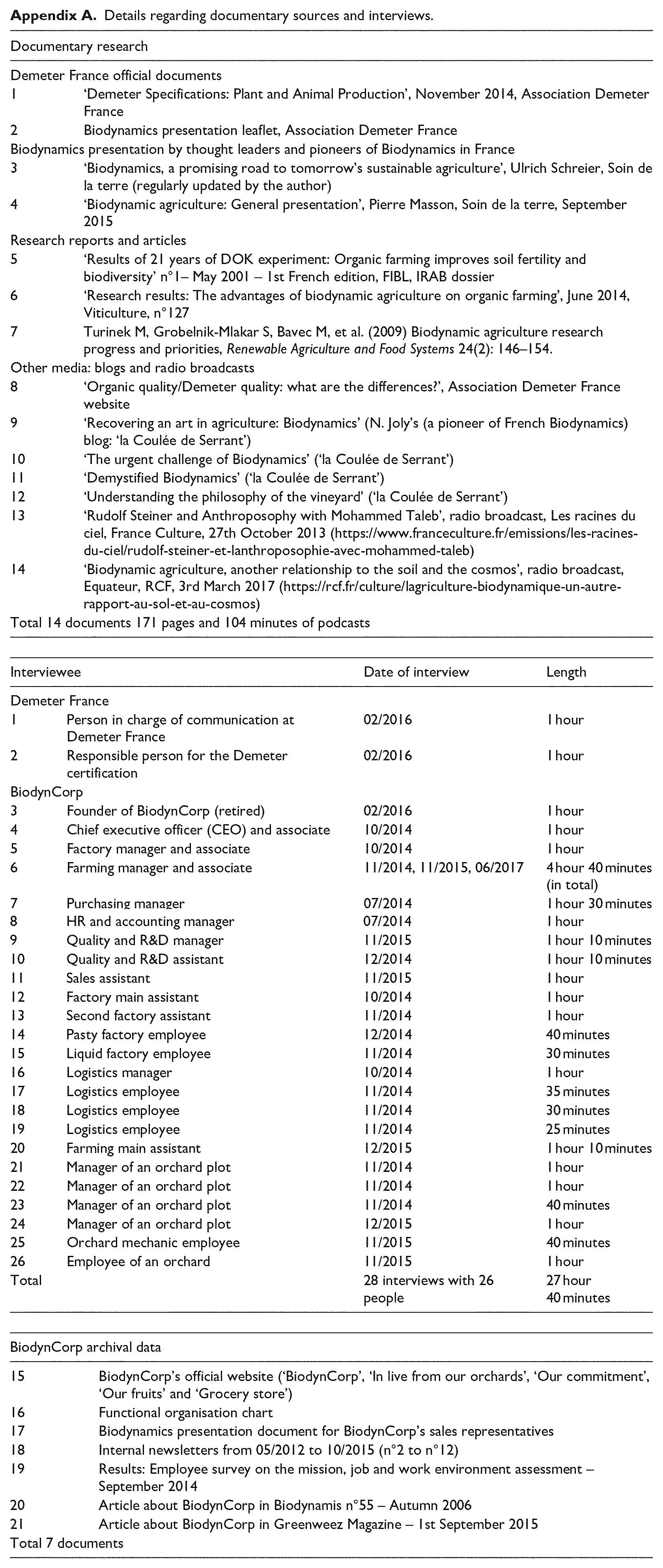
This research is based on a qualitative, interpretative analysis of multiple data sets. Fourteen documents dealing with biodynamics were provided or recommended by Demeter France representatives. The documents describe the principles of biodynamics from different perspectives: official specifications, presentation documents, research reports and articles, blog articles and radio podcasts. That data was complemented by 26 interviews conducted with biodynamic practitioners from BiodynCorp, a small enterprise in France involved in biodynamics, and two interviews with Demeter France representatives. The main author consolidated the understanding of BiodynCorp’s strategy and practices with six visits and two on-site meetings. The company’s internal documents and website were also analysed to triangulate key facts (Appendix A offers more details regarding the documentary sources and interviews).
BiodynCorp produces, manufactures and sells Demeter-certified products from arboriculture. The company has been expanding over the last 20 years due to the increasing demand for organic products. BiodynCorp aims to be the standard-bearer of biodynamics in a competitive context and exemplifies the antagonisms between economic-industrial development and radical ecological commitment. BiodynCorp’s small size allowed us to interview a sizeable proportion of its collaborators (20.2%) in our 26 interviews with factory and agricultural managers and employees. Interviewees were questioned about what biodynamics means for them, how it impacts their daily activities and which tensions have emerged with the company’s growth and structuration. All the interviews were fully transcribed.
Data analysis
While reconsidering the relationship between human and non-human beings would suggest not deciding in advance what is part of the natural or of the social (Latour, 1993), our will to navigate through imaginaries and moral grammar associated with biodynamics leads us to capturing human beings’ perspectives. We focussed our analysis on two types of data in which biodynamists reported their visions and modes of interaction with non-humans: bibliographical data to capture the principles of biodynamics; primary data to identify how actors experiment with those principles through daily practices and the tensions they face in practical situations. We were then able to decipher the internal coherence of the discourses that support biodynamic imaginary. The data analysis followed an abductive approach (Ketokivi and Mantere, 2010) alternating between data collection, data content analysis with NVivo 11 software and the refining of theoretical dimensions. By referring to the Boltanski (2011) analysis of the interdependence of the radical and reformist critiques, three stages of analysis allowed us to grasp and integrate those critiques into a common understanding of biodynamic imaginary.
Exploratory open coding
As a first stage, we conducted exploratory open coding to identify the salient features related to biodynamic imaginary without limiting ourselves to the EW framework worlds. We uncovered a contrast between a modern and materialist vision, which is heavily criticised by biodynamists, of nature as a resource separated from and at the disposal of humans, and an alternative vision, defended by biodynamists, of nature as both living and inclusive of humans. This first step highlighted key features of a radical ecological critique which questions the dualistic nature-human conception and established structures and norms.
Moral value and unresolved tension analysis
As a second stage, we used the EW framework as an analytical grid to reveal the moral syntax of biodynamic imaginary (Augustine et al., 2019; Frère and Reinecke, 2011). The coding consisted of interpreting the justifications used by actors in practical situations and within documents using the eight superior principles: the six worlds from Boltanski and Thévenot (2006), Boltanski and Chiapello’s (2005) project-based world, and ecological argument. 2 This moral-oriented analysis highlighted the limitations of a reformist critique in grasping biodynamic imaginary and provided preliminary insights into the radicality of its moral scope. It allowed us to grasp the constitutive worthinesses of biodynamic imaginary and, lastly, the tensions that cannot be resolved through compromises between worlds. For example, with the growth of BiodynCorp and rising competition in organic farming, the company strategy has become increasingly top-down and managerial, thus provoking unresolved tensions between the market, industrial and fame worlds on one side and the company’s ecological objective on the other. Although the tensions persist, biodynamist practitioners try to avoid illusory compromises by reactivating other values considered fundamental to ecological balance: the inspired and project-based worlds.
Analysis of ecological justice behind the radical critique conveyed by biodynamic imaginary
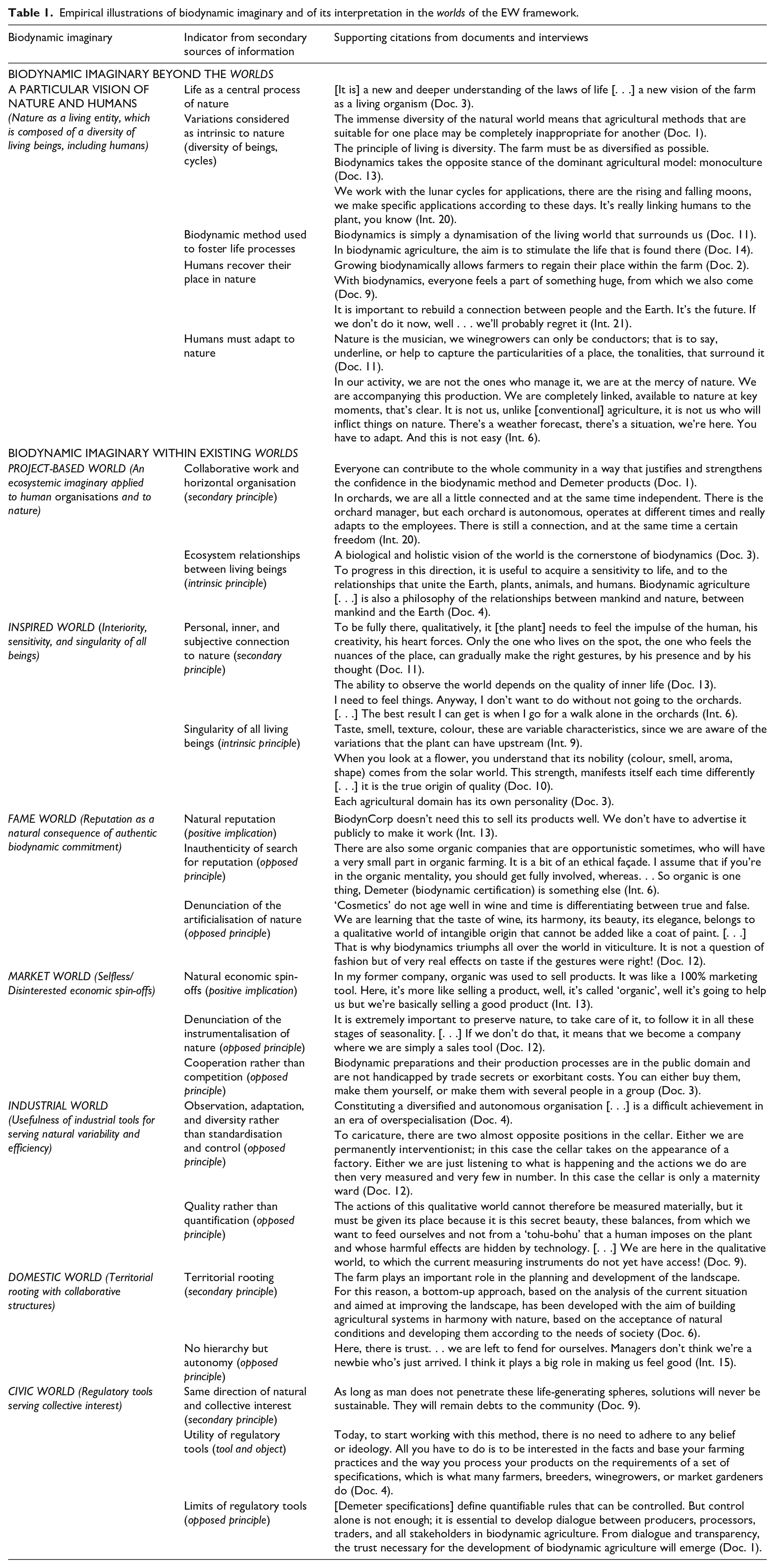
As a third stage, we integrated these two coding steps to specify how biodynamic imaginary translates into moral grammar and what it can teach us about ecological justice. That analysis confirmed that ecological justice is more than just a world; it is rather a meta-world which includes non-human subjects and guides the worlds’ sympathies or incompatibilities. We reinterpreted the resolved and unresolved tensions highlighted in the second stage of our analysis by qualifying the worlds mobilised by the actors in terms of how they used them in their justifications. We thus grasped how this specific ecological imaginary draws on orders of worth, criticises them, undermines their foundations and extends them to non-human subjects. Specifically, we qualified the worlds as follows: intrinsic principle (necessary condition for ecological balance, which applies to humans and non-humans), secondary principle (necessary condition for ecological balance through the (re)integration of humans in nature), object and tool (means favouring ecological balance), positive implication (benefits from ecological balance) and opposed principle (practice that is detrimental to ecological balance and cannot be considered a moral value). We present this integrated analysis with our findings. Table 1 offers additional empirical illustrations of this analysis.
Empirical illustrations of biodynamic imaginary and of its interpretation in the worlds of the EW framework.
Findings
Through the integrated results of our analysis, this section presents the ecological view of justice underlying biodynamic imaginary. Since imaginaries are ‘fictional (not mere representations of reality)’, the purpose of this section is not to detail the practical situations encountered by biodynamists but to present the ‘moral orientation’ provided by the biodynamic imaginary (Augustine et al., 2019[1936]) from the worlds’ qualification resulting from our integrated analysis. These findings help us to make sense of situational effective compromises and unresolved tensions.
An ecological justice applied to all living beings
Biodynamic practitioners deplore the fact that, throughout the 20th century, some institutionalised organic companies lost sight of the ethical foundations of organic farming. Our findings show that biodynamists seek not to deviate from such foundations but to help farmers ‘feel strongly connected to the essence of the biodynamic method, its principles and goals’ (Doc. 1). That essence refers to ‘a profound way of seeing Nature, Life and Mankind’ (Doc. 3) which we aim to clarify in this study.
According to biodynamic imaginary, nature is a whole living entity systemically bringing together ‘the different kingdoms of nature’, including humans, through ‘relationships of a living-biological, psychological and spiritual nature’ (Doc. 4). Biodynamic practitioners are critical of companies that consider nature to be a material resource separate from humans. According to the interviewees, such companies seek to minimise natural variations, diversity and singularities to make resources quantifiable, measurable and homogeneous, in contrast to the view that ‘agriculture is largely concerned with the formation of living interactions and cannot be defined in the same way as methods of producing inanimate objects’ (Doc. 1).
Our results show that the biodynamic method is based on ‘the search for symbioses between soil, plants, animals and human beings’ and ‘seeks to promote a good balance and good health at all levels of the biological pyramid’ (Doc. 3). Biodynamic farming is said to ‘[allow] farmers to regain their essential place on the farm’ (Doc. 2). Our data indicates that biodynamic agriculture is based on observation, experimentation and enduring physical contact with other living beings so that farmers can adapt to complex and variable living interactions. According to this ‘way of seeing Nature’, ecological justice is not strictly a human issue. It concerns all living human and non-human beings, who all have a dignity.
Intrinsic principles of ecological justice
Our results show that the very condition of ecological balance for biodynamists is the interconnection of singular living beings. Under these principles, ecological balance is based on different levels of systems (soil, farm, cosmos, etc.) that make intimate connections possible between singular living beings. Those necessary conditions reflect the characteristics of the project-based and inspired worlds extended to all living beings. First, each farm is considered a ‘diversified and autonomous organisation’ (Doc. 3), functioning as a living ‘individuality’ (Doc. 1), in which diverse humans, animals and plants relate to each other in a complex systemic logic. Beyond the human scope, biodynamic imaginary integrates humans and non-humans into a global cosmic system and subsystems. Biodynamic imaginary extends the project-based world’s scope to all living beings, beyond human relationships alone.
All life is constituted according to organic principles. Organs that appear separately unite to form a living entity. This organism is more than the sum of its parts. [. . .] If an agricultural domain is organised according to these principles and develops from its own resources a suitable system of soil life, plant development and livestock breeding, then we can legitimately speak of an agricultural organisation. (Doc. 1) Second, our analysis shows that biodynamists ‘[attach] great importance to the notions of individuality’ (Doc. 3). Their valuing of living beings’ singular and sensitive characteristics is itself characteristic of the inspired world extended to all living beings. It is important to understand that each animal has an originality to offer that will be more appropriate in one place or another. Every plant too. The possibilities are immense. (Doc. 11) Some humans are more sensitive, others are less. . . In plants, it’s actually the same thing. Each individual is different, each individual has different resistances. (Int. 6)
Secondary principles of ecological justice
Biodynamic imaginary not only relies on an alternative vision of nature and humans but also includes a process of overcoming the disconnection between humans and nature encountered in Western cultures (Descola, 2013). The project-based and inspired worlds shape the relationships between all living beings, but they also specifically indicate a way for humans to (re)integrate themselves into nature. Creating intimate relationships with non-human beings would condition the reconnection between humans and nature, and it would allow humans to grasp the complexity and uncertainty of other living forms. According to the Demeter specifications and principles, to be ‘connected to the essence of the biodynamic method’, humans must be able to ‘penetrate natural processes, using observation, thought processes and perception’ (Doc. 1) and to ‘acquire a sensitivity to life and to the relationships that unite the Earth, plants, animals and humans’ (Doc. 4). Human sensitivity and physical proximity to non-human beings would allow us to listen to other living beings and establish an intimate relationship with them. Practicing biodynamics would rely on such personal and affective relationships with non-human beings. As one biodynamic practitioner said, to work in BiodynCorp, people ‘have to love nature, to be sensitive, very attentive to nature’ (Int. 6). These intimate, affective and singular aspects reflect qualities associated with the inspired world.
We feel it. It’s intuitive, it’s human. At the base, we have this intuition. These values are lived from the inside. (Int. 10)
Biodynamists also show that their particular view of nature has important implications for the way humans work and organise economically. A biodynamic organisation such as BiodynCorp should be able to ‘build agricultural systems in harmony with nature, based on the acceptance of natural conditions’ (Doc. 7) so that they can be sufficiently flexible to adapt to the variations, diversity and complexity of living beings and their interactions.
We have a very flexible schedule. We leave in the morning and say to each other, we’ll do one thing, and the climate changes, we do something else. It has to be understood, it is part of the work. (Int. 22) Companies that only process and don’t produce agricultural products lose a lot; they lose a soul. [. . .] When you know what production is, you have another consideration for the person who will provide fruit [. . .] because you know how difficult it is to produce living things. [. . .] So, we have chosen to have products. . . well. . . with variable characteristics. And this is well understood when we are aware of the variations that the plant can have upstream. (Int. 9)
To reconnect humans with nature, biodynamic organisations must be flexible, horizontal and cooperative. They reject ‘top-down planning and regulation’ and favour ‘bottom-up, individual and participatory initiatives’ (Doc. 6). Biodynamic proponents maintain that ‘everyone can contribute to the whole community’ (Doc. 1). Collective intelligence, cooperation and experimentation are valued, while patents, competition and fixed techniques are criticised. Therefore, to reconcile humans with nature, biodynamics promotes values of flexibility, adaptation, horizontality, cooperation, collective intelligence, experimentation and transparency. Those values underpin the project-based world’s greatness.
Our analysis also shows that certain higher principles condition ecological justice because they achieve better harmony among living beings. Specifically, biodynamics is based on territorially anchored projects adapted to local particularities, because ‘each location is different from another’ (Doc. 1). Such characteristics are related to the domestic world.
Biodynamics includes a broader reflection on the place of the farm in its environment, on the involvement of the people who work on it as well as a balance between the parts or ‘organs’ of the farm (arable land, grasslands, livestock, market gardening, etc.) and the elements of nature such as forests, heaths, hedges, as well as watercourses. (Doc. 6)
Biodynamists also attach great importance to the notion of collective interest. As greatness is no longer limited to the benefit of human societies alone, it extends the boundaries of the civic world to encompass a broader common interest: natural ecosystem balance.
Objects and tools serving ecological justice
Our data shows that achieving ecological justice also relies on tools, some of which refer to worlds that are not necessarily approached as moral values. First, biodynamics proposes a method based on technical specifications with partly measurable processes and results, even if measures are said to be insufficient for ensuring the ‘essence’ of biodynamics or reflecting the complexity of living interactions. The BiodynCorp farming manager reported believing training and research in biodynamic techniques to be a guarantee of transmission, effectiveness and improvement of this alternative technique. For instance, the company works with research centres and provides experimental plots. Biodynamics is thus partly addressed through the objects of the industrial world. Besides that, the apparatus of the fame world provides objects which are said to be useful for BiodynCorp’s internal and external influence in favour of ecological values (e.g. internal newsletters, site visits by external stakeholders and a paedagogical presentation of biodynamics on the company website). The objects of the market world (e.g. investment capacity and product marketing) are also useful for organising the production and sale of biodynamic products, but they should be considered as a means to an end, not as ends in themselves, according to BiodynCorp workers. The project-based world provides objects such as networking technologies and partnerships which are useful for the functioning of a systemic organisation. Finally, regulation objects from the civic world are tools for ecological purposes such as Demeter certification. As tools, they are a way to serve ecological justice without necessarily being considered moral principles.
Positive implications for organising in accordance with ecological justice
According to our analysis, following the principles of ecological justice has positive repercussions for all worlds. However, that does not mean that those repercussions are sought for themselves or considered morally valuable. For instance, the interviewees emphasised the good reputation of biodynamic products. BiodynCorp wins a lot of prizes and trophies because of its ecological commitment and high-quality products (fame world).
We’re selling a product, well it’s called ‘organic’, it’s going to help us, but we’re basically selling a product that’s good. (Int. 12)
Biodynamic products are said to reflect the singularity of each terroir and the personality of the people working on the farm (inspired world), thus making such products inimitable and unsubstitutable. The market world also benefits from a commitment to biodynamics since such products are highly valued for their uniqueness and quality, and thus they are easy to sell.
The sales people often say ‘It’s easy for us. Because we are convinced of the product, we are not asked to sell tyres’. It is a product that is easy to sell today. (Int. 8)
Moreover, biodynamic supporters aim to promote nature-based efficiency (which is different from the technological-based efficiency of the industrial world) based on observation, flexibility and adaptability. Biodynamic farms are also said to stimulate territorial synergies (domestic world) and have local general interest benefits beyond organisational interests (civic world) because biodynamics ‘pays special attention [. . .] to social perspectives and the integration of the farm into the ecological, economic and cultural fabric of its environment’ (Doc. 3).
Principles opposed to ecological justice
Last but certainly not least, biodynamic imaginary challenges the very moral dimension of certain worlds. The market, industrial and fame worlds are not considered as moral principles, so they should not be viewed as goals in themselves, according to biodynamic imaginary. They can provide tools for ecological justice or benefit from its spin-offs, but they exclude non-human living beings in justice issues: seeking market, fame or industrial greatness would be detrimental both to the reconciliation of humans and nature and to ecological balance. The search for reputation (fame world) is vehemently opposed by BiodynCorp employees and managers. According to biodynamists, conventional agriculture would artificialise living organisms with the aim of making products competitive and attractive. Even in companies that appear to be ecologically responsible, reputation would tend to be the motivation for ecological commitment through organic farming or CSR. In contrast, biodynamic commitment is seen as humble and authentic, and reputation should remain a consequence of that commitment.
Some people do organic farming because it’s fashionable. Not everyone does what we are doing right now, whereas it should be mandatory. (Int. 14)
Biodynamists also denounce competition, quantitative management and the search for cost reduction induced by the market world. They strongly criticise the instrumentalisation of ecological commitment in search of economic interests.
If one wants to use these standards [Demeter] in such a way [. . .] that loopholes are sought for economic advantage, one should practice another type of agriculture. (Doc. 1) You shouldn’t use values to get a better return, but to make people feel good [. . .] you shouldn’t use biodynamics as some do with the organic label, for a commercial purpose. (Int. 12)
Biodynamists express the incompatibility between biodynamics and the industrial approach to efficiency, which seeks to reduce to a minimum the variation, complexity and singularity of living things considered as resources. The central assumption of biodynamics is that ‘biodiversity is not industrialisable’ (Int. 6). BiodynCorp’s employees and managers deplore the thought that organic farming has been technicised in line with the industrial world.
Fifteen years ago, there were still people who came from the organic movement, how to say, militants. Whereas now, they are people who do not necessarily have an organic farming state of mind. This is mainly a technical aspect. (Int. 9)
BiodynCorp’s growth and the intensification of competition in the agri-food sector have raised the issue of implementing a more managerial and top-down management approach centred on external marketing expectations. The result has been resistance within the company and the impossibility of finding a compromise between its radical ecological commitment and a strategic market orientation. Managers and employees have tried to mitigate the threat of drift towards the market and industrial worlds and to solidify biodynamic practices through the inspired and project-based worlds. They have tried to foster personal ecological convictions across the organisation through the continuous activation of the inspired world as the moral basis for organisational sustainability (e.g. daily personal and physical relationship between all employees and nature, and the recruitment of ecologically sensitive employees). They have also implemented a collaborative and systemic functioning (project-based world) to ensure that nature remains at the centre of the activities despite the company’s growth, which they wish to limit, and to foster its self-sufficiency and autonomy from external pressures (e.g. through ‘farm-to-fork’ activities and by spreading out seven small agricultural parcels and autonomous teams rather than expanding a single farm). However, those responses have not prevented the persistence of tensions which remain irresolvable from the ecological justice perspective in a context of economic pressures fostering market, industrial and fame objectives.
Some other values of the domestic and civic worlds cannot be applied to non-humans either, and making them a priority would be immoral. Due to its systemic perspective, biodynamic imaginary is opposed to hierarchical relationships and attachment to traditional structures (domestic world). It prefers autonomy and collaboration. Thus, biodynamic discourses are ambivalent about the domestic world because they value projects that are territorially anchored.
People in orchards are not executors, they are collaborators. It’s completely different from a view you can often hear where there’s one person deciding and people have nothing to say. (Int. 6)
Biodynamic discourses are also ambivalent about the civic world. Despite the search for collective interest, some regulations are criticised by BiodynCorp employees and managers as ‘totally out of touch with reality, made by people in their offices who just have technical data on sheets but no hands-on experience’ (Int. 24). That results in a tendency to quantify, standardise and adopt technical approaches. Demeter’s principles highlight the limits of conformity and promote personal engagement rather than strict compliance with regulatory criteria.
Discussion
Extending the EW framework with an ecological view of justice
Through our analysis of biodynamic imaginary, we contribute to the theorisation of ecological justice and provide avenues for enriching the EW framework so that it can accommodate radical ecological values. As biodynamics is just one archetypal but specific example of radical ecological critiques, this analysis could be extended through the study of other ecological movements and initiatives. Our analysis confirms that ecological justice cannot be considered on the same level as the other superior principles, called worlds, since it challenges the axioms defined by Boltanski and Thévenot (2006): non-human beings and ecosystems would benefit from a dignity and would be subject to justice issues (Lafaye and Thévenot, 2017). There is no such thing as a green world but rather an ecological meta-world, which encompasses and surpasses existing worlds. It goes beyond specific situations and is based on the premise that humans are an integral part of nature (Descola, 2013). Our results show that enlarging the community of beings worthy of justice has profound implications for the principles that may or may not be considered moral in social life.
First, in biodynamic imaginary, ecological balance is based on the singularity and diversity of living beings and the particular contribution of each (inspired world), with nature conceived as a systemic, non-static and non-hierarchical balance between beings (project-based world). Although they made no reference to the project-based world since it was theorised after their initial publication in 1993 (Boltanski and Chiapello, 2005 [1999]), Lafaye and Thévenot (2017 [1993]) asserted that the systemic way in which life forms interact is essential for ecological justice. Our research confirms that ecological justice is based on a complex overall balance between all living beings integrated into ecosystems and gives a fundamental character to the project-based world extended to all living beings. Moreover, ecological justice pushes the extent of the inspired world by considering the individuality and interiority of all living beings. As a result, to integrate ecological justice, the project-based and inspired worlds should encompass all living beings.
Second, from an ecological non-dualist view of justice, market, industrial and fame values are not moral. The search for fame as a basis for ecological action has led to greenwashing (Jones, 2019; Kassinis and Panayiotou, 2018; Lafaye and Thévenot, 2017). Despite green products and labels such as Demeter bringing competitive advantage (Latour, 1998), our analysis clearly asserts the moral incompatibility between ecological and market purposes: market objects are mere means to achieving ecological balance. Moreover, although the ecological question can in part be approached in a technical way (Lafaye and Thévenot, 2017; Latour, 1998), prioritising technical efficiency is incompatible with ecological justice (Thévenot, 1996) since the relationship with nature cannot be reduced to technical progress. Rather, it implies new ‘kinds of attachments’ between humans and nature (Thévenot, 2001). Thus, to achieve ecological justice, communication, market and industrial dimensions constitute a set of tools or a consequence of ecological commitment rather than a vision of the common good. The fame, market and industrial worlds would constitute moral values in dualistic justice only; where humans are considered separate from nature and non-humans are considered only as means (Latour, 1998). That would explain why the search for a compromise between ecological objectives and one of those three values is illusory.
Finally, our results highlight the ambivalence of domestic and civic values towards ecological justice. Although biodynamics advocates for territorial rooting and against de-territorialised, uprooted projects (Lafaye and Thévenot, 2017; Latour, 1998), ecological justice’s reliance on horizontal, flexible and cooperative principles (project-based world) means that domestic hierarchical relationships would not support ecosystem balance. In any case, despite contemporary overarching general interest – on the part of future generations and the whole planet (Latour, 1998) – and the need for formal regulatory instruments (Richards et al., 2017), contemporary regulatory language would be unable to fully address the ecological issue (Barouch, 1989).
With regard to compromises and unresolved tensions, to better understand why the ease of combining worlds varies according to the situation (Demers and Gond, 2020; Shin et al., 2022; Whelan and Gond, 2017), returning to imaginaries offers perspectives of more anthropological explanations based on structural sympathies and antagonisms between worlds within a given imaginary, not on specific controversial situations and day-to-day justifications. As imaginary is defined as a ‘phenomenological reality of images or mind-made coherent objects’ (Augustine et al., 2019 [1936]), our analysis shows that the internal coherence of the ecological meta-world is supported by particular compromise possibilities. The ecological meta-world is backed by the synergic combination of certain worlds (project-based and inspired worlds). It allows some compromises between worlds (civic world and domestic world). It finally refutes the moral value of certain worlds and excludes them from potential compromises while regarding them as useful objects for or positive impacts of the ecological balance (fame world, market world and industrial world). Lastly, our research shows the relevance of an analysis embracing the reformist and radical critiques together, as recommended by Boltanski (2011).
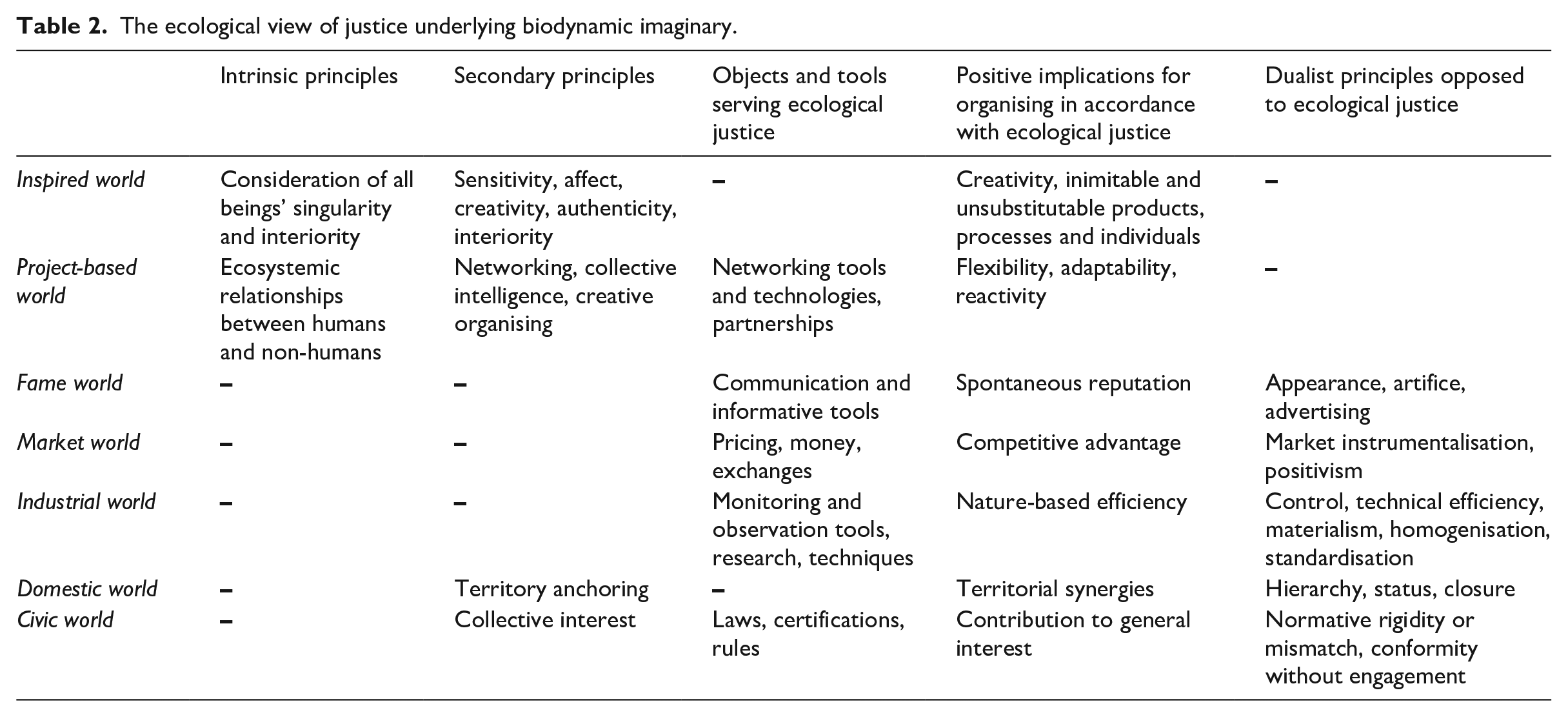
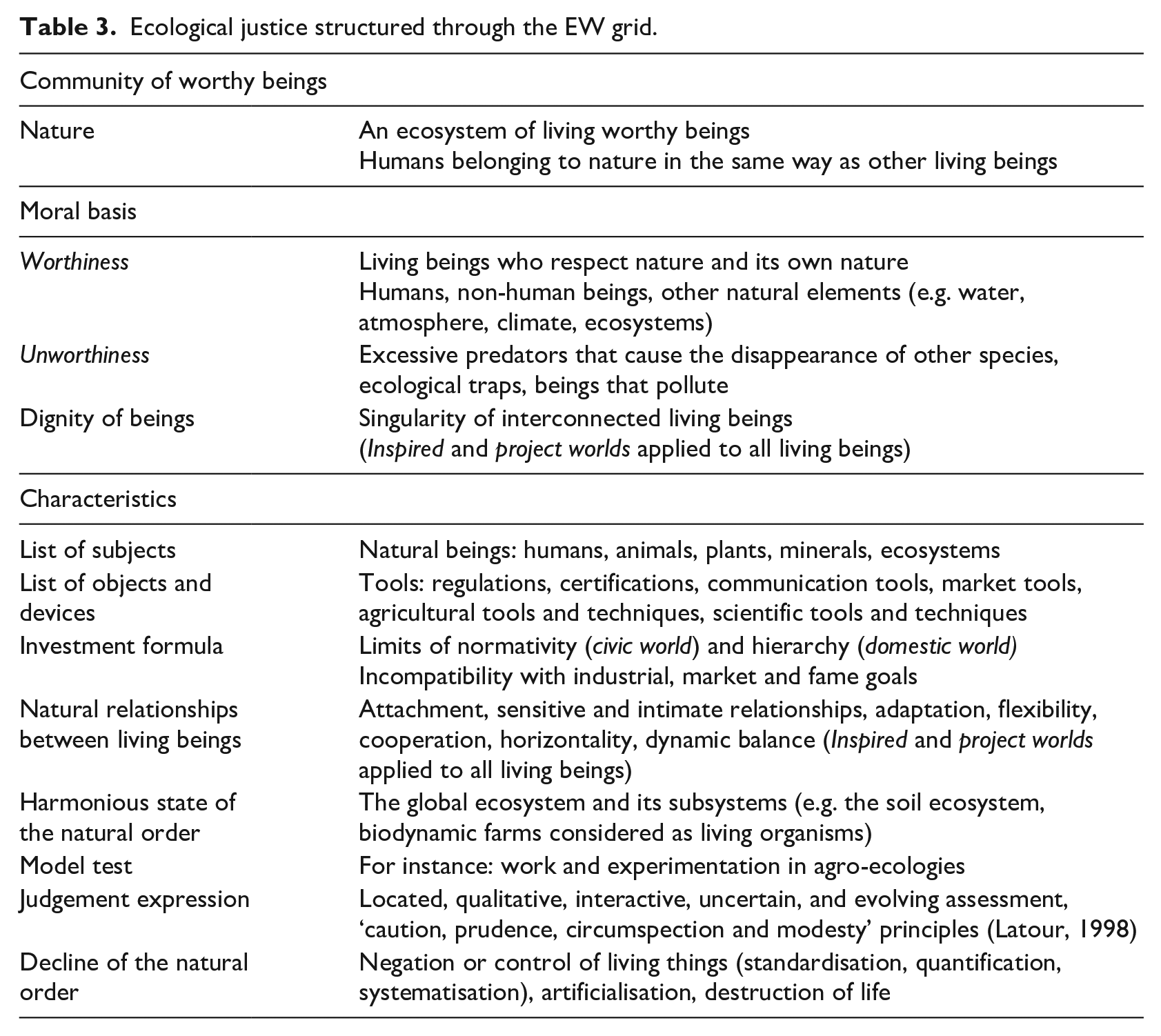
Table 2 describes the ecological view of justice underlying biodynamic imaginary and highlights how ecological justice undermines certain worlds but extends the reach of others. Based on the characteristics of the Boltanski and Thévenot (2006) EW grid and on our findings, we propose in Table 3 a premise of theorisation of ecological justice.
The ecological view of justice underlying biodynamic imaginary.
Ecological justice structured through the EW grid.
Moral substance of ecological imaginary
By unpacking an ecological view of justice carried by a radical ecological movement, we reciprocally provide some avenues by which to better understand the ‘deep cultural structures’ of ecological imaginary (Augustine et al., 2019 [1936]).
Exclusion of dualist values
Our results confirm that ecological imaginary leads to a substantial shift from the dualist and anthropocentric paradigm that has so far shaped sustainable development (Banerjee, 2003) and environmental management initiatives (Purser et al., 1995). Ecological imaginary therefore challenges some of the supposedly moral values linked to this dualist paradigm that concern only human beings and do not consider the dignity of non-human living beings. In particular, ecological imaginary implies abandoning the ideology of growth, economic primacy and the ideal of ‘perfect competition’ (Arrow and Debreu, 1954). It embraces an alternative approach to efficiency and science based on collective intelligence, cooperation and singularity, all of which is a radical break with the technical and materialistic turn of the Enlightenment and the Industrial Revolution. The search for reputation, respect for hierarchy and tradition and rigid attachment to regulations also stand in stark contrast to ecological imaginary.
The community of reference
Our results help to define the substance of ecological critique as, above all, the community concerned with justice issues. The ecological community of reference comprises human and non-human beings, as well as ecosystems. Our results support Latour’s (1998: 17) analysis that ecological justice does not mean that ‘we should not use, control, serve, dominate, order, distribute or study [rivers, animals, biotopes, forests, parks and insects], but that we should, as for humans, never consider them as simply means but always also as ends’. Moreover, this living community composed of dynamically interconnected diverse entities, including humans, is considered uncertain, unpredictable and intrinsically complex (Latour, 1998; Morizot, 2020). It could not be strictly and scientifically defined as an ordered and hierarchical unity, so any decision regarding it would require ‘caution, prudence, circumspection and modesty’ (Latour, 1998: 21).
Practical requirements brought by ecological imaginary
Our analysis of biodynamics helps with the unpacking of more practical requirements derived from ecological imaginary for the (re)integration of humans into nature. Our research reveals that redefining the community of reference from an ecological perspective impacts how humans politically interact with the world.
First, biodynamists emphasise the importance for humans to foster intimate relationships with non-human living beings (Blok, 2013) through physical embeddedness in nature (Whiteman and Cooper, 2000). Those experiences advocated by biodynamists can be considered ‘existential tests’ (Boltanski, 2011), which generate explanations independent of the situation itself (Boltanski, 2011) from ‘“lived” experiences rather than “instituted” reality’ (De Cock and Nyberg, 2016: 475). They also generate abilities to contest the dominant institutionalised categories and to imagine others. In this specific case, those intimate experiences highlight ‘what “affects” people’ during individual lived experience in their relationships with non-humans (De Cock and Nyberg, 2016: 475; Islam et al., 2019). That practical requirement echoes several works in political ecology supporting the idea that gaining sensitive experiences of relationships with all forms of life would allow humans to develop their sensory acuity – the cognitive ability to recognise life through their five senses (Malaurie, 2003). Such experiences would reveal the impossibility of living beings, including humans, to adapt to forms of organisation where commercial and industrial purposes take precedence and would lead them to defend ‘a lived world where humans and nature are not separated’ (Gorz, 2008). By being ‘[plunged] into what makes them humans’ (Latour, 1998: 20), humans would become aware of their ethical attachment and belonging to the natural common world (Larrère, 2018; Naess, 1989), and they would understand that all forms of existence interact in the same sociopolitical space (Morizot, 2020). According to that research, ecological imaginary would arise from such intimate ‘sensory observation and experience’ rather than during anthropocentric political conflicts (Augustine et al., 2019 [1936]).
As a second requirement, biodynamists emphasise the importance of recognising the multiplicity, complexity and uncertainty of the links between living beings, and they invite humans to develop a more complex perception of the world. Since living beings and their relationships could not be comprehended in a systematic, homogeneous and hierarchical manner, new flexible methods based on inquiry, collective experimentation and observation would be necessary (Latour, 1998). From an organisational perspective, that would mean developing interrelation-based organisations through horizontal, adaptable and collaborative processes. To be effective, those ‘project-based’ methods and processes (Boltanski and Chiapello, 2005) would need to rely on humans’ sensory capacity to listen to and perceive the complexity of living beings.
Accepting antagonisms rather than seeking superficial compromises
Although nature-culture dualism is predominant in Western countries’ representations (Descola, 2013), our research shows that some actors experiment with alternative relationships between human and non-human living beings (Wezel et al., 2009). Our analysis does not invite rejecting the nature-culture dualism. Rather, it suggests not considering it to be the only ontological foundation of moral thinking and highlights the possibility of coexistence of radically antagonistic positions within organisations and broader society. Echoing Laclau and Mouffe (1985), who argue that consensus and reconciliation can be dangerous because a society without antagonisms does not exist, some research shows that superficial compromises in a context of a dominant dualist culture (Descola, 2013) actually contribute to the greenwashing of practices which do not protect nature or, worse, promote its degradation (Nyberg and Wright, 2020; Prasad and Elmes, 2005). Compromises would tend to dissolve ecological radicalism (Latour, 1998) and cannot make radical ecological imaginary visible, whereas the true condition of democracy would be to reveal antagonisms (Mouffe, 2013).
Organisations do exist, such as biodynamist ones, that try to implement radically alternative models through collective participation, experimentation and the inclusion of diversity, uncertainty and dynamic variation in their strategies. Those organisations help to create a discursive space by avoiding a mere critique of the present or accommodation with modest expectations. That discursive space, nurtured by antagonisms, ‘allows for chains of meaning that allow the world to be thought differently’ (Parker and Parker, 2017: 1383). That testifies to the critical and reflexive capacity of dualism, which has left room for somewhat opposed moral positions through the emergence of alternate visions of ‘nature’ (Larrère, 2018). For this purpose, the word nature must be handled carefully, but it is still helpful when there is no substitute (Larrère and Larrère, 2019). Our analysis suggests that, whether radical or not, organisations would benefit from embracing antagonisms, breaking away from the pressing and sometimes illusory search for compromise, and allowing opposition to take place without massacre (Mauss, 2011). Faced with the difficulty of building consensus around geoengineering as a solution to climate change, Augustine et al. (2019: 1930) highlight the value of a dialectical process maintained by antagonit imaginaries to increase the concreteness and credibility of this technology. They show that browsing through imaginaries can help actors to envision the future and radical alternatives and to guide collective action in the same way that previous imaginaries have structured the expected futures of capitalism (Beckert, 2016).
Conclusion
Our research contributes to the clarification of ecological justice through the analysis of radical ecological imaginary. It provides some avenues for extending the EW framework beyond nature-culture dualism. Ecological justice challenges the so-called morality of certain values linked to the dominant dualist imaginary, especially economic, industrial and fame values. Reciprocally, it offers a renewed approach to moral values aimed at encouraging reconciliation between humans and nature. This approach supports the idea that, beyond the human critical and political dimension of ecological conflicts (Gorz, 2008), humans should experience personally and physically their ethical attachment and belonging to the natural common world (Larrère, 2018; Naess, 1989) to understand that humans and non-humans are integrated in a complex and dynamic set of systems that are perpetually balanced and unbalanced (Lafaye and Thévenot, 2017; Larrère, 2018).
Looking at ecological imaginary from other perspectives, such as research into plant intelligence (Brenner et al., 2006), changes in the legal rights of nature (Chapron et al., 2019), other ecological movements or non-Western cultures (Descola, 2013), would be relevant to confirming and further theorising the moral values constituting ecological justice. Moreover, actor network theory could constitute a valuable methodological approach to studying relations between humans and non-humans directly – rather than through a given imaginary – allowing participative observations of in-situ practices and direct questioning of actants (Callon, 1986; Latour, 2005). Besides, the extended EW framework could bring a fresh moral lens to analyses of the scope of ecological radical critique on organisational situations and controversies. Breaking the tendency of organisational studies to support business-as-usual would encourage, ‘through a radical re-imagining of the purpose and focus of management research’, the engagement of these studies with ideas that go beyond the ‘phantasmatic win-win scenarios’ of sustainability (Nyberg and Wright, 2020). Finally, there may exist a diversity of imaginaries on which other meta-worlds in play are based; meta-conceptions of justice that allow or ban certain combinations of worlds and that redefine the scope of common higher principles. Besides processual studies, organisational studies could go deeper and benefit from the more radical and fictional perspectives offered by the analysis of imaginaries to unpack such meta-worlds and make sense of other underlying successful or unsuccessful compromise processes.
Footnotes
Appendix
Details regarding documentary sources and interviews.
| Documentary research | |
|---|---|
| Demeter France official documents | |
| 1 | ‘Demeter Specifications: Plant and Animal Production’, November 2014, Association Demeter France |
| 2 | Biodynamics presentation leaflet, Association Demeter France |
| Biodynamics presentation by thought leaders and pioneers of Biodynamics in France | |
| 3 | ‘Biodynamics, a promising road to tomorrow’s sustainable agriculture’, Ulrich Schreier, Soin de la terre (regularly updated by the author) |
| 4 | ‘Biodynamic agriculture: General presentation’, Pierre Masson, Soin de la terre, September 2015 |
| Research reports and articles | |
| 5 | ‘Results of 21 years of DOK experiment: Organic farming improves soil fertility and biodiversity’ n°1– May 2001 – 1st French edition, FIBL, IRAB dossier |
| 6 | ‘Research results: The advantages of biodynamic agriculture on organic farming’, June 2014, Viticulture, n°127 |
| 7 | Turinek M, Grobelnik-Mlakar S, Bavec M, et al. (2009) Biodynamic agriculture research progress and priorities, Renewable Agriculture and Food Systems 24(2): 146–154. |
| Other media: blogs and radio broadcasts | |
| 8 | ‘Organic quality/Demeter quality: what are the differences?’, Association Demeter France website |
| 9 | ‘Recovering an art in agriculture: Biodynamics’ (N. Joly’s (a pioneer of French Biodynamics) blog: ‘la Coulée de Serrant’) |
| 10 | ‘The urgent challenge of Biodynamics’ (‘la Coulée de Serrant’) |
| 11 | ‘Demystified Biodynamics’ (‘la Coulée de Serrant’) |
| 12 | ‘Understanding the philosophy of the vineyard’ (‘la Coulée de Serrant’) |
| 13 | ‘Rudolf Steiner and Anthroposophy with Mohammed Taleb’, radio broadcast, Les racines du ciel, France Culture, 27th October 2013 (https://www.franceculture.fr/emissions/les-racines-du-ciel/rudolf-steiner-et-lanthroposophie-avec-mohammed-taleb) |
| 14 | ‘Biodynamic agriculture, another relationship to the soil and the cosmos’, radio broadcast, Equateur, RCF, 3rd March 2017 (https://rcf.fr/culture/lagriculture-biodynamique-un-autre-rapport-au-sol-et-au-cosmos) |
| Total 14 documents 171 pages and 104 minutes of podcasts | |
| Interviewee | Date of interview | Length | |
|---|---|---|---|
| Demeter France | |||
| 1 | Person in charge of communication at Demeter France | 02/2016 | 1 hour |
| 2 | Responsible person for the Demeter certification | 02/2016 | 1 hour |
| BiodynCorp | |||
| 3 | Founder of BiodynCorp (retired) | 02/2016 | 1 hour |
| 4 | Chief executive officer (CEO) and associate | 10/2014 | 1 hour |
| 5 | Factory manager and associate | 10/2014 | 1 hour |
| 6 | Farming manager and associate | 11/2014, 11/2015, 06/2017 | 4 hour 40 minutes (in total) |
| 7 | Purchasing manager | 07/2014 | 1 hour 30 minutes |
| 8 | HR and accounting manager | 07/2014 | 1 hour |
| 9 | Quality and R&D manager | 11/2015 | 1 hour 10 minutes |
| 10 | Quality and R&D assistant | 12/2014 | 1 hour 10 minutes |
| 11 | Sales assistant | 11/2015 | 1 hour |
| 12 | Factory main assistant | 10/2014 | 1 hour |
| 13 | Second factory assistant | 11/2014 | 1 hour |
| 14 | Pasty factory employee | 12/2014 | 40 minutes |
| 15 | Liquid factory employee | 11/2014 | 30 minutes |
| 16 | Logistics manager | 10/2014 | 1 hour |
| 17 | Logistics employee | 11/2014 | 35 minutes |
| 18 | Logistics employee | 11/2014 | 30 minutes |
| 19 | Logistics employee | 11/2014 | 25 minutes |
| 20 | Farming main assistant | 12/2015 | 1 hour 10 minutes |
| 21 | Manager of an orchard plot | 11/2014 | 1 hour |
| 22 | Manager of an orchard plot | 11/2014 | 1 hour |
| 23 | Manager of an orchard plot | 11/2014 | 40 minutes |
| 24 | Manager of an orchard plot | 12/2015 | 1 hour |
| 25 | Orchard mechanic employee | 11/2015 | 40 minutes |
| 26 | Employee of an orchard | 11/2015 | 1 hour |
| Total | 28 interviews with 26 people | 27 hour 40 minutes | |
| BiodynCorp archival data | |
|---|---|
| 15 | BiodynCorp’s official website (‘BiodynCorp’, ‘In live from our orchards’, ‘Our commitment’, ‘Our fruits’ and ‘Grocery store’) |
| 16 | Functional organisation chart |
| 17 | Biodynamics presentation document for BiodynCorp’s sales representatives |
| 18 | Internal newsletters from 05/2012 to 10/2015 (n°2 to n°12) |
| 19 | Results: Employee survey on the mission, job and work environment assessment – September 2014 |
| 20 | Article about BiodynCorp in Biodynamis n°55 – Autumn 2006 |
| 21 | Article about BiodynCorp in Greenweez Magazine – 1st September 2015 |
| Total 7 documents | |
Funding
The author(s) disclosed receipt of the following financial support for the research, authorship, and/or publication of this article: The research field was funded by Audencia Business School as part of Claire-Isabelle Roquebert’s doctoral contract from November 2013 to June 2018. After this date, the author(s) received no financial support for the research, authorship, and/or publication of this article.

Notes
Author biographies
Agronomist and doctor in sciences of management from AgroParisTech, Gervaise Debucquet is currently professor at Audencia Business School in the field of sustainable and healthy food, with a focus on perceptions of innovation in food and agriculture and on motivations to commit in Community Supported Fishery/Agriculture.