




Abstract
This paper brings together two separate fields—inclusion and alternative organizations—to study the relational aspects of inclusion and exclusion both within and beyond organizations. By analyzing reports and websites of organizations committed to the network “Economy for the Common Good,” we empirically explore, first, how these organizations represent their “alternativeness” and how this relates to inclusion and exclusion; and second, we address the question of who is included in these alternative ventures by examining both their inclusionary and exclusionary potential in terms of diversity. Introducing a conceptual framework to distinguish between internal and external perspectives on inclusion and exclusion, our qualitative analysis reveals the simultaneity of two contradictory phenomena: On the one hand, these alternative organizations offer a new inclusionary potential that encompasses both the social and natural environments; on the other, they tend to ignore internal and external inclusion along diversity dimensions. Hence, we conclude that while there exists the potential to link inclusion with alternative organizations, a commitment to an alternative economy does not automatically lead to an engagement with issues of diversity and inclusion.
Keywords
Introduction
From a relational perspective, it can be asserted that every act of inclusion implies the exclusion of some “other” (Derrida, 1976). Critical studies provide evidence for this on a broader macro level, namely around the issues of social exclusion (Byrne, 2005) and social inequalities (Atkinson, 2015), as well as on the meso level of the organization. More specifically, inclusive measures are found to have exclusionary effects (Dobusch, 2014, 2021) both within profit organizations (e.g. Herring and Henderson, 2015) as well as non-profit and public organizations (e.g. Ahmed, 2012; Dobusch, 2017; Linton, 2017). Even though the relation between diversity and inclusion has attracted much interest over the last decade (Dobusch, 2017; Oswick and Noon, 2014; Özbilgin, 2009; Shore et al., 2011), research has thus far generated more knowledge about the experiences of exclusion than of the mechanisms, processes, or practices that foster equality and inclusion (Nkomo et al., 2019). Moreover, scholars still tend to look at inclusion within organizations, which, furthermore, are solely conceptualized as capitalistic and profit-driven. Our paper addresses these gaps in two ways: first, by extending Goodin’s (1996) distinction between internal and external inclusion/exclusion and applying it to the organizational level; and second, by investigating forms of inclusion in an alternative economic setting, thus extending existing knowledge on inclusion beyond a “capitalocentric” (Gibson-Graham, 2006) understanding of contemporary economies and their organizations. Accordingly, the aim of this paper is to advance our knowledge of inclusion and exclusion beyond the confines of capitalist, profit-driven organizations to consider those committed to an alternative economy. The current focus of inclusion research on organizations within strictly capitalist, profit-driven boundaries is surprising in light of the resurgent interest in alternative economies (Fuller et al., 2010; Gibson-Graham, 2006; Zanoni, 2020; Zanoni et al., 2017), which aim to address not only the adverse effects of business activities but also to change economic relations in general toward more equality-oriented, sustainable and hence—as we will argue in this paper—more inclusive ends.
To extend our understanding of the inclusion-exclusion relation, we look at a specific set of organizations working toward an “interstitial transformation” (Wright, 2010), namely those committed to the network “Economy for the Common Good” (ECG) (Felber, 2015). The objective of this network is to promote and practice an economic model in which the welfare of both the environment and individuals is the central goal. This ethos is expressed in its vision, which proclaims that “[l]iving together in the common good society is characterized by human coexistence, a high degree of trust and appreciation, strong social cohesion, manageable structures and fundamental rights” (Economy for the Common Good, 2018). Guided by the idea that organizations belonging to such a network will display alternative notions of inclusion—both within and beyond the organization—we pose the following research question: How do organizations committed to the ECG report their “alternativeness” as well as diversity and inclusion in official documents and on their websites?
Inspired by recent calls to rethink the relationship between diversity and inclusion (Adamson et al., 2018; e.g. Brewis, 2019; Mor Barak, 2015) aimed at interrogating the inclusivity imperative in contemporary organizations (e.g. Riordan, 2014; Sherbin and Rashid, 2017), we analyze the written documents of organizations committed to the Economy for the Common Good. In so doing, we explore the potential for both inclusion and exclusion in such an alternative setting, thereby identifying new ways of understanding the relation between these two.
In the following, we first outline the fundamentals of diversity and inclusion. Building on this, we introduce a conceptual framework based on Goodin (1996) to identify inclusion and exclusion not only within but also outside organizations. Next, we describe our empirical setting, the Economy for the Common Good, and its core aims. This is followed by a presentation of our data context and methodology. Thereafter we present the results of our analysis of the Common Good Reports and websites of the ECG organizations regarding their potential for inclusivity. The ensuing discussion reveals a nuanced picture of inclusion and exclusion in these ECG organizations, showing the simultaneity of these factors and opening up new perspectives for research on organizational inclusion and diversity. We conclude by arguing that while alternative organizations have a potential to reshape inclusion—also by encompassing the social and natural environments—this nexus of alternativeness and inclusion does not appear automatically; rather, it has to be revealed and fostered.
Inclusion, exclusion, and diversity
Taking a general definition of inclusion as “the action or state of including or of being included within a group or structure” (Oxford English Dictionary), we see that the term harbors both the process of including as well as the state of being included. In diversity studies, the concept of “inclusion” is conceptualized as “the individual’s sense of being a part of the organizational system in both the formal processes, such as access to information and decision-making channels, and the informal processes” (Mor Barak, 2014: 155). In other words, inclusion implies the establishment of an organizational context in which everybody feels like an insider (Janssens and Zanoni, 2008). Such a definition, however, goes beyond individual- and group-oriented feelings of belonging and uniqueness (Shore et al., 2011) to encompass inclusive organizational and leadership practices. In Mor Barak’s (2015) circular two-step process, diversity and inclusion are understood as separate and distinct constructs that nonetheless are mutually reinforcing, together overcoming “a collective amount of differences among members within a social unit” (Harrison and Sin, 2006: 196). The concept of diversity can be broken down into surface-level diversity (gender, age, etc.) and deep-level diversity (education, tenure, etc.) as well as diversity management targeting various dimensions of diversity in an effort to increase organizational diversity (Bendl et al., 2015). The above discussion shows that the concept of inclusion aims to establish an understanding of organization in which every member feels part of, indeed belongs to, the organization. This also means to consider the boundaries of organizations in order to give meaning to the term inclusion.
In this paper we conceptualize diversity as well as the relation between inclusion and exclusion as discursively (re)produced (Ahmed, 2006; Kirsch, 2000; Weed and Schor, 1997). This means that inclusion and exclusion occur simultaneously in their discursive (re)production: the “norm” is constituted as those who are included—along various diversity dimensions—while the ones absent are positioned as the “other” (see Derrida, 1976; Hewitson, 1999). Such a perspective allows us to grasp the constantly (re)produced binary of inclusion and exclusion based on hierarchy and duality (Hewitson, 1999) and encourages an exploration of the rationality that generates the enabling conditions for inclusion/exclusion as well as the relationship between these factors (Demirović, 2008). In organization studies, this means that language and narrations can be seen as generating various concepts, objects, and subject positions within and across organizations (Hardy and Phillips, 2004).
To establish our conceptual framework for exploring representations of inclusion, exclusion and diversity, we apply Goodin’s (1996) distinction of internally and externally inclusive/exclusive to the organizational level. Figure 1 illustrates our extension of Goodin’s (1996) concepts of internally-inclusive and externally-exclusive, to which we add internally-exclusive and externally-inclusive, thereby creating a framework for a more nuanced discussion of inclusion and exclusion in and beyond organizations. This framework reflects the fact that inclusion and exclusion in the organizational context must also be related to the social and natural environment (Etzion, 2007; Pogutz et al., 2011).
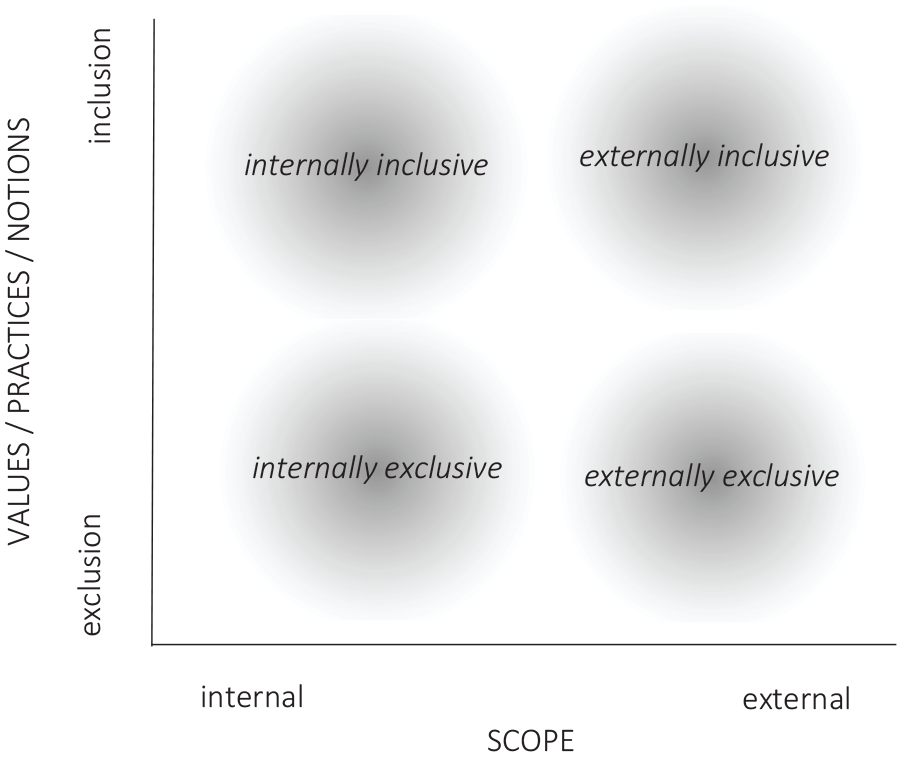
Inclusion and exclusion in their internal and external dimensions.
The two terms on the left of Figure 1 both deal with individuals within the organization. Internally-inclusive refers to “classical” conceptions of organizational inclusion, that is, inclusive norms of the organization or notions that inclusion is considered good and meaningful by the organization either from a normative- or a business case-perspective, or even through a combination of the two (see Dye and Golnaraghi, 2015). Diversity-oriented procedures associated with internal inclusivity address inclusion along specific dimensions valued by the organization. This means that such forms of inclusion are dependent on a “match” between the diversity dimensions an organization upholds and the individual members who represent these dimensions. In contrast, notions that are internally-exclusive marginalize organizational members by denying them access or keeping them at the organizational fringe, for example in marginal/minor positions or working in secluded areas (e.g. veiled women assigned to departments or jobs without customer contact as detailed in Syed et al., 2005). Such a focus on notions of inclusion and exclusion within organizations represents “state-of-the-art” thinking in organizational studies on inclusion (Dobusch, 2017). In an effort to broaden this limited understanding of inclusion, in this paper we enlarge the focus on internal inclusion/exclusion to include the two notions on the right of Figure 1, namely external inclusion/exclusion. The notion of externally-exclusive describes efforts by organizations to keep specific external issues as well as individuals (i.e. non-members) outside the organization. The latter means that certain individuals are not allowed to transgress the organizational boundaries, while the former implies that specific issues, for instance environmental destruction, are discursively positioned outside of organizations and thus rendered externally exclusive. In other words, by excluding specific individuals and phenomena, the “exclusivity” and boundaries of an organization are maintained, even though an organization may have adopted a perspective of internal inclusion. An attempt to overcome this rigid demarcation would be to embrace an externally-inclusive perspective. This implies focusing on relations with individuals and phenomena outside the organization and, in so doing, questioning the boundaries of organizations to admit aspects of the social and natural environments (see, e.g. Etzion, 2007; Hoffman and Bansal, 2011).
In the remainder of this article, we will identify which notions of inclusion and exclusion—both internal and external—are exhibited in the representations of a specific set of organizations, namely those refocusing their economic activities on the common good. Next, we explore the conceptual background of this alternative economic setting.
An inclusive economy and its organizations
The financial crisis of 2008 not only highlighted (once again) the growing inequality of wealth and income in late-modern capitalist societies (Piketty, 2014); it also spurred an interest in alternative economies and organizations (North and Scott Cato, 2017; Parker et al., 2014). Practical enactments of and scholarly debates around economic alternatives have (re-)emerged in the last years (North and Scott Cato, 2017; Parker, 2017; Rothschild, 2016; Zanoni, 2020; Zanoni et al., 2017), questioning the prevailing “capitalocentrism” of current economies (Gibson-Graham, 2006) and pointing out the existing diversity of economic relations (Gibson-Graham, 2008). Accordingly, current debates on alternatives explore if and to what extent they challenge the prevailing neoliberal capitalist system and its unequal redistribution of surplus value (Paranque and Willmott, 2014) by examining possibilities of collective ownership (Bretos and Errasti, 2017; Cheney et al., 2014; Rothschild, 2016) or collective and democratic forms of governance (Atzeni, 2016; Atzeni and Vieta, 2014; Heras-Saizarbitoria and Basterretxea, 2016; King and Land, 2018). Hence, alternative organizations constitute a counterpart to the dominant mainstream of organizations guided by managerialism, that is, “management knowledge” as an “ideology to establish itself systemically in organisations and society [. . .] depriving owners, employees [. . .] and civil society [. . .] of all decision-making powers” (Klikauer, 2013: 3). They do this by presenting alternative approaches to ownership and participation as well as responsibilities to the social and natural environment. Given the great variety of alternative organizational forms, for the purpose of this article we define these in terms of their guiding values. Here Cheney (2014) identifies five key elements to delimit alternative organizations: First, autonomy refers to individual autonomy, implying that members have a say in organizational issues which affect them. Second, equality/equity promotes the notion of a “shared opportunity and stake.” Third, participation and democracy calls for measures to ensure that each individual can contribute to decision-making. Hence, the first three key elements can be associated with internal inclusivity as laid out in our conceptual framework (see above) based on Goodin (1996). In contrast, the fourth key element, solidarity and connection, describes how alternative organizations act in solidarity not only with their members but also with the broader community and the natural environment, a feature that Cheney (2014) links to ongoing debates around the “triple bottom line” of organizations. Accordingly, we conceptualize solidarity and connection as encompassing the social and natural environment of an organization (Etzion, 2007), hinting at external-inclusivity in our conceptual framework. Last but not least, the fifth key element, practices and policies in accordance with these values, reflects how alternative values are implemented within the organization. These five key elements delineated by Cheney (2014) will be used not only to introduce the object of our empirical study—the Economy for the Common Good—on a conceptual level but also to guide our data analysis to uncover notions of inclusion and exclusion in this alternative setting.
Hitherto, only a few studies have investigated the issue of diversity (e.g. Kleinman, 1996; Meyers and Vallas, 2016; Scott, 2005) or inclusion in alternative organizations. In their study of a social movement, Reedy et al. (2016: 1562) showed how the selection of assembly spaces is associated with exclusionary effects; for example, meetings in pubs excluded individuals with children and “there was a gendered aspect to the enthusiasm for pubs by young males.” Moreover, even if the dominance of white males in discussions was questioned by some members, the possible solution of “forcing” everyone to speak entailed further ambivalences, as this might indeed be “experienced as oppressive and as constraining autonomy” (Reedy et al., 2016: 1565). In a similar vein, King and Land (2018) investigated the contradictions that arise when individuals at the top of an organization “impose” democracy. In their case, exclusionary patterns emerging through the non-participation of specific members were discussed in private talks on sexism and racism. Addressing these issues posed, however, again the question whether democratic or authoritarian methods should be applied to deal with them (King and Land, 2018).
While these diversity-oriented individual case studies provide valuable insights into the emergence and persistence of exclusionary patterns, in this paper we aim to broaden our understanding of the relation between inclusion and exclusion beyond the confines of capitalist profit-driven organizations to consider a broad array of organizations committed to an “interstitial transformation” of the current profit-driven system (Wright, 2010), namely the “Economy for the Common Good” (ECG) (Felber, 2015; www.ecogoog.org/en). The ECG platform brings together value-driven organizations (Cheney, 1999; Cheney et al., 2014) determined to direct their economic actions toward alternative ends. Founded in Vienna (Austria) in October 2010, the platform advocates a radical reorientation of the economy over the long term as well as small-step changes in the here and now. The long-term goal is to implement an economic system founded on democratic principles, in which elected councils set up rules on how business activities can contribute to a democratically defined “common good.” To achieve this long-term goal, an institutional framework is envisioned that comprises a democratically-defined legal limit on inheritance as well as a leveling of income disparities. In addition, the platform calls for a democratic central bank and the complete abolishment of capital interest (which is regarded as work-free income flowing to capital owners). While private ownership and profits are still to be permitted, democratically determined limits would be imposed on the use and distribution of profits and work-free income. In fact, the movement argues that all economic decisions should be based on their likely contribution to the common good. In working toward a step-by-step transformation of the economy, the ECG still relies on the market system. However, the main drivers of capitalist markets, namely profit maximization, the extraction of surplus value by capital owners, capital accumulation, and the unequal distribution of wealth resulting from it, are to be replaced by incentives to promote the common good.
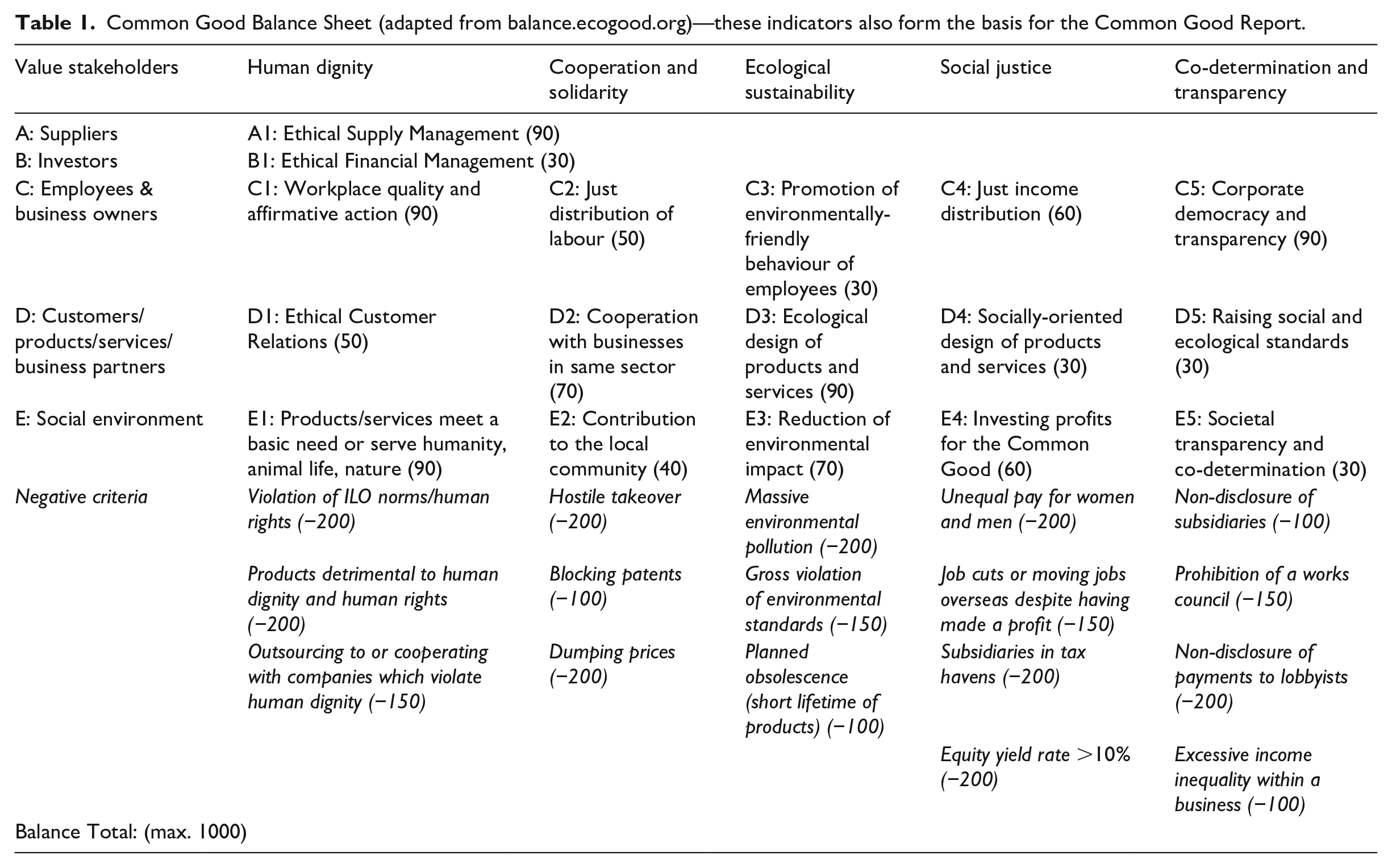
Accordingly, while the feasibility of these long-term goals remains to be proven, the members of the ECG platform are already following an alternative incentive structure at the organizational level. Hence, the ECG movement not only consists of activists committed to an alternative economic system but also entrepreneurs, enterprises, and organizations (currently around 2000) who are enacting organizational alternatives in their daily business. In order to report and measure these ongoing efforts, the ECG platform has created the Common Good Report as well as a corresponding Common Good Balance Sheet to help economic entities assess how their activities are contributing to the common good. The assessment criteria consist of five core values (resembling Cheney’s (2014) five key elements of alternative organizations): Human Dignity, Cooperation and Solidarity, Ecological Sustainability, Social Justice as well as Co-determination and Transparency. These apply to five groups of stakeholders: suppliers, investors, employees & business owners, customers/products/services/business partners as well as the social environment. The resulting matrix of 17 indicators (A1 to E5, the stakeholder groups suppliers and investors are not analyzed for each core value) form the basis of both the Common Good Report and its corresponding Balance Sheet. In addition to these positive values, a number of related negative criteria are also considered. The complete Balance Sheet is shown in Table 1. Organizations and Single Person Enterprises fulfilling all 17 criteria are given the maximum score of 1000 points on their Common Good Balance Sheet. Organizations that only “fulfill” the negative criteria are assigned the minimum score of −3000 points (Common Good Balance Sheet, 2013).
Common Good Balance Sheet (adapted from balance.ecogood.org)—these indicators also form the basis for the Common Good Report.
The Common Good Report and Balance Sheet can be compiled for “companies in any industry, any size and any legal structure – by non-profit and social enterprises, medium-sized family businesses, right up to stock market-listed groups or universities” (Economy for the Common Good, 2018). In this way, the ECG assembles a broad array of organizations aiming to redirect their economic activities toward more alternative ends. These organizations can report their alignment—or dis-alignment—with the ideas of the Economy for the Common Good simply by assessing how well their activities fulfill the 17 criteria. It is important to remember that the organizations in this initiative vary in the nature of their alternative approach, a point that will be explored in detail when we report the findings of our empirical project.
One mid-term goal for ECG organizations is to advertise their score from the Common Good Balance Sheet on products in order to let consumers make informed decisions. In the longer term, the ECG score should also have an impact on the level of corporate taxation as well as value-added taxes.
The ECG’s guiding principles as well as the Common Good Report and Balance Sheet were created in a participatory process involving activists, Single Person Enterprises and organizations (Felber, 2015). For this reason, inclusion lies at the heart of the ECG platform and is, accordingly, also present in its five core values of Human Dignity, Cooperation and Solidarity, Ecological Sustainability, Social Justice as well as Co-determination and Transparency. Each indicator (A1–E5 in Table 1) thus incorporates notions of inclusion while steering organizational activities in an alternative direction. For example, in order to encompass a range of voices in all organizational processes, the indicator “corporate democracy and transparency” (C5) measures how internally-inclusive an organization is by assessing the level of involvement of employees in the decision-making processes. Moreover, the inclusion of wider stakeholder groups is addressed through the indicator “societal transparency and co-determination” (E5) which reflects the involvement of people external to the organization. A similar scope is visible with indicator D5, which assesses how well organizations collectively work toward higher social and ecological standards of their industry. The inclusive accessibility of products is secured by following the indicators “products / services meet a basic need or serve humanity, animal life, nature” (E1), “ethical customer relations” (D1) and “socially-oriented design of products and services” (D4). Moreover, organizations should not only strive to accommodate a wide range of voices but also to foster inclusion in economic terms, as measured by the indicators “just distribution of labour” (C2) and “just income distribution” (C4). “Cooperation with businesses in same sector” (D2) expands external inclusion to other organizations often viewed as “competitors,” thereby fostering an economic structure based on cooperation rather than rivalry. Moreover, the balance sheet also introduces “contribution to the local community” (E2) and “investing profits for the Common Good” (E4) as externally-inclusive notions. In general, the value of Ecological Sustainability points toward external inclusivity in relation to the organization’s natural environment (Etzion, 2007; Hoffman and Bansal, 2011). In this context, the indicator “promotion of environmentally-friendly behaviour of employees” (C3) implies that a sense of responsibility for the natural environment is promoted within the organization, while the “ecological design of products and services” (D3) aims to incorporate the natural environment through the design of products and services. The external natural environment takes center stage with the “reduction of environmental impact” (E3). Inclusion is also the driver behind the aim of fostering ethical supply management (A1) and ethical financial management (B1) to obtain resources from non-exploitative sources in order to facilitate the “trickling down” of the core values to suppliers. Last but not least, the indicator “workplace quality and affirmative action” (C1) explicitly addresses inclusion in terms of diversity.
In the following empirical analysis, we show how organizations committed to the platform Economy for the Common Good report these indicators.
Methodology, dataset, and methods
To gain insights into inclusion and exclusion beyond the confines of capitalist profit-driven organizations, our empirical study explores the discourse of the Economy for the Common Good represented in the Common Good Reports and the websites of organizations committed to this alternative economy. We conceptualize reports and websites as representational discursive artifacts (Bhatia, 2012; Lemke, 1999) which represent a medium of organizational communication (Cheney and Christensen, 2001). Their information is bound by social processes—such as shared understanding and accountability (Wynn and Katz, 1997). By analyzing the ECG reports and accompanying websites, we are able to reconstruct the representations and notions of the alternative organizations regarding inclusion/exclusion. Our analysis is not an authoritative explanation of “the reality” that comprises the real-world actions taken by the organizations. From an epistemological perspective, by focusing on the organizational representations and rejecting the existence of a single objective reality, we as researchers play an active role in identifying representational notions and, thus, in the (re)production of knowledge (Dick and Cassell, 2002) pertinent to alternativeness, inclusion, and exclusion.
In line with the aim of the paper to expand our understanding of the relation between inclusion and exclusion beyond the confines of organizations, we conducted a qualitative analysis of the source data to reveal representational constructions of inclusion/exclusion and their linkages (Flick, 2015). Specifically, we used Mayring’s (2014) method of qualitative content analysis (QCA), which will be presented next.
Data source and context
The main data sources for our analysis are the Common Good Reports complemented by relevant information published on the organizations’ websites. These public texts are not just addressed to audiences interested or active in alternative organizations and economies but also “mainstream” actors. Hence, these discursive artifacts reflect the diverse expectations and questions with which these organizations are confronted with.
Aiming to study a wide range of organizational settings, we selected a total of 70 ECG organizations which underwent an external Common Good audit for their Common Good Report and Balance Sheet (by the time of our data collection in April 2017). Thirty-six were located in Austria and 34 in Germany. Regarding the organizational size, 41 had at least one employee and 29 were single-person enterprises (SPEs). The balance sheets of SPEs do not comprise the three indicators on internal inclusion or exclusion (C4 “Just income distribution,” C5 “Corporate democracy and transparency,” and E4 “Investing profits for the Common Good”) and, hence, SPEs do not report on them. However, we decided nonetheless to analyze these single-person enterprises regarding their self-presentation of external inclusion and exclusion. In the 41 “proper organizations,” the number of employees ranges from 1 to 10 employees (16 entities), 11 to 100 employees (15 entities), and more than 100 employees (10 entities), with the largest company having almost 900 employees. The majority of the organizations are from the service sector: 23 entities are active in consulting and 32 in other branches of the service industry. Nine organizations in the sample are in retail, two in farming and two in food production, one in the banking sector, and one in tourism.
Method
Our dataset consisted of the Common Good Reports and Balance Sheets (together at least 25 pages) and the websites of all 70 entities. The following steps describe the process of our analysis and how the dataset was transformed into the narrative we present in the findings:
The first step of our analysis was to define the dataset (Mayring, 2014: 54) as described above. Thereafter we read through the data to determine a “direction of analysis” (p. 58) and to inductively develop an understanding of the data. This resulted in an initial assessment that the data reflects a heterogeneous assemblage of organizations presenting diverse approaches to the common good, inclusion, and diversity. Based on this first assessment and our research question, we established a coding scheme that collated notions emerging in the data along existing concepts. This led to two sets of main categories (Mayring, 2014: 95), namely those referring to alternativeness and those to inclusion and diversity. In order to grasp the broad array of approaches to “alternativeness,” we decided to use Cheney’s (2014) key elements of alternative organizations as categories in order to code how organizations represent their alternative natures. To cover notions of inclusion and diversity, we used established diversity dimensions (such as gender, ethnicity, age, sexual orientation, dis/ability, religion, and social class) as well as inclusion as categories for the data coding.
A first round of coding was undertaken by students in the master’s program “Management.” In line with Mayring’s (2014: 95) procedure, textual sections were selected if they contained descriptions of the respective category. The text was paraphrased, identical paraphrases were cut to extract key themes from the dataset. In this way it was possible to sort, link, and organize the presentation of the empirical material (Fleming and Sturdy, 2011). To ensure intercoder-reliability, the authors crosschecked and re-coded the preliminary findings to enable robust assessments of the representation of the central categories in the reports and on the websites of the selected ECG organizations.
The last step constituted our core analytical and interpretative task, namely “combining, construction, integration” (Mayring, 2014: 78). In a process of repeated and lengthy discussion of extant research as well as our own data and its interpretation (Alvesson and Kärreman, 2007), we matched the themes that emerged in the previous step along the internal/external axis, that is, whether they primarily concerned the organization itself or targeted the organizational social and natural environment. Subsequently, we reviewed the inclusionary and exclusionary potential of these themes in order to allocate them to the four nodes of our conceptual framework presented in Figure 1, namely internal inclusion, internal exclusion, external exclusion, and external inclusion. Figure 2 below summarizes this approach.
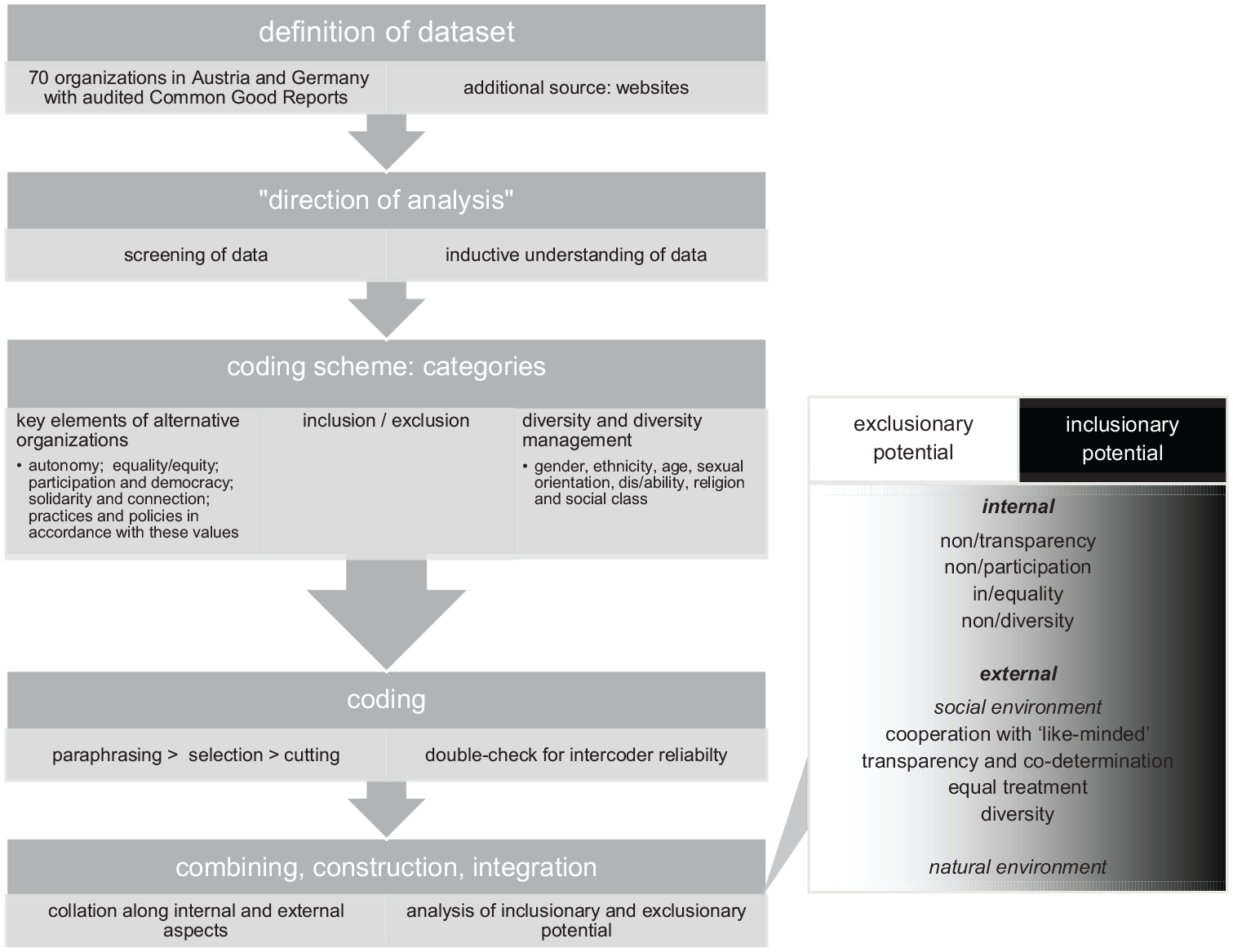
Analytical process.
Findings
In the following we present the results of our analysis. Figure 3 gives an overview of the themes relevant to alternativeness and diversity extracted from the data. Their attribution to the four nodes of our conceptual framework introduced above highlights the relational understanding of inclusion/exclusion, that is, that every act of inclusion is associated with the exclusion of some “other” (Derrida, 1976).
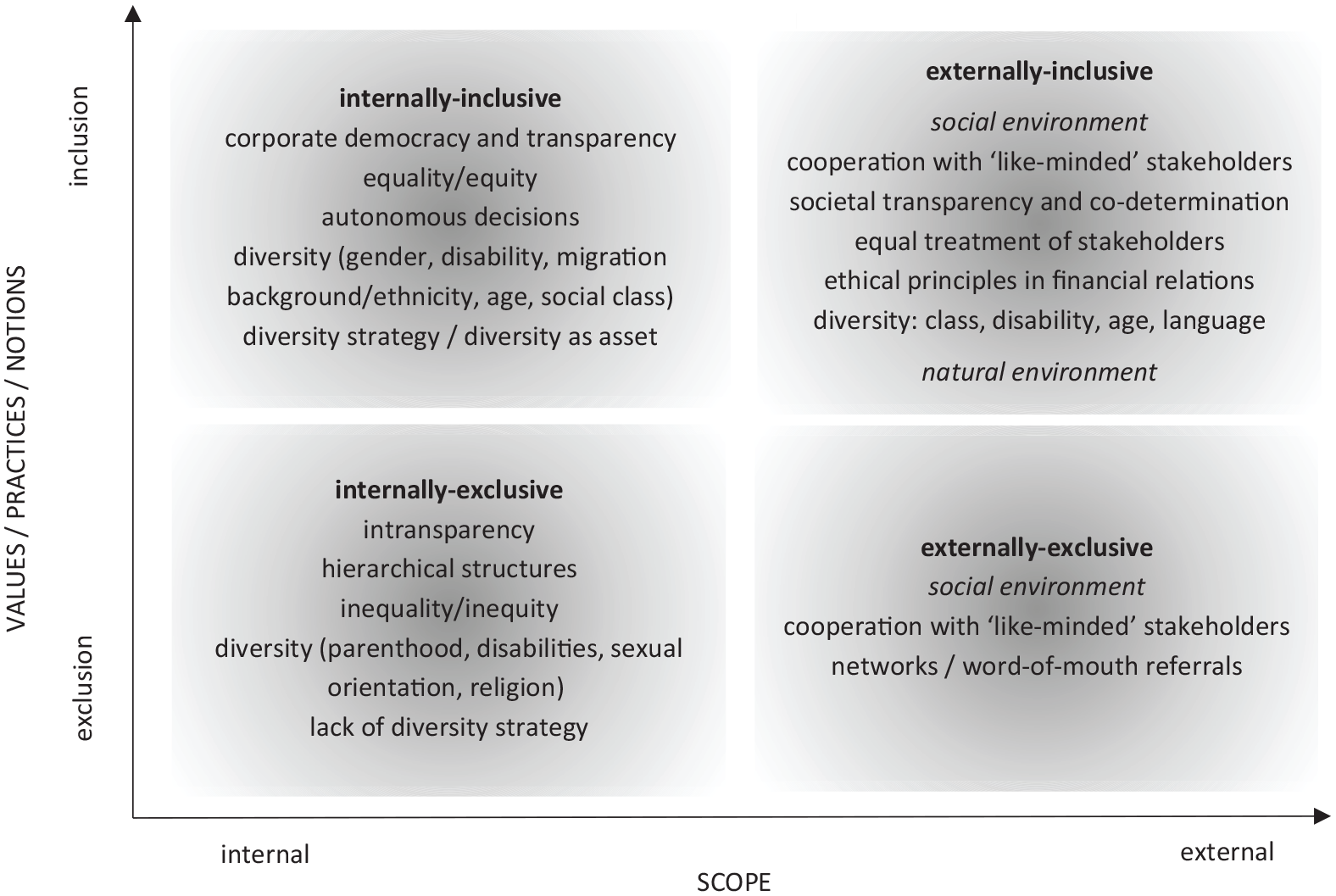
Results of the analysis.
Below we present in detail our results for each node of the analytical framework.
Internally-inclusive node
When looking “inside” ECG-organizations, that is, investigating how the cases in our sample represent their inner structures, the inclusionary potential can first be discerned in relation to corporate democracy and transparency. Specifically, the organizations report practices that give each member equal access to documents on the organization’s file server or include statements that there are “no secrets” in the company (ELVG Bentlage). Some organizations indicate that the minutes of meetings are accessible to all employees while others mention a transparent wage system, that is, the payroll can be accessed by every employee or at least by members of the workers’ council. Regarding participation, flat hierarchies or the explicit abandonment of hierarchical levels are mentioned several times. Many organizations describe how flat hierarchies foster greater equality and increased participation in decision-making processes. The notions in this regard encompass the right of every employee to bring issues to the attention of the board of directors as well as the idea that “all employees are equal”: “There are no managers [Führungskräfte] among the workforce”
1
(Ulenspiegel)
In addition to general descriptions of transparency and the involvement of organizational members in the decision-making processes, some organizations also explicitly mention practices of democratic decision-making. These include “one person one vote” for major decisions, a consensus on pay, collective agreements on recruitment and organizational goals (and their attainment) as well as participatory decision-making related to the distribution of tasks. One organization describes how internal democracy is achieved through team councils and employee committees elected by the entire workforce (DWP). Employee-owned organizations emphasize the fact that such co-ownership boosts collective decision-making competencies. Even writing the Common Good Report is depicted as a participatory process. In sum, we interpret the practices depicted in the reports of allowing organizational members to access information and participate in decision-making processes and organizational democracy as internally-inclusive; in other words, they convey an image of all members being included in the information flow and decision-making processes.
A similar picture emerges when we consider descriptions of how organizations foster equality/equity, for instance through a just distribution of labor and income. In this regard we were able to identify general assertions of organizations promoting “fair cooperation” (“faires Miteinander”) or communicating “on an equal footing” (“auf Augenhöhe”) as well as a just distribution of tasks and working hours. Moreover, the reports also outline particular measures such as limiting internal pay differentials, ranging from an “equal pay” ratio of 1:1 through “minor differentials” up to a ratio of 1:10.5 (e.g. Kirchner, Lifefood, Sparda), whereby the highest salary is 10.5 times the lowest. This maximum differential already suggests the exclusionary potential of such pay disparities. The organization Tut-All explicitly mentions that salaries are openly discussed, and a “living-wage” has been established throughout all premises. The reasons given for setting these income limits are to secure fair and equal pay for women and men.
Moreover, we argue that depictions of how organizational members can take autonomous decisions also hint at internal inclusion, as this has the potential to foster a sense of belongingness. These autonomous perspectives not only suggest that employees are given self-determination in regard to working time and holidays, but also the option of working from home. Further, individual financial autonomy can be secured by the offer of a budget for further education (“work-learn-life balance”). As such, the various forms of autonomous decision-making on working time and place show an inclusionary potential by boosting the capacity of employees to balance their individual needs with the demands of the organization. Some organizations also report autonomous decision-making related to particular organizational aspects, for example autonomous decisions on investments or procurement as well as profit distribution and financing (e.g. Bodan, Ökofrost, Sparda).
In addition to these general organizational views on internal inclusion, in this node we can also find explicit notions of diversity in general as well as the promotion of various diversity dimensions in particular. However, in contrast to those reports which feature elements of alternativeness, those related to diversity are rather scarce in the data. Only a few organizations refer to the various dimensions of diversity, most frequently to gender and disability, followed by migration background/ethnicity, age and social class. Sexual orientation, in contrast, is mentioned only twice and religion only once in relation to employee diversity.
Indeed, the dimension of gender is most evident in the data, appearing in relation to payment issues as well as gender quotas (of between 40% and 66%) and gender budgeting activities. While some organizations make no mention of special activities for this dimension, others name explicit goals for gender equality, women-only internships or establishing a “center for female entrepreneurs” (“Gründerinnenzentrum”) (Anja Haider-Wallner). Notably, family-friendly policies and paternity leave—issues that would generally encompass all genders—are occasionally subsumed as policies related to gender, and in some cases explicitly related to women. In general, we can say that the data reveals initiatives to raise awareness of inequalities between men and women; for example: “As the owner and boss of our firm is a woman educated in a technical profession, gender equality and equal rights are an important matter” (ELVG Bentlage). In terms of gender-inclusive language, some organizations use gender-neutral expressions while others claim that a male-centered language has been adopted to ensure easy readability.
Regarding the diversity dimension disability, the reports show how organizations are intent on becoming barrier free. While some organizations state that they have not yet reached a sufficient level of accessibility (i.e. website and/or office space not barrier free) or that they have not met the legal quota of disabled employees, other organizations indicate that they already employ more disabled persons than the law requires. Some of the organizations highlight specific measures related to disability (e.g. a sign language interpreter), their general commitment to employing people with disabilities or their close cooperation with firms employing or working with people with disabilities. Some organizations also use the label “inclusive” to describe activities that impinge on diversity. One such example is Inklusionsbetrieb—Bürgerstiftung Pfalz, which uses revenues from other sources to support workplaces for people with disabilities.
References to migration background and ethnicity are largely made when discussing employees with diverse cultural or ethnic backgrounds. In their reports, many organizations state the percentage of employees with migration backgrounds, while others claim to avoid making any distinction between non-migrant and migrant employees: “We don’t know the number of employees with a migration background. We don’t collect data on this as we treat all employees equally – independent of their origin” (WBS). Interestingly, this claim is accompanied by a statement that a service technician with migration background created the company’s tagline. Another organization states that “we treat our customers with migration backgrounds just like all our other customers, even if their knowledge of German is limited” (Gebhard Moser). One organization cooperates with the job center (AMS) to attract “foreign employees,” another is proud to be multicultural: “Ökoring is proud to be a multicultural firm with a high number of employees with migration backgrounds. Integration is an inherent part of our organizational philosophy: ‘A connection in which each person counts’.” (Ökoring)
Practices such as internships and further education for refugees are also present in the corpus. Furthermore, the data reveals intersectional migration perspectives by referring to meaningful work for young, unskilled people with migration backgrounds as well as to German classes and multilingual websites.
The diversity dimension age is less prevalent in the data than migration background and ethnicitiy. Only a few remarks refer to the active management of older employees or generation management. While the average age of employees is very low in one organization (36 years, Adamah), another organization mentions the possibility of continuing to work after retirement.
The data also contains notions of social class. The measures range from internships for the long-term unemployed to a “talent exchange for low-income people.” Accordingly, some organizations show an awareness of the reproducing force of social class in contemporary societies.
While the diversity dimensions described above are addressed explicitly in the data, only a few organizations report an active diversity strategy or see diversity as an asset. One organization (AnyaRani) has signed the “Diversity Charter” while another (St. Georgen) understands diversity management as a strategy aimed at interlinking the various dimensions, realized through specific targets. A further organization views itself as “a highly colorful and diverse team with different views and forms of living; but as we love each other, diversity is not a problem but an enrichment” (ELVG Bentlage, 2014: 20) and addresses discrimination based on origin, ethnic background, sexual orientation and religious affiliation. The executive board exemplifies such open attitudes toward all these topics, for example by sponsoring the Life Ball, an initiative to support HIV and AIDS projects (ELVG Bentlage, 2014: 22). For one organization, feminism and diversity are basic principles not only in the field of politics but also for their business ventures: “We consider our economic activity not only in a global context but also in terms of local ties; we act in fairness and with responsibility for the environment and society. Ecology, fairness and self-determination, non-violence, feminism and diversity are basic principles of the politics underlying the Green Economy and guiding principles for our firm’s economic activity” (Armin Schmelzle).
In addition, a diversity strategy is also apparent through the naming of equality reports, gender budgeting, and paternal leave. However, it should be noted that the data also features voices claiming that differences are “not important” or “irrelevant” to the recruiting process. This suggests the influence of internally-exclusive notions.
Internally-exclusive node
Alongside the discussed inclusive potentials, the organizations in the sample also convey some notions that are exclusionary in nature.
Regarding the issues of corporate democracy and transparency, some organizations display intransparency in their descriptions of how information is only shared among executives, how wage levels are not disclosed or that participation is only permitted for the “voicing of concerns,” whereas decisions are taken in formal hierarchical structures. Some reports even display instances of direct opposition to democratic decision-making (e.g. Grüne Erde). With decisions being taken in hierarchies, inequality/inequity emerges as a topic. This becomes visible not only in the depiction of hierarchical structures, but also through an internal pay differential of 1:10.5, as previously mentioned.
Yet we can also find notions of internal exclusion related to diversity. One example is the unsuccessful reintegration of employees returning after parental leave (parenthood), while a second deals with the failure to integrate an organizational member with disabilities: “The attempt to hire a trainee with intellectual disabilities to permanently take care of our bookkeeping was terminated after 4 months, since the cooperation did not work as satisfactorily as expected.” (Communication Design)
Other evidence of internal exclusion is the almost complete lack of measures targeting the diversity dimensions sexual orientation and religion: An open-minded stance to sexual orientation is only referred to by two out of 70 organizations (GDG, ELVG Bentlage), while religion is mentioned by only one organization (ELVG Bentlage). Moreover, those organizations that lack a reference to diversity dimensions or diversity strategy could be characterized as following an internally-exclusive strategy toward diversity.
To summarize our discussion of these internal aspects, the organizations in the dataset display a broad array of approaches in their Common Good Reports. While some present themselves as fostering internal inclusion by referring to organizational transparency, participation, and democratic decision-making, others position themselves in opposition to these goals, thus revealing exclusionary facets. The same holds true for inclusion along specific diversity dimensions. In general, inclusivity in terms of diversity is less evident in the reports than general notions of alternative organizational approaches. While one can find instances of organizations presenting themselves as securing inclusivity along several diversity dimensions, the dimensions of sexual orientation and religion are almost completely absent in the reports. Some organizations even openly discuss failed attempts of inclusion.
The two nodes described thus far analyze how the organizations in our sample report on internal matters. The following two nodes deal with how inclusion and exclusion are portrayed beyond the confines of organizations, that is, the explicit relation of the organization to its social and natural environment.
Externally-exclusive node
Relations to the social environment are depicted, for instance, when the organizations describe cooperation with various stakeholders, for example, their suppliers. Some ECG organizations stress that ensuring solid relationships with (regional) suppliers are more important than pure cost-oriented decisions or that they strive to buy fair trade products or use financial services from ecologically and/or common good-oriented organizations. While this means that those external partners who comply with these requirements (e.g. in terms of regionality, ethics and general “like-mindedness”) are included, those who do not are thereby excluded. For example, Hipper and Lenz Consulting do not conduct business with ethically dubious firms. Similar issues are raised in the reports concerning targeted cooperation with suppliers, customers, and clients that support ecological issues. Furthermore, evidence of unethical behavior by suppliers, customers, or clients is a reason either to refuse to do business with them or cease any ongoing cooperation. Elobau, for instance, rejects customers who wish to use their products for military purposes; EM Faktor refuses to cooperate with organizations which trade in shares in the food sector or those producing land mines; Anya Rana attaches great importance to appreciative, respectful, fair-minded, and authentic customer relationships, and thus rejects any dealings with customers who do not meet a minimum standard of ethical, social, and human values. Wissen Verändern seeks out like-minded suppliers and Schmelzle focuses on cooperation with suppliers who share the same values or “world view.”
The ways in which organizations cooperate is also indicated by claims that they do not actively acquire customers but find them through their networks and word-of-mouth recommendations or that they pass on orders they cannot accommodate to their network partners (e.g. Ökofrost, Schmelzle, Steinwender, Interlink, Moser, Ruether, Eschner, Lenz Consulting).
These examples show how measures that aim to include those in the nearby environment of the organization, for example, regional suppliers, those with similar values or members of the same organizational network, have at the same time an exclusionary potential, namely by excluding those who do not fall within these groups. This gives a clear indication of the simultaneity of exclusion and inclusion. At first sight, the examples show how organizations set boundaries in order to maintain their values as well as to act responsibly for the Common Good. At the same time, networks and the fostering of like-mindedness can also be seen as ways to include those who share these values, in particular those within a specific network. Indeed, the ECG reports also show numerous attempts to include those outside the organization, as will be explored next.
Externally-inclusive node
In the data we could find notions that refer to the inclusion of both the social and natural environment. While the latter is solely discussed in terms of ecological sustainability, the former is related to cooperation, societal transparency and co-determination, equality, ethical financial relations as well as specific diversity dimensions—as will be outlined next.
First, internal inclusion becomes visible through the products and services of the organization, for instance in the way Raumwert, an architectural firm that constructs schools in smaller communities, reports on fostering an awareness of democratic principles by involving children and adolescents in the planning process. In other words, Raumwert facilitates the self-empowerment of individuals through special participatory methods in their product design. Indeed, the social design and inclusive potential of products and services is highlighted by most of the organizations, in particular emphasizing a close and sustainable cooperation with customers/clients in product development and service provision in order to ensure that these reflect the long-term needs of customers (e.g. Sonnentor, Interlink, Culum Natura, Märkisches Landbrot). The focus is on honest long-term customer relationships, transparency in products, pricing, and communication as well as the supply of sustainable/ecological products and services. Here cooperation is favored over competition. Many organizations claim that they are socially responsible, preferring to work with customers in a relationship of mutual trust, understanding and common ethical values (e.g. b.it.gmbh, Märkisches Landbrot, Ökoring, DWP, Wittig, Schmelzle, ELVG Bentlage, Interlink, Spardabank, Ökoring, Ökofrost, Lewandowski, Welten Verändern, Ruether). Some even provide their services for free or offer free seminar materials (e.g. Service Gärtner, Felber, Wittig, Anne Berg, Raiffeisen), while others (e.g. Culum Natura, Moser, and Bodan) claim that they do not discriminate against any social group by promoting “fair prices for everyone.”
Second, although the equal treatment of customers/clients is of great importance, many organizations indicate that they not only design their products to better meet the needs of customers/clients (e.g. Sonnentor, Anya Rana, DWP, Bodan, Adamah, RW-CCT) but also they adjust the price to the financial situation of their customers. Some organizations show an awareness of socially-disadvantaged families, persons with financial problems and low-income customers, offering interest-free loans, price discounts, and other special deals for this social group. Moreover, some reports also mention that less educated individuals are encouraged to participate in seminars (e.g. Schmelzle, Anya Rana, Waldkindergarten, Göttin des Glücks, Service Gärtner, Ruether, Egelseer + Zellmayer, Felber, Wissen Verändert, Kleindienst, Innovia, Regine, Ökoring). Clearly, these measures are evidence of external inclusion because here the organizations consciously consider differences regarding the economic and/or social situation of customers and clients. Moreover, the financial health of client firms as well as of their business sector and business model is reflected in the design and pricing of products (e.g. Schmelzle, Welten Verbinden, Raiffeisen, Sparda Bank, Raum, Interlink, Tut All, Vongerichten, Smiliveda), an approach that can be viewed as externally inclusive in fostering cooperation with “like-minded” customers. This applies to customers as well as to suppliers: Göttin des Glücks not only visits its suppliers regularly but also favors equal opportunity employers which secure equal rights for their employees. Predominantly, the reports reveal the goal of ensuring long-lasting relationships between the ECG organizations and their suppliers, not only to reduce acquisition costs but also to secure reliable and good cooperation as well as fair pricing. This contributes to the production of sustainable goods and services—here based on social and ecological principles (e.g. Simivelda, Sonnentor, Göttin des Glücks, Raumwert, Raiffeisen, Kleindienst, Service Gärtner, ELVG Bentlage).
Third, the social environment also features in practices mentioned in the report that aim to increase societal transparency and co-determination in relation to both suppliers and customers. These include the publication of balance sheets, sample calculations of products as well as information on the company’s strengths and weaknesses (e.g. DWP). Some organizations relate to the broader public by providing education on social change, others state that they generally refrain from lobbying. While the primary focus thus far has been on the local social and natural environment, some organizations also aim at inclusion on a broader scope by hinting at transnational inclusion. This becomes visible when organizations such as DWP claim to contribute to peace work through cooperation with its partners in Palestine, or when Märkisches Landbrot portrays its support for a project in Nepal.
Fourth, the social environment is also taken into account when various ECG organizations (e.g. Anya Rani, EKU, Lenz Consulting, Plöckinger) refer to ethical principles guiding their financial relations. For instance, they report on their financial partners being alternative banks who explicitly provide ethical and/or sustainable financial services (e.g. Triodos Bank or Oicocredit) or the fact that they use the services of established banks which—at the very least—publish CSR reports, promote social banking, gender equality, or family-friendly measures. Others claim that they support the planned incorporation of the Bank for the Common Good [Bank für Gemeinwohl] (Culum Natura, Schmelzle, Eschner). Some ECG organizations state that they invest in ethical-ecological projects (e.g. Innovia, ELVG Bentlage, Raiffeisen) and refuse to use interest-based saving accounts (e.g. OEAD). Several organizations have built long-term relationships with regional partners, that is, local banks, to source external financing (e.g. Steinwender, Sonnentor, Lenz Consulting, Culum). Their relation to financial issues becomes also apparent in the way ECG organizations report on how they use the profits they generate. The data indicates a tendency to either reinvest profits within the organization or to promote the common good by investing in other organizations that support sustainable projects or financial institutions with an ethical or ecological focus. EM Faktor explicitly mentions the goal of spreading their business profits as fairly as possible. Some organizations have established the corporate goal of donating a certain percentage of their net income to charities (e.g. Märkisches Landbrot, Regina NachhaltigkeitsWerk).
Fifth and finally, external inclusion is also connected to various diversity dimensions. In addition to the previously mentioned awareness of the social class of customers, the reports mention the dimension of disability in terms of barrier-free access to websites, offices, seminar and conference rooms, and production facilities as well as barrier-free access to products (e.g. A+P, St. Georgen, RW-CCT, Ökofrost, Dike, EM Faktor, Innovia, Sonnentor, Waldkindergarten, Rusz, Raiffeisen, Lenz Consulting, Plöckinger+Plöckinger, Felber, Adamah, Raumwert). In addition, DWP runs a workshop for individuals with special needs, Rusz offers dedicated services for the elderly and Egelseer+Zellmayer supports women. Acknowledgment of language diversity is indicated by the translation of websites and books as well as by providing information in different languages (e.g. St. Georgen, RW-CCT, Anya Rani, Wittig, Felber). Five organizations also discuss issues of external inclusion in relation to their procurement processes, among them ELVG Bentlage, who prefers to deal with suppliers employing disadvantaged persons, and Smiliveda, who cooperates with workshops for unemployed persons and those with disabilities.
Turning from the social to the natural environment, we could identify three main perspectives: A general aspiration to protect the environment, the aim of fostering environmentally-friendly behavior amongst employees, and a focus on the ecological standards of products and services.
The first perspective is revealed through examples of various measures to ensure ecological sustainability. These include the reduction of emissions, climate initiatives, tree-planting programs, water purification, energy-saving measures, photovoltaic facilities, serving as an ecological role model, producing ecologically durable products, reducing the carbon footprint, fostering an ecological value chain, and the use of ecological products and building materials.
In addition to describing how the organization’s operations contribute to ecological sustainability, the majority of the firms also promote the environmentally-friendly behavior of employees. This is indicated by the following measures: the provision of organic and vegan food to employees and the building of links to the slow food movement; the shared use of resources (meeting rooms and printers), refraining from printing hard copies of documents, arrangements to work from home and a deliberate reduction in the number of business trips (no long-distance flights or, in some cases, no flights at all), car-sharing as well as employee incentives for cycling to work. One organization highlights its use of Skype conferences (Hipper) as an alternative to traveling; others form carpools or explicitly reduce their number of trips while actively checking their CO2 balance (e.g. Plöckinger).
The third perspective deals with the ecological sustainability of products. Notions that can be found in the reports include seminars for customers to foster sustainability, green marketing initiatives (Eschner), an avoidance of packaging (Culum Natura), the reduction of long-distance transportation (Moser), and a focus on organic agriculture (Adamah). In particular, the food manufacturers in the sample emphasize their sustainable and responsible treatment of the environment through their commitment to biodynamic agriculture and attention to the value cycle. They spotlight organic products and a balanced diet for their customers (e.g. Adamah, Bodan, Lifegood).
The natural and social environment is acknowledged by references to regional organic products (e.g. Adamah, Hotel and Villa Auersperg, Raumwert, Sonntentor, Culum Natura), on using eco-friendly products from regional suppliers and other ECG organizations (especially when sourcing green electricity and gas), on the long-term use of office equipment and co-working spaces as well as maintaining short and ecological supply chains (e.g. Interlink, Moser, Egelseer, EKU, Schmelzle, Felber, Escher, Thurner, Service Gärtner, Anne Berg, A+P). This perspective is also indicated by the products and services offered by the organizations, for instance in descriptions of how they meet a basic need or serve humanity, animal life, and nature.
These manifold examples of the externally-inclusive perspective round off the presentation of our results. They broaden our understanding of inclusion by showing how external inclusion is not merely apparent in connection to the natural environment, but also with regard to cooperation, societal transparency and co-determination, equal treatment of stakeholders as well as ethical principles in financial relations. Moreover, external inclusion is also revealed along selected dimensions of diversity, namely class, disability, age, and language.
Discussion
By analyzing how organizations committed to the Economy for the Common Good represent their dis/alignment with ECG goals in their Common Good Reports and relating this to the extended framework of Goodin (1996), we revealed the simultaneity of inclusion and exclusion not only within the organizations but also in their external relations. This became visible at several points:
As discussed in the conceptual introduction of the Economy for the Common Good, we can already discern the inclusive potential of the ECG indicators, some of which not only explicitly promote inclusion within organizations (e.g. in decision-making processes) but also refer specifically to external inclusion by promoting social transparency and co-determination as well as highlighting how external actors from the social environment can be included. The same holds true for other indicators referring to social justice and ecological sustainability. Thus, the originating concept of the Economy for the Common Good depicts a very broad basis for internal and external inclusion, suggesting a re-visioning of what is considered “within” or “outside” an organization. In other words, the concept of the Economy for the Common Good welcomes equality and difference while promoting spaces “that enable experimentation in the politics of the possible in order to seek a fundamentally changed society” (Phillips and Jeanes, 2018: 698). As such, these alternative endeavors may consider inclusion of paramount importance as ecological sustainability. Inclusion, however, takes an ambivalent position in our data. This shows as follows:
First, our analysis of the reports highlights a simultaneity of inclusion and exclusion. In the external perspective this becomes visible in the way that organizations describe cooperating only with like-minded partners, regional partners, those with similar values or entities who are also members of the ECG platform. While these notions can be read as organizations reaching beyond their boundaries to include those generally located on the outside (especially “competitors”), a focus on like-minded stakeholders, in particular those who share the same values and are located within the same region, also conveys a picture of excluding the “others” who do not belong to these groups. This result is in line with the suggestion of Alvarez et al. (2020) that organizations should focus more on questioning how exchange can generate social and economic value rather than whether economic exchanges are “within” or “outside” the organization.
Second, an extended inclusionary potential is visible in the community-building efforts described in the ECG reports as well as in their alternative forms of ownership and accountability. These notions, which can also be related to the concept of boundary spanning (Williams, 2002), are motivated not merely by the need to acquire an understanding of people and organizations outside the ECG, but also with the aim of leveraging the benefit of cross- boundary-interaction and cooperation. In fact, this may also lead to an increased focus on inclusion by encouraging a greater awareness of blindspots and acknowledging or indeed valuing difference in terms of culture, mindset, profession, role, and “gaze” (Williams, 2002).
Third, while the vast majority of ECG organizations indicate in their reports the aim of including those generally seen as located on the outside, only a relatively small number of organizations refer to specific dimensions of diversity. This suggests that the publicly expressed interest in diversity remains more on the surface, and that inclusion—at least in terms of diversity—plays only a minor role in the ECG organizations, despite their focus on social and ecological sustainability and the championing of the common good (Felber, 2015). Being the first large-sample study of diversity and inclusion in alternative organizations, our analysis reveals the inherent ambivalence between the espousing of human dignity, collegiality, and social engagement, on the one hand, and the potential to be internally-exclusive toward organizational members, on the other.
Fourth, our analysis suggests that organizations relying on a notion of inclusivity that simply adheres to alternative values while neglecting differences that structure the possibilities for individuals to participate both in organizations as well as the broader society must be seen (from the perspective of diversity and inclusion) as a half-hearted commitment to social sustainability and the common good. Any organizational commitment to a more ethical economic model, in which the welfare of both individuals and the environment becomes the main business goal, will remain half-baked unless diversity and inclusion are taken into consideration. This contradiction calls for a deeper linking of alternative organizations with questions of inclusion and exclusion, an issue that is starting to be taken up in organization studies (Dobusch et al., 2019; King and Land, 2018; Reedy et al., 2016).
Finally, our proposed framework paints an unusually broad picture of inclusion and exclusion: On the one hand, it revealed the importance of externally-inclusive perspectives in the ECG reports, suggesting new perspectives on “within” and/or “outside” the organization based on alternative principles; on the other hand, it helped uncover the internally-exclusive potential in the reports of the ECG organizations, which in general show a minor involvement in diversity, apart from the diversity dimension of gender. If organizations become aware of this neglect of diversity, this could not only foster inclusion opportunities for diverse individuals in alternative organizations but also help tackle societal challenges, create a broader sense of organizational identity and individual belongingness and/or provide people with purpose and direction (see Alvarez et al., 2020: 713). Organizations committing themselves to the inclusion of diverse people in a world of increasing change and complexity could gain a broader variety of experiences and perspectives that may benefit them as well as the communities in which they are embedded (Shore et al., 2018). In this way, alternative organizations could demonstrate a potential for interstitial transformation by creating a social and ecological environment in which people can “prosper as free and responsible agents” (Alvarez et al., 2020: 713).
At this point it is necessary to acknowledge the limitations of our study. First, using documents of organizations that are externally-audited members of the Economy for the Common Good as our main data source, our results clearly refer to a particular class of alternative organizations. Moreover, such audits strongly influence the choice of topics which are taken up by ECG organizations. Hence, it would be interesting to see whether a study of alternative organizations outside this ECG spectrum confirms or contradicts our results.
Second, given the nature of the data, our analysis remains at the level of the organizations’ self-representation, specifically how these self-representations constitute and contribute to the discourse of alternativeness, inclusion, and diversity. Our paper does not consider if and how the organizations have implemented the values and measures described in their reports and websites, nor do we investigate the perceptions of other stakeholders such as employees or customers. Hence, third, we acknowledge the need for additional research on business owners and employees, who should be engaged with to determine if our identified phenomena only exist at the representational level or also at the level of practices. Finally, while the focus on reports and websites might be seen as limiting, we wish to emphasize the value of these data sources, which are the first to portray a broad array of ECG organizations.
Conclusion
Our analysis revealed that the issue of diversity is still marginal to the studied ECG organizations, despite the large array of notions presented in their Common Good Reports and on their websites in support of their alternative position and external inclusion. Some organizations display a reflective approach that promotes the inclusion of individuals within the organization as well as stakeholders from outside; and yet such a commitment to diversity is not as visible as their commitment to ecological sustainability. Indeed, as the latter issue is present in all reports, it can be considered the core element of the Economy for the Common Good. So what conclusions can we draw from this marginal position of diversity?
Even though the data shows no clear correspondence between alternativeness and diversity, we can still confirm that alternative organizations foster an openness for inclusivity. Hence, we conclude that there is a potential to develop a sense of responsibility for inclusivity. The interlinking of alternative organizations and diversity, as well as the extended framework on inclusion and exclusion introduced in this paper, enabled us to uncover and highlight this potential connection. The representations not only display several notions of internal inclusion along various diversity dimensions, but also numerous efforts toward external inclusion, for example by relying on suppliers who employ people with disabilities or by making products accessible to diverse audiences. This externally-inclusive perspective displayed by the organizations encourages us to rethink the role they can play in overcoming social exclusion. Goodin’s (1996) framework proved to be a viable way forward to expand the conceptual and practical impact of inclusion in and beyond organizations by potentially changing the relation between “the norm” and “the other,” both internally and externally.
Although boundaries are constitutive of identity building, differentiation, divergence, and uniqueness, they must be transformed to reveal the transgressive potential of inclusion, an essential step in realizing an interdependent and collaborative future in which alternative organizations promote the common good for all.
Footnotes
Funding
The author(s) received no financial support for the research, authorship, and/or publication of this article.
