




Abstract
Project-based organizations (PBOs) are increasingly adopting gender equality interventions; yet most of the knowledge on the subject is anecdotal and scattered across epistemological communities. We studied gender equality interventions in project-based organizations through a systematic literature review and semistructured interviews. We identified a comprehensive list of interventions and their success or failure mechanisms. Successful interventions include structural changes, mentorship, training, work-life balance programs, signaling, cultural shifts, laws, and health and safety measures. Key mechanisms are raising awareness, enhancing transparency, incentivizing stakeholders, eliminating perceptual barriers, and shifting mentalities. Cognitive dissonance theory explains why specific interventions succeed while others fail.
Introduction
Gender inequality is “the legal, social and cultural situation in which sex and/or gender determine different rights and dignity for women and men, which are reflected in their unequal access to or enjoyment of rights, as well as the assumption of stereotyped social and cultural roles” (European Institute for Gender Equality [EIFGE], 2024). While there is an increasing amount of literature on gender inequality within general management and project studies, much of this research focuses on the existence and consequences of gender inequality. However, there is a notable lack of studies examining how management interventions can address these inequalities. This article aims to comprehensively assess gender equality interventions and their effectiveness within project-based organizations. The literature about traditionally man-dominated workplaces, such as project-based organizations, discusses seven dimensions of gender inequality, mainly related to women:
The underrepresentation of women, which translates into a lower number of women in the workplace, especially in traditionally male-dominated sectors such as construction, engineering, mining, and technology (Baker & Clegg, 2023; Comptia, 2023); Glass ceiling and vertical segregation describe an “invisible barrier” that prevents women from progressing in their careers (Regis et al., 2019); vertical segregation refers to women being placed in lower hierarchical roles in the organization (Baker et al., 2019); and glass ceiling refers to the unseen barrier that hinders women and minorities from progressing to top leadership and management positions within organizations, despite possessing the required qualifications and experience (Kulik and Rae, 2019). Leaky pipeline refers to women who abandon their careers because of maternity or other personal choices (Worrall et al., 2010); Sexual harassment is unwanted sexual or sex-based conduct that is made a term or condition of employment, used to interfere with an individual’s work performance, or is severe or pervasive enough to create a hostile work environment (American Progress, 2018); Pay gap refers to the difference in average earnings between men and women. This gap can be measured using either the mean (average) or median (midpoint) hourly earnings (Catalyst, 2023); Lack of access to informal networks, as women are often excluded from them (Greguletz et al., 2019; Horak & Suseno, 2023) even though they are necessary for career growth (Georgiadou & Syed, 2021; Horak & Suseno, 2023); and Gender stereotypes have an impact on women’s career growth and progression, especially in male-dominated industries, due to the “lack of cultural fit” (Galea et al., 2020, p. 1219).
Gender inequality in project-based organizations is particularly relevant and distinct from other workplaces (Brière & Auclair, 2020), mainly for two reasons:
The literature on project-based organizations and gender mostly discusses the underrepresentation of women (Afolabi et al., 2019), glass ceilings and vertical segregation (Regis et al., 2019), leaky pipelines (Aboagye-Nimo et al., 2019), lack of access to informal networks (Baker & French, 2018), sexual harassment (Rubin et al., 2023), pay gaps (Afolabi & Akinola, 2021), and gender stereotypes (Galea et al., 2020). Project-based organizations have acknowledged these issues and have developed interventions to address gender inequality. We refer to interventions as “A program, policy, process or experimental condition that aimed to have an impact on an outcome, which in the context of this review were gender bias, discrimination or equality outcomes” (Guthridge et al., 2022, p. 319). As per general management, systematic studies about gender equality interventions are scarce. Guthridge et al. (2022) reviewed 134 interventions to promote gender equality in the workplace, education, and broader society. They found that interventions focusing on education and training alone are less effective than interventions combining education and training with other interventions such as policy and regulation. For instance, concerning the leaky pipeline, interventions to reduce work-family conflicts, such as smart working (Michel et al., 2014) and flexible work arrangements (Weigel et al., 2020), support women returning to work after career breaks, reducing stress, and improving the retention of working mothers (Stamarski & Son Hing, 2015). A common theme among all the initiatives is their exclusive focus on women. Gender inequality issues are commonly framed as women’s problems rather than being recognized as issues that concern both genders, which is why most of the initiatives are directed toward women (Galea et al., 2020; Salignac et al., 2018). Men are often excluded from these initiatives, resulting in their lack of awareness regarding gender imbalances or their disassociation from the issue even if they are aware of it (Caven et al., 2016).
In project-based organizations, the research on interventions is even more scarce. Pinto et al. (2017) suggest that gender bias in the selection process for project managers can be mitigated by raising awareness and promoting diversity in the selection process. Henderson and Stackman (2010) propose that interventions aimed at challenging gender stereotypes and promoting diversity can help create a more inclusive project management environment. Furthermore, mentorship may increase women’s chances of middle-management positions by 56% (Hickey et al., 2022), diminishing the glass ceiling. Conversely, Martos and Onsalo (2012) mention ineffective interventions, namely “control rules” or “voluntary practices” such as policies or laws that often lack uniformity, logical structure, and synchronization across various areas (Baker et al., 2021; Cooper, 2019; Galea et al., 2020). Finally, a study by Hajikazemi et al. (2024) identifies and evaluates the effectiveness of different types of gender equality interventions implemented by construction project organizations in the United Kingdom. This research builds on the work by Hajikazemi et al. (2024) by extending the focus beyond the construction industry and examining a broader range of countries.
In summary, while there is a growing body of literature on gender inequality, including its consequences, gender equality interventions are far less studied (Baker & Clegg, 2023; French & Strachan, 2015), particularly in project-based organizations. This research aims to investigate the effectiveness of gender equality interventions in project-based organizations by addressing the following research questions:
RQ1: What interventions are utilized in project-based organizations to deal with gender inequality? RQ2: What kinds of gender equality interventions are effective in project-based organizations and why?
Theoretical Underpinning
Cognitive dissonance theory (CDT) is one of social psychology’s most impactful theories. Since its introduction 50 years ago, it has inspired over 1,000 empirical studies (Fischer et al., 2008). Beyond its significant influence on social psychology research, dissonance theory has also been instrumental in developing interventions to tackle various societal issues, including gender inequality (Fischer et al., 2008). CDT explains how individuals search for consistency in their beliefs, attitudes, and behaviors. An inconsistency (or dissonance) among these elements results in psychological discomfort, pushing individuals to reduce the dissonance and achieve a state of consonance or harmony (Cooper, 2019; Acharya et al., 2018). Hinojosa et al. (2016) describe the four-step process of dissonance development and reduction:
Cognitive discrepancy: two or more cognitions conflict; Dissonance: uncomfortable negative affective state; Motivation: motivated information processing and/or behavior to reduce dissonance; and Discrepancy reduction: adjusting cognitions to reduce cognitive discrepancy.
This research takes an exploratory approach to delve into the psychological mechanisms that drive resistance to gender equality interventions in project-based organizations. By applying CDT, we make sense of the intricate relationships among individuals’ beliefs, attitudes, and behaviors. CDT is ideal for explaining why some interventions are effective and why some aren’t by explaining why individuals may resist or oppose gender equality interventions in project-based organizations. CDT can help explain how interventions may lead (or not) to attitude and behavioral change. When faced with the dissonance between their behaviors (e.g., participating in gender equality initiatives) and their beliefs (e.g., gender stereotypes), individuals are motivated to reduce the dissonance by changing their attitudes or behaviors. This is supported by research showing that inducing cognitive dissonance can lead to attitude and behavioral change in organizational settings (Aronson, 1999). By leveraging CDT, interventions can be designed to strategically create cognitive dissonance (Stone & Fernandez, 2008), thus encouraging reflection and behavioral change. For example, requiring employees to participate in gender equality training or discussions challenging their existing stereotypes could create dissonance, leading them to reassess their beliefs and, therefore, change their behaviors to align with the new norms (Stone & Fernandez, 2008).
Not all interventions are designed to create cognitive dissonance. Some may focus on other mechanisms such as providing information, fostering empathy, or promoting social norms. Recognizing this diversity is essential for a comprehensive analysis. To address this mismatch, we categorize interventions based on their underlying mechanisms. This allows us to compare the effectiveness of different intervention types and understand the conditions under which cognitive dissonance–based interventions are most effective.
Methodology
Our research design consists of two phases: a systematic literature review (SLR) and semistructured interviews (Figure 1). The systematic review captures interventions broadly applicable across various contexts, whereas the interviews offer nuanced insights into the specific contextual understanding of the phenomenon. Insights from the SLR were also used to inform the design of the semistructured interview guide. As evident from the findings, there is a disparity between the number of papers in each theme and the interview count such as the four articles citing 29 laws and regulations, whereas only five interviewees reference the size of these laws. The SLR was conducted to gather and synthesize existing peer-reviewed knowledge. The two keywords used in the SLR are “sexism” and “gender bias”; this was done to cover a broader range of studies. Consistently with our aim, we developed a comprehensive research design that encapsulates three critical dimensions: the phenomenon of gender inequality, the empirical context of project-based organizations, and gender-equality interventions. We conducted an extensive brainstorming session to identify a range of synonyms relevant to these three dimensions. This iterative process was informed by an exploratory phase aimed at familiarizing ourselves with existing literature. Our keyword list was intentionally designed to be broad, allowing us to capture pertinent references. The Scopus string implanted on 25 September 2023 is the following: (TITLE-ABS-KEY(“gender bias” OR “gender equality” OR “sexism” OR “ gender roles” OR “gender diversity” OR “gender equity” OR “gender-sensitive” OR “chauvinism” AND “project based” OR “pbo” OR “project company” OR “energy sector” OR “construction” OR “engineering” OR “ICT” OR “consult*”) AND TITLE-ABS-KEY (“implementation” OR “measure” OR “intervention” OR “strateg*” OR “solution” OR “initiatives” OR “proposal” OR “action”) AND LANGUGE (English)) AND (LIMIT-TO (DOCTYPE, “ar”)). We obtained 2,062 articles and then screened titles, abstracts, and keywords to code them using the “traffic light coding” method (Tanskanen et al., 2017). We looked for articles discussing interventions in the context of project-based organizations and found 279. The following step involved reading full papers and excluding articles that did not provide enough information about the interventions and duplicate articles. The final list consists of 72 articles.
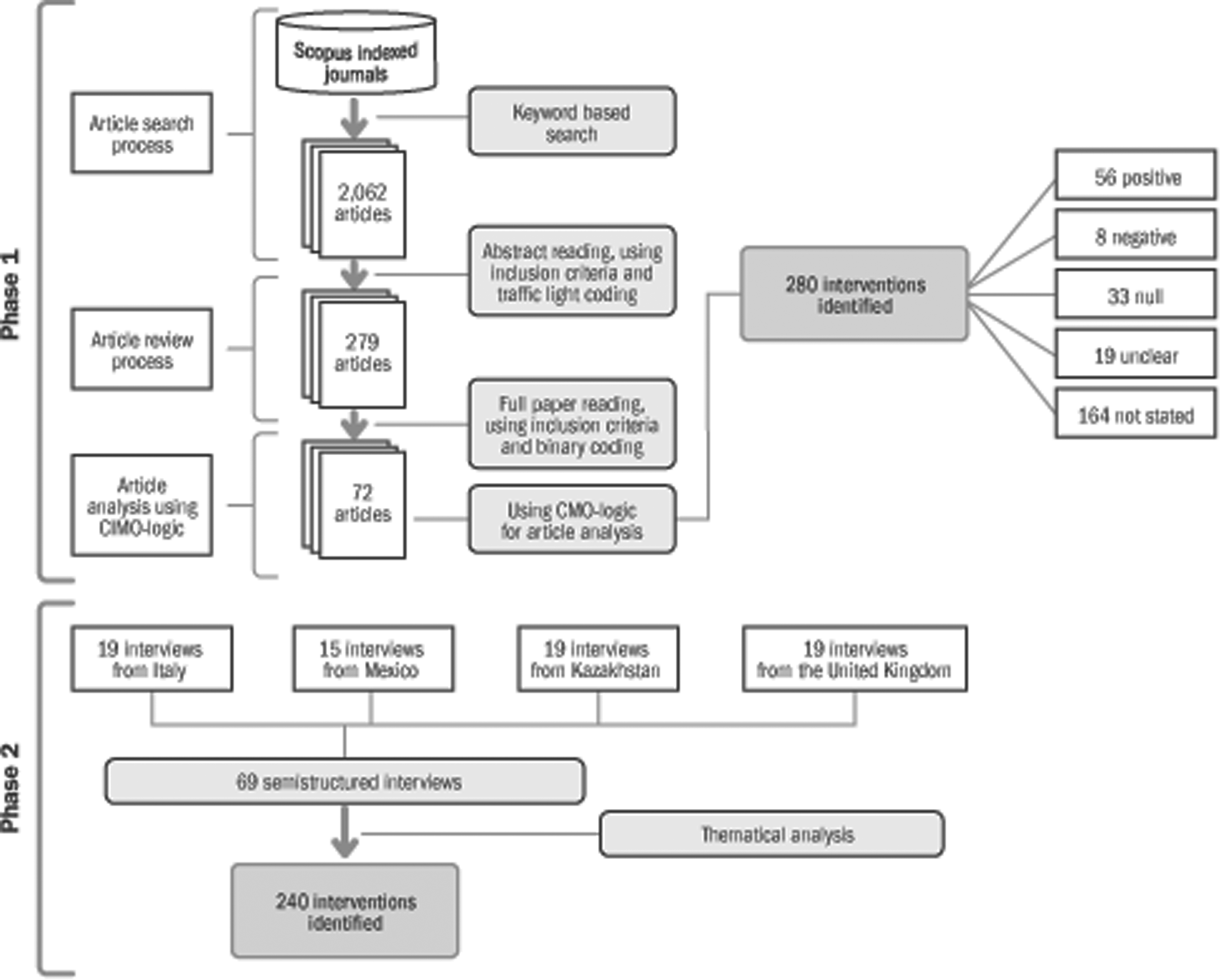
Research design.
For the data analysis, similarly to Lehtinen et al. (2022), we used design-oriented research synthesis (Briner & Denyer, 2012), operationalized with CIMO (context, interventions, mechanisms, outcomes)-logic. CIMO-logic exposes how, in a determined context [c], interventions [i] through specific mechanisms [m] can lead to an outcome [o] (Denyer et al., 2008). Often used in design-oriented research, CIMO-logic is a qualitative research approach (Denyer et al., 2008). In our case, CIMO-logic was used to explore how, in a geographical and sectorial context of a project-based organization, specific interventions that tackle gender inequalities activate a mechanism and achieve (or not) an intended outcome. Across 72 articles, we found 280 interventions that were then categorized into eight groups.
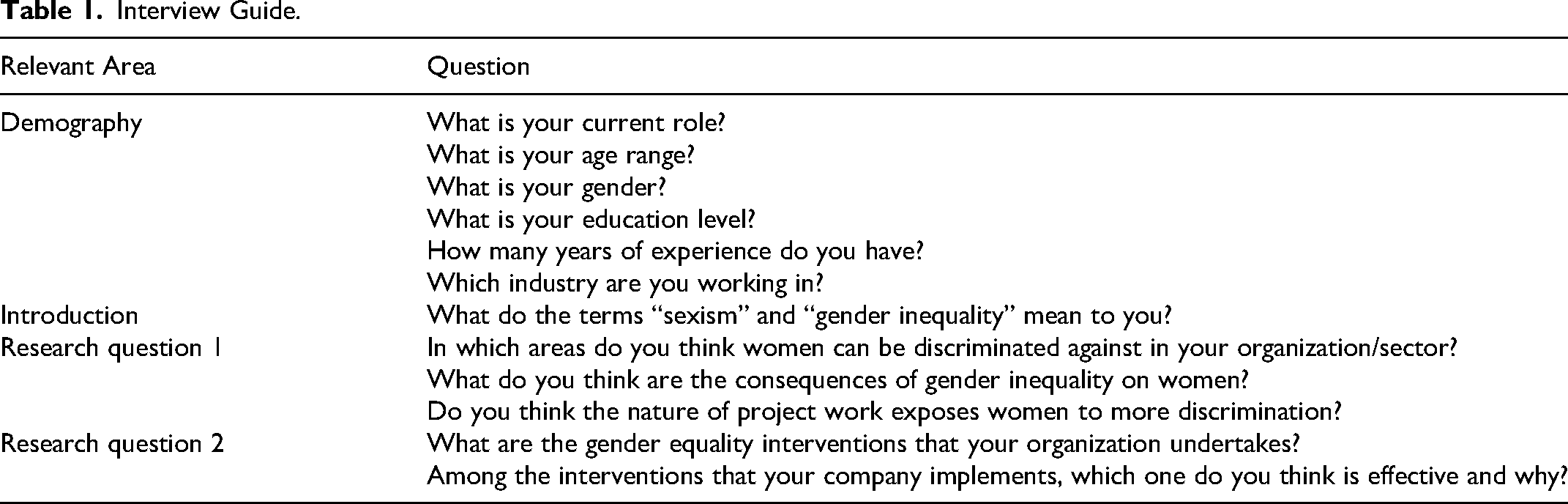
Based on the findings from the literature review, we designed an interview guide (Table 1). During the interviews, we facilitated discussions on existing beliefs and practices regarding women's roles in the workplace and areas where women might face discrimination. We then inquired about the nature of the project work and whether it could expose women to additional discrimination. Finally, we asked participants about the gender equality interventions in place at their organizations and how effective they are, considering the specific culture within their organization.
Interview Guide.
Interviews including participants from various countries captures a broader range of experiences and perspectives, leading to more comprehensive findings (Henrickson et al., 2020) (See Appendix A). We selected interviewees from Italy, the United Kingdom, Kazakhstan, and Mexico, which have similar rankings in the Global Gender Gap Index 2024: United Kingdom (0.78), Mexico (0.77), Kazakhstan (0.71), and Italy (0.7). All four countries have made legislative efforts to promote gender equality and have seen improvements in women's education and healthcare, but women still face challenges with gender pay gaps and underrepresentation in leadership roles (WEF, 2024).
While these countries share similarities, the extent of gender equality varies. The United Kingdom ranks high in educational attainment and healthcare but faces challenges in political empowerment. Italy has made strides in healthcare and education but lags in economic participation and political empowerment. Kazakhstan shows moderate performance with room for improvement in political empowerment and economic participation. Mexico has strengths in healthcare and education but needs to improve economic participation and political empowerment (WEF, 2024).
Data from 69 interviewees were collected between 2022 and 2023. The interviewees were contacted via email or LinkedIn; a brief explanation of the interview was provided, but the questions weren’t disclosed before the interview. Even accounting for the bias of using one social media as a starting point (Lehdonvirta et al., 2021), considering the sample size, we can assume interviewees are randomly selected among individuals working on project activities in project-based organizations. The interviews were conducted online via Microsoft Teams, recorded, and transcribed. The language of the interview was the interviewee’s native language, or English for people working in the United Kingdom, irrespective of their origin, and then translated back to English.
We analyzed 69 semistructured interviews using thematic analysis (Braun & Clarke, 2006) using Atlas. Our abductive research approach was informed by SLR readings and discussions, with CDT aiding data interpretation. We developed a comprehensive codebook through an iterative coding process (See Appendix B). Four authors contributed to the study, regularly meeting to resolve discrepancies and refine the codebook. Finally, two authors recoded the entire interview transcript.
Findings
Our findings are based on the SLR analyzed using CIMO-logic and the interviews. The first finding emerging from the literature and interviews is the lack of substantial difference among the four countries, the types of project-based organizations (e.g., ICT vs. construction), or job roles. Therefore, from this point on, we will not distinguish on this ground throughout the article.
Interventions
We identified 280 interventions from the literature and 240 interventions from the interviews. Leveraging the thematic analysis, we clustered these interventions into eight categories: (1) structural interventions; (2) training interventions; (3) mentorship and support program interventions; (4) work-life balance interventions; (5) signaling program interventions; (6) laws and regulations; (7) organizational culture; and (8) health and safety program interventions.
Structural Interventions
Structural interventions are proactive interventions at the administrative level aimed at reshaping internal structures to reduce gender inequalities (Afolabi et al., 2019; Baker & Clegg, 2023; McCarthy et al., 2021); they can be quotas, organizational changes, changes regarding promotions, and so forth. In both articles and interviews, pink quotas were mentioned the most. Pink quotas are defined as “the percentage of positions reserved by law for women in public and private organizations: companies, educational institutions, decision-making, and government bodies.” (Sentuti et al., 2020, p. 22).
An example is provided by W8-Ita: “Are there any woman quotas? Yes, I think so; we want to get to the same number.” Other structural interventions were the pay policy, cited mostly during the interviews and recruitment and promotion practices such as the formal recruitment process instead of word of mouth (Galea et al., 2015).
Training Interventions
Training interventions are organized educational programs, workshops, or courses to raise awareness and enhance knowledge and skills related to gender equality issues, biases, and inclusivity in the workplace or society (Francis, 2017; Simon & Clarke, 2016; Wang et al., 2021). Training interventions target stereotypical or traditional cultures to improve employees’ understanding and assimilation of gender differences and requirements. Bourguignon and Coron (2023) cite a “training for recruiters on gender equality and vigilance about qualification requirements at the time of recruitment (p. 403).” Training interventions can also target the competencies and skills of candidates or employees. In the interviews, leadership program was frequently cited, as W11-Ita said, “I did a course on leadership; I was the only woman among 20 people. When I got here, I had a six-month course with a team of professionals to help me with the management of the team I had.”
Mentorship and Support Program Interventions
Mentorship and support program interventions are a relationship established between a more experienced mentor and a less experienced mentee to support women’s professional growth and advancement in a structured and supportive way (Francis, 2017; Morello et al., 2018; Wang et al., 2021). A mentorship and support program has two main subcategories: mentorship and networks. Both were cited in the articles and during the interviews. Smith and Gayles (2018) state that “access to supervisors and other informal and formal mentors to new internships representing a wide range of identities, including women and people of color (p. 27).” W11-UK refers to a women network only: There are obviously women's groups, there are, you know, “women in project management,” “women in construction,” and “women in biotech,” which is another one that we deal with, and things like that. So, there are opportunities for women to have a forum for potential opportunities but also issues they have, dealing with those issues in the industry.
Work-Life Balance Interventions
Work-life balance interventions are policies and activities designed to improve the balance between employees’ working and personal lives (Baker et al., 2019, 2021; Baker & Clegg, 2023). In both articles and interviews, flexible work arrangements were the most cited intervention in this category. Regis et al. (2019) stated the “flexibility in the form of schedules, locations and ways the work is done (p. 2546).” In interviews, on the other hand, smart working was frequently mentioned. Childcare was another intervention mentioned in both the articles and the interviews. M1-UKsaid, “The daycare I mentioned earlier and the fact that there is more willingness to give vacations or days off to care for children,” although with far less frequency than the flexible work schedules. This would particularly help women as they typically struggle to balance work and life. The interviews showed that it is not uncommon to follow more than one project at the same time; this leads to overload, which comes with a poor work-life balance, especially at the end of the project (Delisle, 2020).
Signaling Effect Interventions
There seems to be an alignment between the frequency of signaling effect interventions mentioned in both articles and interviews. These interventions vary, as Riva et al. (2019, p. 3) cite “proactive recruitment campaigns and communication activities using positive images of tradeswomen and active enforcement of equal opportunity policies” to incentivize women entering the sector. W2-UK states: “We've got awards for females or women so that they try to recognize outstanding works, which are good. So, it encourages us to be better and do our best.”
Laws and Regulations
We note that this intervention category has been analyzed more in the articles than in the interviews. Moreover, the way these laws and regulations are stated differs. In the articles, laws have been mentioned with precise descriptions. For example, Ackrill et al. (2017) mention that the legal requirement of equal representation of women and men on boards of directors and supervisory boards would work by incentivizing women through the correct processes and collaborating with bodies and movements. Interviewees gave an overall description of the laws they referred to without being sure about the details. W5-Ita states, “I think by law and by national contract there are [incentives for workers with children]; I don't think there are specific company choices.”
Organizational Culture
Organizational culture interventions aim to promote a new culture fostering gender equality (Ward et al., 2019). Therefore, organizational culture interventions would target the core of the employees’ values and beliefs. Macdonald (2021) cite an “explicit discussion of sexism and discrimination in STEM” (p. 11), and W1-Kz underlines the fact that “Management hires the right prospects who are close to the company’s values. And generally, it is unacceptable. This is the company’s organizational culture. Our company’s values are respect and good positive attitudes.”
Health and Safety Programs
A reporting system was frequently mentioned in the interviews and just once in the articles (Hashmi et al., 2022). They mention implementing a formal and notified anonymous reporting and complaints system for sexual harassment through which women can report any incident without feeling ashamed, thus enhancing the psychological capital of employees. Five interviewees referred to having a specific department dealing with incidents. For example, W18-UK stated: We've got a new HR system as well called “My HR which sort of removes us emailing HR directly so that you can go on to this “My HR” portal and you can report things through that, and it's pretty much instantaneous and sort of removes that, I have to tell somebody in person kind of thing when if people are feeling a bit worried about that.
Mechanisms
Investigating mechanisms involves understanding how interventions may or may not lead to the intended outcomes. More rigorously, the mechanism is triggered by the intervention, in a certain context, by indicating why the intervention produces a certain outcome. It can be an explanation of the cognitive processes (reasoning) that actors use to choose their response to the intervention and their ability (resources) to put the intervention into practice. that in a certain context is triggered by the intervention” (Costa et al., 2018, p. 3).
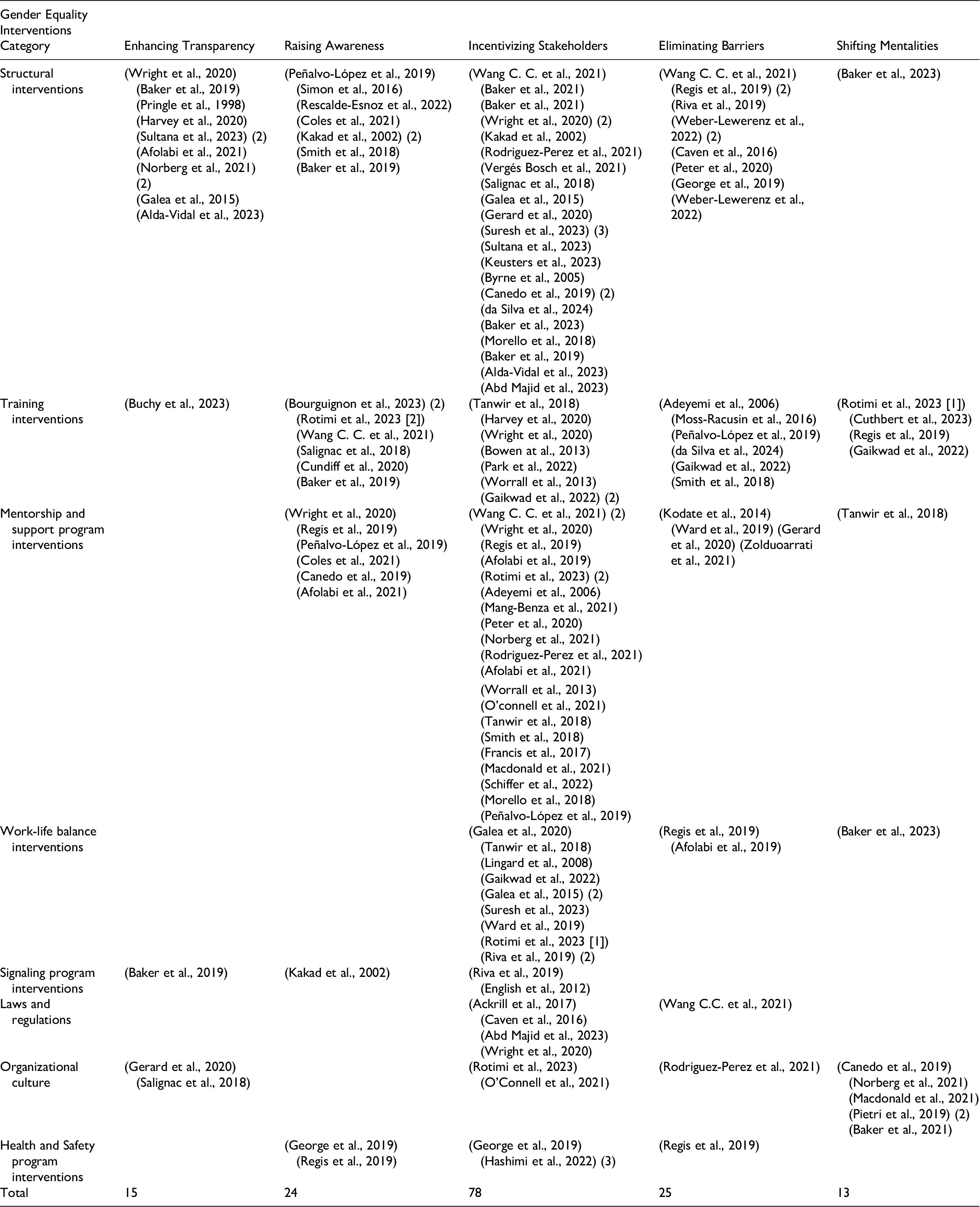
Five categories of mechanisms emerged from our data: (1) incentivizing stakeholders, (2) raising awareness, (3) enhancing transparency, (4) eliminating perceptual barriers, and (5) shifting mentalities (See Appendix C).
Incentivizing Stakeholders
In the literature, incentivizing stakeholders is primarily linked to mentorship and support programs, as highlighted by Wright and Conley (2020) in their discussion on professional networks and structural interventions, as noted by Byrne et al. (2005) in the context of proactive recruitment. In interviews, it was mainly linked to mentorship and support program intervention; as M3-Ita said: “Usually, what the career lacks is the idea of structured growth or development. A path to follow. The sense of possibility of growth.” Indeed, by supporting women, the company provides evidence that female workers are not alone in the industry and encourages them to stay in the sector.
Raising Awareness
Raising awareness is the effort to increase the stakeholders’ understanding and recognition of different dimensions of gender inequality in the industry, stereotypes, and challenges women face. When comparing findings from the articles and interviews, raising awareness is associated with different intervention categories. The articles are mainly associated with training, mentorship support programs, and structural interventions; in interviews, they are associated with training and organizational culture interventions. W3-Kz said, “What we have now is prerecorded video training that you do in your free time and get tested. So essentially, it gives you an overall understanding that there’s a problem that must be tracked.”
Enhancing Transparency
Enhancing transparency increases the openness and accessibility of information and processes to promote gender equality. Galea et al. (2015) mention a formal recruitment process and development plan that would improve transparency in human resources (HR) practices in recruitment and promotion. Through interviews, increasing transparency was also associated with implementing a code of ethical conduct or pay policy where the information about salaries is equally accessible, increasing the likelihood of gender equality. W9-UK declared, “We've also spoken about salary out loud. We've done, you know, our organization has tapped into finance and HR to understand how our, you know, salary for each gender is.”
Eliminating Perpetual Barriers
Eliminating perpetual barriers is the process of removing or supporting overcoming obstacles that generate gender differences, hindering women from accessing the same resources as men. Different correlations exist between the mechanism of eliminating barriers and the types of interventions. This mechanism is connected to structural, training mentorship, and support program interventions. For example, George and Loosemore (2019) propose an example of a structural intervention that looks into the physical barriers facing women with “new production processes and technologies such as offsite assembly” (p. 425) that would “reduce reliance on physical tasks.” On the contrary, in the interviews, there is a strong association between eliminating barriers mechanism and work-life balance interventions, as reported by W3-Kz when referring to smart working: “So, COVID was very good for working from home, making that transition happen very quickly because you can work with your child in the background in another room if they're a certain age.”
Shifting Mentalities
Shifting mentalities is changing stakeholders’ beliefs and attitudes toward women and gender equality. It is triggered by interventions about cognitive processes that can be changed or encourage positive behaviors or values. This mechanism shares a narrow relation with organizational culture and training interventions, as the literature suggests mentalities can be shifted mainly through either training or events. In the interviews, the idea of social conformity emerged as W18-UK said, “They do have the initiatives; I think it is like a trigger to make you understand that yes, you can make certain types of complaints, that certain types of attitudes are not right.”
The Relationship Between Interventions and Mechanisms
Not all mechanisms are triggered by all interventions; for example, setting targets and key performance indicators (KPIs) (Baker et al., 2021) is a structural intervention and triggers the incentivizing stakeholders mechanism. In the CIMO-logic articles, enhancing transparency is a mechanism that relates to structural interventions, suggesting that increasing the transparency of a project-based organization is the result of a change that comes from the very core structure of the company. Galea et al. (2015) mention that a formal recruitment process and development plan would improve transparency in HR practices in recruitment and promotion. Others propose résumés without names to make it impossible to determine if the candidate is female or male (Pringle & Winning, 1998; Harvey & Tremblay, 2020). In the interviews, enhancing transparency is also associated with structural, organizational culture, and health and safety intervention. For example, reporting harassment or other types of discrimination incidents through hotlines (which is classified as health and safety intervention) is connected to enhance transparency because it enlightens employees on the type of sexism that is performed in the company, as in the case of W3-Kz: “They investigate an harassment issue and monitor it, monitor the imbalances, and they talk about it.”
Raising awareness in the articles isn’t narrowly related to an intervention category but is concentrated mainly in three categories: structural interventions, training interventions, and mentorship and support program interventions. In the interviews, it’s connected especially to training, where employees discover different types of sexism like W3-Kz who said: “What we have now is prerecorded video training that you do in your free time and get tested. So essentially it gives you an overall understanding that there’s a problem that must be tracked” or become aware of their own implicit bias as in the case of W8-Ita: “Yes, it is raising awareness on the bias. Some biases are internalized. You think they're normal, but they are no.”
The same can be said for eliminating perceptual barriers; a mechanism triggered mainly in structural interventions, training interventions, and mentorship and support program interventions. Sponsorship was part of the mentorship and support program interventions cited by Ward et al. (2019, p. 2) when they explained that it: …can alleviate issues women typically face when they seek to progress their careers, such as a lack of self-confidence or criticism for excessive self-promotion and can break down barriers women experience when excluded from influential and/or informal (often male-dominated) networks.
Incentivizing stakeholders is mainly linked to structural interventions, mentorship, and support program interventions. Two ways to incentivize stakeholders often cited in the literature are changing the company's structure or helping women with mentorship programs. In interviews, it was mainly linked to mentorship and support program intervention, as W2-Kz stated: “For entry level and junior and interns, I think it [communities for women] is crucial. They can see some role models and examples of representation in their field and get moral support, motivate, and inspire.”
Shifting mentalities share a narrow relation with organizational culture and training interventions, as the literature suggests that mentalities can be shifted mainly through training or events. For instance, Rotimi et al. (2023) propose a training intervention by providing training to employees on issues such as sexual harassment and discrimination and enhancing work morale. Moreover, organizational culture contributes to shifting mentalities as people tend to uniform their behavior to the organizational culture. Indeed, W7-Mex commented: “They do have the initiatives; I think it is like a trigger to make you understand that yes, you can make certain types of complaints, that certain types of attitudes are not right.”
Intervention Outcomes
There are four kinds of intervention outcomes: positive, negative, null, or unclear. Interventions with a negative outcome are those that did not reach their intended outcome (or any other positive outcome) and hurt women.
Structural Interventions
Gender quotas are a well-recognized intervention used in several industries worldwide, including construction (Galea et al., 2020), ICT (Canedo et al., 2019), banking (Buallay & Alhalwachi, 2022), politics (Franceschet et al., 2012), and academia (Park et al., 2022). Galea et al. (2020) state that even though pink quotas should increase the number of women in a company, it makes managers oppose and doubt the capabilities of women, leading to potentially dangerous consequences. M6–Mex stated: When I will have to recruit, I will have to choose from a sample that is full of males. […] However, some companies have quotas. My company imposes an equal representation of both sexes in all disciplines. In that case, I’m against such initiatives because if the sample is 80 men and 20 women, and supposing that there is a Gaussian distribution of competencies, statistically, I will have eight good men and two good women. By taking 5-5, I will damage the level of the team.”
When individuals feel they are being hired due to positive discrimination, which means being favored in a positive way, they often believe they won't perform well or fit in. This perception can worsen gender bias by undermining their technical or leadership abilities. Another risk associated with pink quotas is tokenism (Zimmer, 1988). If pink quotas are not implemented effectively, they could lead to the appointment of an insufficient number of women who would only be used to fulfill a numerical requirement without having any significant impact. Quotas may temporarily correct gender inequalities, but the goal should be creating a working environment where diversity is valued.
Training Interventions
Both culture-focused training and competence-based training have positive outcomes. Both articles and interviews reported positive outcomes for competence-focused interventions; as Worrall et al. (2010) stated “continuous professional development (CPD) is focused upon communication, teamwork and management-based training knowledge and skills, which can be generically referred to as ‘soft skills’ training (p. 270).” This resulted in “over half of the participants who originated from the larger companies and organizations stating that they had experienced barriers or limitations on what level or type of CPD was made available (p. 276).” Similarly, W4- Ita stated: “I believe in terms of self-esteem, you know, empowered by attending these webinars because you can hear other women speaking about their experience.” On the other hand, culture-focused training interventions were rated as positive in all the articles. Moss-Racusin et al. (2016) reported that “trained facilitators introduced attendees to empirical social science literature on the existence and nature of subtle biases and the benefits of inclusive, heterogeneous learning environments (p. 4),” increasing participants’ awareness of diversity issues, a reduction of participants’ biases, and the preparedness of participants to act on diversity-related matters. Yet, training or other interventions based on the presumed agreement on the need for action are unlikely to gain cooperation from employees who might be hostile or dismissive of minorities (McCarthy et al., 2021). A company’s culture is the foundation upon which other interventions can be built. Competence-based training is essential as well. These types of training are beneficial for women, as Finkel et al. (2023) stated that leadership training is more influential in helping women than men to advance into middle and upper management since women are perceived as less suitable to be leaders. This is coherent with the role congruity theory, where men are believed to be more adequate to be leaders; women who try to reach power positions lose typical feminine characteristics and are perceived as “competent but cold” (Fine, 2010).
Mentorship and Support Program Interventions
Mentorship and support program intervention is a category that broadly contains positive outcome interventions. In the articles, women appreciate this type of intervention where mentors show them the possibilities of a career in male-dominated industries to have “the capabilities they need to find a job or launch their own (Peñalvo-López & Cárcel-Carrasco, 2019, p. 4358).” This intervention can help women grow professionally, provide role model figures, and feel psychologically supported. In male-dominated industries, mentorship is particularly relevant due to the harsh work environment; for example, in construction, it can assist women who experience inappropriate behavior (Wang et al., 2021). In project-based organizations, team members may vary from project to project, and quick integration may be necessary. Mentoring programs can facilitate this process by providing new members with a reference point, support, and guidance.
Work-Life Balance Interventions
Harris et al., (2020) evaluate flexible working arrangements as positive, and Baker et al. (2019) stated that, thanks to such interventions, the representation of women in the property and mining industry has increased. W4-UK described smart working as “really helpful” and W6-UK described it as “fundamental.” Negative work-life balance interventions were found in neither the article nor the interviews. Work-life balance interventions were mentioned, especially in the form of flexible working schedules. Surprisingly, many respondents do not consider flexible working hours as an intervention to promote gender equality. COVID-19 has introduced a new way of working, and indeed, teleworking and smart working were the most mentioned interventions in the flexible working arrangements category. Almubarak et al. (2023) state that, in general, both men and women rated teleworking as satisfactory; however, men evaluate it more negatively because they were more likely to report distractions when working from home, doubt how their boss will evaluate their performance, and state that it limits their career opportunities (Raišienė et al., 2020). Having flexible working arrangements could be helpful in project-based organizations since projects follow wave-like patterns, where periods of high work intensity alternate with periods of inactivity. Therefore, employees with flexible working hours can adapt their working hours accordingly to specific project requirements. Ultimately, employers will manage their resources more efficiently, and employees will have greater autonomy and maximize their productivity.
Signaling Effect Interventions
Harris et al. (2020) suggest that better advertising on social media of the role would help better understand the latter. Interviewees, however, state that rewriting the job description has a positive outcome, as stated by W10-UK: “We specifically hired experts and rewrote all our job descriptions …It was transformative in terms of the pool of people we had coming in.” The articles do not state any negative intervention for this category, whereas interviewees referred to this type of intervention as simply being performative.
Laws and Regulations
Two interviewees mentioned laws and regulations (i.e., pink quotas) with a stated outcome and they are both negative; W4-Kz mentioned “…the quota about the leadership positions of 30% for women is more about leadership positions of second sorts…they don’t give you real ones, just an image of it”; W2-UK stated: “…companies are just trying to tick the box.” Conversely, interventions mentioned in the articles were mainly reported as positive. McCrystal and Smith (2011) mention the establishment of a paid parental leave scheme as a positive intervention, and da Silva et al. (2024) state that the pink quotas law increased the representationof women in the legislative power. Only one intervention was reported to have had a negative outcome: the Equality Act in 2010 (which followed earlier legislation such as the Equal Pay Act in 1970 and the Sex Discrimination Act in 1975), due to women being reluctant to proceed legally for fear of being perceived as litigious and damaging future job prospects (Caven et al., 2016).
Organizational Culture
Baker et al. (2021) is one of the two references that positively rated an inclusive culture, whereas in interviews, we can find different evidence of that, as W10-Kz said: We just have equal treatment to men and women; we don’t have discrimination or sexism. Just our company’s values and corporate culture is against it. In our company a girl became a partner and top management, so I think it’s a great example. How effective do you think it is? It works because I have never experienced anything like this.
For negative outcomes, the interviews stated the company is just complying, but things didn’t change. Employees don’t have a great image of the company, as W3-UK: I just know that for the 8th of March, they love to put a little post saying, “all women of [company name]” and the year after COVID, I can tell you that they asked me for a picture, and I said I'm not going to give you a picture at all. You fired all these women during COVID. We are now fewer women than ever in this company. I am not giving you a picture of me so that you can put the post on LinkedIn to say how amazing your company's women are and do a bit of lip service or marketing thing.
Health and Safety Programs
In the articles just one health and safety intervention was classified as positive, whereas in the interviews, there are 14. Baker et al. (2019) mention widely communicating gender-based harassment and discrimination policies within organizations raises awareness, which is the appositive outcome of this intervention. The interviewees mainly mentioned reporting lines for harassment episodes as an intervention with positive outcomes. For example, M3-Mex stated: “I have heard and seen three or four cases, and it [the hotline] has been effective; the hotline is 24 hours a day, so it may happen at night, and they immediately report it, and it goes directly to security.”
Discussions
Crafting a list that neatly categorizes interventions as simply effective or ineffective is an oversimplification. Labeling any intervention as wholly successful or unsuccessful is meaningless as it depends on two critical factors. The first factor is context, which encompasses the country, business, and even the company. Each organization has its unique level of readiness for change, which means the effectiveness of an intervention is contingent on how ready the target group is for that change (Edwards et al., 2000). The second factor is how various interventions are combined and executed simultaneously (Weiner et al., 2012). The interplay among different interventions can significantly influence their overall effectiveness. In isolation, these interventions might not yield the desired results; hence, if an intervention doesn't yield effective results in a particular case, it shouldn't lead to its immediate rejection (Park et al., 2022).
This necessary preamble aside, it is meaningful to make sense of our data based on the CDT (Festinger, 1957), which focuses on personal experience rather than the nature of the intervention, which can explain why interventions have contrasting outcomes. According to Abadeer (2015), gender equality interventions can be closely linked to CDT. In many gender-discriminating societies, women face a difficult choice between advocating for their rights and conforming to discriminatory practices. This conflict creates cognitive dissonance, leading to the unpleasant tension these women experience. These interventions often challenge societal norms and deeply held beliefs about gender roles, creating cognitive dissonance as individuals experience discomfort from conflicting beliefs. This discomfort can motivate individuals to change their attitudes or behaviors to reduce the dissonance such as reevaluating biases and adopting more inclusive behaviors.
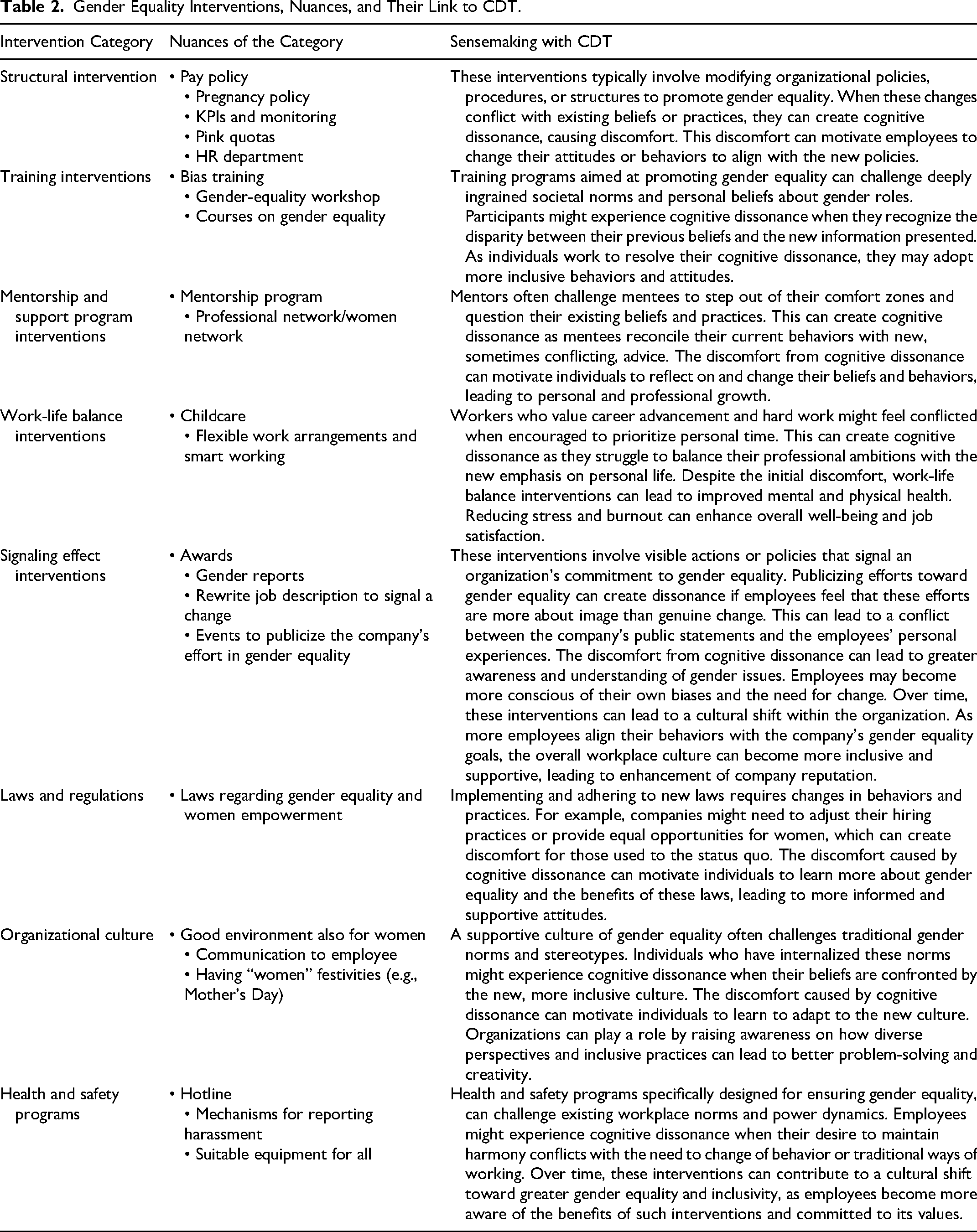
Initially, individuals may experience dissonance if their actions conflict with previous beliefs. Over time, they might change their beliefs to align with new behaviors, leading to enduring changes in attitudes toward gender equality. Interventions provide consistent and reinforcing messages that support gender equality, helping to reduce dissonance and promote acceptance of new norms. When individuals invest effort into supporting gender equality initiatives, they may change their attitudes to justify their efforts, leading to a more profound and lasting commitment to gender equality (Abadeer, 2015). Table 2 explains the nuances between the different interventions in each category and the link between each category of interventions and the CDT.
Gender Equality Interventions, Nuances, and Their Link to CDT.
The first key discussion element concerns pink quotas, one of the most popular structural interventions. For their nature, pink quotas present two outcomes: increasing the number of women in the company and, more subtly, how these women are seen. The former is almost always positive. The interesting outcome, though, is the second one. Women do not wish to be stereotyped or pigeonholed. Despite their good intentions, initiatives like “Chicks with Bricks” (Caven et al., 2016, p. 438) have not been effective. This situation is exacerbated in the project context because of its temporality: W7-Ita said: “When you change teams you can meet different people. You have to create new relations, new empathy, you have to share with everyone the way you work. Someone will always look at you as a suspect.” While in a “permanent environment,” teammates might initially be skeptical about woman X’s skills and capabilities, they can overcome this skepticism over time by overcoming gender bias. In a project environment where teams are often volatile and temporary, woman X may not have sufficient time to prove herself before transitioning to a new team, leading to repeated pigeonholing in each new assignment. This scenario illustrates how employees can experience cognitive dissonance regarding gender equality in the workplace. On one hand, they may support increasing the number of women in the company, recognizing the advantages of diversity and inclusion. On the other hand, they might resist quotas, believing they undermine meritocracy and fairness. This dissonance creates discomfort, potentially resulting in harmful interventions. Training intervention outcomes for competence-focused interventions were primarily positive (Worrall et al., 2010). Competence-focused training targets women's skills, developing them on a personal level. Women will, therefore, not feel any dissonance, which will lead to a positive outcome for the intervention. Culture-focused training interventions, however, have had a different outcome; indeed, they were sometimes found to be ineffective. This is linked again to the specificity of project work, where temporary teams are created, bringing together individuals of very different backgrounds with various stereotypes and biases, particularly in large projects (Govind & Sidharth, 2024). The CDT explains this by stating that employees, especially those from older generations, want better results for the company but do not necessarily want to change their traditions or beliefs (Cooper & Perez-Hooks, 2016).
Mentorship and support programs provide women with experienced mentors who can offer guidance, support, and strategies for navigating and confronting discriminatory practices. This empowerment can enhance women's confidence and leadership skills, leading to a more assertive presence in male-dominated environments and other fields such as medicine (Olland et al., 2022). One interviewee said she wanted a female mentor, but that highly ranked women had a maniacal attitude (i.e., being overly enthusiastic and intense, to the level that the mentees became overwhelmed). Once again, the CDT can explain this dissonance: Women want a mentor, but at the same time, they do not because of the attitudes of highly ranked women. If they get a highly ranked woman with a maniacal attitude, the intervention wouldn’t work as women would feel uncomfortable. Crucially, the temporality of project work can become a barrier to this intervention since the mentor and mentee can be assigned from project to project to different teams, working in different contexts and time zones. As stated by W1-UK: I think there is probably an element of projects disproportionately affecting women, because a project team typically comes together for the duration of the project…you go back a step every time you join a new project so you don’t get the opportunity to build a relationship with the people who can advocate for your career progression.
Creating a bond and a close relationship is far more challenging than in a stable operations management setting, where both could be permanently on the same team, if not even in the same office.
Work-life balance interventions had a common positive outcome, particularly for the interviewees. Projects, by nature, are more challenging than operation-based organizations. They require more flexibility in both time work (because of milestones and deadlines) and locations (e.g., moving across construction sites or customer offices across the country or the world). Women with caregiving responsibilities might struggle with a job that is not based on a routine. While work-life balance interventions are helpful, women experience dissonance when they want to simultaneously achieve a great professional career and fulfill their family duties. The work-life intervention can solve these two contrasting aspects, thus resulting in women typically embracing them.
CDT suggests people feel uncomfortable with conflicting beliefs, values, or attitudes; this discomfort pushes them to change their beliefs or behaviors to reduce the conflict (Cooper, 2019). Successful interventions—such as structural changes, mentorship, training, work-life balance programs, signaling, cultural shifts, laws, and health and safety measures—often work by creating or increasing cognitive dissonance. For example, raising awareness and enhancing transparency introduce new information that clashes with existing beliefs or practices. This clash creates discomfort, motivating people to change their behaviors to reduce the discomfort. Similarly, incentivizing stakeholders and removing perceptual barriers can challenge existing attitudes and encourage behavioral change to resolve the discomfort.
If an intervention does not effectively and credibly challenge existing beliefs or if people can dismiss the discomfort without changing their behavior, the intervention is unlikely to succeed (Michie et al., 2018). Changing mentalities and cultural shifts are particularly difficult because they require profound changes in attitudes and values, which can resist change without significant discomfort. Ultimately, to enhance the design of gender-equality interventions, Rotimi et al. (2023) highlight two essential factors: first, increasing women's participation in the design process of interventions, and second, focusing on identifying the root causes to propose targeted solutions. Many interviews highlighted the importance of including both genders in the interventions, as W2-Kz states: “I think if you say it's a women's issue, you alienate so many people and then you've lost 50% of the people who can help you to fight your battles.” Others argue that gender inequality remains unresolved as stated by W5-UK: We need to just keep reminding people that it's still there and just have open discussions about incidents and about people's behaviors and about how that made people feel. We need to do things, let people know what we have done, how we progress, what issues we had, how we can make things better.
Conclusions
Despite the relevance of investigating the effectiveness of gender equality interventions in project-based organizations, there is no systematic analysis summarizing which intervention exists, which works, which doesn’t, and the reasons behind them. The knowledge on interventions for addressing gender inequality in scientific literature is anecdotal, incomplete, and scattered in different fields and journals. Therefore, this article systematically identified such interventions and assessed their effectiveness and underlying success or failure mechanisms. Intervention outputs found in this research are contrasting; some were incoherent, as the same intervention sometimes had different results, and CDT can help in sensemaking this.
Managerial Implications
Mentorship programs have a positive outcome, as reported in the literature and during interviews. Moreover, work-life balance interventions were popular among female interviewees, as work flexibility and the possibility to work from home helped them better manage what they perceived as “family duties” without sacrificing their professional duties. Another aspect that emerged as necessary is the combination of interventions. Combining interventions helps project-based organizations reach their goal of fighting gender inequality, because different interventions can target different dimensions. Training courses might also be practical, but it is essential to assess to what extent the participants engaged with the subject (e.g., a final test or a reflection discussion).
These recommendations can broadly work in all project-based organizations, yet each project business has peculiarities depending on its temporary nature. Construction-based companies that require on-site presence might focus more on health and safety program interventions. As women might be exposed to harassment on the worksite, anonymous whistleblowing systems should be implemented in all project-based organizations to help women report inappropriate behavior. Construction-based project-based organizations could also focus on all conditions for women on the worksite such as bathrooms, equipment, and safety. Ultimately, CDT highlights the importance of designing interventions thoughtfully, as individual experiences influence their success. By carefully crafting interventions, we can maximize positive outcomes and ensure they effectively promote the desired changes.
The temporary and dynamic nature of projects often results in a lack of long-term accountability and continuity in addressing gender issues. The focus on short-term goals can overshadow gender equality efforts, allowing discriminatory practices to persist. According to Winch (2014), although project-based organizations have permanent policies, projects may lack formal procedures to address gender inequality, leading to inconsistent interventions. Projects spanning different locations and cultures face additional challenges in maintaining consistent gender equality standards due to varying cultural norms. Recognizing these challenges is crucial for effective interventions that create cognitive dissonance and promote inclusivity. Professional bodies can support this journey by developing training programs and facilitating discussions on gender equality.
Theoretical Contributions
CDT is a mainstream theory in psychology, and this research introduces it to project studies, where there is a vast untapped potential for applications. In this case, identifying effective gender-equality interventions involves recognizing those that create or amplify cognitive dissonance. Interventions that raise awareness about gender biases or enhance transparency about gender disparities are particularly effective. These interventions highlight contradictions between people's beliefs and behaviors, creating discomfort, which, in turn, motivates individuals to change their behaviors to align with the new information, thereby promoting gender equality (Abadeer, 2015). Evaluating the mechanisms behind these interventions is also crucial. By examining how interventions like incentivizing stakeholders or eliminating perceptual barriers work, we can determine their effectiveness in creating cognitive dissonance. Effective mechanisms challenge existing beliefs and prompt behavioral change, increasing gender equality.
Understanding resistance is crucial. CDT explains why some interventions fail. If an intervention doesn't generate enough dissonance or if the dissonance is easily dismissed, it won't lead to meaningful change (Harmon-Jones, 2019). Recognizing this helps refine interventions that challenge deep-seated attitudes and values. Pink quotas are an example of such an intervention.
Projects are temporary and involve shifting teams and locations, disrupting traditional norms and creating cognitive dissonance. Frequent exposure to new practices, cultures, and expectations heightens cognitive dissonance as beliefs and behaviors are continually challenged. The temporary nature of projects means team members must regularly adapt to new norms, creating ongoing cognitive dissonance as they reconcile established beliefs with new requirements. Changing teams exposes individuals to diverse perspectives and working styles, amplifying cognitive dissonance and prompting behavioral adjustments. Geographical mobility in some project-based organizations further challenges existing beliefs, motivating adaptation to new environments (Alderman, 2005). While this can enhance adaptability, foster growth, and stimulate innovation, constant change and the need to adapt can lead to stress and burnout. Unmanaged cognitive dissonance can damage mental health.
Limitations and Recommendations for Future Research
Given the novelty of gender interventions in project-based organizations, our research is primarily exploratory and normative. Future research should analyze individual interventions and their mechanisms through detailed case studies or longitudinal studies. This could help understand the impacts over time and how different interventions interact. Researching policy integration into organizational practices to promote gender equality and inclusivity is also crucial. Studying specific policy implementation and outcomes can provide practical insights for creating inclusive workplaces.
Expanding research to include other underrepresented groups, such as men in traditionally women-dominated workplaces, people of color, and members of the LGBTQIA + community, is essential. These groups may experience discrimination in ways that differ from biological women. Sector-specific studies could further enhance understanding of the barriers faced by these groups in different industries.
Footnotes
Acknowledgments
We are deeply grateful to the Project Management Institute (PMI) for their generous funding, which has been pivotal in advancing our research. We also extend our sincere thanks to Dr. Joana Geraldi and Professor Jeffrey Pinto for their invaluable contributions as advisory panel members throughout this project; their insights and guidance have greatly enriched our work. Additionally, we appreciate the thoughtful comments from the Editor, Professor Shazia Nauman, and the anonymous reviewers. Finally, special thanks to Alena Tvorogova, Maria Del Rocio Lozano De Alva, and Aruzhan Kussembay for their support for the data collection, Dr. Kate Lawrence for her insightful ideas and support for data analysis, and Chiara Ogheri, for carefully proofreading the manuscript.

Author Biographies
Appendix A. Research Participants
Country
Participant Reference
Role
Industry
Gender
Years of
ITA
W1-Ita
Project manager
IT consultancy
Female
6
W2-Ita
Project cost controller
Engineering, construction, oil and gas
Female
16
W3-Ita
Project cost controller
Engineering, procurement, and construction
Female
15
W4-Ita
CEO and senior project manager
Manufacturing
Female
25
W5 - Ita
Project leader
Chemical engineering
Female
7
W6 - Ita
Project manager
Manufacturing
Female
9
W7 - Ita
Responsible for electrical engineering
Construction
Female
15
W8 - Ita
Functional analyst
Consulting
Female
2
W9 - Ita
Project manager
Oil and gas
Female
19
W10 - Ita
Senior cost controller
Oil and gas
Female
18
W11 - Ita
Project control manager
Energy
Female
20
M1 - Ita
Site engineer
Construction
Male
3
M2 - Ita
Project manager
Oil and gas
Male
16
M3 - Ita
Project inspector material
Oil and gas
Male
10
M4 - Ita
Project manager
Oil and gas
Male
14
M5 - Ita
Project control manager
Oil and gas
Male
20
M6 - Ita
Team leader
Consulting
Male
5
M7 - Ita
Cost control engineer
Construction, oil and gas
Male
6
M8 - Ita
Project manager
Transportation
Male
6
MEX
M1 - Mex
Structure coordinator
Construction
Male
40
M2 - Mex
Leader programmer
Construction
Male
15
M3 - Mex
Construction manager
Construction
Male
10
M4 - Mex
Machinery manager
Construction
Male
2
M5 - Mex
Engineering coordinator
Construction
Male
15
M6 - Mex
Human capital
Construction
Male
20
W1 - Mex
Project control engineer
Construction
Female
2
W2 - Mex
Geologist engineer
Construction
Female
1
W3 - Mex
Training analyst
Construction
Female
1
W4 - Mex
Construction manager
Construction
Female
14
W5 - Mex
Documents analyst
Construction
Female
27
W6 - Mex
Project control manager
Construction
Female
5
W7 - Mex
Project control coordinator
Construction
Female
17
W8 - Mex
Security technician
Construction
Female
1
W9 - Mex
Subcontracts chief
Construction
Female
6
KZ
W1 - Kz
Project manager
IT
Female
29
W2 - Kz
Brand manager
IT
Female
4
W3 - Kz
Senior consultant
IT
Female
4
W4 - Kz
Data analyst
IT
Female
12
W5 - Kz
Middle–senior data analyst
IT
Female
4
W6 - Kz
Developer
IT
Female
6
W7 - Kz
Product manager
IT
Female
8
W8 - Kz
IOS developer team lead
IT
Female
3
W9 - Kz
Project manager
IT
Female
8
W10 - Kz
Senior IT consultant
IT
Female
12
W11 - Kz
Middle engineer
IT
Female
4
W12 - Kz
Product manager
IT
Female
7
W13 - Kz
The head of learning and development
IT
Female
20
W14 - Kz
Agile coach
IT
Female
6
W15 - Kz
Tech manager
IT
Female
12
UK
W1 - UK
Project manager
Construction
Female
5
W2 - UK
Engineer
Construction
Female
15
W3 - UK
Project manager
Construction
Female
10
W4 - UK
Technical director
Construction
Female
16
W5 - UK
Project manager
Construction
Female
5
W6 - UK
Associate director
Construction
Female
15
W7 - UK
Project manager
Construction
Female
2
W8 - UK
Chief executive
Construction
Female
33
W9 - UK
Senior project manager
Construction
Female
10
W10 - UK
Director portfolio manager
Construction
Female
30
W11 - UK
Quality manager
Construction
Female
17
W12 - UK
Program manager
Construction
Female
5
W13 - UK
Program manager
Construction
Female
6
W14 - UK
Safety manager
Construction
Female
15
W15 - UK
Project manager
Nuclear
Female
10
W16 - UK
Program manager
Construction
Female
26
W17 - UK
Project manager
Construction
Female
9
W18-UK
Project manager
Construction
Female
5
M1 - UK
Company equity partner
Construction
Male
20
M2 - UK
Director of estates and facilities
Construction
Male
25
Appendix B. Extract of the Codebook
Name
Definition
When to Use
Example CIMO-logic
Example Interviews
Intervention: Work-life balance interventions
Policies and activities designed to improve the balance between employees’ work and personal lives.
Interventions aiming to balance the life of employees, including work from home and flexible schedules.
Offering flexible work arrangements and policies that promote work-life balance to accommodate the diverse needs of employees.
"We have the possibility to do 10 days of smart working per month, which however can't be consecutive; that is, per week you have to do at least 1 day in the office. In the summer you have a month that can be consecutive; it's called summer kids, something like that."
Mechanism: Enhancing awareness
Effort to increase the stakeholders’ understanding and the recognition of different dimensions of sexism in the industry, stereotypes and challenges faced by women.
The intervention is useful to make people understand the existence of barriers for females or to increase the consciousness around the typical gender problems.
"Participation in unions promotes awareness of the issue and stimulates the implementation of projects."
“What we have now is prerecorded video trainings that you do in your free time and get tested. So essentially it gives you an overall understanding that there’s a problem that must be tracked.”
Sexism Dimension: Glass ceiling
Invisible barrier that does not allow women to advance their careers within their organization.
References about slow women career progression compared to men.
Structural, cultural, and historical influences can create barriers that prevent women from making progress within the business or entering these industries.
"It's almost taken for granted that a man can make a career and become a manager; it's not so taken for granted that a woman can make a career and hold high positions in the corporate organization.”
“I believe that discrimination exists in the hiring process. I've noticed that there are more men than women in the workplace, which raises some concerns for me. Additionally, for positions involving heavy machinery, candidates must have certification to prove they can operate the machines. This requirement poses a challenge for women who want to learn how to use the machinery, as they have to undergo training and wait for certification, which can delay their employment. Moreover, I recall an incident where a coworker was asked to hire people for a specific area and explicitly referred to “men candidates.” This indicates a bias towards hiring men, suggesting that discrimination occurs right from the start of the recruitment process.”
Discrimination application type: Institutional
Institutional sexism includes policies, practices, and norms that perpetuate inequality by restricting opportunities for women.
Discrimination that is justified by a written document that could be either procedural or reward based.
"Male-dominated project-based industries exhibit both horizontal and vertical segregation, where the workforce is predominantly male, and women often hold lower-level roles with limited career progression opportunities and
limited impact of gender equality initiatives"
Sexism type: Malevolent
Malevolent (hostile or overt) sexism is when there is an intention to harm. It has a manipulative character, where both emotional and physical abuse may take a place.
Examples of it are sexual harassment, physical assault, inappropriate language, and aggressive insults. It can also manifest in different contexts such as recruitment bias, pay gap, etc.
There remains a male-dominated workplace culture characterized by ‘macho”’ behavior, ‘banter’ and sexual harassment, particularly for women in the manual trades.
Appendix C. Interventions–Mechanism Matrix
| Gender Equality Interventions Category | Enhancing Transparency | Raising Awareness | Incentivizing Stakeholders | Eliminating Barriers | Shifting Mentalities |
|---|---|---|---|---|---|
| Structural interventions | (Wright et al., 2020) (Baker et al., 2019) (Pringle et al., 1998) (Harvey et al., 2020) (Sultana et al., 2023) (2) (Afolabi et al., 2021) (Norberg et al., 2021) (2) (Galea et al., 2015) (Alda-Vidal et al., 2023) |
(Peñalvo-López et al., 2019) (Simon et al., 2016) (Rescalde-Esnoz et al., 2022) (Coles et al., 2021) (Kakad et al., 2002) (2) (Smith et al., 2018) (Baker et al., 2019) |
(Wang C. C. et al., 2021) (Baker et al., 2021) (Baker et al., 2021) (Wright et al., 2020) (2) (Kakad et al., 2002) (Rodriguez-Perez et al., 2021) (Vergés Bosch et al., 2021) (Salignac et al., 2018) (Galea et al., 2015) (Gerard et al., 2020) (Suresh et al., 2023) (3) (Sultana et al., 2023) (Keusters et al., 2023) (Byrne et al., 2005) (Canedo et al., 2019) (2) (da Silva et al., 2024) (Baker et al., 2023) (Morello et al., 2018) (Baker et al., 2019) (Alda-Vidal et al., 2023) (Abd Majid et al., 2023) |
(Wang C. C. et al., 2021) (Regis et al., 2019) (2) (Riva et al., 2019) (Weber-Lewerenz et al., 2022) (2) (Caven et al., 2016) (Peter et al., 2020) (George et al., 2019) (Weber-Lewerenz et al., 2022) |
(Baker et al., 2023) |
| Training interventions | (Buchy et al., 2023) | (Bourguignon et al., 2023) (2) (Rotimi et al., 2023 [2]) (Wang C. C. et al., 2021) (Salignac et al., 2018) (Cundiff et al., 2020) (Baker et al., 2019) |
(Tanwir et al., 2018) (Harvey et al., 2020) (Wright et al., 2020) (Bowen at al., 2013) (Park et al., 2022) (Worrall et al., 2013) (Gaikwad et al., 2022) (2) |
(Adeyemi et al., 2006) (Moss-Racusin et al., 2016) (Peñalvo-López et al., 2019) (da Silva et al., 2024) (Gaikwad et al., 2022) (Smith et al., 2018) |
(Rotimi et al., 2023 [1]) (Cuthbert et al., 2023) (Regis et al., 2019) (Gaikwad et al., 2022) |
| Mentorship and support program interventions | (Wright et al., 2020) |
(Wang C. C. et al., 2021) (2) |
(Kodate et al., 2014) |
(Tanwir et al., 2018) | |
| Work-life balance interventions | (Galea et al., 2020) |
(Regis et al., 2019) |
(Baker et al., 2023) | ||
| Signaling program interventions | (Baker et al., 2019) | (Kakad et al., 2002) | (Riva et al., 2019) |
||
| Laws and regulations | (Ackrill et al., 2017) |
(Wang C.C. et al., 2021) | |||
| Organizational culture | (Gerard et al., 2020) (Salignac et al., 2018) | (Rotimi et al., 2023) |
(Rodriguez-Perez et al., 2021) | (Canedo et al., 2019) |
|
| Health and Safety program interventions | (George et al., 2019) |
(George et al., 2019) |
(Regis et al., 2019) | ||
| Total | 15 | 24 | 78 | 25 | 13 |