



Abstract
Drawing from in-depth interviews of cleaners employed in the cleaning industry in India, the study examines the ongoing process of constructing a positive identity among dirty workers. Cleaners respond to the intense identity struggles emerging from caste stigma, dirty taint, and precarity by constructing ambivalent identities. Cleaners’ identity work is constituted by the very identity struggles they encounter, and their efforts to negotiate stigmatized identities further create identity tensions. Apart from accenting the paradoxical duality inhered in identity work, the findings show how caste/class inequalities are reworked in a neoliberal milieu and reproduced in identity construction processes. The findings call attention to caste as an important social category in organizational studies that has implications for work identities, dirty work, and precarious work.
Keywords
Introduction
Dirty work research has documented experiences of invisible and neglected workers in organizational studies such as cleaners (Soni-Sinha and Yates, 2013), refuse collectors (Hughes et al., 2017), security guards (Hansen Löfstrand et al., 2016), slaughtermen (Baran et al., 2016), exotic dancers (Grandy, 2008), and so on, thereby going against the general trend of focusing on clean, good, and high skilled work (Bolton and Houlihan, 2009; Grandy et al., 2014). Despite the increased interest in dirty occupations, there is still much to understand about the experiences of dirty workers. So far, the focus of dirty work studies has been occupational features and taint/stigma management strategies (Simpson and Simpson, 2018), mostly drawn from social identity theory (SIT). Following Ashforth and Kreiner (1999), these studies implicitly assume that dirty workers eventually succeed in creating a positive and coherent self. For instance, firefighters reframe their job as heroic and take pride in their work (Tracy and Scott, 2006). However, recent studies reveal the messy and complex struggle of constructing and sustaining a positive identity (Slutskaya et al., 2016; Van Vuuren et al., 2012).
The efforts to construct a positive self-view are additionally complicated by neoliberal policies which have reorganized dirty occupations worldwide, making them precarious (Aguiar and Herod, 2006). Neoliberal practices are reinforcing and worsening existing social hierarchies and inequalities, further eroding the dignity of dirty workers (Soni-Sinha and Yates, 2013). For instance, cleaning in India, where this study is situated, is perceived as ritually impure and continues to be restricted to Dalits (Chrispal et al., 2021; Noronha, 2021). With the rise of outsourcing and contractual work, cleaners’ employment relations are characterized by extreme insecurity and indignity. Co-constitution of neoliberalism and caste, enacted through spatial and technological practices of cleaning, not only others Dalit bodies and renders them invisible but also normalizes economic exploitation (Gupta, 2022; Mahalingam et al., 2019).
In this study, we examine how dirty workers in a neoliberal context, specifically cleaners in India, make sense of their self in the face of multiple intersecting structural and cultural constraints. Dirty workers facing multiple intersecting taints are found to occupy a tensional space (Wolfe et al., 2018) between positive and negative meanings (Shepherd et al., 2021) arising from simultaneously enabling and constraining identity resources (Simpson and Simpson, 2018). In such contexts, the process of constructing a positive identity may remain as a persistent challenge characterized by helplessness, ambivalence, and discontinuity. Hence, the study employs the identity work lens which provides a frame to explore identity construction as a struggle marked by ambivalence (Beech et al., 2016) compared to a static approach followed by SIT (Alvesson et al., 2008b). Specifically, the study explores the identity struggles of cleaners and their response to the same via identity work.
The study’s contributions are multifold. The findings contribute to the identity literature by showing the dynamic and complicated relationship between cleaners’ identity struggles and identity work which is, sometimes, synergistic and, at other times, disjunctive. The findings also bring out the integrative effect of taint/stigma and taint management at multiple levels (individual, occupational, and organizational). The sources of stigma and taint management strategies transcend levels (Zhang et al., 2021), simultaneously downplaying and maintaining stigma. Additionally, the study discusses the implications of caste for work identities, dirty work, and precarious work, reasserting Bapuji and Chrispal’s (2020) call to include caste as an important social category in organizational studies. The study highlights the instrumental role of caste in organizing work, space and roles at multiple and intersecting levels (individual, occupational, organizational, and industry), especially in a neoliberal environment. Further, in the case of dirty work research, caste emerges as more than a stigmatized identity; rather, it becomes a distinct form of taint that perpetuates embodied suitability (Simpson and Simpson, 2018), especially in undertaking most denigrated tasks such as toilet cleaning (Zulfiqar and Prasad, 2021). Finally, the study enumerates the co-constitution of caste and neoliberal vulnerabilities in India (Gupta, 2022; Mahalingam et al., 2019), where caste-based differences are operationalized and reworked through neoliberal practices (Harriss-White and Rodrigo, 2016). Neoliberalism as a context impinges on cleaners’ identity work, producing ambivalent selves that simultaneously resist and confirm.
Dirty occupations and identity work
The concept “dirty work” refers to tasks, job roles, and occupations attributed as demeaning due to the accompanying physical, moral, social, and emotional taint (Ashforth and Kreiner, 1999; McMurray and Ward, 2014). The taint stigmatizes people who undertake dirty work and deems them inferior (Ashforth and Kreiner, 2014). Dirty work is often devolved to marginalized social groups resulting in intersections of multiple marginalized identities (e.g. gender, class, caste, race, ethnicity, and nationality) at the site of dirty work (Dick, 2005; Shepherd et al., 2021; Simpson et al., 2012). Dirty occupations vary based on the occupational prestige derived from task complexity, educational level and income (Ashforth et al., 2017). For example, physicians, lawyers, social workers, etc., are viewed as relatively high-prestige, whereas cleaners, butchers, refuse collectors, etc., are placed at the opposite end of the spectrum (Ashforth et al., 2007; Baran et al., 2016; Tracy and Scott, 2006).
Taint problematizes identity management for dirty workers since the association with dirt damages individuals’ identity (Grandy, 2008; Kreiner et al., 2006). Nonetheless, dirty workers try to construct positive meanings of self and protect their dignity by engaging in taint management strategies (Simpson and Simpson, 2018) that emerge from strong occupational ideologies/culture (Bosmans et al., 2016). Dirty workers transform the meaning of their work through reframing (e.g. garbage collection as essential service to the public (Hamilton et al., 2019)), emphasizing non-stigmatized aspects of their job (e.g. highlighting professional skills (Clarke and Ravenswood, 2019)), engaging in esteem enhancing social comparison (e.g. male refuse collector’s comparison with women and migrants (Slutskaya et al., 2016)) and confronting stigma (Bosmans et al., 2016).
Much research on taint management employs the SIT lens that highlights coping mechanisms grounded in group membership which aim at establishing positive identities (Simpson and Simpson, 2018; Van Vuuren et al., 2012). Yet, while SIT recognizes dirty workers’ agentic power in redefining and contesting the meaning of their work (Alvesson et al., 2008b; Dick, 2005), it does not explore the complexity of the identity construction process (Huddy, 2001). SIT focuses on a single and static in-group affiliation (i.e. occupational membership in the case of dirty work) rather than fluid multiple group affiliations. For example, drawing from social category theory (SCT), Van Vuuren et al. (2012) recognize the fluidity of self-categorization where various aspects of dirty workers’ identity become salient (e.g. gender) in different contexts. Further, SIT’s focus on cognitive affiliation with group membership neglects the influence of broader social and institutional discourses on how dirty workers construct and maintain positive identities (Dick, 2005; Tracy and Scott, 2006). Not only the meaning ascribed to group membership can differ among dirty workers but also available social identities may be destabilized and non-coherent (Alvesson et al., 2008b). In such situations, group affiliations can be fragile, emergent, and open to dispute, and identity construction can be seen as an ongoing meaning-making struggle (Dick, 2005; Simpson and Simpson, 2018).
Identity struggles occur when individuals confront contradictions between self-views and social or external demands (Alvesson, 2010; Kreiner et al., 2006). In the case of dirty work, such identity struggles can be intense, ongoing, and demanding (Van Vuuren et al., 2012). This is true especially in the case of low-prestige and intractable dirty work where multiple sources of taint intersect, and taint is unavoidable due to social identities (Galazka and O’Mahoney, 2021; Shepherd et al., 2021). Sustaining and creating an enhanced identity takes a toll on dirty workers, resulting in competing feelings about one’s work and self. For example, Grandy (2008) observes that exotic dancers did not achieve a complete and absolute favorable sense of self, but rather their efforts concurrently counteracted and sustained stigma. Nonetheless, recent research on intractable dirty work shows that workers are able to achieve functional ambivalence toward their work and lives (Shepherd et al., 2021).
To capture the abovementioned complexities, we move beyond SIT and employ the broader identity work lens to focus on dirty workers’ intricate and complex identity construction processes. Identity work is an ongoing mental activity (Alvesson et al., 2008b) pursued by individuals in the quest of establishing a distinct and coherent self and equilibrium (D’Cruz and Noronha, 2012; Sveningsson and Alvesson, 2003). Dirty taint is an intense identity threat (Van Vuuren et al., 2012) that necessitates individuals to engage in heightened and conscious identity work (Alvesson et al., 2008b). Though individuals engage in identity work to reduce identity tensions, the outcomes may be liminal identities (Beech, 2011), persisting ambiguity and emergence of new tensions (Beech et al., 2016). Moreover, individuals can engage in self-critiquing, rather than self-affirming, identity work, where the struggle becomes essential rather than the outcome (Beech et al., 2016). Hence, our focus is on the process of identity construction, that is, the struggle itself (Beech et al., 2016), along with the nature of outcomes of such a struggle. To this end, the study explores identity struggles and responsive identity work among cleaners in India.
The low-prestige dirty occupation of cleaning
The cleaning occupation encompasses commercial and house/domestic cleaning performed in public (e.g. hotel, building, mall, hospital) and private (households) spheres, respectively. Though approached as distinct subjects of enquiry due to the varying contexts (Cruz and Abrantes, 2014), both forms are perceived as low status, low skilled, and stigmatized (Abbasian and Hellgren, 2012; Zulfiqar and Prasad, 2021). Cleaning work is physically tainted as it involves direct contact with dirt (Hughes et al., 2017), which is seen as polluting based on the subjective social and cultural standards of cleanliness and purity (Douglas, 1966; Zulfiqar, 2019). Specific cleaning tasks (e.g. toilet cleaning) are considered as extremely disgraceful based on the notions of purity and pollution and occur at the intersection of class, caste, gender, and religion (Zulfiqar and Prasad, 2021).
Cleaning is further seen as degrading due to the attached servile taint which places cleaners in roles subservient to others (Zhang et al., 2021). The notion of servitude embedded in domestic work (Bosmans et al., 2016; Ray and Qayum, 2009) and commercial cleaning (Soni-Sinha and Yates, 2013) is linked to status hierarchies of class, race, caste, religion, and gender (Hughes et al., 2017; Varman et al., 2021; Zulfiqar and Prasad, 2021). Cleaners almost always belong to economically and socially disadvantaged groups and have discontinuous work trajectories (Abbasian and Hellgren, 2012; Orupabo and Nadim, 2020). Together, notions of dirt and subordination direct abuse, exploitation, and humiliation toward cleaners and deem them less human, disposable, invisible, and polluted (Mahalingam et al., 2019; Varman et al., 2021).
The challenges faced by cleaners are compounded by neoliberal policies which promote outsourcing as a strategy to achieve cost-effectiveness and workforce flexibility (McBride and Martínez Lucio, 2016). Apart from precarity (Holley and Rainnie, 2012; Tomic et al., 2006), outsourcing leads to work intensification with tight managerial controls, heavy workload, unsocial hours, and low pay (Campbell and Peeters, 2008; Herod and Aguiar, 2006; Munro, 2012). Though the nature of tasks involved in cleaning remains the same, in a bid to professionalize the work, outsourcing has pushed task fragmentation and technology-enabled standardization. Such restructuring has resulted in the degradation of work and workers’ dignity (Cruz and Abrantes, 2014; Gill-McLure and Seifert, 2008). Cleaners have been rendered voiceless due to declining collective action pushed by the neoliberal agenda (Aguiar and Herod, 2006; Soni-Sinha and Yates, 2013). Even if unions exist, they lack enforcement abilities (Bondy, 2018). While outsourcing is claimed to provide increased job opportunities and flexibility (Holley and Rainnie, 2012), in low-skilled work such as cleaning, it has worsened the employment conditions (Bondy, 2018).
Caste and cleaning in India
Historically, cleaning as an occupation in India has been associated with the Dalit community, a low caste group outside the varna system (Jodhka, 2016). Caste or varna (meaning color or category) is the religiously sanctioned segregation and ordering of traditional occupations structured around the notions of purity and pollution (Jodhka, 2016; Judge, 2012). Social groups considered ritually pure (e.g. Brahmins, Kshatriyas, Vaishyas, Shudras) are a part of the varna system. Outside the varna system are the “untouchables,” also called Dalits, carrying out various polluting jobs such as clearing dead cattle or scavenging for the rest of Hindu society (Jodhka, 2016; Noronha, 2021).
Though caste is primarily associated with the Hindu religion, it has been assimilated by other religious groups such as Sikhs, Muslims, and Christians (Judge, 2012). While Islamic ideology supports egalitarianism, empirical evidence points toward caste or caste-like groupings and the practice of untouchability among Indian Muslims (Trivedi et al., 2016). Similar discrimination is observed among Christians in South India, where high-caste converts other Dalit Christians and deny educational and employment opportunities in community-run institutions (Jeremiah, 2014). Hence, regardless of religion, Dalits face systematic discrimination and denial of material and social equality in Indian society (Bapuji and Chrispal, 2020; Noronha, 2021).
One of the ways caste-based ritual hierarchies are reproduced is by restricting Dalits to a few occupations that are constructed as dirty work which, in turn, deem Dalits as polluted (Mahalingam et al., 2019; Noronha and Sharma, 2002; Zulfiqar, 2019). Often, the dirtiest and ritually impure tasks such as toilet cleaning and manual scavenging/excreta removal (Vyas and Spears, 2018) are devolved to Dalits, Dalit women and the poor (Dubey and Murphy, 2021; Kadlak et al., 2019). In domestic work, Sharma (2016) reports that non-Dalit women resist cleaning toilets, considering this suitable for jamadars 1 or Dalits. In another case, Tripathi (2012) notes that upper castes in Uttar Pradesh (a North Indian state) corner half the government sanitation and sewage jobs due to the attached benefits. However, these jobs are then outsourced to Dalits. Thereby, most marginalized cleaners are systematically pushed to perform dirty work (which is often referred to as clustering), and sometimes such efforts are supported and incentivized by the state (Noronha, 2005). The state undermines any collective resistance from cleaners engaged in manual scavenging by promoting caste-based recruitment policies. Though manual scavenging was abolished by Indian law in 2013, it is still prevalent in many forms owing to the state’s indifference in implementing the law (Dubey and Murphy, 2021; Gatade, 2015).
Privatization, liberalization, and outsourcing of cleaning, accelerated by neoliberal policies (Noronha and Beale, 2011), has further aggravated cleaners’ struggles by making their jobs precarious. For instance, excluding non-core activities like cleaning and sanitation from regular recruitment in the public sector, even when the jobs are perennial, has resulted in informalization (Noronha and Sharma, 2002; Noronha et al., 2020). Under such settings, to provide professional cleaning services at the lowest cost, contractors exploit cleaners by denying them minimum wages, job security, compensation for employment injuries, social protection, etc. (Dubey and Murphy, 2021; Gupta, 2022; Mahalingam et al., 2019). Also, studies identify neoliberal co-optation of caste where cleaning jobs are mostly performed by Dalits, with poor lower caste and rural migrants joining the workforce as the industry expands (Mirchandani et al., 2012). Neoliberal policies imposed by the state reproduce the culture of Dalit servitude, systematically commodifying and invisibalizing their labor and denying access to resources and space (Gupta, 2022; Mahalingam et al., 2019).
Overall, the intersection of dirty, gendered, classed, and racialized/casteist work and precarious working conditions make the cleaning occupation a site of stigmatization, exploitation, and abuse (Noronha, 2021; Soni-Sinha and Yates, 2013). The invisibility and neglect experienced by cleaners on the job affect their sense of self (Rabelo and Mahalingam, 2019; Soni-Sinha and Yates, 2013). Despite the devaluation, extant research shows that cleaners refuse to accept the degrading and hegemonic narratives of subordination and try to construct an enhanced self (Benjamin et al., 2011; Hughes et al., 2017). In the Indian context, such identity construction efforts to seek dignity and pride can be complex and challenging, owing to the narratives of purity and pollution embedded in caste identities, reinforced and reproduced by the state, society, and economic policies. We focus on cleaners’ identity construction processes in India, explicitly examining cleaners’ identity struggles and accompanying identity work.
Method
Since the inquiry aimed at understanding cleaners’ experiences of their identity struggles and identity work, a qualitative approach was deemed appropriate. Qualitative research emphasizes the depiction of social phenomena from the perspective of the people being studied (Bryman and Burgess, 1999), bringing an interpretive and naturalistic approach (Creswell, 1998). This allows for holism, complexity (Creswell, 1998), causality, chronology, and context (Miles and Huberman, 1994). Most pertinently, since qualitative methods facilitate the capturing of and insights into sense-making processes (Alvesson and Sköldberg, 2009), they are eminently suitable to the study of identity struggles and identity work which are made up of intrapsychic cognitive and emotional processes. Hence, we adopt a basic interpretive qualitative approach which allows us to discover and understand the phenomenon, worldviews and perspectives of people involved (Merriam, 2002).
The study, undertaken in a Tier 12 city in Western India, focused on cleaners in triangular employment relationships. That is, the cleaners were employed on a non-standard basis by a hospitality and housekeeping firm with a national presence (employer/contractor/Organization A henceforth) and assigned to work in the premises of an organization with a national and international reputation (client/Organization B henceforth), which had contracted the services of Organization A. It may be noted that cleaning contractors at Organization B change periodically, and cleaners with the outgoing contractor lose their jobs. Yet, cleaners successfully get employment with the incoming contractor who is happy to recruit them not just because of their familiarity with Organization B but also because this saves the latter time, effort and money in training their workforce. At the time of data collection for the present study, cleaners included in the sample were employed by Organization A.
Sampling followed the purposive technique to capture the diversity of the cleaning workforce present in Organization B. Cleaners working in Organization B were men and women, with some belonging to the state in which Organization B was located (henceforth called locals), while the rest came from other distant Indian states and one neighboring country (henceforth called migrants). Through snowballing, we sought to include men, women, locals and migrants, continuing data collection till thematic saturation (Guest et al., 2006) was achieved. In other words, we thought data collection could cease when the emergence of new patterns in the interviews became rare (O’Reilly and Parker, 2013). During data collection, we noted that all women were locals.
Our sample comprised 16 participants—eight locals (six women and two men) and eight migrants (all men) whose education levels were high school or below (see Table 1). Though we did not ask specifically about their caste identity, cleaners’ caste-related details emerged during the interviews. All local participants were Hindu and all specified belonging to a caste group whose traditional occupation is cleaning and hence belonged to the Dalit community. Four migrants were Hindu, and all specified that their caste group’s traditional occupation, though of low status, was at a higher position than cleaning. Four migrants were Muslim. While they did not specify a caste group, they indicated that their community’s traditional occupation, though of low status, was at a higher position than cleaning. Both Hindu and Muslim migrants were seen as belonging to the Shudra community.
Participants details.
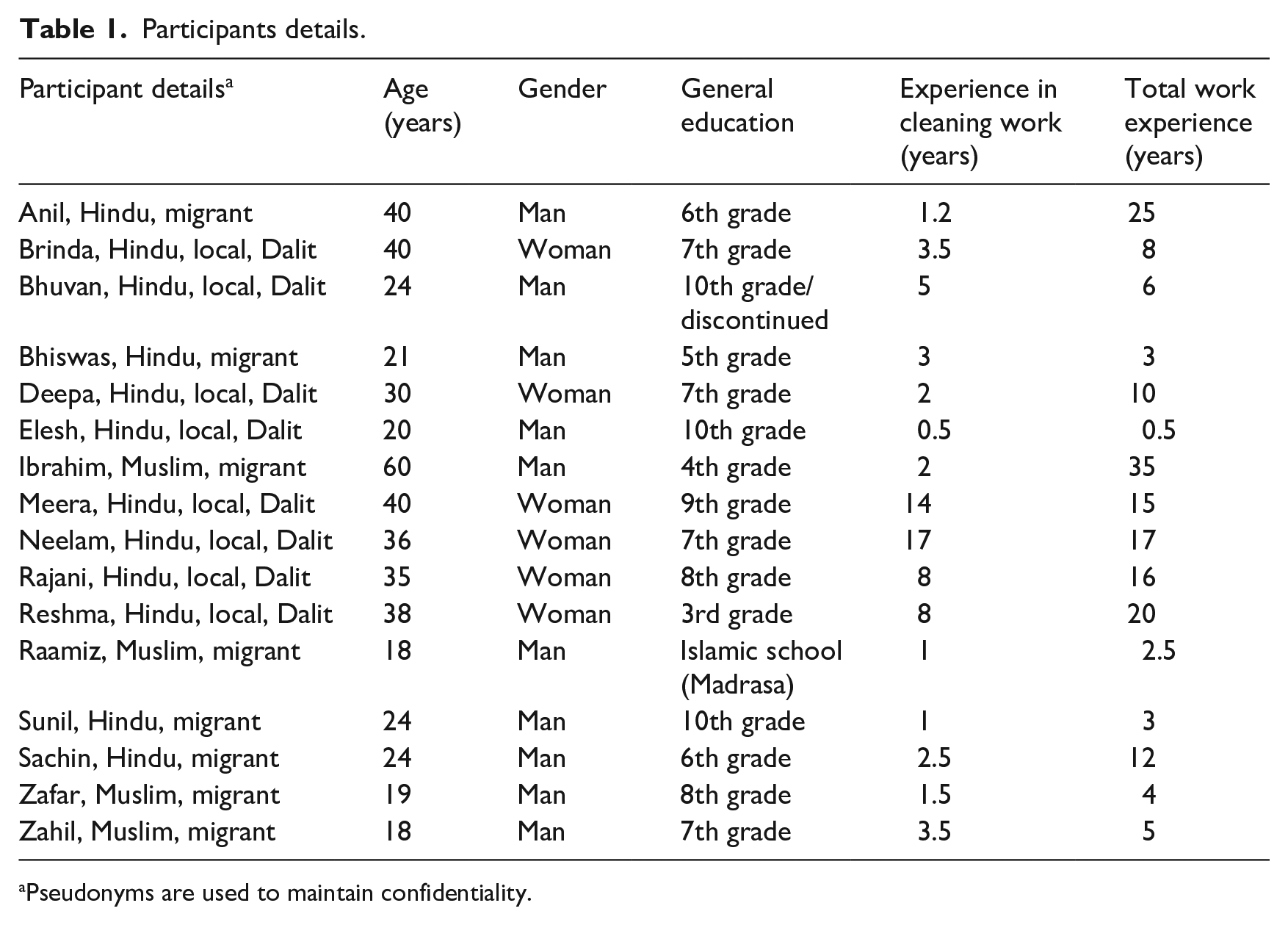
Pseudonyms are used to maintain confidentiality.
Data were collected through in-depth interviews, held as per participant convenience and conducted in Hindi, with which both the cleaners and researchers were conversant. Workers were interviewed at their workplace during lunch breaks and after work hours, in spaces they used to rest, such as bathrooms, gym, corridors, lawn, stairs and pathways, where there was a minimal disturbance. The research questions were open-ended and mainly pertained to their job (e.g. nature of employment, description of work, feelings toward job, quality of job, use of equipment and chemicals), employer and client dynamics (e.g. identification, belongingness, temporariness, uncertainty, interactions with supervisors), and the experiences of doing stigmatized work (e.g. others’ perception of their job, experiencing devaluation, coping, support). Though the interview focused on the research question prompting the inquiry (identity struggles and identity work), the clarity of the research question did not preclude exploring issues that emerged during the process since we were aware that these could generate important insights. Interviews, ranging between 45 and 80 minutes, were audio-recorded with participants’ permission. Interviews were later translated into English and transcribed for analysis.
Researcher positionality
Reflexivity is an essential part of qualitative research since researchers’ positions influence their access to the field, the researcher-researched relationship and the lens used to make meaning of participants’ experiences (Pullen, 2006; Zulfiqar and Prasad, 2021). Importantly, when marginalized groups are studied, there is a danger of subordinating participants’ voices with researchers’ presumed authority or higher position (Brewis and Wray-Bliss, 2008). Hence, we consider the effects of researchers’ positionality on the research process.
All the researchers involved in this inquiry are born, live, and work in India and have been engaged in research that addresses the intersection of caste, workplace bullying, cyberbullying, precarity, unions, and dirty work. Living in a caste-segregated society, the researchers have been exposed to multiple caste narratives and witnessed caste prejudices manifesting in both explicit and subtle ways in and around them. Simultaneously, all the researchers have similar religious and cultural backgrounds that did not ascribe caste-based identities to them. Such a position provided the researchers with insider and outsider perspectives, enabling them to be open-minded, sensitive, and empathetic toward marginalized experiences. Since the researchers were part of Organization B in various capacities during the study, they had a favorable position in terms of organizational hierarchy, which helped gain access to cleaners for the study. However, ethical protocols of informed consent, voluntary participation, and confidentiality have been duly ensured.
During the interviews, direct questions related to cleaners’ caste identity and stigmatized nature of work were avoided due to the likely associated sensitivity, allowing such topics to emerge during the interactions. Most cleaners were forthcoming in expressing their views about the contractor, employees of Organization B, caste and their devaluing experiences. Some interviews were intense, with cleaners being emotional about their helplessness, which was a moving experience for the interviewing researcher. Notes were recorded immediately after some interviews, highlighting any interruption or hesitation to answer questions and capturing researchers’ thoughts during the process. The researchers conducted regular peer debriefing sessions during the interviews and data analysis. This helped them to recognize their own thoughts, experiences and prejudices, and approach data with sufficient distance (Alvesson et al., 2008a), while allowing them to remain as close as possible to participants’ subjective experiences.
Data analysis
Thematic analysis of the data was undertaken and carried out using Saldaña’s (2009) two-cycle coding. In the first round of coding, a mixed coding method involving In Vivo coding and descriptive coding was employed. In the second round of coding, pattern coding was used to select, order and re-order codes under related concepts, patterns and constructs emerging from the data. In developing sub-themes, themes and major themes, we “immersed” ourselves in the data (Crabtree and Miller, 1992), thereby identifying emergent categories and patterns (Marshall and Rossman, 1999). Linkages between patterns and categories were used to develop sub-themes. Sub-themes held together in meaningful yet distinct ways were grouped into themes. Themes that dovetailed together in coherent yet recognizable ways were grouped into major themes.
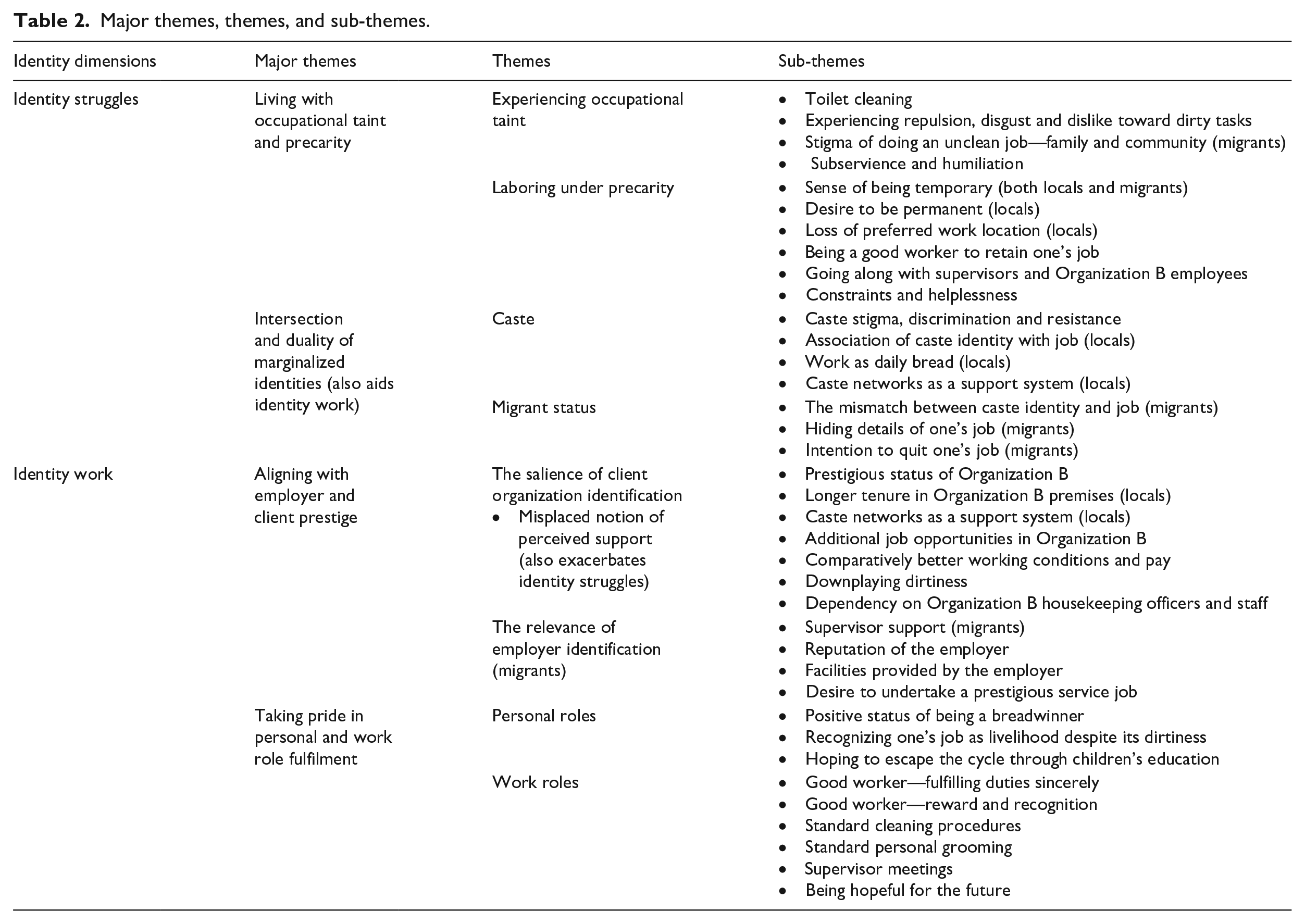
Though identity struggles and identity work, pre-determined from the substantive area, formed the essential organizing framework, they were constituted by major themes and sub-themes that emerged from the data. The themes showcased the simultaneous duality that inhered in some dimensions of identity struggles (e.g. caste), which aided identity work and in some dimensions of identity work, which concomitantly exacerbated identity struggles (see Table 2). Also, marked differences emerged from the experiences of Dalit and non-Dalit (migrants) cleaners in how they perceived their work. Table 2 lists the study findings thematically, highlighting the abovementioned complexity and differences.
Major themes, themes, and sub-themes.
Findings
The findings show how cleaners make sense of their self and their work in the face of multiple taints and constraints, simultaneously revealing an intricate identity construction process marked with duality. Cleaners’ caste identity influences how they make sense of themselves and others, and the nature of identities they embrace to create a positive self. Despite being pushed to do the job, Dalits eventually view cleaning as a livelihood due to the acceptance of the job in their family and community. This acceptance makes them invest in identifying with Organization B and actively engage with organizational networks. Migrants, who consider cleaning as beneath their caste identity, are unable to accept the job in the beginning and eventually make sense of cleaning as “a temporary arrangement for livelihood.” The caste stigma affects migrants’ identity work where they identify more closely with the employer/contractor to get nearer to their aspirational identity of a chef/service employee and to distance from the identity of cleaner. While both Dalits and migrants predominantly highlight the “breadwinner” identity to make sense of themselves, the “good worker” identity plays out both at the level of self and in relation to others. Both Dalits and cleaners embrace “good worker” identity derived from organizational narratives, which makes them simultaneously resist and confirm indignities emerging from a precarious and stigmatized job. We see sources of taint, such as caste, transcending from individual level to occupational level (locals) and vice versa (migrants). Similarly, taint at individual and occupational level is managed through organizational level narratives providing a view on multi-level integrative stigma management.
Living with occupational taint and precarity
Cleaners’ identity struggles emerge from the intersection of multiple occupational taints and the precarious nature of the job. While identity struggles are intense to all cleaners, they play out differently in the case of local Dalit and migrant non-Dalit cleaners. While both Dalit and migrant cleaners dislike their job, the association between cleaning and Dalit caste influences how migrants and locals experience dirty stigma and ascribe meanings to their job.
Cleaners struggle to see their self and work in a positive light due to the attached physical and servile taint. The necessity of undertaking repulsive tasks, such as cleaning and unclogging toilets, cleaning vomit and blood, and collecting and disposing garbage, constantly reminds them of their marginalized self of being less-educated, poor, migrant, and low-caste. Cleaners are overwhelmed with feelings of helplessness and powerlessness when they undertake repulsive tasks, especially toilet cleaning. Zahil, a Muslim migrant from a distant Indian state, finds toilet cleaning as the most difficult task:
Sometimes I get very angry, and sometimes you have to do it because you are helpless. . .The bad thing is the toilet. There is no problem. But I feel something in my mind. I start thinking about why I didn’t study before and all. . .But if it is very dirty, I start to hate it.
Rajani, a local Dalit cleaner, who has been working as a garbage collector in housing societies and thereafter as a cleaner in different organizations for 8 years, vividly expresses how the nature of the job makes her question her life:
When I remember it, I do not feel like eating. Then I would tell my daughter, keep it (food) aside now. I will eat it later. Sometimes (my) kids ask me, ‘what happened’? I do not feel good. I tell my kids what kind of life we are leading; you should not live like this. The job I do, I do not like it myself, then how can you like it.
Migrants (both Hindus and Muslims) acutely feel the stigma of doing a dirty job owing to the notions of purity and pollution attached to the cleaning occupation. In the case of Hindu migrants who belong to castes above Dalits in the caste hierarchy (i.e. Shudras who undertake clean occupations), being employed in cleaning jobs, particularly toilet cleaning, threatens their higher caste identity. Raamiz, a Muslim migrant, says that he would do any other job but not cleaning:
I would be here only till Diwali (a festival celebrated in India). Then I would never do this kind of job. Because my father is not well, and we need money at home, I am doing this job. . .I will do any other job, such as kitchen work, machine work, making buckets, etc.
Few of the migrants try to avoid disgusting tasks, especially toilet cleaning. Since they cannot refuse to do the job, they do it very quickly or sometimes delegate to others in exchange for doing other cleaning work.
Apart from physical taint, the subservience expected of them from Organization B employees further intensifies cleaners’ identity struggles. Zahil narrates that getting inside the offices of employees of Organization B and cleaning is scary since even a little dust left can initiate shouting and humiliation, with employees demanding him to do the cleaning several times. Raamiz shares a similar experience where one of the Organization B employees pushed him and called him “donkey” when Raamiz dropped the heavy dustbin on the ground. Though many other cleaners did not share specific instances, the undercurrents of subservience present in their day to day job interactions were aptly captured by Brinda, a Dalit woman cleaner, who shifted from care work to cleaning a few years ago due to low salary—“there are people who look at us differently because we are poor. They feel that way, but they do not express it. If you are a good human being, then you see us as equals.”
What adds further to cleaners’ identity struggles is the sense of being temporary, dispensable, and substitutable that emerges from the contractual nature of the job. Cleaners remain in a state of limbo since they cannot be long-term/formal employees of either the contractor or the client. Such ambivalence about their work identity and fear of losing the job exacerbates the identity struggles. The feeling of powerlessness and injustice arising from the denial of job security is prominent among local Dalit cleaners. Even though local cleaners know that their position is contractual, they hope and desire to be permanent employees of Organization B, particularly those who have survived several contractors in Organization B. The recurring event of “contract change” puts locals in a stressful situation, with newly joined employees taking up their positions and preferred work locations (outdoor vs indoor cleaning). As Meera puts it:
But contractors keep changing. . .The contractor brought new people and assigned us outdoor cleaning. . .When these new employees came, I was removed from the indoor location. . .Because we are contract employees, anyone can point at us, shout at us and threaten that you will be removed from the job.
Though migrants view their job as a temporary arrangement, the uncertainty affects them as well since it puts their family and their planned future at risk. Both migrants and locals emphasize the necessity to be a “good worker” to survive the contract change. Since the proof of being a good worker lies in informal recommendations provided by supervisors of Organization A and employees of Organization B, cleaners are at their mercy. Such dependence makes cleaners easy targets of abuse, creating a sense of devaluation, powerlessness and vulnerability. Cleaners have to display and prove that they are good workers, which is often contested and used as a tool to get their submission. Bhuvan, a Dalit cleaner, recounts a similar experience:
When Organization A came as a new contractor, they told me that they would keep me in the job. But, they refused to assign me the indoor location where I was working. They told me that I do not work. They disagreed that I am a good worker because they had not seen me working. Then I said, “wherever you assign me, I will work because I want to work.”
The job insecurity forces cleaners to comply with the demands of supervisors and officers of Organization B, as questioning and complaining can result in job loss. Neelam, a Dalit woman cleaner who was removed from the job once and reemployed, narrates, “if I go alone and fight, they would remove me. . .Three months they made me stay at home. If I stay at home, what will I eat.” Both Neelam and Bhuvan (both local cleaners) were rehired since they had support from some middle-level officers in Organization B. Unlike locals, migrants lack support at work and are not part of cleaners’ social networks (mainly comprising of locals and their relatives working in Organization B), which leaves supervisors as their only support, making them vulnerable to abuse.
Intersection and duality of marginalized identities
Cleaners’ self-worth is additionally challenged by the intersection of multiple marginalized identities such as Dalit, low caste, low class, uneducated, migrant, religious minority, and gender. Interestingly, cleaners’ marginalized identities, such as caste identity in the case of local cleaners and migrant identity in the case of non-Dalit cleaners, play a dual role by simultaneously aggravating identity struggles and facilitating identity work.
In the case of locals, while caste emerges as a source of stigma and oppression, it also helps construct positive meanings. Local Dalits have witnessed caste-based discrimination (e.g. prohibition from entering upper-caste homes) while growing up in/visiting villages. Locals’ reaction to such discrimination varies. Brinda says she cannot object to such discrimination since it does not look good. But her sons dislike it, as she puts, “my sons just do not like it. They tell what all this nonsense is. That’s why they do not like going to our native village.” Bhuvan voices similar resistance to caste discrimination by recounting an incident where he and his friends filed an atrocity complaint 3 against the barber who refused to cut their hair due to their caste identity.
Caste-based discrimination persists with varied levels of resistance seen from Dalits. Locals deny caste-based discrimination at their workplace. Despite feeling disgust toward dirty tasks, locals paradoxically highlight how the association between their caste and cleaning helps reframe their job as a livelihood. Bhuvan notes that most of the members of his community, especially uneducated, often undertake cleaning. He adds that Muslim and Hindu migrants undertake the job due to their helplessness and notes that “same caste people (referring to migrants’ higher caste) who are from this city will not do this kind of job.” Brinda, Meera, and Neelam parents have worked and retired as cleaners. Brinda and Neelam accompanied their mothers to work. Neelam especially highlights how this exposure has made her get used to the job:
This is our Dhanda (work). . .This is our daily bread. We take dirty waste. . .I do not feel dirty doing this job. After cleaning everything we go and take a bath and become fresh. . . I have a habit of doing the job. . . You know that municipality lorry with garbage. I used to go with my mother to throw garbage into it.
Meera, Bhuvan, Neelam, and Rajani point that everyone in their community knows what job they are doing. Meera highlights how some of her relatives are appreciative of her job that involves working for Organization B. Locals eventually bring in their family members and relatives to take up jobs in Organization B, leading to a close-knit network of cleaners belonging to the same caste. Moreover, lack of education and alternative jobs push local Dalits toward cleaning jobs. Rajani voices similar thoughts “I am uneducated, so I have to do toilet cleaning. If I was an educated person, then I would not have liked doing it.” Deepa and Reshma highlight that the present job is the best job they have ever got since their previous jobs were dirtier than this (cleaning dirty utensils) and did not guarantee regular pay. Despite facing caste and dirty stigma respectively at individual and occupational levels, the prestige attached to the organization helps cleaners to see their work in a positive light. Hence, integrating experiences of doing dirty work at organizational, occupational, and individual levels reinforces the positive meaning.
Whereas the caste identity, regardless of stigma, assists locals in identity work, the same stigma leads to intense identity struggles among migrants. Though Hindu migrants belong to the lowest caste in the varna system (Shudra), their caste is associated with clean occupations such as fishing and farming. Similarly, Muslim migrants identify their traditional occupation as farming, perfumery, and daily wage jobs and consider cleaning beneath their social status. Ibrahim and Raamiz assert that everyone is equal once they enter the mosque; nonetheless, they note that no one undertakes cleaning in their community. Performing an occupation that is perceived to make the performer untouchable stains the clean caste identity of migrants. Hence, migrants often face the question “why you are doing such a job?” from their family members and friends. Bhiswas, a migrant from a distant Indian state, observes that, in his hometown, cleaning is performed by Dalits, and hence, undertaking such a job makes him polluted and unwelcome in his family and community:
If I tell the truth, then I would not have any place there (at home) . . .If you tell that I do toilet cleaning, nobody will sleep near you.
In addition to the caste stigma affecting their sense of self, being a migrant in an unfamiliar city with no social network at the workplace puts migrant cleaners in a vulnerable situation. Migrants are recruited by giving false hopes of work in hotels/restaurants. Once they arrive in the city, they are told to undertake cleaning work citing a lack of vacancies in hotels. Most migrants, with no money and help, decide to put up with the job. As Bhiswas puts it, “when I came here, I did not like the job. I have gone home in between several times. Every time I came back, but I do not like the job.” Besides non-familiarity, the regional and religious barriers hinder the active formation of networks among migrant cleaners.
While the necessity of hiding the real nature of their work from family and friends affects them, being away from home also provides migrants refuge from stigmatized identity. Migrants demarcate the self they present back home from their actual work identity. As Sunil puts it:
I do not share details about my job. How can I tell? My family itself does not know. There is no one here who belongs to my place. I am alone here from my place. So, people from my village, my family, my friends and siblings nobody knows that I am doing this job.
Moreover, living in an unfamiliar city makes their job details inconsequential, which is not the case if they undertake similar jobs in their hometown. Anil, a migrant from a neighboring country, insists that he will never do cleaning jobs back home since “there (hometown), anybody can see what job I am doing. My relatives may say that I am doing such a job.” Hence, being a migrant marginalizes them; however, it protects them from the stigmatization directed from friends, family, and community back home.
Aligning with employer and client prestige
Despite the intense struggles emerging from intersecting sources of taint and marginalization, cleaners respond to identity threats by engaging in identity work that utilizes the discourses of prestige. Cleaners derive their alternate identities from the prestige attached to both the client and the employer. Identification with the client/Organization B emerges as salient for cleaners’ identity work. The prestigious status of Organization B helps cleaners offset devaluation and insecurities stemming from the nature of their job; in the process, they engage in constructing and reconstituting their self in a positive light. The identification with Organization B is strong in the case of locals since many of them have been working in the latter’s premises for several years. This is illustrated in the case of Meera, who claims herself to be an employee of Organization B since she has worked there for 15 years. Their long-term association with Organization B, social networks with the fellow locals and employees of Organization B accentuate the identification process. These social networks reduce the precarity by assisting locals in shifting from one contractor to another, during contract change. In addition, the prestige attached with the client makes locals proudly share the association within their community, which can be seen in the case of Neelam:
My mother and father used to feel very happy that their daughter had gone to work at Organization B. When some guests came home and asked about my husband or me, my parents used to say that both of them are working in Organization B.
Neelam and Meera also highlight how they selectively reveal their job details in social interactions; as Meera says, “I tell them that I work in Organization B. . .I share real work details with whom I can share. I will not share details with whom I should not be sharing”. A similar strategy can be seen among migrants who take their photographs in Organization B’s premises and share back home that they work in the prestigious Organization B.
Another reason for locals’ emphasis on their association with Organization B is they find doing a dirty job in its premises less humiliating. The alternative cleaning jobs available in the city are in the municipal corporation, housing colonies, and private companies, which cleaners view as difficult and dirtier compared to their present job. As Bhuvan puts it, “this is less dirty, and here we stay together and belong, but that is not the case there (street cleaning). If you work on the roadside, and when you are sweeping, people can shout at you.” Besides better working conditions, cleaners differentiate between public toilets in India (which are extremely dirty and often not well-maintained (Paul et al., 2020)) and toilets in Organization B. Ibrahim describes “it is not so dirty. . .people of Organization B do not make toilets much dirty. Other people who drink and smoke, they make the toilets very dirty.” By contrasting the toilets’ status, cleaners emphasize the prestige of Organization B and the higher status of its members, thereby downplaying the dirtiness of the job.
Further, being at the premises of Organization B provides additional earning opportunities for migrants and locals. After work hours, cleaners team up and undertake additional jobs (e.g. pest control, furniture cleaning, kitchen gutter cleaning), which help them earn extra income. Women cleaners work as domestic help in the houses of Organization B employees. The informal work arrangements between cleaners and Organization B employees enable cleaners to highlight their association with the prestigious organization.
Though associating with the prestigious Organization B emerges as a major way to manage stigma, the outcomes of the identification are limited to a positive self and do not contribute toward cleaners’ material well-being. Cleaners simultaneously highlight the indifference of Organization B toward their plight and its prestigious status, bringing out the duality of their experiences. Such duality can be vividly seen in Meera’s experience who strongly identifies with Organization B, and even works in the households of its employees, yet feels wronged by them:
Employees (of Organization B) here trouble us. They transferred me twice. When I was working at an indoor location, a cat made it dirty near the place where the security guard used to sit. Then these people told me to wash it and all. Then everybody started shouting at me. . .Permanent employees (Organization B employees) did all this. They think very bad about us.
This is similar to the case of Neelam, who takes pride in working at Organization B, yet has experienced removal from the job, demotion and a long excruciating struggle to reinstate herself in the job. She holds both employees of Organization B and the contractor responsible for her troubles. Notwithstanding the lack of support, the desire to be a regular employee and the prestige makes cleaners emphasize that they belong to Organization B. Thus, while the organizational prestige acts as a shield against taint, lack of material support makes the identification process limited, wishful and vicarious, leading to persistent identity struggles.
Migrants also identify with their employer due to the latter’s prestigious image. Apart from the housekeeping business, the contractor is into other hospitality services such as hotels and resorts. Though pushed into housekeeping work, migrants maintain back home that they work for the hotel business of their employer. This also helps them alternatively identify as a chef/cook and customer service provider, which migrants perceive as a prestigious/clean job. As Sunil puts it:
Organization A also has a hotel business. When I came here, there was no vacancy. Then I had to do this job. Once you are here, you cannot go back just like that, so I started working here. Nobody knows at home that I do this job. I tell them I do servicing job in the hotel.
In addition, since the contracting company has chains in several places in India, migrants’ friends and family back home are aware of the contractor’s existence and prestigious status than Organization B. Hence, identification with the employer brand name aids migrants in creating an alternative identity of being an employee of a prestigious organization.
Taking pride in personal and work role fulfilment
Besides using the discourse of prestige in their identity work, cleaners also derive a sense of self from their breadwinning experiences. Such identity work explains who they are to themselves rather than presenting themselves to others in social interactions. Nonetheless, such explanations are very much influenced by cultural and organizational discourses that support employers rather than cleaners’ interests. Cleaners see themselves as socially/organizationally valued people as they can fulfill their personal role as a breadwinner and work role of “good worker” through their current job.
Cleaners highlight that cleaning job provides them with an opportunity to earn their livelihood, given their weak labor position in the job market. Cleaners take on the identity of a responsible breadwinner who fulfils the unfinished dreams of their family members, buys comforts and provides education to children. As Rajani, who hopes a better life for her children, states, “I want them to be educated and whatever they want to become in life.” Likewise, fulfilling his father’s unfinished dream drives Sunil to continue in the job “my dad was trying to build the house. . .He passed away. . .So, I think of completing it. . .I will save money and finish what my father started.”
Regardless of the positive self-definition, cleaners’ experiences of being a breadwinner are complex. The paradox of accepting the job they dislike can be vividly seen in women Dalit cleaners’ experiences. Being a woman, they are loaded with the additional burden of managing the household. Moreover, in the case of Deepa and Reshma, they are the major contributors of income and primary caregivers in the family. The necessity to earn a livelihood compels women cleaners to sideline dirtiness which women describe as “forgetting.” As Brinda puts it, “when I go home, I have to wash utensils, cook food, wash clothes, then there is the kid’s problem, and then the husband’s problem, and I just forget what I did here.”
Despite the unequal burden shared by women cleaners, they take pride in ensuring their children’s mobility and find a sense of worth and hope for their self in providing for the family; as Deepa says, “I want to do many things. Like looking after my mother and father. Building our own house. I want to be just like their son, who is earning and looking after them.” Thus, the emphasis on the breadwinner’s role incorporates both the despair and hope of doing a dirty job for a livelihood. Seeing themselves as breadwinners makes cleaners resilient despite the several indignities, as Brinda explains:
Through this work, we fill our stomach. I do not think that the work is dirty. If I do not get this job, I will not get a salary. If there is no salary, then there would be a problem at home. . .Even if it is not good, you do not like it; we have to do this job.
Apart from personal role fulfilment, cleaners take pride in carrying out their work roles, and it is manifested in the form of achieving a “good worker” status. Cleaners infuse positive meaning to their work by highlighting the importance of work itself, deriving from larger cultural and organizational discourses. Ibrahim uses the proverb “work is worship” (a proverb often found in Indian folk tales and cultural discourses which means that, regardless of the nature of work, one should do it sincerely (Vaidyanathan, 2011)) to stress that, even if it is dirty, work duties should be fulfilled responsibly. Dalit cleaners highlight the importance of their work by stressing its usefulness to people around them. As Brinda, “if we do not do toilet cleaning, then people will fall sick. Even if people do not fall sick, someone has to do the job.” Likewise, Bhuvan highlights his ability to withstand dirty and demanding labor:
No boy was ready. The meeting was called, people were asked to open it (kitchen gutter), but nobody was ready. I had no problem doing that job. Whatever I do, they told me that they would give me extra money. They told this to all boys, but no one was ready. . .Then I told the supervisor I would do it.
Apart from recasting their work in a positive light, some Hindu migrants and local cleaners reconcile with the nature of their work by invoking the notion of “Karma” (outcomes of one’s actions) and “fate,” as in the case of Reshma, who states “I have many desires and interests, but all is not written in my fate.” By highlighting the concept of Karma, cleaners emphasize the importance of hard work that will change things in their next life, as Bhiswas hopefully notes: In this life, it is not at all possible. Everybody says that human beings would be reborn as human beings in the next life. If I work hard in this life, next life, I will get good things. God will give nice things to me.
While some Hindu cleaners emphasize hard work and its futuristic positive outcomes, young Muslim migrants save money to go to Middle East countries such as Dubai, Kuwait, and Saudi Arabia, in the hope of getting work that pays well. Some of their family members are already working in those countries and have achieved better economic status. For instance, Ibrahim mentions his brother’s case “we arranged money from our land (for brother’s travel). Then he went abroad for the job. He repaid the loan, and he also visited Mecca and Medina.”
The positive self-definition of “good worker” also flows from organizational discourses that highlight the benefits of being a good employee who is “hardworking, trustworthy and ensures cleanliness.” Such narratives are often discussed in employee meetings; as Elesh explains: In meetings, they tell that we should work well. The company should grow. Our complaints should not go to higher officers. We should clean well whether it is the toilet, lobby or rooms. We should do a good job.
Various employer discourses such as “standard cleaning processes (i.e. cleaning done with the help of advanced equipment and chemicals according to the standard operating procedures specified by the employer) inspection and employee awards” make cleaners recognize themselves as good workers since it will result in rewards, praise and recognition. As Raamiz puts it, “they would observe who is working, who is doing it well. If you do good work, you will get an award.” Cleaners also use the narrative of “standard cleaning” to differentiate themselves from street cleaners and domestic workers, claiming that their work is advanced and more prestigious than other forms of cleaning.
Discussion
The present study furthers the discussion on dirty workers’ self by taking an identity work perspective, thereby extending our understanding of identity work, dirty work, and cleaning occupation situated in the neoliberal context. The study contributes to the identity literature by presenting how identity construction manifest in cross-class encounters generally and in cross-caste encounters specifically, leading to classwork (Gray and Kish-Gephart, 2013). Concurrently, the study accents the paradoxical dualism that inheres in identity work. The findings call attention to caste, an overlooked social identity in organizational studies (Chrispal et al., 2021), revealing its complex contours at multiple intersecting levels (individual, occupational, and organizational). Additionally, caste stigma emerges as a distinct form of taint defining the experiences of dirty workers. The findings also enumerate how neoliberalism context impinges on the experiences of cleaners by co-opting existing inequalities (Gupta, 2022), leading to cleaners’ intense, complex, and contradictory experiences of self.
In line with the existing dirty work literature, the findings uncover the role of collective identities (e.g. caste, organization, occupation) and group-based hierarchies in influencing cleaners’ identity construction, invoking SIT that elucidates how “self” and “other” are discursively constructed (Zulfiqar and Prasad, 2021). Caste, along with class, educational attainment, occupational prestige, and employment status, emerges as an essential social identity that defines inter-group status difference (within cleaners and between cleaners and others). Caste also makes cleaning intractable dirty work for Dalits (Shepherd et al., 2021), influencing how they make meaning of their work. As SIT explicates, due to the impermeable caste boundaries, Dalits engage in intrapersonal classwork of shifting to socially valued identities (e.g. prestigious organization) (Gray and Kish-Gephart, 2013; Turner and Reynolds, 2003). Alternately, migrants construct Dalits as an out-group in relation to their higher caste positions and resist dirty stigma by “othering” the Dalit cleaner identity (Gray and Kish-Gephart, 2013). For non-Dalits, the practice of disliking or delegating toilet cleaning serves as self-preservation (Sharma, 2016). Though migrants also affiliate with prestigious collective identities, the resultant identity work is more of a pragmatic act to counter their stigmatized representations. Along with social constructions of purity and pollution (Douglas, 1966), organizational discourses of “hard work, good worker and cleanliness” influence cleaners’ subjectivities, displaying collective class work undertaken by organizations, via supervisors, resulting in the perpetuation of cleaner subordination (Gray and Kish-Gephart, 2013; Zulfiqar and Prasad, 2021).
The findings bring out the fluidity of self-categorization (Van Vuuren et al., 2012). Cleaners selectively draw from multiple identity resources (e.g. caste, multiple organizations, occupation, gender, work role, cultural and religious beliefs), the salience of which depends on the audience and context. We see cleaners simultaneously identifying with both client and employer (George and Chattopadhyay, 2005) to varying degrees. In the process, cleaners claim hybrid (Banerjee et al., 2009), dual and complex identities that shift along with different spaces and social interactions. Though cleaners do not invoke masculine resilience in the face of devaluation, as seen in the case of refuse collectors and firefighters (Slutskaya et al., 2016; Tracy and Scott, 2006), it is interesting to note that both male and female cleaners underscore the masculine value of being a family breadwinner (Collinson, 2003). In the face of intractable nature of their stigmatized identity, Dalits derive from religious and cultural narratives of Karma (outcomes of one’s action) (Kent, 2009) to make sense of their present state, while migrants seek mobility in pursuing less stigmatized and higher-paying jobs.
The findings also extend our understanding of identity work’s processual nature (Beech et al., 2016; Sveningsson and Alvesson, 2003). Though taint management is seen as a discursive struggle (Dick, 2005; Simpson and Simpson, 2018), what stands out from cleaners’ experience is that their alternate identities are constituted by the very identity struggles they encounter (Brown and Coupland, 2015). For instance, Dalits are troubled by what it means to be a cleaner, Dalit or a woman, but at the same time, they invest their sense of self into their work (identity-in-the-work (Beech et al., 2016)) to preserve their job. Whereas the possibility of a paradoxical identity is seen in liminal identity positions (Beech, 2011), the present study brings out the paradoxical duality embedded in the identity construction processes. That is, a single entity is seen to be contributing to contradictory functions, evidencing that identity struggles and identity work are not only overlapping and interleaved (Brown and Coupland, 2015) but also embody an inherent paradoxical duality. For instance, low educational attainment pushes cleaners toward a stigmatized and precarious job, which simultaneously serves as a justification for accepting the job.
In addition, not all identity struggles are transitory for cleaners. This draws attention to cleaners’ vulnerable position of doing low-prestige and intractable dirty work (Shepherd et al., 2021), where there are compelling reasons to undertake identity work but perceived identity resources are limited or weak (Beech et al., 2008). Identity resources provide means that also act as obstacles for identity construction, resulting in the pursuit of a sense of self that is incoherent and insecure (Beech et al., 2016). Unlike musicians studied by Beech et al. (2016), cleaners do not deliberately engage in self-critiquing their identities. Instead, their stigmatized identities lead to self-doubt and unresolved identity work, aggravating insecurities, and resulting in paradoxical subjectivities (Collinson, 2003).
Caste, co-opting neoliberalism, emerges as instrumental in organizing work, space, and roles at multiple and intersecting levels (individual, occupational, organizational, and industry). Caste actively defines workplace relations, assignment of work, and cleaners’ identities, without being explicitly referred to (Sharma, 2016). The study evidences that the caste system is not just occupational segregation (Bapuji and Chrispal, 2020) and limited to the spaces of urban public infrastructure in India (Gupta, 2022; Mahalingam et al., 2019), but an active presence in organizations, defining power relations, networks, and social interactions in a complex triangular employment context created by the neoliberal agenda.
Caste as an embodied institution with ritual justifications (Chrispal et al., 2021) also has implications for dirty work research. The study brings out caste stigma as a distinct taint that is hereditary and a highly visible marker (Zhang et al., 2021). Caste stigma perpetuates embodied suitability (Simpson and Simpson, 2018), where certain forms of dirty work such as toilet cleaning are deemed suitable for “untouchables” and not for others (Sharma, 2016; Zulfiqar and Prasad, 2021). Caste stigma positions its bearers as ontologically impure (Zulfiqar and Prasad, 2021), even when one is not performing low-prestige dirty work. The stain (Simpson and Simpson, 2018) of caste stigma rubs on to non-Dalits who undertake the dirty job. Though servile stigma and caste stigma have been subsumed under social taint in dirty work literature (Ashforth and Kreiner, 1999; Zhang et al., 2021), caste stigma on its own can have severe repercussions for one’s sense of self in the form of dignity injuries (Mahalingam et al., 2019). Extending the research by Sharma (2016) and Zulfiqar and Prasad (2021), we suggest dirty work studies to engage with caste not only as a stigmatized social identity but also as a distinct form of taint, alongside its intersection with other marginalized identities.
Together with caste, we see how neoliberalism context impinges on the experiences of cleaners by embedding with the pre-existing system of inequality (e.g. class, caste, religion, gender) and thereby producing hybrid regimes of oppression (Carswell and De Neve, 2014; Gupta, 2022; Noronha and Beale, 2011). Under neoliberalism, the discursive context of cleaning is reframed as “standard cleaning” by organizations and exploitation is normalized using “good worker” narrative. In line with previous studies, the findings enumerate how neoliberalism operationalizes and reproduces caste-based inequalities (e.g. Harriss-White and Rodrigo, 2016; Mahalingam et al., 2019) via spatial and technological practices (Gupta, 2022), and further reveal how these processes affect cleaners’ subjectivities. Whereas Dalits resist historically demeaning caste representations, they are rendered powerless in the face of new forms of exploitation that blur the boundary between caste-related discrimination and other oppressions (Harriss-White and Rodrigo, 2016), such as the constant threat of dismissal. The result is cleaners produce ambivalent selves which simultaneously confirm organizational discourses and resist stigma (e.g. good worker). Such ambivalence simultaneously incorporates cleaners’ agency of denouncing stigmatized identity and their boundedness to the reworked culture of servitude under neoliberalism (Mahalingam et al., 2019).
Conclusion
The present study offers insights into the challenging nature of the identity construction process among cleaners, which is marked by the intersection of multiple sources of taint. Such insights are essential to understand why and when dirty workers find it challenging to construct a satisfactory sense of self, and for organizations to provide appropriate structures and support for workers who undertake dirty jobs in precarious work environments. The study brings forth identity work as a relevant theoretical lens to examine dirty workers’ identities capturing the dynamic interplay between identity dimensions. The study contributes to dirty work research by highlighting caste stigma as a distinct taint and to organizational studies by giving an intricate account of the co-constitution of caste and neoliberalism in organizations. In the South Asian context, caste emerges as an entrenched and persistent social category that leads to a vicious circle of economic and social subordination. Caste remains very much alive in organizational settings and the neoliberal milieu (Bapuji and Chrispal, 2020), though its presence and implications are portrayed and perceived to be absent. We suggest bringing caste to the forefront as an important social identity and form of stigma in inquiries studying occupations/professions and employee identities, especially in the context of South Asia.
Footnotes
Funding
The author(s) received no financial support for the research, authorship, and/or publication of this article.
