




Abstract
Slaughterhouse workers face the reality of industrialized meat production on a daily basis, experiencing firsthand the routinized killing of animals. This occupation provides a window through which to view one key way in which animals and organizations intersect in modern society. Given its proximity to death and undesirable required tasks, working in a slaughterhouse is classified as ‘dirty work’. Current theorizing, however, does not address how the intentional killing of animals may impact workers beyond its inherent dirtiness and low prestige. In this study, we draw upon and extend dirty work theory to further understand the unique nature of work that involves the intentional killing of animals. Regression analyses of data from 10,605 Danish workers across 44 occupations suggest that slaughterhouse workers consistently experience lower physical and psychological well-being along with increased incidences of negative coping behavior. Our findings hold while statistically controlling for occupational prestige and overall dirtiness. Additionally, we compare the pattern of results with a comparable occupation that does not involve animal killing, suggesting specific outcomes associated with routinized killing of animals. Building upon extant research and considering our findings, we discuss the theoretical implications regarding dirty work and the intentional killing of animals in organizations.
Keywords
‘It was all so very businesslike that one watched it fascinated. It was porkmaking by machinery, porkmaking by applied mathematics. And yet somehow the most matter-of-fact person could not help thinking of the hogs; they were so innocent, they came so very trustingly; and they were so very human in their protests—and so perfectly within their rights! They had done nothing to deserve it; and it was adding insult to injury, as the thing was done here, swinging them up in this cold-blooded, impersonal way, without a pretense of apology, without the homage of a tear. Now and then a visitor wept, to be sure; but this slaughtering machine ran on, visitors or no visitors. It was like some horrible crime committed in a dungeon, all unseen and unheeded, buried out of sight and of memory’.
The role of animals in society and organizations takes many forms, from beloved companions to trusted aids, from essential workers to metaphors used in organizational discourse. Behind the veil of most people’s everyday lives, however, is the industrial complex that systematically slaughtered 31.89 million head of cattle in the United States during 2013 alone—the equivalent of more than 1 per second for the entire year (USDA Economic Research Service—Statistics & Information, n.d.). Taken together with other forms of meat production such as pork and poultry, killing animals has become a massive, routinized, efficient process that functions largely behind the scenes of modern society.
Problematizing the slaughterhouse provides the opportunity to investigate potential trends among its workers, whose labor with animals occupies a specific space within the study of organizations. At the theoretical level, however, it affords the chance to begin understanding a number of specific gaps in how we currently think about stigmatized or tainted work and occupational prestige as they relate to the well-being of workers. Namely, we suggest that the intentional killing of animals inherent in the slaughterhouse represents an additional internal demand upon these workers, which signifies a specific expansion of the dirty-work theoretical framework.
Below, we provide the larger theoretical background and identify the specific ways in which studying slaughterhouse workers contributes to knowledge about occupational prestige, dirty work, and workers’ well-being within the context of animals and organizations. To illustrate that context, we begin by describing the slaughterhouse. We then further expand upon the theoretical framework of dirty work and related constructs. In so doing, we highlight specifically how this study contributes to theorizing about animals and organizations by demonstrating potentially unique ways in which the intentional killing of animals as an occupation negatively influences workers.
Problematizing the slaughterhouse
Written in the early 1900s, Upton Sinclair’s novel The Jungle—quoted above—exposed numerous concerning aspects of the meatpacking industry in the United States, including the role of immigrant labor, sanitary conditions, and the life of the slaughterhouse worker. Although a work of fiction, the book sparked both public outrage and regulatory action. Those outcomes, however, focused more on food safety than on workers’ well-being (Lee, 2008).
Despite improvements in the sanitary nature of meat production, work within slaughterhouse remains traumatic for workers. As noted in Dillard’s (2008) legal essay, slaughterhouse workers experience both financial and physical hardship, earning low wages in return for their strenuous, dangerous work. Dillard furthermore discusses the psychological trauma reported by slaughterhouse workers due to the grisly nature of their work, providing accounts of animal cruelty both perpetrated and witnessed, resulting anecdotally in substance abuse and other maladaptive coping strategies.
It is not, however, simply that slaughterhouse workers perform work that most people would consider distasteful. Rather, it is that they perform an act that involves intentionally inflicting death upon another living creature, potentially resulting in what has been referred to by MacNair (2002) as ‘perpetration-induced traumatic stress’ (Dillard, 2008). Anecdotally, slaughterhouse workers have reported nightmares, alcohol abuse, and consistently conflicted emotional reactions to their work (Dillard, 2008). Dillard shared a quote from a former hog slaughterhouse worker that illustrates the unique nature of the job from a psychological perspective: The worst thing, worse than the physical danger, is the emotional toll. If you work in that stick pit [where the hogs are killed] for any period of time, you develop an attitude that lets you kill things but doesn’t let you care. You may look a hog in the eye that’s walking around down in the blood pit with you and think, God, that really isn’t a bad-looking animal. You may want to pet it. Pigs down on the kill floor have come up and nuzzled me like a puppy. Two minutes later I had to kill them—beat them to death with a pipe. I can’t care. (p. 4)
Although these anecdotal reports are highly vivid and illustrative, a dearth of empirical research on this unique population can be found. We believe that our study is the first of its kind to explore slaughterhouse workers with our specific theoretical approach and methodology. In the next section, we outline that theoretical foundation for our work. We then describe a set of analyses that compares Danish slaughterhouse workers with people in 43 other occupations.
The theoretical structure of dirty work
Slaughterhouse work is a type of work that scholars (Ashforth et al., 2007; Ashforth and Kreiner, 2014) characterize as ‘dirty work’. Dirty work involves work that is undesirable, morally objectionable, or otherwise carries a stigma (Ashforth and Kreiner, 1999; Hughes, 1962). A few examples of such work include exotic dancers (Mavin and Grandy, 2013), morticians (Ashforth et al., 2007), and animal euthanasia technicians (Baran et al., 2012; Reeve et al., 2005). Given these criteria, slaughterhouse work, due to its proximity to death and exposure to numerous tasks that are physically extreme and perceived as distasteful (e.g. gutting freshly killed animals, cleaning areas soaked with animal waste and blood, etc.), classifies as dirty work. Dirty work as a theoretical framework, however, goes beyond simply categorizing occupations and types of tasks. Below, we outline the central tenets of dirty work as they apply to the present study.
In particular, the unifying characteristic across the disparate occupations within the dirty-work domain is that they all carry some level of physical, social, or moral taint (Ashforth and Kreiner, 1999; Hughes, 1962) or some combination thereof (Ashforth and Kreiner, 2014). We explain each type of taint below, drawing in part from the categorizations provided by Ashforth et al. (2007). In keeping with the theme of this Special Issue, we highlight some occupations in each category that involve animals.
Physical taint
Two criteria help explain what constitutes physical taint (Ashforth and Kreiner, 1999). First, work is physically tainted when it involves a high level of direct association with physically ‘dirty’ matter, for example, sewage, death, or garbage. Second, physical taint involves those occupations that workers perform under particularly harmful physical conditions or threatening environments (e.g. miners, soldiers, firefighters, etc.). Potentially, physically tainted work that involves animals may include animal control officers, animal euthanasia technicians, exterminators, butchers, zookeepers, and slaughterhouse workers.
Social taint
Some occupations require workers to be in close contact with stigmatized populations, engendering a taint-by-association or ‘social’ taint. Such taint can also arise due to a worker’s servile relationship to others. Common examples include social workers, chauffeurs, prison officers, and probation officers (Ashforth et al., 2007). Regarding animals, therefore, socially tainted work would involve occupations requiring association with stigmatized animals. The stigmatization of animals, while outside of the direct scope of the present study, involves the consideration of factors such as culture, geography, and social perception (Jerolmack, 2008) as they relate to how people regard different animal species. Depending on the space and culture, therefore, stigmatized animals could include pigeons, rats, snakes, large predator animals, and various types of insects and reptiles. Occupations such as a dealer of such animals, from the social taint of dirty work perspective, could be stigmatized due to their association with those types of animals.
Moral taint
The third category of taint that can lead to stigma and cause an occupation to become considered dirty work involves work that others largely consider to be of a dubious or immoral nature; it can also include work that often employs tactics generally regarded as suspect or devious (Ashforth et al., 2007; Ashforth and Kreiner, 1999). Common examples include collection agents, used automobile sales personnel, exotic entertainers, and pawnbrokers. Morally tainted work involving animals could potentially include animal experimenters/researchers and certain categories of animal breeders (e.g. those who run ‘puppy mills’, which are large, often unsanitary facilities aimed at the production of numerous domesticated dogs for sale). In various regional cultures or groups where a significant proportion of the population considers eating meat to be wrong, slaughterhouse workers could carry a moral taint. The moral complexity of meat eating (e.g. Williams, 2008) notwithstanding, the Danish culture in which the slaughterhouse workers studied here are situated is typically not one in which those workers are necessarily considered morally tainted. We do, however, recognize that such work has the potential for moral stigmatization and that slaughterhouse workers certainly are at risk for being perceived as ‘tainted’ in many different ways.
Dirty work, those who perform it, and well-being
Following the conceptualization of dirty work, taint, and stigma provided above, we now turn our attention to the people who engage in dirty work and the range of reactions they may have to it. Understanding dirty work and well-being starts with a recognition that performing dirty work challenges workers’ identity, their sense of both ‘who I am at work’ and ‘who I am’ fundamentally (Ashforth and Kreiner, 1999; Dutton et al., 2010). One of the identity frameworks often associated with dirty work is that of social identity (Tajfel and Turner, 1985), which explores how the conception of one’s self arises from group membership and how such classification helps people to define who they are within human collectives and as individuals. Identifying with an organization (Ashforth and Mael, 1989) or an occupation (Kreiner et al., 2006) is a similar type of process, and for those who conduct dirty work, the act of engaging in such stigmatized work is itself an organizing characteristic that can define group membership (Baran et al., 2012).
Kreiner et al. (2006) suggest that occupations are different in terms of their overall dirtiness, and such differences likely influence employee well-being. For those occupations with the highest level of dirtiness—discussed by Kreiner et al. (2006) as having ‘pervasive’ stigma—the resulting effect is likely one of ambivalence, which is the state of being torn between identifying with one’s occupation while simultaneously disidentifying with the occupation. The focal occupation of this study, slaughterhouse workers, likely falls into such a category.
Independent of those who work with within them, occupations carry a level of prestige (Treiman, 1977). Such prestige is important to consider within the theoretical framework of dirty work because even dirty work can differ—in some instances, dramatically—in terms of relative occupational prestige. For example, both slaughterhouse workers and medical doctors potentially carry high levels of physical taint, as do exterminators and funeral directors. Slaughterhouse workers and exterminators, however, are generally of lower occupational prestige than medical doctors and funeral directors (Ashforth et al., 2007).
At the theoretical level, occupational prestige is important as it relates to dirty work because of its potential shielding function from the effects of taint and resultant stigmatization (Ashforth et al., 2007; Kreiner et al., 2006). For example, as mentioned above, medical doctors enjoy a high level of occupational prestige. At the same time, their work often requires them to engage in tasks that are highly tainted physically (e.g. examining disease-ridden areas of patients’ bodies, lancing boils, etc.). In the case of high-prestige types of dirty work, it is therefore argued that the effects of doing tainted work are reduced—or shielded—by the prestige of the occupation. The public may know that those in the high-prestige occupation conduct dirty work, but they withhold some of the stigma associated with such work due to the level of prestige.
Dirty work and the intentional killing of animals
Thus far, we have discussed the primary aspects of dirty work as they relate to our study of slaughterhouse workers. In this section, we discuss one of our primary areas of contribution to the literature besides being in our knowledge the first to study quantitatively the well-being of slaughterhouse workers. Occupational prestige and overall dirtiness are key parts of dirty work theory, and both are foundational parts of this study. We suggest, however, that certain aspects of slaughterhouse work—beyond those previously explored in the dirty work literature—negatively affect workers’ well-being. The gap that we address in the literature is looking at the potential influence of the intentional killing of animals upon workers’ well-being above and beyond the influences of prestige and overall dirtiness.
Routinized killing as a distinctive type
Given our focus on slaughterhouse workers, we first need to differentiate between the type of killing they do and killing wild animals (i.e. hunting). Slaughterhouse work is different for three reasons. First, slaughterhouse work is routinized killing. It involves systematic, organized methods for slaughtering massive numbers of animals. In terms of magnitude, it simply dwarfs any kind of killing through hunting. Second, as noted by one of our reviewers, hunting is typically an activity performed at a distance using a weapon intended to kill an animal from afar. Hunters using high-powered firearms, for example, can kill from several hundred meters away. Even less powerful methods, such as black powder rifles and bows and arrows, are designed to kill from a distance. Slaughterhouse work, however, is up close and personal. This makes the act of killing in the slaughterhouse much more salient psychologically and physically. Third, hunting wild animals is different because the wild animal has a different relationship with the hunter than the slaughterhouse animal has with workers. As described by Case (2005), wild animals have never ‘been lied to’. Animals killed in the slaughterhouse are nurtured by humans (external to the slaughterhouse) and may even learn to trust humans until that final moment of death. Furthermore, the slaughterhouse is an occupation and involves an organizational context, both of which are congruent with the theorizing we have presented.
The psychological dynamics of the slaughterhouse have some similarities with what Reeve et al. (2005) investigated as the ‘caring–killing paradox’. This phenomenon pertains to animal euthanasia technicians whose job involves caring for but then killing unwanted or sick animals. Reeve et al. (2005) found that euthanasia technicians suffered a host of negative effects to their well-being, including higher levels of strain and substance abuse. It is important to note that these workers do differ on important dimensions from slaughterhouse workers such as (1) they are typically attracted to this line of work out of a love for animals, (2) they care and nurture animals on a regular basis, and (3) the euthanasia of animals is a last resort typically for health or behavioral reasons (Reeve et al., 2005).
Perpetration-induced trauma beyond dirty work
Although our data do not allow us to test it directly, we expect that slaughterhouse workers are susceptible to both outcomes similar to those of perpetration-induced traumatic stress (e.g. MacNair, 2002) and the harmful effects of performing dirty work. Drawing again from research conducted with those who work in animal welfare, evidence of such stress exists. For example, Rohlf and Bennett (2005) found moderate levels of traumatic stress among 11% of animal-welfare workers that they studied.
Furthermore, evidence exists suggesting that butchers who work in slaughterhouses report higher levels of psychological disorders than office workers (Emhan et al., 2012), and several studies have documented the rise in social problems that coincide with the presence of slaughterhouses in a community (Broadway, 2000; Fitzgerald, 2010; Fitzgerald et al., 2009). For example, Broadway (2000) demonstrates the impact of introducing slaughterhouses to the community of Brooks, in the Canadian province of Alberta. Although the new slaughterhouses brought some positive changes such as new jobs and other economic opportunities, Broadway documents a variety of negative social changes that arose. These included incidents of disorder fueled by alcohol consumption and increases in demands upon social workers to respond to issues of spousal abuse and child welfare.
Whereas Broadway’s research focuses on only one community, Fitzgerald et al. (2009) further validated the issues suggested by Broadway in their large scale study of 8 years of panel data covering 581 counties in the United States. Their quantitative study found connections between slaughterhouse employment and increases in various types of crime (overall arrest rate, rape, and sex offenses). Alluding to Upton Sinclair whom we quoted at the beginning of this article, Fitzgerald and her colleagues suggest that slaughterhouses have a ‘Sinclair effect’ on the communities in which they are situated, arguing that the violent nature of the work spills over into non-work life and the general community.
We expect to find similar effects at the individual level, such that slaughterhouse workers likely suffer not only from the negative effects explained by dirty-work involvement but also from additional negative effects due to their involvement in killing animals intentionally as a central part of their occupation. Our study, therefore, contributes to the theoretical perspective of dirty work by integrating the potential effects of slaughterhouse work due to the intentional killing inherent in its daily tasks.
Taken together, there is strong theoretical reason to suspect that dirty work theory is just not enough to explain slaughterhouse workers and well-being. Instead, the intentional killing of animals likely impacts workers’ well-being in deep, psychological ways through their repeated exposure to and involvement in tasks that make them additional victims of the pain they perpetrate. Because of this uniquely negative and poignant interaction with other living beings, we expect that such work results in outcomes to workers’ well-being above and beyond that which can be explained by prestige or overall dirtiness.
In the sections that follow, we describe our approach toward unpacking the influence of intentional killing of animals on workers well-being. We first compare workers in the slaughterhouse occupation with all other workers in our data. These other workers comprise 43 other occupations including academics, medical doctors, janitors, and many others across a spectrum of prestige and dirtiness. We do so using a hierarchical regression framework, with theoretical control variables appropriately chosen to isolate to the best of our ability the phenomena of interest—intentional killing by slaughterhouse workers.
Namely, we control for occupational prestige and overall dirtiness. Doing so when analyzing the influence of slaughterhouse work on well-being, we expected to find negative outcomes above and beyond what could be expected due to variance in those theoretical control variables. We then conduct the same analysis using a different occupational set that has nearly identical dirtiness and prestige (janitors and home care workers who focus upon elder care) to demonstrate how slaughterhouse workers might differ from other dirty work occupations that are highly similar except for the presence of intentional killing. These comparisons, as a collective, contribute to the dirty-work literature and general knowledge about the outcomes of intentional killing of animals upon workers.
A comparative research approach
Participants and data collection
Our comparative approach used data collected as part of the Danish Work Environment Cohort Study (DWECS), which identified a representative sample of 30,000 Danish residents aged 18–59 years as potential respondents in October 2010. Potential respondents were drawn from the Danish Central Persons Register, which allows us to link age, gender, and occupation to responses. The Danish Data Protection Agency approved the study. The 30,000 potential respondents were sent a printed questionnaire by mail and also had the possibility to respond via Internet. The questionnaire contained questions regarding the physical work environment, the psychosocial work environment, and the health of the respondent. As listed below, we chose variables that are key indicators of physical and psychological well-being to analyze as potential outcomes. The questionnaire was written in Danish; we provide the English translation of the relevant questions below in our descriptions.
Of the 30,000 potential respondents, 14,453 actually participated for a response rate of 48.18%. The job of the participants was determined from register data from Statistics Denmark subsequent to participation. Job types were coded using the DISCO-88 codes, which is the Danish version of the ISCO-88 (the International Standard Classification of Occupations 1988). Subsequently, job types were merged into job groups that form the basis of the reporting of the data in the present study. As such, the data include responses from workers representing 44 occupations. Across all variables, the total sample size available is 10,605, with 58 of those being slaughterhouse workers. The total sample was 53.3% female and 46.7% male. Ages ranged from 18 to 59 years (M = 42.56, SD = 11.00) and tenure ranged from newly hired to 47 years (M = 9.14, SD = 8.74).
Our first task was to categorize the occupations along the dimensions of prestige and overall dirtiness. Given that both prestige and perceived dirtiness are socially constructed within cultural contexts, we obtained ratings on both dimensions from nine Danish subject-matter experts. These subject-matter experts are senior-level researchers employed at the National Research Centre for the Working Environment associated with the original data collection, but they were blind to any findings discussed below.
Measures
Occupational prestige and dirtiness
To obtain ratings of occupational prestige and dirtiness for each occupation, we constructed a survey that listed each occupation and asked respondents to rate each one in terms of prestige and dirtiness. For prestige, the survey read, ‘Below is a list of occupations/jobs. Please rate each according to the level of PRESTIGE you think applies to each occupation/job. Think of PRESTIGE as the level of honor, regard, respect, standing, and/or esteem associated with the occupation/job’. Respondents rated each occupation from 1 (very low prestige) to 5 (very high prestige).
For overall dirtiness, the survey read, Many people in society perform jobs that are considered ‘dirty work’, where some aspect of the job (or the whole job) is affected by physical, social, or moral taint. Sometimes, because of the taint in these jobs, people might ask, ‘How can they do that?’ To what extent do you agree or disagree that society (or large segments of society) tends to describe each of the following occupations/jobs as ‘dirty work’ (regardless of its level of prestige)?
Respondents rated each occupation from 1 (strongly disagree) to 5 (strongly agree), with both prestige (M = 2.87, SD = .87) and overall dirtiness (M = 2.64, SD = .54) ratings being near the mid-point. The subject-matter experts rated slaughterhouse workers as an occupation of relatively low prestige (M = 1.67, n = 58) and high dirtiness (M = 3.56, n = 58). Similar occupations were janitors (prestige M = 1.67, dirtiness M = 3.78, n = 79) and home care workers who focus upon elder care (prestige M = 1.89, dirtiness M = 3.67, n = 220). Examples of other occupations either opposite on one or both dimensions include academics in the social sciences and humanities (prestige M = 4.11, dirtiness M = 1.89, n = 190), medical doctors and dentists (prestige M = 4.75, dirtiness M = 2.67, n = 112), and receptionists and aids in white-collar work (prestige M = 2.33, dirtiness M = 1.78, n = 91).
Occupational group
We constructed dummy variables to indicate occupational membership. The first grouping variable indicates slaughterhouse workers (coded as 1, n = 58) versus all other workers (coded as 0, n = 10,547). The second grouping variable indicates a combined group of janitors and home care workers who focus upon elder care (coded as 1, n = 299) versus all other workers (coded as 0, n = 10,306).
Physical well-being
Among our dependent variables were eight indicators of physical well-being. We calculated body mass index (BMI) for each respondent by dividing self-reported weight (in kilograms) by the square of self-reported height (in meters) (Centers for Disease Control and Prevention, n.d.). Two items measured alcohol consumption. One item asked respondents to indicate the number of alcoholic drinks they consume per day during weekdays. The second item asked about number of alcoholic drinks consumed per day during weekends. As an indication of tobacco smoking behavior, we analyzed responses to a single item that asked respondents to indicate the average number of cigarettes they smoke each day.
Given their relevance to our study, we included three specific single-item indicators of general health and rest in our analyses. The first item was ‘How often do you feel rested in the morning after a day of work?’ Response options ranged from 1 (never) to 5 (almost always). The next two items were adapted from the Work Ability Index (Tuomi et al., 1998). The first of these items was ‘Given your health, can you perform your present job in two years?’ Response options ranged from 1 (no, unthinkable) to 4 (yes, definitely). Second, we asked, ‘Is your work ability reduced due to sickness or accidents?’ Response options ranged from 1 (no, not at all) to 4 (yes, greatly).
Finally, to measure work ability, we constructed a 2-item scale from the following items from (Tuomi et al., 1998): ‘How do you evaluate your current work ability with regard to the physical demands in your current job?’ and ‘How do you evaluate your current work ability with regard to the psychological demands in your current job?’ Response options for both items ranged from 1 (excellent) to 5 (poor). The scale demonstrated sufficient internal consistency (Cronbach’s alpha = .77). Prior to computing the scale, we reversed the values such that larger values indicate larger levels of work ability.
Psychological well-being
Two indicators of psychological well-being were particularly relevant for this study. We measured work engagement using a 3-item scale based on the Utrecht Work Engagement Scale (Schaufeli et al., 2002), which assesses the facets of vigor, absorption, and dedication. A sample item is ‘At my job, I feel strong and vigorous’. Response options ranged from 1 (always) to 5 (never). The scale demonstrated sufficient internal consistency (Cronbach’s alpha = .81). Prior to computing the scale, we reversed the values such that larger values indicate larger levels of worker engagement.
We also assessed meaning at work, for which we developed a 3-item scale. The items are ‘To how large a degree is your work important for your self-esteem?’, ‘To how large a degree do your work tasks give you a clear sense of purpose in life?’, and ‘To how large a degree is your job important for your personal development?’ Response options ranged from 1 (to a very high degree) to 5 (to a very low degree). The scale demonstrated sufficient internal consistency (Cronbach’s alpha = .84). Prior to computing the scale, we reversed the values such that larger values indicate larger levels of meaning at work.
Findings
Descriptive statistics and zero-order correlations
Table 1 displays the means, standard deviations, and correlations among focal variables.
Descriptive statistics and zero-order correlations among study variables.
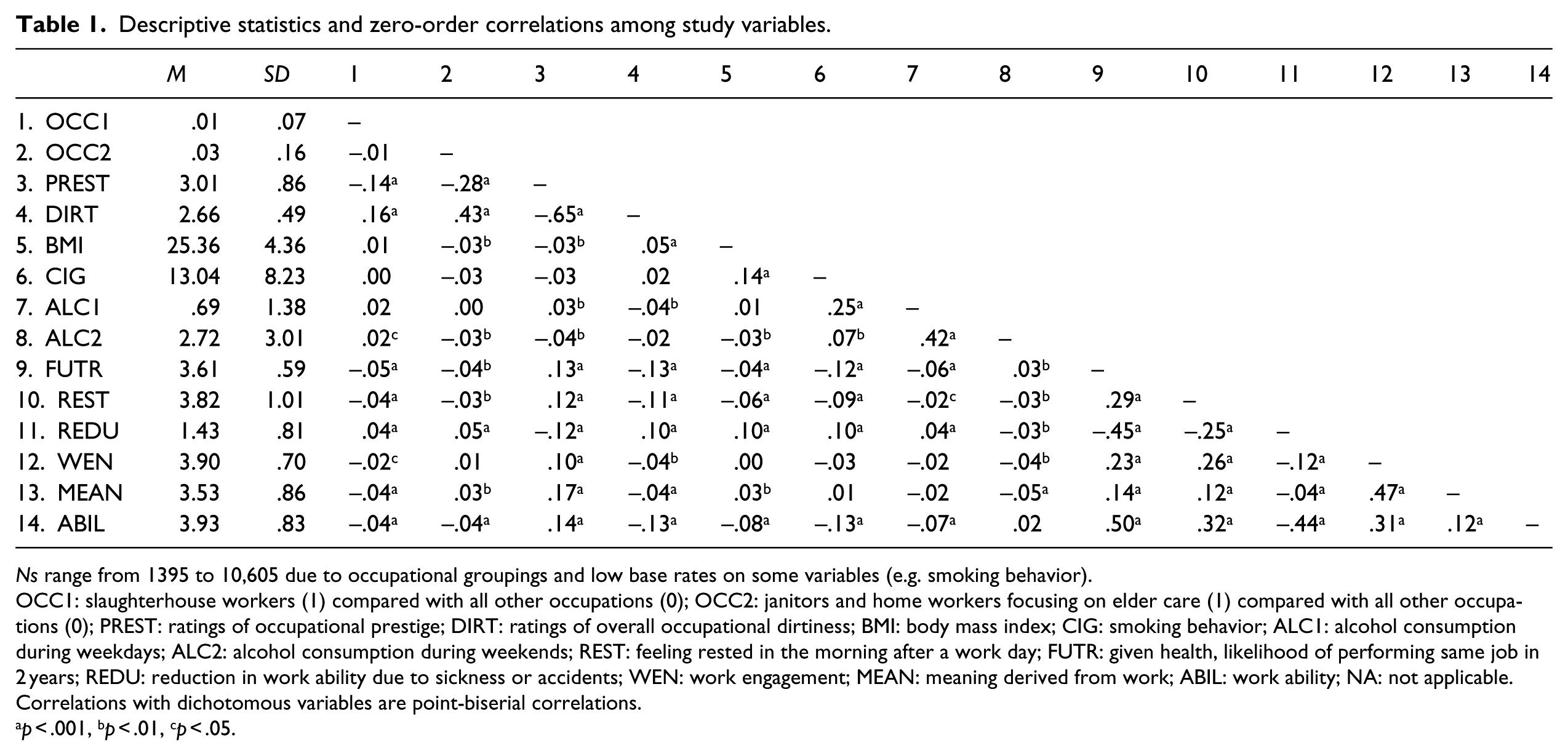
Ns range from 1395 to 10,605 due to occupational groupings and low base rates on some variables (e.g. smoking behavior).
OCC1: slaughterhouse workers (1) compared with all other occupations (0); OCC2: janitors and home workers focusing on elder care (1) compared with all other occupations (0); PREST: ratings of occupational prestige; DIRT: ratings of overall occupational dirtiness; BMI: body mass index; CIG: smoking behavior; ALC1: alcohol consumption during weekdays; ALC2: alcohol consumption during weekends; REST: feeling rested in the morning after a work day; FUTR: given health, likelihood of performing same job in 2 years; REDU: reduction in work ability due to sickness or accidents; WEN: work engagement; MEAN: meaning derived from work; ABIL: work ability; NA: not applicable.
Correlations with dichotomous variables are point-biserial correlations.
p < .001, bp < .01, cp < .05.
Slaughterhouse workers’ well-being findings
To investigate the effect of working in the slaughterhouse occupation upon workers’ well-being, we conducted a series of regression analyses. Following the most recent recommendations in the literature regarding the inclusion of statistical control variables (e.g. Becker, 2005; Bernerth and Aguinis, 2015; Spector et al., 2000; Spector and Brannick, 2011), we considered a number of variables for our regression models, including various demographics. In evaluating those potential variables, we decided that they likely functioned as substantive instead of biasing variables (Spector et al., 2000). For example, if we controlled for the workers’ sex, we would essentially be controlling for the occupation given that 74% of slaughterhouse workers in our sample are male. However, to further understand the potential influence of demographic variables on our findings, we performed an exploratory analysis in which we looked within the slaughterhouse worker group at the correlations among the demographic variables in our data—age, sex, and tenure—and all of our outcome variables. Of 30 correlations examined between these demographics and our outcome variables, the only statistically significant correlation was between sex and alcohol consumption on the weekends, with men appearing to consume more alcohol than women, r(54) = .28, p < .05. Therefore, it does not appear that demographic variables were likely to have a significant influence on our findings.
In keeping with our theoretical foundation and line of inquiry, we controlled for two variables: occupational prestige and overall dirtiness. Doing so allowed us to better isolate the potential influence of intentional killing of animals on workers’ well-being. Therefore, in the first step of each regression model, we entered the prestige and dirtiness variables as controls. In the second step, we entered the appropriate grouping variable that compares occupational membership. For interpretation ease, all groupings have slaughterhouse workers coded as 1 and the comparison occupation(s) as 0.
Slaughterhouse workers
As displayed in Table 2, slaughterhouse workers differed significantly from other occupations on six key indicators of physical and psychological well-being. Being a slaughterhouse worker was associated with increased alcohol consumption during weekdays, increased alcohol consumption during weekends, feeling less rested in the morning after a day of work, reporting a lower likelihood of being able to perform the same job in 2 years, reporting a reduction in work ability due to sickness or accidents, and lower levels of meaning from work. As displayed, effect size indicators were very small (these were highly conservative low-end estimates as noted later) but statistically significant.
Slaughterhouse work compared with other occupations.
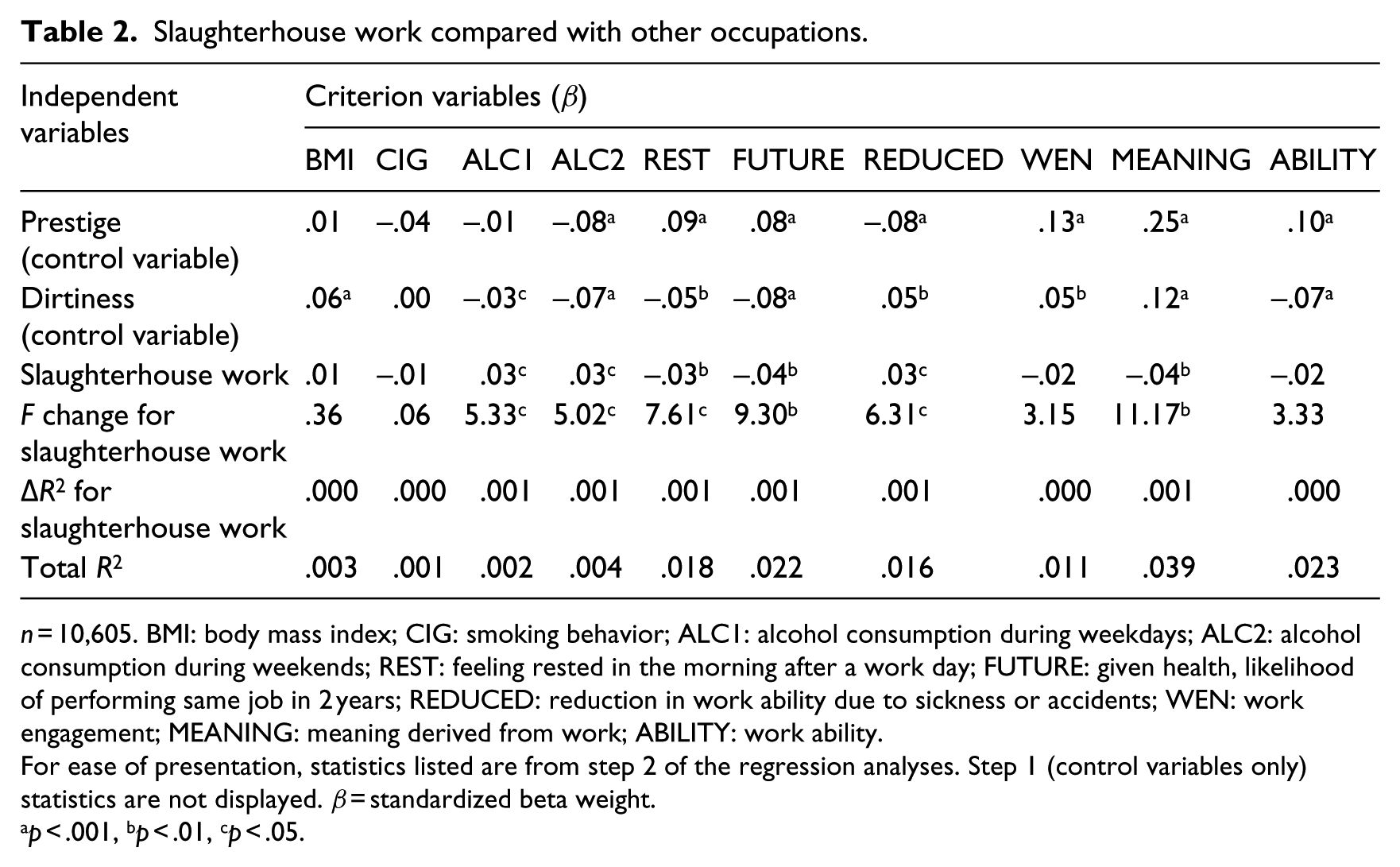
n = 10,605. BMI: body mass index; CIG: smoking behavior; ALC1: alcohol consumption during weekdays; ALC2: alcohol consumption during weekends; REST: feeling rested in the morning after a work day; FUTURE: given health, likelihood of performing same job in 2 years; REDUCED: reduction in work ability due to sickness or accidents; WEN: work engagement; MEANING: meaning derived from work; ABILITY: work ability.
For ease of presentation, statistics listed are from step 2 of the regression analyses. Step 1 (control variables only) statistics are not displayed. β = standardized beta weight.
p < .001, bp < .01, cp < .05.
Janitors and home care workers who focus upon elder care
To further explore the nature of intentional killing as an occupation, we conducted the exact same analysis as described above, but used a set of occupations that were nearly identical in occupational prestige and level of dirtiness to that of slaughterhouse workers. Namely, we compared one group comprising both janitors (prestige M = 1.67, dirtiness M = 3.78) and home care workers who focus upon elder care (prestige M = 1.89, dirtiness M = 3.67) with all other occupations in our sample. Our subject-matter experts described these positions as similarly dirty to slaughterhouse workers and dirtier than plumbers, sales people, and police and correctional officers. Interestingly, for none of our outcomes did we find that janitors and home care workers had poorer outcomes than those in any of the other occupations. Thus, even though these two occupations had nearly identical prestige and dirtiness ratings with slaughterhouse workers, they did not appear to result in negative outcomes. This serves to highlight that the intentional killing of animals appears to be a key differentiating feature.
Theoretical implications
Summary of findings
Based upon theoretical propositions derived from an integration of theoretical perspectives from dirty work (Ashforth et al., 2007) and perspectives regarding the internal consequences of intentional killing (MacNair, 2002; Reeve et al., 2005), we explored the impact of a working within an occupation inherently devoted to the intentional killing of animals upon workers. In so doing, we explicitly extend dirty-work scholarship by looking beyond the impact of prestige and dirtiness as explanations for why those who conduct dirty work tend to suffer. Through our analysis, we provide early evidence that slaughterhouse workers potentially experience negative effects beyond what might be explained by current dirty work theory alone.
In the first step of our approach, we compared slaughterhouse workers with 43 other occupations on outcomes of both physical and psychological well-being. We included both occupational prestige and overall dirtiness as theoretical control variables, which allowed us to isolate the unique characteristics of slaughterhouse work as potential drivers of negative well-being. Our data suggest that slaughterhouse workers have increased alcohol consumption during weekdays, increased alcohol consumption during weekends, feel less rested in the morning after a day of work, report a lower likelihood of being able to perform the same job in 2 years, report a reduction in work ability due to sickness or accidents, and have lower levels of meaning from work than workers in other occupations.
Given our analytic approach, such outcomes are not due to the low occupational prestige or high level of dirtiness experienced in the slaughterhouse occupation. But to further test the idea that something else about occupations with low prestige and high levels of dirtiness might negatively influence workers’ well-being, we conducted the same analysis with a comparison set of occupations that had nearly identical profiles of dirtiness and prestige to that of slaughterhouse workers. We did not find the same outcomes with this comparison group that we found with slaughterhouse workers.
As such, in this study, we tested the theoretical proposition that intentional killing as a key occupational characteristic matters above and beyond prestige and dirtiness. Our analyses of the data support that proposition. But what might this mean for dirty work theory and for how we conceptualize work that involves the intentional killing of animals? In the next section, we summarize our theoretical contribution by proposing that dirty work of the type we investigated in this study requires explanatory mechanisms beyond occupational prestige and overall dirtiness.
Beyond prestige and dirtiness
The theoretical framework of dirty work, which comprises the three types of taint leading to stigmatization within varying levels of occupational prestige (Ashforth et al., 2007; Kreiner et al., 2006), is appropriate for the study and theoretical development associated with intentional, organized, routinized killing of animals. It is relevant because killing animals puts those who do it in close contact with death, leading to physical taint. It is also relevant because such theoretical developments have considered the organizational, occupational, and group-centric nature of identity and well-being for workers. What has not been considered to the best of our knowledge, however, is the additional complexity that routinized killing may have upon the occupational experience of those who do it. Even though other studies have explored killing animals from a dirty-work perspective (Baran et al., 2012; Lopina et al., 2012; Reeve et al., 2005), they have focused on occupations in which killing is but one dirty task undertaking periodically, not occupations like working in a slaughterhouse in which killing is the occupation’s raison d’être.
Little research has specifically investigated the psychology of routinized killing of animals in terms of the mechanisms through which it may affect the humans involved. Evidence does exist, however, that suggests that killing animals may affect how people think and behave. For example, it does appear that substantial cruelty toward animals during the early stages of life may relate with violence toward people in adulthood (Felthous and Kellert, 1986) and that violence toward animals relates with a wide variety of types of antisocial behavior (Arluke et al., 1999). Relating closely to the topic of this study is the finding that communities with slaughterhouses tend to have higher incidents of social problems (Fitzgerald et al., 2009) than comparison communities. To further develop theory, we outline how our findings extend knowledge about the outcomes of routinized killing within the context of dirty work.
Ambivalence and psychological demands
Slaughterhouse work fits in the pervasive stigma category of occupations that engage in dirty work, which suggests that these workers experience considerable internal conflict due to ambivalent identification (Kreiner et al., 2006). Slaughterhouse work, however, involves direct contact not only with death and blood and entrails but also direct contact with violence perpetrated upon other living beings. Our findings suggest that this aspect of their occupation—intentional killing of animals—explains lower levels of well-being beyond those that we would expect from the propositions of the dirty-work literature. Therefore, it appears that current theory and future research should consider not only the aspects of dirtiness and prestige suggested by the dirty-work framework but also the additional psychological demand that such workers may be experiencing.
Additionally, slaughterhouse workers likely experience inner conflict that taxes their resources to the point of causing strain. An explanation for this phenomenon comes from conservation of resources theory (Hobfoll, 1989, 2001), which suggests that people have a set amount of resources from which they draw when faces with demands. As those demands increase, resources diminish. Strain results when demands continually exceed one’s resources. In the case of slaughterhouse workers, we expect to see an increase in negative coping strategies and lower indicators of well-being as a result of their occupational involvement when compared with other occupations. Slaughterhouse workers also likely expend resources when defending what they do to group outsiders. This requires additional cognitive effort, further contributing to resource drain and ultimate strain. Furthermore, the lack of occupational prestige associated with slaughterhouse work can accentuate this resource drain.
Dirty work, perpetrating pain, and empathetic suffering
Some of the unique outcomes associated with slaughterhouse workers in this study were potential indicators of negative coping strategies (e.g. increased alcohol consumption). Others were potential indicators of physical and psychological strain (e.g. feeling less rested, reduced work ability, lower levels of meaning). One proposed explanation, as outlined earlier, is that slaughterhouse work is unique from other commonly studied dirty-work occupations in that because it routinely involves the perpetration of violence upon other living beings, those who perform it may be susceptible to perpetration-induced traumatic stress. Our data did not allow us to test this precisely; however, we see the role of such a construct as highly relevant to the study of slaughterhouse workers.
Related to the role of perpetration-induced traumatic stress—yet holding potentially even more explanatory power at the theoretical level—is the potential role of empathetic suffering among slaughterhouse workers. Namely, being closely involved with the intentional killing of animals may result in the inflictors of such suffering—the slaughterhouse workers—to take on aspects of the suffering themselves. From anecdotal evidence and basic facts of the occupation, we know that slaughterhouse workers directly cause and witness suffering and pain (e.g. Dillard, 2008). But how might such exposure affect the slaughterhouse workers themselves? Some evidence from neuroscience and the witnessing pain in other humans seems to be relevant.
In a study using functional magnetic resonance imaging, Botvinick et al. (2005) exposed people to images of other people displaying various facial expressions. Some of those facial expressions were pain induced. The study found that simply witnessing other people experiencing pain resulted in similar brain activation to experiencing the pain firsthand. These findings, of course, only involve the human species, but they signal potential ways in which empathy can relate to the suffering of others.
In a more recent study, Perry et al. (2010) found that empathy to pain tends to happen even when the pain is being experienced by others who are different than oneself. Again, these findings are among human subjects, but the brutality and intentionality of killing in the slaughterhouse lead us to suspect that those who are exposed to—and indeed, perpetrate—such violence as part of their job likely experience negative effects upon their well-being. If the findings among humans regarding empathy and pain extend to witnessing animal cruelty and death, it could be argued that similar psychological processes are at work among slaughterhouse workers. When faced with animal suffering in the slaughterhouse, therefore, it is likely that such empathetic tendencies may become activated at some level and elicit both physical and psychological responses. Over the course of a career in a slaughterhouse, it is plausible that such reactions manifest themselves in strain and attempts to distance oneself from the pain.
Such distancing could be a reason why alcohol use appears to be higher among slaughterhouse workers, as they may be using alcohol as a coping mechanism to deal with the empathetic suffering they face daily. In addition, we found that slaughterhouse workers tend to experience less meaning at work than other workers. On one hand, such a finding is unsurprising. From all descriptions we have examined, working in a slaughterhouse is difficult, gruesome work. These workers clearly deal with a high level of dirtiness within a low-prestige occupation. Another alternate hypothesis is that the social and economic characteristics of typical slaughterhouse workers may coincide with higher levels of alcohol use.
Given that our results hold even while controlling for dirtiness and prestige, however, suggests that such a loss of meaning might be attributable to the nature of slaughterhouse work more specifically. Namely, it could be that the intentional killing of animals induces chronic empathetic suffering, which in turn influences slaughterhouse workers to distance themselves psychologically from their work even more than those in other dirty work occupations. It is important to note that our study was not designed to provide an in-depth, deep understanding of slaughterhouse workers’ lived experiences. Future research could potentially do so through rigorous ethnographic methods including participant observation and in-depth interviews. Clearly, further research is needed and our findings are tempered by limitations mentioned below; however, it does appear that the relationship between intentional killing as a part of an occupation and its workers experiencing less meaning in their work is worth future exploration.
Why would workers who engage in routinized killing be particularly susceptible to a loss of meaning at work? One explanation is that these workers may intentionally separate themselves more from what they do than workers from other occupations. Such a tactic could be a coping strategy for dealing with the identity-threatening aspects of their work. For example, if a central aspect of one’s work is killing animals in a routinized fashion, the person might be less likely to incorporate his evaluation of his work as part of his self-esteem. Creating a psychological barrier between work and non-work life might be a coping mechanism that these workers employ. If a slaughterhouse worker did view her work as central to her self-esteem, it presents additional potentially problematic psychological challenges. For example, it could force workers to reconcile what they do with who they are. Such reconciliation is difficult because it would necessarily require them to see themselves as animal killers instead of people who kill animals as a job or as providers of meat.
A potential area for further theoretical development lies in the consideration of occupations that organize the routinized killing of animals within the context of symbolic interactionism and related sociological theories. Such considerations regarding companion animals (Sanders, 2003) highlight the promise of viewing animal–human relationships as a lens for developing understanding of how personhood and related constructs develop through interaction. When such interaction is in the slaughterhouse, however, a different dynamic is at play. Namely, these workers likely experience both identification with and forced psychological separation from the animals around them. Our data do not speak to these issues, but we see promise in such direction.
Limitations and future research directions
As with any field study, methodological limitations are inevitable. It is important, however, to note these limitations to temper generalizations and conclusions. In the case of this study, despite our extremely large representative sample as a whole, the slaughterhouse worker group was generally small in size. Although there is no reason to expect substantive nonresponse bias per se (Rogelberg et al., 2003), the small sample did not allow for meaningful within-group analyses to better understand variability among individuals in the same occupation.
Although our findings were statistically significant, it is indeed important to note the small effect sizes in our analyses. Namely, the magnitudes of overall variance in our outcomes that are explained by occupational differences were small in this study. One potential reason for this could be that the variance across the 44 occupations in our data was somewhat limited in terms of meaningful variables such as occupational prestige and dirtiness. Across all 44 occupations, subject-matter expert ratings of prestige and overall dirtiness were near the mid-point on a 5-point scale and had small standard deviations (prestige M = 2.87, SD = .87; dirtiness M = 2.64, SD = .54). Compared with slaughterhouse workers (prestige M = 1.67; dirtiness M = 3.56), the differences are not dramatic. With a more diverse set of occupations, we would expect for more robust findings that would follow a similar pattern to those found here.
For example, when we limited our analysis to comparing slaughterhouse workers with a single high prestige, low dirtiness occupation (academics in the social sciences and humanities), 9 of the 10 outcome variables were statistically significant and all were in the expected direction (engagement was the only non-significant outcome). In this focused comparison, being a slaughterhouse worker explained from 2 to 14 percent (M = 8 percent) of the variance in the physical and psychological indicators of well-being that we studied. Therefore, we note the importance of considering the potentially small effect sizes as we have reported, but at the same time, we think reasons exist for those effect sizes to be potentially underestimating the true effects of slaughterhouse work on well-being. Future research with an even more diverse set of occupations would likely provide useful insight on this issue.
In addition to a broader set of occupational types, future research could benefit from a wider range of types of work that involve animals. As noted by one of our reviewers, it would be interesting and useful to look at different types of animal slaughter, differentiating, for example, among different types of animals being processed. Such differences could provide insight regarding the different types of relationships between humans and animals in these different settings.
Although we were fortunate that the DWECS was as comprehensive as it was, it was not designed with dirty work research questions in mind. It was able to capture health and psychological outcomes thoroughly, but it was not useful for capturing process type variables such as occupational identity, perceived stigma, and perceived status which would be highly recommended in additional studies (Bickmeier et al., 2015). Relatedly, variables around passion (Burke et al., 2015) and calling (Rawat and Nadavulakere, 2015) would be useful to include when doing occupational analyses. Furthermore, future research would benefit from the inclusion of measures assessing the specific hourly or daily tasks of the slaughterhouse workers and the extent of slaughter engaged in. This would further allow for meaningful within-occupational analyses to better understand the effects of animal slaughter on the individual. Finally, individual differences of the workers themselves would serve to provide a complete picture such as trait resilience (Parker et al., 2015), hope and optimism (Strauss et al., 2014), and coping strategies (Clark et al., 2014). Relatedly, the single time-point administration of the survey does not allow for examination of temporal and dynamic processes around identity and adjustment and outcomes in these employees. One highly valuable area for future research, as suggested by one of our reviewers, is to employ a longitudinal design to unpack more fully the psychological mechanisms at work among slaughterhouse workers. In particular, future research could explore mediation models that measure potentially causal factors related to one’s occupation, psychological mechanisms, and key indicators of well-being. It is important to note, however, that our study design focusing on occupational differences as evaluated by subject-matter experts and then linking to employee data does allay concerns around common method bias that often plague single point-in-time research. Finally, future research would benefit by addressing the limitation that we had only one easily identifiable animal occupation in our database. More specifically, being able to identify clearly other occupations dealing directly with animals (e.g. trainers of service animals; zookeepers; veterinarians, and those responsible for animal experimentation and testing) would be informative for better understanding the multifaceted ways animal may impact the employee experience of work.
Conclusion
Our study is the first of its kind to explore slaughterhouse workers in a quantitative manner within the theoretical framework of dirty work. Through the use of occupational comparative analysis we were able to better isolate the effects of dirtiness, prestige (or lack thereof) and, of relevance to this special feature, the effects (negative) of intentional routinized killing of animals on employee health and well-being. Given this, we not only were able to contribute to dirty-work research and theory and to research on stigma and status shields, but also to burgeoning scholarship on animals and organizations.
Footnotes
Funding
The author(s) received no financial support for the research, authorship, and/or publication of this article.