



Abstract
In this article, we elaborate on the significance of suffering in processes of embodied identity construction. Drawing on interviews with 62 chefs employed in elite kitchens around the world, we make two main contributions. First, we extend our understanding of suffering as a traumatic, alienating experience by theorizing it as a distinctive form of embodied identity work. We show how suffering can function as a mechanism through which people forge an understanding of who they are. Our second contribution extends the first by elaborating on what we call the aesthetics of suffering. We show how suffering can be perversely appreciable, distinguishing and endured in culturally significant, identity-implicative ways. Via this theorization, we progress our understanding of how identities are forged through (and read from) suffering bodies, and add an additional layer of interpretation to research in which matters of embodied identity and suffering are nascent but largely neglected.
Introduction
In this article, we ask the question: how is suffering a crucial mechanism in processes of embodied identity construction? We are concerned with how suffering bodies can function as a conduit through which people form, repair, maintain, strengthen and revise their identities in relation to their self-concept (Budgeon, 2003; Snow and Anderson, 1987).
We pose this question in the context of two principal theoretical points: that suffering can disrupt (Charmaz, 1983; Robertson and Long, 2018; Ullström et al., 2014), but also inform (Alexander et al., 2004; Giesen, 2004; Kidd, 2012; Scott et al., 2017) our understanding of who we are. The former being grounded in the common sense, prima facie notion that all forms of suffering are bad and should be ameliorated when and wherever possible (Brady, 2018). The latter being the far more contentious possibility that, while suffering can be traumatic and alienating, it can also feed into, underscore and even define the identities of the afflicted.
With reference to this latter possibility, we argue that a significant corpus of organizational identity research (e.g. Brown and Coupland, 2015; Coupland, 2015; Courpasson and Monties, 2017; Kachtan and Wasserman, 2015; Thornborrow and Brown, 2009) trades on, but has not directly considered suffering’s generative effects. Precisely how suffering bodies are (or can be) variously mobilized in processes of identity construction is a domain that remains poorly understood. In particular, we have yet to fully comprehend the individual and organizational circumstances in which people can suffer in ways that are apparently appreciable, distinguishing and implicative of who they are. These are the concerns this article seeks to address.
To progress our understanding of how suffering bodies matter in processes of identity construction, we ground this study in a theorization of the body as a responsive, living site for the construction of identity (Budgeon, 2003; Lawler, 1997). Drawing on Merleau-Ponty (1962/2012), we identify the body as an instrument of comprehension, a tool we use to (De Rond et al., 2019). The implication being, in the context of identity construction, that the body is far more than simply passive material upon which discursive and representational regimes can act. It is ‘active’ and ‘self-transforming’ (Freund, 1988: 851). As Crossley (2004: 37) describes, the body is ‘reflexively’ involved in identity construction.
Via this theorization, and drawing on empirical data comprising interviews with 62 elite chefs, we show that chefs submitted to suffering when it resonated with their understanding of who they are/who they wanted to be. We show that they suffered because it was mythologized as virtuous and beneficial, and as a pathway to new skills, insights and understandings. We also show how, through more or less purposeful suffering, identities were forged on and through bodies, and read from the bodies of others.
Based on these findings, we make two main contributions to research concerned with embodied identity work, and with the connection between identity and suffering in particular. First, we argue that suffering and its endurance can be theorized as a distinctive form of embodied identity work in contexts where it is perceived to have instrumental value (e.g. developmental and communicative effects). We argue that in these contexts suffering can be mobilized in identity-implicative ways – to forge character and project a particular understanding of who someone is. Our second contribution progresses our theory of suffering as embodied identity work one step further, by elaborating on what we call the aesthetics of suffering: this being a system through which suffering in its myriad forms is imbued with qualities, virtues and even a dark, tawdry kind of beauty. Thus, we reveal how suffering is experienced and performed through the body in ways that are generative (i.e. appreciable and distinguishing) in processes of embodied identity construction.
In the sections that follow, we expand on this article’s theoretical, and then empirical context. We describe our data, how it was collected and analysed. The findings we present show how suffering functioned as an identity-implicative event; the relationship between suffering, durability and identity; and how suffering helped to establish individually defining social bonds within high-performing kitchen brigades. The article concludes with a discussion of our findings and how they extend the extant literature.
Theoretical context
In this section, we set the theoretical foundations for this study in the extant embodied identity work literature. We then focus on suffering and its connection to processes of identity construction. We close by explaining how the focused analysis of suffering can extend our understanding of how identities are constructed, and add an additional layer of interpretation to organizational research where matters of identity and suffering are nascent.
Embodied identity work
The concept of embodied identity work is concerned with how the body is used as a conduit for the construction of identity (Budgeon, 2003; Pitts, 1998; Schultze, 2014). Still a niche field of research, much of the extant literature is broadly concerned with gender identity, and is predominantly grounded in a Foucauldian understanding of the body (Wolkowitz, 2006). According to this framework, bodies are docile sites of manipulation, devoid(ed) of their ‘animal spirits’ and there to be ‘disciplined’ (Foucault, 1977: 136 and 143). They are something to be ‘surveilled, managed and made useful’ and ‘subjected, used, transformed and improved’ (Foucault, 1977: 155).
Through the Foucauldian lens, the utility of docile bodies in processes of identity construction emerges via disciplinary practices that target the self but act upon the flesh and are materialized through the fleshly body (Godfrey et al., 2012: 543). Embodied identities are constructed through things like bodily markings and worn insignia (Budgeon, 2003). Also, through carefully crafted embodied performances. These are the ‘multiplicity of embodied cues’ that arise as a consequence of more or less conscious bodily adaptations to norms linked to social circumstances (Godfrey et al., 2012). They matter because we instinctively draw on them to establish an understanding of who someone is (Knights and Clarke, 2017).
Recent critiques of the field (e.g. Harquail and Wilcox King, 2010; Knights and Clarke, 2017) emphasize the significant advances that have been made in identity research. Particularly, in relation to our understanding of how identities are constructed on and through the body (e.g. Coupland, 2015; Kachtan and Wasserman, 2015). However, these critiques also highlight the constrained nature of the field. They suggest there is an ‘overemphasis on a limited range of human bodily experience’ (Gimlin, 2007: 354–355). The argument being that our understanding of how people use their bodies to construct identity is limited by analysis that is restricted to bodies sexed or erotic potential (Courpasson and Monties, 2017). ‘Other body action roles can be empirically observed’ (Michel, 2011: 331), but these are not accorded much attention within identity research (Wacquant, 1995: 65).
Central to this critique is Lewis’ (2000) point, that we do not inhabit our bodies as docile. Our bodies are ‘not objects’ (Merleau-Ponty, 1962/2012: 204). Rather, they are sensate. We are ‘corporeal creature[s]’ and the lives we lead are ‘carnal’ ones (De Rond et al., 2019; Wacquant, 2015: 2). Thus, the body is far more than simply passive material upon which discursive and representational regimes can act. Bodies can be a canvas upon which who we are is written (as in Coupland, 2015; Kachtan and Wasserman, 2015; Trethewey, 1999), but they are more than the ‘biological integument of the self’ (Wacquant, 1995: 70). The body is living, responsive and a tight relationship exists between our body and our understanding of who we are (Budgeon, 2003; Wacquant, 1995). As Merleau-Ponty (1962/2012: 205) puts it: ‘I am my body.’
Accordingly, the body can also be conceptualized – as it is here – as an instrument of comprehension (Merleau-Ponty, 1962/2012). It is a tool we use to (De Rond et al. 2019). The body is ‘active’ and ‘self-transforming’ (Freund, 1988: 851). Crucially, it is also what Crossley calls ‘reflexive’, meaning that bodies are capable of acting back upon the agent and modifying their conception(s) of who they are (Crossley, 2004: 37–38; Wacquant, 1995: 70).
Embodied identity work and suffering
One theme that emerges from studies of embodied identity work is a connection with organizational suffering. Defined as a form of harm that arises from threats to personhood (Cassell, 1998), suffering has yet to attract much attention in the context of identity research (embodied or otherwise), despite suggestions that it should do so (Charmaz, 1999: 368). This is surprising because suffering is intimately linked to our sense of self (Brady, 2018; Carel and Kidd, 2019; Charmaz, 1983). Precisely what and how we suffer is ultimately contingent on our understanding of who we are (Gill, 2019).
From the extant literature, two aspects to the connection between suffering and identity stand out. First, suffering can be theorized as disruptive of identities. As such, an important point arising from Michel (2011) is how cultures of extreme commitment and self-sacrifice can trigger actors to divest themselves of regimes that were previously central to their understanding of who they are (see also Rahmouni-Elidrissi and Courpasson, 2021). So, suffering can be theorized as a type of social cue that can prompt individuals to reflect on their circumstances and revise them when they conflict with their self-concept (Snow and Anderson, 1987). The basic thesis being that those who experience suffering will actively seek to avoid, mitigate or ameliorate it altogether. After all, who wants to suffer?
Second, suffering can also be theorized as helping to solidify identities. This is the contradictory, paradoxical notion upon which Brady (2018) is instructive – that suffering is not always an alienating experience that conflicts with a person’s understanding of who they are. Rather, that in certain contexts suffering can actually reinforce and be constitutive of who someone is (e.g. Carel and Kidd, 2019, 2020). Moreover, that people might paradoxically pursue and even treat suffering as an ostensibly valuable experience (Brady, 2019); that is, as something with the potential to affirm (or facilitate) their being (or becoming) who they want to be. Both Crossley (2004) and Scott et al. (2017) are instructive in this regard, as is Charmaz (1999: 368).
As a basic thesis, the idea that suffering can be instrumental in processes of identity construction is widely visible in many organizational studies of identity, albeit primarily as an implicit metanarrative. For example, in Godfrey et al. (2012), suffering is clearly central to the identities soldiers aspire to realize and the military-machine seeks to build. They describe how soldiers are trained to be tough to cope with the rigours of war, but also to be tough men. The (unspoken) implication being that one cannot truly belong (to the Marine Corps), or be a real man, without having suffered. Access to both identity-implicative distinctions being ultimately contingent of one form of suffering, or another.
The implicit importance of suffering in processes of identity construction similarly underscores a range of other studies. Notably, Thornborrow and Brown’s (2009: 366–367) study of paratroopers, which highlights the importance of ‘collective hardship’, ‘brutal regimes’ and ‘crow beatings’ comprising verbal assaults, acts of intimidation and physical aggression as important rites of passage in the process of professional development. Also, Courpasson and Monties’ (2017: 46–48) description of how police officers ‘author’ physical identities by training their bodies to ‘endure extreme hardships’. And, Brown and Coupland’s (2015: 1326) description of how elite rugby players’ understandings and representations of themselves as ‘tough’ are achieved through participation in brutal training regimes (see also Coupland, 2015).
Our understanding of the potential significance of suffering in processes of identity construction is also not limited to people with careers in (extreme) organizational contexts. For example, in the field of medical sociology, Charmaz (1983) connects the suffering experienced by chronically ill people with fundamental revisions to their understanding of who they are. More broadly, Alexander et al. (2004) connects people’s shared experiences of suffering (e.g. cultural traumas, such as ethnic cleansing) with the formation of individual and collective identities. Eyerman (2001) similarly connects the traumatic effects of slavery with contemporary African-American identities. Also, Giesen (2004), who elaborates on the impact of the holocaust on post-war Jewish and German national identity. The collective point being that when suffering is shared it creates what Heise (1998) calls ‘emphatic solidarity’. Similar to Durkheim’s (1885/2014) notion of collective effervesce, identities derive from (and are grounded in) shared, painful cultural heritages (Smelser, 2004).
Suffering and embodied identity work in organizations: A new direction
To surmise, suffering’s solidifying effects on identity is widely traceable, but rarely in organization studies as more than an implicit metanarrative within research ostensibly concerned with other phenomena. Organizational research in which matters of identity and suffering are nascent abounds, but we have yet to consider the generative interplay between the two. Put simply, the notion that suffering can inform and even be constitutive of who someone is remains marginal, understudied and poorly theorized in the context of people and organizations. It is a ‘dark side’ of identification in organizations that we have yet to address (Caprar et al., 2022).
To address this paucity, we pose the question: how is suffering a crucial mechanism in processes of embodied identity construction? Our aim in posing this question is to augment current theories of suffering as an exclusively traumatic experience, by showing how suffering can also underscore people’s understanding of who they are. We therefore aim to establish that while organizational suffering can be deeply morally problematic, it can also be meaningful for the afflicted; even, we contend, perversely and paradoxically appreciable in contexts where it is recognized and valued despite its traumatic nature and origins.
In these ways, we propose to extend our theoretical understanding of how people build identities through their suffering bodies and add an additional layer of interpretation to research in which matters of identity and suffering are clearly surfaced but not discussed. Research such as Wacquant’s (1995) into pugilism, Thornborrow and Brown’s (2009) into paratroopers and Michel’s (2011) into knowledge workers. These contexts being just a few of many where suffering is apparently celebrated as an important expression of who someone is, but not scrutinized as a distinct proposition in its own right.
Context, data and analysis
Context: The brigade de cuisine
We examine the connection between suffering and identity in the context of the ‘brigade de cuisine’, which is an enduring system of organization widely used in the kitchens of fine dining restaurants around the world (Trubek, 2000). By fine dining restaurants, we mean organizations comprising a global community of elite culinary establishments that are rated and ranked by either the Michelin Guide or the ‘San Pellegrino’ list of the ‘The World’s 50 Best Restaurants’.
In the current context, the significance of the brigade system is grounded in its historical and ideological origins; specifically, military-inspired thinking applied to the management and organization of kitchen work (James, 2006). On the front line this widely translates into brigades defined by authoritarian structures, asymmetrical, sometimes abusive power relationships, and highly prescriptive working practices (Burrow et al., 2015; Gill and Burrow, 2018); that is, into what Taylor (1977: 22) calls a ‘measure of brutality’ built into kitchen work. The simple point being that in the kitchens of modern fine dining restaurants suffering of one form or another is omnipresent.
Data collection
The data we draw on comprise 62 interviews with elite chefs. Interviewees were initially from the UK and were identified using the Michelin Guide. We invited chefs to be interviewed by contacting them directly using social media, by emailing or writing to them or their media representatives. At the end of every interview, we asked for referrals to colleagues that might be willing to be interviewed. Because of the nature of the industry, many of the chefs we were referred to worked abroad. In these cases, initial contact was made by Skype. When we achieved sufficient referrals in one particular country (e.g. 3–6), we visited that country to undertake interviews. Visits were made to France, Italy, Switzerland, German, Belgium, Demark, China, Australia, Singapore and the USA. During these visits, we augmented our list of referrals by contacting and interviewing other fine dining chefs in the local area.
The interviews we conducted followed a semi-structured format, with researchers working to facilitate the articulation of salient occupational experiences. Interviews averaged 63 minutes, ranging from 17 to 140 minutes (Table 1). All interviews were conducted in English, this being a commonly spoken language across the industry. Interviews began with primarily biographical questions – the trajectory of the chefs’ careers and prominent, defining events. Additional topics included chefs’ inspirations, the changing nature of the industry and effects of social media. The topic of suffering featured prominently, particularly in relation to questions like: how would you describe kitchen culture? How would you describe the emotions you experience at work? What are the best and worst aspects of life in the kitchen? Subsequent questioning strategies were responsive to the events described by chefs.
Outline of participants.
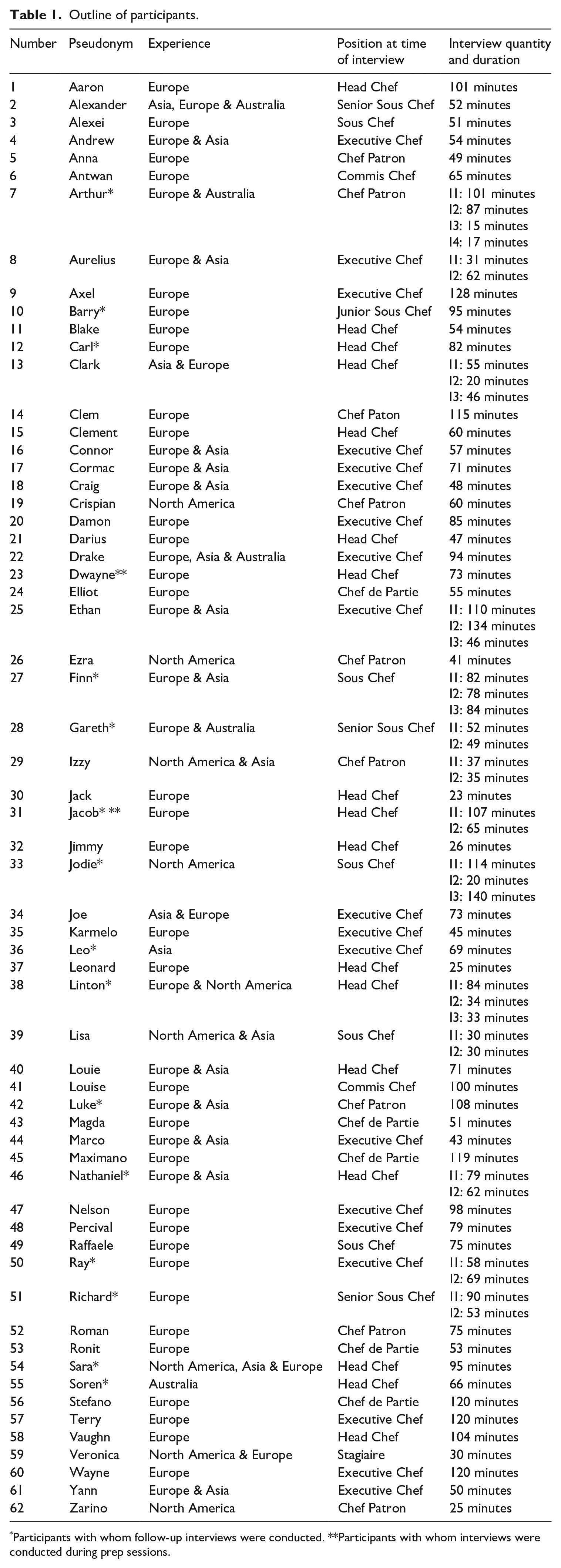
Participants with whom follow-up interviews were conducted. **Participants with whom interviews were conducted during prep sessions.
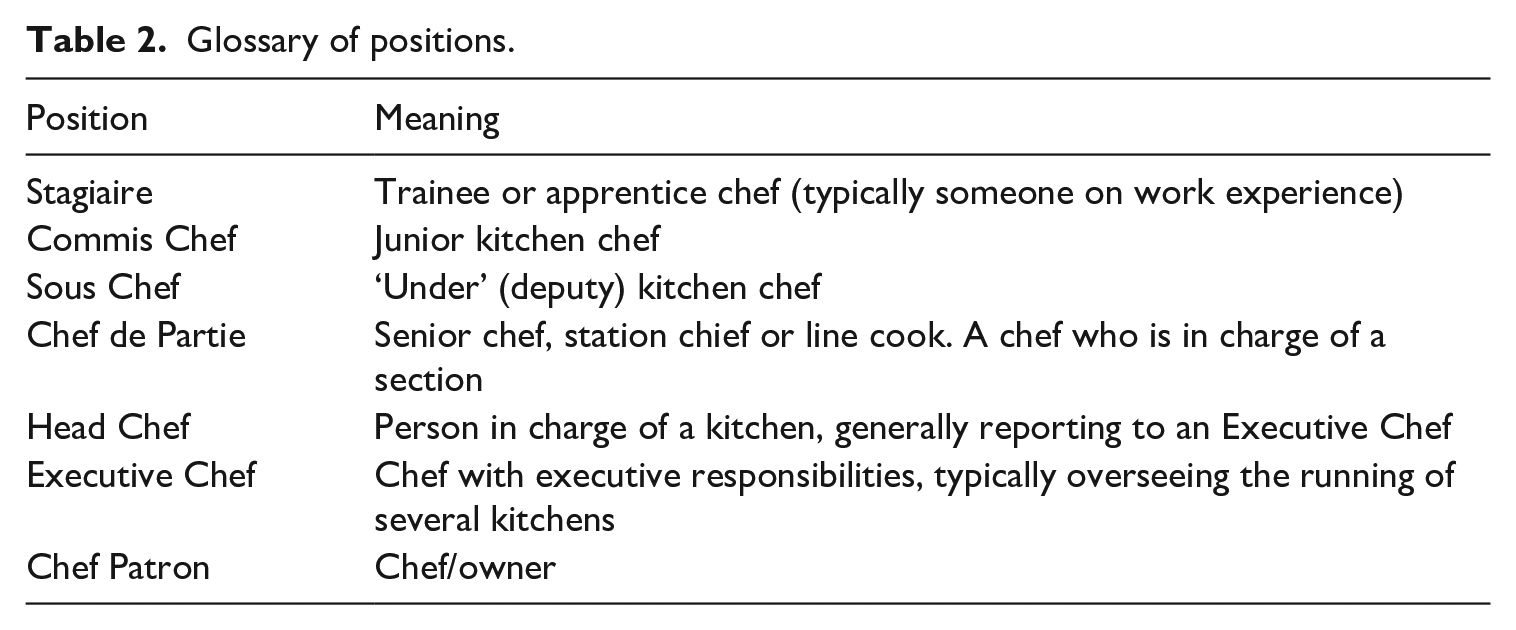
To protect anonymity, interviews were conducted off ‘home turf’ wherever possible, in coffee shops or close meeting rooms (Herzog, 2005). This made it easier for private issues to be discussed more freely (Adler and Adler, 2002). When time was limited, chefs were interviewed multiple times (for 15 chefs), or during ‘prep’ sessions in side rooms away from the main kitchen (for two chefs). This enabled chefs to ‘show’ as well as ‘describe’ their experiences. For example, in response to the question ‘how would someone know a chef was suffering?’, the interviewee gave the researcher a tour of back-stage areas of the restaurant, including rooms where chefs lay sleeping on the floor. During another interview, the researcher was shown photos illustrating chefs’ fatigue during a particularly demanding period. Table 1 gives basic, anonymized details about study participants, and should be read in conjunction with Table 2 (glossary of key positions in the kitchen).
Glossary of positions.
Analysis
The approach we followed to analysing our data was one of ‘progression rather than fixed sequence’ (Locke et al., 2022: 277–278). We moved from lived experience to theoretical narrative (Glaser, 2001; Glaser and Strauss, 1967) via a form of inductive ‘bricolage’ (Pratt et al., 2022). Ours was a process of cycling iteratively between three principal coding practices broadly consistent with Locke et al.’s (2022: 274) ‘processes of coding’, ‘organizing to code’ and ‘putting patterns together’. The process unfolded as follows.
Stage 1
We began by transcribing all our interviews verbatim and anonymizing them. Considerable time was then spent reviewing – ‘scrutinizing, pondering, and organizing’ (Locke et al., 2022: 264) – the transcripts. Our initial aim was simply to interact with our data and ‘symbolically assign summative, salient, essence-capturing codes’ (Saldaña, 2021: 5). We wanted to establish our first order concepts (Gioia et al., 2013; Van Maanen, 1979).
The codes we assigned during this initial stage of analysis generally related to the ‘measure of brutality’ that Taylor (1977: 22) argues is implicit in kitchen work. The code ‘suffering’ (as in ‘painful, distressing, or injurious experiences’ – OED 2021) was well used. As were concomitant synonyms such as ‘pain’ and ‘hardship’. Example 1 is drawn from an initial data table and is instructive of data we were coding. Guided by the words used by the informant (Gioia et al., 2013: 18), we simply coded this quote ‘abuse’.
Example 1: At such a young age I was in a position where I felt very lonely. I was really exhausted. I wasn’t used to the abuse I was getting. I was getting really abused, really badly – you’d be called all sorts of names. I was locked in fridges, punched, kicked about. Yeah, it’s pretty horrific. (Antwan)
A proportion of the suffering our informants described was connected to what could be extreme acts of violence, defined as ‘assaults on the personhood, dignity, sense of worth or value of the victim’ (Scheper-Hughes and Bourgois, 2004: 3). We were also coding suffering connected to much more subtle forms of violence. As in, the suffering arising from the everyday violence of culinary work (e.g. Example 2), from chefs’ working environment (e.g. Example 3) and from abusive management practices (e.g. Example 4).
Example 2: So we’d have to peel a hundred, a hundred and fifty fresh langoustines every day with our bare hands. And that would basically rip your hands to shreds because they’re extremely sharp. (Cormac) [coded ‘hardship’] Example 3: The environment is very stressful . . . If you make mistakes, you get food thrown in your face . . . So the body assumes that it’s going to war. So before I was starting work, I was vomiting, diarrhoea and then going to work and doing a 19–20 hour shift. (Gareth) [coded ‘extreme stress’] Example 4: She just started laying into him – not laying into him [physically], like verbally, like ‘You’re shit, you’re going to go back to [place name] . . .’ at the end of that week he had a panic attack downstairs. (Finn) [coded ‘abuse’]
Stage 2
During the second stage of analysis, we reviewed our codes and worked to eliminate overlaps and similarities by refining and sharpening the codes in use (Emerson et al., 1995/2011). At this stage, we became conscious of an apparent connection between suffering and identity. Both male and female chefs seemed to have a kind of contradictory, at times celebratory relationship with suffering. To suffer and be able to endure it well apparently said good things about a chef. Example 5 is instructive of the material we were working with, and of the connections chefs were drawing between suffering and identity.
Example 5: If you fucked up in the service someone would come and push you against the wall, punch you in the ribs . . . I kind of went there a bit of a timid boy. I left a bit more sure of myself and, you know, like – I mean taking a bollocking – it kind of builds your character and . . . that’s what I liked . . . everyone I worked with there all wanted to be three Michelin star chefs. (Finn) [coded ‘abuse and identity’]
Intrigued by the connections chefs were making between suffering and identity, we pursued this line of investigation further. Treating our codes as categories for further analysis (Fereday and Muir-Cochrane, 2006), and chefs’ rhetoric as synonymous with what they felt (Merleau-Ponty, 1962/2012), we reanalysed our transcripts. Our aim was to focus in on (but also move beyond) simple indicators that suffering and identity were connected. We wanted to understand the nuanced nature of this connection: so, precisely what chefs suffered, how they suffered and why and how their suffering mattered in the context of their understanding of who they are.
Stage 3
Having re-analysed our data, we proceeded to compose a series of short narratives describing key insights and understandings. These narrative-based analytical artefacts eventually structured our findings section, but initially functioned as heuristics; that is, as ‘aids for discovery that stimulate(d) generative thinking’ (Mees-Buss et al., 2022: 406). The narratives in their finished form, but particularly the process of writing them, facilitated a kind of critical reflexivity. They informed (but also delimited) how we engaged with, understood and made sense of our data (Locke et al., 2022: 267). In particular, they helped with the process of axial coding, with establishing patterns between codes (Charmaz, 2014; Strauss and Corbin, 1994). They also prompted us to ask new and probing questions of our data, such as ‘does this make sense?’, ‘is this plausible?’, ‘what is missing from this account?’, ‘how can we explain this?’ and ‘is there a better way to explain this?’.
The increasingly focused insights that were emerging enabled us to engage in a (more) targeted review of the extant literature. In particular, they provided a pathway into research into suffering – organized, or otherwise – and identity construction in pain-based occupations. Moving iteratively and reflexively between these literatures and our data, we started to establish the basis for our theoretical contributions and identify areas where further (theoretical-informed) sampling was required.
Stage 4
During this final stage of analysis, we elected to undertake what ultimately became multiple rounds of additional data collection to probe, test and flesh out our findings. We reinterviewed approximately 25% of our original study participants, and recruited a further 15 chefs with work experiences in Europe, Asia and North America. Our aim was to develop our increasingly detailed understanding of how suffering mattered in processes of identity construction. We continued sampling, refining our codes and revising our narratives until we settled on a set of empirically and theoretically novel insights, which we now present in the sections that follow.
Findings: Suffering as embodied identity work
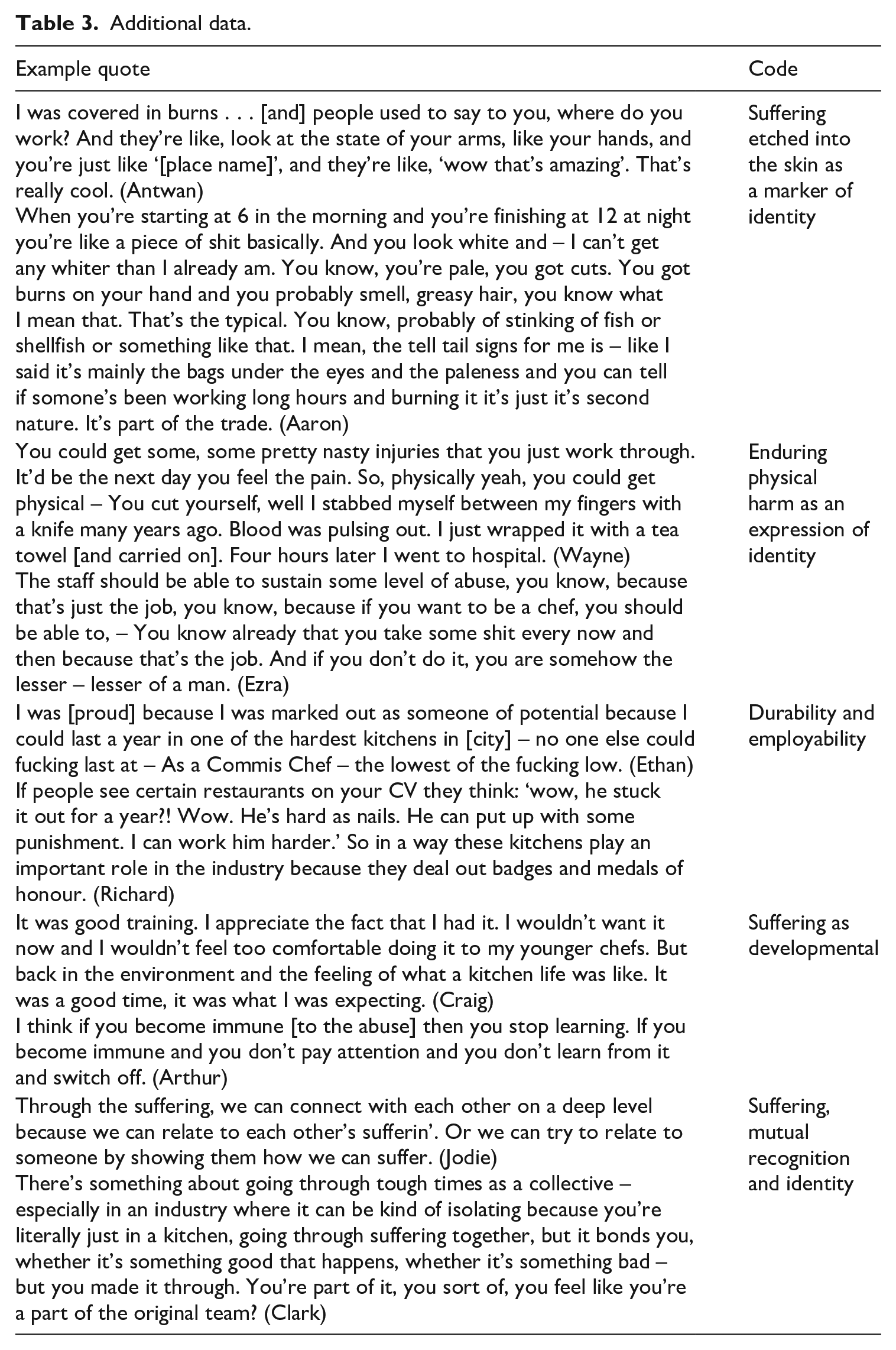
In this section we elaborate on the connection we found in our data, between suffering and identity. We do this across three interrelated, mutually reinforcing subsections. These are supported by Table 3, which contains additional supplementary data.
Additional data.
Suffering as an identity-implicative event
This first section focuses on physical suffering, its endurance and importance as a distinguishing, appreciable identifier of who someone is.
Suffering etched into the skin as a marker of identity
In the kitchens our chefs worked in, physical injuries like cuts and burns were regularly suffered and often left very visible wounds physically etched into the skin. Oftentimes these wounds would be small and temporary (e.g. tiny cuts or scalds), but on occasions they could be large, long-lasting and even permanent: You burn yourself because you’re tired, you’re run down and you’re moving quickly and you make mistakes. It’s not usually on your hands. It’s on your arm either the top or the bottom. So when you reach into the oven, [your arm will] either touch the top of the oven or the rack. So you’ll get this like bar line and it’s sort of – they blister and turn red. I’ve got one at the moment. It’s a very distinctive line that sort of scabs over. Everyone seems to – it’s like people have the same shape and style, but in different places. It’s sort of a good indicator that wherever they’re working, they’re, you know, under some sort of pressure. (Arthur)
The sort of injuries Arthur describes matter because of what they signify, and because they stand out. As Arthur says, they’re ‘distinctive’ and ‘a good indicator’ of things. Such injuries are communicative in that they convey details about the individual. Details like the injured person is a chef. Also, in their multiplicity, that they are a chef who is tired, run down and working in a hard (e.g. probably a good) kitchen. Potentially, also things like status and prestige: I was on the tube once and I was hanging – stood up holding the top rail. And someone was like: ‘oh, where are you a chef then?’ I was like: ‘what, do you mean?’ And they were like: ‘well look at your arm, you must be a chef!’. And I had all burn marks on my arms from the oven. And it felt so cool to be recognized as a chef. (Jacob)
The encounter Jacob describes is significant because his burns were clearly noticed, appreciated for what they were and prompted an apparently positively framed (even excited) assumption about who he might be and where he might work. While the inference of prestige is unspoken, it is nonetheless omnipresent. Importantly, it is something Jacob is clearly attuned to. He is glad his burns marked him out and that he was recognized as a chef. As he says, ‘it felt so cool’.
Enduring physical harm as an expression of identity
A second way bodily injuries mattered derived from the opportunity they created for shows of endurance. Injuries gave chefs a chance to prove they were what Wright (2005) calls a ‘tough cookie’. This aspect of the connection between suffering and identity was brought into particularly sharp relief when chefs’ injuries were so bad they required time off work. Such episodes created a conundrum because kitchens were invariably short-staffed and many chefs were anxious not to be seen as uncommitted or weak. In contexts where resilience and total unwavering commitment was valued highly, taking time off was the very antithesis of what it meant to be a chef. As Antwan describes, even when injured a chef must stay put: When I was at [place name], I slashed my thumb really badly. I couldn’t stop it bleeding, and [name] grabbed my arm just – he put it [my thumb] on the stove top and cauterized it. And I was just like screaming. And he’s like ‘there you go, stopped the bleeding, hasn’t it?’ . . . So to this day, I’ve got like literally no thumb print. I was like pissing blood, everywhere, in the middle of service, and he’s like, ‘you’re not going anywhere’. (Antwan)
Antwan was unusual insofar as he wanted to take time off to get his injury treated. In contrast most chefs were willing, and even enthusiastic about staying at their station when they had been hurt. The general practice was to soldier on regardless of any injury. Such showy acts of commitment were important because they dispelled notions of weakness and enabled the hardy sufferer to cast themselves in a particularly positive way. Simply, staying at work when injured said great things about the individual: I cut myself when I just start there and I have six stitches in [my] finger and I went to the hospital and I had my finger stitched . . . I went back to work right after. . . . I came back to [work on the] fish [section] and I had my finger burnt, the same one. [They] say to me ‘[do] you take the day off?’ [I say] ‘No chef, I work. We chefs, we not dancers.’ (Maximano)
Maximano’s diminutive contrast between ‘chefs’ and ‘dancers’ is particularly revealing. He invokes the former (chefs) as strong, resilient professionals, and the latter (dancers) as soft, fragile people unable or unwilling to suffer on with fortitude. Of course, the irony here is that like chefs, dancers also suffer regular injuries and work on regardless (Aalten, 2005). The crucial distinction being that dancers (unlike chefs) tend to hide their injuries and disguise their suffering. The performing arts is an industry where the injured get side-lined because blemishes of injurious imperfection diminish the beauty of the show (Wulff, 1998: 106). So, dancers work hard to disguise their injuries and suffer in silence out of fear of not being cast or promoted. In contrast, our chefs did quite the opposite. Our chefs showed off their injuries and wore them with pride because this was precisely how valued identities were forged in the kitchens where they worked.
Taken together, these excerpts illustrate the significance of physical injuries and the endurance of suffering as an important expression (marker) of identity. They also give us a sense of injuries (such as lines burnt into the skin) contributing to/constituting a particular kind of valued, even sought-after aesthetic. We show that chefs not only took pride in their ability to endure, but also variously valued injured bodies in their own right. For many of our chefs, a body marked by cuts and burns was the right kind of body to have – it was the body of a committed, hardworking, tough chef, that was noticeable, distinguishing and something to be celebrated.
Suffering, durability and (valuable) identity
This second section builds on the notion that enduring physical harm can function as an expression of identity by outlining the wider connection we found in our data between durability, employability, character and worth.
Durability and employability
Among those we interviewed, culinary work was collectively understood to be extremely harsh. It was a tough, demanding line of work; ergo, to be durable was to be employable. Chefs needed to be durable to survive and do well. This belief was widely reported, particularly by senior chefs when questioned about who they wanted to employ. Some answered the question coyly but others were very explicit about who they wanted in their kitchen: ‘I want tough guys. Good cooks who can deal with pressure, stress. Because at the end of the day that produces me a fantastic restaurant’ (Louie).
When probed on the topic of who the ‘ideal chef’ was, our chefs described how people who were resilient to suffering simply had better prospects and were more valuable than those who were not. There was significant cache attached to people who could endure, while those who could not (or who did not want to) were written off professionally: It’s about putting up with that hardship. Chefs need to be able to take it. You know, kind of a smile about it afterwards for sure. Otherwise, you’re just like a little Cry-Baby in the corner. And, you know, that sounds quite detrimental to say, but don’t be a Cry-Baby. You can’t be a Cry-Baby. (Andrew)
Those we interviewed described myriad ways chefs could show they were not one of Andrew’s Cry-Babies. The things they described were mostly very simple acts, such as not quitting if things were hard. However, in extremis, chefs also reported purposefully seeking out suffering in order to prove themselves. Two examples stood out in our data. The first pertained to participation in simple games designed to showcase (test) strength and durability. To play the game was to prove one’s self and one’s worth (character) as a chef: They would get you to put your hand into flour, then into it eggs and then into breadcrumbs. . . . and the game was who could hold their hand in the fryer the longest, with the breadcrumb mix until you – until – before you feel it burning and take it out. So there’s a lot of shit like that, that happens, you know . . . whether it’s sealing open wounds on a stove or whether it’s, you know, who can withstand the temperature of something, or who can leave their hand under the salamander the longest. Who can pick up the stupidly hot pan without an oven cloth, you know. It’s [about] proving you[rself]. (Ethan)
The second example centred on the pursuit of work in the most brutal kitchens in the world. If a chef could last six or 12 months in one of a number of notorious kitchens they got huge respect within the community. They would be recognized and accepted as a tough, capable, good chef. The need to embark on such heroic acts was felt by many, but particularly by women. For female chefs there was an omnipresent need to live up to the institutionalized ‘hard-man’ ideal (Nilsson, 2013): There are absolutely people who seek that [hardship] out. I was one of them. So at one point in my early, earlier in my career, I absolutely sought that out. And it was, I actually believed for a short few years that I had to endure that kind of suffering in order to prove my worthiness as a chef, to prove my ability to, amongst my peers, especially as a female, trying to really work side by side in a male dominated career field that I was able to do it and as well, if not better than them. I absolutely felt that. (Jodie)
The full extent of the emphasis placed on durability as an indicator of chefs’ character and worth was brought into particularly shocking relief by Louie. Attacked in the kitchen by a senior chef, Louie described how his professional worth was amplified by his response to the event. Put simply, showing he was the kind of person who could ‘take it’ accelerated his career: It just blew up in the service . . . [He] picked up his bread knife from the middle of the kitchen and just – had it to my neck in front of everyone. . . . [he] said I’m going to fucking kill you. And that was traumatizing. . . . Not so long after that I got moved to the flagship – the three Michelin star restaurant. They thought: ‘fuck, this guy’s good!’. . . . ‘Fuck, man, that guy’s just done that to him and he doesn’t give a fuck. Bring him over.’ (Louie)
Tough kitchens producing the sort of experience Louie described played an important role across the industry. Chefs who survived such places (such as Louie) got recognition and respect within the brigade, but also valuable, portable accolades in the form of notable entries on their resume. These entries denoted time served in tough places and signified the chef was a person of quality. In some cases, they were one of the principal bases upon which decisions about whether to recruit a chef (or not) was made.
Suffering as developmental
Widely reported was the belief that Andrew’s Cry-Babies were not only weak, but were also ignorant of the developmental benefits of suffering. Those who neglected to suffer missed the widely believed point that suffering could strengthen the individual and make them fundamentally better at their job. So, in much the same way an athlete might throw themselves into a demanding training session to develop themselves physically, so our chefs threw themselves into gruelling working lives in the hopeful belief they would come out stronger: You make sure that you don’t show a sign of weakness. Basically, you wanted to prove a point to him that, okay, I can do this and I can do it better than you and it’s not gonna break me or anything like that. So [the suffering] does strengthen you. . . . It’s like that mentality of if you go through war and stuff like that. You come out and you’re stronger on the other side. (Cormac)
Cormac’s argument that suffering makes you stronger was widely reported. Chefs often described believing that, like soldiers who survive war, those who endured hard kitchens gleaned valuable lessons from the experience. So, suffering mattered because the ability to endure it said great things about the individual, but also because it was believed to transform them into someone better. Arthur was particularly vocal on this topic: There isn’t a way of developing yourself without suffering – your abilities and your tolerances, without that. You know, there isn’t – it’s all part of the development in that world. . . . Through suffering there’s some enlightenment, some higher goal. It’s that stoic life. You just had to be hard . . . it’s very unpleasant, [but] what you can actually do at the end of it, you can look back and say ‘I’m better’, you know. As an individual ‘I’m a lot better. I’m more capable and confident.’ (Arthur) . . . [it’s about] how they mentally translate that suffering – If they just think – if they just chew on the fact that ‘I’m suffering everyday’, [and that] ‘everything’s not working’, I think after a time that will crack them. I mean we always turned it around. It’s like, oh, it’s, you know, those cliches like, ‘oh, it’s moral fibre’. ‘It’s a building processes.’ It’s – you gave it some sort of, positive [spin] to it. You knew the reality was your bloody suffering and it’s horrible and horrendous, but you couldn’t let it in. You can’t do that. (Arthur)
What therefore emerged from our analysis was an understanding of suffering’s significance as being bound up with two interrelated ideas. These being: that suffering was required for the job chefs do, and that suffering was developmental (transformative) of the individual. The latter point being that chefs needed to be able to put themselves through suffering, this making them harder, tougher people, but also helping to foster higher-level skills, insights and understandings. Chefs had to be able to suffer so they could put themselves in the kind of harsh contexts where serious learning happens. Reaching the state of enlightenment Arthur described was contingent on enduring a life defined by what he called ‘bloody suffering’.
Social bonds and identity established through suffering
This final section describes how the suffering chefs endured enabled them to not only construct a sense of who they are, but also to know, understand and relate to one another. It describes the heightened sense of belonging to a broader social collective (e.g. the culinary community) that derived from suffering, and the imperative it created for chefs to maintain their commitment to suffering.
Suffering, mutual recognition and identity
Our data showed that suffering had identity-implicative repercussions at the collective level. Specifically, people who suffered together enjoyed a special bond, mutual recognition and respect. There was a sense of being viscerally connected – of we-ness – that existed between chefs who has suffered with one another. Each knew (or had a sense of) what the other had been through and could therefore relate to and identify with them: Suffering makes you closer as a team. So you will see someone that you know, who will break down and have shell shock when they are too tired. They’re a mess. When you see people at their lowest point and they see you at your lowest point, there was a strange bond in that. . . . But the people you were with in that environment, through that suffering, I suppose, it takes you a lot deeper, you really know them on a much deeper level. (Gareth)
The connection that existed between chefs was not restricted to those who literally suffer together. There was a sense that one does not need to have been in the same kitchen, standing shoulder-to-shoulder with another chef to know and be able to identity with them. The universal nature of chefs’ suffering unified them across time and space. The point being that because all chefs suffer, they all enjoy a sense of belonging to a single, massive social group – the culinary community. Suffering therefore defined and unified chefs, even if they worked in different kitchens, countries and continents – it was the one thing they all had in common: If you meet chefs. If I sat down here today and you were a chef who’s been on a similar path or a more experienced path and you worked in a one star, two star, three star, and I was the same, but we didn’t know each other, we’d [still] have this connection between us. I can guarantee you one of the first things we would talk about is our bad experiences, and we’d joke about it. I guarantee. ‘I was working in this restaurant, and fuck, he did this’ and ‘wow it was crazy’. But we’d be laughing about it, looking back. Then we talk about the food. (Louie)
One implication of suffering’s unifying effect was that chefs who neglected to suffer had little claim to membership of the culinary community, in the truest sense. They were not true and proper chefs. As such, the suffering our chefs reported was not confined to young, aspirational chefs – to those at the bottom of the organizational hierarchy. Certainly, they were the ones who suffered most obviously, but the empirical reality we uncovered was that all chefs regardless of rank need to (be seen to) suffer the full hardship, toil and torment that kitchen life had to offer. There was no escaping suffering for those at the top of the hierarchy. In fact, the onus was on senior individuals to lead by example. They had to suffer more, and do so in a fundamentally better way than those around and below them in the brigade. They needed to set an example: If you’re the Head Chef that you could be, and you just point and say ‘do this’, ‘do that’, ‘do the next thing’, then the team is going to bond without you. But if you’re the guy with them getting in the shit together, running – you’re the guy, you know, chopping onions in the middle of service when you really shouldn’t be . . . then, yes, you’re all in it together and you all have that bonding experience. (Roman)
The cumulative point arising is that chefs who step away from the frontline and neglect to suffer risk the brigade bonding without them. The remedy being to suffer, as Roman did, with the rest of them. And, to do this even when their (senior) rank could theoretically afford them a more pleasant existence. The result being that for most Head Chefs, suffering was not just something other people did, they did it too.
Summary
Our findings reveal how suffering functioned as an identity-implicative event. It shows how the ability to endure suffering was bound up with notions of employability, character and worth. And, how the suffering chefs endured underscored collective identities, catalysed mutual recognition and bound chefs together in tight brigades. The cumulative insight that emerges is one in which suffering is central to chefs’ understanding of who they are both as individuals, and as a broader social collective.
Discussion
This article aimed to address the question of how suffering is a crucial mechanism in processes of embodied identity construction. The findings we present show that our chefs were not what Thornborrow and Brown (2009: 370) call ‘bit-part players without agency’. Their suffering bodies were unquestionably subject to power and regulated in the ways Trethewey (1999) and myriad others describe (e.g. Godfrey et al., 2012; Haynes, 2012; Mavin and Grandy, 2016a, 2016b). However, they also operated as ‘self-referencing and self-creating “subjects”’ (Thornborrow and Brown, 2009: 370). Insofar as chefs drew meaning from and even sought out suffering, they clearly operated as sophisticated agents (Thornborrow and Brown, 2009). Chefs made choices about who they wanted to be, and enacted those choices within the frameworks of disciplinary power they were inescapably subject to. As such, agency in the form of the desire to be/be seen as a particular kind of person was traced in the ways chefs made sense of suffering as a functional, identity-affirming experience. It stood out on occasions when chefs purposefully navigated extant frameworks of power, choosing (to the extent they could) what to suffer, where, when and for how long. In what follows, we explain how these findings provide the basis for two main contributions to our understanding of embodied identity work, and of the connection between suffering and identity in particular.
Suffering as embodied identity work
We make our first contribution by theorizing suffering, and specifically the act of enduring suffering, as a distinctive form of embodied identity work. Predicated on the point that suffering has yet to be conceptualized in these terms, our argument has two parts. First, we argue that suffering can function as a form of embodied identity work in a direct and very literal way. This is the deeply rooted belief we recorded that suffering can have what Paul (2014) calls a ‘transformative effect’ on individuals. The point being that through suffering, our chefs developed themselves (but also other people) into particular kinds of individuals. They used suffering to build character, or impressed it on others. Things like toughness, the ability to work fast under immense pressure and other concomitant characteristics connected with the endurance of harsh physical asperities.
This argument claws at the widely repeated point among those we interviewed, that there was little to be had from a closeted, safe, low-pressure, low-stress work ethic or environment. That one does not become a great chef by taking it easy, or working in easy places. Rather, that to become all that one can be, a chef should subject themselves to every hardship on offer; this being, as one chef described, the pathway to enlightenment.
For our chefs, the implication of suffering’s apparently transformative capacity was that aspirants should seek out (or at the very least be able to endure) the myriad forms of suffering available to them. A form of ‘bodily labour’ (Wacquant, 1995: 66) suffering was how the weak and wildly incompetently became tamed and trained; that is, fundamentally useful and valuable. The process might be painful and traumatic, but it was how (good) chefs distinguished themselves from the merely average and aspirational.
The second aspect of our argument pertains to the way chefs used their suffering to project a very particular, highly stylized understanding of themselves. We argue that suffering can not only be transformative of the person, but also implicative of who they are. Suffering can be what Brady (2019: 120) calls a ‘communicative act’; this being, a way of projecting – and thereby laying claim to – a particular understanding of who someone is.
This communicative aspect of suffering played out in our data in the visible, physical signs of suffering chefs purposefully, publicly and often pridefully wore. These communicated in a very literal way who they were. In our data, chefs were identifiable precisely because of the signs of suffering that decorated their bodies. They were visibly chefs because of the injuries (e.g. the distinctive scars) etched into their skin, as well as other indexes. Such markings said a great deal about them as individuals.
In addition to the identity-implicative projections of physical markings, the public act – the show (e.g. Goffman, 1959) – of enduring suffering also functioned as a form of embodied identity work. By suffering in a public way, chefs proclaimed who they were to those around them. They used their suffering to convey a sense of brilliant virtuosity. As such, those who suffered garnered respect, awe and even adoration – much like the righteously sick described by Charmaz (1999: 368). Such assessments and moral judgements arose because within the culinary community, suffering was loaded with ‘personal, interpersonal, social, and cultural meaning’ (Yarris, 2011: 227). To suffer well (as in, excessively and without complaint) was to be a special kind of person.
Taking the two parts of our argument together, our theory is that suffering can in certain contexts be understood as the precise moment when identities are realized. The brutal reality being that suffering not only symbolized the traumatic path taken (Lewis, 2000; Stranger, 1999), but also was the very moment when identities were worked into existence. So, suffering can be a sign of victimhood. However, what we achieve here is a sense of how people more or less purposefully self-created their subjectivity and forged an understanding of who they are through their suffering bodies, and off the bodies of others.
This theorization is significant because it constitutes a marked departure from the extant literature, where suffering is understood almost exclusively in terms of trauma and alienation. The enduring underlying thesis being the simple, reasonable point that all forms of suffering are bad, and should be ameliorated no matter where, when or how they occur. Clearly, to a great extent we strongly concur with this framing. We do not commend the suffering we report – beaten novices, cauterized flesh and the trauma of a knife held to a throat. We are emphatically not advocates of suffering nor do we wish to gloss over the painful lived realities of ‘horrendous evils’ (Adams, 2018). In theorizing suffering as embodied identity work, our aim is to integrate into extant theorizing the notion that suffering is not necessarily a purely, exclusively degenerative experience. Contra to this dominant narrative, our point is that in certain contexts suffering can play a generative (albeit morally dubious) role in processes of identity construction. Our argument is that people can sometimes relate to suffering as constitutive of who they are. For these individuals suffering can be personally defining, even ‘edifying’ (Kidd, 2012). Consequently, suffering should not be conceptualized as leading directly and universally to an individual being fundamentally alienated from their sense of identity (as in Charmaz, 1983; Smith and Osborn, 2007). Certainly, suffering can lead to alienation. However, what we show here is that it can also play an important, functional role in the process of embodied identity construction. This role arising precisely because suffering can be constitutive and communicative of who someone is.
Theorizing suffering as a form of embodied identity therefore enables us to add an additional layer of interpretation to a body of research where matters of identity and suffering are nascent (e.g. Brown and Coupland, 2015; Coupland, 2015; Courpasson and Monties, 2017; Kachtan and Wasserman, 2015; Rahmouni-Elidrissi and Courpasson, 2021; Thornborrow and Brown, 2009; Wacquant, 1995). By detailing the generative possibilities of suffering we deepen understanding of how and why events centred on pain and hardship – for example, ritualized beatings and the like – matter so much within certain (e.g. violent) organizational communities. We help to explain their importance not just in terms of social cohesion, but in the concomitant context of ideologies of pain-based self-fulfilment and individualized becoming. Thus, we add another reason to our understanding of why people sometimes endure and even take on suffering despite its essentially violent nature and oftentimes seriously traumatic effects.
The aesthetics of suffering
Our second contribution deepens the argument that suffering can be understood as a form of embodied identity work by elaborating on what we call the aesthetics of suffering. As a concept, aesthetics pertains to the philosophy of beauty, and the existence of a system of principles through which it can be appreciated (Hofstadter and Kuhns, 2009). It is our subjective, experiential reactions to things real or imagined, our ‘embodied, sensory modes of human being within the world’ (Warren, 2008: 560; see also Taylor and Hansen, 2005: 1212). Aesthetics is thus a prelinguistic form of ‘sensible knowledge’ acquired through ‘immediate experience’ (Baldessarelli et al., 2022: 218; see also Polanyi, 1962: 601).
Within this theoretical context, we suggest that a further way of interpreting and understanding our chefs’ embodied identity work is in terms of a system through which aesthetic value – a kind of dark, tawdry beauty (Dumitrescu, 2017; Wilson, 1997) – is attached to suffering within and by members of the culinary community. We argue that the suffering we see in our data is not necessarily indiscriminate suffering, but suffering that functions as identity work precisely because it fits a particular aesthetically appreciable form. Put another way, we argue that among our chefs, suffering functioned as identity work precisely because it was appreciated as a culturally significant aesthetic event. Our point is thus that there was a strong normative dimension to the way chefs suffered. Chefs’ identities were not forged through suffering per se, but through suffering in (typically) particular, stylized, aesthetically appreciable ways. Our findings show there was a right way to suffer, be transformed by suffering and project a sense of who one is through suffering. Consequently, our second contribution is grounded in the notion that chefs were not only individually and collectively attuned to the significance of suffering in the process of identity construction, but were also attuned to the particular aesthetics of appreciable suffering. They knew how to suffer well. Here though, we acknowledge and press against the limitations of our data. Ours is not a study with direct, unfettered access to chefs’ ‘sensory knowledge’ of suffering (Strati, 2000: 16). Yet, what our data do reveal is three distinct aesthetic dimensions to the suffering chefs endured, and through which they forged their identities.
The first aesthetic dimension of suffering our findings reveal is a comported one, in the Foucauldian sense (e.g. Foucault, 1977: 138). By this we mean that our chefs’ suffering had its own carriage, demeanour, behaviour and outward conduct, which incorporated things like composure, poise, stance and gesture. Comported suffering therefore being the distinctive act – the embodied performance – of suffering in a quasi-theatrical sense. In our data, examples of comported suffering as a particular kind of aesthetic were visible in forms of embodied identity work such as chefs’ more or less purposeful shows of durability. Also, in chefs’ pointed, dogged commitment to work even when exhausted or injured. And, in their pursuit of work in notoriously harsh kitchens; that is, on those occasions when someone suffered to make a spectacular point to themselves and/or to others. Public displays of suffering being, after all, the stuff of legend – virtuosity literally played out in real-time as an impressive, commendable, imitable act of selflessness and commitment that should be noted, acknowledged and replicated.
The second aesthetic dimension of suffering we identify centres on the way chefs variously dressed their bodies to project (show off) their suffering. So, where comported suffering centred on the aesthetic produced by stylized actions and behaviours, this dimension concerns what Kachtan and Wasserman (2015: 403) call ‘representational aesthetics’. This is the suffering worn on the body in a superficial, but symbolically significant way – things like disorderly clothes, dishevelled make-up and the like. Things that individually and collectively mark the experience of some kind of suffering, and which variously function as a sign or a show of who someone is.
The third aesthetic dimension our data reveal centres on the literal enfleshment of suffering. By this we mean suffering physically carved into the skin of the body. Here, we invoke Crossley’s (2004: 38) notion of ‘reflexive body techniques’, these being ‘techniques which act back upon the agent, modifying him or her, and which are employed specifically for this purpose’. Our data foreground examples of both superficially and deeply enfleshed suffering, both of which mattered in the context of chefs’ embodied identity work. Of this dyad, superficially enfleshed suffering is the aesthetics of suffering carved into the body in a temporary way – things like light scalds, burns and cuts, which mark a chef out as working in a tough kitchen. Also, the strength and resilience conditioned into bodies through work done to/on the body (Wacquant, 1995); this being, in the case of chefs, the sustained endurance of all the harshness culinary life has to offer. Superficially enfleshed suffering therefore being the kind of aesthetic arising from things like physical training. It is the aesthetic produced by modifications made to the body (Crossley, 2004: 37; Wacquant, 1995). So, the honed, toned physiques that are the reflexive effects of the training endured by Brown and Coupland’s (2015) elite rugby players; by Kachtan and Wasserman’s (2015) Golani soldiers; and by Courpasson and Monties’ (2017) police officers. In these studies, the informants described working on their bodies to bring about essentially superficial changes under the auspices of achieving the physical fitness required to do the work, to project a sense of indomitability, of heroic strength and steely toughness.
A point to note about the aesthetic achieved through superficially enfleshed suffering is that what is enfleshed endures only for as long as the body work is maintained. When the person negates their suffering – when the body work stops – hard physiques and rough edges soften; that is, the enfleshed aesthetic wanes, and with it the person’s identity. Thus, suffering can be superficially enfleshed, but like comported and representational aesthetics, its enfleshment must be maintained. The individual must continue to suffer and bear its effects on their body if they want to keep their identity.
By contrast, deeply enfleshed suffering involves the aesthetics of carvings made into the skin in a way that is not reversable. So, deep scars, tattoos and other fleshly markings that project a particular image and permanently signify who someone is (Kosut, 2000; Phelan and Hunt, 1998). This is the aesthetic that enables chefs to forever be recognizable in bars, when walking the streets or riding subways – as some of our chefs were. It is the aesthetic that enables someone to not just be recognized as a chef, but to be recognized as a particular kind of chef – one who works in a certain kind of place and has a certain standing within the community.
Theoretically, conceptualizing suffering through the lens of aesthetics reinforces our earlier notion of suffering as embodied identity work. It also extends it through a more nuanced, systematic appreciation of how suffering bodies matter in processes of identity construction. In particular, it deepens our understanding of what it means to forge an identity through suffering by elaborating more precisely on how suffering can be endured in a way that is implicative of who someone is. In addition, by attending to the aesthetics of suffering we deliver what Strati (2000: 16) calls a ‘more authentic, more complete interpretation of organizational life’. We connect with the morally dubious but very real ‘sentiments’ of people within the culinary community (Carter and Jackson, 2000: 181). Specifically, with the idea that suffering bodies can carry (be imbued with) a form of bodily capital, in the Wacquantian sense (e.g. Wacquant, 1995). In doing so, we create a particular, more profound form of knowledge about what it truly means to be a chef, and of how their identities are forged in ways that are both reflective of, and deeply rooted in, the violent history of the culinary community (Strati, 2000: 20). Within this context, the aesthetics of suffering can therefore be understood as a hitherto unacknowledged dimension of embodied identity work, that is revelatory of what it really means to be a chef in the modern food and drink industry.
Conclusion
Our answer to the question of how suffering is a crucial mechanism in processes of embodied identity construction centres on the idea that suffering can have developmental and communicative effects. These effects are particularly pronounced in contexts where suffering is perceived to have instrumental value. We argue that in such contexts, suffering can be used by individuals in identity-implicative ways – to forge character and communicate a particular understanding of who they are. The summative point being that suffering, and specifically the act of enduring suffering, can be understood as a distinct form of embodied identity work.
Allied to this thesis, we also make the concomitant suggestion that suffering can be understood to have its own aesthetic – that the value of suffering in processes of identity construction is derived from it being imbued with a kind of dark beauty derived from the particular qualities and virtues it is perceived to project. Thus, we argue that what we see in our data is chefs trading upon, and variously invoking, what we call the aesthetics of suffering as they worked to forge a particular understanding of who they are.
To further progress research concerned with embodied identity work, and the connection between suffering and identity in particular, we suggest there are at least two areas that might be probed by future research. First, the data we present are drawn from a very particular, highly institutionalized context, this being fine dining restaurants operating more or less exclusively according to classically French culinary principles. The experiences our chefs report – and thus our theorizing – are therefore intertwined with the ideology of the ‘brigade de cuisine’ (Trubek, 2000); this being a context where suffering and the ability to endure it was (in our data at least) a relatively universal experience. Our suggestion is that future research might probe contexts in which different local, contextual norms and values apply. In particular, contexts where extant value systems are linked with distinct culinary ideologies. For example, do Japanese chefs guided by the principle of kaiseki relate to suffering in a similar way to the haute cuisine chefs who participated in our study? There is also the question of what happens when cultures collide? Do European expatriate chefs export their suffering-based ideology, if/when they take up positions in leading South American restaurants? Or, is this ideology and the conditions required to sustain it resisted when implemented in different national, cultural contexts?
Second, our data suggest that women must suffer more than men as they labour to construct a valued identity in the context of fine dining. Against the backdrop of chefs’ individual worth being defined in essentially (hyper)masculine terms (Harris and Giuffre, 2015; Leer, 2016; Nilsson, 2013), questions remain about how suffering is instrumentalized to reinforce gender-based inequalities in the kitchen. Also, allied to this, about what women must do to overcome discrimination, achieve recognition and a sense of self-worth in the kitchen. These are just a few possible areas we think might be usefully investigated.
Footnotes
Acknowledgements
The authors would like to sincerely thank all the chefs who gave up their time to participate in this study, and give us an insight into their working lives. Thanks also go to the associate editor, Juliette Koning, and the three anonymous reviewers for their patient, constructive and thoughtful comments. And, to Sarah Gilmore, Sam Parsley (née Warren) and Sophie Hennekam for their collegial support, encouragement and advice. Lastly, thanks go to Claire Revans, for her assistance at the start of this project.
Funding
The authors received no financial support for the research, authorship and/or publication of this article.
