




Abstract
Geographies of inclusion have largely been ignored in Management & Organization Studies (MOS), which tend to be encased within global white Western power over knowledge production. In this paper, I contribute to how non-Western contexts can serve as a counterpoint, yet avoid sharp dichotomies, concerning hegemonic Western discourse in geographies of inclusion. Through ethnography, I seek to provide some answers to the question: How does inclusion happen and how can it be theorised in non-Western contexts. Two central ideas of the paper are: 1. MOS can and should learn from non-Western contexts. Indigenous inclusion, specifically linked to Adivasis in India, illustrates how geographical contexts matter for theorising inclusion which can be enriched by examining non-Western contexts; and 2. Liberation theology through discernment and contemplative action, can provide insights and probe the possibilities of the nature of inclusion. I make no claim to a sole interpretation, rather I offer a guiding framework, grounded in an empirical contribution, for a nuanced understanding of Indigenous inclusion. My poignant hope is to invite other adaptations and traditions to further enrich and unveil understandings of geographies of inclusion for MOS.
Introduction
In Management and Organization Studies (MOS), geography has been excluded from scholarly debates about inclusion. This is based on the hegemony of the West or Global North – a minority of the world’s population – in choosing labels which denote the majority, non-West, as third world, Global South, under-developed, developing, backward, marginalised and generally inferior (Dar, 2018; Holt, 2003; Johnson, 2019; Noxolo, 2009; Parr, 2000; Pio, 2015; Pitoňák, 2019; Sibley, 1995). Mir and Mir (2013) summarised the last 20 years of non-Western concepts in MOS. They note that most of the contributors to non-Western concepts have been writers from the global South, but constructive critiques on non-Western concepts by these Southern writers, seem to have had a negligible presence in mainstream American and European academic journals.
In exploring the colonisation of the Global South by the Global North, there are many versions of history that could be written, for it is not an end state (Fallov and Birk, 2018) and any effort to integrate such myriad perspectives is likely to risk falling short or leaving something aside (Tomlinson and Schwabenland, 2010). Keeping in mind this cautionary note of falling short, and informational knowledge asymmetry of the non-West (Banarjee, 2003; Cooke, 2003; Dar, 2014, 2018; Faria et al., 2010; Gantman et al., 2015; Liu and Baker, 2016; Mandiola, 2010; Mir and Mir, 2013; Nkomo, 2011; Yousfi, 2014) in much of MOS, I seek to further disrupt this asymmetry by focusing on geographies of inclusion related to the Indigenous peoples of India/tribals, specifically Adivasis or original inhabitants of the land. I explore geographies of inclusion through liberation theology (LT) and its practice in India, which emerged among the Catholic theologians of Latin American in the 1960s. My choice of LT is based on my work with Jesuits engaging with LT in action, over more than a quarter century. I use non-West as a descriptor, even though I am trying to overturn rather than reproduce a binary. This is based on my desire to critique and reinterpret the inclusive-exclusive currency, noting that these are fluid permeable concepts in the spectra of geographies of inclusion, with a continuum of knowledge and praxis. Hence, I seek to present, honour and disrupt rather than desecrate, the scholarship on inclusion, emphasising the non-West, but paying due credence to the West in MOS. In this endeavour, I have capitalised Indigenous, and focused on LT’s inclusive interpretation, through enfolding the poorest of the poor, in various geographical contexts.
The purpose of this article is twofold. First, I intend to provide a broad swathe of literature focusing on geographies of inclusion and how this needs to include the non-West and hence present literature on LT and Adivasis. Second, my research seeks to highlight how LT is enacted through Indigenous inclusion. I seek to provide some partial answers to the research question: How does inclusion happen and how can it be theorised in non-Western contexts? I do this through ethnographic immersion in the life and work of the Maharashtra Prabodhan Seva Mandal (MPSM), started in 1964 in India, committed to rural, Adivasi and tribal awakening, with the translation of prabodhan as awakening (MPSM, 2018). Thus, I engage with inclusion through footfalls and heart-prints for and through Adivasis. By footfall, I refer to the need to engage in-person with Adivasis and by heart-print, I mean that this inclusive stance must touch myriad aspects of the status of Adivasis, such as acknowledgement and recognition of their history, socio-economic status and education.
Adivasi, though a contested term, is the collective name for Indigenous peoples of India and literally means earliest inhabitants, numbering approximately 104 million in India with over 100 languages (Banerjee, 2016; Das and Mehta, 2012; Dasgupta, 2016; Ministry of Tribal Affairs, 2019; Minority Rights Group International (MRG), 2018). This term is derived from the Sanskrit words ‘adi’ meaning earliest times/ from the beginning and ‘vasi’ or resident/ inhabitant (Oxford Dictionaries, 2014). Indian Adivasis are the most vulnerable and marginalised groups in India, with human rights violations, questionable restoration of alienated tribal land and various kinds of repression, making it difficult for them to maintain their distinctive way of life (International Work Group for Indigenous Affairs (IWGIA), 2018; MRG, 2018; Pio & Waddock, 2020).
In constructing a working definition of inclusion, I build on previous scholarship and findings from my ethnographic research with Adivasis and define inclusion as ‘the engagement with and of all peoples through enacting processes of honouring each other’s unique potential’. Hence, I respond to the plea of Zanoni et al. (2010) for ‘critical literature to become more performative, explicitly dealing with stimulating social change’ (p. 19). Furthermore, I seek to provide some answers on critical inclusion for empirical research and its manifestation in different geographical contexts, specifically non-Western contexts (Adamson et al., 2018). This research contributes to the extant literature on geographies of inclusion in two ways. First, my findings challenge the notion that geographies of inclusion must dichotomise the West and non-West, in order to provide meaningful theorisation and praxis. Second, my research provides new insights into the processes for Indigenous inclusion, through pivoting on LT and its emphasis on discernment and contemplative action, to leverage geographies of inclusion for MOS.
This article is organised into four sections. After this introduction, the first section discusses framing geographies of inclusion, setting out the theoretical underpinnings of the article. Here the global South is unpacked through discussions on the hegemony of the West and micro-geographies. Next LT is highlighted with a focus on the Jesuits – a Catholic religious order of men – and the Adivasi experience. The second section provides a description of the study, with information on the research context, data collection and analysis. The third section presents the findings which are organised around the themes of accompanying the inclusive subject, praxis of contemplative action and discernment for faith and action. Exemplar extracts are provided to deepen understandings of the nature and processes of Indigenous inclusion. The last section wraps up footfalls and heart-prints for Indigenous inclusion and suggests areas for future research.
Framing geographies of inclusion
Inclusion may be an equivocal socio-spatial concept and can mean different things to different narrators, despite some collective group understandings, such as co-existence (Holt, 2003; Parr et al., 2004; Ye, 2019). Inclusion usually refers to a set of procedures intended to shift organisations towards a culture in which opportunities are provided for every member of the organisation to thrive and flourish (Ahmed, 2012; Ahonen and Tienari, 2015; Downey et al., 2015; Lerner et al., 2009; Mor Barak and Cherin, 1998; Nishi, 2013; Oswick and Noon, 2014; Sabharwal, 2014; Shore et al. 2011, 2018; Tyler, 2019). Inclusion connotes social and cultural processes that may be constructed and enacted through micro-geographies of inclusion (Holt, 2003; Hopkins et al., 2018; Parr, 2000; Sibley, 1995; Tyler, 2019). Ye (2019) adds that inclusion is a concept that addresses the management and upholding of standards in shared spaces. Various definitions of inclusion have been provided such as that by Brewis (2018) who writes that inclusion is the process through which a desired state of heterogeneity can be achieved, managed and maintained. However, inclusion may be ‘problematic that it does not require individuals to acknowledge issues of privilege and unequal distribution of resources and representation’ (Brewis, 2018: 6). From a critical spirit it has been argued that regardless of the efforts made by organisations, inclusion is a malleable concept not always achievable (Holck, 2018).
In the context of inclusive geographies, this implies more than just the acknowledgement of national identity, migration, mobility and misrecognition issues – rather, a range of concerns and heterogeneity are important to the racialised participant group, and these must be openly discussed and challenged (Hopkins et al., 2018; Parr, 2000). Yet, in MOS geographies of inclusion have not received much attention. A few scholars have explored the diversities that exist within the global South/racialised Other, or in Parr’s (2000) terms – the micro-geography of inclusion, and how these diversities influence and reflect in knowledge-production. Therefore, the next part of this framing deals with the Global South, specifically the hegemony of the West and micro-geographies. This will be followed by LT developed through the work of Jesuits among Adivasis in India.
Global South: Hegemony of the West and micro-geographies
The Global South is representative of countries that are perceived to be less developed, and othered by the hegemonic knowledges of Anglo-American dominance and understandings of development (Alcadipani et al., 2012; Banarjee, 2003; Pitoňák, 2019). The South was deemed to be backward and inefficient, and needed ‘saving’ through colonisation (Alcadipani et al., 2012). This can be illustrated through the American style of management, which has been positioned as a role model, the Americanisation of the British management education process and the grafting of Anglo-Saxon organisational practices and knowledge onto Southern countries (Alcadipani and Reis Rosa, 2011; Alcadipani et al., 2012). In the context of Adivasi inclusion, the focus of this article, the term Adivasi is often seen as a product of British imperial governmental techniques, categories and classifications of the hill, frontiers and forest peoples of India – these peoples were neither stateless, nor outside history, but were non-hierarchical, egalitarian communities with occupational specialisations (Banerjee, 2016; Dasgupta, 2016; Shah, 2010). Yet the British classifications, based on European and Iberian concepts of land use and ownership, ‘did not take into account other modes of use and habitation of land that were common in India at the time of colonialism’ (Banerjee, 2016: 131).
In MOS there generally exists an exclusion of non-Western concepts and where there is inclusion, this is varied and asymmetrical. Scholars tend to stress justice, freedom, emancipation, decolonisation of minds, practices, politics and cultures. Concepts pertain to postcolonialism (e.g. Banarjee, 2003; Banarjee and Linstead, 2004; Banarjee and Prasad, 2008; Ibarra-Colado, 2006), neocolonialism (e.g. Banarjee and Linstead, 2004), language barriers (e.g. Alcadipani et al., 2012; Gantman et al., 2015), anti-colonialism (e.g. Nkomo, 2011), hybridity (e.g. Alcadipani and Reis Rosa, 2011; Yousfi, 2014), use of colonial language (e.g. Alcadipani et al., 2012; Dar, 2018; Ibarra-Colado, 2006; Gantman et al., 2015) and the global North versus the global South (e.g. Alcadipani et al., 2012; Banarjee, 2003). References to the global South imply that the South is a collective, racialised Other and a homogenous group, that is, set against the white background of the global North. However, Nkomo (2011) noted that within MOS scholarship, generalisations exist – what is deemed representative of one country is incorrectly assumed to be representative of other, similar countries. Sibley (1995), Noxolo (2009), Alcadipani et al. (2012), Dar (2014), Pitoňák (2019) and Johnson (2019) question the degree to which homogeneity can be applied to knowledge production in the non-West as diversities exist which are unique and cannot represent the entirety of the non-West group. For example, while Adivasi is a term used to represent the Indigenous peoples of India, they consist of approximately 700 groups with more than 100 languages, thus displaying tremendous heterogeneity. However, the West too has never been homogenous and hence the dichotomy of the East-West must be frequently and continuously revisited in our globalised interconnected worlds (Pitoňák, 2019).
Amidst the consensus on the hegemony of Western scholarship in MOS, scholars (e.g. Faria et al., 2010; Ibarra-Colado, 2006; Nkomo, 2011; Noxolo, 2009; Pitoňák, 2019; Yousfi, 2014) note that these concepts remain insufficient and/or inadequate for non-Western organisational problems and must be treated as provincial and contextual. Here the interlocking concepts of glocalisation or practices contextual to geographic locations (Ritzer, 2003), glocal management or locally developed practices and knowledge (Alcadipani and Reis Rosa, 2011) and hybridity through locally contextualised practices (Yousfi, 2014), are useful. Johnson (2019) proposed a methodology, consisting of double consciousness and dialogical thinking, that could enable racialised Others to explore the diversities within groups. For example, an ethnographic study of an American multinational in India, (Mir et al., 2008) where class struggles, alienation and cultural dislocation are evident in workspaces; Western understandings of the Chinese business model (Xu, 2008); Western interpretations on non-Western working women (Kharouf and Weir, 2008); and notions of leadership in white-dominated countries where the white (male) leader is perceived to be both the norm and the ideal (Liu and Baker, 2016; Nkomo, 2011). Relatedly, Cooke (2003) writes that management histories have excluded American slavery and practices which were created on the backbone of white supremacy in America.
Ibarra-Colado (2006) noted that ‘global knowledge’ is largely produced and distributed by relatively large American and European universities and publishing companies, which represents another type of colonisation. But knowledge isn’t just produced through academic journals, for it can be produced in other, non-academic and un-published spaces (Alcadipani et al., 2012; Gantman et al., 2015; Johnson, 2019), or in individual’s minds (Mir et al., 2008). For example, the use of (colonial) English language in MOS scholarship (e.g. Alcadipani et al., 2012; Dar, 2018; Ibarra-Colado, 2006; Gantman et al., 2015), where the English language may facilitate interaction across borders and act as the common communication platform amongst multiple language speakers, but at once limit the inclusiveness of non-English speakers in the field.
In concluding this section on global South, hegemonies of the West and micro-geographies, a social agenda, that is, emancipated from exclusively Western ways may serve as a guide/reference point rather than the rule/only way (Mandiola, 2010), thus moving away from sharp dichotomies and complicating and interrogating the tensions of East-West binaries.
Liberation theology: Jesuits and the Adivasi experience
Liberation theology (LT) is generally attributed to Latin American Catholic theologians in the 1960s (Breton, 2008; Prevot, 2017). LT encouraged entanglement of politics, engagement with social action and socioeconomic delivery structures, so that the marginalised are included in community life. The final goal was inclusion through peace and love or a peaceful revolution without recourse to violence to ensure social justice (Corrin, 2015). Rieger (2017), in writing about LT uses the concept of empire to describe oppressive global situations and sites of power, that impinge on politics, economics, society, culture and religion. He stresses the importance of developing alternative options where myriad traditions contribute to inclusion. Geographies of exclusion can be disturbed by working with Indigenous peoples, through education, women’s groups and organic farming to reaffirm the dignity of each human.
Prevot (2017) in explicating LT notes that ‘theology is at its most theological when it is formed in the context of a ‘spirituality’, that is, when it expresses a way of life in which the infinite, incomparable freedom of the living God interacts with and transforms the finite freedom of creaturely existence’ (p. 310). This reconceptualisation of theology as requiring reflection on praxis and the historical legacy of labels and structures provided new interpretive frames for action, encounters and options for the poor (Lamola, 2018). Faith is lived in all parts of life, including at work, thus endorsing and creating tension in MOS (Neal, 2013). Petrella (2017) emphasises the practicality of LT and develops the concept of the ‘undercover liberation theologian’ in opting for liberation of the poor so that praxis is extended and transcends beyond theology and proselytisation to ‘build new, more radically egalitarian models of political, economic and social possibility’ (Petrella, 2017: 327).
LT became the mindset for many Jesuits, who viewed this form of liberation as a way of life through spiritual discernment and faith that does justice (Beste, 2020; Cline, 2018; Meki, 2019; O’Malley, 2014; Tardiff, 2019; Vedanayagam, 2019). Discernment leads to unfolding choices where resources are mobilised for productive nurturing works. Ignatius of Loyola (1491–1556), a 16th century Spaniard, was the founder of the spiritual order the Society of Jesus, popularly known as the Jesuits – a Catholic order of men (Fernando, 2016; Friedrich, 2017). Since the 16th century, Jesuits have been a continuing presence in various parts of the world, including India. In fact, these men were one of the ‘most mobile and the most religious specialists’ (Zupanov, 2005: 2).
In the early days of their history in India, the Jesuits reproduced and worked within the caste system, for securing the conversion of the upper castes and their help in understanding and translating the religious scriptures into local languages (Zupanov, 2005). The Padrado or Portuguese empire was noted for entering India in search of spices and souls (Correia-Afonso, 1997). Yet, Friedrich (2017) notes that ‘consciously, the order had incorporated different or even conflicting notions of geography and space into its own identity’ (p. 2) and being local was a prominent aspect of the Jesuit blueprint of engagement with diverse populations. The Jesuits were forerunners in questioning ‘if and to what degree European notions of social and political realities could still be meaningfully applied’ in new geographical spaces (Friedrich, 2017: 4). Hence, working with Adivasis, as well as with the Indian population over many centuries, has resulted in the spread of Catholic faith, prized educational institutions, translation of oral, local and Indigenous languages into a written script, scientific advancements in astronomy, life sciences, literature and printing (Fernando, 2016).
Dar (2014, 2018) investigated the role of colonial language in stakeholder collaborations in a linguistically diverse context pertaining to NGO reporting in India. She notes that historically the English language was associated with coerciveness and subjugation by colonisers and contributed to replicating inequalities in stakeholder workers. However, her work also indicates that some NGO workers preferred the use of English due to the language representing a demarcation of educational status and prestige, as well as the language historically being instrumental in some marginalised people’s freedom. Further afield in Canada, Sylvestre et al. (2019) found that though medical practitioners were against racism towards Indigenous peoples, they remained unaware of the racial and cultural marginalisation of their curricula and how these were manifested in the context of settler-colonial power. These studies point to the imbrication of English as a language that may enable the marginalised to seek and achieve enhanced lives without necessarily giving up their own languages. However, the content of curricula needs to be scrutinised to ensure that inequalities are not reinforced.
Narratives of gender discrimination also came into the mainframe of LT and touching the lives of the marginalised and dehumanised, based on caste and class in India such as the Adivasis, Dalits and Tribals (Fernando, 2016; Holden, 2015; Kumwenda, 2018; Rasquinha, 2013). Jesuit enculturation due to learning the local languages and embedding themselves with the Indian hierarchy, led to reduced geographical expansion in India, unlike the case of the British. Though there is a colonial history, underlying the Jesuits in India over many centuries, they were also responsible for major advances in education and science. Foreign born Jesuits, naturalised Indian Jesuits and Indian born Jesuits worked with senior Indian leaders and were influenced and in turn influenced them – some example in the 20th century include, the Belgian Jesuit Michael Windey, the German Jesuits Herman Bacher and Hans Staffner, the Spanish Jesuits Carlos Valles, Hermenegild Santapau and Jaume Fillela and Indian Jesuits such as Michael Amaladoss, Noel Sheth, John Correia-Afonso, K.M. Matthew, Rudolf Heredia and Errol d’Lima, to name just a few. Interfaith quests, social justice and ecological works became a major focus in the 20th century with an understanding that discernment must be adapted through consideration of the context.
While many of the early Jesuits in India were from Spain, France, Germany and Italy, in the 21st century, about 4000 Jesuits, mostly Indian, continue to work with individuals and communities of various faiths, including Adivasis, across the vast territory of India (Bauman, 2008; D’Lima, 2018; Fernando, 2016; Pio, 2019; Woods, 2017). Adivasis comprise about 8% (approximately 104 million) of the total Indian population and are generally among the poorest, with high poverty rates across India and a disproportionately high number of child deaths in the age group of 1–5 years, illiteracy, severe malnutrition, poor access to health facilities and physical remoteness (Babu, 2017; Das and Mehta, 2012; Lerche and Shah, 2018).
India is a pluri-religious country, manifested through various nuanced realities. Thus, for example, Jesuits, Jesuits partake in Adivasi traditional ceremonies, music and dance rituals (D’Lima, 2018). It is in this vein that Osuri (2012: 1) writes of ‘a sense of multiplicity, of intersecting and overlapping sounds, recognisable as calls to the sacred through musical conventions’ in writing about the secular nation of India and the plurality of religious beliefs. The Constitution of India through its freedom of religion acts, specifically article 25 notes that ‘all persons are equally entitled to freedom of conscience and the right to freely profess, practice and propagate religion’. It is worth noting that 96.9% Scheduled Tribes are Hindus, followed by Muslims (0.9%), Christians (0.4%) and Sikhs (0.1%) (Census of India, 2001). However, anti-conversion campaigns and ghar vapasi (translated as return home) are reconversions or return to the fold of Hinduism, based on skewed interpretations of conversions by force, fraud and other incentives as well as understandings of anti-colonial sentiment and the complicity of lawmakers have become part of the Indian scenario (Osuri, 2012). This has served as a nexus for various Hindutva movements in the current century ‘enabled by normative understandings of India as a Hindu nation in both secular as well as Hindu nationalist texts. . .easily translated by Hindu nationalists into discrimination and violence against minoritised religious others through the secular instruments of state laws’ (Osuri, 2012: 38).
In closing this section on framing geographies of inclusion, it is important to note that Adivasis have lived through a deep bonding with nature in tandem with a deep wounding from society. A caveat to this framing is a reiteration that this paper presents a small slice of the vast multi-ethnic, pluri-religious, pluri-linguistic, country of India with vast discrepancies in socio-economic status and literacy.
Description of the study
Qualitative research lends itself to rich descriptions of processes and practices from the point of view of those involved in inclusion. Ethnography can deepen understandings of emancipatory knowledge, social justice and complex struggles pertaining to oppression, revealing how multiple realities can co-exist, while also circumventing categorical confinement or dualism of local and global (Eccarius-Kelly, 2019; O’Doherty and Neyland, 2019). Thus, ethnography was considered most appropriate for studying inclusion of Adivasis. My empirically grounded ethnographic research (Van Maanen, 2011) seeks to ‘enrich and complexify our understanding’ (O’Doherty and Neyland, 2019: 2) of geographies of inclusion. My research process was not linear but cyclical in order to be co-constituted and relational (Baser et al., 2019; Roseneil, 2013). The study was a joint relationship between me, the researcher and the organisation, and individuals shared photographs, pointed me in the direction of websites and published information. Criticality is another aspect of this research process, as I acknowledge that my understanding of this study is constituted by a deep need towards an emancipatory role which eschews dichotomies as inside and outside. Rather, my research emphasises ‘potentiality of the present, in all the complexities of our implication in its creation and recreation. . .’ (Roseneil, 2011: 127), to open dynamic spaces for geographies of inclusion for MOS.
I have visited MPSM sites over a period of 30 years, accompanying colleagues and students in working with and for Adivasis. More recently in the period 2016–2019, I visited the Nashik sites in Maharashtra, India, for deep immersion, to understand MPSM’s engagement with Adivasis. The Adivasis whom I studied are not nomadic, though they leave their homes in certain seasons in search of work, wherever it might be available, for example, fishing or saltpans. Through ethnography, I was able to listen actively to a range of stakeholders when I visited them at work, lived with them and engaged in conversations to jointly understand, in a spirit of partnership, the design and processes of working with Adivasis. The core research question was: How does inclusion happen and how can it be theorised in non-Western contexts. This question led to conversations which explored how leaders see their work in the context of Adivasi communities and how members of the organisations/community perceive these processes, practices and outcomes. At no point in the field work was inclusion mentioned, rather I told all participants that I was interested in the work of MPSM and what it had achieved.
As an ethnographer I am a woman scholar of colour, of Indian heritage, currently living in the Southern Hemisphere. I speak and understand several regional languages of India, including Hindi and Marathi – the languages used in this ethnographic study – along with English. I have been educated by Jesuits and have taught at some of their higher education institutions. I was mindful of these aspects while conducting field work, data analysis and interpretation and in writing this article. I am aware that where there is silence, there is likely to be muffling of voices or a bundle of silences (Trouillot, 1995), and it is to these complex silences that my research gives voice. My association with the Jesuits has undoubtedly provided me with a lens into their work, influenced my access to the sites, the participants and my voice in data interpretation. However, not having an association with Jesuits could possibly have limitations regarding access to the sites and interpretations could vary. In order to ensure that my interpretation is not overly inflected by my Jesuit association, and to maintain a critical distance, many of my interviews were conducted in the presence of only Adivasis. Echoing Dar (2014), these aspects of myself, which I have unveiled, are hybrid facets which facilitate the complex warp and weft of geographies of inclusion. This positionality enabled me to reduce the power dynamics of inclusion/exclusion as a researcher, with the knowledge that the choices I make uncover certain kinds of silence, that shape the incompleteness of interpretation.
Research site
MPSM, is based in the Western state of Maharashtra, India. Among the Adivasis of Maharashtra, the percentage of literate persons aged 7 years and above, is 55.2%, which is lower than 76.9% reported for the whole state population (Census of India, 2001). The Indian government generally recognises most Adivasis under the constitutional term scheduled tribes, located in 14 states of India (Das and Mehta, 2012). The Adivasis inhabiting the areas MPSM is engaged with comprise primarily five groups, listed based on their socioeconomic status, with the Kokna highest ranked, followed by the Thakur, Mahadev Koli, Warli and at the lowest level Kathkaris. The Kathkaris are among the most marginalised and vulnerable tribes in Maharashtra with impoverished living conditions, generally landless with poor sanitation facilities and interrupted education based on seasonal migration in search of work (Sinha, 2017). While the theft rate is low despite no doors to their huts, excessive consumption of alcohol is high as also domestic violence, low empowerment of women and early marriage (Sinha, 2017).
The organisation MPSM, started by Jesuits, provides ongoing inclusive people centred approaches. Key strategies are sustainable agriculture and supportive educational initiatives, irrespective of caste or creed (MCERT, 2017). MPSM’s inclusive outreach is offered and accepted by more than a thousand Adivasi women, children and poor farmers and MPSM Centre for Educational Research and Training (MCERT) covers a range of activities.
Figure 1 indicates the operational praxis of MPSM.
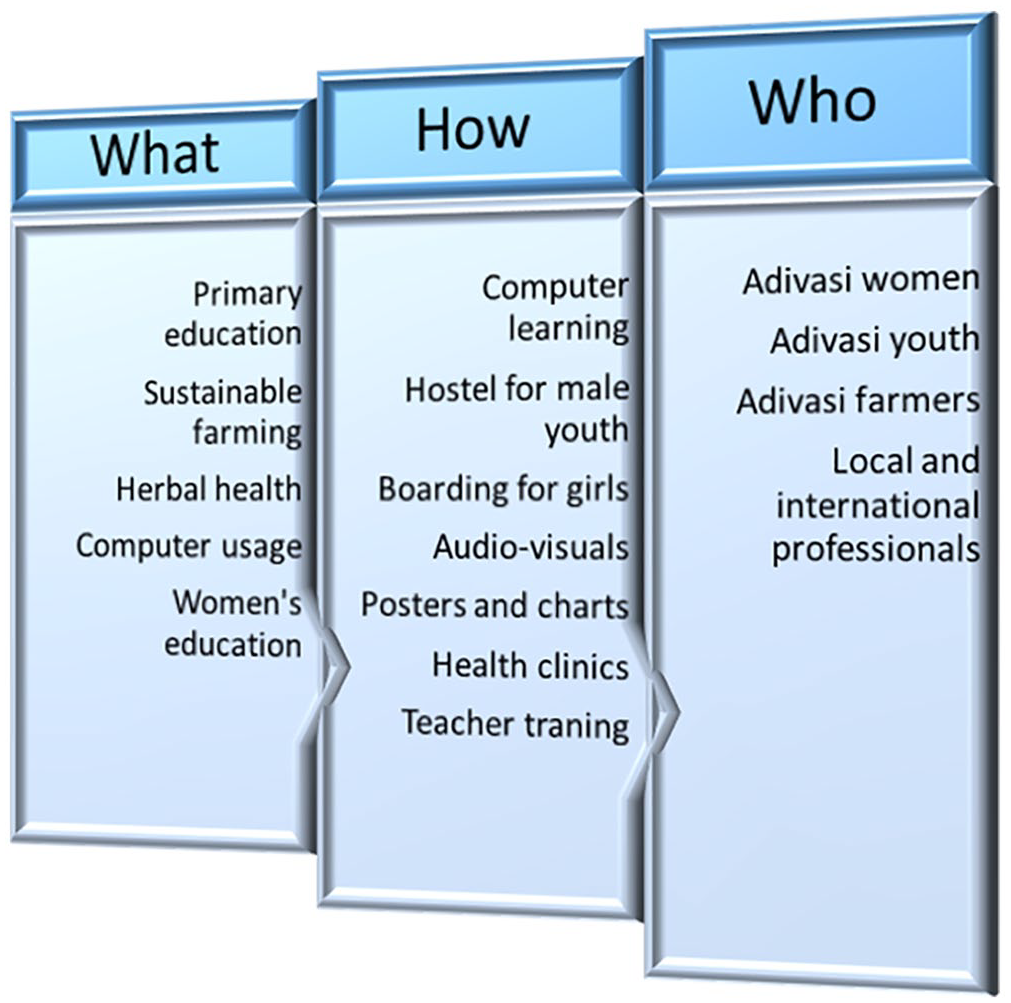
MPSM operational praxis for Adivasis.
Data collection and analysis
During the field work, culturally appropriate protocols, relational respect and care were maintained, for creating and maintaining an environment of good faith, collaboration and knowledge sharing (Dar, 2014, 2018; Larner and Mason, 2014; Roseneil, 2011; Trouillot, 1995). Data collection occurred in the geographical sites of the organisation in India and included three components (Prasad et al., 2010). The first component was ethnographic observation at various villages where MPSM worked, such as women’s training, children’s education in classrooms and organic farming. I observed and participated in six meetings, lived on site and always wore Indian garments. I partook of meals, discussions and travel by scooter, auto-rickshaw, jeep on rural unsealed roads and walks in my quest for situated contextual knowledges and local knowledge producers.
The second component consisted of 30 in-depth ethnographic interviews at various locations, including remote villages, during 2016–2019. Participants were over 18 years of age and involved in their organisation for at least 1 year in the role of leaders/founders/managers and people currently engaged with the organisation. Ten individuals were key informants, all of whom either worked for or were deeply associated with MPSM in planning its trajectory with Adivasis (six men – two Adivasis and four Jesuit non-Adivasis, and four women – two Adivasis and two non-Adivasis), and 20 Adivasis (12 women and 8 men) who participated in MPSM programmes. The languages used were English (official language for legislation, many educational institutions, the judiciary and many parliamentary proceedings as also the official language in the Indian states of Arunachal Pradesh and Nagaland), Marathi (the regional language) and Hindi (the official language). Except for the Jesuit key informants, the other participants all followed their Adivasi religions with nature worship of flora and fauna, dance and song. It was inappropriate to ask about their status in the Adivasi hierarchy as this was a critical aspect MPSM had worked on over many decades, to create porosity in geographies of inclusion and stress equality for all, irrespective of being a manager, woman, man or at various levels in the caste structure.
Interviews commenced with requesting participants to talk about their association with MPSM through a description of two examples. I sought to understand, what is done, how it is done, by whom, why and to what effect. Data was digitally recorded during the interviews and transcribed verbatim. This was supplemented with extensive note taking, observations, reflections and communication with MPSM. The third component was examining different documents and reflections on data collected with various participants. Documents included annual reports, reports of events, plans for training workshops and conversations with individuals who did not work for MPSM and did not live in the villages where MPSM worked and photographs from the MPSM archive.
Analysis was done through an iterative process of repeated re-readings and deep listening of transcripts and notes which enabled me to tune into the intonations, emphases and pauses of the transcripts. Hence, I re-immersed myself in the geographic location of the sites I visited and the participants I engaged with. This was buttressed by multiple sources of evidence, such as documents, to provide data triangulation. Other sources included telephonic and written communication with MPSM (between 2016 and 2020), direct observations in the field, participant observation and physical artefacts such as charts, posters, herbal medicines, basic computers and classroom facilities. Drawing on Glaser and Strauss (1967) and Gioia et al. (2012) I coded the transcripts with first order analysis (informant-centric terms), second order analysis (researcher-centric terms) and aggregate dimensions. The analysis was done with reflection and repeated consultation with key stakeholders, in the geographic location of the site as I moved between the emergent data and codes. While I suspended my knowledge of the literature in this area for some phases, I also circled back to re-reading the literature on MOS and hegemony of the non-West, LT, Jesuits in India and Adivasis, to balance my understanding and analysis of the data.
The data structure is provided in Figure 2.
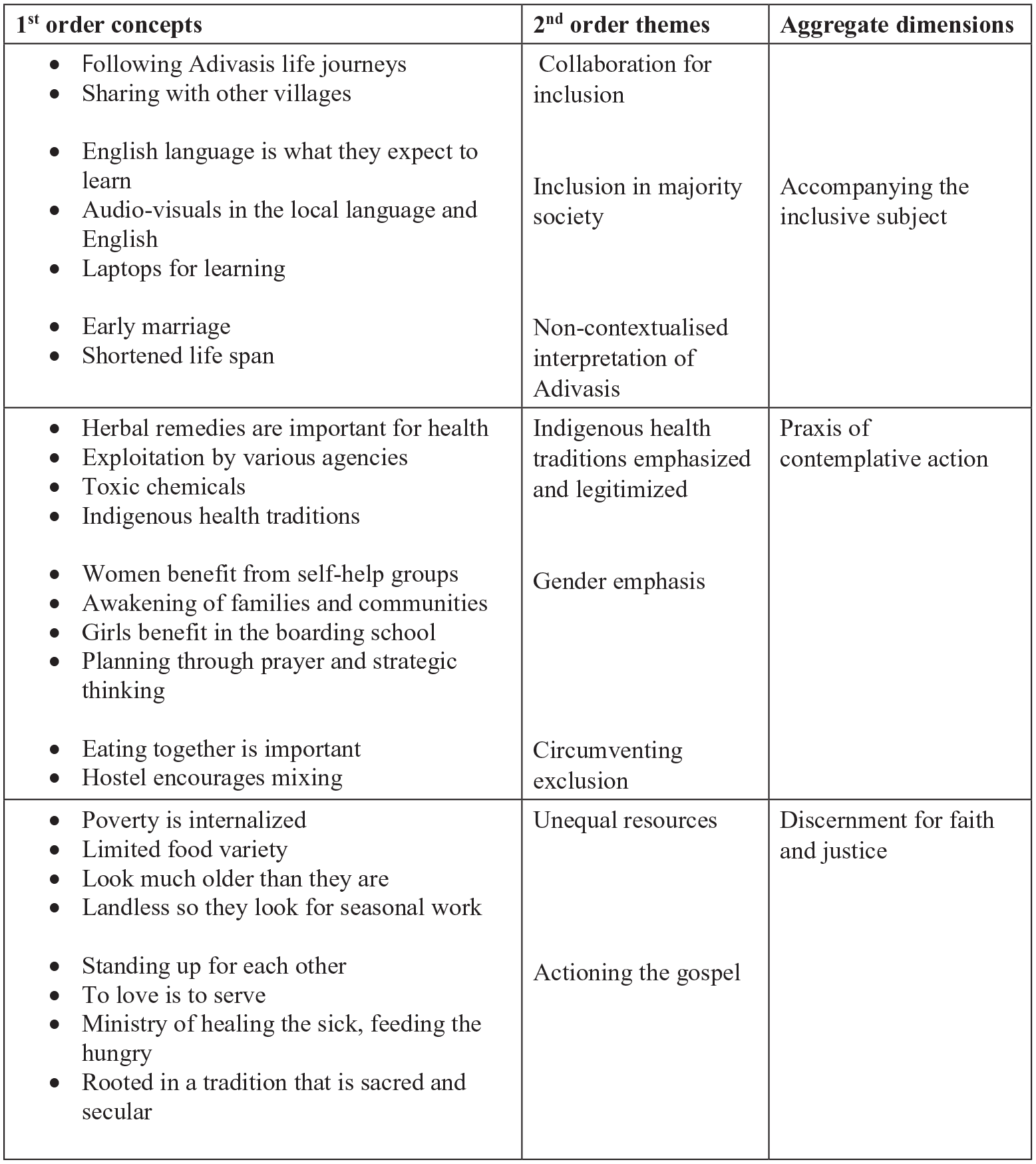
Data structure.
In the following section, I describe three main dimensions which emerged from the data: (1) accompanying the inclusive subject, (2) praxis of contemplative action and (3) discernment for faith and justice.
Findings
The findings, with participant extracts through thick descriptions, display the complexity, messiness and richness of everyday life. They serve as a unique access to explain and theorise geographies of inclusion in seeking to demystify the enigma of inclusion. Inclusive stances are based on accompanying the inclusive subject, in an ongoing praxis of contemplative action and discernment for faith and justice, as depicted in Figure 3.
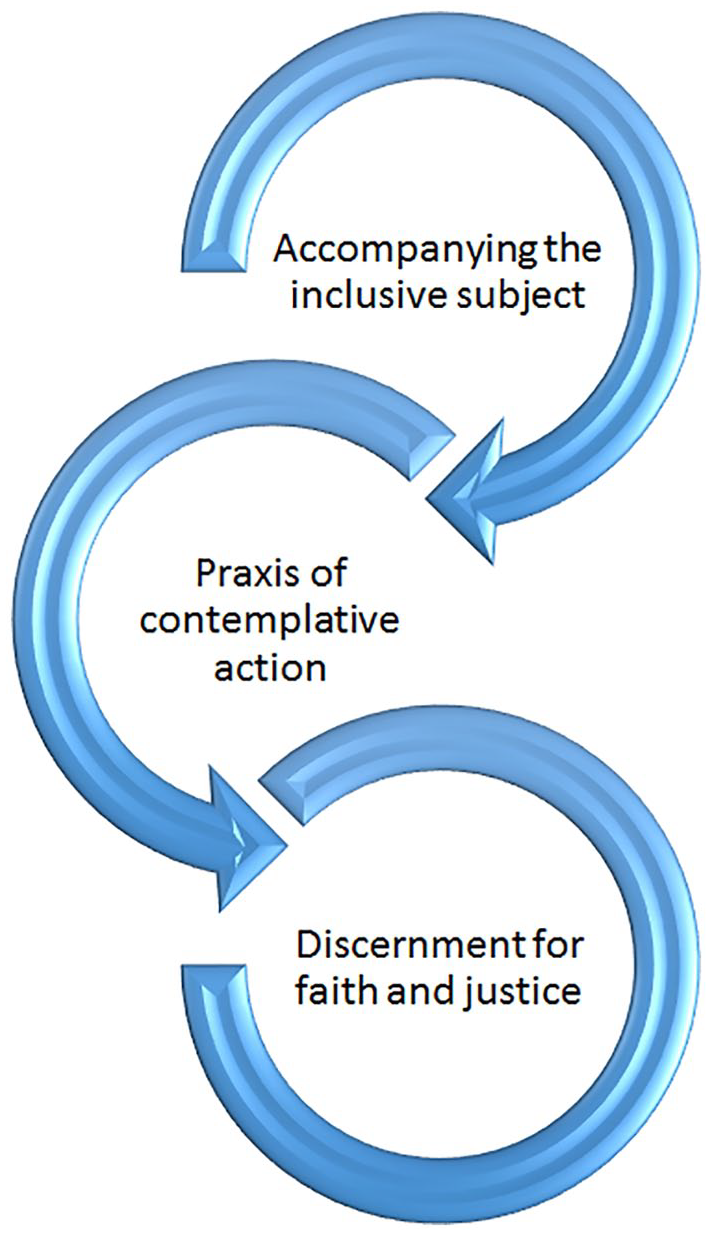
Framework for geographies of inclusion.
Accompanying the inclusive subject
This dimension details how the inclusive subject is accompanied through wholistic strategies, shared with surrounding regions and Government agencies in a non-competitive manner; the non-inclusive way of viewing aspects such as low literacy and early marriage and circumventing non-inclusion through deeper understandings of the context. Sharing is illustrated through SEAD or Sustainable Environment and Agricultural Development, which reaches 300 poor farmers, especially Adivasi farmers and those with small land holdings. These farmers grow fruit trees, green manure plants on field borders, kitchen gardens, practice organic farming technologies, form farmers’ clubs and are involved in various innovative agricultural activities, bee keeping and poultry. “Extension assistance to other district centers to share, collaborate and learn about the dual foci of education and ecology are part of the faith and justice inclusive processes of MPSM” (Key informant, Adivasi, male). MPSM’s Organic Farming Poster Exhibition, its agricultural videos and handbooks are appreciated in the various Adivasi and non-Adivasi locales. But, “organic farming may not result in as much crop produce as with chemical fertilisers. . .” (Adivasi female). This indicates some reluctance and hesitation to implement organic farming, which was an uphill task for MPSM.
Wholistic strategies of sharing are exemplified by a key informant, a Jesuit, who has worked with Adivasis for more than a quarter century, who noted: “The greatest service to social transformation is accompanying the march of people in every way as they work out their development” (non-Adivasi, male). Another key informant said “MPSM seeks to be present with the Adivasi communities. . .not merely executing programmes for development but closely following the life journeys of these communities in order to enhance their own options and decisions for development” (non-Adivasi, female). MPSM accompanies Adivasis on their journey through life, constantly seeking to understand what works best for them.
Low literacy is acted on through Computer Learning & Audio-Visual Education (CLAVE) with a team of 15 local Adivasi youth visiting 60 classes on motorcycle, or on foot – to screen educational films and give children a hands-on experience of laptops once a week for each class. CLAVE is managed by a self-taught Adivasi youth, who also keeps the internet systems smoothly functioning in MPSM for the College Hostel students. “Laptops for learning continues to be an innovative learning experience for tribal and rural children in primary schools” (Key informant, Adivasi, male). MPSM has a team of educators working to research and develop suitable teaching aids for rural tutorials and instruction to farmers, children, youth and women’s groups. A series of 19 animated videos for English and Marathi learning were developed along with an innovative Marathi song DVD. “Such audio-visuals are an endeavour to fill the gap due to the lack of competent teachers in rural areas” (Key informant, Adivasi, male). These audio-visuals add to the compendium of more than 70 charts covering eight topics: English, Marathi, Maths, Health, Social Themes, Organic Farming, Watershed and Farm Animal Care.
An example of the non-contextualised interpretation of the ‘racialised Other’ within the heterogeneity of the global South is early marriage, where it is assumed that early marriage means more children, reinforcing the poverty cycle. A participant voiced concerns about the longevity of Adivasis “hence they marry early. . .but this is often castigated by wider society. . .” (Adivasi, female). Here a deeper comprehension of the context would include understanding of the shortened life span due to poverty, poor access to health care and minimal resources and hence early marriage.
MPSM presents concerns, processes and progress to wider Jesuit organisations, church organisations, government, faith-based and non-faith-based people from a variety of castes and creeds. The work is huge and moves beyond the horizons of ideological cogitations to be inclusive. This connotes foregrounding the honouring of each other and constantly descripting inclusion categories, as these are dynamic and changing. MPSM provides a constant and unrelenting push for spatial geographic inclusion to encourage Adivasis to negotiate their environments so they can continue to live close to the land, and honour their heritage, along with literacy and numeracy skills. This is in consonance with the Jesuit mission of LT through which MPSM is animated.
Praxis of contemplative action
This dimension highlights issues pertaining to space, gender, health, herbs and food. Generations of exclusion and violation have created a wariness to be outside the geographic locales of Adivasi communities. However, the Ambatha Adivasi girls boarding, run by MPSM, enables 150 Adivasi girls in primary and middle school to access quality education in the Jesuit run educational complex in Village Ambatha. Besides school teaching, the girls receive special attention from the Catholic Sisters who “make every effort to offer growth opportunities to the girls” (Adivasi, female) through computer learning, art and craft workshops, audio visuals, cultural sessions with yoga, dance and street play performances, sporting activities, sharing responsibilities in the boarding and leadership training.
Regarding gender, “Women have been active crusaders in prabodhan or awakening of themselves, their families and their communities” (Key informant, non-Adivasi, female). Adivasi women’s inclusion has been actioned through a range of initiatives in 30 villages. Examples include 70 Self-help groups, developed over 25 years. “We enjoy these meetings – we learn, share and eat together” (Adivasi, female). These groups hold regular meetings to plan activities benefitting women in small villages, such as linking with government agencies, awareness of Indigenous health traditions, income generation activities, savings and credit and solidarity among village women. The women’s farmer’s club encourages Adivasi women “to take greater leadership in organizing and operating their group activities, such as working on organic agricultural methods by themselves. Women meet to learn about Indigenous health traditions” (Key informant, non-Adivasi, female). MPSM encourages Adivasis to tap into their unique ecological heritage.
This interpretation of inclusion, involves a concerted effort to eschew toxic chemicals and fertilisers, organise for sustainable agriculture and environment preservation, through reaffirming Indigenous health traditions and sustainable livelihood enhancement. “I now give my child healing herbs when he has a cough, and don’t have to visit the hospital” (Adivasi female). MPSM’s team of four core Adivasi health practitioners manage a Herbal Nursery and hold demonstrations on herb processing to provide relief from elementary ailments like coughs, colds, sprains, hair depletion, stomach upsets and arthritic conditions. “More than the impact of these herbal remedies is the raising of awareness among Adivasis of their own medicinal and health traditions” (Key informant, Adivasi, male). The team is headed by an experienced Adivasi man who recalls learning about herbs as a child when going to the forests with his grandfather. But, “sometimes our health traditions are not shared by the people who know them, so this information will be lost when they are no more” (Key informant – Adivasi female)
A key informant who has worked with Adivasis for more than 10 years noted that “in general Adivasis are very wary of going outside Adivasi areas, even if they are very sick and need hospital care, as they tend to be exploited by various agencies and the girls experience violence. . .” (non-Adivasi, female). This violence tends to be the result of powerful individuals’ impositions on Adivasi girls, who are viewed as vulnerable and easy prey. MPSM engages with basic health aspects of Adivasis and seeks to give them confidence and include them in a variety of ways through nutritious food information such as simple high protein diets, herbal medicines and accompanying them to hospitals.
An extract pertaining to food and space, illustrating exclusion, is illuminated by this example –“eating with the higher castes is not allowed and they have to take their own plates and cooking vessels – so then they stop going there and isolate themselves because they do not want to be demeaned – these conditions grow out of exclusion” (non-Adivasi, female). In seeking to create inclusion, MPSM encouraged the different castes to mix during various meetings and festivals, but as evidenced from this quote, exclusion was hard to break through. Hence MPSM staff sought to always display geographies of inclusion by always eating with Adivasis in their communities, and when they are on MPSM premises. Here we see spatial geographic inclusion to assuage rampant exploitation and exclusion for routine daily aspects such as eating food and cooking. MPSM’s College Hostel with 180 Adivasis, offers simple, economic facilities to Adivasi youth from remote villages. “The ethos of the Hostel is self-discipline and self-reliance. Serious personal study, attending their classes in various institutions, cooking their own food in groups, keeping the premises tidy, and helping with common activities, marks the life of the hostelite” (Key informant, non-Adivasi, male). On feast days, the staff and students share a meal. This reaffirms credibility of the inclusive process and reiterates the de-risking of engaging with diverse individuals, through food and space.
From the extracts, what emerges is the importance of inclusive stances through numerous aspects of Adivasi life and this must be an ongoing process through conversations with Adivasis and MPSM enacting LT and ensuring geographies of inclusion.
Discernment for faith and justice
Discernment is built on the bedrock of a LT stance for faith and justice – one of the reasons MPSM works with the poorest of Adivasis. This dimension includes fracturing the internalisation of poverty, managing despite unequal resources of network connections and land and multiple interpretations of faith and justice.
A key informant stated: “Adivasis internalise their poverty and develop a culture which traps them into poverty, so that they can adapt and cope with their poverty” (Adivasi, male). Emphasising the poverty aspect, a participant noted “Some days we don’t have food, so the children are hungry and then their learning in school is poor. . .” (Key informant – Adivasi female). Another key informant was saddened and distressed when he said “you see the Adivasi wizened, burnt in the sun, thin wiry people, dark, who look much older than they are, they don’t have food which can be consumed thrice a day” (non-Adivasi male). This was further clarified “While the quality of food may be very good as it may be devoid of toxic chemicals, there is limited variety and quantity. . .we have hardly any good land” (Key informant, Adivasi, male). These extracts indicate the extreme poverty and lack of resources that Adivasis must contend with – poverty extending to the work they can get and the food they can eat. Challenges are numerous in actioning faith and justice and “those who are landless and earning through hard work seasonally and through labour intensive jobs such as working in the salt pans and fishing vessels sorting fish and drawing in the nets – they might eat better in these occupations as compared to if they were in their own homes, but the conditions are very harsh” (Adivasi, male). Additionally, “they lose their land to richer Adivasis. For example, they borrow for weddings and sickness and then they cannot pay back. This can lead to alcoholism, and then family violence as well as being tricked to affix their signature (fingerprint) on documents and then being deprived of ancestral lands” (Key informant, non-Adivasi, female). It is a dire indictment that in the 21st century, Adivasis continue to be tricked into various forms of penury, whether it be violation of women, loss of land or lack of food. Here the enduring processes of MPSM seek to make a difference through disrupting and fragmenting oppressive structures and fracturing the internalisation of poverty by inclusive stances.
Many rural areas have poor or no network connections, reinforcing the cycle of poverty – but: “despite difficult internet connections as we do not get a signal in our village, I climb on a tree and place my mobile phone on a high branch at a particular angle, and that downloads what I need” (Key informant, Adivasi, male). Adivasis and those working with them must constantly seek alternate routes where conventional ones are unavailable, due to unequal resources. For example, having internet connectivity and know-how is crucial, but sometimes unavailable. Instead, areas where signals are available have been identified, facilitating access to the world at large.
The tradition of commitment to Adivasis, involves an inclusive quest for education, health and a range of requirements. Thus, “In order for Adivasis to make a living, we take seriously anything that can be done to help these communities without any prejudice of faith and we are specially directed to the poorer sections wherever possible – this links to the understanding of what the gospel wants of us as Christians and human beings” (Key informant, non-Adivasi, male). Here we see an explicit performance of LT in action. As stated by a Jesuit key informant “the gospel invites us as persons who love and serve and this has to be done to the least – those who suffer most, who have less people to care for them, the widow and the orphan – the images of those who have less support in society – the stranger – these concerns of the gospel find fulfilment in reaching out to the poorest of the poor – Jesus’s ministry as healing of the sick, the feeding of the hungry, the helping of those who feel rejected – the failures to conform to some standard – even those who have done wrong – bring back a sense of worth that Adivasis can build on” (non-Adivasi, male). These compelling extracts indicate the enduring reach of the gospel translated into life-changing inclusive initiatives. This is done for all Adivasis irrespective of their faith. These works of faith and justice emanate from the Jesuit interpretation of the Christian gospel and its current relevance in context for geographies of inclusion.
Another Jesuit key informant of MPSM noted “we will always have new expressions of the key guiding principles of LT, but this will remain rooted in a tradition that is sacred and secular at the same time –grounded in faith and justice” (non-Adivasi, male). Here we see that MPSM, provides reflection and innovative people processes for inclusion. Another participant noted “life generally has quite a few unfinished dimensions. . .we keep processing what we do. . .we must stand up for each other. . .we do not have the luxury not to work at the intersections of the various parts of ourselves and of each other. . .” (Key informant, non-Adivasi, female). This is exemplified through 65 Learning Centres where MPSM recruited and trained Adivasi women to be educators, running tutorials before the start of the weekly local government schools. As a participant lucidly put it “If it wasn’t for you, the programmes we work at for learning and livelihood just wouldn’t come through. . .” (Adivasi, female). Here we note the confidence in MPSM and their processes to increase self-worth and dignity of Adivasis through a variety of inclusive initiatives in numerous geographically scattered locations. These include women’s groups, teacher training, children’s education, audio-visuals, hostels, herbal remedies, organic farming and sharing of learnings. Figure 4 depicts a photograph collage of inclusion showing (left to right) engagement with primary education, health, farmers, self-help women’s groups, girls enjoying sporting facilities at their boarding place and teacher training.
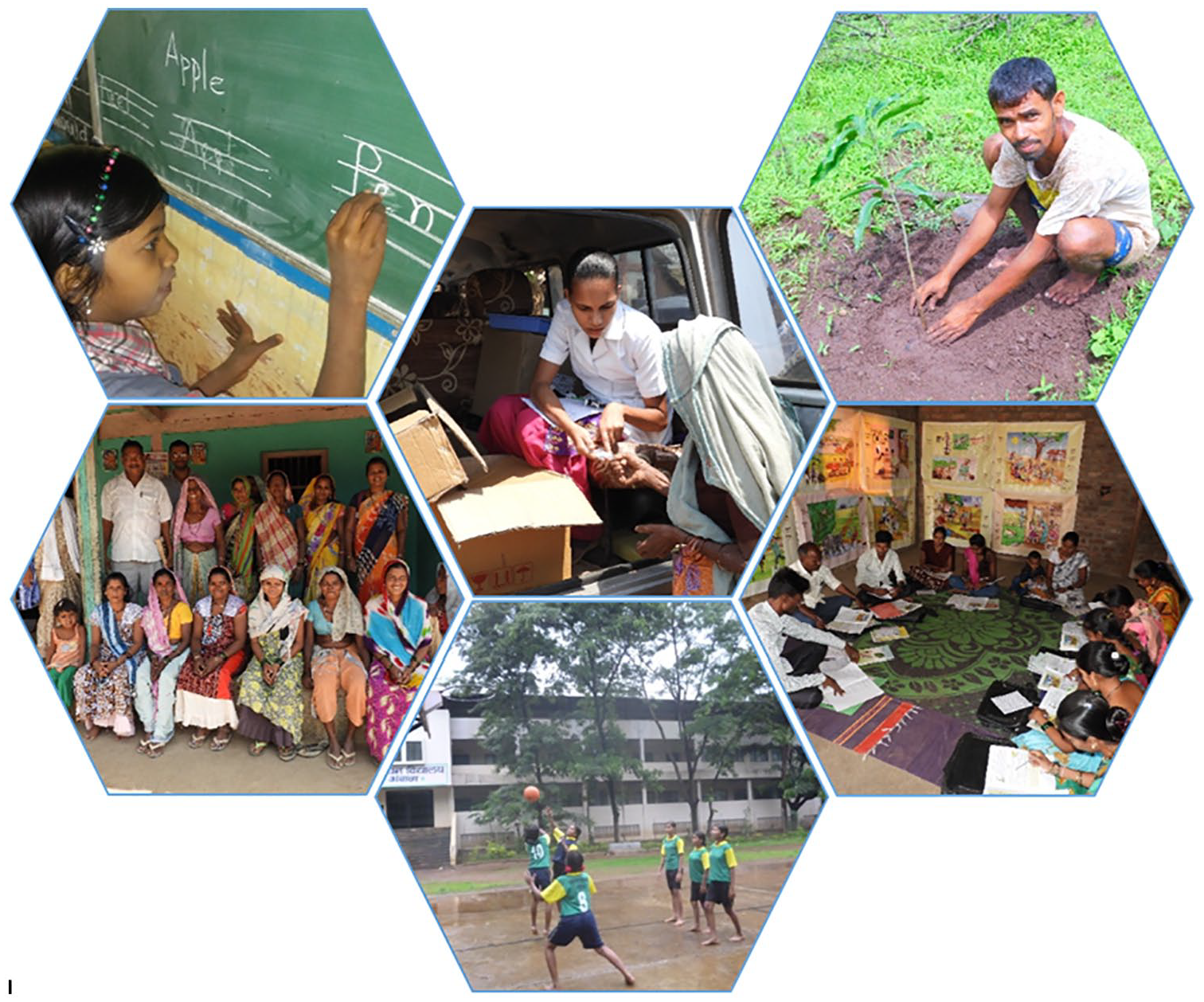
Collage depicting the fabric of Indigenous inclusion.
Discussion
Numerous scholars in MOS have engaged with inclusion viewing it generally from a Western context, with few scholars writing from a non-West perspective. However, critical inclusion and geographies of inclusion linked with LT and Indigenous peoples have rarely been explored. In this article, I have sought to provide a deeper understanding of Adivasi inclusion in a non-Western context through geographies of inclusion. I have focused on the work of MPSM and its engagement with Adivasis and how inclusion is enacted through accompanying the inclusive subject, a praxis of contemplative action and discernment for faith and justice. I provide some answers to the guiding research question: How does inclusion happen and how can it be theorised in non-Western contexts. In this process, my working definition of inclusion, developed from the literature and my ethnography study is ‘inclusion is the engagement with and of all peoples through enacting processes of honouring each other’s unique potential’. Overall my findings suggest that MPSM has achieved its current role and status based on inclusive geographies through food, work, education, gender, herbal medicines, acknowledgement and legitimising traditional ways, circumventing space constraints of caste, while also understanding the expectations of Adivasis, such as for example the need to learn English to access jobs. I suggest two of the most notable findings that are fundamental to enriching a critical and deeper engagement with geographies of inclusion and MOS in the context of Indigenous inclusion: discernment and contemplative action.
Theorising the significance of discernment in geographies of inclusion
My findings highlight discernment and its significance for geographies of inclusion. In seeking to construct a desired state of heterogeneity (Brewis, 2018), spaces for shared eating, herbal farming, women’s groups and laptops for learning for children are actioned. I observed this process of discernment that characterised MPSM when I attended their meetings and read through archival material. I suggest that the significance of discernment is enacted through two processes. The first consists of spaces constructed through dialogic processes (Johnson, 2019) along with those who are being included or the inclusive subject, where both Adivasis and non-Adivasis learn from each other. Through MPSM, there is upholding of each other in shared spaces, and nuanced processes for engagements with broader structures which impinge on everyday practices (Ye, 2019). For example, women are taught how to be self-sufficient in self-help groups and how to replicate these groups in surrounding villages, thus embedding geographies of inclusion in everyday life. Furthermore, sharing of learnings by MPSM in various villages and with the government, epitomises collaboration. This is done with discerning care to ensure that learnings are relevant to specific locales, in the context of producing knowledge, that is, relevant, hybrid and porous, for inclusive geographies (Gantman et al., 2015; Ibarra-Colado, 2006). Learning English is a critical component of expressed Adivasi needs for progression; as also being comfortable in Western garments and games, while not forgetting one’s own Adivasi culture. These stances take account of historical processes and appropriate programmes are designed which are in touch with the local context. And local can mean not only Adivasi villages, but also neighbouring cities and the larger land mass of India. Hence there is a merging of non-West and Western concepts in Indigenous inclusion. In this way, through geographic spaces for inclusion, Adivasis feel acknowledged and hopeful to break their cycle of poverty.
The second process consists of endorsement of heterogeneity that exists in the non-West, and in the context of MPSM, with a specific option of working with the poorest sectors of society. This illustrates LT through peace and love to ensure social justice, where different traditions, such as traditional remedies and farming practices make their specific contributions (Corrin, 2015; Rieger, 2017). There is honouring of each other’s unique potential (Sherbin and Rashid, 2017; Tomlinson and Schwabenland, 2010), through community involvement without loss of identities in the knowledge production (Dar, 2018; Johnson, 2019) and in individual’s minds (Mir et al., 2008). Inclusion is viewed as malleable (Holck, 2018) and achievable (Tyler, 2019) as evidenced in laptops for learning where laptops are taken to individual villages for educating children through Adivasi teachers. The Adivasi technology manager is recognised for his individuality and unique potential. MPSM has encouraged him to share his expertise with Adivasis in his own and neighbouring hamlets. This Adivasi man is also responsible for MPSM’s IT networks. Here we observe discernment in practice, where Adivasis develop skill sets, utilise these for their own enhanced self-worth and then share this skill with other Adivasis. Hence discernment, facilitates circumventing atonement for indigeneity. In other words, Adivasis do not have to be trapped in poverty, forever outside the fold of literacy based on historical connotations of the label Adivasi (Lamola, 2018).
This discernment is faith that does justice, to present possibilities of dignity (Petrella, 2017). Therefore, unfolding choices are discerned and resources are mobilised for productive and nurturing engagement through geographies of inclusion with Adivasis. Discernment is conscious and cautious in exploring the needs and expectations of the inclusive subject. For geographies of inclusion, discernment is not myopically driven by conversions (Osuri, 2012) but rather by acknowledging the plurality of religions, traditions and ways of being (Zupanov, 2005) or the heterogeneity of Indigenous peoples. Remembering and forgetting are implicated through inclusion and exclusion for deep bonding and healing deep wounding (Pio, 2020; Pio & Essers, 2013; Pio & Waddock, 2020; Priola et al., 2018; Sabharwal, 2014). This reinforces Johnson’s (2019) double consciousness and dialogical thinking in exploring diversities, with the need for local scenarios and contextualisation (Ibarra-Colado, 2006; Lamola, 2018).
In conclusion the data indicates that critical inclusion must have heterogeneity within geographies of inclusion and spaces for dialogic engagement to discern appropriate strategies and actions. Further research is required to understand how other organisations working with Indigenous peoples do inclusion, as well as how external factors such as governments and policy makers can impinge/facilitate geographies of inclusion for MOS.
Theorising the manifestation of contemplative action for geographies of inclusion
MPSM seeks to create porosity in the self-worth of Adivasis so that their feelings of being social inferiors are diffused, through micro-geographies of inclusion (Parr, 2000), even though this notion may be buttressed by an extensive catalogue of exclusion which accompanies Adivasis, often through generations (Pio, 2020; Banerjee, 2016; Dasgupta, 2016). The data indicate how accompanying the inclusive subject translates as focusing on the marginalised and their inclusion through interpretive frames of action, to reduce and disrupt oppression and create comprehensive liberation (Petrella, 2017; Prevot, 2017; Rieger, 2017). For example, gender is foregrounded in the boarding for girls, and self-help groups for women which include a range of issues (Hopkins et al., 2018) such as health, education, herbal remedies, leadership and language. The data illustrate how the focus on women is reminiscent of the impetus of LT to foreground the inclusive exclusive continuum regarding gender and socio-spatial inclusion (Holt, 2003; Lamola, 2018; Petrella, 2017). However, images of Adivasis in grim poverty continue to be a reality (Pio, 2015; Lerche and Shah, 2018). Therefore, fracturing internalised exclusion is a complex and long-term strategic process, where concerted praxis and discernment from leaders can influence decisions for fair and equitable treatment (Sabharwal, 2014), including hybridity (Dar, 2014; Yousfi, 2014) throughout the process of fostering Indigenous inclusion.
Constant research and contemplation ensure that meaningful praxis can disrupt labels such as Adivasi as inferior and illiterate, in the context of specific geographies of inclusion (Heredia, 1988; Noxolo, 2009; Rasquinha, 2013; Sylvestre et al., 2019). Here I note the heterogeneity within the Global South (Nkomo, 2011; Sibley, 1995) and acknowledge that Indigenous populations are far from being homogenous. Difficult issues need various modes of address in unmasking idolatries (Petrella, 2017) such as bowing down to higher castes, richer Adivasis and corrupt officialdom. Contemplative action has ensured that Adivasi teachers, managers and leaders are trained with the LT belief that they are crucial in fostering spaces for different voices for cultures of inclusion (Tyler, 2019). Thus, the undercover liberation theologian who does not proselytise but works to build a just society of social possibility (Correia-Afonso, 1997; Friedrich, 2017; Petrella, 2017; Prevot, 2017) is personified by MPSM. The manifestation of contemplative action is in peoples’ daily actions/needs/relationships with each other and the environment (Brewis, 2018; Lerner et al., 2009). Consequently, the construction of the inclusive subject (Brewis, 2018) stimulates social change (Zanoni et al., 2010) and fosters spaces for recognition of different voices (Pio, 2020b; Kumwenda, 2018; Mandiola, 2010; Tyler, 2019).
Concluding comments
The aim of this article is to illuminate how non-Western geographical contexts engage with inclusion through footfalls and heart-prints for and through Adivasis, hence, not an either or, but a continuum of knowledge and praxis. This reiterates the epistemic challenge to delve into layered and nuanced aspects of the intersecting worlds of the non-West and West, Jesuits, Adivasis and MOS. Through geographies of inclusion I have sought to provide some partial answers to the research question: How does inclusion happen and how can it be theorised in non-Western contexts? I did this by offering rich contextual information through ethnographic research in the life and work of the Maharashtra Prabodhan Seva Mandal (MPSM). A critical aspect in geographies of inclusion and MOS from an Indigenous viewpoint emphasises honouring each other not only through rhetoric but also through localised, contextualised actions or footfalls and heart-prints for inclusion.
Limitations in this article include the fact that while this was an ethnography study, surveys and quantitative methods may further enhance the findings. Yet, due to the qualitative nature of the study, there is exhaustive information as well as photographs to provide in-depth understandings about inclusion from a non-Western perspective in a non-Western context. The research was mediated through MPSM, and this could create bias in what participants narrated. Undoubtedly this underscores the choices made with respect to silence and voice and thus alternative choices may uncover different silences and different ways of seeing and understanding. Another limitation is that the researcher was a woman and while this could add to the rapport and information shared in conversations by participants, this may have served as an inhibiting aspect for men. However, gender differences in rapport can be an area for future research with Adivasis. Additionally, how other religious groups work with Indigenous peoples in various parts of the globe, can be a fertile research field. A related research area could be issues of power and how these are played out in geographies of exclusion, as also the inclusion of various religious traditions, spiritualties of Indigenous peoples and their impact on MOS. While the findings and discussion presented in this paper may serve as a template for non-Western ways of inclusion, it would be instructive to see how this is applicable with the 370 million Indigenous peoples globally. Furthermore, it would be useful to see how politics structures geographies of inclusion.
In this paper, I have sketched broad outlines in the dual quest to confront Western ways of inclusion, while offering alternatives to western ways of inclusion. I do this by providing deep insights into discernment and contemplative action for geographies of inclusion and MOS. The challenge is to continuously rethink the concept of possibility in critical praxis and future research, with greater granularity in interpretations for the marginalised through the marginalised. For mainstream MOS, this suggests the need to encourage a plurality of multidisciplinary voices through inclusive paradigms, with persistence to honour and articulate silent scripts and collaborative gazes from around the globe. This would extend our understandings of the dynamics and intricacies of geographies of inclusion.
Through ‘Footfalls and heart-prints for Indigenous Inclusion’ I have sought to provide unique perspectives to reimagine, renegotiate and unlock complex diverse shades of inclusion, in probing the possibilities and meanings of the nature of inclusion. Yet, I am aware that meaning is always in the process of being made. Hence, I invite other adaptations and traditions to further enrich and unveil multiple interpretations and understandings of geographies of inclusion and MOS.
Footnotes
Acknowledgements
The author expresses her gratitude to the editor Raza Mir and in particular, to the associate editor Martyna Śliwa whose careful steer from initial submission to acceptance, oriented my writing. Thanks to the anonymous reviewers for their meticulous and helpful comments. My heart-felt appreciation to the MPSM Director Godfrey D’Lima and my son Isaac for their faith in me and their cheerful upbeat encouragement through the process of writing this article.
Funding
The author received no financial support for the research, authorship and/or publication of this article.
