




Abstract
There are more than 3000 ongoing conflicts involving the extractive industries (mining, gas, and oil) and communities impacted by extractive activity. Most of these conflicts are in the developing countries of Africa, Asia, and Latin America. In this paper we examine three resistance movements in Brazil, Chile, and India where Indigenous groups are resisting mining operations on their lands. We argue these movements represent forms of translocal subaltern resistance based on local political ecologies of marginalized communities. In particular, we develop the notion of disembeddedness to show how conflicts arise between local political ecologies and the political economy of resource extraction. We contribute to the literature by (1) bridging insights from subaltern studies and political ecology to explain how forms of resistance emerge (2) providing empirical support to theories of translocal resistance by conducting a comparative analysis of resistance movements from three countries. We discuss the theoretical implications of our findings for resistance movements.
Keywords
“If there are necessary sacrifices to be made for human progress is it not essential to hold to the principle that those to be sacrificed must make the decision themselves?”
There are currently more than 3000 ongoing conflicts between communities and the extractive industries (mining, oil and gas) where local communities have organized resistance movements against powerful market and state actors (EJOLT, 2020). While these conflicts are generally described as conflicts over land and resource rights there are deeper underlying tensions about ecological, political, social, cultural, and economic impacts of mining projects on communities in these regions. Past studies on resource extraction conflicts have focused on the role of corporate social responsibility (CSR) (Hilson et al., 2019; Kapelus, 2002), stakeholder engagement (Yakovleva and Vazquez-Brust, 2012), tensions between ethnic groups (Hilson and Laing, 2017), Indigenous rights (Ali and Behrendt, 2001; Banerjee, 2000), and community engagement practices (Idemudia, 2009; Muthuri et al., 2008). What is missing from accounts of conflicts is an understanding of the competing, often incommensurable cultural and ecological worldviews between communities resisting extractive projects and the market-state actors that promote resource extraction. We argue that it is important to understand the cultural basis of resistance movements and its implications for how conflicts are managed because failure to do so can exacerbate existing economic, ecological, and social inequalities and lead to more conflict.
In this paper we focus on three resistance movements against mining corporations in Brazil, Chile, and India. What we find particularly intriguing is that in all three cases conflicts have arisen despite assurances by governments that the proposed projects would deliver economic development and by corporations who claimed that their CSR, community engagement and sustainability policies would enhance community welfare. Our study is motivated by the following questions: What are the sources of conflicts from which resistance movements emerge? What are the commonalities and differences between the sources of conflict across the three resistance movements? Why and how do resistance movements produce differing outcomes—stopping or failing to stop the mining project? Drawing on insights from subaltern resistance and political ecology we provide cultural and ecological perspectives of resistance that enhances our understanding of resistance movements by providing a more grounded, bottom up account of resistance.
Our paper makes two key contributions. First, we contribute to emerging research about anti-mining resistance movements in developing countries, a topic that is beginning to get some attention in organization and management studies. Studies on social movements are predominantly focused on Western sites and our paper expands both the geographical scope as well as the socioeconomic and cultural context of narratives of resistance. By providing a “power from below” perspective from subaltern groups who have limited means to voice their concerns and who tend to be excluded from political representation, our findings lend empirical support to theories of translocal resistance by showing how local struggles emerge from contestations with global regimes of development (Banerjee, 2011; Misoczky et al., 2017).
Second, our study contributes to the theoretical literature on resistance movements by developing a framework that explains resistance using theoretical insights from political ecology, a field of study that has not received much attention in organization studies. By bridging insights from subaltern studies and political ecology we explain how forms of translocal resistance emerge from subaltern struggles based on political ecologies that reveal fundamental incommensurabilities with market-state political economies of development. In particular, we develop the notion of disembeddedness to show how meanings of economy, ecology, and culture that reflect local political ecologies are in conflict with the imperatives of the political economy of resource extraction and how interconnections between economy, culture and ecology can influence the strength of resistance movements.
The paper is organized as follows. First, we discuss the broader political economy of resource extraction and explain how the market-state nexus establishes the rationale for the developmental state. Second, we provide a broad theoretical spectrum using insights from the literature on translocal subaltern resistance to frame the three cases (Banerjee, 2011; Chandra, 2015). Third, we describe the political ecology of resistance movements, in particular its economic, ecological, and cultural dimensions. We then provide a brief overview of our cases, describe our methods, data collection, and analysis. We discuss the main themes that emerge from our findings and theorize narratives of resistance using insights from subaltern resistance, political ecology, and accounts of local livelihood struggles. We conclude by discussing the implications of our study for future research.
The political economy of resource extraction
Government economic policies in the extractive sectors of Brazil, Chile, and India can be described as a form of neoliberal developmentalism where the state plays a key role in encouraging foreign investment by opening up markets while also creating institutional arrangements that determine how economic and social relations are governed (Adduci, 2012; Nem Singh, 2012; Pandey, 2017). The political economy of resource extraction is constituted by the capital-state-development nexus which reflects both the neoliberal political rationality of governments and the governmentality of the developmental state. Neoliberal reforms aimed at expanding private investment in the sector are justified in the name of regional and local development, since most mining occurs outside of urban centers. Neoliberal developmentalism is governed through practices of governmentality that regulate the conduct of populations (Foucault, 1979). Governmentality refers to practices of government that govern populations not just through the institutional power of states but by inscribing a particular political and economic rationality that shapes the conduct of individual subjects (Dean, 2010). In the political economy of resource extraction governmentality implies managing populations based on the requirements of development—thus communities resisting mining operations on their lands need to be “guided” to embrace development and these governed populations are organized for productive purposes defined by market rationalities. This “guidance” can be consensual in the form of deliberative consultative processes with communities but can also involve “legitimate” state violence that is deployed to quell dissent and relocate populations (Lemke, 2002).
Thus, capital-state-development nexus forms the structural basis of neoliberal governmentality where power is exercised in the economy through the axes of sovereignty, discipline, and government. The state exercises authority over its subjects through territorial sovereignty—Brazil, Chile, and India for example, have all opened up vast tracts of forest land for mining in recent years—while expanding the institutional governing structures for mining development through land acquisition policies for private corporations, taxation regimes, royalty payments, environmental regulation, health, and social welfare policies that regulate the lives of its subjects through disciplinary power (Foucault, 1979). Any community demands for self-determination, autonomy or attempts to assert Indigenous sovereignty over lands are countered with state sovereignty and either met with state coercive power citing “national interest” or through the disciplinary apparatus of social welfare policies. For governmentality to serve effectively in the development state, populations need to be governed in a way that requires individuals to accept being entrepreneurs of themselves through individual choice and responsibility.
However, within governable populations there are always groups of people that resist governing rationalities through, “voluntary insubordination” or “reflected intractability” (Foucault, 2007: 47). Resistance thus requires “oppositional reflected practices” that can produce “unwieldy knowledge in order to “de-realize” the state from the limits of governmental reason” (Biebricher and Vogelmann, 2012: 12). In generating such power/knowledge Foucault (2007: 65) rejects analysis of institutional or functional power but calls for “deinstitutionalizing and defunctionalizing” contemporary power relations, which implies looking at extra-institutional technologies of power and analyzing power relations not in terms of how particular power relations function but where they are located, how they were produced in the first place and how they are challenged. Such an analysis requires relying on a knowledge that articulates the disempowering consequences of a particular power/knowledge while identifying alternate economic, political and social arrangements. Understanding local livelihood struggles of Indigenous communities against extractive industries may provide some sources of this knowledge as we discuss in the next section.
Translocal subaltern resistance
Resistance to mining projects arises due to negative economic, social, cultural, and ecological impacts on Indigenous communities and the disproportionate costs they bear from resource-intensive and resource-extractive industries (United Nations, 2009). Despite billions of dollars of revenue generated from extractive activity between 35 and 55% of the communities that inhabit the mining zones of India, Latin America, and Africa live below the poverty line (PWC, 2013). Mining conflicts often involve violence, with more than 900 documented killings reported between 2002 and 2013, mainly in Latin America (Global Witness, 2014). The extractive industries thus provide an ideal context to examine resistance movements in diverse regions of the world in order to understand how the political economy of resource extraction impacts local communities and the ways in which local communities articulate their resistance.
While there are significant differences in the national contexts of Brazil, Chile, and India in terms of their political, regulatory, cultural, and social environments, the local resistance movements can be theorized as translocal (rather than transnational) because they mark a shift from nation state based formations of identity and its relationships with territory and political authority (Appadurai, 1996). Translocality refers to the multiplicity of local spaces and actors and their interrelationships in a global world. The prefix “trans” refers to the ability of translocal interactions to “both transcend territorial locality and change the local spaces from which they emerge” (Banerjee, 2011: 331). The diversity of Indigenous tribes living in different nation states yet sharing a common relationship with the land and cultural identities that transcends national borders reflects a form of translocality.
The three resistance movements in Brazil, Chile, and India that we analyze in this study can be theorized as forms of subaltern resistance, where marginalized groups with limited or no access to political participation organize resistance against extractive projects, which they perceive can threaten their livelihoods, culture and social welfare (Pal, 2016). Scholarly studies of subaltern resistance date back to the 1970s and 1980s with the Subaltern Studies Collective perhaps being the most prominent group that pioneered the study of peasant resistance against colonial rule in India (Guha, 1983). These and other studies of peasant resistance in southeast Asia (Scott, 1976), Latin America (Mallon, 1994) and South Africa (Comaroff, 1985) described how marginalized groups on the fringes of society resisted the political authority of the state while remaining on the “outside” of modern market-state economies (Chandra, 2015).
Mumby (2005: 23) describes resistance as “an effort to engage in some form of praxis—individual or collective, routine or organized—in the context of established social patterns and structures (including mechanisms of control), such that these patterns and structures are, at some level, dereified and their identity logic interrogated”. If we adopt this view of resistance, the conflicts we describe in this paper reflect narratives of “resistance from below” where subaltern populations attempt to renegotiate power relations to protect their livelihoods. For Indigenous communities facing the brunt of extractives industries their relationship with the land becomes the basis for resistance where they use a variety of tactics to negotiate with market, state and civil society actors to resist threats to their economy, culture, and ecology. Resistance may or may not ameliorate oppressive conditions or lead to radical social change but as Chandra (2015: 561) points out it is important to differentiate the “failure of resistance” from the “failure to resist.” And as we will see, the outcomes of the three resistance movements did not overcome oppressive structures in all cases and in the case of Brazil, reinforced the power of market and state actors.
The theoretical framework of subaltern resistance has three major elements: rightful resistance (O’Brien and Li, 2006), lawfare (Comaroff and Comaroff, 2006), and political society (Chatterjee, 2004). Rightful resistance operates within existing societal structures of power and domination where resisting groups and individuals negotiate with state, market and civil society actors using the latter’s rhetoric and language. For example, communities that are impacted by extractive industries engage with sustainability discourses deployed by market and state actors in an attempt to push local sustainability demands (Banerjee, 2011).
Lawfare refers to the use of judicial systems by local communities to oppose development projects that threaten their livelihoods (Comaroff and Comaroff, 2006). In recent years several Indigenous groups have either won lawsuits to stop extractive projects or received compensation from mining corporations for environmental damage. For instance, the Achuar tribe in the Peruvian Amazon won an out-of-court settlement after a long legal battle with Occidental Petroleum after they sued the company for causing pollution that led to deaths and birth defects in their communities (Collyns, 2015). Legal action by communities in the Chilean and Indian resistance movements described in this paper was also successful in stopping extractive projects, despite prior state approval of the projects.
Finally, subaltern resistance represents a form of political society (Chatterjee, 2004) whose members often face the brunt of state and market power while resisting extractive projects. These groups tend be excluded from civil society, which mainly consists of elites that enjoy a greater range of citizenship rights. Despite their marginal status resistance among members of a political society engage in “uncivil or unruly forms of politics” that serve their interests (Chandra, 2015: 562). Resistance tactics are sometimes “unlawful” and involve confrontations with state forces and direct action against corporations especially when community demands cannot be accommodated within existing laws or administrative systems (Chatterjee, 2011).
The communities in our study represent subaltern groups within their respective nation states in terms of their social, economic, political and even geographical disadvantages. We focus on their narratives of resistance in particular the cultural and ecological dimensions of their struggles, which enable us to provide a more grounded approach to resistance. Conflicts between Indigenous communities and the extractive industries are essentially over contested meanings of development arising from political, social, cultural, and economic differences between different groups of people and their uneven access to resources (Escobar, 2006). We discuss these local political ecologies in the next section.
The political ecology of resistance
Political ecology reflects relationships between economic, social, and political conditions that create and manage environmental problems, combining ecological concerns with natural resource exploitation (Blaikie and Brookfield, 1987). Natural resource extraction and other land-based activities that create economic value take place in the broader political economy of development, characterized by shifting configurations of market and state actors that determine governance arrangements of resource access, control and property rights. However, resource access governed by political economic actors and institutions does not go unchallenged as evidenced by conflicts over extractive activity and land use. These resistance movements seek to contest patterns of resource control and access, and “to challenge the institutions, structures and discourses that determine the social distribution of assets, as well as their relative productivity, security, and reproducibility” (Bebbington et al., 2008: 2900).
Political ecology describes relations between cultural practices and resource management and searches for ways to integrate the biophysical, the cultural and the economic in an attempt to produce just and sustainable outcomes (Escobar, 2006; Peet and Watts, 1993). The “political” in political ecology refers to contestations over land use and struggles by communities for social and ecological justice. Subaltern groups engage in a process of “conscientization” as knowing subjects that achieve a deepening awareness of both the socio-cultural reality which shapes their lives and of their capacity to transform that reality (Freire, 1970: 51). Conflicts over resources have been described as “cultural distribution conflicts” arising from power relations between different cultural groups (Escobar, 2006: 122). For many Indigenous communities natural resources are not valued just in monetary terms that are reflected in commodity prices. The natural environment is often valued for reasons that are non-economic, for example as cultural resources where sacred sites are an integral part of Indigenous cultural identity. The problem of resource distribution therefore needs to be conceptualized not just in economic terms but also ecologically and culturally given that nature and natural resources are valued in those terms as well.
If political economy is the basis for understanding economic distribution then political ecology becomes the basis for understanding the unequal distribution of ecological problems arising from dominant economic strategies of development and growth. Struggles around protection of forests, wetlands, lakes, and rivers are conflicts about ecological distribution. To the economic and ecological dimensions of distribution Escobar (2006: 125) adds a cultural dimension that identifies the “distributive effects of cultural dominance” and conflicts that arise as a result. Political ecology reveals the incommensurability between economy and ecology, if the latter is to be recognized in non-economic terms. Identifying culturally diverse models of nature further deepens this incommensurability because different groups assign different cultural meanings to nature. The defense of nature and place, which is the basis of many Indigenous resistance movements, thus becomes both a defense of the source of livelihoods as well as a defense of cultural identity (Escobar, 2008). When different cultural meanings and practices conflict with each other, culture becomes political, a space where particular groups attempt to redefine social power by deploying alternate meanings of development, economy, nature, democracy and property rights (Rajagopal, 2003).
Indigenous communities across the world have maintained their distinctive cultural practices through subsistence economic activities like hunting, fishing, agriculture and even small-scale artisanal mining. Thus, economy-culture-ecology constitutes the political ecology of livelihood struggles in different localities. The interaction and contestations between these three domains, reflect the embeddedness of communities in their political ecologies. As we will show later, mining projects can disembed communities from their local political ecologies because of their negative social and environmental impacts, leading to conflicts between communities, mining corporations, and the state.
Resistance movements can lead to differing outcomes: extreme outcomes for communities include dispossession and ethnocide as was the case during the colonization of the Americas. Ethnocide—the deliberate and systematic destruction of the culture of an ethnic group—is an existential threat for several Amazonian tribes in Brazil under the current government’s proposal to expand oil and gas exploration on Indigenous territories where communities would be “consulted” about projects but not given veto power (Londoño and Casado, 2020). In other cases communities have been successful in negotiating their demands with mining companies and governments leading to regulatory reform (Bebbington et al., 2008). Other possible outcomes include self-determination and increased participation in governance (Banerjee, 2017). The theoretical framework of our study is shown in Figure 1.
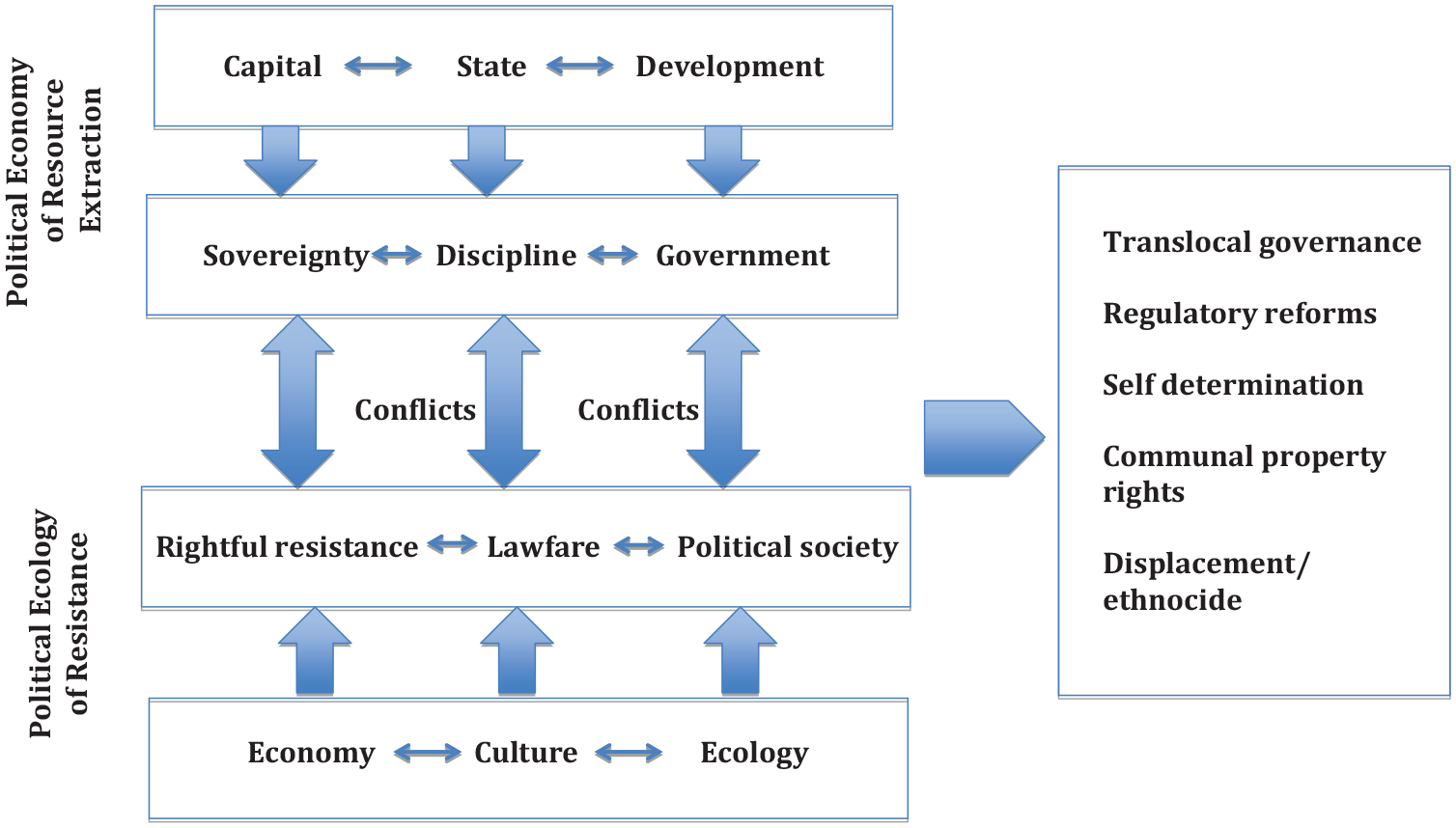
A framework of resource extraction and resistance.
Methods
Our empirical analysis of three resistance movements in India, Brazil, and Chile adopts a political ecology approach in explaining ongoing struggles against extractive projects. As such our cases constitute a theoretical rather than generalizable sample. We believe that the cases are comparable and “controlled by the emerging theory” (Glaser and Strauss, 1967: 45) as can be seen by the remarkable similarities in the way local communities framed their resistance to mining as cultural and livelihood struggles. A wide variety of primary and secondary data sources were used to reconstruct the case studies that we discuss in the next section. Table 1 lists our primary and secondary data sources.
Data sources for the three cases.

It is also important to point out that we are not representing communities as unified and homogenous entities. Rather we acknowledge that the notion of “community” is contested in terms of membership, inclusions and exclusions, which can lead to inequalities and marginalization within communities. Our intention was to understand the subjective experiences of individuals who were engaged in resistance. We provide a summary of the three cases below.
“Mountain is our soul”: The Niyamgiri resistance movement in India
The resistance movement in India was over the construction of a bauxite mine by the Vedanta Group in the Niyamgiri mountain range inhabited by about 8000 Dongria Kondh tribals, for whom the mountains are not only a source of livelihood but carry deep cultural and religious significance—the very “soul” of the tribal communities. The mountains are also a rich source of bauxite and a particular hill, the Niyam Dongar, was the proposed site for a bauxite mine that would supply ore to an existing refinery located on the plains. The initial protests were over land acquisition for the construction of that particular refinery (Padel and Das, 2006). Resistance against the construction of the refinery was overcome by a combination of state repression including beatings and imprisonment of protestors as well as payoffs and bribes made by the company including promises of resettlement and compensation that divided opposition to the refinery.
Although the resistance movement failed in its attempt to stop the construction of the refinery, local activists along with tribal communities started organizing against the construction of the proposed bauxite mine to be built on the mountain. They garnered support from nearby tribes and farmers who had been dispossessed during the construction of the refinery. They also documented problems like ground water contamination from polluting effluents and dust leading to skin diseases, crop failure and livestock deaths and diseases. Opponents of the proposed open-pit mine on the top of the mountain claimed that the mine would have devastating ecological consequences, contaminate the region’s water supply and adversely affect local communities’ livelihoods and culture.
The struggle continued for more than 10 years with battles being fought in the courts, in the media, on the ground at the mine site, at the state capital Bhubaneshwar, the national capital Delhi and at the headquarters of the company in London. Local resistance received the support of national advocacy networks who used their international connections to draw the attention of powerful Western NGOs like Amnesty International, Survival International and Action Aid, who transformed the movement into an international one.
The conflict was finally resolved by the Indian Supreme Court, which ruled that the mining project could only proceed with the consent of the tribal communities that would be impacted (overturning an earlier ruling that had approved the project). Twelve gram sabhas (village councils) were set up to consult with the communities involved and in August 2013 all 12 councils voted against the project. In January 2014, the Ministry for Environment and Forests ruled that the mining project would not proceed, marking a victory for the resistance movement.
“Water is worth more than gold”: Mining for gold in the Huasco Valley, Chile
Our second case focuses on a conflict involving the Canadian mining company Barrick Gold and a rural community of nearly 5000 people located in the Huasco Valley in Northern Chile. Most of the local population consists of Indigenous peoples known as Diaguitas. The local economy in the Huasco valley consists of small-scale agriculture and livestock farming. The Huasco Valley community has a strong attachment to the valley, particularly to the River Huasco originating from the Andes mountains, whose waters are the main source of sustenance for the farming community.
After years of prospecting during the late 1970s, Barrick Gold applied for mining licenses in 1999 for their Pascua Lama project, which involved mining around and below glaciers, which are a vital source of water to local communities. During the early stages of the project community members claimed that Barrick did not carry out any meaningful consultations with local communities (Urkidi, 2010). A local leader who had access to the project’s environmental impact assessment report raised concerns about the negative impact of the mine on the glaciers and on local water sources with OLCA, an environmental justice NGO based in Santiago. OLCA together with the church and local community leaders coordinated an educational campaign designed to raise concerns among the local community, using street art and film screenings about other mining conflicts in the region. Community members also painted murals depicting environmental destruction across the municipality with slogans like “water is worth more than gold” and “Pascua Lama is bread for today but hunger for tomorrow.”
In 2006 the Chilean environmental authorities authorized an expansion of the Pascua Lama project, which involved mining under glaciers that fed local water sources. There was considerable community opposition to the proposed expansion and several NGOs coordinated multiple protest marches through the Valley to voice their outright rejection of the project. Using social media and their transnational networks, OLCA, the Santiago based NGO was able to internationalize the conflict resulting in the involvement of Canadian anti-mining groups like StopBarrick and MiningWatch Canada in the movement. These groups brought local Huasco leaders to express their concerns at Barrick’s Annual General Meeting in Toronto and at various university campuses in an attempt to mobilize international support. In response Barrick Gold mounted an aggressive CSR strategy aimed at gaining the support of local communities and committed to invest in health, education and cultural programs. After persistent legal challenges by local and national activists, environmental regulators ordered Barrick Gold to permanently shutdown the Pascua Lama mine in January 2018. Barrick appealed the decision; however Chile’s Environmental Court upheld the decision for a definitive closure of the mine in October 2018. This decision was upheld in September 2020 and for the first time since the legal dispute began Barrick announced that it would not appeal the decision.
“A necessary evil”: Mining at Paracatu, Brazil
The city of Paracatu is located in the state of Minas Gerais in Brazil. The gold mine, a joint venture between Rio Tinto and Autram Mineração e Participações, was built in 1987. In 2004 Kinross Gold Corporation, a Canadian mining company acquired the mine, which is the largest gold producer in Brazil. Before the arrival of the mine most of the local population made their living from artisanal gold mining and subsistence agriculture. The open cast gold mine is less than 2 km from the historical city center and also borders Quilombola communities that live in nearby Sao Domingos. The Quilombolas are descendants of escaped African slaves who formed settlements in the hinterland since the mid 1600s, creating and preserving a unique culture that reflected their African origins. The expansion of the mining project had several negative impacts on the community: loss of livelihood, loss of water sources, structural damage to many houses resulting from detonations, increased toxic dust pollution in the city, health impacts from the use of arsenic and cyanide, and the forced relocation of some Quilombola communities.
Despite community grievances about the environmental impacts of the mine there was no strong collective resistance movement. During the mid 2000s a local doctor tried to mobilize the community by raising awareness about high levels of arsenic dust pollution, which he claimed was responsible for the high rates of cancer in the community. The doctor joined forces with a Quilombola activist who took legal action against the mining company’s expansion plans because of its negative environmental and cultural impacts on the community. However, there were divisions in the community because the mine provided direct and indirect employment to a significant proportion of the city’s population and the mine was seen as “a necessary evil,” in the words of a local community leader. The Quilombola community leadership was also divided in their support for and against the mine.
Initial mobilization met with partial success and received some media coverage. The mining company countered the opposition with CSR funded community projects. In response to a protest march, employees of the mine took out a counter-protest street march in support of the mine. After a few years of trying to mobilize protests with partial success the local doctor suddenly left for Germany, where he continued voicing his opposition to the mine via an internet blog. Many local residents claimed he was offered money to cease his protests at Paracatu and also alleged that the company’s security contractor was engaged in surveillance of protestors. During this time the Quilombola activist also left Sao Domingos due to alleged death threats. The resistance movement fizzled out in 2010 mainly because of a lack of collective resistance and divisions in the community.
Data analysis
The Indian data came from a larger research project that examined transnational advocacy networks in anti-mining movements in the state of Odisha. The Brazilian and Chilean cases were part of another research project that examined community perceptions of mining in eight communities. Interviews were recorded and transcribed. Some interviews that were conducted in local languages were translated by native speakers. Detailed field notes and observations were also included in the data analysis.
Based on our interview and archival data we reconstructed the accounts of the three resistance movements. We also conducted validity checks with key informants to assess if our narratives matched their accounts. Any inconsistences that arose were resolved through further discussion and triangulation with other data sources. Initial open coding of the interviews was first done separately for each case, resulting in a total of 47 categories. Further analysis involved combining categories into themes based on similarities and differences. For example, we were able to combine the initial set of categories into the following 13 themes: development, role of NGOs, mobilization, environmental concerns, cultural survival, state repression, political participation, resistance practices, government, community development, displacement, compensation, and corporate social responsibility. We then re-read the narratives in each theme and attempted to relate them to theoretical perspectives from the literature on resistance movements. In particular we used an iterative process to infer themes from political ecology as the basis of resistance. For example, in arriving at the dimension of economy we analyzed our transcripts to locate all references to economic development, economic benefits, jobs, livelihoods, money, etc. This allowed us to interpret them as elements of the broader theoretical dimension of economy. We then constructed narratives that reflected participants’ experiences of the economy. Next, we turned to the political ecology literature where we found references to local economies, subsistence economies, and livelihoods, which helped to validate our empirically developed codes. We returned to our data to find cases where individuals described how their local economies were adversely affected either through displacement or environmental degradation. We followed a similar approach in interpreting themes that reflected culture and ecology. Based on this iterative process we were able to distil the themes from our data into three broad dimensions of political ecology—economy, culture, and ecology. We also conducted a word count from our interview transcripts of the themes that emerged. Table 2 summarizes the frequency of words and phrases used by our respondents to describe the resistance movement. The numbers in parenthesis are the frequency of occurrence of particular words adjusted for sample size.
Word counts.

Figures in parenthesis are adjusted by sample size. Frequency counts should be interpreted contextually—instance “jobs and employment” were not necessarily seen as a positive outcome in all three communities. Also, the relatively low occurrence of “culture” in respondents’ interviews from Niyamgiri should not be interpreted as culture being less important: in fact the opposite is true. Culture is deeply intertwined with relationship to the land and communities did not articulate their spiritual connection to the land as being separate from their economic and ecological relations.
Our analytic coding process is summarized in Figure 2. We present our findings based on these themes.
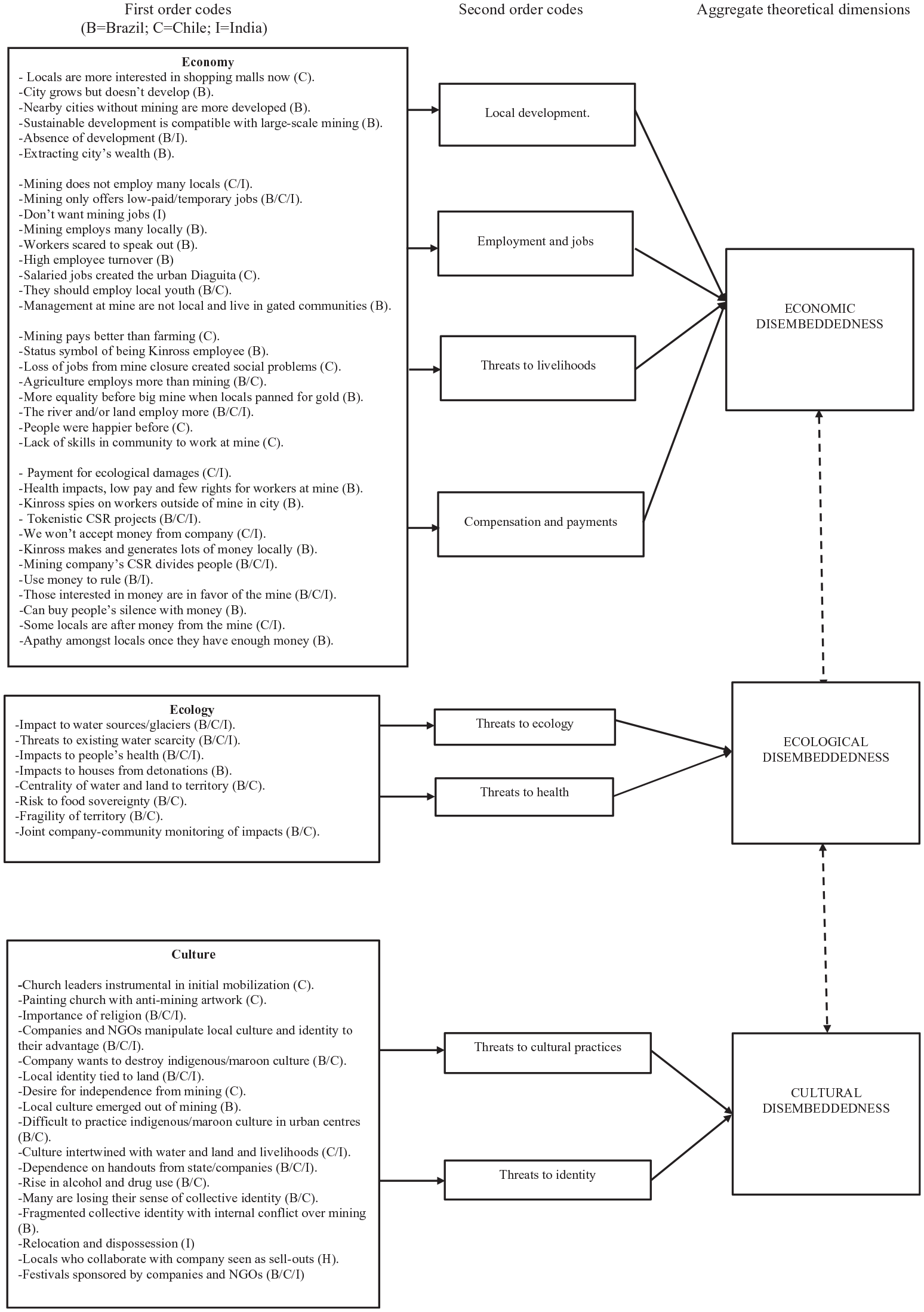
Thematic coding.
Findings
Economy: The development battleground
Communities impacted by mining had differing perceptions of economic benefits: in Niyamgiri the community rejected any offers of money or employment and were strongly opposed to being resettled. For them, development meant continuation of their traditional lifestyles and any economic returns arising from mining were not perceived as being beneficial, in fact were seen as detrimental to their livelihoods. As one activist at Niyamgiri mentioned: ‘They say mining can bring employment, but there is no employment. Maybe in the beginning, yes. There is some dirty work to do but for the actual production process, they bring in their experts’.
Forced eviction of villagers, often without appropriate compensation, during the construction of the refinery dispossessed villagers of their farmlands and forests, which were the source of their livelihoods, leaving them to become dependent on the company as either casual wage laborers or as recipients of handouts. Most of the high-skilled and well-paid jobs went to outsiders or “experts.” Within a few years of the refinery there were more non-residents of the area that had regular work while the displaced communities were forced to live in degrading conditions. In the words of a displaced villager: ‘They made the factory on our fields, on our forest. But we don’t get any jobs. There is no work and now we live by collecting leaves and firewood from Niyamgiri and selling it in Muniguda. Then we get money to buy food. Why did they build the factory here? It has brought great misery to us. We have been devastated. They never give our village any work. We are staying in deplorable conditions. Why do you outsiders get work but not us? You took our land away; even then you bring such discomfort to us’.
One of the reasons why the resistance movement against the proposed bauxite mine on the Niyamgiri hills was stronger (and ultimately successful) was that tribal communities in the hills could see the extent of social, economic, and environmental degradation that resulted from the construction of the refinery. There were concerns that mining would not only lead to loss of livelihoods but would create a new dependency on the mining company for survival of local communities. As a tribal member stated: “We are dependent on the mountains. Our lives are with Niyamgiri, our lifestyle is because of Niyamgiri.”
Dependency was also a key theme in the mining conflict involving Brazil’s largest gold mine in Paracatu, but in this case dependence was on mining not on the land. Agriculture and small-scale artisanal mining were the main economic activities in the region before commercial mining operations began. Plans to expand mining operations and construct a tailings dam after the company was granted a permit in 2011 were met with some resistance. Community grievances against the mining project focused on resettlement and compensation claims as well as health and environmental damage from the mines. However, opposition to the mine was not particularly strong: those that benefited directly or indirectly in terms of jobs did not publicly oppose the company’s expansion plans, while those who would be impacted negatively attempted to mobilize resistance. As a local councilor stated “Yes we are dependent on the mine, but the mine created that dependency which was not necessary.” A member of a local NGO engaged in mobilizing local people against the company’s expansion plans also commented on the limited employment opportunities that mining operations would bring compared to their environmental and social costs: “Most of the workers are from outside and not the city. The workers from here do the basic simple manual work.” A trade union official also agreed with these sentiments: ‘The company just leaves crumbs in the community. They paint a church; they put their name here and there. But they are taking our wealth. The best jobs are not for people from here, they come from outside. There are several cities around without mining but have better development rates than Paracatu. The mine hasn’t contributed significantly to the city. Comparing what they take from here and what they leave is very unequal’.
In Chile there were more divisions about the expected economic benefits of the mine. About half the community were interested in mining jobs instead of grape farming which was their primary economic activity. The development discourse was dominant in all three cases but the meaning of development was contested: for state and market actors development meant expanding the mining sector, building the required infrastructure to provide employment and generating tax revenues and royalties. However, most communities were skeptical about how development would benefit them as an activist involved in the Niyamgiri resistance movement commented: ‘Development has become a religion now, the most fanatic religion. And you see the kind of economic model that is being forced into India by the government. And we see what kind of devastation this causes. So we don’t accept it. We are not against development but it shouldn’t lead people into a more deprived state and shouldn’t be imposed but rather demand driven. If there is large damage to local economies and ecologies through mining then it should not be considered a good form of development. The needs of the tribals are not being catered to by this form of development and there is no demand or permission by the tribes for mining. The State is basically pushing a model of development that is actually anti-development’.
Critics of the development state have also pointed to the neocolonial conditions that are embedded in resource extraction. Colonial modes of resource extraction continued in postcolonial countries in the name of “development” with rural and Indigenous communities facing the brunt of development policies (Escobar, 2006). There was an acute awareness of neocolonial domination in all three resistance movements. As an activist in Niyamgiri stated: ‘What is the political economy in our country? There are different political parties and even up to the highest parties, they believe that India is a semi-feudal, semi-colonial state. And now I think it has become a fully neocolonial state as far as the tribals are concerned’.
A tribal member from the Niyamgiri hills stated: ‘They want to displace us to some barren land. What can they give us in return? Niyamgiri is not a pile of money. That mountain is our life. We are the children of Niyamgiri. It seems like some colonial ghost has returned. I have this axe ready for them’.
On the other side of the world, the same sentiment was echoed by the president of a trade union in Paracatu, Brazil: ‘I always say since 300 years we produce gold and the slave would come put it on a donkey send to Rio de Janeiro and then to Portugal. Today the slaves take the gold, put it on a helicopter and send to Canada. Paracatu continues to remain poor, the city has never benefited from this gold extraction’.
What mode of development becomes dominant in a particular political economy is an outcome of power relations between different actors. However, as our cases illustrate even the relatively powerless engage in modes of resistance that reflect their livelihood struggles against markets and states. For Indigenous communities culture and ecology also become weapons in these struggles, as we will show in the next section.
Culture: The ideological battleground
Resistance as cultural survival is also framed by folklore and cultural beliefs (Ali and Behrendt, 2001). Cultural practices, religious ceremonies, songs, and dances are fundamental to Indigenous identity that reflects their relationship with the land and are an integral part of the political ecology of resistance movements. In Niyamgiri, the resistance movement was framed as a matter of cultural survival. Thus, for the Kondh tribes the “value” of the mountain is not extrinsic: Niyamgiri is their “soul,” the “abode of their gods,” which is a worldview that is profoundly incommensurable with the economic value of the bauxite in the mountain. A tribal member from Niyamgiri described the struggle against the mining company, drawing from their cultural history of the region: ‘And there was a giant who was eating people, killing people. So Gajare, what did he do? He killed the giant. So, the time has come now, Vedanta, that is the giant. So it has come to destroy Dongria Kondh life. Dongria Kondh people, like Gajare should be very strong and they have fight against the giant Vedanta’.
In the Huasco Valley, Chile an Indigenous leader from the Diaguita community also identified cultural survival as being integral to the resistance movement against mining companies: ‘We were the first People the Spanish encountered upon entering Chile from Peru, and the Spaniards killed our Cacique (chief) in front of his family, yet we continued fighting even as the slaves of the Spanish. . . .we burned down La Serena (a town located 400km south of Huasco) twice, when it belonged to the Spanish. . . So we kept the Valley for our people and they the Spanish stayed near the coast. . . . . . .so if we allow all these proposed mega mines into our valley it will turn into a mining valley and our culture will die. We want the mining companies to leave so we can keep our identity, culture and water which is life’.
In Paracatu, Brazil there were conflicts between the Quilombola people and the mining company over resettlement and compensation claims. The expansion of the Kinross mine in the region came at the expense of the dispossession of two existing Quilombola communities who were forced to relocate to peripheral regions without any compensation. One Quilombola member who was evicted from her land had this to say: ‘The company doesn’t help us at all. They might be helping urban communities. The Quilombos are the real neighbors here and have history, all our ancestors lived there. It is difficult to maintain our culture now. We can’t even go back to our Quilombo lands to practice anything so the culture’s dying. I used to be on the jury of our dances. The company put security guards there so we can’t get past them, besides they’ve destroyed our houses. Its hard to live this culture in an urban area’.
Interestingly, culture was also deployed by both NGOs in their resistance to mining operations as well as mining companies in their counter-mobilization strategies. In the Niyamgiri case, the international NGO Action Aid was accused by local activists of misrepresenting tribal culture to western audiences in order to promote their own agenda while ignoring the network of local activists and organizations engaged in larger struggles about development and resource access. As part of their strategy to publicize the resistance movement and “showcase Dongria culture,” Action Aid staged a “mass worship” movement in the mountains, which the community claimed did not reflect local cultural practices. The NGO was also criticized for inaccurately portraying members of other tribal groups that were not part of the resistance movement as tribal leaders just because they filled the “tribal slot” that appealed to western audiences (Kraemer et al., 2013). While deploying cultural traditions and sacred sites may be an effective political strategy to challenge mining industries it can also become a double-edged sword. For instance, in the Huasco Valley, Chile it was the mining company that was accused of misrepresenting and manipulating tribal culture to promote their CSR agenda. The company offered courses in pottery and handicrafts in an attempt to “preserve and promote local culture,” which local activists claimed depoliticized conflicts over resources. According to a local community leader: ‘None of us were interested in their “little demeaning courses and workshops.” What can they teach us about being Diaguitas?! We are Diaguitas and land and water are essential to us, not these courses about artisanal goods and pottery! Just the most vulnerable, humble people and agreed to take part but none of us did. We showed them we don’t want or need them in our valley!’
Another activist who was a representative of the Parish Church stated: ‘Barrick in their Diaguita publications speak about ceramics and knitting. They financed the Indigenous New Year of the sun. They are manipulating their (Diaguita) identity for their own good. Barrick does it to divert the attention to the secondary elements of the identity and not to teach the parts of territory and water and language, which are the primary ones’.
In addition to tensions and contradictions around economy and culture, ecology also emerged as a key theme of resistance in the three regions.
Ecology: The environmental battleground
Another driving force of all three resistance movements in the study was concerns about the environmental impacts of mining. These concerns were heightened among Indigenous communities, who have a fundamentally different relationship with the land than urban or semi-urban communities. Economic, ecological, and cultural domains are inextricably linked in Indigenous communities and hence any environmental threat to their lands, waters, or animals becomes a threat to their livelihoods and health, their identity and way of life. In Niyamgiri, environmental impacts of the refinery became apparent both during construction and operation of the refinery. The villagers blamed pollution from the refinery for increasing rates of skin diseases, livestock diseases, crop damage, and groundwater contamination due to seepage of toxic slurry. There were also concerns that if the bauxite mine was constructed on the mountains the influx of workers and machinery would pose threats to wildlife and forest cover.
One local described how pollution from the refinery was affecting their lives: ‘See there is dust everywhere. Niyamgiri is covered with dust. The trees are not bearing fruits. Crops are failing. The dust has covered all our rice crops. When we taste the rice it is bitter. Then the water is polluted because of the dust from the factory. The water in the wells is also polluted. All the dust and emissions affect our village. Everyone is sick and we have to take care of all our medical requirements. Don’t ever touch the red mud. Your skin might peel off. We have to protest against this’.
At Paracatu, Brazil, community members complained of dangerous air and noise pollution as well as water contamination. As one resident commented: ‘The main concern in health is with arsenic from the dust. One worker had 6 times the national limit of arsenic in his blood. After 8 months away from arsenic he still has high levels. A lot of people in Paracatu have cancer, cancer of the cervix, breast, prostate. The company don’t listen to the population on issues of pollution. A university found proof of it in the air but the company say it’s an isolated incident. The company don’t give us answers. The water here is polluted, the company then shows its research as proof to show it’s not polluted’.
At Huasco Valley, Chile, threats to water supply, loss of biodiversity and soil contamination, and were the key environmental concerns of surrounding communities. As a Diaguita farmer stated: “The Diaguitas, most of us are micro farmers. We are defending our farms. Our trees are drying out.”
To summarize our findings: market and state actors strongly supported the mining projects in all three countries. Community resistance arose because of the detrimental social, economic, cultural, and environmental impacts of mining. Communities engaged in a variety of resistance practices including direct actions and blockades, protest marches, lawsuits, public campaigns, mobilizing national and international NGOs, lobbying governments, and challenging environmental impact assessments. Conflicts revolved around differential impacts on economy, ecology and culture. Contestations about economy were about the lack of real jobs, dependence on mining, imposed modes of development, inadequate compensation, inequitable distribution of mining incomes, and loss of livelihoods. Ecological concerns included loss of landscape, deforestation, water and air pollution, waste overflow, health hazards to humans, and cattle and crop failure. Contestations around culture included threats to cultural traditions and practices, desecration of sacred sites, lack of access to cultural sites and appropriation of Indigenous culture by market, state and civil society actors. Counter mobilization strategies of market and state actors included criminalization of dissent, corporate-state collusion, arrests and physical assaults on protestors, refusal to hear grievances, forced consent processes, repressive legislation, payoffs and bribes, divide and rule strategies, and CSR practices.
Returning to the research questions that motivated this study, we found that local political ecologies that reflected communities’ relationships to the land were incompatible with the global political economy of resource extraction, leading to conflicts. Our findings highlight key elements of resistance as identified by Mumby (2005: 23): collective and organized efforts by communities engaging in practices of resistance (“form of praxis”) against state and market actors (“established social patterns and structures”), deploying cultural and social identities to disrupt and interrogate dominant “identity logics.” The “mechanisms of control” that regulate and manage resistance movements involve political economic structures dominated by state and market interests. The outcomes of the resistance movements were different: in India and Chile the resistance movement was successful in stopping the mine but not so in the case of Brazil. Given the qualitative nature of the case studies we do not want to generalize our findings to other conflicts. And as mentioned earlier failure of resistance does not mean failure to resist—there were remarkable similarities in how communities mobilized local political ecologies of resistance despite the differences between the three countries. While the themes of economy, ecology and culture reflected political ecologies of all three communities there were also differences in the extent of their embeddedness. In the next section we will discuss the theoretical implications of our findings by examining these differences and how they may have influenced the strength and outcomes of the resistance movements.
Discussion and implications
Based on our findings we theorize that disembeddedness was at the root of the conflicts, which explained why and how the three communities opposed mining projects. Economic rationality in market societies is always embedded in social relationships to some degree, despite an economic logic that separates economics from society and culture (Granovetter, 1985). Embeddedness was more prevalent in pre-market societies where the separation of economic and social spheres was less discrete (Polanyi, 1944/2001). The economy in local political ecologies is based on the relationship between land and livelihood. Mining changes this relationship and the alternative livelihoods of wage labor in low end jobs that mining projects offer, while providing an income, cannot compensate for the loss of a livelihood that is derived from the land, especially for communities whose lives and identities are intimately connected with the land. Disembeddedness from the land is also reflected in the increasing separation of ecological, economic and cultural spheres that constitute local political ecologies. It is this disembeddedness that is being resisted by communities impacted by mining activity.
Disembeddedness arising from threats to economy, ecology and culture was not uniformly distributed across the three regions. The Indigenous community at Niyamgiri was the most “traditional” in the sense that their economic, social, and cultural lives were inseparable and inextricably linked to the mountains—this “ecological embeddedness” defined their identity which was intimately linked to the land (Whiteman and Cooper, 2000). Constructing a bauxite mine on their sacred mountain did not just pose an environmental problem but was a threat to their livelihoods, their lives and their identity. Defending their land was also a defence of their cultural identity and way of life and this political ecology of resistance was incommensurable with the political economy of extraction because of the different meanings and value attached to nature and the land.
Communities in Niyamgiri and Paracatu were at opposite ends of the spectrum in terms of economic disembeddedness: in Niyamgiri the communities derived their livelihoods from the land, had no interest in whatever economic benefits the mine would bring and vigorously opposed any resettlement plans. The economic life of the community in Paracatu on the other hand was closely tied to the mining project and residents saw few lucrative opportunities in other sectors. There was a history of small-scale artisan mining in the region but once that economic activity ceased (because it was deemed “illegal”) the community became more dependent on the company for direct and indirect employment. At Huasco Valley the community was almost equally divided between those that were interested in jobs and money that the mine would bring and those who felt their livelihoods as grape farmers would be threatened because of water shortage and contamination.
Cultural disembeddedness also differed across the communities. The Niyamgiri community had a strong spiritual connection with the land and were united in their opposition to proposed mine, which was to be built on one of their sacred sites. Paracatu was already a mining town and the expansion would not have a significant effect on the culture of the Quilombolas. In Huasco Valley the situation was more complex: while mining had little impact on the community’s cultural practices there was a resurgence in the importance of Diaguita identity. Both opposing factions leveraged culture to make their respective case: for example, international NGOs showcased the culture of Niyamgiri’s Indigenous tribes in their campaigns claiming that mining would endanger cultural traditions of the tribes. At Huasco Valley the mining company promoted and funded a number of cultural events and even commissioned a book called “Diaguita” to demonstrate their respect for local culture. However, corporate CSR strategies that leveraged Indigenous cultural identity were decoupled from community concerns over damage to land and water, which were also integral to cultural identity.
In terms of ecology while all three mining projects had negative environmental effects perceptions of threats and strength of opposition to the mine varied. At Niyamgiri the community was united in its efforts to stop the mine because they had witnessed firsthand the severe environmental problems that resulted from the construction of the refinery on the plains leading to resettlement of neighboring communities. At Huasco Valley responses to ecological concerns were divided between those that sought higher compensation and demanded better environmental management practices from the company and those that were firmly opposed to the mine. At Paracatu, the community documented the deleterious health effects from environmental pollution but wanted the company and government to address their health concerns rather than oppose the mining project.
Our findings reveal how interconnections between ecology, economy and culture and the extent of disembeddedness arising from mining can influence the direction and strength of the resistance movements. At Niyamgiri there was no separation of economy, ecology, or culture given the community’s spiritual connection to the lands. Health and wellbeing of the community was seen as being inseparable from ecological, cultural, and economic relations to the land. As a result their opposition was united and strong. At Huasco Valley there were clearer separations between culture and economy/ecology where tradeoffs between economic benefits and ecological problems were to be negotiated through higher compensation from the company. Ecological concerns prevailed in the decision by the Chilean government to halt mining expansion. At Paracatu economic dependence on the mine was sufficiently high to prevail over cultural and ecological concerns, which the communities wanted to be addressed separately, thus weakening the anti-mining resistance movement .
Our findings make two contributions to the resistance literature. First, we have explained the basis of translocal resistance by bridging insights from subaltern studies and political ecology to explain how forms of struggles emerge. Second, our empirical analysis provides a “power from below” account of translocal subaltern resistance in three countries rather than describe processes of resource mobilization, which tends to be the predominant approach of describing social movements (de Bakker et al., 2013). We expand on these contributions below.
Our findings indicate that rightful resistance (negotiation with local and state officials) and lawfare (using judicial systems as sites of contestation and negotiation) were the primary modes of subaltern resistance in the three cases. The tribal communities resisting the mining project in India could conceivably constitute a political society where they find themselves in conflict with the state in an attempt to negotiate collective rights as opposed to citizenship rights in a neoliberal-democratic nation state. There are also overlaps and tensions between the different modes of resistance. For instance, in the Indian case when negotiations with the state broke down (rightful resistance), communities engaged in direct action by blockading roads, preventing company bulldozers from clearing the land and confronting state police. Legal action to prevent the mine continued, as did the mobilization of external groups both domestic and international. Through lawfare and direct action the community was able to obtain a decision from the Indian Supreme Court that overturned prior approval of the mine. However, there are limits to what the law can provide for subaltern communities and laws are always subject to change. For instance, partly in response to the successful resistance mounted by the Dongria Kandh, the Indian government introduced new legislation in 2015 to fast track development projects while amending existing forest rights legislation so that new projects are not required to seek the approval of tribal village councils (Barry and Bagri, 2014).
Our findings indicate that subaltern resistance is more a reformist project where subaltern populations engage with hegemonic structures of subordination. In our study we found resistance as negotiation (rather than resistance as negation) to be the defining feature of subaltern resistance, where the modern state remains at the heart of subaltern politics (Chandra, 2015: 564). Communities resisting extractive projects in Brazil, Chile, and India not only endure domination but also attempt to negotiate better outcomes with existing power structures by deploying key aspects of their political ecology: economy, ecology, and culture.
The state is a key player in resistance movements both in its developmental role of providing employment, alleviating poverty and generating economic growth as well as in its protective role in providing security for its citizens. The state also claims a monopoly of the “legitimate” use of violence and physical force where the army and police can be used to suppress dissent (Özen and Özen, 2009). The role of the state thus appears to be somewhat contradictory when it comes to governing extractive industries, where on the one hand the state is responsible for economic development and jobs, which mining can provide; and on the other hand it has a responsibility to protect its citizens who are displaced, dispossessed or suffer ill-health as a result of mining operations. In many cases the state is also a joint-venture partner with mining corporations, which raises serious conflicts of interest about the state’s commitment to the welfare of communities negatively impacted by mining. Regardless of whether the state plays a coercive or “meta-regulatory catalytic role” (Reinecke and Ansari, 2016: 320) public/private governance mechanisms can do little to address the needs of subaltern populations (Maher et al., 2019).
If, as our findings indicate, subaltern groups are attempting to rework power relations and alter the conditions of their subordination through their political ecology then the political task of resistance movements is to foster a “democratic equalizing movement” of economic, ecological, and cultural distribution (Escobar, 2006: 133). It is this political ecology that can repoliticize the local sphere and counter neoliberal practices in the larger political economy. Such a political ecology needs an acknowledgement of collective property rights where collectivity is not posed in unitary opposition to neoliberal notions of individualism. Instead, a system of collective property rights could coexist within dominant individual property rights regimes as an alternative to an economic system that produces social arrangements based on private property rights. Resistance movements against resource extraction provide a different understanding of property and rights that are focused on relationships and custodianship with land rather than ownership (Rajagopal, 2003). Autonomy and self-determination of local communities cannot be reached without a clear understanding of how Indigenous collective property rights can be articulated at international, national and local levels of decision making for extractive projects and how the right to say no to development can be given regulatory authority. The political space of Indigenous postcoloniality cannot be recognized within the postcolonial nation state framework. The translocality of resistance movements can create a new political space that while not directly challenging the authority and sovereignty of nation states may allow some form of Indigenous sovereignty to coexist that can enable a plurality of local voices to have a say in decision-making. Conflicts over mining are not just material conflicts but also epistemic conflicts—a form of epistemic violence that uses language and legal mechanisms of dominant powers to marginalize certain populations (Spivak, 1988). We believe listening to these voices may enable us to understand alternate realities and point to the possibilities of coexistence of apparently incommensurable worldviews.
Conclusions and future directions
What then can these three anti-mining resistance movements tell us about the future of resistance? Our study has implications for emerging research on the organization of resistance movements that go beyond describing social relations and mobilization strategies but are more place and territory based struggles (Ehrnström-Fuentes, 2020). Our theory of the political ecology of resistance movements situates conflicts in the disembeddedness of economic, ecological, and cultural practices and the broader market/state forces that constitute the political economy. Resistance movements are thus an ongoing process of negotiations between hegemonic and counter-hegemonic forces involving contested relations of power and knowledge and cultural contestations over the construction of a collective identity (Munro, 2014). More research is needed to understand the conditions under which the deployment of cultural difference as identity can engender participation in resistance movements and not just serve as symbolic challenges to dominant cultural codes but how cultural forms of mobilization can lead to institutional change.
Second, dependence on extractive industries also defines livelihood struggles. Our analysis indicates that a community’s dependence on mining and the extent of a community’s social, cultural, and economic alignment with the industry influences the strength of resistance movements. Opposition to mining was stronger and conflicts more intense in areas that had relatively lower levels of dependence on mining. Among communities that historically depended on mining for their livelihoods, the level and intensity of conflicts were lower, despite grievances against social dislocation and environmental damage that flared up occasionally. Dependence on mining also influenced the capacity of communities to mobilize resistance. More research is needed to examine the relationships between mining dependency and community capacities to articulate alternate forms of development that do not rely on extraction.
Third, our findings have implications for organization studies, in particular the need for a more nuanced and critical understanding of organization-stakeholder relationships (Banerjee, 2000; Maher, 2019; Yakovleva and Vazquez-Brust, 2012). More empirical research is needed to examine the consequences of corporate stakeholder engagement strategies for local communities. In stakeholder theory corporate managers have the authority to determine power, legitimacy, and urgency of stakeholders, which effectively marginalizes some stakeholders. Studies that focus on the outcomes of stakeholder engagement strategies for marginalized communities will yield valuable insights into the tensions and contradictions that arise in the implementation of CSR. The effectiveness of many social responsibility and stakeholder engagement standards in the extractive industries remains in doubt given that virtually all the corporations involved in ongoing conflicts in the extractive industries are signatories to these standards. A fruitful area for future research is to examine how standards dealing with mining impacts are operationalized and understand how consultative processes and “meaningful participation of Indigenous communities in decision making” actually works on the ground.
Finally, our analysis provides a foundation for a normative theory of the governance of natural resource extraction. Conflicts can also generate positive consequences in terms of changed institutional arrangements that enable more direct participation of affected communities and there is a need to understand the conditions and mechanisms where conflicts can lead to institutional innovation (Bebbington et al., 2008). For example, Indigenous communities are using their own organizational forms like gram sabhas in India or los caracoloes by the Zapatistas in Mexico to negotiate with extractive corporations and governments. These new forms of local authority may provide some means of self-determination whereby tribal councils can decide on development projects on their lands. All resistance movements in the extractives industries are not anti-mining per se and some conflicts are over more equitable distribution of rents and provision of employment and education. More research is needed on the types of institutional arrangements that can generate equitable outcomes from extractive projects while minimizing its environmental impacts as well as providing the necessary authority that can prevent mining projects from proceeding, based on the desires and needs of affected communities.
Demands for autonomy from different cultural groups can be seen as demands for coexistence and marks a departure from discourses of inclusion and multiculturalism, which, once interpellated with neoliberal notions of homo oeconomicus imposes “on all societies a structure of power in which the cultural codes of modernity have been inscribed” (Escobar, 2006: 128). Livelihood struggles of Indigenous communities are more about demands for “pluri-culturalism” than multiculturalism where the former is predicated on economy, ecology, and culture and collective rights along with a reflexive appreciation that collectivity is always contested along gender, class and ethnic identities. Understanding the diversity of resistance movements will enable us to identify the range of generative practices and forms of organizing that do not focus solely on “inclusion” and “engagement” but also build collective capabilities that can foster coexistence.
Supplemental Material
sj-pdf-1-org-10.1177_1350508421995742 – Supplemental material for Resistance is fertile: Toward a political ecology of translocal resistance
Supplemental material, sj-pdf-1-org-10.1177_1350508421995742 for Resistance is fertile: Toward a political ecology of translocal resistance by Subhabrata Bobby Banerjee, Rajiv Maher and Romy Krämer in Organization
Footnotes
Funding
The author(s) received no financial support for the research, authorship, and/or publication of this article.

Supplemental material
Supplemental material for this article is available online.
Author biographies
References
Supplementary Material
Please find the following supplemental material available below.
For Open Access articles published under a Creative Commons License, all supplemental material carries the same license as the article it is associated with.
For non-Open Access articles published, all supplemental material carries a non-exclusive license, and permission requests for re-use of supplemental material or any part of supplemental material shall be sent directly to the copyright owner as specified in the copyright notice associated with the article.
