




Abstract
The aim of this paper is to examine how territorial movements, as distinct forms of place-based social movements, organise in defence of life against the threat of resource extraction on their land. Based on the experiences of Indigenous Lafkenche-Mapuche members of a protracted struggle against a pulp mill in southern Chile, the study seeks to address the following research questions: (1) How do territorial movements emerge and organise the defence of their threatened lives? and (2) How do diverging (Indigenous and non-Indigenous) territorial relations shape the dynamics of the struggle? Combining insights from Enrique Dussel’s ‘ethics of liberation’ with that of Indigenous ontologies, this study suggests that territorial movements emerge out of the awakening of a critical consciousness of the threat of death and the collective ‘desire to live’ that define the dynamics of the struggle. The findings demonstrate how the diverging territorial relations, the societally embedded ‘coloniality of power’, and the state and corporate induced violence shape the movement dynamics. Changes in the movement dynamics also occur as a result of the struggle itself, as the movement actors’ unified desire to live continuously transforms the people and shapes the territory they inhabit.
Keywords
Introduction
Local communities across the world are increasingly engaged in conflicts with transnational corporations that seek access to natural resources on their land (Temper et al., 2015). In recent years, a growing number of organisation studies (OS) scholars have also expressed interest in the political and organisational processes involved in these struggles (e.g. see Banerjee, 2008, 2011; Ehrnström-Fuentes, 2016; Kraemer et al., 2013; Misoczky, 2011; Misoczky and Böhm, 2015; Pal, 2016). Nonetheless, the subject of how precisely these types of movements emerge and the dynamics involved in territorial struggles remains an undertheorised topic.
Previous research on social movement organisations (SMOs) suggests that the emergence of social movements (SMs) is ideologically motivated and that identities, interests and political opportunities shape the dynamics of the struggle (Den Hond and De Bakker, 2007). Other studies theorise SM mobilisations as examples of antagonistic struggles, in which strategic powerful coalitions unify actors with diverging interests and ideologies to contest the hegemony of corporations, states and dominant institutional orders (Contu et al., 2013; Otto and Böhm, 2006; van Bommel and Spicer, 2011). However, such readings provide a limited understanding of movements that organise themselves to defend their life forms against the threat of death and destruction of their entire community (Misoczky and Böhm, 2015).
Many of these movements are embedded in institutional settings marked by violence and exclusion (Banerjee, 2008; Ehrnström-Fuentes, 2019; Özen and Özen, 2009). Furthermore, the emphasis placed on the social dimensions of movement dynamics in the interaction with corporate and political authorities oversees the territorial dimensions of the struggle. In fact, studies on movements resisting resource extraction on their land have indicated that the organising processes are locally situated (Pal, 2016) and shaped by the histories, memories (Banerjee, 2011) and social imaginaries (Ehrnström-Fuentes, 2016) tied to a particular place. These struggles also often involve Indigenous communities (Banerjee, 2011), for whom the place-based relations among humans and other than humans are central to their own world-making practices (Blaser, 2013; De la Cadena, 2016). Nevertheless, current debates on SMs in organisation studies have not addressed the issue of how the Indigenous ways of knowing and being inform the actual dynamics of the struggle (Misoczky, 2011).
The aim of the current paper is to enrich the current understanding of the organisation of movements that defend their lives from destructive projects on their land, which is conceptualised as territorial movement in this study. Instead of merely focusing on the social dimensions of the struggle, the objective is thus to advance a theory on how relations to place, or different forms of territorial relations, influence the emergence and dynamics of such movements. Drawing upon the experiences of Indigenous Lafkenche-Mapuche members of a territorial movement that defends their ocean bay against the industrial waste of a toxic pipeline in southern Chile, the study asks two key questions: (1) How do territorial movements emerge and organise the defence of their threatened lives? and (2) How do diverging (Indigenous and non-Indigenous) territorial relations shape the dynamics of the movement? The analysis indicates not only how the defence of livelihoods is central to the process of enacting these struggles but also how ontological issues of how people relate the territory they are defending are at stake and influence the dynamics of communities that are rising to defend life in places threatened by extinction.
Territory, a central concept in the current paper, holds multiple meanings depending on research traditions and origins. In most Anglophone studies, the word ‘territory’ is separated from social processes, referring primarily to the physical space governed by nation states or non-state actors (Halvorsen, 2019) or just a container for human history (Marker, 2018). In Latin American SM research, the concept is used to make visible the social processes, practices and political contestations that produce specific types of configurations and realities in place (Escobar, 2008; Porto-Gonçalves, 2006; Santos, 2005). Territory in this sense is continuously crafted, or ‘geo-graphed’ (Porto-Gonçalves, 2006), through the human practices, institutions and memories inscribed in space (Santos, 2005), and it takes on different meanings as different groups of actors (peasants, Indigenous groups, companies or states) organise themselves to defend their own interests in place (Mançano Fernandes, 2004). Yet, both the Anglophone and Latin America conceptualisations of territory are insufficient to comprehend the struggles enacted in Indigenous communities. In this context, the term territory refers to all the relational features of a certain place inhabited by both human and other than human actors (De la Cadena, 2016), where the place itself holds agency to shape the stories, events and meanings of how to be on the land (Marker, 2018).
Accounting for this multiplicity of definitions emerging from different sites of enunciation, I refer to territory in this paper as a concept shaped by the histories, narratives, practices and human-nonhuman webs of relations (e.g. the reciprocal relations between waters, air, humans, animals, and other than human beings) in particular places. I describe the relations among these elements as territorial relations, or life-sustaining webs of relations that make life possible in place. Territorial movements are thus place-based collectives that defend their own life-sustaining webs of relations in places threatened by resource extraction. Thus, territorial movements not only engage in a struggle over who has access to land and resources in particular physical spaces but through their actions they (re-)construct histories, narratives, practices and relations that enable them to sustain their lives in their communities.
By introducing the concept of territorial movements in organisation research, this paper contributes to theory with key insights into the organising processes in places threatened by resource extraction. The focus on territory as the site of contestation allows for a nuanced understanding of movement politics that is not located in the institutional settings of the workplace or civil society (Spicer and Böhm, 2007) but in particular places that are threatened by death and destruction. I argue that these struggles are not ideologically motivated (Den Hond and De Bakker, 2007; Otto and Böhm, 2006, Van Bommel and Spicer, 2011), but they arise from a pressing need to defend the diverging life-sustaining relations tied to places threatened by extinction. Thus, movement dynamics are not shaped by abstracted discourses or politics in the public sphere but by the lived experiences and the dynamics of territorial relations in the place of the struggle. The organising processes also include a transformative element, in which the creative force emanating from a unified ‘desire to live’ (Dussel, 2013) strengthens local practices and life forms that provide a means of resisting extractive projects on their land.
Theoretical frame
In previous research, the dynamic processes of social movement organising has been conceptualised in different ways. Institutional scholars suggest that movement emergence and dynamics depend on the mobilisation of the constituents’ internal resources (McAdam et al., 2001; McCarthy and Zald, 1977; Yaziji and Doh, 2013), the opportunities in the external environment (Tilly, 1978) and the tactics and framing methods used for attracting members with similar interests and identities (Benford and Snow, 2000; McAdam et al., 2001). The success – and hence the power – of movements depends on how well they draw upon these interrelated elements to have an influence on the ‘socially constructed arenas’ (Fligstein and McAdam, 2012, p. 10) of societies, industries and markets (De Bakker et al., 2013; Soule 2012).
This perspective on movement dynamics has generated several critiques. First, concerns have been raised about the effects of drawing upon organisational theories used for explaining capitalist organisations and the experiences of North American movements on movements that emerge in radically different contexts (Misoczky et al., 2017; Otto and Böhm, 2006). Such theories may fail to attend to ‘the multiple and contested processes of organising and the knowledge produced in the organisational practices from below’ (Misoczky et al., 2017, p. 250). Others have underscored that the literature on SMOs with its emphasis on resources, structures, and frames disregards the strategic and internal dynamics of how and why movements mobilise (van Bommel and Spicer, 2011).
To account for some of the critiques raised against the dominant institutional frames of SM theories, a growing body of literature in OS has instead examined the internal dynamics of resistance movements (Contu et al., 2013; Otto and Böhm, 2006; Spicer and Böhm, 2007; van Bommel and Spicer, 2011). Drawing upon Neo-Gramscian theory to explain social change, these authors recognise SMs as socially constructed and relationally constituted by the antagonistic struggles in which they engage (Contu et al., 2013; Otto and Böhm, 2006). Movement dynamics evolve from a ‘war of position [which] constitutes a longer term strategy, coordinated across multiple bases of power, to gain influence in the cultural institutions of civil society, develop organisational capacity, and to win new allies’ (Levy and Newell, 2005, p. 88). The focus of the analysis lies on how actors form strategic coalitions and articulate a common language (‘chains of equivalence’) to demand change that has wide-reaching effects on cultures, subjectivities and identities in civil society at large (Böhm et al., 2008).
Due to their focus on visible conflicts in the cultural, economic and social spheres of society, both the institutional and resistance-focused literature provide an inadequate frame to address the particularities of movements that resist resource extraction in peripheral communities in the Global South. The emphasis on social processes and conflicts does not allow for an analysis of the territorial dimension of the struggle, or of the actual ‘things at stake’ (Blaser, 2013, p. 15) when movements rise to defend their own place in the world for death and destruction. Furthermore, movements defending their own living sphere do not emanate from particular ideological convictions or detached individual interests, but they emerge from the threat of death confronting their community (Misoczky and Böhm, 2015).
The structural constraints that these movements encounter limit their capacity to have an influence on the institutions that guide the cultural, economic and political spheres of life. Many movements encounter systemic exclusion from public politics in the discursive domain of civil society (Ehrnström-Fuentes, 2015, 2019), which can be traced back to the ‘coloniality of power’ (Quijano, 2000) of the modern world order. This power differential is upheld by the assumed superiority of modern over the colonial nonmodern, based on questions of race, class and the assumed universal applicability of the Cartesian knowledge system and Europe’s historical processes on the rest of the world (Blaser, 2010; Mignolo, 2011; Quijano, 2000). These universalising assumptions create separations between humans and objects, nature and culture, while organising the past, the present, and the future of societal life based on linear narratives of progress and development (Blaser, 2010). Thus, by structuring reality based on particular parameters, the power of coloniality effectively occludes and excludes the experiences of those deemed as inferior - and whose ways of being and knowing do not follow these same parameters - from the domains of the institutional politics in the public sphere (Ehrnström-Fuentes, 2015).
Furthermore, movements that do rise up to defend their own ways of being commonly confront state and corporate violence. Banerjee (2008) describes this violence as ‘necrocapitalism’, a set of government and corporate-led practices that ‘deny people access to resources that are essential to their health and life, destroy livelihoods, and dispossess communities’ (p. 1551). These practices create state of exceptions that allow the use of private and state military forces to settle conflicts over the access to natural resources between transnational corporations and Indigenous communities (Banerjee, 2008). Thus, people resisting resource extraction on their land have a limited capacity to challenge institutional structures through democratic processes of will formation.
Accounting for the specificities of territorial movements that emerge in the Indigenous and rural communities of the Global South requires a nuanced approach towards movement logics that take their ‘concrete reality as the starting point’ (Misoczky et al., 2017, p. 253). This postulation signifies that the research must be designed in a manner that accounts for the actual context where these movements emerge, based on the lived experiences of those involved, while also respecting the ethical and political purposes of the actual struggle (Misoczky et al., 2017). In the case of struggles enacted in Indigenous communities, the researcher need to also consider the ontological differences that exist between modern and Indigenous ways of knowing and being (Blaser, 2013). To account for these aspects, I subsequently introduce the philosopher Enrique Dussel’s (2013) work on the ethics of liberation, which provides a frame for analysing the emergence and dynamics of movements based on the concrete lived realities of those defending their existence against the threat of resource extraction. To be attentive to Indigenous ways of being and knowing, I also discuss how Dussel’s human-centred ethics can be accommodated to relational ontologies in which humans are not separated from nature but part of the larger cosmological whole.
Ethical conflicts and the desire to live
For Dussel (2013), the ethics of liberation parts from the material principles of life and death of each human being and the capacity of a social order to reproduce and sustain human life in community. An ethical conflict occurs when a social order negates the ‘dignity of the life of the victim, oppressed, or excluded’ (Dussel, 2013, p. 55) that no longer can reproduce his or her life within the limits of that order. Dussel stresses the importance of people becoming conscious of their victimisation to organise themselves and prepare their liberation from a system that inflicts death and exclusion upon them. The core of his proposition is that a system of domination stops being legitimate in the eyes of the dominated and oppressed victims when they realise that the system does not guarantee the reproduction and development of their lives. In Dussel’s view, the critical consciousness of the threat of death and the exclusion that the system imposes on the victims is the spark needed to organise resistance. As he explains: The ethical conflict starts when the victims of a prevailing formal system cannot live, or have been violently and discursively excluded from such a system; when sociohistorical subjects, social movements (e.g. ecological), classes (workers), marginal groups, gender (feminine), races (non-white), peripheral impoverished countries, and so on become conscious, organize themselves, formulate diagnoses of their negativity and prepare alternative programs to transform the systems that are in force and that have become dominant, oppressive, the cause of death and exclusion. (Dussel, 2013, p. 401, author’s emphasis)
Dussel (2013) defines social movements as ‘fluid and fragmented socio-historical subjects’ that ‘appear and disappear in well-defined junctures’ (p. 388). These junctures are the moments when the victims of the system become aware of the threat of death and organise as a movement in defence of their lives. Thus, the struggle is marked by a negative moment when the ‘victims of the prevailing system cannot live fully (this is why they are victims)’, and a positive moment when ‘their will-to-live against all adversity, pain, and imminent death is transformed into an infinite source for creation of the new’ (Dussel, 2008, p. 78). This positive moment arises when the victims become actors with the power to change the course of actions, engaged in the struggle of their own liberation while building something new. As Dussel (2008) explains: All subjects, upon becoming actors – and especially when representing a movement or people – become the motor, the force, the power that makes history [. . .] This praxis has two moments: a negative struggle, deconstructive of a given [. . .] and a positive moment of outlet, of the construction of the new [. . .] The power of the people –hyperpotentia, the new power of those ‘from below’ – becomes present from the beginning in its extreme vulnerability and poverty, in the end the invincible force of life ‘that desires-to-live’. (pp. 94–95, italics in the original)
The power that resides in this unified desire to live is the element that transforms the victims into an organised movement with the capacity to change the course of history and build ‘new life options from definitive alternatives’ (Dussel and Ibarra-Colado, 2006, p. 504). Thus, this invincible force that resides in the desire to live not only aids the movement to defend itself from the threat of death but also transforms how the movement collectively visualises and constructs its own life options.
Indigenous ontologies and the life-sustaining webs of relations
Dussel’s work on the ethics of liberation parts from ‘the concrete life of each human being from which reality is faced’ (2013, p. 434), thereby grounding the struggle in the lived experiences and realities of those involved. To define the limits of human life, Dussel draws on Franz Hinkelammert’s principle of the material feasibility of human life (Dussel, 2013, pp. 181–85) where ‘nature fixes certain frames of possibility’ (Dussel, 2013, p. 187). Yet, the emphasis placed on ‘the development and reproduction of human life’ (p. 385, author’s emphasis) within the material conditions of the ‘law of nature’ (p. 188), requires some elaboration in Indigenous contexts where humans are not separated from nature and where life is enacted through complex webs of relations between humans and other than human beings (Blaser, 2010; De la Cadena, 2016; Kuokkanen, 2007).
For example, the Okanagan scholar Armstrong (2007) refers to community not as simply comprising of humans but as a living system consisting of a diversity of beings, in which the knowledge of multiple generations contributes to the process of ‘how to be community on the land’. Sami scholar Kuokkanen (2007) pertains to this type of circular reciprocity between people and land as the ‘ability to respond, to remain attuned to the world beyond oneself [. . . ] where the well-being of the mountains and rivers is linked to the well-being of the humans and that of the whole community’ (p. 39). Similarly, in the Mapuche cosmology, wisdom is an outcome of the humans’ inseparable and interdependent relation to land, as Catrileo (2017) explains: Our kimün is in the healthy nature, from here one can learn küme mogen (living well). If the native trees disappear, if the land is sick, our newen (life force) is not well. We are all sick. (Catrileo, 2017, p. 131, author’s translation from Spanish)
This relational way of engaging with the life-sustaining webs of relations suggests that everything in the universe is connected and that, the human being ‘is not an individual subject in relation to others [. . .but] a knot in a web [. . .] inherently related to others’ (De la Cadena, 2016, p. 258). Thus, the dynamics of the movement are dependent not only on the human actors but on the reciprocal relationships between humans and other than human beings that together make life possible in place (Kuokkanen, 2007; Marker, 2018; Rosiek et al., 2020).
Reframing the desire to live as the ability to respond to the web of life-sustaining relations suggests that the mobilising force of the movement does not emerge from the humans’ desire to live within the frames of possibility of nature (Dussel, 2013), but from the community’s ability to respond to the needs of the wider web of life in place. Thus, the desire to live that Dussel (2008, 2013) describes as the force of the movement that changes the course of history and builds new definite alternatives (Dussel and Ibarra-Colado, 2006) is in an Indigenous context made up of a wider web of life-sustaining relations that continuously shape natures and life in the community. The experiences from the territorial movement in Mehuín in Chile provide insights into how the dynamics of diverging territorial relations play out in a community that consists of both Indigenous and non-Indigenous actors who have engaged in a long-lasting and successful defence of their territory against the threat of a toxic pipeline.
Methods
I draw upon storytelling as a method for engaging with the struggle discussed in this study. The way that stories are used in this study does not follow the storytelling tradition within organisation research, which views stories as fragmented and detached representations of the ‘discourses of the human world’ (Brown et al., 2009; see also Boje, 2011). Instead, I draw upon insights from political ontology (PO) (Blaser, 2010, 2013; De la Cadena, 2016), in which stories are conceptualised not as discourses and representations of a world ‘out there’ but as a world-making practice that reveals the things and relations that constitute a given world, an ontology or a reality (the words are used interchangeably) (Blaser, 2010). As a field of inquiry PO has evolved in close dialogue with Indigenous communities in Latin America, bringing to the fore modern social theory’s incapacity to account for the experiences and knowledges emerging from territorially based worlds (‘the pluriverse’) (Blaser, 2010; De la Cadena, 2016; Escobar, 2017).
Blaser (2010) draws on actor network theory (ANT), posthumanism and decolonial thinkers, when conceptualising storytelling as performative (stories are shaped and shape the realities they narrate); relational (stories are inseparable from the ‘world’ of the subject who speaks) and entangled with the universalising effects of modernity (which occludes other ways of being and knowing). Thus, stories are understood to shape and be shaped by the realities that they narrate (Blaser, 2013). They are performed from the lived experiences of the persons narrating the story (Blaser, 2013). And stories narrated in Indigenous contexts do not always follow universal modern assumption about how ‘the world’ works (Blaser, 2010).
The key stories upon which I draw originate from movement members who identify themselves as Indigenous Mapuche-Lafkenche
1
and who have been engaged in the defence of their ocean bay since the start of the conflict in 1996. Two of these stories were presented at an open seminar at the Universidad Austral in Valdivia in November 2015, which was held to commemorate the village’s 19 years’ defence of the ocean bay against the threat of a pipeline with industrial waste. Both presenters have consented to the use of their stories for the purpose of this research. The presentation of the struggle heavily draws upon the story of the werken
2
of one of the Indigenous communities involved in the struggle. His position as a werken and his presence at the seminar (and as a leading Indigenous figure in the struggle since it started in 1996) indicate that he has some authority to speak on behalf of the community. However, the selection of this specific story to narrate the struggle in Mehuín was also justified because of the specific experiences being narrated, which allowed me to think through the emergence and dynamics of territorial movements from the position of the ones involved in the struggle (Blaser, 2010). The following quote explains how the ‘locus of enunciation’ (Mignolo, 2011), or the embodied standpoint from which the werken narrates his story, also shapes the actual dynamics of the struggle: In my case, I am an artisanal fisherman but I am also Mapuche. I was born as one and I will die as one. My perception and my words are going to come from that context. The theme about the Mapuche is a theme that is a profound critique against the state and private institutions that exist today in this region and nationally. It is something much more profound than the environmental issues at stake. (Werken, university seminar, 2015)
By locating himself as both a fisherman and a member of the Mapuche society, the werken positions his story in relation to both the Mapuche struggle against the Chilean state and the different realities that exist within the movement. Thus, the selection of these stories should not be interpreted as being ‘representative’ of the entire village; others with different relations to the sea and the Chilean State could have narrated the struggle differently based on their locus of enunciation and lived experiences.
My own locus of enunciation as a researcher of European descent, with several years of interaction and research with the village and the movement, similarly shapes the analysis of the events narrated through these stories. Acknowledging my own non-Indigenous epistemic-ontological background, I view my role as a researcher as one that requires me to learn from (Kuokkanen, 2007) and ‘walk with’ (Sundberg, 2014, p. 41) those whose stories contribute to the claims put forth in the current study. This walking-with concept obliges me to respect the voices of those involved in the struggle, requiring me to seriously engage with Indigenous worlds in a manner that treats Indigenous people as a subject rather than researchable objects (Sundberg, 2014). Through my research, I also seek to respect and give back to the community with which I engage (Smith, 1999; Sundberg, 2014). Originally, I was granted access to this community through trusted local researchers, and I have since returned three times to present my research for those involved in its making, which has obliged me to respect and remain attuned to the world of those who take part in this research (Kuokkanen, 2007).
This material is only one part of a more extensive database that informs my understanding of the struggle. That database consists of newspaper material from the early years of the conflict (1995–2006, with more than 1,200 texts in total), documentaries (five in total), 3 ethnographic research, interviews with key community actors and participation in workshops in situ (in 2012, 2015 and 2017). To increase the depth of the analysis and substantiate the claims with further narrations of the conflict, I have also incorporated quotes by Mapuche–Lafkenche members of the community from personal interviews and from secondary sources.
The analysis is reflexive, shifting between the voice of the narrator and the researcher, in an attempt to perform a ‘border dialogue’ that engages with ‘the radically different knowledge practices of those worlds/realities deemed inferior by modernity’ while allowing ‘modern ways of knowing to be “contaminated” by them’ (Blaser, 2010, p. 23). Collective storytelling dynamics (CSD) (Boje, 2011) guided me in making sense of how the stories relate to events and themes of the theoretical propositions of this paper. Furthermore, CSD allowed each story to be understood as a thread that links people and other elements in place together in a network of multiple dimensions (Boje, 2011). These threads created the possibility to distinguish the emerging and unfolding changes in the territorial relations regarding the threat of extractive investment, the actors involved in the struggle, and their ability to respond to the world beyond themselves during the active stages of the struggle.
The struggle of the defence of the ocean waters of Mehuín
Mehuín is situated some 700 km south of Santiago and 70 km northwest of the town of Valdivia, on the coast of the Pacific Ocean. Since 1996, the village has been engaged in a protracted effort to defend the ocean waters from pollution from a planned 30-km pipeline transporting wastewater from a pulp mill in the nearby small town of San José de la Mariquina (Ehrnström-Fuentes, 2015, 2016; Skewes and Guerra, 2004). In the initial stage of the struggles, the village of Mehuín challenged and defeated the forestry company Arauco, part of the largest Chilean holding company COPEC, in a territorial struggle without precedence in Chilean history. The conflict has undergone several stages and different actors have shaped the more than 20 years of defence of the sea (see Table 1 for an overview of the struggle in Mehuín).
Timeline of events.
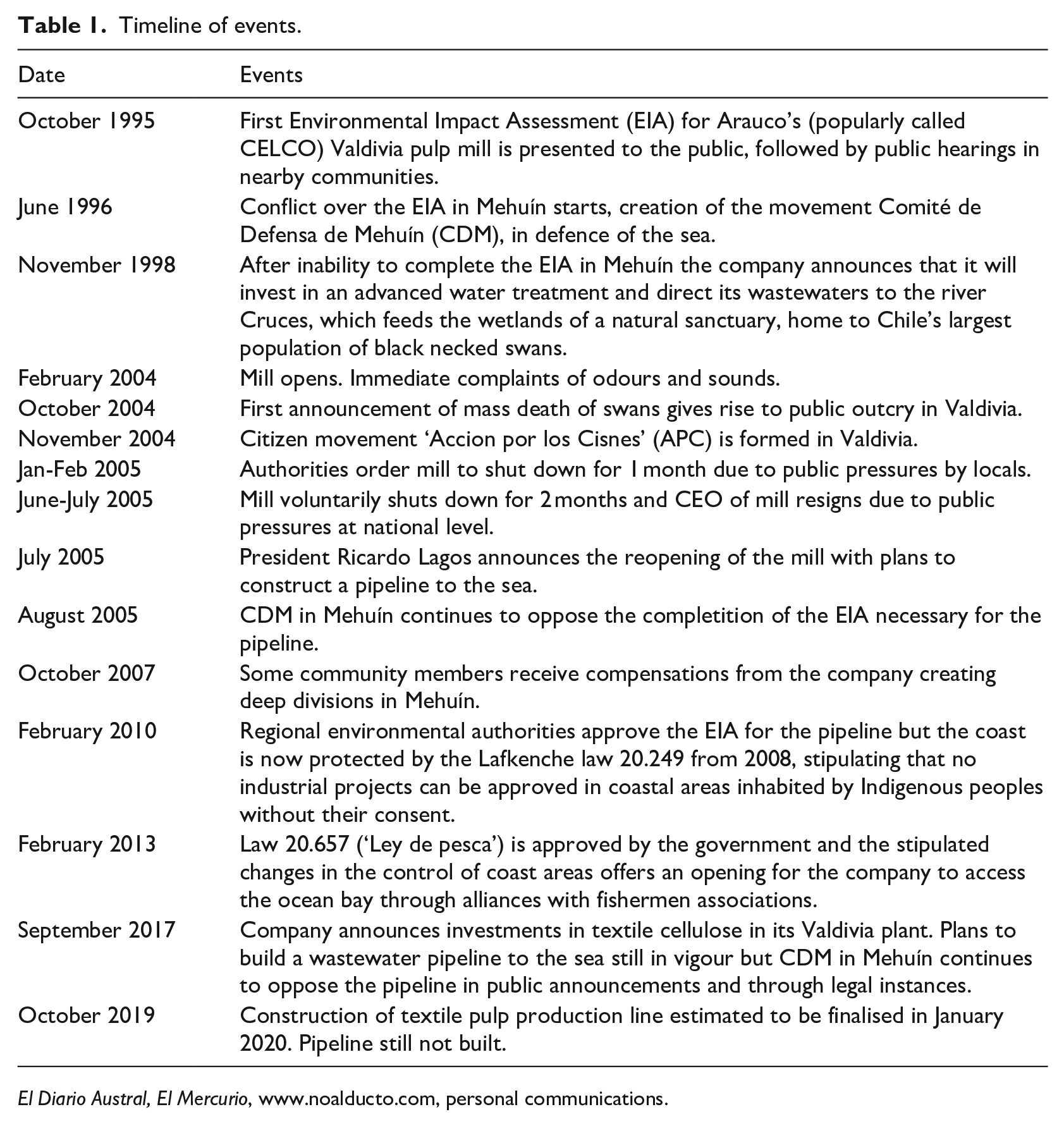
El Diario Austral, El Mercurio, www.noalducto.com, personal communications.
The defence of the bay was initially based on the entire community’s unity and its refusal to engage in any form of communication with the state or the company representatives. The community also barred access to the sea to prevent an Environmental Impact Assessment (EIA) from being completed (Ehrnström-Fuentes, 2015, 2016; Sepúlveda and Villaroel, 2012; Skewes and Guerra, 2004). In response, the company opted to release its wastewaters into the river Cruces connected downstream to a sanctuary inhabited at the time by one of Chile’s largest populations of black-necked swans (Sepúlveda and Villaroel, 2012). This river also runs through the urban centre of Valdivia. In 2004, shortly after the mill had initiated operations, it was accused of causing the deaths of the black-necked swans. The mill temporarily closed twice in 2005 due to the public outcry and the mobilisations that these events provoked. After the second closure, the then president of Chile, Ricardo Lagos, announced that in order to resolve the environmental issues in the sanctuary, a pipeline with the industrial waste would be built to the sea. This announcement reactivated the struggle in Mehuín. In this latter part of the struggle, the defence has also focused on assuring protection through legal means (e.g. Ley Lafkenche; OIT 169) (interviews 2015; 2017) and building alliances with other communities (interviews 2017). To date, the pipeline has not been constructed while the pulp mill continues to release its wastewaters into the river. If a pipeline were to be built, the company would be capable of increasing its production to the full capacity of the mill (interview with community leaders, 2012; 2015). I then present the mobilisations in Mehuín in more detail, drawing upon the stories of key members of the movement involved in this struggle since the beginning in 1996.
Analysis
While drawing upon the stories of those engaged in the defence of the sea in Mehuín, I subsequently discuss the emergence of a territorial movement and its dynamics over time, starting from the moment when the ethical conflict manifested itself and when the community realised the threat that the planned pipeline would pose to them.
The ethical conflict and the awakening of a critical consciousness
At the university seminar, the presenters did not describe the exact moment when the community became conscious of the threat of the pipeline and mobilised as a movement. However, a member of the movement described this moment in the following terms: This thing started when a few technicians arrived to do some tests in the sea in Mehuín. The fishermen saw them and gave them a hand and then the technicians were sincere and admitted that they were preparing for the installation of a project that would release toxic discharge into the sea. [. . .] That’s when all the families started to organise themselves because what this really meant for them was death [. . .] The whole community started to join in. Some communities from the surrounding areas started organising and the committee for the defence of the sea [comité de la defensa del mar] was formed, an alliance between non-Indigenous, non-Mapuche and Mapuche communities, which was a quite powerful alliance at the time. (Interview with a Mapuche community member, September 2012)
This excerpt reveals the formation of unity and the collective force that emerged from the ethical conflict of the threat of death that equally affected all the community members. Thus, in this initial stage of the struggle, the entire local community inhabiting the place also identified itself as a community of victims. This equation between the community of victims and the local community would later change as new disruptive conflicts erupted among the actors involved in the struggle. The unity of the community sparked the mobilisations, which during the first phase of the struggle resulted in the successful outcome of halting the planned pipeline, as explained by the werken at the university seminar: This conflict started in 1996 and ended its first stage in 1998[;] we won [it] with social resistance and that part of the battle was won as a vision of a battle and a force of resistance coming from the artisanal fishermen’s perspective. The Lafkenche communities were a little invisible at the time, but we were there and until this day we are still there. I was criticised at the time or they criticised us – the leaders – because the Mapuche issues were not present in that struggle. I said it did not matter; we were going to defend the sea and the territory that we want. In this first stage of deceit and lies, we won after two and a half years of struggle, with a united resistance, Mapuche and Chileans and those of whatever nationality that came to support us. We won that struggle. (Werken, university seminar, 2015)
This account of the movement in Mehuín suggested that the unified defence of the sea made the struggle successful during the first 2 years. However, the Mapuche’s inability to defend the territory that they wanted signals that the diverse relations to the sea were equally a source of tension among the Indigenous and non-Indigenous groups of the movement. The relations that the Mapuche defended were not specifically addressed during the university seminar; nonetheless, in a study on the early years of the struggle, a movement member explained these relations in the following terms: For us Mapuche, the ocean is the same as if we were speaking about the land because things flow from the land. We are connected to the sea because the sea is part of our life, of our culture, of our region and of our society. What moves us is the cultural protection of the entire zone. With the nguillaiiin, with our supplications, we protect what is ours. One asks for the protection of the spirits, from the nguenlafquen who is the owner of the ocean. We pray to the one who handles the world, the one who handles the people, the chaungechen. The chaungechen is only one [spirit]. Then you have the owners that we call the nguen, the ngemnavida [the spirit of the woods], the ngenirayen [the spirit of the waterfalls], the ngenwinkul [the spirit of the mountains], the ngenlafken [the spirit of the ocean], the owners. [Moreover], if we respect that principle, we have to respect what is inside the waters, inside the ocean. If nature is spoiled or impoverished, so would be the language, the culture and the knowledge that is drawn from the environment. (Lienlaf cited in Skewes and Guerra, 2004, p. 225)
The references made to the spirits of the mountains, the sea and the waterfall suggest that the defence of the sea is equally a defence of the reciprocity between humans and other than human ‘earth beings’. Earth beings is a concept that de la Cadena uses to conceptualise ontological differences between the kind of separate observable natural entities in modern ontologies and other than human actors in Indigenous ontologies that ‘blur modern distinctions between humans and nature’ (De la Cadena, 2016, p. 5). Thus, this excerpt makes visible the relational logics of Indigenous ontologies, in which the life of humans cannot be separated from the interdependency with other than human beings on the land (Kuokkanen, 2007; Marker, 2018). For the Mapuche, the defence of the sea was not simply a question about subsistence. The planned pipeline posed a threat to the existence of the life of the entire Mapuche world, as also explained by a movement member in an earlier study on the conflict: Mapuzung is a language that does not come from books, from the dictionaries, or from the academies and universities. It is a language that comes from natural resources, which are right here, a language that comes from the ixiean. It speaks about the land and about all the natural resources. What would it be not to defend these places? It would be as if culturally dying. (Hualme cited in Skewes and Guerra, 2004, p. 225)
This quote suggests that without their language and their interdependent relations to the place where they live the Mapuche world would cease to exist. The reference made to the relation between Mapuzung language and the natural resources also reveals how the agency of inhabiting the land itself is manifested through the land’s relation to the humans and their language (Marker, 2018) and how the pipeline would have interrupted this relation and provoked the death of the whole community and its culture.
Yet, an important aspect to note is how, at the start of the conflict, the Mapuche culture and were also shaped by experiences of colonisation, as a movement member observed: [In Mehuín,] the identities are neither fixed nor static, . . .but [they] are shaped based on the situation and specific context of how the men and women circulate in place. [. . .] In the past, the people experienced a violent process of colonisation where the priests, teachers and the state regarded us as an inferior race [. . .] The problem is not that they have told you that are Indian, that you are of an inferior race and that your customs and your language are inferior; the problem is that you internalise that because of the violent conditions into which you have become socialised in a colonial situation. [This issue consequently] affected Mehuín deeply. (Interview, November 2012)
This quote underscores how the movement was affected by the coloniality of power in relation to the dominant Chilean culture and actors. In particular, the Indigenous members of the movement had to overcome their internalised sense of inferiority and experience of the violent processes of colonisation to defend their ways of being on their own terms. These hierarchical relations to the dominant Chilean culture also affected how the different relations to the sea that existed in place were articulated during the early years of the struggle, as a Lafkenche community member noted: Silencing processes occurred within the movement. Those who monopolised the words were the environmental organisations and the fishermen organisation – not the Mapuche – despite the fact that Mapuche [community members] were on the committee of the defence of the sea. (Lafkenche community member, September 2012)
This quote reveals that the movement consisted of multiple groups of actors whose stakes, relations and practices tied to the sea differed. Moreover, it suggests that Indigenous and non-Indigenous voices did not weigh equally when issues were made visible in public. Despite the tensions experienced, these groups remained united during the first phase of the struggle because the planned pipeline equally threatened all the different forms of life in the community.
Disruption in territorial relations
The threat of the pipeline caused disruptions in the relations between the villagers and those whose lives did not depend on pollution-free waters in the sea. The first disruption occurred with the university scientist based at a research centre in Mehuín, as the werken explained: During that [initial] conflict, the relationship with Universidad Austral’s office in Mehuín was broken. The professors, the students, the trainees – all those jobs made by the students from the university that had been done in the past 20 years – [they acted] as if they threw in the towel and prioritised the space for this assumed development or progress. With those concepts, they were thrown out of Mehuín. [The fact] that men of the ocean sciences are there preparing for this doesn’t make any sense. At some point, they should have said no, but they said yes to the company and not to us. We could not sacrifice the territory, but the university has other buildings. I hope that they continue to do good science and that the history that took place in Mehuín does not repeat itself.
This conflict emerged between the local villagers and the scientists who could ‘sacrifice the territory’, as their lives and professions did not depend on the wellbeing of the ocean waters. This diverging relation with, or commitment to the wellbeing of the elements in nature vis-à-vis the support for industrial development, also influenced the movement’s incapacity to create a coalition with other places threatened by the same project; as the werken explained: After 1996–1998, when we had won the struggle and saved the territory, the conflict moved to Valdivia. We thought that Valdivia was going to act, but it did not. The citizens did not mobilise. We always said to the people that ‘you have the words now; it is your turn now. We will be there with you whenever necessary’. I think that the institutional system that was installed here in the region captured the whole population [in Valdivia]. Everybody talked about how this [pulp mill] was the best option for progress and development and how it was an alternative for the society: work, a source of employment for several thousands of people like us, they told us. We were not deceived by that story. The company from the beginning until the end was racist because in the newspapers they described us as, I cannot remember the exact phrase, but [the description was] something like ‘savage Indians’ – without any reason. Such headings were present in the local newspapers. The people here felt very offended with how they treated us.
A key point in this case is how the consciousness was tied to a particular community whose life-sustaining relations were threatened by the proposed project. In other words, what was perceived as a matter of ‘death of a whole village’ (interview, September 2012) in Mehuín was interpreted as a promise of improved life in Valdivia (Ehrnström-Fuentes, 2016). The reference made to ‘savage Indians’ also reveals how the power of coloniality (Quijano, 2000) created a sense of exclusion in Mehuín and influenced how they reacted to the threat of the pipeline. This sense of exclusion repeated itself and impeded the formation of alliances with other sets of actors in society: The governor was one of our first enemies, together with the whole governing machinery of the Chilean institutions. We had everybody against us, except for some conscious citizens who were with us. The CUT [national workers’ union] said that it meant progress for the region, the best thing that could happen to us with the promise of more jobs and opportunities. I mean they did not support us at all. Countless organisations and institutions in Mehuín united in only one block. To sum it all up, the state of Chile together with the company [were] against us. Mehuín was not a known place, Mehuín was something quite invisible on the map so Mehuín was not important. Valdivia was important, but [the people in] Valdivia remained asleep when they should have acted.
This reference to the Valdivians being ‘asleep when they should have acted’ suggests that the negative moment of the ethical conflict never materialised at a point in time when it have halted the entire project. In the early stages of the project, the people in Valdivia did not become conscious of the life-threatening relations that the project posed on them. The inaction of the people in Valdivia can also be understood based on the type of historic relations to territory that existed in that place. The reproduction of life in Valdivia did not depend on life-sustaining territorial relations but on industry developments that could provide the community with jobs (Ehrnström-Fuentes, 2016).
After that [incident] came the death of the swans and the biodiversity crisis in the sanctuary and with it the days of mass mobilisation [in Valdivia]. They mobilised and gained a very strong voice. It was too late, but they did it. That [incident] put pressure on the government because the conflict was no longer visible only in Chile, as it had also spread internationally over the borders because of the disaster in Valdivia. Then Mr Lagos [the Chilean president at the time] came to Valdivia sometime in May or June 2005 and said that the pipeline was going to go out to the sea. That was when it all started again, the war of Mehuín and all that. At that point, they came with their whole machinery: the military, the police force, the air force and whatever mechanisms they could use against us.
This quote underscores the stark differences between a social movement defending ‘the environment’ through politics in the public sphere and a territorial movement protecting its life-sustaining webs of relations in place. The urban social movement defending the swans and the environmental biodiversity in Valdivia attracted the attention of the Chilean president and transnational networks of support, whereas the territorial movement defending their lives and the sea confronted the violence from military and police forces seeking to curb their resistance.
Corporate intervention disrupting the unity of the movement
In this second phase of the defence of the ocean bay, the corporate and state responses to the movement’s actions and the diverging life-sustaining relations in place shaped the movement dynamics and unity, as the werken explained: They saw that we were no longer the sheep that could be easily dominated, so they used the whole machinery of the state system in order to defeat us. In 2007, we saw the result of that manoeuvre in Mehuín, when a large [majority] of the fishermen in Mehuín and some of the peñis [Lafkenche community members] sold out to the company. A gentleman employed by the company Arauco tried to see how they could break this movement in an elegant and professional way with psychologists, theologists and lawyers. He did the job for the company, and I think that because of what he did, they managed to buy the fishermen and part of the Lafkenche people. These things do not happen just like that. The company has used all its means, both human and material resources, to combat us.
The consciousness of the threat of death already existed during the second phase of the struggle, which signified that the corporation needed to find a means of disrupting the unity of the community to gain access to the bay. The corporate compensation packages co-opted parts of the movement, divided the community and broke its unity. As the corporation gained access to some of the movement members offering them monetary compensation for the loss of livelihood, the local community was no longer united as ‘a community of victims’ but divided due to diverging commitments to place. The compensation packages created a dependency on the corporation rather on the life sustaining webs of relation in place, which in turned caused violent confrontations with those who continued to defend the sea (interviews with author, 2012). The difference in their relations to the sea was key to this disruption, as the second speaker, who was part of the movement defending the sea, noted at the university seminar: The people [who] used to defend the sea were later ready to do what they did. They saw the sea as something that gave them money, [. . .] when they defend the sea, they do it because of subsistence [. . .]. [However,] when they are offered another way of having that money, they forget the sea. [By] contrast, we will never forget the sea because we will never move from where we live [. . .] the adherence [to the sea] is not momentary [but] it is for life; it is where we were born and that is where we will die, and it is the place that we have to take care of and respect.
The quote suggests that the compensation created divisions between how different community members had envisioned their lives - or how they desired to live - in the community. Those community members who saw the defence of the sea as simply a question of subsistence were more prone to accept compensation, whereas those members whose defence of the sea was part of a wider web of life-sustaining relations continued committed to the struggle.
The positive moment: The affirmation of life in community
The divisions caused by corporate interventions deeply affected the movement dynamics. Although the negotiations with the corporations created divisions in the community, these events also sparked deep transformations within the movement itself, particularly in how it positioned itself and related to the territory it defended. The struggle was no longer about defending livelihoods tied to the sea, but about the movement members’ responsibility towards the wider web of life in community: Time passed and despite the sell offs (by the rest of the community), we said to the peñis [Mapudungun for ‘brothers’] at the time: ‘We have the historical responsibility to continue the path that our ancestors left us with. They never gave up. The Mapuche people have never given up their right to have a territory [that was] not only free from pollution but [was also] free and autonomous’. This is another theme [that] is important in this struggle. Our cultural-historical fundaments present in this territory have special characteristics. This territory was in past times militarised and demilitarised in between times of war and peace. The territory has united us under certain circumstances to defend our rights since a very long time back, 500 years until this date. Today, that history repeats itself. (Werken, university seminar, 2015)
As the fishermen left the movement, the narratives of the struggle and the territory changed making visible the Lafkenche’s historic relations to place and their continuous struggle against colonial rule. The struggle was no longer about a toxic pipeline, but it also included responsibility towards the ancestors to continue the fight for autonomy. The reference made to how the territory itself united the people suggests that the place held agency to shape the movement’s emergence (Marker, 2018). As the werken further explained: Our ancestors left a clear picture for us about what we have to do in [the] form of oral history. I think that our history, our common ancestry, was key to our struggle. At least in my case, I look at the history of my ancestors, and knowing that history [clarifies for] me the kind of strategies and the intelligence that we need to use to resist the spying and resist all those things that we find ourselves immersed in. Some 300, 400, 500, 100–150 years ago, our ancestors did not know how to read or write, which is another thing that they say that they did not know how to read or write or that we do not know how to read and write and therefore we are ignorant. Although our ancestors did not know how to read or write, they signed an international agreement. You could say the first international treaty of autonomous states [was signed] here in the south of this continent between the Mapuche and the Spanish Crown
4
. They did not know how to read or write but they were . . . great defenders of all of the biodiversity that leaves us with a lesson, and it is a firm fundament for us to say that we should not do this and with this as an argument, I go out to fight the enemy. (Werken, university seminar, 2017)
The critical consciousness is no longer about the threat of a toxic pipeline but about the negation of Indigenous lives caused by violent colonisations. The current struggle becomes intertwined with ancestral territorial struggles. Furthermore, the relations to future generations and their visions of the future in Mehuín shaped the movement dynamics, as suggested by another speaker at the university seminar: We do not only think about the defence [but] we also try to work with the children. We try to have conversations with the children so that they value themselves and that they feel proud of who they are, and so that they see that the place where they live is beautiful, and that there are so many plants to which the forestry companies do so much damage. [. . .] What we teach we also do in practice, and we try to do as much as we can to do more tha just say no to the pipeline. Anyone can say no to the pipeline, but [the challenge is] to do things so that the company does not come here and so that the defence is something concrete – not only against cellulose pulp production; other projects [may also] come [in] and try to do the same. If we do not protect ourselves beforehand, [subsequent occasions may] not be easy for anyone. (Second speaker, Lafkenche community member, university seminar, 2015).
This excerpt signifies the importance of the intergenerational aspect of territorial movements that endure over several decades, which requires educating and involving future generations in the struggle. The reference made to doing things in practice demonstrates how the actions of the movement also involve building concrete alternatives that enable the people to say no to the forestry industry and other industrial projects that threaten the community in the future. In a separate workshop for schoolchildren, these alternatives have been explicitly clarified as day-to-day practices of growing natural food, taking care of the sea and practising Mapuche rituals. These examples indicate that the defence of the territory is not only about creating concrete alternatives to forestry but also redefining practices tied to place and reconfiguring the life-sustaining webs of relations, such that the community holds the capacity to respond to future threats and possibilities.
Discussion
Through the stories of those communities and parties involved in the struggle in Mehuín, this study explores the emergence and dynamics of territorial movements. Territorial movements pertain to organised collectives that defend their own life-sustaining webs of relations in places threatened by resource extraction. Current readings of social movements conceptualise their organising processes as political processes and social struggles enacted in the institutional sphere of organisations, work places and civil society (Contu et al., 2013; De Bakker et al., 2013; Levy and Egan, 2003; Otto and Böhm, 2006; Spicer and Böhm, 2007; van Bommel and Spicer, 2011). The experiences from the movement in Mehuín point at highly diverse organisational features in territorial movements, in which the threat of death of and desire to live of the entire community shape the dynamics of the movement.
Movement emergence from becoming conscious of the threat of death
The movement in Mehuin emerged when the community members became conscious of the planned pipeline and the threat it posed to the reproduction of all the life-sustaining webs of relations in the community. This awareness unified the community to organise a movement in defence of all the relations tied to the sea. The mobilising power of the movement, or its internal invisible force, therefore emerged from the very concrete unified desire to live (Dussel, 2013) of all the community members. Hence, the movement did not materialise from any particular ideological motivation to change socially constructed arenas (Fligstein and McAdam, 2012, p. 10) or institutional fields in the wider civil society (Den Hond and De Bakker, 2007; Otto and Böhm, 2006; Van Bommel and Spicer, 2011). Rather, the movement emerged from the community’s need to defend its own diverse life-sustaining relations from the destructive forces of resource extraction. Thus, both negative (resisting the threat of death) and positive (defending the desire to live) moments transpired in the organising logics of territorial movements. Territorial movements are thus not only resisting extractive projects on their land (Banerjee, 2011; Kraemer et al., 2013; Pal, 2016) but are also defending all the life-sustaining webs of relations that render their diverse ways of being in place practically possible.
As the people organised into a movement, the community members also ‘formulate[d] the diagnoses of their negativity’ (Dussel, 2013, p. 401) of the oppressive forces causing their victimisation (Dussel, 2013). As the werken noted, the corporate actions and the planned pipeline posed a threat to the community; at the same time, the actors who favoured the societal narratives of progress and development were viewed as a threat to the community’s life-sustaining webs of relations. These types of narratives are discursive forms of power that legitimise the destruction of livelihoods, lands and life itself in the Indigenous and rural communities of the Global South (Banerjee, 2011), occluding and excluding the voices of those adversely affected by such operations (Ehrnström-Fuentes, 2016). As the werken noted, the community members were not ‘deceived by that story’. Nevertheless, these narratives created divisions with other groups (i.e. university scientists, citizens from the city of Valdivia and unionists) that were not dependent on the sea for the reproduction of their own lives, but for whom the promise of progress and development brought hopes of jobs and opportunities. These divisions between the locals defending their territory and those prioritising progress and development impeded the movement from forming strategic alliances across multiple bases of power (Levy and Newell, 2005) beyond the local sphere.
Movement dynamics shaped by the diverging life sustaining webs of relation
The experiences from Mehuín also underscore the difference in the internal dynamics of the movement compared to how such processes in social movements are theorised. The dynamics of the movement do not depend on how the movement influences some socially constructed arenas by drawing upon ideologically motivated resources, opportunities or frames (De Bakker et al., 2013; Den Hond and De Bakker, 2007; Fligstein and MacAdam, 2012). The movement dynamics do not simply emerge from carefully selected articulations of floating signifiers that are strategically used in different contexts and discourses to achieve mass societal impact (Otto and Böhm, 2006; van Bommel and Spicer, 2011). Furthermore, neither do these types of movements craft frames that ‘fashion shared understandings of the world’ (McAdam et al., 2001, p. 6). Instead, the experiences from Mehuín instead exhibit how the dynamics of the movement depend on the concrete practices and relations tied to the life in territory being defended. These practices and relations are not static or fixed in time but change with the actions and strategies involved in the struggle, as seen in the case of Mehuín.
In the early years of the struggle, the multiple territorial relations that existed within the community created tension among those members who recognised the movement as a livelihood struggle and the ones who viewed it as a defence of Indigenous lifeforms inseparable from other than human elements in territory. The corporation later used such tension to break the unity of the movement by compensating the loss of livelihood of those community members whose relations to the sea were merely economic. However, the compensation did not justify the destruction of the sea for the community members whose whole culture, language and territorial existence were at stake. As the fishermen left the movement, the struggle became more focused on Indigenous claims for self-determination on their ancestral territories linking their actions to previous generations’ fight against colonialism. Thus, the multiple relations to the sea also affected the practices involved in the struggle and the movement’s articulation of the defence of the life-sustaining webs of relations in different stages of the struggle.
The focus on the different territorial relations and how they influence movement dynamics over time similarly highlights the differences in how identities are being formed in territorial movements in contrast to current readings in the social movement literature. The dynamics of the movement and the movement identities are neither shaped by the carefully crafted frames that movements use to further their cause (McAdam et al., 2001), nor are the identities of movement members merely an outcome of discursively articulated signifiers (Contu et al., 2013; Otto and Böhm, 2006). Instead, the identities in territorial movements must be understood as inherently connected to the place of their enactment (Marker, 2018). Despite their connection to place, these identities are not fixed, as one interviewee noted, but they emerge from the community members’ own embodied historic experiences, narratives and practices in relation to the territory being defended.
Another key point is how the struggle of territorial movements is marked by exclusion and violence in comparison to other (social and environmental) struggles. The social conflict that erupted in Valdivia after the construction of the pulp mill and the swan deaths made visible the stark difference between a social movement acting from within the institutional context of the modern nation state and a territorial movement whose struggle is characterised by exclusion and necrocapitalist practices of repression and violence. In Valdivia, the environmental movement defending the dying swans sought to advance the support for environmental values (i.e. protection of swans and biodiversity of the sanctuary) in the wider civil society, and its actions attracted both national and international support that prompted a response from the corporation and the political establishment. In Mehuín, the effort to defend the community members’ own lives in the public sphere was met by racial negations (e.g. movement members referred to as ‘savage Indians’) that limited the movement from engaging in politics in the public sphere (Ehrnström-Fuentes, 2016). As previously noted, the movement’s rejection of progress and development as lead words for the reproduction of life in community also restricted its capacity to create any coalitions with other powerful groups in civil society.
In the later of stages of the struggle, when the state and corporate actors acknowledged that they ‘were no longer the sheep that could be easily dominated’, the movement also faced the state and corporate-led necrocapitalist practices (Banerjee, 2008). The state used the military, and the police force in an attempt to interrupt the unity of the movement and curb the local resistance, whereas the corporation resorted to psychological violence to divide the community’s unified desire to live connected to sea. This context marked by exclusion and violence signified that the internal dynamics of the territorial movement in Mehuín were not primarily focused on how to gain influence in the public debate but on how to build a strong local defence of the territory and its life-sustaining webs of relations.
The creative force of the movement
The dynamics of the movement were not merely shaped by the events related to the immediate threat of the pipeline. The movement actions similarly included the positive moment when the unified desire to live transforms victims into actors with the ability to change history and shape their own future (Dussel and Ibarra-Colado, 2006). By drawing upon the ancestral knowledge about how to preserve the biodiversity on the land and previous territorial struggles against colonisation, the movement transformed the histories, narratives, practices and relations tied to the territory they were engaged in defending. Similarly, educational efforts directed towards the children sought to counter the colonial narratives of the past that deemed the Mapuche as inferior by strengthening the children’s self-worth and appreciation of place.
The diverging territorial relations that existed among the Indigenous and non-Indigenous groups influenced the dynamics of the struggle and shaped how the defence of the territory was articulated at different stages of the struggle. Those who saw their role in the community as part of a larger web of life-sustaining relations were less prone to accept compensations from the corporation than those whose relation to the sea was a matter of mere subsistence which corporate compensations could replace. For the Indigenous actors, the defence of the sea was not just about safeguarding their own lives and subsistence within a clean nature, but included responsibilities towards their ancestors, future generations and the spiritual forces of the mountains, waters and lands that sustained the wellbeing of the community, the language and culture tied to this particular place.
By engaging in practices that reinforced their ties to land (e.g. growing their own food, caring for the sea) and their relations to the spiritual forces residing in place (expressed as practising Mapuche rituals), the community sought to take charge of its own history and future. This creative force emerging from the community’s ability to respond to the needs of the wider web of life-sustaining relations in place (Kuokkanen, 2007) also strengthens its capacity to be community on the land (Armstrong, 2007) without the interference of destructive external forces.
The compensation paid to a large majority of the community members must be understood in relation to the positive moment of the struggle and the creative force enabling territorial transformations. The attempt to disrupt the movement by dividing the community is not simply a strategic intervention that disturbs the movement’s unity as noted in previous research (e.g. Kraemer et al., 2013). Corporations’ act of offering monetary compensations to community members in order to achieve local acceptance of its presence also disrupts their capacity to respond to the wider life-sustaining webs of relations that assure the survival of all human and other than human beings in the community (Armstrong, 2007; Kuokkanen, 2007). How precisely these corporate interventions in the community affect the creative force of the movement is an important topic that should be addressed in future research.
Concluding remarks
In this paper, I have explored the emergence and dynamics of a territorial movement based on the lived experiences of the 20-year-long defence of the sea in the village of Mehuín in Chile. The study addressed the following research questions: (1) How do territorial movements emerge and organise the defence of their threatened lives? and (2) How do diverging (Indigenous and non-Indigenous) territorial relations shape the dynamics of the struggle?
Drawing on Enrique Dussels’ (2013) ethics of liberation, I showed how the territorial movement in Mehuín emerged when the people became aware of the threat of death that planned pipeline posed on their community. This awareness unified the people and sparked mobilisations in defence of their diverging life-sustaining relations tied to the sea and created disruption within the relations between the villagers and other societal groups (university scientists, NGOs) whose lives did not depend on pollution-free waters in the sea.
The dynamics of the movement was directly dependent on how the actors involved in the struggle related to the territory they were defending. Those whose relations to the sea were merely economic were more prone to accept corporate compensations than those who saw themselves as part of a wider web of life sustaining relations in place. These diverging territorial relations also shaped how the actors involved at different points in time articulated the defence of the sea as struggle for livelihood or autonomy. The dynamics include transformative elements, in which the struggle itself shaped the histories, narratives, practices and human-nonhuman relations tied to the territory being defended.
The organising of territorial movements cannot be adequately address by just focusing on the visible institutional spheres of civil societies and markets (De Bakker et al., 2013; Den Hond and De Bakker, 2007; Levy and Newell, 2005; Otto and Böhm, 2006). In these contexts, the coloniality of power and necrocapitalist violence exclude and occlude many of the voices of those defending their own territorial existence (Banerjee, 2008, 2011; Ehrnström-Fuentes, 2015, 2019). Focusing on the territorial dimensions allows for a nuanced understanding what is actually at stake when communities mobilise in defence of their own lives.
Rather than abstract discourses, internal resources (Yaziji and Doh, 2013), or political opportunities (Tilly, 1978), it is the relations to place, or the different elements in place, that shape the formations and dynamics of territorial movements. The main concern for these movements is not to craft abstracted discourses that can achieve mass societal impact (Otto and Böhm, 2006; van Bommel and Spicer, 2011) but to defend and sustain the relations that make their lives liveable in place. How this life in place is lived and sustained depends not on some generalisable laws of nature (Dussel, 2013) but on how people together with other than human beings shape the contours of their own existence. How these life-sustaining webs or relations are enacted in place, also shape the dynamics of the movement and the territory being defended.
Engaging with communities whose struggles are a matter of life and death requires that we as researchers are both respectful to the people involved in the struggle (Misoczky et al., 2017) and attentive to their own ways of relating to the places they are defending (Rosiek et al., 2020; Sundgren 2014). What stories we choose to tell and what territorial relations that these stories make visible also shape the struggles we narrate (Blaser, 2010). In contexts of conflicts, it is also necessary to be mindful of what stories should (not) be told that could transmit sensitive information to those who seek to disrupt the movements involved in our research. To avoid such dangers, in this paper I have drawn on historic accounts and stories presented at public seminars, always cautious about how my writings affect those still involved in this struggle. How I have narrated the struggle depends not only on the stories that contributed to the research but on my own locus of enunciation and relation to the world(s) beyond my own, informed by numerous conversations and materials gathered during research visits to the place discussed in this paper. My commitment to ‘walk with’ (Sundberg, 2014) those whose stories contributed to this research signified that I also had to learn from, and cite, Indigenous scholars to address the particularities of movements defending ‘life’ in Indigenous territories.
In this paper, I engaged with a particular territorial movement with its own trajectories and embodied experiences that cannot be directly applied to experiences in other places. However, the people in Mehuín are not alone in their struggle against life-destroying extractive projects. Local communities across the world are rising up against state and corporate claims on their lands (Banerjee, 2011; Kraemer et al., 2013; Misoczky and Böhm, 2015; Pal, 2016; Temper et al. 2015). Each movement follows its own particular dynamics depending on the extractive projects threatening their lives as well as the histories, practices, narratives and relations that shape and are shaped by the territory being defended. Thus, the stories put forth through this research should not be understood as an illustrative case of territorial movements in general. Place-based territorial movements do not lend themselves to generalisations; their strength lies in the particularities of the relations that constitute their own beings (Marker, 2018; Rosiek et al., 2020).
Instead of generalisations, I have wanted to provide an opening to new territories in organisation research, an invitation to others to also explore the territorial dimension of organisations whose own existence depend on the territories they are engaged in defending.
Territorial relations are not just of importance for organisations and movement involved in conflicts over land and resources. Other grassroots organisations are also engaged in defending, transforming and strengthening the webs of relations that make life possible in place. For example, ecovillages, transition towns, and local food networks all consist of different types of actors with diverging territorial relations, who through joint efforts seek to build place-based sustainable futures. How do territories – or the histories, narratives, practices and human-nonhuman relations linked to the different elements in place – shape the dynamics of these types of organisations is a question worth exploring in future research.
Footnotes
Acknowledgements
The author would like to thank the CEAM Insitute at Universidad Austral de Chile for their institutional support during the empirical part of the study, the people in Mehuín and in particular the Committee of the Defence of the Sea and key members of the Lafkenche community for lending their stories to the making of this paper, and Pirjo Virtanen, Silviya Svejenova and Daniela Vono for the support with the final revisions of the paper. A special thank you goes to the three anonymous reviewers and the editors for their constructive and helpful comments during the whole review process.
Funding
The author disclosed receipt of the following financial support for the research, authorship, and/or publication of this article: The article is part of the research project ‘Organising from the grassroots: territorial movements and their role in building sustainable futures’ funded by the Academy of Finland, grant number 317910.
