



Abstract
The spatial imaginations of organisations can be particularly insightful for examining power relations. However, only recently they have gone beyond the limits of the workplace, demonstrating the role of the territory for organised action, particularly in mobilising solidarity for resistance. In this article, I investigate power relations revealed by the political economy of the territory to explain contradictory actions undertaken by organisations. Specifically, I adopt the theoretical framework of the noted Brazilian geographer Milton Santos, who recognises spatial multiplicity and fragmentation while maintaining an appreciation of the structural conditions of the political economy. This perspective is particularly useful for the analysis of civil society organisations (CSOs) in a Brazilian favela (slum), given the context of high inequality perpetuated by the selective flows of urban development. First, I show that the history of favelas and their role in the territorial division of labour explain the profiles of existing organisations. Then, I examine how the political engagement of CSOs with distinct solidarities results in a dialectical tension that leads to both resistance based on local shared interests and the active reproduction of central spaces even if the ends are not shared. The article contributes to the literature of space and organisations by explaining how territorial dynamics mediate power relations within and across organisations, not only as resistance but also as the active reproduction of economic and political regimes.
Introduction
I had worked for many years in favelas (Brazilian slums) prior to engaging in the research presented in this article. Despite their diverse characteristics, favelas struggle against inherent prejudice in Brazilian cities. One of the organisations that most fascinated me was a museum based in a favela that strove to fight prejudice by sharing the history and culture of favelas through artwork depicting everyday life. They hoped that by placing favelas at the centre, they could subvert the prejudice that relegated them to the margins. However, I was puzzled by how often they abandoned their own position. While many actions did reinforce their creed on the political project that recreated local solidarity, many actions were also aligned with hegemonic discourses and practices that reinforced prejudicial conditions. In this article, I explore this dialectic (i.e. a paradoxical relationship between two inseparable yet opposite entities) of organisational spaces as they unfolded from economic and political structures and processes.
Since Yeung (1998) published a ground-breaking article in this journal about the socio-spatial constitution of organisations, a spatial turn has occurred in the field of management and organisation studies (MOS) as scholars seek to understand how space is both a social product and a means for producing organised social relations (Baldry, 1999; Kornberger and Clegg, 2003). One implication is that all spatial organisation necessarily implies power relations (Kornberger and Clegg, 2004). This perspective has been particularly fruitful, enabling scholars to demonstrate the emplacement and resistance of bodies in conceived spaces of the everyday (Beyes and Holt, 2020). However, attention to these power relations beyond the workplace, or implications for the ‘organisation of space’ (Dale and Burrell, 2008) has been limited. Important exceptions reflect the emerging interest in the spatial conceptualisation of resistance (Courpasson et al., 2017; Munro, 2016), particularly the organisation of solidarity embedded in the territory for the constitution of transformative spatialities (Daskalaki and Kokkinidis, 2017; Fernández et al., 2017). In this paper, I investigate not only the normalisation of and resistance to economic and political regimes but also their active reproduction by organisations.
I am particularly interested in the political economy of the territory, which is inherently historical (Lefebvre, 1991), and is investigated here by adopting the theoretical approach of renowned geographer Milton Santos. The Return of the Territory (2005) is the title of one of the later works of this Brazilian author who investigated, among other things, the conditions of urbanisation in Latin American countries. Santos is one of very few scholars from outside Europe or the United States and the only Portuguese speaker ever to have been awarded the annual Vautrin Lud Prize (an international award for geography modelled after the Nobel Prize). Although widely cited and revered in Latin America, Santos has not been acknowledged by Anglophone audiences until recently. His work has been especially influential in critical development studies, where his ideas have been used to interpret the distinct development trajectory of Latin America and the specific socio-cultural features that have unfolded from it (Czerny, 2018; Ferretti and Viotto Pedrosa, 2018; Melgaço and Prouse, 2017).
Santos’s theory is particularly useful for examining the role of organisations in favelas – territories where the very unequal and selective processes of urbanisation have produced extreme effects. Although favelas are diverse and have their own spatiality, it is also true that they share the same structural patterns of spatial inequality that crystallised them in the urban landscape (Abreu, 1987) and continue to be reproduced and reorganised. Santos constructed a framing of space that recognises its multiplicity and fragmentation while maintaining an appreciation of the structural conditions of the political economy, which explains spatially imposed relations of domination. For him, the selective development of urban space in Latin America results from how techniques are selectively created, controlled and applied to space (Santos, 2006).
Favelas are significant nodes of intervention by civil society organisations (i.e. private and non-profit grassroots organisations claiming a public good), both resulting from internal self-organisation and external philanthropic institutions. Investigating these organisations, the question I ask here is: What power relations are revealed by the political economy of the territory that explain the contradictory actions undertaken by organisations? To answer this question, I argue that the historical fragmentation of the urban space explains the profile of organisations in a given territory, and organisations respond dialectically to this fragmentation in contradictory actions. Thus, rather than resistance to spatial inequalities, the conditions of fragmentation are reproduced. The contribution to the field of organisations is twofold. First, it introduces the work of Milton Santos to the management readership of the Global North, supporting scholars from the Global South that struggle against the epistemic falsification of their own knowledge (Dussel and Ibarra-Colado, 2006; Ibarra-Colado, 2006). Second, it shows how the power relations of spatial organising involve both resistance to and the reproduction of economic and political regimes, conveying contradictory solidarities, and demonstrating the interplay between the ‘space of organisations’ and the ‘organisation of space’ (Dale and Burrell, 2008).
This paper is organised as follows. In the next section, I review significant contributions to the literature on space and organisation, highlighting the overlooked importance of the historically constructed territory. Then, I explain the spatial ontology of Milton Santos and the main components of his theoretical framework before describing the territories of favelas with a specific focus on organised responses to structural inequality and segregation. After presenting my methodology, which involved the use of participant observation to collect data while working in civil society organisations (CSOs) in a favela in Rio, I present my findings. Employing Santos’s theoretical framework, I describe the historical background of organisations through the lens of the territorial division of labour and demonstrate how opposing flows are manifested in the territory, highlighting the political dimension of organisational actions. I conclude by discussing my contributions to research on space and organisations.
Understanding organisations through space: Back to the territory
In recent decades, the spatial turn observed in MOS has shifted the understanding of organisational spaces from neutral areas encompassing objects and activities to ensembles of social relations that are materially realised and symbolically signified. Research on space and organisations emerged from calls to integrate socially constructed spaces into the analysis of working environments (Baldry, 1999), to shift from a Cartesian view of organisations to a more spatially oriented understanding of management (Kornberger and Clegg, 2003), and to engage with different strands of theory that illuminate the ‘space of organisations’ and the ‘organisation of space’ at different levels (Dale and Burrell, 2008). Research in this developing field has made important contributions, although the materialisation of power relations largely continues to be limited to the analysis of workplaces, that is, the ‘space of organisations’.
The literature of space and organisation has been particularly insightful for examining power relations. For example, the design of organisational architectures extends organisational control to aesthetic domains through the ‘symbolic production of architectural space and organisational identity’ (Hancock and Spicer, 2011: 95). However, such designed spaces are also challenged, and ‘resistance may be in the form of transgressing spatial boundaries’ (Panayiotou and Kafiris, 2011: 277). The construction and demarcation of spaces in the organisation are thus produced by relations of power, reinforcing new exclusions, as this is a process of privileging certain experiences and excluding others (Van Laer et al., 2020). The pervasiveness of control could also be deployed beyond the office building, for example, through spatial and temporal orderings that enforce the emplacement of individuals at multiple sites (Fahy et al., 2014), or through the multimodal surveillance of algorithms employed by food-delivery platforms (Newlands, 2021). These analyses of materiality and control tend to focus mainly on the workplace or individual experiences.
Works on power and control in organisations have also been questioned for their fixed representations, as attempts to explore an ‘open-ended emergence’ (Ratner, 2020) of space – or rather ‘spacing’ (Beyes and Steyaert, 2012) – have influenced the field of organisational spatiality. These researchers have gone beyond the boundaries of the workplace to explore the performance of everyday activities, from ‘non-representational’ (Beyes and Steyaert, 2012) perspectives that have contributed to MOS by expanding analysis beyond fixed boundaries. These efforts include, for example, organisational studies of mobility and nomadic spaces (Agar and Manolchev, 2020; Daskalaki, 2014), debates on the evolution of borders and the reordering of spaces (De Molli et al., 2020; Munro, 2016) and the liminality of multiple belonging in individual responses to flows of deterritorialization/reterritorialization (Maréchal et al., 2013; Paquette and Lacassagne, 2013). Non-representational studies have widened the field and enriched the analysis of space as emergent and complex. However, they are less interested in disclosing the causes for power relations in space, which would mean looking beyond what is and approaching why that is so. As MacFarlane (2017) noted in his critique of the incorporation of relational and process-based ontologies for conceiving change in management, they risk depicting a neutral world devoid of politics and decision-making points, thereby overlooking the mechanisms of social reproduction. Consequently, they risk limiting the existence of the subject to relations in the present, hindering the possibility of questioning the relations that are anchored in a political economy of space.
Lefebvre (1991) proposed that the abstract science of political economy – which emerged from reflection on industrial practice ‘in conjunction with reflection on the past (history) and with the critical evaluation of innovations (sociology)’ (p. 80) – should be analysed in terms of material implications, that is, the production of space. Likewise, Massey (2009: 17) reminded us that the ‘production of space is a social and political task’. The analytical focus on the territory helps us see this interplay of micro and macro scales of power relations. In organisation studies, territory appears as the locale where people sharing the same experiences mobilise transformative solidarity initiatives to wage resistance against neoliberal regimes (Daskalaki and Kokkinidis, 2017; Fernández et al., 2017), although resistance is sometimes found in the opposite vectors of deterritorialization, thereby escaping local control (Munro, 2016). The politics of space are thus largely explored through the lens of resistance to hegemonic systems.
In this article, a political economy of territory perspective reveals conflicting solidarities enacted by organisations as they resist but also reinforce the selective flows of urban development. These dynamics of development were also the main object of theorisation for renowned Brazilian geographer Santos (1979, 2005, 2017), whose ideas are foundational to this study, although his conceptual framework is much richer than what this article covers. 1 By conceptualising the notion of plural modernisations in Latin America (rather than modern or non-modern transformations), he has had a remarkable influence on Brazilian scholarship and Latin American research on geography (Grimm, 2011; Melgaço and Prouse, 2017; Saquet, 2011). The vast majority of his extensive work has been written and published in Portuguese; and although most of it has been translated to other languages, such as Spanish and French, it has largely escaped the notice of Anglophone scholars (Melgaço, 2013). I explain his theoretical framework in the next section.
Milton Santos: The dialectics of the fragmented territory
Santos’s theorisation explains how techniques are applied as instruments of domination and fragmentation of space. When discussing the geopolitics of territory, he noted that geographic space has always been the object of compartmentalisation, but the fragmentation of this compartmentalisation is confined to late modernity (Santos, 2005). The classical notion of territory restricts space to a fixed zone of influence, often related to the influence of a nation-state. Santos challenged this understanding, seeing territory as an inhabited human space pervaded by material and immaterial flows, which he called ‘used territory’. However, his approach to used (inhabited) territory remains dialectical, for it highlights the opposing flows that inseparably constitute space. These flows are inherently historical and political, which allow us to examine organisational space beyond the descriptive present.
Defining territory as the ‘aggregate of equipment, institutions, practices, and norms that simultaneously move and are moved by society’ (Santos, 2017: 47), he discussed how this aggregate is unstructured by hegemonic rules imposed by established technical systems. This can be observed, for example, when local producers are regulated by a far distant market, subjected to prices over which there is no local control, and forced to comply with labour norms that follow an external logic. Santos discussed why this de-structuring effect of technology was more brutal in countries that were less involved in previous technical innovations, resulting in the reorganisation of their territories and establishing new territorial roles while preserving old ones (Santos, 1978, 1999, 2006). 2
However, in his ontology of space, Santos (2005) was sceptical of the demise of territory and the sovereignty of the state that had been announced by some scholars as they turned their attention to the spatiality of networks and globalisation. He argued that networks only exist because the territory gives them material support, even if immaterial elements moving through networks, such as information, can disorganise the social relations established in the territory. Therefore, although a so-called ‘perverse globalisation’ (Santos, 2017) could discipline and impose the abstract rationality of production worldwide, its regulation would necessarily be combined with local forms of regulation. Santos called these local forms ‘banal space’ – that is, everyone’s space, which is not limited by particular flows or economic actors. Encounters between outsiders and local spatialities would produce dialectics of the territory that ‘create new synergies and end up forcing the [globalised] world to a rematch’ (Santos, 2005: 254).
Understanding the division of labour as the key driving force of spatial difference, Santos (2006) argued that the materiality of territory manifests particularly in the territorial division of labour, which would explain the social division of labour as well. Moreover, he noted that the current territorial division of labour reveals previous arrangements which became crystallised in built environments. The accumulation of capital into land produces legacies – such as plantations, harbours or population distribution patterns – that influence contemporary actions: ‘the current territorial partition of labour rests on territorial divisions of previous labour’ (Santos, 2006: 92). Thus, past historical systems may subsist in the landscape as artefacts of past divisions of labour.
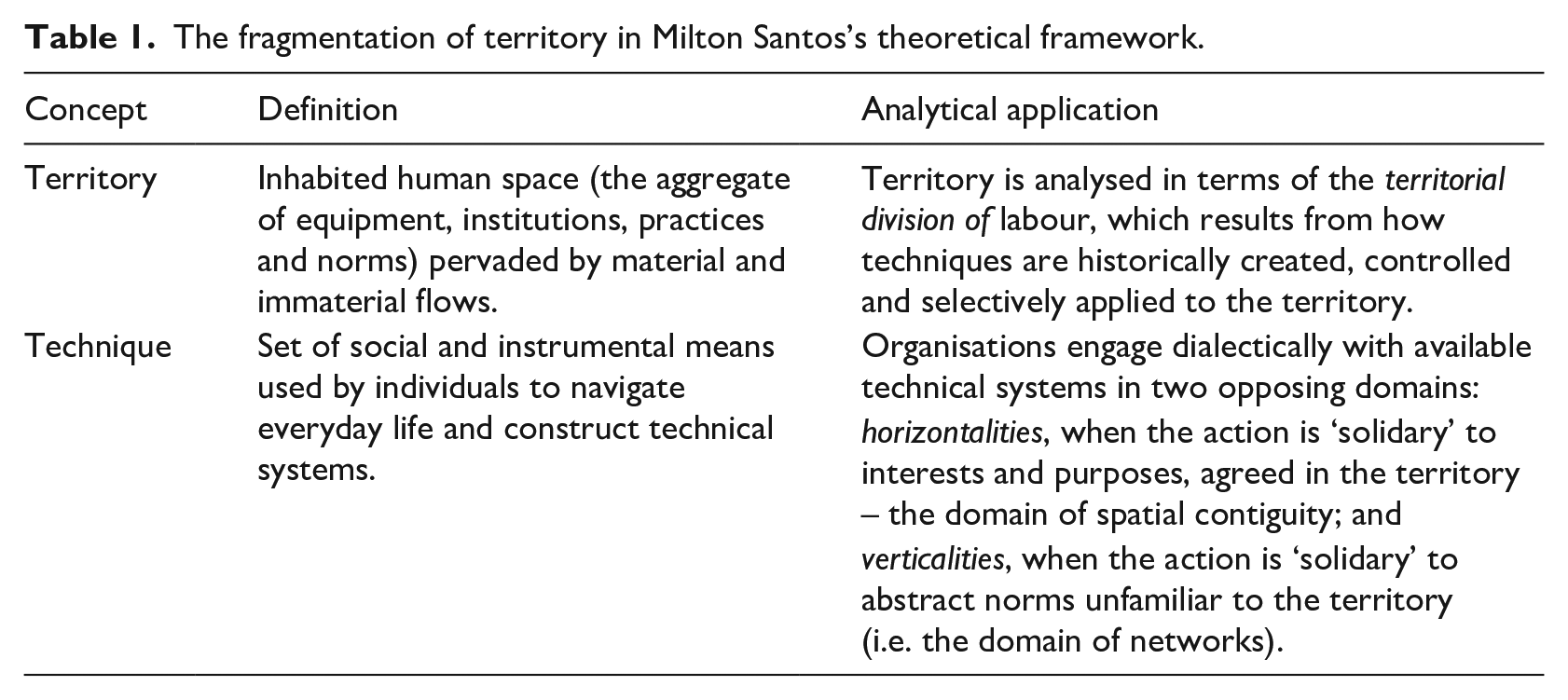
The territorial division of labour is noticeable in the historicisation of techniques that have been selectively appropriated to a territory. In Santos’s ontology, this technical phenomenon is fundamental to understanding how territories are structured. He referred to the set of social and instrumental means employed by individuals as they navigate their lives as the main mediator in the material transformation of space. By analysing how techniques are created, controlled and selectively applied by corporations, Milton Santos explained the process Lefebvre (1991) referred to as the social production of the abstract space of capitalism. By shifting the focus from the embodied social space – as is the case in many applications of Lefebvre’s work in organisation studies (Dale et al., 2018) – to personal relations with the territory, Santos identified the mechanisms that explain territorial fragmentation. Modern processes of urbanisation seek to create a single ‘place’ – understood here as shared norms – across various territories. For example, a marketplace that imposes its instrumentality may dissolve previous solidarities, thereby creating a homogeneous spatiality. However, that abstraction is also mediated by local constraints, and this flow of urbanisation becomes especially selective in Latin American countries, generating distinct circuits of economic activity that share the same urban space (Santos, 1979).
Santos (2006) described two concurrent spatial domains that craft novel places in a territory: horizontalities (‘horizontalidades’) and verticalities (‘verticalidades’). He used these two terms to dialectically contrast the orders being disputed. These two processes coexist: On one side, there are extensions shaped by points that aggregate without any discontinuity, as in the traditional definition of region. These are the horizontalities. On the other hand, there are points in space that are separate from each other [that] ensure the global functioning of society and economy. These are the verticalities. Space is composed of both arrangements, inseparably. (Santos, 2006: 192, my translation)
Verticalities override social bonds because they unfold from unfamiliar places, even if the actions are enacted locally. They happen in places where the political control of production promotes an external planning process that connects each locality with outsider needs, for example, when a head office regulates local branches according to global market requirements. Although verticalities fragment local bonds, Santos highlighted that they also introduce important instruments for the operation of a centralised economy. Conversely, horizontalities preserve and connect the everyday spaces of individuals in the same territory. They consist of points and actions that are contiguous in geographic space, conveying solidarity with local norms. However, this distinction should not be understood simply as a moral divide, as horizontalities could sustain a social fabric based on the local violence of drug dealing or gender inequality, for example.
The relative intellectual neglect of territory in recent times is attributed primarily to its traditional conceptualisation as the appropriation of space in somewhat homogenous zones of power and influence (Raffestin, 2012). This conceptualisation has been replaced for other constructs that highlight the processual imagination of space, as geographical thinking increasingly emphasises ‘porosity and fluidity of boundaries, and the supposedly consequent reduction in their political salience’ (Painter, 2010: 1091). However, Santos’s conceptualisation does not convey a sense of homogeneous power centres; quite the contrary, it frames two dialectically opposed forms of producing space as coexisting in a territory.
In the analysis of the coexistence of horizontalities/verticalities in a territory, Santos (1978) explained that different happenings can enact different linkages of things, people, places and actions that coexist in space, depending on the solidarity of the studied happening. A happening is solidary to a given place by reproducing it. Thus, the idea of being solidary to other places conveys unity and agreement of interests and purposes. Durkheim’s (1984) classic notion of social (mechanical and organic) solidarity (i.e. what bonds individuals together in a society) reflects solidarity within a single territory. In contrast, for Santos, a territory can stage actions that perpetuate multiple orders unfolding from various places. The analysis of these actions reveals their solidarity and the extent to which they structure the territory according to local interests (horizontalities) or distant norms (verticalities). Table 1 summarises how these concepts are applied in my investigation.
The fragmentation of territory in Milton Santos’s theoretical framework.
Observing transformed territories through these lenses may expose their contradictions and contribute to subverting classic dichotomies while remaining sensitive to the political economy of space. The old categories of centre and periphery would be challenged, but on the grounds that the periphery may be ruptured by the reproduction of central spaces and/or displaced to be embedded in the centre, thereby occupying the whole world (Santos, 1994: 79). In Brazil, favelas are an extreme effect of the selective urbanisation of countries with late development. But the capitalist space organises itself as a mosaic, and unequal processes of accumulation might result in favelas occupying the same territory as luxury accommodations or central spaces manifesting within the boundaries of favelas. I discuss this spatial context in the next section.
Favelas as fragmented and unequal territories
Slums are a worldwide phenomenon, and various figures show that the number of slums is increasing worldwide (Davis, 2007). But counting slums is not necessarily the same thing as counting favelas. Likewise, the term favela does not necessarily encapsulate all slum-like spaces in the city, of which there are hundreds. Favelas are defined in terms of their common relations to the formal city rather than their essential conditions because they epitomise a historical spatial inequality that continues to be reproduced via material and symbolic discrimination.
Inequality is a prominent feature of the distribution of land and wealth in Brazil. Despite its vast territory, nearly half of all private land (180 million ha) is concentrated in less than 2% of the properties (Sparovek et al., 2019). The same structural inequality is evident in urban spaces: in Rio de Janeiro, 22% of its 6.7 million inhabitants live in favelas, occupying less than 8% of the urban space (IPP-Rio, 2019). This concentration can be traced to historical processes of spatialisation that materialise inequality in the city’s landscape (Abreu, 1987) and perpetuate discrimination. For example, residents of favelas are less likely to access educational opportunities (Koslinski and Alves, 2012), are more likely to be victims of police (and non-police) violence (Corrêa et al., 2016), and have much greater exposure to health risks and illnesses such as COVID-19 (Klôh et al., 2020).
However, this material divide of the urban space is also enacted and perpetuated discursively by focussing on what the favela ‘lacks’ and overlooking what it ‘is’ (Lacerda, 2015). Favelas are spaces of innovation, ingenuity and cultural effervescence, where small creative ventures are launched and from where many cultural genres such as samba and passinho emerge and spread throughout the city. It is also a space of resistance, where the territoriality tailored by solidarity motivates collective solutions (Souza and Cassab, 2020). The motto coined by movements that emerged in favelas in response to the COVID-19 pandemic – ‘us for ourselves’ – reflects this social potency (Fleury and Menezes, 2021). These territories engender intense social relations, and it is in such a context that dozens of vibrant organisations emerge. This research concentrates on civil society organisations (CSOs), meaning non-profit organisations that are not controlled by the state, such as churches, residents’ associations and philanthropic projects. Rooted in the territory, they have spread over time, and analysing their actions can reveal a great deal about responses to contradictory flows of development.
At this point, it is important to clarify the boundaries that the process of researching favelas might draw. Their diversity in terms of resources, institutions, culture and organisation could make it difficult to place them under the umbrella of a single category that has unfairly stigmatised them as places of poverty and violence from its very inception (Valladares, 2000). However, stigmatisation is a discursive divide with material consequences (Lacerda, 2015), and acknowledging these consequences is important when criticising the perpetuation of segregation. Favelas are disputed territories where governmental agencies launch market building initiatives (Ost and Fleury, 2013), residents’ formal rights are restricted under the rule of criminal gangs (Oliveira, 2012), and social development is promoted by activists residents (Fahlberg, 2018). The political economy of the territory suggests that tensions resulting from these disputes are regulated by technical flows across organisations in the favelas, which support their role in the territorial division of labour. In the next section, I explain the approach I adopted as I observed this in the field.
Methodology: The case of Papua
The fragmentation of territory due to selective urbanisation is a characteristic that Milton Santos associated with Latin American urban spaces in general. The choice of a favela as a more specific territory for fieldwork can be considered an extreme case, given the more pronounced indicators of structural inequality. Flyvbjerg (2006: 229) explained that ‘atypical or extreme cases often reveal more information because they activate more actors and more basic mechanisms in the situation studied’. In this qualitative research, choosing the organisations to investigate was the first step of the fieldwork. For many years, I had already done volunteer work in the investigated favela, Papua (a pseudonym). It is located on a hillside in Rio, as are the vast majority of other favelas in the city. According to the most recent census data, Papua had 10,000 residents divided into two main communities. As in most favelas, development indicators such as literacy (93.6%) and income above the minimum wage (27%) are considerably below city averages (97% and 58%) (IBGE, 2018). My ethnographic fieldwork involved participatory observation and interviews, and access to the favela was obtained through organisations operating there.
Data collection
Papua is divided into two communities. I committed to preserving the anonymity of the favela, organisations and informants because of the sensitive topics under investigation, which included drug dealing and the police. I was granted access to the territory because I had worked for more than 5 years with members of one of the organisations being studied (SingingOrg), and I was aware of the various other organised actions taking place in the favela. On a governmental website, 22 organisations were listed as operating in this territory ‘for the promotion of social development’. I used this list to locate the CSOs that were the target of this study. Through my own mapping, I identified 46 organisations, including 35 non-state organisations. They were diverse, and most of them engaged in activities focussed on culture (e.g. dance groups; n = 10), education (e.g. schools, n = 7) and sports (e.g. football leagues; n = 4). Churches (n = 5), work and residents’ associations (n = 4), health and sanitation organisations (n = 2), social movements (n = 2) and social assistance agencies (n = 1) also played important roles in the development of the territory.
I engaged in participant observation while working as a volunteer in the following two CSOs: MuseumOrg (a museum of favelas whose main project was to paint the walls of residents’ houses with murals depicting historical events of the favela) and SingingOrg (an organisation of three residents that had provided children with music education services since 1999). I volunteered to work at MuseumOrg 3 days a week, 6 hours a day, and committed to helping SingingOrg with various activities in the remaining time. The investigation was also extended to several other organisations that were somehow connected to these two or whose members I could interview.
I recorded hand-written observations in a small notebook that I kept in my pocket and systematically compiled these observations into reflexive diaries. The collected data were not restricted by organisational boundaries. Instead, I focussed my observations on activities the organisations were involved with. The interviews were divided into three sections: (a) responding to past changes, (b) transforming spaces and (c) aspirations for the future. I interviewed 20 participants (15 of whom were residents in the territory) from 10 different organisations. I also collected organisational documents and minutes of the meetings I was allowed to attend during the fieldwork.
Data analysis
Having collected the data, the first step of the analysis was to transcribe all recorded information. Then, I created a hermeneutic unit (HU) for open coding in the Atlas.ti software package. The analysis in this paper is part of a bigger research enterprise focussed on the role of the state and the struggle for hegemony in the territory. Once the entire dataset was coded, I ordered codes from the most grounded to the least grounded, considering the number of quotations associated with each code. The initial list included 198 codes grounded in 1280 quotations, but I narrowed this list down to the 68 codes that were supported by more than 12 quotations or were directly linked to the researched objectives. The number of quotations (excerpts from data) grounding each code was the first and most important criterion used to prioritise the significant codes, which were aggregated to theoretical categories. This paper concentrates on part of these findings, focussing on data directly related to the aforementioned question about the contradictory actions undertaken by CSOs.
Each quotation could be associated with as many codes as necessary, and quotations could overlap. Atlas.ti was used to identify instances where two codes were simultaneously applied the same quotation (Menu Analysis→Code Co-occurrence Table). In this report, the software generated, for example, a list of quotations where the code ‘Disputes’ overlapped with the codes ‘Process – Horizontality’ and ‘Process – Verticality’, or where the code ‘CSOs – Majority are cultural/sporting’ overlapped with the code ‘CSOs – Limited access to means of production’. Focussing on the cells with a high number of co-occurrences was one of the strategies for identifying relations that were highly grounded in data. This analytical approach enabled abductive exploration of the data (Locke et al., 2008) by linking puzzling observations such as the high number of cultural and sports organisations with theoretical categories, such as the territorial division of labour.
Findings
I present my findings in two parts. First, I present evidence regarding the ‘historical’ constitution of the territorial division of labour. Second, I present ‘political’ implications for organisations, which are divided into three sections: solidarity with the local place (horizontality), solidarity with outsider places (verticality) and the reconciliation of this tension.
Historical fragmentation of the urban space: The territorial division of labour
One of the first questions I asked during each interview in the field was ‘If I were a Martian that had just landed on Earth, how would you describe the place where you live/work – the favela?’. Responses
3
often invoked the past: It is a place of survival of a population, A space of livelihood but . . . how can I say that . . . regarding the view of it,
This distinction between morro (hill) and asfalto (road) is how residents had long differentiated life in the favela from life in the formal city. This dichotomy was largely embraced by Rio society, although this separation has been challenged as a discursive strategy to legitimise inequality (Lacerda, 2015). Today, this historical construction expresses materiality, supporting the relevance of the past for understanding the present. In most interviews, participants responded to the opening question about what Papua is in the present using direct or indirect references to the past, as illustrated by the responses above: ‘they seized it and made their homes’; ‘In the past the morro was less dense’; and ‘the favela was much more segregated in the past’. They acknowledged, thus, that their present space was not arbitrary but incorporated the content of past historical systems (Lefebvre, 1991; Santos, 2006), which subsisted in the landscape.
Santos (1978) called these inherited patterns of territorial organisation ‘spatial roughness’, a geologic metaphor incorporated from the idea of previous layers moulding the form we see on the surface, which he suggested also applies to social labour. Other scholars also have referred to the idea of the historical production of space as an iterative construction of territory, using terms such as a ‘leafed space’ (Raffestin, 2012), which also can be seen as a ‘multiplicity of “layers”’ (Lefebvre, 1991). In other words, the lasting forms of accumulated work from the past remain in the territory, and the past division of labour enacts material contingencies for the present. I was also interested in understanding what heritage from the past might have led to Papua having an extremely high number of CSOs relative to most other favelas in the city. Some more politically engaged participants, such as Tandara (MuseumOrg), first argued that the high number of CSOs was related to unfulfilled demand for public services in the favela, in contrast with the surrounding territories. Organisations would emerge to respond to these needs, as the community perceived the state as being largely absent from the favelas: NGOs started appearing . . . from this gap, right? I believe a gap emerged, the necessity, demands not met . . . and people decided to create their non-profit organisations because . . . someone has got to do it, right? And you know ‘where your own shoe pinches’, right? Be it at the road, the hill, the outskirts, on the periphery . . . WE who are IN that territory, in that place, we know what the needs are. (Interview with Tandara, MuseumOrg)
Tandara claimed that CSOs appeared in the territory to respond to the absence of the state and the needs that existed in the territory, confirming that favelas can exhibit strong organisational capacity when driven by local solidarity (Fleury and Menezes, 2021; Souza and Cassab, 2020). What she did not explain, though, is why other favelas that are just as precarious are not as well served by CSOs as Papua, or what justifies the high concentration of organisations focussed on cultural initiatives while many other demands remain unfulfilled. Expanding Tandara’s argument that organisations were created to respond to local needs in the territory, a spatial analysis of this development suggests that historical relations also led to organisations with a certain profile occupying the favela today.
In Rio, favelas were first inhabited by ex-slaves and immigrants from impoverished areas; these areas continue to be spaces of exclusion today. Favela residents enjoy a lower share of urban space (IPP-Rio, 2019) and public services (Klôh et al., 2020; Koslinski and Alves, 2012), and yet their territories house a large number of city workers who perform essential but often stigmatised and undervalued jobs (Millar, 2014). The geography of the hills was the first constraint to be overcome by new organisations, usually located in difficult-to-access areas that hinder organisational activity, even for small things: ‘We would carry this chair [uphill], and the spine would be burning three days later’ (Tandara, MuseumOrg). Although the territory places strong limitations on organisations, it also holds possibilities. The hill where Papua is situated is surrounded by an affluent area that is also very well connected to the rest of the city, which facilitates the influx of external resources. That spatiality stimulates the creation of CSOs with support from the surrounding neighbourhood.
Hence, in addition to the unmet demands, other factors are important in explaining the creation of these organisations. The territorial division of labour drives the technical content available in the territory and is particularly important in explaining the profiles of CSOs that emerged in Papua. For example, for decades, there was no organised action from civil society to tackle the issue of waste collection in Papua, even though local surveys revealed that it was by far the most significant problem for residents. In contrast, at least four CSOs focussed on martial arts in the territory; arguably, the needs Tandara referred to would not warrant this many distinct groups. From a managerial perspective of urban planning, the high concentration on sports and cultural organised activities could be regarded as dysfunctional. However, it can also be explained by the technical content of the territory.
Excluding churches, according to my own assessment, out of 30 private CSOs in the favela, nearly half (n = 14), such as DancingOrg, CircusOrg, JazzOrg, SambaOrg, BoxingOrg, FootballOrg and JiuJitsuOrg, focus on either cultural activities or sports. Other organisations can be categorised as providers of education, health and sanitation, or social assistance services, work and resident associations and political movements. As explained by one resident: I see that in
One of the things that connect the categories of cultural activities and sports is that practising them requires little more than one’s own body. This argument was suggested by a research participant who works with young people in the favela and said girls preferred dance activities because that was a way for them to overcome resource limitations. She viewed dance as a way for young women to use their skills as means of empowerment and added that the body was an instrument that ‘nobody could take from them, and which allowed them to express themselves, imprinting their own mark’ (Field Notes). She related the use of the body thus to the lack of other means by those who live in the favela. As another participant revealed: ‘the most structured CSOs are those that came from the outside of the favela [. . .] those coming from the inside are not as legalised, not very resourced’ (Suelen, SingingOrg). Based on my observations of these organisations, it is clear that for many people in the favela, where other means of production are limited, the body remains an important means of expression. These present limitations have been inherited from past historical arrangements whereby disenfranchised people became concentrated in favelas. This does not mean that the favela is devoid of techniques or resources; the territory is filled with local technical content that promotes a separate but dialectically connected economic circuit (Santos, 1979).
The high number of CSOs in Papua in relation to other favelas was associated with the wealthy neighbourhood that mobilised direct philanthropic actions organised by civil society. The strong focus on cultural and sport activities that depend primarily on bodily expression can be traced to economic limitations that have been historically imposed on marginalised territories. Santos (2006) argued that the socio-spatial formation is a more adequate instrument to understand the past and the present than the mode of production of society, and in effect, although they are distinct, the latter is included in the former. The analysis of territorial spatiality thus locates and materialises abstract entities such as the market and civil society: ‘The arena of opposition between the market—which singularises—and civil society—which generalises—is the territory, in its various dimensions and scales’ (Santos, 2005: 259). Next, I explore how organisations respond to this political economy of the territory.
Political implications: Horizontalities crafting solidarity with places from within
One of the organisations where I worked was MuseumOrg. The purpose of the organisation was to preserve the history of Papua and dispute the dominant narrative about favelas, in an attempt to deconstruct the myth held by outsiders that the favelado (inhabitants) represent a life of struggle characterised only by tragedies and entanglement with criminality (Valladares, 2000). Based on their research, they commissioned murals on the walls of houses depicting local life and history. Their cultural interventions in space changed the landscape and informed residents about the (often unknown) history of the territory. Dozens of such paintings constituted an open space museum. One of its members, Gerson, argued that MuseumOrg and its activities could not be separated from the favela, and for him, the development of one constituted the development of the other: [MuseumOrg] wants to foster the community, but with the clear objective of preserving its memory, you see? That embraces a lot: this is a living museum, then everything is memory. Then, if you do an encompassing initiative to develop something else, you are interested in capturing memory, which is an ongoing memory . . . thus,
According to Gerson, the organisation – its practices, artefacts and representations – could not be disassociated from the territory, because the action for one was included in the other. In addition to the entwinement of material and social relations (Dale, 2005), which reveals the sociomaterial assemblage that organising entails (Orlikowski, 2007), this statement refers more generally to the relation between the organisation and the territory. The historical construction and political contradictions of the favela were also inherited by the organisation. Fostering one would mean fostering the other. The museum was created because of a particular history and told stories related to this history.
Each visit to the open space museum was driven by a sense of solidarity crafted within and through the favelado in the territory. This place became the centre of the narrative conveyed by MuseumOrg, which people from the outside could come and visit. This domain of contiguity in the organisation of space could be related to horizontalities (Santos, 1999), which help maintain the social fabric of a particular place. To accomplish this, MuseumOrg mobilised resources from the favela and organised them according to local needs and motivations. Hence, the principle of organisation behind every visit to the museum shaped the territory by reinforcing the connection to the local place.
This solidarity with the local place not only was present in the physical manifestation of the organisation but also was crafted in everyday activities, in joint efforts that extended beyond the members of MuseumOrg. Tandara explained: ‘It was the residents who were involved with these social issues. It was the residents who took the broom to sweep, who got involved in Sunday joint efforts’. This solidarity is also manifested in other organisations, regardless of their activities, and it became conspicuous when mobilised in local disputes. For example, Victor, from FootballOrg, forwarded an e-mail to me that he had sent to the sponsor of CSROrg when the organisation had tried to prevent the community from using the football pitch: We would like to remind you that
The intention of the e-mail was to subtly threaten CSROrg, an outsider organisation that relied on local bonds within the territory to develop its activities. The e-mail leveraged the political power held by FootballOrg, which was formed solely by residents, whose influence came from everyday bonds in the favela.
Political implications: Verticalities crafting solidarity with outsider places
Most of MuseumOrg’s realisations had been enabled by funding granted by the government to support its innovative cultural proposition. This source of funding was limited and contingent on the political context. One year before the start of my fieldwork, members of MuseumOrg had decided to focus primarily on promoting outsider visits to the murals, predicting that the associated revenue stream would ensure the organisation’s long-term financial sustainability. The organisation developed a trail across the entire favela with 27 stations where it had painted murals telling various stories about the communities therein.
Despite positive feedback from visitors, however, the number of visits was still too low (i.e. two groups a month) to yield the intended financial outcomes. This triggered an internal process of revision and changes in how the service was communicated. The organisation partnered with a researcher of tourism markets who explained that the price charged for admission was too high for a museum ticket. She also suggested changing the name of the service from ‘Visit the Museum’ to ‘Favela Tour’, which was a type of service the market was more likely to pay a higher price for. The organisation’s website was thus updated to reflect this market-oriented language. However, the new term ‘Favela Tour’ had a strong meaning attached, linked to the commodification of the favela. In many ways, it countered the original idea of visitors learning from the favela by developing an understanding of its history through art; in contrast, a favela tour invoked the idea of a tourist attraction widely associated with voyeurism and the commodification of poverty.
When receiving advice from consultants, MuseumOrg had to deal with the clash between their own vision of the territory and the common understanding of favelas reproduced by market-oriented techniques. It is often the case that visitors who are interested in favela tours are motivated by a desire to confirm negative stereotypes produced in films about favelas (Freire-Medeiros, 2011), which they bring to the territory. The offer of a commoditised service would incorporate contractual expectations generated in the marketplace that had not been conceived when MuseumOrg was created. Hence, by changing the name of their main activity to ‘Favela Tour’, the organisers were forced to adopt prejudicial discourses embedded in the external order of the marketplace, crafting new solidarities that, to a certain extent, betrayed their former solidarities.
Outsider frameworks brought in by external advisors also impacted the internal processes of MuseumOrg. In another one of their partnerships, students from a business school were trying to improve the efficiency of the CSO. While I was working there, members of MuseumOrg were struggling to fill in a provided Business Model Canvas poster, a classic business tool intended to map organisational building blocks to support the definition of strategic plans. The poster had spaces where the organisation was supposed to fill in key activities, value propositions, customer relationships, channels, etc. When they told me about the task, I explained that it was a business-oriented tool and suggested that the terms might make more sense if they pretended that their services (using the example of the ‘Favela Tour’) were business services offered for profit. Only from this perspective could they relate to the questions being asked.
MuseumOrg’s members struggled to fill in the poster because the terms did not initially resonate with a territorially embedded non-profit organisation. The framing did not align with their activities because it had been developed in a different context, and its application was intended to erase local meanings. In that instance, the efficient use of such a managerial tool could help the organisation attract visitors (‘customer relationship’), provide (‘perform key activities’) them (‘customers’) with a pleasant experience (‘added value’), and charge them a price (‘revenue stream’) that covered their expenses (‘cost structure’) and yielded a profit. It assumed practices with a fixed form and void of ideological content, in which relationships were based on instrumental exchanges, and the effects should be accounted for in terms of costs and revenues with a positive output. Nonetheless, they accepted the need to adopt it.
When organisations adopt norms and representations that are unfamiliar in the local territory, such as in the examples above, their actions are influenced by distant places that dominate it. Santos (1999) referred to these relationships between locations as ‘verticalities’. When spatial integration is promoted by networked knowledge that flows from the outside, management practices are prioritised by the ‘pragmatic discourse produced by hegemonic sectors, which creates an obeying and disciplined everyday life’ (Santos, 2006: 193). Disciplining everyday life requires actions that are imposed hierarchically and guided by a logic deemed superior, such as the advice offered by the researcher who partnered with MuseumOrg.
Political implications: Synthesis of the dialectical tension
In the cases described above, representations grounded in abstract concepts, such as the ‘tour’ or ‘market’, drained organisations of their political value. In the words of Santos (2005: 257), ‘This dialectic is affirmed by means of “local” control of the “technical” portion of production and remote control of both the “technical” and “political” portions of production’. This instance of verticality can also be associated with Lefebvre’s (1991) idea of abstract space. However, the abstraction of space could imply homogenisation of the territory, whereas the discussion above shows that territory is composed instead by both arrangements – verticality and horizontality – which are inseparable (Santos, 2006). Santos argued that the dialectics of the territory unfold from the tensions between hierarchical and networked integration and the integration of solidarity into the banal space – that is, everyone’s space. The cases discussed above demonstrate the dynamics that involve dispersive (verticalities) and agglomerative (horizontalities) forces for the constitution of organisational space.
The same organisation can be contradictorily solidary to contrasting places – such as the marketplace that generates consumers of a ‘favela tour’ and the local community that invites outsiders to ‘visit’ artistic representations of their history. Because space is inherently political, such tensions reveal the politics of how organisations selectively appropriate and apply techniques, choices that might be mistaken as neutral when the political economy of the territory is overlooked. CSOs are instrumental in both introducing the ‘new’ (e.g. managerial planning techniques) and preserving the ‘old’ (e.g. the history of the favela) in a territory, and spatial fragmentation emerges to the extent that outsider places are reproduced without abandoning local places (Santos, 1999). In effect, the outcome of technical systems depends on how organisations mediate this production since ‘the forces that create fragmentation may, in other circumstances, serve the opposite intent’ (Santos, 2005: 260).
Discussion
Despite the diverse nature of favelas and their organisations, their territorial dynamics are remarkably similar, particularly in terms of the spatial inequalities they face (Lacerda, 2015; Brulon and Peci, 2018; Fleury and Menezes, 2021). I have shown how the historical context of favelas and their role in the territorial division of labour explain the profiles of existing organisations. Constant references to the past observed in the statements of residents reveal a conscious appropriation of their trajectories. Their organisations were created with a purpose rooted in perceived differences from the formal city. This history suggests that relations of domination previously approached by scholars of space and organisations, such as inequality (Van Laer et al., 2020) and identity regulation (Fahy et al., 2014), also can be analysed, and in spaces of precarity are arguably explained by, a territory’s historically constructed technical content (Santos, 2005). In favelas, available technical systems hinder activities that require specific resources (e.g. hauling equipment uphill) and foster the advancement of other widely practised activities (e.g. cultural activities and sports), bringing the political economy of territory to the fore.
Beyond a descriptive profile of the organisations, my analysis of the solidarity conveyed in each case reveals the interaction between the ‘space of organisations’ and the ‘organisation of space’ (Dale and Burrell, 2008), explaining how territorial dynamics mediate power relations within and across organisations. At first, the apparent disorganisation of a precarious territory looks inviting to observe, for example, ‘hybrid organisational spaces’ (De Molli et al., 2020: 2), ‘space as being in constant deformation’ (Ratner, 2020: 13) or ‘temporary territories’ (Daskalaki, 2014: 228), which demonstrate the continuous and sometimes ambiguous production of space that describes how these spaces are enacted. Yet, integration and control do not follow naturally; they depend on organisations politically mediating the contradictory flows that have historically created disputes in the territory. The dialectical opposition between verticality and horizontality enables the analysis of political engagement with distinct solidarities, which reveals why these territorialities are enacted in each happening. Santos’s (2006: 109) view of the political economy of the territory reveals the fragmentation reproduced by organisations that are solidary to local and outsider places through the ‘compulsory fulfilment of shared tasks, even if the goal is not a shared one’. In that sense, it is revealing of power relations that both resist and reproduce central spaces conveying hegemonic economic and political regimes.
In organisation studies, spatial imagination of organising concerned with relations of power trying to impose a pre-determined conceptualisation of space are often read as resistance or ‘contestation’ (Beyes and Holt, 2020). For example, discussing Wikileaks as a network organisation, Munro (2016) described vectors of ‘deterritorialisation’ as a strategy of organisational resistance to create spaces of autonomy beyond the reach of (state) control. In another case of resistance, Daskalaki and Kokkinidis (2017) described how urban movements enact solidarity initiatives through the interplay of local and translocal practices. The cases analysed here reveal that organisational practices involve not only resistance, but also active reproduction. On the one hand, CSOs engage with the solidarity coined in the territory, such as the local history of the favela represented and defended by MuseumOrg interventions, which could be related to the ‘mundane politics’ of poor neighbourhoods in Latin America (Fernández et al., 2017). On the other hand, the same organisation also accepts framing its own actions in business terms conveyed by the ‘business canvas’ and advertising it using market terms such as ‘favela tour’, manifesting the dialectical relation. This approach to the analysis of CSOs also reinforces the importance of considering the larger questions of development in management research, a disciplinary gap that although increasingly acknowledged is rarely bridged (see Srinivas, 2021).
Beyes and Holt (2020) cautioned against the linearity of dialectics that the description of conceptual binaries might evoke when attempting to describe organisational life. The argument made here in support of dialectical analysis is nonetheless defended, particularly in light of the context found in certain territories that only their political economy can explain (Czerny, 2018). Since we could argue that any theorisation will be ‘narrow and ontologically excluding understandings of space’ (Beyes and Holt, 2020: 20), any adopted conceptualisation will rely on deliberate choices. The epistemological (but also political) choices made here unfold from ‘critical performative work’ (Leca and Barin Cruz, 2021) that is motivated by the disconcerting pattern of naturalisation and reproduction of precarity in these spaces. The political economy of the territory thus reveals the conditions for organisations to selectively appropriate and apply techniques according to the conducive solidarity of each happening, thereby reproducing these spatialities.
Conclusion
The question motivating this research was: What power relations are revealed by the political economy of the territory that explain the contradictory actions undertaken by organisations? My findings show that: (a) the territorial division of labour and its historical processes of development explain the profile of existing organisations in the territory; and (b) these organisations support contradictory norms in the same territory, as they convey distinct solidarities enacting not only resistance to, but also the reproduction of dominant places. These findings are based on a spatial approach to power and decision-making beyond the boundaries of the workplace and frame the territory as neither completely dependent on a distant centre nor autonomous from it; rather, the territory is locally governed by that centre through the actions that are solidary to local interests and hegemonic regimes, thereby revealing the fragmentation mediated by organisations.
In recent decades, the spatial turn in the social sciences became dominated by a critique of the fixed and measurable (Thrift, 2006). As Raffestin (2012: 125) put it, ‘representations are like currency: they are subject to inflation and progressively lose their value’. That is, new modes of spatial representation have emerged that more adequately explain the relational and process-based aspects of being present. However, recent capitalist crises that have undermined the stability of the global economy, combined with growing nationalism and an upsurge in territorial disputes, have rekindled attention to how issues of territory and territoriality remain significant on different levels. By examining the political economy of the territory, Milton Santos had already provided a conceptualisation of space that incorporates fragmentation but preserves the structural explanation for imposed relations of domination. His theory conveys well-established circuits (rather than liminal or fluid spaces) that are fragmented by continuous dialectical tensions with dominant spaces.
Santos (2005) claimed that territory would remain a determining spatiality, inviting the globalised world to a ‘rematch’, which in his analysis represented hope against selective integration that contributes to structural exclusion and inequality. Here, I have shown why adopting this perspective is important in research on organisations in marginalised territories, as it enabled me to consider the systemic role played by favelas in the political economy of the urban space. It can also be useful for analysing corporations in the territory, particularly how multinational corporations mobilise local solidarities to exploit natural resources and the inexpensive workforce in the Global South. Producing management knowledge to tackle structural inequality rather than reproduce it requires identifying and promoting the techniques that are solidary to the local places. A more in-depth exploration of the work of Milton Santos and other scholars from the Global South who have built their theories from within should be integral to this project.
Footnotes
Acknowledgements
The author is indebted to Karen Dale and Pete Thomas for their invaluable support during the many years of this research. I would also like to thank the editorial team and the anonymous reviewers for their dedication and patience throughout this long and insightful review process. Responsibility for the content is, however, incumbent on the author.
Funding
The author disclosed receipt of the following financial support for the research, authorship, and/or publication of this article: The author is grateful for the financial support by Montpellier Business School (a founding member of the research centre Montpellier Research in Management: MRM, EA 4557, Univ. Montpellier).
