



Abstract
This article examines the question of solidarity in light of recent refugees’ and forced migrants’ arrivals on Greek island shores as the first point of entry to the European Union. It focuses on various community solidarity initiatives emerging in 2015 and how they unfolded over time, until replaced by hostility and indifference following the EU–Turkey deal in March 2016. To account for this transformation, the study, carried out between 2016 and 2018, involved ethnographic work, interviews with local populations, activists, teachers and community leaders, and participant observations primarily in Lesbos, as well as Chios, Leros, and Samos. This article also sheds light on how Greece’s severe economic crisis has compounded anti-migration politics and securitization in recent migratory movements. Drawing on Judith Butler’s ideas of embodied vulnerability and intersubjective relationality, the article theorizes how solidarity evolves when border struggles intersect with deservingness, belonging, and refugees’ and forced migrants’ precarity. It concludes by proposing a psychosocial embodied notion of solidarity as a political strategy to counteract the neoliberal predicament that threatens all life with extinction.
Humanity is in crisis – and there is no exit from that crisis other than the solidarity of humans (Bauman, 2016: 19).
Introduction
We are now witnessing unprecedented numbers of displaced people worldwide, with 79.5 million forced migrants at the end of 2019, including nearly 26 million refugees, half of them under the age of 18 (UNHCR, 2020). Within a few months in 2015 and early 2016, over a million refugees arrived into the European Union (EU), mainly from Syria, Iraq, and Afghanistan. This highlighted the magnitude of the forced migration of for many Europeans (UNHCR, 2015), although millions of refugees from these and many other countries have been hosted by neighboring countries in the developing world for many decades (Parekh, 2020).
Local communities in Greece, one of the first points of entry into the EU via the Mediterranean sea, displayed solidarity in action by joining forces with international networks of volunteers to address the most urgent needs of arriving refugees (Amnesty International, 2015; HPN, 2016). In the summer of 2015, various self-organized hosting initiatives and community groups providing social support to migrant populations sprung in the Greek islands and mainland (Oikonomakis, 2018). Many others helped the refugees on their journeys toward northern Europe (Karakayali, 2018; Krzyżanowski, 2018). However, these early outpourings of goodwill do not seem to have led to lasting solidarity with the dispossessed “others”. After the official policy of limiting refugees’ and forced migrants’ arrivals by any means possible culminated in the EU–Turkey deal in March 2016 (Amnesty International, 2016; Qiblawi et al., 2020), fear and fatigue has displaced compassion. As many Europeans are influenced by a discourse of racialized “others” who threaten national security (Berry et al., 2015; Dempster and Hargrave, 2017; Papademetriou and Banulescu-Bogdan, 2016), national identity (Dixon et al., 2018) and the stability of welfare systems (Banting and Kymlicka, 2017; Fotaki, 2020; Holck and Muhr, 2017), it seems particularly important to establish how solidarity initiatives to help refugees arise, and what makes them successful.
This article examines these issues in relation to local communities’ responses to the refugee and forced migrant crisis between 2015 and 2018 in Greece, a key EU frontier. Drawing on ethnographic work, interviews with locals, activists, teachers and community leaders, and participant observations in four island communities on the Greek side of the Aegean sea, it investigates how local solidarity initiatives emerged and shifted over time, in the context of border struggles and anti-migration politics. Specifically, this study considers the impact of the EU’s securitization policies (Fine, 2019), following a deal with Turkey in March 2016 to fend off arrivals of refugees and forced migrants into the Greek islands in exchange for billions of Euros paid to neighbouring Turkey. These policies have been characterized by shifting borders, responsibilities and notions of belonging, leaving many refugees and forced migrants stranded on in camps termed as “hotspots” or “reception and identification centers” for years, often unwillingly. Thus, the overarching question this article addresses is how solidarity thrives and wanes in local communities in the face of substantial political and policy changes, particularly with the EU’s shift toward securitization and policing borders on the Aegean sea by the European Border and Guard Agency: Frontex. 1 Its specific aims are: (1) to present and critically interpret how local populations responded to refugees’ and forced migrants’ arrivals in the Greek islands of Lesbos, Chios, Samos, and Leros before and after the EU–Turkey agreement in 2016; and (2) to determine whether and how collective and individual solidarity with refugees in local communities may be influenced by the neoliberal economic crisis and austerity. This case study of crisis-stricken Greece, at the periphery of the Eurozone, with its own populations increasingly facing eviction from their homes, unemployment, and rapid impoverishment (Sassen, 2014) after the global financial crisis (GFC), examines factors that facilitate or impede local communities’ responses to dispossessed newcomers. Its aims are: (1) to present and critically interpret how local populations responded to refugees’ and forced migrants’ arrivals in the Greek islands of Lesbos, Chios, Samos and Leros before and after the EU–Turkey agreement in 2016; and (2) to determine whether and how collective and individual solidarity with refugees in local communities may be influenced by the neoliberal economic crisis and austerity. This enables us to theorize the malleability and multiple meanings of solidarity, fluctuating between particularism and universalism (Banting and Kymlicka, 2017; Kymlicka, 2015; Wilde, 2007). Both notions of solidarity (the former implying membership of a defined community/group and the latter focusing on universal human rights) are crucial for understanding the current ambivalence and hostility toward refugees and forced migrants.
This article’s first contribution is to the extant literature on solidarity and issues of inclusion/exclusion in organizations and society (see Organization Special Issue on Critical Inclusion 2020; Dussel and Ibarra-Colado, 2006; Kenny and Fotaki, 2015; McMurray and Pullen, 2019). The study demonstrates how the recent EU anti-migration policies, together with the protracted effects of the EU-instigated austerity crisis, lead to the emergence of egregious inequalities on its borders, extending to issues of human rights, human dignity, and protection of life. This, we argue, is because solidarity is conceived primarily as an economic-technical concept, with weak normative commitment to the abstract and idealistic promises of equality for all that can easily be separated from its social and ethical dimensions (Banting and Kymlicka, 2017; Covi, 2016). The diminished solidarity seen in the debt management and refugee crises illustrated by the Greek case, we argue, is also core to the neoliberal ideology dominating EU policies. This illustrates the double failure of solidarity under the neoliberal global governance regime, as securitization limits protection of refugees and forced migrants to voluntary assistance by EU member states that may choose not to relocate them (Boucher and Gördemann, 2021). The increasing division between voluntary assistance and human rights and corresponding obligations in the EU approach shows how the latter are being sacrificed in defense of Fortress Europe (Boucher and Gördemann, 2021). However, this failure extends not only to exceptional emergencies and crises but also to the historical and continuous human rights abuses tied to long-term economic exploitation beyond the North Atlantic (Cheah, 2006).
The second and related contribution of this article is to offer an alternative notion of solidarity that is both situated and embodied. In developing this, we take inspiration from Butler’s (2004, 2009a, 2009b, 2015) idea of shared vulnerability as a source of empowerment and her reading of Levinas (1987) work on ethical obligation toward the unknown other. The proposed notion of solidarity is not based on abstract ideas of love, charity, shared cultural values or pursuit of “an identitarian assimilation” (Butler, 1998: 37), but emerges from the shared predicament of human life as a precarious condition, while recognizing that precarity is unequally distributed between groups of people within/across different societies. Building on this theorization, we offer a feminist conception of solidarity that rejects the ideal of homogeneity and the notion of common interests as its foundation. The proposed solidarity is non-exclusionary because it accounts for individual differences yet focuses on common vulnerabilities, establishing an obligation to care for the irreducible other. This theoretical proposal of a holistic, relationally reconfigured notion of solidarity that is situated and embodied, allows us to formulate a political strategy to counteract the neoliberal predicament that threatens all forms of life with extinction. Our empirical case study grounds these theoretical arguments and provides a basis for developing our contributions to the literature.
In the remainder of this article, we begin by discussing different conceptions of solidarity, tracing their roots to the dual philosophical heritage of utilitarianism and idealism (Stjernø, 2012). This, we suggest, finds its political expression in particularism versus universality in European welfare states, and raises questions about obligations toward dispossessed others, such as the refugees and forced migrants considered in this study. Drawing on Butler’s (2004, 2009a, 2015) work, we then contrast these conceptions with feminist ideas of solidarity emerging from embodied precarity and relational ties with others. We explicitly link material and existential vulnerability as part of the human condition with the notion of interdependency that obliges us to protect human life and the dignity of irreducible “others.” Our empirical case study grounds these theoretical arguments and provides a basis for developing our contributions to the literature. We conclude by arguing that the present refugee and forced migration crisis aptly illustrates the current dilemmas of solidarity and possibilities for overcoming them.
Different meanings and scope of solidarity
Solidarity emphasizes cohesive social bonds valued and understood by all group members (Rehg, 2007). Many conceptions of solidarity assume (imagined) reference groups entailing some sort of “membership,” implying responsibilities for others. At the simplest level, solidarity is about readiness to share resources with others (Lahusen, 2020; Stjernø, 2012). However, how “others” are defined is crucial, because solidarity rarely extends to all categories of others. It is sometimes motivated by affection and shared norms and beliefs, and sometimes by rational choice and self-interest (Covi, 2016; Douwes et al., 2018). Although the study of solidarity is as old as the social sciences (Durkheim, 1893/1997), it means different things in different disciplines, which explains its malleability and popularity (Laitinen, 2013; Liedman, 2002). This plurality encompasses conceptual developments, empirical measurements, and solidarity at national, organizational and individual levels (Lahusen, 2020).
Since its early conceptualizations, solidarity has commonly been associated with the idea of a clearly-defined community demarcated by social boundaries, which for Durkheim meant the entire nation, and for Marx a particular class (Liedman, 2002). However, its broader meaning implies an emotionally and normatively motivated universalist willingness to provide mutual support, as in the slogan “one for all and all for one” (Laitinen, 2013). The paradox of universalism versus particularism at the heart of the idea of solidarity has long been evident. On the one hand, it has connotations of unity and universality, emphasizing responsibility for others, a feeling of togetherness (Wilde, 2007) and a strong sense of justice. On the other hand, the welfare state—a political manifestation of solidarity—is based on social membership rather than universal humanitarianism (Kymlicka, 2015). The particularist solidarity underpinning the construction of European welfare states can be seen in the assumed “deservingness” of some social groups, which implicitly favors, for instance, elderly and disabled people over the unemployed, poor and immigrants (Van Oorschot, 2006: 23). Types and levels of sharing are also hotly contested. Particularistic and universalistic solidarity claims therefore come into conflict in welfare states, with differing emphases in different models of welfare (Esping-Andersen, 1996). Overall, the social and participatory rights of groups at the bottom of the social hierarchy thus remain unrepresented in particularistic systems.
At the other extreme is the universalism underlying ethical, philosophical and some political notions of solidarity. For instance, for Honneth (1995), solidarity is achieved when all individuals understand that they are similarly “esteemed” by all citizens. This notion of solidarity, which concerns how people and groups are recognized as moral subjects with altruistic value rather than merely as moral objects with instrumental value, has practical policy implications, for instance in the field of care (Jennings, 2018). Various other postmodern philosophers theorize on the universalistic notion of solidarity. Bauman (2002: 124–143) endorses this idea in his search for a denominator of common humanity. He argues that postmodern politics must be guided by the triumvirate of freedom, difference and solidarity, and that solidarity is a necessary condition for our collective ability to preserve freedom and difference (Bauman, 1997). The idea of human solidarity has also resurfaced in emerging debates around cosmopolitanism (Appiah, 2006). However, for Calhoun (2002), the cause of solidarity will not be advanced merely by adopting an “attenuated” or “soft” cosmopolitanism without challenging global neoliberalism. Under neoliberalism, the power of nation states is subordinated to the demands of global capital manifested, for instance, in the decreasing role of the welfare state even as a particularistic form of solidarity. This is because the globalized postnational neoliberal cosmopolitanism is “generated by, and structurally dependent on the active exploitation and impoverishment of peripheral majorities” (Cheah, 2006: 11).
Mapping the genealogy and conflicting conceptions of solidarity is important for understanding shifting attitudes toward refugees in Europe. It relates to debate about whether solidarity should focus on societal interdependence rather than abstract systems based on norms and legal regulations. It also contextualizes the ambivalent and contradictory policies of EU governments and large sections of their populations during the 2015–2016 refugee crisis and thereafter. Specifically, it raises questions about resource sharing and reciprocity, such as whether solidarity should benefit the neediest citizens beyond members of a nation state, and how much sharing should be involved. This article questions whether supporting needy others whose situations differ from our own counts as solidarity, or whether it has more to do with charity and “humanitarianism.” How these differences are resolved has important implications for changing attitudes toward refugees and forced migrants, while breathing new life into the reimagined idea and practice of solidarity.
Theoretical framing
The foregoing discussion suggests that solidarity is not a fixed and immutable concept, but can be rethought to provide a different basis for answering these questions. To do so, we incorporate ideas from bodies of knowledge not commonly considered in theorizing solidarity, such as feminist philosophies (Butler, 2004, 2009a, 2015; Cheah, 2006; Federici, 2012; Mohanty, 1998). In contrast to utilitarian and economic approaches, or idealistic but abstract invocations of solidarity, feminist thinking focuses on situated practices and embodied experiences (Covi, 2016; Fotaki and Daskalaki, 2020; Kenny and Fotaki, 2015). Feminist theory is well suited to addressing the current dilemmas of solidarity and reimagining its humanist foundations through the prism of relationality and shared vulnerability. Moreover, feminist theorization of solidarity across different geographical locales accounts for the experiences of those excluded from defined social groups, such as refugees, migrant workers, ethnic minorities, and various categories of dispossessed (see Cheah, 2006; Federici, 2012; Fotaki, 2019; Mohanty, 1998), or from dominant social norms, for example through sexual normativity (Butler, 1990, 1993). We briefly discuss some of these ideas to foreground our theoretical approach.
Judith Butler, a theorist and activist whose work inspires our theoretical framework, offers helpful ideas for developing our proposal, which is structured around the notion of embodied vulnerability and relationality, allowing us to reconsider solidarity in terms of interdependence vis-à-vis the unknown other. Her notion of performativity of words and utterances shaping social norms (Butler, 1990, 1993) and her theoretical framing of precariousness and precarity (Butler, 2004, 2009a) provide a useful basis for re-envisioning solidarity. Specifically, we draw on Butler’s ideas of performativity of discourse and ethical obligation to the irreducible other ahead of our own needs, which she takes from Levinas. We also take inspiration from her thinking on vulnerability as a foundation for the ontology of the subject, and her ethico-political stance. Butler thus stresses the performative role of discourse in the uneven distribution of precarity that renders some lives invisible and less worthy, while her concept of relationality explains how our own precarity binds us to others (Fotaki, 2017). Accordingly, humans are relational, since they must be recognized by others as such for their literal and symbolic survivability (Butler, 2004). In her early writings, Butler relates vulnerability to absence of social recognition and our narcissistic need to be acknowledged as intelligible beings (Cyfer, 2019). Her later work is preoccupied with the human body’s vulnerability to injury, privation and suffering, which is socially induced (Butler, 2004, 2009a, 2015). Vulnerability we all share as humans, makes us infinitely open to injury and precariousness. However, this shared vulnerability does not mean that we are equally exposed to these fundamental facts of life, as privation and suffering are unevenly distributed across different social groups and geographies.
This framing of precariousness as an existential concept often interchangeable with shared vulnerability, and precarity as the more specific process of rendering some lives more valuable and more equal than others (Butler, 2004, 2009a), offers a promising avenue for understanding how solidarity has played out in the recent European refugee crisis (Squire, 2018). This crisis also provides an opportunity to rethink issues of ethical obligation to the other, and the social and political conditions that make human lives livable.
The approach taken in this article combines psychosocial perspectives on subjectivity and relationality focusing on the micro (individual) level, with analyses of policy (macro level), and their organizational (meso-level) manifestations in the communities studied. To this end, it brings together macro-sociological analyses theorizing hostility to migration (Bauman, 2016; Sassen, 2014) and psychosocial theories of subjectivity and precarity (Butler, 2004, 2009a). Sassen’s (2014) conceptualization of pervasive forms of dispossession across the developed and developing worlds reinforces Bauman’s (2016) critique of neoliberalism in his recent work on the “forced migration crisis,” and the role of late capitalism in producing this. Taken together, these approaches can provide novel insights to studying interactions between policies and solidarity responses within communities. The eclectic approach offered captures the multidimensionality of solidarity: It may help to unpack the discursive construction of “otherness” in macro-level political pronouncements, and illuminate how these affect individual and organized responses to other humans’ vulnerability and helplessness.
Background
Migration is ubiquitous in human history, with flights from war, persecution and extreme destitution. Forced migrations have become integral to North–South relations and are closely linked with processes of global social transformation (Castles, 2003). Forced migration to the EU has gradually increased since the 1990s, and is now a structural condition (Lulle and King, 2016), fueling anxiety in many countries (OECD, 2015; Papademetriou and Banulescu-Bogdan, 2016). In addition to a perception that refugees and migrants threaten economies and security, such anxiety is often attributed to concerns surrounding globalization and multiculturalism (Berry et al., 2015; Papademetriou and Banulescu-Bogdan, 2016) and dilution of a sense of national identity (Dixon et al., 2018).
Despite myths circulating in the EU and the Global North about “unsustainable” numbers of refugee and forced migrant arrivals, most refugees and displaced people flee to the nearest bordering country, as demonstrated by the huge numbers of Afghan refugees in Iranian and Pakistani refugee camps in the past (O’Neill and Spybey, 2003). Of the 6.6 million Syrian war refugees since the war began in 2011, the majority have fled to neighboring Turkey (over 3.6 million), as well as Lebanon (almost 1 million), Jordan (over 660,000) and Iraq (c. 245,000) (https://data2.unhcr.org/en/situations/syria), whereas the whole of the EU has accommodated fewer than 1.3 million. This recent migratory movement to the EU represents less than 1.3% of nearly 80 million displaced people worldwide (Parekh, 2020).
Historically, dispossession of needy groups of others was often met with indifference and rejection by those who might help (Dragostinova, 2016; Stonebridge, 2018). Social and individual factors identified as potentially facilitating or impeding societies’ willingness to receive refugees and migrants fall into the broad categories of economic, security-related, cultural, and integration threats (Dempster and Hargrave, 2017). Cholewinski and Taran (2009) note decreasing solidarity with uprooted people, despite their greater exploitability under conditions of deregulatory globalization. Major international crises and upheavals may also shape responses by both states and populations, as in the spread of the 2008 global financial crisis (GFC) to the EU.
Greece was badly affected by the Eurozone debt crisis and ensuing austerity, and was the first point of entry for those fleeing wars in the Middle East, extreme poverty in sub-Saharan Africa and persecution in Iran, Iraq and Afghanistan. The relatively numerous arrivals of refugees and migrants during a short period in summer 2015, which became known as the EU “refugee crisis,” occurred amidst the severe austerity policies demanded by the troika of supranational lenders and implemented by all Greek governments. In 2016, the country was experiencing a sixth consecutive year of economic contraction with its economy shrank by 30% between 2008 and 2015, a drop in GDP unparalleled for a peace-time economy (Coppola, 2018). In July 2015, official unemployment rates stood at 25%, with long-term unemployment at 20% and youth unemployment at 49.5%. In 2016, reception centers for processing refugees and forced migrants, known as “hotspots,” were established across Greece, and particularly in the islands neighboring Turkey.
In March 2016, the EU signed an agreement with Turkey to send thousands of refugees back in a deal aimed at preventing people from reaching the EU by sea. In exchange, Turkey would receive €6 billion to assist in hosting its vast refugee community, and once the number of irregular arrivals dropped, a “voluntary” humanitarian scheme would be activated to transfer Syrians from Turkey to other European countries (Gogou, 2017). Yet the deal was flawed from the outset. Denying refugees the right to apply for asylum as they reach the EU is against international humanitarian principles, violating the Geneva Convention (Peers and Roman, 2016); and Turkey had a poor record on according asylum claimants and refugees proper access to asylum procedures (Poon, 2016). More importantly, various EU members states refused to relocate refugees and forced migrants from temporary camps in Greece even if they qualified for asylum.
We demonstrate how all these changes have impacted on individual and local organizational attitudes in communities with a track record of supporting refugees and forced migrants in Greek islands (Oikonomakis, 2018) and the mainland (e.g., in the occupation of unused buildings in Thessaloniki—see Tsavdaroglou, 2018 or Athens—see Squire, 2018). Their emergence and demise under neoliberal crisis conditions and the EU’s shift to securitization at any cost raise important questions about what enables shifts from compassion to hostility, and pose theoretical and empirical challenges to the nature and purpose of solidarity.
Methodology
A research methodology explains the links between methods and epistemology, highlighting the implications for research practice (Harding, 1987). This study followed a feminist epistemology, which acknowledges that researchers and researched are both subject and object of research (Sprague and Kobrynowicz, 1999), meaning that academics are not the sole, isolated producers of knowledge (Haraway, 1988; Harding, 1987). Establishing a relationship of mutuality between researcher and researched through self-revelation and emotional support produces better data and richer understanding (Oakley, 1981). Feminists also object to “othering,” questioning the legitimacy of research on groups over which the researcher has privilege (Harding, 1991).
These assumptions had implications for the study’s design and methods for collecting information and analyzing the data gathered. Driven by ethical and philosophical concerns, we decided not to interview forced migrants and refugees themselves, as the researcher’s presence might put them at a further disadvantage, given their vulnerability and dependence on outsiders (Nayeri, 2019), as well as language barriers. Instead, we conducted participant and non-participant ethnographic observations and short ad hoc conversations with some refugees who addressed us. The author’s intimate connection to the subject studied, stemming from her personal multiple histories of exile and migration as a Greek national, was a strength rather than a weakness of the methodology, allowing a reflexive stance that rejects detachment and embraces engagement as the road to knowledge (Burawoy, 1998).
Methods
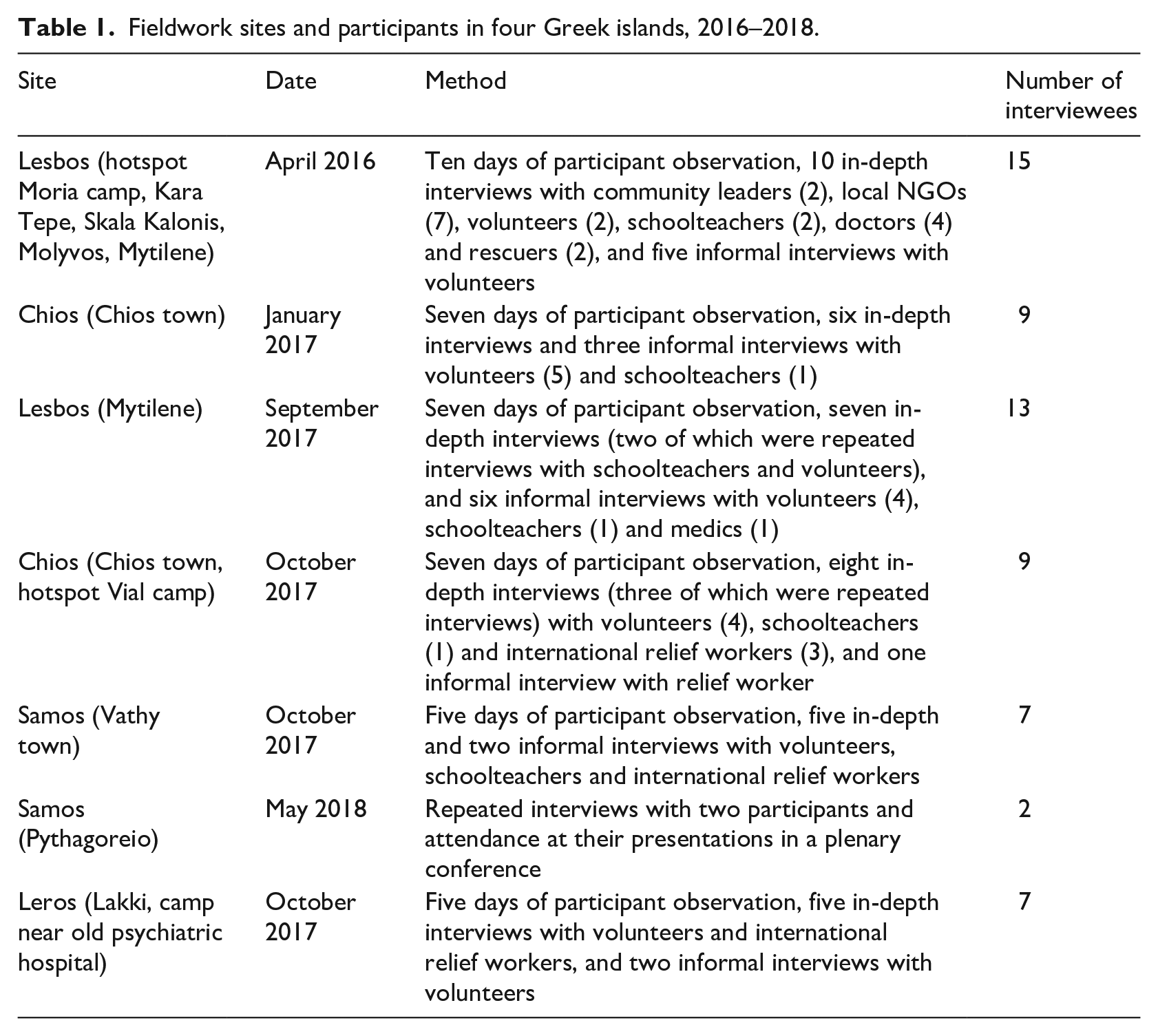
We adopted a multi-methods approach appropriate to the various disciplinary inputs that inspired the theoretical framing of this study, comprising (i) 34 in-depth interviews with key informants (local leaders such as doctors and teachers, activists/organizers setting up or participating in charities, and local and international volunteers) on their involvement in assisting refugees and forced migrants, lasting between 1 and 3 hours each; (ii) 300 pages of diaries and contemporary records of activities and meetings of voluntary organizations; (iii) participant observations; and (iv) documentary analysis of press excerpts. All fieldwork was conducted by the author in Lesbos (April–May 2016, September 2017), Chios (January and October 2017), Leros and Samos (October, 2017), and again in Samos (May 2018) (see Table 1). The researcher stayed in Greece during the summer of 2015 and observed first-hand the unfolding of refugee arrivals in Lesbos and Athens, which inspired the conduct of systemic research on communities’ solidarity responses to refugee arrivals over time. The sites were chosen because Lesbos and Chios were the islands with the highest numbers of refugee arrivals, many of them detained in closed facilities, while Samos and Leros were sites where reception facilities (hotspots) had been newly established, with smaller numbers of refugees and forced migrants. 2 Initial contacts obtained through a family member’s involvement as a volunteer in Lesbos in September 2015 enabled the identification of further participants across the four islands using a snowballing method. Securing access to community NGOs set up by citizens of the four islands studied, and solidarity networks through the researcher’s contacts with local communities (three doctors, one nurse, five teachers) was key, as these were often the first points of contact providing essential welfare services to the newcomers. Initial contacts obtained through a family member’s involvement as a volunteer in Lesbos in September 2015 enabled identification of further participants across the four islands using a snowballing method. The researcher visited them in refugee centers, rehabilitation institutions, and charities working with the disabled, worked as a participant observer in activities such as cooking in the Moria and Kara Tepe (Lesbos) refugee camps, and attended classes teaching children in another refugee camp (Vial, Chios).
Fieldwork sites and participants in four Greek islands, 2016–2018.
Data analysis
An inductive approach was employed in the analysis, tracing through all the chronologically-ordered raw data (interview transcripts and observation notes), and coding to identify key themes in an iterative process (Charmaz, 2006). We initially identified broad terms such as “help,” “assistance,” “solidarity,” “support,” “fear,” “stranger,” and “compassion.” Relevant excerpts from the open-coded interviews were highlighted, copied from transcripts, and then pasted and collated into a data summary document. In the second stage, intermediate codes across the four case studies were identified, which were concerned with “facing the other in need,” “choice-less choice,” “identification and/or dis-identification with the plight of the other,” “individual spontaneous reaction,” “embodiment,” “shifting solidarity,” “unwanted others (refugees and migrants),” and “penalizing those who help them.” Psychosocial approaches can offer unique methodological insights into how social structures interact with personal stories and identities (Hollway and Jefferson, 2005). This enabled the informants’ narratives to be compared and contrasted across the four study sites. Our analysis yielded a cluster of themes with common threads and topics concerning the challenges and complexities of facing the strange “others” reported by individuals, the collective responses by groups within communities organizing assistance for refugees, and the shift in attitudes following the formal policies of the EU and the Greek state. Refining and bringing these together with analysis of the ethnographic notes and press excerpts allowed us to build a theoretical framework linking macro, meso, and micro levels from all the cases. Three core categories underpinned our multilevel theorization: (i) individual empathy or hostility toward the unknown other; (ii) the role of collective attitudes and discourses in embedding these attitudes in local communities at the organizational level; and (iii) overturning of solidarity by macro-level state and EU policies. The first two phenomena were observed mainly in the first massive influx of refugees in 2015 and early 2016, and the third became evident following implementation of the controversial EU–Turkey agreement after 20 March 2016.
The analytical strategy was informed by grounded theory, in which diverse but compatible theoretical perspectives, including macro-sociological analysis with psychosocial approaches, are thoughtfully incorporated into the general outline of the original method (Strauss and Corbin, 1990). This “dwelling in” theory underpins what Burawoy (1998) terms a reflexive model of science, deploying multiple dialogs to reach explanations of empirical phenomena. In ethnography, this aims “to extract the general from the unique, to move from the “micro” to the “macro,” and to connect the present to the past in anticipation of the future” (Burawoy, 1998: 5). It also allows ethnographers to organize their empirical research materials into a story (Tsing, 2004). Despite conducting ethnographic observations rather than an extended ethnography, we drew on a variety of theoretical insights to interpret the empirical data. In addition to organization studies, these included philosophy, and particularly feminist psychoanalytic philosophy, anthropology, and political science. We deployed our theoretical arguments, moving from the macro to the micro level, while acknowledging how different levels of analysis were embedded in each other. For the macro-analysis we used policy documents and media discourses to account for shifts in the political landscape; for the organizational meso-level analysis our aim was to document how various, mainly temporary, solidarity initiatives were set up and how they dissolved; and for the micro-level analysis we conducted repeated in-depth interviews between 2016 and 2018 with key individuals, most of whom were still actively involved in these initiatives.
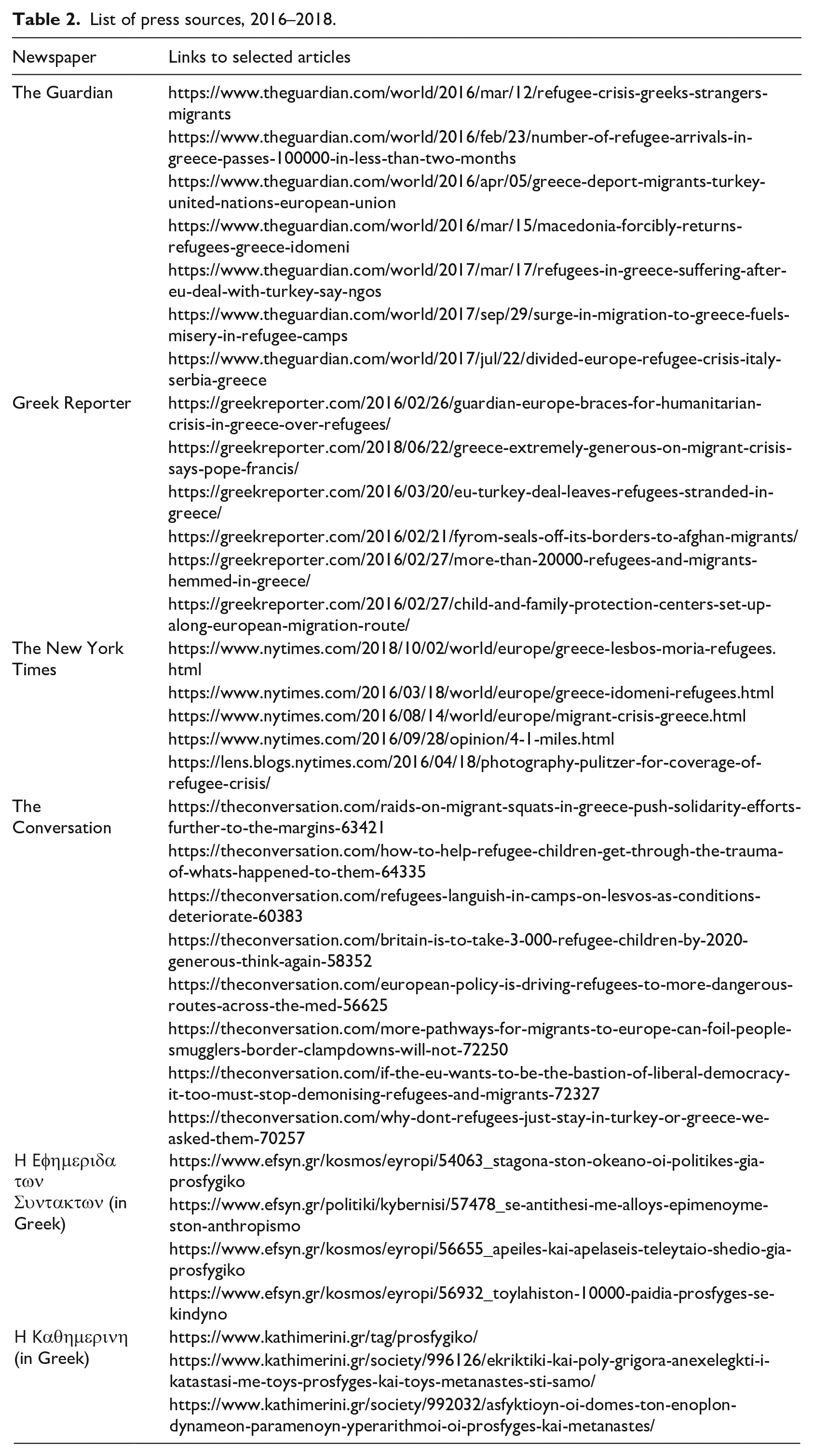
This study was limited by its relatively small sample and the rapidly changing political and geopolitical context. However, the findings presented here are of wider relevance for building theory relating to shifting solidarities under globalized neoliberal regimes and EU securitization policies. To overcome the first limitation, documentary analysis of excerpts from both the media and professional publications (see Table 2) was undertaken to triangulate the findings from interviews and observations. The second limitation was addressed by focusing on theorization combining interdisciplinary insights to tell the story.
List of press sources, 2016–2018.
Findings
Individual level: Meeting the unknown other
I was struck by how ordinary the village was when I first arrived in Skala one afternoon in early April. This was a typical seaside place that could be found in many corners of Greece, with its cafés, the elderly strolling with their grandchildren, old men drinking boiled, finely-ground coffee from small cups – an impression of a leisurely early evening: peaceful, still, and a little boring perhaps . . . Yet a quick stroll revealed a community office turned into a warehouse of used clothes in case they are needed for the new arrivals, two camps of international volunteers at the outskirts of the village, with opposing political views not speaking to one another– and what looked like stillness was, in reality, thick anticipation bubbling under the surface of what might yet happen when boats show up on the horizon again (Note from ethnographic diary, 9 April 2016)
Skala Sykamnias is a village of only 140 inhabitants in northern Lesbos, where people crossing the Mediterranean in the latest wave of European migration arrived in 2015 and 2016. With more than 200,000 refugees entering EU territory through Skala, on the northern Aegean borders with Turkey, the small community became an epicenter of the “European refugee crisis” (Papataxiarchis, 2016a). Described by anthropologists as a unique experiment in humanitarian governance involving a multiplicity of actors (see Papataxiarchis, 2016b), it was also a stage on which various dimensions, dilemmas and aporias of solidarity unfolded. The following account by Evi, a 60-year-old woman from Skala, offers a glimpse into these complex and conflicting feelings:
I could not bear to see their suffering . . . and there were so many of them, the boats were coming all the time, there were days with more than 50 of them arriving . . . I recall one morning when all of this began, I woke up to the noise of foreign language just outside my window . . . like guttural sounds . . . was it Arabic? I was not sure where I was . . . in Iran?
Many other respondents who received people off the boats often felt they had to do something to alleviate the misery of other humans they were witnessing: There is not much choice when you find a boat full of scared people in the middle of the night . . . The sight of shivering people moved even those who did not want them in the village in the first place.
This was how Minas, an old fisherman, reported his decision to rescue people in dinghies who could not operate the engine and might not have seen the sea before. From the accounts many participants shared with us across different locations, it appeared that such decisions were not a result of conscious deliberation, but rather arose from an urge to protect them from harm. It was as if the whole process occurred through an embodied feeling rather than through thinking. Common expressions in retrospective accounts included “feeling pity,” “compassion,” experiencing “the urge to act in the face of other people’s powerlessness,” and “fear that the other vulnerable human could die in their hands,” as reported by Minas’ wife, Zoe. Although human despair and neediness left many respondents shocked, this was often mixed with ambivalence, or even hostility.
In the same tiny village, Skala Sykamnias, villagers displayed a wide range of behaviors. For instance, Minas reported that a shop owner refused to sell a bottle of water to a man coming off a lifeboat in the scorching heat of the Greek summer. Yet, while many other fishermen in Lesbos acted like Minas, there were also mentioned (isolated) instances of fishermen searching any dead bodies they found for valuables. At every study site, interviewees reported many anecdotal references to local people overcharging refugees and migrants for all kinds of services, including mobile phone plugs and toilet facilities. We also heard accounts of people engaging with and reproducing racialized tropes, while doubting the migrants’ motives for leaving their war-torn countries and their entitlement to refugee status.
In the city of Chios on my visit to the hairdresser, I engaged in small talk with a young woman doing my hair. After asking about my purpose for visiting the island in January, she opened up by sharing with me how these ‘newcomers destroy the island’. I tried to inquire further about their specific actions, knowing that Chios does not rely on tourism as much as it does on agriculture, for instance. The answer was blunt: ‘we do not want them here’ (Ethnographic diary, 8 January 2017).
Villagers’ responses to arriving strangers were often determined by their political beliefs, which influenced their attitudes in favor of or against providing selfless assistance. Fishermen hauling numerous unknown others to safety in Lesbos were often affiliated with left-wing parties (Cantat, 2018; Papataxiarchis, 2016a). For instance, Minas and his wife Zoe stated that, unlike them, “the majority of people who were hostile to refugees were supporters of right-wing parties.” Their personal histories as descendants of refugees from Asia Minor (Oikonomakis, 2018) also played a role. Respondents from all study sites referred to being motivated by their own families’ past histories. A track record of previous engagement with anti-austerity or self-help solidarity movements in the aftermath of the financial crisis (Tsavdaroglou, 2018) was also a strong factor ensuring people’s sustained support and action in solidarity with the dispossessed in the long run. Yet many other locals, for instance in Leros, appeared to be donating clothes or food in response to the community mobilization and media attention. Some continued reluctantly to do so silently while expressing their anxiety about people coming to their sparsely populated island: “They would often tell me we supported them when they arrived in 2015; now we are tired and then they would leave a bag of oranges from their grove in the morning” (Lina, a former magistrate who set up a charity to receive refugees).
Organizational level: Solidarity as a collective and discursive process
The example of the tiny village in Lesbos provides another important lesson on why collective responses may prompt people to help others, even if not motivated by compassion: individual choices were socially mediated. For instance, the hostile shop owner changed his ways when his neighbors shunned him. Even islanders who were not welcoming toward refugees came to accept their duty to help, as suggested by a shop owner who initially refused to sell water to people coming off the boats: “no, we do not want them here, but as they appear in front of us in desperate need we cannot let them be like this” (Tassos, local shop owner, Skala). Not letting them be “like this” involved clothing, feeding, sheltering, and keeping people warm to prevent hypothermia as soon as they arrived. “Feeding” and “saving” then became paradigmatic manifestations of “love,” “humanness” (ανθρωπιά) and “solidarity,” which seemed particularly worth celebrating in Skala Sykamnias, and in Lesbos more generally: “Skala emerged in public discourse as the place where one could trace an authentic essence of solidarity in the actions of particular inhabitants” (Papataxiarchis, 2016b: 4). “Hospitality” (literally “love of the other” in Greek—φιλοξενία), a long-established value governing Greeks’ attitudes to strangers and foreign others, thus “retreated to the discursive margins; it was outflanked by “solidarity” as a mode of engagement with an “other” who does not have and does not claim a place” (Papataxiarchis, 2016b: 207). The widely circulated image of three village grannies helping to feed a refugee woman’s baby (see Picture 1) symbolized this transformation.
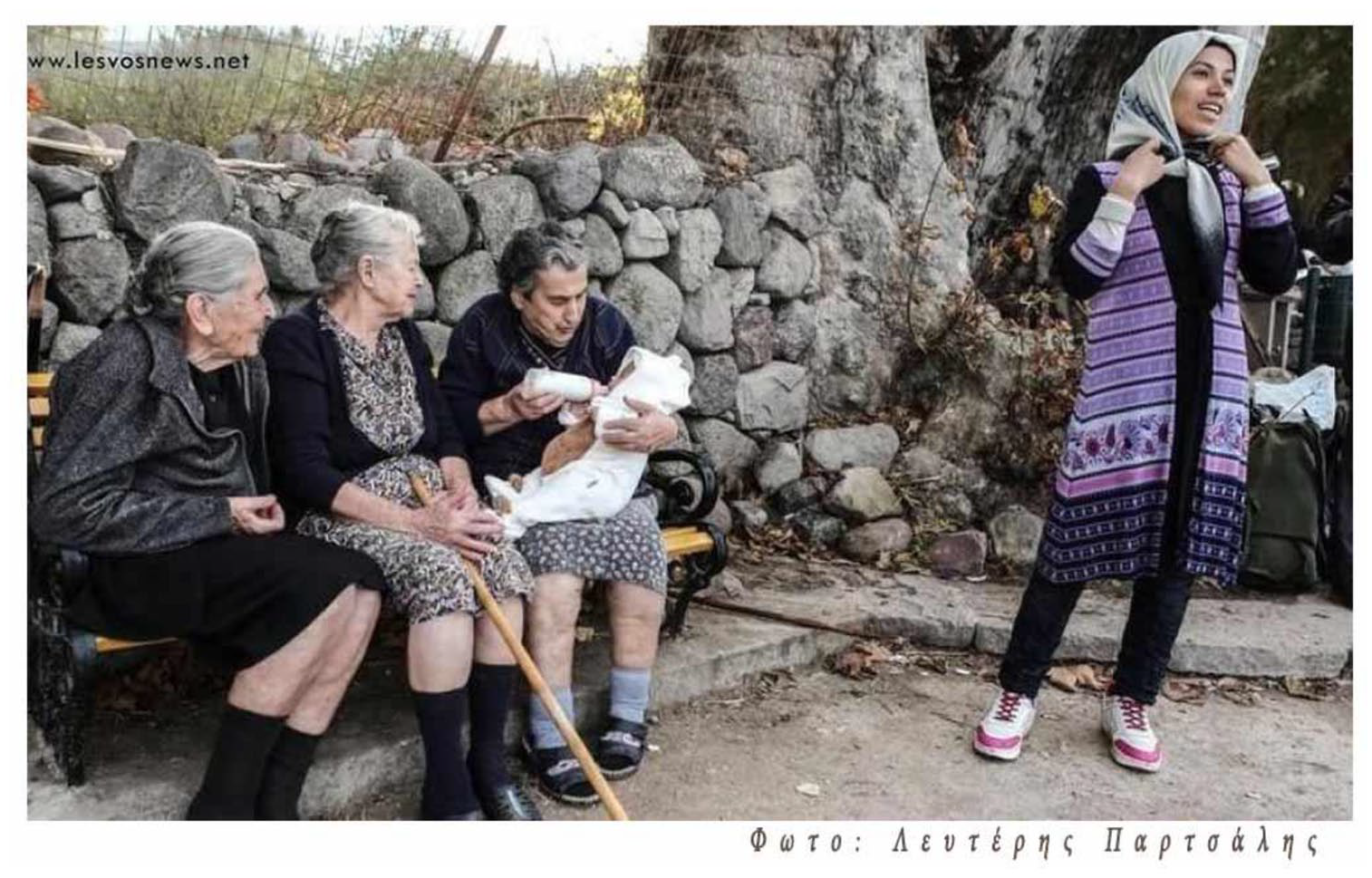
Grannies from Skala Sykamnias in northern Lesbos.
“Solidarity” was thus conflated with the Greek islanders’ patriotic attitudes, to produce the embodiment of moral Europe upholding the values of universal humanitarianism (Papataxiarchis, 2016b). According to the European Commission President, “Europe is the baker in Kos who gives away his bread to hungry and weary souls,” referring to a baker who provided refugees with over 100 kg of bread each day throughout the long summer of migration (Adamopoulos, 2015). This enabled individuals to adopt a positive image of Greece amid the crisis, overturning the stigmatizing discourses of profligate southerners “living above their means” and the stereotype of the “scapegoat,” which many Greeks felt they had been turned into during the financial crisis. The European Commission President at the time stated, “Europe is the baker in Kos who gives away his bread to hungry and weary souls,” referring to a baker who provided refugees with over 100 kg of bread each day throughout the long summer of migration (Adamopoulos, 2015).
Nevertheless, those sustaining various solidarity initiatives were mainly small groups and individuals acting out their political beliefs and civic commitments, rather than performing moral and European values in the abstract. As already stated, various political forms of solidarity took off during the financial crisis. Citizens set up self-help initiatives, such as social supermarkets, cafés, and health centers (Daskalaki and Fotaki, 2017; Kantzara, 2014; Kouki, 2021), where people could donate their labor or barter goods and services to offset the devastating effects of austerity and spiraling unemployment (Daskalaki, Fotaki and Simosi, 2020). Further, most of those who set up charities, NGOs and other organizations to assist the refugees had previously worked with asylum seekers in detention centers, or had run legal help groups for migrants arriving irregularly and clandestinely in Chios, Leros and Lesbos.
The GFC had also mobilized citizens with no previous history of engagement with migrant help groups and collectives, or anticapitalistic and alternative movements. As quite a few respondents reported, helping refugees enabled them to break through the stigma and isolation of being unemployed. This was evidenced by Yiannis, a former salesman from Mytilene:
When I lost my job at the age of 45 at the beginning of the crisis, I felt ashamed and did not want to leave my home anymore. Joining the social kitchen, cooking and offering free meals to refugees gave me back my sense of dignity and self-worth.
Panagiotis, a retired accountant from Mytilene, was not alone in relating that being able to meet the refugees’ essential needs and care for them gave him a sense of meaning and purpose:
Refugees allowed us to rediscover the sense of happiness we experienced when helping others. It was not us giving to them; it was them offering us this gift which made us rethink the things that mattered.
Although he experienced this as self-fullfillment and happiness, other well-meaning people might be seeking social recognition through their acts of humanitarianism. Consciously or otherwise, they may thus remove the agency and dignity required by refugees (Nayeri, 2019) to experience themselves as equivalent human beings. Overall, the many actors engaged in helping refugees had very different motives, politics and practices. For instance, activists espousing the values of politicized solidarity (“the solidarians”) in Lesbos shied away from giving associated with pure charity and humanitarianism. As Cantat (2018: 6) explains:
In the Greek context, ‘solidarians’ is the label used by people who act in solidarity (in this case with migrants) on the ground of strong political and ideological commitments usually associated with self-organization and ‘horizontality’. They often contrast their stance with that of ‘volunteers’, seen as defending a narrower agenda, focused on ‘helping’ and devoid of political ambition.
This tension between solidarity and humanitarian philanthropy could also be seen in the egalitarian, collective production and consumption of food in public, including “initiatives” on the island of Lesbos such as O Allos Anthropos (translating as “Another Human”) and Platanos (the Plane Tree). While both cooked for refugees, Platanos, which originated in the anti-authoritarian No Borders movement, espoused the logic of agonistic solidarity, whereas O Allos Anthropos (where the researcher helped with cooking) was closer to the logic of philanthropy, although it mobilized people like Yiannis and others, enabling them to realize hidden needs within their own communities and find ways to meet them. Given the scale of arrivals, even providing essential help to the numerous newcomers would have been impossible without some form of collective action often involving entire communities. There were many examples of public facilities being turned into clothes and food distribution points including parking lots, parks, and open-air spaces set by local teachers, community leaders, and served by ordinary people or small local businesses such as Aggalia in Skala Kalonis or OXI in Northern Lesbsos for instance. However, all these forms of solidarity would prove unsustainable without expression and representation in the political arena, as discussed next.
Macro-level policies: Overturning solidarity through securitization
In early 2016, the long summer of a welcoming culture and cross-border solidarity came to an abrupt end (Amnesty International, 2016). Fear and resentment began to replace the initial welcome by on-the-ground initiatives when some European governments started to erect wire fences and walls to stop people moving. Policymakers’ reactions and media discourses (Berry et al., 2015) played key roles in setting the tone and influencing collective organizational responses by communities and societies. Motivated by nationalism and xenophobia right-wing governments in some EU member states refused to accept any refugees or forced migrants who were not Christian. This left the refugees in limbo, and the Greek government was unable to meet their needs. Many islanders who had been helping them began feeling like they were sharing the abandoned and stranded migrants’ fate. Rather than becoming the foundation for solidarity with refugees and migrants, “the common predicament” took an adversarial and confrontational turn when securitization replaced EU and Greek policymakers’ symbolic and non-committal nods toward “solidarity.”
In the town of Vathy in Samos, the refugees and migrants could be seen from afar: women with long sober dresses and headscarves and young men congregating in the outdoor public spaces in the promenade, children playing in the playground. These places were also avoided by the locals. The camp was located 700 metres away from the central square on the hill but there was no entry for the outsiders (Ethnographic diary, 15 October 2017).
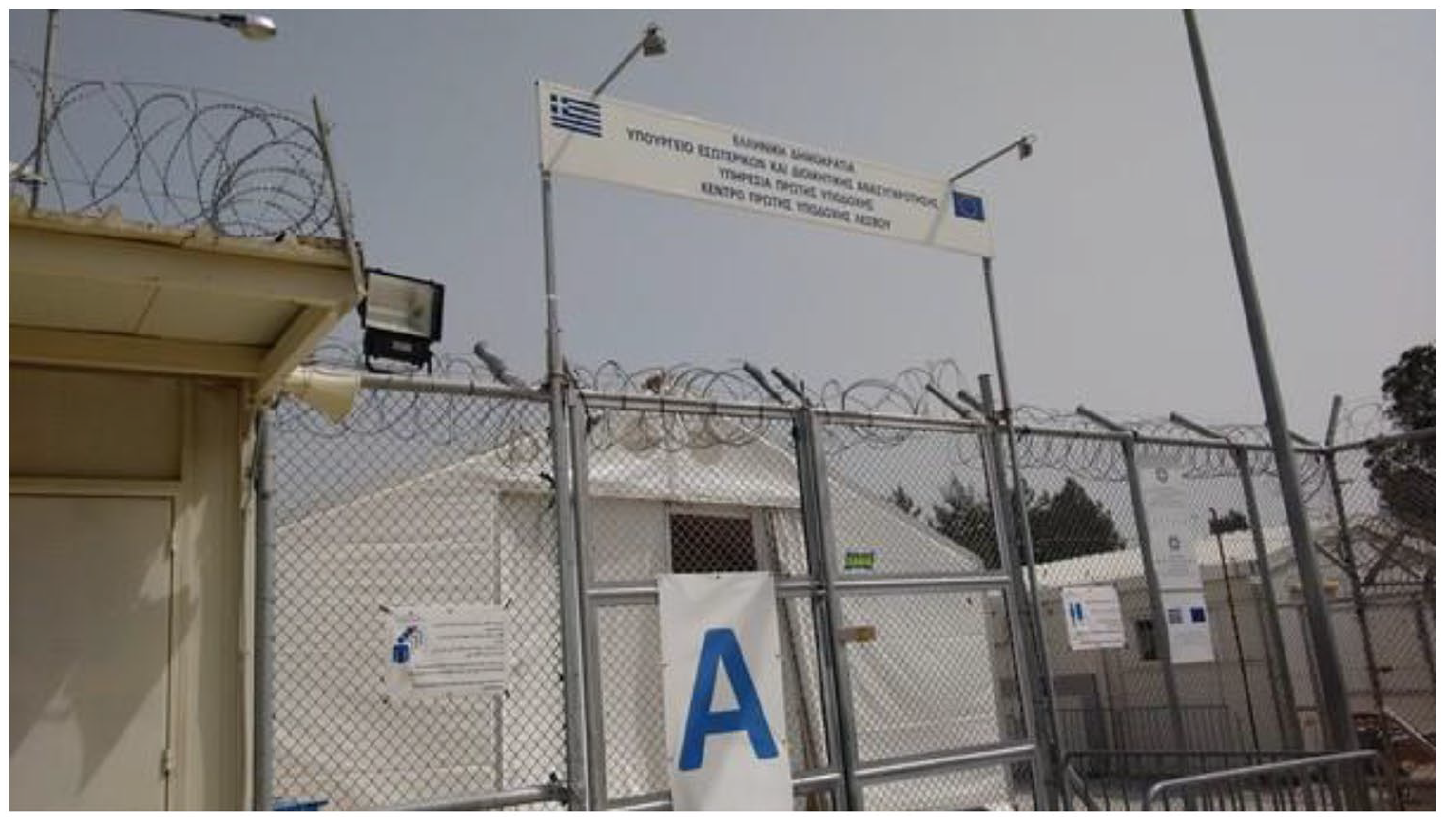
According to Lina and Stelios, founders of a local NGO to host arriving refugees and migrants, the mayor of Leros volunteered to set up a reception center known as “the hotspot” to attract funds in the hope of stimulating the local economy of the sparsely inhabited and rather isolated island. However, this did not help the occupants’ integration into the community: It was a half-hour stroll from Lakki to the old psychiatric hospital on the outskirts of the town where the hotspot was located. On my way, I passed the faded white and yellow buildings of the former Italian WWII base which was a place of enclosure for political prisoners and then for the mentally ill in post-war Greece. Like most camps, this one is also separated by barbed wire – when I try to take photos of the premises, the armed guard approaches me and firmly commands me to delete them (Ethnographic diary, 24 October 2017).
Termed “reception and registration centers,” commonly referred to as “hot spots”, these liminal spaces are places of incarceration for refugees and migrants who cannot legally leave the islands before being granted asylum in another EU country, which is a lengthy process often taking years (Amnesty International, 2016). With the exception of Samos, most of these facilities were located outside city centers; yet their presence consistently evoked open hostility in the islanders. Physical distancing caused various forms of social distancing. Georgios, an employee of a charity seeking accommodation for vulnerable refugees in Samos, reported that local people resented the unfamiliar appearance of women wearing scarves and long dark coats and their presence in public spaces.
In the town of Vathy in Samos, the refugees and migrants could be seen from afar: women with long sober dresses and headscarves and young men congregating in the outdoor public spaces in the promenade, children playing in the playground. These places were also avoided by the locals. The camp was located 700 meters away from the central square on the hill but there was no entry for the outsiders. (Ethnographic diary note, 15 October 2017). I was struck by the image of the playground with no local children, with only refugees’ and migrants’ children accompanied by their parents playing there [see Picture 2]. They were also sitting outside on the promenade, away from the locals who were no longer seen strolling (Ethnographic diary note, Samos, 15 October 2017).
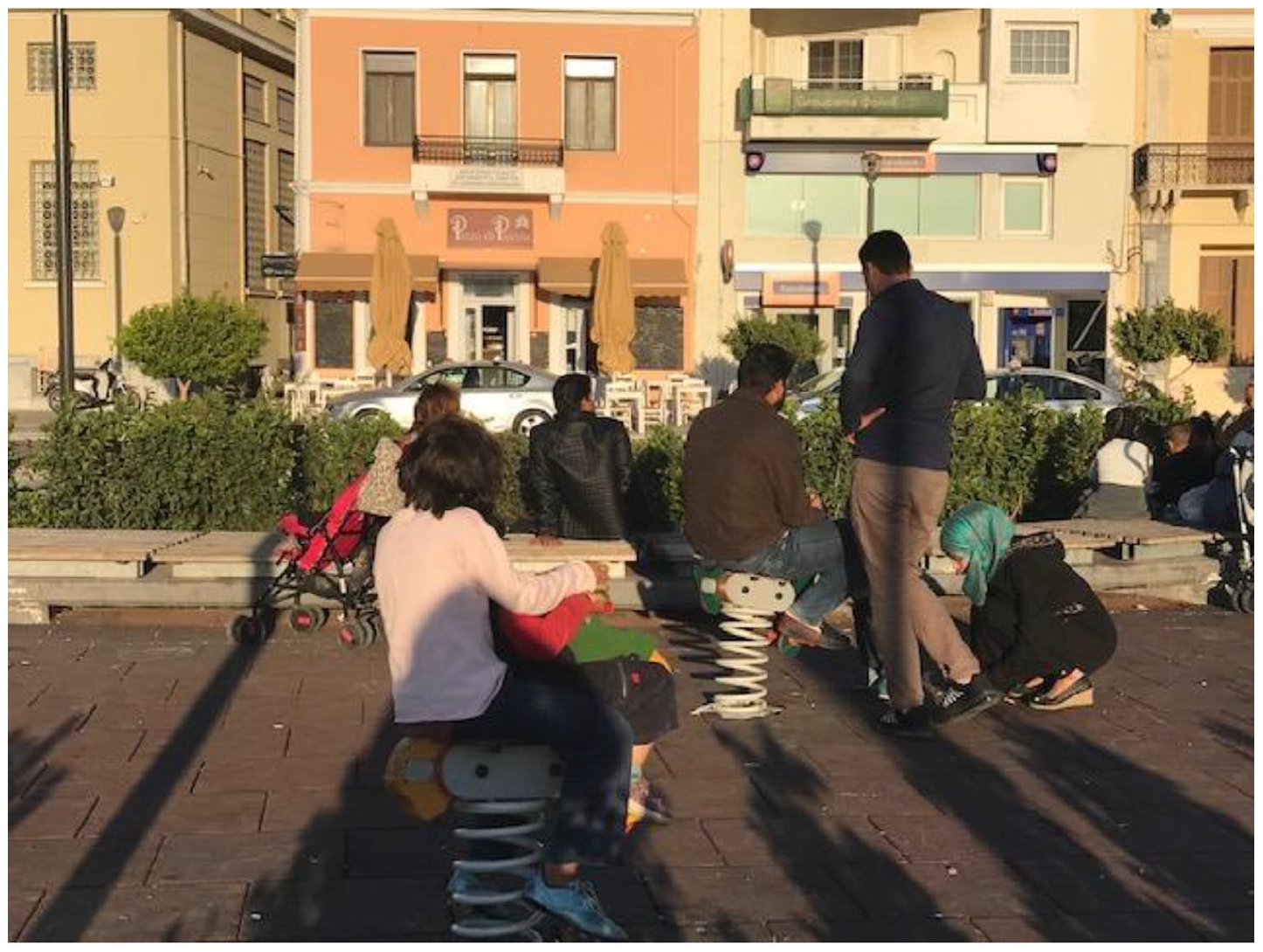
Refugees and forced migrants in the playground in Vathy, Samos (author/s own photo).
“The locals avoid any places where refugees go to – even public spaces,” reported Ann, an international relief worker from Switzerland. When speaking to Vathy citizens in cafés and restaurants, the researcher was told several times that they were afraid to go out because of the migrants, whom they perceived as “dangerous” and “alien.” This applied even to those receiving money for renting their properties to refugees categorized as vulnerable under Greek law (Fotaki, 2019), and to the owners of cafés and supermarkets.
According to Lina and Stelios, founders of a local NGO to host arriving refugees and migrants, the mayor of Leros volunteered to set up a reception center known as “the hotspot” to attract funds in the hope of stimulating the local economy of the sparsely inhabited and rather isolated island. However, this did not help the occupants’ integration into the community:
It was a half-hour stroll from Lakki to the old psychiatric hospital on the outskirts of the town where the hotspot was located. On my way, I passed the faded white and yellow buildings of the former Italian WWII base which was a place of enclosure for political prisoners and then for the mentally ill in post-war Greece. Like most camps, this one is also separated by barbed wire – when I try to take photos of the premises, the armed guard approaches me and firmly commands me to delete them (Ethnographic diary note, 24 October 2017).
Even in Lesbos, dubbed “the island of solidarity” and nominated for a Nobel Peace Prize in 2015, local tolerance of the trapped asylum seekers was rapidly diminishing. Many locals, who invariably claimed to have offered help when the refugees first arrived, reported “being fed up with the worsening situation.” Although the flow of migrants decreased by 90% after the EU–Turkey agreement in March 2016, the deal did not entirely halt irregular migrations: in 2019 alone, more than 70,000 people crossed from Turkey to Greece by sea (International Organization for Migration [IOM], 2019b), while fewer than 5000 refugees were transferred back to Turkey. As the focus of humanitarian governance shifted from rescue to “protection” in the Greek islands, the handling of refugees in the camps gave rise to a new round of contestation from “within,” by both humanitarian actors and locals (Papataxiarchis, 2016b). Part of the problem was that they had not anticipated having large populations of strangers living permanently nearby. Their helping attitude had occurred when the people arriving had been passing through, rather than being trapped in the “hotspots” on their islands.
Respondents who had until then been able to help the refugees, including seasoned activists from solidarity formations in Chios, reported that “Chios is a conservative society. They just about tolerated the presence of refugees. Now the agreement [the EU–Turkey deal] changes everything” (Kleio). Not only were migrants attacked in Chios during a demonstration by local supporters of the Golden Dawn (a neo-Nazi party whose leadership arrived from Athens to bolster their antimigration activities), but those supporting them, known locally as “solidarians,” were also attacked. “We fear for ourselves and our families,” reported Hari, an activist who had worked for a migrant support group for many years. Refugees and migrants, along with their supporters, were explicitly or implicitly targeted and seen as undesirable (Fine, 2019; Maccanico et al., 2018). In Samos, right-wing supporters established an organization, Samos SOS, to protect citizens from the potential and alleged threats posed by refugees. The policy of “securitization” resulted in thousands of asylum seekers living in appalling conditions in the Greek islands, with inadequate and overcrowded facilities (e.g., former military camps and disused factories, see Picture 3), while enduring prolonged uncertainty about their future and drifting in a psychological limbo. 3 Many women, men and children found themselves sleeping in flimsy tents, while young men were sometimes victims of violent hate crimes (see Picture 3).
Moria Camp, Lesbos (author/s own photo).
As a result, the recent anti-migration policies redefined the EU’s internal and external borders, creating liminal spaces to contain and deter unwanted outsiders in frontline areas such as the Greek islands. For the local populations in our study, the term “solidarity” all but disappeared from their vocabulary or was used sarcastically. There was an overwhelming sense of disillusionment and fatigue. Many blamed northern European countries’ refusal to relocate and admit refugees. There were also frequent references to separating “genuine refugees” from “economic migrants.” Typical expressions by the islanders included “Who will support Greeks who suffer from the financial crisis?” and “Europe has abandoned us, turning Greece into a holding pen for the unwanted souls.”
These attitudes were actively fostered by official government policies in Greece and the EU by both left- and right-wing governments, the former propagating the discourse of Greece suffering a humanitarian crisis in the aftermath of the GFC, and the latter engaging in open anti-migration rhetoric and illegal push-backs of boats in the Aegean. Both governments attacked solidarity initiatives, including attempts to close down the PIKPA center in Lesbos (Amnesty International, 2018; Odyssea, 2020) where volunteer doctors, social workers and psychologists provided dedicated care for disabled refugees, and/or by charging volunteers with trafficking (Maccanico et al., 2018).
Overall, the caring attitude was ultimately undermined by the joint EU and Greek governments’ policy of separating refugees from the locals and subjecting them to protracted vetting and invasive scrutiny as unwanted outsiders or trespassers. This all but removed any prospect of sustained solidarity based on the “shared humanity” (ανθρωπιά) commonly referred to only a few months earlier. Most people appeared to completely disidentify themselves from the refugees’ and forced migrants’ dire predicament, apart from a very few who had worked with them long before. These individuals and some grassroots organizations continue to carry out their work under adverse and unglamorous circumstances.
Discussion: Toward psychosocial embodied and situated solidarity
This article examines how local solidarity responses to refugee arrivals emerged and evolved over time in light of enforced border securitization policies. We conducted empirical work with local populations, activists and community leaders in Greek islands (Lesbos, Chios, Leros, and Samos) that had received large numbers of refugees and forced migrants escaping war, oppression and poverty. These continue to be the first points of entry to the EU for growing numbers of dispossessed people, mainly from the Middle East, Asia, and Africa (IOM, 2020).
We traced how tiny communities in diverse settings set up local charities and makeshift organizations to help refugees and migrants, who appeared first in groups of ten, and then in their hundreds and thousands out of nowhere, often during the night. The study aimed to identify what motivates individuals’ solidarity actions and communities’ and societies’ organizational responses, and to understand what makes them flourish or wane. Examining the question of solidarity in the absence of any apparent sameness, defined group or expectation of reciprocity led us to reconsider it in the context of vulnerability we all share as human beings, rather than as another form of social boundary.
This interplay between deservingness, embodied vulnerability and socially induced precarity, examined in the context of border struggles in a frontline EU country, leads us to propose a re-theorized notion of situated solidarity drawing on feminist psychosocial approaches and the ethics of relationality. The psychosocial frame, combining Butler’s work on performatively constituted and precarious subjectivities with Bauman’s and Sassen’s macro-sociological analyses of neoliberal capitalism, provides a critical, empirically informed account of how policies, discourses, and experiences internalized by individuals influence their responses to destitute and vulnerable “others.” Overall, the study explains the rise and fall of solidarity responses by local communities and their leaders as a political and social process by offering insights into individual and collective reactions to the refugee crisis in the Eastern Mediterranean.
The proposed framework, encompassing macro (policy), meso (organizational), and micro (individual) levels, demonstrates the importance of multilevel analysis for better understanding how solidarity emerges and how it can be sustained. We suggest that it starts at an individual level, but show that this alone is insufficient. Butler argues that ethical responsibility toward others emerges from recognizing how their vulnerability affects us (Butler, 2004). Their distress gives rise to an ethical obligation of “unwavering and total responsibility for the Other whose face compels us to protect him/her ahead of ourselves . . . The I is infinitely responsible. The Other is the poor and destitute one, and nothing which concerns this Stranger can leave the I indifferent” (Levinas, 1996: 18). More aptly, Butler’s work on the socially-induced precarity experienced by refugees and migrants, as opposed to the existential precariousness we all share, unravels the social and political dimension of solidarity (Butler, 2004, 2009a). The disregard for humanitarian principles, as Butler (2004, 2009a) reminds us, is predicated on radical inequality between lives that are worth living and protecting, and unworthy deaths that are unseen and unmarked by grieving. Indeed, Bauman (2016: 16) reiterates this in claiming that it is because of their desperate condition, seeking shelter, and opportunities for new lives free from war, persecution and debilitating poverty, that we may turn away from them:
Those nomads – not by choice but by the verdict of a heartless fate – remind us, irritatingly, infuriatingly and horrifyingly of the (incurable?) vulnerability of our own position and of the endemic fragility of our hard-won well-being.
In such instances, compassion is replaced by the defensive reaction of turning a blind eye to and rationalizing away the causes of their distress. The adiaphorization is justified by deploying various “othering” strategies. In every island community we studied, examples of compassionate behavior co-existed with displays of indifference and callousness bordering on cruelty.
We also demonstrate that such solidarity initiatives, even if performed with selflessness and commitment by individuals or groups, cannot be sustained without political expression by social movements at an organizational level or formal government policies at a macro level. As our evidence shows resources must be shared and support provided on a more permanent basis.
4
This must extend beyond “the notoriously short-lived carnivalesque explosions of solidarity and care that are triggered by media images of successive spectacular tragedies in the migrants’ unending saga” (Bauman, 2016: 80). However, the EU’s policy of paying countries with dubious track records on human rights protection, such as Turkey and Libya, to keep refugees and migrants away from its shores militates against situated and embodied expressions of solidarity and cannot be justified on political or moral grounds. Equally, descriptions by some politicians and media outlets in affluent EU countries of refugees as “floods,” “invasions,” or “swarms of people” (Taylor et al., 2015) functions performatively, shaping (and perhaps limiting) transnational solidarity responses to these people across redefined borders/spaces. Such discourses portraying refugees and migrants as a threat to be contained at the EU’s outer border (Arcimaviciene and Baglama, 2018) may profoundly affect people’s attitudes toward refugees and forced migrants (Rea et al., 2019). Thus, exclusionary ways of thinking about migrants and migration incorporated into public discourses legitimize people’s moral stance toward the Other/“them” which, as Bauman (2016: 35) explains, leads to adiaphorization, that is to neglect and indifference toward the migrant predicament: “Once they have been cast in public opinion in the category of would-be terrorists, migrants find themselves beyond the realm of, and off-limits to, moral responsibility – and, above all, outside the space of compassion and the impulse of care.”
Little attention is then paid to how those arriving cope with the trauma of the dramatic events that led to their flight, or with the aftermath of the traumatic journeys in which tens of thousands have lost their lives. 5 Instead, this is normalized as an unfortunate outcome of their choices and their exploitation by unscrupulous human trafficking networks.
This article makes two key contributions. First, it contributes to inclusion/exclusion questions in organizations and society. It speaks not only to debates on solidarity entailing relations of care and help, altruism and empathy, but also to the notion of solidarity linked with reciprocal expectations and practices between people expressing sameness, togetherness, and inclusiveness (Stjernø, 2012). Political theories dealing with institutionalized forms of solidarity, in terms of welfare states, public policies, and constitutional rights that regulate citizens’ social rights and obligations, establish the scope and limits of solidarity (Scholz, 2008; Spicker, 2000). Yet we may overestimate the mobilizing potential of grand institutional ideas (Calhoun, 2002: 98), especially when institutionalization of the principles of solidarity is somewhat weak. Despite being a formally stated principle governing relationships between EU member states (Lahusen, 2020; Lahusen et al., 2018), solidarity was repeatedly rejected during the recent financial crisis. The EU’s inability to demonstrate solidarity, or even to consistently respect refugees’ and forced migrants’ human rights, exposes the fragile origins of an idea “that is based on the negative invocation against war between the member states, and fails to reconcile economics with politics and ethics” (Covi, 2016). Unsurprisingly, the EU’s “incapacity to express social solidarity for its weakest members such as Greece and other Eurozone states while pursuing economic solidarity for the strongest ones, matches its incapability to enact solidarity when faced with the repeating tragedy of migrants and refugees, weak constituencies of labor and asylum seekers coming from the outside” (Covi, 2016: 151). It also conditions crowding-in effects on civic solidarity, particularly at times of accelerating crisis and when remedial actions are urgently needed (Lahusen, 2020). Unsurprisingly, the EU’s “incapacity to express social solidarity for its weakest members such as Greece and other Eurozone states while pursuing economic solidarity for the strongest ones, matches its incapability to enact solidarity when faced with the repeating tragedy of migrants and refugees, weak constituencies of labor and asylum seekers coming from the outside” (Covi, 2016: 151).
This may explain why the idea of solidarity, as a normative commitment by the EU toward hundreds of thousands of people fleeing war zones and political oppression, did not survive the early phase of the “Willkommen” culture in Germany and Sweden (Berry et al., 2015; Karakayali, 2018; Krzyżanowski, 2018), or perhaps less so in Italy and Greece. The relative absence of political demands by citizens of nation states to internationalize solidarity may also explain the frail display of solidarity between states during and after the EU migration crisis considered in this study: “citizens need to be motivated by solidarity, not merely included by law” (Calhoun, 2002: 153). Yet an embedded inclusion/exclusion dilemma that has confronted welfare states since their inception suggests that European solidarity within states is also subject to fluctuation, indicating its contested and fragile nature (Lahusen, 2020). In their multilevel individual and aggregate analyses, Crepaz and Damron (2009) show that the more comprehensive the welfare state, the more tolerant natives are of immigrants. Thus they argue that contemporary welfare states’ capacity is similar to that of their 19th-century incarnations to bridge class divisions and mollify ethnic divisions (Crepaz and Damron, 2009). However, reconciling the dilemma of universality versus particularism that has long bedeviled debates on solidarity “requires not just the civilities and hospitalities of everyday life, but a commitment to building a society of equals, which in turn requires active state measures to address unchosen disadvantages in people’s life chances” (Kymlicka, 2015: 1). Yet the recent explosive rise in inequality across Western societies indicates that we may now be moving ever further from this goal (Kymlicka, 2015: 1). Having espoused neoliberal public policies, policymakers often stoke people’s fears to deflect attention from their failure to address the needs of the most vulnerable –refugees, forced migrants, and their own populations (Fotaki, 2020). The danger of governments propagating fear is immense, as it permits us to neglect even the most vulnerable and to consider their essential human needs as somehow of lesser value than our own. The increasing division between voluntary assistance and human rights with its corresponding obligations in the EU approach shows how the latter are being sacrificed in defense of Fortress Europe (Boucher and Gördemann, 2021). The shift toward securitization in the era of Fortress Europe has replaced European cosmopolitanism with an “enlarged particularism” in which postnational solidarity is often reduced to shared efforts to strengthen Europe’s borders (Bhambra, 2017; Edmunds, 2017; Kamminga, 2017, 83–108, cited in Boucher and Gördemann, 2021). Specific meanings of globalization are often seen through the prevailing lens of Eurocentrism (Dussel and Ibarra-Colado, 2006), rather than as transnational links and dependencies that might give rise to global forms of solidarity (Cheah, 2006; Federici, 2012; Mohanty, 1998).
Yet, we must also not ignore the myriad forms of solidarity achieved outside formal policies and political organizations. As our study demonstrates, the urgency of the rescue and relief operations required in the Mediterranean in 2015, and frontline states’ inability or unwillingness to accommodate, process and relocate those arriving, mobilized an extraordinary response by ordinary people and communities stepping in to fill the gaps, as has often been the case in the past (Dragostinova, 2016). It has been argued that such initiatives embody universal values of humanitarianism and international citizenship, and reject state claims to a monopoly on concern and care in the face of what is perceived to be manifest incapacity or negligence (Foucault, 1979). The history of European solidarity is firmly rooted in its citizenry, civil societies and social movements, as well as in public policies and discourses (Lahusen et al., 2018). Having espoused neoliberal public policies, policymakers often stoke people’s fears to deflect attention from their failure to address the needs of the most vulnerable –refugees, forced migrants and their own populations (author/s). Specific meanings of globalization are often seen through the prevailing lens of Eurocentrism (Dussel and Ibarra-Colado, 2006), rather than as transnational links and dependencies that might give rise to global forms of solidarity (Cheah, 2006; Federici, 2012; Mohanty, 1998). The danger of governments propagating fear is immense, as it permits us to neglect even the most vulnerable, and to consider their essential human needs as somehow of lesser value than our own.
Our second and related contribution is to the organization of solidarity in the context of refugee studies, and how it can be re-imagined as interconnectedness and inclusivity to avoid these undesirable developments. Drawing on Judith Butler’s work, we propose a notion of solidarity rooted in embodied vulnerability and a precarious existential condition shared by all humans that binds us to others through socially mediated affects. She conceives precarity and vulnerability as existential conditions that all humans share, which poses an ethical obligation toward irreducible unknown others. Butler argues that since we all depend on the other under conditions that are inevitably precarious, our fears about survivability link us with others whom we do not know. While all humans share a physical dependence on other humans for survival, we must experience the possibility of losing the other to feel how it fundamentally affects us: “I think I have lost ‘you’ only to discover that ‘I’ have gone missing as well” (Butler, 2004: 22). Relatedness and relationality, as the foundation of subjectivity and our social existence, emerge from this realization.
Moving toward situated, embodied, and relational solidarity
We apply Butlerian concepts of embodied precariousness and relationality to theorize how individuals engage in solidarity initiatives. Various respondents confirmed that when they came face to face with the physical suffering of people whom they had initially rejected, they did not hesitate to offer unconditional help. Taking Butler’s ideas forward and building on the work of feminist organizational scholars’ intercorporeal generosity (Pullen and Rhodes, 2014) and matrixial borderspace (Kenny and Fotaki, 2015), we thus propose the idea of ethical responsibility as intersubjective relationality, which ensures the survival of the unknown “other” as a first crucial step in creating solidarity. Embodied connections are a key but neglected aspect of this process, as “ambiguous and cross-corporeal cohabitations [that] unsettle the I . . . are the sedimentation of the ‘we’ in the constitution of any ‘I’” (Butler, 1993:105). They become inscribed in our psyches through social practice (Kenny and Fotaki, 2015). Thus, we invoke the idea of cohabitation and compassionate borderspaces (Kenny and Fotaki, 2015) that acknowledge the shared existential reality to which we are exposed: our bodies’ fragility and our capacity to experience injury. However, as we live politics through the body in our everyday practices, it is important not to rely simply on people’s ethical values and personal ability to identify with or disidentify from the other, but to promote policies and politics that account for our shared precariousness as sentient human beings, extending to all forms of life.
Our proposed theorization thus enriches the universalistic conception of solidarity based on recognition (e.g., Fraser, 1986; Honneth, 1995) by introducing the situated embodied dimension. Fraser (1986) stresses that the ethics of solidarity requires account to be taken of the standpoint of the concrete collective other. We suggest that recognizing interconnectedness vis-à-vis the (unknown) but embodied other may serve as a foundation for politics of justice. This is because conceiving humans as relationally constituted social beings allows the development of the idea of agonistic solidarity, which recognizes dependency on the other for one’s own social and also literal existence, without presupposing knowability or even reciprocity from the other: If I seek to preserve your life, it is not only because I seek to preserve my own, but because who ‘I’ am is nothing without your life, and life itself has to be rethought as this complex, passionate, antagonistic, and necessary set of relations to others (Butler, 2009a: 44).
Levinas (1987: 75), a key inspiration for Butler, elucidates this further:
The relationship with the other is not an idyllic and harmonious relationship of communion or sympathy through which we put ourselves in the other’s place; we recognize the other as resembling us, but exterior to us; the relationship with the other is a relationship with a Mystery.
Such understanding provides a foundation for developing emancipatory solidarity with others within the framework of an egalitarian relationship, which entails a process of continued negotiation rather than the production of docile subjects who must perform suffering to deserve our support. This also allows us to theorize solidarity as inclusivity in difference. Butler’s analysis warns of the atrocities that may be freely committed on some people by others because those on whom the violence is visited are not recognized as living human beings and, relatedly, by severing our relational ties with others (Fotaki, 2017). The overturning of solidarity observed in our study was made possible by attacks on social bonds and by distancing refugees from their hosts through policy shifts toward securitization. Disregard for humanitarian principles, as Butler (2004, 2009a) reminds us, is predicated on radical inequality between lives that are worth living and protecting, and unworthy deaths that are unseen and unmarked by grieving. Acknowledging vulnerability as a universally shared condition that affects us, we argue, can thus provide a basis for recognizing all human beings and all lives as equivalent, despite their differences. Although vulnerability may have depoliticizing and exclusionary effects when exercised to craft deserving refugee subjects (Alberti, 2010; Malkki, 1996), such a notion of solidarity may also lead to the practice of affirming the moral standing of others—their rights, freedom and dignity—if we view our own lives and agency as bound together with the rights, wellbeing, health and dignity of others here and now (Jennings, 2018).
Furthermore, Butler’s work can help us recognize how precarity is unequally distributed across different groups, societies and geographical locales, to promote politics of justice (Andrijasevic et al., 2019; Mir and Zanoni, 2021; Parker, 2003). An ethical stance by individuals may therefore be insufficient without collective solidarity and without political actions by them to overcome the injustices created by various forms of socially induced precarity. The refugee and migration crisis reveals how, in the absence of collective solutions, precarity designates a politically induced condition whereby certain populations suffer from failing social and economic networks of support and become differentially exposed to injury, violence, and death (Butler, 2009b). To prevent this from happening, Butler urges us to make explicit governments’ role in how people understand, treat and relate to one another. She also argues that public policies must emerge from a recognition that all our lives are precarious and that we all depend on society for survival. For this, we need systematic policy solutions to reinforce and institutionally embed the stances we take as individuals to advance solidarity.
Practical implications and directions for further research
The proposed theorization of solidarity across individual (micro), organizational (meso), and political (macro) levels has practical policy implications. It can help to design effective policy responses to “refugee crises” and other forced migrant arrivals, which are expected to continue owing to political upheavals, the dramatic rise in inequalities in various parts of the world, and threats from the destabilization of our natural habitats, such as pandemics and irreversible climate change. Specifically, it might be deployed to understand issues of otherness and proximity, which are brought into relief through the ever-increasing global migratory and refugee movements that are likely to redefine the future of citizenship, belonging and solidarity. This also presents an opportunity and a challenge to rethink our commitment to equality and global interdependence and our obligations toward one another and all forms of life.
The study has practical organizational implications beyond the topic of migration, extending to how we deal with exclusion and otherness in our everyday practices. It enables us to reconsider our relation to difference in organizations from a radical perspective (McMurray and Pullen, 2019), drawing attention to the very qualifiers of negative difference that are the condition of particularism, and hence exclusion (see also Organization Special Issue, Critical Inclusion 2020). This is particularly relevant to the world of translocal organizations, where pre-existing forms of difference and otherness are interpellated (Butler, 2007) by new forms of fragmentation and dispossession in the globalized capitalist economy. Our aforementioned contributions may thus help identify areas that require further exploration to gain a deeper understanding of socially, politically, and historically situated meanings and practices of locality, identity, difference, and citizenship, all of which may influence forms of embedded solidarity, and the notion of solidarity based on our shared precarity.
Conclusion
In this article, we adopt a psychosocial approach to embodied vulnerability and shared precarity to reframe solidarity in relational terms, showing that our sociality is always intersubjective and defined vis-à-vis others. Despite referring to a specific context and period in time, it highlights the potential impact of the shifting notion of solidarity, rooted in contradictory definitions, transnational migrations, and our obligations toward others. These questions are particularly important amidst the profound crisis and upheaval caused by the global coronavirus pandemic and its multiple interconnections, which we are experiencing while writing this article. The future of our societies may be decided by the meaning we give to solidarity now, based on either narrow definitions that divide us into categories of deserving subjects, or on a notion of interdependency without which no form of life is possible. We must protect the dispossessed who arrive on our shores, because their fate concerns us all. In offering protection, we value their lives as equal and accept the vulnerability of the dispossessed as our own. Public policies that reinforce our inclination toward compassion for the helpless other and our global interconnectedness, rather than individual identification, promote solidarity by recognizing how we all depend on each other for survival.
Footnotes
Funding
The author(s) disclosed receipt of the following financial support for the research, authorship, and/or publication of this article: This research was partly funded through the Global Research Priorities Programme from the University of Warwick, which is gratefully acknowledged.
Notes
Author biography
 ) pro bono (2014–2017). She has published over 100 articles on gender, inequalities, and the marketization of public services appearing in the leading international journals. Her recent books include Gender and the Organization. Women at Work in the 21st Century (Routledge, 2017 co-authored with Nancy Harding shortlisted for the EGOS Best Book Award in 2019), Diversity, Affect and Embodiment in Organizing (Palgrave 2019, co-edited with Alison Pullen), The Whistleblowing Guide: Speak-up Arrangements, Challenges and Best Practices (Wiley Finance, 2019 co-authored with Kate Kenny and Wim Vandekerckhove), Business Ethics, and Care in Organizations (Routledge 2020, co-edited with Gazi Islam and Anne Antoni) and Working Life and Gender Inequality. Intersectional Perspectives and the Spatial Practices of Peripheralization (Routledge 2021, co-edited with Angelika Sjöstedt and Katarina Giritli Nygren). Marianna currently leads on a UKRI funded COVID scheme project ‘Understanding the financial impact of COVID-19 on the UK care home sector – implications for businesses and the workforce.