



Abstract
While emerging literature explores how organizations engage with the past, investigations of how complex relationships to the past influence mobilizing multiple forms of historical representation in practice remain scarce. The current study examines different relationships to the past to shed light on how their complex and at times contradictory connotations relates to the use of multimodal historical cues in organizational practices, based on a qualitative study of art galleries in downtown Tehran, Iran. We describe how fondness for, aversion to and conflicted relationships with the past coexist, and how and why actors use diverse historical cues to express these diverse relationships in practice. We add to current understandings of organizational uses of the past by offering insights into how and why organizations actively evoke and manage positive, negative, and conflicted relationships to the past, and how these relationships draw upon diverse discursive and non-discursive supports to organizational practices aiming at different yet complementary goals.
. . .a way that does not attempt to petrify and sever the past but to revise the inheritance of it, to reinherit it? (Cavell, 1981: 773)
The past informs organizational practices in important and complex ways. Recent scholarship holds that organizations use the past to provide stability during turbulent times (Maclean et al., 2014), craft or strengthen identities (Basque and Langley, 2018; Oertel and Thommes, 2018), and navigate change and continuity (Maclean et al., 2018; Ybema, 2014). However, the multiple ways in which the past becomes present (e.g. as a break, a continuity, and a reversal) and by what means of representation (e.g. through speaking, written text, monuments) are not well understood. Understanding this complexity relates to recent calls to explore how organizations use the past (Hatch and Schultz, 2017; Hernes and Schultz, 2020; Zundel et al., 2016).
Organizations selectively mobilize the past in light of present-day aspirations, objectives, and concerns (Ravasi et al., 2019), with ample plasticity around what elements are recalled, represented, and recontextualized. Therefore, past conditions organize the present and future, even if they do not necessarily determine them (Blagoev et al., 2018; Gioia et al., 2002). The past is not used “as is” (Ooi, 2002) but is evoked through different forms or modalities that include narratives, events, and artifacts (Ravasi et al., 2019; Schultz and Hernes, 2013). Shaped by present-day motivations (Ravasi et al., 2019), representations of the past are mediated in diverse ways that structure their representation (Sunstein, 1995); in other words, they are multimodal (cf. Höllerer et al., 2019). Locating our question at the interface of these two aspects, we respond to calls around the organizational uses of the past and ask: how do complex relationships to the past influence historical representation in organizational practices?
Contemporary literature examines how “rhetorical history” (Suddaby et al., 2010) incorporates past elements to serve specific purposes (e.g. Hernes and Schultz, 2020). Historical representations are shaped by an array of diverse and sometimes ambivalent relationships to the past (Marie Cappelen and Strandgaard Pedersen, 2021). Most research focuses on positive relationships and fond remembrances that confer pride and affiliation, enable continuity, and legitimize agendas (Brown and Humphreys, 2002; Moufahim et al., 2015). However, some literature suggests that organizations occlude undesirable and potentially contradictory aspects of the past in their attempts to reshape it (Anteby and Molnár, 2012; de Holan and Phillips, 2004; Easterby-Smith and Lyles, 2011).
Choices about how to handle the past can have high organizational stakes (Suddaby et al., 2020). As actors reconcile conflicting past accounts to “impose a degree of coherence in the face of assorted vulnerability” (Brown, 2019: 10), they face challenges of inclusion and exclusion (Nissley and Casey, 2002). To deal with such challenges, actors turn to specific artifacts or objects, individual memories, personal objects, organizational heritage, social understandings, and acquired practices. This multimodal aspect of dealing with the past introduces complexity, allowing multiple and at times contradictory relationships to the past. Varying in accessibility and malleability, multimodal historical cues shape strategies of historical representation. Working between discursive and nondiscursive elements (Schultz and Hernes, 2013) involves striking a balance between historical continuity and distinction while drawing on a broad array of representational possibilities.
To address our research question, we examine an emerging art scene in Tehran, Iran, where a new generation of art galleries has been challenging entrenched norms and practices within the Iranian art field. Although young and lacking organization-specific historical support (cf. Basque and Langley, 2018; Hatch and Schultz, 2017; Ravasi et al., 2019; Rowlinson and Hassard, 1993), these new galleries are remarkable in that they draw upon diverse historical cues with a counterintuitive insistence on simultaneously preserving and eradicating the past. These emerging art galleries operate in a sociohistorical context influenced by major disruptions and historical changes, which makes their relationships to the past complex and volatile (Pickering and Keightley, 2006). Moreover, as art-based organizations, art galleries represent an instance of historical representation through discursive and nondiscursive means (Wadhwani et al., 2018).
Below, after situating our approach at the crux of multimodality and uses of the past literature, we describe the Iranian art scene and methodological design of our study. In our findings, we show how the galleries drew upon complex relationships to the past, deploying distinct modalities of historical cues in authenticating, distinguishing, and opposing practices. We then offer a twofold theoretical contribution. First, we show how multiple, coexisting relationships to the past can be mobilized to support complex agendas while balancing preservation and progress. Second, we discuss how using multiple modalities allows organizations to hold together different standpoints to the past. On this basis, we theorize representations of the past as a multimodal achievement and argue for an expanded research agenda around multimodal uses of the past.
The past in organizational life
The past, defined as that preceding the present moment, relates to history, understood as “making the past present” (Wadhwani et al., 2018: 1666) and involves representations of the past. In an approach termed “uses of the past,” scholars examine how actors draw upon the past to shape opinions and influence present and future actions (Maclean et al., 2018; Suddaby et al., 2010). This approach understands the past as a dynamic concept and historical representation as influenced by human agency, contemporary interpretations, and expectations (Suddaby et al., 2010; Wadhwani et al., 2018). However, historical representation practices, which are broadly defined as history through situated activities (Hernes and Schultz, 2020), remain complex and ever-unfinished. Here, we emphasize two related issues: the implications of multiple relationships to the past and their representations in organizational practices through multimodal historical cues.
Relationships with the past
Understanding how relationships to the past influence organizational practices requires examining how the past, real, or “invented” (Ybema, 2014), is seen from a particular standpoint (Sunstein, 1995) that involves subjective judgments of continuity, difference, or disdain (Marie Cappelen and Strandgaard Pedersen, 2021). Organizations are not determined by history (Gioia et al., 2002); representing the past lends organizations coherence and consistency across time (Howard-Grenville et al., 2013; Schultz and Hernes, 2020). However, given that working with the past depends on the agency and perspective of the actors involved, multiple relationships to the past can coexist in organizational reality. For instance, a seemingly insignificant event for one group may be pivotal for others (Maclean et al., 2018; Rowlinson et al., 2014b). Thus, even though the literature indicates the plasticity of organizational renderings of the past and suggests that organizations can enact multifaceted and plural representations of the past, studies tend to focus on one type of relationship while ignoring other possibilities.
Notably, the literature tends to emphasize positive continuities with the past, as evident in glorified accounts of founders’ pasts (Basque and Langley, 2018; Maclean et al., 2018; Thornborrow and Brown, 2009) that build a sense of affiliation, continuity, and authenticity (Brown and Humphreys, 2002; Ybema, 2014). Romanticized accounts of a golden past serve to neglect less pleasant aspects, as organizations avoid associations with unpleasant aspects of the past that could lead to the potential loss of historical resources and generate negative organizational effects (Anteby and Molnár, 2012; de Holan and Phillips, 2004; Easterby-Smith and Lyles, 2011).
Despite multiple and heterogeneous relationships to the past, the scant empirical and theoretical investigation of such complexity has hindered development in this area. Extant literature tends to focus on positive framings and consistent narratives (e.g. Basque and Langley, 2018), making it less apt for understanding contexts marked by traumatic or difficult past events. Moreover, while studies examine how either positive or negative aspects of the past inform organizational actions (Marie Cappelen and Strandgaard Pedersen, 2021), less is known about their interplay in situations of multiple relationships to the past and how these are represented, to which we turn next.
Multimodal historical representation in organizational practices
The multiplicity of relationships to the past and modes of representation suggest the need to study how these different modes evoke the past in diverse ways. This is because historical representations are articulated not only in the minds and words of actors but also in their practices and material constructions. By practice, we refer not only to the daily goings-on in an organization but also to the performance of such activities bundled with the material and narratives that connect the organization to the past and the future (Hernes and Schultz, 2020; Schatzki, 2006).
Practices provide a window onto complex organizational realities. Hernes and Schultz (2020) acknowledge how reflections on the past condition present-day practices, while Ybema (2014) argues that actors socially establish continuities and discontinuities to motivate change. Practices that involve both discursive and nondiscursive modalities ground historical representations (Blagoev et al., 2018; Hatch and Schultz, 2017; Hernes and Schultz, 2020; Nissley and Casey, 2002; Schultz and Hernes, 2013). Although strategy and corporate branding studies provide some insights into modalities of historical representation (e.g. Burghausen and Balmer, 2014; Zamparini and Lurati, 2017), as an organizational process, this area of inquiry remains largely unexplored.
Building on recent research in organizational studies that examine multimodality (e.g. Alcadipani and Islam, 2017; Höllerer et al., 2018; Lefsrud et al., 2020), this added layer of theorization can lead to a more nuanced view of uses of the past (Wadhwani et al., 2018; Zilber, 2017). The “uses of the past” approach has moved away from treating the past as immutable and history as a constraint and instead insists that the past is a malleable resource that can be actively managed (Blagoev et al., 2018; Wadhwani et al., 2018). A multimodal approach, with its emphasis on heterogeneous and interactive modes of representation, provides a tool with which to understand such management.
Specifically, this approach combines insights from scholars who note the complexity of how organizational actors interact with the past (e.g. Dacin et al., 2019) with those who emphasize nondiscursive forms of representation (e.g. Zamparini and Lurati, 2017). We bring these views together by attending to multimodal historical representation through texts, speech, visual and material artifacts and the respective opportunities and constraints they afford (Schultz and Hernes, 2013).
Most studies of historical representation focus on discursive representations, largely through individual or organizational narratives (Brown and Humphreys, 2002; Clark and Rowlinson, 2004; Cox and Hassard, 2007; Lubinski, 2018; Rowlinson et al., 2010, 2014a). As linguistic devices that structure meaning (Hansen, 2012), narratives link past and present while assigning, sharing, conveying, or changing meaning(s) attributed to the past. For instance, narratives can lend cohesion and vividness to the past, confer legitimacy and consistency, and align past meanings with current experiences and actions (Anteby and Molnár, 2012; Gioia et al., 2002; Hatch and Schultz, 2017; Maclean et al., 2018). Moreover, they can position actors against wider structures (Wadhwani et al., 2018; Ybema et al., 2009) while giving rise to competing historical narratives (Lubinski, 2018; Wadhwani et al., 2018) and highlighting actors’ agency (Lubinski, 2018).
Despite having received less attention, nondiscursive historical representations have been acknowledged by organizational scholars (e.g. Blagoev et al., 2018; Hansen, 2012; Nissley and Casey, 2002). For instance, social practices can establish meanings for the past (Hernes and Schultz, 2020; Schwartz et al., 1986) and thus connect past and future (Hernes and Schultz, 2020). Activities “transform our social conditions, resolve contradictions, generate new cultural artifacts, and create new forms of life and the self” (Sannino et al., 2009: 1). Moreover, material artifacts provide tangible and physical cues that constitute “direct manifestations of what something looked like or felt like, or how it may be adapted to identity claims” (Schultz and Hernes, 2013: 6). Materials support immediate experiences but remain discursively open, allowing different or contested interpretations (Alcadipani and Islam, 2017; Gasparin and Neyland, 2018). However, little is known about how different modalities are deployed by actors in situations of complex relationships to the past, leaving the full potential of this line of research to be fully realized.
Understanding relationships to the past through multimodality
Based on the above discussion, examining a broad range of discursive and nondiscursive modes allows scholars to attend to the characteristics of different modalities of historical representation. For instance, narratives can relay concepts but also shape interpretations of artifacts, places, or any other material entities that mingle functional and symbolic properties (Zerubavel, 1997): a door can act as a physical barrier to shape a space and include or exclude actors, but it can also convey a division of power, a sense of security, or even anger if it is slammed. The presence of a door thus establishes physical possibilities for action and representation (i.e. closing the door renders the representation of a room difficult) while taking on symbolic meanings based on by whom, where, when, or how it is used.
Moreover, discursive and nondiscursive modes of historical representation vary in terms of malleability and accessibility (Pickering, 2017; Schultz and Hernes, 2013). Tangible historical cues such as objects, buildings, or monuments offer stability and continuity over time, while narratives may be more easily malleable. Some research suggests that rigid historical cues provide stability anchors (Walsh and Glynn, 2008), whereas malleability may be useful where organizational transformation is sought. Historical representation thus depends on its modalities, and different aspects of the past may be distributed across different modalities.
To elaborate, some have noted the interweaving of different modes into an overall representation of history. For instance, Nissley and Casey (2002) note how corporate museums weave artifacts and stories together in written descriptions and tour guide narrations, while Burghausen and Balmer (2014: 2319) argue that “corporate heritage” can be built through a “multimodal and multisensory identity system.” Similarly, Blagoev et al. (2018) discuss how the emergence of digital technology shaped how organizational memory is distributed between the social practices and technologies of remembering. In each case, different modalities form part of a mosaic of historical practices of representation.
Nevertheless, rather than strategically reinforcing a unified sense of history (e.g. Basque and Langley, 2018; Burghausen and Balmer, 2014), the multifaceted potential of multimodel representations may be particularly important when histories are complex, contradictory, or ambivalent. In summary, the idea that such complexities may be encapsulated in different modes of representation suggests promising conceptual and empirical possibilities. Here, we examine how different modalities of historical representation are entangled with actions and how their collective influences shape the complex meanings given to the past.
Research setting, data, and methods
Over the past half-century, the Iranian art scene has been shaped by deep turbulence and political contestation (see Figure 1 for a timeline). Having emerged in the 1950s (Ekhtiar and Sardar, 2000; Golestaneh, 2012), the Islamic revolution of 1979, followed by the Iran-Iraq war from 1980 to 1988 and the consequent period of postwar reconstruction, severely disrupted the Iranian art scene (Afsarian, 2011; Golestaneh, 2012; Keshmirshekan, 2006; Pakbaz, 2007).
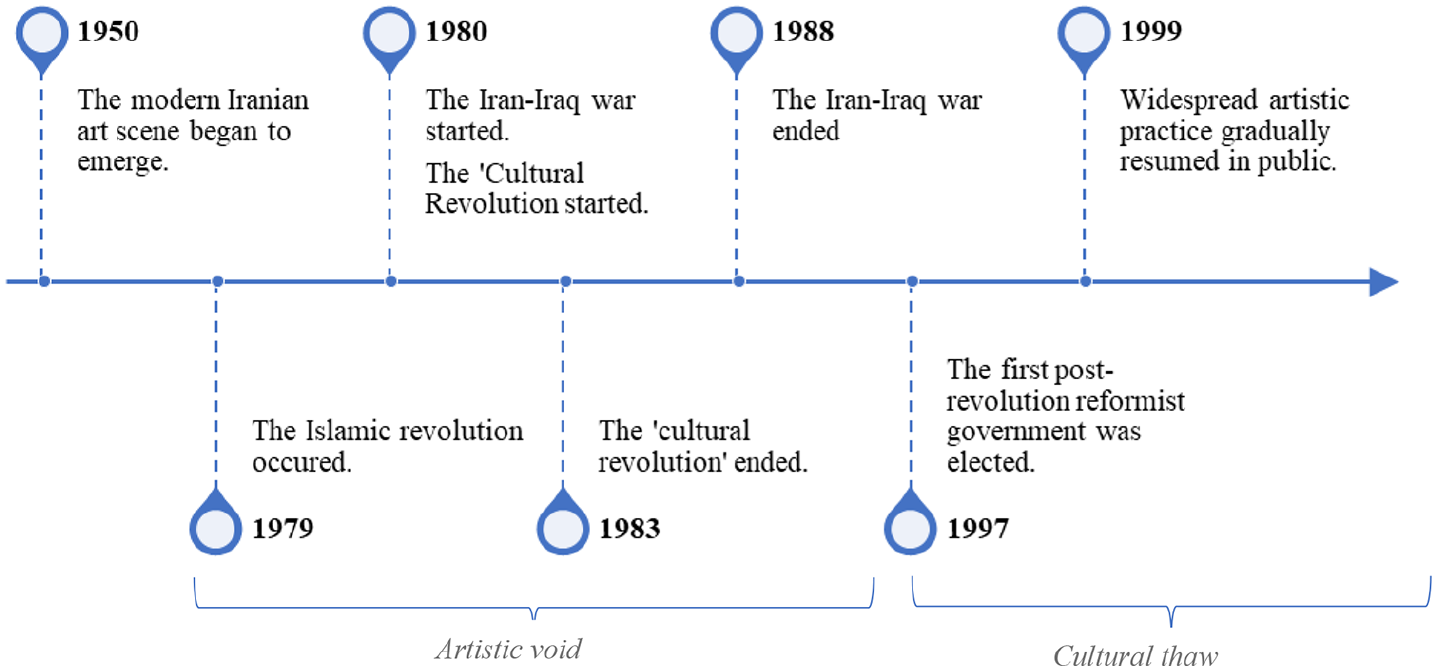
A timeline of significant events in the Iranian art scene.
During the early postrevolutionary years (1979–1997), art production was largely invisible (save for specific forms of government-sponsored utilitarian art). However, public artistic activities enjoyed a resurgence beginning in the early 2000s, when discourses and debates over the volatile yet rich history of art and its actors also resurfaced (Keshmirshekan, 2013). A sequence of historic and social crises resulted in each generation creating artworks “used by each to describe its own comprehension of its historic context as well as its self-identity” (Kamrani, 2012: 20). Thus, different visions of this past can be read from the art production itself and from art critics from this period (for a comprehensive review, see: Keshmirshekan, 2013). Nonetheless, the role of art galleries as a force shaping the contemporary Iranian art scene remains understated. Our data focus on historical representation in the practices of a group of galleries from downtown Tehran, which we refer to as downtown galleries. Heavily engaging with the past, specifically, the first two postrevolution decades, these galleries spearheaded an alternative approach to art against an incumbent group of mainstream art galleries, that, in their view, had neglected past historical traumas to pursue immediate commercial gain.
This setting offers multiple advantages for exploring questions of multimodal historical representation. First, cultural forms are particularly impacted by unsettled times (Swidler, 1986), and major life changes can ground participation in cultural forms and exchanges (DiMaggio, 1987). While disruptive social events such as revolution, regime change, and war alter how the past is seen (Pickering and Keightley, 2006; Terdiman, 1993), they provide opportunities to explore scattered and heterogeneous views of diverse cultural actors. Thus, this setting offers a unique vantage point for exploring novel practices of historical representation surging from complex, and particularly negative, relationships to the past.
Second, art galleries are inherently political entities (Rodner et al., 2020) that exemplify an intertwinement of materiality, esthetics, and discourse in complex ways, where diverse historical cues require special selection and attention (Wadhwani et al., 2018). Demarcating art and non-art, even the physical boundaries of an art gallery carry symbolic meanings (Rodner et al., 2020). In the current case, the young downtown galleries had limited organization-specific historical cues at their disposal (cf. Basque and Langley, 2018; Hatch and Schultz, 2017; Moufahim et al., 2015; Ravasi et al., 2019), requiring them to take stock of disparate and sometimes contradictory historical material (Lubinski, 2018). This unique feature is particularly beneficial in illuminating creative and novel forms of multimodal historical representation (Wadhwani et al., 2018).
Data collection
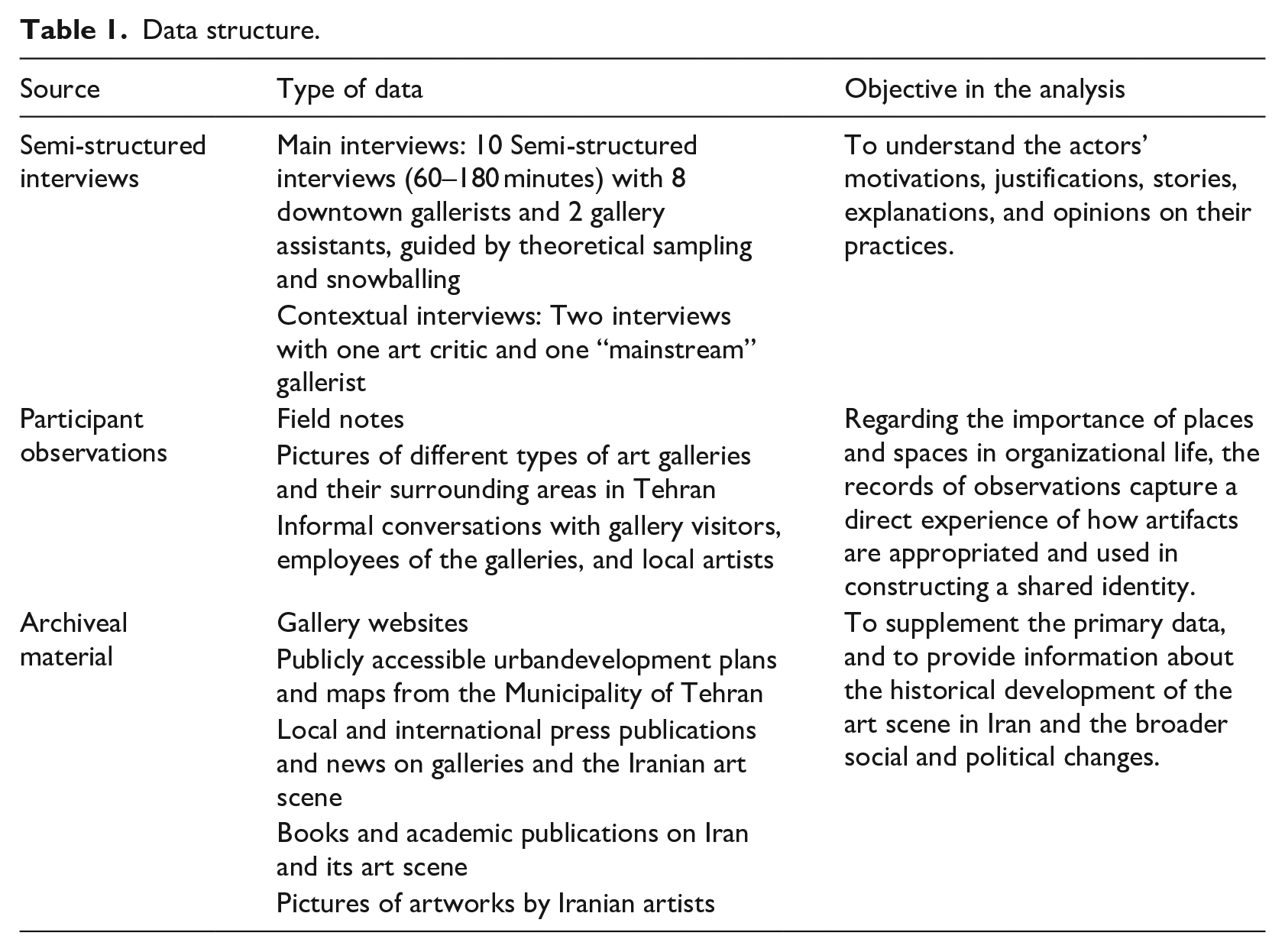
We used interviews, participant observations, and visual and textual documents (Table 1), collected in 2016–2017, as explained below.
Data structure.
Interviews
The growing popularity around the up-and-coming galleries in downtown Tehran and their specific relationships to recent history sparked our theoretical interest in discovering how they approach historical issues. We used theoretical sampling (Eisenhardt, 1991) to identify and reach out to informants who could help us understand the historical representations in downtown galleries. To identify the core informants, we sought help from a well-known downtown gallerist through the first author’s network of contacts within the Iranian art scene. We interviewed her and four other gallerists whom she described as “my alternative-thinking peers.” Then, we used snowballing techniques to contact other informants until no new informant was mentioned. Eventually, of the 11 existing downtown galleries in whose practices we were interested, we secured the participation of eight. We conducted semistructured interviews with eight gallerists who, as founders or directors of very small organizations (see Table 2), provided a detailed representation of their respective art galleries. We also interviewed two experienced gallery assistants with insights on both downtown and mainstream galleries and conducted two clarification interviews: one with a veteran mainstream gallerist and one with a local art critic.
Interviewees and background information on galleries.
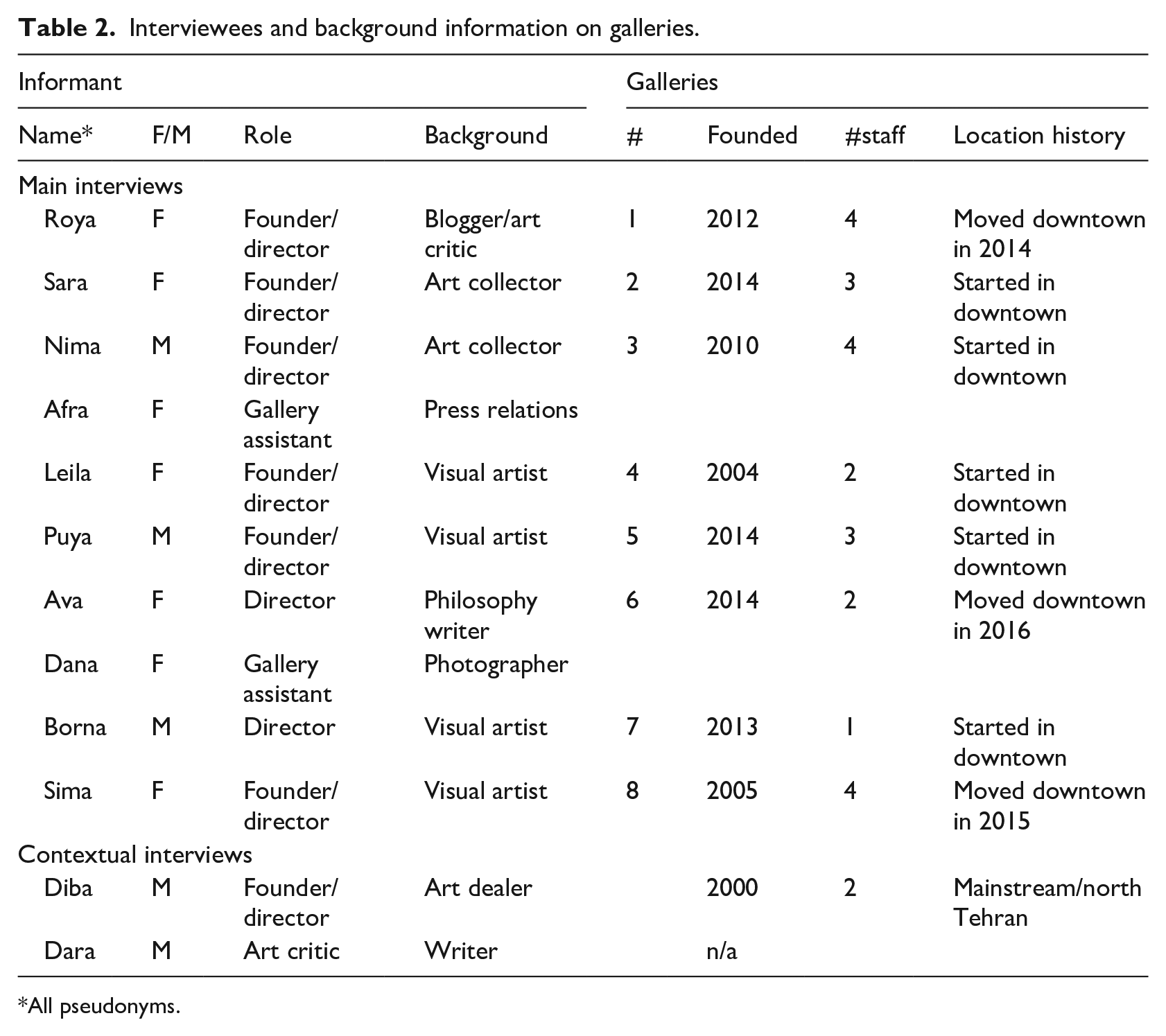
All pseudonyms.
The interviews were conducted on-site and in the local language (Farsi); these were often accompanied by a walking tour of the gallery guided by our interviewee. Starting with a general set of questions regarding the background of downtown galleries and their practices, we asked follow-up questions on emerging topics incorporated in consequent interviews. The sociopolitical context of the country and the general sensitivity of art-related activities generated heightened privacy and anonymity concerns. Thus, the interviewees occasionally requested to go “off the record” when discussing sensitive topics while granting consent for anonymized notes. The interviews lasted between 60 and 180 minutes and were transcribed verbatim.
Participant observations
Our periodic visits to the field provided direct insights into the setting and local social interactions, which particularly helped us experience the spatial, material, and esthetic distinctions between downtown and mainstream galleries. We took field notes on mainstream and downtown art galleries and their surrounding areas, the exhibitions that we visited, and our informal conversations with gallery employees, visitors, and artists. Moreover, given our interest in multimodal uses of the past, we collected visual evidence including photographs, pamphlets, and publications with limited circulation within the downtown galleries. Due to the abovementioned privacy and anonymity concerns, we did not include these photos (cf. Greenwood et al., 2019; Jancsary et al., 2016), as they would have rendered the galleries and their members easily identifiable. However, we used them as references throughout our analysis and findings to better make sense of our interpretations.
Archival data
We collected online and in-print documents including books and peer-reviewed articles on Iran, its development and art scene; urban development plans from the Municipality of Tehran; visual art magazines; and the visual and textual contents of galleries’ websites. Supplementing the primary data, these sources helped us better understand the historical development of the art scene in Iran and the broader sociopolitical changes, contextualized the practices in history and geography, and supported our interpretation of the gallerists’ practices.
Data analysis
Beginning with our initial research question concerning complex relationships to the past and historical representations, we inductively drew themes from our data while cross-referencing these against an emerging theoretical story. We iterated between analysis of interviews, archival data, and observations, collecting additional data when required.
First, we systematically scanned the data to examine broad historical uses. At this point, the archival material and field notes were indispensable to a thorough understanding of our subject, background, and context, and we referred to them extensively in the case background and sporadically in subsequent sections. Moreover, following the aim of our study, we drew upon the interviews to understand the background from the standpoint of our informants. As this step revealed a particularly turbulent past, we continued our analysis to uncover how the past was reflected in our informants’ practices.
Next, we inductively coded the interviews (Gioia et al., 2013) in the original language to ensure the preservation of the discussed concepts and meanings. To distil the contents of the interviews and gain preliminary insights, we labeled phrases, sentences, or paragraphs with simple content descriptions, arriving at 140+ first-order codes. As it became increasingly apparent that these codes often described different modalities involving objects and activities, along with narratives, distinguishing between these modalities emerged as a way to disentangle the complex uses of the past. Thus, we categorized the first-order codes according to three modalities: narratives, which included verbal expressions of opinions, explanations, reasons, or justifications; activities, which described ways of doing things; and material, which referred to observable, tangible objects or structures. We also noted the main relationship toward the past from the vantage point of the downtown gallerists and generated a rough sketch of overlapping “pasts” ranging from individual to shared.
In the third stage, guided by extant theory and our research question, we returned to the data to examine how historical cues across the three modalities were related to each other. More specifically, with the historical background and tensions in mind, we used narratives from interviews and field notes to connect and make sense of the codes and code groups from the previous stages, which revealed three distinct yet interrelated themes in practices. Our theoretical puzzle partially stemmed from acknowledging that relationships to the past are multiple, complex, and sometimes contradictory, and data analysis confirmed this. Therefore, to theorize from the findings, we discussed how mainly positive and negative views on the past influenced practices and dedicated the last section of the findings to conflicted relationships or coexisting positive and negative relationships toward the same past. Consequently, each theme shows how downtown galleries mobilized a specific relationship to the past in their practices for various purposes. Finally, based on our initial categories, we constructed an integrative model to synthesize and theorize the diverse practices and modalities emerging from the analysis.
As elaborated below, the historical representations of a group of art galleries in downtown Tehran involve a meso-level process given that the galleries act together in ways that shape the field more broadly. However, because their practices are emergent and largely informal, accounting for micro-level interactions and practices became vital, even as historical representations by these young organizations also draw upon national history and global conventions. Accordingly, while our analysis tracks how these art galleries shape the art scene together and therefore involves the meso-level, these influences largely depend on micro-level perceptions that we identify and specify (cf. Eckardt et al., 2019).
Findings
The emergence of the downtown galleries was marked by the use of historical cues to navigate simultaneous, specific relationships to the past. To explain these uses, we first summarize the major disruptions and changes in the Iranian art scene as it pertained to downtown gallerists and then examine the diverse relationships to the past and their modes of representation.
Background of the site
The modern Iranian art scene emerged in the early 1950s (Ekhtiar and Sardar, 2000; Golestaneh, 2012), only to be disrupted during the Islamic Revolution of 1979 followed by an 8-year war. Amid widespread postrevolution turmoil, the nascent Iranian art scene was internally constrained and externally disconnected from global trends: the postrevolution era rejected modern art along with cultural elements reminiscent of those supported by the previous regime (Keshmirshekan, 2006). Thus, in the early postrevolutionary years, art was largely neglected or rejected, except when it served utilitarian purposes or conveyed ideological, religious, or ethical “messages” (Afsarian, 2011; Golestaneh, 2012; Keshmirshekan, 2006; Pakbaz, 2007). The closure of universities from 1980 to 1983 during what was termed The Cultural Revolution (Sobhe, 1982) further exacerbated the situation, impacting attitudes toward art, particularly for the younger generation. Reflecting on the volatility of the period, Leila, our most senior interviewee, remembered the following: “It was the post-revolution era; it was the time of severe sanctions. Logically, art was the last thing that was worth attending to. Sure, there was ideological art by revolutionaries and leftists, but the only real thing that was left from the past was the modernists who had fled the country.”
Following the abrupt halt in the development of the nascent Iranian art scene, many artists continued their work abroad. Of those who stayed, some, including Leila, managed to show their work in private exhibitions in basements, houses, and similar unregistered spaces for fellow artists and trusted friends. A few succeeded in selling their works in world-class auctions at high prices (Keshmirshekan, 2010). However, while dispersed and private artistic activities continued, public engagement remained limited: “There was hardly any opportunity for me and my colleagues to meet. Every once in a while, someone held an exhibition, but we had lost each other. We were disconnected and there was a felt need for open spaces to exhibit, discuss, a critique.” (Leila)
Following the election of a reformist government in 1997 and the subsequent postwar reconstruction and liberalization (Moghadam, 1994), sociopolitical changes promoted a “cultural thaw” (Keshmirshekan, 2011: 45). By the early 2000s, enabling art-related activities (Afsarian, 2011; Azarin, 2012), and resurrecting a historical debate concerning how artistic practices negotiate contemporaneity while remaining true to traditions, history, and cultural identity (Keshmirshekan, 2011). Such debates were intensified by the rich yet volatile history of the country and the art scene, which have been marked by rapid transitions and subjected to varying ideologies and policies, yielding equivocal and complex relationships to the past that have, in turn, “prompt[ed] the creation of intentionally generation-specific objects” (Kamrani, 2012: 20).
In this emerging art scene, local actors sought to reestablish local and international links (Keshmirshekan, 2007), a difficult task, given strict public restrictions. Moreover, those born after the revolution or shortly before had little affiliation with or interest in the art scene (Azarin, 2012). With little to build upon, the question of how to build the new public art scene remained unresolved.
As influential intermediaries, gallerists were central to answering this question. Amidst the cultural thaw, some art galleries (to which we refer as mainstream galleries) adopted a commercial orientation, attempting to monetize potential demand for art. Borna, an experienced visual artist-turned-gallerist, criticized those galleries for being: “not very professional. Until the late 2000s, galleries only provided a somehow appropriate space for presenting artworks. Then they sold the works to a few select customers [. . .]. They thought their only mission was to exhibit works of prominent artists and provide a space for them.”
Nonetheless, this approach persisted and grew. While newer mainstream galleries subsequently replicated this commercial orientation, the legacy of this strategy was visible in the biannual Tehran Art Auction, which first made international headlines in 2015 with unprecedented sales of over US$7 million (Najib, 2019).
In the early 2010s, however, a small group of galleries in downtown Tehran gained recognition and attention through their alternative approaches. The downtown galleries contested the mainstream commercial approach, advocating for a reconciliation of art with “the people” while engaging with the past in complex ways. While we focus on downtown galleries, our interviews and observations indicate that the main difference between downtown and mainstream galleries is that the latter had allegedly skipped over the “artistic void” during the first two postrevolution decades and showed little interest in engaging with this period or remedying its impact. In contrast, the downtown gallerists focused on history in multiple and sometimes conflicting ways. Below, we present these approaches to the past (or parts of it) and their mobilization of diverse modalities.
Resonating with a fondly remembered past
The gallerists emphasized numerous stories of their own past artistic work in different capacities, aligning themselves with the art scene and their own place within it. For example, one gallerist summarized his career as an “art student, art collector, publisher, curator, gallerist,” emphasizing that he had spent his entire life in the art world.
They also expressed affinity with a collective pre-disruption past, of which downtown Tehran was emblematic. Once defining the city’s northern limits, the neighborhood had expanded in every direction from the 1920s, exhibiting the first signs of modernization of the city and, by extension, the country. Housing historically important cultural institutions, such as Iran’s oldest modern university (established: 1934) and the Tehran Museum of Contemporary Art (established: 1977), the area had gained a reputation as a “cultural hub” after the Iranian Artists’ Forum was opened there in 2000. This history rendered the downtown area a cherished token of the past, embodying a collective reminder of a historical and cultural identity predating the downtown galleries. Dana, a gallery assistant, shared that another reason for such fondness: “. . . is in the buildings of this neighborhood. They are very attractive. Very beautiful. There are buildings which, with a bit of renovation, can become very beautiful, so they attract people, and they will come to this area.”
As this quotation suggests, the downtown gallerists focused on the iconic neighborhood to remind their audiences of a collective artistic heritage regardless of whether they had themselves witnessed the previous era.
These positive depictions consolidated attachment to the conventions of the art world while embedding them in a particular urban context with a rich cultural background. Such fondness spurred a set of practices to which we refer as authenticating, which incorporates shared and unique historical cues of different modalities.
Authenticating practices
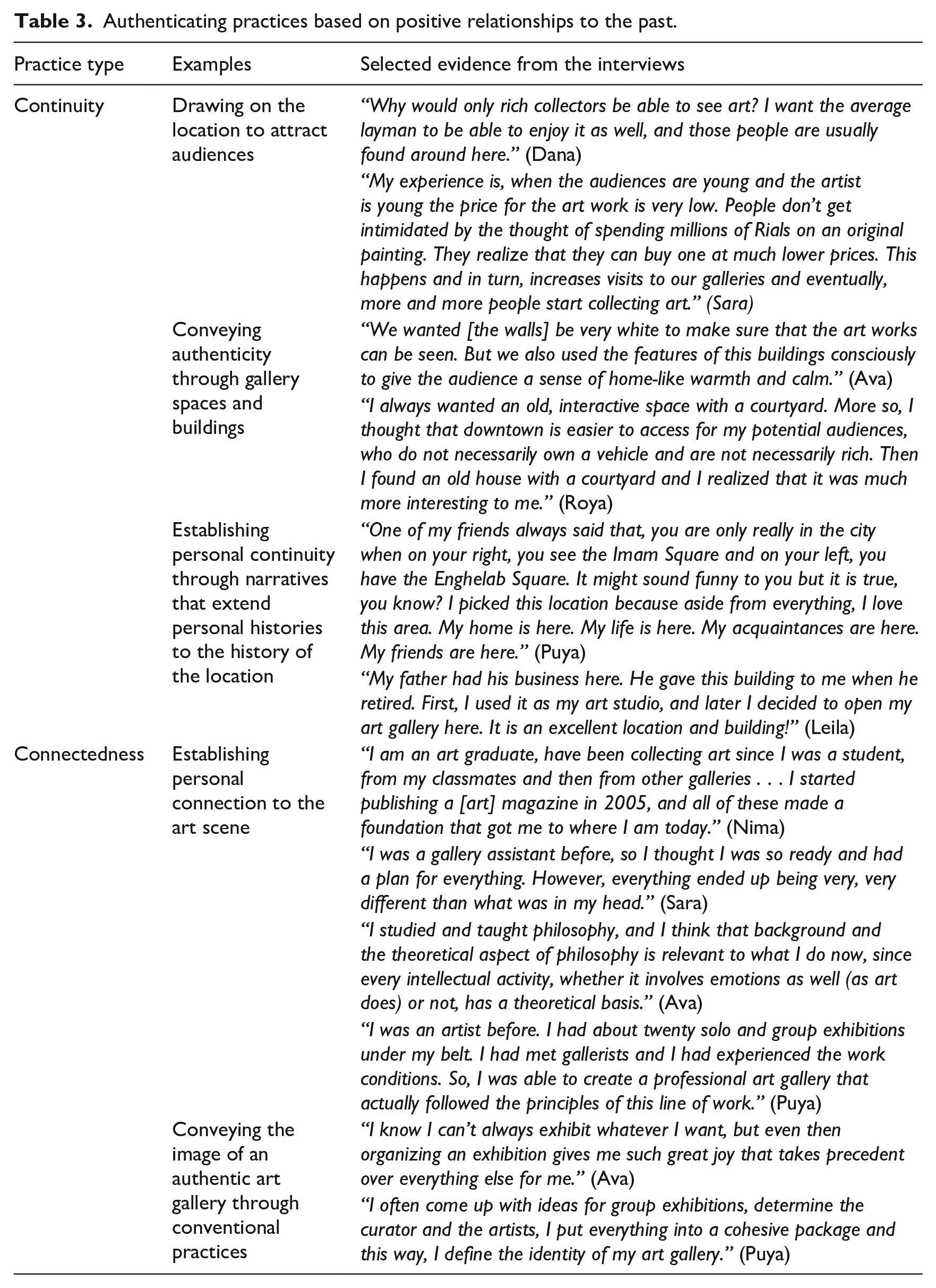
Authenticating practices (Table 3) consisted of representing and establishing positive links with the past and took the forms of connecting to a pleasant past while continuing it toward the future. These practices forged a position between past and future for the downtown galleries.
Authenticating practices based on positive relationships to the past.
Continuity
In establishing continuity, the downtown gallerists used historical cues in a future-oriented manner. Continuing art gallery traditions, such as discovering and incubating artists and promoting and selling their work, helped establish the downtown galleries as authentic and constituted what we label principal activities (Table 4). By using material historical cues, the downtown gallerists, quite literally, placed themselves within history: they chose to maintain a continuity with this collectively shared past through the geographical and architectural location of their practice (Figure 2), which served as an unmediated manifestation of that cherished past in two main ways.
Classification of activities by individual downtown galleries.
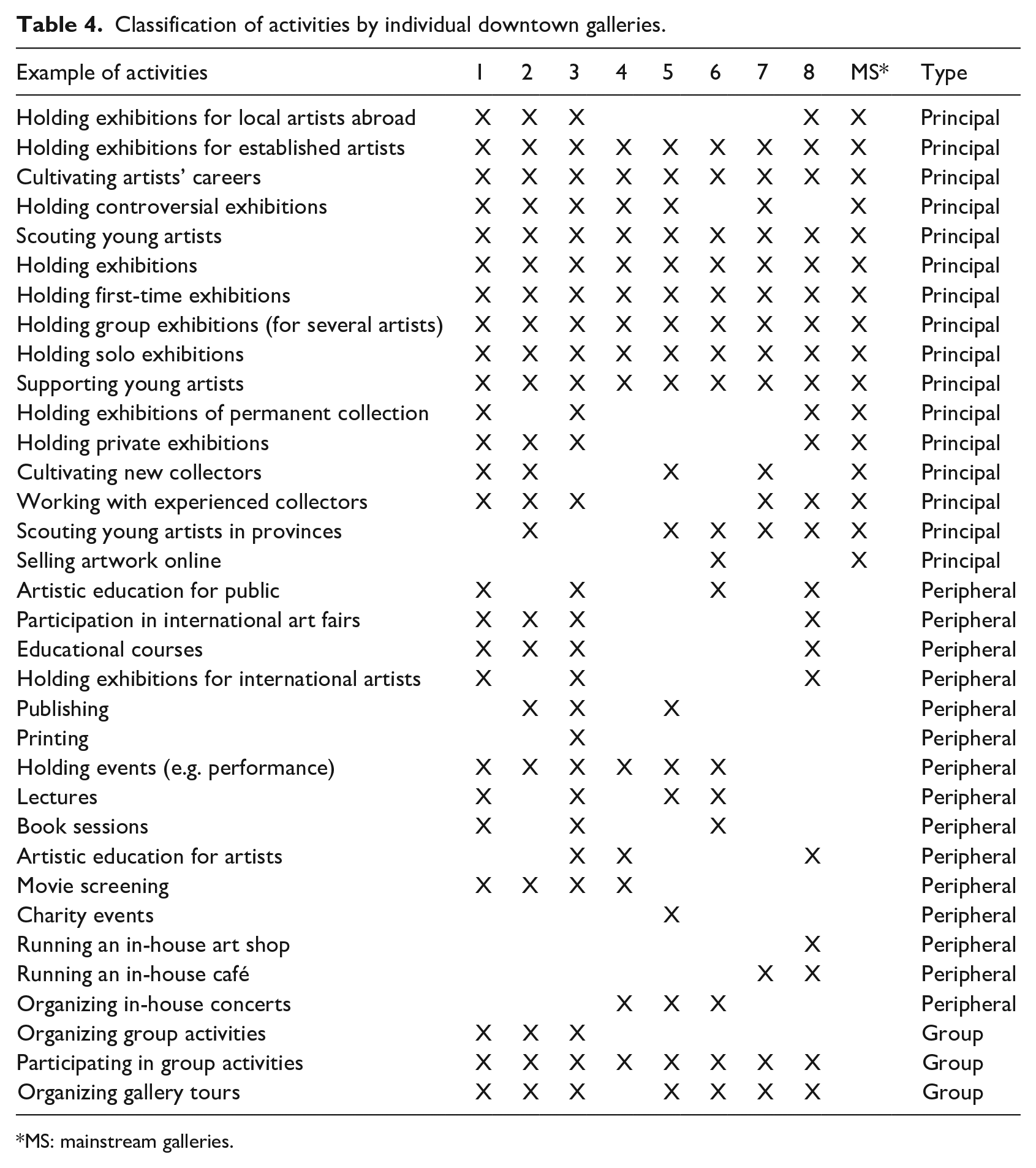
MS: mainstream galleries.
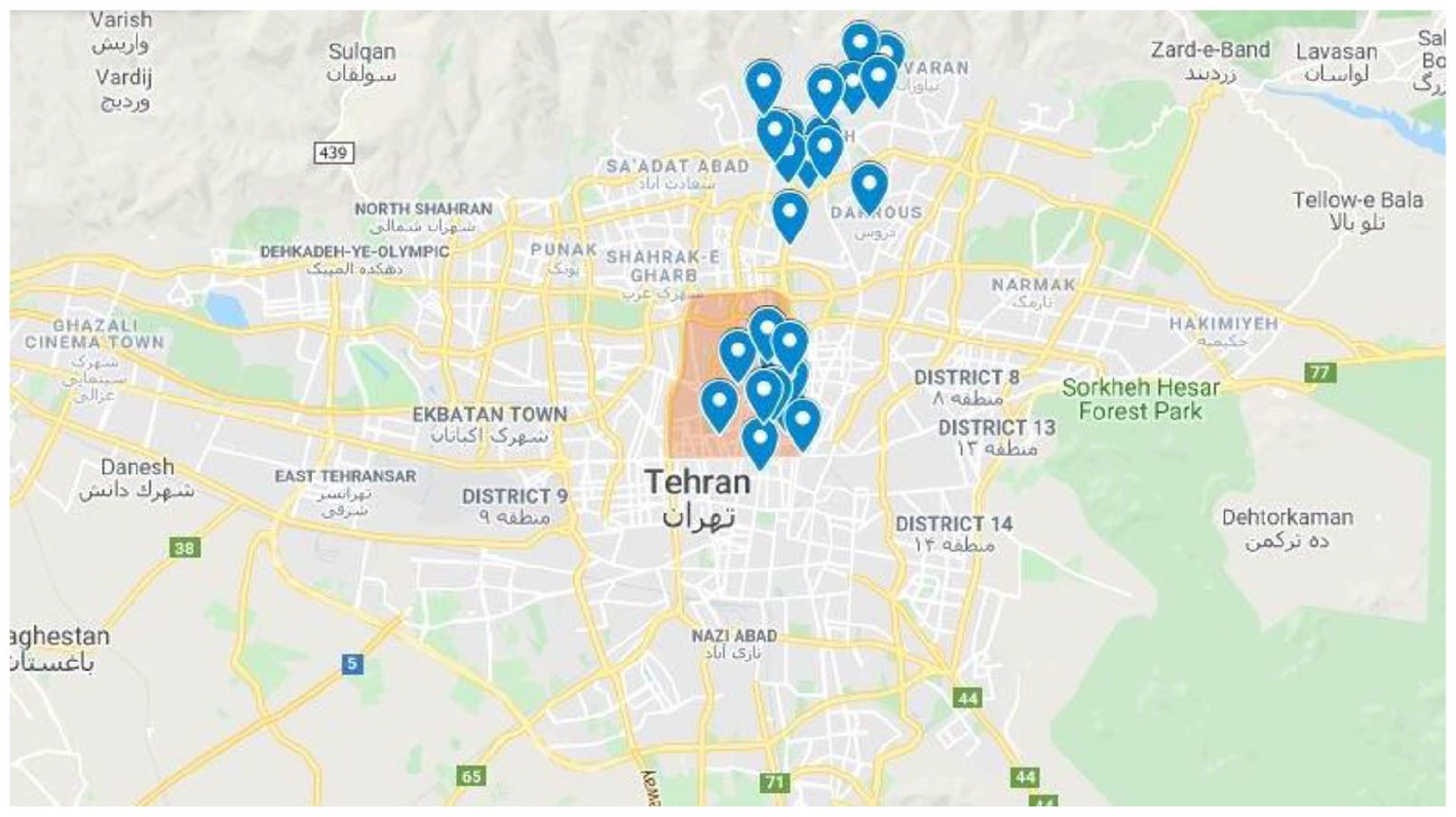
Map of Tehran, and downtown (highlighted) and mainstream galleries.
First, the downtown gallerists cited the iconic history of the area to justify their choice of location (which was, importantly, distant from the mainstream galleries). The presence of iconic buildings helped the downtown gallerists attract new publics to their art world. For instance, Puya described his selection of the area as: “a very conscious choice. This building is downtown, in the middle of the city, it attracts students and people who are interested in culture, and it is close to the [Iranian] Artists’ Forum. Naturally, our visitors grew in numbers.”
Proximity to other cultural attractions also enabled the downtown galleries to seek to become “the next cultural destination” (Borna). This attraction was so strong that while five of the galleries had been established in the downtown area from the beginning, three others that had started elsewhere subsequently relocated to the downtown gallery neighborhood.
Second, locating the art galleries in buildings that were much older than the galleries themselves created authenticity by extension. Given their age and previous uses, the buildings were often modified to meet the requirements of a gallery space, involving an unplanned yet similar architectural pattern. Sara, a gallerist with international experience, deliberately worked to integrate the building with the gallery’s look: “I had a mental image of what the inside of the gallery should look like – well, not only in my head, I also had taken photographs of different galleries around the world. Eventually, I realized that I either had to build the ‘white cube’ or think about what I can do with what I was given.”
Her solution was to create a unique bricolage of the white cube and preserved historical elements of what was available to her, and for good reason: “I thought I could preserve the soul of what already existed: the exterior spaces, like the courtyard, give a sense of traditional and old Iranian-style architecture, while I tried to make the inside, where we show contemporary art, resemble the “white cube” as closely as possible. On the outside, it fits the urban identity of the area and on the inside, it fits the work we show.” (Sara)
Sara’s description exemplifies a hybridization of the space to address competing needs, reconciling the tension between the “white cube” (Velthuis, 2005: 4) and the traditional courtyard and establishing both continuity and authenticity. For Sara and her peers, the gallery buildings with their courtyards and more traditional appearance fused art and popular culture, expressing a desire to attract a public otherwise intimidated by the “shiny, cold, modern” (Ava) appearance of mainstream galleries.
Connectedness
Forging a connectedness to the past, the downtown galleries actively used historical cues that showcased their desired connection to the past. The downtown galleries used narratives to forge connections to the downtown art scene. Associating himself and his young organization with the historic buildings, Puya noted: “I and my father and grandfathers are from this area. I love the city, and by ‘the city’, I mean this area. I don’t consider any other area the real Tehran. Those are just dorms with many people who just sleep there.”
Puya considered his own story, and by extension, his gallery, as being located at the site of a pleasant history. A natural extension of his past, his personal story legitimates the new presence in the art scene vis-à-vis the more established galleries.
The galleries also strengthened their connectedness by drawing on histories beyond the founding date of the galleries. Recounted personal pasts appeared as internal discourses that created common bonds between the downtown gallerists and gave meaning to their affinity with the past. Considering the relative youth of their galleries, such proximity allowed them to remain more accessible to outsiders than the mainstream galleries, particularly to younger artists and audiences. As Sara explained: “My mission is scouting young artists and cultivating their careers, and they can better connect with the younger audience with the same age and mindset. So, I need to be accessible to them, not to people who live up north and are more willing to pay for that kind of art.”
In summary, authenticating practices allowed the downtown gallerists to establish continuity of and connectedness with the past that situated them toward the future and the past, respectively, to claim a space within the art scene. These positive framings shaped representational practices through the use of spaces and buildings to build a sense of durability supported by personal narratives and “conventional” activities. However, the past also brought forth unpleasant memories, calling for other practices that ensured that authentication did not equate to conformity to that unpleasant past.
Breaking with an unpleasant past
The scattered and disrupted past evoked negative relationships, notably expressed toward the individual experiences of the downtown gallerists in their former careers in the art scene as well as the history of scarce public appreciation of art. First, within the downtown galleries, while personal narratives conferred pride of place and authenticity given the length of experience in the art world, the shared quality of experiences among the downtown gallerists tended to be highly negative. This was partially due to the limited space for artistic expression, reflected, for instance, in the aforementioned experiences of Leila. In another example, in light of how he and his peers run art galleries today, Borna regretfully recalled how restrictive approaches to art had negatively affected his artistic career: “In the late 90s, I had to adhere to a certain set of principles in my paintings. Now, thankfully, those principles do not hold anymore, so what I created before has to go to storage now, you know? So it is a negative point in my [artistic] career, and I don’t even want anyone to see those works of mine now, because I made them that way just because the requirements of that time dictated so.”
The principles to which Borna referred were unpleasant, limiting, and experienced as imposed by a normalizing mainstream. As a previously aspiring artist, Borna was frustrated about not having a space to exhibit his work and grow as an artist, and he had felt the need for change.
In this way, the negativities also extended beyond personal experiences and were expressed as a broader concern. For example, showing a similarly negative relationship, Puya explained how his previous experience studying and working in the visual arts and his inevitable encounters with mainstream gallerists had made him realize that the commercial approach provided neither a suitable platform for his work nor a response to his and his fellow artists’ concerns. He saw mainstream galleries as “art stores that do not follow the principles of art and culture,” elaborating that through their neglect of a wider cultural past, the mainstream galleries’ elitist approach and limited exposure impeded their public reach and impact, constituting “violations” of the principles of art and culture.
Second, the public’s lack of exposure to art over the previous decades was discussed as an unpleasant legacy of the early postrevolution years. A younger generation had been born and raised in the postrevolutionary period, when art was considered superfluous and, at times, taboo and public art-related activities were scarce. According to Ava, a gallery assistant and first and foremost an art enthusiast, recounted a visit to a mainstream gallery as a student 15 years prior, remembering “not getting [the artworks], and. . . feeling like I was being ridiculed by everyone else there for not getting it.” Thus, the frustrations of the downtown gallerists in their own careers were rooted in a problematic past relevant to the broader population. This had given rise to what we call distinguishing practices that aim to render the downtown galleries as proponents of a decided break from an unpleasant past through leading by example.
Distinguishing practices
Mobilizing unpleasant aspects of the past helped the gallerists form a distinctive approach while addressing past problems in a set of multimodal distinguishing practices with the aim of becoming attractive to audiences while compensating for an unpleasant past (Table 5).
Distinguishing practices based on negative relationships to the past.
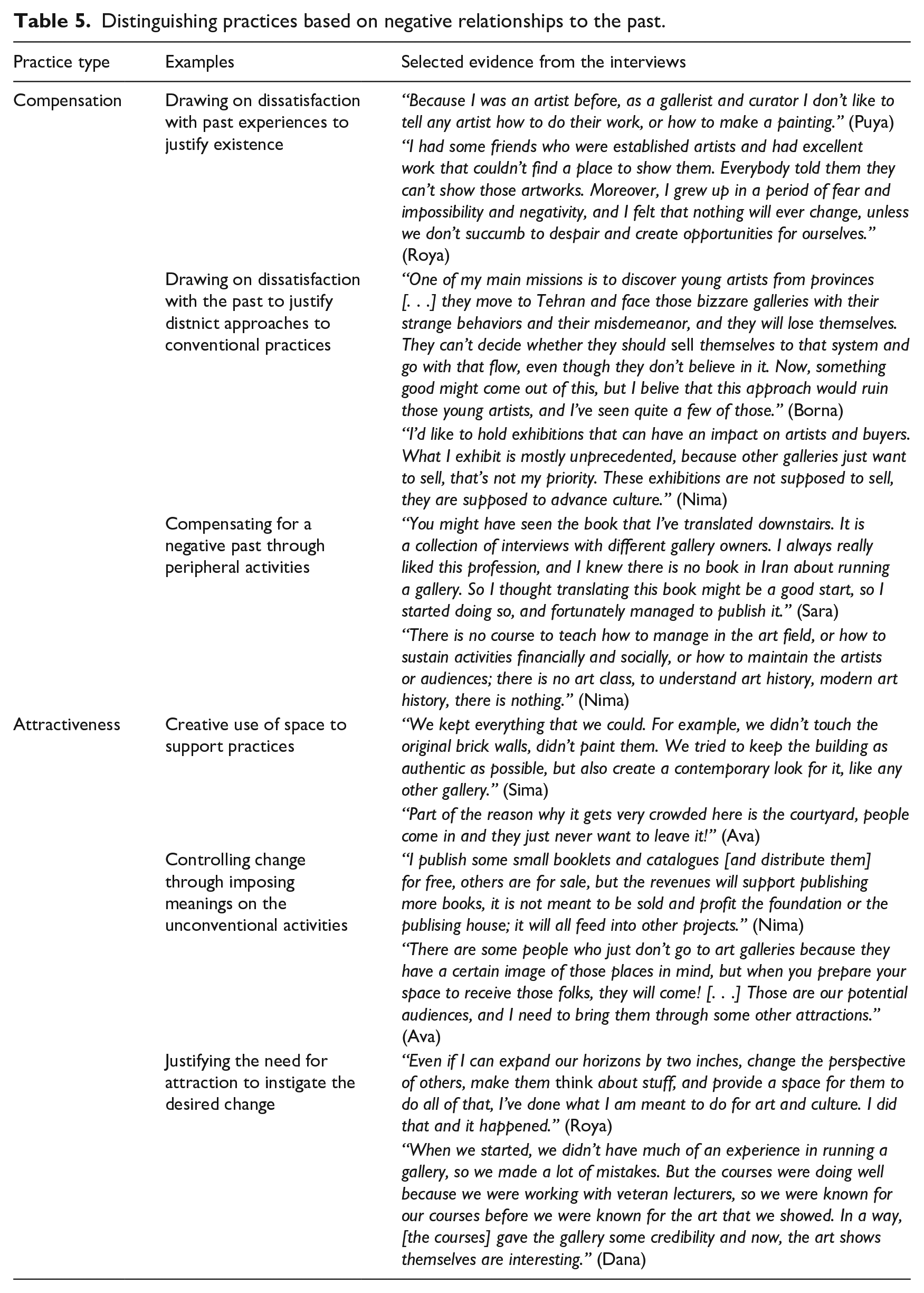
Compensation
Compensation for the past stemmed from an active, critical retrospection of it. In response to an unpleasant past, Puya and others had founded their own art galleries to make up for the unpleasant past and “do” history differently, something that was perhaps best done through activities. With some variety (Table 4), unconventional activities exhibited a break with past practices. More specifically, the downtown gallerists often altered conventional activities. Roya, for instance, exhibited: “. . . what others, for any reason, are afraid to show. Artists were creating [the artworks], yet no one was willing to show them. It wasn’t that the artworks were forbidden or taboo, no, they weren’t. It was just that [galleries] were hesitant about taking the risk of showing them. I did it though, it was possible.”
Roya claimed that she took a bold approach in choosing artworks for the exhibition because she could not see such works anywhere else. While all the gallerists engaged in conventional practices of cultivating artists and promoting works, some took pride in discovering unknown artists in underprivileged areas and the provinces. Some discussed the “one-of-a-kind” works that they promoted, where the uniqueness was less about artists or artworks than about their own unpleasant past experiences as artists, gallerists, or audiences. Because the mainstream galleries had largely ignored unique artworks and young, aspiring artists, engaging with such negative relationships to the past enabled the downtown galleries to recuperate and interrogate these lost experiences.
Moreover, the downtown galleries established secondary activities to raise the public’s consciousness of art. For the downtown gallerists, rebuilding the art scene required fostering understanding and appreciation in the younger generation. Given the artistic void (Figure 1) and the turbulences in the personal, collective, and national past, the downtown gallerists understood the problem as one of historical neglect and established practices such as educational courses on art and culture, lectures, and video production. Notorious for organizing movie screenings, for example, Roya acknowledged the gradual yet notable results of such activities: “After three years of doing that, I see them coming in early and checking out the artworks on the walls before going to the movie session. [The exhibitions] were nonsense to them in the beginning. Then, they started asking questions and doing their own research on them.”
As this quote suggests, unhappy with the public’s lack of previous exposure to art, the downtown gallerists used peripheral activities to stoke interest in art through other, more familiar attractions. However, the passion expressed in the gallerists’ descriptions of such normally peripheral activities took us by surprise given the conventionally marginal status of such activities in most art galleries. In other words, the downtown gallerists imposed meanings on such activities using narratives to emphasize that these were secondary to their main work. For instance, having produced and screened a short film of an artist at work, Ava remembered: “We sent someone to the provincial hometown of the artist. It took two days of shooting and several days of editing.” However, although it had required even more effort than organizing the exhibition itself, Ava still considered the short film to be peripheral: “Showing fine art is pivotal. Everything else is set around it. Everything else relates to it. What I’m trying to say is that the exhibition is the core, and other [activities] are here, as if we’re helping the main exhibition in a way.”
Ava’s statement exemplifies how, through narratives, downtown gallerists imposed desired meanings on unconventional practices, creating coherence between seemingly divergent practices. However, as these peripheral activities still bore little resemblance to traditional understandings of art galleries, the new actors risked being discounted as a legitimate art gallery while trying to broaden public exposure to “true” art galleries.
Attractiveness
The downtown galleries made themselves attractive to audiences to strengthen their desired future direction, which was rooted in dissatisfaction with an unpleasant past. Even though narratives appeared essential to shape the meanings of peripheral activities as distinguishing practices, material historical cues supported these practices and lent attractiveness to the emerging downtown galleries. We observed that the creative uses of places allowed representations to distinguish past and present activities. Using the gallery space for attractions such as art shops or cafés and hosting events such as concerts, fundraising, and poetry readings aimed to attract an otherwise unaccustomed audience. Borna argued: “I keep leaving the brochures in the café to promote [exhibitions] and let the ladies and gentlemen who spend five, ten minutes in the café, drinking their coffee, tea, infusion, you can also take five, ten minutes to see some artworks in the gallery, maybe it becomes interesting to you, maybe it changes the way that you see the world, maybe you’ll learn a new way to spend your time.”
Furthermore, the materiality of historical representation involved approaches involving continuity and distinction in the renovation of the gallery buildings. While the preserved nuances within the “white cube” design served the authenticity concerns discussed above, the gallerists made conscious efforts to preserve idiosyncratic elements of the original buildings despite their transformation into art galleries. The subtleties of the interior spaces provided reminders of a past within the wider movement to change a dominant conception of art.
For example, as emblematic elements of classical Iranian architecture, traditional courtyards were preserved and used for interaction and socializing in the otherwise “modernized” downtown galleries. During visits to the galleries, we observed that the courtyards were nearly as crowded as the exhibition spaces and doubled as socialization venues. In another example, a gallerist pointed to a faded pink flight of stairs, which appeared to clash with the pristine white gallery space. Intentionally having left the staircase untouched, she explained her desire to preserve the “soul of the building” (Sima). In another example, Ava thought that the home-like atmosphere helped the downtown galleries “not to look like a store,” an important and highly negative feature of mainstream galleries and one that is emblematic of an unpleasant past.
In sum, the distinguishing of the downtown galleries’ practices simultaneously represented attractiveness in moving forward and compensated for negative aspects of the past in retrospect. Constructing activities to attract the audiences while compensating for the troubled past involved activities that departed from conventions with narrative supports and selective material elements reducing dissonance between past and present and drawing connections between the two.
Navigating conflicted relationships with the past
The simultaneously positive and negative aspects of the past gave rise to conflicting relationships, which contributed to opposing practices that, alongside the authenticating and distinguishing practices, directly served the collective goal of the downtown gallerists to change the direction in which the art scene was developing. The conflicting relationships were mainly observed toward the recent past and were demonstrated in explicit or implicit comparisons to mainstream galleries as well as in the strong desire to be part of the public art scene while rejecting its past and current state.
The strong opposition of the downtown gallerists toward the mainstream led to contention over the past (Table 6). Most evident in authenticating practices, the downtown gallerists insisted on embracing historical elements and practices from the personal, local, and global context. However, while demonstrating their unique position, they remained exposed to the mainstream galleries’ attempts to perpetuate this unpleasant past in the present. Outnumbering the downtown galleries, the mainstream galleries constituted a strong constituency in the art scene and could potentially mute alternative approaches. The tension between wanting to be a local, authentic and attractive art gallery and not wanting to be associated with extant notions about art galleries created a conflicting relationship with the previous Iranian art scene.
Opposing practices based on conflicted relationships to the past.
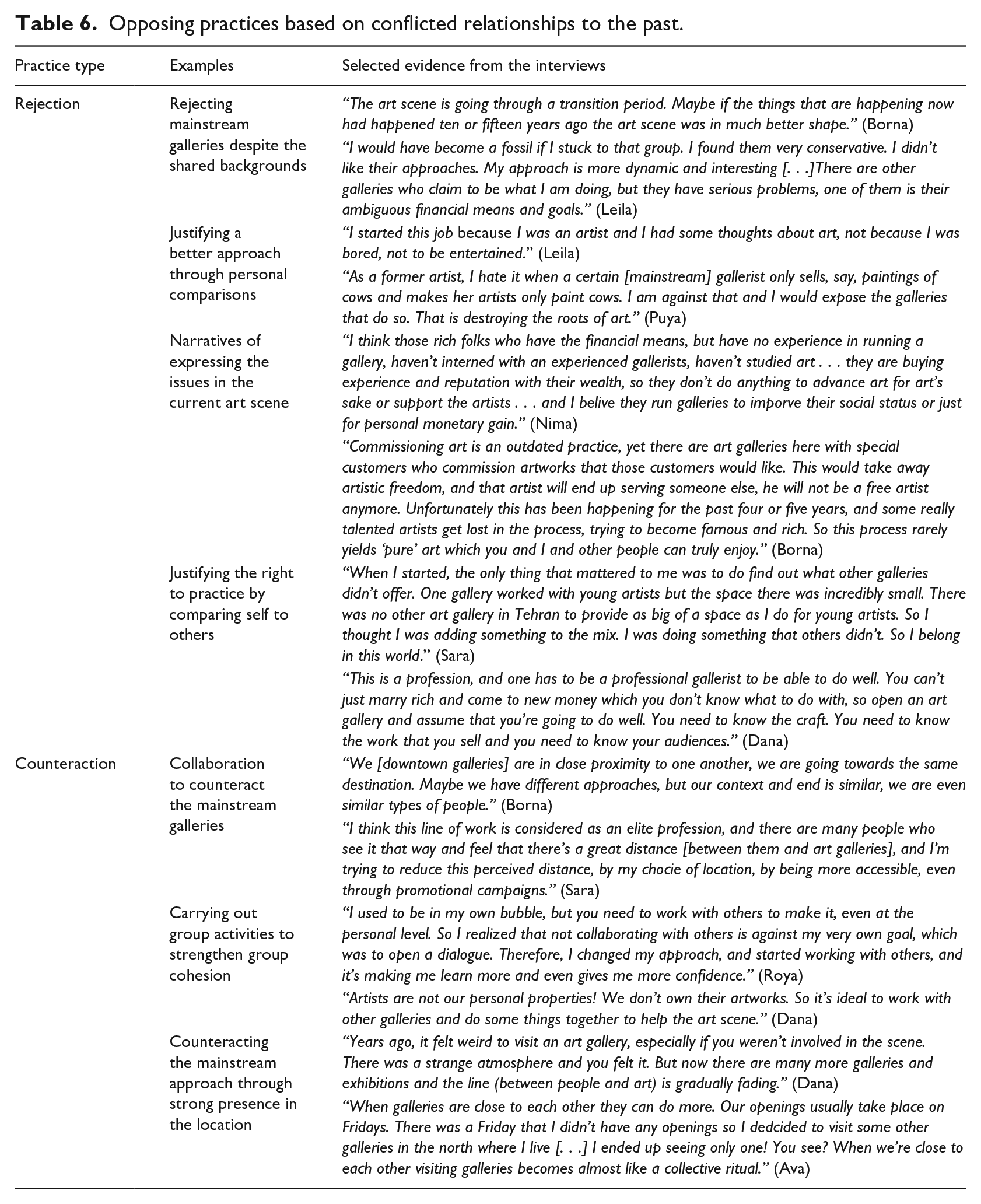
This conflicting position was expressed in a counterintuitive remark from Nima. When asked to discuss his gallery, he vehemently responded “This is not an art gallery!” only to later affirm that he was indeed a proud founder of a “true” art gallery but had not wanted to be associated with the mainstream idea of an art gallery. Afra expressed a similarly conflicting relationship when describing how mainstream galleries promoted the past for commercial gain, disregarding its negative impacts on the public and artists. For her, this seemingly mindless repetition of the past was a significant issue. Thus, for the downtown galleries to have a true impact on the art scene, they engaged collectively in opposing practices to reframe the scene from their now authentic and distinct position.
Opposing practices
The conflicting relationships to the past instigated multimodal opposing practices to oppose and counteract the historical representations of the mainstream galleries.
Rejection
Looking back at the conflicted relationships and their historical roots, the downtown gallerists represented their conflicted standpoints using comparative narratives of personal pasts, strongly voicing their opposition to the status quo of the mainstream art scene. Specifically, they positioned their own pasts in contrast to what they saw as irrelevant mainstream gallerists who had not studied art or had previous engagement with the art scene. They described mainstream gallerists as “lacking knowledge about art,” “only here to improve their social status,” and frequently, “to make a quick buck.” According to Nima: “They don’t do anything for promoting art or supporting artists.[. . .]They don’t have any long-term plans; because they have no knowledge about galleries, the art system, they don’t know the contemporary artists[. . .]this will damage the system, so why would I want to be one of them?”
Nonetheless, through authenticating practices, Nima and other downtown gallerists had claimed their spot in the art scene, carrying out distinguishing practices to make that spot unique while remedying an unpleasant past by attracting crowds. To ensure that they did not appear as “one of them,” they drew on material historical cues, notably location.
The historical downtown area of Tehran was significant because of its contrast to the northern and more affluent neighborhoods that housed the mainstream galleries. This spatial distancing was self-consciously used to reject the older galleries, as Sara explained: “If I want to visit a gallery uptown, I feel like I have to spend half a day to just be able to see one. On the other hand, if I go to the center, I can visit [. . .] at least four galleries in an hour, and you feel like this neighborhood is becoming a cultural hub.”
However, for her, downtown gallerists were not the only ones aware of the ever-strengthening image of the neighborhood as a cultural destination: “Other [galleries] are moving here as well. People are starting to notice a cultural space being created, with all the cafés and publication houses and bookstores, and art galleries are a nice addition to this atmosphere.” (Sara)
Thus, the gallerists drew on the downtown revival, accessible to a broad public and not only elites, repurposing this location as an affirmation of a new relationship to art. This allowed the gallerists to collectively voice and embody their movement beyond what one gallery or gallerist could have achieved. In this sense, the galleries formed part of a broader cultural movement to rebuild the historical significance of the downtown area as a precious space. Rather than a serendipitous discovery of the past, the downtown gallerists did not leave the “creation of the cultural space” to chance but developed interrelated practices to embed their art in the surrounding culture, which was enabled by and enacted in the location.
Counteraction
Counteraction stemmed from conflictual relationships with the past and informed how the downtown galleries oriented themselves toward the future. It was somewhat ironic that downtown gallerists claimed distinction from the pursuit of “the quick buck” while simultaneously pursuing a larger public with attractions such as stores and cafés. Hence, faced with a potential conflict of interpretation, they organized collective activities to bring a cohesive story of the neighborhood as a cultural destination in opposition to mainstream galleries. Mixing material historical cues and activities, they held joint exhibitions across multiple gallery buildings, which were made possible by the short downtown walking distances connecting the web of galleries. A joint project with bookstores, museums, and cafés furthered this image of urban regeneration through culture and involved a walking tour of galleries and museums in downtown Tehran, with breaks in cafés and bookstores. The first of its kind in the country, this project was anticipated to: “. . . give the wandering crowd in the area more purpose: they normally would come to the neighborhood to visit only one or two galleries, but there is much more to see in here.” (Nima)
In addition to attracting more crowds to individual and group exhibitions, carrying out such activities had another unanticipated outcome: the “gallery hoppers” were a rather distinctive-looking bunch, colorful, hip, and artsy, and they received ample attention. Their strolls in the area signaled that something new was happening there beyond what could be achieved by a single gallery. As Roya put it: “When we first moved here, local shopkeepers thought we were Martians, crazy to dress like this and work like that. Nowadays, they come up to me, ask what’s up, and even bring their families to see the shows.”
This quote emphasizes the cultural shift as a desired achievement not only for the artistic community but also for the general public: The downtown galleries had joined forces to reject a certain past and counteract it in moving forward to create cultural momentum for an alternative vision of Iranian art that “expand[ed] everyone’s world, even if by just an inch” (Roya).
To summarize, the downtown galleries’ contestation of art traditions led to collective interactions and the construction of a narrative of newness that was supported by collective, geographically based activities. This enabled them to construct a new narrative about who they were and what they were doing there, disseminating their vision of art within the broader culture as an alternative to the mainstream galleries. Even as they attempted to break with the past, the downtown galleries took a strong stand as a renewed form of their core identity as art galleries. In the concluding words of Roya: “I’d like for us to get to the point where I can do my thing in the right way. So far, my work has been somehow private, but I’d like to do something that stays in the audiences’ minds and gives them a nudge, aesthetically or conceptually. That’s my goal in the future scene.”
To synthesize the findings, we describe the new galleries’ complex relationships to the past and how they mobilize multiple modalities via an ensemble of historical narratives, material structures, and individual and collective activities to express distinct relationships to the past. The challenge of establishing authenticity while presenting alternatives led them to draw on previously obscured material and esthetic histories. They deployed multiple modalities—narratives, materials, activities—in different ways across practices. Authenticating practices involved the solidity of architectural supports and urban spaces, supplementing these with narratives and practices. Distinguishing practices involved practical actions supported by remaking materiality and narrating opposition. Conflicted views vis-à-vis the older galleries invoked opposing practices that consisted of artistic narratives along with attempts to collectively interact and structure spaces to materially realize these narratives. These multimodal distributions worked together, in leading or supporting roles, which we elaborate theoretically below.
Discussion
Our study focused on the complexity of relationships to the past and how organizations express these complex relationships through multiple modalities (Figure 3).
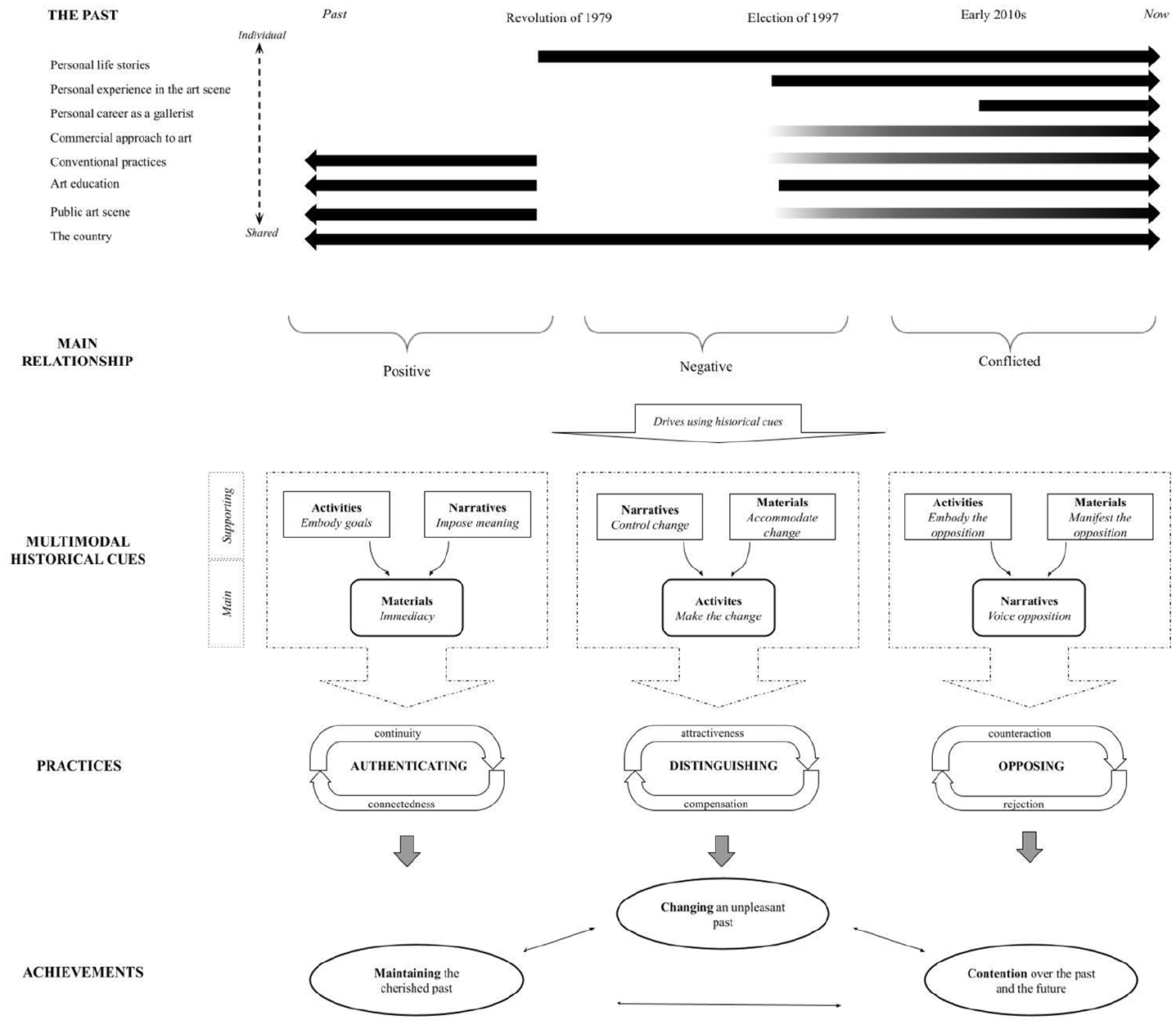
How do complex relationships with the past influence practices of historical representation? An integrative model.
As Figure 3 shows, different relationships to the past informed future- and past-oriented practices. First, positive relationships with the past allowed the actors to crystallize claims of connectedness and continuity via historical representations that maintain a cherished past and remain authentic to it. This was achieved by evoking material historical cues with the capacity to evoke immediate experiences and because of the durability and temporal continuity of the artifacts (e.g. buildings and public spaces). Claims to continuity were further strengthened by narratives of personal pasts and adherence to conventional practices. Second, by contrast, negative relationships to the past were mobilized to create distinctiveness vis-à-vis an older tradition, leading to historical representations through actions that distanced the actors from an unpleasant past and its legacies (as opposed to manipulating or forgetting it). Other modalities supported this distinctiveness such as repurposing material to frame the change process. When such activities threatened authenticity claims, informal and formal narratives worked to smooth over the risks associated with this break from tradition. Third, conflicted relationships with the past built upon authentication and distinction simultaneously to resignify and reframe counterhistories. In our case, this was mainly done through “self-other talk” that was pliable enough to allow for articulating continuities and differences in discursive struggles over the past. However, collective activities and creative uses of material spaces were used to consolidate a collective identity and materialize these narratives.
In each of these ways of relating to the past, diverse modalities were applied, and none were exclusively tied to a single modality. At the same time, the actors’ ability to use different modal resources—the stability or persistence of buildings and neighborhoods for continuity, the oppositional possibilities of practices for change, and the sense-giving aspects of narratives for contestation—meant that multimodal representational strategies allowed different and sometimes contradictory elements of the past to coexist.
Contributions to organizational uses of the past
At our site, multiple relationships with the past influenced historical representation in distinct yet intertwined organizational practices. Below, we elaborate on how different types of relationships to the past are mobilized and explain our specific contributions to understanding how organizations mobilize multiple, complex, and at times contradictory relationships to the past in practice.
Regarding positive relationships to the past, the extant research contends that actors use glorified historical accounts to claim legitimacy or authenticity in everyday practice (e.g. Basque and Langley, 2018; Brown and Humphreys, 2002; Moufahim et al., 2015; Ravasi and Schultz, 2006). While our findings confirm continuity as a support for authenticity claims, we also show how and why organizations establish continuity with less-cherished aspects of the past beyond the boundaries and reach of the organization. The young organizations in our setting enjoyed neither a perennial and glorified founding narrative nor a diverse organization-specific past upon which to build, while the collective past remained conflicted and fragmented. Instead, they delved into scattered and diminishing historical cues that elicited pleasant reminders of individual and collective pasts. Drawing on humble and individual pasts rather than mythicizing history, we show how historicizing myths can authenticate organizations.
Second, while a negatively perceived past is often assumed to be abandoned or heavily manipulated (Anteby and Molnár, 2012; Hatch and Schultz, 2017; Nissley and Casey, 2002), we show how it can be shaped and leveraged by organizations. Discontentment with a past within an organization (i.e. the individual experiences of the founders) and outside the organization (i.e. the art scene and public), the gallery founders shaped historical representations to create distinction and motivate change (Ybema, 2014). Despite the tendency in the literature to treat an unpleasant past as something to be relinquished (e.g. Anteby and Molnár, 2012; de Holan and Phillips, 2004; Easterby-Smith and Lyles, 2011), by showing how images of an unpleasant past were actively used by the galleries, we illustrate how engaging with past traumas constitutes an important part of organizational uses of the past.
Third, by showing how actors mobilize coexisting negative and positive views of the past (i.e. conflicting relationships), we show how relationships to the past are not monolithic and are contradictory and that diverse aspects of these relationships can be expressed in various ways. Acknowledging the agentic nature of using the past (Hernes and Schultz, 2020; Ybema, 2014) means that “different collectivities see the past according to their own interests and present experiences, perception of the past sustains and often intensifies social conflict” (Schwartz et al., 2005: 256). Such struggles over the past, however, require careful navigation since, for instance, actors’ divergence from conventions imposes risks of sanction (Maclean et al., 2014; Suddaby et al., 2010, 2020). The downtown galleries took a risk by breaking with mainstream modes. Nevertheless, by collectively reinterpreting history in opposition to the mainstream, this minority could sustain an alternative relationship to the past that, while complex, was creatively and carefully orchestrated to have a collective impact. Given that remembering requires others (Rowlinson et al., 2010) and that struggles over the past are likely to arise alongside societal alterations (Terdiman, 1993), collective practices to forge alternative connections to the past can enable group cohesion in opposition to incumbent historical traditions and instigate broader changes.
On our site, the downtown art galleries’ claims to distinction required establishing authenticity while opposing incumbent actors’ visions of the art scene and drawing audiences to the downtown area to create collective momentum for an alternative art scene rooted in a revisited history. They thus navigated a forward-looking strategic practice and retrospective processes for addressing past problems. In showcasing their practices, we draw attention to the complexity of relationships to the past, particularly when we view organizations against the background of a history of social conflicts (Maclean et al., 2014; Rowlinson et al., 2010). We emphasize the importance of acknowledging complexity in the uses of the past, which are complementary and interlinked. Both individual and collective in nature, these complex practices can be simultaneously deployed to manage apparently contradictory relationships to the past in orchestrated organizational practices.
Finally, the diversity of historical cues that informed organizational practice shows how historical representation can serve even young organizations. Despite scarce organization-specific historical cues (cf. Basque and Langley, 2018; Moufahim et al., 2015; Ravasi et al., 2019; Rowlinson and Hassard, 1993), even organizations without a long history can mobilize broader pasts in their practices to support diverse and sometimes contradictory purposes.
Contribution to multimodal historical representation
Our study also contributes to understanding how multimodal historical cues interact with complex relationships to the past. Simultaneous positive, negative, and conflicting stances challenge coherence, managed in our case by the multimodal distribution and orchestration of the uses of historical cues and actions. Acknowledging that organizations select cues based on their needs (Foster et al., 2011), our study affirms the role of narratives, material historical cues, and orchestrated activities for representing multiple relationships to the past.
As newcomers, the downtown galleries sought to simultaneously create a sense of authenticity, distinction, and opposition, which they consider to be essential to connect to the public and influence the art scene. Doing so meant drawing upon and resignifying diverse cultural materials, narratives, and spaces (e.g. Brown and Humphreys, 2002; Howard-Grenville et al., 2013; Ybema, 2010). The current study thus examines which modalities appeared as well as why they worked separately and together in practice. Our attention to the materiality of historical representation (Wadhwani et al., 2018) suggests the constraining, enabling, and orienting potential of both discursive and nondiscursive modalities. Our contribution to the literature on multimodality (e.g. Höllerer et al., 2019), therefore, is in showing how different modalities are distributed and related with regard to complex relationships to the past.
Specifically, narratives were an important vehicle by which relationships to the past were expressed and shaped, particularly in the form of individual narratives around the gallery owners’ own pasts. However, the elusive and malleable character of the narratives hampered their reach and power, especially given the small size and marginality of the group in our setting. Their narratives were strongly oppositional, which shows the power of narratives to voice opposition without necessarily becoming bound to it. However, our findings also show how the potential pitfalls of narratives can be remedied in conjunction with other modalities.
Material historical cues provided the immediate experience of the present and the past through objectively understood and at times functional properties. In our case, the location and buildings were collectively shared and cherished; while they remained open to reappropriation and interpretation, they lent solidity to the emerging movement. The tangibility of material historical cues had direct effects—the courtyards objectified traditional architecture, the downtown area offered specific spatial relations and described its history on a carved plaque. The immediacy of material historical cues anchored and maintained the sense of a pleasant yet elusive past. Conferring a pattern and commonality to reinforce a common historical standpoint (Harquail and Wilcox King, 2010) while conforming to the tangible aspects of art galleries (i.e. the white cube), materiality anchored practices, and provided a sense of continuity of a cherished past. However, the polyvalent and interpretively open nature of these materials meant that ample symbolic and organizational work needed to be done to make these artifacts work for the galleriests’ vision.
Given the multiple forms of historical representation (Blagoev et al., 2018; Gasparin and Neyland, 2018; Nissley and Casey, 2002), we contribute to a multimodal conception by drawing attention to the material historical resources deployed in conjunction with narratives and practices. Despite their repurposing and modified usage, the downtown gallery buildings remained accessible to instigate intra- and interorganizational coherence while directly supporting the diverging narratives and activities, thereby providing tangible and visible proof that the divergence did not question the authenticity of the organizations.
Finally, activities were used to “do history” to transform social conditions and create new lives and selves (Sannino et al., 2009). We thus acknowledge activities as another nondiscursive use of history. As a direct enactment of relationships to the past, activities answer the question of “what can be done with the expressed relationships to the past” and thus connect the past to the future (Hernes and Schultz, 2020). Recognizing that adherence to traditional practices can be limiting (Dacin et al., 2019), young organizations can nevertheless benefit from such practices to claim authenticity and the “right to be there.” Moreover, doing things together created the sense that the downtown galleries were together and provided an opposing voice to the incumbent mainstream galleries.
However, we contend that activities can be most useful when a particularly negative relationship to the past requires the organization to do something about it. Thus, seemingly disparate activities, orchestrated carefully in relation to the past, can support the coherence and distinctiveness of historical representation and help organizations survive the early volatile stages of formation.
In sum, our contribution lies at the interface of multimodal representation and the uses of the past. Complementing the established centrality of narratives in taming conflicts and “struggles for meaning” (Maclean et al., 2014), we extend this notion beyond one organization and in concert with other nondiscursive tools. Narratives, with their versatility and malleability, were supplemented by material supports and practices, with their visibility and durability. Verbal communication, which is polyphonic and polysemic (Brown and Humphries, 2002), can recontextualize the material (Blagoev et al., 2018; Humphries and Smith, 2014), while materiality confers solidity and concreteness to social relations. This suggests the utility of studying the material in addition to discursive historical resources, particularly when the esthetic aspects of organizing are as important as the language (Louisgrand and Islam, 2021; Wadhwani et al., 2018). Attending to multiple relationships to the past and their multimodal representation in organizational practices enhances the understanding of the potentials and pitfalls that each one carries and how they can complement each other in representing complex histories.
Concluding remarks and future research
Our contribution to the uses of the past and multimodality involved exploring how multiple relationships to the past coexist and can be mobilized simultaneously. Discursive and nondiscursive historical cues can be combined in creative and intertwined ways to serve organizational purposes, allowing for the exploration of the boundaries of choices among the seemingly infinite pool of resources. Given our setting within the culture sector, this creative struggle to work with the past also highlights the role of cultural organizations in unsettled times as they can potentially address and remedy problematic pasts through their creative use of stories and other material and practical strategies.
Nevertheless, we note two limitations. First, our empirical setting, while unique and dynamic, is under severe scrutiny by local authorities, which limits the extent of both the organizational activities themselves and the research around these settings. Due to the sensitive nature of art or any art-related activity in Iran, we were not able to secure the participation of all the downtown galleries. Out of those that were willing to participate, at times, we noted reluctance to speak openly during the interviews, except for when the interviewees requested to go “off the record,” which we naturally did not use in our data analysis or findings. Moreover, while we took and gathered numerous visuals (of artworks, people, places, spaces, streets, etc.), the photos are easily identifiable, which can endanger the anonymity and privacy of our informants. Therefore, we had to resort to discussing such visual evidence and refrained from including it in our formal data analysis and our final manuscript. Second, while our analysis and discussion provide an elaborated understanding of a rather complex historical representation, they do not represent an all-encompassing model that can explain all types of historical representation. For instance, as the national history of our own case indicates, contentions over the past sometimes go beyond struggles over representation and into struggles over more material forms of power over history. The relationship between these different forms of contesting history, although beyond our present scope, is an important area for the organizational research.
This research focuses on the claims, practices, and sense of righteousness of one group and is, by and large, faithful to its perspective. However, an important research avenue would include juxtaposing multiple groups’ diverse forms of historical contention to understand how these reinforce or compete in an overall struggle over history. Combining the ideas of a diversity of relationships to the past with a diversity of material and discursive modalities with which to articulate these relationships, such research would be able to link to broader questions about the multimodal strategies through which organizations react while constructing their histories and, in turn, more broadly inform the organizational microfoundations of social history. The current study, with the more modest goal of understanding how this occurs in a small group of emerging cultural actors, nevertheless hopes to provide a step toward such broader questions.
Footnotes
Acknowledgements
The authors would like to acknowledge the kind help of Pascal Dey, Paul Stewart, PhD students and faculty members at Grenoble Ecole de Management, and the participants of SAMS PDW on creative industries at the University of Edinburgh for their comments on previous versions of this paper. We would also like to thank Patrizia Zanoni, Sara Louise Muhr, and two anonymous reviewers for their in-depth engagement with our manuscript.
Funding
The author(s) received no financial support for the research, authorship, and/or publication of this article.
