




Abstract
Drawing on Organizational Memory Studies (OMS), this paper examines how the conflicts that gradually emerge between different mnemonic communities over how to deal with the past spatially shape a memory site over time and its underlying collective memory. To this end, we conduct a historical analysis of the Oradour-sur-Glane site from 1944 to 2024, covering 80 years from immediately after the massacre of almost all the village’s inhabitants by the German army. Our findings reveal the dynamic of spatial multivocality with the creation and reconfiguration of different sub-spaces expressed through conflict mitigation mechanisms: preserving, echoing, privatizing, combining, and bridging. Our findings contribute to OMS research by exploring the contested nature of collective memory, the role of spatial multivocality in mitigating conflicts, and the significance of spatial arrangement as a mnemonic trace. We highlight how spatial arrangements not only anchor memory but also act as mediums for negotiating competing interpretations of the past, revealing the complex interplay between collective memory, conflict, and spatial arrangement.
Keywords
Introduction
This paper contributes to the stream of research on collective memory, rooted in Social Memory Studies (SMS; Halbwachs, 1980; Olick and Robbins, 1998) and, more recently, in Organizational Memory Studies (OMS; Foroughi et al., 2020). It aims to investigate how conflicts gradually emerging between different mnemonic communities regarding how to deal with the past spatially shape a memory site and its underlying collective memory over time.
Collective memory was originally conceptualized as a social process (Misztal, 2003) to determine what should be remembered and emphasized, and what should a contrario be forgotten (Feldman and Feldman, 2006; Mena et al., 2016). It is now widely recognized as a contested process (e.g. Foroughi and Al-Amoudi, 2020; Halbwachs, 1992) shaped by multiple mnemonic communities (Coraiola et al., 2023; Zerubavel, 2003) defined as “groups of people coalescing around particular understandings of past events” (Foroughi, 2020: 1348).
Despite their crucial role in shaping collective memory, research in OMS has largely overlooked the existence of multiple and overlapping mnemonic communities within an organization or a memory site as in our case. These communities often generate competing narratives and tensions in the memorialization process. Indeed, existing studies have primarily focused on conflicts within a single mnemonic community, as it gradually forms around specific interpretations of the past (e.g. Crawford et al., 2022; Cutcher et al., 2019). However, in the context of organizations or memory sites, multiple mnemonic communities may coexist, each supporting different interpretations of the past (Coraiola Diego et al., 2018; Mena et al., 2016). Research on conflicts between different mnemonic communities, however, remains largely underexplored (Coraiola et al., 2023; Zerubavel, 1996), with notable exceptions including the work of Fentress and Wickham (1992) at the field level and Foroughi (2020) at the organizational level. However, those studies focused on their differences and analyzed the communities in isolation, without considering their interactions. By adopting the perspective of “ecologies of memories” (Coraiola et al., 2023: 378), which emphasizes the role of multiple mnemonic communities in shaping collective memory, this study aims to deepen our understanding of the interactions and the conflicts that may arise concerning collective memory.
In addition, conflicts and the broader process by which mnemonic communities shape and re-shape the past, have predominantly been examined through the lens of immaterial mnemonic traces such as narratives or storytelling (Anteby and Molnár, 2012; Blagoev et al., 2018; Foroughi, 2020; Foroughi et al., 2024; Hatch and Schultz, 2017; Ravasi et al., 2019; Rowlinson et al., 2014a; Sinha et al., 2020; Ybema, 2014). However, some scholars have underlined the influence of more material mnemonic traces, such as rites, statues, and buildings (e.g. Crawford et al., 2022; Do et al., 2019; Eisenman and Frenkel, 2021; Mena et al., 2016). In doing so, they opened up avenues for considering the spatial arrangement through the location of such material mnemonic traces which can play a role in making sense of a past event and be the subject of conflict. While Allen and Brown’s (2016) study of the Hyde Park 7/7 memorial first illuminated the negotiation and contestation surrounding the spatial arrangement -highlighting its intricate spatio-temporal “meshwork”- the interplay between spatial arrangement and collective memory needs further investigation, resonating with Halbwachs’s seminal work (1980[1950]).
Building on these insights, this study seeks to investigate the underexplored conflicts among different mnemonic communities and how their spatial resolutions can shape collective memory over time. This inquiry leads us to the following research question: How do conflicts between different mnemonic communities spatially shape a memory site and its underlying collective memory over time?
Empirically, our research focuses on the memory site of Oradour-sur-Glane. This site holds historical and political significance as it was created to commemorate the massacre of nearly all the inhabitants of this French village by the German army on June 10, 1944, during the World War II (e.g. Farmer, 2007; Fouché, 2004). Our historical analysis from 1944 to 2024, uncovers the main conflicts among the different mnemonic communities and reveals how their resolutions have led to the creation and reconfiguration of different sub-spaces within the memory site. These sub-spaces were supported by diverse mechanisms - preserving, echoing, privatizing, combining, and bridging - to mitigate conflicts and convey different interpretations of the past. Preserving involves the permanent reconfiguration of a sub-space to fix the past permanently; echoing involves the creation of a new sub-space in the shadow of the preserved one, thereby echoing the massacre; privatizing refers to the reconfiguration of a sub-space to facilitate private remembrance of the victims; combining refers to the creation of a new sub-space to accommodate conflicting interpretations of the past and bridging refers to the spatial cohesion across the entire memory site in support of collective memory. Together, these mechanisms illustrate a dynamic that we term spatial multivocality, highlighting the spatial coexistence of diverse interpretations maintained by different mnemonic communities within a single memory site.
Our study advances the literature on Organizational Memory Studies (OMS) by examining the contested nature of collective memory, the role of spatial multivocality in mitigating inter-mnemonic conflicts, and the significance of spatial arrangements as a mnemonic trace. By investigating the interplay between spatial arrangement and collective memory, our findings reveal how spatial arrangements serve not only as a site but also as mediums through which the past are negotiated, contested, and reinterpreted. This approach underscores the dynamic relationship between collective memory, conflict resolution and spatial arrangement.
Theoretical framework
Conflicts between mnemonic communities in shaping collective memory
The concept of collective memory, first introduced by French sociologist Halbwachs (1992), is understood as a social (Olick and Robbins, 1998) rather than individual process (Bell, 2012; Foroughi and Al-Amoudi, 2020; Rowlinson et al., 2010). Collective memory is shaped by mnemonic communities that share a particular understanding of the past (Aksu, 2009; Halbwachs, 1980]; Mena et al., 2016; Misztal, 2003; Zerubavel, 2003). These communities selectively emphasize, reinterpret, or ignore aspects of the past based on their specific interests and contexts (Anteby and Molnár, 2012; Aroles et al., 2024; Foroughi and Al-Amoudi, 2020; Mena et al., 2016; Zerubavel, 1996). Such selectivity often leads to conflicting interpretations, especially between those who have direct experience of events and those who have only indirect knowledge (Misztal, 2003). This transforms collective memory into a process of negotiation and contestation rather than a static body of knowledge (Foroughi, 2020; Foroughi and Al-Amoudi, 2020; Wertsch and Roediger Hl, 2008).
Research on mnemonic communities has typically focused on how specific communities such as occupational community (Foroughi et al., 2024; Noh et al., 2024), emerge to preserve or commemorate a shared vision of the past (Crawford et al., 2022; Cutcher et al., 2019; Eisenman and Frenkel, 2021; Zerubavel, 2003). In this vein, studies have investigated how a mnemonic community can shape members’ perceptions (Ravasi et al., 2019; Suddaby et al., 2010; Wadhwani et al., 2018), or, conversely, how intentional and non-intentional selective forgetting of certain events and behaviors influences organizational reputation, identity, and culture (Foroughi and Al-Amoudi, 2020; Mena et al., 2016). While these studies generally focus on the influence of a dominant mnemonic community in shaping collective memory (Basque and Langley, 2018; Foster et al., 2011; Nissley and Casey, 2002), we conceptualize the construction of the past as a series of conflicts between different mnemonic communities (Zerubavel, 1996), following the ecologies of memories approach (Coraiola et al., 2023) and the work of Smith and Russell (2016).
Emerging research examining multiple mnemonic communities has identified three primary mechanisms for resolving conflicts, shaped by power dynamics (Coraiola et al., 2023). When power is unequal, dominant communities may impose their interpretations, as illustrated in the U.S. tobacco industry’s efforts during the 1950s to downplay smoking risks (Coraiola and Derry, 2020). Yet, less powerful mnemonic communities may resist to preserve their own memories, as demonstrated in Foroughi’s (2020) study of a nonprofit’s “old school” community resisting a “new school” narrative on the organization’s origin myth. When power relations are more balanced, communities may negotiate to allow for different interpretations as in the reconciliation to collectively condemn past actions of Volkswagen’s complicity in human rights abuses during the Nazi regime (Schrempf-Stirling et al., 2016).
Although these studies recognize the existence of multiple communities, they often examine them in isolation rather than through their interactions (e.g. Fentress and Wickham, 1992; Foroughi, 2020), limiting insights into inter-community conflicts. Additionally, they focus on immaterial mnemonic traces, like narratives and organizational storytelling. To further our understanding, we propose examining the conflicts between mnemonic communities and the way they can be mitigated through more material mnemonic traces, particularly spatial ones.
Spatial arrangement as a mnemonic trace in shaping collective memory
A crucial element of collective memory is the presence of mnemonic traces, material or immaterial, that enable mnemonic communities to uphold specific interpretations of the past (Mena et al., 2016). These traces, which include narratives, technology, storytelling, monuments, statues, rituals, or commemoration ceremonies (Anteby and Molnár, 2012; Blagoev et al., 2018; Coraiola and Derry, 2020; Crawford et al., 2022; Do et al., 2019; Foroughi, 2020; Foroughi et al., 2024; Foroughi et al., 2024; Hatch and Schultz, 2017; Ravasi et al., 2019; Rowlinson et al., 2014a), serve as valuable resources through which communities can build, maintain, and reinforce collective memory over time (Aroles et al., 2024; Clark and Rowlinson, 2004; Do et al., 2019; Foster et al., 2011; Hatch and Schultz, 2017; Rowlinson et al., 2010). Typically, what is useful or acceptable is remembered, while painful or shameful aspects are often suppressed (Anteby and Molnár, 2012; Coraiola and Derry, 2020; Mena et al., 2016; see Crawford et al. (2022) for an exception).
Although a variety of mnemonic traces have been studied, including the material ones, the current literature provides limited insights into how the spatial arrangement of an organization or a memory site as in our case functioned as a mnemonic trace. For example, the Do et al. (2019) study just mentions the role of a building in the community that was left vacant after the bankruptcy of an organization. However, since 1950, Halbwachs (1980], pp. 6–7) linked spatial arrangement to collective memory, stating that “every collective memory unfolds within a spatial framework.” More recently, Allen and Brown (2016) emphasized that collective memory, composed of fragmented images, narratives, and feelings, is shaped by objects and spaces. While the connection between spatial arrangement and collective memory is acknowledged (Halbwachs, 1980, 1992), it remains understudied and undertheorized (Decker, 2014).
Based on those current limitations, we propose to examine the role of conflicts between different mnemonic communities and the spatial arrangement as a mnemonic trace to gain deeper insights into how collective memory is spatially shaped over time. To do so, we align with research efforts aimed at enriching OMS by selecting non-traditional settings, with painful memories (e.g. Allen and Brown, 2016; Aroles et al., 2024; Crawford et al., 2022). Specifically, we focus on a memory site (lieux de mémoire; Nora, 1996), that is, a spatial site where collective memory is preserved and commemorated. Our research therefore examines how conflicts between different mnemonic communities spatially shape a memory site and its collective memory over time.
Research setting: The Oradour-sur-Glane massacre
The massacre at Oradour-sur-Glane is one of the most significant civilian atrocities committed by German forces in France during the World War II, and has had a lasting impact on French society (Farmer, 1995; Plas, 2015). This event marked the largest mass killing of civilians in France by the German army and, like similar massacres at Marzabotto in Italy and Distomo in Greece (which occurred on the same day), represented the extension of Eastern Front practices to the Western Front.
On 10 June 1944, the village of Oradour-sur-Glane, near Limoges in the center France, was destroyed by a detachment of the 1st Battalion of the 4th Panzergrenadier Regiment der Führer, part of the Waffen-SS Panzer Division das Reich (Leleu, 2010). This division, formed in 1938, was one of the oldest units within the Waffen-SS, the armed branch of the Nazi forces. The regiment entered the village around 2 p.m. and within 15 minutes the inhabitants were gathered in the village square. After a methodical search, any residents who resisted were killed (Centre de la Mémoire d’Oradour, 2000; Fouche, 2004; Malinvaud and Paul, 2000).
At 3 p.m. the women and children were locked in the village church, while the men were taken to seven barns around the village. About half an hour later, the men were shot. At around 4 p.m., soldiers placed explosives inside the church near the altar, lit the wicks and secured the doors. As the explosions went off, the soldiers opened fire on the women and children trying to escape (Farmer, 1995).
The evening train from Limoges arrived at Oradour-sur-Glane around 7 p.m., but passengers remained on board, unaware of the massacre that had occurred. By 10 p.m., most German troops had left. In the days that followed, however, soldiers returned to bury the dead and to incinerate the remains of 328 buildings, including houses, a school, shops and hotels (Leleu, 2010). The massacre resulted in 642 deaths, with only six survivors. Many of these perpetrators remained still unpunished in Germany, a fact that was recently denounced by the German President during the commemoration of 10 June, 2024. expressed, “I want to admit my shame that afterward, murderers went unpunished, and the most severe crimes were not atoned for. Here, my country bears a second guilt” (Der Bundespräsident, 2024).
Research method
Because our purpose is theory elaboration, we focus on an in-depth historical case study of the memory site of Oradour-sur-Glane in France, from 1944 to 2024, covering 80 years from immediately after the massacre of almost all the village’s inhabitants. This case-based methodology involves the systematic alignment of collected data with our theoretical framework, as advocated by Langley (1999), to support rigorous pattern matching and interpretation within a theoretical context.
Data collection
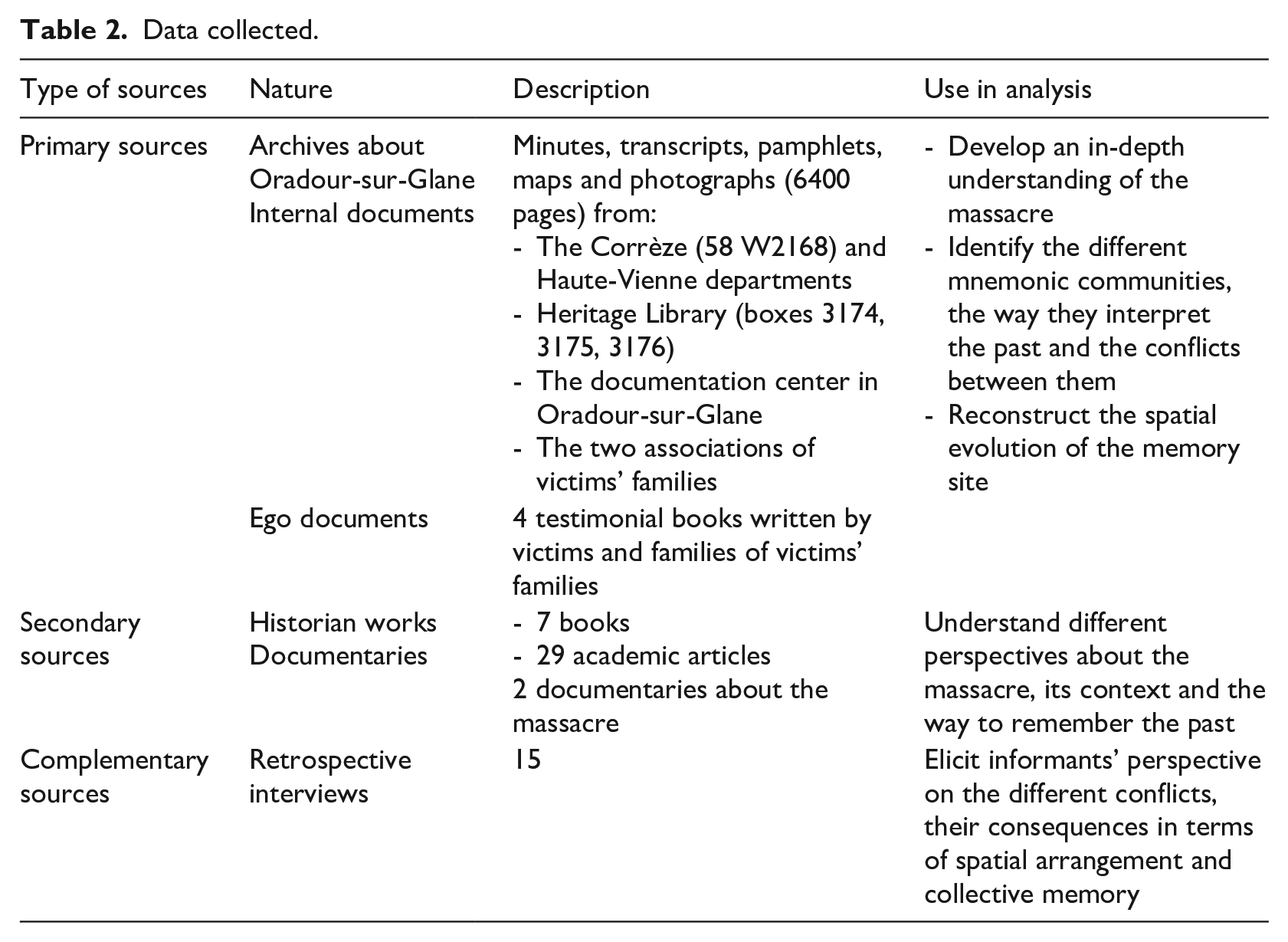
Following Decker et al. (2021) in the case of retrospective organizational memory studies, we gathered extensive historical material (Decker et al., 2023; Rowlinson et al., 2014b) such as archives as primary sources, supplemented by secondary sources and retrospective interviews. Our aim was to build a rich database to meticulously trace the spatial evolution of this memory site and to document the conflicts among different mnemonic communities over what to remember and what to forget regarding this massacre, as their spatial resolution.
Firstly, as primary sources, we consulted the archives of the Corrèze and Haute-Vienne departments (two districts close to Oradour-sur-Glane), from the documentation center of Oradour-sur-Glane and from the Heritage Library. We also have consulted the archives of the two associations of the victims’ families: the most influential, the National Association of Families of the Martyrs of Oradour-sur-Glane (ANFM hereafter) and a second one, the Oradour-sur-Glane Remembrance Committee (Comité du Souvenir d’Oradour-sur-Glane), as reportative documentary sources (Heller, 2023). These archives include minutes, transcripts, pamphlets, maps and photographs and represent more than 6,400 pages of written documents that we have consulted and/or copied on site. They provide a longitudinal account of what happened, including what decisions were made, by whom, for what reasons, and with what consequences. To take into account a more intimate and personal viewpoint, we also collected ego documents (Tinning and Lubinski, 2022), that is, books authored by one the survivors (Hébras, 1993, 2014) and families of victims (Desourtreaux and Hébras, 2003; Pauchou and Pierre, 1970), considered primary sources.
Secondly, we complemented our data collection with secondary sources. These included books by historians on the Oradour-sur-Glane massacre (e.g. Beck, 2004; Farmer, 2000, 2007; Fouché, 2004; Hawes Douglas, 2007; Leleu, 2010; Malinvaud and Plas, 2000; Thomas, 2013) and academic articles on the event (e.g. Farmer, 1995; Fouché, 2002, 2011; Léger, 2014; Plas, 2015). In addition, we watched documentaries about the massacre, such as A life with Oradour (Une vie avec Oradour) by Seraudie (2011) and Der Fell Oradour, a war crime investigation, by Casper. (2014)
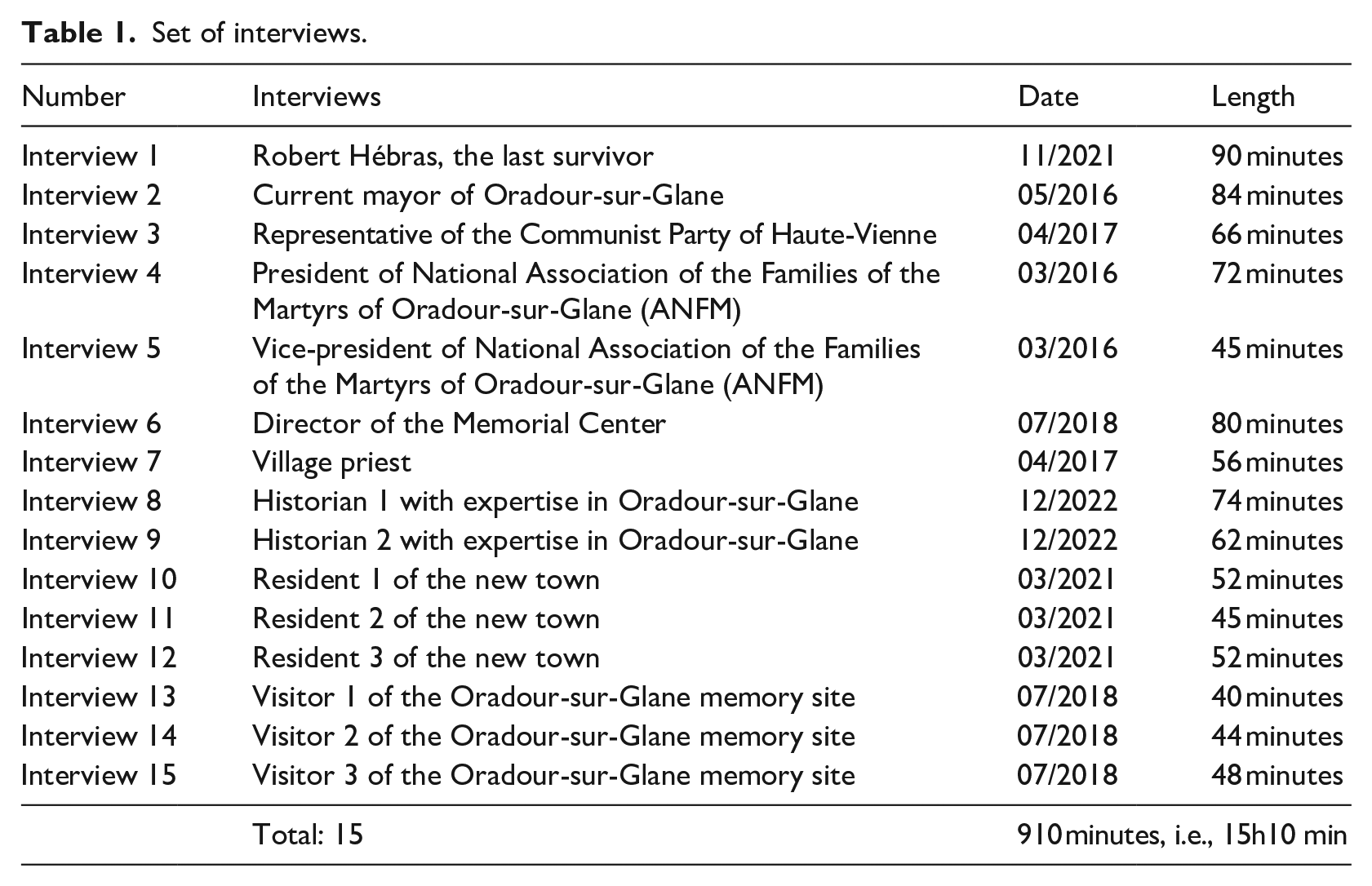
Thirdly, between 2016 and 2022, we conducted a series of 15 retrospective interviews, with key actors associated with the Oradour-sur-Glane memory site, as a complementary source (Table 1). Notably, we had the privilege of interviewing Robert Hébras, the last survivor, who had dedicated his life to the memory of the massacre and passed away in February 2023. The interviews were conducted by two of the authors. They lasted between 40 and 90 minutes and were fully transcribed. While retrospective interviews must be used carefully to account for the subjectivity of memory, they do help to gain insight into the interpretation of conflicts surrounding collective memory and their consequences for the spatial arrangement of the memory site.
Set of interviews.
The data collection process was iterative, with continuous cross-checking and verification. We concluded the data collection when no further information could be obtained (Table 2).
Data collected.
Data analysis
Our data analysis followed a four-step iterative process, which involved back and forth movement between the different sources, existing literature, and the development of theoretical arguments.
First, we compiled a time-line of the memory site of Oradour-sur-Glane to document who did what, and when, and who said what, and when (Langley, 1999). From this analysis, we constructed a detailed and chronological narrative description of the spatial evolution of the memory site. This comprehensive narrative served as the basis for our analysis, allowing us to delve deeper into key dimensions such as the involvement of different mnemonic communities, the emergence of main conflicts surrounding collective memory and the subsequent evolution of the spatial arrangement.
Second, based on this rich narrative and the primary and secondary sources we collected, we focused on delineating the different mnemonic communities involved. Six were thus identified. First were the associations of survivors and families of the victims, such as the ANFM and the Oradour-sur-Glane Remembrance Committee, whose members were directly impacted by the massacre. We have also identified the community of the French Nation, including the State as a mnemonic regulator and the national architects responsible for the site, the Communist Party representing a political movement, the local municipal administration led by the mayor, the church, and historians offering their own interpretations on the massacre. This categorization was also confirmed by all interviewees.
Third, after delineating the different mnemonic communities, we focused on identifying the conflicts between them over collective memory, examining the messages that they south to convey or forget, and analyzing the resulting spatial arrangement. A thorough examination of our different sources revealed three main conflicts which were clearly identified and acknowledged by our different sources, including the interviewees. We carefully analyzed each of them, considering the motivations behind it and the divergent messages supported by the different communities involved. Our analysis revealed that the resolution of these conflicts led to the creation or reconfiguration of four different sub-spaces (the ruins where the massacre took place, the new town, the cemetery and the Memorial Center) through different mitigation conflicts mechanisms. Preserving involves the permanent reconfiguration of a sub-space (the ruins) to fix the past permanently. Echoing involves the creation of a new sub-space (the new town) in the shadow of the preserved one (the ruins). Privatizing consists in the appropriation and reconfiguration of a sub-space (the cemetery) to facilitate private remembrance of the victims. Combining involves the creation of a new sub-space (the Memorial Center) to accommodate conflicting interpretations of the past (Figure 1).
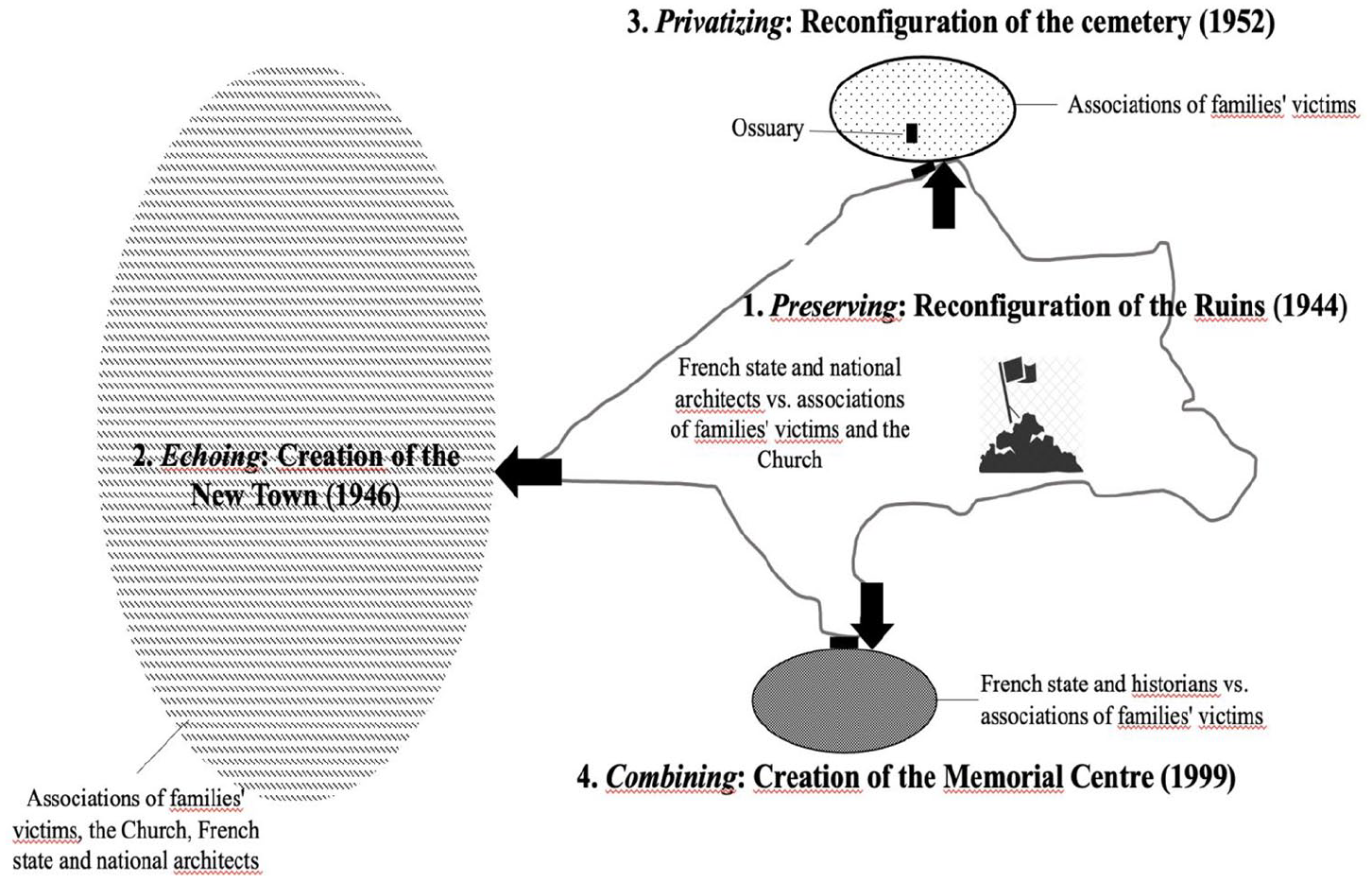
The evolving spatial arrangement of the Oradour-sur-Glane memory site.
Fourth, we considered the memory site as a whole and its current spatial arrangement. Using maps, images, brochures, and tourist visits such as our own, we scrutinized the relationships among the previously identified sub-spaces and examined their spatial connectivity. This led us to the identification of another mechanism: bridging. It refers to the will to foster a spatial cohesion across the entire memory site in support of collective memory. Together, these mechanisms demonstrate a dynamic we refer to as spatial multivocality, emphasizing the spatial coexistence of diverse interpretations maintained by different mnemonic communities within a single memory site.
Findings: A dynamic of spatial multivocality
Drawing on an in-depth longitudinal study of Oradour-sur-Glane, we have chronologically unpacked how the conflicts between different mnemonic communities over how to deal with a painful memory shape and influence the spatial arrangement of this memory site and its collective memory over time. We have identified five mitigation conflict mechanisms: preserving, echoing, privatizing, combining, and bridging, which led us to reveal a dynamic of spatial multivocality (Figure 2).
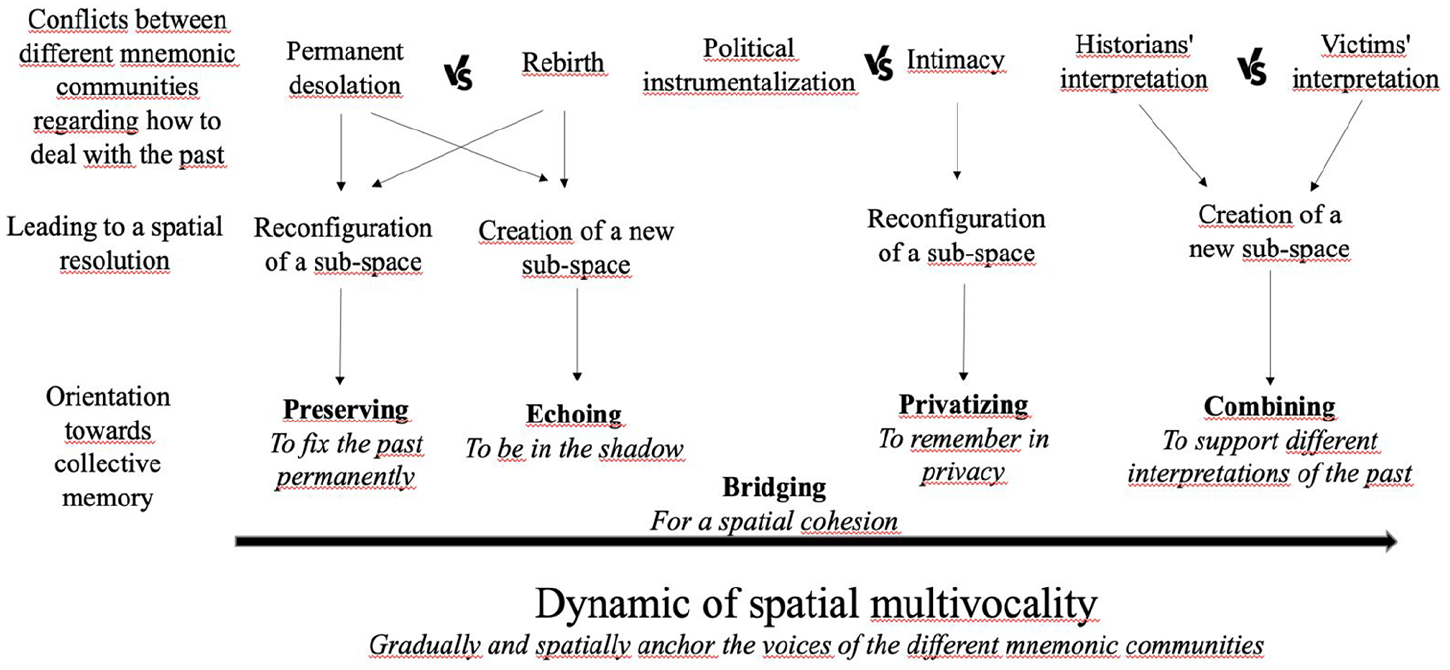
Dynamic of spatial multivocality.
Preserving: To fix the past permanently
The first major conflict emerged very quickly after the massacre. The question of what to do with the village where the massacre took place soon emerged and gave rise to two opposing interpretations. On the one hand, the mnemonic community constituted by the French public administration, through the sub-prefecture and with the support of national architects, suggested building a new village on the original site as was usual after the war. For example, the town of Saint Malo in western France, which was badly damaged by bombing during World War II, was completely rebuilt on its ruins, as a fresh start.
On the other hand, the desire to never forget and to anchor the painfulness of this massacre forever was evident to all who visited Oradour-sur-Glane, including the few survivors (Farmer, 1995). To this end, within 4 months of the massacre, the survivors and families of the victims created associations, as the ANFM and the Oradour-sur-Glane Remembrance Committee, to perpetuate the memory of the massacre and its atrocities and to be recognized as a mnemonic community in its own right. They all insisted on the need to preserve the ruins in their original state, that is, the old town destroyed after the massacre. As evoked by Dr Masfrand, one of the founders of the Oradour-sur-Glane Remembrance Committee in 1944, “visitors will have all the more memories if they are moved and if they have the opportunity to feel the invisible presence of people in these houses” (Remembrance Committee, 1944a, 1944b: 7). The Church, another mnemonic community, also actively supported this plan.
Despite the fierce conflict between these two opposing perspectives, it did not last long, as the government of the provisional French State quickly realized that it would be difficult to resist public pressure. The French State adopted the plan proposed by the associations of families of the victims and the Church, despite the protests of the Committee of National Architects, which considered the preservation of the ruins to be too difficult, if not impossible (Fouché, 2011). On 28 November 1944, the French State recognized Oradour-sur-Glane as an “object of special government protection” (Heritage library, 1944: box 3174) and of great national importance.
Preservation of the ruins began in the spring of 1945, with the aim of preserving them in their best possible state of destruction (Farmer, 2007), to reveal the painful nature of the site and cement it in the past, in the hope of stirring the emotions of visitors. To this end, a large wall was built around the ruins to preserve them for eternity, isolating this sub-space spatially (Fouché, 2011; Picture 1). Inside, “some houses (were preserved) in the state in which they were found immediately after the tragedy” (Remembrance Committee, 1944a, 1944b: 7) and a crypt was built for the ashes of the unidentified victims.
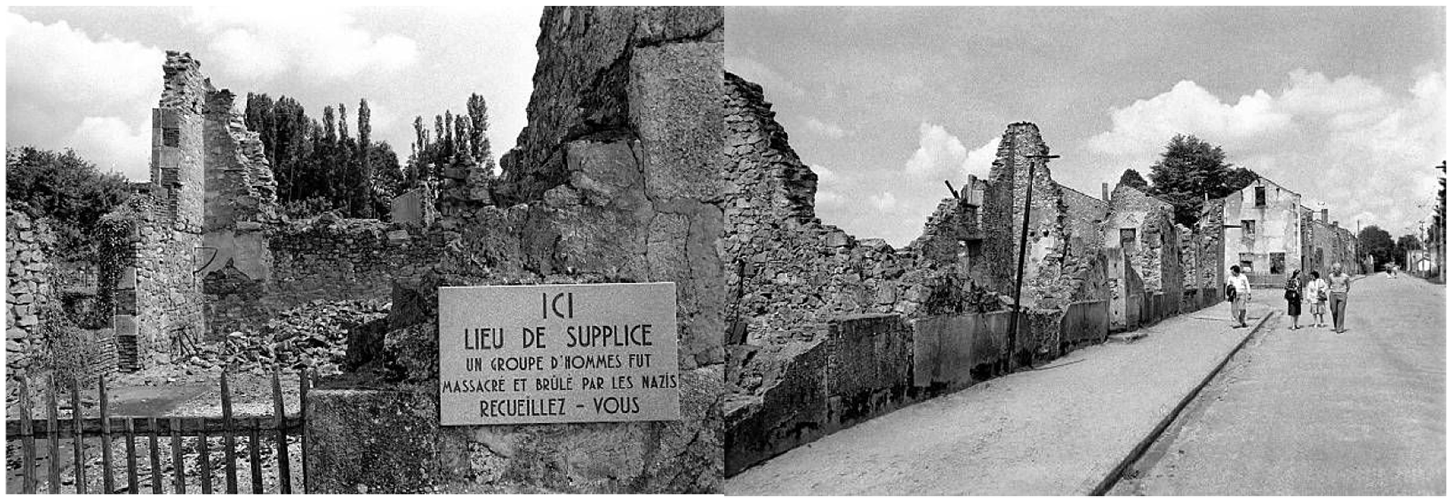
The ruins.
In this sub-space which has been renamed “the Village of the Martyrs,” the aim was to promote two types of memory: the mourning, that is, the memory of the massacre and victims described above; and the past family life. To this end, the Monuments Historiques, that is, the national heritage organization, has placed plaques on the walls of the ruined houses and shops on the main street, listing the names and occupations of those who lived there, so that they will never be forgotten. Although some occupations no longer exist, such as sabotier (clog maker), puisatier (well-digger), charron (barrel maker), and feuillardier (makers of wine barrels from chestnut wood), these plaques serve to remind us of a rural world and past family life that has disappeared (Farmerh, 2007).
To sum up, the whole reconfiguration of this sub-space where the massacre took place aimed at preserving time forever and fix the past permanently. This allows the painfulness of this massacre to be permanently and spatially anchored in “the graves” and the atrocities to be remembered forever.
Echoing: To be in the shadow
In parallel with the will to fix permanently the ruins and the official recognition of Oradour-sur-Glane as a historical monument, the law of 10 May 1946 authorized the construction of the new town from scratch (Farmer, 1995), as a symbol of France’s capacity for rebirth. Gabor Mester de Paradj, Chief Architect of Historical Monuments and responsible for the Oradour site in the late 1980s, explained: “[In the past], it was rare for a new town to be built from scratch” (Farmer, 2007: 96). In the end, the creation of the new town was supported by all the three mnemonic communities: the French Nation, the associations of families of the victims, and the Church.
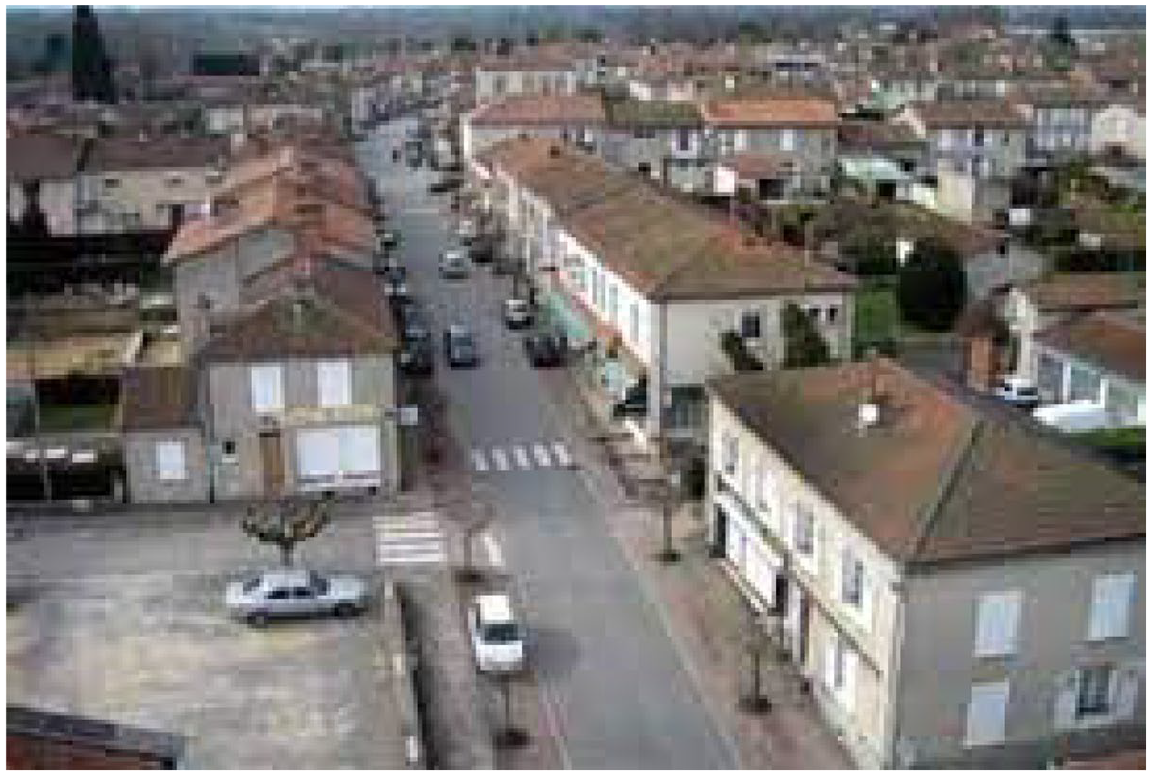
Only a few hundred meters away and overlooking the ruins, the new town is spatially separated from them, but it echoes them, so as never to forget the past and what happened. When the first group of surviving families moved into 20 of the 200 new houses in the spring of 1953, the new town was at first like a grim town which reflects the weight of collective memory and the legacy of the massacre commemorated there. For many inhabitants at the beginning, choosing to live in Oradour represents a way to honor the past and maintain connections to family roots. Under the influence of the associations of the victims’ families, the streets had no names. All of the new houses were made of concrete, which gave them a sad, gray appearance (Picture 2). Women had to dress in black and were not allowed to wear lipstick. While the atmosphere of Oradour may seem somber to outsiders, for local inhabitants, the decision to stay or settle in the new town often reflects a deep personal or family commitment to preserving the memory of the massacre. Although weddings were permitted in Oradour, celebratory gatherings or festivities were restricted, and couples typically held these parts of their ceremonies in neighboring villages until the 1990s. As the current mayor explains, “the new town lived in the shadow of the ruins and remembrance, and avoided celebrations for a long time” (Interview 2).
The new town of Oradour-sur-Glane.
However, as the children of the survivors grew up and new residents moved in, mainly for economic reasons as the nearby city of Limoges expanded and the cost of living in Oradour remained relatively low, the situation evolved slowly and progressively. In the 1990s, some of the facades were painted in color, and the first trees were planted, underlining its gradual opening up. As one resident who recently moved from Limoges to Oradour-sur-Glane pointed out, “ it’s true that the history, the ruins, must put some people off. In the end, we feel that it’s still there and that we can’t just pretend it doesn’t exist. I wouldn’t dare to have a very big party here, for example” (Interview 12).
In the shadow of the ruins preserved in the past, the creation of this new sub-space was primarily dedicated to echo them. While this new sub-space allowed a return to life, the permanent view of the ruins influenced and limited the way people lived, maintaining a collective memory of mourning and revealing its painful aspect; an aspect to which the mnemonic community of the associations of the victims’ families was attached.
Privatizing: To Remember in Privacy
After this main conflict about what to do with the ruins, a new one arose a few years later concerning the orientation of the annual commemoration held in the village square in the middle of the ruins. Commemoration is recognized as a powerful mnemonic trace to remember who and what is important (Foroughi et al., 2020). This conflict pitted the mnemonic community of the associations of victims’ families in favor of a more emotional approach, against two others: the Communist Party at the local level, and then the French Nation at the national level, which wanted to use the symbol of Oradour-sur-Glane and its massacre for a more political purpose, to defend their ideas.
At the time, the Communist Party in France was popular at the local level because of its active role in the Resistance during the war. The new mayor, a member of the party, became the local Communist leader. From 1948 to 1953, he used the symbol of Oradour-sur-Glane as a forum to promote local and national Communist views. In protest against the non-Communist French State, he refused to take part in the official ceremony still held every year on 10 June in the square of the ruins, and instead organized a counter-ceremony 2 days later, on 12 June 1948, in the same place, attended by around 10,000 people, among them were many celebrities of the time. As a former leader of the local Communist Party put it: It’s true that the Communist Party used the symbol of Oradour-Sur-Glane to reinforce its national pacifist discourse. But that wasn’t the main issue. The point was to convey a message of world peace, of discussion between the Western and Eastern blocs in order to avoid further wars or the desire for revenge. (Interview 3)
In this complex context, the associations of victims’ families voiced their concerns about the increasing politicization of the commemorations. They complained that this was detracting from the solemnity of honoring the victims and preserving the painfulness significance of the site. As a result, a collective sense of ownership emerged within this mnemonic community and they gradually transformed the cemetery adjacent to the ruins into a private sub-space for personal tributes that reflect the heartfelt wishes of those directly affected.
The cemetery became a permanent and private sanctuary for the families of the victims following the national political conflicts with the French State over the 1953 Bordeaux trial. This controversial trial resulted in the conviction of 21 people involved in the massacre. Among them were 14 “malgré nous” - French citizens from the North East of France (Alsace) who had been forced to serve in the German Nazi army. The trial sparked a fierce debate: while families victims’ associations called for severe punishment as a form of retribution for the past persecution they had endured, the French Nation, committed to the present and future national unity and peace, leaned toward forgiveness and amnesty, especially for the “malgré nous” participants, in defiance of the court’s ruling.
This amnesty was a point of no return, perceived as a profound betrayal by the associations of victims’ families. In response, they made a definitive break with national and political entities. The president of one such association symbolically returned the Legion of Honor awarded to him in 1949, signaling a renunciation of state recognition. Furthermore, state representatives were no longer invited to the annual 10 June commemoration, traditionally held in the heart of the ruins. To underline their stance, a list of deputies who had voted in favor of the amnesty was prominently displayed at the entrance to the ruins, serving as a stark reminder of the perceived injustice.
In the midst of the opposing approaches to commemorations and the symbolic significance of Oradour-sur-Glane, this mnemonic community took a decisive step by choosing the cemetery, as a private sub-space to commemorate victims, free from political or institutional influence. They also spatially reconfigured it and built their own ossuary to relocate the ashes of the victims, originally kept in a crypt built by the state within the ruins. Called the “Tomb of the Martyrs,” this ossuary has benefited from the generous support of private donors including one of the survivors who had lost his entire family in the massacre (Picture 3). This transformation embodied their commitment to honoring the victims in a way that was consistent with their own belief. As the last survivor, Robert Hébras explains: Ah, we were angry then. It felt like such a terrible injustice, they talk about ‘national unity’ - as if that could excuse what had happened to our loved ones. The families couldn’t accept it. For a long time, we cut all ties with the state. It wasn’t just out of defiance; it was to preserve their dignity, to show that we had not forgotten. (Interview 1)
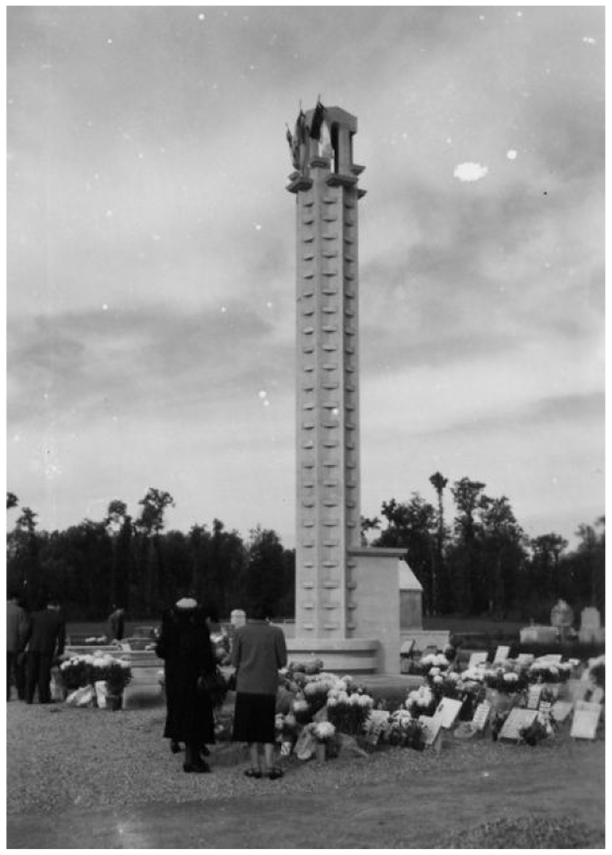
The cemetery with its own ossuary.
By reconfiguring and privatizing the cemetery, this mnemonic community has empowered itself to commemorate the memory of the victims in privacy, according to its own deepest convictions, beyond political constraints.
Combining: To support different interpretations of the past
In 1989, the French Nation, acting as a mnemonic community, decided to create a “cultural companion” (Farmer, 1995: 46) to the ruins by building a Memorial Center nearby. The aim was to contextualize the massacre of Oradour-sur-Glane through the lens of historical research in order to provide a deeper understanding of the massacre. However, this initiative triggered a deep conflict and prolonged negotiations, pitting two opposite interpretations. On one side was the interpretation woven by the associations of victims’ families, based on personal testimony and emotional memories. On the other side, historians argued for an interpretation based on empirical evidence and scientific analysis. This conflict highlighted the tension between subjective memory and objective historical truth, and underlined the complexity of collective memory for such a massacre.
Indeed, the ANFM emerged as an authoritative mnemonic community who directly interacted with the State. To support its own interpretation, the ANFM published a seminal book entitled “Oradour-sur-Glane: A vision of horror.” Written by Pauchou and Dr. Masafrand in 1970, this book is still in circulation today and is widely recognized by local people as the definitive account of the massacre. Robert Hébras, a survivor and former president of the ANFM, further consolidated the community’ authority by writing his own book, “Oradour-sur-Glane: The Tragedy Hour by Hour” in 1993. Although offering a subjective perspective as a first-hand witness, Hébras’s contributed to the formation of what could be called the “official” narrative. Through these complementary publications, the ANFM association of victims’ family, alongside Hébras, consolidated their position as custodians of the Oradour-sur-Glane legacy and the memory of victims, shaping public perception. As the director of the memorial center explains: One of the peculiarities of Oradour, and a source of tension, is the presence of one survivor in particular, Robert Hébras. Because of his situation, he believes that his vision, the story he tells, is necessarily the true one and that it stands above those of the others. This is extremely difficult to manage. For example, how do you tell a survivor he’s wrong? It’s simply not possible. (Interview 6)
In contrast, the three historians who make up the scientific committee overseeing the Memorial Center argued for a broader historical context in presenting the Oradour-sur-Glane massacre. They considered that it was crucial to categorize it as a “war crime” rather than a crime against humanity or genocide, and that the interpretation should include an exploration of the motivations and rationales of the soldiers involved. By placing the massacre within a larger historical framework, historians seek to provide a more comprehensive understanding, delving into the complexities of wartime dynamics and the socio-political context of the era. However, this approach has often led to disappointment and rejection on the part of ANFM as they saw this contextualization as detracting from the primacy of honoring the memory of the victims and survivors (Farmer Sarah, 2007; Fouché, 2002).
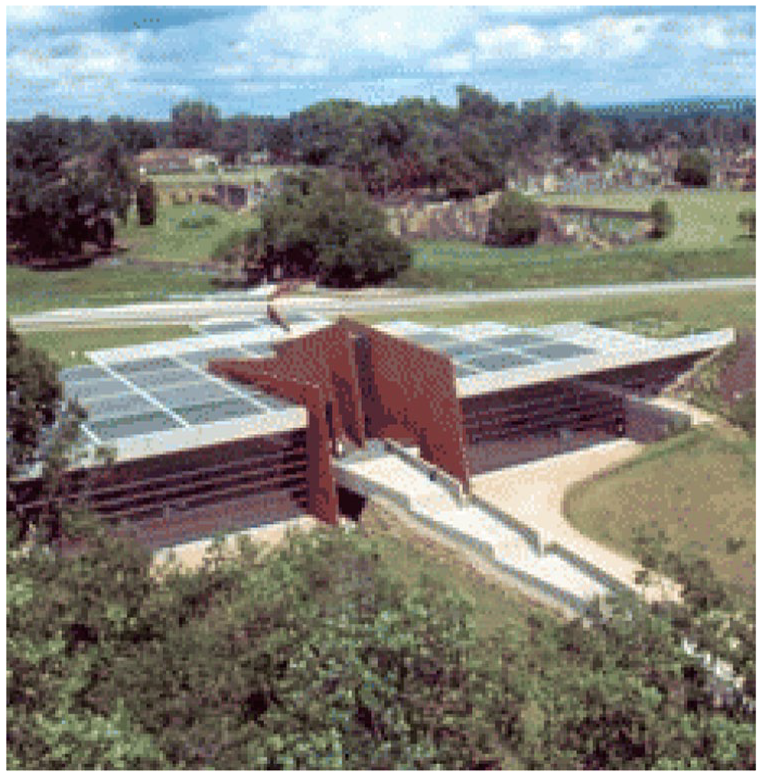
The prolonged negotiations that followed reflected a delicate balancing act between preserving the integrity of personal interpretations and acknowledging the wider historical context. This eventually led to a compromise, albeit years later than originally planned as the Memorial Center finally opened its doors in July 1999, instead of September 1993. The way it is structured sought to reconcile these divergent interpretations and offer visitors a multifaceted understanding of the Oradour-sur-Glane massacre (Farmer, 2007; Picture 4).
The Memorial Center, the unique access point to the ruins for visitors.
Indeed, this half-buried building consists of three distinct rooms. The first main room presents the permanent exhibition, curated by historians. It offers a comprehensive explanation that places the massacre in the wider context of the Third Reich, the World War II, the complex circumstances surrounding the involvement of the members of “malgré nous,” and the specific history of Oradour-sur-Glane. In contrast, the second room, a smaller one called the “Bookshop,” offers only publications that reflect the perspective of victims and survivors. The third and final room, called “Reflection,” offers a somber and contemplative atmosphere with a survivor’s testimony. The dark and minimalist design of this room aims to evoke a sense of solemnity and introspection, inviting visitors to reflect on the profound impact of the Oradour-sur-Glane massacre. As the village priest explains: The construction of the Centre was a matter of compromise. Originally, the idea that it would not be designed by the families of the victims and the survivors was unthinkable to the locals. And it was more or less the same for the historians. They didn’t want to have to deal with the individual accounts of those involved and those left behind. And then, after a series of compromises, we ended up with something that was quite fair and acceptable to all of us. (Interview 7)
By combining these conflicting interpretations in the same building, the Memorial Center serves as a sub-space of dialog and reconciliation. It promotes a more comprehensive understanding of the massacre of Oradour-sur-Glane while honoring the different interpretations of those involved.
Bridging: To provide a spatial cohesion
Although each creation and reconfiguration of these different sub-spaces conveys a specific message and interpretation of the massacre, they are all part of the same memory site. Through extensive negotiations between the different mnemonic communities, they are all bridged by a well-balanced circuit for visitors that promotes cohesion and support the collective memory characterized by feelings of pain, sorrow, and mourning (Dekel, 2013). As the current mayor of the town emphasizes, “the situation in Oradour has always been complicated. . . but ultimately, we have to find a way to unify this site” (R2). This means that the site has evolved “from a chaotic scene of destruction to a historical monument owned and managed by the French State” (Farmer, 1995: 33).
The visit begins in the Memorial Center, the most recently constructed building. Originally designed to present only the historical interpretation of the massacre, its spatial configuration accommodates different interpretations, as described above. Visitors can then explore the ruins. As it was not possible to preserve the entire site, the French State decided to restore a limited part of it. In February 1984, the French Minister of Culture allocated 1 million francs (the equivalent of over 400,000 euros) to create a visitor circuit within the Martyrs’ Village, a decision approved by both the ANFM and the town council. In addition to serving as a mnemonic trace of the massacre, the ruins collectively convey a unified message that recalls a common beginning - “once upon a time, in a peaceful town” (Fouché, 2011: 72). The balanced itinerary facilitates public exploration of key sites, including the church where the women’s and children’s graves are located, the village square where official ceremonies took place, the state-maintained crypt, and the cemetery with its own ossuary and the martyrs’ tomb, which is overseen by the associations of victims’ families. This balanced circuit with the constant view of the new town from the ruins, brings together different messages and fosters a coherent collective memory.
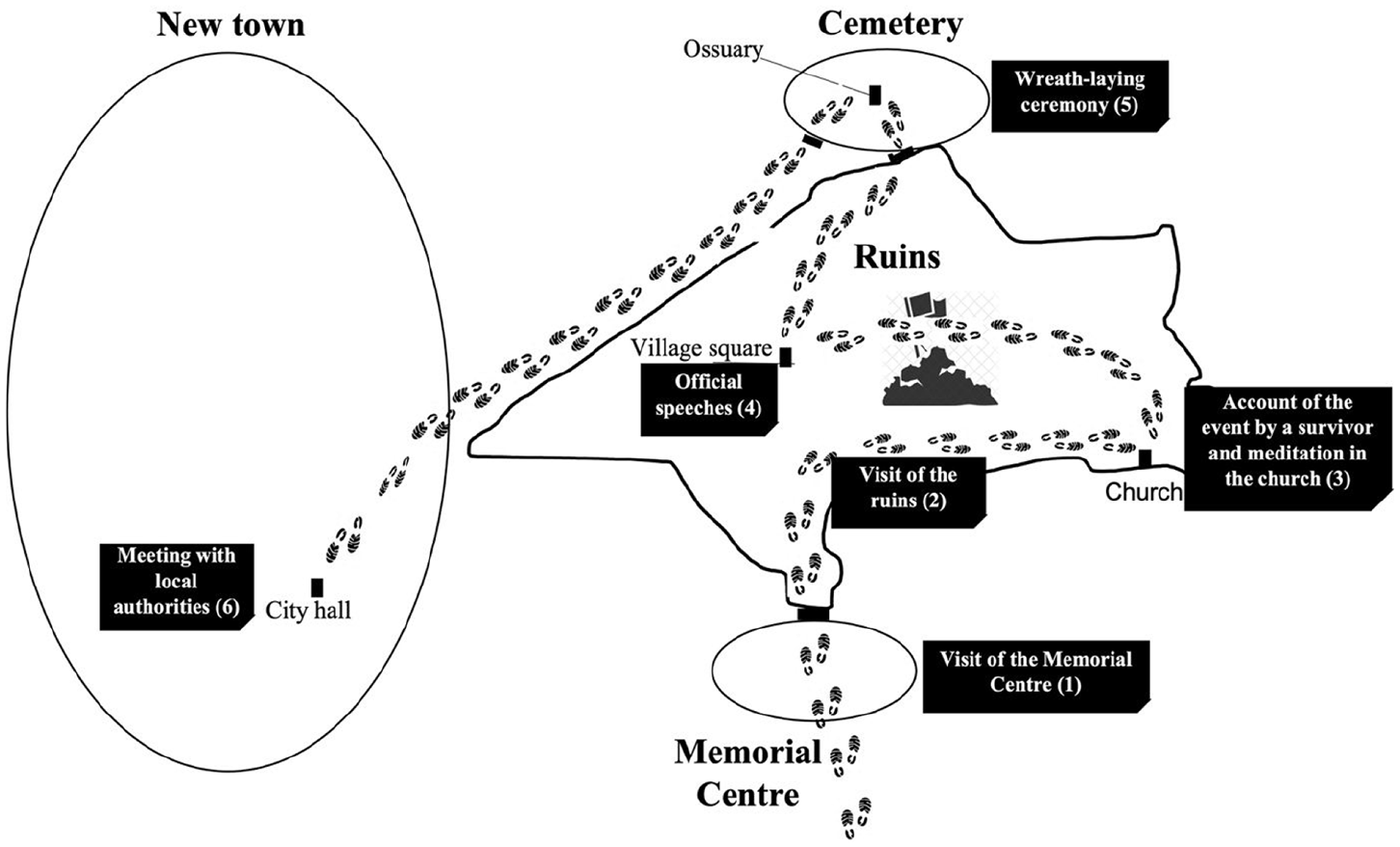
This circuit is further illustrated by the itinerary followed by officials and successive French presidents during their regular visits to the site (Figure 3), which is also the results of conflicts and negotiations between the different mnemonic communities. Their itinerary begins at the Memorial Center, before moving on to the church and the village square in the midst of the ruins, which serve as platforms for various speeches. They then proceed to the ossuary in the cemetery, where they pay tribute to the victims’ memory with a wreath. They then move on to the new town, where they sign both the Town Hall and the ANFM guest books, thus acknowledging the different interpretations of this massacre. This protocol was confirmed by the mayor of the town: From now on, the itinerary, the order of the stops and the people present, everything is calibrated, codified. We have arrived at an institutionalized form of the visit, that it seems impossible to change for fear of upsetting a balance that has been so hard to establish. (Interview 2)
Bridging with a well-balanced circuit: Example of the official one.
As shown in Figure 2, introduced at the beginning of the findings section, we observe a dynamic of spatial multivocality. This results from conflicts between different mnemonic communities on the way to deal with the past, leading to the creation and reconfiguration of different sub-spaces as a way to mitigate them. Each of these sub-spaces conveys a different message about how the massacre should or should not be remembered, and is supported by different mnemonic communities. Through this spatial multivocality, the different voices of the mnemonic communities are spatially anchored and can all coexist within the same memory site.
Discussion and conclusion
In this study, we aim to deepen our understanding of how conflicts that gradually arise between different mnemonic communities about how to deal with the past spatially shape a memory site and its underlying collective memory over time. Through an historical case study, our research unveils the dynamic of spatial multivocality, illustrating how the resolution of conflicting interpretations of the past led to the creation and reconfiguration of the different sub-spaces within a memory site, each conveying a specific interpretation of the past. Despite their distinct nature, these sub-spaces are integrated into a cohesive whole through the overall spatial arrangement, supporting thus a collective memory.
Based on our findings, we offer several theoretical contributions to Organizational Memory Studies (OMS; e.g. Foroughi et al., 2020), particularly on the contested nature of collective memory, the role of spatial multivocality in mitigating conflicts, and the significance of spatial arrangement as a mnemonic trace. These contributions highlight the complex interplay between conflict, collective memory, and spatial arrangement revealing how spatial arrangement functions both as a site and medium for negotiating past events.
Shaping collective memory through conflicts between mnemonic communities
This study advances the understanding of collective memory as a dynamic, multi-authored and contested process (Eisenman and Frenkel, 2021; Foroughi, 2020; Foroughi et al., 2020; Halbwachs, 1992; Mena et al., 2016; Zerubavel, 1996). By shifting the analytical focus from conflicts within a single mnemonic community (e.g. Basque and Langley, 2018; Ravasi et al., 2019; Sinha et al., 2020; Ybema, 2014) to complex inter-community conflicts, we address calls for more research on interactions between multiple memory communities that shape collective memory over time (Coraiola et al., 2023; Smith and Russell, 2016). By exploring these conflicts, we highlight collective memory not as a static, unified process, but as a site of contestation and negotiation, where multiple voices, often at odds, shape its contours and impact.
Our findings shed light on the significant role of power relations in shaping whose memories are legitimized and whose are marginalized. These dynamics echo Cutcher et al.’s (2019) analysis of commemoration as both recognition and exclusion, reinforcing the view of collective memory as a dynamic process of competing memories (Feldman and Feldman, 2006; Foroughi et al., 2020; Wertsch and Roediger Hl, 2008). This is particularly evident in the case of Oradour-sur-Glane, where various mnemonic communities including associations of victims’ families, political parties, and the French nation, compete for control over the interpretation of a painful memory (Aroles et al., 2024; Crawford et al., 2022). These power relations shape the way collective memory is constructed, legitimized, and remembered, as well as how certain narratives are excluded or sidelined.
We further contribute to ongoing discussions of collective memory as both a site of mourning and a mechanism for negotiating power (Bell and Taylor, 2016; Coraiola et al., 2023; Cutcher et al., 2019). Our analysis illustrates how conflicts between mnemonic communities are embedded in broader political and organizational dynamics, raising critical ethical and political issues (Mena and Ritamäki, 2020). These conflicts are not limited to commemorative practices (Bell and Taylor, 2016; Cutcher et al., 2019) but also extend to the spatial arrangement and development of memory sites. Decisions about the preservation of the ruins, construction of the Memorial Center, or restriction of access to certain sub-spaces such as the cemetery reflect strategic acts of inclusion and exclusion, often dictated by competing interpretations. These choices reveal the power structures at play, shaping whose memories are publicly affirmed and whose are marginalized.
Building on Sadeghi and Islam (2023), we demonstrate how the creation and/or reorganization of sub-spaces selectively reinforce particular narratives while sidelining others, thereby framing the political-ethical boundaries of remembrance and forgetting. This is particularly evident in conflicts over the political use of the site (such as Communist Party commemorations) and debates around privatizing certain sub-spaces for family members. Such conflicts expose how commemorative acts can serve to consolidate collective identities, while simultaneously marginalizing alternative perspectives (Bell and Taylor, 2016). This underscores the ethical imperative to strike a balance between respecting the victims’ experiences and acknowledging the diversity of historical perspectives (Dekel, 2014).
Additionally, drawing on Sadeghi (2024), we highlight the critical role of memory workers, such as state officials and curators, in navigating the complexities of these inter-community conflicts. These individuals face ethical dilemmas as they manage competing mnemonic narratives. In the case of the Memorial Center, memory workers must balance the official narrative with personal testimonies, thus embodying the broader political and ethical responsibilities tied to the representation and preservation of contested pasts. Their work underscores the need for sensitive, inclusive practices in memory work.
Finally, these dynamics resonate beyond Oradour-sur-Glane. Similar tensions emerge at other sites of memory, such as Babi Yar. Babi Yar refers to a ravine in Kyiv, Ukraine, where over 33,000 Jewish men, women and children were massacred by Nazi forces in September 1941. In this memory site, local, national, and even global memory narratives, shaped by the Holocaust, Soviet history, and contemporary politics, intersect and compete. In both cases, these memory sites become arenas where political, ethical, and community interests collide, reflecting the ongoing negotiation of history, identity and power (Decker et al., 2021; Ravasi et al., 2019). These conflicts over collective memory are emblematic of broader cultural and political processes, where memory plays a key role in the construction of identity and the negotiation of power. Memory sites are not merely passive reminders of the past but active sites of political struggle and ethical negotiation.
In conclusion, our findings deepen the understanding of collective memory as a dynamic and complex process shaped by mnemonic inter-community conflicts and power relations. It extends prior research by foregrounding the ethico-political and spatial stakes of collective memory in the context of painful memories.
The role of spatial multivocality in mitigating inter-community conflicts
Our findings contribute to the literature on collective memory by introducing the concept of spatial multivocality which we define as the deliberate spatial arrangement of a memory site that allows for the parallel expression, visibility, and persistence of multiple mnemonic interpretations. Spatial multivocality describes how the spatial organization of a site, through the delineation of sub-spaces, enables different mnemonic communities to maintain distinct interpretations of the past within a shared location. Crucially, this allows competing memories to coexist without erasing or subordinating one another, thereby mitigating mnemonic conflict and fostering pluralistic memory work within a single memory site.
This theoretical concept extends previous work on mnemonic communities and their conflicts (Fentress and Wickham, 1992; Foroughi et al., 2024, 2020), which has largely focused on the social and discursive dynamics of memory competition. Our contribution is to shift attention to the spatial dimensions of these dynamics, demonstrating that it is not only through narratives or symbols that plurality is sustained, but also through the concrete spatial arrangement of memory sites themselves. In this sense, spatial multivocality offers a durable material space that anchors mnemonic plurality over time, making it possible for competing interpretations to coexist and persist.
After the massacre, different mnemonic communities shaped the site that reflected their interpretations: some emphasized the preservation of the ruins as a testimony to the atrocity, while others supported the construction of a new town as a symbol of resilience. These conflicts revealed temporary shifts in influence driven by the emotional shock of the event, even in the midst of enduring political inequalities (Coraiola and Derry, 2020). Over time, less dominant groups, such as associations of victims’ families, asserted their claims to memory by reconfiguring some sub-spaces such as the cemetery into semi-private sites of remembrance. The creation of the memorial center later institutionalized spatial multivocality, balancing competing narratives through deliberate spatial arrangements (Mena and Ritamäki, 2020; Schrempf-Stirling et al., 2016). In this way, spatial multivocality became symbolic resources (Elsbach and Pratt, 2007), allowing diverse memories to coexist and mitigating the marginalization of weaker voices.
However, spatial multivocality does not eliminate power asymmetries. While it can prevent the silencing of certain mnemonic communities (Ybema, 2014), it cannot fully counteract the structural inequalities that determine which interpretations dominate over time. Similar dynamics are observed in organizations, where dominant groups-such as founders or leaders-often control the spatial and symbolic interpretations of maintaining preferred narratives (Basque and Langley, 2018; Foster et al., 2011; Nissley and Casey, 2002; Rowlinson et al., 2010). Marginalized communities may continue to struggle for enduring spatial recognition, even when plural representations appear to be present. As Coraiola et al. (2023) note, power imbalances often persist beneath superficial inclusivity.
While spatial multivocality as a theoretical concept describes the spatial mechanisms through which mnemonic plurality is sustained, we recognize that it also has policy implications. Understanding how spatial multivocality can foster or inhibit multiple memory work has practical relevance for the design and management of memory sites with painful memories.
The role of spatial arrangement as mnemonic traces
Finally, our study advances the growing literature on mnemonic traces (e.g. Foroughi et al., 2024) by introducing spatial arrangement as a material and spatial trace that facilitates pluralistic memory work.
The concept of spatial arrangement extends previous work on mnemonic traces, which has often focused on discrete material traces such as monuments and statues (Allen and Brown, 2016; Crawford et al., 2022; Cutcher et al., 2019; Do et al., 2019; Zerubavel, 1996) or immaterial traces such as discourse and narrative (e.g. Coraiola and Derry, 2020; Hatch and Schultz, 2017). In contrast, our study foregrounds the spatial arrangement of entire sites as an enduring mnemonic trace in its own right. By analyzing the entire memorial site rather than isolated monuments or commemorative practices, our study emphasizes the relational dynamics between space, materiality, and memory conflict. Building on Halbwachs’s (1980) insights into the embeddedness of collective memory in space, we argue that spatial arrangements actively shape and sustain collective memory by anchoring competing interpretations within distinct, coexisting physical subspaces (such as the Martyrs’ Village or the Memorial Center). These enduring spatial arrangements not only preserve historical narratives, but also help regulate how different mnemonic communities interact within the same site over time.
Furthermore, our findings illustrate how internal and external spatial arrangements work together to shape collective memory. For example, the reorganization of the cemetery, including the relocation of victims’ ashes, reflects an embodied negotiation of personal and collective memory through spatial means. Such interactions between spatial form and material content further reinforce the role of spatial multivocality in mediating conflicts between mnemonic communities.
Finally, in line with research on museums and commemorative spaces (e.g. Aroles et al., 2024; Blagoev et al., 2018), we show how spatial arrangements can support pluralistic memory work, not simply by preserving material traces, but by maintaining the spatial conditions necessary for diverse interpretations to coexist. This insight points to the broader significance of spatial arrangement for both understanding and managing memory sites, which must navigate the complexities of contested pasts and painful memories.
In conclusion, this study empirically demonstrates the multi-authored and contested nature of collective memory, highlighting the role of spatial multivocality in mitigating conflict between different mnemonic communities. Conceptualizing collective memory as a dynamic process of “contention and contestation” (Wertsch and Roediger Hl, 2008: 318), we extend organizational memory studies (OMS) by showing how spatial arrangements serve as mnemonic traces. Our findings call for further research into the power dynamics between mnemonic communities and the evolution of spatial arrangements, particularly in contexts where direct witnesses to events are no longer present, as in the case of the recent passing of Oradour-sur-Glane’s last survivor, Robert Hébras, in early 2023. This perspective offers valuable insights into the interplay between collective memory, spatial arrangement, and conflicts dynamics, laying a foundation for future studies on the spatial manifestation of collective memory.
Footnotes
Funding
The author(s) received no financial support for the research, authorship, and/or publication of this article.
