



Abstract
In a time and place where being impaired is equated to being of lesser economic value, some disabled people take matters into their own hands by creating their own job and converting their bodily difference into bodily capital. This paper uses a Bourdieuan lens to discover what sets apart disabled entrepreneurs who build their business around disability and those who do not. Building on the experiences of 40 entrepreneurs, we outline the existence of certain bodily and mental schemata that lead to a body habituated to run a business centred around one’s impairment and experience of living as a disabled person in an ableist world. We specify such ‘anomalous’ bodily capital and discuss the constraints to its conversion related to the social environment and impairment effects. This study speaks back to the literature on disability in organizational contexts by extending the ‘value in disability’ debate whilst remaining cognizant of the danger of ‘supercrip’ stereotyping and disability ghettoization. In addition, the complex structure/agency interplay inherent to the practice of leveraging anomalous bodily capital offers a contribution to entrepreneurship research that tends to adhere to a simplistic view of the body.
Keywords
Introduction
‘I don’t think a person with a disability can run just any business, let’s say a shoe store, no, they will be bankrupt within the first year. I think that disabled people should choose a business that is linked to their impairment, to have a certain credibility as entrepreneur.’ (Kurt, visually impaired product developer of visual aids) ‘In the end, people should do whatever it is they enjoy doing, whatever the sector, just go for it, don’t let yourself be stopped by a wheelchair or what others make of it.’ (Joris, mobility impaired whiskey brewer and store owner)
These opposing convictions demonstrate how the choices and strategies of entrepreneurs take place in a pre-existing context which, far from being ‘open and accessible’ to all (Ahl and Marlow 2012: 1), is dominated by normative ideas about appropriate roles and bodies, founded in an ableist worldview where disabled people are relinquished to the position of inferior other (Campbell, 2009). Scholarly inquiry into the ableist context in which the business venturing of disabled 1 entrepreneurs 2 takes place is important, as they are a widely neglected group of entrepreneurs in both theory and practice. Yet entrepreneurship can help advance the inclusion of disadvantaged persons, stimulating both the economy and individuals’ personal growth (De Clercq and Honig, 2011). Research shows disabled entrepreneurs benefit from a number of advantages compared to waged employees (e.g. more flexibility to manage health) but at the same time, various barriers persist inherent to the ableist business environment in which their ventures take place (e.g. discrimination from banks) (e.g. Ashley and Graf, 2017; Hwang and Roulstone, 2015). Recently, a handful of studies have started to hypothesize entrepreneurial dispositions and skills inherent to disabled people that potentially lead to success in entrepreneurship (e.g. problem-solving mind-set, creativity, tolerance for risk). In this positivist tradition a positive relationship between mental health difficulties and entrepreneurship has been proposed (e.g. Antshel, 2018; Miller and Le Breton-Miller, 2017; Wiklund et al., 2018).
Whilst a positive spin on the economic value of disabled entrepreneurs is important given the omnipresence of ableist beliefs of lower productivity (Jammaers and Zanoni, 2021; Jammaers et al., 2016), the latter type of studies are also limited. Firstly, they lack a fluid and complex understanding of the disabled body and its impairment effects (Jammaers and Williams, 2020; Williams and Mavin, 2012, 2015), rather treating it as static and structurally endowed with certain entrepreneurial dispositions. Secondly, they ignore the interplay of agency and structure in leveraging the benefits of a different embodiment for one’s business. Assuming that certain bodily differences will universally benefit an entrepreneur’s business paradoxically limits their agency (Zanoni et al., 2017) and ignores how such valuing is fundamentally relational and socially embedded (Tatli et al., 2014). Moreover, such studies neglect to ask the important question of whether and to what extent the entrepreneur wants to strategically link their social identity to their business (Calás et al., 2009; Zanoni and Janssens, 2004).
To overcome such limitations, we draw on the framework of Bourdieu (1977, 1985, 1989, 1990), as well as extensions by Wacquant (1995, 2004) and Bourdieu and Wacquant (1992), lauded for its relational thinking, sensitivity to power differences and corporeal sociology (Emirbayer and Johnson, 2008; Shilling, 2004; Townley, 2014). Empirically, we compare a data set of 40 qualitative interviews with disabled entrepreneurs who have either a ‘disability-related business’ (14) or a ‘general’ business (26). We examine what these entrepreneurs might have in common and how the two groups differ. The contributions this study makes are twofold. First of all, we make a contribution to the literature on disability in organizational contexts related to the ‘value in disability’ perspective (e.g. Maravelias, 2020; Wiklund et al., 2018) by critically reflecting on two potential negative side effects: reproduction of a ‘supercrip’ model of disability (Kafer, 2013) as well as disability ghettoization (Swail and Marlow, 2018). Second, we make a contribution to entrepreneurship research by detailing how the interplay between agency and structure comes together in the practice of leveraging anomalous bodily capital, whilst at the same time advancing a more complex understanding of the body, as both physical and socially situated (Bourdieu, 2000; Shildrick, 2009).
Theory
An unequal field of entrepreneurship for disabled people and the value in disability
Several governments have raised questions about how entrepreneurship can be promoted to emancipate disabled people in society (Halabisky, 2014). Self-employment is argued to offer advantages such as more opportunities to accommodate impairment-related requirements and a flexible working schedule (Jones and Latreille, 2011; Schur, 2003), a greater independence, range of choices and level of self-determination (Anderson and Galloway, 2012; Larsson, 2006; Lorenzo et al., 2007) and greater job satisfaction (Pagan-Rodriguez, 2009). Yet studies have also outlined a number of structural factors which indicate how the field of entrepreneurship is rife with disability-based inequality: discouraging governmental financial structures (Hwang and Roulstone, 2015; Renko et al., 2016; Van Rampelberg, 2018), lack of support from vocational rehabilitation counsellors (Ashley and Graf, 2017; Halabisky, 2014), inaccessibility of the built business enterprise environment (Vick and Lightman, 2010) and social discrimination from banks, customers and suppliers (Jones and Latreille 2011; Pagan-Rodriguez, 2009).
Recent studies have started to highlight how the disabled body/mind can function as a resource for success in entrepreneurship. For example, dispositions such as tolerance for risk and perseverance (Miller and Le Breton-Miller, 2017), high ambition (Johnson et al., 2018) and a problem-solving mind-set along with a willingness to ask for help (Maritz and Laferriere, 2016) are described as inherent to (some) disabled people. In addition, socio-technical skills such as creativity, as well as networking skills have been linked to certain impairments, and a positive association between particular mental health impairments such as ADHD and entrepreneurship have drawn significant attention in conceptual studies in the field (see Antshel, 2018; Lerner et al., 2018; Wiklund et al., 2018).
Whilst these studies are a welcomed addition to the predominant focus on barriers within disabled entrepreneurs’ literature, they remain limited for several reasons. They lack an understanding of how the body is a complex site of cultural and corporeal production (Shakespeare, 2006; Shildrick, 2009) both socially ascribed rather than ‘outside of discourse’ (Shakespeare and Watson, 2001: 25) and subject to bodily variations or ‘impairment effects’ such as pain and fatigue (Williams and Mavin, 2012, 2015) which result into a unique and fluid ‘corporeality’ in the workplace (Jammaers and Williams, 2020; Meldgaard Kjær and van Amsterdam, 2020). By presenting disabled bodies as structurally endowed with fixed positive characteristics, studies ignore their embeddedness in specific social contexts, as well as potential impairment effects related organizing requirements (Williams and Patterson, 2019), while the agency of the entrepreneur becomes paradoxically reduced (Zanoni et al., 2017). Indeed, through their principal focus on individual characteristics rather than the social environment, they align with an individual model of disability (Shakespeare, 2006). Inscribed in ‘trait theories of entrepreneurship’ (Jones and Spicer, 2009; Tedmanson et al., 2012), they neglect to carefully consider when and how bodily or cognitive difference becomes valued.
Prior research founded on a social interpretation of disability in waged employment settings has critiqued the hostile, ableist climate that prevents difference from being valued, finding that despite organizations proclaimed enthusiasm for increasing diversity in their workforce, the bodily or cognitive difference disabled people (are seen to) have in practice often remain devalued (Jammaers et al., 2019; Jammaers and Zanoni, 2021). Some scholars argue that employers see the ‘business case for disability’ as ‘a bridge to far’ (Woodhams and Danieli, 2000). Even when organizations see how hiring disabled people can benefit the bottom line (e.g. targeting a wider customer base; providing cheap labour), critical diversity scholars warn against common limited understandings of diversity which assume diverse workers’ main virtue is the knowledge they have to offer ‘of their people’, which leads to segregation rather than true inclusion (Thomas and Ely, 1996; Zanoni and Janssens, 2004). To further extent these debates, contextualise the impaired/disabled body and promote agentic counter-cultures that celebrate difference (Goodley, 2014), we turn our gaze towards the practices of entrepreneurs who make a business out of their disability, whilst remaining cognizant of the broader (ableist) structural context through the frameworks of French sociologists Pierre Bourdieu and Loïc Wacquant.
Bourdieuan-inspired entrepreneurship studies and bodily capital
Bourdieu’s theory has increasingly been adopted to examine social practices as the building blocks of social reality (Sieweke, 2014; Townley, 2014). Through a number of Bourdieu’s core concepts, entrepreneurship scholars suggest it is possible to get a better understanding of the field, which is the macro-structure or particular social setting in which certain capitals are strategically deployed by an entrepreneur whose habitus or dispositions, acquired through upbringing or situated action, allow them to fit in and ‘act’ according to the ‘rules of the game’ (Bourdieu, 1990; Bourdieu and Wacquant, 1992; De Clercq and Honig, 2011; De Clercq and Voronov, 2009; Edgerton and Roberts, 2014; Emirbayer and Johnson, 2008; Lee and Shaw, 2016; Spence et al. 2016; Tatli et al., 2014).
This framework is helpful for two particular reasons. First of all, Bourdieu’s relational thinking allows for a balanced, agentic perspective that takes macro structural settings into account, privileging neither structure nor agency (Townley, 2014). Through the concept of habitus, we get a better understanding of how external social structures become interiorized corporeally, linking individual action to social forces (Emirbayer and Johnson, 2008; Spence et al., 2016). By analysing the individual and their body in interaction with broader social structures, a better understanding of how social inequalities are reproduced becomes possible (Edwards and Imrie, 2003). This relates to a second strength; the sensitivity to power processes infusing the capital-framework (Townley, 2014). Indeed, for Bourdieu, the rules within a field are never neutral as outcomes result from agents’ differential access to valued and legitimized forms of capital rather than being the result of merit (Tatli and Özbilgin, 2012). Taken-for-granted assumptions within entrepreneurship theory and practice become more explicit when applying the lens of Bourdieu (Townley, 2014).
Recently, theoretical reviews (De Clercq and Honig, 2011; De Clercq and Voronov, 2009; Spigel, 2013; Tatli et al., 2014) as well as empirical investigations (Lee and Shaw, 2016; Vincent and Pagan, 2019) have begun to illustrate how Bourdieu can help us advance current knowledge on business venturing. Particularly interesting are the few studies that focus on entrepreneurs with a minority background (Anderson and Miller, 2003; Cederberg and Villares-Valera, 2019; Marlow and Carter, 2004; Vincent, 2016). These find that despite the important role played by economic capital (e.g. cash liquidity) in the success of business venture creation (De Clercq and Voronov, 2009; De Clercq and Honig, 2011; Lee and Shaw, 2016: Tatli et al., 2014) minorities often lack access to loans and start-up capital, leading, for instance, to ethnic minorities limiting endeavours to the start-up of small-scale businesses (Cederberg and Villares-Valera, 2019). Social capital for ethnic minorities often comes in the form of mobilization of family ties to provide customers as well as flexible and cheap labour (Cederberg and Villares-Varela, 2019; Ram et al., 2008). And lastly, concerning cultural capital, migrant entrepreneurs struggle to have their educational qualifications recognized in their new host country, forcing them to activate informal, unrelated skills to develop a business strategy (Cederberg and Villares-Valera, 2019). Instead of profiting from their institutionalized cultural capital, they rely on the cultural knowledge derived from being socialized in a different culture to identify niche markets (e.g. ethnic cuisine).
The physical and socially situated body in Bourdieu’s framework is seen as important ‘to the production and accumulation of any form of capital’ (Shilling, 2004: 479), as ‘we learn bodily’ whilst social relations of domination are always written onto the body (Bourdieu, 2000: 141). Yet it was Wacquant (1995) who initially sought to further extend the somatic aspects of Bourdieu’s original framework through the concept of ‘bodily capital’, defined as ‘the specific capital constituted of one’s physical resources’ (Wacquant, 2004: 127). He claimed that in social studies the body was rarely studied as a living body of flesh and blood, shaped by the social structures that become embodied by agents. He was, therefore, intrigued by the question of how people use their fleshy body as raw material to convert into a form of capital, empirically studying boxers, as ‘entrepreneurs in bodily capital’ for whom the boxing gym was ‘a [piece of] social machinery designed to convert abstract bodily capital into pugilistic capital,’ leading to the production of ‘recognition, titles and income streams’ (Wacquant, 1995: 66–67). For this a certain habitus was required, a pugilistic practical sense or ‘a sense of corporeal thrift acquired gradually through long-term contact with other athletes and with coaches’ (Wacquant, 2004: 128).
Although the different forms of capital ‘accumulated through the body’ (economic, social, cultural capital) and ‘of the body’ (bodily capital) are a useful lens to study entrepreneurial endeavours, Wacquant (2004) analysed the masculine bodily capital embodied by hyper fit individuals and ‘manifested by strength and controlled violence’ (p. 221), which differ from what are argued to be socially undesirable bodies in this study, characterized by disability (Shildrick, 2009; Wendell, 1996). To provide an alternative to the current literature on disabled entrepreneurs and move past a limiting focus on barriers or simplistic view of the body, we analyse the stories of disabled entrepreneurs through the conceptual framework of Bourdieu and Wacquant. The relativity inherent to the (bodily) capital concept as well as the agency awarded to ‘players-in-the-field’, might be a helpful tool to better situate the impaired/disabled body relative to a given field or sub-field, leaving open a wide range of individual and societal bodily interpretations from disability pride and a ‘business case’ to impairment effects and ascribed anomaly.
Methods
Context of the study
This study was part of a larger research project which aimed to explore the experiences of disabled entrepreneurs in Flanders (Belgium), through in-depth interviews with 35 entrepreneurs with a variety of impairments, conducted between the period of April 2016 and November 2018. In Belgium, both the employment rate of disabled people and the gap between the employment rate of disabled and non-disabled people is significantly worse than the European Union averages (Grammenos, 2018). Recent Labour Force Survey figures show that the number of self-employed people in Flanders who self-identify as having a long-term illness or disability increased from 16,193 in 2009 to 25,751 in 2016. Among disabled people, for every nine waged employees, there is one self-employed person (Van Rampelberg, 2018). Whilst various support measures for disabled people in salaried employment have been implemented in order to foster activity rates (Jammaers et al., 2016), support for entrepreneurs remains scarce, with no targeted entrepreneurship training or start-up support programs for disabled people (Halabisky, 2014). Whilst in theory wage subsidies are available both for employees and self-employed people with officially recognized disabilities, in practice the heavy administrative requirements make it an unattractive support measure for the majority of self-employed disabled people. A recent Flemish Government survey of disabled entrepreneurs revealed a lack of clarity on how to get governmental support, respondents’ reliance instead on employer organizations and family or friends and the need for more flexible taxation options for carrying out an activity as a secondary occupation to allow for adjusted working hours (Van Rampelberg, 2018).
Data gathering
The two criteria for selecting participants were that they self-identified as a person with a disability and were currently or recently self-employed. Respondents were sampled using various purposeful sampling techniques. A first technique consisted of emailing local employer organizations and asking them to forward an email containing information on the project to members with a disability. As expected, this resulted in an overrepresentation of respondents with visible impairments in such organizations. To ensure our call would also reach members who had not disclosed their health condition or with invisible impairments, we had an announcement placed in the organizations’ newsletters. A second technique consisted of contacting specific disability-related organizations, including sports organizations. Lastly, we used personal networks (e.g. through LinkedIn and Facebook) and snowball-sampling to extent the sample. This resulted in the participation of 40 individuals with a variety of impairments. During the semi-structured interviews, interviewees were first asked to introduce themselves and describe the nature of their impairment, followed by an in-depth focus on different aspects of their current and previous experiences in the labour market. All interviews covered the following topics: career trajectories and why interviewees had become self-employed, benefits and barriers experienced in entrepreneurship, relations with co-workers/employees, clients and suppliers and the support received from the government. The interviews lasted between 30 minutes and 3 hours and were all audio-recorded and transcribed.
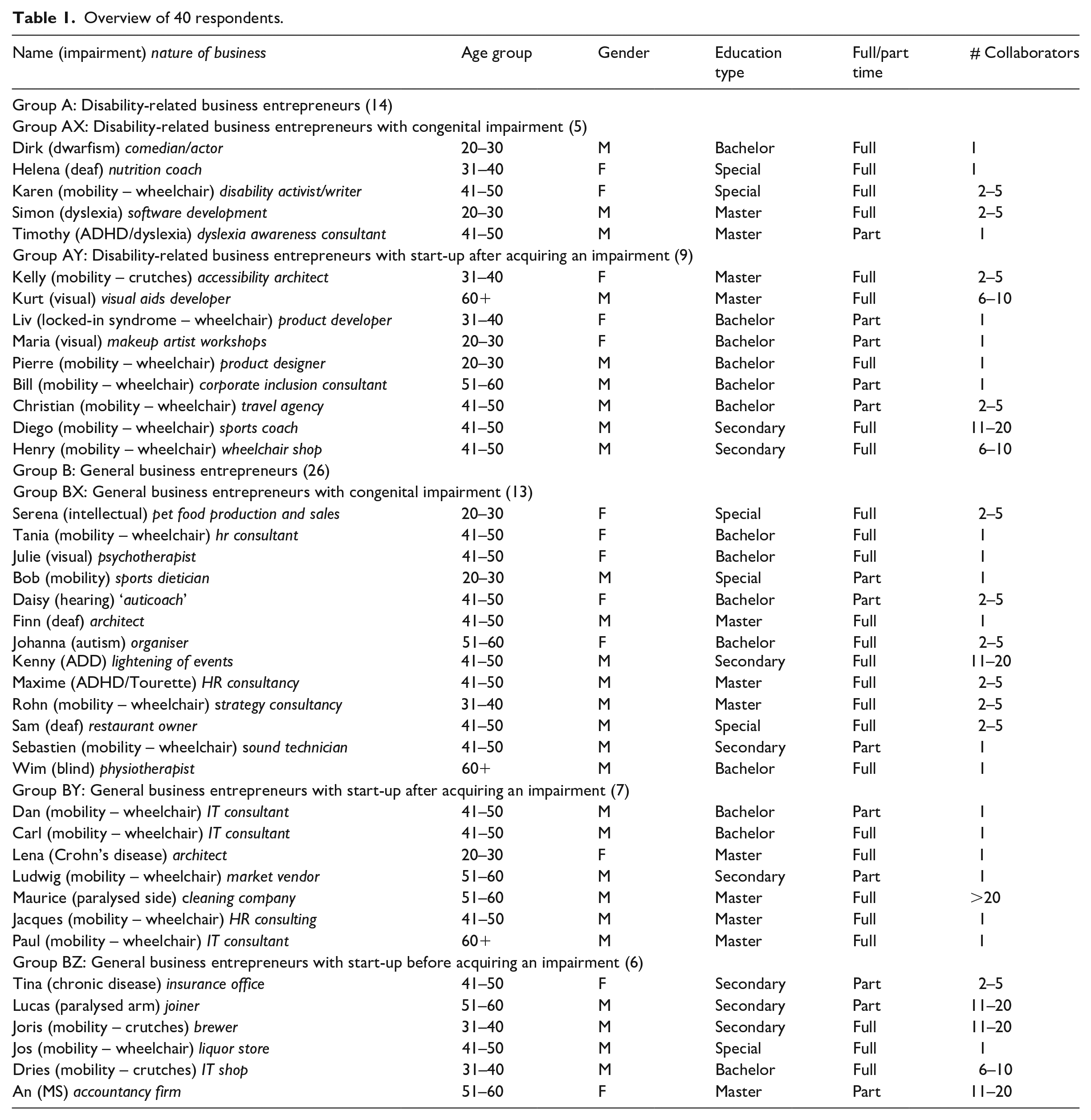
From the disabled entrepreneurs that participated in this study, 27 worked fulltime, and 13 part-time (either because they combined their business with another waged job or because their health did not facilitate full-time). Twenty-six had at least a bachelor degree. Twenty-one were self-employed while 19 employed other people and/or worked together with co-business owners. During the process of interviewing and later upon closer examination of the gathered interview material, it became clear that 35% of the entrepreneurs had a business that was ‘disability-related’, servicing mostly disabled people (see group classification A/B, Table 1). This sparked our interest in further analysing the differences between both groups. Table 1 shows an overview of respondents’ demographics and the characteristics of their businesses. Additionally, a further classification based on when entrepreneurs started-up their business was made (see group classification X/Y/Z, Table 1) showed that group A respondents started-up their business more often after acquiring an impairment as compared to group B (±64% vs ±23%).
Overview of 40 respondents.
Data analysis
In a first step, from an in-depth reading and re-reading of the interviews with 14 disabled entrepreneurs in group A, we distinguished a number of commonalities in their stories that seemed key: (1) interpreting the experience of becoming impaired or growing up as a disabled person as a source of dispositions helpful for running a business, (2) positioning the impaired/disabled body as adding value to the business and (3) choosing a business that fitted their (prior) cultural capital and disability.
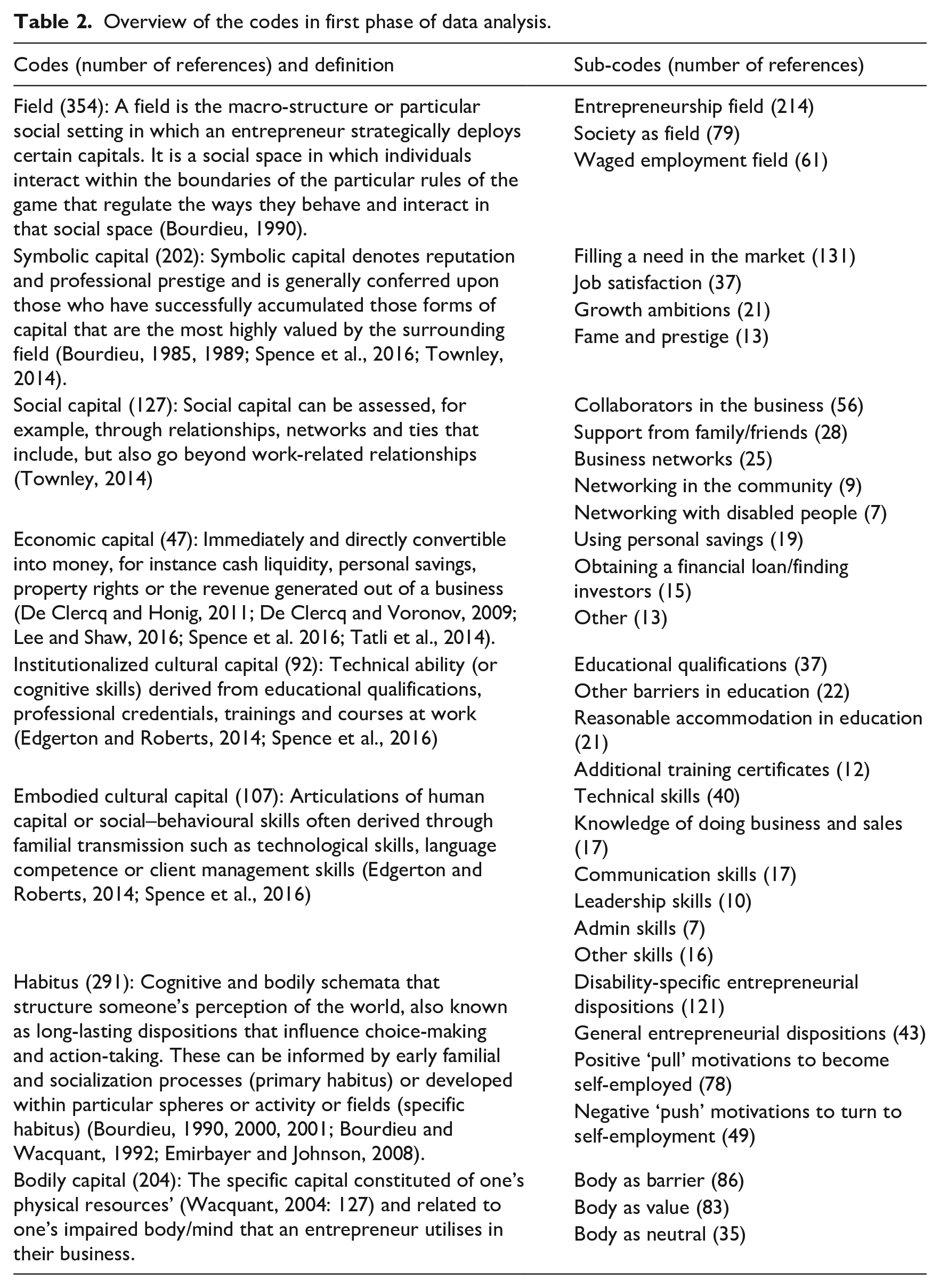
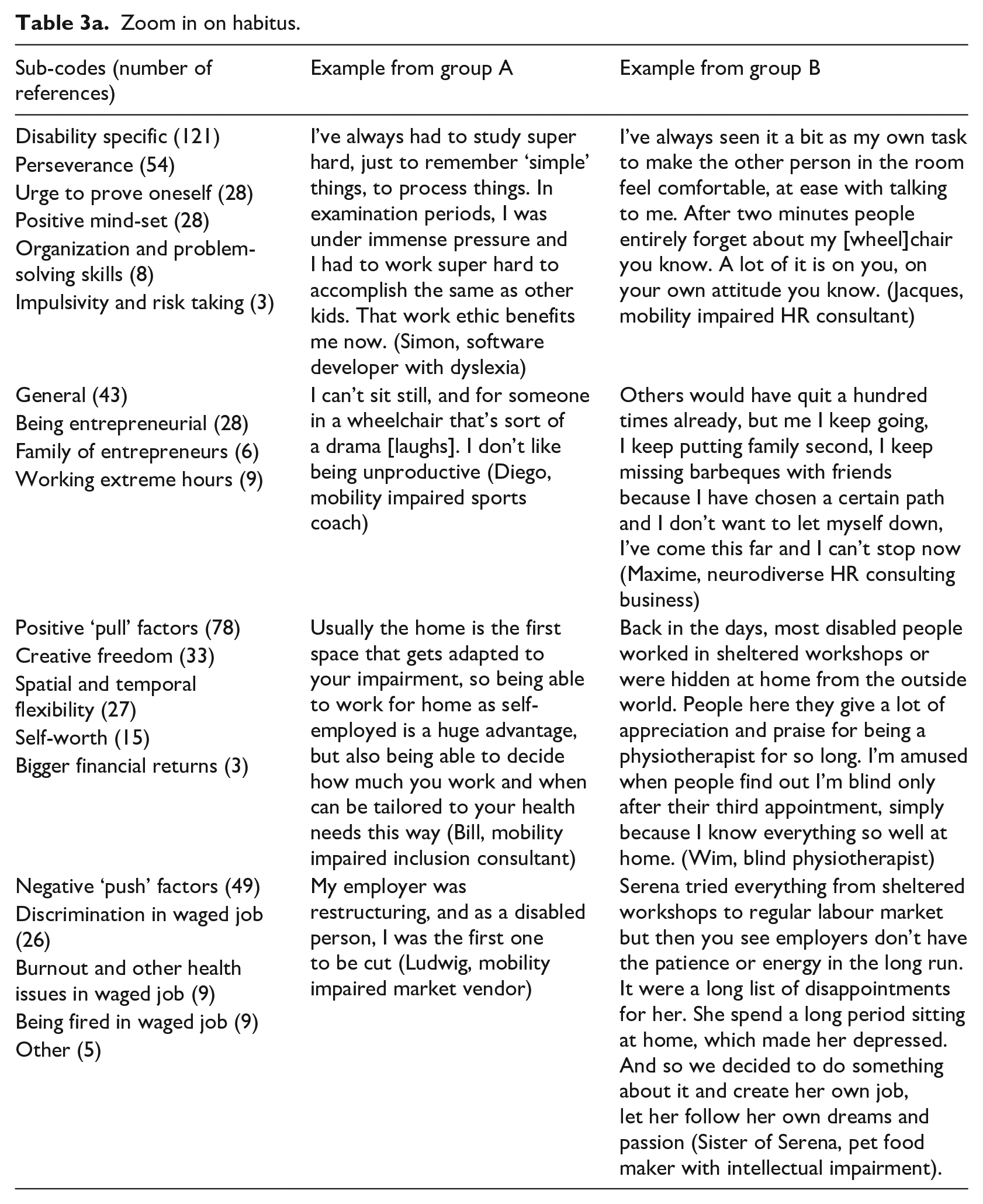
As a second step, we systematically coded all interview data of 40 disabled entrepreneurs using NVivo12 along the key concepts of our theoretical framing: field, symbolic capital, social capital, economic capital, institutionalized and embodied cultural capital, habitus as well as bodily capital (see Tables 2, 3a and 3b). This on the one hand helped document the structures in the field (e.g. government support; ableist society) and on the other hand gave a broad insight into respondents’ agency through a mapping of their ‘capital portfolios’ and habitus (e.g. resources disabled entrepreneurs mobilize or lack in the business) (Bourdieu, 1977; Cederberg and Villares-Valera, 2019).
Overview of the codes in first phase of data analysis.
Zoom in on habitus.
Zoom in on bodily capital.
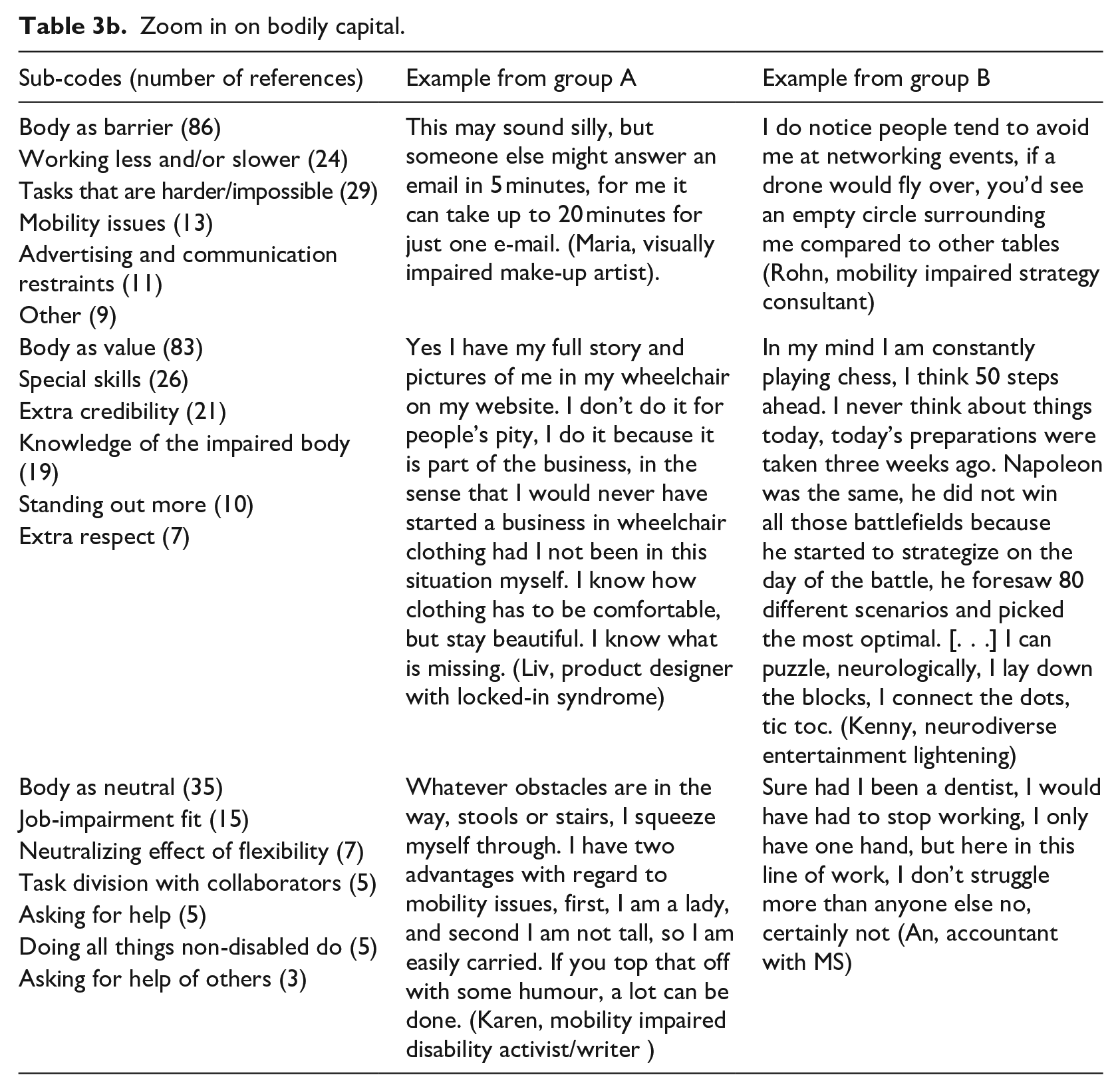
From this analysis, respondents in group A and B did not seem to differ in a meaningful or clear way in terms of levels of education or skills, social networks or economic capital. In light of answering the research question ‘When and how do disabled entrepreneurs make a business out of their disability?’, and following up on the themes discovered in the first step, we took a closer look at the references coded under habitus and bodily capital (see Tables 3a and 3b). We learned that in the entire sample, disability-specific entrepreneurial dispositions derived out of the experience of acquiring an impairment or growing up as a disabled person (e.g. perseverance, positive mind-set, . . .) were three times more common than general entrepreneurial dispositions (e.g. coming from a family of entrepreneurs, always having been an entrepreneurial person, . . .) (121 vs 43 references) (see Table 3a). In addition, disabled entrepreneurs gave more positive ‘pull’ reasons (e.g. creative freedom, flexibility, . . .) for wanting to become self-employed than negative ‘push’ reasons (e.g. discrimination, burnout or being fired in previous waged job) (78 vs 49 references). We also learned that in the entire sample, references to the impaired/disabled body as a source of value for the business were more or less as common as references to the impaired/disabled body as a barrier in the business (86 vs 83 references) (see Table 3b). Explicit denials of the body having any significant impact on the business were less common (35 references).
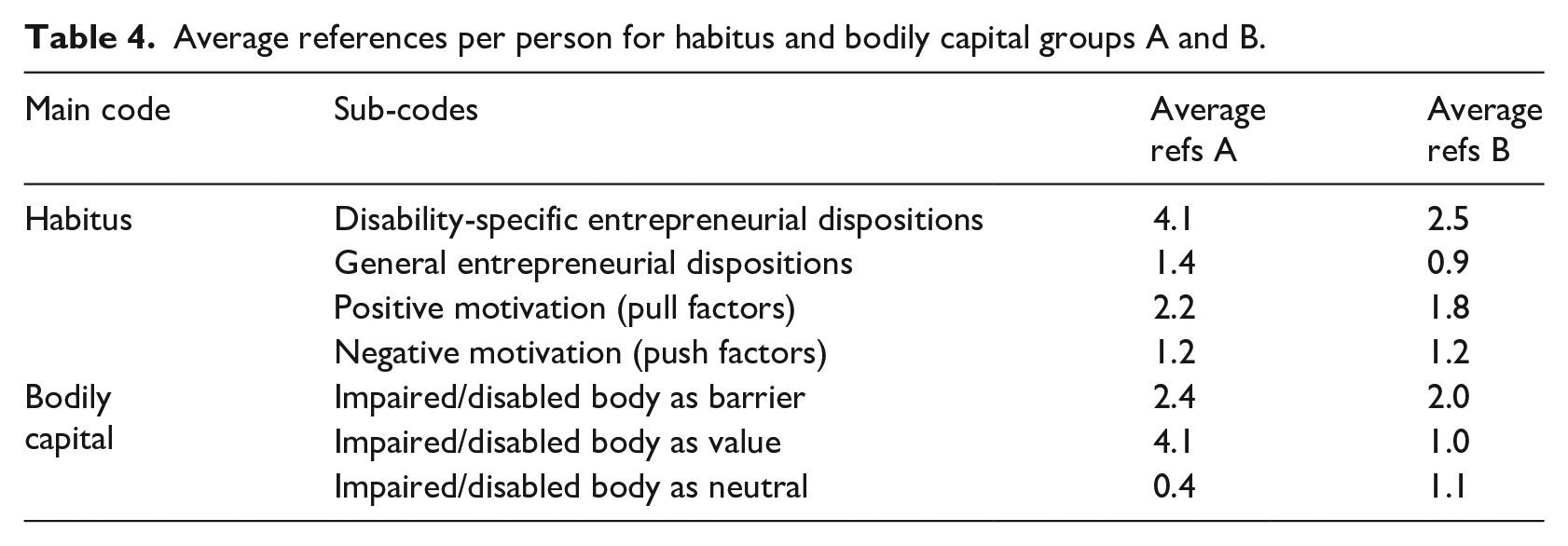
In a third step, we compared the frequency of our key variables of interest (habitus and bodily capital) between the different groups A and B, using NVIVO12’s matrix function. We calculated average number of references per person (given the different sizes of the groups) (see Table 4). A few differences stood out. Compared to group B, disabled entrepreneurs in group A with a disability-specific business made more mention of their experience of acquiring an impairment or growing up as a disabled person as providing useful dispositions for the business (4.1 vs 2.5 references per person) and of their impaired body as useful for the business (4.1 vs 1.0 references per person). Other differences were less outspoken.
Average references per person for habitus and bodily capital groups A and B.
In the findings, we discuss the meaning respondents assigned to their embodied dispositions and bodies. We first present the differences and similarities between group A and B. Next we focus on group A, as it presents us with ‘an extreme case’ of bodily capital (Chen, 2016; Eisenhardt, 1989), and make a within-group comparison, zooming in on our main phenomenon of interest.
Self-reflexivity
The authors are a pair of non-disabled and disabled persons interested in understanding how ableism and impairment shape experiences of organizing, in both a positive and negative sense, who became curious about the overrepresentation of disabled people in self-employment, and from the data collected, the difference it made to run a disability related business. The authors therefore acknowledge their social locations (Johnson and Duberley, 2003) contribute to a sensitivity to, and the choice to zoom in on, the stories of group A, and recognize this is but one of many possible approaches. Such an endeavour is therefore inevitably partial and selective, though purposefully so, in order to explore a niche phenomenon.
Findings
Bodily and mental schemata that form an entrepreneurial habitus
Compared to disabled entrepreneurs with a ‘general’ business, disabled entrepreneurs with a disability-related business more often mentioned disability-related dispositions (developed through the experience of becoming impaired or growing up as a disabled person) as helpful for the business (4.1 vs 2.5 references on average per person), as well as general entrepreneurial dispositions (1.4 vs 0.9 references on average per person), and positive reasons for starting a business of their own (2.2 vs 1.8 references on average per person).
Zooming in on the stories of disabled entrepreneurs with a disability-related business, half of the respondents had a severe accident as young adults and started a business shortly after the onset of impairment. Their stories showcase remarkable recoveries and evidence a high level of perseverance and commitment to survival. For example, Christian had a diving accident when on holiday, Diego a sports accident when training abroad, and Pierre’s tractor fell off a cliff when working on a farm as a student. Similarly, Kelly fell during a client’s site inspection, both Henry and Bob had car accidents whilst driving around for work-related purposes, while Liv had a stroke. All these respondents talked of a long and hard period of recovery and rehabilitation. For some, chances of survival were ‘estimated by medical staff to be as low as 5%’ (Pierre, mobility impaired product developer), yet all regained some bodily function, ranging from paraplegia to walking short distances with the aid of crutches.
For these respondents, the rehabilitation centre became their second home, and like the gym ‘a machinery designed to fabricate the spirit of discipline’ and rediscover or better yet reproduce themselves again (Wacquant, 2004: 22). Becoming a successful recoveree required a specific habitus, consisting on the one hand of bodily schemata, incorporated through a set of corporeal mechanisms that were strictly time-managed by the rehabilitation professionals, as well as a set of mental schemata important to create the needed willpower for recovery against all odds. And this willpower seemed beneficial for the subsequent entrepreneurial journey as explained by Liv ‘[In the centre] I learned to try harder every day and be happy with every small improvement’ (product designer with locked-in syndrome) as well as Christian (mobility impaired travel agent) when he stated, ‘the traumatic experience of the accident has given me an extra 10% push to want things even more.’ As ‘products of similar conditions of existence and conditionings’ (Bourdieu, 2000: 146) respondents showcased a collective habitus, summarized in the following excerpt: The impact of the accident was quite dramatic. I was a professional athlete, and all the jobs I had done before all required a body that functioned 100% [. . .] I remember, sometime after the accident, having a moment of contemplation in which I decided a broken back did not have to mean a broken life. (Diego, mobility impaired sports coach)
The concern for taking (back) control over one’s life was also apparent among respondents whose impairment was congenital or acquired more gradually. Similar schemata developed through living in a world that was maladapted, inaccessible or discriminatory towards disabled people. For instance, Kurt explained how he ‘learned to relativize things and see [inaccessibility] problems as challenges to be overcome’ (Kurt, visually impaired product developer) while Simon decided to ‘focus on the positive traits of dyslexia rather than the stigma’ (Simon, product developer with dyslexia).
Indeed, it seems that for many of the interviewees in group A, a collective habitus was formed through the experience of acquiring an impairment and subsequent rehabilitation. The process of remodelling the body from one that was ‘broken’ to one that regained (a certain degree of) functioning, led to a corporeal thrift, marked by bodily and mental schemata of willpower and a hard work ethic, which seemed to fit with popular understandings of the entrepreneurial habitus (De Clercq and Voronov, 2009) and was necessary to survive a world designed against them which assumed a corporeal standard different from their own embodiment (Van Laer et al., 2020). In this sense, social structures built around ableist taken-for-granted notions of the way bodies should look and behave became inscribed into respondents’ bodies through the habitus, producing a collective will to satisfy a shared neoliberal interest: to take back control over one’s life and become a productive citizen again.
Choosing a business that fits (prior) cultural capital and impairment/disability
Compared to disabled entrepreneurs with a ‘general’ business, disabled entrepreneurs with a disability-related business more often described their impaired/disabled body as a source of value for the business (4.1 vs 1.0 references on average per person). With the exception of a few respondents who took over a family business, most disabled entrepreneurs in both groups chose their business in accordance with the cultural capital they possessed, yet for disabled entrepreneurs with a disability-related business, an additional fit between the business and their bodily capital was surfaced.
Looking at disabled entrepreneurs with a disability-related business up-close, it seems that becoming or being impaired and consequently confronted with an ableist world, designed to cater for non-disabled people, provided entrepreneurs with insights into opportunities for products and services that were lacking in the market. This confrontation functioned as ‘a school of life’ for the respondents, transmitting a certain knowledge onto the entrepreneurs by way of direct embodiment, through a practical mastery of corporeal and mental schemata. When this knowledge was coupled with the appropriate cultural capital (e.g. technical skills, credentials, diplomas), bodily capital could become fructified.
For instance, product designers Pierre (mobility impairment) and Liv (locked-in syndrome) experienced the poor aesthetics of disability clothing early after acquiring their impairment and it was this lived experience of aesthetic disappointment that led to the start-up of their businesses. Similarly, Maria (visually impaired make-up artist) experienced that the desire to feel confident and beautiful did not disappear when one’s sight declined, and thus wanted to ‘give back to the blind community by teaching them techniques for how to do make-up without use of a mirror’. The need for practical as well as appealing solutions, was also central to Kelly’s (mobility impaired accessibility architect) concern, as she remarked: ‘people already in the rehabilitation center started asking me if I could do the renovations for their house, to make their homes accessible, as they needed an architect with insights into their particular needs.’ For Bill (mobility impaired inclusion consultant), Timothy (neurodiverse dyslexia awareness consultant) and Karen (mobility impaired disability activist/writer) it was their experience with inclusion as well as exclusion in waged labour that gave them the incentive to raise corporate awareness about disability. The prior market gap that the respondents sought to fill, of adapted products and services, was inscribed in ableist assumptions that disabled people are not in need of aesthetically pleasing solutions or even economic participation through job offers.
The importance of carnal experimentation to the respondents’ businesses stood out and set them apart from non-disabled competitors. For instance Christian’s case (mobility impaired travel agent) exemplifies how ‘20 years of traveling “on wheels” and figuring out accessible routes’ placed him in a unique position in the travel industry. Others without such experience might be able to acquire a theoretical mastery for inventing similar products and services but may never develop the same practical mastery. Indeed, the knowledge of travelling, dressing, toileting, ‘design living’ and job searching as a disabled person has been assimilated by respondents’ bodies in and through endless practice, and as such became inscribed within their bodily schema. Yet such inscription was not enough to build a disability-related business, as shown by the following excerpt indicating the importance of institutionalized and embodied cultural capital for the conversion of bodily capital into income streams: I started playing [G-sport] basketball already during my revalidation. When I got at a more competitive level, I noticed there was a severe shortage in technically skilled people who knew how to take measurements of wheelers [. . .] and all the sportspeople “on wheels” I knew were forced to travel to a neighbouring country to purchase and repair their gear [. . .] with reparation demands being very high due to the roughness of the sport and taking up to eight weeks [. . .]. Because I had studied mechanics and worked on aircraft engines for more than 10 years [before the accident] I found it easy to fix my own gear. . . Before I knew it, I was fixing up everyone else’s gear as well. (Henry, mobility impaired wheelchair repair and sales).
Indeed, it was the combination of earlier acquired skills to fix aviation material, a capital acquired through the body, and the knowhow of taking measurements of people in a wheelchair, a capital of the body, that gave Henry a competitive advantage in the market. The same was true for Simon (software developer with dyslexia), who combined his skills to develop software, obtained through school, and affinity for playing videogames with his childhood experiences of ‘being dragged from therapist to therapist’ to innovate the landscape of reading and speech therapy for children with dyslexia which ‘in 20 years. . . had hardly changed at all’.
The practical sense that respondents gradually developed through their experiences as living as a disabled person in an ableist world that tended to neglect their needs, helped them develop a business that fitted their impairment/disability. In addition to a wide range of different capitals, the presence of bodily capital was key. Such capital was one of the body, acquired through the practical apprehension of the strengths and weakness of its anatomy and through a knowing of one’s own somatic possibilities and limits drawn from daily encounters with an ableist field. It was this bodily capital that facilitated a competitive advantage vis-vis non-disabled peers who might understand the business requirements with an intellectual understanding, but who lack comprehension through the body (Bourdieu, 2000; Wacquant, 2004). Despite the positive opportunities for conversion into income streams, it is important to underline the oppression and symbolic violence caused by the ‘ordinary order of things’ (Bourdieu, 2000) which assumes disabled people do not care for economic participation, design, aesthetics and fun, as demonstrated through the lack of adapted products and services our respondents built their businesses around.
The body as barrier and constraints to the conversion of bodily capital
In the entire sample, seeing aspects of the impaired/disabled body as a barrier for the business was as likely as seeing the impaired/disabled body as valuable for the business (86 vs 83 times mentioned). Moreover, disabled entrepreneurs with a disability-related business did not differ a great deal from disabled entrepreneurs with a ‘general’ business in terms of frequency of mentioning how the impaired body poses a barrier in the business (2.4 vs 2.0 references on average per person). So even if disabled entrepreneurs build a business around their disability, this does not mean the body did not create challenges in their daily life. Both groups of disabled entrepreneurs encountered (negative responses to) impairment effects that could not be incorporated into their ways of organizing work.
Many of the disabled entrepreneurs with a disability-related business served the needs of the disabled community as a conscious strategy, and sometimes additionally served a social goal: to ‘give back’ to others in similar circumstances. The focus on a niche market, however, often meant limited profit possibilities. Some respondents, in an attempt to broaden their market, experienced difficulties with targeting non-disabled clients or making their business non-disability related. As Helen explained (deaf diet nutritionist):
I got so many compliments from people for looking fit and healthy, and people wanted my help, to make them a plan too [. . .] in the deaf community, people often struggle to get help from doctors or dieticians who can’t understand them or don’t want to put in the extra effort to help with communication. So I quit my job as a butcher and became a fulltime self-employed nutritionist [. . .] Hearing clients are tough because I need to make [a] reservation for interpreters long in advance, and when a hearing person wants a meeting, they don’t want to wait. . .. I find it very challenging expanding the business in that direction.
This example shows how the bodily capital of disabled entrepreneurs ceases to hold value in contexts premised on the assumption of able-bodiedness, in this specific case assumptions of immediate aural/oral communication. A different example of bodily capital losing its value due to ableist world views is provided by Dirk (comedian with dwarfism), who experienced negative comments about his skills being limited to his bodily capital:
During my shows in the night-time, like every other comedian, I joke about what I’ve experienced in the daytime [. . .] At one point, someone told me I was only good in making dwarf jokes and I took that very badly. I tell them ‘the day that I can walk into a butcher shop without turning heads, that’s the day I’ll stop making dwarf jokes’. Because that’s everyday reality for me, you see [. . .] When my management inquired about the reason for turning me down for that [movie] role they replied ‘no audience would believe a dwarf playing a judge’, that seemed incredible for some reason, even though I could well have been an actual judge had I chosen a different career path!
These quotes suggest that the same body could be both a source of value and devalued in operating the same business. The social meaning of making a business out of one’s disability can thus only be fully apprehended when taking into regard ‘the structure of life chances offered-or denied’ (Wacquant, 2004: x) by important stakeholders and local systems. As with the boxers in Wacquant’s (2004) ethnography, who found their body devoid of value in any other domain after their prize fighting career, so too did our respondents run into impossibilities to convert their bodily capital.
Besides limits imposed by the social environment, limits to entrepreneurs’ position-taking also arose from the impaired body itself. Some of the respondents pointed out how their impairments meant they could not put in the same hours as competitors did. Others mentioned how their impairment impacted on undertaking certain aspects of business venturing. For instance, Liv (locked-in syndrome, product designer) pointed out, ‘I don’t manage to make enough promotion for my business due to my speech impairment [. . .] I only advertise online now, but it’s a product that actually needs to be brought to the people in the flesh.’ Maria (visually impaired make-up artist) also talked about struggling to grow the business because ‘It’s hard for me to set up a business plan, I know I should [. . .] to plan the future and stuff, and to convince investors, but reading just takes me so much time.’ Overall, it would thus be wrong to conclude that these entrepreneurs only reaped the benefits of their impaired/disabled body, a trap which explicitly worried Timothy (neurodiverse dyslexia awareness consultant):
[dyslexia] helps find solutions that maybe other people would not see [. . .] It made me very skilful at networking [. . .] But the number of people who talk about dyslexia as a super power, it drives me insane. It fails to take dyslexia seriously. The stress and the depression, and anxiety attacks that I suffer, because of the executive functioning disorder, because of being terrified that I was not going to get the simplest thing done. . . I remember being curled up on the floor in a foetus position, because I was so stressed. This does happen. And this is why anyone with dyslexia that goes into a business, they need a network, a support network. They need to be able to go into business with people that complement them, like jigsaw pieces.
As the excerpt makes clear, for some disabled entrepreneurs social capital becomes an extremely important requisite to turn bodily into symbolic capital.
The narratives presented here start to reveal how entrepreneurs’ position-taking did not take place in a social vacuum, but rather depended on the ‘social possibles of which the context is the bearer’ (Wacquant, 2004: x). Neither was the position-taking of disabled entrepreneurs decoupled from the lived reality and predicaments of working in an impaired body. In sum, the fit between one’s impairment and/or disability and one’s business also came with limited possibilities to step outside a narrow box due to ableist characteristics of the field. At the same time, issues of the body and impairment limited disabled entrepreneurs’ ability to compete, as these experiences hint at the relativity and structural embeddedness of anomalous bodily capital and the range of possibilities for its conversion in the ableist field.
Discussion and conclusion
This study explored the experiences of 40 disabled entrepreneurs, zooming in on the stories of a smaller group who have strategically linked the experience of being or becoming impaired and disabled to their business venture. By comparing them with disabled entrepreneurs who were in a ‘general’ business unrelated to their disability, it became apparent that they more often tended to think of the experience of being or becoming disabled as bringing along dispositions that were helpful for running a business (e.g. perseverance, urge to prove oneself, positive mind-set, organization and problem-solving skills, impulsivity and risk taking), made more mention of positive pull factors drawing them to self-employment (e.g. creative freedom, spatial and temporal flexibility, self-worth) and more often saw their impaired/disabled body as adding value to the business (e.g. special skills, knowledge of the impaired body, extra credibility, standing out more and extra respect). This said, they equally pointed out situations and circumstances during business venturing were the impaired/disabled body posed a challenge and they equally experienced negative push factors (e.g. discrimination and burnout in waged jobs) as a motivation for making the move towards self-employment as compared to disabled entrepreneurs with a general business.
This study advances an understanding of the role of ‘anomalous’ bodily capital for disabled entrepreneurs which is a ‘capital constituted of one’s physical resources’ used for economic survival (Wacquant, 2004: 127), however instead of originating from fit, valued bodies it originates from the disavowed, anomalous body that ableist society considers as ‘out of place’ (Campbell, 2009; Shildrick, 2009; Wendell, 1996). Although the possession of this bodily capital is in itself not enough to generate income streams – certain embodied dispositions as well as other capitals too need to be present and/or aligned for example, cultural and social capital – and although disabled entrepreneurs with a general business also occasionally interpret their impaired/disabled body as valuable for the business, in the stories of disabled entrepreneurs with a disability-related business, this form of capital takes a more prominent place (four times more likely). Consequently, a first contribution of this study is its in-depth exploration of the ‘value in disability’ perspective as commenced by positivist entrepreneurship scholars (Antshel, 2018; Lerner et al., 2018; Wiklund et al., 2018) and explored briefly in waged employment settings (Andreassen, 2012; Jammaers et al., 2016; Maravelias, 2020). Responding to calls to destabilize ableism through counter-cultures that celebrate difference (Goodley, 2014), our findings defy ableist beliefs that equate disability to inherent inferiority by demonstrating the value of bodily difference for all disabled entrepreneurs (Campbell, 2009), whilst remaining cognizant of what impairment can mean for the day-to-day operations of entrepreneurs. This recognizes both experiencing the effects of impairment as well as ableist contexts where such impairment effects are negated in organizing practices.
This study at once points to the danger in reproducing a ‘supercrip’ model of disability. Prior research has critiqued supercrip representations as wicked ‘Othering’ process because in considering business venturing by disabled entrepreneurs as extraordinary, superhuman achievement, we award praise to disabled people in contexts where non-disabled peers would not stand out (Brylla, 2019; Kafer, 2013). This arguably stems from low social expectations in ableist society which result from distorted assumptions rather than realistic assessments of their capabilities (Silva and Howe, 2012). Despite the benefits of such celebratory discourses to individuals’ self-view (Baldridge and Kulkarni, 2017; Jammaers et al., 2016), such representations set a high bar for all by enforcing an ‘achievement syndrome’ (Silva and Howe, 2012: 174) or the idea that disabled people are only valid or respectable if they can turn their misfortune into fortune (Siebers, 2008). In addition, this study shows that considering disability as a ‘superpower’ paradoxically perpetuates disabled people’s existence as a ‘problem’ because it ignores bodily complexity and the potentially important role of impairment effects. If fully incorporated in the field, rather than further problematizing disability, impairment effects could reframe bodily and cognitive variation as legitimate organizing requirements (Williams and Mavin, 2012). Future research should investigate how promoting positive links between impairments and entrepreneurial dispositions or matching disabled people to certain jobs in which their disability becomes an advantage in waged employment settings (e.g. persons with Asperger in programming jobs, see Rovnick, 2019) might also reproduce inequality.
Further, by linking disability to their business, disabled entrepreneurs encounter a potential for ‘disability ghettoization’, through serving a niche-market with limited possibilities for stepping outside a ‘narrow box’. The focus on designing products and services to improve the quality of life for disabled people is perhaps unsurprising since non-disabled design professionals often disregard the ‘complexity of the human body and the manifold ways in which bodies interact with everyday material objects,’ especially disabled bodies (Imrie, 2015: 486). This often results in the experience of ‘aesthetic stigma’ by disabled people, as a result of poor design that privileges function over aesthetics (Bichard et al., 2007). On the contrary, by using disability as a creative starting point (Boys, 2017), the respondents in this study developed unique businesses that produce functional and aesthetically pleasing products. Yet prior studies on minority entrepreneurship have warned how serving one’s ‘own community’ risks further perpetuating marginalization in the field, as these are often located within low-paying sectors or segments (Pritchard et al., 2019; Smith, 2014; Swail and Marlow, 2018). Similarly, the overrepresentation of disabled people employed in the low-payed health and social care sector, where their disability may be seen as an asset (Andreassen, 2012), indicates a potential for similar issues. Future research, using quantitative data such as income streams, should further investigate to what extent ghettoization of businesses run by disabled entrepreneurs is an actual threat.
A second contribution of this study to entrepreneurship research is made by empirically detailing how the interplay between agency and structure comes together in the practice of leveraging anomalous bodily capital, advancing a more complex understanding of the body. Instead of a mere ‘barrier approach’ (e.g. Ashley and Graf, 2017) or a ‘special talent approach’ (e.g. Antshel, 2018), we conceive of disability as neither structurally disadvantageous nor beneficial to one’s business as conversion of bodily capital is always dependent on broader social structures that constrain individual position-taking. In doing so we accord agency to disabled people who are often assumed to be passive recipients of care or non-creative consumers of the ableist-designed world, rather than active creators of products and wealth. Rather than an open, accessible and potentially emancipatory space (Ahl and Marlow, 2012; De Clercq and Honig, 2011), entrepreneurship remains rife of taken-for-granted ableist assumptions about which bodies fit in well (e.g. those that can do an 80 hours a week) and disability-based inequalities, stemming from a complex interpellation of both environmental (e.g. accessibility, government support, societal beliefs) and bodily variations (e.g. how one reads or speaks, or experiences of pain and fatigue). The concept of anomalous bodily capital, as specified in this study, advances our understanding of entrepreneurship by seeing the body as a complex site of corporeal and cultural production (Shildrick, 2009): fluid rather than fixed, both dis/advantageous to one’s business and constructed as anomalous in one context but celebrated as ‘superhuman’ in others (Siebers, 2008; Swain and French, 2000; Wendell, 1996). In order to truly understand how bodily variations as well as their socially ascribed meaning changes entrepreneurs’ position-taking (or not), it could be interesting to focus future research on entrepreneurs who acquire an impairment later on in life whilst already being self-employed, either temporarily through burnout or acquired permanent conditions. This would allow for a more detailed assessment of the enabling or disabling role of the ‘changed’ body in business venturing.
It is the right of disabled people to participate fully in the domain of economic life, by undertaking work that is freely chosen (UN General Assembly, 2007), whether that be self- or salaried employment and whether that be disability-related or not. At the same time, it is the duty of governments to prevent restrictions in choice related to normative prescriptions of ‘suitable roles’ from occurring by offering the necessary support and altering false perceptions about disability in our society. As it is, such support falls short (Van Rampelberg, 2018) whilst negative perceptions of disabled people in the entrepreneurial ecosystem remain omnipresent (Unia, 2019).
Footnotes
Funding
The author(s) received no financial support for the research, authorship, and/or publication of this article.
