



Abstract
This special issue (SI) editorial contributes to ongoing efforts worldwide to decolonise management and organisational knowledge (MOK). A robust pluriversal discussion on the how and why of decolonisation is vital. Yet to date, most business and management schools are on the periphery of debates about decolonising higher education, even as Business Schools in diverse locations function as contested sites of neocolonialism and expansion of Western neoliberal perspectives. This editorial and special issue is the outcome of a unique set of relationships and processes that saw Organization host its first paper development workshop in Africa in 2019. This editorial speaks to a radical ontological plurality that up-ends the classical division between theory and praxis. It advocates praxistical theorising that moves beyond this binary and embraces decolonising knowledge by moving into the realm of affect and embodied, other-oriented reflexive, communicative praxis. It underscores the simultaneous, contested and unfinished decolonising-recolonising doubleness of praxis and the potential of borderlands locations to work with these dynamics. This special issue brings together a set of papers which advance different decolonising projects and grapple with the nuances of what it means to ‘do’ decolonising in a diversity of empirical and epistemic settings.
Introduction
This special issue (SI) aims to make a collective contribution to ongoing worldwide efforts to decolonise management and organisational knowledge (MOK). While the SI adopts a purposefully broad idea on forms of MOK covering theory, discourse, practice, and its asymmetrical structures of production, distribution, consumption and appropriation, a more specific foil are the Eurocentric 1 academic forms that dominate contemporary management research and education. Generally, decolonial conversations set out to critique the ‘dominant Eurocentric academic model’ and to ‘imagine what an alternative to this model could look like’ (Mbembe, 2016: 36). Decolonial feminists (Lugones, 2010; Mohanty, 2003) call for nothing less than the transformation of hetero-patriarchal, colonial, racist, epistemic, affective, cognitive and economic structures of organisation and power, and a non-expropriating revival of Indigenous knowledges and practices. The need for a robust pluriversal discussion from diverse positions on the why and how of decolonisation is vital for multiple knowledge systems to coexist. Yet to date, most business and management schools remain on the periphery of debates about decolonising higher education, even as business schools in diverse locations function as contested sites of neocolonialism and expansion of Western neoliberal perspectives.
As an ‘early champion of non-Western organization theory’ (Mir and Mir, 2013), Organization has nourished critical scholarship about existing and new forms of coloniality, including in prior special issues on postcolonialism (Jack et al., 2011) and Knowledge from the South (Alcadipani et al., 2012). This special issue continues this journey. As a heterogeneous editorial team committed to understanding, advocating for and practicing decolonising and decoloniality in MOK, we have brought together papers which, we believe, help advance different decolonising projects across the world. Each paper grapples with nuanced complexities and contradictions of what it means to do decolonising in diverse empirical and epistemic settings; diverse because one cannot escape the ‘class, sexual, gender, spiritual, linguistic, geographical, racial hierarchies of modern/colonial world’ (Grosfoguel, 2016: 3). Just as we seek to in this editorial, the papers demonstrate the necessity and inescapability of relational reflexivity among scholars (Mignolo and Walsh, 2018) infused with respect, empathy and care towards others with whom we co-exist in borderlands while pursuing decolonial praxis.
This SI is the outcome of a unique set of relationships and processes which led to Organization’s first paper development workshop on decolonising management and organisational knowledge in Africa (Durban, South Africa) in 2019. Despite the plethora of decolonisation events in South African higher education, this paper development workshop was the first focused on business and management. While we acknowledge the richness of the papers here, we also draw attention to the doubleness of decolonial praxis that is, the opportunities, problematics and contradictions associated with the decolonising-recolonising dynamics of our/others’ decolonial endeavours such as this SI. We also hope to convey some of the profound affective, intellectual and relational experiences of decolonising praxis in MOK. Thereby we recognise decolonising as both the need for scholarly work as well as work beyond the academic written text. Such parallel work is wide-ranging and includes public intellectual work, affective work, capacity development work and critical mass building work in diverse contexts.
The first part below approaches the decolonising of MOK through the prism of ‘colonial difference’ (Mignolo, 2012). This informs how we, and some of the papers in this volume, think about decoloniality as a possible liberating option for all toward a pluriversal world in which many worlds co-exist, colliding, sliding, coalescing with each other, ‘interconnected without becoming commensurate’ (de Lima Costa, 2016: 53). In the next part, we consider why decolonising MOK is a significant and timely necessity, relying and commenting on prior scholarly work. As a commitment to relational reflexive praxis (Mignolo and Walsh, 2018), we then offer an account – a necessarily partial one – of the production of the SI, and how far we feel we met our aspiration of decolonial praxis in the doing of the issue itself along with the embodied struggles and insights we gained enroute. Finally, we provide an overview of the six papers, and some important acknowledgments and thank-yous.
Departing from colonial difference
Our point of departure is the notion of ‘colonial difference’ (Mignolo, 2012) put forward by decolonial scholarship from Latin America and elsewhere to critique the management of difference between the modern self and the racialised other. Colonial difference is vital for historicising, understanding and re-appropriating decolonial thought and practice. It is central to the coterminous operation of coloniality and/as modernity. Colonial difference enables the management of the threat posed to the modern self by the other’s existence, and the multiple pluriversal possibilities of otherwise she embodies and stands for. It is enacted through the discursive and material production of her difference and through violence against her by virtue of such difference. Barbaranising, criminalising, inferiorising, annihilating, discriminating, denying, disguising difference is the managerial operation of colonial difference (Mignolo, 2012).
Such domestication of difference and its contested management has been the central theme of Eurocentric colonisation in its multiple articulations worldwide at least since the “discovery” and conquest of the Americas by Christopher Columbus in 1492 (Dussel, 1995). While political colonisation might have formally ended in many parts of the world after World War II, the internal and external operations of managing colonial difference have not disappeared in the post-colonial era of independent states. The West is not just in the geographic West anymore. It is everywhere in the self-proclaimed centre and interiority of Europe, and the peripheries and exteriorities, Europe has constituted through colonial difference. Today, around the planet, we live under arguably more intensified operations of coloniality/modernity – economic, epistemic, political, military (Quijano, 2000). Decolonising and decoloniality is thus not a peculiarly Global South or Latin American problem or worldview. It is about all of us, and all of us now!
This longue durée of coloniality/modernity is also the historical canvass for decolonial thought and practice (De Sousa Santos, 2019). Decolonial thought and practice inspired by anticolonial movements has operated concurrently with colonial difference (Maldonado-Torres, 2011) and seeks alternatives to colonial difference. However, decolonising is not a term which is necessarily used by those engaged in such struggles, such as Indigenous Peoples, landless farmers, workers or those who may already propose, enact and embody alternative and/or disruptive practices of their own for working with, not managing, difference. Despite such long histories (Bouka, 2020; Césaire, 1955; Fanon, 1952/1967, 1961//1967; Young, 1991), and debates about decolonising (Nandy, 1983; Wa Thiong’o, 1992), only recently have intellectuals referred to a decolonial turn (Maldonado-Torres, 2011, 2016). Originating as a theoretical concern in area studies, cultural studies and ethnic studies departments of the Western University, the phrase decolonial turn has come into vogue from 2005 (Maldonado-Torres, 2011). Now, ‘the decolonizing project is back on the agenda worldwide’ (Mbembe, 2016: 36).
The decolonial turn has come to signify an open-ended academic concept of diverse epistemic and ontological criticisms and refusals of Eurocentric modernity and its capitalist, patriarchical underpinnings. It expresses a principled and broader move with political, artistic, intellectual, epistemic and other interventions against the totalitarian implications of a universal global design championed by the white-European-masculine-heterosexual subject (Grosfoguel, 2011) and his respective ‘cognitive empire’ (de Sousa Santos, 2018), including MOK. Decolonising is a heterogeneous notion and set of practices that keep resurging, insurging, in spite of contestations, at multiple exteriorities and borders around the world (Ndlovu-Gatsheni, 2013). It is not a master plan, nor is it a global design controlled by those who have a master key. It is ‘a diverse horizon of liberation of colonial subjects, constructed by the colonial subjects themselves’ (Mignolo, 2018: xiv).
Such decolonising involves a praxistical epistemology 2 of love, respect, life and caring for and with, diverse locals in the world, that are ‘connected’ to each other through their knowledges, histories, peoples and societies (Bhambra, 2014). We use the term praxistical to move beyond the binary of theory-praxis, thinking-doing, such that all thinking is doing and all doing is thinking (Anzaldúa, 2015; Mignolo and Walsh, 2018; Sandoval, 2000). As praxis, decolonising is a perpetual work-in-progress that many have characterised as a contested and ‘unfinished project’ (Cusicanqui, 2020; Maldonado-Torres, 2011). It is also one in which ‘recolonising’ continuously appropriates decolonising efforts (Bhambra et al., 2020).
Are business schools and management education embracing the decolonial turn?
Even in a world ravaged by the COVID pandemic, business schools are carrying out neoliberal business as usual – laying off staff, cutting down essential investments in pedagogical capacities, chasing mythical rankings, marketising curricula, diversifying clientele, and increasing fees. This is occurring even as fervent appeals for decolonising the university are appearing in the Global North (e.g. London-based City University Business School’s organisation in 2020 of webinars on decolonising the curriculum; the ongoing anti-racist work in the UK by Building the Anti-Racist Classroom (BARC)) and Global South (decolonising university movements in Africa (Jansen, 2019; Ndofirepi and Gwaravanda, 2019), in Chile (Perez-Arrau et al., 2020), or via LAEMOS in Latin America). Disciplines such as sociology, psychology, history and a range of other social sciences and humanities are actively engaging in decolonial projects (e.g. in sociology, see Bhambra, 2014, and de Sousa Santos, 2018; in psychology, see Carolissen et al., 2017, and Fernández, 2018; in history, see Subrahmanyam, 1997, 2005).
Yet a comparable energy and movement is missing from MOK disciplines and the predominantly Western(ised) business schools that produce it. Inevitably we have to ask: Is there something about these schools that makes them not only privileged embodiments of coloniality but also particularly immune to decolonising engagements? Is it that Eurocentric MOK is viewed as an immutable truth that requires no historicising or politicising work, only conformity and complicity? Or does it lie with the scholars working in management and business schools who are more invested in maintaining the status quo of MOK, or who are arguably working within the colonial difference? Or is it a reflection of the disciplinary silos, competition and complicity in which many academics work? These silos are producing too few praxistical interactions with other social science theoretical developments and concerns. Is it a lack of awareness of decolonial literature, caused by such silos, even if there is an intuitive feeling that something is amiss in the visible and hidden curriculum and structures of business schools? Or, for those who have engaged with literature on decolonisation, is its at times highly theoretical register off-putting?
One of us (Shaun) has remarked that feedback from a few workshops on decolonisation held in South Africa has shown that many scholars find resonance to the ideas, but the language of decolonial debates obtuse, alienating, fatiguing and counter-praxistical. This might be so, for example, for a PhD student in, say, South Africa or India or Sri Lanka, who has a daily lived experience of colonial difference and its multifaceted consequences, can articulate them all too well in everyday thinking and doing, but fails when he/she is asked to do so in the theoretical and conceptual vocabularies that govern and structure decolonial MOK debates and the Westernised university system as a whole. These reflections preface and underscore the importance of answering two questions from a praxistical perspective. Why is it important for us to push and broaden the decolonising MOK project? And how far have we come along this journey?
Why decolonise MOK?
We call business school scholars to get to the forefront of decolonising conversations on the colonial management of difference from a praxistical perspective rather than waiting for ideas and practices to trickle down from other humanities and social science disciplines. Business schools not only produce Eurocentric MOK but through a global management education system, train current and future practitioners. Both this knowledge and its practitioners shape our lives all over the place, even as the knowledge itself remains substantively isolated and ignorant of the many others who are not only struggling with colonial difference but also coexisting alongside such Eurocentric MOK. In this regard, we believe a praxistical approach to decolonising MOK is necessary for at least three key inter-related reasons: the growth of business schools; the increasingly contested nature of globalising Eurocentric MOK; the rise and consolidation of the neoliberal university. Other reasons could, of course, be added.
First, notwithstanding its contribution to global life-destroying capitalist crises (Fotaki and Prasad, 2015; Ghoshal, 2005), Eurocentric management remains a sought-after education and profession (Durand and Dameron, 2017; Pfeffer and Fong, 2002), with 69% of universities around the world offering business degrees (Hawawini, 2016). Business schools have thus enjoyed ‘seemingly limitless growth’, while other, especially humanities and social science university departments, are being shut down (Honig et al., 2017: 84). This may have made the business and management scholarly community large and well resourced, yet insulated from the major struggles lived by others and the alternate ways they live and manage. We believe that with such stature as a business school scholar comes an increased co-responsibility for human well-being, something that requires praxis beyond the boundaries of the formal curriculum and the classroom.
Secondly, Eurocentric MOK is the most strategic instance of epistemic coloniality in the last 200 years (Ibarra-Colado, 2006). The history and continuation of this epistemic coloniality is well documented. Following World War II, the export of US management education, schools and development models to the Rest of the World came with the goal to modernise and develop them/us. This was to occur through the cultivation of a cadre of modern managers well trained in capitalist extraction practices that would catalyse and assert Western dominance in response to and anticipation of Third and Fourth World counter-movements (Cooke and Alcadipani, 2015). Consequently, a Northern global system of MOK hierarchy is in place (Jack, 2015; Prasad, 2015). This coloniality, inspite of being called out in recipient locations, has been met with denial, co-optation and appropriation-containment of materialities and practices (de Sousa Santos, 2018; Saldaña-Portillo, 2003) within the global management education system. All of this underscores the importance of practical action and praxis to the colonising/decolonising project.
Thirdly, the neoliberal university’s (Canaan and Shumar, 2008) consolidation, characterised by US-led academic capitalism and academic managerialism and in the pacifying guise of consumerist quality assurance. Such consolidation combined with epistemic coloniality has ensured that business schools previously exported to the Souths and even so-called locally relevant Indigenous knowledges in the Souths, remain firmly tethered to US-led concerns and practices in a renewed, albeit contested form of colonisation. Accreditation schemes like AACSB, or journal and business school rankings (Vakkayil and Chatterjee, 2017) promote the devoted institutional pursuit of the totalising version of Western management knowledge and publishing, reproducing coloniality/modernity on a global scale. Our lived experiences tell us that many institutions of management across regions in the Global South are running this unbridled rat race, further reproducing dynamics of dependency and inequality within the global management education system (Murphy and Zhu, 2012; Nkomo, 2015; Westwood et al., 2014). The effect of these recolonising dynamics is that scholars are partially distracted from solidary praxis with co-existing others on locally relevant issues: the aftermath of colonisation, racial discrimination, de- and reindustrialisation, post-political independence rebuilding of socio-political-economic order (Bachetta et al., 2019; Boatca, 2015; Joy and Poonamallee, 2013; Kothiyal et al., 2018; Nkomo, 2011).
Decolonising MOK: Journeys to date
Against this context, the project of decolonising MOK has proceeded unevenly, heterogeneously and within limits, chiefly under the expansive umbrella of predominantly Western critical theory-driven critical management studies (CMS). Almost 25 years ago, in the second issue of Organization, a brilliant critique building a case for decolonising knowledge, and decolonising critique in particular, was put forward by Radhakrishnan (1994) before the creation of the Anglo-American CMS project. This piece talked of the neoliberal colonialist imperialism lived by southern academics with diverse and praxistical criticalities in both Souths and Norths (see Prasad, 2015). Yet, as recently as 2016, the The Routledge Companion To Reinventing Management Education lists decolonising challenges as aspects to be dealt with in the future of management education. Was 2016 not the future for all those past struggles?
That said, MOK scholarship on decolonising seems to remain largely concerned with highlighting the coloniality and Eurocentricity of MOK. This is important and ongoing work, for sure. Some of these decolonising critiques rely on the particular umbrella of postcolonial theory and analysis for inspiration and application. It is pertinent to note here that while postcoloniality and decoloniality have ‘complementary trajectories with similar goals of social transformation’ (Mignolo, 2011: xxvi), they are projects with different genealogies and possibilities 3 . The genesis of postcolonial theory (specifically the Holy Trinity of Said, Bhabha, Spivak) in departments of comparative literature located in the Global North prioritised textual criticism and colonial discourse as objects of inquiry. As such, postcolonial theory may be considered limited in furthering a more praxistical decolonising agenda due to its Eurocentric theoretical language and limited action-orientation that creates boundaries separating predominantly Westernised university scholars and co-existing ‘others’ (Yousfi, 2021). Postcolonialism is sometimes also characterised by assumptions that critique or critical MOS (as much as its mainstream foil) is universal, rather than reflective of a particular location.
Decolonising work in MOK has also been practiced through attempts to write in other, Indigenous philosophies (Connell, 2007; Naude, 2019; Panoho and Stablein, 2012) to move beyond colonial-race-blind Eurocentric critiques (Nkomo, 2011). While valuable, such attempts may miss the messiness of diverse racial and political contexts of business schools in post-colonial locations which generate distinct decolonising challenges in the turn to Indigenous or reflexive knowledges. For instance, the mainstreaming of a particular version of Hindu ideology and practice in Indian socio-political and economic space (Mignolo, 2005; Nandy, 1983) and its expansion to higher education institutions.
Decolonising is also advocated in MOK through individualistic reflexivity about the researcher’s own positionality vis-à-vis the other. Often highlighted here are an individual’s racial and metropolitan privileges and implication in a northern business school and the asymmetry of studying peripheries and their inhabitants struggling against oppressive structures of colonisation and expropriation. A non-extractive critical researcher subject position is advocated here, where one does not seek to extract others’ knowledge and profit from it, but instead to represent and give it voice (Girei, 2017; Love, 2018; Manning, 2018; Prasad, 2014). However, this perspective may overlooks the messy recolonisation of business schools in the Souths, where colonial difference creates dilemmas, tensions, ambivalences, challenges, resistances and backlashes for educators and students alike even within the same societal, national context (Kothiyal et al., 2018; Siltaoja et al., 2019). These are things which go beyond the individualistic reflexivity identified above.
Decolonial is also positioned as another theoretical tool for critical organisational analysis and the internationalisation of critique beyond Western-centrism (Paludi et al., 2019). Such a positioning, though, splits decolonising from its praxistical dimensions visible in broader decolonial thinking (e.g., Lugones, 2010; Mignolo and Walsh, 2018). Latin American management academics at the exteriorities have embraced decolonial praxis in their local languages, by reaffirming the liberatory imagination of Latin American activist scholarship (e.g. Faria et al., 2010; Misoczky et al., 2017) in contesting CMS’s critical theoretical orthodoxy (see Prasad et al., 2015). Yet, the praxistical dimensions of decolonial are often omitted through framing decolonising MOK as a theoretical approach. But praxis has not been completely ignored either! Increasing calls for decolonising have been addressed through introduction of decolonial courses/programs in some universities (one of the submissions we received also spoke of this). Perversely, such an approach to managing (colonial) difference has found acceptance in the higher education market (Bhambra et al., 2020).
The praxis dimensions of decolonising assume greater significance as key MOK institutions undertake internationalisation efforts in the name of diversity. The Academy of Management, for example, has undertaken initiatives to diversify its member base (currently 122 countries) and conference participant profiles, and to set up conferences and affiliate organisations outside North America. Arguably these developments represent a problematic ‘extension of diversity, inclusion and representation politics’ (Nisancioglu, quoted by Bhambra et al., 2020: 3) in our discipline, a form of managing difference hidden within the celebratory rhetoric. But does shifting location, or changing demographics, shift mindsets? Does more demographic diversity necessarily represent more epistemic diversity in the management academy?
These market-oriented, inclusion-speaking varieties of decentring knowledge from/at the centre have generated their own dynamics of re-appropriation and sub-ordination, even alongside the promise of decolonisation. Often, visitors to the centre, and diaspora, become either willing, or inadvertent, spokespersons and conduits of packaging and marketing particular manners/practices/beliefs/knowledges of home(s) (natal and/or adopted) in developing MOK expertise, theory or best practice. The resulting circulation of ideas raises questions as to how far they enable the appropriation of Indigenous knowledges, as well as a reverse diffusion of the modern universal. Critical questions about the appropriation, dis-embedding, promotion and ploughing back of Indigenous ideas/practices have been raised in the context of (South Africa’s) Ubuntu (Ruggunan, 2016), or (India’s) yoga (Srinivas, 2012). Appropriations eventually produce discontent and backlashes in the form of ‘who speaks for whom?’ and defensiveness implicating both the centre and the peripheries in conflictual relationships and us versus them binary antagonisms. It can foster discontent and failed attempts at working with differences, the protest about LAEMOS-EGOS being one illustration.
More work is needed by researchers on key institutions such as AOM and EGOS as sites of empirical investigation of colonising/decolonising praxis. Pending such investigation, and as a way out of these antagonisms, we suggest that it would be more productive to imagine different worlds from the standpoint of the borderland, rather than a centre or a periphery. It is only when we stand on one side of this border, centre or periphery, that we sense these recolonising/decolonising dynamics as antagonisms. Locating ourselves on the border allows us to apprehend these dynamics for what they are, critique them and deploy them together productively for human well-being. This means, considering AOM or EGOS as a borderland, Organization as a borderland, and management scholars as borderland dwellers.
We take inspiration for this from Anzaldúa’s (1987) ‘la frontera’ or Borderlands. Decolonial scholars such as Mignolo (2012) have fruitfully extended the idea of Borderlands to encompass a decolonising praxis of border thinking-doing. Other and prior anti-racist and/or decolonial scholars have identified this standpoint in their own ways, for instance as double consciousness (DuBois, 1903), mestiza consciousness (Anzaldúa, 2012), differential consciousness (Sandoval, 2000) or, anticipatory consciousness (Cusicanqui, 2020). Whatever the name, such decolonial thinking-doing is primarily a modality of praxistical consciousness otherwise (Faria, 2013). It is that cognitive-affective location where the person, by virtue of being on the border of centre-periphery, belongs to neither but has access to both those worldviews, and then critically engages with both, drawing them together in myriad ways. Border thinking-doing differs from hybridity (Bhabha, 1994) in the sense that the actor is aware of the source of his/her thought/action, but they do not seamlessly merge into a hybrid. Here the centre-periphery becomes a hyphenated continuity existing in the creative tension of the border, carrying both the pain of oppression and the hope of liberation simultaneously. Such border thinking-doing exists as everyday praxis in Souths and Norths. It emerges at the cracks of totalising modernity, posing critical, radical and insurgent challenges against colonising oppressions everywhere.
Thinking-doing from borderlands as a praxistical epistemological approach put forward by the colonised, and aiming at affirmation of life, that is, as a will to life, rather than a will to truth (Mignolo, 2012), carries the moral, ethico-political force of the ‘excluded Other’ (Dussel, 2013). This makes its decolonising effects particularly potent in most spheres of human activity, including MOK. We believe that through this praxistical approach large inclusive bodies of management scholars/practitioners such as business schools, journals, associations, may potentially transform from being part of hegemonic universe of MOK into a pluriverse that belongs to everybody. The production of this decolonising SI is intended as one illustration of this praxistical border thinking-doing in the Organization borderland.
Contextualising this SI within (our) borderlands
It is with praxistical decolonial understanding and hope that this SI intervenes in management and organisational scholarship. To this end, it is vital that we take a moment to share our own positionalities and locations as SI co-editors. Nimruji is a native brown middle-class mother, Indian, educated and working in India. Belonging to a traditionally elite caste, she is cognisant of the oppressions perpetrated in the name of caste. She lives a schizophrenic split, practising critical traditionalism enjoying the privileges and responsibilities of being a teacher, even as she teaches modern Western colonising management in an elite Indian school. Alex identifies his doubleness as an afro mestizo raised in a low-middle class suburban Rio de Janeiro family. Alex has experienced both discriminations and protections at houses of knowledge at home, where he works in an elite business school, and abroad, where he got his PhD. His life enables him to believe that pluriversality has been oppressed but not defeated by universality: ‘caminante, no hay puentes, se hace puentes al andar’ (Anzaldúa, 2015: 254). Gavin identifies as a Scottish, white male, carrying the privilege, guilt and status of his whiteness, gender, first language (English), and academic position in a research-intensive Australian (usually taken as part of the Global North, despite its location in the southern hemisphere) university. He takes a keen interest in the possibilities for Scottish independence and the resurgence of Celtic nations. Shaun is a fifth-generation South African, a descendant of Indian indentured labour, who in the Apartheid racial hierarchy was considered more privileged than Black African and mixed race South Africans, but less privileged than White South Africans. As a descendent of KwaZulu-Natal’s sugarcane slave labour, teaching at the University of KwaZulu-Natal he too holds multiple identities. We understand that such a detailed statement of our positions is not the academic convention, yet we believe it is necessary for apprehending the doubleness and borderlands we embody. We carry and signify both hopes and fears. We do not see ourselves as either from the periphery or from the centre, North or the South, but as located on the border with both privileges and lacks/sub-ordinations and thus in a position to effectively utilise these. We are similar but differently located, carrying with us unique imprints of colonial subjugations and modernity’s privileges and have approached the decolonial project differently.
Decolonising language, similar to anti-racism language, is liberating and risky. For many, it means anxiety, threat, chaos, violence, barbarism, even terror. As business school professionals, we may risk our jobs or livelihoods for suggesting that organisations and academia reproduce racism/colonialism (Dar et al., 2021). We as co-editors are aware in our being, that engaging with any decolonising project comes with different vulnerabilities and is at the very least exhausting in emotional terms. In doing this SI on decolonising, we have been particularly conscious of the doubleness of our actions; that is, of their decolonising-recolonising dynamics. For example, this SI on decolonising MOK, is being organised in a prestigious Northern journal, with academic English as the language of writing and speaking. Channelling decolonial currents into prestigious Northern journals may be viewed as managing and domesticating their radical potential (e.g. linguistically, epistemically), thereby re-appropriating and re-colonising them in some way. Embracing and interrogating this doubleness through relational reflexivity is needed. This ethos informs the remainder of this essay.
Producing the special issue: A praxistical case
In this section, we present the doing of this SI as a mini-case study of decolonial praxis, and its joys and complicities. We do so as an acknowledgement that a SI is not just a collection of papers but a wider act of scholarly production, and as a commitment to our praxistical-theoretical perspective. Our intention has been to subvert ongoing colonising endeavours by embracing tightly the practical/praxistical side of decolonising. The case covers four different aspects: first, the SI idea and developing the call for papers (CFP); second, doing the special issue workshop; third, receiving submissions and managing the review process; and fourth, broader editorial reflections around the decolonising project.
The special issue idea and CFP
The idea for this SI had its genesis in the AOM conference of 2018. Three of us, Nimruji, Alex and Gavin met regularly in the AOM conferences, served together in the AOM-CMS division executive. In spite of being only visitors to the AOM, AOM was our borderland. We realised that we had several shared understandings in our decolonial sensibilities. Recent publishing and research in MOK conferences and journals seemed to indicate that decolonial was emerging as a strong area. Roughly 80% of decolonial MOS and 50% of postcolonial MOS was written between 2014 and 2019 (Jammulamadaka, 2020). It seemed like a right time for an SI. While we readily embraced the idea of a SI, we were acutely aware that coloniality is experienced in diverse ways in diverse locations of the world and amongst the three of us, we were missing a very important set of experiences – those from the continent of Africa. In any absence of a co-editor located in Africa, as outsiders, we were wary of speaking for dynamics, including, if a co-editor were to be part of the diaspora. Luckily, one of us had met Shaun at the AOM borderland at a previous meeting. We found a kindred spirit and intellectual activist in him and our quartet set to work. The drafting of the call for papers was not a top down setting of agenda rather it came about as a bottom up engaged conversation with our multiple embodied identities. We tried to accommodate diverse concerns in a meaningful way. Shaun was particularly conscious of his own racialised and privileged identity (assigned by Apartheid’s racial classification system) as an ‘Indian’ South African in speaking for and representing indigenous African interests and colleagues from South Africa. Alex was concerned about the embodied geo-politicised academic dwelling in borderlands, Gavin about gendered aspects of coloniality/decoloniality and Nimruji about bridging decolonial conversations from different parts of the world. These conversations were further de-centered and enriched with the views of Organization’s editors and editorial feedback. The very same intent for conversations was communicated in the CFP.
Doing the special issue workshop
Organization informed us there was some funding to organise a workshop linked to the CFP. We made a conscious decision to do this in the Global South. As scholars working in the South, some of us frequently experience access issues, in the form of funding, getting visas and so on to participate in events that happen in the metropolitan centre/West. We wanted to reduce this access problem by bringing the event closer to home, and to attempt to shift the geography of/for thinking. The play between Norths-Souths – involved in Northern funding and legitimacy for a workshop held in the South by scholars located in the South – was not lost on us and functioned as an interesting case of border praxis. From the limited options we had, we agreed on Durban, at Shaun’s institution, the University of KwaZulu-Natal (UKZN). Perversely, or perhaps subversively, the preoccupation of university managers there with performance metrics (one of which is decolonisation of the university in the South African context) and internationalisation helped leverage a space for raising extra funding. Senior managers were not so much concerned with the content or format of the colloquium but rather that it would represent a key performance indicator where international visibility could be demonstrated. UKZN and Monash Business School (Gavin’s workplace) provided generous support along with the journal.
While Shaun was wary of the fetishisation of Africa as South Africa, and of decolonial fatigue in South African higher education, it was nevertheless important that this workshop happened in Africa. We realised that many of us scholars from South and West Asia, Latin America and Asia-Pacific were visiting the AOM or EGOS borderlands and getting to know each other there. But meeting African counterparts was rarer, so we needed to foster solidarities and dialogues with each other. We were also conscious of the risk that we might get fewer submissions from the Northern mainstay of the journal for our workshop since it was in the South. Yet in a decolonising way, it was a risk we were willing to accept. Coming from multilingual regions, we were conscious too of the language barrier English represented and we looked into the linguistic repertoire of our team and opened up the workshop for multilingual submissions. We were also aware of funding constraints for travel in the South and therefore enabled online participation much before the dawn of the COVID pandemic, to foster wider participation. While we did not have any submissions in languages other than English, our aspirations and fears did come true. We had submissions from Asia, Africa and one from Latin America/Brazil. Folks from India and elsewhere participated online. But we did not get a single abstract for the workshop from the usual locations in the centre.
The doing of the workshop was a lesson for us in decolonial praxis in borderland situations. It underlined the need for continuity in engagement between theorising decolonial and doing decolonial, where the struggles are most prominent. In different situations, we had to find ways to deal with the complicity-subversion doubleness of our being. In spite of being from the South, three of us were the privileged international and racialised outside experts at this workshop. This awareness was important because for large pockets of the South African intelligentsia, the decolonial project is seen as an indigenous African project. We worked with this dynamic by consciously inviting a non-management scholar of African origin, and of South African nationality as our keynote speaker. We were keen to give a local voice centre-stage and step back and engage with this voice.
While there was a structure to the two-day event (keynote and discussion panel; paper development workshop for the special issue; PhD colloquium), we adopted a free-flowing approach. We stuck carefully to the structure for the individual paper presentations which had to be co-ordinated over time zones. For the rest, we abandoned the structure and let the flow take over. By spontaneously reducing the time of presentations of our expertise, instead choosing openness and vulnerability in our approach, we participated in the co-creation of a common space of co-existence, letting people speak without interruption, specifically encouraging students to talk openly. We envisioned this as a space where parties could share their experiences and challenges, raise locally relevant issues, and together we could foster solidarity in differences. We hoped for the possibility of building alliances around shared issues, and combating perceptions of isolation or exceptionalism in our decolonial project(s). All through the course of the workshop, there was anger, pride, frustration, pain, helplessness, hope, brother-sisterhood coming to the fore at various points of time and making this workshop a memorable decolonial event in recent times in a decolonial-event-fatigued South Africa! One participant’s comment captures the sense: ‘The most powerful thing for me was the audience engagement and the dissolving of boundaries …. It was very affirming and at times felt a bit like managing the trauma of ‘damage.’
Another echoed the decolonial implications of the workshop: ‘The fact of organising the colloquium at the ….school, and not having it in the Global North, was in itself a symbolically and materially important act. Symbolically, it generated pride and excitement for the Dean, DVC [Deputy Vice Chancellor] and academics and students at the university. Materially, it brought resources to the institution, and established UKZN as an important site for present and future decolonial work in our discipline’.
It also underscored an important question: How do we do decolonisation rather than turgid theorisations of it? Here, we realised that while many of our authors, Faculty and students, experienced and embodied decolonial on an everyday basis, they reported being constrained in their doctoral training, project design and academic writing by a positivist, empiricist, quantitative, English language orthodoxy which their academic training valued and mandated under the auspices of the colonial university. It was these experiences and conversations that occurred over the two-day SI paper development workshop that were (based on systematic participant feedback and our own reflection) extremely valuable for understanding what it means to do academic decolonial work. In many ways, it was the first time for South African MOK scholars, especially younger and African scholars to engage about their embodied experiences in management schools in South Africa.
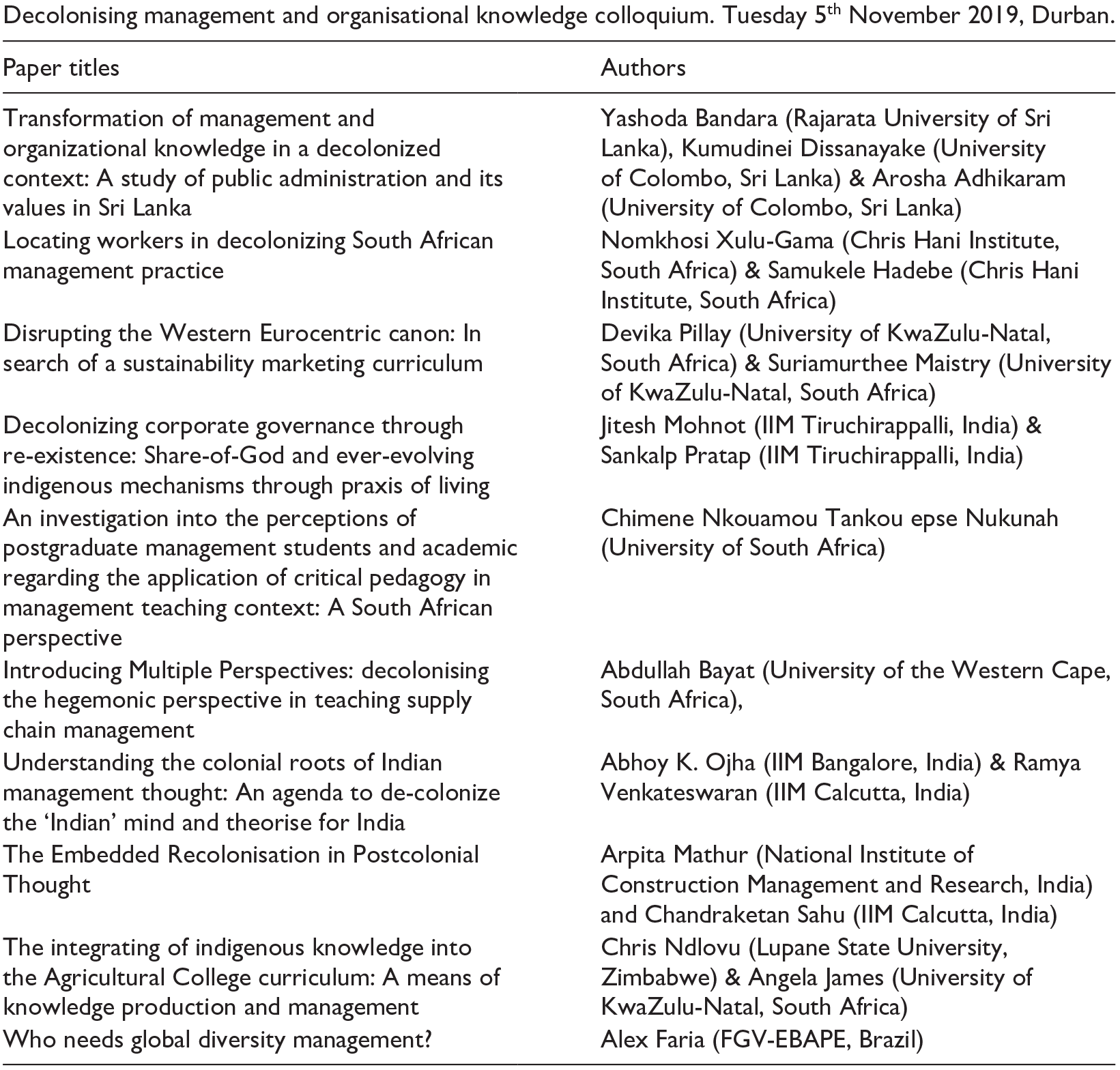
It is a sad testament to colonising/decolonising dynamics that in a SI on decolonising MOK with a workshop in Durban where six papers were from Africa, none of those six was ultimately submitted to the special issue. There were other submissions from/about Africa to the SI which were not presented at the workshop, and one of those features in the final line-up. Notwithstanding this, for many that attended the workshop, publication was perhaps not the endgame. Rather, being part of a pluriversal community of reflexive scholars that connected over similar issues, a solidary praxis was more rewarding. The workshop participants taught us, and each other, most valuable lessons in the importance of decolonial praxis and affective engagement with epistemologies of love, hope and solidarity for decolonising MOK beyond formal theory. We therefore in acknowledgement of their authoring, practising and teaching of this decolonising knowledge with a ‘will to life’, share a photograph of the workshop below (see Figure 1). We also share the names and topics of the papers that were discussed at the Durban workshop so that you might contact our colleagues directly if you would like to find out more about their work (see Appendix 1).
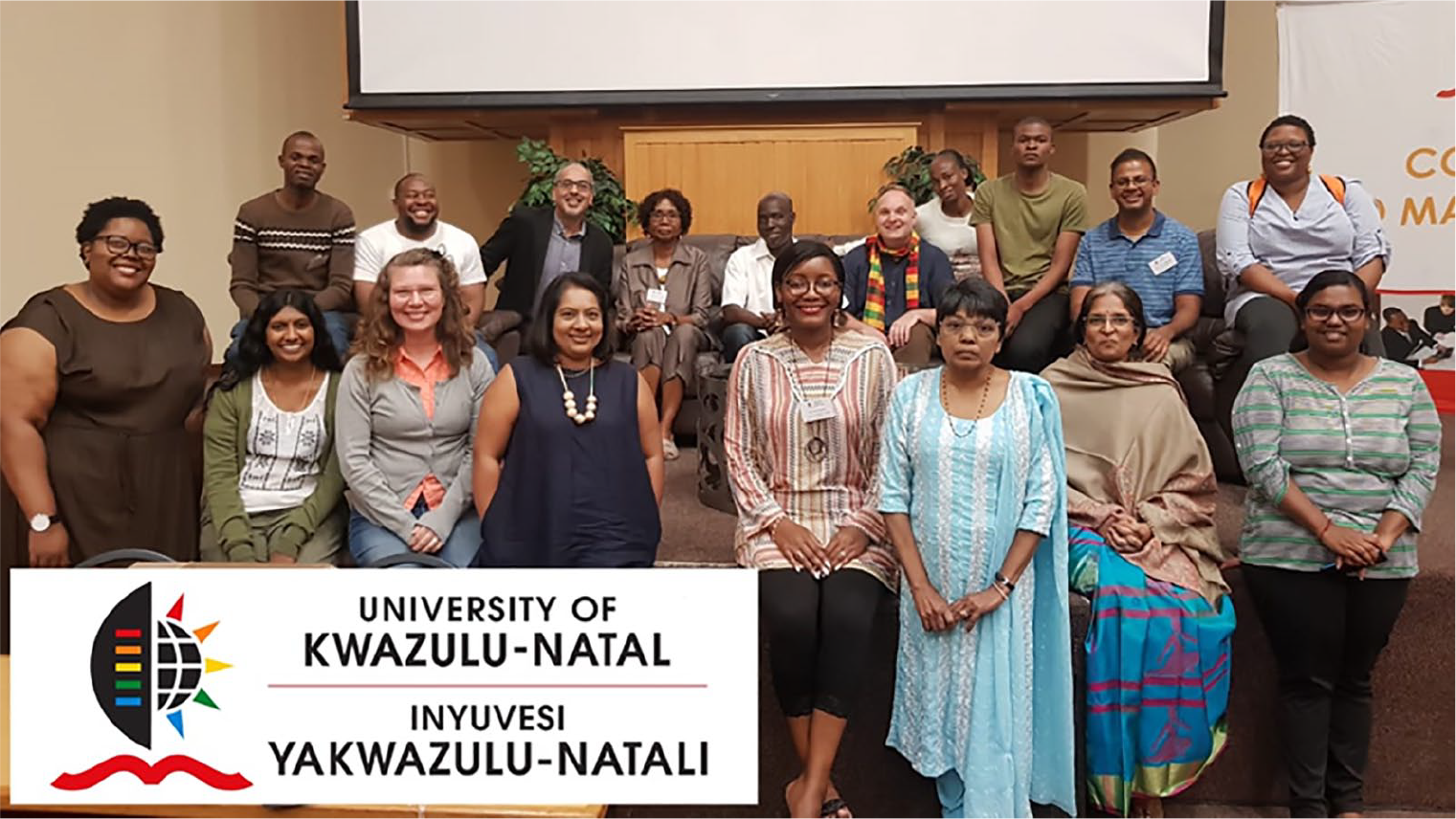
A photograph of participants from the decolonising management and organisational knowledge colloquium. Tuesday 5th November 2019, Durban.
Receiving submissions and managing the review process
Nowhere have the irony and pervasiveness of concurrent decolonising-recolonising dynamics been more acutely observed, participated in, and felt, than in the subsequent doing of the special issue. Despite consciously striving to decolonise by engaging with the excluded other through doing the workshop in the exteriority of the MOK system, we ended up re-excluding as well as simultaneously re-appropriating through our final line-up of accepted papers. Such dynamics in this SI journey, that can be easily illustrated, and are important to our understanding of decolonial academic praxis, are given below.
Initial submissions to the SI were encouraging and diverse. Some were first-time submitters who felt solidarity and encouraged to submit after recognising the Southern-ness of the guest editors! (personal communications). Yet, perversely, the same Southern-ness produced wariness and anxiety in others about whether their submission (from a Global Northern location) would fit the call for papers (and indeed was explicitly articulated in a compelling auto-ethnographic account in one submission). As editors, we struggled at times to find the most appropriate reviewers for the submissions. Reviewers of journals such as Organization inevitably touch upon and may well reproduce the colonising machinery. Owing to our/their (we implicate ourselves in this review process, as we have served as reviewers over the years) status as subject experts, we/they journal reviewers usually reside in privileged centres, mobilise critical knowledge and expertise ambivalently, sometimes, at odds with decolonising initiatives, and often do not work in decolonising universities or business schools. We/they are not just part of the decolonising-recolonising problem, but also embodiments of both complicity with Empire and its partial dismantling with its tools.
This is a condition that decolonisers (including the majority who will not read Organization, refuse to or cannot read English language, or even do not have access to the journal) around the world live in. With this awareness, the parameters we chose to work with to identify reviewers were: find respected scholars/critters; find someone from the location; find someone with subject matter familiarity. In balancing these parameters, we invariably ended up having the bulk of our reviewers from the larger CMS community of scholars from the interiority/centre, many of whom have been well schooled in the production of critical academic writing in English. One doubleness consequence of this, possibly owing to the vagaries of decolonial jargon-laden academic writing, and/or Eurocentric theoretical training, was the tendency of submitters as well as reviewers, to synonymise pluriversal with postmodern relativism. Both postmodern relativism and pluriverse refer to multiple worlds/worldviews, which probably explains their conflation. However, unlike postmodern relativism, pluriversal thinking embraces historical and geopolitical relations between multiple worldviews. Innocent conflations disavow the constitutive role of such relations in colonial difference, and serve to re-appropriate potentially transformative knowledges.
Sometimes reviewers would object, as indeed would we as editors at times, that authors/papers had not covered sufficient prior work in, say, CMS as a broad umbrella on a topic, or not sufficiently theorised the contributions or implications for CMS. We may have noted that research design and methodologies were underdone, or that the academic writing needed further clarity and proofing. In short, we – as a collective term for reviewers and editors – would sometimes reach into the arsenal of Western academic orthodoxy/heterodox critique of methodology and theory. Decolonial had at times to pass through this hoop, before it could be recognised as properly decolonial in the context of this English-language SI! In short, despite encouragement, de-linking of knowledge claims from the canons of the centre (critical or otherwise) was a privilege that could not always be easily afforded to the author. The pervasiveness of coloniality is illustrated in the fact that, not just authors even reviewers (ourselves included) from the Souths, who believed and advocated decolonising, sometimes pointed to ‘poor writing’, ‘poor English’, and weak literature as shortcomings in some aspects of some manuscripts.
The intractability of the colonial enterprise was also visible in the reference lists of the manuscripts we received. While all manuscripts engaged decolonisation, it is (perhaps not) remarkable that most reference lists (we estimate) comprised articles or books written within the context of Global Northern academia. Local place-based knowledges, thinkers, writers, journals and books outside of the usual canon were harder to come by; though there are of course a few in our final line-up. In some instances, this lacuna persisted, even after reviewers specifically pointed this out.
We do not wish to diminish the work of our reviewers or submitters at all; we merely wish to draw attention to an operation of decolonising-recolonising in which we all – ourselves included – are participating, and how praxistically challenging it is. We are extremely grateful to the care and decolonial sensitivities of many reviewers, and we are extremely thankful to them. These individuals practised relational reflexivity and were cognisant of the doubleness of their task – their implication in a colonising apparatus and the incessant striving for decolonising from within coloniality. In this relational reflexivity, they/we were at once being able to fathom the historical forces at work and the individual’s subjective experience, and establish solidarity through care and respect for the authors’ struggle to express themselves decolonially. They/we strove to provide comments from and with the stand-point of the author(s) so that they may co-create a better manuscript and contribute to wider learning and praxis.
How did we try to work with these variegated reviews? Our intent was to practise phronetic judiciousness, moderating the reviews from a decolonial standpoint, with respect to the comprehensibility and internal consistency of the arguments presented, and last but not the least, to the feasibility of a revision within the short time-frame available to the SI. Sometimes, we even introduced authors to some useful nuances of using and doing decolonial language, to enable better articulation. Sometimes we had conversations with authors and/or reviewers (both those accepted and those which could not be) to better understand their point and facilitate its articulation and clarification. We approached the process more as an ongoing dialogue of co-sojourners, and less as a detached objective review of merit by experts.
Broader editorial reflections
Our experiences and learnings from various co-sojourners in the unfinished decolonial project that this SI is a part of, prompt us to assert that this is how things have been happening in the concreteness of everyday decolonising struggles for a 'better world' lived by a growing population. The decolonial future is now; it has always been. It has been like this for over five centuries. Standing for 'a better world' is a fraught and passionate venture of doubleness. Our experience has been that praxistical theorising for decolonising MOK is materialised through a relational reflexivity, a concern rooted in care, empathy and respect for each other. Praxistical theorising is beyond doing decolonial theoretical analysis. It is embracing tightly the messiness of real-world decolonising-recolonising dynamics with the ethical courage and practical wisdom to stand for decolonising. Such praxis requires one to engage deeply with one's own location, actions and implication in colonisation-decolonisation dynamics in the myriad roles we play as academics: teachers, students, colleagues, reviewers, authors, researchers, editors, theorising, analysing, conferencing, etc. We need to consciously ask ourselves about the consequences of our actions and whether there is something we can do differently even when tradition and convention might be privileging quality, merit, best practices, professionalism and other similar things in producing knowledge and praxis.
In addition to these passionate assertions, with humility and respect, we offer some insights that can help us work with rather than manage (read domesticate) difference and put forth further questions for conversations. These might serve us going forward in our decolonising journey:
Similar to the way in which postcolonialism and postmodernity are sometimes framed in Eurocentric discourse as a moment ‘after’, decoloniality has often been framed as the future when coloniality ends. We have learnt here, and in struggles elsewhere, that this decolonial language is a problem. For many, the idea of coloniality is deadly offensive and decoloniality means barbarian threat, and even terror. The virtual impossibility of such a future has become part of our lives. We do not live in a present of coloniality evolving perhaps toward a decolonial future; rather we have been living decolonising-colonising dynamics since 1492. Decolonising-recolonising dynamics are constitutive of the matrix of coloniality that we live, but fail to conceptualise because our theories describe colonising as unequivocally contrary to decolonising (critique contrary to mainstream, local contrary to global, us against them). Privileged decolonial academics and practitioners inevitably reproduce extractive-expropriation mechanisms when engaging racialised others who struggle everyday, with the darker side of colonial difference by using different ways of knowing, and living otherwise. The co-construction of MOK ‘otherwise’ from within dominating institutions demands theories-practices which problematize the longue durée of everyday decolonising-colonising dynamics lived by practitioners and academics in general.
In our call for papers we inscribed ‘decolonising MOK’, at least in part, as a localised representation of an emerging ‘goodness’ for/from a 'globalising' MOK. In doing so, we implicitly equated decolonial knowledge with local knowledge through a binarising boundary-placing between local-global. During the course of this SI journey, we have come to recognise and be reminded that decolonising knowledge is not simply a matter of ‘reaching for’ or ‘writing in’ the local. It does not mean recognising and labelling a ‘local knowledge’ and concurrently, limiting the usefulness, belongingness, and relevance of such knowledge to a local geography. The questions we grappled with were these. Does decolonising knowledge have to be necessarily meaningful only for the local context in which it is developed in contrast to ‘the universal/global’? Can such decolonising knowledge, also embodying local dynamics of capitalist expropriation, not have utility elsewhere in a pluriversal world, beyond universality? If we only valorise local relevance, are we not falling again into a binary trap created by the dynamics of universalist appropriation? What we realised is the need for a massive and ‘unfinished’ decolonial turn to enable the university and its embodied constituents like us and you the reader, to de-link from global-local, universal-pluriversal binaries. We need to recognise and enable re-appropriations of interconnections and cross-relevances from knowledges in/from diverse locales in multifarious ways while being rooted in respectful dialogue and co-existence (Turnbull, 1997).
Inspite of listing the limitations of postcolonial approaches vis-à-vis decolonising earlier, we believe focusing on limitations alone is politically detrimental especially from the standpoint of establishing solidarities for pluriversal worlds. To us, this seems like in-fighting within families, while an increasingly ‘diverse’ Eurocentrism and Northern global system of MOK (Prasad, 2015) silently gains strength and devastating traction. That said, it would be inappropriate to view postcolonial and decolonial theories as just either-or choices, or to consider decolonial as the logical and more refined progression of postcolonial. Their relation is more productively described, we propose, as a hyphenated and conjugated one – ‘post- and decolonial’. We offer it so that MOK scholars doing such work, might move along, in between and across these spaces with a practical wisdom (Jammulamadaka, 2017). Mestizas have been doing just this since before the ‘invention’ of the university.
Scholars advocate attention to language and decolonisation of concepts and/or vocabulary (Mignolo and Walsh, 2018) through possible catachrestic reading (Spivak, 2000) to reclaim silenced knowledges. This editorial has also underscored the problematic of language. Yet, decolonising concepts too, like much decolonial work, are fraught with doubleness. Indeed doubleness is a term we have struggled with in this editorial and SI as we have experienced and invoked it several times and with different connotations. Yet can we clarify different meanings of this word within manuscript word limits? How do we do this while ensuring that our writings do not become towers of Babel and/or reproducers of the management of difference design? More significantly, when does clarifying and defining concepts/restricting meaning stop being better writing and start becoming a silencing device concealing the colonial reign of theory over praxis, while estranging ourselves from our reader(s)? How can one include me/you, the excluded reader, as co-creators of meaning along with the author(s) in a hermeneutic process in the publishing borderlands, to turn ambivalences into something else resurging at margins of the university/academic system with a new mestiza consciousness? Such a consciousness is ‘a source of intense pain [from which] energy comes from continual creative motion that keeps braking down the unitary aspect of each new paradigm’ (Anzaldúa, 2012: 80), and also breaks down ‘the subject-object duality that imprisons her’ (p. 80) in unambiguous decolonial positions against epistemic colonisation. Further, how do these questions affect the choices we make as authors, reviewers and editors in our manuscript writing/reviewing processes? What changes do we need to bring into these writing and editorial processes?
Finally, we have come to realise that the theme ‘Decolonising Management and Organisational Knowledge’ is a kind of oxymoron. The very idea that knowledge could exist as a free-floating entity within racialised capitalism is a colonial artefact that potentiates, conceals and enables violence. We have been able to reaffirm that not only does knowledge exist in embodiments, it is also produced in the intersubjective, communicative, reflexive praxis of such embodiments. The producer and the process of production is as important as the produced artefact. Thus, for decolonising, we need to recognise this wholeness, to transcend beyond the producer-produced binary in both ‘epistemic’ and ‘ontological’ terms. The epistemic and psychological violence of the colonial project is such that the decolonising work we/us do is not just about theorising local knowledge. It is also about recognising the pain, grief and wounds of the colonial project in its materialities, and struggles for an otherwise. It is about mitigating, undoing, and healing the violence of the colonial and apartheid projects on gendered and racialised bodies. This moves the locus of decolonial work ‘into’ the body and into the realm of affect (Fanon, 1952/1967, 1961/1967). Decolonisation is therefore not only about decolonising ‘the mind’, or knowledge systems and knowledge production practices. It is also about liberating the embodied, affective nature of such decolonial praxis and activating the intersubjective process of knowing and doing things with a double/mestiza/oppositional consciousness. This is a radical ontological plurality that up-ends the classical division between theory and praxis. 4
The articles in this SI further decolonising conversations by not only pushing the boundaries of decolonial work in MOK, but also through their significant methodological and conceptual implications. They are also narratives of struggles, survivals and hope of both the researcher and the researched. Turning to these articles, the special issue leads with Mohnot, Pratap and Saha’s rich study on the practices of unlimited liability Marwari businesses in a Western Indian textiles and trading town ‘Liba’ (pseudonym). Entitled ‘Governance of Marwari Capital: Daily Living as a Decolonial ‘Matrix-of-Praxis’ Intermeshing Commercial, Religious and Familial Spheres’, the authors draw on analyses of fieldwork visits, (colonial) historical legal documents on corporate forms in India, and interpret them reflexively and with reference to Mignolo’s notion of ‘colonial-matrix-of-power’. The subaltern Marwari world of Bazaar-based textile production system is a ‘way of life’, not just a business. It is one that thrives and survives despite its oft colonial depiction as backward, inferior and requiring modernisation/capitalisation. In asking why this form of unlimited liability entrepreneurship has enjoyed continued success despite such portrayals, the authors demonstrate how the intermeshing of commercial, religious and family systems, beliefs and practices enabled them to engage and flourish inspite of the colonial difference. Marwaripan is an example of ‘an-other way of commerce’, illustrating a different and decolonial logic and praxis at the exteriority of limited liability corporate forms.
Our second article by Ainsworth and Pertiwi, ‘From 'Sick Nation' to 'Superpower': Anti-corruption Knowledge and Discourse and the Construction of Indonesian National Identity (1997-2019)’ shows that predominantly Westernised MOK influences the construction of national identity in former colonies. The article investigates how anti-corruptionism has been universalised as a Cold War conditionality of national identity for a recolonising post-war design of organisation and management of/in the Third World. Weaving a decolonial perspective with Northern critical discourse theory, this article advances the view that decolonising MOK from the South requires a move beyond a contemporary Northern decolonial focus on organisations, business schools and inter-state capitalist systems. Instead, it shifts attention to other systems and sub-systems where the situated colonial matrix of power operates and liberating movements for an ‘otherwise’ take place. Finally, it also shows the importance of further decolonising the fields and industries of international development, critical development studies, international relations, development management and (international) political economy. Such fields keep creating and mobilising broader colonial dynamics through managerialist discourses of ‘good governance’ sponsored by neoliberal institutions.
The third article by Toivonen and Seremani entitled ‘The Enemy Within: The Legitimating Role of Local Managerial Elites in the Global Managerial Colonization of the Global South’ explores a rather under-investigated issue: the legitimating role played by indigenous managerial elites in the global managerial colonisation of the Global South. It focuses on the city council of Yaoundé, in Cameroon, an independent state subjected to German, French and British colonialisms and renewed and contested internal colonialism. The article sets a dialogue between post- and decolonial traditions beyond the North-South binary to suggest from a Southern perspective that contemporaneous radicalisation of managerial colonialism on a global scale needs decolonising MOK. The colonial matrix of power is not construed locally as a direct result of the imposition of conditions from a distant Global North; rather it is mediated by members of a heterogeneous local elite who actively promote the selective import of ‘colonising disguised as modern’ knowledge from the North to the country. At the same time, the authors illustrate counter-revolutionary hybridist mechanisms for managerial colonialism with support of powerful Northern institutions of international development.
The papers of Ainsworth and Pertiwi, and Toivonen and Seremani, read together, suggest that ‘local’ dynamics embody a complex capitalist system (without boundaries) in transition. They provide further academic support for moving beyond the idea of the managed organisation as privileged locus of transformations and the co-creation of a broader decolonising MOK agenda, from multiple and interconnected Souths for a pluriversalist otherwise. They unmask the possibility that the project of decolonising MOK and business schools, led from the North, might enable local/transnational elites to learn from an emerging system of partially decolonised business schools about fostering more effective hybrid narratives for the expansion of managerial colonialism in both South and North.
The fourth article by Irigaray, Celano, Fontoura and Maher – ‘Resisting by Re-existing in the Workplace: A Decolonial Perspective through the Brazilian Adage ‘For the English to See’- offers a window into how Brazilian executives from a variety of organisations encapsulate their resistance to colonial dynamics and interactions using this common idiom. Analysing how the participants explain the meaning and use of ‘For the English to See’ in business settings, the authors identify a set of subjectivation strategies on a range of embodiment to concealment of coloniality. These various strategies illustrate distinct forms of hybridisation and border thinking-doing by these savvy executives, forms which the authors collectively refer to as ‘resistance by re-existence’. The papers of Irigaray and colleagues, and Mohnot and colleagues, share an empirical concern with local practices, and praxis of decolonial living and resistance. Despite their distinct contexts and histories, and for sure the socioeconomic and linguistic backgrounds of the research participants, they give rich insights into living colonial difference, and surviving and thwarting its operations.
The fifth article by Yousfi ‘Decolonizing Arab Organizational Knowledge: ‘Fahlawa’ as a Research Practice’ is a deeply reflective study that unpacks what it means to occupy certain positionalities and identities as an organisational scholar, and its implications for how management and organisational knowledge is produced. More specifically, when occupying simultaneously contradicting and competing identities as a scholar ‘from an Arab country with a Francophone intellectual mindset’ who is trying to produce knowledge ‘based on subjugated perspectives for and about the countries studied’. The account given is both a personal and methodological reflection. Methodologically the Arabic term ‘Fahlawa’ is offered as a way of engaging in research practice in these contexts. It is more than just a research strategy, but a practice that becomes embodied in the researcher as part of her continuing journey in performing and doing MOK. Fahlawa is ‘messy’, ambiguous and incomplete and reveals the nature and experience of embodied border-thinking.
The special issue concludes with the paper by Scobie, Lee and Smyth ‘Braiding Together Student and Supervisor Aspirations in a Struggle to Decolonize’ and it echoes the personal and relational ethos of Yousfi’s work. It explores how the supervisor-supervisee doctoral relationship, located within a UK university and cultural context, unfolded in the doing of decolonising management and organisational knowledge. It draws on the Māori braided rivers metaphor to articulate and recognise a plurality of knowledge streams as well as relational, epistemological and bureaucratic issues for supervisors from the Global North supervising a doctoral student from Aotearoa/New Zealand, identifying as Indigenous. The inherently power-laden relationship is compounded by coloniser-colonised dynamics, also experienced by the supervisee as he undertook local fieldwork in Māori community settings. This paper, whilst speaking to a specific set of relationships, poses broader questions about decolonising the MOK curriculum and the complicity and roles of universities in maintaining power imbalances. The papers by Yousfi, and Scobie and colleagues, Lee and Smyth in this volume, read together, make us ponder upon the complex relationship that links ‘the border’ and ‘oppressed bodies’ when producing decolonising MOK. They also underscore the importance of messiness, empathetic relationality, and situated other-oriented reflexivity in the process.
We conclude this special issue editorial essay with important acknowledgments, and a series of thank-yous. First, we wish to gratefully acknowledge the material support and encouragement of UKZN, Monash Business School and Organization in funding our successful SI workshop in Durban. In particular, we thank Professor Stephen Mutula, Dean of UKZN Business School, and Professor Brian McArthur, Deputy Vice-Chancellor, UKZN, for funding, for speaking at, and attending the workshop. Nuria Cadete is currently doing her PhD at UKZN and led the practical organisation of the workshop, whilst also contributing and participating in it. Thank you Nuria! To our wonderful keynote Professor William Mpofu, we say thank you for your inspiration and solidarity. And to Professor Stella Nkomo, your constant intellectual companionship and sage advice at the workshop, and for the special issue and the decolonising agenda more broadly meant the world to us. We would like to express our condolences to the family, friends and colleagues of Professor Kriben Pillay, who sadly passed away recently. Professor Pillay was one of our keynote panelists, and an outstanding scholar and educationalist. We thank all the participants at the workshop, especially the PhD students from UKZN and elsewhere, and for those who travelled to Durban to take part. We have received unstinting support and encouragement from the editors and editorial board of Organization, especially Raza Mir, Patrizia Zanoni and also from Nusi Cornelissens, the journal’s amazing manager. We are thankful to you all. And finally, we wish to acknowledge our mutual respect and work with each other as co-special-issue editors over the last few years.
Footnotes
Appendix 1
Decolonising management and organisational knowledge colloquium. Tuesday 5th November 2019, Durban.
| Paper titles | Authors |
|---|---|
| Transformation of management and organizational knowledge in a decolonized context: A study of public administration and its values in Sri Lanka | Yashoda Bandara (Rajarata University of Sri Lanka), Kumudinei Dissanayake (University of Colombo, Sri Lanka) & Arosha Adhikaram (University of Colombo, Sri Lanka) |
| Locating workers in decolonizing South African management practice | Nomkhosi Xulu-Gama (Chris Hani Institute, South Africa) & Samukele Hadebe (Chris Hani Institute, South Africa) |
| Disrupting the Western Eurocentric canon: In search of a sustainability marketing curriculum | Devika Pillay (University of KwaZulu-Natal, South Africa) & Suriamurthee Maistry (University of KwaZulu-Natal, South Africa) |
| Decolonizing corporate governance through re-existence: Share-of-God and ever-evolving indigenous mechanisms through praxis of living | Jitesh Mohnot (IIM Tiruchirappalli, India) & Sankalp Pratap (IIM Tiruchirappalli, India) |
| An investigation into the perceptions of postgraduate management students and academic regarding the application of critical pedagogy in management teaching context: A South African perspective | Chimene Nkouamou Tankou epse Nukunah (University of South Africa) |
| Introducing Multiple Perspectives: decolonising the hegemonic perspective in teaching supply chain management | Abdullah Bayat (University of the Western Cape, South Africa), |
| Understanding the colonial roots of Indian management thought: An agenda to de-colonize the ‘Indian’ mind and theorise for India | Abhoy K. Ojha (IIM Bangalore, India) & Ramya Venkateswaran (IIM Calcutta, India) |
| The Embedded Recolonisation in Postcolonial Thought | Arpita Mathur (National Institute of Construction Management and Research, India) and Chandraketan Sahu (IIM Calcutta, India) |
| The integrating of indigenous knowledge into the Agricultural College curriculum: A means of knowledge production and management | Chris Ndlovu (Lupane State University, Zimbabwe) & Angela James (University of KwaZulu-Natal, South Africa) |
| Who needs global diversity management? | Alex Faria (FGV-EBAPE, Brazil) |
Funding
The author(s) received no financial support for the research, authorship, and/or publication of this article.
