




Abstract
China’s presence in Africa appears to be part of a new geopolitical dynamic that may be affecting the way management and organizational knowledge from the South should be conceptualized and studied. The purpose of this article is to interrogate the adequacy of emerging critical management theories premised on challenging the West’s modernization projects, particularly Postcolonial and Dependency Theories, in the light of a changing geopolitical dynamic. It discusses the need for a new theoretical lens through which to understand and research China’s presence in Africa at organizational and community levels. It points to the lack of empirical knowledge at these levels, and proposes a research agenda based on an interrogation of China’s previous anti-colonial relationship with African countries and the way its present-day motives are played out at organizational level, and with an aim to understanding the extent to which China’s engagement is given voice to African management and organizational knowledge.
Keywords
The purpose of this article is to interrogate the adequacy of emerging critical theory in international and cross-cultural management studies in the light of a changing geopolitical dynamic, and to discuss the possible need for a new theoretical lens through which to understand and research China’s presence in Africa at organizational and community level. Attempts to understand management and organizational knowledge from the South may well be taking on a new turn in the light of such developments. As with postcolonial theory, which has taken management scholars several decades to take on board, so the changing geopolitical dynamics involving the ‘resurgence of ancient civilizations’ (Jackson, 2011: 239), specifically China, has so far bypassed any serious discussion in management and organization studies. Currently there is a dearth of empirical studies. The presence of China in Africa, which provides a focus in the current work, has implications on at least two fronts.
Firstly, postcolonial theory, and dependency theory which is also discussed in the current work, grew out of and developed within a specific historical and global context, dealing with North-South (or West-East) dynamics. It provides a critique, for example, of why African local or indigenous knowledge has been disparaged and often ignored in favour of a dominant (modernizing) management knowledge (Wong, 2010). For example, it could be argued that the motives for (Western) colonialism, the need to subjugate periphery countries, and even the task of ruling a country with a minimum colonial army (Ferguson, 2003), the motive to impose a ‘civilizing’ religion (Thomson, 2000) and more latterly the neo-colonial motives to impose a Western liberal democratic governance structure and universal human rights (Schech and Haggis, 2000), all add up to a pejorative portrayal of local knowledge and values that appears reflected in the modernizing project in management and organization. Any study of the presence of China in Africa and its implications for resulting management knowledge, has to be interrogated in relation to China’s motives.
Secondly as a result of an increased Chinese organizational and management presence in Africa, the combined influences on management and organizational knowledge in Africa, and the way these influences come together in different hybrid forms of managing and organizing may be changing. Hence Bhabha’s (1994) elucidation of ‘mimicry’ of the colonizer by the colonized, part of a process giving rise to cultural ‘third spaces’, may have to be reconsidered from a perspective of a South on South relationship, rather than one where the ‘North’ dominates the ‘South’: in terms of both process and content.
Jackson (2004) has pointed to the lack of appropriateness and synergies of imposed Western management knowledge (from the North) with local African values and knowledge. African voices are still weak in this context and at variance or subordinated to dominant Western approaches. Is China’s engagement with African countries likely to make a difference?
Of key interest in the current work is the relevance and appropriateness of Chinese management knowledge in Africa, and possible synergies with African management knowledge, how the dynamics and resultant management knowledge might be conceptualized within this emerging geopolitical context, and how empirically this might be studied, and for example, is local knowledge likely to be given a stronger voice, or will it again be subsumed within a more dominant body of management knowledge?
Ashcroft (1997) speaks of ‘Africa’ as a European concept which continues to underlie contemporary discussion of Africa. As Edward Said (1978/1995) equates the ‘Orient’ with Europe’s ‘other’, so the representation of ‘Africa’ lies behind the West’s hegemonic role. Yet it is now that this hegemonic role is being challenged by China’s presence in Africa. The West is feeling threatened in this role, sufficient, for example, for German’s Chancellor, Angela Merkel, to remark in 2006 ‘We Europeans should not leave the continent of Africa to the PRC … We must take a stand in Africa’ (Campbell, 2008, who also reports a spokesperson of the World Bank saying that ‘China’s unrestricted lending had “undermined years of painstaking efforts to arrange conditional debt relief”‘: p. 92).
The main importance of postcolonial theory to the current work is its critical perception that indigenous knowledge is somewhat elusive given the historical circumstances of colonialism, decolonization and neo-colonialism and the associated power relationships in constituting resultant hybrid forms of knowledge. Indeed, if ‘Africa’ is a colonial invention that colours contemporary discussion, then interpreting the ‘indigenous’ and indigenous knowledge, and making it available and understandable to an ‘international’ body of scholarship is a Western project. Through a lens of postcolonial theory we should rightly be critical of this project. Yet this critique is premised on a North-South dynamic, and does not take account of South-South (or more accurately South-North-South) dynamics, that although have been present for many years, have recently come to the fore, and appear to be re-shaping geopolitical relations (Campbell, 2008).
The current work is premised on the assumption that wider geopolitical dynamics have a major impact on the nature of knowledge, the way knowledge is transferred internationally and the nature of local knowledge resulting from and contributing to this dynamic. This includes scholarly and management knowledge, as well as concepts such as organizing and managing people. This is particularly relevant to scholarly work in areas such as the international transfer of knowledge and the way the contribution of knowledge from different parts of the world is assessed and evaluated from the perspective of a dominant knowledge base. For example, Smith (1999), speaks of the wariness of indigenous peoples towards Western research directed towards them, and the need for research to follow an indigenous agenda in order to decolonize knowledge. Yet this critique itself is premised on assumptions of the post-colony that already may be out of date, and superseded by new dynamics that cannot be readily accounted for without re-thinking some of the premises of postcolonial theory (of which possible implications are summarized later in Table 1).
Conceptualizing South-North-South Relations

However, this is not a straightforward assumption as China (as part of the Western construct of the ‘orient’, and in its relationship with the West) has been brought under the critical gaze of postcolonial theory, as a perceived mixture of primitivism and the exotic (Said, 1978/1995), perhaps in contradistinction to Africa, which has been largely seen through a prism of primitivism (Jackson, 2011). Within the management literature there is evidence of Western influence on organization and management in China (Jackson, 2002; Jackson and Bak, 1998; Warner, 1996; Zheng & Lamond, 2009) and of ‘reverse diffusion’ of Western knowledge taken back to China by Chinese MNCs operating in Western countries (Zhang and Edwards, 2007). So it is likely that any new geopolitical dynamic involving a relationship with African countries also assumes a prior Western relationship with China, as well as with Africa. That China’s relationship with the West has been fundamentally different from Africa’s relationship with the West provides a problematic for an analysis and conceptualization of a South on South relationship between China and African countries.
The purpose of this article is therefore to start to develop a theory and methodology that incorporates current geopolitical dynamics and which is able to analyse the influences on the development and transfer of management and organization knowledge in sub-Saharan Africa in a (post-)postcolonial context, with particular reference to China’s presence in Africa. It draws on postcolonial theory(ies) but not exclusively so. Dependency theory also has provided a relevant critique of modernization theory which is also discussed in connection with how China’s relationship with African countries should be interrogated. Hence the current work points to why such theory could start to be superseded in the light of contemporary global power dynamics, and may provide a more useful understanding of China’s relation to Africa. It is also concerned with operationalizing this theory, and pointing to the possibilities in empirical organizational research.
Why China’s presence in Africa makes a difference to critical theory building
Both postcolonial theory and dependency theory have served as critiques of, first, a colonizing project, and then a neo-colonial modernizing project and modernization theory (Schech and Haggis, 2000). Modernization theory in its various guises has over the last decades underpinned the West’s policies on international development. This has become largely institutionalized through the prominence of economist from the ‘Chicago School’ (emanating from Milton Friedman and his neo-liberal philosophy) in the IMF and World Bank. Aid from these two organizations has been conditional on the countries’ governments implementing structural adjustment programmes that required them to restructure their economies and societies in line with neo-liberal theory (Ritzer, 2011). This has of course included many Africa countries. This theory of development became known as the ‘Washington Consensus’ because it was so closely linked to the economic and political position of the US, as well as the location of these supranational organizations in the US’s capitol. This Consensus has been underpinned by a view that ‘unimpeded private market forces were seen as the driving engines of growth’ (Cavanagh and Broad, 2007: 1243). There appeared to be an absence of ‘… any concern for equity, redistribution, social issues, and the environment’ (Ritzer, 2011: 39).
Conditionality has been fundamental to Western countries’ development programmes in Africa, hence their concern with China’s apparent different approach. Similarly, modernization theory is firmly entrenched in a belief in the benefits of the spread of global capitalism in modernization, whereas China’s professed policies have been founded in a Marxist-Leninist-Moaist tradition that has been fundamentally anti-capitalist and anti-colonialist (Thiam and Mulira, 1999; Young, 2001).
Dependency theory in particular has been used as a critique of modernization theory, while postcolonial theory only obliquely so, yet has been set against the project of Western colonialism, neo-colonialism and globalization. Postcolonial theory’s implicit assumption, which the current work takes as a premise, that wider geopolitical dynamics have a major impact on the nature of knowledge, must also be applied to postcolonial theory and dependency theory. They are both time and space limited. Hence, can these theories that challenge(d) the hegemony of Western imperialism and globalization discourse still be applicable to understanding China’s engagement with Africa, and indeed emerging South on South relations and concomitant management and organizational knowledge from the South?
Revisiting postcolonial theory
Postcolonial theory has provided a means of understanding the more subtle implications of power in international relations mainly through cultural transmission and the way knowledge is transferred internationally. Said (1978/1995) proposed that the developing world is represented in the eyes of the developed world. Western imperialism, through Western culture has developed a systematic ‘body of theory and practice’ that constructs or represents the ‘Orient’ (Said’s, 1978/1995: 49). In colonial times, this has portrayed images of the ‘noble savage’, the ‘wily oriental’, where Westerners are regarded as ‘rational, peaceful, liberal, logical … without natural suspicion and Easterners as irrational, degenerate, primitive, mystical, suspicious, sexually depraved … ’. These representations are carried over to Western intellectual and cultural production including research, and management studies.
The acceptance and internalization of such representations by the developing world itself can mean, firstly, there is both an acceptance and challenging of these representations that constitute hybrid forms of presentation of the nature of people of the Third World. Secondly, because this challenging itself grows out of the cultural and intellectual representations of Western discourse, this ‘contamination’ of the colonized means that they can never refer back to an ‘authentic’ identity of pre-colonial times (‘The subaltern cannot speak’; Spivak, 1988: 104). Any conceptualization of this identity would be by definition seen through the eyes of the colonizer’s representations (Kapoor, 2002), rather than an articulation of a local or indigenous view. Even conceptualizing this as a hybrid view is problematic as hybridity is not the result of a cosy dialogue, or a reasoned and equal negotiation. It occurs through a process involving ‘… the epistemic violence of Eurocentric discourses of the non-West … ’ (Mohan, 2002: 157).
This is implicit within Bhabha’s (1994) elucidation of ‘mimicry’. This applies predominantly to a colonizing power’s ability to get the colonized to mimic the colonizer, in order better to control the unfamiliar, and to gain acceptance of transferred-in knowledge. In Bhabha’s (1994) view the process of mimicry leads to hybrid cultures as an ongoing process of colonial imposition and resistance from the colonized. It is never possible therefore to speak about an authentic or innate culture, and is an ongoing product of a conflictual process between the powerful, and less powerful. This leads to the apparent unquestioning of the superiority of Western knowledge, and to the embracing of Western education, knowledge and technology. Yet the resultant disparaging of local, and more appropriate solutions (Briggs and Sharp, 2004), is only half the issue. This also leads to a kind of ‘false consciousness’ in the Marxian sense, so that local people have lost their authentic voice (cf. Spivak’s 1988). This has implications for the way scholars research these ‘subjects’, in the projection of Western representations of ‘the other’, and the way these representations are reflected back to Western researchers.
This aspect of understanding, representation and identity may make postcolonial theory difficult to operationalize in empirical research: if the non-West has internalized the way the West has represented it, on behalf of the other, and if Spivak (1988) is right that the non-West cannot then speak for itself, the self-representation by the other is going to reflect the representation constructed by the West.
In this way postcolonial theory is a critical theory, rather than an agenda for empirical research. In this light Jack and Westwood (2009: 253) speak about ‘decolonizing’ international and cross-cultural management methodology, through an emphasis on reflexivity, dialogically-informed research collaboration to ‘escape a US-centric and Eurocentric “world-picturing”‘, and through indigenous research. The latter they take up in more detail and in some way see this as key to reconfiguring methodology through a primary emphasis on indigenous representation. Yet this is problematic on two interconnected counts: the issue of identifying the authentic nature and site of the ‘indigenous’ (in view of globalization, cultural crossvergence and the creation of hybrid ‘third spaces’, through power dynamic); and the subaltern (the ‘indigene’) being unable to speak for themselves in light of several centuries of colonization (mimicry of the colonizers) and globalization (acceptance/internalization of disparaging views of local knowledge).
In this regard Nkomo (2011: 368) points to the importance of the African anti-colonial movements in the resistance to colonial representations of ‘the other’, when she says ‘Anti-colonial activists created new and powerful identities to challenge colonialism not only on a political or intellectual level but also on an emotional plane’. As noted later, Mao’s stress on the peasantry as a revolutionary force had a major influence on the anti-colonial thought of Fanon and Cabral (Young, 2001). Similarly China’s help to anti-colonial movements may have had an effect on African resistance to colonial representations. The possibility of its having a role today in developing new African identities should not be discounted.
There is also another way of looking at the problematic created by postcolonial theory in the subaltern not being able to speak, or represent themselves in any authentic way. What you see is what you get: hence, the concept of the ‘third space’ (Bhabha, 1994). Through historical and ongoing geopolitical interactions involving power dynamics, cultural spaces are constructed and reconstructed. Hence the Orientalism of Said might be said to deconstruct theories of modernization in international development and international management, as does Spivak’s concerns of the lack of authentic voice of the subaltern. Yet Bhabha’s concept of resistance and (re-)construction of discernable hybrid cultural spaces gives impetus to cross-cultural research being able to discern and empirically analyse such cultural spaces, including those constructed through new South-South interactions.
The representations of self, or ‘culture’, within these spaces is simply what we have ended up with at any point in time. Power dynamics, viewed through a postcolonial lens (e.g. Chatterjee, 1986) allows for an element of resistance to the dominant view (perhaps more overtly successful in India than African countries, where for example Christian missionaries were less successful, and perhaps in China where the Western powers only partially managed to colonize, and had less success in disparaging centuries of cultural production as was the case in sub-Saharan countries). The anti-colonial movement and its role in resisting colonial representations in Africa have already been alluded to. Yet these cultural third spaces, which have occurred through cultural crossvergence and the emergence of hybrid cultural forms, should be (empirically) discoverable, and can form the subject of social scientific enquiry. The point is that postcolonial theory alerts researchers to the necessity to be critically aware of wider geopolitical dynamics, the need to be reflexive, and the need to incorporate local views (through a critical lens). But it also points to the difficulty inherent within indigenous research in that ‘indigenous’ knowledge is not an artefact to be preserved (Briggs and Sharp, 2004). It is part of a dynamic within a cultural interface that constantly produces new knowledge and social forms, albeit through (changing) geopolitical power dynamics that have a profound affect on this production. It is these changing power dynamics, and therefore the changing nature of knowledge production, that need to be taken into account when looking at China’s involvement in Africa.
Revisiting dependency theory
In understanding how the presence of China in Africa is changing these geopolitical dynamics it is helpful to refer to dependency theory (Cardoso and Faletto, 1979; Frank, 1969) as another, more direct, critique of modernization theory which explains how the continued underdevelopment of the Third World has fuelled the First World, and indeed enabled it to become ‘developed’ (Schech and Haggis, 2000). Yet this theory also has had little impact on the way international management has been studied. Rather, modernization theory appears to have had an implicit influence on the way ‘developing’ countries in general (e.g. Kanungo and Jaeger, 1990) and Africa in particular (e.g. Blunt & Jones, 1992) have been studied by management scholars. In this sense Jack and Westwood (2009) appear justified in their assertion that international and cross-cultural management studies, with its binaries (in this case clearly representing a dichotomy between ‘developed’ and ‘developing’ countries) supports the colonial project.
In part these theories have been applied to an understanding of China’s development, and provide a starting point in now focusing on the role of China and its interaction with African countries.
Dependency theory, derived from Marxist theories of development (but also later critiqued by some Marxist theorists; Ritzer, 2011), arose first in the context of Latin America, as a direct challenge to modernization theory (Schech and Haggis, 2000). As early as the late 1940s, the Economic Commission for Latin America, under the leadership of Argentinian Raul Prebisch, attempted to understand why, after a century and a half of independence, the economies of Latin America were still retarded. In part the answer appeared to lie in the unequal exchange of the raw materials produced in Third World countries and the industrial First World countries, which were unwilling to share their expertise and to offer equitable terms of trade, implying an unequal distribution of power. In the 1960s Andre Gunder Frank (1969) developed his theory of underdevelopment which argued that capitalism as a world system systematically exploits peripheral countries through monopolistic trade. The wealth of First World countries was based on the exploitation and consequent underdevelopment of the Third World. In opposition to modernization theory he asserted that it was exactly these ties with Western nations that were disrupting the normal course of development for Third World countries (Schech and Haggis, 2000). Leys (1996) identifies the main tenets of dependency theory as follows:
Underdevelopment is the underside of the same global-historical process through which the First World became developed, directly contradicting modernization theory that sees the Third World as undeveloped or untouched.
Its main motivator is capital seeking profits
Capital accumulation is easiest in countries where labour and resources are cheap, and governments are weak.
Its secondary consequences are to reproduce processes that constantly block local initiatives that seek to pursue an independent course, such as the creation of surplus labour and marginalization leading to a small domestic market, unequal income distribution and narrow import-oriented consumer demand. (see also Leys’, 1975, earlier work that applies this to Africa, specifically Kenya)
Dependency theory has largely now been incorporated into the broader world systems theory (Wallerstein, 1974) which sees the world divided between the core and periphery nations, with the latter being dependent on and exploited by the former. In these terms, the development project of the Western nations was a failure as the world remains characterized by (especially economic) inequalities between North and South. Further, this project, according to Ritzer (2011) became to be seen as offensive as it elevated the North and demeaned the South. Re-couched in terms of ‘globalization’, which at least sounded more equitable since it appeared multilateral and multi-directional in contradistinction to the unilateral and unidirectional nature of development, this also appears to be little different to the development project, particularly as it is being championed by the same institutions inherited from that era (Ritzer, 2011).
Dependency theory’s critique may apply directly to those countries previously colonized by the West, and to neo-colonial involvement of, for example, the United States. There is ample evidence of the United States contributing to Africa’s underdevelopment since the 1960s (e.g. the now well understood political involvement of the CIA in countries such as DRC; Hochschild, 1998), yet dependency theory may be only indirectly useful in understanding the relationship of the West with China as a semi-colonized country. Certainly, like Africa, China’s resources have been exploited by the West to the detriment of China (for example, following the Opium Wars; Grasso et al., 2004) and this may have contributed indirectly to China’s previous underdevelopment.
Decolonization, modernization and China in Africa
If postcolonial theory and dependency theory grew out of a critique of the West’s relationship with the non-West, or of the advantaged position of the North over the South, it seems unlikely that an analysis of China’s relationship with Africa can be based on these critical theories which challenge the development and globalization agendas. China itself has recently gone through an industrialization and modernization process, which in some ways may be seen as a model for Africa. Yet based on successive declarations by the Chinese government, it does not seem likely that China’s intent is to impose a modernizing trajectory on Africa, or for China to develop on the back of further contributing to Africa’s underdevelopment in an exploitative way (MOFA, 2006), although this appears a contested area in the literature.
There appears to be some consensus in the literature that Chinese investment in Africa is directed towards resources that can meet the needs of Chinese economic development particularly in terms of energy and mineral security and to attribute China’s investment and construction in Africa to China’s resource-dependence on African countries (Kurlantzick, 2006). Gill, Huang and Morrison (2007) believe that China needs Africa for resources to fuel China’s development goals, for markets to sustain its growing economy and for political alliances to support its aspirations to be a global influence. Yet there is also evidence of a genuine desire to provide other resources for Africa, and to do so on the basis of cooperation and friendship (Shaw et al., 2007).
There is also a view that China’s involvement in Africa has a political content (Gill and Reilly, 2007) that may have implications for a consideration of the difficulty of applying postcolonial theory in this context. Along with investment, cultural communication between Africa and other countries has also been a feature, with China appearing to celebrate Africa’s culture and achievements, while these appear implicitly denigrated in the West (King, 2006). Marafa (2007) contends that when Africa is discussed in the West by governments and international development agencies, it is normally poverty, conflicts, wars, corruption, poor governance and hopelessness that are mostly tabled for deliberation, The $US100 billion international aid industry (OECD, 2008) may also have a vested interest in portraying the ‘developing’ world in such terms through, for examples, images shown in the media. Reactions to this type of relationship may be summed up by the president of Botswana remarking: ‘I find that the Chinese treat us as = the West treat us as former subjects’ (Kaplinsky, 2008).
There is also the perspective that from the experience of transformation in China, there are lessons to be applied in Africa. Indeed there is a contrast between the historical relationship of Africa with Western colonial powers (and preceding this, with the transatlantic slave trade) and the historic relationship with the Chinese in connection with the decolonization of Africa (Thiam and Mulira, 1999). Young (2001) contends that Mao’s revolutionary success in China inspired liberation movements in Asia, Africa and Latin America to increasingly identify with the peasantry, whereas formerly the communist commitment to the urban proletariat as the revolutionary vanguard had been a constant impediment to political success in the predominantly rural countries of Africa and other Third World regions. Hence, after the China-Russia split in 1956 Young (2001: 188) asserts that much of the anti-colonial struggles in the Third World had ideologically allied themselves with China, as a result of its
… apparently disinterested substantive support to liberation movements or hard-pressed front line … states, particularly in Mozambique, South Africa, Southwest Africa, Zambia and Zimbabwe, its populist orientation towards the peasantry and the need for an agrarian revolution, towards struggle from below, and its emphasis on guerrilla warfare and armed struggle against imperialism ….
He also contends that Mao’s peasant revolution laid the foundations of anti-colonial thought from such as Fanon and Cabral.
China’s aid did not simply extend to freedom fighting organizations such as the Pan-Africa Congress of South Africa and ZANU in Southern Rhodesia. It also included China’s first major infrastructure project in the 1960s in the Tanzania-Zambia railway (TAZARA), under the threat of the white regimes of South Africa and Rhodesia to cut off all communication lines with landlocked Zambia. The Tanzania prime minister of the time is quoted as saying: ‘TAZARA is a project of special status in Africa and the world of aid-giving by one country to another in a pure spirit of goodwill and mutual benefit. The status of TAZARA is a victory for cooperation between Third World countries’ (Thiam and Mulira, 1999: 820). 1 The 1278 mile railway was completed ahead of schedule in 1975 and built by 15,000 Chinese and 30,000 African workers. The loan was interest-free and paid back over 30 years starting in 1983 in currency or forms of goods acceptable to China.
Thiam and Mulira (1999) pointed out that China’s economic aid policy was different from even other socialist countries such as the Soviet Union, based on the principles that:
aid provided must be to the mutual benefit of both donor and recipient whose independence should be respected;
it should be granted free of charges and with the intent that the recipient becomes self-sufficient;
the aid is to be invested in projects that quickly become cost-effective;
the quality of the product supplied should be guaranteed;
local technicians should be trained to carry through the projects implemented with Chinese aid;
Chinese experts should enjoy the same advantages as local experts.
It attempted to follow these rules strictly, making aid available between 1956–1977 in West Africa (Ghana, Sierra Leone, Gambia and Nigeria) mainly for agricultural projects and bridge building) and in the Horn of Africa (Somalia and Ethiopia) for road construction and setting up textile mills. In East Africa, Kenya received aid for building a modern stadium and developing the bamboo industry, while Uganda received aid for rice growing projects. In the southern part of the continent, Zimbabwe, which had been a major recipient of military aid during the war for independence, became one of the main recipients of Chinese aid after independence receiving some $82 million for major development projects. Yet by far the largest recipient of Chinese aid up to 1977 was Tanzania. The two countries appeared to have a special alliance based on Tanzania’s stand against imperialism on an international front and its socialist policy of self-reliance, paralleling China’s own internal policies in this area (Thiam and Mulira, 1999)
Yu (1975) accounted for this involvement with Africa as China’s perception that this was part of the emancipation of the world proletariat; that with the presence of China’s two rivals, USSR and USA, in Africa it was in China’s national interest to be present on the continent; and, as it had been through a semi-colonial experience itself, it was well placed to understand the problems of colonialism and to assist with Africa’s decolonization. China’s further involvement at the Bandung Conference in 1955 that led to the Movement of Non-Aligned Countries in 1961 with a professed intent to promote cooperation and non-interference among Third World countries, Young (2001: 191) claims represented ‘a foundational moment for postcolonialism’.
The five principles of peaceful co-operation put forward by Zhou Enlai at the conference (1 Mutual respect for territorial integrity and sovereignty; 2 Mutual non-aggression; 3 Mutual non-interference in each other’s internal affairs; 4 Equality and mutual benefit; 5 Peaceful co-existence) later also became written into China’s constitution in 1982 (SAIIA, 2009).
Evidence, from China’s historical relations with African countries therefore exists of a sense of ‘Third World solidarity’, drawing on its socialist heritage and anti-imperialist discourse. This has been carried over to its more recent involvement, as its nature appears as a reaction to the World Bank and IMF’s neoliberal policies discussed above and government alignment with the United States (CCS, 2008; Kapinsky, 2008), notwithstanding other motives that exist for China’s involvement in Africa.
Current motivations for China’s involvement in Africa
The current relationship of China with African countries clearly appears not to have been built on a colonial or imperial history. In fact this appears as quite the antithesis as it was on the basis of an anti-colonial discourse and geopolitic. It is therefore unlikely that postcolonial theory, or indeed dependency theory, can adequately explain the current geopolitical dynamics of China in Africa. That it is not a post-colonial relationship has implications for the way we might conceptualize and study relationships at organizational level, and indeed for the way international and cross-cultural management scholars should begin to conceptualize the wider and changing geopolitical context, and how this should be incorporated into their scholarship.
However, these theories may explain the West’s relations with China, and indeed one of the reasons why China’s involvement in Africa is much denigrated by Western commentators, and why much of the literature on Chinese FDI in Africa is indeed critical (e.g. CCS, 2008). The way scholars conceptualize (or assume/ignore) these geopolitical relations, has implications for theory building and research. Such possible connections are summarized in Table 1 assuming any of three ways of understanding North-South interaction and power relations in Africa, together with possible assumptions about a new South-South dynamic.
Table 1 suggests firstly that modernisation theory has set the tone of North-South relations based on the nature of the presence of Western powers in Africa, and that both dependency theory and postcolonial theory are a reaction to and critique of modernization assumptions. Secondly, it can be seen that the nature of China’s involvement in Africa is ambivalent, and largely hypothesized at this stage (and as above, often seen in derogatory terms). If knowledge creation in this context is a function of the reasons why the West and Africa have been interacting, and give rise to scholarly theories about this interaction and ensuing knowledge creation such as modernization theory and consequently its critical counterparts, postcolonial theory and dependency theory, then similarly knowledge creation (and our theories about that) must also be a function of the nature of China’s interaction with Africa (and possibly how this challenges Western interaction). Yet, at the moment we have a large and growing literature on the possible motivations of China’s presence in Africa (for example, based on resource-seeking, market-seeking and political-seeking; Gelb, 2005; Gill and Reilly, 2007; Gill et al., 2007; Kurlantzick, 2006; Marafa, 2007) yet little of its nature at organization and management level, and similarly little on the perceptions of this interaction at community and local level.
For example, the Centre for Chinese Study at Stellenbosch University, South Africa has undertaken a number of studies on Chinese economic activity in Africa which so far appears, in the absence of any management and organizational empirical studies, to present an ambivalent view, somewhat supporting and somewhat debunking suppositions, for example, about the level of African versus Chinese employment in Chinese projects, and the treatment of employees. Hence one study reports that:
… it was noted on several occasions that the use of Chinese labour was dependent on the level of and availability of skills in the local market. In instances where the requisite skills were available locally, the preference was to use Chinese labour in the capacity of supervision, engineering, design or at a more senior level with tasks involving technical expertise, such as the grading of roads and the operation of sophisticated machinery. Chinese companies have no automatic preference for Chinese labour, but given the lack of specialised skills in many African markets where aid projects are being implemented, the import of Chinese skilled labour is sometimes required. … In these cases it is easy to note where misperceptions around the employment practices of Chinese companies may have arisen, as it may appear that Chinese companies are importing manual labour, when, in reality, Chinese labourers are brought in for their skills. (Davies et al., 2008: 17)
Another study indicates problems with employment conditions when it is reported somewhat anecdotally that:
There is at times a stark contrast between the Chinese rhetoric of brotherhood with African people, and some of the criticism coming from African citizens. (CCS, 2008).
Another comprehensive study undertaken by the African Labour Research Network (Baah and Jauch, 2009) reports fairly widespread issues with employment conditions in Chinese organizations. For example in the country study on Ghana they report that:
There is a general perception in Ghana that Chinese employers do not respect labour rights. Workers in Chinese enterprises typically work long hours and receive low pay. Some workers especially in the construction sector have complained about the negative attitude of their Chinese employers towards trade unions and collective bargaining. (p. 97)
Deborah Bräutigam’s recent work has done much to disabuse some of the misperceptions, although the issue with poor labour conditions appears to remain persistent. For example, in a report to Norfund (Bräutigam, 2011a: 3–4) her summary of many of her research findings is worth quoting at length:
Many Western donors think they know what China is doing in Africa. They’ve seen headlines: the Chinese arrived a few years ago in a desperate search for oil. They set up a huge aid program, propping up governments in resource-rich, pariah states that the West won’t touch. Their companies bring in all their own workers and refuse to hire Africans. They’re leading the ‘land grab’ in Africa, growing food to ship back to China. It’s an alarming story … but, on closer inspection, none of it is true.
A more sober assessment reveals that China is not a new donor, but has been providing aid in Africa since the end of the colonial period, at least as long as the West. But China’s official aid is fairly modest, if we use the same categories used by the OECD’s Development Assistance Committee (DAC) to categorize flows from governments.
In contrast to most donors, China also spreads its aid relatively evenly across the African continent, in every country where China has official ties. Only two African countries have not been recipients of Chinese aid: oil-rich Libya, and Swaziland, which has always had official diplomatic ties with Taiwan. Chinese companies do bring a larger proportion of their workforce from home than Western firms, but this is the case mainly for construction projects in oil-rich countries like Algeria, Libya, or Angola where local labour is expensive. In other places, with few exceptions, Chinese projects have a majority of Africans in their workforce. Those who do fieldwork regularly report this reality. For example, a researcher who recently visited Cameroon expecting to find large groups of Chinese workers found instead that every construction site she visited had Cameroonian workers under Chinese managers. It is the poor conditions of this employment, and not its absence, that is a constant complaint among African workers. (see also Brautigam, 2011b)
Research in these areas appears to come from economists, international development specialists and experts in international relations. This leaves unanswered many of the questions in which management scholars would be interested. The reason for this lack of published work on the nature of management and organization of Chinese organizations in Africa appears simply to be due to management scholars not having engaged with this area. This is in part the rationale for this current article, in order to help point the direction of empirical research in this area informed by a critical conceptual base.
At this stage we are still left only with hypotheses about the nature of that knowledge creation which assumes certain motives on the part of both Chinese and African partners and how this manifests at organization and communities levels. Those motives shown in Table 1 are illustrative of those that could be further developed through, for example, extensive interviewing of Chinese CEOs as to strategic motives and practices 2 as a prerequisite, and corroborating this with similar interviews with different staffs (above all working in partnership with Chinese colleagues). If the ‘disconnect’ hypothesis of Dia (1996) suggests that Western institutions were tacked onto African communities during colonial times, and if Jackson (2004) alludes to African workers (and managers) stepping outside their own culture when going into work in the morning and stepping back into it when returning home at night, what of the nature of Chinese-led organization among African communities?
So far in this article, hypotheses at this stage in our knowledge have been suggested largely through extrapolating to the organizational level from knowledge of Chinese involvement, particularly in terms of possible motivations at macro-levels. It is now necessary to look at how critical theory can be built that can be operationalized through empirical investigation, and which can bring in both endogenous and exogenous influences on management and organizational knowledge in sub-Saharan Africa.
South-North-South dynamics: towards a conceptual understanding
There are two aspects of developing a conceptual and methodological framework for interrogating China’s engagement with Africa. The first is conceptualizing the geopolitical dynamics and the implications of this. This is an area that has been lacking in extant international and cross-cultural management scholarship, which has been more recently challenged by exponents of postcolonial theory (Jack and Westwood, 2009) and more tentatively in the area of management and leadership in Africa (Nkomo, 2011). In the discussion above, it can be seen that there is a case to be made for a rethinking of the dynamics that postcolonial theory has conceptualized, as this may be time- and space-bound, where a new South on South dynamic should begin to be analysed in the context of China in Africa, and its implications for developing management scholarship.
The second aspect is exploring and understanding the content of China’s engagement, in the way it is changing management and organizational knowledge and practices in Africa. As can be seen from the above discussion, there has been little interest by management scholars (even cross-cultural management scholars) of China’s engagement with Africa. This leaves us very exposed in terms of current knowledge, the generation of which has so far been left to other disciplines such as economics and international affairs. Anecdotal information, particularly in the Press, predominant and this is mostly pejorative and driven by a Western suspicion of China’s motives in Africa (Brautigam, 2011b).
As suggested above, a way forward may be incorporating a conceptualization of what Bhabha (1994) has referred to as the ‘third space’, developing from Ralston’s (e.g. 2008) idea of cultural crossvergence (a theory that is well known in cross-cultural management studies), yet incorporating conceptually global-local power relations. This stems from an understanding that cross-cultural interaction results in, and results from, the production of hybrid forms of organization and management knowledge that can be analysed through focusing on the cultural influences and the dynamics that contribute to and constitute a third space, or in the organizational sphere, hybrid systems of management knowledge and values.
For example, Jackson (2004) has suggested that ‘ideal type’ analytical categories can be identified as sources of influences from ‘post-colonial’, ‘post-instrumental’ or modern Western and ‘African Renaissance’ or humanistic management systems, and identified in hybrid forms of management in organizations in Africa. This may be useful as a first stage in identifying the nature of management and organizational knowledge drawing on the legacy of colonialism, the influence of neoliberal reforms and ‘modern’ management methods, as well as embryonic forms of revival of indigenous management knowledge in such concepts as ubuntu (Mbigi, 1997).
Much of his analysis is in the conceptualization of a distinction between Western (including previously colonial) bodies of management knowledge which value people instrumentally in organizations as a means to an end (as in the concept of a human being as a resource) and many non-Western societies that appear to hold a more humanistic concept of people with an intrinsic value for who they are, and often as part of a collective (see Jackson’s, 2002, study across seven countries). Hence, some of the perceived inefficiencies in what is often regarded in the literature as ‘African’ characteristic (e.g. Kiggundu, 1989) and suggested by Jackson (2004) as being a colonial legacy (‘Post-colonial management’) such as risk aversion, high hierarchy, authoritarian, bureaucratic, discriminatory, staff alienating and so on, are countered through, for example, MNCs and management education by the results-orientation of modern Western management knowledge, with more consultation at non-strategic levels and an achievement ethos in motivating employees to meet targets and company objectives, upon which employees are rewarded.
Jackson (2004) contends that it is this antagonism between the instrumental Western management knowledge, and local, community-oriented humanistic views of human value that may give rise to problems in employment relations reported in organizations in Africa (Blunt and Jones, 1992; Kamoche, 2001), and by which a body of management knowledge may be regarded as inappropriate within a specific local socio-cultural setting.
As suggested above, with changing geopolitical dynamics impacting on the nature of organization in African countries, other influences may now be combining with previously identified bodies of management knowledge in Africa that can be conceptualized as ideal types and used to analyse the nature of hybrid management. Although appropriateness of management knowledge (involving the perceptions of different stakeholders) may be more difficult to analyses than effectiveness, an area of investigation should be the appropriateness of Chinese management models to the African communalities within which they operate.
For example Ip (2009) has suggested the ‘Confucian firm’ as an ideal type that can be conceptualized and used as an identifier in management research. Clearly, from the above discussion there could be other ideal types that could be identified that exemplify a potential influence of Chinese management and organizational knowledge. For example, some sources suggest adherence to Buddhism in China as high as 80 per cent of the population (US State Department, 2006), which may have an influence on management values and knowledge. Western (instrumental) influences as well as Chinese communist (statist) influences over several decades in China (Warner, 1996) should also not be excluded as influences on management knowledge taken by Chinese managers to Africa, and from which ideal types could be constructed to assist in the analysis of resultant hybrid management knowledge systems.
Figure 1 provides a number of possibilities that need to be investigated empirically (not least the extent to which Chinese organizations export particular bodies of management knowledge to Africa) in order to understand those influences that may contribute to emergent management knowledge through a South-North-South dynamic involving influences that are both exogenous and endogenous to China and to Africa.
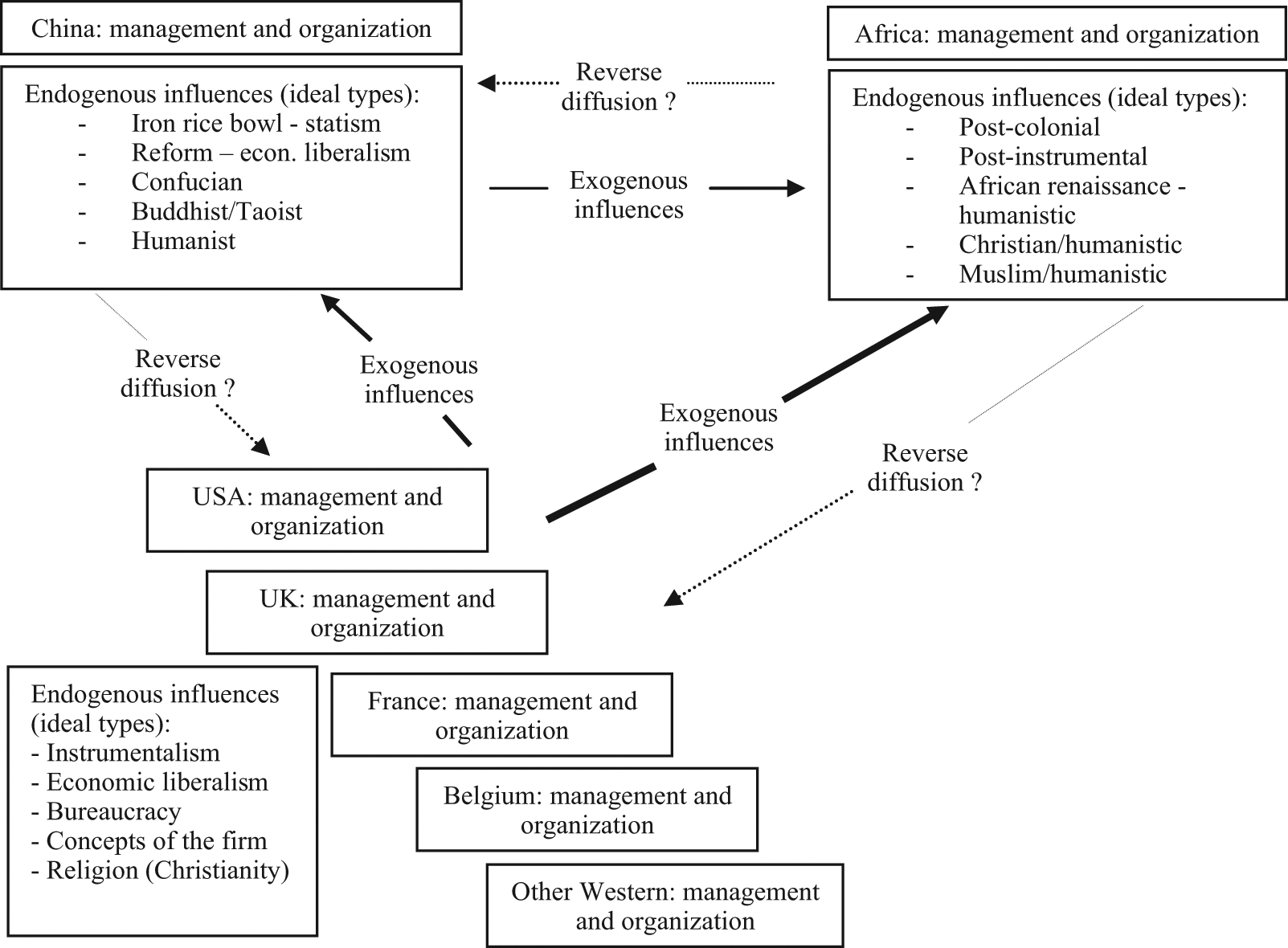
Exogenous and endogenous influences in a new power dynamic creating cultural Third Spaces
In connection with the possible influences on management knowledge that Chinese organizations may be importing into Africa is a question concerning the influence of Chinese presence in Africa: is this giving greater voice to African local management knowledge? There are characteristics within Ip’s (2009) depiction of the Confucian firm that aligns with some of the characteristic of Jackson’s (2004) ‘African Renaissance’ ideal type.
Ip (2009) defines the core principles of the Confucian firm, in terms of ren (a virtue or capacity of benevolence and compassion: humanity—and perhaps akin to ubuntu), yi (a sense of moral rightness) and li (conventions, etiquettes or norms). An organization’s goals, strategies and practices are defined by the principles of ren-yi-li. Hence the profit motive would be acceptable for corporate leaders but would be morally constrained and consistent with ren, yi and li. However, other legitimate goals of the organization would be looked at, such as doing good for the community and society. Leaders should use the principles of zhong shu: stemming from ren (humanity). This, according to Ip (2009) articulates the human capacity for compassion: that one should do unto others what they would want others to do to them.
If the strategic direction and leadership of the corporation has to be guided by ren-yi-li, so do the power structures, relationships, decision making and management processes have to be also consistent with these concepts and principles. Hence all stakeholders of the firm would be treated with rightness and humanity. This would involve providing fair wages and safe working environments, fair-dealing with customers, providing benefits to the community, being a good corporate citizen, promoting social good generally and protecting the environment. Furthermore it should be de (people’s moral virtues) driving people’s moral actions within the firm rather than rules and regulations. Ip (2009) in fact makes the point that zhong shu is not a rule but involves the virtue of reciprocity and is a reflection of the capacity of ren (humanity).
The virtue of ren appears therefore close to ubuntu and the Confucian concept of the person is essentially a social one, through familial collectivism. The person is defined by his or her relationships. A person’s identity cannot be understood as something separate from his or her social attachments and place in the hierarchy of social relationships. A person is shaped by this social embeddedness in terms of their interests and goals, and also constrained by the same relationships. The social bonds thus created are a source of indebtedness and obligations.
The humanistic orientation included in the concept of ren-yi-li (humanity-rightness-conventions) and zhong shu (compassion), together with a community-orientation appears to provide common ground with African humanism expressed for example through ubuntu, yet other factors that appear in this Confucian ideal type such as paternalism and hierarchy may be more contentious. Older research claim these as ‘African’ characteristic (e.g. Kiggundu, 1989) and more recent research challenges this (Jackson, 2004; Mutabazi, 2002).
It may be possible that Chinese management knowledge and organization may be more synergistic with (or appropriate to) community- and humanistic-oriented local knowledge and values that appear to pertain in African community values (in distinction to Western colonial-imposed and more recent Western institutions and values). Certainly Horwitz and colleagues’ (2002) comparison of Jackson’s (2002) African Renaissance/humanistic ideal type and Confucian humanistic characteristics East Asian firm, in the context of Southern Africa appears to support this assumption of synergy.
Yet without further conceptualizing this within a geopolitical dynamic (why Chinese organizations are in Africa?) and without empirical evidence (what is the nature of Chinese organization in this organization, and the nature of community values and knowledge in this community?) this assumption remains tentative.
Within the body of knowledge on ‘collectivism’ in cross-cultural management studies is an assumption that in-group collectivism is target-specific (Hui, 1988; Hui and Triandis, 1986). This would imply that Chinese collectivism may only apply to Chinese staffs, but not necessarily to Africa staffs. This is another factor that may affect the synergies between Chinese and Africa stakeholders, as well as the many cultural differences among different Africa communities and nations, in relation to the potential cultural differences among Chinese staff in Africa.
Table 1 proposes, under the heading ‘Possible assumptions about South-South relations’, different hypothetic motives for the presence of Chinese organizations in Africa. Here it is hypothesized that these (different) motives will influence the way management knowledge is deployed and developed in Chinese organizations operating in Africa, including the way it interfaces with local knowledge. This requires empirical study on the nature of this motivation, and the nature of management systems and styles operating. While Figure 1 proposes the pool of sources of management knowledge that Chinese organizations operating in Africa might draw on, Table 1 indicates possible (geopolitical) reasons for the nature of (hybrid) management knowledge systems that may actually pertain in different organizations. Further empirical research should then focus on the synergies with local knowledge and community life within the communities in which Chinese organizations are operating.
For example, Gill and Reilly (2007) point to the ‘political-seeking’ nature of Chinese presence in Africa. This includes the possibility of China being a model of modernization for Africa, friendship and mutual learning (MOFA, 2006), and contrary perceptions of Africa’s ‘backwardness’ compared with the West’s perceptions. This may further suggest alternative organizational models to those derived from the West, possible harmonization with local needs and mutual trust, and even the possibility of what Zhang and Edwards (2007) has described as ‘reverse diffusion’. So far this has only been applied to Chinese MNCs operating in Western countries: Chinese organizations take ‘advanced’ practices back to China, thus impacting on the ‘development’ of Chinese organizations. To what extent this has the potential to happen when Chinese organizations operate in Africa should be investigated empirically. Figure 1 provides the basis for conceptualizing those interactions which could be thus researched.
Towards a research agenda
The modernization project of international business reflected in the sometimes conservative attitudes in management scholarship has ensured that Africa has largely been neglected in the literature. Dependency theory and postcolonial theory provide critiques of modernization theory and also explain why African models of organization and management have been disparaged, and seen as not offering the rest of the world anything significant. Renewed interested in emerging markets, and the need to understand management and organization knowledge from the South, has prompted an interest in postcolonial theory in management studies. This portends a further renewal of interest in Africa just as world dynamics involving the re-emergence of China and its role in Africa, after several decades, begin to come to the fore. Yet as they begin to assume a position of importance to a Western world that feels threatened by these apparent changes in geopolitics, international management and organizational scholars again are left trailing behind. This is not only in the way these dynamics are conceptualized and the implications of this to management scholarship, but in the sheer lack of empirical data. There is an urgent need to now generate these data on China’s involvement in Africa at organizational level, based on the conceptualizations discussed so far in this article, but also to enable us to move our theories forward. Hence, any agenda for research in this area should include the following.
Interrogating China’s motives at organizational level
China’s motives are a much debated area, but mainly at the macro-level, and not yet by management scholars. An examination of the nature of power relations between China and African countries in which Chinese organizations are operating, and how this impacts at organizational and community level, should provide a starting point.
China’s reasons for being in Africa (e.g. a colonial project, extraction of mineral resources, development agenda, mutual help and learning) may represent too broad a generalization, as commentators have pointed out that these motivations are complex, and may well be different for different industries (e.g. extraction, manufacturing, banking, retail) and different countries (Brautigam, 2011b; Mohan and Power, 2008). Motives involving a combination of resource-seeking (Gelb, 2005; Gill et al., 2007), market-seeking (Kurlantzick, 2006; Marafa, 2007) and political seeking (Gill and Rielly, 2007; MOFA, 2006) may play out differently by sector and by individual organization. Yet these three potential motives are useful starting points. How this translates down to organizational level should be the subject of empirical research focused on interrogating motives of senior organizational executives in China, in Africa, as well as Chinese and African managers, and observations and discussions with employees, in partnership with Chinese and African researchers.
To what extent the organization’s intent is resource seeking, may reflect in either the minimum employment of locals, with use of mainly Chinese staff and expertise, or on poor employment conditions of which there is currently some evidence (Baah and Jauch, 2009). Yet resource exploration and exploitation may also involve the importing of scarce engineering skills to Africa. Hence researchers may find evidence of local skills development and employment opportunities through newly created jobs. That resource seeking activities may also involve knowledge sharing between China and Africa through the creation of local level partnerships and organizational forms to share and develop local knowledge, may make researchers wary of simply exploring one motive at a time. Resource seeking does not exclude other motives such as Third World solidarity, local skills development, and for example humanistic values. These should be interrogated by the researcher.
Similarly, focusing on market-seeking motives may be associated with a lack of involvement with local communities, with Chinese firms with lean organizations that do not employ locals or contribute to local development. If these market-seeking activities are leading to employment opportunities for Africans with local market knowledge, at organizational level this may lead to new skills development through employment of local staffs. Gelb (2005) argues that such activity may embody business models which are less corporatized and more informal than Western models, and are often more appropriate to the local context (Gelb, 2005). Hence if the Chinese firm’s market seeking intent is to provide distribution channels and different types of organization to distribute cheaper and more varied goods, it is possible that these may provide new and different organizational models for Africa. For example, with anecdotal evidence of interaction between such Chinese firms and traders, and African entrepreneurs in the informal sector in some countries, what form does this activity take, involving what types of organization, and how are these activities managed?
These motives of course interact with China’s political motives (Gill and Reilly, 2007). If Chinese political-seeking intent is in providing a model of modernization for Africa that is essentially different from Western modernization theory, this may also offer opportunities to work with different organizational models. Chinese political-seeking intent may also involve friendship seeking, then at organizational level this may suggest a closer harmonization with local needs based on mutual trust. It is likely that researchers would need to corroborate these motives in the organization through extensively working with multiple stakeholders. This may also frame Chinese attitudes towards African workers. Do Chinese managers have the same disparaging regard for African workers that Western managers have sometime had based on perceptions of Africa’s ‘backwardness’ compared with the West (Jackson, 2004). Researchers would need to check for management models based more on humanistic perceptions of employees and cultural understanding.
Interrogating cultural influences at the African-Chinese interface
In order to begin to understand the nature of ‘third spaces’ created in different country, community and organizational contexts through the interaction of Chinese and African knowledge, values and practices, it is necessary to identify the types of processes and influences represented in Figure 1.
This suggests, for example, that different Western systems of management knowledge may influence both Chinese and African partners, and interact with different endogenous management knowledge from historical and contemporary sources. These influences can be further conceptualized as ‘ideal types’ and identified in current hybrid management systems (Jackson, 2004). Through this, synergies or antagonisms between Chinese and the different national and local management knowledge and practices can be investigated. Yet simply looking for ideal types within the African-Chinese interface is insufficient, and somewhat naive, if undertaken out of the geopolitical context: that is, the reason for and nature of that interaction needs to be investigated. For example, to what extent are the two partners learning from each other? Reverse diffusion (Figure 1) is unlikely to happen (i.e. African knowledge taken back to China) if the interaction is merely exploitative, but possible if undertaken in a spirit of cooperation and mutual learning. Hence, is there evidence of cross-cultural teams working in the organization for mutual benefits?
China itself, as a ‘Third World’ country in a subordinate position may have adopted some of the assumptions of Western ‘superior’ knowledge. Hence to what extent is China re-exporting knowledge gained from working with Western partners and through Western education? Are Western methods being introduced into organizations by Chinese managers?
China itself may assume a superior position of the ‘Middle Kingdom’ against the underdevelopment of African partners with Chinese managers looking down on these partners as possessing inferior knowledge and skills. This could be evidenced by a lack of participation and empowerment in organizations, with technical expertise and management coming from the Chinese.
That China is not interested in imposing economic and political conditions on Africa in exchange for aid or economic partnerships is often seen by Western commentators as not bothering with African human rights issues (Brautigam, 2011b). If this is a correct assumption, at organizational level the flouting of human rights may have implications for employment conditions. This may be another key area for management researchers to investigate.
Investigating synergies
The nature of management knowledge and practices that Chinese managers are employing in organizations in different contexts in Africa, is of course of crucial importance to management researchers. This would involve general management principles, strategies (presumably reflecting the types of motives discussed above), organizational structure, governance and decision-making, management control, people policies and practices; as well as more indirect indicative aspects such as internal climate, management attitudes to different stakeholders (customers, community, trades unions, government); and, levels of skills and knowledge among different personnel. This is requisite to investigating the synergies between such practices and employee and community groups. The extent to which African employees feel they are stepping outside their culture when they go to work in the morning is a good test of the extent to which management practices are appropriate to the local context (Jackson, 2004).
The proposition discussed above that Confucian principles employed by managers may be synergistic to African humanist values, should be investigated alongside the investigation of other values and principles Chinese managers may be employing. Postcolonial critics of imposed Western management in Africa might argue that African cultures have been denigrated, and Africa management knowledge and principles suppressed. Is this applicable to Chinese managers and their attitude? Or, do Chinese managers attempt to work with local managers and employees to draw out local knowledge and management practices?
This is not necessary a matter of seeing if participatory or consultative practices pertain in Chinese organization, but focusing on the appropriateness of Chinese values, principles and practices to local approaches, and the adoption and integration of such approaches. In some instances this may not include greater participation in the workplace in a Western sense (see Cooke and Kothari, 2001; elaboration of participation as tyranny), but other ways of working synergistically, which themselves can be the subject of research.
Investigating reverse diffusion
Although alluded to above, the extent to which reverse diffusion (Zhang and Edwards, 2007) is operating, is an area of investigation that is important in its own right. What are Chinese organizations/managers learning from Africa and what are they taking back to China? This may be a true test of the extent to which Chinese organizations are giving greater voice to local systems of knowledge.
Conclusion
The purpose of this article has been to interrogate the adequacy of emerging critical theory in international and cross-cultural management studies in the light of a changing geopolitical dynamic, and to outline the need for a new theoretical lens through which to understand and research China’s presence in Africa at organizational and community level. It has also been argued, along the way, that an understanding of the wider geopolitical context is important to the way scholarship is undertaken, and the outcomes of scholarship. Modernization theory appears to have been implicit in much of the extant scholarship in international and cross-cultural management theory, and this is particularly apparent in the literature on organizational and management in Africa, which Jackson (2004) has noted as largely painting a pejorative picture. Dependency theory has not made an impact on management and organizational studies as a critical theory, yet postcolonial theory has been recently posited as a counter to the apparent support that international and cross-cultural management studies has given to the colonial project (Jack and Westwood, 2009).
It is clear that China’s engagement with Africa has been substantially different to that of the Western countries. In his book The Scramble for Africa, Pakenham (1991) describes how David Livingstone, the 19th century British missionary-explorer, called for Africa to be redeemed by the three ‘C’s’ of Commerce, Christianity and Civilization, and heralded Western colonial expansion in Africa and its dividing up by the European powers after the Berlin Conference of 1884–1885; and, after which a fourth ‘C’ of Conquest (enter the Maxim gun) was introduced. The new scramble for Africa (Carmody, 2011) appears to suggest that the main motivation is the one ‘C’ of Commerce. Certainly China’s motive has not been a ‘civilizing’ nor a proselytizing one. There does not appear to be a disparaging attitude attached to China’s engagement, and despite the large numbers of Chinese immigrants in Africa, nor a colonizing project (Brautigam, 2011b). Yet in order to undertake informed and appropriate empirical research on China’s engagement at organizational level it is necessary to understand the difference between these two distinct types of geopolitical relationships and the implications of this for doing research (the researcher’s own reflexivity), and the implications for the research questions generated.
It is hoped that the current work acts as a starting point for management and organizational scholars in interrogating these changing geopolitical dynamics in relation to their work; in understanding the importance of Africa in international management and the dynamics being played out there; and, the imperative of undertaking empirical research informed by these dynamics in order to generate a body of scholarship that might answer, for the current author the most important question: to what extent, as a South on South relationship, is China’s engagement facilitating the articulation of African voices, and in what ways?