




Abstract
Innovation is filled with aspirations for solutions to problems, and for laying the groundwork for new technological and social breakthroughs. When a concept is so positively charged, the hopes expressed may create blindness to potential shortcomings and deadlocks. To disclose innovation blind spots, we approach innovation from a feminist viewpoint. We see innovation as a context that changes historically, and as revolution, offering alternative imaginaries of the relationship between race, gender and innovation. Our theoretical framework combines bell hooks (capitalist patriarchy and intersectionality), Mazzucato (the entrepreneurial state and the changing context of innovation) and Fraser (redistributive justice) and contributes with an understanding of innovation from the margin by unveiling its political dimensions. Hidden Figures, the 2016 biographical drama that follows three Black women working at NASA during the space race, provides the empirical setting of the paper. Our analysis contributes to emerging intersectionality research in management and organisation studies (MOS) by revealing the subject positions and dynamics of inclusion/exclusion in innovation discourses, and by proposing a radical – and more inclusive – rethinking of innovation. With this article, we aim to push the margins to the centre and invite others to discover the terrain of the margin(alised). We suggest that our feminist framework is appropriate to study other organisational phenomena, over time and across contexts, to bring forward the plurality of women’s experiences at work and in organisations.
Introduction
‘Of course billionaires like Elon Musk love outer space. The Earth is too small for their egos.’ (Mahdawi, 2020)
This paper opens with the provocation that the role of innovation and innovators might have escaped the very meaning of innovation, a terrain for economic growth and social development, and, most importantly, a revolutionary act for the common good. Today innovation is replete with examples of how innovations place some people, values and issues in the margin. It is filled with aspirations for positive change. Yet what is seen as positive is often narrowed down to a better search algorithm or a more efficient spacecraft, despite the continuing inequalities and racism underpinning them. Having studied innovation contexts for the past ten years, the authors of this article – two female scholars – have recurrent experience of stumbling upon frail, marginalising, and non-inclusive understandings of innovation. As white scholars, we also fell into the trap of lacking a racial focus, with an insufficient understanding of the far-reaching effects of power that are reproduced in racial and gendered intersections in innovation contexts. With this article we approach feminist studies of innovation by engaging in a dialogue with critical race theorists and, not least, with three Black 1 women who have spurred us to see how innovation is shaped from the margin.
To advance an understanding of innovation from the margin, we are inspired by Rodriguez et al. (2016) to engage with intersectionality research in MOS that moves beyond a focus on identities. Instead, we tie identity to structures by linking micro-level encounters with systemic processes and institutional arrangements. To address how systemic oppression unfolds in innovation contexts over time, we adopt Mazzucato’s (2015) theory of the entrepreneurial state to understand the role of the state in spurring innovation in different temporal frames, and Fraser’s (1995, 2000) approach to redistribution to enable an understanding of how feminist collective efforts have been displaced by individual achievements. We trace the continuities of the ‘imperialist white supremacist capitalist patriarchy’ (Hooks, 1984/2000) in the innovation discourse of NASA’s space race in the 1950s and 1960s projecting into contemporary understandings of innovation. The research questions that guide us are twofold: How are Black women positioned in innovation contexts? How does the innovation discourse operate through the nexus of inclusion/exclusion? In this endeavour, we use vignettes from the film Hidden Figures (2016), a biographical drama of three Black women working at NASA during the space race, to situate innovation historically and to understand how innovation takes shape from the margins.
Our article contributions are three-fold. First, we show how Black women, and women more broadly, have navigated through innovation contexts and contributed to innovation from the margin. Second, we contribute to innovation studies by offering a feminist analysis of innovation. We build on MOS critiques of discourses that frame innovation as related solely to the fields and outcomes of technology and natural sciences (e.g. Segercrantz et al., 2017; Styhre, 2013; Sveiby et al., 2012). Rather than connecting innovation to an individual or a technology, we explore its structures and institutional arrangements and thus address innovation as a context. Our feminist approach allows us to shed light on subject positions created in the innovation context, and, more importantly, shows how these positions leave structural inequalities untouched by creating a conditional inclusion based on a gendered and racial matrix. We suggest that positions at the margins radicalise the innovation context by innovating current gender-race relations. Third, we contribute to intersectionality as a research agenda in MOS by producing a more inclusive innovation discourse that discusses and brings to light Black women’s experiences and contributions.
Innovating from the margins
Feminist research on innovation has started to pave the way towards more critical takes on innovation as a social process. Innovation is entrenched in masculine practices (McIntyre, 2015; Wikhamn and Knights, 2013); role models for inventors are mainly white men (Alsos et al., 2013; Pettersson, 2007) and women’s contributions are often not perceived as innovative (Danilda and Thorslund, 2011; Lorentzi, 2011), but generally marginalised through organisational practices). Consequently, women (especially from minority backgrounds) have not been provided with images that they can identify with, nor are they granted the status of inventors (Blake and Hanson, 2005). Although feminist approaches to innovation have gradually introduced a gender analysis, they have remained in the margins of innovation literature, ignored, or viewed as being of secondary importance (Andersson et al., 2012). Studies of innovation share the epistemic oppression of feminist analysis within MOS at large (Bell et al., 2020). The time is ripe for opening up to alternative ways of thinking, conceptualising, and envisioning innovation. Envisioning innovation anew can disclose ‘paradoxical spaces’ of feminist resistance where innovation can be re-invented (Pettersson and Lindberg, 2013). We offer one way of engaging in a feminist analysis of innovation, by mobilising the concept of ‘innovating from the margins’, inspired by bell hooks, Mazzucato and Fraser. Together, their thoughts shed light on aspects of marginalisation in innovation that have been thus far left in the dark, and provide us with a theoretical framework that promises an epistemological shift for a metamorphosis of innovation.
bell hooks: Looking at the margins as an uncomfortable position
Looking at innovation from the margins is an uncomfortable position. It confronts us with the enduring ‘systemic oppression of racial Otherness under white power and privilege’ (Liu, 2018a: 115). For many this might seem an unwarranted move. To theoretically contextualise the systemic oppression of Black women in the American innovation arena of the 1950s, we are inspired by bell hook’s concept of the ‘white supremacist capitalist patriarchy’ as it provides a clear theorisation of the interlocking nature of gender, race and class for understanding oppression.
For Hooks (1984/2000) the ‘white supremacist capitalist patriarchy’ captures the interlocking systems of oppression that Black women in the United States have been, and are, faced with. In her work, hooks does not define each term, which allows for a broader understanding of her theory. Instead, she suggests that these forces operate at their intersections. Black women, however, may find it difficult to distinguish between these intersections because the two forces (sexism and racism) heighten Black women’s psychological anxiety (Bell, 1990) in everyday life.
The entangled relation of sexism, patriarchy and racial oppression was first elaborated by Crenshaw (1989, 1991). Crenshaw (1989) uses the term intersectionality to reflect on how different identities might collide and thus cannot be understood by focusing on a single identity category. The term has also been used to criticise the essentialist nature of dominant liberal white feminist approaches to understanding the experiences of women, who are often treated as a homogeneous group (Holvino, 2010). Instead, Crenshaw (1989) points towards the centring on Black women’s experiences, which broadens anti-racist analysis and highlights the remaking of sexism. The concept of intersectionality has allowed scholars to challenge binary thinking, promoting fluidity among various forms of systems of power. Binary thinking is rooted in an ‘us-and-them’ paradigm (hooks, 2013a: 29) that maintains dominator culture and projects towards an other as the enemy. Thus, when things go wrong, the other is to be blamed. This dualist thinking is also, for Hooks (2013a), one explanation of why sexism has thus far been the most important system to challenge in a way that has been decoupled from other systems of power.
For Crenshaw (1991: 1251–1252), intersectionality plays at both structural and political levels. Structural intersectionality refers to how women of colour are situated differently in the social, economic, and political spheres. In analysing Black women’s plaintiff experiences, Crenshaw (1989) shows that the concept of structural intersectionality grasps the two-folded subordination of Black women that Black men and white women do not necessarily confront. Political intersectionality takes these intersections to show that political agendas are shaped by conflicting identities (as a Black and a woman). Political intersectionality is rooted in Black feminist politics of the 1960s and 1970s (Collins, 2000). It is narrated by Bambara’s (1970) collection of provocative essays on the struggles of African American women in the 1950s–1970s. Later, in the 1980s and 1990s, the works of Angela Davis, Audre Lorde and June Jordan, as well as other Latina feminists, were pioneering in the analysis of the intersections of race/class/gender/sexuality. Yet it is only with Crenshaw’s (1991) article that the term became an accepted interrogation of marginality and social justice.
In MOS, studies adopting intersectionality approaches have mainly focused on structural intersectionality, leaving the political aside. These studies discuss the individual experiences of marginalisation and subordination, rather than questioning the political forces underpinning such subordination, across different organisational fields. For example, some studies explore professional identities (Essers et al., 2010; Johansson and Śliwa, 2014; Kelan, 2014), while others focus on inequality regimes (Healy et al., 2011) or diversity management (Zanoni et al., 2010), among others. As an example, Essers et al. (2010) offer an analysis of lived experiences of Muslim immigrant businesswomen in the Netherlands. They engage with intersectionality as intra-categorical, thus pointing to the multiple categories shaping the identities of these women. In doing so, they contribute with an understanding of how agency is developed at the crossroads of identity categories and the coping strategies enacted by female minority entrepreneurs. However, as Liu (2018a) reminds us, a focus on individual identities and categories of differences underplays the questioning of the reproduction of white, imperialist power, even by the authors themselves, and the political strategies underpinning its perpetuation, as evidenced by Bell et al. (2020) in MOS. This leaves out the possibility of grasping the multiple inequalities of groups of people in subordinate positions. Inspired by Liu (2018a), we are reminded of the dangers and shortcomings of a structural intersectionality approach to studying organisations as a box-filling exercise.
Engagement with a political intersectionality lens is limited in MOS. As an exception, Healy et al. (2011) pave the way for an engagement with political intersectionality in organisations, through the use of an intersectional sensibility. More recently, Dennissen et al. (2020) mobilise political intersectionality to reveal that different diversity networks focused on making a positive contribution to the organisation challenging systems of inequalities. Rodriguez et al. (2016: 214) point to the intersectional interrogation of leadership, human resource management, marketing and entrepreneurship to reveal norms of the centre, incentivising a political understanding of organisational practices. Needless to say, the centring on white privilege is dangerous for several reasons, such as the risk of whiteness becoming the hegemonic category (Nkomo, 1992) against which all other groups are defined and evaluated, placing other groups in the margins. Innovation, however, remains to be interrogated in a political way.
In our analysis, we approach intersectionality as both structural and political. Structural intersectionality informs us about those who occupy positions at the margins (and thus also of those holding positions at the centre). In contrast, political intersectionality radicalises the way we engage with innovation; it allows space to innovate race/gender relations from the margins. This is a feminist act that places the margins at the centre and opens up new imaginaries of innovation. In other words, by practising innovation for equality, we may transform – or more radically, co-opt – the concept of innovation in a feminist way. Such a feminist approach has a transformative potential for how we as scholars articulate innovation and its research, and how practitioners can foster a more inclusive innovation discourse. We thus unstitch how gender and race are trapped in patriarchy and white privilege. From this viewpoint, innovation can no longer be neutral, but turns into a political exposure of the reproduction of oppressive orders in (predominantly white) imaginaries of the future. Not only is innovation here a revolution, it is also a context for positive change, to which we turn next.
Mariana Mazzucato: Marginalising the innovation context
The innovation context has undergone dramatic changes since the heyday of NASA and the global space race, not merely technically, but also historically and politically. In the context of the U.S. in the 1960s, innovation was configured around a collective praxis where the state played a critical role through its long-term investments and active participation in creating future markets for technology. Following Mazzucato’s (2013) thesis on the entrepreneurial state, the role of the state at the time of the space race was to invest in ‘mission-oriented’ policies (p. 4). The state was the orchestrator of the future, incentivising different actors to contribute to its making and collectively enact the unknown. Innovation thus became institutionalised, although this was perhaps less articulated than now; it was practised by those involved in creating a vision of the future nation. For Mazzucato (2013), state interventions led not only to the success of the space industry, but also to the unfolding of the ICT sector and the flourishing of the biotech industry.
The emphasis on the collective dimension in practising innovation should not be confused with equal engagement with innovation; and in particular not in the context of NASA (Ruel et al., 2018). Tracing the hiring, firing and re-hiring of Ruth Bates Harris, the first African American appointed to a senior management position at NASA, Ruel et al. (2018) describe the struggle to voice inequality and the difficulties to act upon an accepted civil rights discourse in this particular organisation. In 1973, the U.S congressional and Senate transcripts stated that ‘NASA wasn’t ready to see any minorities share the responsibility’ (Ruel et al., 2018: 40). Whilst NASA successfully conquered space through technological innovation, racial inequality within the organisation remained untouched and equality appeared to be a much more difficult innovation to achieve.
Today, contemporary western societies seem to spin stories of innovation in the making around imaginaries of the future. For example, Elon Musk has pushed for the colonisation of Mars (The Guardian, 2018), by creating a 100-metre spacecraft, first codenamed the Big Falcon Rocket (BFR), and later Starship. These imaginaries of the future position technology as the seed for conquest, and are moved by rational logics, branded with war-like language and themes (cannibalise, colonisation, etc). Decoupled from a state-based intervention, innovation has progressively turned into an individualistic playing field. On a societal level, Mazzucato (2015) calls for the distribution of roles among states, organisations and individuals, and points to the need for the redistribution of resources. The taxes paid by individuals and organisations contribute to publicly funded innovation activities that should ultimately also benefit them, either directly through the products/services offered or, in the long-term, through investments in markets and infrastructure (Mazzucato, 2015). With the emergence of a neoliberal society, however, the state downgraded itself from an orchestrator of the future to being on a par with enterprises at large. In de-institutionalising innovation, the individual became a focal point of interest. On 30 May 2020 we witnessed the launch of SpaceX astronauts into orbit from U.S. soil. This signals the beginning of a new era of privatised space exploration where, in contrast to the state-bound interventions of the 1950s and 1960s, the major players are billionaire-backed companies (such as Musk’s SpaceX, Jeff Bezos’ Blue Origin and Richard Branson’s Virgin Orbit). In the background, state agencies take responsibility for the emergence (and failure) of innovations, but cannot reap the rewards of these privatised ventures.
The privatisation of the innovation context runs in parallel with a progressive deterioration of workers’ conditions in these organisations, reminding us about the marginalising of equal rights to this day (cf. Ruel et al., 2018: 42). As reported by Mahdawi in The Guardian (2020), in 2019 ‘Bezos cut health benefits for 2000 part-time workers at his grocery store Whole Foods, saving him a few millions. He did that after boasting that he is so rich, “the only way that I can see to deploy this much financial resource is . . . space travel”’. For Bezos, and others who feel they have too much wealth (and power), state-backed agencies such as NASA (whose vision – ironically – is ‘To discover and expand knowledge for the benefit of humanity’) no longer set the rules of the game. Instead, they need to be attuned with the powerful players in the market and direct their missions accordingly (Mazzucato and Robinson, 2018). These political and historical changes indicate that it is increasingly difficult for the collective impetus of innovation to be sustained. Progressively, innovation has come to be understood less as a context and more as an individual trait to which only a few entrepreneurial individuals are entitled (cf. Alsos et al., 2013; Styhre, 2013). Below, we suggest that, with the help of Fraser’s concept of redistribution, the changes of and within the innovation context can be mirrored as a larger shift in society, pushing not only a collective understanding of innovation, but also radical feminism, to the margin.
Nancy Fraser: Displacing revolutionary feminism to the margin
Following Fraser (1995, 2000), we have witnessed, over the past decades, a displacement from redistributive politics to identity politics. Translated into the context of this paper, the collective impetus of the innovation context has been displaced towards an individual effort. Similarly, feminism itself has been scattered and marginalised, moving radical politics to the margins and positioning the emergence of ‘market feminism’, or postfeminism, at the centre. This has resulted in an ambiguous situation for women, as the postfeminist subject who ‘is exhorted to fashion herself as an independent and ambitious ‘working girl’ who also conforms to traditionally feminine conduct and desires’ (Liu, 2018b: 2). Postfeminist constructions of the independent, highly feminine woman in mainly male-dominant workspaces have taken central stage in the current neoliberal era (Lewis, 2014). Women are reasserted as autonomous agents, yet they face continuing inequalities and power imbalances, especially at work. The idea of a responsible, successful, competitive woman who can ‘have it all’ (Duffy and Hund, 2015) implies a move away from expectations of welfare, justice, and equality as a civil right (Fraser, 2013) towards the construction of an entrepreneurial self. Therefore, women are asked to ‘invent themselves’ in solitude and make use of qualities traditionally constructed as feminine to gain an advantage in the market. This not only halts collective feminist efforts, but also produces unwanted subjects that do not fit the script as the poor, single mother (Genz, 2006), or traditional feminine positions focused on the silent domestic work and nurturing relations in the mundane.
The emergence of postfeminist discourses thus depoliticises feminist goals (they have already been reached) and undermines many of the achievements made by collective feminist politics, making redundant the structural analysis of patriarchal power that Fraser and bell hooks point to. Further, intersectionality and marginalisation may become incomprehensible in a postfeminist understanding of the world. With the emergence of leading figures such as Beyoncé and Oprah Winfrey, the lay analysis of ‘you just have to work harder to make it’ is not far away (cf. Sullivan and Delaney, 2017), thus ‘blaming the victim for their own oppression’ (Ferber, 2012: 70) and remaking racism as colour-blind. In other words, both postfeminism and colour-blind racism are part of an ideology of ‘oppression-blindness’ that operates to defend the culture of privilege against perceived attacks (Ferber, 2012). This reinforces the distance between centre and margin, veils structural intersectionality and depoliticises revolutionary attempts of radical feminism.
Innovating from the margin: hooks, Mazzucato and Fraser
The framework of bell hooks, Mazzucato and Fraser offers an approach to understanding what is happening to those operating at the margins in a time when the idea of innovation has become entwined with individualisation and oppression-blindness. In a closed system, a strong state that orchestrates the future by incentivising actors to collaborate in innovation making has become, following Mazzucato (2015), a confirmation-thirsty state. It has put itself in the same position as other market actors, paving the way for the displacement of a redistributive society. Liberal values, comprising citizens with civil rights, are supplanted by a neoliberal society of innovative and entrepreneurial actors (Fraser, 2000). Through these displacements, the collective understanding of innovation and social development is replaced by the individualisation of innovation where social development merely seems to follow on and structural inequalities are blinded. This displacement blurs the boundaries between innovation and politics. For women, it results in a postfeminist impasse: they are expected to empower themselves, be innovative and contribute on a par with men (and thus imitate male ideals). If feminism previously emphasised social change as the answer to inequality, today women are called to participate in a make-over of themselves to fit the innovation context.
Methodological approach
In what follows, we use vignettes from the script of Hidden Figures, the 2016 biographical drama film directed by Theodore Melfi and co-written with Allison Schroeder, along with episodes from today’s innovation scene. We acknowledge that the film (and text) is itself an attempted intervention to make Black women visible in an innovation context. Yet we take this further and make a feminist intervention through the text. Holvino (2010: 263) suggests that telling the stories of organisational actors ‘across different axes of power and identity practices is an important intervention for changing dominant organisational discourses’. Our intervention brings to light narratives that are seldom discussed in innovation literature.
With an intersectionality approach as a guiding lens, we follow Rodriguez et al.’s (2016) encouragement to embrace methodological pluralism. Fiction is here used as a field of enquiry, a thought-provoking medium (Beer, 2016; Rhodes and Brown, 2005; Savage et al., 2018) for an analysis of the innovation context through the embodied lived experiences of Black women scientists. Using Hidden Figures as field material allows us to unearth the continuation of racism and sexism into the contemporary innovation context.
Inspired by Dar (2019), we readapt, fragment and craft a screenplay, re-appropriating it for our aim of inviting innovation scholars into feminist thinking and asking feminist scholars to think innovatively. Our selection of specific vignettes from the drama is made not only based on their evocative content (Martin, 2001), but also because they triggered our own reflections on how exclusion operates in contemporary innovation contexts. We also recognise the complexities of narrating and analysing, as white women, the struggles of Black women. Thus, the choice of vignettes for discussion is our own arbitrary selection, one possibility among many others, guided by our positionality in critical race theory and redistributive justice, and by experiences of organisations as white women. Nonethelss, we hope that this selection and analysis will generate and mobilise new (innovative?) subject positions, involving others to express what has been silenced (cf. Gherardi, 2019).
We use the label voice-over to distinguish voices outside of the fiction, embodied by us as directors of this adaptation, an interior monologue, a feminist lamentation that we want our readers to hear. Inspired by Antonioni’s (1953) use of voice-over in When Love Fails, we use voice-overs as a technical and stylistic device to engage the viewer in an intimate exchange (Kozloff, 1988), and one that also provokes the reader to rethink the innovation discourse through the lens of bell hooks, Fraser, and Mazzucato, among other feminist scholars. In this play, the voice-over appears below the verbal text (in italics) and the visual text (in Bahnschrift Condensed). The verbal text is the direct dialogue (e.g. ‘White cop: You have identification on ya?’); the visual text is a description of the scene that accompanies the verbal text and describes the context and actions, such as camera panning, transitions, close-ups, etc. These have been created by Schroeder and Melfi (2016) and are directly cited in quotation marks.
The main body is organised according to a threefold narratological division (Pavis, 1998):
Act One (Protasis): Birth of the conflict. In this act, we reveal the conflict of the story, introduce the protagonists, the dramatic premise and the inciting incident (both literally and figuratively).
Act Two (Epitasis): Collision. One of the main characters encounters an obstacle that prevents her from achieving her dramatic (and human) need. This complication sets her back and seems to drive her further from fulfilling her human/dramatic objective. Is there any way she can succeed?
Act Three (Catastrophe): Paroxysm and reconciliation. The climax. The spiralling of the different motions come together in a dénouement, a sense of calm at the end of this play, where we reach a state of equilibrium. This is the resolution.
Below, we mobilise the theoretical framework proposed above as an analytical lens to focus on the margins as a space that allows a radical rethinking and remaking of innovation. The table in the concluding section summarises such framework and moves on the debate on the making of inclusion/exclusions in the innovation context. More specifically, the table frames the different dynamics of inclusion/exclusion as they relate to innovation as a context, the manifestations of the ‘white supremacist and capitalist patriarchy’, s, at the Langley Research Centre in Hampton, Virginia (USA). Katherine Goble, Mary Jackson and Dorothy Vaughan are working in the racially segregated division of West Area Computers. Katherine is the first Black woman mathematician in the Space Task Group led by Al Harrison. Katherine is blatantly excluded from her workplace when her name is removed from the report that she produced for the Mercury 7 launch. Eventually, she is given access to test the mathematical instructions for the Friendship 7 landing. Dorothy informally supervises West Area Computers. Feeling threatened by the installation of an IBM 7090 electronic computer, Dorothy secretly learns programming and will lead her team to become programmers and secure their jobs. Mary’s positive experience of working with Polish-Jewish Holocaust survivor Karl Zielinski stimulates her to pursue additional engineering studies. Mary faces challenges, not least in court, in pursuing her dream of becoming an engineer at NASA. Following the closure of the Space Task Group, Katherine is reassigned to the Analysis and Computation Division (and will later calculate trajectories for several space missions, including Apollo 11, and in 2015 she will be awarded the Presidential Medal of Freedom). Dorothy will supervise the Programming Department and Mary will graduate in engineering and become a NASA engineer.
Act I. Birth of the conflict: Conditional inclusion
Three Black women are on their way to work at the National Aeronautics and Space Administration (NASA) in a 1955 turquoise Chevy Impala. It is a sunny day and they float down towards a long stretch of road somewhere in Hampton, Virginia. Dorothy Vaughan drives the car. Next to her sits Katherine Goble, who stares out the window and up at the sky. In the back seat, Mary Jackson puts on her lipstick.
Suddenly, the peace is shattered by a noise from the car. Dorothy stops at the roadside and skilfully slides under the car to investigate what went wrong, a frustrated Mary cries:
‘We’re all gonna be unemployed driving this hunk of junk to work every day.’
In discussing how they can solve the situation, Mary spots a car coming up fast over the hill, a police car with a white male cop. He stops behind their broken car.
You have identification on ya?
We sure do. We’re just on our way to work’.
At Langley, she says, and pulls out her NASA ID badge so that he can see. Dorothy also holds up her badge fills in:
We do a great deal of the calculating, getting our rockets into space.
The cop turns his attention back to Mary:
All three of ya?
Mary pulls out her NASA badge and replies
Yes, Officer.
White cop: takes Mary’s badge. Studies it. Inspects the back. It’s official. NASA.
That’s somethin’. Had no idea they hired. . . He stops himself from saying ‘coloureds’. Or worse. Dorothy saves him the embarrassment and says: There are quite a few women working in the Space Program, sir.’ (Schroeder and Melfi, 2016: 7).
Once it has been proved that Katherine, Mary and Dorothy are women of worth, because they work in a highly regarded American institution, they are no longer ‘the other’ to the white cop. Instead the Russians are turned into the common Other that is threatening: ‘The white cop looks toward the sky.
‘Damn Russians are watching us right now. Sputniks.’
You girls ever meet those Astronauts? The Mercury 7?
Mary, now uses a white lie, and replies quickly: Absolutely.
Alan Shepard? John Glenn?
We work with those gentlemen all the time.
Those boys are the best we got. That’s for sure. We have-ta get a man up there before the Commies do. Whole damn country’s counting on ’em.
That’s for certain.
Hard to be of service broken down on the side of the road though.’ (Schroeder and Melfi, 2016: 8)
The police officer now springs into action to find out how he can help the stranded women, and whether he can tow them? No, they reply, that is not needed. Dorothy resolutely takes a screwdriver, ducks under the hood and crosses the screwdriver across the battery poles. The engine starts, and the women can continue on their way to NASA, now with police escort, the blue sirens signalling their importance.
Voice-over
Hidden Figures opens with a sharp punch. The police officer’s remarks and Dorothy’s tactful response show that the experiences of Black women are ‘frequently the product of sexism and racism’ (Crenshaw, 1991: 1243). The Black women’s fear of white male authority evidences the oppression and racism of social, institutional, and governmental structures of power characteristic of the 1960s, also reported in today’s killings and abuse of Blacks by police in the U.S. Mary, Dorothy and Katherine are here confronted with racialised and gendered assumptions that place them in a subordinate and precarious position. The tension is palpable: anything could go wrong if they speak up. Instead of facing a confrontation with the white cop that might have led to grievous consequences, they decide to follow the script: Dorothy and Katherine look down at the pavement – a sign of respect. In other words, they play along (both verbally and physically) with the white cop’s racist assumptions to defuse the situation. As Liu (2018a) describes, interlocking oppressions can pressure members of organisations to choose from competing discriminations which are grounded in wider systems of power. Ultimately, in saving the policeman from an embarrassing situation, Dorothy trades a form of equality (racial) for another form of oppression (gendered).
Here, issues that seem to be racial only (the abuse from the white police force) in fact intersect with gender lines (Crenshaw, 1989, 1991). While the presence of white women at NASA might have sounded familiar to the white cop, that of Black women was indeed less so, bringing up the continuation of racism from public life into work. It is not only that the white cop exerts his white power and privilege, resulting in the Black scientists’ fear; we also see the mobilisation of a patriarchal assumption that does not see Black women as capable of contributing to, or even remotely being associated with, innovation. As the Combahee River Collective’s position paper (1982) suggests, race or gender-only frameworks provide only partial analyses of the social injustices of African American women’s lives, playing across lines of race, gender, social class and sexuality (Collins, 2012). In this scene, we are not told whether white women would have been questioned in the same way. What we do know is that Black women are even today immediately repressed, as we discuss below. In this innovation context, conditions of impossibility position Black women as absent or minoritarian in science and innovation fields.
Today, even when attempts to include women in discourses of science and innovation are mobilised institutionally, they remain frail and connoted by enduring sexism and racism. In 2012, the EU launched a campaign to encourage young girls into further education in science and technology. To this end, the EU released a video entitled: ‘Science is a girl thing!’ The video captured three women in their twenties walking towards the viewer, swaying their hips. Suggestive music played in the background. A man appeared on the screen, looking up from a microscope. The picture zoomed in on one of the women, who smiled. The man put down his glasses, looking puzzled. Another of the women put on her sunglasses, smiling with a catch-me-if-you-can look. There were close up pictures of a laboratory, chemicals, a woman making calculations. Something red was dripping, exploding. A lipstick appeared on the screen. The campaign provoked a spiralling teaser on social media regarding the use of a pink lipstick to write the campaign slogan: ‘Will it suggest that girls wanting to do science not only have to be smart but also feminine?’ (Rice, 2012).
The lipstick is an important symbol in both examples. In Hidden Figures, the imitation of behaviour, lifestyle and consciousness of the white colonisers signifies the extent to which Black people gained equal access to resources and privileges available to whites (hooks, 1990). Furthermore, it embedded the recognition of Black women as women, after a long period of dehumanisation (hooks, 1990). In drawing on the example of Michael Jackson, hooks (2013a) traces how gaining freedom was equated to reaching economic power – which it was assumed white people had. At the same time, examples of Black women who were economically powerful (and had high status), such as Oprah Winfrey, seem to reiterate that the only way forward for Black women is to pursue liberal individualism (hooks, 2013a). Mary’s denigration of ‘this hunk of junk’ (Dorothy’s car, driving them all to work) is a reflection of the struggle of Black people to get rid of the white supremacist culture they are embedded in (hooks 2013a: 23). Moreover, the lipstick, as a cultural aesthetic practice, is a symbol of what is deemed beautiful and desirable in white supremacist assumptions, a form of consumerism that locks us into the belief that ‘you are what you buy’ (hooks, 2013a: 181). The phallic symbol of the lipstick used in both contexts is also a placeholder of freedom for women, who have to buy themselves beauty and recognition, perpetuating a capitalist patriarchy (hooks, 1984/2000: xiv).
Therefore, the scene might have been scripted to show how class mobility had produced a variety of Black experiences and multiple Black subject positions (hooks, 1990), or as a liberating way of appropriating a space for a Black woman in an all-white male environment. Put differently, the EU’s lipstick campaign was undoubtedly not planned as such. Rather, it appeared to mobilise young women to choose science as a career path; a path which could entice only women interested in innovating girly stuff. Contemporary attempts to counterbalance women’s invisibility in innovation in the way the video displays are problematic for a number of reasons. Instead of promoting the many inventions of Black women innovators, the video resorts to suggesting that young girls might not be interested in science and innovation because these are not feminine fields. The video also compels us to ask what types of inventions women are asked to invent (only those related to a patriarchal vision of a feminine field?). Today, we still see an erasure of Black women’s contributions, in the lack of the acknowledgement of their work by international institutions, and the promotion of women’s presence as only pertaining to certain parts of the innovation field (those aligned with an old-fashioned ideal of femininity). This is also echoed in Hidden Figures. In the police officer’s view, the male astronauts are heroes and the Black women may, to his surprise, play a part in supporting them in some way. They become important by proxy. The sequence is constructed to leave the viewer with a smile on their face and the thought: times have changed.
Act II. Collision: Entwinement of racial and gendered oppression
The setting is a church banquet. Mary, Katherine and Dorothy, among other parishioners, are enjoying an outdoor potluck on a sunny day. Mary and her husband, Levi, are serving their children, and have a hushed argument:
Now you want to be an engineer? A female engineer. We’re Negro, baby. Ain’t no such thing. Understand it.
It’s not like that there, Levi.
The only real chance we’re gonna have is when we fight back. You can’t ‘apply’ for freedom. Freedom is never granted to the oppressed. It’s got to be demanded. Taken.
Levi, please. Stop quoting your slogans at me. I’ve heard them all. There’s more than one way to achieve something.
I don’t want any greens.
I tell you about interruptin’?
Mary steps in, replaces the greens with mac and cheese.
Try this, baby.
He’s gonna eat the greens too.
[Levi pushes the greens back on his son’s plate.]
Kid needs to eat vegetables. You would know that, if you were home.
You better settle, Levi Jackson. Less you want this female’s mind right here, front of everybody.’
[Continued]
All I’m saying, don’t play a fool. I don’t want to see you get hurt. NASA’s never given you gals your due, having another degree won’t change that. Civil rights ain’t always civil.’ (Schroeder and Melfi, 2016: 37).
‘[Levi walks off. Mary serves greens to her daughter, Carolyn and cuts her off before she can complain]’
No lip, little miss. Your brother gets them, so do you.’ (Schroeder and Melfi, 2016: 38).
The scene now turns to the NASA headquarter. Mary has filed an application for becoming a NASA engineer and is awaiting results. Mary meets Vivian Mitchell (personnel department) in the canteen and enquires about her application.
NASA doesn’t commission females for the Engineer Trainin’ Program.
That position is open to any qualified applicant.
’Cept you don’t have the educational requirements.
I have a Bachelor’s Degree in Mathematics and Physical Sciences. Same degree as most engineers ’round here.
We now require advanced extension courses through the University of Virginia. It’s in the Employee Handbook. An addendum. [She slides a copy on the table.] ’Case you haven’t read it.
[Mary can’t control her frustration.]
Every time we have a chance to get ahead, ya’ll move the finish line.
[Vivian tightens up.]
I just follow the rules around here. And I expect those who work for me to follow ‘em as well. There are no special circumstances for anyone. Ya’ll should be thankful you have jobs at all.’ (Schroeder and Melfi, 2016: 52)
Voice-over
In the banquet scene, Mary is confronted with Levi’s argumentation on the white male standard of the NASA engineer and innovator; a standard that she is well aware of. The sense of struggle emerges here vividly and illustrates how Black women have more in common with men of their race than with other (white) women. Indeed, Black women and men ‘have had the same experience of struggling with them for a better life’ (hooks, 1984/2000: 70). Levi’s slogan reminds us of Weathers’ (1969) argument that nobody can fight your battles for you; you have to do it yourself. Weathers calls for an appropriation of rights that have for too long been denied to Black women, men and children. Hers is a call to arms, a violent and rightful claim for a place for Black people in the world. Yet, Mary may be before her time with her sophisticated response to power. When working from the margin, it can be difficult to confront the status quo; it might be better to work through the system than against it, Mary implies.
Mary and Levi’s clash seems, on the surface, to be played out as a man seeking to protect his wife. Yet they do not advance their difference in a dialogue on how power can be redirected in a way that could have moved them closer to each other. Instead, Mary is further confronted by her husband who did not have the last word in their first exchange. The conflict escalates. Whilst he wishes to protect her from racial discrimination, albeit she is asking for his support, Levi continues to criticise her as a mother (‘kid needs to eat vegetables, you would know that, if you were home’). In outlining her inadequacy in living up to motherly care, Levi perpetuates the idea that women are ‘naturally’ better caregivers for children than men are (Collins, 2000). Implicitly, her devotion to a career also brought instability in the marriage, which shows how marriage and family can both create an opportunity for success, but also operate as a site for reproducing racial and gendered orders (Collins, 2000). Mary is positioned as a fragile subject in need of protection, perpetuating patriarchal power; she is downgraded as a mother – as if a woman cannot be both a professional and a mother. It is this combination that is challenged by her husband. This results in a collision between a Black man who, on the one hand protects a Black woman’s fight for a better (and more equal) professional role at NASA, and on the other holds her back through conventional assumptions on mothering. Mary (and her two ‘sisters’) are here innovating the way Black women could live their lives, both at home and at work.
Mary’s struggle continues in her workplace in her interaction with Vivian: the lack of solidarity from white women, the misrecognition of white privilege, and an individualistic achievement rhetoric that plays at the expense of collective change (Fraser, 2000). Whilst showing the reproduction of the female hierarchy, the ladder that all women need to climb, this episode also suggests that Black women struggle more to climb this ladder. Crenshaw (1991: 1280) reminds us that ‘the race/sex hierarchy subordinates Black women to white women, as well as to men – both Black and white’. White privilege is recreated by Vivian in dismissing the structures that hold minority women ‘in place’. The strongest opposition to the liberation of Black women, and the greatest discrimination, come from other women (e.g. Vivian) and from Black men (as shown by Levi) (Weathers, 1969). Women rising to relative power within the extant structure will tend to imitate men in their oppression of other people, including other women (Chesler and Goodman, 1976). Such oppression is a blatant racist act: ‘White women may be victimised by sexism, but racism enables them to act as exploiters and oppressors of black people’ (hooks, 1984/2000: 16). At the same time, Mary seems to be leaning in to current structures of power in order to be allowed there (as an engineer among white male engineers). This leaning in might be Mary’s only option in her struggle against the requirements set by the white supremacist and patriarchal system of the time.
Today, women hope to fight oppression, as recent responses to Sandberg’s (2013) book ‘Lean In: Women, Work, and the Will to Lead’ have shown. Based on Sandberg’s personal experience, the book aims to increase other women’s chances of making it to the top. Lean In and other business books contribute to shaping a postfeminist subject who focuses on her individualistic and entrepreneurial project, carried out through practices of self-regulation and self-care (Liu, 2018b). For Faludi (2013), Sandberg’s call for women to lean in is rooted in a logic of individualistic achievement that leaves structural social and economic change untouched. 2 The manifesto uses feminist causes of equality to advance the cause of the free market: ‘Capitalism, you could say, had midwifed feminism’ (Faludi, 2013: 6).
Like Vivian, Sandberg fails to recognise her racial privilege and the intermingling of racism with gender discrimination towards minority women. As reported by Rewire (2014), Sandberg does not see that a Latina or African American woman would have been burdened by gender and race in a different way than she is. Sandberg’s response to a question from Nya Whitaker, a young Black woman, at a university launch of the book illustrated her myopia with regard to the intersectional burdens that Black women face in the corporate world; her answer was that ‘As women and as women of colour, the bar is higher. We know men get promoted based on potential and women on what they already know [. . .] We’ve gotta change that, and until we change that, the onus is on us to be super prepared’. (Rewire, 2014). The erasure of minority women’s experiences is a failure in feminist action, albeit Sandberg presented the book as a ‘sort of feminist manifesto’. Reading these examples through a political intersectionality lens, we agree that Black and white women are differently positioned in a distinctive matrix of domination that creates different situated imaginations (Stoetzler and Yuval-Davis, 2002), and thus different ways individuals and groups are enabled to imagine their future. Thus, we see not only a lack of acknowledgement of white privilege, but also that white privilege is often linked to a lack of politics of accountability (hooks, 2013a: 30) that allows white people to benefit even today from the privileges accrued.
Within the context of science and technology research fields, there are several examples of the continuation of sexism and racism into the present. In 2019, Karen Keskulla Uhlenbeck became the first woman to be awarded the Abel prize for her contributions in the field of mathematics, 17 years after the prize was instigated. In fields such as software development, only 4% of professionals are female developers (Ratcliffe, 2015). Women in computer science and programming have been ‘airbrushed out’ (Tassabehji et al., 2020: 4), first by men and then by technologies. During World War II, women contributed with ground-breaking work in computing (e.g. as coders). Later, they were progressively replaced by men. Today, the very definition of a computer is of a machine, a term that Katherine in Act 1 shows used to be related to women’s computational work. Thus, the foundational role of women in the development of the profession has historically been wiped out (Tassabehji et al., 2020). Today, in fields such as software development, women remain at the margins; only 4% of professionals are female developers (Ratcliffe, 2015). Many achievements of Black women are underplayed and/or hidden from the public eye, from Grace Murray Hopper, the ‘mother of’ Harvard Mark 1 (computer language) and creator of the first compiler to Valerie Thomas, a Black woman working at NASA, who in 1980 developed and patented a 3D illusion transmitter that allows us to enjoy 3D movies today. We can also now prevent blindness caused by cataracts thanks to Patricia Bath, the first African American female doctor to receive a patent for medical purposes. Some of us might not be able to imagine our lives without comfortable shoes, a thermostat, a home security system, or even a good hairbrush – all invented by Black women. Dr. Shirley Jackson was the first Black woman to earn a PhD from MIT and to be appointed chair of the U.S. Nuclear Regulatory Commission. She invented several of today’s telecommunication technologies (caller ID, portal fax, fibre optics, etc.). Other notable Black women scientists include Alice H. Parker, Sarah Goode, Marie Van Brittan Brown, Lyda D. Newman, Bridget ‘Biddy’ Mason, Mary Beatrice Davidson Kenner, Sarah Boone, Ellen Elgin and Mariam E. Benjamin, among others.
Act III. Paroxysm and reconciliation
Katherine is chasing Harrison, Stafford, and the team to their daily briefing that she is not allowed to participate in. Katherine stops them before they enter:
I cannot do my work effectively without having all of the data and all of the information as soon as it’s available. I need to be in that room, hearing what you hear.
Paul Stafford:Pentagon Briefings are not for civilians. It requires the highest clearance.
I feel like I’m the best person to present my calculations, Mr Harrison.
You’re not going to let this go. Are you?
No, sir.
[Harrison nods again. Takes off his glasses. Stafford shifts.]
And she’s a woman. There’s no protocol for a woman attending.
Okay, I get that part, Paul. But within these walls, who makes the rules?
You, sir. You’re the boss. You just have to act like one.
[Harrison looks at Katherine. She’s got serious guts.]
You keep quiet.
[Stafford, frustrated, pushes past them and into the room]
Thank you, sir.’ (Schroeder and Melfi, 2016: 85–86)
Later Katherine leaves her office to go to the ‘coloured’ bathrooms, positioned half a mile from where she works. Whilst she has finally reached the bathrooms, all soaked and tired with a pile of calculations in her hands to make whilst relieving herself, Al Harrison looks for her in the office. No sign of Katherine.
‘Al Harrison: Ruth, get the Cape on the line. Shepard’s trajectories need to be updated. [He looks over to Katherine’s desk.] Where is she?!’
Ruth shrugs. Harrison, frustrated, walks off.
Coloured restroom. Katherine’s washing her hands. She grabs a stack of worksheets and rushes out.
Ext. NASA Grounds. Pouring rain. Katherine runs across campus, back to the East Building.
Int. Space task group – moments later
Katherine’s soaked like a wet rat. She walks back to her desk. Stafford’s staring at her. Ruth’s staring at her. The whole damn place seems to be staring at her.
Where the hell have you been? Everywhere I look you’re not where I need you to be. And it’s not my imagination. [Katherine turns, Harrison’s on the floor. Katherine freezes.] Where the hell do you go every day?
Katherine (quietly) The bathroom, sir.
The bathroom! The damn bathroom!
Yes, sir. The bathroom.
For 40 minutes a day!? What do you do in there!? We are T-minus zero here. I put a lot of faith in you.
Katherine can barely speak. She whispers:
There’s no bathroom for me here.
There’s no bathroom? What do you mean there’s no bathroom for you here?
Katherine can’t take it anymore. Her voice rises.
There’s no bathroom here. There are no COLORED bathrooms in this building or ANY building outside the West Campus. Which is half a mile away! Did you know that?
I have to walk to Timbuktu just to relieve myself! And I can’t take one of the handy bikes. Picture that, with my uniform: skirt below the knees and my heels. And don’t get me started about the “simple pearl necklace” I can’t afford. Lord knows you don’t pay “the coloureds” enough for that. And I work like a dog day and night, living on coffee from a coffee pot half of you don’t want me to touch! So excuse me if I have to go to the restroom a few times a day!’ (Schroeder and Melfi, 2016: 64–67)
Later a loud bang echoes in the corridors. In front of a group of workers, an inflamed Al Harrison, wielding a crowbar, is bashing the ‘Coloured Restroom’ sign on the wall, yelling ‘Damn thing!’. The entire West Computing Group watch in wonder. Katherine makes her way through, whilst Harrison keeps ripping the sign apart. As the sign crashes to the floor, a tired Harrison says:
‘There you have it! No more coloured restrooms. No more white restrooms. Just plain old toilets’.
Harrison looks over. He sees Katherine.
Go wherever you damn well please. Preferably closer to your desk.
Harrison snatches up the sign.
At NASA we all. . .pee the same colour!
He stumbles off, straight through the crowd. Shock and pride and justice for all those watching. Katherine nods approval.’ (Schroeder and Melfi, 2016: 64–67)
Voice-over
The exchange between Katherine, Al and Paul is explicative of dynamics that tend to confine power to the hands of a few white men. Not surprisingly for the time, a white male boss grants a Black female scientist access to the briefing room. Today, the inclusion of women in the innovation space is advancing at a very slow pace. More than 500 astronauts have been into space; only 11% were women. On March 2019, NASA announced that the scheduled all-female spacewalk would not take place due to a shortage of outerwear, replacing one of the female astronauts with a male colleague. Whilst the episode has been justified as an issue of safety, a closer look at the presence of women in the broader innovation context challenges this assumption. For example, all but one of the CEOs of Forbes’ top 10 most innovative companies of 2019 (Han Myeong-sook, CEO of Naver Corp) are men. The persistence of gender inequalities in innovation can be attributed to the unequal distribution of resources and power across women and men (Alsos et al., 2013; Fraser, 2013).
The vignette also speaks to Fraser’s redistribution, as a remedy to socioeconomic injustices. Socioeconomic injustice is revealed in the economic marginalisation, exploitation and deprivation of material resources (Fraser, 1995: 70–71). More specifically, Katherine’s reference to the simple pearl necklace she cannot afford is a comment on the economic injustices that Blacks faced in the 1950–1960s. Today, we still witness the ‘intensification of black poverty’ (hooks, 2013b: 20) in the form of deprivation. Katherine, Dorothy and Mary are constantly ‘being denied an adequate material standard of living’ (Fraser, 1995: 71) – adequate for their profession and their work. Being denied access to the Pentagon Briefings and the erasure of her name from the calculations report are other manifestations of the socioeconomic injustice Katherine is subjected to, namely exploitation – where the fruits of her labour are ‘appropriated for the benefit of others’ (Fraser, 1995: 70).
Running in parallel to the maldistribution of economic resources is the lack of cultural recognition. In the vignettes, cultural misrecognition takes a double form. First, structures of power within the organisation (higher hierarchical levels being occupied by white men) entwine with a performance of a femininity that is direct, honest and strong-willed. The assertiveness mobilised is the only symbolic resource Katherine holds to be recognised as on a par with her colleague (who has no shame in disrespecting her and fighting against her inclusion in the meeting). For Fraser (2000), recognition is a ‘social status’ (p. 89), meaning that those who are not recognised (in Katherine’s case as a scientist contributing to her team) are positioned in a status of social subordination and prevented from participating as peers in social (work) life. For Fraser, emphasis should be on how specific institutionalised patterns of cultural value (i.e. cultural norms) constitute actors not as peers, but as excluded (from meetings and reports), subordinate (not allowed to contribute equally to social interactions), or simply made invisible (e.g. by deleting their names in key reports). Lack of recognition is a form of oppression (Taylor, 1994) that goes beyond a lack of respect hindering the full recognition of the self. Second, recognition here unfolds in the neutralisation of racial and gendered assumptions. Al moves towards recognising Katherine’s contributions by trumping meetings norms on the presence of Black women in the room and in knocking down the coloured bathroom sign. Thus, Al’s move to include Katherine in the meeting is an attempt to deinstitutionalise a pattern of cultural value that impedes Katherine’s parity of participation, replacing it with a pattern that fosters it (Fraser, 2000).
However, while dismantling the racism underpinning the organisation of space, other inequalities are reinforced. What is represented is a white man who has the symbolic and material resources for change; it seems that it is only through his actions that racism in the organisation can be countered. Whilst this might seem like the distant past, Claudia Rankine (as reported by Tillet, 2020), a Jamaican-born American poet, playwright, educator and multimedia artist, recalls one of her flight experiences:
‘On my next flight, I came close [to understanding white male privilege]. I was a black woman in the company of mostly white men, in seats that allowed for both proximity and separate spaces. The flight attendant brought drinks to everyone around me but repeatedly forgot my orange juice. Telling myself orange juice is sugar and she might be doing my post-cancer body a favour, I just nodded when she apologised for the second time. The third time she walked by without the juice, the white man sitting next to me said to her: “This is incredible. You have brought me two drinks in the time you have forgotten to bring her one”. She returned immediately with the juice’.
Both episodes tell us how the distribution of resources (material, cultural, symbolic) affects Black women’s experiences of discrimination running on both gender and race lines (Crenshaw, 1989, 1991), as previously argued. These are also evident examples of Fraser’s nexus between redistribution and recognition (Fraser, 2003). For Fraser (2003), the two terms are not in antithesis, and to address racial injustice we need to attend to both distribution (who holds material and symbolic resources) and recognition (to be recognised on a par with other colleagues).
The end. Backstage
Guided by the two questions – How are Black women positioned in innovation contexts? How does the innovation discourse operate through the nexus of inclusion and exclusion? – we unearthed several subject positions and dynamics of inclusion/exclusion, summarised in Table 1.
Subject positions and dynamics of inclusion/exclusion.
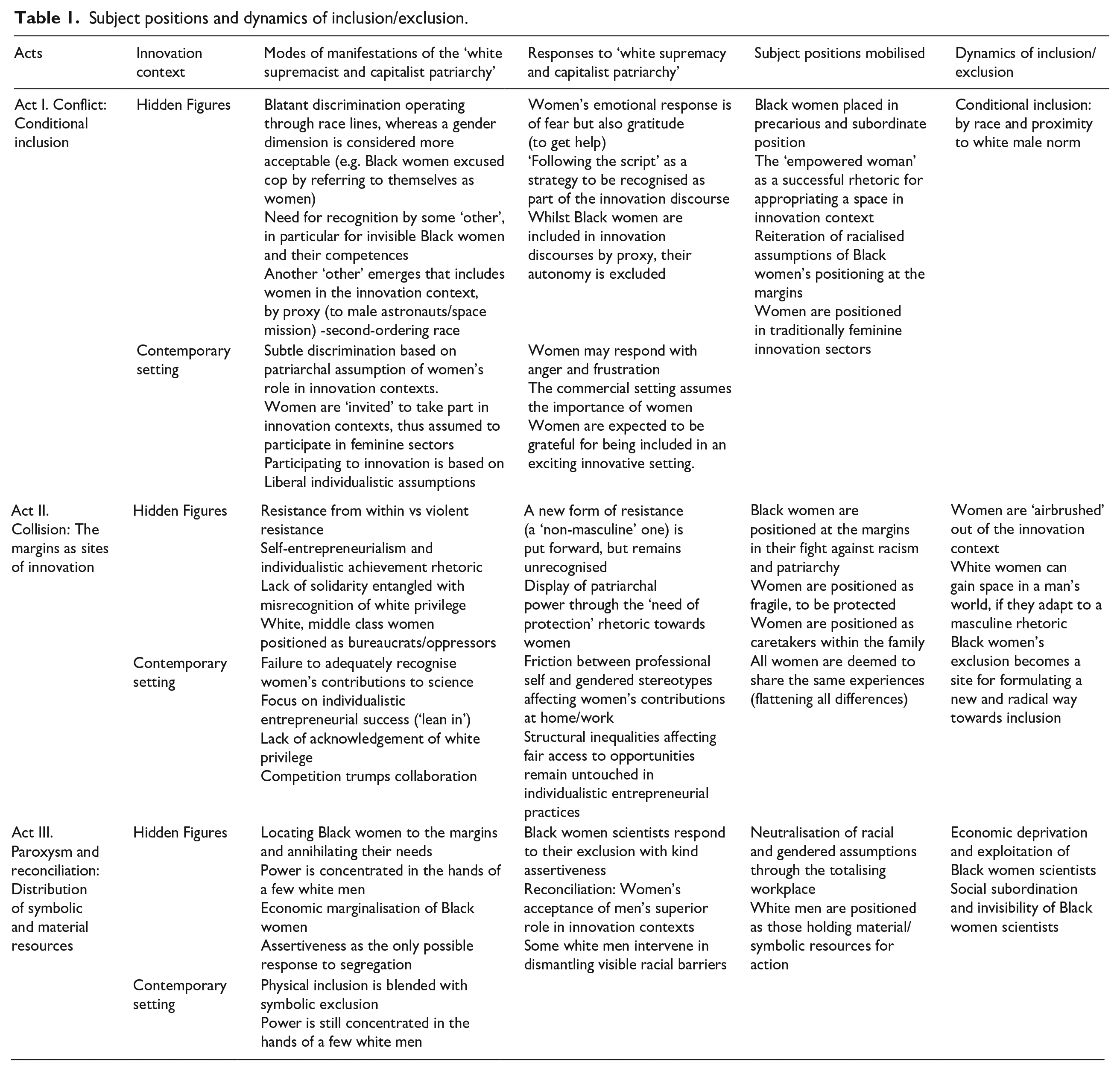
In the voice-overs we have discussed how conflicts and collisions act to bring out interesting dynamics of inclusion/exclusion in the backdrop. We now move them upfront by highlighting how the Table 1 facilitates an understanding of the innovation context as an unfriendly terrain to navigate, in particular if we are Black, women or from any other minority background.
In our paper we approached innovation as a context to uncover that the individualisation of innovation masks a gender-race matrix that operates through what we named a ‘conditional inclusion’. The context of NASA has provided us with an opportunity to understand innovation from both the centre (the dominant innovation practices and discourses) and the margin (the role of Black women in sustaining and/or challenging such practices). (Black) women are continuously, if not airbrushed out of the innovation context, positioned in its margins. They are included in the innovation discourse, but in retrospect as Katherine, Mary and Dorothy deservingly have been, and often as an exception. Furthermore, they are offered ambiguous and conflicting subject positions. Whilst conditional inclusion is clearly recognisable in Hidden Figures, it was more difficult to detect the bicultural life, and the psychological anxiety that it may entail. Racism and sexism are neatly separated in the script, making it easy (for the viewer) to see when either of the two forces is in play. However, walking in the shoes of Katherine, Mary and Dorothy is something else. They might have struggled, as Bell (1990) suggests, to separate bundled forces of racism and their operations in the margin.
The conditional inclusion of Black women is further strengthened today through postfeminist narratives, emphasising self-determination, and individual success (Fraser, 2000). Both the contemporary innovation context, and the innovation context of the 1950 to 1960s, promote discourses that hide the structures placing women as subordinate and unsuitable for innovating. Here, competing discriminations (Liu, 2018a) are played out: Black women are positioned as women assisting in the efforts of others, whether that be the white male astronauts/scientists, or the national state. Whilst current research suggests that women’s ability to innovate is often linked to traditionally feminine fields, our paper contends that conditional inclusion implies a symbolic misrecognition of women as capable of contributing to innovating by proximity to a male engineer or the national state. As innovation has progressively become an individual opportunity to be pursued, collective efforts shown in Hidden Figures are shattered and women are prevented from participating in it. The postfeminist narratives emphasising individual success made available to all women tend to blame them for not taking part in the innovation race, instead of recognising its inequalities structures, further perpetuating innovation as male and white. Thus, blame hurts the most for those at the margin.
Our feminist analysis of innovation connects to MOS critiques of discourses ignorant of innovation as socially shaped (e.g. Styhre, 2013; Sveiby et al., 2012), and as a predominantly white, masculine terrain (Alsos et al., 2013; Blake and Hanson, 2005; Petterson, 2007; Wikhamn and Knights, 2013). Building on this critique, we have argued that a metamorphosis of the innovation context cannot happen only through narrating the experiences of white women, although that is a good start. Rather, it needs to account for the plurality of experiences of women in innovation. Thus, we extend current feminist literature of innovation by arguing that innovation discourses have historically created subject positions that operate to conditionally include Black women innovators. Through these positions, the ‘white supremacist capitalistic patriarchy’ (hooks, 1984/2000) is perpetrated.
By bridging Mazzucato’s concept of the entrepreneurial state, hook’s theory of the white supremacist capitalistic patriarchy and Fraser’s redistributive justice, we also contribute to the intersectionality research agenda in MOS by offering analytical concepts (innovating from the margin, innovation as context) and a more inclusive innovation discourse that discusses and brings to light Black women’s experiences and contributions. To move forward, we encourage feminist and innovation scholars to engage with innovation as a context and to avoid individualising innovation. Such individualisation is dangerous; it reduces the potential of innovation to operate for the social good, and bases participation in it on liberal individualistic assumptions that leave women and minorities in the margins, and structural inequalities untouched.
In embracing hook’s theory of the white supremacist capitalist patriarchy, the margins become a site for revolutionising innovation, as a new, radical way towards inclusion. Such revolution, we suggest, can happen by taking intersectionality as a process that not only considers inequalities at the individual level (structural intersectionality), but that calls for a radicalising of our engagement with innovation and allows space for innovating race/gendered relations from the margins (political intersectionality). In discussing the different dynamics of inclusion/exclusion, we propose a shift from margin to centre to open up possibilities for change. Black women (and their lived experiences) have taught us to embrace innovation as revolution. This is nothing new from a historical viewpoint; innovation has often been depicted as reforming the social order, including in a violent way, which made the innovation concept dangerous for a long period of time (Godin, 2017). Likewise, within MOS, Bell et al. (2020) remind us that feminist knowledge and practice is indeed revolutionary, it is violent and dangerous. But it also allows us to revive innovation as a terrain for positive change, for shattering oppression. We engaged in a dialogue between the revolutionary power of intersectionality and the revolutionary aspect of innovation, with the hope that other scholars might want to engage with the lessons that structural and political intersectionality can bring.
Finally, our theoretical framework emphasises that innovation is political, not only in its operating gender-race matrix, but also in the maintenance and remaking of inequalities. Through the progressive individualisation of the innovation space, we witness a lack of a serious structural dismantling of the ‘white supremacist capitalist patriarchy’. Furthermore, an historical look at innovation shows how innovation has been ‘fashioned as equally available to all’, and is veiled by structures of individualism and entrepreneurialism. Overall, feminism as radical politics can revolutionise the innovation contexts by recentring the margins, escaping identity politics that mask structural inequalities, and co-opting non-inclusive forms of innovating. The aim has been to push the margins towards the centre and invite others to discover the terrain of the margin(alised).
Footnotes
Funding
The author(s) received no financial support for the research, authorship, and/or publication of this article.
