




Abstract
A key focus of intersectional research is to engage with the power dynamics resulting from the sameness/difference paradox that Crenshaw (1991) originally identified in Black women’s legal status. This article extends intersectional research in public relations by investigating how the tensions of responding to this paradox unfold in professional life. I combine Carastathis’ (2017) use of intersectionality as a provisional concept that can prompt different thinking about taken-for-granted realities, and Jorbá and Rodó-Zárate’s (2019) formulation of intersectional categories as fluid structural and agentic properties of a particular situation, to understand how sameness/difference is strategically negotiated by public relations practitioners of colour, the tensions that arise during these negotiations, and the impact of such negotiations on their own professional standing, as well as on the unmarked, normative white, male and middle-class identities that characterize the ‘post-race’ professional spaces in which they work. I conclude that, without genuine recognition of the daily compromises and sacrifices that practitioners of colour have to make in order to foster perceptions of ‘sameness’ and keep ‘difference’ at bay, the professional field’s blindness to its white, male and middle-class archetypes will persist – and will continue to blight the careers of those for whom the comfort of belonging remains elusive.
Intersectionality is a central tenet of feminist scholarship that explores contextual dynamics of power in a wide range of fields, grounded in the need to address structural disadvantages not captured by analyses focussing only on one dimension of inequality (Collins, 1990; Crenshaw, 1991). A key focus of intersectional research is to engage with the power dynamics resulting from the sameness/difference paradox that Crenshaw identified in Black women’s legal status – as too different from the category ‘woman’ (defined by whiteness) to be protected by gender discrimination law; and too different from the category ‘Black’ (defined by maleness) to be protected by racial discrimination law (Cho et al., 2013). Intersectional approaches to disadvantage thus generate political visibility for those who are racialized, but who experience disadvantage as a complex outcome of multiple aspects of their identity, and thus fall through the analytical ‘cracks’ that are left when only one of those aspects receives attention (Ramji, 2007; Davis, 2008; Carastathis, 2013; Carbado and Harris, 2019; Jordan-Zachery, 2007).
Intersectionality is a valuable theoretical and methodological tool for understanding disadvantage and discrimination in public relations (Golombisky, 2015). However, genuinely intersectional research in public relations is relatively rare (Place, 2015), and much of that which has been conducted is a decade or more old (Vardeman-Winter and Place, 2017). Some scholars have used an intersectional approach to better engage with the complex inequalities that shape the experiences of practitioners, audiences and researchers in their encounters with public relations (Vardeman-Winter et al., 2013; Vardeman-Winter and Tindall, 2010). Other studies have focused on the presence of intersectional messaging in PR campaigns (Vardeman and Sebesta, 2020; Sison, 2013; Vardeman-Winter, 2016), exploring how PR privileges certain identities over others, and how publics receive messaging in ways shaped by their intersectional identities (Vardeman-Winter and Tindall, 2010). However, there is a dearth of contemporary data about the experiences and structural positions of practitioners occupying identity categories other than gender, and Golombisky (2015) advocates an urgent need to adopt intersectionality as ‘method and habit’ to more effectively embed plurality and multiplicity into public relations research.
In this paper, I follow Golombisky’s call for a broader engagement with intersectionality in PR research through an analysis of the professional experiences of practitioners of colour working in the UK. I challenge post-racial professional narratives of public relations by exploring how practitioners must manage intersectionality in their environment in ways that foster perceptions of sameness rather than difference, to consolidate their right to belong in a colour-blind and ‘gender-blind’ professional field where whiteness, maleness and middle-class status are normalized and therefore invisible (Carbado, 2013). I adopt Carastathis’ (2017) approach to intersectionality as a provisional concept, best used to prompt different thinking about taken-for-granted realities, and always an anticipatory promise rather than a fixed reality. I also integrate Jorbá and Rodó-Zárate’s (2019) formulation of intersectional categories as fluid structural and agentic properties of a particular situation. Correspondingly, the empirical data focuses on context-specific articulations of intersectional properties in professional lives, as both structural realities and opportunities for agentic resistance.
I first summarize the movement in intersectional research towards conceptualizations of fluidity and openness, before discussing intersectional research in professional fields and public relations in particular. I then introduce the study and method, before engaging with the findings of five practitioner cases. I conclude with a discussion of how the analysis adds to our understanding of how practitioners of colour experience professional life, as well as to the continuing development of intersectionality as a valuable heuristic for revealing how race and racism continue to operate in the post-race professional spaces of public relations.
Intersectionality, sameness and difference
Intersectionality addresses the specific nature of oppression resulting from an individual’s location, or social position, in relation to a range of ‘primary social definers’ (Anthias, 2001) such as race, gender, class and sexuality. The relevance of these categories to social position, and the relationship between categories, both shape the nature of disadvantage or privilege and will differ in different situations (Gunaratnam, 2003; Anthias, 2012; Carbado and Harris, 2019).
Intersectionality’s origins are firmly located in an active engagement with social justice, and in the recognition that the experiences of Black women in particular provide a route for both theorizing and empirically identifying how disadvantage plays out in different contexts. Consequently, intersectional research must be focused on the power dynamics that operate in the context of struggles between institutional interests and individual resistance in particular locations (Rice et al., 2019; Collins, 2015). The majority of intersectional research has addressed multiple forms of oppression (Anthias, 2012; Carastathis, 2014; McCall, 2005), but researchers have also recognised the importance of addressing the experiences of individuals who are simultaneously associated with identities that generate privilege alongside those that produce disadvantage (e.g. Hulko, 2009; Carastathis, 2008; Levine-Rasky, 2011; Tackey et al., 2011). From a structural perspective, Carbado (2013) has highlighted the importance of interrogating unmarked, dominant categories such as whiteness and maleness, which have tended to receive less empirical attention as axes of domination, while modes of disadvantage are more thoroughly examined.
A significant ontological challenge for intersectional researchers is to find a way to conceptualize disadvantage such that its material realities are neither oversimplified through categorical aggregation, nor fragmented such that the connection between categories is lost (Jorbá and Rodó-Zárate, 2019; Hancock, 2016; McCall, 2005). Scholars have argued for the heuristic utility of categories as tentative and provisional modes of distinction and tools for understanding complexity, so that analyses interrogate the power dynamics they produce in ways that accommodate both their mutual influence and their irreducibility (Carbado and Harris, 2019; Gunnarson, 2017). For example, Walby et al. (2013) propose the concept of ‘mutual shaping’, where categories exert mutual influence on each other but are not obliterated or completely remade through their interactions. Contextual analyses show what is sustained in each category, as well as how ‘shaping’ emerges. The question of how categories articulate is open, insofar as articulation ‘is a linkage which is not necessary, determined, absolute and essential for all time’ (Grossberg, 1986: 53), but rather depends on specific conditions. Others suggest that, while categories may be fundamental to the way intersectionality unfolds in practice, their ontology is less important than the effects they produce, in the form of ‘collective exclusion and belonging in relationship to other groups whose borders are permeable and fluid’ (Levine-Rasky, 2011: 242). This approach focuses on the processes and contexts in which belonging and exclusion are achieved, or on ‘the doing or making of difference’ (Dhamoon, 2011: 235) and of sameness. Drawing on Stuart Hall’s understanding of articulation, the central question is how categories ‘do or do not become articulated at specific conjunctures, to certain political subjects’ (Grossberg, 1986: 53).
Paying more attention to the problematic of how sameness/difference is constructed in relation to different individuals retains the focus on power that is foundational to intersectional analyses, and the analytic force needed for addressing real-world realities of categorization (Carbado and Harris, 2019). At the same time, the contingency of articulation makes space for the fluidity that marks the production of sameness/difference over time and space. It does not resolve the problem of categorization but rather shifts priorities so that the provisional nature of intersectionality (Carastathis, 2017) as a tool for thinking differently about their status and use, can be realized. For example, Jorbá and Rodó-Zárate (2019) suggest that categories are best conceptualized as properties, both of an individual, with variable effects on their experience in different contexts, and of the system of power, inflecting how power operates in different situations. Experience, they argue, is then an ‘emergent entity’, with ‘emergent properties that are produced out of the interaction and configuration of certain properties (gender, race sexuality, etc.)’ (Jorbá and Rodó-Zárate, 2019: 190–191). It follows that, if both properties and experience are emergent, they can be constantly re-created as power dynamics change in different situations (Cho et al., 2013: 795).
Adopting this analytical approach requires thinking about ‘the contingent, the non-necessary, connection […] between ideology and social forces, and between different elements within ideology’ (Grossberg, 1986: 53). It creates space for understanding how race and gender can generate privilege as well as disadvantage – for example, when unmarked identities such as whiteness and maleness constitute a normative benchmark for conduct because of their already privileged status. Carbado’s (2013) concept of ‘blind’ intersectionality is particularly important for understanding how normative categories such as Whiteness, or maleness, become the default through which other identities are expressed (Carbado, 2013: 823). Whiteness, for example, appears neutral, a taken-for-granted reality, unmarked and unremarkable, while non-whiteness is always a modifier, ‘racially impure and thus juridically suspect’ (824). In his strong interpretation of the definitive role of whiteness, Carbado reflects Higginbotham’s (1992) description of race more broadly as a ‘meta language’ that contributes to the construction of other social positions. Both ideological and mythical, race ‘blurs and disguises, suppresses and negates its own complex interplay with the very social relations it envelops’ (Higginbotham, 1992: 255). As the experiences of the PR practitioners in this paper show, ‘post-race’ professional contexts are places where the meta language of race has powerful traction, a factor to which practitioners of colour are repeatedly required to respond as part of their professional practice.
Intersectionality in public relations
Following Jorbá and Rodó-Zárate (2019), intersectionality in professional fields may be understood as the ways in which properties of the field articulate with properties of the individual to produce a unique professional experience, a flexible connection (Hall, 1997) where the possibilities of oppression and privilege become material and contribute to, or challenge, professional hierarchies. All professionals negotiate these articulations, but those whose individual properties align with the field’s existing hierarchies are more likely to have a ‘collective experience of belonging’ (Levine-Rasky, 2011) than those whose properties delegitimize their professional status because their difference renders them suspect.
UK PR has a gendered subculture (Acker, 2012), as well as a racialized subculture, both of which disadvantage female practitioners and practitioners of colour (Edwards, 2014a; Yeomans, 2019). Moreover, class-based indicators of identity (e.g. dress, speech, comportment, familiarity with office and business life, networks of the ‘right’ contacts) are understood as neutral ‘standards’ that professionals naturally embody. In this context, middle-class whiteness 1 is unmarked and underpins archetypal professional identities (Edwards, 2013, 2014b); ‘acting white’ (Carbado and Gulati, 2013) is a normative benchmark for all professionals. While generally speaking, professionals are better educated, wealthier and enjoy greater access to different forms of capital (Friedman and Laurison, 2020), for practitioners of colour, these advantages articulate with ascriptive judgements about their non-white ethnicities (Choroszewicz and Adams, 2019; Edwards, 2014a; Friedman and Laurison, 2020; Hearn et al., 2016; Race for Opportunity, 2010; Tomlinson et al., 2013).
These intersectional disadvantages have been powerfully illustrated by Pompper (2013), who analyzed 10 years’ worth of data to illustrate the impact of age, gender and race/ethnicity, on professional life, identifying various forms of oppression, including salary differentials; a lack of collegiality and respect; and a variety of racist, ageist and sexist behaviour. Other research pinpoints gender discrimination, including a gender pay gap (Vardeman-Winter and Place, 2017; Public Relations Consultants Association, 2018); segregation of emotional labour as a mainly female burden (Yeomans, 2019); gender stereotypes; and working patterns that discriminate against women with caring responsibilities. Practitioners of colour also face exclusionary practices including racial stereotyping, pigeonholing, discriminatory recruitment and promotion practices, racialized embodiment, and normative associations of whiteness with professionalism and leadership (Edwards, 2014b; Logan, 2011; Pompper, 2004, 2005). In these contexts, race is defined as just another form of ‘difference’ that can be commodified as an object for promotion, a target audience, or a practitioner attribute useful for a particular type of campaign (Edwards, 2013, 2014a).
The commodification of race reflects the nature of PR as a ‘post-race’ professional environment, where neoliberalism’s flattening of difference and individualization of experience (Mohanty, 2013) leads to race and racism becoming mythical, emptied of their political and ideological force. As Mohanty notes, in these contexts ‘[q]uestions of oppression and exploitation as collective, systematic processes […] have difficulty being heard when neoliberal narratives disallow the salience of collective experience or redefine this experience as a commodity to be consumed’ (Mohanty, 2013: 971). Yet, difference is ‘an ongoing interactional accomplishment’ (West and Fenstermaker, 1995: 9) and given that intersectional properties are context-dependent, then privilege and oppression will vary during the emergent professional experience (Hulko, 2009: 49). In ‘post-race’ environments where proliferating diversity policies perform a commitment to inclusion but simultaneously incorporate diversity into institutional structures that sustain, rather than contest, power (Ahmed, 2012; Bilge, 2013), the mythical presentation of race makes the reality of racism in professional hierarchies difficult to articulate.
For PR practitioners of colour, articulating and challenging discrimination requires them to contest not only the invisibility of race and racism, but also the invisibility of the whiteness that dominates the professional field and allows their colleagues to claim success on the basis of merit or talent, rather than racial advantage (Carbado and Gulati, 2013). The risk of this professional heresy is such that alternative strategies may be preferred, involving silence or conformity so that sameness, rather than difference, is the focus of others’ attention. Individuals may pursue strategic intersectionality (Fraga et al., 2006), where individual properties are re-cast as advantageous rather than detrimental, or strategic visibility (Hancock, 2016), fostering one’s personal profile in different contexts, in order to counter exclusion and marginalization by constructing a self that emphasizes ‘sameness’ and ‘fit’ in relation to normative narratives. Deploying strategic ambiguity by speaking about discrimination and racial identity in coded language that accommodates white fragility (Joseph, 2018) is an important tactic to ensure that any kind of resistance to discrimination can be done in a ‘safe’ way.
The tense negotiation of sameness and difference is fundamental to the emergent professional experience for practitioners of colour. Strategizing about when and how to make intersectional properties visible, or speak safely about racism, may provide ways for professionals to reveal the materiality of discrimination while avoiding a hyper-visibility of problematic identities, but it is never straightforward (Joseph, 2018). As Hancock (2016) notes, ‘[T]he pursuit of visibility is a fraught process that can include the (perhaps tortured) choice of strategic (in)visibility’ (p. 78), because it necessarily invokes heightened visibility for the very properties that are likely to prompt exclusion, and an implicit threat to the stable narrative that protects more privileged colleagues. In the remainder of this paper, I explore how managing intersectional properties that prompt perceptions of sameness and difference is fundamental to the emergent professional experiences of practitioners of colour.
Methodology
Participant ethnicities (self-ascribed).
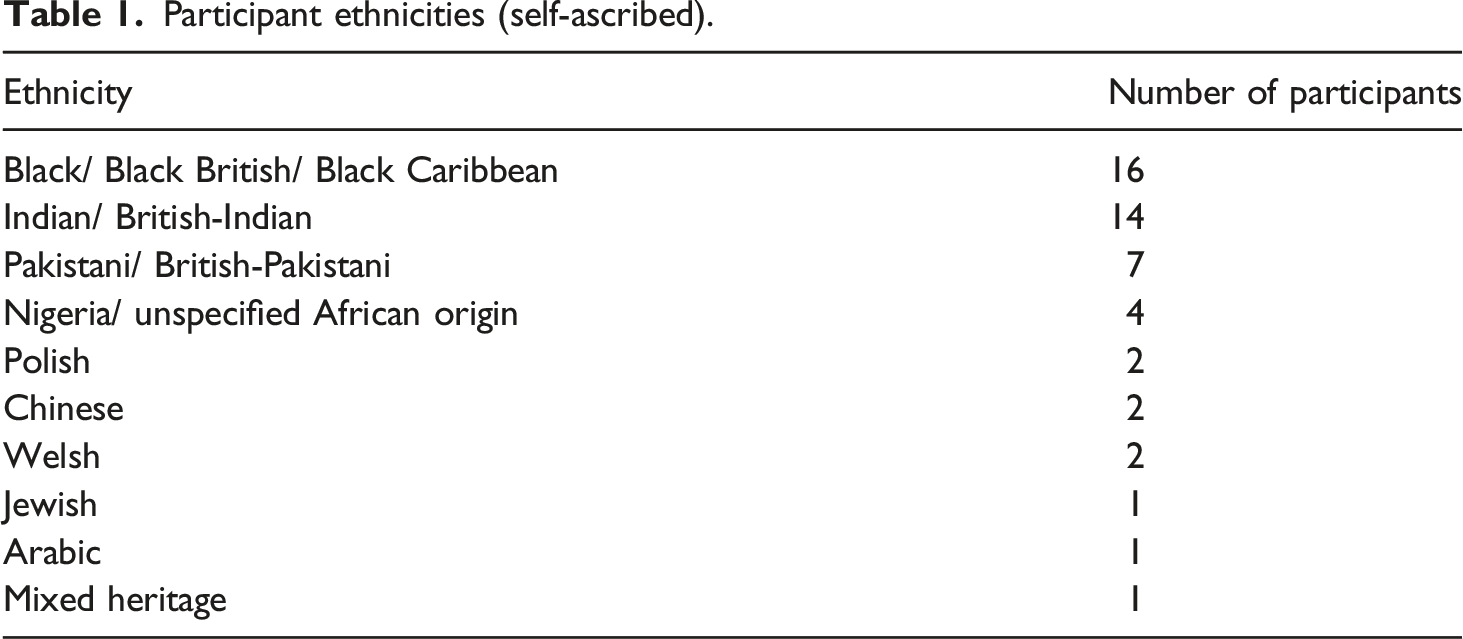
The findings presented here are drawn from the interviews and diaries, which provided the most detailed accounts of practitioners’ individual experiences.
Each data collection method addressed a slightly different aspect of the professional experience. The interviews focused on how participants came to work in PR, assets that had helped them to progress, barriers they had had to negotiate, and questions about how their ethnicity and personal background had affected the development of their career. The focus groups addressed practitioners’ perceptions of the ‘typical’ PR practitioner, the similarities and differences between this abstract individual and themselves, and the professional assets and liabilities associated with both the typical practitioner and the participants’ identities. The diaries were conducted with a subset of 10 practitioners and consisted of 10 weekly entries that accessed deeper and more personal reflections about the quotidian experience of being different from the professional norm 3 . Intersectionality was not an explicit focus of the discussions with participants, but the ways in which they managed intersectional properties (associated with both their own individual identities and the professional environments they worked in) emerged in the data as an important locus of their efforts to negotiate their professional identities.
I began each in-person data collection process by introducing my own background as a white, middle-class, ex-PR professional and now academic. I explained my interest in the topic, grounded in a commitment to social justice and a desire to understand how the PR profession is implicated in processes of racialization and racism. I am racialized as white, and while this differed from my participants, my class and professional background aligned with the majority of them, which helped me build rapport through the interviews. In pilot interviews, I was hesitant to impose any explicit focus on race, gender or class on the discussion, since I did not want to pre-empt participants’ experiences, or assume a position of victimhood. However, it became clear that this white fragility was a barrier to frank and open discussions, because it caused participants to be hesitant in sharing their experiences. Following a discussion with the project steering committee 4 I was much more forthright about explicitly recognizing my own position of privilege, and about asking participants to share experiences that they felt had been marked by race and racialization. This led to much richer exchanges.
Given that the experiences they shared were highly personal and often painful, the ethics of the study were critical. I confirmed that all their data would be anonymised and kept confidential, and they could withdraw from the study at any time without giving a reason. As the data collection progressed, I learnt more about not only the deep injustices that practitioners face because of their racialized identities as ‘other’ in the profession, but also about my own privilege and how I had benefited extensively from the profession’s unmarked whiteness (and continue to do so in the white academy). These realisations continue to influence my analysis, interpretation and presentation of the practitioners’ narratives. My aim is to make visible the deeply discriminatory nature of the PR field, and to highlight the agency practitioners try to exert in a post-race context where speaking about injustice is almost impossible. The complexity of their experiences, I suggest, provides a way of moving beyond binaries of inclusion and exclusion, or disadvantage and privilege, instead revealing the grey areas of negotiation that are a consistent feature of their professional lives.
The data was analyzed using an open coding approach (Lindlof and Taylor, 2011), with a specific focus on identifying the intersectional properties in play for participants; on how they perceived the relationship between these properties and their professional identities and practices; and on how they managed the articulations of intersectional properties during their working lives.
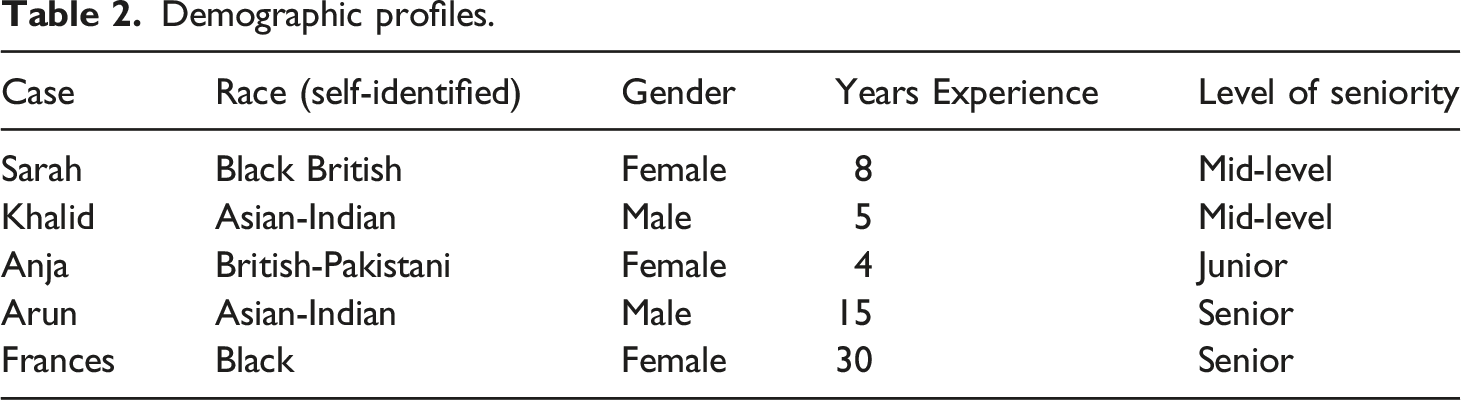
Demographic profiles.
While the data were collected a decade ago, progress in the industry towards improving diversity has been extremely limited, suggesting that little in the professional environment has changed. If the study were to be conducted today, the impact of widely circulating campaigns such as Black Lives Matter and #MeToo would constitute a different context for practitioners’ responses, that might generate a higher awareness of the discrimination they face. That said, and as the results will show, the awareness of discrimination shown by the practitioners in this study suggests that recent campaigns make visible what was already felt by practitioners of colour, rather than revealing anything new to them. Moreover, recent industry research confirms the continued prevalence of the experiences described by the participants in this study. For example, the 2019/20 ‘State of the Profession’ report by the UK’s Chartered Institute of Public Relations shows that while the gender balance at senior levels is improving, the gender pay gap persists; it remains a middle-/upper-class profession, with both private, fee-paying schooling and university-level education over-represented among practitioners (as compared to the national average); and the profession remains over 90% white, with all other ethnic groups underrepresented (Chartered Institute of Public Relations, 2020a) The Institute’s most recent qualitative research shows that the professional lives of Black, Asian and other minority ethnic practitioners remain marked by the same kinds of racialized expectations and micro-aggressions as they were at the time of my own study (Chartered Institute of Public Relations, 2020; Edwards, 2014b). Correspondingly, the cases detailed here have continued relevance to the ways in which practitioners negotiate their working lives.
Findings
Participants experienced intersectionality in the form of racialized, gendered and colour-blind effects on their professional experience. They interpreted their experiences in light of the purpose of the occupation, their own ambitions and the wider social context. The choices they made about how to manage the articulations between their individual properties, and those of the field, were complex, involving challenges to personal authenticity and integrity as they negotiated professional terrain, reflecting the double-edged sword of strategic approaches to intersectionality. Their sense of who they were, and who they could be, as PR practitioners, was linked to their personal identity; to wider societal perceptions of them as racialized, gendered and classed individuals (e.g. as a Black woman); and to their occupational status as members of the field who understood the rules of the PR ‘game’ (Bourdieu, 1992). These interactions of these complex realities opened up opportunities to use a ‘double-voiced’ strategy (Higginbotham, 1992: 267) of resistance, illustrated in the findings below, where they challenged the power of race to over-determine professional identity, by reimagining oppressive discourses of racialization as a means of liberation.
Sarah
For Sarah, a Black senior communications manager in a London-based utility company, her private education, embodiment (particularly her way of speaking), and seniority countered the potentially negative effects of her ethnicity by prompting perceptions of sameness and mitigating disadvantage. Sarah uses the term ‘colour-blindness’ to describe her colleagues’ reaction, and recognizes how it can reinforce the ‘post-race’ mentality that reduces ethnicity to an over-simplified form of difference. Sarah rejected such responses, because they required her to ‘slice off’ part of her identity and negated the value of her ethnicity as a professional asset. As she described in her interview: It’s okay for me sat here, my parents paid for elocution, I’ve got a quite good sounding voice, I’m reasonably well presented, so most people can sort of allow a glaze of colour-blindness, but actually no, I’m me as I am and that has an impact when I go out and I talk to the community groups which will have a mixed group, a mixed audience, a mixed constituency. [….] Human interaction requires you to interact as a whole being, you can’t sort of slice off one bit of who you are and engage, there’s always going to be a disconnect.
Sarah makes a ‘double-voiced’ argument (Higginbotham, 1992: 267) by using her professional status to argue for a reframing of race as a professional asset, a means of connecting her to important audiences and communities, even as she recognizes the way it constructs her as ‘different’ in her organizational and professional context. Her cultural capital and class identity may fit with professional norms, ‘allowing’ people to ignore her identity as a person of colour, but she rejects this separation because her ‘whole being’ means that she is better equipped to engage with the audiences she speaks to; to sacrifice that would be to introduce a ‘disconnect’ and be a less effective professional.
Sarah’s cultural capital also masked a complex class identity that could mark her as professionally ‘different’, but actually delivered an important advantage. While she recognized that some aspects of her background were clearly middle-class, she also pointed out that doing multiple jobs to pay the bills was something that she’d ‘been raised with’. Her experiences, she argued, gave her and other successful practitioners of colour an ability to adapt to different situations: ‘that adaptability I think is something that is a natural... a natural thing in myself and I think a natural thing in successful BME practitioners actually.’
5
The point is illustrated by her reading of situations where she was required to exert managerial authority. Here, her status as a woman, and a Black woman in particular, had to be managed differently. Strong assertions of both ethnicity and gender were riskier, potentially making her hyper-visible and facilitating the normative power of (unmarked) maleness and whiteness to define her, in Carbado’s (2013) terms, as ‘less than’ the norm. She reflected on this in her interview, when discussing how gender and ethnicity were shaping her approach to an upcoming managerial challenge: I’m going to have to get quite assertive, but I know I’m going to have to think about how I’m going to play that, because otherwise the reaction will be – and I’ve seen, it’s happened to other colleagues who are women but are white – and people have said, ‘Oh, you’ve just got too big for your boots here’. Or ‘You’ve been very assertive and we don’t appreciate that’. […] And you kind of think, that’s the thing for women. […] [Engineers are] just not going to be used to being told they’ve got to get things done by a woman and by a Black woman. So, I think it... I think women always have an issue but I think the societal view of Black women also has an impact on how black women are perceived in the office, so you’ve got to be quite aware of that when you’re working with people.
Sarah’s comment reveals the constant awareness of how her own intersectional properties articulate with professional environments in different ways. In collegial interactions, she can see how her ethnicity is largely overlooked because of the sameness that her class background invokes. However, once she is in a position of authority she becomes a gendered, racialized body ‘out of place’ (Puwar, 2004), and has to think more strategically about managing these properties in order to avoid endangering her career.
Khalid
Khalid, a communications manager in a government department, was a practicing Muslim whose parents migrated to the UK from Pakistan. Racism had prevented his parents from achieving their ambitions and he recognized the potential for discrimination because he was Asian. However, he described his experiences largely in terms of his colleagues’ ignorance about his race and religion. He offered multiple examples, including having to explain how fasting worked during Ramadan when at a ‘working lunch’, and countering assumptions that he knew about the Hindu festival Diwali, because of his ethnicity. These were frustrating experiences – as Khalid said, ‘if I get on my high horse it’s like, “How ignorant can the person/country be about different races, religions and all the rest of it?”’ – but he did not narrate them as direct discrimination in relation to his professional role.
Unlike Sarah, Khalid rejected race, class and age as markers of identity and professional capability, suggesting that his professional status should make these properties irrelevant. This aligns with the professional habitus that Edwards, 2014a identifies, where practitioners are characterized by their talent, creativity and merit first and foremost. For him, making race, class and age visible was always risky, framed in the quote below as a wilful act of separation that could marginalize his professional identity. In his interview, he reflected on the ways in which overt claims to visibility could overwhelm his professional identity: I kind of think that that doesn’t really help that you’re kind of closing yourself off and saying, ‘Right, we’re Asian
6
PR people, let’s talk about how we deal with that’ and I don’t really like to think like that. I’m like, ‘I’m a PR person. Let’s just deal with it’. […] I don’t like going into little groups and doing things like that.
The ambiguity of this position, however, is problematic; while he prefers to identify only as a professional, the following quote shows how he recognizes that this position does not eliminate discrimination, not least because his parents actively adopted strategies to facilitate perceptions of sameness (here, in terms of class and regional identity) in order for him to reach his potential. Khalid’s acknowledgement that there ‘will be obstacles’ admits the necessity of strategically managing intersectional properties to facilitate perceptions of sameness or difference, even though he does not think of himself in those terms. Indeed, throughout his interview, Khalid constantly reinforced the notion that he is ‘just’ who he is. And yet, you know, there will be obstacles and all the rest of it in the way. Because I’m Asian or because I’m from Birmingham. You know, for example, like my parents made me have, I won’t say elocution lessons, but lessons to get rid of my Birmingham accent, because they thought if I talked like a thick Brummie
7
nobody would take me seriously. So all that kind of stuff. You know, you think about me being male, being Muslim, whatever. And I don’t… […] I’m just who I am.
Khalid does accept that he is recognized through the lens of certain properties – his race, gender and religion – but would prefer these to be ignored unless they have relevance as a form of merit in a particular situation. Nonetheless, at several points in the interview Khalid described his own internal struggle with the recognized potential for discrimination, based on the reality that he worked in an almost exclusively white environment. In the following quote, he describes his desire to subdue its effect on his confidence and sense of professional legitimacy. I kind of used to go into the room and think, ‘Oh. I’m the only Asian person here’. Type of thing. But it didn’t go any further than that. Because I think… maybe I’ve got my head in the clouds or whatever, but I just… I’d think of it and then I’d think, ‘Oh well, that doesn’t matter’, because I’ve got… I’m here as a person with the skills, etc. demonstrated who I am. Not the colour of my skin. […] And so if I’m in a room surrounded by white people and I’m the only Asian person in there, it’s just like… it’s more of an observation with a subtle awareness of it. But then it doesn’t ever go any further than that to thinking, ‘Oh, God so surrounded by these whites, grr’ kind of thing. I don’t really progress beyond that. And I’d… I don’t… again maybe it’s naïveté or whatever, I don’t really see it as a problem.
Khalid’s assertion that the whiteness of his environment is ‘an observation’ is simultaneously undermined by the phrases that suggest he may not be seeing what is really happening, because he has his ‘head in the clouds’ or is naïve. These self-attributions suggest a sense of idealism and even day-dreaming, perhaps to imagine the professional world he would like to see rather than the one that exists. Later in the interview this tension between ideal and reality is illustrated by a re-reading of the situation, and a recognition that his racialization has the potential to undermine his professional legitimacy: ‘like I said, the awareness of it… of me being the only Asian person in the room is slightly… is just an observation, but then I think sometimes it is a… a bit more… can be a bit more than that. So that I kind of feel I have to… kind of outwardly, kind of justify my worth, or whatever, my reason for being there. And my… myself a little bit more on certain occasions.’
On occasions when race and religion became relevant to his work, Khalid adopted a strategically ambiguous approach, framing them in professional terms of skill, a form of ‘objective’ merit, and an added benefit for his organization. The following example, where Khalid describes his work on a health communication project, shows how religion in particular played a role in helping him deliver better case histories of chronic illness for his employer. I’d go into a family and from a knowledge point of view I’d know the right questions to ask, etc. and get the specifics. You know, ‘How does it work during Ramadan? How does it conflict with religion? Does faith provide you with strength?’ All that kind of stuff. And because obviously I have that awareness of religion. Although it’s more religion itself rather than Islam. That’s been quite… that’s been useful there.
In Khalid’s statement ‘It’s just who I am’, he makes his intersectional properties safe to speak about in a context where he could be perceived as an outsider. In the above quote, for example, he commodifies religion but distances himself from the more problematic ‘Islam’ 8 . The strategy makes it easier for him to fit in, but also results in his ethnicity and religious identity – including his own family history – being ‘flattened’ (Mohanty, 2013), dislocated from their historical and social, often violent and painful origins as a condition for their utility in the pursuit of professional success.
In contrast to race and religion, Khalid’s gender was a property that demonstrated a degree of sameness in a predominantly male work environment (a science-oriented government department). In the following quote, the binary opposition between ‘women’ and ‘us’ suggests he recognized it as an intersectional property that allowed him to ‘belong’ – even though he expressed dislike of the testosterone-fuelled corporate world elsewhere in the interview: ‘it’s actually now reversed around to being a male-oriented environment. Which is interesting. Lots of testosterone flowing around. But then, the women keep us under control.’ Thus, his gender may have operated as a form of privilege in certain contexts 9 , just as Sarah’s was a disadvantage when she asserted her authority.
Overall, Khalid’s need for professional safety requires him to contribute to the profession’s post-racial norms, such that he persuades himself to minimise the effect of collegial ignorance, occasional discrimination and an almost completely white working environment on his professional confidence. Instead, his race and religion remain unthreatening personal characteristics and leave the dominance of whiteness unchallenged, and he accepts the gender binary that places him in an advantageous position while positioning his female colleagues (who are more senior than him) as responsible for the emotional labour that the men’s ‘testosterone’ requires.
Anja
‘Flattening’ intersectional properties that create the impression of difference rather than sameness was also a strategy adopted by Anja, a mid-level communications manager in an insurance company who was a practicing Muslim and wore a hijab. She moved into PR via an internal appointment, having previously worked in the IT department, where she had learnt about the gendered whiteness that characterized the company. In her new role, gender, religion and race were all parts of her identity that were very unusual and would need to be managed. In her interview, she explained how this felt: I personally feel people were looking at me thinking does she really fit in. I could sense that people were questioning whether I fit into the [company] ethos, because having worked at a lower level within IT, you could... you, you get a sense of what the company’s about, erm, what sort of people progress, what sort of, you know, there aren’t any women on the Board, erm, there aren’t any women who are second tier as well, […] I knew that I’d have to work hard as a woman to prove myself.
Anja spoke in particular about normalizing her existence in an environment where she was the only Asian, other than the Asian men who worked in the IT department. The normativity of both whiteness and maleness subjected her to an environment where colour- and gender-blind intersectionalities dictated the terms of sameness/difference. As the following interview excerpt illustrates, she recognized that success would be down to her own efforts, rather than any external support: I thought, ‘I really need to prove myself if I’m going to succeed in PR. And I really need to fight every step and make sure I give my all and try and fit in. But not… you know, don’t go against my beliefs, but do as much as I can to mix in and prove that they have chosen the right person for this job’.
At the beginning of her career, she had no PR-specific credentials to draw on, although she did have a law degree. While she was unable to draw on PR qualifications to demonstrate her legitimacy, the law degree gave her a sense of how important public commentary on the company could be, increasing her confidence answering press queries (a significant part of her early role). She described in her interview how she worked as hard as she could to make a good impression and was recognized for her efforts. Nonetheless, she still found it necessary to publicly counter her marginalization by adopting the language of her colleagues, and their focus on her hijab as an ‘easy’ way of managing her presence. I’ve had comments about the girl in the headscarf, even from colleagues who it’s just an easier way of telling somebody who someone is, which I don’t find now discriminatory in any way because I even sometimes say, ‘Oh just tell them I wear a headscarf’. Or somebody comes up to see me who doesn’t know me I say, ‘Oh yeah I’m the girl that sits by the back lift and wears a headscarf’, because people now refer to me as that as well.
This version of strategic visibility, adopting discriminatory language and focus as her own, made it easier for her to fit in, but as with Khalid’s situation, it also meant she perpetuated the meta-linguistic power of race to define her professional identity. Not only is she defined in terms of the physical difference related to her ethnicity and religion (using a term that secularises the hijab and thus denies her religiosity), but she is also infantilised as a ‘girl’ (in contrast to the ‘men’ she worked with). Accepting both these attributions made her identity easier to manage, but they also normalized the gendered whiteness of her professional environment. As her experience increased, and in a similar way to Khalid, she hoped that her hijab would be transformed from a visible sign of her ‘different’ gender, religion and ethnicity, to a simple feature of her appearance, a flattened, decontextualized attribute that would fit in a post-race environment.
Anja’s recognition of whiteness as a benchmark for belonging and ‘sameness’ is reflected in the following quote, where she suggests that ‘normal’ equates to ‘the same as the white person next door’. I believe that… although being Asian is probably a slight disad-, it is a disadvantage, I see it, but I’m trying to prove that I can be the same as the white person next door type of thing. And I think in my business I’ve… over the last three years I’ve actually proved that. And they now use me as an exam-, well I think it’s because it’s in a white area, they actually use me as an example, ‘No. We’ve got an Asian girl who works here. You know, wears a headscarf …’
Ironically, Anja’s professional success, achieved despite her racialized and gendered difference, opens the way for her to be instrumentalized by the company in the service of their diversity narrative. Yet, the fact that Anja has had to do all the emotional and physical labour to be accepted vividly illustrates the ways in which this diversity is contingent on ‘valorizing without consequences, recognition without redistribution’ (Bilge, 2013: 409) – a neoliberal taming of race that makes discrimination even more difficult for her to articulate.
Anja’s hesitation in describing racial discrimination and her repeated use of the words ‘headscarf’ and ‘girl’ betray the degree to which managing the hyper-visibility of her gender, ethnicity and religion required the ongoing deployment of strategic ambiguity so that her white, male colleagues did not feel threatened. Unlike Sarah, who felt empowered enough to adopt a double-voiced strategy and reframe ethnicity as an asset, and unlike Khalid, who could use his gender to fit in, Anja’s professional environment made such strategies risky. Instead, she had to at least partially accept a form of ‘happiness duty’ in her role as a ‘diverse’ employee who does not dwell on the negative experiences of racism or gender discrimination in her organization (Ahmed, 2010).
Arun
Like Khalid and Sarah, Arun, a senior PR practitioner in Scotland running his own consultancy, recognized that the intersection of his Indian ethnicity with his professional status could be beneficial. With extensive media and public sector experience, he was very aware of occasions when it was part of the reason for his involvement in projects. As the following diary entry illustrates, he used such opportunities to educate his clients about the variety of non-white stakeholders they had, and to counter the tendency to homogenise them into ‘Asian’ or ‘BME’ target audiences. clients often lump together the BME community grouping. There needs to be better awareness in the public sector that this group comprises a broad range of sub-groups (Chinese, Polish, Indian, Pakistani, etc), and so, each one of these requires a targeted approach. Will see if [there is] scope to educate client around this as the project takes shape.
This educational role characterized his approach to his ethnicity as a professional asset, similar to the way that Khalid and Sarah use their intersectional identities to improve their practice. However, in his interview he also talked about his frustration when his professional advice had been perceived as a personal bias based on race. it’s quite frustrating I think for me just because of my background. I think sometimes the clients wrongly will assume I’m maybe more passionate or considerate to a particular grouping. […] If a campaign’s saying we want to target these hard-to-reach groups as a professional you’re representing all of them. But as I say I feel in meetings, and I have felt if I […] as an example talk about the Sikh community or the Pakistani community or the Hindi community there’s almost a ‘Well you would say that...’
Perhaps as a result of these experiences, Arun’s diary demonstrated an ambiguous and uncertain attitude to what he calls ‘positive discrimination’, a form of privilege that intersectionality can afford in some cases, but that often goes unmarked when framed in terms of ‘discrimination’. Indeed, positive discrimination, while it can open doors to opportunity, is dependent on identification of an ‘othered’ aspect of identity that happens to work in the individual’s favour. As such, positive discrimination is a fleeting form of privilege that cannot be relied upon. In the following diary entry, Arun describes how he mitigates this fragility in his reflections on an invitation to a meeting between the local authority and an Indian bank representative. Rather than accept others’ interpretation of his ethnicity as a form of merit or expertise, he counters it by asserting and demonstrating the relevance of his professional identity and capability. Indeed, he undermines the assumption that he knows about the Asian business community by virtue of his Asian identity, saying he had to do ‘homework’ in order to meet that expectation. To be honest, I was asked to attend because of my ethnicity – as an Asian professional, there was a gross assumption made that I was an expert of the make-up of the Asian business community in the city. Thankfully I had done a bit of homework so think I handled it well and everyone seemed complimentary enough.
In the paragraph following, however, Arun considers the complex personal dilemma that this situation presented. I guess it was an example of ‘positive’ discrimination, if it can be possible for discrimination to be positive. Did I mind? I guess not, as the intentions were sound and I guess it was a privilege to be invited to support senior officials of the local authority at such a high-level meeting. I was invited 1. because I am Asian and 2. because I am a businessman and 3. the local authority felt I could add value to their presentation – there’s not really anything wrong with this.
The repeated use of ‘I guess’ betrays an ambivalence towards the assumptions made about him on the basis of his ethnicity, and a personal distance from them – these are not assumptions he shares. His ‘sameness’ – a fellow businessman – in this context is dependent on his difference – an Asian businessman – which simultaneously endangers his professional status in other circumstances where his ethnicity is not relevant. In recognizing the value of ethnicity as something that facilitated his invitation, he must simultaneously acknowledge that without it, he may not have been invited. In other words, the unmarked, normative status of ‘white male’ in the business world has the potential to render him suspect unless his ethnicity is detached from his identity and instrumentalized. Ironically, he has to do ‘homework’ to live up to the stereotypical expectations that he will ‘know’ the Asian business community because he is Asian, and thereby reinforce his professional credentials. The role of race as a meta-language emerges here – it is brought to bear on his professional status, yet the implicit discrimination that haunts the instrumentalization of race brings the spectre of marginalization closer to his working life. The tensions resulting from this manifestation of colour-blind intersectionality, where whiteness is the unmarked racial filter that defines ‘businessman’ and ethnicity invites a form of belonging dependent on ‘othering’, is reflected in the difficulty Arun has in objecting to the situation. He concludes by suggesting that ‘there is nothing really wrong’ with this particular perception of his identity.
Frances
Finally, some practitioners drew on aspects of privilege in their personal and family backgrounds, including cultural capital associated with activities such as Sarah and Khalid’s elocution lessons; Anja’s law degree; political networks that come via student politics (e.g. joining and working with UK political parties during university); or engaging in cultural activities and sports. These ‘soft’ credentials supported their professional legitimacy claims, aligning their individual properties with the properties of the professional field. For example, Frances, a senior PR practitioner and now independent consultant, explained in her interview that her parents’ commitment to engaging in all sorts of social and cultural experiences during her youth, from opera to Wimbledon, as well as a lack of racism in the area she grew up in, meant she had no fear of any situation based on her racial or class identity. However, she knew that during her career assumptions about her class were made on the basis of race. if you’re black then you’re definitely working-class and you’re definitely from, you know, a real down at heel family and some impoverished area, so therefore you would be different to everyone else in that kind of rarefied environment because they will all have gone to Oxford and Cambridge at least or a few other, you know, serious universities. So… and they would never have assumed that I would have come from that kind of [rarefied] background at all, and they would never ask anyway. […] you were never just a normal, equal person.
Frances explained the pain of racism and discrimination in the early years of her career in vivid detail. Gender was a critical factor in her experiences as well – both as a source of support (she described her female bosses as ‘really supportive, they were great’) and of discrimination (for example, when male bosses made it particularly difficult for her to work part-time). Now at the zenith of her career, she had achieved a sense of her own power, particularly as a Black practitioner, and recognized the effect she had on professional environments where white, male and middle-class identities were the norm among the senior practitioners she mixed with. In her interview, she explained this in the following way: I’ve got lots of black friends who feel … they look at that room of white faces and think, ‘God, what am I… I can’t fit in with them …’ I never feel like that. I never walk into a room full of white faces and feel intimidated, but I know they feel intimidated about me.
In this assertion, Frances reverses the negative impact of the intersection of race and class and instead takes the place of a dominant actor, undermining the high-status associations with whiteness and transforming discrimination into a defensive strategy in response to fear, rather than an index of superiority. She ‘plays’ with this reality in her self-presentation: I think one of the things I’ve done is a bit like smoke and mirrors, so I’ve always given the impression of being more important than I actually am. […] It works wonders. People get very confused because they think, ‘She’s behaving in that way so she must be extremely important, she’s very influential’. […] And those were the games I used to kind of play with people, so that’s what used to really, you know, cheese them off. […] it was me being, you know, playing silly buggers.
This playful strategy has a serious underpinning: it allows Frances to refuse the strategic invisibility that so many practitioners feel they must adopt in order to achieve acceptance through sameness. At the peak of a 30-year career where discrimination had been commonplace, Frances transforms difference into a form of power that she uses to assert her right to belong – and to turn the confusion that victims of discrimination in a post-race environment often feel, back on its perpetrators. However, her experience is not the norm. As she acknowledged elsewhere in her interview, the challenge of resisting the constant threat of ‘othering’ and exclusion had been exhausting for her in the past, and it. Remained common among her friends. This was by far the dominant experience among the practitioners in this study. Resisting, and even reversing, the normative power of whiteness, class and maleness remain remains, for most people, an ambiguous, challenging and energy-sapping task.
Conclusion
The narratives of professional life that practitioners shared during this study show clearly that managing the articulations of intersectional properties is a fundamental feature of professional life. For practitioners of colour, the articulations they face invoke the prospect of exclusion as well as inclusion, difference as well as sameness. Managing them requires a constant assessment of the balance between each pole and of the strategies that are available and most appropriate, an assessment that must be renewed in each novel situation they face. The decisions they make are fraught with tensions that require compromise between professionally ‘risky’ visibility and ‘safe’ invisibility; speaking out (ambiguously) and maintaining silence; demonstrating ‘fit’ and asserting the value of difference. Their struggle is not so much about whether or not to overtly resist discrimination – this rarely happens, because of the professional risk it entails. Rather, their dilemmas are focused on how to present their resistance in ways that leave their claim to belonging intact, and their difference – from post-racial, colour-blind and gender-blind professional norms – ambiguous.
The prize for successfully negotiating these challenges is professional success and, in some cases, greater confidence to contest racialisation. The practitioners I spoke to were all pursuing successful careers, and although the discrimination they experienced had presented important barriers to their progress, many had found ways around it by adopting the strategies described here. Nonetheless, progress often came at a cost. As noted above, Frances’ confidence came after decades of discrimination and was unusual among the practitioners I spoke to. Finding ways to bypass discrimination often meant that practitioners found themselves in the position of reinforcing professional norms and facilitating the neoliberal instrumentalization of their identities. Many expressed emotional distress and frustration at the lack of progress and the continued focus on their race, class and/or gender as lenses through which their professional capabilities were assessed. Managing one’s individual career path required significant effort, expended alongside the time and emotional investment needed to foster resilience in the face of repeated overt and implicit discrimination in different professional contexts and at all stages of their careers.
As Hall (Grossberg, 1986) and Jorbá and Rodó-Zárate (2019) argue, articulations between intersectional properties are never stable; the management they require is therefore an ongoing challenge for practitioners. The findings presented in this paper provide an important illustration of the impact this challenge has on the lives of professionals of colour as they negotiate to achieve sameness and belonging. They show how understanding intersectionality as a set of individual and structural properties can facilitate a nuanced and detailed reading of personal experience as emergent, of identities and professional environments as a set of ‘working truths’ always in the making (Rice et al., 2019: 415), and of normative dominance (e.g. maleness, whiteness) as ideological positions that are contestable through practice, even in a post-race context, where race is constructed as fiction rather than fact.
The analysis also shows how useful intersectionality can be as a heuristic for thinking differently about taken-for-granted realities (Carastathis, 2017), ‘simultaneously constituting and complicating social identities and identity politics’ (Rice et al., 2019: 414), and politicizing race and diversity in post-race contexts. In Collins’ (2015: 4) terms, it allows us to understand post-race professions like PR as particular racial formations that depend on a particular type of racial project. In the case of PR, the racial project is one that privileges racialized identities that can serve the professional project and meet client expectations, while prompting those whose identities introduce risk to construct their professional performances in ways that mask the risk they present. As the findings show, this involves a range of strategies, including outright rejection of racializing practices, re-reading and revealing the whiteness that underpins responses to their presence, and using double-voiced strategies that turn intersectional identities to their advantage.
Nonetheless, regardless of the performative strategy used, the fact that some kind of performance must be enacted illustrates how the meta language of race (Higginbotham, 1992) operates as a structuring force in the field. It is visible in the ways in which practitioners’ experiences directly contradict the comfortable performances of diversity in policies and public statements from professional bodies and organizations, and thereby show that PR’s diversity ambitions depends on the ability to make powerful claims to openness, while simultaneously imposing professional closure on all their members, even those who supposedly benefit from diversity initiatives. Once race, gender and other aspects of identity are emptied of their political and ideological power, as is necessary for ‘safe’ strategizing in professional contexts, they become mechanisms through which dominance is perpetuated precisely because ‘safe’ inclusion demands reification of existing power structures.
At the time of the study, there were no associations or groups where UK practitioners of colour could share their experiences. Without such a ‘shared space for living’, any agenda for justice remains primarily individual (Dhamoon, 2011: 233). Consequently, articulating the collective, systemic injustices that structure professional life was extremely difficult, with no guarantee of long-term, profession-wide impact. Since the study was conducted, a number of networking groups have emerged that have the potential to provide the shared spaces that Dhamoon (2011) advocates. The first was set up by a small group of participants and the author, in response to the finding that shared spaces for networking and connection between practitioners of colour were needed. It was suspended in 2013 because of the burden of organizing placed on already-overloaded practitioners of colour, although we remain in touch and continue to pursue research together. Since 2018, BME PR Pros and BAME2020 and the UK BlackComms Network have all been set up as initiatives for change. The majority of practitioners leading these efforts have been women, perhaps because the feminized nature of the profession highlights the need for gender- as well as racial equality, although male practitioners are important supporters and in some cases, heavily involved.
It is possible that the outpouring of corporate support for the Black Lives Matter movement following George Floyd’s murder in May 2020, may make some difference; the two professional associations for PR both initiated fresh support for diversity and anti-racism initiatives in the second half of 2020, and many PR companies have also more actively pursued diversity initiatives. For practitioners of colour, the burning question will be whether such initiatives are effective not merely in increasing numerical diversity, but also in preventing the intrusion of racist, gendered and classed assumptions about their professional identities, capabilities and legitimacy. In other words, are diversity initiatives capable of making the professional field a space where race, gender and class are genuinely marginal to professional legitimacy, and where speaking out about discrimination is regarded as a constructive and productive move for the profession, rather than a personal risk? The findings here suggest that any change will be gradual, and perhaps even glacial. Without genuine recognition of the daily compromises and sacrifices that practitioners of colour have to make, the professional field’s blindness to the impact of its white, male and middle-class professional archetypes will persist, and will continue to blight the careers of those for whom the comfort of belonging remains elusive.
Footnotes
Declaration of conflicting interests
The author(s) declared no potential conflicts of interest with respect to the research, authorship, and/or publication of this article.
Funding
The author(s) disclosed receipt of the following financial support for the research, authorship, and/or publication of this article: This study was supported by Economic and Social Research Council; RES 000-22-3143.
