




Abstract
Drawing on Actor-Network Theory and the cartography of controversies, we present a method for ANTi-History research to investigate the implementation of a contract between a labour services company and a public university hospital in Brazil. The research question focuses on how the past is enacted in the present. The method is a general guideline based on five focal points used to organize the fieldwork: identifying controversies; mapping the actor-network; drawing out the translation process; politics of actor-networks and multiple reality/power relations. The proposed method makes two contributions to ANTi-History literature. First, although these focal points have been discussed by ANTi-History scholars, they are scattered throughout the literature. We unite them to offer a guide to doing historically embedded research. Second, we show how controversy analysis can be helpful for mapping the politics of actor-networks and describing multiple realities in the construction of history.
Introduction
The organizational present is produced in part through past events, analysis of which establishes how dominant versions of organizational reality come into being and are reproduced (Mills and Durepos, 2010). An ANTi-History approach (Corrigan and Mills, 2012; Durepos and Mills, 2017; Durepos et al., 2008) assumes that the past is never ontologically available to researchers other than through accounts (see Corrigan, 2016) the narratives of which always skew that which is being recounted. The stories of actors silenced or forgotten for the vast majority of human history remain unexplained because the actor-networks (see Latour, 2005) to fix them in dominant inscriptions were absent (Kivijarvi et al., 2018). For ANTi-History, historical accounts are a product of the politics of actor-networks. These actor-networks sustain various accounts that perform the past in the present. There is a growing body of empirical research on ANTi-History (see Durepos and Mills, 2018 for a literature review) and while the methodological implications of this approach have been subject to recent discussion (see Tureta, Américo and Clegg, 2021; Durepos, 2015; Durepos and Mills, 2012a), the development of a guide to be used as a starting point to operationalizing fieldwork remains a lacuna that this paper will fill.
Scholars have advanced a more critical organizational history (e.g. Durepos et al., 2019; Hartt et al., 2014). One way of focusing critical reflection is to attend to controversies in which actors disagree and question what was taken for granted (Venturini, 2010a). Novicevic and Mills (2019) analyse the controversies surrounding divergent views of management and organizational history and their implications for the research community in this field. By focusing on actors’ disagreements, researchers can expose the diverse networks of associations responsible for producing and occluding realities (Venturini, 2010b). Controversy is an ideal model for an ANTi-History because the focus is on processes that are unpredictable and unstable. For example, global crises such as a pandemic present problems that are not only injurious for personal health but also involve the social construction of controversial technical, social, economic and political issues as do Anthropocentric issues of climate change involving international networks and conflicting narratives (Bothello and Salles-Djelic, 2018; Heikkurinen et al., 2019). Whether attending to these global issues or more local power struggles in an academic field or a hospital, analysis of controversies can uncover deep structures of power relations that underlie the availability of accounts (Venturini, 2010a).
In terms of methods for studying actor-networks, Hartt et al. (2014) developed ‘seven moves’ to investigate history from which ‘it might be possible to tease potential NCAs [non-corporeal actants] out of the sense-making black box’ (Hartt et al., 2014: 293). Controversies involve all kind of actors (Hussenot, 2014; Venturini, 2010a), embracing a broad range of actants and viewpoints (Venturini, 2010b). Historical viewpoints are key. Current controversies can be haunted by past ones as processes unfold. Multiplicity suggests that realities are produced within practices (Mol, 2002; see Corrigan, 2016) drawing on sediments of history (Clegg, 1981). Organizational practices, history and realities are not given (in)dependent variables but actions and conditions of processes that can be produced, changed and explored.
Inspired by Venturini et al. (2015), the focus of the method is on process rather than a linear application of a model such as Callon’s (1986). Processes constitute a cornerstone for ANTi-History research and are important to the development of actor-networks. Therefore, our method is grounded in organizational fieldwork research informed by the centrality of the process whereby a simple contract unfolded in a public University Hospital (UH) in Brazil. The UH was chosen as a research setting because it was engaged in implementing a service contracted with a private company. From the beginning of the process, the contracting proved to be turbulent and full of controversies. Soon after starting the fieldwork in UH, we identified that a traumatic event from the hospital’s recent past had contributed to the unfolding of current controversies, making the research setting appropriate for the conjoining combination of ANTi-History and controversy analysis of unfolding processes. We develop a method for studying the past and history creation in which the key research question is: how is the past enacted in the present?
The contribution of this paper to developing empirical methods is twofold. First, we develop a research procedure based on five nonlinear relational focal points in the research process. While they may be found in ANTi-History research, they appear scattered throughout the literature. We unite them together to offer a guide for historical accounts. Second, we show the usefulness of controversy analysis to ANTi-History, making it a central point of inquiry for conducting research. Starting from controversy analysis, we seek to develop ANTi-History further with respect to its ‘practical research implications for researchers’ (Durepos and Mills, 2017: 57, 58).
We will begin by presenting the main assumptions and concepts related to an ANTi-History approach to prepare the ground for the empirical research and proposed method. We then present the case of a hospital controversy before outlining a research process attending to five focal points. Finally, the proposed method will be explained through the operationalization of each focal point to understand how the actors perform history and the implications of the controversies for historical accounts.
ANTi-History
The historical turn
Positivist history has been abandoned in favour of reflexivity (Jenkins, 1995). The historic turn in organization studies (Booth and Rowlinson, 2006; Maclean et al., 2016, 2021) enables the study of the past and its histories from the perspectives of different ontologies. Histories can both reveal and conceal simultaneously (Clark and Rowlinson, 2004; Kieser, 1994; Weatherbee, 2012). Concealment can occur through constituting some aspects of the past as non-issues. Both the people’s history project of Samuels (1981) and the work of feminist historians such as Anne Summers (1994) reveal matters previously concealed through inattention. Weatherbee (2012: 212) suggests the past can be understood as ‘what happened’ while history becomes ‘the meaning of the past’. We would probably wish to say, in the plural, ‘meanings’ of the past. Both the past and history comprise accounts that are relationally entangled (see Durepos, 2015). The extent to which elements of the past are regarded as being constituted in the present creates different ontological and epistemological positions.
Key assumptions
ANTi-History presents itself as an approach that differs markedly from realist ontologies and positivist epistemologies (see Durepos, 2015). Initially, Durepos and Mills (2012a) and Mills and Durepos (2010: 27) argued that ANTi-History makes apparent the instrumentality of historical accounts enacting transparency in history. Durepos (2015) emphasizes that history is enacted through heterogeneous practices (see Corrigan, 2016) performing history through both human and non-human actants (Durepos and Mills, 2018; Hartt et al., 2014; Latour, 1999; Kivijarvi et al., 2018). If an element participates in the course of action, making a difference in other actors’ actions and leaving behind some detectable trail that allows researchers to identify its presence, it is an actant (Latour, 2005). Actants are anything that can be said to act or is capable of altering other actor’s actions through associations changing practices and modifying the state of affairs (Latour, 2005). Phenomenal action should be treated symmetrically when considering the past and its unfolding in terms of actors and actants (Durepos et al., 2012).
The symmetry principle and the idea that non-humans actants have agency has been criticized (see Castree, 2002; Hornborg, 2017; Kirsch and Mitchell, 2004). According to some authors, symmetry implies that disparate elements are equivalents (Castree, 2002; Vandenberghe, 2002). Kirsch and Mitchell (2004) argue that humans and non-humans actants come from different ontological domains with different powers of action. Vandenberghe (2002) likewise maintains that humans and non-humans belong to different ontological dimensions. For Castree (2002), the notion of symmetry portrays disparate elements by hiding their differences. Collins and Yearley (1992) argue that the symmetrical principle is an analytical conceit. These critiques are founded on the assumption that humans and non-humans are well-demarcated and that there is a separation, a priori, of an ontological order between them. Vandenberghe (2002) argues that only humans can act since people are responsible for giving meaning, value and use to non-humans. Hornborg (2017: 98) maintains that ‘agency is propelled by purpose’ suggesting that maintaining the analytical distinctions between subject and object, society and nature and human and non-human is important (Hornborg, 2017) because while non-humans may behave purposefully, only humans can be reflexively purposive. Purposeful behaviour is described by Checkland (1993) as willed; in which there is, thus, some sense of voluntary action. Purposive behaviour, by contrast, is behaviour to which an observer can attribute purpose.
Criticism modified the meanings of ANT. Callon and Latour (1992) opened such conversations, recognizing the partial character of their research program but postulating symmetry as an important notion to account for the relationship between humans and non-humans. The purposive agency is the consequence of the association between humans and non-humans, forming actor-networks (Latour, 2005). Latour (2001) points out that the ontologies of objects go beyond supporting phenomenological experience, in a world of mad cows, depleted uranium shells, global warming and genetic manipulation (for more details of the new meaning of ANT in response to criticism, see Alcadipani and Hassard, 2010; Barry, 2001; Latour, 2005; Law and Hassard, 1999).
An actor-network is a process ‘in which bits and pieces from the social, the technical and the textual’ (a list of elements to which one could easily add) become related and converted into a set of heterogeneous materialities (Law, 1992: 381). Furthermore, actants ‘offer the possibility of holding society together as a durable whole’ (Latour, 1991: 103). Archives, documents and artefacts help history to be performed. Hartt et al. (2014) argue that history may be produced from a series of actants composed not only of people and their objects but also NCAs: ideas, values and concepts mobilized in making sense of the past as history. For NCAs to be actants, they need to modify other’s actions and leave a traceable trail. Hartt et al. (2014: 3, italics in original) assert that ‘NCAs may be an ephemeral form of actant’. Ephemera can manifest in an abstract form such as a memorable or flawed speech, a heroic or taboo story, a celebrated or hidden ritual, influencing behaviour and how sense is made (Hartt et al., 2014), leaving an identifiable trace for investigation and data for analysis. Each of these actants participates in the politics of actor-networks.
The past and politics of actor-networks
Inspired by ANT’s idea that networks of actors form as well as are formed by political interests (Alcadipani and Hassard, 2010; Mol, 2002), reality creation can be seen to involve a set of relations and movements between heterogeneous elements engendering political engagements (Durepos and Mills, 2017). According to Mol (1999), several realities are always performed in practices that implicate the real in the political. For example, Corrigan (2016) demonstrated how municipal budget practices might be told through multiple stories that ‘do not necessarily interfere with each other. They hang together’ (p. 94). Different realities can coexist but also conflict and be divergent (Mol 2002). Reality is not fixed (Alcadipani and Hassard, 2010) and could always have been different, characterized by multiplicity (Corrigan, 2016; Mol, 2002). Enacting one reality rather than another is implicitly a political question that can hide possible alternative versions in the shadows of the dominant version secured (Law, 2004).
Tracing politics of actor-networks may make explicit silenced but salient voices and untold stories (Durepos et al., 2008; Kivijarvi et al., 2018). Durepos et al. (2008) researched an airline’s history and concluded that ‘actors try imputing or imposing interests upon others in hopes of enlisting them onto their cause’ (p. 76). Reality with an appearance of unity can be full of disagreements and disassociations. Corrigan and Mills (2012) investigated gender discrimination and masculine dominance at Air Canada, demonstrating how actor-networks constructed a dominant version of history by silencing women’s voices. Deal et al. (2019) addressed the corporate-sponsored history project at Pan American Airways, in which traces of the past allow inquiry into sotto voce socio-politics’ controversies in history’s construction. These and others ANTi-History researchers (see Corrigan and Mills, 2012; Secord and Corrigan, 2017) identify a common point. History’s accounting is a process marked by disagreements and marginalization of peripheral actor-networks. Even when reality’s surface appears coherent and unproblematic, stories untold can be brought to life, allowing researchers to understand how they are interwoven, avoiding special status being assigned to privileged actors (Secord and Corrigan, 2017).
Translating and fixing versions of the past
Translation is the practice of transformation by which elements move through social relations and are modified from context to context (Latour, 1987) combining hitherto distinct interests as well as mobilizing a series of elements (Latour, 1999) held together by actors. Through such processes, organizational goals become directive translating interests that direct people in different forms of action into a focally collective object (Latour, 1987). Translation is a process in which the interests of actors may be divergent and contradictory (Latour, 1999). Heterogeneous actors interact in constructing versions of the past while being uncertain about the present and future specific meanings they will secure (Durepos and Mills, 2017; Durepos et al., 2012) as the result of their translations. According to Callon (1986: 70), this process demands a system of associations between actors to establish their goals and create an ‘obligatory passage point’ (OPP) that all actors must accept to achieve what they want (see Clegg, 1989). Other actors must accept a specific definition of the issue at stake for the OPP to become legitimated (Callon, 1986). Devices such as public administrative practices that institute and inscribe rules, routines and taken for granted assumptions are organizationally key in translating diverse disciplinary practices. Once translation involves negotiation between diverse actors’ interests, controversies of interpretation are likely to arise (Hussenot, 2014). Secord and Corrigan (2017), for example, showed the historiography of Nova Scotia being performed in terms of controversies between privateers and the court of the vice-admiralty, a point tangentially addressed by Corrigan’s (2016) analysis of the controversies between the municipality of Halifax and the community of Africville.
The empirical analysis of situated actions is evident in much ANTi-History research. However, except for Secord and Corrigan (2017) and Novicevic and Mills (2019), ANTi-History authors have not shown how dominant versions of reality may be directly derived from controversies. This is an important consideration because heterogeneous actors will sometimes disagree with each other, bringing different relevancies and interests to bear on their storying of the past, creating controversies. Moreover, except for Tureta et al. (2021), there is a lack of an ANTi-History research method aimed at putting its conceptual framework into practice. Controversy analysis provides the necessary means to include as many viewpoints as possible (Venturini, 2010b). As we will demonstrate, it is an appropriate method for achieving these goals.
Controversies
Bringing the politics of actor-networks to the foreground of organizing and mapping their constitution is one of the objectives of ANTi-History (Durepos and Mills, 2017) in its questioning of taken for granted facts (Alcadipani and Hassard, 2010). Beneath the settled surface of present practices and protocols reside controversies whose oppositions breach the accord that subsequently covered them. Heterogeneous actor-networks that constitute the past (Durepos and Mills, 2012b) can be brought to the surface through discussion of the actors involved in defining their positions in the network (Latour, 1987). Controversy occurs when there is disagreement among actors who cannot ignore each other (Venturini, 2010a). In organizations, controversies usually concern disagreements about the way an organizational practice is structured, managed or strategized (Hussenot, 2014). They may also be related to the way historical accounts and versions of the past are performed and embodied in present organizational practices. In general, disagreement occurs when a situation that was taken for granted is questioned and becomes the subject of discussions among the actors (Venturini, 2010a). Typically, controversy is translated episodically, with a compromise that stabilizes relationships rather than generating enduring peace, contradictions and/or conflicts.
Accounts that stabilize history can be invented discourses (see Corrigan, 2016; Secord and Corrigan, 2017) or a consequence of power relations silencing peripheral voices (see Durepos et al., 2008; Kivijarvi et al., 2018). Therefore, from the genesis to the temporary closure of controversy, it is essential to describe the representativeness, influence and interests of diverging points of view (Venturini, 2010b). If a controversy is resolved, its outcome becomes legitimated and shared, providing temporary stability (Lanzara and Patriotta, 2001). Legitimation leads to new definitions of the situation (McHugh, 1968) and relations between actors playing a role in the creation of a dominant version of the past (Corrigan and Mills, 2012; Durepos et al., 2008). Versions and traces of the past implicate the present and the future. The use of a cartography of controversies (Venturini, 2010a) can improve the process of mapping networks of actors in analysing relationships connecting actors with traces of the past (Durepos and Mills, 2017), as we show next.
The case
The case will be presented through chronologically recounted narratives (Berends and Deken, 2021). All names of organizations, people and the contract details have been made anonymous. The UH was implementing an outsourced service contract from a private company: Brastump. The implementation of the contract proved to be full of controversies. Indeed, as we shall elaborate, it proved metaphorically ‘infectious’. In 2015, Brastump won a bid to provide administrative support services and auxiliary activities to UH. The result of the bidding generated contract nº 77/2015 between Brastump (contracted) and UH (contractor). During observations, we noticed that contract inspectors were concerned about the service delivery covered by Brastump. There were historic reasons for these concerns. A traumatic controversy took place a few years ago and lingered still, like a bad smell, haunting the scene.
Before hiring Brastump, the Quality Institute had provided labour-intensive services at UH from 2012. In August 2013, the Court of Union Accounts investigated the Quality Institute for the non-payment of taxes in relation to the provision of labour-intensive services at UH. A few months later, the Institute delayed payment of wages generating two consecutive stoppages of outsourcing employees in October and December 2014. In October 2014, 330 Institute staff went on strike to which the hospital responded by prioritizing internal patients in preference to processing new ones. Outsourced employees were trying to make their voices heard, having been silenced. From their perspective, the delays in payment that occurred just before Christmas denoted a lack of respect. The hospital’s administrative manager gave interviews to the local media in December 2014: ‘It is a typical situation when talking about contracts with public authorities. The company committed to making payments until the 24th’ (G1, 2014).
By mentioning that ‘it is a typical situation’ the manager indicates that problems with outsourced companies are usually taken for granted. The controversy lasted until January 2015. The hospital imposed a fine on the Quality Institute and subsequently did not pay the invoice for services rendered from April 2015. The actors were unable to resolve the controversy by negotiating. The contract was terminated, to the cost of the outsourced employees. UH moved to contract a new alternative. Given the past traumatic controversy, the implementation of the new contract occurred under constant surveillance by the UH managers. The new contract, between UH and Brastump, also produced controversies around two spreadsheets: (1) Billing Statement for Payment and (2) Retention for Restricted Account. They are equivalent to a stack of manuscripts prepared monthly by Brastump and inspected by UH.
At the beginning of the contract implementation, Brastump submitted spreadsheets with inconsistencies that breached contractual clauses. The spreadsheets acted in order to make UH managers better control the contract implementation and payment of the outsourced employees whose rights were violated and, as occurred in the past, their dissatisfaction increased. The spreadsheets became a central and powerful actant creating controversies and changing the relations between UH and Brastump. To solve the problems, UH managers started to negotiate with the company and discipline its actions aiming to correct the spreadsheets and forcing Brastump to pay the employees’ salaries and benefits correctly.
Method
The research process was both qualitative and inductive (Berends and Deken, 2021), being applied to the public administration practices enacted in organizing a hospital contract. Inspired by Hartt et al. (2014), Hussenot (2014) and Venturini (2010a, 2010b, the process we followed in fieldwork is presented to describe how we mapped the controversies. It makes a direct link between ANTi-History and analysis of controversies. The research process was based on a general guide for conducting fieldwork attentively, providing focal points for analysis of simultaneously occurring processes. Itemized, these were:
Sampling: how to identify controversies.
Scanning: how to map the actor-network.
Tracing: how to draw the translation process.
Labelling: the politics of actor-networks.
Describing: multiple realities and power relations
Data collection
Data collection took place through non-participant observation, document collection and informal interviews. Observations made and various material and digital documents collected were the main sources of data. The interviews served to clarify the multiple starting points from which ‘the past is (re)assembled’ (Durepos and Mills, 2012b: 712). The UH administrative manager provided the field researcher with a workstation at the Operational Support Unit. Between April and November in 2015 the second author was in the UH twice a week, 5 hours a week on average. The controversies observed that arose during the implementation of the contract were chronologically recorded in the field notebook, highlighting multiple temporal dimensions of the politics of actor-networks. By following the contract relationships, we were able to access documentary data drawn from both the past and present. Local media reports, e-mails and federal government documents offered an additional path of investigation.
Informal interviews using ethnographic questioning were conducted (Spradley, 1979) responses to which were also inscribed in a field notebook. Those who were directly involved in the controversies were interviewed, which amounted to eight people from five different units and departments. These interviews had an average duration of 35 minutes. Despite the number and reduced time of the interviews, by offering a concise view of the controversies, these narratives helped us to understand the actors’ version of the past (Mills et al., 2014). Using these, we were able to map the connections between the constituent elements of the actor-network (Durepos and Mills, 2017).
Data analysis
In the data analysis, the researchers were guided by the technique of codification and categorization (Corbin and Strauss, 1990). All fieldwork material was ordered so that the actor-network of contract implementation could be mapped over time in order ‘to understand the ways in which the present is constructed through reference to past events’ (Mills and Durepos, 2010: 27).
Sampling was the first focal point in the research process. Focusing on disagreements, we identified controversies related to calculation errors in the spreadsheets, breach of contractual clauses and outsourced employees’ dissatisfaction. Identifying what types of controversies were at stake, we could code them as technical, legal and social, respectively. Constant comparisons between events and actors involved in the controversies enabled us to follow connections by analysing field notes, e-mails and interviews, reaching back from current to past controversies. Doing so, we also identified when controversies occurred (present and past) and traced their connections with each other.
Following the actors by scanning for those whose participation made some difference to others’ action allowed mapping who and what was involved in the controversies: human actors (HU inspectors, Brastump manager and outsourced employees) and non-human actants (Circular Letters and spreadsheets), constituting the actor-network of the contract implementation. After mapping actors, we sought to understand how they translated their interests. The past controversy had been a traumatic event for HU actors haunting their current actions and decisions, providing a keyframe through which tracing occurred. We identified negotiation and discipline as the means for creating temporary stability in the actor-network. As the actors’ confronted the sediments of history, translation of various interests did not proceed smoothly.
In analysing the translation process, we focused on the politics of the actor-network to understand the reasons why the actors invested efforts in such practices. Thus, we inspected the power relations between actors (Brastump and employees), influential positions (UH managers) and marginalized viewpoints (employees). By labelling each actors’ positions in the network and analysing them, we identified that the past traumatic controversy and the need for cooperation were the two main motivations for achieving a (temporary) resolution.
After we connected past to current controversies and grasped the interests of the various actors, it became clear that the politics involved in the translation process performed multiple realities. At this moment, we were describing which versions of reality were being performed as history. Inspecting connections between past and current events, the influence of past controversy as ‘haunting the reality’ of actors’ actions and decisions became evident. Our interest was in tracing connections between the interests of the different actors in resolving conflicts. Table 1 provides a summary of the method.
Summary of method.
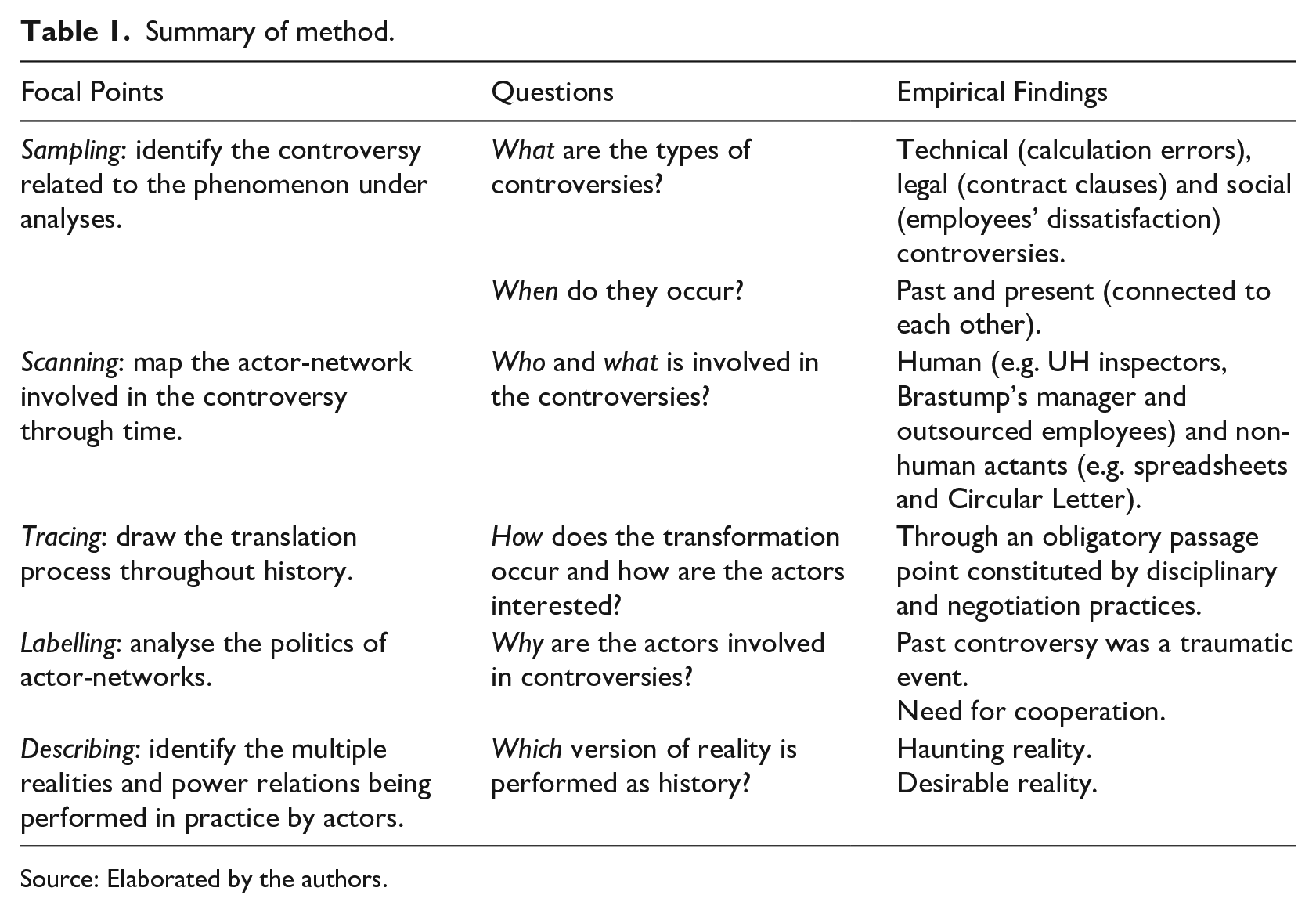
Source: Elaborated by the authors.
As Law (2004) observes, there is no such thing as an objective reality waiting to be discovered. It is the research method in action that helps to produce what it strives to understand and describe. According to Durepos et al. (2019), ‘as researchers we can and should think about the worlds we wish to describe. This is because we participate in the decision concerning what can and should be brought into being through our research’ (p. 13). In writing about the controversies around contract implementation we are enacting hospital reality. As researchers we are surrounded by a network of sources of information (e.g. informants) and a network of legitimate history (e.g. other authors or historians) which create constraints and legitimations of historical accounts (Hartt et al., 2014). In this sense, in describing events and history we do so as a social construction that results from the association of networks (Durepos and Mills, 2012a).
Considering that knowledge of phenomena is partial and situated (Durepos and Mills 2012a), other researchers might trace a different actor-network, bringing the fore actants not visible at the time of our fieldwork. Different network sources of information may leave new traces; for example, as ‘archival material passes into the public from the confidential. Stories previously untold by informants are revealed’ (Hartt et al., 2014: 301).
Durepos and Mills (2012a) point out that actors’ situated knowing performs partial accounting among multiple possible realities. The partial history performed in this empirical methods paper made hospital managers and inspectors concerned about their responsibilities and those of the outsourced company to its employees in terms of payments for their labour rights, even though we avoided taking sides or exposing our perception on the most rational ways of proceeding in the face of the controversies caused by the contract (see Guillemin and Gillam, 2004).
Next, we will detail the method and its application. The five focal points should not be seen as a linear process but focus on research attention in analysing controversies.
Contributions and method implications
Sampling (identify controversies): What are the types of controversies and when do they occur?
Our first focal point was identifying what type of controversies emerged during the contract implementation and when they took place. Doing this was important because identifying a heated controversy opens up an opportunity for exploring different historical accounts created by actors (Secord and Corrigan, 2017). To know if we were observing a controversy and not just a one-off conflict, we focused our search on disagreements that triggered a variety of snowball issues (Hussenot, 2008) related to the past and the facticity of knowledge production (Durepos and Mills, 2018). We sampled controversies that were technical/legal and social that had taken place during the recent history of the hospital.
The technical/legal controversies concerned disagreements in the network of actors related to the non-fulfilment of the contractual clauses. The problem became apparent when UH received two spreadsheets and supporting documentation related to Brastump’s first payment, containing inconsistencies. A series of negotiations were initiated by UH’s detailed checking of the spreadsheets. The contract auditors prepared a Circular Letter indicating errors found in monthly invoicing. On this basis, it was decided that it was not feasible for UH to pay Brastump. Brastump’s actions were causing controversy related to payment errors in the amounts of wages and benefits outlaid. Consequently, social controversies arose as and from dissatisfaction among Brastump employees. The UH managers were worried about a potential conflict situation emerging in current organizing practice as a result of the sub-contractors’ actions. An e-mail exchanged between HU managers illustrates this point: The July/2015 salary came out in early August with many inconsistencies creating collective demotivation in the Brastump employees. The biggest complaint is the company neglect of them, so they criticize that no one explains what is going on. Brastump just say that they are ’waiting for a hospital positioning’. Well, we think that this situation is serious because we understand that Brastump should not transfer its responsibility to employees for the hospital (E-mail 01).
Following Venturini (2010a) and Hussenot (2014), we looked for practices taken for granted in the past and recently questioned. The payment of employees was a vexed issue. At this point, by focusing on questions related to payment practice controversy analysis was helpful in tracing the history of contracted companies. As Tureta et al. (2021) suggest, researchers should embrace past controversies in order to understand current disagreements and marginalized voices. The marginalization of outsourced employees as a result of contract disputes had occurred in the past, a critical event that prepared the tense ground on which the history of the present unfolded. For Bettin and Mills (2018) the tensions between distinct narratives and accounts are important since it is evidence of an initial disjuncture among actors. In this sense, the controversies around the contract became a repository for critical events recalled from the past. Since past events contributed to the actors’ understanding of the present (Mills and Durepos, 2010), local history became our key starting point for analysis.
Researchers interpret the material and discursive traces produced by actors (Clark and Rowlinson, 2004; Corrigan, 2016; Kieser, 1994; Weatherbee, 2012) as the past is not ontologically recoverable. We directed our focus to the discursive narratives around the materiality and accuracy of the spreadsheets, the ensuing dissatisfaction of Brastump employees and the articulation of contract clauses. Doing so, we were able to identify that technical (spreadsheets errors), legal (breach of contract clauses) and social controversies (employees’ dissatisfactions) were entangled. The following excerpt illustrates this point.
On August 10, 2015, two outsourced employees stepped into the UH administrative facilities looking for help. They carry out the same activity but while one received an insalubrity benefit, the other did not. Lisalba’s assistant took their information and told them: “that is not acceptable, we will talk with Brastump and get in touch with you soon”. The next day, we observed dialogue between Lisalba and Marechal [UH managers] in the corridor. Lisalba told Marechal some bad news: “Brastump sent a wrong spreadsheet considering the payment of insalubrity on top of base salary”. Shocked, Marechal said: “insalubrity is paid on top of the minimum wage”. Lisalba agreed and concluded: “we will have to bar the insalubrity payment to Brastump again” (Field Notes 01).
The controversies around both spreadsheets unfolded a set of relationships among heterogeneous actors to translate their interests, opening up the opportunity to follow the actor-network of the contract implementation.
Scanning the terrain (mapping the actor-network): who is involved in the controversies?
After the contract implementation controversy an actor-network formed. In mapping the actor-network involved in the controversy we could identify those who were engaged in situated disagreements (Venturini, 2010a) as ‘actors are never isolated in controversies’ (Venturini et al., 2015: 78). We were also able to trace the relations of actors from past to present (Durepos et al., 2012). Callon (1989) argues that as controversies arise actors composing networks may associate or disassociate. A significant number of humans (inspectors, Brastump manager and outsourced employees) and non-human actants (Circular Letter, spreadsheets and rules of public administration) became associated in the network centred on the contract. We adopt the three parameters indicated by Venturini (2010b) to map an actor-network from the actors’ viewpoints: representativeness, influences and interests. Doing so allows us to include as many viewpoints as possible from central to peripheral actors (Corrigan and Mills, 2012; Deal et al., 2019; Novicevic and Mills, 2019). These parameters were also helpful in mapping the positions of the actors at different moments in the recent history of the hospital and their interpretations of the current controversy, as well as its relation with what had occurred in the past.
According to Venturini (2010b) when a viewpoint has support from actors, it becomes representative, making it a focus for research attention. Influential viewpoints are related to the actor’s ability to attract prominent supporters, enhancing their chance of shaping controversies and succeeding (Venturini, 2010b). Using these two parameters, we identified that Lisalba’s viewpoint was representative and influential in inspecting spreadsheets and negotiating the resolution of errors. As a contract audit specialist she worked hard to avoid contractual problems that could generate similar traumatic controversies as in the past.
In the morning, Lisalba continued analysing the worksheet of Brastump, seeing several mistakes emerging from the analysis. At Lisalba’s desk, there are some processes that have to be followed by entailing much documentation. Questioned about these, she answered: “supervising a contract is a constant learning. You need to have the various volumes on the table to consult more easily. And with the incessant revisions we learn new things daily. We found errors.” (Field Notes 02).
Furthermore, Lisalba was responsible for meeting with the Brastump manager to negotiate the solution of inconsistencies in spreadsheets. Doing so, she was able to get support from the other actors and frame their actions in order to cooperate in providing the correct information on the spreadsheets, as demonstrated in subsequent e-mails: ‘Excellent position Lisalba and Brastump Company. We have to understand the adjustments that are taking place’ (E-mail 02). ‘I leave here also my compliment to Lisalba. Excellent!!!’ (E-mail 03).
Finally, controversy depends on minorities disagreeing with majority reports questioning what is taken for granted (Venturini, 2010b). Since the traumatic event that gave rise to the past controversy outsourced employees were mapped as occupying a marginalized position: they were undervalued and mistreated by Brastump (see E-mail 01). As in the past, the current controversies arose mainly from the manifestation of employees’ dissatisfaction with errors in the payment of their salaries (see Field Notes 01). They started to question Brastump’s actions in the face of its demands.
The enactment of multiple local histories (see Jenkins, 1995) brought non-humans actants such as spreadsheets, Circular Letter and contractual clauses to the surface, making them visible, as we mapped the actor-network. Controversies involve all kind of actors (Hussenot, 2014; Venturini, 2010a) and these should be treated symmetrically when considering the past and its unfolding (Durepos et al., 2012). The spreadsheets prompted hospital managers to take action to solve payments problems. The Circular Letter constrained Brastump to start negotiations with the UH. Contractual clauses supported employee complaints. The controversy analysis allowed us not only to map non-humans as (passive) elements of the hospital network but also to understand their role in modifying the state of affairs. The agential capacity of these actants contributed to shaping the action of other actors, as we will show next.
Tracing (drawing the translation process): how does the transformation occur and how are the actors interested?
Translation implies the association of different actors to (re)define their goals and interests and establish an OPP that all actors must accept to achieve what they want (Callon, 1986; Clegg, 1989; Latour, 1999). We were focused on understanding how transformations in the relationships of actors occurred and how they associated with each other, especially in modifying other actor’s actions (Durepos and Mills, 2012b). To do this, we had to inspect traces of the past and grasp how similar practices took place during the previous controversy. History both informed practice and provided an interpretative context (Clark and Rowlinson, 2004). Controversy analysis was critical here because, as Novicevic and Mills (2019: 131, 132) state, ‘a controversy may emerge when the AH [ANTi-History] scholar, following practices in actor-networks as they produce alternative histories/knowledge of the past, unpacks how the seemingly hegemonic nature of the conventionally accepted history is challenged’. In this sense, tracing the composition of networks we were able to move from social facts taken-for-granted (e.g. employee marginalization) to alternative histories of their emergence (Foster et al., 2014), such as negotiations for the (temporary) resolution of the current controversy.
In inspecting the traces of the past, we found that the attempt to achieve a resolution of the controversy between UH and the Quality Institute had failed. To draw attention to the seriousness of the present controversy, Lisalba referenced the previous controversy as having produced a trauma that persisted: ‘we have a massive trauma bequeathed by the previous company which delayed payments and did not properly pay terminations’ (E-mail 04). The past controversy was being re-embedded in current organizing. The past is not abandoned when artefacts such as contracts change.
After analysing traces of the past controversy, we turned our focus to the present controversies aiming to understand how remnants of the past produce transformation influencing localized decision making and actors making sense of events (Hartt et al., 2014). Faced with the sediments of history laid down in the traumatic controversy of the past, those that did not share it could seek only to negotiate the disciplining that the current controversy enacted in its wake. The Circular Letter was a bureaucratic actant that disciplined Brastump, altering its actions. As an actant, it brought the manager to the hospital to start a negotiation, transforming him from a passive actor to one interested in finding a solution. Similarly, the spreadsheets also brought about changes. The spreadsheets exposed the company’s neglect in relation to its employees, compelling hospital managers to take actions to guarantee employees’ rights.
Barely dawn on a working day on Wednesday, Benjamin from Brastump entered the UH administrative building eager to resolve the problems and questions raised in the Circular Letter. The second month of Brastump services had almost ended, meaning it would have to make another request for payment for its outsourced employees working at UH but without having received payment for the first month. In a brief meeting, Lisalba explained each of the points of the Circular Letter. Later, Benjamin reappeared to present the documents listed in the clause 1.13.29 of the contract (Field Notes).
Whenever actants act they leave some traces deploying information that allows researchers to seek clues to actions (Latour, 2005). Thus, to observe actants in action we looked for changes in the course of actions of other actors, such as Brastump’s position in the actor-network shifting from a disengaged to an interested actor. The non-human actants (Circular Letters and spreadsheets) proved capable of making a difference. Their despatch led the Brastump manager to a meeting with the contract inspectors and providing corrections to complete the payments. As actants, these materialities modified the state of affairs (Latour, 2005; Mol, 2010) of contract implementation by establishing negotiation and discipline practices as an OPP through which the different interest might pass. On the one hand, Brastump wanted to be paid. On the other hand, UH was trying to solve the outsourced employee’s problem.
Hussenot (2014: 380) claims that non-humans play an active role in controversies, that is, ‘they set the controversy in a specific territory (or negotiated space), which facilitates the activities of negotiation and coordination’. They circumscribe the controversy, enabling actors to share meaning (Hussenot, 2014). In tracing the translation process from past to present controversy analysis was helpful because it allowed us to observe that spreadsheets and Circular Letter were not just passive tools used by managers to do bureaucracy. In fact, they were actants whose agency in enacting negotiation and disciplinary practices played a central role in the translation process. In this sense, we investigated actants producing durable alliances (Secord and Corrigan, 2017) during the translation process. For example, as a bureaucratic artefact, the Circular Letter obliged Brastump to start a negotiation. The temporary stability of the actor-network in the implementation of the contract was achieved by this guarantee. Paraphrasing Latour (1991), these actants afforded the possibility of holding contract actors together while simultaneously making the hospital contract durable.
The combination of interests cooperating with each other seemed to offer a plausible (temporary) solution. As shown by Secord and Corrigan (2017) in the case of the entrepreneurial work of privateers, once controversy is provisionally resolved, the translating process ends up establishing a specific actor-network. Gathering a variety of heterogeneous elements and keeping them in place requires a significant effort on the part of the actors (Cassel and Lee, 2017). As a result of such efforts heterogeneous elements assume agency in the politics of actor-networks (Corrigan, 2016).
Labelling (politics of actor-networks): Why are the actors involved in controversies?
In labelling, the focus was on identifying and analysing why the actors got involved in the politics of actor-networks. We investigated those motives that led the actors to invest efforts and resources in persuading others to create a goal and connect with each other by cooperating. The past controversy was evident in the current controversial politics of the actor-network. In this sense, controversy analysis was appropriate because the politics of an actor-network were enacting the past, framing the present controversy in terms of those matters at issue (Durepos et al., 2012). What seemed a simple matter of a contract ended up decomposing into conflicting parts (Venturini, 2010a). We found that the primary motivation of UH managers for investing efforts in cooperation related to the past controversy. The trauma of employees’ protests and breach of the contract was still alive.
Brastump’s motivation was financial, as it wanted to be paid as soon as possible. As Hartt et al. (2014) show, the remnants of a past network can endure in the form of non-corporeal actants, in this case, remembrances of times past influencing decision-makers’ choices. We observed that the translation of current interests was enacted through past traces constituting the politics of actor-networks. Past decisions did not determine organizing but an understanding of them framed present decision-making (Kieser, 1994), as we identified in the engagement of the actors in political action around the OPP in negotiations. Circumscribing a specific territory (Hussenot, 2014) for the formation of politics of actor-network spreadsheets and Circular Letters brought the actors together to cooperate in creating a space in which negotiation and disciplining were performed.
On the one hand, UH actors sought to negotiate the relationship with Brastump, by being tolerant and flexible regarding deadlines and possible errors. Traces of the past indicated that breaking the contract could be disastrous. On the other hand, if they were to be unduly lax and benevolent, it could lead to an untenable situation for Brastump employees working at UH, triggering protests such as those that occurred in the past. When the politics of actor-networks enact what was an assumed contractually shared reality in different ways (Corrigan, 2016), attempts to stabilize those controversies that ensue will involve numerous turbulent translations, as heterogeneous actants construct and interpret the history of these controversies (Durepos and Mills, 2012b).
Different from the past controversy, the current one did not end in breach of contract. However, the appearance of stability was ‘an effect of a process of ordering’ (Durepos et al., 2008: 76) making ‘a provisional end to controversy and . . . the political cost of alternatives too high’ (Secord and Corrigan, 2017: 108). Considering the consequences of the past traumatic event it was clear that the cost of breaking the contract would be high for both organizations. So, the actors had considerable motivation to find a shared solution by adjusting the spreadsheets. These political endeavours implied the enacting of multiple realities.
Describing (multiple reality and power relation): which version of reality is performed as history?
Describing is the fifth focal point in the research process. The focus was to understand which reality was being performed. We were attentive to the actors’ practices enacting both visible and less visible realities, since it is from these that history emerges (Bettin and Mills, 2018). When actors perform multiple narratives of the past (Corrigan, 2016) reality can be both more than singular at the same time as it is less than many (Mol, 2002). Controversies set the ground for multiple realities to be enacted. To identify this multiplicity controversy analysis was practical at this point for making visible traces that afforded some hints of potential disagreements concerning organizational history and practices. Mapping controversies and multiplying viewpoints (Venturini, 2010b), we were able to identify two distinct realities. The first is a haunted reality that arose from past controversy. The second is a desirable reality that was being enacted in the current politics of the actor-network. As we showed earlier, the spreadsheets were mostly responsible for bringing these realities to life. They expose the neglect by Brastump of its employees and the need of UH managers to enforce the contract clauses to avoid a similar situation to that which caused the past traumatic controversy.
On the one hand, we observed that the contract inspectors resuscitated the past controversy in meetings and e-mails. A strategic narrative showed that the current controversies could produce an undesirable reality, such as had occurred in the past. In the past controversy, the voices of outsourced employees had been marginalized, with their labour rights threatened by the Quality Institute’s management practices, resulting in a strike. It was this reality that haunted UH’s perceptions of the present situation. On the other hand, to implement the contract correctly would create the desired reality. To achieve that result, discipline and negotiation required the association of heterogeneous actants (Circular Letters and spreadsheets) creating an OPP. The OPP ensured the temporary success of translation processes achieving a desired reality for the hospital community, one that unified the actors around cooperation.
These realities are consequences of many people and actants making up an organizational practice (Corrigan, 2016). As UH managers performed bureaucracy, they negotiated a history that imbued the present as well as being a part of a traumatic past. Although specific modes of ordering may be forgotten over time after translation processes (Durepos et al., 2008), they remain sedimented in the consciousness of past practices connecting and performing the actor-network (Durepos and Mills, 2017). Multiple realities coexist and are part of a whole actor-network (Mol, 2002). The past reality that still haunts the present does not just coexist with desirable reality but is a constitutive part of its meaning. Controversies are an opportunity to understand not only the constitution of the past (Secord and Corrigan, 2017) but also its current developments and the materialization of the contract actor-networks’ temporary stability in public administration practices.
Conclusion
Analysis of controversies was presented as a method with which to trace and investigate the enactment of organizational reality related to the past, thus answering the question of how the past is enacted in the present. We have indicated that researchers can use the five focal points as a sensitizing device with which to focus on fieldwork and inquiry. The method is a process in which some of the focal points may take place simultaneously or in a different order than presented. Controversy analysis applies to ANTi-History scholars because it allows researchers to map the politics of actor-networks and exposes the associations between humans and non-humans that produce multiple realities and silence marginal voices.
We have shown that controversies are not only simple conflicts around current organizing issues. They can be related to past events that reveal what was taken for granted by actors, such as occluding peripheral voices of the outsourced employees. When past controversies are associated with current issues they influence the politics of actor-networks, how the present is enacted, as well as the multiple realities produced. We also argue that controversies can be brought to life through non-humans (spreadsheets and Circular Letter) whose agential capacity constraints actors to do what otherwise they would not do. The spreadsheets were the materialization of controversies in the most vivid form, exposing neglect on the part of Brastump and the need to enforce contract clauses by UH managers to guarantee employees’ rights. As actants, these elements can turn a passive actor (Brastump) into an interested one negotiating and achieving goals. The need for a more critical organizational history (Durepos et al., 2019) can be accomplished by using controversy analysis as a tool for questioning what is taken for granted and tracing how multiple realities are enacted in organizations.
Footnotes
Funding
The author(s) received no financial support for the research, authorship, and/or publication of this article.
