




Abstract
The article describes what we have come to call ANTi-History, which entails the development of actor-network theory (ANT) as a critical approach to organizational historiography. It proceeds through four sections: 1) a review of the call for critical organizational historiography to establish the need for ANTi-History; 2) an overview of ANT to identify its potential to contribute to critical organizational historiography; 3) a development of ANT insights into an ANTi-History, through engagement with cultural theory historiography, and the sociology of knowledge; and 4) an account of the potential contribution of ANTi-History to critical management studies.
Keywords
Historians, as portrayed in historical texts, can move freely in the past, possess knowledge of the future, have the ability to survey settings in which they are not (and never will be) involved, have access to actors’ motives, and (rather like god) are all-knowing and all-seeing, able to judge what is good and bad. They can produce histories in which one thing is the ‘sign’ of another and in which disciplines and ideas ‘burgeon’, ‘mature’, or ‘lie fallow’. Our own historical interest … does not attempt to imitate that of professional historians. We do not attempt to produce a precise chronology of events in the field, nor to determine what ‘really happened’. … Instead our concern is to demonstrate how a hard fact can be sociologically deconstructed. With this somewhat lame historical interest we hope to provide an enriched study of the past which avoids some of the basic contradictions and lack of symmetry characteristic of much history of science. (Latour and Woolgar, 1986: 107)
In their call for a critical ‘historic turn’ in management and organizational studies, Booth and Rowlinson (2006: 7) argue for an approach that is ‘aligned with critical management studies in its critical and ethical reflections’. We contend that a historically engaged actor-network theory (ANT) has the potential to be such an approach given its method of (re)assembling the social, its acknowledgement that actors are historical, its mention of history and its inherent critique of positivism and realism. As such, we see in ANT the promise of a critically reflective historiography capable of simultaneously dealing with, and problematizing concepts such as the past, history (especially large ‘H’ History, see Jenkins, 1997) and historiography. Perhaps this alternative could be a form of anti-history or, what we have come to call ANTi-History (Durepos, 2009; Mills and Durepos, 2010). 1
Before proceeding, however, we want to make clear that our references throughout this article to ANT is to a body of theory associated with a growing number of scholars, particularly the so-called ‘French School’, and ‘And After’ literature that make conscious claims to be contributing to ANT. This may strike the reader as obvious but, as we shall demonstrate at different points, ANT itself is a contested term, an ironic outcome of socio-politics (Law and Hassard, 1999), with different meanings to different collectives of scholars. The latter point is evidenced in the diversity of labels used to describe ANT. For example, Callon (1999: 194) has problematized the use of the word ‘theory’ in ANT, arguing that ‘it is this that gives it both its strength and its adaptability’. We follow Law (1999: 1) as well as Alcadipani and Hassard (2010: 419) in referring to ANT as an ‘approach’. In using the term we shall attempt to indicate some of the differences that have occurred over the meanings of ANT and illustrate our position on the tenets. In this way reference to ANT can be understood through our own socio-political ordering.
The promise and the problematic of ANTi-History can be glimpsed in the opening quote. Latour and Woolgar (1986: 107) reveal an ‘historical interest’ in ‘the past’ but distance themselves from the methods of ‘professional historians’ and standard historical (or ‘chronological’) accounts. Instead, through ‘sociological deconstruction’ (later referred to as ‘reassembly of the social’, see Latour, 2005), Latour and Woolgar set out to ‘provide an enriched study of the past’. In this early description, we can see an attempt by scholars of ANT to deal with the past that is at one and the same time a critique (an anti-history perspective) and an approach 2 (a historical perspective) to history (albeit a ‘lame’ one!). Surprisingly, given its focus on (re)assembly of society, its regular mention of history (Latour 1999a, 2005; Law, 1994) and its acknowledgement that elements composing society stem from the past, nowhere does ANT explicitly theorize concepts of ‘past’ and ‘history’.
Thus, while the concepts of ‘past’ and ‘history’ appear regularly in ANT studies, their mention and use is often unreflexive and unproblematized. For example, Latour’s (2005: 166) description of interactions in the social as made of ‘elements which are already in the situation coming from some other time, some other place …’ neglects to inform us of the constitution of the ‘other time’ from which the ‘elements’ that make up the social have stemmed. Nor does he hint to the nature of the historicity of the elements (from ‘some other time’) that make up the present composition of the social. Similarly, Callon’s (1999: 192) discussion of the constitution of an ‘organized market’, in which he states that ‘homo economicus does exist, but is not an ahistorical reality’, fails to explain how things are constituted as an historical ‘reality’. Mol (1999: 75), in an elaborate discussion of ontological politics assures us ‘that reality is historically, culturally and materially located’. However, her illustration of ‘anemia’ (p. 79) as composed of elements that have ‘emerged at different points of history’ rather than as ‘alternative, bygone constructions of which only one has emerged from the past’, does not deal with issues of what constitutes ‘a point in history’ or its ‘emergence’.
Acknowledging that an element constituting society comes from another time (Latour, 2005) or that a market economy is a historical construct (Callon, 1999) is quite different than performing its historicity (i.e. revealing how historical knowledge is created). And, perhaps as a result of the lack of an explicit attempt to do history, no discussion of historiography features in extant ANT research. In fact, it is assumed in much of the ANT scholarship that history or understanding the past is the task of the historian as opposed to sociologists of the social. Latour (2005), for example, notes that the work of ‘the history of science and technology is important for our program [of research]’ (p. 11); asking ‘What would we know of the past without historians?’ (p. 257). In much the same vein, Law (1999: 6) directs us to ‘historians of technology’ for an understanding of ‘networks’ and ‘power’. In short, it is as though ANT scholars acknowledge the historicity of the social but leave its performance to others.
The above examples, we hope, illustrate both ANT’s neglect of doing history as well as its immense potential to form the basis of a critical approach to historiography. As we shall argue, the promise of ANT as a ‘critical organizational historiography’ (Taylor and Freer, 2002) depends on an engagement with ‘history’, ‘historiography’ and ‘the past’, as well as with critical approaches to organization studies. This article seeks to realize ANT’s potential as historiography by informing it with insights from the sociology of knowledge (SoK) and cultural theory to develop an ANTi-History. To do this, we begin by describing recent calls in management and organization studies for an historic turn, followed by a review of ANT. The third section draws on insights from ANT to develop ANTi-History. We conclude with reflections on history and critical management studies.
The call for a critical ‘historic turn’ in organization theory
The call for an historic turn in management and organizational theory goes back at least three decades (Austin, 2000; Kieser, 1989, 1994; Wren, 1979) but has more recently become a determinedly critical call (Booth and Rowlinson, 2006; Jacques, 1996, 2006; Taylor and Freer, 2002; Zald, 1993). According to Üsdiken and Kieser (2004), we can detect at least three approaches to the historic turn—supplementarist, integrationist and reorientationist. The first merely argues for ‘adding history as another contextual variable, alongside other variables such as national culture’ (Booth and Rowlinson, 2006: 8). 3 The second argues for an enrichment of organization theory ‘by developing links with the humanities, including history, literary theory and philosophy, without completely abandoning a social scientifistic orientation’ (Booth and Rowlinson, 2006: 8). This is the approach favoured by Kieser (1994; Üsdiken and Kieser, 2004), who make four key points:
In order to understand contemporary institutions it is important to know something of their historical development.
Through historical analysis we can reduce the ideological biases that are embedded in ‘current “fashionable” trends in organization theory and practice’.
Through historical analyses we can ‘interpret existing organizational structures not as determined by [objective] laws but as the result of decisions in past choice opportunities’, whether intentional or implicit.
‘By confronting theories of organizational changes with historical development, these theories can be subjected to a more radical test than they have to pass when merely being confronted with data on short-run changes’ (Kieser, 1994, cited in Bryman et al., 2011, 429–430).
While this form of questioning challenges the overly ‘objectivist’, ‘presentist’ and ‘universalist’ character of much of management and organizational theory it, nonetheless, does so in a way that tends to objectify ‘history’ and ‘the past’ and privilege evolutionary notions of historical development (see for example Kieser, 1989). Taking the third approach, Booth and Rowlinson (2006) argue for a thoroughgoing reorientationalist agenda that involves a fundamental critique of both the ahistorical nature of existing theories of organization and the atheoretical character of much of historical analysis—suggesting the need to develop styles of writing and methods that can enable historicized research.
Ahistorical business studies
Booth and Rowlinson (2006: 6) contend that ‘the approach to problems in business school social science is “universalist and presentist”’. The former refers to the view that ‘contemporary organization theory applies to organizational phenomena in all societies at all times’, while the latter refers to research that is reported as if ‘it occurred in a decontextualized extended present’ (Booth and Rowlinson, 2006: 6). Universalism and presentism can be seen as important outcomes of a search in the social sciences for general and abstracted laws that, in the process ‘cut itself off from history’ (Booth and Rowlinson, 2006: 6).
To redress this, they go on to argue that calls ‘for more historical awareness’ are often aligned with critical management studies, including claims that business schools have been cut off from humanistic thinking; that business school faculty have ‘been allowed to escape from “any real sensitivity to the issue raised by the humanities, including history”’, and that ‘an “historical perspective”’ can “provide a critically reflective version of the good society”’ (p. 7). Thus, they conclude, the historic turn should also involve ‘more critical and ethical reflection’ (p. 7).
Historical methods and styles of writing
Booth and Rowlinson (2006: 9) contend that much of what counts as historical analyses in business studies, whether by non-historians or historians (including business historians), is not usually accompanied by methodological justification: at its best ‘the copious notes detailing the location of sources in the archives are usually seen as sufficient methodological justification in their own right’. This can be compared with the requirements of ‘social science research in general, and for qualitative researchers in particular [where] it is expected that there will be a detailed methodological justification of the research conducted’ (Booth and Rowlinson, 2006: 9). Thus, continue Booth and Rowlinson (2006: 9) ‘we would therefore expect the historic turn to lead to greater reflection on the historical methods appropriate for studying organizations’. In particular, they continue, (2006: 10) ‘if there is to be methodological reflection and experimentation in historical writing, then this will involve further engagement with the philosophy of history and historical theorists’.
(Re)visiting actor-network theory
Taking up the challenge of a more critically aware approach to history, our review of the literature suggests that ANT provides the basis for a thoroughgoing critical organizational historiography. In this section, we briefly revisit some of the key tenets of ANT (Figure 1). We then pull together insights from the sociology of knowledge and cultural theory historiography in the next section to illustrate an alternative critical approach to organizational history, or an ANTi-History.
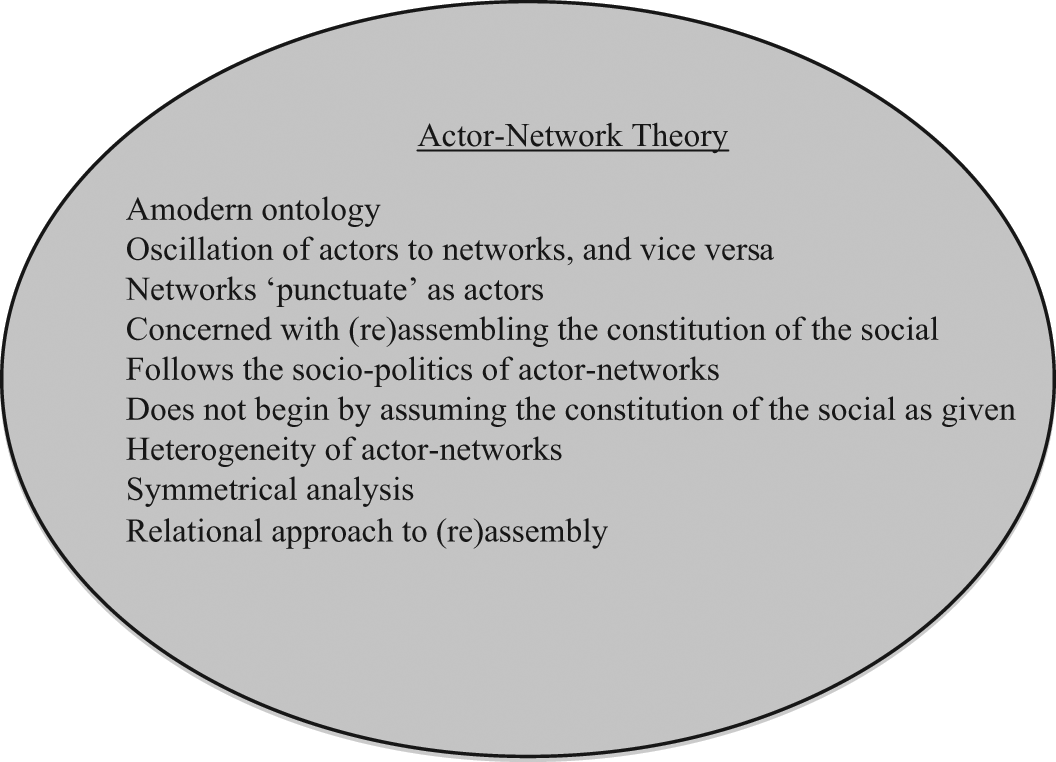
Key Insights of Actor-Network Theory
As Latour (1983) notes, ANT initially developed from studies that were dedicated to an anthropological analysis of laboratories. In Laboratory Life, Latour and Woolgar (1986) viewed laboratories as sites where many disparate elements (chemicals, small animals, people, typewriters, pencils, complex machinery) came together to be transformed into scientific reports and journal articles that contained ‘truths’ and ‘facts’ (Godfrey-Smith, 2003). The initial studies of laboratories were devoted to understanding what happened in the process of transformations, what ‘processing’ transformed the series of disparate elements into an ordered, coherent, and finished product. Latour and Woolgar (1986) saw these ‘processes of processing’ as an enterprise in fact building in which the end products (facts, truths) hid all human participation. Thus, for many, the laboratory studies served to expose the subjectivity of scientific knowledge by illustrating its socio-political genesis (Pickering, 1992). Ultimately, Latour felt that these studies would yield keys to the sociology of ordering of social life; to show scientific knowledge as a socio-cultural product; and thus to trace the roots of the social and the knowledge that is understood as an effect of social ordering (Callon and Law, 1982; Latour, 1999b; Law, 1994).
In their attempt to develop a new social theory to understand science and technology (S&TS, a strand of the sociology of scientific knowledge), Callon (1986a), Latour (1988) and Law (1986a, 1986b) challenged the asymmetrical character of the social as ordered around human and nonhuman categorization (Collins and Yearly, 1992), arguing instead for analysis that looked processually at the interactions between nonhuman and human actors, to generate new insights on the composition of society as made of heterogeneous actors (Callon and Latour, 1992). This lead to friction among scholars in the field of the sociology of scientific knowledge, leading to a split into, what has been labeled, the ‘Bath’ and the ‘French’ ‘schools’ (Pickering, 1992). The latter approach included Latour, Callon, and, eventually, Law and was transformed continually through its extensive academic travel across disciplines including science and technology studies and more recently, organization studies (Alcadipani and Hassard, 2010; Brigham and Corbett, 1997; Calás and Smircich, 1999; Czarniawska and Hernes, 2005). With each application and every translation, ANT was altered causing some (Law and Hassard, 1999) to comment on the irony of the theory’s fate. The late 1990s saw the emergence of the ‘ANT And After’ literature whose agenda focused on reclaiming and problematizing basic tenets of ANT, while further theorizing it. This agenda included discussions concerning ontological politics (Alcadipani and Hassard 2010; Mol, 1999), multiplicity (Mol, 1999) and topological complexity (Law, 1999).
The variant of ANT developed by Latour (1987, 1993, 2005), Law (1986b, 1992, 1994, 1999) and Callon (1986a, 1986b, 1999), offers specific ontological insights to understand the composition or topography of society (Latour, 1993, 2005). Society, according to Latour (1986: 273), is what is ‘performed through everyone’s efforts to define’ or explain it. This differs from sociological perspectives that begin their analyses with an implicit assumption that society is constituted, or pregiven (Latour, 1999b). From this approach, society’s composition includes a trail of associations, multifarious connections between heterogeneous elements. It is less a specific realm or an academic domain but a ‘very peculiar movement to re-associations and reassembling’ (Latour, 2005: 7). As Alcadipani and Hassard (2010: 419) have recently noted, ANT promises ‘a reflexive approach to management and organizational knowledge’. Since it is assumed in ANT that knowledge, too, is an effect of the ordering of actors, it can be a useful approach to trace the politics of knowledge creation. We contend that it can also be applied as an approach for understanding knowledge creation of the past as an effect of heterogeneous actor-networks (Law, 1992). It is to a review of actors and networks that we now turn.
Actors and networks
ANT, thus, is an approach that suggests that understandings of the constitution of society can be achieved through efforts to trace actors as they form networks and in tracing networks as they become ‘actors’. Specifically, it is about the ways in which elements that make up the constitution of the social join together in creating and reproducing or altering social patterns. ANT assumes the social to be constituted of actors—defined as those that have the capacity to act upon or alter another (Law, 1986b). According to Latour (1983), actors continuously partake in political work through engaging, mobilizing and translating other actor’s interests, and finally enrolling actors to take on the same cause. A cause is made stronger when actors and their interests have been translated (i.e. the process whereby interests become aligned through one actor showing his or her capacity to assign roles to other actors, see Law, 1992). As Latour (1983: 144) notes, ‘who is able to translate others interest into his [sic] own language carries the day’. Through translation and the systematic alignment of actors, networks are formed. To the degree that actors making up networks are capable of sustaining an extreme alignment of interests, according to an overarching cause, they begin to act as one, or a single point actor, punctuated actor or black box (Akrich, 1992). If a network is capable of sustaining an ‘extreme’ alignment of its actors, i.e. where it is capable of acting as ‘one’, it comes to be viewed as an actor, rather than a network. For example, prior to his election the campaign activities around the candidacy of Barak Obama was often commented on for its network of actors, while after the election the multitude of activities was seen as more the embodiment of one man. In this way actors can be understood as networks and networks can be understood as actors. Because a network’s capacity to sustain an extreme alignment of its actors is precarious, networks are said to oscillate between a status of ‘actor’ and ‘network’. This explains the depiction of a hyphen between ‘actor’ and ‘network’.
The hyphen in actor-network theory
In observing the relationality of actors, ANT theorists focus on the manner in which actors become networks and networks become actors. Instead of looking at the activities of a single actor, a relational approach is adopted, whereby the focus is on what happens between actors to see how one actor is altered by virtue of interacting with another. The emphasis is on the relations established between actors to see how they form networks through the political engagement of the interests of other actors. Given that, in ANT, actors are assumed to be heterogeneous, the adoption of a relational lens also means looking at the intertwined nature of humans and nonhumans to understand their constitution in networks and society. By shifting the focus from an analysis ordered around human and nonhuman categorization to one that looks processually at the interactions between nonhuman and human actors, new insights are offered on the composition of society.
Where actors are proven durable and persistent in their relational activities (i.e. where certain activities are being constantly repeated, reproduced or routinized) the complex mode of ordering that initially made up the network is potentially forgotten (Law, 1992; Law and Mol, 1995). This is because a given actor (for example a corporate history book) can be understood to stand on behalf of the complex mode of ordering that initially made up a network (e.g. the people who commissioned and shaped the writing of a corporate history). In other words, a given actor can come to represent a particular complex set of relationships (see Durepos et al., 2008). However, to the degree that the actor eventually comes to conceal the social complexity that has allowed for its emergence, that actor can be understood as a black box, or a seemingly fixed social entity rather than a series of fluid entities of unknown duration and interpretation. Through this process, actors often take on an air of timeless permanence and objectivity (e.g. the corporate history book becomes the history). Using the act of writing as an example of network formation and black boxing, Law (1994: 31) described writing as ‘work, ordering work. It is another part of the process of ordering. It grows out of a context. It is an effect of that context. But then it tends to go on to hide that context’.
Amodernism and society as heterogeneous
Embedded in the ANT view of the social as relational is the assumption that the social is heterogeneous in that it is made of human and nonhuman actors (Brigham and Corbett, 1997). Human actors are not privileged over nonhuman actors (Latour, 1992; Law, 1991); instead, from an ANT perspective, both are endowed with the capacity to alter each other’s courses of action.
Material delegation offers an example of an inter-relationship between human and nonhuman actors. Material delegation refers to the delegation of a task usually assumed by a human actor to a nonhuman actor (Singleton and Mulkay, 1993). An inscription, in which a human actor transfers information to a written document (nonhuman actor), can provide an example of a material delegation. Thus, the task of delivering information previously held by the human actor is ‘delegated’ to a nonhuman actor. Inscription devices are durable (e.g. books outlive their authors); portable, and capable of reaching mass audiences through less effort than that required of a human actor engaged in the same task. Because material delegated actors can be circulated widely through little effort, they provide the possibility for disseminating information and conducting interest work on behalf of their respective network.
The ontological assumptions of ANT have been described as relational materialism (Law, 1999; Sismondo, 2004) or amodern (Latour, 1993). Instead of studying the social as separate from the material/physical, ANT theorists assume that the social is constituted by interacting human and nonhuman elements, and these elements must be understood relationally. Thus, ANT is considered a relational theory in it insistence that conceptions of the social are not embrained within actors (Blackler, 1995) but instead are (re)produced through patterned networks of heterogeneous relations (Law, 1992). Social ordering, patterning or orchestration is described as processual in the formation of networks and actors, and the task of the researcher becomes demonstrating the performativity of actor-networks (i.e. showing how the outcomes are achieved). This undercuts relentless modernist tendencies of imputing ontological concreteness onto our understanding of social processes (Chia, 1995, 1996; Latour, 1983). As opposed to understanding the social as a noun, ANT proposes understanding the social as a verb, a process of becoming that is emergent (Chia, 1995, 1996; Law, 1994). Instead of focusing on what happens cognitively or behaviourally, ANT looks at what happens relationally, that is, between actors, to understand how they are connected (Law, 1999), how they change through interactions, and how the outcomes constitute ‘the social’.
Actor-network theory as historiography
Despite its promise to reveal the political character of constructions of the social, critically missing from ANT is concern with, what we would call, the socio-past. We contend that illustrating and situating the concept of the socio-past is different from the constitution of the social (Latour, 2005), the historical subject (Foucault, 1972, 1997; Jenkins, 2003; May, 2006), even ‘the past’ (Jenkins, 1995, 1997). However, we should note that how we will describe the socio-past intersects with aspects of cultural theory, in particular Foucault’s archaeology and genealogy, as well as Latour’s ANT. Cultural theory historiographers focus on constructing history that views the constitution of the subject and its precariousness as fundamental (Jenkins, 2003). In Foucault’s archaeology and genealogy, the study of the ‘constitution of the subject across history’ (Foucault, 1997: 150) assumes a central focus, and he notes that ‘the aim of my project is to construct a genealogy of the subject’ (Foucault, 1997: 152). Thus, Foucault centres on the subject and assumes it to be a vehicle for studying and gaining insight into the various discourses that operate through it and shape it. Foucault (1997: 150) suggests that the study of the constitution of the subject has not been an easy task because ‘most historians prefer a history of social processes [where society plays the role of subject]’. In contrast, Latour (2005), while interested in social processes, focuses not on the history of those processes but on how the (present) social is performed through the social relations or politics of actor-networks.
ANT assumes that actors, the emergent constitution of society and networks are historical (Latour, 2005; Mol, 1999), but ANT fails to actually engage in a thorough problematized historicization of the elements that constitute society and their various topographical assemblies. It has been left to cultural theorists to contest notions of ‘history’, ‘historiography’ and ‘the past’ (Ermarth, 1992; Gunn, 2006; Green, 2007; Iggers, 2005; Jenkins, 1995, 1997; Munslow, 2010), and to offer insights that are crucial to the development of critical organizational historiography. Those insights include the suggestion that history is knowledge of the past (Jenkins, 1995), which, despite the material existence of people and events at a point in time (Munslow, 2010), is not materially accessible except through historiography methods rooted in different philosophical assumptions and expressed through narrative rather than evidence (White, 1973, 1985). Historiography pertains to philosophically informed methods used to craft history. What is or has past is an absent present which has no realist ontological status (Collingwood, 1956; Jenkins, 1995; Munslow, 2010; White, 1973, 1985) but nonetheless is assumed to have existed. However, a description of ‘the past’ as having previously existed may lead one to imagine that it has already happened and as a result is already constituted. Drawing in part on ANT, one might question portrayals of the past as pre-constituted. To be clear, what we lived and now call the past is not to be denied, nor what we wish to contest. What is of concern are depictions of the past as stable, already assembled, unchanging, closed, and done, prior to our efforts to assemble it (and after our efforts in assembling it for that matter). Specifically, what we encourage is questioning whether a specific constitution of the past might actually take its shape through our very efforts to define it. If we accept Jenkins (1991, 1995, 1997) description that history is knowledge of the past, then is a given variant of the past not emergent through our activities in doing history? To date, cultural theory historiographers have remained silent on the emergent constitution of the past and on their end, ANT scholars have remained relatively silent on theorizing history, past, and historiography. In this article we attempt to bridge this intellectual divide through what we will call ANTi-History.
What Latour (1986, 2005) has been effective in showing us is that actor’s translations are the active forces that shape society and give it its specific constitution. Drawing on Latour (1986, 2005), what we wish to show is the composition of society in a time before now or what we will come to call the socio-past using ANTi-History. Thus, a specific constitution of the past comes into being through the associations and translations of actors as they engage in doing history (see Jenkins, 1995).
To summarize, there is potential for theoretical engagement between ANT and cultural theory and ANTi-History is a product of our efforts to realize it. If we associate the cultural theory insight that the past refers to before-now, with the ANT insight that society is emergent and performed through our efforts to define it, our curiosities might be drawn to the composition of the before-now-society or, more succinctly, the socio-past. The aim of ANTi-History is to trace the socio-past to see how it oscillates as history, and ANT scholars have taught us well in the art of tracing associations.
The composition of the socio-past as actor-networks
We have contended that a critical historiography (or ANTi-History) should focus on the constitution of the socio-past. Drawing on ANT, we see ANTi-History as interested in tracing the actor-networks that constitute a socio-past, where the past is seen as comprised of actors who have the capacity to alter the course of other actors. Actors who have engaged in socio-politics successfully and thus have enrolled other actors in their cause are understood as having formed networks. When all the actors forming a network align their interests, they can be understood to act as one actor. There is continuous oscillation between actors becoming networks and networks becoming actors. ANTi-History seeks to map the socio-past by following the series of socio-politics of actor-networks, to understand how they perform knowledge of the socio-past or do history.
Problematizing the apriori
Next, we put forth the need to build into ANTi-History the continuous problematization of the a priori (Veyne, 2010) when tracing the actor-networks that constitute a socio-past (Latour, 1999b, 2005). We argue that in using ANTi-History, one should not let preconceptions of the composition of the past impose itself on the ordering of the traces of the past into history. What this means is exercising caution to avoid imposing a pre-given plot to order traces of the past. Any researcher dedicated to tracing the socio-past should not begin by assuming as given what a history will eventually show. Akin to empiricist and cultural theorists, we argue that, in the task of constructing knowledge of the past, one should be cautious in terms of imposing an a priori understanding on the traces to be followed (Green and Troup, 1999). Therefore, ANTi-History should not have any inherent and pre-formulated ordering prescription that is to be imposed on the activities of actor-networks but rather should follow their socio-politics to see how they map out. Drawing on insights from cultural theory, such a critical organizational historiography should seek to liberate ‘history’ (the academic category with specific conventions) from its own history (the past of the academic category where the strict academic conventions were set in place) to create new forms of telling that surprise and liberate us from the type of history that is an effect of strict historical conventions designed to impose the idea of an (ultimately) singular history.
ANTi-History problematizes the notion of predetermined histories that the historian is expected to discover or unearth. A historian’s effort to ‘unearth the history’ suggests that stories of the past are given, have plots, and are essential as well as unchanging. We argue instead that, following ANT, actor-networks are not performed according to preconceived plots; neither do they map out their socio-politics prior to engaging in them. The complexity of the social makes this task impossible, and thus we would refute the notion that pre-given plots guide actors. Actor-networks are plot-less until they engage in socio-politics; thus, they create their plot through performing socio-political acts toward achieving a desired purpose. Furthermore, our notion of ANTi-History suggests that the plot of the socio-politics of actor-networks is a retrospective construction.
We note that both Foucault (1972, 1997) and Derrida (1978) offer contrasting examples to an ANTi-History approach. Whereas Foucault (1972, 1997) is engaged in describing the discursivity of phenomena by showing how various discourses operate through and constitute the subject, Derrida (1978) is concerned with deconstructing textual products to expose their construction as interest-laden effects of modernism. Both Derrida and Foucault assume their phenomena of study as already constituted. The task of ANTi-History is dramatically different. It acknowledges that history and knowledge of the constitution of the socio-past is performed through an actor’s effort to define and characterize it.
(Re)assembling the associations of the socio-past
History is performed through (re)assembling the socio-past by tracing the associations of actor-networks. 4 As critical theorists have stated, the past is already gone, and because ‘nothing ever repeats itself’ (Jenkins, 2003: 23) our task for constructing history is always one of (re)assembly. With ANTi-History, the past is (re)assembled by following and mapping the traces, politics, and, assemblies of actor-networks to map out their performativities. And historical knowledge is not viewed as embrained, rather as communal and an effect of the politics of actor-networks.
Privileging the voice of the actors
In our development of ANTi-History we specify privileging the voice of the actors followed over that of the historian (though the historian too is also understood as an actor, she must trust that the actors followed offer the best explanation of their practice) and premise the empirical over the theoretical when (re)assembling the traces of the socio-past. Following Marx, we aspire to not explain practice from the idea but explain the generation of ideas from practices. Parallel to Mannheim’s (1953, 1985) notion of knowledge as the outcome of community interactions, we argue that there is a need to assume that distinct ways of knowing the past by actor-networks grows out of existing social conditions in which the actor-network is a participant. Thus, these forms of knowing, which are effects of actor-networks, do not need to be legitimated by a formal epistemology. As Latour (2005: 9) notes, ‘the actors’ objection to their social explanations offer the best proof that those explanations are right’. In following the actor-networks that constitute a socio-past, an ANTi-History approach would thus encourage privileging the voice of the actors followed over that of the actor who is following or (re)assembling. This means that the actor-network should speak louder than the voice of the trained historian. In this way, the iterative nature of the empirical and the theoretical is recognized.
Constitution of the socio-past as heterogeneous
We would also put forth that the socio-past is constituted of heterogeneous (nonhuman and human) actor-networks. Though this theme is drawn specifically from ANT, cultural theory historians have specified a need for a historiography that does not ignore the ‘world of things’ (Joyce, 2007: 90). ANTi-History, we contend, needs to understand actor-networks as heterogeneous and should be dedicated to a relational understanding of the relationship between human and nonhuman actors. The constitution of the socio-past through politics, translation, and punctuation are drawn from ANT and are explored in the next three points. They warrant special attention as core processes in doing history (see Figure 2).
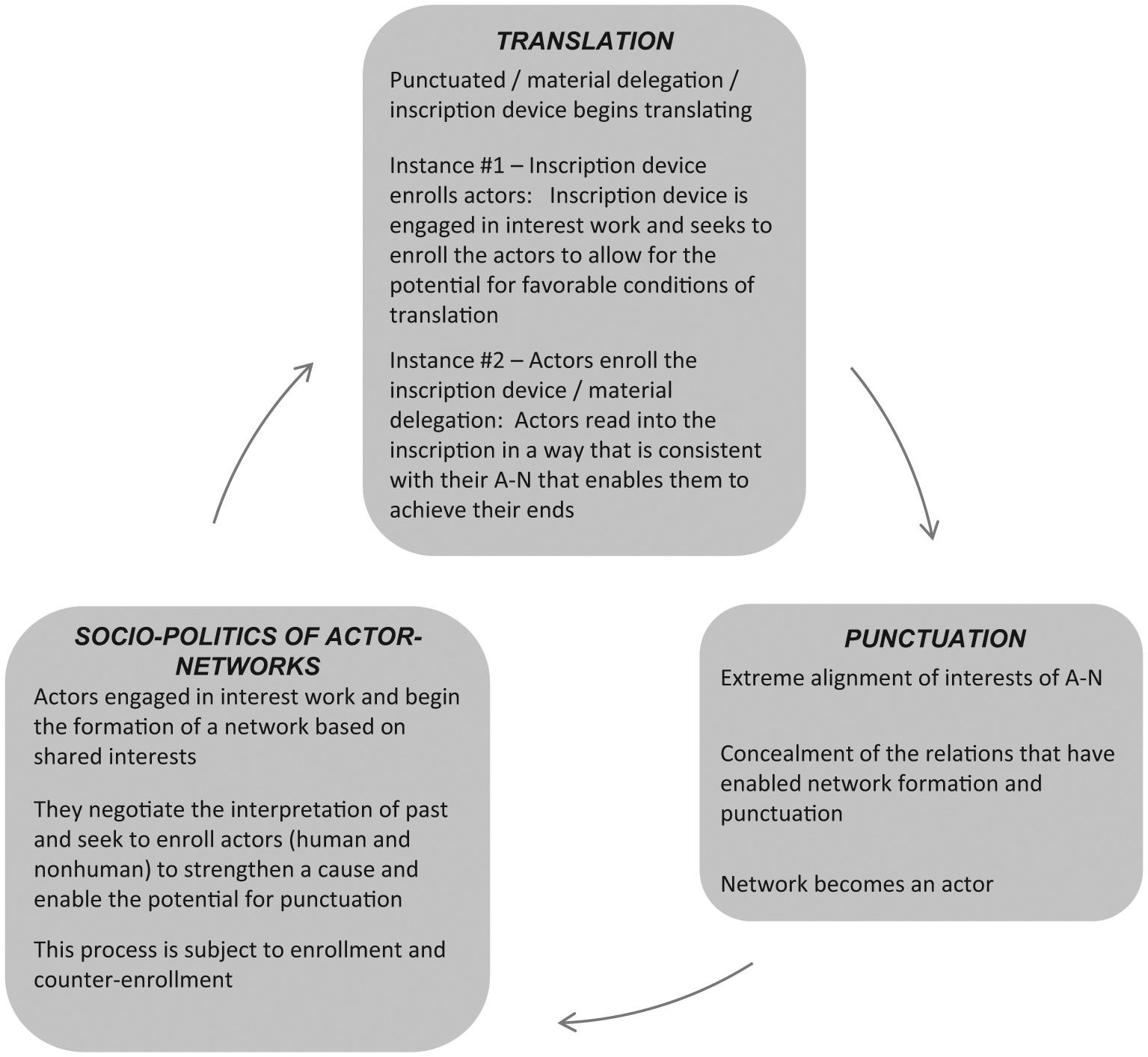
The iterative nature of the socio-politics of actor-networks, translation and punctuation
History as an effect of the interest-driven socio-politics of actor-networks
From our perspective the craft of history should be understood through the politics of actor-networks. Cultural theorists suggest that history, as knowledge of the past, can be plural and political, while an ANTi-History approach would add that the activity of knowledge creation of the socio-past is subject to the politics of actor-networks and is multiple. As illustrated in Figure 2, drawing on ANT, actors can be seen as negotiating the interpretation of the socio-past by conducting interest work with other actors. Actors are engaged in network building through the enrollment of heterogeneous actors for the purpose of creating an interpretation of the socio-past that can be considered ‘strong’ and ‘durable’ (consider the possibility that a history can be inscribed in a book). Networks in which knowledge of the past is constructed comprise many interacting actors, including not only historians, archivists and their traces, but also the material archive itself, and inanimate objects such as computers, paper, popular books, and so on. Only when the heterogeneous actors making up a network have become aligned in their interpretation and knowledge of the past is history possible.
Understanding favourable conditions of translation of a punctuated history
An ANTi-History approach might also provide insight in understanding the favourable conditions in which history as a punctuated actor travels and translates. Thus, ANTi-History might offer an explanation of the specific conditions that allow for a favourable and wide travel and absorption of a history by a collective. It is suggested that histories or knowledge of the past travel and gain legitimacy to the degree that their content is plausible, accepted and shared by a collective. Again, drawing on ANT, ANTi-History sets out to understand the conditions that allow for the translation and absorption of a ‘history’ through the politics of actor-networks. We suggest two noteworthy aspects that inform the process of translation of ‘histories’. In the first instance, the history (as an actor) is successful in conducting interest work, translates and enrolls other actors into accepting the story it tells of the past. Thus, the history is understood as successfully dispersing across or translating and altering actor-networks. In the second instance, actor-networks read into the history with their interests at hand and thus enroll the ‘history’ into making their cause stronger. The two paragraphs below explain both aspects of the process of translation.
In the first instance, we suggest that histories disperse to the degree that they are capable of enrolling actors onto their cause of accepting a given story of the past as plausible or legitimate. This means that the ‘nonhuman actor’, history, is engaged in interest work, where it encourages the translation of alternative interpretations of a socio-past held by other actor-networks into that of its own. The ‘history’ can thus be said to enroll actors into its cause of ‘knowing the past’ in the manner prescribed in the history. If a given history is successful in enrolling actors into accepting its particular story of the past, the history is said to disperse or translate. For example, Foucault’s Discipline and Punish has proven popular with a wide number of management theorists (Ahl, 2006; Burrell, 1984; Calás and Smircich, 1996; Clegg, 1990; Corbett, 2010). For the year of 2007 Foucault was the most cited author of books in the humanities http://www.timeshighereducation.co.uk/story.asp?storyCode=405956§ioncode=26): clearly his account of the Birth of the Prison (the subtitle of Discipline and Punish) has dispersed. Yet Foucault died in 1984. The book was originally published (in French) in 1975 as Surveiller et Punir: Naissance de la prison (see May, 2006: 165). It was translated into English by Alan Sheriden and published by Random House in 1977. Several management theorists has since cited this work, long after Foucault’s death (e.g. Burrell, 1984; Calás and Smircich, 1996; Clegg, 1990), some refer to a 1979 edition (e.g. Corbett, 2010), others to a 1995 version (e.g. Ahl, 2006). The ‘history’, it would appear, continues to ‘influence’ understandings—medating death, translation, publication and editions.
In the second instance, actor-networks read into the history and they enroll the ‘history’ as an actor dedicated to making their cause and their network stronger. Drawing on Bennett (1987), we suggest that the specific manner in which a history is read depends on the ideological, spatial, and temporal situatedness of an actor-network. This is in line with postmodern historians, who have suggested that there are no beginnings and no endings in history (Bennett, 1987; Jenkins, 2003; Rigney, 2007). ‘History’, therefore, is denied a fixed or a closed meaning because it is subject to the continuous interpretations of situated (ideologically, spatially, temporally) actor-networks who engage with it and read into it with their interests at hand. This means that an actor-network’s interpretation of ‘history’ may never be faithful to the tale told.
History as a punctuated actor
We suggest that the potential of ANT as a critical organizational historiography stems largely from its capacity to view (most notably supplementarist and integrationist (Üsdiken and Kieser, 2004) types of) ‘history’ as a ‘punctuated actor’ or a ‘black box’. As depicted in Figure 2, history is possible through the extreme alignment of the various actor-networks who were actively engaged in negotiating interpretations and knowledge of the past. ANTi-History would thus stress that an interpretation of knowledge of the past or history can be possible only when all of the actors involved in its creation have aligned both their interests and their various interpretations of the past. Here ANTi-History draws on ANT to suggest that history is a punctuated actor that conceals the series of relations and socio-politics of actor-networks that have enabled its formation. History can be understood as a material delegation in that the task of telling a story of the past that was previously held by a human actor is now delegated to a nonhuman actor, such as a book. Because histories are often inscribed or written, materially delegated histories can also be understood as inscription devices.
Acknowledging and exposing the potential instrumentality of historical accounts
Next we propose the capacity of ANTi-History to acknowledge and expose the potential instrumentality of all historical accounts. Herein lays a central critical element of our attempt to construct an ANTi-History. It assumes that the process of constructing history can be understood through the interest-driven politics of actor-networks. As a critical approach, ANTi-History needs to view: ‘history’ as purposive and potentially instrumental (the politics of actor-networks being understood as enacted, with the goal of exerting influence to achieve shifting ends); actor-networks as purposive as well as exerted toward achieving a desired use or end; and the effect of actor-networks as creating a ‘history as a punctuated actor’.
By tracing the socio-politics of the actor-networks involved in the construction of history we can ask questions such as which actors were involved in the history’s creation, on whose terms was the history created, who benefits and who is marginalized from a particular interpretation of history? By tracing the politics of actor-networks, we set out through ANTi-History to expose the interests of the actor-networks involved in the construction of a history. Ultimately, ANTi-History is interested in ensuring transparency in the craft of history, whether that means illustrating the interests of the actors of an already-published history or (re)assembling history in a manner that is transparent.
Transparency and the political conditions of the creation of history
Using ANTi-History means ensuring that the (re)assembly of a socio-past is performed with special attention to ensuring transparency. It is suggested that any given history should expose its conditions of creation. This means that histories must render transparent the politics of the actor-networks that were involved in its construction. It also means that doing so will involve an active political choice in representation whereby certain facets of the history’s construction will feature largely at the expense of others. As we have suggested, the punctuation of a history leads to the concealment of politics and the series of relations that allowed for the emergence of the history and its punctuation. This means that history grows out of the politics of an actor-network but then goes on to hide those politics. ANTi-History suggests that politics and techniques of power should be written into the story reflexively to show the history as a constructed, ordered, political, and situated (ideological, spatial, temporal) product.
The multiplicity of history
Our last point draws on Mol’s (1999) notion of reality as multiple, and cultural theorists objection to history as singular (Ermarth, 2007; Jenkins, 2003), to suggest that history should be viewed as multiple. ANTi-History contests singularity in history to illustrate the need to disassociate the socio-past from history (see also Munslow’s, 2010 critique of ‘the-past-as-history’). We maintain that doing history does not entail an attempt to ‘capture’ the past as it happened. Unitary histories that have acquired authority can be viewed as participating in the maintenance of hegemonic social processes. They do this in terms of maintaining and sustaining a singular interpretation of the past whose construction (regardless of intention) often serves the interests of a particular group while disenfranchising another. Hegemonic histories act to continuously instill a version of a history that is favourable to a dominant group and thus acts in silencing alternative interpretations.
The disconnect between the socio-past and history gives rise to the potential for many interrelated versions of socio-pasts to get assembled as histories. Indeed the political space between the socio-past and its assembly as history is an exciting and liberating site; it is where the conditions of possibility for multiplicity lie. Multiplicity in history is achieved through the performance of different variants of socio-pasts which come about or are achieved in ‘different sets of relations’ (Alcadipani and Hassard, 2010: 427). Each of the variants of history might support, influence or contradict the other, but their complex interconnections cannot be denied. In this manner, we can recognize all ‘knowledge’ of the socio-past as partial, in that situated actor-networks will ‘know’ some variant or version of a socio-past but (given its ontological absence) will never know that socio-past in any supposed absolute. It is through the different variants offered in multiple assemblies of the socio-past into history that choice of interpretation is offered. Choice provides the potential for liberating actors from otherwise dominant interpretations of the socio-past that constrain or disenfranchise their local way of knowing. It allows comfort to stem in accepting a locally situated and communal variant as plausible.
Conclusions: ANTi-History and Critical Management Studies
In building on ANT towards an ANTi-History we have sought to indicate its capacity for dealing with the various concerns with the ‘historic turn’ in management and organizational theory, in particular the call for a critical organizational historiography. Thus, for example, we have shown the potential for developing links between management and ‘the humanities, including history, literary theory and philosophy’ (e.g. a fusion of ANT with insights from SoK and cultural theory). In the process we have moved beyond the integrationist perspective on history and management to a more critical approach through an interrogation of the methods and writing styles of historiography (Booth and Rowlinson, 2006). Through translating ANT into critical historiography, we have sought to offer pointed insight on the process of ‘doing history’ that renders explicit the relationship of (a translated) ANT to events such as the past, history and historiography. Our aim has been to introduce ANTi-History as both an alternative method for doing critical organizational histories as well as a method that can critique how organizational histories are done, though due to space constraints, the focus of the current article has been on surfacing the latter.
In our focus on actor-networks and the politics of knowledge of the socio-past we recognize but problematize the call for an understanding of contemporary institutions by knowing something of their historical development (Kieser, 1994: 609), seeing the past as open to multiplicity in interpretation (Mol, 1999). Through this focus we also serve to expose and explain the political character, rather than simply the historical roots, of ‘current “fashionable” trends in organization theory and practice’, while undermining the notion of ‘existing organizational structures [as seemingly] determined by [objective] laws’ (Kieser, 1994: 610-611). In this last regard, we are in tune with Kieser’s (1994: 611) focus on ‘decisions in past choice opportunities’, whether intentional or implicit but we site those within analyses of the politics of communities of knowing. And by problematizing notions of the past and of history we confront ‘theories of organizational changes with historical development’ (Kieser, 1994: 612) in a way that does not compound unreflexive management theories with unreflexive historical approaches.
Moving towards the critical call for the ‘historic turn’ we see a focus on the politics of actor-networks as a way to undermine presentism (revealing the present as consisting of a multitude of punctuated histories), universalism (showing understandings of organizational reality as rooted in ordered contexts that differ across relational communities of knowledge production) and objectivism (as a punctuated outcome of a series of constructed accounts).
Nonetheless, we are aware that the potential of ANT as a critical approach has been questioned in some quarters (Alcadipani and Hassard, 2010; Hassard and Alcadipani, 2010). It has been critiqued for sounding more prescriptive than a reflexive processual approach; for a simplistic portrayal of ordering processes and avoiding taking a political stance (Hassard and Alcadipani, 2010). In the last regard Hassard and Alcadipani (2010: 12) point to a number of critiques of ANT’s lack of critical credentials. They cite the work of Star, who argues that ‘heterogeneity tends to be different for those who are privileged and those who are not’; Reed (1997) who argues that ‘ANT ignores how opportunities are unequally distributed in society’ and Whittle and Spicer, who argue that the actual motivation of actors within ANT is assumed rather than described. ANT has also been accused of being politically neutral, which has been cited by critics to justify that ANT may never become a critical approach to management and organization studies.
While debatable most of these points nonetheless raise important questions about the use of ANT as a critical method or approach to the study of management and organizations. We have attempted to deal with some of those critiques through a fusion of ANT with insights from the SoK and cultural theory. Indeed, we would contend that ANT’s neglect of/failure of develop a reflexive historiography lends itself to some of the critiques leveled against it. For example, ANT’s supposed prescriptive character may have been compounded by unreflexive references to the past and to history that inadvertently served to suggest a fixed or inevitable character to certain events. In any event, we view the development of ANTi-History as a way to rescue ANT from such critiques as we fuse it with other—critical—perspectives in the creation of a critical organizational historiography. In the process, as we have argued above, we see the multiplicity of knowledge of the past, and transparency, coupled with a focus on the politics of knowledge creation, as a way to move ANT in a more critical direction.
Footnotes
1
The term ANTi-History assumes its name because it is anti history in the sense of (i) rejecting the possibility of pre-given stories of the past (history) awaiting discovery and (ii) questioning the limitations imposed by the academic category of ‘history’ upon doing history. It is also (iii) pro-histories in its aim to surface multiple alternative accounts of the socio-past’ and (iv) draws on ANT, thus ‘ANTi-history (Durepos, 2009).
2
Our decision to describe ANT as an approach as opposed to a method or methodology was undertaken after much consideration and was informed by Law (1999) and a recent depiction of ANT by Alcadipani and Hassard (2010). In positioning ANT as such, we wish to stress that the differences between a method, a methodology and an approach are by no means trivial. For example, a methodology involves a method infused with ontological and epistemological assumptions. Although it is clear that the ontological positioning of ANT is amodern (Latour, 1993), our explicit choice to refer to it as an approach stems from the difficulty in outlining its epistemological assumptions. For example, ANT is critical of social constructivism and constructionism as well as positivism, but its exact positioning is less apparent. In calling ANT an approach rather than a methodology, our wish is not to deny that ANT is rooted epistemologically, but we sought to avoid a thorough description of its epistemological position.
3

4
Author Biographies
Gabrielle Durepos is an Assistant Professor at the Gerald Schwartz School of Business, St Francis Xavier University, Canada. Her upcoming book titled ANTi-History: Theorizing the Past, History, and Historiography in Management and Organization Studies features a full discussion of ANTi-History. She is a co-editor of both the Sage Encyclopaedia of Case Study Research as well as the upcoming Sage Major Work on Case Study Methods in Business Research. She is an Associate Editor of the Gender and Diversity in Organization Division of the Canadian Journal of Administrative Sciences. Her recent publications have appeared in Management and Organizational History as well as Journal of Management History. Her PhD dissertation, which was focused on developing ANTi-History through an empirical study of Pan American Airways, was awarded the Critical Management Studies Best Dissertation Award at the Academy of Management Conference in 2010. She is currently engaged in a pilot study focused on historicizing heritage operations in Nova Scotia. Address: Gerald Schwartz School of Business, St Francis Xavier University, Antigonish, Nova Scotia, Canada B2G 2W5. Email:
Albert J. Mills is a Professor and Director of the PhD program at the Sobey School of Business, Saint Mary’s University, Canada. He is the author of over 300 books, chapters, articles, cases, conference proceedings and presentations. His books include Business Research Methods, Sage Encyclopedia of Case Study Research, The Dark Side: Critical Cases on the Downside of Business, Understanding Organizational Change, Sex, Strategy, and the Stratosphere: The Gendering of Airline Cultures, Identity Politics at Work: Resisting Gender, Gendered Resistance, Gender, Identity and the Culture of Organizations, Managing the Organizational Melting Pot: Dilemmas of Workplace Diversity, and Gendering Organizational Analysis. Albert is the Critical Management Studies Area Editor of the Canadian Journal of Administrative Sciences; an Associate Editor of Gender, Work and Organization and of Qualitative Research in Organizations and Management; and is on the editorial board of Management and Organizational History; Leadership; Journal of Workplace Rights; Equality, Employment and Inclusion and Tamara. Address: Sobey School of Business, Saint Mary’s University, Halifax, Nova Scotia, Canada B3H 3C3. Email: