




Abstract
This study aims to better understand the modern evolution of the workplace not only as a place to work but also increasingly as a place to live. Current research largely excludes the instrumental aspects of this blurring of personal and professional spheres at work, as manifested in an intentional dissolution of the boundaries between work and non-work activities. To understand the meaning and implications of these new workplaces, which rely on a central tension between care and control and tend to reinterpret paternalism as an organizing principle, this study develops a conceptual framework derived from Michel Foucault’s concept of pastoral power. This framework helps make sense of a caring mode of power that marks modern organizations. The application of this framework—using a qualitative case study of a French company’s home-like working environment—suggests a processual and constructivist conceptualization of these workplaces as a manifestation of pastoral power, embedded in a broader governmentality strategy. It emphasizes the material and discursive construction of the workplace as a place to live and highlights the emergence of neo-paternalism as a new form of care and control. This critical perspective informs discussion on the implications of this caring mode of control for workers, in a hopeful call to stay alert to modern capitalist intrigues.
Keywords
Introduction
The leitmotif adopted by the founders of ITcomp, 1 a French IT company, is “[to] push the boundaries of the workplace, to go out of the professional field.” Its home-like working environment actively fuses private and professional spheres; its employees can readily compare their setting with that of their peers in Silicon Valley, such as people working at Google, a long-standing “best place to work” (Fortune, 2017). Though often described as an extreme example of the blurring of work and non-work activities, Google is no longer an exception. Contemporary organizations are increasingly relying on engaging work environments that cross the lines between home and office to increase employees’ motivation, loyalty, and productivity. The modern labor market features a growing millennial workforce, increased need for multitasking (job and leisure activities simultaneously), strong demands for flexible work environments, and greater frustration with long commutes. In response, employers in modern organizations are developing original, inspiring, family-like, community-driven workplaces that resemble homes, where employees are encouraged to share (some of) their private lives with their coworkers. Never before has the boundary between office and personal sphere been so porous (Fleming and Spicer, 2004; Perlow, 1998), such that the modern workplace is increasingly designed not just a place to work but also a place to live.
Despite the increasing popularity of these practices, as demonstrated by prominent examples such as Facebook, Yahoo, LinkedIn, and Zappos, as well as by smaller start-ups, scant research has addressed these home-like workplaces or the underlying managerial practices, motives, and implications for workers. In particular, current research largely excludes the instrumental aspects of this intentional dissolution of the spatial boundaries between work and non-work activities (Fleming and Spicer, 2004; Kooijman, 2000; Perlow, 1998), which can be far more complex than anticipated. Former employees of such innovative companies for example complain that this blurring of personal and professional spheres at work actually represents managerial efforts to keep employees in the office, get the most from them, and control their sense of engagement with the workplace as an apparent utopia.
In a sense then, rather than being totally innovative, these seemingly renewed workplaces may be reminiscent of ancient, utopian organizational forms (e.g. phalansteries, company towns). Phalansteries, designed in France in the early 19th century, were promoted by idealist industrialists (e.g. J.C. Godin, the well-known Familistère de Guise, Lallement, 2009) to house workers and their families; they offered basic conditions of hygiene and comfort and organized working and personal lives. With some differences, similar experiments appeared in the United States and United Kingdom (e.g. the Dearborn, Mich., Fordist company town; miners’ cottages). Owen (1813), striving to improve U.S. workers’ living conditions, convinced investors, including Bentham, to develop an ambitious rebuilding program for new factories, houses, schools, and shops. In the New Harmony community, he carefully organized production, recreation, religion, and family life by investing in buildings, plants, machinery, apprenticeships, leisure facilities, and churches. Such initiatives initially constituted ambitious social experiments, driven by altruistic logics, but critics also recognized in this blurring of professional and personal spheres a new form of exploitation (Marx, 1867/1976) that created new constraints, allowed for detailed monitoring of workers’ lives (Foucault, 1991), and imposed a new type of voluntary servitude (La Boétie, 1997).
We aim here to understand whether modern, home-like workplaces are truly revolutionary or are simply a new interpretation of classic industrial utopia, signaling a resurgence of paternalism as an organizing principle (i.e. orienting and guiding a person’s or group’s liberty or autonomy with the intention to promote their good; Dworkin, 2010). To address this goal, we ask three main research questions:
RQ1. How are modern workplaces discursively and materially built as places not only to work but also to live?
RQ2. What are the underlying organizational and managerial goals to purposefully dissolve the boundary between home and office?
RQ3. Perhaps most critically, what do these shifts mean for workers?
To address these questions, after an overview of relevant literature on space and control and research on home-like workplaces, we turn to Foucault’s (2008) governmentality frame and, in particular, to his concept of pastoral power. According to Foucault (1981), modern organizations rely on the convergence of particular sets of techniques, rationalities, and practices, designed to govern or guide people’s conduct, just as a shepherd cares for a flock (O’Farrell, 2005). Inspired by Judeo-Christian culture, pastoral power defines governance and its political technologies by focusing on ways to modulate conduct and direct the governed toward their own salvation or transformation. This framework helps understand, from a processual and dialogical standpoint (Deetz, 1996) that highlights the ambivalence of care and control logics, how workers engage in modern workplaces that are materially and discursively constructed as places to live. With this conceptual framework, we explore the development of a home-like environment fusing the private and professional spheres at ITcomp. After describing our research methods, we conceptualize its workplace as a manifestation of pastoral power and highlight the emergence of neo-paternalism as a new form of care and control in modern organizations. Beyond differences in historical contexts and employees’ profiles between modern home-like organizations and ancient, utopian forms (phalansteries and company towns), we compare the emergence of neo-paternalism with the latter. In analyzing the implications for workers of neo-paternalism, we issue a hopeful call to stay alert to modern capitalist intrigues.
The workplace as a place to live: An ambivalent tension of care and control
Distinct views of the workplace can help make sense of home-like work environments, which oscillate between a view of the workplace as a manifestation of care for employees, to enhance their well-being and motivation (the carrot), and as a manifestation of control over employees through power relations (the stick). Beyond this duality, we aim to demonstrate a central tension between care and control logics in modern organizations that fuse professional and personal spheres.
From early Hawthorne experiments (Mouzelis, 1968) to more recent studies on innovative workplaces (open plans, hot-desking, flex offices, coworking spaces; De Paoli et al., 2019), research on organizational space has shown that the workspace can positively influence performance and group dynamics, health and safety, creativity and innovation, and organizational actors’ overall perceptions and behaviors (Kornberger and Clegg, 2004). The organization and management of the workplace thus constitute a form of “soft management” that influences workers’ perceptions of the company’s care about their quality of life, well-being, and satisfaction. Positive perceptions enhance their motivation, involvement, and productivity, and the realization of social harmony can occur through the work environment (Owen, 1813). Through its workspace, then, the firm might become a locus of social integration and achievement, which in turn makes it efficient as an organization.
However, beyond this somewhat idealized view of organizational space, spatial dynamics also offer means for control (Clegg and Kornberger, 2006; Dale and Burrell, 2008; Taylor and Spicer, 2007), which company owners and managers can mobilize to direct people’s actions toward specific aims (De Paoli et al., 2019; Kooijman, 2000; Taylor and Spicer, 2007). In line with the spatial turn that reintroduced the importance of space in organizational studies (Hatch, 1987, 1990), a critical view of space and control presents the organizational space as political rather than aesthetic (Dale and Burrell, 2008). In particular, it highlights the spatial materialization of power relations (Fleming and Spicer, 2004; Taylor and Spicer, 2007), as epitomized by Foucault (1991) in his well-known use of Bentham’s panopticon design to analyze how power relations are spatially organized in modern institutions (prison, hospital, school, factory) with the aim to control people and produce docile bodies through their “disciplinary power” and “surveying gaze.” We thus highlight a central tension between care and control in organizational literature on space, which, we contend, seems particularly salient in managerial initiatives that intentionally dissolve the boundaries between work and non-work activities, such as in home-like work environments.
Historically, this ambivalence between care and control logics has been observed in utopian organizational forms (e.g. phalansteries, company towns). At the beginning of the 19th century, ambitious social experiments attempted to organize workers’ lives (work, recreation, leisure, religion, family life) to achieve an altruistic ideal. Driven by humanist logics, founders of these companies designed communities with the aim to install employees in high-quality homes and amenity-rich communities with schools, recreation facilities, parks, libraries, and hospitals, in an effort to keep workers happy and productive (Mortice, 2017). Utopian company towns fused work and home layouts, and the resulting professional and personal environment was aesthetically appealing. Beyond housing, they contributed to workers’ well-being through social, educational, cultural, developmental, and sporting programs, along with health care systems, boarding schools, and training opportunities (Dellheim, 1987). The founders of company towns also explicitly promoted ideals of equality, progress, social mobility, and communal harmony. To guide workers, they imposed middle-class ideals, thus directing their actions and intentions by imposing norms of behavior that dictated how workers should act to climb the social ladder. Founders often served as the town’s mayor, constable, or fire chief, and in these roles, they preached Christian values, such as respectability, loyalty, thrift, and sobriety, while also attempting to unify the community through rituals (Dellheim, 1987). Yet with their messianic motivation, the founders of company towns also believed that they had to “shepherd,” care for, and protect their workers (which also made them rich), notably because otherwise they believed they would not go to heaven (Beanland, 2015). Similar to the French phalansteries, cooperation within an idealized organization would facilitate a match between workers’ needs and productive objectives, in a somewhat instrumental, means–end relationship.
The construction of factories can also be interpreted as employers’ effort to organize work, efficiency, and control within a space that forced workers to concentrate, so they were accessible to surveillance (Foucault, 1991). By grouping the factors of production in the same place and time, the factory system divided the organization from the outside world and demarcated a controllable area (Fleming and Spicer, 2004), in which management could exert tighter control over the workforce (Dale, 2005). By extension, the development of company towns reflects the utmost manifestation of organizational and managerial efforts to control the workforce, because they embed all social and economic conditions of production within their spatial arrangement (Taylor and Spicer, 2007). Company towns and French phalansteries represent versions of a Foucauldian panopticon, marked by invisible omniscience and behavioral discipline conveyed by their spatial organization, which creates increased control over the workforce. In this view, rather than signaling altruistic ideals, the organization of life and housing around factories represents “an attempt to create communities that come under the absolute rule of the industrialist” (Taylor and Spicer, 2007: 330). It represents the triumph of the collective over the individual (Green, 2010) and reveal the power and control of the company owner (Marx, 1867/1976), who shapes the lifestyle, activities, behaviors, and minds of employees to serve business interests (Garner, 1992). Even employees’ free time is precisely organized, through the design of residential streets and leisure activities that enable nearly continuous surveillance, thereby complementing the control exerted within factory walls (Taylor and Spicer, 2007). These environments thus rely on a conception of organizational patterns that entail both care and control logics, which are all the more ambivalent, as the espoused language of care often masks the efforts at control.
Such an ambivalence seems to underlie as well the more recent initiatives of employers in some progressive companies to develop engaging, inspiring, home-like work environments, fusing private and professional activities. Although these employers’ objective is not to integrate workplaces and housing completely on one site, 2 as in classic utopian forms (Kooijman, 2000), their organizations are based on the shared purpose of dissolving the boundary between home and office, or private and professional spheres. Employers and managers in these companies share goals with early industrialists, as they try to attract and retain employees while enhancing their well-being, loyalty, and productivity (Crawford, 1995). The multiple activities, amenities, and services these organizations provide might be playful, cultural, developmental, or professional, but the goal is to enhance employees’ well-being, fulfillment, sense of community, satisfaction, and productivity. When these non-work activities become part of the organizational workspace, employees implicitly are encouraged by management to engage in shared experiences with coworkers and managers, including the sentiments, emotions, and moods that would more conventionally be associated with private life (Petelczyc et al., 2018; Taylor and Spicer, 2007). These uplifting work environments rely on appealing aesthetics and design in their spatial and material organization (De Paoli et al., 2019; Vidaillet and Bousalham, 2020), which invite employees to increase their social connections. In addition, soft managerial, developmental, or recreational practices (e.g. sports, play, training, coaching, mindfulness therapies, meditation) help them achieve well-being, fulfillment, emotion management, and engagement.
Yet the incorporation of leisure activities, fun, and non-work activities into work (Hochschild, 1998) also implicitly constitutes a “neo-normative” form of managerial control (Fleming and Sturdy, 2009; Kunda, 1992), designed to improve productivity, such that care ultimately devolves into control. Modern attempts to stretch the limits of the workplace by creating home-like working environments can also thus be grasped through this central tension. In that regard, practitioner studies (Beanland, 2015; Mortice, 2017) and research in architecture (Crawford, 1995; Kooijman, 2000) and anthropology (English-Lueck, 2000) suggest a resurgence of company towns in the modern economy (Taylor and Spicer, 2007). Kooijman (2000), for example, cites some similarities between business parks and company towns, both of which functionally integrate the economic sphere of production and the consumption sphere of housing and other facilities, which allows managers to mobilize spatial dynamics for control purposes. According to English-Lueck (2000), founders of Silicon Valley even reinvent the company town, by creating a community in which work filters all activities, penetrating and dominating the lives of its inhabitants, such that the sociocultural order of the region becomes conditioned by employing companies. In reverse, employers and managers in modern organizations that introduce non-work elements into work spaces (Hochschild, 1998) extend the boundaries of the workplace, whether by intentionally dissolving the traditional split between home and office or by integrating both spheres. Whereas industrial company towns and phalansteries were designed with the aim to organize workers’ houses to be closer to the factory (Green, 2010), modern companies can be interpreted as managerial attempts to extend their own boundaries to keep employees within and attached to the workplace (Crawford, 1995). By providing on-site activities and amenities, the norms and sentiments of private or familial life then leak back into the office (Fleming and Spicer, 2004).
We contend that the organization and daily management of this boundary between work and non-work activities also constitute a managerial technique of control that is blurred with caring logics in modern home-like environments. Perlow (1998: 329) defines “boundary control” as managers’ ability to dictate how employees divide their time between work and non-work spheres. She identifies an increasing lack of employee autonomy at this boundary, due to the imposition of temporal demands at work (e.g. meetings, reviews, deadlines). Similarly, Fleming and Spicer (2004) note that in the scant literature that examines the power-laden nature of spatiality, the focus has consistently been within the workplace itself, even though the boundary that separates the inside from the outside is equally important in terms of controlling employees. With few exceptions (Fleming and Spicer, 2004; Hochschild, 1998; Kooijman, 2000; Shortt, 2015; Taylor and Spicer, 2007; Vidaillet and Bousalham, 2020), modern innovations in working arrangements, in particular home-like work environments fusing the personal and professional spheres, rarely have been questioned. In most cases, different types of modern workplaces (e.g. call centers, open plans, open spaces, corridor offices, team-based spaces) are conceptualized as spatial configurations that favor control over activities, whether in the form of “boundary control” by managers (Fleming and Spicer, 2004) or “visual control” and “monitoring” by peers. This research domain also emphasizes manipulative tactics (e.g. corporate branding, culture management) to encourage the development of creative workplaces driven by managerial strategies (De Paoli et al., 2019).
Organizational research remains nascent with regard to these aspects, without fully addressing the use of the organizing principle of paternalism or how it gets enacted by dissolving the boundary between home and office in a work environment. Recent research considers the introduction of play or distraction at work (Kim, 2018; Mainemelis and Ronson, 2006; Petelczyc et al., 2018), but extant theory and empirical work has paid little attention to the instrumental aspects of this spatial blurring of personal and professional activities, the organizational and managerial underlying goals, or the implications for workers. In particular, existing research tends to regard workplace arrangements in a static way, without accounting for the processes by which employers and managers come to adopt and develop such workplaces, or how workers engage in and react to them. Furthermore, some extant studies have prompted criticism (Taylor and Spicer, 2007) for reducing all spaces to manifestations of power, materializations of deeper structures of domination, or hidden logics of exploitation (Marx, 1867/1976). For Taylor and Spicer (2007: 332), such a view results in an “impoverished analytical tool box in the attempt to explain spatial phenomena,” because it neglects other organizational processes (e.g. development of employees’ well-being or satisfaction at work, as objects of care) that also define the arrangement of workspaces. Modern home-like environments epitomize a central tension between care and control logics, soft management, and neo-normative forms of control that increasingly becomes blurred, such that control projects may be obscured. To address such issues and understand what is really at stake in home-like working environments, from a more processual and integrative standpoint, we aim to balance the caring and controlling logics, according to the Foucauldian concept of pastoral power.
Pastoral power as a mode of government
We use Foucault’s (1981, 2008) concept of pastoral power as a framework to make sense of organizational evolutions into home-like work environments. The concept of pastoral power is embedded in Foucault’s (2008) analysis of “governmentality,” which refers to the ways actors “conduct the conducts.” Governmentality involves a range of practices and spatial distributions performed to shape, guide, and direct individual and group behaviors in specific directions. By analyzing the evolution of power relations and the emergence of the modern State, Foucault (1981) highlights the development of specific power techniques oriented toward individuals, in an effort to rule them in a continuous, permanent way. The resulting pastoral power implies the political organization of the day-to-day conduct of a population, borrowed from the Christian metaphor of a shepherd’s care for a flock. The shepherd cares for, guides, and leads the flock, from birth to death, with the ultimate goal of accomplishing its salvation; a person with pastoral power similarly seeks to modulate conduct, modify the spirit, and mold the will of the guided individual members in a certain direction—that is, to pilot the governed.
The concept of pastoral power represents an extension of disciplinary power (Foucault, 1991) and an alternative to classic sovereign power that seeks to repress. Rather than reigning, ruling, or commanding, governing through pastoral power involves guiding, caring, maintaining constant vigilance, nurturing, protecting, and creating comfortable and safe conditions. Pastoral power, or the “principle of duty to care,” creates a discourse of responsibility and “benevolent” guidance, to provide care for every object of care, or every member of the flock. Pastoral power is totalizing, because it seeks to ensure the welfare of a community, but also individualizing, because it focuses on each individual in particular, throughout his or her entire life (Foucault, 1981).
Furthermore, caring is invariably an opportunity for control. Guidance is impossible without surveillance, knowledge, and truth. Beyond guiding, pastoral power watches over individuals in all aspects of their lives, normalizes their lives as docile bodies, and creates conditions that affect their voluntary compliance. By watching, the shepherd follows the flock everywhere and at each moment in time. Pastoral power intrudes on individuals’ private lives, through various micro-practices and technologies of power (e.g. examination, guidance, correction) that also are productive, in that they produce subjects and new identities through self-transformation. Self-transformation also contributes to the disciplinary production of desirable subjects, who express specific attitudes and compliance.
Foucault (2008) invokes the pastoral metaphor as a process of making sense of the caring mode of power in modern democracies, which is also a way to guide and govern a population, to care for and control individual members, through benevolence and order (Figure 1).
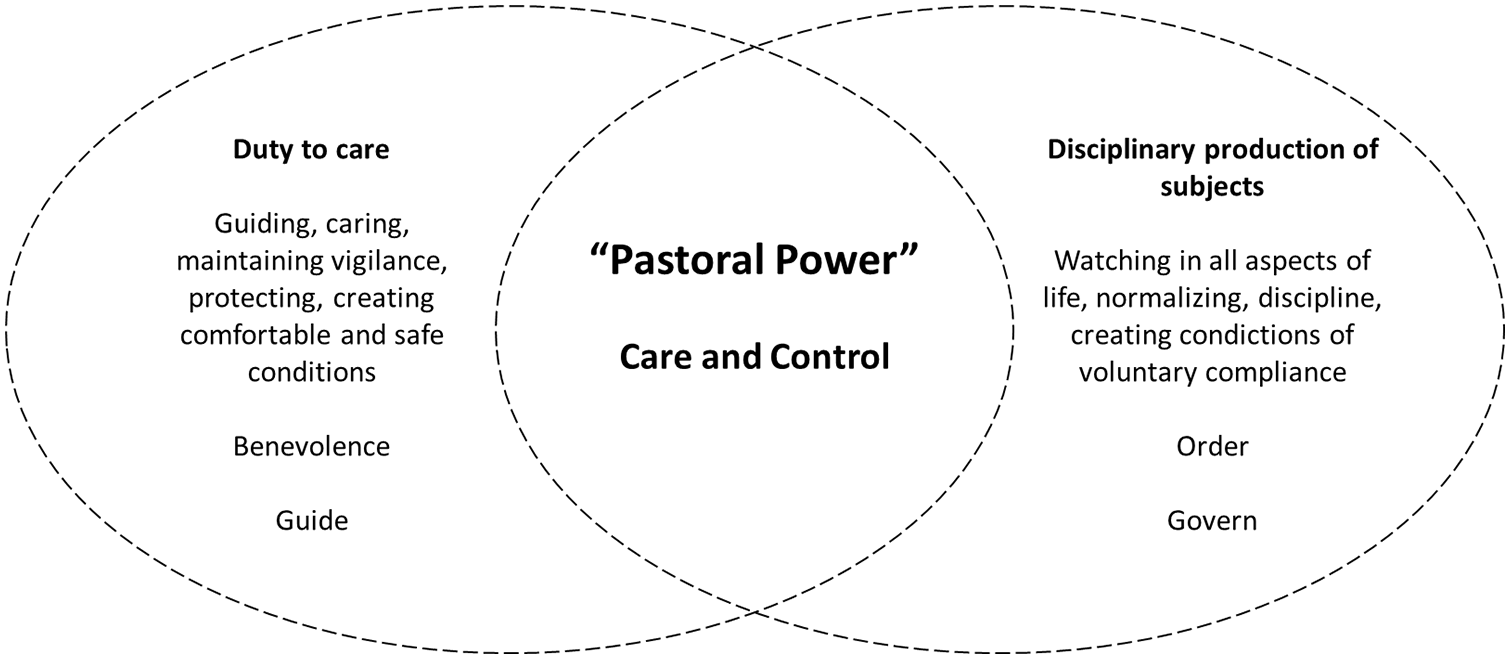
Foucauldian framework on pastoral power.
Pastoral power is a key characteristic of the modern Western state, with its techniques prominent in practices and organizations, such as schools, factories, churches, and institutions. Four important aspects define pastorship as a technology of power:
1. Question of responsibility: The shepherd assumes responsibility for the destiny of the whole flock and for every individual member, including his or her detailed actions and life.
2. Question of obedience: A pastoral power relation features dependence and the sense that individual obedience to the will of the shepherd is a virtue and end in itself.
3. Type of knowledge: Between the shepherd and the flock, knowledge is personal, individualized, and based on self-examination of individual members’ material needs and the guidance of their conscience.
4. Potential for transformation: This power implies the promise of individual salvation and self-transformation.
This framework presents an insightful dialogical view that aims to deconstruct power relations, clarify the constructed nature of reality, and acknowledge the ambivalence of organizational life (Deetz, 1996). Because it grasps the ambivalent, dialogical relation between care and control, this framework helps conceptualize modern workspaces as carefully organized mixes of care and control, carrot and stick, benevolence and order (Crawford, 1995), embedded in a broader strategy of governmentality with a clear rationality and relying on managerial forms of pastoral power. By developing a processual perspective, this approach also overcomes some limitations of existing research that presents static or ahistorical views of organizations. In this way, a Foucauldian approach helps us answer our three research questions, by addressing:
- How modern workplaces are materially and discursively constructed as places to live (RQ1).
- What the organizational and managerial underlying goals in the adoption of these working arrangements are (RQ2).
- How workers engage in (and react to) these workplaces, and what it means for them (RQ3).
Hereafter, we use Foucault’s pastoral power concept as a framework to analyze modern home-like workplaces, which tend to reinterpret paternalism as an organizing principle.
Immersion at ITcomp
Case study as a research design
We opt for a qualitative, interpretivist approach and a case study method, to analyze the dynamics and underlying processes of certain phenomena (Eisenhardt, 1989). Our Foucauldian conceptual framework serves as a backdrop to analyze a meaningful field situation that acts as an “instrumental case” (see Stake, 2003), in that it advances understanding of the home-like workplace, in particular to better grasp its ambivalence in terms of care and control. Our case study refers to ITcomp, a French company that has developed a modern, home-like workplace. Founded in the early 2000s by two engineers, ITcomp specializes in business-to-business IT services with more than 800 clients worldwide; its revenue is approximately 40 million euros. Roughly 500 people work for the company, 250 of whom are located in the Parisian office (the focal site of this study). These white-collar workers exhibit strong capacities for planning, judgment, collaboration, complex problem analysis, and operational autonomy (Perlow, 1998). They perform complex, analytic, knowledge-based, and abstract work, and their tasks call for specific competencies generally acquired by high-level education and experience. The company has earned a reputation as a leading-edge firm in terms of its innovative work environment, amenities, activities at work, managerial practices (e.g. gamification; Kim, 2018), and consideration of employees’ well-being. Although ITcomp does not integrate offices and housing on one site, as in classic company towns, in this distinct historical context, it offers a concrete example of the development of an innovative home-like working environment, in which the boundaries between work and non-work spheres are intentionally dissolved.
Data collection and analysis
The case study combines several data collection techniques. The research took place between November 2013 and July 2014, as part of a project on the development of new work practices and employees’ well-being (which involved ethnographic fieldwork conducted by the author and a Master’s student, who also worked there as a part-time employee). The primary data were gathered from a guided tour of the headquarters, direct field observations on-site conducted over 8 months, pictures (Appendix 1), and 21 semi-directive interviews (approximately 45–90 minutes each), along with two interviews with former ITcomp employees who had left the company. We complemented these data with an analysis of ITcomp’s official discourses, collected from published articles appearing in the Factiva database related to ITcomp in the national and international press since 2012. Thus, the secondary data include internal documentation, notes from meetings, and analyzes of the company’s website and presence on social networks (e.g. Facebook, Instagram, Twitter accounts).
The purpose of the guided tour of the headquarters and on-site observations was to review ITcomp’s working environment and observe its appropriation by employees and their managers, through an observant approach. We participated in meetings to understand the relationships between employees and management; unstructured observations and discussions also gave us a sense of the tone and atmosphere and provided validation for some of our initial impressions. After each interaction, we took notes on what we had observed, including verbal and nonverbal elements, descriptions and uses of the workspace, attitudes, and contextual aspects.
The interviews involved different levels of respondents (founders and CEO, commercial director, human resource [HR] manager, managers, technicians, engineers, commercial agents, and two former employees). This variety helped us identify the founders’ and management’s views of the workplace, objectives, and associated managerial practices, as well as employees’ perceptions and appropriation of the workplace, including the two former employees. The respondents ranged in age from 22 to 52 years, with varying experience (however, we sought respondents with at least 5 months’ tenure with the company). Different interview guides reflected the unique functions performed by the respondents. Every interview began with general questions about the respondent’s role and responsibilities, then moved on to wide-ranging topics. For example, questions for employees asked about their perceptions of the workplace (e.g. amenities, activities) and its boundaries, as well as their perceptions of the motives for designing the home-like working environment and communicating caring logics to employees. We also asked about their relationships with management and peers; their satisfaction and motivation; and their perceptions of autonomy, empowerment, flexibility, and control. For founders and managers, the questions focused on the motives for adopting and developing the working environment, their expectations of the implications for employees, and the modes of management they encouraged on a daily basis.
To analyze the collected data, we used a qualitative, thematic analysis on NVivo software. We first stored information that described the case (descriptive coding) and then allocated passages to topics (topic coding). This process relied on abductive reasoning, which aligns conceptual (deductive) and empirical (inductive) research realms. In accordance with a deductive principle, we identified key topics related to our three research questions (see Appendix 2). We first highlighted the material and discursive construction of ITcomp’s working environment as a place to live (Theme 1); then considered the origins, expectations, interests, underlying meanings, and managerial goals pursued for the development of this workplace (Theme 2); and finally focused on the employees’ and former employees’ perceptions of the work environment, engagement in the workplace, and potential reactions (Theme 3). In accordance with an inductive perspective, we allowed some themes to emerge from the data—for example, we gleaned various meanings that employees associated with the intermingling of work and non-work activities through the use of specific lexical categories, such as those related to “life,” “family,” and “childhood” (e.g. play, fun). Then, we further analyzed our findings and made sense of the tension between care and control logics through Foucault’s (2008) frame of pastoral power. The Foucauldian framework helped us distinguish between espoused statements about the workplace adopted at ITcomp (i.e. the official rationale for blurred boundaries) and latent statements below the surface (i.e. unstated reasons for blurred boundaries and underlying managerial goals pursued in this workplace, such as the purposeful exertion of new forms of control associated with care logics).
Hereinafter, we describe the workplace environment at ITcomp according to our three research questions. After detailing how the workplace is constructed as a place to live (RQ1), we describe how the management at ITcomp has come to adopt this working environment and identify the underlying organizational and managerial goals (RQ2). Finally, we address how employees are led to engage in (and react to) this working environment and what this means for them (RQ3). By doing so, we not only detail the official rationale and discourse justifying the adoption of such a workplace but aim to highlight, through a deeper reading and critical analysis of the meanings and implications behind official statements, the motives of care and control by management. In particular, we critically discuss the purposeful exertion of subtle means of control through the workplace, which affects the employees’ productivity, sense of engagement, and loyalty by making them adhere (almost unreflexively) to care logics as a new form of governance in their lives. We draw on these findings to analyze (in the discussion) the emergence of neo-paternalism as a new form of care and control in modern organizations, and we form conclusions about the parallels between home-like work environments and ancient utopian organizational forms (e.g. company towns).
Findings: “A life outside work inside the company”
How is the ITcomp workplace discursively and materially constructed as a place to live?
The ITcomp workplace was constructed as a place to work “differently.” Our guided tour of the Parisian headquarters, constructed in 2012, which internal actors refer to as the “ITcomp valley,” uncovered several surprises. In particular, we were struck by the originality of the building and its amenities (see Appendix 1). A revolving door into the main building opens up into a large entrance hall dominated by a giant slide. According to a manager, “we try to move in the building in an efficient and ecological way, by using the slide.” Beyond pragmatism, the slide is “not only a gadget,” as the CEO explained, but also “above all a symbol of our company that is symptomatic of our spirit and our way of working.” He added, “It translates the mischievous spirit of ITcomp. . . . We really fought for it, we had many conflicts with the architects, and fire officials, but in the end we got it.”
The rest of the building is divided into different spaces. In the middle of a large open space, where the CEO and cofounder also sit, a strange ski lift–like cubicle provides an unusual room for meeting with clients. Along the open space, another meeting room features a large saltwater aquarium in the middle, which is intended “to invite people to take a different view and refresh their ideas,” according to a manager. On each floor, different rooms reflect a “working differently” ethos, developed by the employees themselves, with different styles, furniture, decoration, and colors, though generally they capture an “off-the-wall” spirit and encourage self-expression. For example, in the “Pitch Theater,” employees can challenge their ideas and generate innovative solutions; the “Playground” is a game area, with billiard, Ping-Pong, and Foosball tables; a television and video games; and a piano, all encouraging employee creativity and quality interactions. The well-equipped sports room (treadmills, exercise bikes, fitness equipment) also is staffed by a sport coach, and an outdoor multisport field allows employees to play football or basketball at any time.
Other non-traditional rooms are designed to encourage relaxation and concentration, or to enhance employees’ well-being. Break rooms (called “cocoons”) are equipped with sofas, pouffes, hammocks, and beds, in case employees need to rest during the day or stay longer in the evening. Such installations also enable, in one manager’s words, employees to “slow down time, which is beneficial in a general context marked by urgency and permanent rush, and enjoy moments for reflection in dedicated spaces.” Other convenience services provided to enhance well-being and make the space “feel like home,” according to the HR manager, include a bathroom with showers, massage room, hairdressing salon, and reading corner.
Thus, more than working differently, we observed that employees were encouraged, through the spatio-material and discursive construction of the workplace, to engage in activities that usually are not part of a professional field and instead traditionally fall within the private sphere. According to a manager, such amenities “have the advantage to make employees consider the office as a second home, and their colleagues as a second family.” The ultra-comfortable environment enables employees to participate in various activities, beyond classic work tasks. In the canteen and kitchen, employees can bring their own meals, collectively share lunches or dinners, or cook together (team members are invited to take turns cooking for their teammates, and cooking courses are regularly organized). Free coffee and tea are available, and free pastries are distributed every Monday morning, with seasonal fruits every Tuesday and brunches on weekends for those who volunteer to work those days. One employee also noted that “it is also very frequent to get free pizzas in the evening, so that it is not a problem to stay longer to finish something, all the more that we don’t really have the feeling [of being] at work here.” Self-service barbecues, adjacent to a large garden and terrace, are also at employees’ disposal. Thus, employees can find all necessary equipment to satisfy their (even most basic, physiological) needs. The founders also decided to install a beehive “to create honey, 100% ITcomp-made” and an organic vegetable garden (the “collaborative ITcomp vegetable garden”), to which employees can contribute by planting seeds.
Through the company’s working environment, management also considered ways to fulfill more complex belonging needs, such as with regularly organized sporting, charitable, and recreational activities (e.g. concerts, board game tournaments). Similarly, personal events and accomplishments (e.g. birthdays, achievements) are celebrated together to create a “familial spirit” that signals collaborative and team values (“the ITcomp spirit,” in a manager’s terms) and to make employees feel valued and important in this community.
The construction of the workplace was thus inextricably related to the spread and sharing of specific values, such that the ITcomp working environment reflects a true lifestyle. To strengthen this shared feeling, the structure of the space is closely tied to its informal dress code (e.g. wearing Stan Smiths offers a discreet sign of being in tune with ITcomp values; even the founders do not wear ties). More fundamentally, it establishes a specific language and jargon associated with the workplace and the “ITcomp spirit,” such that “working there [is] a real lifestyle” for one employee informant. Descriptions of this “ITcomp lifestyle” (also mentioned by the cofounder) include the designation of employees as “ITcompies,” working in the “ITcomp valley” or “jungle,” where “the tribe” lives and produces its own “ITcomp honey” or “ITcomp vegetables.”
What are the managerial goals underlying the adoption of this workplace?
As a “small growing company [that] not only boasts excellent results, with average annual growth rates of 30%, but also literally spoils its employees” (source disguised for confidentiality reasons), ITcomp earned a national “enterprise and conviviality” award in 2015 and a “Happy at Work” label in 2017, which one of the cofounders attributes to its attempts to be “just as good as Google and other giants of the Silicon Valley.” The other ITcomp cofounder explains that “every employee has the possibility, at any moment of the day or night, to play a game of billiards or video games, play a football or basket match on the outside playground arranged at the foot of the building, garden in the vegetable garden installed closed to the parking, participate [in] a cooking or pastry workshop, or enjoy a massage,” adding, “it is our role to offer each of them such freedom and make their life better . . . they spend so much time here.” This description demonstrates how the amenities are thought and designed to increase employees’ sense of autonomy and freedom, while paradoxically encouraging them to spend more time in the workplace.
The two founders explained they actually made it “a point of honor” to create a working environment that would “favor the well-being of employees” and “produce a convivial atmosphere,” thereby “showing [employees] the company’s willingness to care for them.” To that end, according to the CEO, the headquarters were designed to reflect a “willingness to reproduce a start-up spirit,” such that “it is not only a nice place to work but mainly to live. . . . We wanted a different building, different from classic offices, where it is good to live. Not only to work, but really to live as such.” In turn, the company paid 10% more than the industry average to construct its new headquarters, in an effort “to improve the quality of life, well-being, comfort and self-development of its employees,” according to one manager.
Another manager similarly expressed the idea that the adoption of this workspace was driven by a strong sense of care for employees; officially, the founders were led by their desire to improve employees’ well-being, overall satisfaction, and pleasure, while also encouraging a “collective, team-based spirit.” In this manager’s view, “the objective of such installations is to create a convivial, nice, familial, fun atmosphere, where employees can play together and learn about each other, a bit like kids in kindergarten.” Another manager referred to these amenities as “fulfilling physical education, contributing to the creation of complete profiles of employees,” with “a healthy mind in a healthy body.” Enabled by the building, its amenities, and its equipment, these various activities help employees feel good and blossom.
The workplace also reflects the direction of the company and its pursuit of corporate social responsibility (CSR) and engagement with employees and society at large, which “is inscribed in the DNA of ITcomp and its founders,” according to a manager. As elements of its CSR commitment and care for employees, the environmentally friendly building features triple glazing of the windows, to avoid heat loss, and a heat pump that maintains a stable temperature regardless of the season. More broadly, preserving the environment (e.g. vegetable garden, beehive; a manager referred to these initiatives as “good for the health of our employees and for the environment”), enhancing the well-being of collaborators (e.g. amenities, convenience services), and encouraging their development (e.g. sporting, charitable, or recreational activities) together are “a priority” for a cofounder, as well as “a means to distinguish ITcomp from other companies in the field.”
In turn, ITcomp’s management relies on its home-like working environment to attract and retain employees. This discursively and materially constructed environment, providing an appealing and creative workplace, represents a strategic managerial tool that management leverages for its brand marketing and to serve its business interests, as signaled by managerial discourse about the “chance of being recruited in such a modern workplace, which is not given to anybody . . . the list of candidates is long” (HR manager). Through these official discourses, the company keeps its founding mythology of being “a different company, where it is good to be” (manager). The company is described, through its constructed ideal working environment, as “the place to be.”
Officially, other goals have also driven the ongoing, internal adoption of the working environment. The home-like workplace purportedly increases team cohesiveness, beyond work but still within the company. By doing so, the spatial organization allows management at ITcomp to establish a third, hybrid, liminal space, between work and non-work, within its walls, which extends employees’ presence on-site and engagement. Management insists on the importance of such interstitial moments of interaction and points of contact between work and non-work activities within the company, to live the provided dynamism of the space and allow the organization to exist as such, because “it is in such spaces that the organization constitutes itself,” according to a manager. As a result, for one employee, “working here means that there is a life outside of work inside the company.” Management has explicitly designed the organization of the workplace and the boundaries between different spheres as means to create interactions between work and non-work activities that can be conducive to new forms of reflection, collaboration, and engagement. A cofounder emphasizes the federative, unifying aspects of the work environment, particularly in this project-based work environment, citing the need for employees to be on-site, as often and as long as possible: “to exist as a company, all our employees need to be there, on our sites, for these work and extra-work activities.” We thus note a gap between the official discourses about employees’ autonomy and apparent freedom and the implicit (and unofficial) injunction made by ITcomp’s management that workers should visit the office every day and spend as much time as possible there to exist as a company and enhance their performance (as we also observed in shared behavioral norms).
In line with the ITcomp spirit, the working environment is embedded within a broader managerial discourse of agility and efficiency, based on employees’ empowerment and entrepreneurial spirit, such that all employees are purportedly autonomous and responsible for their own work and must show some sense of effort and capacity for adaptation. The construction of the new working space paralleled a managerial transformation, described by the CEO as follows: Since our creation, we [have] hired people like crazy, to cope with our growing demand and activity. But [over time] the nice machine started to seize up; our revenues started to stagnate, and I realized that a kind of deadly boring spirit started to install. It was time to shake up the agility and stimulate the creativity of our employees. . . . With the new building, we have removed any sign of power to give everybody the envy to contribute to the big family . . . no trips in business class, no appointed car place any more . . . we also share our desks, which are not attributed to anybody, but are instead installed everywhere, like pop-up desks, without any hierarchy.
The home-like working environment is thus associated with clear managerial objectives—to empower employees while increasing their performance and the company’s revenues.
In addition to this workplace transformation, managers’ roles have evolved, in line with training and coaching, “turning them into guides, more than ordering persons or supervisors,” according to a cofounder. In turn, they can build bonds and personalized relationships with employees. With its focus on employees’ well-being and development of individual potential, the company’s management also has committed to a substantial increase in its training budget (twice that of the legal affairs department), hands-on management and flat hierarchies (five or six people report to each manager), and internal and managerial mobility options for all employees. Individualized, voluntary developmental practices (e.g. training, personalized coaching, yoga, mindfulness meditation) also are available to employees who want to improve their well-being, health, and engagement with the company.
However, our data show that investing in employees’ development through the space thus serves business and managerial interests, because “it stimulates the productivity” of employees, as mentioned by the cofounder, who believes that the rapid growth of the company is largely due to these spatio-material and managerial arrangements.
Beyond the official rationale for blurred boundaries, other underlying reasons (e.g. search for productivity, engagement and loyalty through care logics as a subtle but purposeful exertion of control) explain the adoption of this home-like working environment. Our findings indeed reveal how the workplace offers a management tool that managers try to leverage to make employees engage, want to work, give their best, perform well, and remain loyal to the company, in the belief that “[if] employees are happier, they are more productive and more loyal,” as a manager expressed. Thus, although ITcomp operates in a challenging, extremely competitive market, its employee turnover is lower than the industry average. The home-like working environment, fusing professional and personal activities and associated with specific managerial practices, thus appears as a latent and subtle control dispositive, coupled with care logics, that produces workers as docile bodies (Foucault, 1991), offering a guard against absenteeism and turnover while also increasing ITcomp’s attractiveness.
How are workers led to engage in (and react to) this workplace?
The power of such a control system is its diffuseness, in that it creates the conditions that affect the employees’ voluntary compliance. At ITcomp, employees almost unreflexively adhered to the conditions of their subjection. As they were naturally encouraged to engage in this attractive workplace, most openly shared their enthusiasm and positive feelings, in regular references to ideas of pleasure, fun, conviviality, play, or a sense of sharing. These positive feelings frequently reflected ideas of being part of a real community, which appeared like “a family.” Many employees embraced the managerial discourse about the chance to work for such a “different” organization, where it was good to be. An engineer said, “I feel extremely fortunate to work here, we are like in a family. I personally feel grateful for what the whole community gives me and for what we are allowed to do.” Another employee referred to being “a member of a tribe, living in a bubble between a home and a vacation camp, inside the company.” Still another explained, “I feel it quite like a second home.” Such spontaneous lexicons attached to family and community-driven values (e.g. equality, faith, loyalty, honesty, collaboration, vision of the company as “a big tribe”) often appeared in explanations for employees’ enthusiasm for working for the company.
Echoing the perceptions expressed by most employees, one engineer explained: “The atmosphere is really fulfilling. There are different events every day, there is always something to celebrate or share with the others.” Some employees contrasted their experience at ITcomp with experiences in other companies to highlight the different atmosphere of “being” there (and not only “working there”). “I had never known [such an experience] in any other company before; it’s like a family, we trust each other, as we are on an equal foot[ing],” said one engineer, while another mentioned that he had “so much pleasure working there that it could hardly be considered as work.”
The constitution of a community induced a sense of belonging among employees, encouraging their symbolic investment in the job and engagement in broader working life. The constructed workplace at ITcomp thus had a kind of “totalizing effect” through the constitution of a “novel family-based community” (employee) and frequent uses of collective pronouns (“we,” “our”) to refer to their actions, sentiments, and life in the company. Building such a community also made employees feel strongly attached to their coworkers and the company itself, of which they were particularly proud (e.g. noting pride in working for ITcomp, explaining the advantages of the working conditions to relatives and friends). Such an emotional attachment made them less likely to quit.
Furthermore, the practices were individualizing; employees referred to personalized relationships and attention (care) established for each employee (e.g. describing amenities “adapted to different needs” or specific managerial practices to support each employee). Many employees said they “felt important” and “valued;” furthermore, the company’s provision of facilities and services led them to feel personally indebted to it. As an engineer explained: “Everything is done to make us feel happy and to address our individual needs; we get more involved, it is really motivating.” These perceptions of care and the freedom employees personally enjoyed in the resulting relationships seemed to be real and positively experienced. Many employees expressed strong dedication to the company, to the extent that some even seemed out of touch with the real world. An engineer explained that “when [he is] in the company, the outside world tends to disappear.”
Surprisingly, when asked about the potential drawbacks of such a situation, no employee expressed much discontent; for them, dedication and long hours spent on-site were acceptable and normal, regarded as a logical counterpart of working in such nice conditions. The notion of control was never spontaneously raised by ITcomp employees, as if they had unreflexively internalized the management discourse and the implicit injunction to be engaged in. They thus naturally agreed to spend as much time as possible on the company premises, without noticing that a growing part of their (professional and non-professional) life and time was “governed” by their company.
However, in contrast with other espoused statements, two former employees, who had left the company some time ago, expressed some anger about the working environment, asserting that the relationships between employees were not authentic. One of these former employees also noted, “the reality is less rosy than the outlook suggests.” To this former employee, people are not able to not complain about the overwhelming workload and implicit pressure. He noted that “managers will never tell employees that they should work harder, or stay longer, or work during their holidays. . . . But they instill such a culture by doing so. Like at Google, they create an addiction inside us. I’ve seen many colleagues choosing work rather than personal projects, and others becoming ill because of stress. It’s becoming ridiculous.” He cited the implicit community pressure on employees, who might feel uncomfortable leaving after a typical workday if their peers remain for longer hours. Another former employee explained, “the atmosphere is festive for those who get by, but for the others, [they are] not allowed to complain and to say the ambiance is not good.” He cautioned that “beyond the smoke and mirrors, employees are prisoners of a lure. Only the search for productivity is the motor . . . but YOU are the fuel.” He argued that working in such companies would satisfy only junior employees, who accept low salaries and are willing to put up with heavy workloads and disguised working hours.
The workplace as a place to live, a revolution, or a myth?
The home-like workplace as a manifestation of pastoral power
Similar to ITcomp, management in many modern organizations has not only introduced play to work (Kim, 2018; Petelczyc et al., 2018) but also attempted to organize the day-to-day conduct of employees, such that working in such workplaces represents a “lifestyle” or an “art of living” and a way to “conduct the conducts” (Foucault, 1981) producing docile bodies (Foucault, 1991). Management constructs the working environment, materially and discursively, as a place not only to work but also to live, due to the permeability of the traditional boundary between the home and the office. Consequently, time spent on the company’s premises, for activities traditionally not associated with the professional sphere, increases. Boundary control (Perlow, 1998) and the regulation of internal and external domains provides a culture management technique that enables control of employees. In particular, boundary control distinguishes modern employment relations from pre-industrial modes of production, for which no line of division existed between the organization and the outside world; the workday was determined personally on the basis of required tasks, and individuals (farmers and artisans) exerted autonomy in defining the boundary between work and personal lives (Fleming and Spicer, 2004; Perlow, 1998). As people moved from the farm to the factory and then to the office, the workplace and domestic sphere began to be separated (Taylor and Spicer, 2007), and employees lost some control over this boundary, due to constraining work schedules, growing rigidity in their lives (Zerubaval, 1981), and predictable temporal boundaries (Perlow, 1998).
Our case study reinvigorates the logic of boundary control. As illustrated by ITcomp, home-like workplaces are not designed or used to govern when employees must be at work or not (i.e. by delineating an “inside” and an “outside” of the organization or imposing formal temporal demands) but instead blur the physical and symbolic spatiality and liminality of working and non-working lives. Management uses these workplaces to intermingle work and non-work spheres during the day and construct a permeable, hybrid space, between personal and professional lives, within the organization. These workspaces enable a purposeful dissolution of organizational boundaries, together with a spatio-material and symbolic arrangement that promotes the notion of a “tribe” driven by community- and family-based values (e.g. loyalty), thus reflecting a neo-paternalistic logic. The workplace is constructed as a home-like environment to enforce power in a way consistent with Foucault’s (2008) framework on pastoral power; this workplace and its boundaries are embedded in a specific rationality (governed by a conscious aim, Foucault, 1984) that goes beyond the mere spatial, architectural activity, so that it manifests itself in a new form of pastoral power (Foucault, 1981). Management has pastoral relationships with employees, focused on modulating their conduct and piloting the governed to increase their development, fulfillment, and transformation, through the spatio-material and symbolic arrangement of the workplace. To analyze the modern home-like workplace as a manifestation of pastoral power, we use four characteristics of this type of power (Foucault, 1981) (Table 1).
Overview of the home-like workplace as a manifestation of pastoral power.
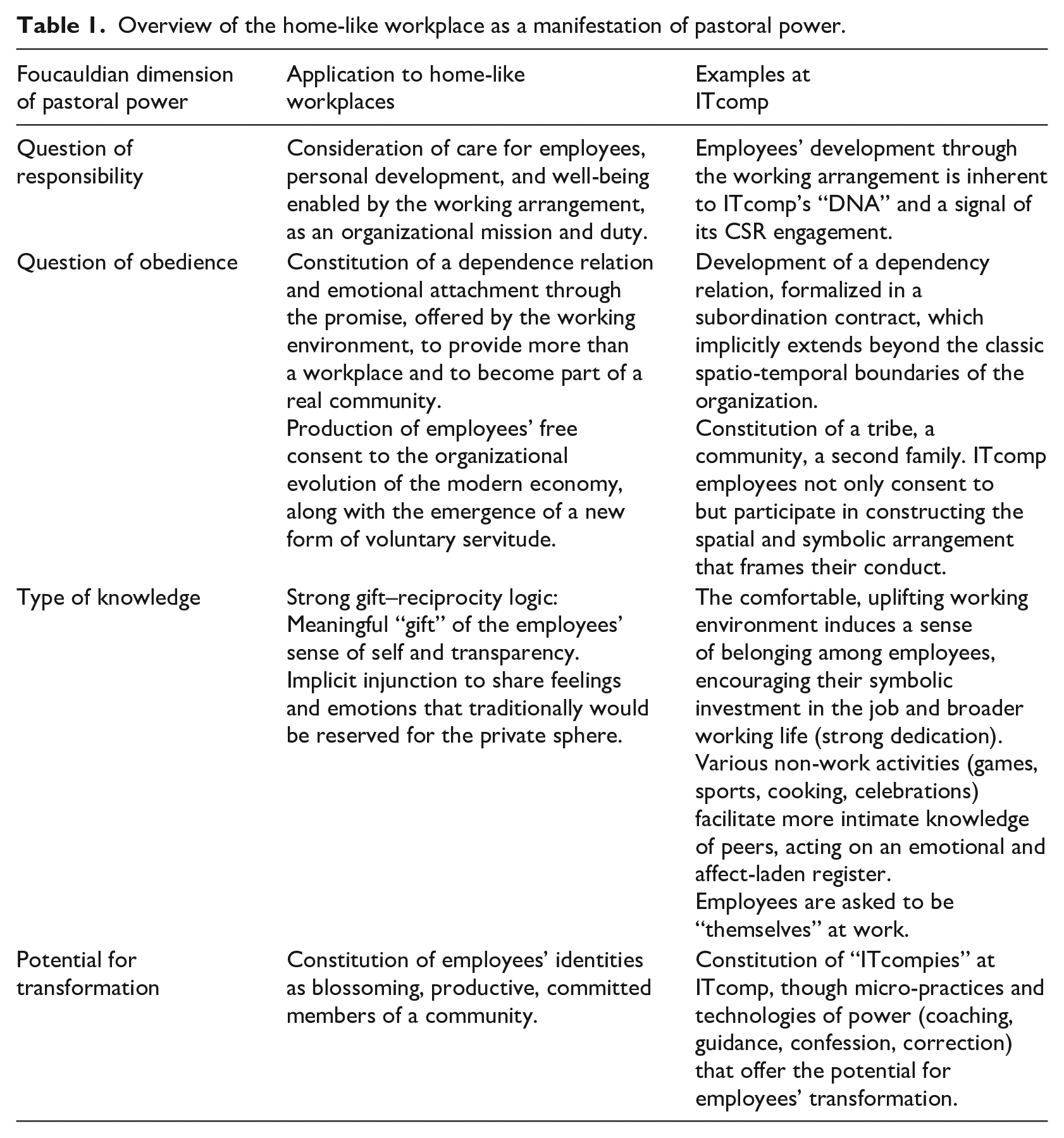
First, the question of responsibility is particularly acute in such workplaces, exhibited in the caring logics they deploy. As illustrated by the case, management emphasizes the personal development and well-being of employees as its mission and duty, inherent to “its DNA,” and a signal of its CSR engagement. This responsibility is a rational, planned activity, embedded in a broader conception of governmentality (Foucault, 1981). The home-like workplace is also a technique to guide the day-to-day conduct of employees, while attracting and satisfying them (similar to classic company towns; Crawford, 1995), which is especially crucial in work contexts characterized by substantial stress and burnout, as well as labor markets filled with millennial workers and their unique aspirations. Just as a shepherd assumes responsibility for the well-being of the flock and every individual member, the type of responsibility that results from this exercise of pastoral power is individualizing (through the constitution of an individualized relation, such that each employee feels important and valued) and totalizing (through the constitution of “novel family-based communities”).
Second, the question of obedience pertains to dependence in the pastoral power relation. This dependence is particularly salient in such workplaces, because they provide more than a workspace and offer the promise of being part of a real community, “tribe,” or “family,” to which employees feel emotionally attached. Employees not only consent to but also participate in, through their voluntary compliance, the construction of the spatial and symbolic arrangement that serves to frame their own conduct (Foucault, 1981). The home-like workplace procures employees’ free consent to the organizational evolution of the modern economy, which makes it inconceivable to complain. Employees instead are expected to engage more with their organization, assume more responsibilities without being ordered to do so, enjoy being there, and perform for the organization in a novel type of happy, voluntary servitude (La Boétie, 1997). These relations, reflected in specific arrangements of the workplace, imply that management can expect dedication over time from its employees. Despite promoting employees’ well-being as a cardinal virtue, their dependency relation, formalized in a subordination contract for a fixed amount of time, implicitly extends beyond the classic spatio-temporal boundaries of the organization. The freedom employees enjoy in this pastoral relation is thus real and effectively experienced, but it also imposes a particular, restricted type of freedom that is not intended to promote absolute autonomy but rather to shape the way the governed behave and feel.
Third, the peculiar individualized type of knowledge in such working arrangements involves a strong gift–reciprocity logic (Mauss, 1950/2002) between the organization and the employees. Through care logics and the organization of the workplace, management offers a comfortable, uplifting working environment, which induces a sense of belonging among employees, encouraging their symbolic investment in the working life. The various activities (games, sports, cooking, celebrations) provided through the spatial organization of the working environment facilitate more intimate knowledge, acting on an emotional and affect-laden register. They also are associated with developmental practices and soft management techniques (training, coaching, mindfulness) that emphasize guiding, leading, confessing, and inspiring roles of managers, exerted through pastoral power rather than mere discipline. Such practices constitute a symbolic, personalized space, in that they function like confession rituals. Employees enact both work and non-work roles and share aspects of their selves that rarely would be revealed in other work settings. This meaningful “gift” of employees’ sense of self creates an implicit injunction to share emotions that traditionally would be reserved for the private sphere. The “corporate colonization of the self” (Casey, 1996) occurs not because employees become “company people” at home (as in classic views) but because they are asked to be themselves (i.e. show their entire self, including personal, hidden parts) at work.
Fourth, the potential for transformation of this mode of government results from self-transformation. Pastoral power focuses on piloting those governed by modulating their conduct, shaping their spirit and will, and steering their development in appropriate directions (Foucault, 2008). In these modern workplaces, management’s objective is to enhance employees’ well-being, development, and fulfillment, as well as constitute their identities as blossoming, productive, committed members of a community. To that end, the uplifting work environment, associated with micro-practices and technologies of power (coaching, guidance, confession, correction), serves to create a material and symbolic space that offers the potential for transformation, though this is not separate from power relations. Instead, it involves subjects who can achieve self-fulfillment and make claims on organizational evolutions. Whereas prior research anticipates that disciplinary boundary control serves to hide the real nature of employees’ jobs, which finally leads to employees’ psychic anxiety, role contradiction, and burnout (Casey, 1996; Fleming and Spicer, 2004; Kunda, 1992), managers in such modern organizations strive to make employees actively desire this transformation, so they happily consent to and participate in the construction of the spatial arrangements that shape their conduct.
Thus, we conceive of the pastoral power managers exert in such organizations as neo-paternalism, a novel form of care and control that aims to guide employees. Compared with classic command and control logics, it represents a more subtle way to arrange the relationships between managers and employees, embedded in the broader government of spatiality.
Neo-paternalism: Reinterpretation of company towns?
Our Foucauldian perspective provides a novel view of the dialogical (Deetz, 1996), ambivalent tension between care and control logics involved in the development of neo-paternalism. As illustrated by ITcomp, the blurring of work and home observed in a growing number of organizations challenges the meaning of working and living. Such blurring has occurred in the past as well (e.g. phalansteries, company towns), but the parallel has not been investigated, particularly from a spatial perspective (Fleming and Spicer, 2004).
Our findings suggest that modern home-like workplaces constitute a revolution, defined as an “instance of great change” or an expression of organizational innovation (Crawford, 1995). However, we propose that the first meaning of the term “revolution” (i.e. a return to the source, as a “noun of action from past participle stem of Latin revolvere ‘turn, roll back, happen again, return; go over, repeat’” 3 ) is more appropriate for describing modern home-like workplaces. Classic company towns and modern home-like workplaces share similarities: they both rely on paternalism as an organizing principle according to which management guides its members with the intention to promote their own good (Dworkin, 2010) by mixing care and control logics and establishing pastoral relations. These organizations also focus on modulating employees’ conduct through their spatio-material and symbolic arrangements, emphasizing a shared sense of community. Pastoral power is exerted through spatially built, symbolic techniques that blur personal and professional spheres (Kooijman, 2000); it also attempts to regulate people’s lives and define the boundary between home and work (Perlow, 1998), to determine the day-to-day conduct of members and extend influence over them. Modern home-like workplaces are thus reminiscent of classic, utopian, paternalistic organizational forms.
However, deep differences between classic company towns and home-like workplaces prompt fundamental questions about the development and implications of neo-paternalism. The historical context is different: modern organizations differ, especially relative to the 19th-century moral regulations that led to the emergence of company towns. Modern home-like workplaces generally do not fuse housing with the office. Management’s goal in such organizations is not to “own” employees’ lives, minds, and souls (Garner, 1992) or to dictate the terms by which they should live, as in classic utopian forms. Rather, the control of employees in modern home-like workplaces represents a seemingly outdated concept (Crawford, 1995), rarely raised by employees and even less by management (as in ITcomp). In this sense, management in these modern organizations often relies on home-like working environments as strategic tools to ensure that the workplace is “creative” (De Paoli et al., 2019), with the underlying goals to attract and retain employees.
Deeper differences exist however. Classic company towns focused on laborers, who were told what to do and when; by contrast, modern home-like workplaces involve white-collar knowledge workers, who exhibit high degrees of autonomy, judgment, analysis, and collaboration. Company towns also were developed by industrial organizations that fabricated goods, whereas modern home-like workplaces process information and knowledge to provide services. Workers’ proximity on-site and housing in company towns thus were justified by the demands of the production process, but the blurring and governing of work and personal lives in modern knowledge-based organizations seem less necessary and justified.
Moreover, the transition from the industrial era to the knowledge era has been characterized by a liquefaction of work (Bauman, 2000), such that it can be performed remotely, almost anywhere, and in flexible ways (e.g. telecommuting, flexible schedules, third-spaces). The emergence of neo-paternalism in modern organizations is thus particularly striking. Our findings reveal a gap between official discourses about employees’ autonomy and management’s implicit injunction in these organizations that workers should visit the office every day and spend as much time as possible there. Managers in modern offices seem to rationalize space and time within organizational boundaries, so the freedom of moving outside is confiscated. This evolution of the modern workplace thus is eminently paradoxical, with deep meaning for what managing and being an organization actually entails nowadays.
This evidence of neo-paternalism means that managers often require employees’ physical presence in the workplace, which helps explain why organizations are configured in certain ways (Taylor and Spicer, 2007). Such organizations increasingly constitute themselves and exist mainly through the hybrid, liminal spaces and times they manage to create. At these interstitial points of contact and unexpected interactions—between work and real life, halfway between the formal and the informal, labor and leisure, the office and the home—the dynamism of the organization gets experienced (Shortt, 2015). This reterritorialization process also legitimizes and celebrates the organization, which is understandable considering how the nature of work has evolved (with the rise of the Internet, mass collaboration options, and development of project-based work, jeopardizing traditional organizations).
In addition, even if control in such workplaces is outdated (Crawford, 1995), neo-paternalism, through its caring mode of power, offers a renewed type of management control that is less direct, panoptical, or disciplinary than what appeared in classic company towns. Neo-paternalism is exerted through diffused, subtle, implicit forms of control, relying on a blurring of personal and professional spheres and the personal and collective spaces of action; it enables a meaningful “gift” of the employees’ sense of self, who are asked to be themselves at work. In such logics, the individualized space tends to become collective, as it heightens feelings of belonging to the group, while the collective and organizational space tends to become private, infused with personal practices.
With these reconfigured boundaries, work and home spatial practices become permeable or even merge, producing a more committed workforce. This reconfiguration then is increasingly enforced by management through horizontal relations, empathy, emotional attachment, and enjoyment, which constrain individual employees without them noticing. Through this caring mode of power, management aims to colonize the inner feelings of employees (as a new resource or instrument) and to tell them how to work and live.
Such control is subtle. This caring mode of power helps management achieve social peace, because it does not make sense to rebel against a shepherd who has employees’ best interests at heart. These uplifting workplaces, as a form of compensation for arduous work, dazzle employees, who in turn avoid (possibly contradictory) voice behaviors or reflective thinking. Such reflective thinking seems all the more difficult for employees because the organizations are generally presented by management as the best places to work, as reflected in official organizational discourses about their demanding recruitment processes.
Conclusion
This research offers a novel view on home-like working environments, which have become increasingly popular worldwide, especially in the rapidly expanding and enchanting discourse on care for employees. Responding to recent calls to critically reflect on new ways of working and analyze the dominant well-being narrative at work (Watson et al., 2020), we propose a critical approach, according to the Foucauldian framework of pastoral power, that highlights the emergence of neo-paternalism as a new form of care and control in modern organizations.
This research has some limitations, in that it relies on a single case study. However, this case seems representative of a broader trend, in which management increasingly relies on workplaces that dissolve the boundary between private and professional spheres, the inside and outside of the organization, epitomizing a new, caring mode of power and control. Analyzing the development of neo-paternalism in other fields, such as the government of the boundary (as a means of control), the management of liminality (Shortt, 2015), and the challenges thus raised would be worthwhile. In addition, a pertinent extension of this research stream would be to initiate a case study even before the construction of a company’s space, to identify evolutions and implications of the paternalistic employer–employee relationship with a more processual approach. Future research could also investigate issues of care and control in new types of contexts that blur professional and non-professional boundaries, as employees are increasingly encouraged to work at home (in the current pandemic context), implying that they must appropriate personal and private spaces as workspaces (e.g. Koslowski et al., 2019) and manage the boundaries between working and non-working lives themselves.
This pastoral power lens is largely neglected in prior organizational research, yet it provides an extended view of the government of spatiality and a better grasp on the spatial techniques of management and the resulting authority of spaces. We provide here an insightful conceptual framework to make sense of the caring mode of power in modern organizations, as a subtle means of control. Such neo-paternalism, a way to govern and guide, to care for and control employees simultaneously, is expressed by managers in various forms in well-known organizations, in ways that guarantee employees’ autonomy and empowerment but also impose new forms of responsibility, engagement, and constraint. The value of making things transparent and open for discussion is that it allows for the emancipation of workers. Beyond the mere identification of neo-paternalism as a renewed organizational phenomenon, this research thus invites people to stay alert to modern capitalist intrigues. To seize this opportunity, people need to be aware of the underlying meanings of the working arrangements in which their self is embedded. This position reflects Foucault’s (1988) approach to power, which views knowledge and awareness as conditions of freedom.
Footnotes
Appendix 1
Appendix 2
Thematic overview of findings.
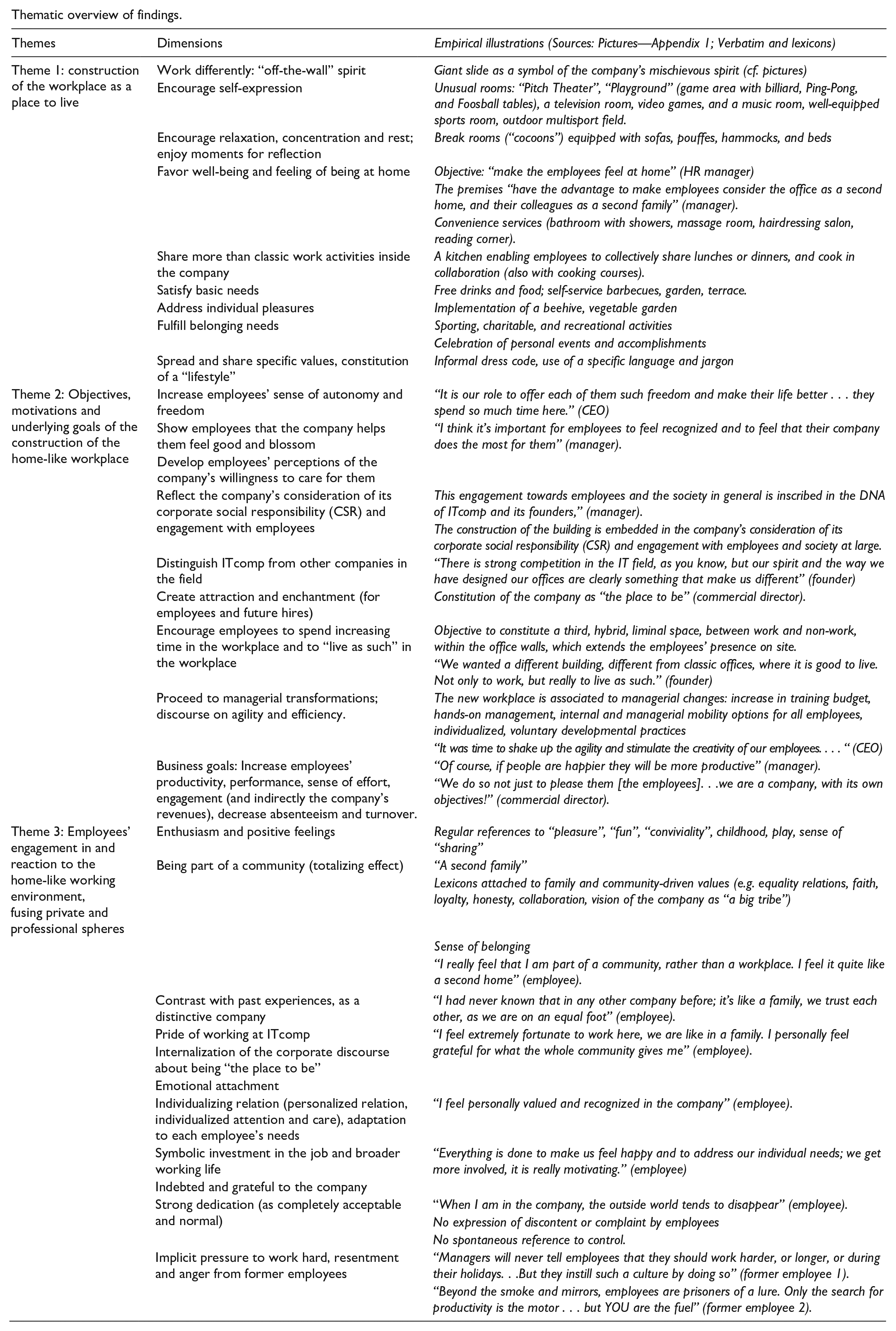
| Themes | Dimensions | Empirical illustrations (Sources: Pictures—Appendix 1; Verbatim and lexicons) |
|---|---|---|
| Theme 1: construction of the workplace as a place to live | Work differently: “off-the-wall” spirit | Giant slide as a symbol of the company’s mischievous spirit (cf. pictures) |
| Encourage self-expression | Unusual rooms: “Pitch Theater”, “Playground” (game area with billiard, Ping-Pong, and Foosball tables), a television room, video games, and a music room, well-equipped sports room, outdoor multisport field. | |
| Encourage relaxation, concentration and rest; enjoy moments for reflection | Break rooms (“cocoons”) equipped with sofas, pouffes, hammocks, and beds | |
| Favor well-being and feeling of being at home | Objective: “make the employees feel at home” (HR manager) | |
| The premises “have the advantage to make employees consider the office as a second home, and their colleagues as a second family” (manager). | ||
| Convenience services (bathroom with showers, massage room, hairdressing salon, reading corner). | ||
| Share more than classic work activities inside the company | A kitchen enabling employees to collectively share lunches or dinners, and cook in collaboration (also with cooking courses). | |
| Satisfy basic needs | Free drinks and food; self-service barbecues, garden, terrace. | |
| Address individual pleasures | Implementation of a beehive, vegetable garden | |
| Fulfill belonging needs | Sporting, charitable, and recreational activities | |
| Celebration of personal events and accomplishments | ||
| Spread and share specific values, constitution of a “lifestyle” | Informal dress code, use of a specific language and jargon | |
| Theme 2: Objectives, motivations and underlying goals of the construction of the home-like workplace | Increase employees’ sense of autonomy and freedom | “It is our role to offer each of them such freedom and make their life better . . . they spend so much time here.” (CEO) |
| Show employees that the company helps them feel good and blossom | “I think it’s important for employees to feel recognized and to feel that their company does the most for them” (manager). | |
| Develop employees’ perceptions of the company’s willingness to care for them | ||
| Reflect the company’s consideration of its corporate social responsibility (CSR) and engagement with employees | This engagement towards employees and the society in general is inscribed in the DNA of ITcomp and its founders,” (manager). | |
| The construction of the building is embedded in the company’s consideration of its corporate social responsibility (CSR) and engagement with employees and society at large. | ||
| Distinguish ITcomp from other companies in the field | “There is strong competition in the IT field, as you know, but our spirit and the way we have designed our offices are clearly something that make us different” (founder) | |
| Create attraction and enchantment (for employees and future hires) | Constitution of the company as “the place to be” (commercial director). | |
| Encourage employees to spend increasing time in the workplace and to “live as such” in the workplace | Objective to constitute a third, hybrid, liminal space, between work and non-work, within the office walls, which extends the employees’ presence on site. | |
| “We wanted a different building, different from classic offices, where it is good to live. Not only to work, but really to live as such.” (founder) | ||
| Proceed to managerial transformations; discourse on agility and efficiency. | The new workplace is associated to managerial changes: increase in training budget, hands-on management, internal and managerial mobility options for all employees, individualized, voluntary developmental practices | |
| “It was time to shake up the agility and stimulate the creativity of our employees. . . . “ (CEO) | ||
| Business goals: Increase employees’ productivity, performance, sense of effort, engagement (and indirectly the company’s revenues), decrease absenteeism and turnover. | “Of course, if people are happier they will be more productive” (manager). | |
| “We do so not just to please them [the employees]. . .we are a company, with its own objectives!” (commercial director). | ||
| Theme 3: Employees’ engagement in and reaction to the home-like working environment, fusing private and professional spheres | Enthusiasm and positive feelings | Regular references to “pleasure”, “fun”, “conviviality”, childhood, play, sense of “sharing” |
| Being part of a community (totalizing effect) | “A second family” | |
| Lexicons attached to family and community-driven values (e.g. equality relations, faith, loyalty, honesty, collaboration, vision of the company as “a big tribe”) | ||
| Sense of belonging | ||
| “I really feel that I am part of a community, rather than a workplace. I feel it quite like a second home” (employee). | ||
| Contrast with past experiences, as a distinctive company | “I had never known that in any other company before; it’s like a family, we trust each other, as we are on an equal foot” (employee). | |
| Pride of working at ITcomp | “I feel extremely fortunate to work here, we are like in a family. I personally feel grateful for what the whole community gives me” (employee). | |
| Internalization of the corporate discourse about being “the place to be” | ||
| Emotional attachment | ||
| Individualizing relation (personalized relation, individualized attention and care), adaptation to each employee’s needs | “I feel personally valued and recognized in the company” (employee). | |
| Symbolic investment in the job and broader working life | “Everything is done to make us feel happy and to address our individual needs; we get more involved, it is really motivating.” (employee) | |
| Indebted and grateful to the company | ||
| Strong dedication (as completely acceptable and normal) | “When I am in the company, the outside world tends to disappear” (employee). | |
| No expression of discontent or complaint by employees | ||
| No spontaneous reference to control. | ||
| Implicit pressure to work hard, resentment and anger from former employees | “Managers will never tell employees that they should work harder, or longer, or during their holidays. . .But they instill such a culture by doing so” (former employee 1). | |
| “Beyond the smoke and mirrors, employees are prisoners of a lure. Only the search for productivity is the motor . . . but YOU are the fuel” (former employee 2). |
Funding
The author received financial support from the LEM (CNRS, LEM UMR 9221, IESEG School of Management) for the publication of this article.
