




Abstract
This article traces the development of practices of accountability in the Scottish Presbyterian church from its origins in the 16th century. Such practices are shown to have theological roots, but to be mediated by liturgical and governance practices which, once routine and taken for granted, become available as resources in the economic domain. The influence, in particular, on the early development of managerial thought in the United States is suggested. The treatment suggests the importance of taking a historical approach to the development of core concepts in organizations.
This article explores the theological roots of accountability in the development of management through an examination of the notion of ‘discipline’ in the Scottish Presbyterian tradition. Influenced by some ideas drawn from the work of Foucault and others on governmentality, I take a historical approach to the emergent and unfolding practices of governance that came to represent a systemic approach to the governing of conduct. In 1713 Lord Cullen of Monymusk, Aberdeenshire, established a charitable trust to provide education to the poorer families of the parish. In it he trusted ‘the exact discipline of Presbyteries over ministers in what relates to religious ends’ to ensure that the terms of his bequest were carried out (Court of Session, 1797). By ‘discipline’ he meant an entire system of practices, outlined in textual form, embodied in formal organizational units and recorded in a variety of forms. With its focus on the giving, recording and monitoring of accounts, in both textual and numerical form, this has resonances of the ‘audit society’ (Power, 1997). This notion, drawing in turn on Foucault’s notion of ‘governmentality’, has been criticized for its lack of attention to historical precedents (Maltby, 2008). By examining the nature of accountability practices in a church which set great store by them, this article contributes to the history of what we can term ‘systemic accountability’. This approach, characterized by the formal specification of techniques and practices to regulate and guide conduct, was then available, thanks to the widespread influence of Reformed Protestantism in general and Presbyterianism in particular, for the shaping of the culture of organization that developed in the United States in the second half of the 19th century. Much work on theology concerns itself with belief; the approach taken here seeks to trace the often obscure implications that belief had for governance practices, practices which could then become detached from belief and become accepted as taken-for-granted means of organizing. The focus is, therefore, on the longer run influence of debates which continue to exercise their influence at considerable temporal distance, even when the nuances of those debates have been forgotten (Baltzell, 1979).
Following a brief discussion of Foucault’s concept of governmentality and its roots in pastoral power, I consider the sources on which this account is based. I then explore four phases of the elaboration of the concept of discipline in Scottish Presbyterian thought and practice. I show how important the notion of discipline was in the founding documents of the church and seek to show that theology has not only direct impacts, but also produces indirect impacts in the form of liturgical and governance practices. A considerable period of conflict at the political level prevented the full realization of this vision, which I see as characterizing the second phase. Running from the recognition of Presbyterianism by the state in 1690 I focus in this stage on the completion of the framework for the imposition of discipline throughout the church. This leads to a switch in focus in the third stage, where I outline, based on detailed archival sources, the full realization of discipline in the form of governance practices. It is these practices, I suggest, coupled with the broader institutional environment, which sees the transfer of notions of accountability from the ecclesiastical domain to that of economic endeavour, which completes the consolidation of this notion of systemic accountability from the late 18th century.
Having shown this interplay between theology and practice I seek to trace the dissemination of the ideas into the economic domain, with a particular focus on the spread of ideas from Scotland to North America. I show the importance of Presbyterianism in contributing to the formation of what Hall (1984) terms a ‘culture of organization’ which then forms the to-hand resources for much later thinkers such as Taylor. In the constraints of a journal article a historical account such as that being outlined here is of necessity compressed, but such an account is necessary to counteract a tendency to look for immediate transmission of ideas from one domain to another. A historical account enables us to trace the shifting inter-relationships between theology and practice, both within particular ecclesiastical traditions and between religious and economic domains.
Governmentality and pastoral power
Michael Power’s (1997) exploration of the rise of ‘audit society’ draws on ideas developed about governmentality by Miller and Rose (2008). This has looked at rationalities, or styles of thinking, and technologies, or ways of applying those rationalities, in a range of situations. By design, 1 such approaches are not based on the detailed exegesis of Foucault’s work, but this does mean that the central concern of Foucault to locate the origins of governmentality in what he terms ‘pastoral power’ has been neglected. For Foucault (2009), the formation of governmentality is a shift away from a focus on discourses to what he termed ‘ethics’, the technologies governing the formation of subjectivities and the modes of governing conduct. As he was to observe, ‘When I was studying asylums, prisons, and so on, I perhaps insisted too much on the techniques of domination. … Having studied the field of power relations taking techniques of domination as a point of departure, I would like, in the years to come, to study power relations starting from the techniques of the self’ (Foucault, 1997: 177). This was based in large part on the notion of pastoral power, but this has not been explored in more recent work. When considering the relationship of theology to modes of organizing it seems worth returning to this focus. In his formulations, Foucault suggests that
the origin of the idea of a government of men should be sought in the East, in a pre-Christian East first of all, and then in the Christian East, and in two forms: first, in the idea and organization of a pastoral type of power, and second, in the practice of spiritual direction, the direction of souls. (Foucault, 2009: 123)
This focus emerged from Foucault’s work on sexuality, which saw him examining the specific practice of the confessional. It was this focus, argues Elden (2002), which led Foucault to look in more detail at pastoral power. In doing this Foucault argued that historians had looked at the development of religious institutions and the nature of doctrines and beliefs, but that
the history of the techniques employed, of the reflections on these pastoral techniques, of their development, application, and successive refinements, the history of the different types of analysis and knowledge linked to the exercise of pastoral power, has never really been undertaken (Foucault, 2009: 150).
As we have seen, the confessional was one of the key items of religion as social practice that Foucault examined, extending his consideration to technologies such as the appearance of the confessional box in the 16th century (Foucault, 1999). In these discussions he was quite aware of the impact of his own formation in a Roman Catholic milieu. As he observed in a 1982 interview ‘I think any child who has been educated in a Catholic milieu just before or during the Second World War had the experience that there were many different ways of speaking as well as many forms of silence’ (Foucault, 1997: 121). This experience informs the focus of the discussion on confession, in which he records,
Of course, the evolution I have hastily sketched is peculiar to the Catholic Church. A somewhat similar evolution takes place in Protestant countries, but through very different institutions and with a fundamental fragmentation of both religious theory and forms (Foucault, 1999: 184).
What this discussion amounts to is a promissory note, a promise to return to an explication of the Protestant form of pastoral power. But this is a note which is never cashed in, because his dissatisfaction with his discussion of confession led him to turn back into classical antiquity (Elden, 2002). Clearly, it is not the purpose of this article, nor would it be possible, to provide that history of Protestant pastoral power. However, what we can do is to sketch in some of the dimensions such a history would cover to form the context for our focus on what Miller and Rose (2008: 32) term the ‘humble and mundane mechanisms which appear to make it possible to govern’.
At one level the simple answer to the question of why examine Protestant pastoral power is its world historic influence on the development of governments and economies, especially through its influence on the formation and development of the United States (Meyer and Jepperson, 2000; Taylor, 2004). But another reason is that closer examination indicates aspects closely related to the development of what we have termed a systemic approach to discipline and authority. For Foucault, the key difference was one which simply amplified the focus on individual self-examination, replacing the mechanism of the priest’s control through the confessional with the new technologies of writing and the confessional diary. Thus
we see the emergence in English Puritan circles of the practice of permanent autobiography in which each individual recounts his own life to himself and to others, to those close to him and the people of his own community, in order to detect the signs of divine election within this life (Foucault, 1997: 184).
There is no doubt that this genre was of importance but, as MacCulloch (2004: 471) has pointed out, it was specific to particular locales of Protestantism, not being found, for example, amongst French Huguenots. What he notes as more significant within Reformed churches was a concern ‘with sins that could be defined as public rather than private: matters which affected the community as a whole, rather than the inner thoughts of the heart’ (MacCulloch, 2004: 597). This suggests a need to examine the entire disciplinary system, but in order to do that, we have to draw some distinctions between different types of Protestantism. We can suggest three major divisions: the Lutheranism developed from the work of Martin Luther in the Germanic lands, spreading later to Scandinavia; the Anglican tradition unique to England and emergent from the particular political and historical contingencies of that country; and the Reformed tradition associated in particular with Jean Calvin. It is the latter that forms the basis for the following discussion, because of its world historic importance in the formation of some key conceptions of the subject in Western thought and practice. It was also a tradition with a distinctive approach to authority and discipline. Both Lutheranism and Anglicanism continued traditions of hierarchical organization inherited from Catholicism, albeit with adjustments to meet their theological differences. However, the Reformed tradition marked a radical break, with new organizational forms and new practices of accountability which we explore more in what follows.
Within this Reformed tradition, the most thorough-going instantiation was in Scotland (Marshall, 1980). Because of contingent historical circumstances the Scottish Reformation led to a wholly new church and to intense debates on the appropriate form for that church. These debates enable us to present the evolution of accountability mechanisms not as an ideal type but as the most clearly realized form of the injunctions at the heart of Reformed theology. This experience gains more resonance when we consider the influence of some key Scottish thinkers, notably David Hume and Adam Smith, on broader debates. Whilst rejecting much of their Calvinist inheritance, such thinkers were profoundly shaped by it. Taylor observes that,
It is no accident that classical political economy emerged in Scotland. The version of Calvinism characteristic of Scottish Presbyterianism combined with the moral philosophy promoted at the University of Glasgow to form an interpretation of markets that is deeply indebted to theology and aesthetics. In the work of Smith and his Scottish precursors, God, art, and economics intersect in an account of capitalism whose implications do not become clear for two centuries (Taylor, 2004: 80).
This makes an exploration of the practices and technologies at the heart of Scottish Presbyterianism of more than local interest. Accordingly, the account which follows outlines some of the key features of that system. It does so historically, recognizing that the system was not a static one, but one which was subject to development and debate over the course of over two hundred years.
This is, therefore, a historical rather than a genealogical approach, but one which is informed by the focus in the literature on governmentality on mundane and routine practices. The literature on governmentality, as with aspects of Foucault’s work on the confessional, has been criticized for its failure to attend to historical evidence (Maltby, 2008; Payer, 1985). Accordingly, the account presented here combines archival work with the secondary literature. A number of aspects of this merit further discussion. The challenge in adopting a practice-based approach is access to the details of mundane and routine practices, which by their nature are often absent from the historical record. As with Foucault, we can turn to the procedure manuals, recognizing that their impact might not be directly on practice but mediated through educational processes (Foucault, 1999: 197). Such procedure manuals are an important part of the evidence from Scotland. However, there are two problems with their use. One is that the practices which they lay down may not have been followed, making it important for us to look for evidence of implementation or translation in practice. The second is that what is contained in administrative handbooks may not exhaust or be able to detail the practices which proved necessary in practice to put in motion the broader prescriptions. Accordingly, we also need to interrogate the historical evidence for those practices which were not laid down centrally, but which emerged from the imperative to put broad guidelines to work.
Here extensive evidence does indeed exist for Scotland, but we have to pay attention to the nature of that evidence. At one level, the simple survival of such extensive records is evidence in itself of the broadly successful working out in practice of schemes derived from theological principles. But in many cases it is not the content which informs us about practice but the form. That is, in many cases the ways in which accounts are recorded may be as illuminating as the substance of what is recorded. This is particularly the case when the patterns that emerge are persistent over long periods of time. It is also the case when such patterns are extensive in their appearance at particular times. The detailed inquiries reported on below were therefore structured in such a way as to facilitate the systematic recording of practice over time across a specified sample of organizational units. Scottish Presbyterianism is particularly rich in written records (Todd, 2002). This is not just an accident of survival, but speaks in itself to the power of the word and of discipline in that tradition. This is true at a number of levels. The church is unusual in having a ‘procedure manual’ as its founding document. The Book of Discipline and succeeding refinements thus become important sources for this account. However, the church also produced extensive written records at each stage of its operation. The various bodies in the concentric system of discipline are described in more detail below, but much of this article is based on a tracing of notions of accountability from their formulation at the General Assembly (the supreme decision making body of the church) through to the Synod of Aberdeen, the provincial body. This body had in turn the oversight of seven ‘presbyteries’, collections of parishes, and this work is based on examination of one such body, the Presbytery of Garioch in Aberdeenshire. This rural area consisted of fifteen parishes and the extensive records of twelve ‘kirk sessions’ survive. The account presented is based on the detailed and systematic evidence of this extensive set of records (the Presbytery records for 1732–1752 consisting, for example, of 547 foolscap pages).
It was necessary to select one area for closer examination because of the sheer volume of surviving records and because of the desire to trace practice in a number of parishes which shared the same economic and social context. That context was a rural one, because it was desired to see how the system might work in a context abstracted from the potential influence of urban, mercantile factors. The area in question was an under-developed one, although one with rich natural resources for agriculture that were slowly being improved towards the end of the eighteenth century. Settlement was largely scattered, with only a few small towns. The area was conservative in religious practice as well as farming technique, although by the end of the first quarter of the 18th century a fully established presbyterian system of church governance was in place. In these features the area was a little behind other parts of lowland Scotland, but examination of sets of presbytery records in other districts confirms that the system examined was broadly representative of the rest of the country. Details of the records examined are supplied in an appendix and of the way in which they were analysed in detail in publications elsewhere (Mutch, 2012). 2 While some of this detail is supplied below, for the purpose of this article there is a pulling back to examine the entire system with a view to understanding how accountability operated and how it might have in turn have provided a resource for the development of particular approaches to management.
Phase one: the birth of ‘discipline’
The origins and events of the Scottish Reformation are ably handled elsewhere (Ryrie, 2006) but for our purposes the important consequence of the events of 1560 are that, in Kirk’s (1989: xv) words, ‘the new kirk was accorded that rare and exhilarating experience, denied to most churches, of determining its own programme and constitution’. This was drawn up by a committee of four, including Knox, which drew up the Book of Discipline presented to and approved of by the Scottish Parliament. This contained an extensive blueprint, heavily influenced by not only Calvin and Geneva, but also contemporary French Huguenot practice, for a complete system (Macgregor, 1926). This system, which was to emerge over the course of a number of years to take its final form, envisaged a church governed by a set of concentric courts, each providing checks and balances over the others. As Weatherhead (1997: 37) notes, from a position within the Church,
The distinctive thing about the presbyterian system is that the Church’s authority, received from Christ, is vested in church courts and not in individuals. It is a conciliar system, in which legislative, judicial, and administrative decisions, and supervisory actions, are taken corporately.
At its heart was the notion of the priesthood of the believers and a determination both to protect the church from secular interference and to prevent the emergence of a priestly caste within the church. Pastoral power, that is, shifts from being the concern of the church hierarchy to being more diffused into a complex system of corporate accountability. The term ‘lay involvement’ is strictly speaking inaccurate in Presbyterian theology, but at all levels of the church ordained ‘elders’ played an important part alongside professional ministers (Weatherhead, 1997: 38). At the local level such elders sat on ‘kirk sessions’ which governed the spiritual life of the parish and played a crucial role in the enforcement of discipline. From kirk sessions the minister and a representative elder sat on the Presbytery, which had the key role in ensuring ecclesiastical discipline in the parishes, with, as we shall see, rights of visitation and inspection of records. Above them was the Synod, exercising an overview over a large geographical region and responsible to the General Assembly. This body, meeting once a year, was the supreme decision making body and the key interface with the state. This system, as we shall see, evolved over the years with presbyteries, in particular, being a later innovation whose important role was not clear at the outset. But at the heart of this system lay the notion of discipline, as expressed not only in the Book of Discipline but in its refinement in the Second Book of Discipline (Kirk, 1980), shaped extensively by Andrew Melville in 1592.
We can isolate three inter-related notions of discipline in these documents. The first, and it is clear in Knox’s Confession, is that discipline flows from the absolute necessity of the existence of a church. Whilst the theological focus may be on God’s intentions as revealed in His Word in the Bible, this does not mean that each believer should be free to go his or her own way. ‘We utterly abhor,’ thundered Knox, ‘the blasphemy of those that affirm that men which live according to equity and justice shall be saved, what religion soever they have professed’ (Knox, 1905: 352). The core characteristics of a church rightly established were true preaching, right administration of Sacraments and discipline: ‘ecclesiastical discipline uprightly administered, as God’s Word prescribes, whereby vice is repressed, and virtue nourished’ (Knox, 1905: 354). So discipline is at the heart of the church’s programme, hence the need to specify how it is to be exercised in detail. But there are other indirect roots which contribute to reinforcing the nature of the discipline to be enforced.
A key feature of the new church, flowing directly from its theological commitments, was a reduction in the number of sacraments. Responding to what they perceived as corrupting developments in Catholicism, the reformers insisted on only two sacraments in their new church: baptism and communion. The latter was to be elevated in importance and rendered special by only being celebrated a limited number of times. (Knox proposed four times a year, but over time this became usually just once a year). Only those who passed the test of faith should be admitted to communion or ‘the Lord’s Supper’ (Knox, 1905: 360). This admonition had disciplinary consequences, in that tests of knowledge of basic doctrine were required to be applied and to be recorded. In each parish there was a regular rhythm to the sacramental year in which the weeks before the annual celebration of communion were filled with the minister visiting houses and checking if parishioners could recite the basic texts, including the Lord’s Prayer. In 1772, for example, in the minute book of Rayne there is the observation that there would ‘be a Diet of catechizing in the Church for sometime and that they would begin this Afternoon’ (Rayne, 24 May 1772). Similar passages could be found in most parish registers. The practice developed of giving tokens to those who had passed the requisite examination by the minister and elders (Ryrie, 2006). Such tokens were required to be presented at the entrance to the place where communion was to be held (Yates, 2009). Over the course of time practices evolved such that communion rolls were established and so a theological commitment led to liturgical practices which in their turn spawned administrative practices.
The third facet of discipline was to found in the concerns of the reformers to prevent the spoliation of the church’s revenues by secular authorities. In particular they saw the church as having the central role in caring for the poor. This was to be done at the parish level, administered by the elders on behalf of a community of believers who should look after each other’s material as well as spiritual welfare (Knox, 1905: 394–395). We will see that there were some changes to these roles over time, but the important point here is that at a very early stage an accounting system was being laid down, with concomitant requirements for forms of record keeping (albeit not spelled out in detail here) which set the tone for the exercise of pastoral power which was to emerge in the church. This was one which placed considerable emphasis on the written record and the use of such records to monitor the activities of both persons and bodies within a system of accountability. It is this focus on systemic accountability that marks the mature system as outlined in the next section.
Phase two: consolidating discipline
The proponents of the system of discipline, such as Knox and Melville, had support from secular figures but they also faced considerable resistance. Their notion of a separate spiritual sphere working in parallel with the state was a challenge to existing conceptions of discipline and authority. Such conceptions saw discipline as the preserve of divinely appointed rulers. Such rulers favoured a more hierarchical form of discipline, enforced by bishops more likely to be aligned with the policies of their rulers. Such struggles to impose Episcopalianism were most pronounced under Charles I and provoked the Covenanting movement, in which Presbyterians vowed to defend the settlement of Knox and Melville. This struggle occasioned many bitter disputes, culminating in the brief ascendancy of Episcopal government under James II. When he was overthrown by the invasion of William of Orange in 1689, the invasion force was accompanied by many Scots who had gone into exile in the Netherlands (Gardner, 2004). Some of these were key advisors to the new king and their eminent position meant that a somewhat reluctant monarch confirmed the place of Presbyterianism in Scotland as the state recognized religion (Kidd, 1993). (The notion of ‘establishment’ is not appropriate according to strict Presbyterian theology, conceding as it does too much to the secular wing to recognize what is seen as God’s creation; Weatherhead 1997). This recognition was to be confirmed in the Treaty of Union between England and Scotland in 1707, with the position of Presbyterianism receiving specific constitutional safeguards (Patrick, 2008). The long struggle to expel the bishops ended in success and the Presbyterians could move to the renewal and consolidation of their particular form of pastoral power.
We need to set this project in the context of the wider intellectual climate. In 1681 Lord Stair produced his massive and comprehensive Institutions of the Laws of Scotland (Walker, 1981). Drawing on the work of the Dutch jurists Grotius and Pufdendorf, it was an early attempt to systematize on the basis of fundamental principles the whole body of Scottish law (Robertson, 2005). This marks an early impulse towards systematization by a devout Presbyterian who was to go into exile in the Netherlands because of his opposition to the imposition of bishops. Returning with the Dutch invasion force, he returned to his work, producing a revised version in 1693 which featured a new fourth section on judicial process. There was, then, a concern with system and process in the influential group of Scots lawyers which set the intellectual climate for a return to Knox. We know that Stair also published work in defence of Presbyterian principles of church governance (Hutton, 1972), although we do not know whether he had a hand in the anonymous manual published in 1696 by the printer to the General Assembly entitled Overtures concerning the discipline and method of proceeding in the ecclesiastick judicatories in the Church of Scotland: humbly tendered to the consideration of the several Presbytries, and to be by them prepared for the next, or some ensueing General Assembly (Anon, 1696). This work of 60 pages consisted of detailed rules governing how matters were to be organized in hearings before church courts and how bodies such as kirk sessions, presbyteries and synods were to be run. At their heart were mechanisms for ensuring the preservation and monitoring of discipline, both through visitations and detailed record keeping.
Every year, suggested the overtures, each parish was to be subject to a visit from the presbytery. At each such visitation, all the records of the church should be laid before the visitors. In turn the minister was to be questioned about the conduct of his elders and congregation, the elders about the conduct of their minister and the congregation about the conduct of the kirk session. This focus on accountability was amplified for ministers in the form of the ‘privy censure’ to be undertaken at presbytery meetings, in which the conduct and bearing of each member was to be examined in turn by their peers. All of these actions were to be carefully recorded and the Overtures go into considerable detail about the form and nature of record keeping. So, for example, they specified the particular form of minute books, down to the need for a margin in which to record a note of the decision taken so that the volume could be indexed (Anon, 1696: 4–5). Registers so kept were to be examined on a regular basis by the next court and to be attested to that effect. There were even provisions for the archiving of records and laid down intervals at which records should be deposited in the nearest University.
This remarkable draft of a complete system of church accountability was laid before the General Assembly in 1697 and from there appointed to be sent to the presbyteries for their consideration. A sticking point here was that many such bodies, especially north of the Tay, were scarcely functioning in their primary role of planting and maintaining congregations. It was to take some time for Presbyterianism to establish itself securely as the national religion and during that time there were many attempts to return to the more precise formulation of the disciplinary system. In 1698, recognizing that more work was needed on the detail, the General Assembly appointed a committee to revise the Overtures, featuring not only ministers and university principals but also, significantly, Sir James Stewart, his Majesty’s Advocate, Adam Cockburn of Ormiston, Lord Justice-Clerk, and Sir Colin Campbell of Aberuchle, one of the Senators of the College of Justice (Church Law Society 1843). This should reinforce the point that for the church its bodies were courts or judicatories and so needing the same attention to process and record-keeping as secular courts. These lawyers were present in their place as ruling elders, but also demonstrate the interchange of ideas between the two spheres.
This should also remind us that pastoral power at this stage was not simply a matter of record keeping, but also one with often grave consequences for those upon whom it was exercised and who dissented from its basic tenets. In 1697 the young Edinburgh University student Thomas Aikenhead was hanged for blasphemy (Graham, M., 2008). Many of the leaders of Presbyterianism had benefited from the tolerance of the Netherlands, but they were not prepared to import the free-thinking heresies of that country, notably those associated with Spinoza, into their native land. In conjunction with the persecution of many defenceless elderly women in a wave of witch hunting, this should serve to remind us that pastoral power, albeit one which combined a wide range of actors within the church, was a totalizing force backed up in many cases with the coercive power of the state. However, by the Act of Union Presbyterians were beginning to feel a little more comfortable with their position and in 1707 the General Assembly finally enacted the sections of the Overtures, suitably revised, on the processes to be adopted, into the church constitution (Church Law Society, 1843). Indeed, the Form of Process of 1707 is still cited as one of the foundational documents of church law (Weatherhead, 1997). It is to the development of this maturing system, rather than to limited examples of sovereign power, that we turn next.
Phase 3: consolidation in practice
The Overtures continued to be subject to debate over the early years of the 18th century. As late as 1718 the
The General Assembly, considering the necessity of having a complete system of rules for the procedure of the judicatures of this Church in matters of discipline, and that the framing of this is one of the most proper works of the General Assemblies of this Church, from which they have been long diverted by other incidental things, and not having time now to overtake this necessary work, [ask for responses from Presbyteries] (Church Law Society, 1843).
However, a combination of presbyteries dragging their heels and some of the issues proving more contentious than had been imagined, meant that the Assembly decided in 1721 that the overtures could not be turned into Acts and this is where the initiative appears to have run into the sand. Examination of presbytery records (as indicated in the list of sources consulted) indicate that by this time they were putting most of the Overtures into practice, certainly in establishing effective systems of visitation and monitoring of records. For example, the presbytery of Edinburgh records that it has been dilatory about carrying out visitations in the past and resolves to do better in future (Edinburgh, 26 December 1705). In 1706 it records a visit to the parish of Kirk Newton which takes 2,289 words to record (Edinburgh, 10 April 1706). Part of this length was because of an allegation of mismanagement of the poor’s money, but the record adheres to the format as laid down in the overtures. As a source of guidance they could turn to Walter Steuart’s Collections and Observations Methodised, concerning the Worship, Discipline and Government of the Church of Scotland, first published in 1709 and frequently reprinted thereafter (Steuart, 1802). This influential work, which again is still cited in much more recent work on the laws of the church, contained much of the material found in the earlier Overtures and seems to have become the de facto procedure manual of the church. Steuart was another exile in the Netherlands and again we see the same urge towards systematization that characterizes the works we have already reviewed (Patrick, 2008).
The failure of the 1715 Jacobite Rebellion saw the effective defeat of Episcopalianism, the latter being tainted by its endorsement of the Pretender (Lenman 1980). So the alternative to Presbyterianism was thoroughly discredited and the church could commence to impose its disciplinary system. Although the church was also to feel exposed by the Rebellion of 1745, these were years in which the discipline laid out in texts was instantiated in local areas up and down the country. In considering the progress of this process, we have to bear in mind that at the beginning of the 18th century Scotland was a poor and under-developed country (Davidson, N., 2000, 2003). If we turn our attention to the grassroots of practice by looking in detail at one locality, the Presbytery of Garioch was based in a rural area which, although later to become a rich agricultural district, had suffered a grievous famine in 1696 and was to suffer periodic food shortages throughout the century (Davidson, J., 1878). Its agriculture was poor and under-developed. Its urban settlements were small and poverty-stricken (Simpson, 1947). It had also been a stronghold of Episcopalianism, so this is a district in which one might not expect to see the most thoroughgoing implementation of church discipline. And yet scrutiny of the surviving records indicates a remarkable consistency of disciplinary practice.
This is manifest in the thoroughness of the records, especially from the 1720s when the basic structures are in place in all the parishes. As an example, in Inverurie from 1716 the registers maintain a running record of all income and expenditure (‘charge and discharge’) in neatly ruled columns on every page, with every page totalled so that the Session could see their financial position. (By way of contrast, detailed examination of a sample of English records would suggest that this was never possible in an equivalent English parish at any time during the century; Mutch, 2011). This enabled the Session to record in 1724
considering that they distributed some money to the poor on July last, and that the balance in the Treasurer’s hand is only two lib nineteen and six and that the winter is approaching when the poor will be in greater need than now, did agree to delay giving them anything till about [Martin]mas (Inverurie 19 October 1724).
So we can see in this case the practical consequences for decision making of the routines of detailed record keeping and accounting. There is variety of practice in the ways in which the Session’s decisions, both financial and spiritual, are recorded from parish to parish, but such recording takes place in considerable detail. Each register maintains a note of which ministers have preached which sermon. Centrally, they record the discipline which has been exercised, mostly concerned with matters of sexual misconduct. In many cases the investigation of such cases is precisely noted over many pages, with witness statements being carefully recorded. In the early part of the century such offences result in the offender being forced to appear in sackcloth before the congregation, often over several weeks. Later in the century it becomes common practice for such penalties to be commuted to monetary penalties for the benefit of the poor. (On this disciplinary process in another Scottish parish, Cramond, near Edinburgh, see Hanham 2005). What is distinctive is the careful attention to the recording of evidence and decisions, with considerable repetition in formal terms which are seen to ape legal language. For example, in 1790 in Chapel of Garioch the register records
The Sess. being met and constituted compeared [summoned and heard]Ann Nicol and confessed that she was with child. Being seriously spoke to & exhorted to give up the true father she accused Adam Singer an unmarried man in Durno. The Officer was appointed to cite the said Singer to attend the Sess. next Lord’s day after Sermon and the woman was summoned apud acta [a legal term for a decision imposed] to the same diet (Chapel of Garioch, 16 May 1790).
The detailed injunctions of the Form of Process and associated documents had become embedded in local routines and language.
The traces of the place of such local records in the broader system of discipline are to be found in the registers themselves. At all levels they bear the marks of ‘revision’ as members of superior courts record their review of the records (e.g. Chapel of Garioch, 29 November 1738). At a higher level the Synod in 1790 commanded ‘the Presbytery of Fordyce to be more attentive to their Registers in times to come’ (Synod of Aberdeen, 13 October 1790). The review by the Presbytery of Garioch of the session books of the parish of Monymusk in the 1790s occasioned a major confrontation with the dominant landowner Sir Archibald Grant over the running of parish charities that ended up in the Court of Session (Simpson, 1947). Most discipline was not exercised in such spectacular fashion, but rather in the mundane and taken for granted practices refined and practiced over decades, such as the recording in the parish of Rayne in 1772 that,
Session being met and constitute Did immediately enter upon the Examination of their Treasurers Accounts and having carefully collected his Accounts with those held by their Clerk Found them agree in omnibus (Rayne, 30 December 1772).
This minute nicely illustrates the systemic nature of pastoral power, requiring as it did the checks and balances of specified roles and the detailed record keeping that allowed agreement to be reached. It is this systemic accountability that lies at the heart of the mature system of pastoral power developed by Scottish Presbyterianism and which formed to-hand resources for use in other domains.
Phase 4: reinforcing mechanisms
It is not being claimed that the system of discipline described above operated in a vacuum. Clearly, it was influenced by and had influence on its broader institutional context. In this section I seek to sketch in some key dimensions of that context and examine how they reinforced the conception of discipline that ultimately derived from theological concerns. One of those spheres, which has already been alluded to, was that of the law. We have seen how lawyers played an important role in the formulation of the disciplinary procedures of the church. Within the body of Scottish law there was considerable emphasis on the system bequeathed by the legacy of Roman law. But another key characteristic was the emphasis placed on written pleadings ( Parratt, 2006). The voluminous papers produced by such a system have their parallel in the compendious registers of the church. We have noted above that for the church their bodies were courts which should have processes of taking and recording evidence as thorough as their secular equivalents. The shared focus on process and record keeping in the two central institutions of Scottish identity following the Union is a clear illustration of how ideas derived from theology might come to hold a position of central influence.
Another key influence mechanism was that of education. In the first Book of Discipline (Knox, 1905) there was laid out a clear plan for a national system of education, with schools in every parish leading into universities which would train and supply the ministers to run the church. Whilst this vision might have been far from complete recognition, considerable progress was made and the result was that Scotland possessed the most literate population in Europe by the late eighteenth century (Smout, 1969). The purpose of this literacy was to be able to participate in the priesthood of believers, but it had other consequences. There was particular attention in the Scottish system to arithmetic and book-keeping, essential, of course, to the careful keeping of accounts within the church, but also with application elsewhere (Murray, 1930). The impact of this educational system can be seen in a number of areas, two of which are outlined briefly. One was the dominance of Scots in book-keeping in the burgeoning slave economy of the Caribbean (Graham, E., 2009; Hamilton 2005). Scots kept the books of the plantations (as well as supplying many of the overseers who brutalized the slaves and the doctors who patched them up afterwards). A second was the exceptional contribution of Scots administrators to the running of the empire in India. Their building on existing Indian traditions, argues Mclaren (2001: 254) was ‘the legacy, not of Victorian England, but of Enlightenment Scotland’. So a Scottish tradition of excellence in administration can be seen to have issued, in large part, from religious practice ultimately rooted in particular theological conceptions.
Conclusion: broader impacts
If this was simply a story of one small country then it would be easy enough to dismiss this form of accountability as being of local interest only. However, Scotland’s experience with the development of its distinctive form of pastoral power needs to be seen in the context of the impact of reformed religion more generally, particularly in the emerging United States of America (MacCulloch, 2004: 175). As we have seen, at the level of ideas, those of Adam Smith were shaped against the backdrop of the practices of accountability that we have outlined, although these connections require further explication. Of more significance, it is argued, was the transfer of taken for granted practices of organizing. The US experience was of a kaleidoscope of variants of Protestantism. However, the initial adoption of forms of Congregationalism ceded considerable ground to Presbyterianism, in large measure due to its ready-made disciplinary structure, well-suited to newly developing communities (Baltzell, 1979; Foster, 1960; Tiedeman, 2005). In addition, the adaptation of Scottish forms of communion celebration, the so-called ‘Holy Fairs’, also meant the dissemination of the organizational techniques that we have explored above (Schmidt, 2001). In this way, the organizational and disciplinary tenets of Scottish Presbyterianism came to form to-hand resources for the construction of organizational arrangements in the post-Civil War period. These were fostered by an enduring exchange of personnel and ideas across the Atlantic, as US Presbyterians looked to the authority of the Scottish church (Davenport, 2008). This continued into the era of Progressivism. Here, a concern with the reform of public conduct, with a particular focus on rational administration drawing on technical expertise, saw a regular flow of both ideas and personnel between the USA and Scotland. Drawing on the shared assumptions given them by Reformed Protestantism, this flow was particularly strong between Glasgow and Chicago (Aspinwall, 1983). These ideas might now be more to do with questions of administration, but they were shaped by a common theological backdrop.
Hall has suggested that the debates of these years laid the foundations for subsequent developments:
The evangelicals’ most powerful impact was on the attitudes that made corporate organizations possible. Through their complex of organizations, evangelicals reached out to individuals, particularly the ambitious and often rootless young, educating them to modes of self-control that were particularly adaptive in a society in which external authority was largely lacking. No less important was evangelical support for these resocialized individuals, who were rewarded for their successful attainment of autonomy with responsible and remunerative places in the emerging network of private business and eleemosynary corporations. This subculture of individuals, trained to autonomy and accommodated to modes of corporate and proto-bureaucratic activity, would prove of immense importance not only in organizing the Civil War mobilization but also in creating and staffing the large-scale organizations that emerged after the war (Hall, 1992: 33).
Of course, other factors contributed to such movements, but tracing the long development and maturation of ideas of accountability developed and perfected in Scottish Presbyterianism suggest the contribution of theology to central conceptions of the modern organization.
We can see this influence in embodied form if we consider the career of James Montgomery. The Glasgow cotton industry was marked, in contrast to England, by the employment of salaried managers to run the enterprises funded by the profits of transatlantic trade (Cooke, 2010). One of these managers, James Montgomery, rising from a humble background, wrote what has been termed the ‘first management text’, The Carding and Spinning Master’s Assistant, published in Glasgow in 1832 (Chandler, 1979; Gantman, 2005). Based on the success of this book and his comparative work on American and British productivity, Montgomery moved across the Atlantic to manage mills in New England. He retired as a pillar of his local presbyterian church and a respected mill manager in South Carolina (Jeremy, 2004). This is suggestive of influence not just at the level of texts but also at the level of practice. This connection remains to be traced in further detail, but it provides an illustration of the value of tracing the religious influences on economic activity.
This article suggests that when looking at the broader development and diffusion of ideas about accountability we need to trace their emergence over a significant period of time. Doing this enables us to see how ideas which might have a theological genesis are then embedded in liturgical and governance routines. Ideas, that is, have to be put into practice. In turn, these practices generate routines of record keeping and accountability which then, particularly amongst certain social groups, become taken for granted means of organizing. Thus it is quite clear that there was a small group of men (and they were always men), often drawn from the ‘middling sort’ in each Scottish parish who were part of a bigger system of governance which had particular notions of accountability at its heart. This generated, it has been argued, a particular ‘culture of organization’ which could then form resources which, combined with other influences, created notions of accountability which were central to the development of modern organizations.
The history of Protestant pastoral power remains to be written, but the distinction MacCulloch (2004) draws between private and public discipline will be central. It draws our attention to the creation of systems of accountability involving checks and balances, reconciliations and cross references, detailed record keeping and tokens of adherence. At the root of such systems lie those mundane and routine mechanisms that are the focus of much of the work on governmentality as applied to contemporary phenomena. Setting this work in the broader context of pastoral power illuminates the enduring impact of theological conceptions. Much of the discussion presented here will have seemed redolent of Weber’s (1976) exploration of the ‘spirit of capitalism’, but there is a crucial difference (Mutch, 2009). Weber was a social theorist of the epic, despising the everyday and the mundane. His focus was not on the routine practices that sit at the core of governmentality. But Weber was also, as Hennis (1988) reminds us, centrally concerned with subjectivity, with the type of subjectivity best adjusted to emerging capitalism. He observes, ‘[h]ow much easier everything would have been if Weber’s most famous study could be attributed to this ‘universal point of view’, if in its title it referred to the capitalistic ‘Gesamthabitus’ instead of the ‘spirit’ of capitalism’’ (Hennis, 1988: 70). That is, Weber was as much concerned with the ‘habitus’ shaped by and productive of economic activity as with the more abstract influences of belief systems. This suggests that there are overlaps between Foucault and Weber which remain to be explored, to do with the shaping of subjectivities (Gordon, 1987). 3 The forms of Protestant pastoral power examined above suggest one way in which such subjectivities were shaped, by the inculcation of habits of action through systemic accountability that produced those, in the words of Calvin (1983: 292), operating ‘decently and in order’. In 1868 Andrew Carnegie, Scottish emigrant and successful American ironmaster, drew up a balance sheet of his activities during the year. He ‘had never accepted the Calvinist view of either man or God,’ writes his biographer, ‘but the ethos of Scotland had been bred into him. With all the introspection of an Edwards or a Knox, he took a hard, unpitying look at himself’ (Wall, 1970: 224). Supported by the accounting practices which gave him an obsessive level of detail on costs and ‘the fullest minutes of board meetings that probably ever existed in business history’, it was such habits, rather than belief, which were then transferred to managerial capitalism (Wall, 1970: 670).
Footnotes
Appendix
Parishes in Presbytery of Garioch and records examined at National Records of Scotland
| Parish | Records used |
|---|---|
| Bourtie Chapel of Garioch | With Meldrum GB234/CH2/527 |
| Minutes 1714-1900 | |
| Culsalmond | GB234/CH2/278 |
| Minutes 1735-1743; 1748-1802 | |
| Daviot | GB234/CH2/549 |
| Minutes 1731-1747; 1756-1804 | |
| Accounts 1731-1748; 1756-1911 | |
| Insch | GB234/CH2/189 |
| Minutes 1683-1705; 1720-1792 | |
| Inverurie | GB234/CH2/196 |
| Minutes 1716-1771; 1779-1962 | |
| Keithhall | GB234/CH2/201 |
| Minutes and accounts 1684-1708 | |
| Minutes 1709-1778 | |
| Kemnay | GB234/CH2/542 |
| Minutes and accounts 1661-1707; 1709-1752; 1758-1818 | |
| Kintore | GB234/CH2/223 |
| Minutes 1713-1891 | |
| Leslie | No records |
| Meldrum | GB234/CH2/1146 |
| Accounts 1747-1829 | |
| Minutes 1724-1829 | |
| Minutes and accounts 1698-1707 | |
| Monymusk | GB234/CH2/1399 |
| Minutes and accounts 1678-1709; 1770-1772; 1799-1911 | |
| Disbursements, 1678-1729; | |
| Collections, 1678-1704 and 1707-1730; Register of discipline, 1709-1729 and 1772-1799; | |
| Testimonials, 1726-1731; | |
| Pew money, 1704-1729 | |
| Oyne | GB234/CH2/293 |
| Minutes (with accounts) 1701-1706; 1714-1720; 1777-1940 | |
| Premnay | No records |
| Rayne | GB234/CH2/310 |
| Minutes 1705-1814 | |
| Accounts 1744-1772 |
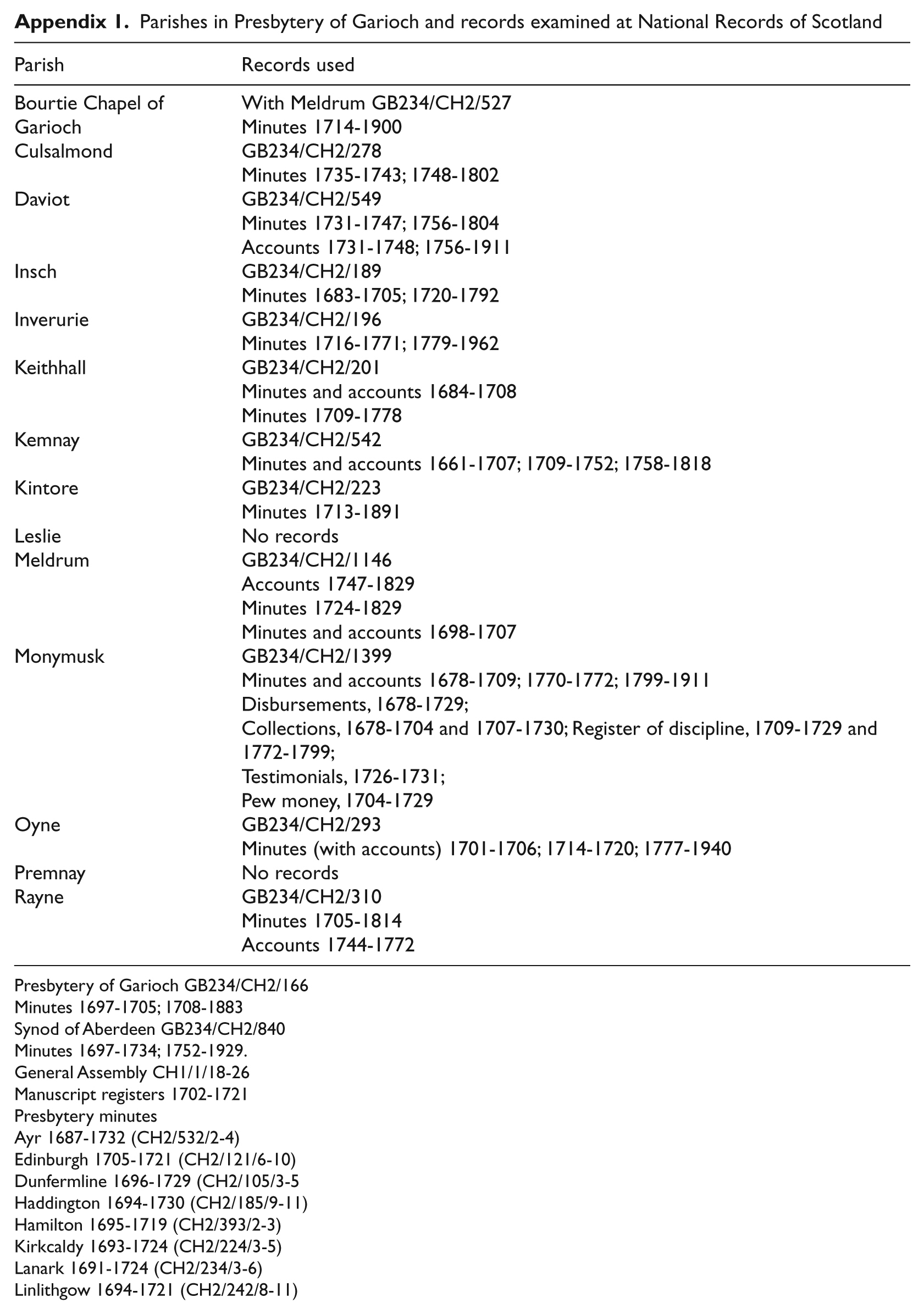
Presbytery of Garioch GB234/CH2/166
Minutes 1697-1705; 1708-1883
Synod of Aberdeen GB234/CH2/840
Minutes 1697-1734; 1752-1929.
General Assembly CH1/1/18-26
Manuscript registers 1702-1721
Presbytery minutes
Ayr 1687-1732 (CH2/532/2-4)
Edinburgh 1705-1721 (CH2/121/6-10)
Dunfermline 1696-1729 (CH2/105/3-5
Haddington 1694-1730 (CH2/185/9-11)
Hamilton 1695-1719 (CH2/393/2-3)
Kirkcaldy 1693-1724 (CH2/224/3-5)
Lanark 1691-1724 (CH2/234/3-6)
Linlithgow 1694-1721 (CH2/242/8-11)