




Abstract
Anti-corruption knowledge and discourse emerged in the mid-1990s promoted by powerful international actors and organizations, mostly targeting countries in the ‘Third World’. In this paper, we seek to decolonize this knowledge and show how it influences the construction of national identity of former colonies. Our case is a country with a reputation as one of the most corrupt in the world: Indonesia. Long celebrated in the West for its economic growth and political stability, in 1997 the Asian Financial Crisis forced Indonesia to accept financial aid from the International Monetary Fund accompanied by harsh conditions that resulted in domestic turmoil. Using discourse-historical method, we trace how national identity was constructed in The Jakarta Post from 1997 through two decades of Western-influenced corruption-related reform. Our findings show how acceptance of Western anti-corruption discourse and knowledge early on contributed to highly negative internal constructions of Indonesian national identity, but over time, this gave way both to more positive self-presentations as well as greater critique and contestation of this knowledge. Moreover, alternative rationales for anti-corruption were asserted that drew from shared understandings of Islam and Indonesia’s independence. Overall, we show how this type of internationally dominant management and organizational knowledge (MOK) colonized how Indonesia was imagined but that contestation was possible, enabled by improvements in economic circumstances. We conclude by arguing that to understand the colonizing effects of MOK, it is necessary to look at the impact of management knowledge beyond the boundaries of organizations, including at the level of national identities.
Introduction
Anti-corruption became a central focus for international development agencies from the mid-1990s onwards, generating a canon of development management discourse, knowledge, tools and instruments designed to reform the governance and public administration of former Eastern-bloc and ‘Third World’ countries along Western ideals of a free market, liberal democracy and modernity (Koechlin, 2013; Marquette, 2012; Murphy and Albu, 2018; Sampson, 2010; Wedel, 2012). Organizations such as The World Bank (1997), the International Monetary Fund (IMF) (2018) and Transparency International (TI) (2020), helped establish corruption as an urgent problem requiring action. The World Bank and TI in particular were both major producers of knowledge about corruption as well as involved in its implementation. Together with the IMF, the anti-corruption programme they launched enlisted a complex web of actors including some Western nations, NGOs and consultants (Baumann, 2020; Marquette, 2012; Murphy and Albu, 2018; Wedel, 2012). Such has been its success Sampson (2010: 263) argues ‘anti-corruptionism’ has become an industry because of the institutional investments it has attracted and the way it has kept corruption on the international ‘policy agenda, attracting ever more attention and resources’.
However, it has also been widely critiqued. The World Bank’s (1997) original definition of corruption as ‘the abuse of public office for private gain’ (p. 8) 1 acquired epistemic authority (De Maria, 2008), establishing a nexus of power-knowledge relations around good governance, anti-corruption and development management supported by ‘technicist’ instruments, expertise and practices that lent a scientific legitimacy, obscuring its origins and depoliticizing its assumptions and impact. While purporting to be universal, it had highly partisan effects, focusing attention on corruption among the governments and public sectors of ‘Third World’ countries (Koechlin, 2013), emphasizing ‘bribe-takers’ rather than ‘bribe-payers’ (Löwenheim, 2008: 270; Murphy, 2011), and diverting attention from corruption in developed economies (Murphy, 2011; Murphy and Albu, 2018; Wedel, 2012). In short, it has acted as a form of (neo)coloniality operating through knowledge, expertise and techne, (Quijano, 2007) rather than brute force.
In taking anti-corruption and international development as our focus, we are following decolonial scholars such as Murphy (2007), Cooke (2004), Cooke and Faria (2013) and Banerjee et al. (2009), who argue management knowledge’s impact is not limited to organizations but has a global reach, extending to nation-states and relationships between them, mediated by powerful institutions such as the World Bank and IMF (Banerjee et al., 2009), constituting and reflecting global hierarchies and inequalities. In order to understand this reach, they call for more critical dialogue between the fields of international relations, development studies and management (e.g. see Cooke and Faria, 2013), particularly international management which still exhibits a lack of alternative worldviews and narrow focus on MNCs (Faria et al., 2010). Examining the role played by international institutions in promulgating Western management knowledge and its impact on relationships between nation-states would go some way to addressing this gap. In this spirit, we seek to explore how one particular type of Western management knowledge – anti-corruption – generated by global actors such as the World Bank and the IMF and which often takes the country as the unit of analysis (Wedel, 2012), has had a particular impact on the way ‘Third World’ nations are constructed or ‘imagined’ from the outside.
In this paper, we explore how that exterior knowledge was mobilized, reproduced and/or contested to construct versions of national identity within a country often portrayed as one of the most corrupt in the world: Indonesia. Here we draw on the idea of national identity as a product of Western European modernity – an ‘imagined community’ (Anderson, 1991; Bhabha, 1990) narrated into being for specific audiences, whose meaning is dependent on its relation to other nations, awareness of an ‘inter-national’ beyond its borders and shared understandings of its geographical location, and past, present and future. However, for former colonies, ‘nation’ and national identity are complex and ambivalent constructs (Jack et al., 2011; Prasad, 1997): a focus around which independence movements organized but also a legacy of the Western colonial/modernizing project that imposed foreign, unitary views of colonized peoples, and continues to function as a means through which ongoing inequalities are given form (Mignolo, 2011a).
In our study, we collected and analysed texts from The Jakarta Post (TJP) to trace how international anti-corruption knowledge was featured in versions of Indonesian national identity constructed between 1997 and 2019. We use news media because it reflects and shapes the culture in which it is situated, and functions as a source of everyday knowledge (Fairclough, 1995; Van Dijk, 1995, 2000). As an English-language newspaper, with an educated international and domestic middle-class audience, The Jakarta Post occupies the border between Indonesia and an external world. As such it provided a site where we could explore how awareness of external constructions of Indonesian national identity were taken up, interpreted and potentially transformed into alternative versions, reflecting the shifting dynamics of domestic politics and economic fortunes, and international relations.
Based on patterns of similarities and differences we identified in our analysis, we categorized the findings into three episodes (see Table 2) marked by shifts in the prevalence and acceptance of international anti-corruption knowledge and how it was used to construct versions of national identity. Overall, TJP consistently reinforced the normative ideal of one Indonesian nation, though its characterization varied. Highly negative self-presentations of Indonesia reflecting Western evaluations in the earlier episode gave way to more moderate and positive self-presentations in later episodes, enabled by improvements in economic conditions, and accompanied by greater critical distance and assertion of alternative knowledge. While Western appraisals of Indonesia were still apparent, we detected a growing sense of collective agency and possible imagined futures in which Indonesia is far less reliant on Western powers.
Our study makes several interrelated contributions to decolonizing management knowledge. Firstly, through our empirical case, we show why and how management knowledge, needs to engage to a greater extent with international relations, critical development studies and political economy. In particular, there needs to be greater recognition within management of the inequalities between nation states and other powerful international actors that make up the global economic order, constituting the environment in which governments and businesses operate. Secondly, and closely connected with the first, we show how management knowledge has neo-colonial effects beyond organizations, on the way nations and entire peoples are characterized by external authorities and how those targeted by such characterizations engage with those appraisals over time. Thirdly, we offer an example of how to apply a decolonial ethos to critical discourse analysis, in our case, discourse-historical method as it has been developed to study the construction of national identity (Wodak et al., 2009).
We begin by explaining the decolonial idea of the ‘geopolitics of knowledge’ (Bhambra, 2014: 120; see Mignolo, 2011a, 2011b) and then apply it to trace how the international anti-corruption industry emerged and diffused. We then discuss why the very idea of ‘nation’ is complicated and ambivalent for former colonies and how this form of knowledge can influence the collective ‘self-image of peoples’ (Maldonado-Torres, 2007: 243). This is followed by an overview of our methodology, data collection and analysis. In our findings, we detail the patterns and shifts in how anti-corruption discourse features in constructions of Indonesia and conclude by discussing the implications our study has for understanding the reach of management knowledge, the ways in which it continues to influence the way nations are imagined (Bhambra, 2014; Wanderley and Barros, 2019) in formerly colonized areas but also how this can change over time.
De-colonizing anti-corruption knowledge
While a diverse body of scholarship, decolonial thinkers share a concern with making visible how colonial power continues to operate through economic, political and cultural means (e.g. Bhambra, 2014; Grosfoguel, 2007; Maldonado-Torres, 2007; Mignolo, 2007a, 2007b, 2009, 2011a, 2011b, 2020; Quijano, 2007; Wanderley and Barros, 2019). In Maldonado-Torres’s (2007: 243) words, former European colonies may have gained political independence but ‘colonality survives colonialism. It is maintained alive in books, in the criteria for academic performance, in cultural patterns, in common sense, in the self-image of peoples, in aspirations of the self, and so many other aspects of our modern experience. In a way as modern subjects we breathe coloniality all the time and every day’. An insidious form of power, it operates through various means: economic, political, knowledge and being – how individual and collective subjects are known by others and come to know themselves (Mignolo, 2007a; Quijano, 2007).
Decolonality attempts to both make coloniality visible and undo the power relations saturating dominant knowledge (Maldonado-Torres, 2007; Ndlovu-Gatsheni, 2015) that perpetuate and naturalize global hierarchies of inequality. It therefore seeks to problematize not just the form and content of knowledge but also its origins. In Mignolo’s (2009: 2) words this means asking ‘who and when, why and where knowledge [is] generated’ as well as who or what is targeted and constructed by such knowledge. It involves questioning the limits placed on what is thinkable as well as the boundaries that have been institutionalized between different fields of practice and scholarship and the assumptions on which these are based. For example, decolonial scholars in management have challenged the distinctions maintained between international management and international relations as well as between management and ‘development and administration management’ reinforced by the presumption that ‘management’ should focus on the organization as ‘object’. One consequence is that the relevance international politics, political economy and development has for management knowledge is obscured, and vice versa (Cooke, 2004; Cooke and Faria, 2013; Faria et al., 2010; Özkazanç-Pan, 2008).
In contrast, a decolonial approach to international management would broaden the scope of inquiry beyond the ‘organization’ per se. It would explore how management knowledge produced by powerful global actors circulates, impacting how people, territories and nations are classified, known and acted upon but also how those targeted by such knowledge can take up, contest and change how they are constructed. Further it would also not take the institutions and ‘structures of governance in the world economy’ (Jaya, 2001: 230) such as the World Bank for granted but situate these structures and the knowledge they produce in a geopolitical and temporal context. In turn this can create space for surfacing ‘those modes and practices of knowledge that have been denied by the dominance of particular forms’ (Bhambra, 2014: 118; Mignolo, 2009, 2011a).
Our focus is on anti-corruptionism and our objective here is to contextualize it both temporally and geographically, as a way of contesting its claims to universality. It emerged as a form of Western power-knowledge generated by certain international actors at a time when the geoconomic and political order was in flux. From the 1960s until the mid-1980s corruption had been seen as a ‘growing pain’ and even a ‘welcome lubricant’ for Third World countries’ transition to modernity (see Koechlin, 2013: 2; also Marquette, 2003). The very term ‘Third World’ is a product of this period of the Cold War, denoting countries that had not yet undergone processes of industrial and economic modernization by ‘First World’ (i.e. Western capitalist and liberal democratic) standards (see Cooke and Faria, 2013) but that were not aligned with communist regimes (the ‘Second World’). During this period, authoritarian governments in ‘Third World’ countries were tolerated and supported financially through foreign aid, because they were considered potentially stable and effective political systems for countries undergoing economic development. Over this time, the World Bank claimed it had a non-political stance but its lending decisions reflected US foreign interests (Cooke, 2004; Cooke and Faria, 2013). For example, in South-East Asia, in the late 1970s it extended loans to political allies of the US that did not meet its standards of creditworthiness, such as Indonesia, Thailand and The Philippines, but refused to lend to communist Vietnam (Marquette, 2003: 31). But after the Cold War ended, Western powers, principally the US, (Faria et al., 2010) were no longer dependent on political alliances with such countries to combat the rise of communism. It was then that corruption, particularly that which hampered foreign business interests, became constructed as an urgent priority warranting international attention and intervention prompting Western-sponsored managerialist reform of economic, governance and political systems in developing regions (Dar and Cooke, 2008).
When James Wolfensohn became World Bank President in 1996, he expanded the institution’s remit to address corruption, labelling it a ‘cancer’ causing poverty and impeding development (Marquette, 2003; Sampson, 2010; Wedel, 2012; Wolfensohn, 2005), a view that quickly spread within powerful Western governments and international development and financial agencies. Subsequently this network of international actors blamed the financial crises that hit Eastern Europe, Latin America, Africa and Asia on the poor governance of their nations: their financial failure was constructed as the fault of domestic governments who over-regulated their economies (referred to disparagingly as ‘crony capitalism’), and whose systemic ‘corruption’ impeded growth and development, making them unattractive sites for foreign investment. Therefore, corruption had to be addressed through neoliberal-style reform (Koechlin, 2013; Löwenheim, 2008). Earlier tolerance of, and overt support for, authoritarian regimes in these regions was thus explicitly reversed.
For example, Hall (2003) argues the financial crises in South-East Asia in 1997 were portrayed by the IMF and the US Treasury as a ‘morality tale’ (Hall, 2003: 85) about the folly of domestic governments deviating from the norms of Western capitalist modernity by controlling certain industries and restricting foreign access. And yet, not long before, the rate of economic growth in this region (and returns to foreign investors) was heralded in the West as the ‘East Asian Miracle’. Even though some attributed the crisis to too-rapid financial liberalization in these economies, rather than its absence, (significant foreign capital able to be quickly withdrawn, left them vulnerable to currency devaluation), reform focused on greater and faster liberalization, openness and transparency to Western experts, development and financial agencies and global business interests. The economic vulnerability of countries in South-East Asia meant many were unable to negotiate the terms of the financial aid from the IMF (Budianta, 2000). Impatient with Indonesia’s pace of change, the IMF went so far in its managerial economic intervention as to ‘specify. . . in minute detail such things as the price of gasoline and the manner of selling plywood’ (Feldstein, 1998: 24). Rather than restoring these economies, critics argued the aid’s harsh terms exacerbated the depth, impact and duration of the crisis. Under these conditions, Hall (2003: 73) argues the Asian Development Model was ‘discursively delegitimated’ with nations forced to take the ‘bitter medicine’ the IMF prescribed.
Understood in this context, it is easier to see how this form of anti-corruption knowledge became dominant, assisted by growth in governance and corruption indices. The most influential – the World Bank’s Governance Indicators and TI’s Corruption Perception Index (CPI) – are used by international credit rating agencies and Western Governments in their lending and investment decisions (Baumann, 2020; Löwenheim, 2008). The CPI is particularly well known and includes a league table ranking nations according to their reputation for corruption – through international comparison, some countries (usually Western nations) are ‘named and proclaimed’ as clean, whereas others (typically poorer and developing countries) are ‘named and shamed’ as corrupt (Baumann, 2020; De Maria, 2008; Koechlin, 2013; Murphy, 2011). That the instrument measures Western perceptions of corruption, particularly those of businesspeople, (Wedel, 2012) reflecting their cultural biases, rather than any evidence of corruption per se, seems largely forgotten. And while TI maintains it is does not intend to ‘brand’ any nation as ‘clean’ or ‘dirty’, it appears to have this effect with evidence some states have internalized these evaluations and changed their policies as a result (De Maria, 2008, 2009). Development and anti-corruption discourse have thus generated authoritative knowledge about countries in the ‘Third World’ that influences the decisions they and other international actors make. In this transnational arena, versions of national identity are constructed by being labelled and ‘known’ through anti-corruption discourse, in ways that have reproduced and strengthened existing inequalities between Western and Third World countries.
However, from decolonial and postcolonial perspectives, the very concept of ‘nation’ or ‘nation-state’ is a fraught one (Chatterjee, 1991/2010; Jack et al., 2011; Prasad, 1997). On the one hand it is a legacy of colonization, imposed by European powers. Those they colonized were re-made in the image of the colonizer, articulated as a homogenous geographic and cultural entity that reflected European ideas of a ‘nation’ (Bhabha, 1990). But it was also a focus around which decolonial, independence movements were able to mobilize, ending formal colonial ties and achieving sovereignty and recognition of nationhood in the international sphere. In the following section we explain this ambivalence in more detail.
National identity: Colonial, decolonial and neo-colonial dynamics
The idea of the ‘nation’ and national sovereignty, that is that a single government should exercise independent control over people living within the borders of a particular territory, is commonly attributed to the Westphalian peace treaties of 1648 (Caporaso, 2000). It thus emerged in Europe at a time when European powers and businesses (e.g. the Dutch East India company and the Portuguese East India company established in 1602 and 1628, respectively) were colonizing regions in South-East Asia, South Asia, the Pacific, Africa and Latin America. European modernity and the economic and industrial progress, scientific and technological innovation that exemplified the Age of Enlightenment were made possible by the value forcibly extracted from its colonies (Mignolo, 2007b; Quijano, 2007). Thus the very idea of the ‘nation’ is bound up with Western modernity, development and coloniality (Mignolo, 2011a).
More specifically, according to Anderson (1991), two related developments from the early 17th century on helped to spread the idea of the ‘nation’ in Western Europe: print capitalism and a literate bourgeoisie. Technology enabled the mass publishing of newspapers and pamphlets which meant people who would never otherwise meet could think of themselves as belonging to the same community. Circulation of ongoing stories invited readers to identify as part of the same social and political imaginary and encouraged increasing levels of literacy among a new middle class who in reading newspapers could imagine the existence of others like themselves (Anderson, 1991: 36 and 77). Print capitalism was thus vital in imagining and sustaining the idea of a nation, and sense of national consciousness or identity among an increasingly important group in society. Consequently, language is central to the construction, performance and reproduction of national identity (Bhabha, 1990): ‘From the start, the nation was conceived in language’ (Anderson, 1991: 145).
When European powers colonized areas of Africa, Latin America and Asia, they introduced their own languages and ideas of a ‘nation-state’, often imposing unity on diverse and hitherto distinct and unrelated peoples and territories. Inevitably, in order to govern areas so far from Europe, native people had to be schooled to administer the colony. This meant the emergence of a ‘bilingual intelligentsia’ (Anderson, 1991: 113) who had access to Western culture but who could also, according to Chatterjee (1991/2010), use the Western public/private distinction to protect a separate cultural identity from the colonizer. Nation-states in colonized areas were thus at once an imitation of European political forms but perpetually marked as different from them (i.e. inferior, not equal) (Bhabha, 1990; Chatterjee, 1991/2010). The nation-states created by colonial capitalism were fundamentally ambivalent (Bhabha, 1990) because the ‘precise difference between the ruler and the ruled’ (Chatterjee, 1991/2010: 32) had to be continually re-articulated and re-affirmed to justify differential treatment between the colonizer and the colonized.
In the decolonizing movements that occurred throughout the 20th century, ‘nation’ was taken up, translated and modified in former colonies to express a will to sovereign nationhood, independent of the colonizer (Chatterjee, 1991/2010). It also involved transnational coalitions and dialogue between national independence movements, such as the 1955 conference in Bandung, Indonesia. It was here that Asian and African delegates generated ‘decolonialism’ as an alternative to the ‘grand narratives’ of capitalism (First World) and communism (Second World), (Mignolo, 2011b). In the 1980s, a resurgence of scholarly interest in nations and national identity was sparked by regional studies scholars (i.e. specialists in countries and regions that were formerly colonized) (Chatterjee, 1991/2010). One of the most influential contributions was Benedict Anderson’s Imagined Communities, first published in 1983, in which he traced the emergence of nations in formerly colonized areas of Africa and Asia. Here he conceptualized nation as an ‘imagined community’, imagined because at no time could all of its members encounter one another directly, and community because it was ‘bounded’: it was not coterminous with the entire world and assumed an awareness of other communities beyond its borders. National identity is thus an expression of ‘national consciousness’, or a ‘will to nationhood’ (Anderson, 1991: 6–7), that is, a group thinking of themselves as, or acting as if they were, a nation, that exists in relation to other nations constituting an ‘international’ realm (see also Bhabha, 1990). In the process intra-national differences are homogenized and suppressed, while inter-national differences are emphasized (Wodak et al., 2009).
Just as coloniality was the ‘dark side’ of the emergence of European modernity, global modernities and the global economic order, including international development, are dependent on global coloniality (Mignolo, 2011a). In this regard, the internationalization of business warrants critical reflection as ‘[O]nly one particular version of “globalization” has been assumed and reproduced, with the denial of the asymmetries that characterize relations between peoples and nation-states’ (Faria et al., 2010: 103). For Western business seeking to expand internationally, downplaying the relevance of ‘national borders’ has been in their interests. However for those in non-Western contexts including former colonies, nationalism remains an important ‘form of identification confronting the homogenizing forces of globalization’ as well as a basis for asserting their sovereignty of their states (Mignolo, 2011a, 2011b: 5)
While international relations and development may seem beyond the scope of management, this is precisely the type of disciplinary boundary that decolonial management scholars have sought to challenge and interrogate (e.g. Banerjee et al., 2009; Cooke, 2004; Cooke and Faria, 2013). Following Murphy (2011) we regard the Western advice and expertise about development and anti-corruption as a form of ‘neo-colonial’ development management knowledge that has uneven effects at the level of countries, encouraging those it targets to be known, and know themselves, in particular ways, operating through a ‘colonialization of the imagination of the dominated’ (Quijano, 2007: 169). Thus we are purposefully expanding the scope of inquiry beyond organizations to enhance our capacity to understand the neocolonial effects of this type of management knowledge.
However, such knowledge may not be accepted unproblematically. In this research we seek to explore how the discourse/knowledge generated by the international anti-corruption industry (Sampson, 2010; Wedel, 2012) influenced how Indonesia was imagined between 1997 and 2019. Specifically, we focused on how this knowledge was internalized, translated, resisted and/or contested over time within Indonesia, in ways that reflect the ‘dialectical interrelationship between institutional and material conditions and . . . discursive practices’ (Wodak et al., 2009: 4). Wodak et al. (2009) make the point that all national identities are tentative and temporary constructions of unity, contingent, ‘malleable’ and ‘fragile’, fragility that is more pronounced when countries experience crises. When we add to this the fundamental ambivalence (Bhabha, 1990) of former colonies’ claims to nationhood equal to their colonizers, a major economic and political crisis in such a setting has the potential to destabilize and complicate constructions of national identity. We chose the period 1997–2019 for data collection because 1997 marked the beginning of the Asian Financial Crisis, which exacerbated inequalities between Indonesia, Western nations and international development agencies (Feldstein, 1998), triggering much economic and political turmoil and extended it to 2019 to include the most recent data available at the time the research was undertaken.
Methodology
Our study draws upon discourse-historical method as developed and used by Wodak et al. (2009) to examine the construction of national identity. This tradition of critical discourse analysis focuses on integrating historical background and contextual information into textual analysis to investigate how discourse evolves over time, in ways that contribute to, and reflect, changes in institutional and social contexts. It assumes a mutually constitutive relationship between discourse and social structure: discursive practices produce, and potentially reproduce or contest, certain versions of knowledge, social reality and social arrangements. It focuses on identifying how power operates in discourse, for example, showing how discursive practices maintain, obscure and/or resist, relations of power between groups or actors. However, we also adapted this methodology to incorporate a decolonial perspective. Scholarship on decolonizing forms of critical discourse analysis has begun to appear (e.g. Ahmed, 2021; De Melo Resende, 2021; Richardson, 2021) and our objective is to add to this body of work, providing an empirical illustration of how discourse theories and approaches developed in the global North can be applied to decolonial areas of inquiry. Moreover, our understanding is informed by the first author’s experience of living in Jakarta, Indonesia both before and after the fall of the Suharto regime, including the political and economic upheaval of 1998 where she witnessed the mass demonstrations and persecution of students active in the movement to bring down Suharto. She later worked in anti-corruption reform before undertaking higher degrees in Australia and then returning to Indonesia in 2016. Hew view of events and anti-corruptionism has shifted over this time, informed by both interior and exterior knowledge of corruption, at times in contradiction, and the differences she has observed in how Indonesia is constructed internally and externally. Our methodology is thus a situated artefact of embodied/embedded knowledge in which Western and decolonial knowledges and alternative ways of knowing interact.
Wodak et al. (2009) draw on Anderson’s (1991) conceptualization of national identity as a form of ‘imagined community’. They describe it as ‘a product of discourse’, neither constant nor uniform but a temporary ‘positioning’, a version of the nation’s past, present and future influencing how people think about their world and the nation to which they ‘perceive themselves as belonging’ (Wodak et al., 2009: 29). National identity is constructed around key dimensions including: uniqueness, similarity and difference (to other nations or groups), autonomy (self-government and independence from others), coherence or unity and continuity (i.e. a sense of identity coherence over time) as well as inclusion and exclusion (p. 34). These are accomplished by discursive strategies realized through various rhetorical, and linguistic devices (and those of other semiotic modes) such as metaphors, pronouns (such as ‘we’) and argumentation schemes. Here ‘strategy’ denotes ‘action oriented towards a goal’ (p. 32) that does not assume conscious intention on the part of an actor (as some actions occur automatically in ways that reflect social conditioning etc).
In order to ‘decolonize’ Wodak et al.’s (2009) approach to studying national identity we needed to firstly, consider how, when and where it was produced and what influence this may have had on the framework and assumptions on which it was based. In this regard we are following Ahmed (2021) and De Melo Resende (2021) who argue that theories and methodologies developed in the Global North can be applied in decolonial scholarship but require an additional focus on the ‘coloniality of power’ (Ahmed, 2021: 140) and contextualizing all claims to knowledge (De Melo Resende, 2021). This raises several pertinent points. Firstly, Wodak et al. developed their framework in the context of Western Europe, specifically Austria, to analyse how constructions of similarity and difference were negotiated and contested. Their ‘Vienna school’ of critical discourse analysis was particularly concerned with discourses of prejudice (anti-Semitism, immigration), the rise of neo-nationalism and how this was mobilized to construct versions of collective identity that excluded some groups. And at the conclusion of their (2009) book they explicitly suggest their approach could be applied to study the construction of national identity within other Western European nations.
Their focus is thus on within-country discourse, rather than the influence of those outside its borders. Related to this is their assumption that nations have equal status who recognize others’ claims to this status within their region (i.e. Western Europe). While Wodak et al.’s (2009) theory is critical in its overt concern with power, it is silent on the inequalities between nation states because of colonization, perhaps because Western European nations tended to be colonizers, rather than colonized. We argue that one way of decolonizing this theory is to focus on the interplay between external appraisals and internal constructions of national identity in former colonies. If global modernity is not possible without global coloniality, as Mignolo (2011a) suggests, then important power effects will be missed unless the exterior-interior dynamics are understood. The key dimensions of national identity by Wodak et al. (2009) outlined above would all be more complex in former colonies because of colonizer/colonized dynamics. For example, establishing similarity and difference to other nations would reflect both the current global economic order but also colonial pasts. The trajectory of nationhood constructed might also reflect and/or contest Western modernity’s linear narrative of progress and development.
Therefore, while we used Wodak et al.’s (2009) framework, we explicitly focused on the power relationships between Indonesia and external (particularly Western) appraisals as well as the comparisons drawn between it and other nations. The framework consists of five ‘macro’ discursive strategies which we used heuristically to interpret the overarching patterns in our initial findings and shifts within and between episodes. In brief, these are: strategies of justification and relativization (e.g. shifting blame, downplaying harm); constructive strategies (emphasizing national uniqueness, coherence/internal similarities and autonomy); strategies of perpetuation (which links continuity with positive self-presentations); strategies of transformation (used to argue for change, e.g. through warnings or threats to national autonomy, possibility for positive futures); and strategies of dismantling and destruction (pp. 35–42).
We chose media texts as data because they enable understanding of how everyday forms of knowledge are formed and circulate and newspapers produce knowledge about both national identity and corruption. News media remains a technical means of imagining the ‘nation-as-community’, structuring and constructing its audience. It is also attracted to covering corruption, particularly scandals, and people rely on it to know what is occurring in their society and what it means (Bratu and Kažoka, 2018; Breit, 2011; Kramer, 2013).
Data collection and analysis
We collected articles published by The Jakarta Post (TJP) via the Factiva database between 1997 (1 year before Suharto’s regime ended) to 2019 in order to trace the meaning of corruption and the influence of the international anti-corruption agenda during periods of political and economic transformation. Prior to 1997, in the Suharto era, Indonesia experienced periods of relatively economic stability and high growth compared to the previous Sukarno era (Woo and Hong, 2010). For example, during 1969–1982, Indonesia recorded nearly 8% annual growth rate (Liddle, 1991). While this growth strategy was not ‘pro-poor’ (Booth, 2000) there was a decreasing trend of absolute poverty during the Suharto regime. However, the government became notorious for its political repression, nepotism and corruption, particularly involving Suharto’s family. The president became synonymous with ‘patrimonialism’ and the phrase ‘the Suharto franchise’ was used to describe his style of corruption (McLeod, 2000). The deterioration of economic and political conditions with the onset of the Asian Financial Crisis coincided with a growing wave of criticism towards the behaviour of Suharto’s children.
Between 1997 and 2019, Indonesia experienced significant events including the financial crisis of 1997–1998, agreeing to the IMF’s bailout packages, Suharto’s resignation, three instalments of constitutional amendments, the first direct presidential election, early repayment of foreign debts and regaining international trust in their economy (see Table 1 for Key political/financial events).
Key political/financial events.
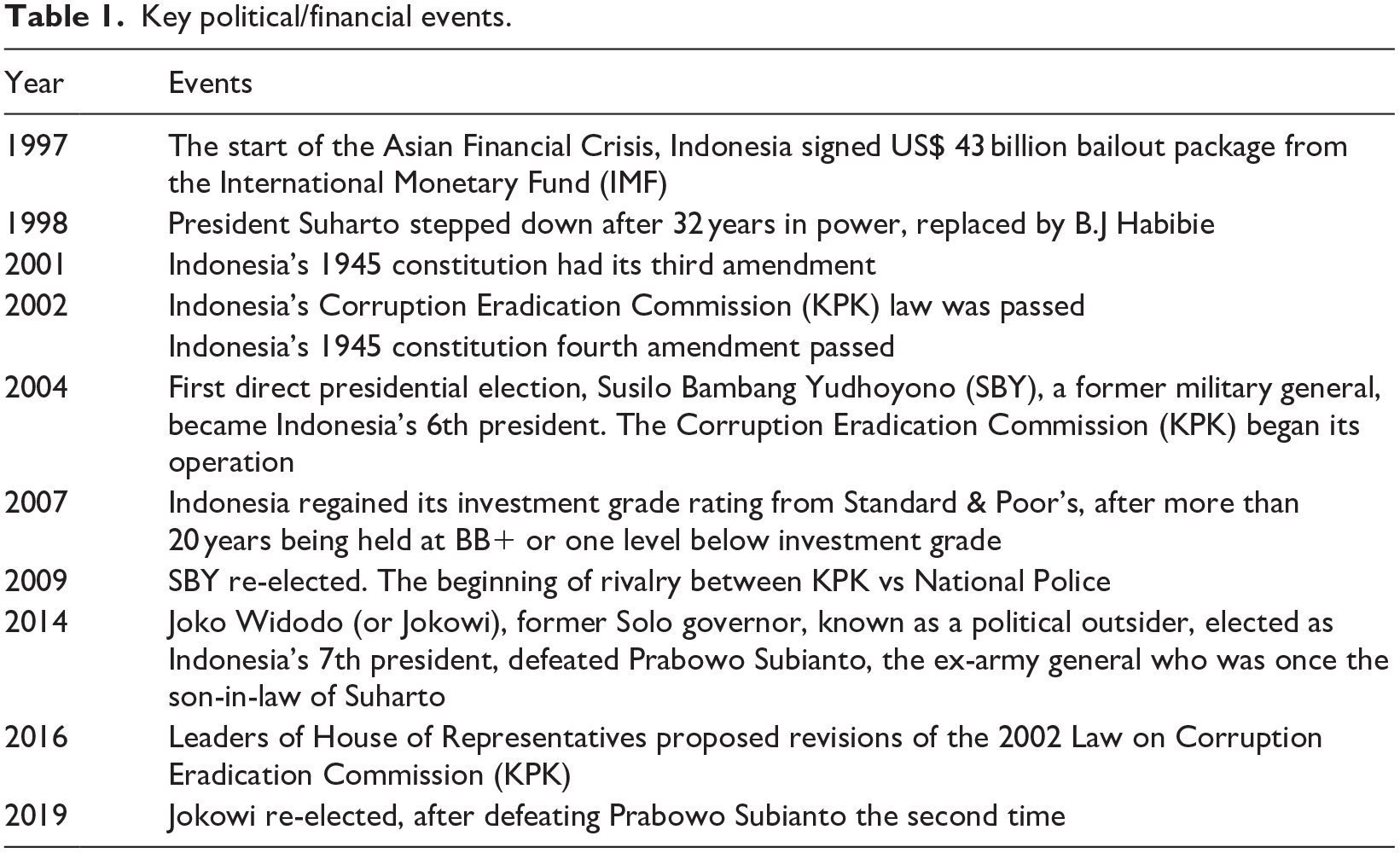
We used texts from The Jakarta Post because it occupies a unique position on the border between Indonesia and the Western world. It was the Suharto government that initiated the establishment of The Jakarta Post in the 1980s by a consortium of media companies. The government considered the country lacked an English-language newspaper that could convey an ‘Indonesian’ viewpoint to those at home and abroad, including foreigners in Indonesia (Tarrant, 2008). In addition, it attracted an educated national and expatriate readership of the kind Anderson (1991: 131 a ‘bilingual intelligentsia’) argues were central to movements for independence and a sense of shared nationhood in former colonies. Its audience are those inside Indonesia but also beyond its borders, facilitated by its use of English – a Western ‘language of power’ (Richardson, 2021). Because of this position, it is likely to include coverage of external appraisals of Indonesia and construct the meanings of these appraisals for its audience. It was thus a suitable choice to assess how Western corruption and anti-corruption knowledge and discourse are used to construct the national identity of Indonesia by those interested in its relation to international actors and the rest of the world.
We collected all page-one articles and editorials from 1997 to 2019 that mentioned corruption and efforts to combat it because they tend to represent the view of the newspaper and what it deems important. We also paid special attention to coverage of scandals and included some opinion pieces or letters that clarified arguments and views about the meaning of corruption in relation to Indonesian national identity. These were then catalogued according to date of publication.
Initially we searched for patterns of similarity and variation around the following key questions: Why is corruption a problem, what causes it and what should be done? What metaphors are used for corruption (and what do these imply about Indonesian national identity)? What metaphors are used to construct the identity of Indonesia? How are Western actors, and their views of Indonesia, constructed? Are these constructions accepted or rejected? Are the constructions of Indonesia’s identity positive, negative or ambivalent? What versions of Indonesia’s past, present and future are constructed and how are these used argumentatively? What relationships are constructed between Indonesia, other countries and international actors (e.g. Western experts, multinational development agencies)?
Using a timeline and integrating our understanding of key historical events and significant political and economic changes into the analysis, we identified several distinct patterns that led us to inductively categorize the overall time period into three episodes. In creating this periodization, we have drawn upon Luyckx and Janssens (2016: 1596) and Rowlinson et al.’s (2014) understanding of a ‘historical treatment of time’ which recognizes the variability of historical context, rather than just time as a linear phenomenon. We focused our analysis around questions such as: how is Indonesia’s identity constructed differently from 1 year to another? What (dis)continuity can be found in those constructions? We found anti-corruption knowledge appeared in all three episodes but there were shifts in their prominence and how they were used to construct Indonesia as an ‘imagined community’. For example, we summarized the dominant metaphors used to construct Indonesia’s relationship with the West and its relative position in the international realm for the articles for each year. On this basis we detected both similarities and differences between years which corresponded with more negative or positive constructions of Indonesia, and acceptance or contestation of anti-corruption knowledge. When we detected a distinct shift in patterns that was repeated in subsequent years, we provisionally grouped the time period into episodes with reference to key political and economic events. Following this, we compared these patterns with the framework of macro discursive strategies by Wodak et al. (2009) to assess if certain strategies were present and their prevalence. On this basis we finalized the periodization.
Both the substantive content of the findings and the periodization thus reflect and privilege our interpretation of the data. Periodization involves abstraction (Lorenz, 2017) and involves decisions about inclusion and exclusion. Searching for patterns of similarity and variation directs attention to coherence on the one hand and distinct differentiation on the other, both of which are produced by the analytical process itself. As with all interpretive research, we acknowledge others may have identified different patterns and conclusions, particularly if they had analysed newspapers with a different audience and over different time periods. As researchers we made choices that generated the findings and drew on our varied knowledge of Indonesian/external relations; other accounts are not only possible therefore, but probable, the result of the interaction of the researchers’ positionality, the data used, time period, methodology and ways of analysing and interpreting the texts. As with all decolonial scholarship, the objective is not to assert an alternative, fundamental truth but rather to open up alternative ways of knowing and encourage a plurality of views.
Findings: Imagining Indonesia
The first episode begins with the Asian Financial Crisis of 1997 and its fallout and the start of a significant and lengthy programme of anti-corruption reform including the establishment of the KPK (Anti-Corruption Commission). The second episode spans Yudhoyono’s time in office (2008–2014) including his second term in which his Democratic Party was plagued by corruption scandals. The third is from 2014 to 2019, which started with the election of Joko Widodo (‘Jokowi’) as the new President, someone who was widely seen as an (ordinary) person of integrity and outsider to entrenched political elites (see Table 2). Initially there was greater acceptance and reproduction of international anti-corruption knowledge which led to more negative constructions of Indonesia and a discursive strategy of dismantling and destruction. Over time, this gave way to more mixed and positive constructions that corresponded with greater contestation of the logic and assumptions of ‘anti-corruptionism’ and assertion of alternative views using discursive strategies of transformation and then constructive strategies and strategies of perpetuation (Wodak et al., 2009).
Summary of episodes.
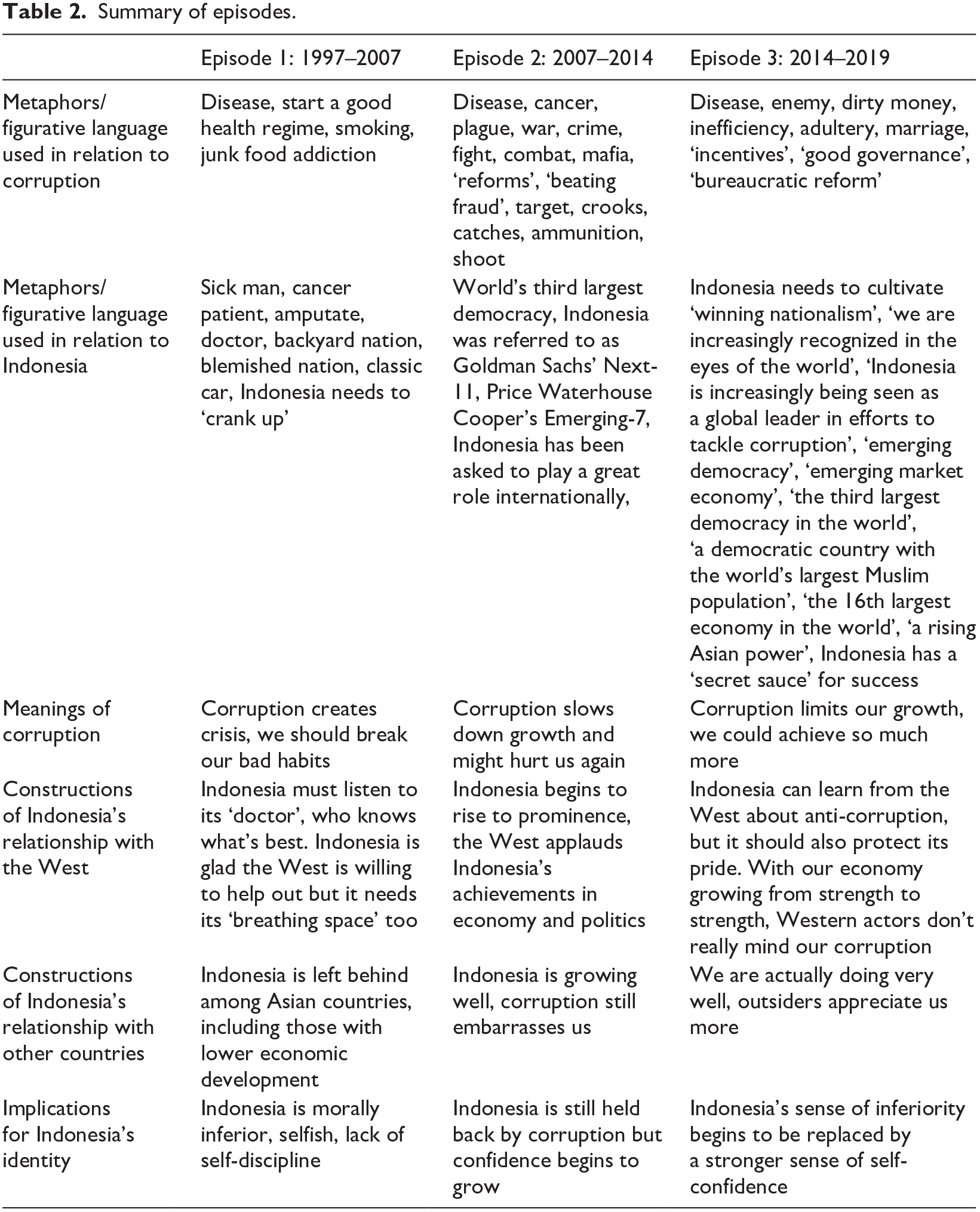
Episode 1: Indonesia is a sick nation, thanks to corruption (1997–2007)
In the first episode (1997–2007), knowledge and discourse generated by the international anti-corruption industry was reproduced in TJP, reflected in largely negative constructions of Indonesia. Once a sensitive topic under Suharto, more newspaper coverage of corruption started to appear in 1997 (e.g. the Hong Kong-based PERC report cited Indonesia as the most corrupt country in Asia). However, it was not until the collapse of the Rupiah against the US dollar September in 1997 that corruption started to dominate headlines. International and local experts struggled to explain the reversal in Indonesia’s fortunes which had been known as the East Asia Miracle for its rapid economic growth, political stability, poverty reduction and openness to foreign investment under 32 years of Suharto’s rule. The World Bank, admitted they ‘got it wrong’ (5 February 1998) in their confidence in the Indonesian economy but then blamed Indonesia for the crisis, an attribution repeated in TJP.
Metaphors related to health and disease were common, for example, characterizing Indonesia as a ‘sick nation’ (26 January 2002), suffering from extensive and serious ‘illness’ (15 August 1997), and ‘societal malaise’ (5 August 1998) while its government was riddled with the ‘cancer’ of corruption (8 May 1998). Personified as a ‘sick person’, ‘sick man’ (3 December 1997) and ‘cancer patient’ (25 June 2003), articles suggested Indonesia was under threat from within. Its economy was ‘bleeding’, it ‘needs blood transfusions’ (8 December 2003), and had been ‘crippled’ by the financial crisis (5 February 1998).
The IMF, World Bank and its experts were constructed variously as ‘doctors’ (11 October 1997), ‘surgeons’, and ‘Men in Black’, in reference to the American blockbuster movie, suggesting they were trusted experts who could help to rescue Indonesia from itself. As the ‘patient’, Indonesia should follow the doctor’s advice even if that meant pain and invasive procedures, such as ‘amputating’ its rotten parts. Consistent with the overall tone of self-blame, articles constructed corruption as an illness caused by Indonesia’s own bad habits, for example: Some leading politicians have even attributed the nation’s financial troubles to the institution. But while the effectiveness of some of its policies may be debatable, to put the blame on the IMF for weak economic performance is akin to a cancer patient blaming his doctor for his condition even though he has been smoking 20 Marlboros a day over the last 10 years. (25 June 2003)
Articles attempted to educate their readership about anti-corruption knowledge and called on them and the government to face reality and accept the situation, admit its bad habits and let the IMF do their job because ‘half the cure comes in realizing the problem’. (16 August 1998). In these initial years, representations of Indonesia in TJP largely replicated the image of it promoted by the international anti-corruption industry.
Commentary about politically motivated violence, agitation for independence by some provinces and criticism of collusion and nepotism among the elite, including those in the military and government, constructed political and economic turbulence as threatening the continuation of Indonesia as one nation. However, despite the complexity of contributing factors, it was longstanding corruption that was seen as causing the prospect of national ‘disintegration’ (25 October 1998): Corruption, which found fertile ground during the New Order regime, is the culprit responsible for the miseries that our people now are enduring. It is also responsible, indirectly, for the threats of disintegration and the sizable numbers of lives lost in those ‘rebellions’. It is the manifestation of greed, avarice and egotism of most of our government officials. (29 April 2000)
The problems experienced in Indonesia were thus simplified and reduced to symptoms of the one underlying weakness – corruption – which then led logically to the solution of anti-corruption reform recommended by international experts.
Indonesia was consistently constructed as inferior to other countries, especially its Asian neighbours. Citing the global corruption reports and using metaphors such as ‘nation of coolies’, ‘the coolie of other nations’, and ‘a nation of debtors’ (29 June 1998), articles compared Indonesia unfavourably to other developing nations. In an article titled ‘Indonesia at risk of becoming Asia’s black hole’ (19 June 1998), the financial crisis was constructed as a ‘dust storm originating in Wall Street’ that had covered the ‘four big houses’, that is, Thailand, Malaysia, Indonesia and South Korea, and Indonesia was the last house still covered in ‘thick black dust’. This pattern continued until the later years in this period, with warnings that Indonesia would soon become ‘the backyard’ nation among Asian countries. For example, in one article titled ‘Indonesia a truly sick nation – Scholar’: Speaking at the annual meeting of Muhammadiyah here, Nurcholish said Indonesia was already lagging behind other countries in finance, education, science, culture but most importantly in morality and mentality. ‘We should be ashamed to be known as ‘lazy and poor people.’ Indonesia will always be at the rear end and looked down on by others.’ (26 January 2002)
Articles argued the crisis was caused by the ‘mentality’ of Indonesians, the result of previous colonialism but also inherent cultural flaws of being ‘narrow minded, contentious, egotistical, self-serving’ (21 December 2000). The uniquely Indonesian ‘way of doing things’ was described as ‘wearing one’s clothes inside-out’ (11 November 1998), which was both the result and cause of its previous colonization: …it could be an effect of our having been colonized for 350 years. Or, the worst yet, that it might be our intrinsic “way of fashion” which made us easily colonized for such a long period!
Indonesia’s ‘selfishness’ was also mentioned by Western experts who argued it had to be addressed to enable the country to be part of the international economy: Harvard professor Michael Porter made an interesting comment last week that garnered headlines in Indonesia. He said that to succeed in global competition, our nation had to refrain from being selfish. He also suggested that the government help create a favorable environment for people to do business. This is important because a thriving business sector, he argued, is key to the country’s prosperity. There is nothing especially new in those observations. Yet, we badly need to take Porter’s comments to heart, because selfishness and corruption are among the most pressing problems Indonesia is confronting right now. (7 December 2006)
In summary, the dominant macro-discursive strategy in this first episode is dismantling and destruction (Wodak et al., 2009) particularly early on as journalists and commentators attempt to educate their readership about the extent of corruption, why it is a problem, what causes it and what should be done. The Western view of Indonesia as one of the most corrupt countries in the world (and the cause of its own financial ills) promoted by the anti-corruption industry is reproduced internally in TJP, leading to totalizing negative constructions of Indonesia, which attribute corruption to fundamental inferiority in Indonesian culture. At this point, anti-corruptionism as a form a neocoloniality is at the height of its influence in that the ‘colonized’ are seeing themselves ‘through the eyes of the colonizer’ (Wanderley and Barros, 2019: 93). As a metaphorical person, Indonesia is both sick, deteriorating and morally flawed: at worse, at risk of collapse and at best, condemned to future subservience to others. Overall then, we suggest this reflects a ‘colonization of the imagination’ (Quijano, 2007: 169) by the international anti-corruption industry who produce and implement anti-corruption knowledge, that reduces and simplifies the conditions being experienced in Indonesia to its internal corruption.
However, towards the end of this first episode, some positive constructions of Indonesia started to appear. Indonesia’s first direct presidential election in 2004 was seen as an achievement and the 60th anniversary of Indonesia’s independence prompted public reflection on the history of the nation, the changes it had experienced and the challenges it currently faced. One political commentator wrote that Indonesia did not have the same advantages as the ‘world’s superpowers, which grew to greatness leaning on a world of ignorant peoples’ over a period of several hundred years. Instead, it had to learn and adapt quickly ‘to build a new ethical order’ and achieve recognition by others in the international realm: We are a good country and a great people, but we are a blemished nation. Indonesia is known less for its positives than for the atrocities in human rights abuse and the extreme scale of corruption of the Soeharto years, which refuse to go away. We know we are not like that. We know that we are a good people. We have strong family values, a high degree of pluralism and religious tolerance. We have energy and sensitivity and a very open democratic system. (19 August 2005)
Metaphors for Indonesia also started to become more favourable. In an article titled: ‘Crank up the engine Indonesia, we may win the race’, Indonesia was described as a classic car, very desirable for many but needing to ‘crank up’ to keep pace with others and modernize quickly in order to compete: Everyone wants a page, a cut or a slice of our beautiful nation. And they have. The foreign mining companies have found a comfortable niche in our far-flung islands and they have brought about a fair amount of benefit to the nation. Like every classic car, we are highly desired and seen by many as a status symbol. Yet this valuable and grand car simply cannot compete in present day races. Japan, China and India now lead that race in Asia. We are out of their league. And we shall be out of the league until we crank up our engine, change our rotten parts, put in modern, viable technology and get back on the track as soon as possible. We can. We can if we look toward eastern Asia and learn fast and well from our neighbors. (9 May 2003)
Therefore, while corruption was still endemic and defined Indonesia, towards the end of this episode there were signs of a growing construction of collective national agency and capability in addressing. This reinforced the normative ideal of one Indonesia as well as a Western normative trajectory of development and modernization.
Episode 2 (2007–2014): Indonesia still has corruption, but we are doing much better
In the second episode, corruption discourse still featured but the metaphors were more diverse. Those relating to health and disease were combined with other metaphors such as ‘war’, ‘fighting’, ‘combat’, ‘crime’, and ‘offence’, suggesting the problem of corruption was no longer ‘within us’, like a disease caused by our own bad habits, but outside and separate. Rather than ‘medicine’ to cure corruption, Indonesia needed to deploy particular ‘strategies’ and work hard to ‘win’ the war, not to be the ‘loser’. The enemy also began to become more easily identified. Typical villains were mainly politicians and the national police, while the hero was the KPK.
Overall a macro-strategy of transformation (Wodak et al., 2009) became more apparent as more positive external views of Indonesia appeared in the media, suggesting Indonesia has made progress and it could recover further, potentially leading to a better future. The economic crisis was now part of Indonesia’s past with articles speculating that perhaps if corruption had been eradicated it could have achieved ‘double-digit’ (4 June 2012) growth. Many commentators believed Indonesia could become a ‘superpower’ (10 June 2012), but this would require strong leaders who dared to make changes. In the same year, the United Nations Development Programme praised Indonesia for ‘outstanding efforts in tackling corruption’ (27 November 2012).
In relation to other countries, either Western or Asian, Indonesia began to be seen more favourably. The dramatic end to Suharto’s time in office was seen as enabling Indonesia to advance and become the ‘world’s third-largest democracy’ (12 April 2008). Instead of accepting corruption as an inherent and unchangeable feature of the nation, articles now argued Indonesia could overcome its problems by itself and was not inherently inferior to other nations in the global realm: There is nothing inherent in the country or the people that insists that Indonesia always be at the bottom of lists. Indonesia has everything it takes to be a stronger, more compassionate country, a place that people envy and respect rather than disparage. (16 August 2007)
Later in this episode, Indonesia’s improved appraisal from others, including Western nations and foreign business (1 March 2011), was cited as evidence of a growing sense of confidence that should be reflected in how Indonesians thought about their own nation: In his speech, “Who Says Indonesia Can’t Do It?”, Yudhoyono also called on Indonesians to stop finding fault with the country and themselves, and start developing a sense of self-respect.
He said the country’s success in achieving things others thought out of its reach should encourage the entire nation to strive for greater progress in the future. (30 October 2009)
Thus there was still a reliance on, and sensitivity to, Western views of Indonesia, particularly surrounding its progress in anti-corruption and democratic reform. However, there was also more diversity of views. Some articles warned against accepting Western evaluations at face value and to remain steadfast in fighting corruption: Indonesians deserve to be proud because our country now belongs to the world’s top 20 largest economies list. Indonesia has been able to transform itself to become the world’s third-largest democracy after India and the US, within less than 10 years after the fall of Soeharto in 1998. We are also the world’s most populous Muslim nation and are proud to be recognized as a moderate Muslim nation often described by international media as a role model for the Muslim world. But we also need to remember how in the 1990s, Western countries repeatedly praised Indonesia’s economy under Soeharto’s leadership. Indonesia was the golden boy of the World Bank, the International Monetary Fund and Asian Development Bank. But our economy crashed to zero, even to minus levels, when a financial crisis hit Asia in 1998. (27 September 2009)
The argument of ‘history as a teacher’ (Wodak et al., 2009: 40) is apparent as journalists warn Western assessments of Indonesia have been wrong before. Here there is less reliance and deference towards Western expertise and more sense that Indonesia can ‘help itself’.
Dominant anti-corruptionism knowledge was still evident, including the reasons why corruption was problematic, that is it hindered economic growth and development. For example, a leading ‘anti-corruption expert’, Robert Klitgaard, wrote in an opinion piece: Why is corruption a problem? We shouldn’t think of opposing corruption because we’re goody-goodies and corruption is wrong. We fight corruption because it hurts what we most want to achieve in society. Corruption slows economic progress. My research shows that other things equal countries with more corruption have less investment, and each dollar of investment has less impact on growth. Corruption hurts the poor, not the rich. (23 November 2009)
However, other articles mobilized religious understandings stemming from an alternative knowledge base, for example, that corruption is bad because it celebrates materialism and pursuit of material pleasure is what causes corruption: Materialism is the winner, money ranks above all else, success is measured in material achievements; luxury cars, mansions. Most of us have become Machiavellian – concerned with the ends, and not the means. We, the Eastern world have embraced materialism to a greater degree than the capitalistic Western founders. (26 July 2008)
To address this, Indonesia needed to incorporate religious values and ethics in the nation’s way of life. The article continued: Moral and religious ethics are personal matters, but they must become part of our way of life, become the structure upon which this nation is based. Without these qualities, our justice system will be plagued by corruption.
Religion should be used as a ‘social critique’ (2 September 2011). Beyond ritualistic practices, Islam, as the dominant religion, should help challenge and solve various social ills including corruption, poverty and unemployment.
religion emerged as a radical challenge and prophetic alternative to the existing confining social praxis, moral decadence, corrupt tradition and false system of consciousness. In this way, religion also provides inspiration, social energy and vision to create sociological imagination.
Thus there are indicators of more pluriversal understandings of corruption that draw an alternative sources of authority to critique and condemn corruption. By ‘pluriversal’, we do not just mean differing perspectives on corruption but rather decolonial ontologies that create the possibility of multiple worlds, rejecting the ‘Euromodern world’s claim to universality’ (Hutchings, 2019: 117).
Indonesia’s national identity also changed through its relation to others: comparators were different from those mentioned in the earlier episode. It was compared to its closest neighbour, Singapore, but also more distant countries such as Japan and Sweden. Approaching the end of this episode, corruption began to drop down the list of government priorities after ‘the economy, national security, jobs, the price of everyday essentials’ (20 October 2009). Thus, while still present, corruption became less central in Indonesian national identity; in turn, constructions were becoming more positive.
Episode 3: We could actually be better than other nations
In this final episode, there was both continuity and change in the relationship between Indonesia’s identity and corruption. Metaphors of ‘disease’ and ‘war’ were still used and there were calls to hand down harsher punishments including death penalty. Yet there was also increased self-confidence and more complex understandings of corruption, its causes and effects, linked with issues such as ‘oligarchs’ (21 May 2018), ‘power sharing’ and ‘transactional politics’ (7 May 2019), or as a subordinate issue, using more neutral terms such as ‘inefficiency’, ‘bureaucratic reform’ or ‘good governance’.
Indonesia’s relationship with the West was coloured by increasing distrust, with calls to no longer depend on it to solve our ‘domestic and regional problems’ (27 May 2015). Moreover, articles re-narrated the 1997 crisis in terms very different than the first episode: the IMF may have ‘rescued’ Indonesia but at a very high price. 2
Many Indonesians still remember the country’s bitter experience with the international agency during the Asian financial crisis in 1997. The IMF helped to salvage the country’s economy, but it hurt the pride of Indonesia as a nation. (6 September 2015)
Indonesia’s achievements were covered more frequently and it was constructed as more powerful and agentic than in previous episodes, particularly in terms of its economy. While the fight against corruption was ongoing, Indonesia was becoming recognized (e.g. by Australia) as a significant regional presence by those outside: “Indonesia’s a funny economy because in some ways it looks very disorganized – it’s got a lot of corruption, it’s got a bad legal system and a lot of nationalism that can inhibit trade,” White said, as reported by the Australian Broadcasting Corporation (ABC). However, Indonesia is “[. . .] the only one of our neighbors that’s strong enough to really work with us to help to secure the region”, White told the ABC. (31 August 2018)
Some Western actors’ negative assessments of the extent of corruption in Indonesia were contested. Media coverage of a report constructed Indonesia as ‘lambasting’: a recent European Parliament resolution blasting the country’s palm oil industry, calling it an “insult” to ongoing efforts to increase sustainability of the commodity’s management…. The report specifically singles out the palm oil industry in Indonesia, concluding that the sector is marred with numerous problems such as corruption, child labor, human rights violations and the deprivation of tribespeople’s basic rights. (8 April 2017)
Not only did corruption receive less attention, articles also started to question the accuracy of external ratings of Indonesia as having the highest level of corruption in the world. There were thus more overt challenges to Western anti-corruption knowledge and the instruments used to measure progress. Corruption in Indonesia was seen as ‘still pretty bad, but no worse than many other countries’ (20 July 2016).
“Countries like the United States could have higher scores than us now in terms of the corruption-perception index. But, today if you try to measure what I call ‘anti-corruption fever’, you will find that we are higher or even the highest among other countries in the world,” Bambang told reporters. (4 December 2014)
Similarly, Indonesia was not the only country with corrupt practices where business interests intermingled with politics – after all the United States – ‘[t]he world’s oldest democracy has a hotel mogul as president’ (20 July 2016).
The assumption that corruption impeded economic development and investment was also questioned with arguments that ‘instead of aiming to eradicate corruption – which would compete with other development priorities – the government should instead try to control it’ (4 March 2015). The logic of anti-corruptionism was thus openly contested. Despite having a reputation as a corrupt country, Indonesia was doing much better economically than its less corrupt counterparts: The Indonesian economy is growing quite rapidly, so are those of China, Laos, Iraq and Vietnam, so that it can achieve a steady annual GDP growth. Meanwhile, countries known to be less corrupt such as Greece, Spain and many Western countries, including the US, have to accept the reality that their debts are putting them at high risk of financial default and that their economic growth is not as fast as their Eastern counterparts, which are known as the most corrupt nations. (7 December 2016)
In addition, religious discourse was used to argue for continued effort to combat corruption in daily life and constituted an alternative source of epistemic authority/knowledge. Some articles criticized people’s ‘religious hypocrisy’, in their pursuit of materialism and disregard for others. For example, throughout the month of Ramadan, readers were reminded that practices such as fasting and paying zakat (alms) were designed to teach people to have empathy with the poor, to control their impulses and resist material temptations, that is, corruption. People should continue this self-discipline beyond Ramadan, and strive to be an ideal human being in society, able to stand up to scrutiny: Indeed, the basic objectives of this month-long process are to mold the behavior and pattern of life of Muslims in such a way that they turn out to be ideal human beings. In the words of Prof. Amin Abdullah, the philosophy of fasting has to be understood as overhauling of the spirit for a month in a year. Overhaul is a process of investigating the spare parts, tightening the saggy screws, changing the damaged spare parts, totally fix them. During the overhaul there will be nothing to be hidden. Everything should be declared, transparent, accountable, willing to be investigated, corrected and repaired. (4 July 2016)
Finally, closer to the end of this episode, Indonesia was compared more favourably to other countries than in earlier episodes and its achievements recognized internationally but underappreciated at home, a legacy of its previous self-image as inferior. Referring to the political turmoil taking place in the UK and US, Indonesia was seen as better off than either.
This is one of the rare moments I heave a sigh of relief that I am Indonesian. Watching the Brexit and Trump saga unfold, I reckon, we’re doing OK after all. Indonesia’s remarkable achievements are far more appreciated abroad than by its own people. (20 July 2016) In foreign literature and media coverage, Indonesia enjoys many accolades such as “emerging democracy”, “emerging market economy”, “the third largest democracy in the world”, “a democratic country with the world’s largest Muslim population”, “the 16th largest economy in the world” and “a rising Asian power”. You would not have found any of these descriptions for Indonesia 20 years ago. (24 May 2018)
In this third episode then, there is more use of both constructive strategies and strategies of perpetuation (Wodak et al., 2009). Indonesia is now compared favourably to the U.S. and the United Kingdom in both its political stability, debt levels and economic growth and Indonesians are called upon to appreciate their country’s progress and status, which are recognized internationally. Importantly, there is a re-imagining of Indonesia’s past and its potential future that to some extent contests the neocoloniality of anti-corruptionism. The events surrounding the Asian Financial Crisis and the role of the IMF are re-narrated in a more critical way, that shows far less acceptance of Western power-knowledge about corruption.
Discussion and conclusions
Our aim in this study was to explore how knowledge and discourse produced by the international anti-corruption industry (Sampson, 2010) influenced constructions of Indonesia internally and whether and how this changed over time. Through applying discourse-historical method with a decolonial lens we have traced how shifts in national identity corresponded with the reproduction, translation and contestation of Western development management knowledge about anti-corruption, creating space for alternative views.
In the first episode, the Asian Financial Crisis, the forced resignation of a pro-Western authoritarian President and regime, and the aftermath rendered Indonesia particularly vulnerable to, and dependent on, international anti-corruption knowledge and discourse promoted by powerful organizations such as the IMF, TI and World Bank. Reproduction of this knowledge internally led to largely negative constructions of Indonesian identity. Its power was augmented by combining it with discourses of health and psychology to silence alternative views. Indonesia was cast as a patient who would be unable to recover by itself without following Western/international doctors’ orders; the Indonesian who disputed the extent of the problem was in ‘denial’ and deluded. Anti-corruption knowledge/discourse destabilized and disrupted Indonesia’s national identity during this period to the point where its continuity was called into doubt.
However, this changed over time. During the second and third episodes, we identified more diverse and complex accounts of the problem that corruption posed within Indonesia, and why it was problematic. While Western anti-corruption knowledge was not wholly rejected, its assumptions and logic were challenged supported by empirical evidence of Indonesia’s experience of economic recovery. Data about its economic growth and low levels of national debt were used to question the premise that corruption impedes economic development and deters foreign investment. Moreover, the mirror was held up to Western countries who had been instrumental in the emergence of the international anti-corruption industry: Indonesia may be chaotic and suffer corruption but so too does the U.S.
While corruption coverage continued to appear in TJP, earlier more simplistic versions of its causes, effects and importance gave way to more pluriversal and complex understandings of its origins, consequences and rationale for reform. Over time anti-corruption seemed to recede in prominence as did its capacity to define Indonesia. Departing from the secular, instrumental and economic assumptions that underpin Western/international knowledge, corruption was constructed as religious hypocrisy: Indonesia sees itself as a moderate Muslim nation yet corruption is rife. Regardless of the macro-economic consequences, to take more than you need and to live extravagantly, succumbing to (Western influenced) materialism and over-consumption, when others have very little, transgresses the Islamic values that underpin the official state philosophy, proclaimed at Indonesia’s independence in 1945. Elites have an added responsibility to protect the welfare of the community, not pursue their own gain. Corruption threatens the unity of the nation, assumed to be a normative ideal. Thus, an alternative form of deontological knowledge about corruption became evident, connected to foundational values proclaimed at Indonesian independence.
Such a view of corruption resonates with Wedel’s (2012) critique of Western-dominated knowledge about anti-corruption. She suggests one option (Wedel, 2012: 454) would be ‘return[ing] to classic understandings of corruption, such as those revealed in texts such as the Bible and Qur’an, [which] may better serve both the study of corruption and practical efforts to combat it’. Seeing corruption as a ‘violation of public trust’, recognizing that ‘public trust’ will be culturally and temporally variable, has the potential to ‘upend the assumptions and approaches of the anticorruption industry consensus’ (p. 488) and make visible the forms corruption takes in the West. Rather than ethical relativism, this is a view that embeds contextualization into its meaning (cf. Clegg et al., 2007). There are, no doubt, other alternatives. From a decolonial perspective the point is not to develop a new ‘universal’ definition but rather to encourage a pluriversality of views (Brooks et al., 2020) that by their very circulation create other possible knowledges and ways of knowing. What a decolonizing perspective on dominant international anti-corruption knowledge offers then, is a way of contesting the universalism inherent in this knowledge, by showing how and why all knowledge is situated and the product of particular times and places. Further we have shown that such contestation is necessary in order to create the space for other views to be heard in the public domain.
Our research makes a contribution to decolonizing management knowledge by showing how and why management should engage more critically with fields such as international relations and critical development studies, as recommended by Cooke (2004). This seems particularly pertinent to the fields of international management and international business that may not recognize the inequalities between nation states and if they do, relegate this to the background by way of contextualizing information. Our goal, therefore, has been to bring this to the foreground, showing how management knowledge is produced and mobilized by a matrix of international institutions that target developing nations, their government and administration, rather than simply organizations. However, such knowledge is not received passively: its reception and its power can and does change over time, reflecting shifting economic and political dependencies.
By tracing how the national identity of Indonesia was constructed internally over more than two decades, we have been able to illustrate the complex dynamics of the interplay between Western development management knowledge, evaluations and expertise and domestic mobilization of this knowledge, in ways that at times accept and reinforce its power but at others, contest it. Our study demonstrates then, how a discursive-historical approach to understanding national identity can be used in research about former colonies if it is employed with a decolonial ethos. While any national identity is malleable and fragile (Wodak et al., 2009), this is more pronounced in nations produced by Western colonization which are susceptible to neocolonialism in which ongoing relations of inequality are inscribed. The fundamental ambivalence (Bhabha, 1990; Chatterjee, 1991/2010) that underpins narratives of nationhood, where former colonies may continue to be seen as both similar to, but always different from (and inferior to), countries in the West is a key source of this discursive instability. Yet there is also the prospect that the future may bring a shift in the international arena and the relative power of the nations that constitute it – from the threat that Indonesia will repeat its colonial past and become a ‘nation of coolies and a coolie nation’, it becomes possible, in the last period, to imagine Indonesia as a possible superpower. Future research on how anti-corruption and other related development managements discourses are used to construct national identity in former colonies could fruitfully focus on exploring particular aspects in more depth such as unity (and threats of national disintegration) as well as autonomy (relative power, agency and threat of dependence) as these are likely to reflect the ongoing contradictions of colonial pasts, neo-colonial presents and imagined futures.
Our study has a number of limitations: we collected data from only one source – the national Indonesian English-language newspaper – TJP – that has a middle-class and expatriate readership. Because of this it is likely to show particular sensitivity to how Indonesia is perceived internationally. However, at the same time, the translation and interpretation of these external perceptions for domestic consumption was our major area of interest and made constructions of Indonesian national identity highly visible.
While our focus has been on historicizing the dominant anti-corruptionism that has targeted the management of nation-states in the ‘Third World’, it is only one of several related discourses and bodies of knowledge that make up an international development agenda that extended the reach of ‘global managerialism’ (Murphy, 2007) through institutions such as The World Bank and the IMF. In this piece we have shown how it operates beyond the bounds of organizations per se, both constituting and reflecting global hierarchies and inequalities among nation-states. The influence of this knowledge is not limited to the activities of particular forms of business, nor does it confine itself within the boundaries of organizations – rather it operates at the level of being, and in our case, targeting the national ‘self-image’ (Maldonado-Torres, 2007) of formerly colonized peoples. National difference is therefore not an objective phenomenon to be understood and managed by those involved in international business but rather a construct brought into being by international anti-corruption knowledge. At the same time as countries continue to be influenced by such power-knowledge, resistance and contestation is possible, but also constrained and enabled by material circumstances.
If international anti-corruption knowledge and discourse is a potential form of neocolonialism, then the trajectory we have described here is one that moves from an internalized ‘colonization’ of Indonesia as imagined community to a more complex and contested relationship with Western development management knowledge. In its claims to universality and objectivity, international anti-corruptionism acts as a form of ‘cultural globalization’ (cf. Boussebaa, 2020) that effaces its geopolitical and temporal origins at the same time as it is constructed around ideas of national difference and similarity. As is so often the case then, ‘international’ and ‘global’ stands in for the ‘zero-point’ (Bhambra, 2014; Grosfoguel, 2007; Wanderley and Barros, 2019) of Western/Eurocentric dominance of management knowledge, rather than the declining importance of geographical location and transcendence of national boundaries. This is why it is particularly important for decolonial scholarship to identify ‘who generates knowledge and from where’ (Ndlovu-Gatsheni, 2015: 492). National identity or ‘consciousness’ may matter less to those who are able to promulgate management knowledge as a form of cultural globalization based on their own values and epistemic location but for those it targets, independence in politics, the economy, being and imagination (Quijano, 2007), cannot be taken-for-granted.
More broadly, we have also addressed the repeated calls for more critical dialogue between international relations, development studies and management (Cooke, 2004; Cooke and Faria, 2013; Dar and Cooke, 2008; Faria et al., 2010; Murphy, 2007) and shown through our empirical research why this is needed in order to decolonize forms of management knowledge. Rather than maintaining the distinction between international relations and development management on the one hand, and management (including international management) on the other, decolonial scholarship can explore, rather than obscure, their connections. In doing so, this can enhance understanding of both the reach of different types of managerial knowledge and the mechanisms and institutions through which they operate.
Footnotes
Funding
The author(s) received no financial support for the research, authorship, and/or publication of this article.
