




Abstract
The feasibility and desirability of endless economic growth is being increasingly questioned by scholars and activists. Whilst envisioning alternative economic models is key to assure the sustainability and wellbeing of present and future generations, few studies have analysed what might be the role of ‘innovation’ in a post-growth era. Innovating has become an imperative for the survival and expansion of any form of organisation. But this ‘innovate or die mania’ underpins assumptions – such as technological determinism and productivism – that neglect the socially constructed character of technological development, its politics and its capacity to enable (or disable) just and equitable societies. In this paper we posit that untangling innovation from growth is key to imagine a post-growth era. We show how alternative bottom up initiatives, promoted by a variety of different organizational forms, have challenged mainstream ideas about innovation and growth. These experiments provide a glimpse into what ‘innovation without growth’ could mean in terms of technology and social organization. We conclude by proposing new paths in research aimed at exploring under which conditions post-growth-oriented organizations can flourish and diffuse.
Introduction: Innovate or die
“Modern methods of production have given us the possibility of ease and security for all; we have chosen, instead, to have overwork for some and starvation for the others. Hitherto we have continued to be as energetic as we were before there were machines; in this we have been foolish, but there is no reason to go on being foolish for ever.”
―Bertrand Russell (2004), In Praise of Idleness
Although today it seems common sense, the idea that societies need endless economic growth to prosper dates back to the post-WWII era (Rist, 2011). This period coincides with an unprecedented development of science and technology that delivered an endless stream of products, services, new materials and processes that fed collective imagination to such a point that people living in the 1950s thought they would have driven flying cars in a matter of few years (Graeber, 2012). However, already in the 1970s environmental movements began to denounce the dangers of uncontrolled economic growth. One of first controversial critique to the ideology of growth was the famous report ‘Limits to Growth’ that, drawing on system thinking and a rough estimation of the biophysical limits of the earth, suggested that endless economic growth was virtually impossible (Meadows and Randers, 2006). The report was ridiculed by most of the mainstream economists of the time. Robert Solow, for example, stated in an interview: ‘Technology has to be the main part of the solution. To the extent that we talk in terms of any moral obligation, it’s our obligation as rich countries to find ways for the rest of the world to develop economically with a proper respect for the environment (Solow, 2002).’ Technological change, and then innovation, soon became the keywords to advocate the necessity and feasibility of endless growth. Back in the 1930s Schumpeter’s had already demonstrated that the real engine of capitalist expansion is technological change, which continuously revolutionises the way goods and services are produced and delivered, introducing dynamism and instability into the context of a competitive free market economy. A process of ‘Creative Destruction’ as he called it. The capacity to innovate (i.e. to exploit technological change into the market), he argued, is embedded in people and organizations. Schumpeter identified the main agent of this process as being the visionary entrepreneur (the so-called Mark I) who is actively and incessantly looking for competitive advantages to overcome competitors. Later in his life, Schumpeter modified this position following his observation of the new wave of innovations that followed WWII. He considered that the R&D departments of the big corporations had become the new core of industrial innovation (Mark II) (Schumpeter, 1934, 1994). He witnessed the development of heavy industry and the beginning of the mass consumption culture in the US and Europe, where the big private or state companies were the major actors of the innovation processes. Schumpeter’s work challenged the assumption that growth is only based on capital accumulation and highlights the importance of the organizational capacities that enable any innovation process.
The revival of Schumpeter’s ideas in the 1980s laid the foundations for a definitive coupling of innovation with economic growth. The ideas developed by Schumpeter in the 1930s were refined and complemented by a variety of different theoretical frameworks that emphasise the complex and systemic nature of innovation. Innovation systems, triple helix or evolutionary economics, just to mention few of the most influential schools of thought, all in different ways highlight the importance of creating networks and interaction between public and private institutions to create environments favourable to innovation (Leydesdorff and Etzkowitz, 1998; Lundvall, 2010). All these different perspectives on innovation agreed on two basic assumptions: (i) Innovation delivers economic growth and thus it creates prosperity for all; (ii) Innovation stretches the limits to growth imposed by resource scarcity. This view has become normalised and it is today a matter of fact for most governments and international institutions. In 2015, for example, the OECD wrote ‘[. . .] well-timed and targeted innovation boosts productivity, increases economic growth and helps solve societal problems’ (OECD, 2015). The discourse of innovation has even crossed the borders and has become hegemonic within the discourse of economic development in the South (Pansera and Owen, 2018a).
This discourse also drastically affected the way institutions operating within market economies were governed and organised. Organizations became shaped around the imperative to innovate and constantly renew themselves. The mantra ‘innovate or die’ quickly moved down to the level of organisations (Eekels, 1984; Maynard-Atem, 2018). Organizational models oriented to maximise creativity and technological innovation became a priority in the industrialised world and modules on strategic management of innovation flourished in Western business schools (Pansera and Owen, 2018a). Boosting and managing innovation has become a vital capability for private but also public organisations (Tidd and Bessant, 2009). Innovation today has become the holy grail of any capitalist organization that aspires to growth and gain competitive advantages over its competitors. It has become a powerful discourse reproduced by media, international organizations and governments that preaches the transformation of any forms of organization – third sector organizations are non-exempt – into sources of never-ending innovation streams. National and regional governments compete to design more and more attractive programmes to boost innovation capabilities and the European Union Horizon 2020 research programme devotes a significant portion of its budget to foster innovation among its members (Mazzucato, 2016). Supranational institutions like the OECD with its guidelines and manuals dictate the features of the ‘innovative organization’ measuring its creativity, performance and outcomes (OECD, 1992).
Within this innovation mania there are a number of implicit beliefs that are both descriptive and normative. Strand et al. (2018: 1850) claim that these include among others: (i) Technological innovation (including new artifacts, software, services, new organizational forms and even new genetically modified organisms) and change lead to more societal benefit than harm and risk; (ii) Innovation leads to more and better paid jobs; (iii) Higher efficiency in technical systems implies decreased use of natural resources and is therefore sustainable; (iv) The main role of citizens is to be producers, consumers, receivers of welfare, voters and subjects of governance. These assumptions underpin, in turn, two deeper beliefs. First, technological progress is inevitable (i.e. technological determinism) and, second, innovation always leads to economic growth, economic prosperity (at some level) and the creation of jobs and, as such, is always a good per se (i.e. productivism). It is not difficult to see that this perspective leaves no space for alternative socio-technological imaginaries about growth and development and closes down any possibility for a democratic and participative debate about what futures we as a society, community or groups of individuals desire (Pfotenhauer et al., 2019). Most importantly it defines the only legitimate field of action for most of the organizations that populate modern societies: innovate or die.
In the remainder of this paper, we present a critical analysis of the problematic assumptions underpinning technological determinism and productivism and its implications for organizations operating in growth-oriented societies. Such analysis would serve to start unpacking the notion of ‘growth’ that has been normalized in industrial society and its relationship with a particular notion of what ‘innovation’ is for. As such, the main contribution of the paper is twofold: first, drawing of the notion of ‘convivial tools’ developed by Ivan Illich and André Gorz in the 1970s, the paper provides some theoretical basis to decouple ‘innovation’ from ‘growth’ and second, it presents some preliminary empirical evidence that suggests that such a decoupling might be already happening in certain organizations (or modes of organizing) that could therefore lead to different models of post-growth societies. The examples presented, we argue, suggest how ‘innovation’ must be re-signified (i.e. fundamentally repurposing innovation as a social phenomenon itself) through organizational practices that decouple innovation from growth. The outcomes of this re-signification in the organizations analysed does not merely result in experiments to overcome the paradigms of technological determinism and productivism. They also present a significant attempt to reframe the question of development, democracy and autonomy away from the imperatives of large-scale technologies, intensive industrial production, and passive users/consumers normally associated with economic growth theories.
Limits to innovate: Technological determinism and productivism
Academic works questioning the feasibility and desirability of endless economic growth have mushroomed in the last three decades. The field of Ecological Economics has largely focused on the necessity to reframe economic thinking to take into account planetary boundaries, ecosystems and energy/material flows (Costanza and Daly, 1987; Daly, 2005). Whereas a new wave of transdisciplinary studies has shown that growth does not necessarily (or automatically) lead to more prosperous societies (D’Alisa et al., 2014; Kallis, 2018). A systematic review of these criticisms is out of the purpose of this paper. We’d rather limit our scope here to questioning the two general assumptions introduced above that is, technological determinism and productivism.
Technological determinism is based on the idea that technological change (often fuelled by science, see Mokyr (2002)) is inevitable and the innovation pace in a given economy is bound to increase indefinitely. This assumption has become to be increasingly questioned by macroeconomists and innovation scholars but also by common people who wonder why we are not all travelling on flying cars as predicted by futurologists in the 1950s (Pansera et al., 2019). Huebner (2005), for instance, has documented how the rate of technological innovation (measured in terms of patents applications) reached a peak a century ago and has been declining ever since. Similarly, Gordon (2017) has noticed that the ICT revolution, if measured in terms of its contributions to total factor productivity, led to minimal and short-lived improvements compared to previous less sexy technologies such as indoor plumbing or electricity. In the same vein, the work of Bonaiuti (2014, 2018) suggests that the total factor productivity increase has fallen to pre-industrial levels and industrial societies are entering a phase of declining returns of innovation. In other words, the present pace of technical change won’t guarantee the level of economic growth that we experienced in the last century. Despite these evidences, technological progress is considered by many inevitable and unstoppable. Science, Technology and Society (STS) studies show that this assumption is problematic. STS scholars have shown that technological innovations are not neutral and apolitical process, but reflect the values, ideologies, and worldviews of the society in which they emerge (Jasanoff and Kim, 2009; Winner, 1980). That means that technology evolution doesn’t not follow a steady evolutionary progress forward but it’s more likely to proceed by a succession of leaps forward and periods of stagnation (Bijker, 1987; Callon, 1991). In this view, a certain path of technological change is enabled by specific socio-economic conditions, convergences of interests and historical circumstances that can or can’t occur. Moreover, multiple paths of technological change are possible and often coexist at the same time. Although, over the time, one specific technological path may become hegemonic (Leach et al., 2012). Once a certain technological path becomes dominant, it goes through a process of naturalization that creates the illusion that this is the only possible way of doing things, an inevitable progress of human ingenuity. However, what looks like an inevitable evolution is often the result of convergent interests, asymmetric power relationships and in many cases systems of domination and violence (Castoriadis, 1998; Polanyi, 2001). These dynamics are also evident in the way technology has been used as an instrument of colonial domination in the global South silencing or erasing pre-existing ways of doing things and ways of living (Pansera and Owen, 2018a). The narrative of the inevitability (and thus the superiority of Western technology) of technological change has been often used instrumentally to impose changes in the productive systems of the colonies (and former colonies) that exclusively favoured the colonial powers (Escobar, 2004).
The second problematic assumption is that innovations lead to economic prosperity, new jobs, new and more efficient products and services and, thus, the ‘new’ is a good in itself. There exists robust empirical evidence that more innovative economies show higher growth rates (Fagerberg and Verspagen, 2009). What is unclear is whether or not the wealth created by innovation is automatically distributed equally among all social sectors. Evidence suggests that economic growth boosted by innovation can actually lead to increasing levels of inequality. The Schumpeterian ‘Creative destruction’ usually implies that the appearance of new technologies suddenly makes obsolete previous jobs, skills and business models. Innovation, thus, often reinforces unequal dominant positions on a market, limit the access of certain resources and social goods to specific societal sectors or quickly disrupt traditional (in some case more sustainable) ways of doing things (e.g. Wallmart vs. small local shops, agribusiness vs traditional agricultures) (Cozzens and Kaplinsky, 2009; Cozzens and Thakur, 2014). The idea that innovation creates many and better jobs is also highly contested. If on one hand technical change has eliminated the necessity of toiling in the fields for most of the population in the industrialised countries, on the other hand, the relation between innovation and employment remains complex and highly contested (Bogliacino and Pianta, 2010; Pianta, 2006). What is evident, however, is that innovation increases labour productivity, but it is not sufficient to provide wellbeing or escape poverty. Especially when productivity gains are appropriated by a few powerful people. According to the ILO global wage report, the labour productivity index in the last three decades increased much more than the real wage index, that means that wealth created is not being equally distributed between labour and capital (Piketty, 2014). As André Gorz (1980) has convincingly demonstrated, the elimination of social exclusion, poverty and unemployment can never be accomplished by exclusively increasing production, which is the implicit goal of the mainstream way of framing innovation. The essential lesson of these arguments is that ungoverned innovation solves problems but also creates more (social and environmental) problems (Macnaghten and Owen, 2011). What’s more, innovation always creates winners and losers (Hartley et al., 2017).
The problem, we argue, is that the proponents of technological determinism and productivism neglect the fact that the innovation process is socially, culturally and politically constructed. As Stirling (2015: 19) states, ‘innovation is fundamentally about the politics of contending hopes’; innovation in any given area is inherently ‘plural and conditional’ (Stirling, 2008). In other words, what counts as a ‘good novelty’ for innovation is plural because a number of contrasting pathways are typically equally valid. This validity depends partly on changing perspectives and circumstances (Bussu et al., 2014). In sum, technological determinism denies the inherent plurality of innovation, its variegated and diverse possible outcomes, whilst the productivism position neglects the political questions around it for example, who decides what’s good or bad? Who wins who loses? By which mechanisms of power? Do we want to use productivity increase to reduce work time, to increase salary or to distribute dividends to shareholders? These questions are rarely posed in innovation projects (Flyvbjerg, 2004). As Ellul (1964) famously posited in the 1960s, modern technological societies are affected by a fixation with increasing efficiency and technical solutions which has become independent from reflexion and alternatives. Ellul’s concern focused on underlying societal structures that have become uncontrolled, self-perpetuating, and independent of human needs (Zoellick and Bisht, 2018).
A final important point, connected to Ellul’s perspective, which serves us to situate the discourse of innovation within a debate on post-growth societies is the fact that technology development can become uneconomic, that is, its damages might become more significant than its benefits. This idea was put forth already in the 1950s by Jünger (1949) and Ellul (1964) who arrived at the pessimist conclusion that human beings are destined to be enslaved by technology and technological modes of thought. This pessimism was challenged in the 1970s by opposite views that called for repurposing the direction of technological change towards a development that favoured social justice, freedom and ecological equilibrium over economic growth – see the notions of ‘liberatory technology’ of M. Bookchin (2004), the ‘ecology of tools’ of A. Gorz (1980) and ‘appropriate technology’ of F. Schumacher (1973). More recently, the repurposing of the innovation role in society has been also advocated by the notion of ‘social innovation’ defined as the introduction of new social practices that aim to meet social needs in the fields of working conditions, education, community development or health (Manzini, 2015). The idea of social innovation is intimately connected to social activism and its role in strengthening civil society organization beyond the introduction of new technology per se.
Post-growth and degrowth studies suggest that beyond a certain point, and for a variety of reasons, relentless economic growth may be neither desirable nor indeed feasible. Whether from a decline in resource quality, or from the need to reduce environmental and/or social impact, proponents of these ideas point at the imperative to reflect on the social conditions (and economic implications) of a world in which, for the advanced economies at least, it is necessary to ‘innovate without growth’. In the next section, we explore how innovation in a post-growth era may look like and the organizations in which it would be more likely to flourish.
Convivial innovation as ‘post-growth modes’ of innovating
In this section, we first outline a theory of convivial innovation based on the work of Illich (1973). Then we show examples of different ways of framing non-growth-oriented innovation. Finally, we analyse them under the lens of what Illich (1973) has described as convivial tools.
In his book ‘Tools for conviviality’, Ivan Illich (1973) analyses the threats of uncontrolled economic expansion fuelled by technological advances. Illich argues that uncontrolled technical change can lead to an overgrowth of tools that are beyond the boundaries of and incompatible with a sustainable society. He specifically points at six main threats of overgrowth: (1) biological degradation, uncontrolled technological development can destroy ecosystems (e.g. climate change); (2) radical monopoly, a condition in which who has no access to a certain technology is excluded from social life (e.g. cars and highways, mobiles phones etc.); (3) over-programming, the impossibility of users to understand and manipulate technology (e.g. overcomplexity, closed code, intellectual property rights etc.); (4) polarization, increasing inequality caused by innovation; (5) obsolescence, the necessity to keep producing and buying new products and (6) frustration caused by the realization of one or more of these six mechanisms simultaneously.
To these threats, Illich opposed his notion of convivial tools for example, technologies that preserve or enhance ecosystems, enable users’ autonomy and control, disrupt unequal power relationships and are robust and durable (Vetter, 2018). Illich (1973) framed conviviality as ‘individual freedom realized in personal interdependence and, as such, an intrinsic ethical value’. He concluded that in any society in which conviviality is reduced below a certain level, no amount of technological progress can effectively satisfy the social needs of its members. It is important to notice that Illich’s notion of tools is not restricted to technology but includes all sorts of rationally designed institutions like schools, bureaucracies and more generally any organizational settings (Vetter, 2018). In this sense, the notion of conviviality embeds a much higher ambition than that of increasing productivity commonly associated with mainstream technological innovation. The struggle for alternative, convivial technologies becomes essential to the struggle for visions of a different society (Gorz, 1980). In practical terms, technologies to be ‘convivial’ should show 5 core features: Relatedness, Accessibility, Adaptability, Bio-interaction, Appropriateness.
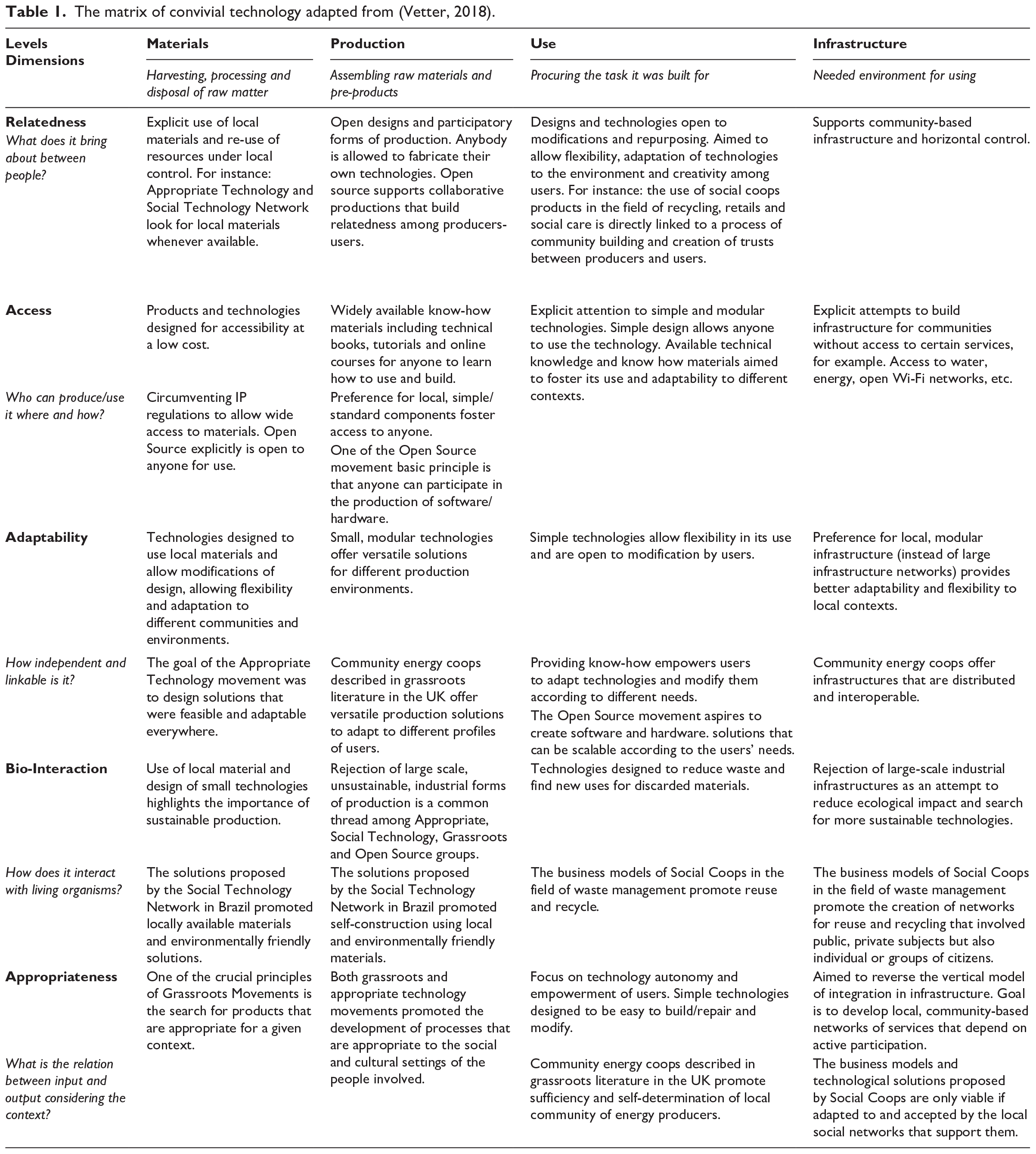
In the next sections, we present five examples of post-growth-oriented innovations and their organizational settings. We discuss the common features of these examples and their differences with the innovations pursued by growth-oriented organizations. Finally, we present a comparative analysis in Table 1 that maps the cases on the ‘Matrix of Convivial Technology’ proposed by Vetter (2018).
The matrix of convivial technology adapted from (Vetter, 2018).
Appropriate Technology Movement (1970s to late 1980s)
The Appropriate Technology Movement was highly influential for diverse grassroots innovation movements in the 1970s and 1980s around the world. The umbrella term ‘appropriate technology’ involved, broadly speaking, a set of common characteristics that attempted to shape technologies for development: low in capital cost; reliant on local materials; job-creating, employing local skills and labour; small enough in scale to be affordable for small groups; understood, controlled and maintained by local people wherever possible, without requiring a high level of Western-style education; involving some forms of collective use and collaboration; avoiding patents and property rights; and other similar characteristics (Darrow and Pam, 1978). In essence, proponents of appropriate technology sought a more situated, environmentally concerned and socially just set of design and operational principles for diverse technology choices by involving local communities (Kaplinsky, 1990; Willoughby, 1990). Appropriate technology was a reaction against wholly blueprint developments involving imported Western technologies, whose industrial contexts were ill-suited to the poor, and ended up lying idle for lack of supportive supplies, infrastructure, and relevant skills. An important inspiration for practitioners in the appropriate technology movement was the economist Fritz Schumacher, who founded the Intermediate Technology Development Group (ITDG) with colleagues in 1966 in England (Willoughby, 1990) and wrote the influential book ‘Small is Beautiful’ (Schumacher, 1973). Schumacher’s views, along with related arguments by Ivan Illich (1973) and others, resonated with the frustrations many development workers in the field had with post-WWII industrialisation blueprints through North-South technology transfer (Rist, 2011). The appropriate technology movement repeatedly cited notorious cases of large-scale, expensive and ultimately poorly chosen technologies that had failed to induce the development processes anticipated in the planners’ blueprints and theories (Carr, 1985). In particular, Appropriate Technology practitioners targeted small rural communities, since there lived a majority of the poor under significant inequality (McRobie, 1981).
Grassroots movements (1980s–ongoing)
The principles of the appropriate technology movement have been revisited by grassroots innovation movements. Smith et al. (2014) identify at least three major grassroots groups in developing countries: The People’s Science Movement and the Honeybee Network in India and the technologies for social inclusion movement in Latin America. Nevertheless, this phenomenon has also diffused in industrialized countries as several scholars (Seyfang and Smith, 2007), especially in the UK, have proved: Hargreaves et al. (2013), and Ornetzeder and Rohracher (2013) documented the grassroots innovation in the field of ‘community energy projects’ and the strategies deployed to diffuse them; Kirwan et al. (2013) analysed social grassroots innovations in the food sector; Monaghan (2009) documented the creation of grassroots innovation niches in the sector of body disposal; White and Stirling (2013) focused on the evolution of ‘communal growing’ initiatives, their dynamics and diversity. Some of these scholars have also explored the potential of grassroots initiatives to start a transition towards an environmental and socially sustainable new society (Feola and Nunes, 2014; Seyfang and Haxeltine, 2012; Seyfang and Longhurst, 2013; White and Stirling, 2013). Other aspects of grassroots innovation have been analysed by those scholars interested in user-led innovations. Low-cost innovation niches, for instance, are highly diffused among lead users in developed countries in different fields, serving to decrease the innovation cost with respect to formal R&D activities (Von Hippel, 2005). The rising phenomenon of the DIY culture of the makers’ movement is another example of grassroots innovation (Honey and Kanter, 2012; The Economist, 2011). Other examples of grassroots, user-led innovation can be found in the cases of desobedencia tecnologica (technological disobedience) documented in Cuba by the designer Ernesto Oroza (2019) or the platform Ifixit that groups different users collectives that struggle against planned obsolescence under the slogan Right-to-Repair (Ifixit, 2019; Matchar, 2016). Enabled by the internet and social media, hundreds of similar initiatives are mushrooming around the world. These manifestations of grassroots innovation have been classified by Manzini (2015: 11) as forms of ‘Social Innovation’ for example ‘creative recombination of existing assets (from social capital to historical heritage, from traditional craftsmanship to accessible advanced technology), which aim to achieve socially recognised goals in a new way (emphasis in the original)’. An essential element of these initiatives is the focus on distributed design/knowledge, horizontal and democratic participation, the search for autonomy and the capacity of reshaping social relationships including power distribution among stakeholders (Avelino et al., 2019). According to some authors, despite their limited impact, grassroots/social innovations are an important alternative source of knowledge and innovation that should be taken very seriously (Tracey and Stott, 2017). Smith (2005, 2007), suggests that small scale grassroots initiatives generate relevant knowledge to formulate alternatives for sustainable innovation policy. Demeritt et al. (2011) argues that, despite its limited impact, grassroots innovation opens up the space for debating alternative pathways to sustainable futures.
The Social Technology Network – Brazil – (2004–2012)
Despite the increasing interest and support to those initiatives shown by some politicians, grassroots innovations are still generally considered a restricted form of social intervention rather than an alternative to the traditional development policies. One exception is the Social Technology Networks (STN) launched in the first years of the Lula da Silva presidency in Brazil with the idea of combining the resources of the Brazilian State and Public companies such as Petrobras and Banco do Brasil with the existing social movements and civic society organizations. The STN selected ideas and technologies from the grassroots in order to improve the access to basic resources (like water, sanitation, food systems) and provide basic rent for impoverished communities. Once certain technology was selected, companies and State agencies funded its implementation thousands of times, with one initiative (the rain harvester) reaching more than 600 thousand applications in northeast Brazil (Smith et al., 2014). One of the interesting features of the STN’s vision was its ideas against commercial innovation (they did not seek to patent technologies) and against large industrial production schemes. They opposed large agricultural exploitations based on monoculture and large megaprojects like dams. Much of these ideas were part of a heritage of Appropriate Technology history in Brazil, but also include the vision of several social movements such as Solidarity Economy or Agroecology (Smith et al., 2014). Thus, the STN was in tension between ideas of scaling up projects to help impoverished communities and keep small scale technologies in order to attain sustainable development.
Social Cooperatives movements (mid 1970s–ongoing)
Social Cooperatives are worker-owned organizations that emerged in Italy in the 1970s and were recognised by Italian legislation in the 1990s (Pansera and Rizzi, 2020). Nevertheless, similar organizational forms are present in many European countries (Parker et al., 2014). Social Cooperatives are characterised by forms of ownerships, funding, decision-making, leadership and communication alternatives to the classic capitalist forms (Gibson-Graham, 2003; Heras-Saizarbitoria, 2014). Historically, these organisations can be located in the doctrine of the ‘civil economy’ which has had a long and important tradition in Italy since the 17th century (Bruni and Zamagni, 2007). As opposed to capitalist economics, civil economy frames economic transactions essentially in terms of reciprocity and brotherhood. In this view, the institution of the market is either morally neutral or morally corrupt. Social Cooperatives were regulated in Italy in 1991 with the introduction of Law 381 which regulates the activities of ‘volunteer organizations engaged in an improved deployment of human resources and the integration of disadvantaged citizens into society (e.g. minors, the disabled, drug addicts, the elderly, former prison inmates, the mentally handicapped, and immigrants) (Thomas, 2004). The long tradition of industrial clusters based on family businesses strongly connected in networks of mutual assistance in the centre-northern region of Italy certainly favoured the institutionalization of alternative forms such as the Social Cooperatives (Menzani et al., 2010). According to Poledrini (2014), the social purpose of Social Cooperatives is to satisfy the community’s general interest in human welfare and social integration by adopting a multi-stakeholder governance which includes employees, volunteer workers, but also sponsors and beneficiaries. Pansera and Rizzi (2020) have shown how Social Cooperatives are able to innovate to co-exist with capitalist competitors in the field of recycling, retails and social care. What’s interesting in these cases is the fact that these organisations do not aspire to grow or scale up their operations, but they rather point at replicating their model in other sectors and other geographical areas. In their view, growth would compromise the horizontal and democratic functioning of the coops. Models based on similar principles are also present on a larger scale in the classic cooperative literature for example see (Gibson-Graham, 2006; Parker et al., 2014) and in the literature of community-based enterprises that has documented similar approaches in different parts of the world (Dentoni et al., 2018; Peredo and Chrisman, 2006). According to a recent study by Gebauer (2018: 230), an increasing number of social enterprises and SMEs are already exploring post-growth practices such as establishing internal ‘goals and criteria for limited growth, decisions of growth independence, and finally processes of transition’.
Open and collaborative production (mid 1980s–ongoing)
From the mid-1980s, and ongoing wave of movements, practices and ideas – from the free/libre and open-source software movement, to citizen science experiments, to open design, to community-based prototyping spaces such as fab labs and makerspaces – is changing the scope and opportunities for working in ways that are based on openness and collaboration. Open software started to gain momentum in the 90s with the advent of internet and the development of new organizational approaches to programming, which allowed a widely dispersed, and potentially very large, community of users/developers to test and make incremental improvements to software code. 1 Using this approach, Linux went from being a mere idea to a fully open operating system which is often deemed superior, in terms of performance, reliability and adaptability, to proprietary software produced by some of the largest companies in the world (Weber, 2005). Open source software became a game changer in demonstrating the possibilities and potential of open and collaborative production within a networked digital infrastructure. In this way, it helped to challenge a series of mainstream ideas about the need for firms or hierarchical modes of organization, and property rights to support innovation (Benkler, 2016). From the 2000s open source software has inspired similar kinds of initiatives in a wider number of fields especially in information/knowledge dense areas such as open science, open journalism and open data, but increasingly in other more ‘material’ areas of production such as open hardware, open seeds, digital fabrication and citizen labs (Kreiss et al., 2011).
Initiatives such as Linux, Wikipedia and Galaxy Zoo are challenging traditional assumptions about collective actions, its motivations and results, including standard assumptions about innovation and production (Benkler, 2016). By making available the knowledge production through non-proprietary systems of knowledge production, open and collaborative initiatives are able to draw on a much wider range of people, benefiting from heterogeneous expertise. When heterogeneous groups of actors collaborate in the production of knowledge, creativity can be amplified when large in ways that have been termed ‘the wisdom of the crowds’ (Nielsen, 2012; Surowiecki, 2004). A key difference with more formal structures of production resides in the open character of licences which allow individuals to use, share and, in some cases, redesign content, disregarding who those persons or groups are and what applications are implemented (non-discriminatory). Open licences do not necessarily prohibit making profit from the content, but they do forbid powerful actors to appropriate the work of others in a direct fashion (Weber, 2005). In that sense, open licences not only allow the separation of management from property (Benkler, 2016), but in fact are designed to empower forking or new lines of experimentation with code, hardware and data (Weber, 2005).
Matrix of conviviality
The examples reported above, although limited in number, reveal a set of clear features that distinguish growth-oriented organizations from post-growth-oriented organizations. In particular, we argue they demonstrate consistently a resignification of ‘innovation’ and ‘growth’ from the imperatives of technological determinism and productivism as well as recoupling them in new forms. In this section, we analyse such new modes of innovating drawing on the notion of ‘Convivial Tools’ as framed by the work of Illich (1973)/Vetter (2018) (see Table 1). In the matrix, each of the 5 core dimensions of conviviality is analysed according to 4 levels: Materials (or products); Production (or process); Use and; Infrastructure. Then in the following section we inductively propose 9 dimensions that, we argue, can help to distinguish and characterise growth-oriented vis-a-vis post-growth-oriented organisations.
Post-growth- versus post-growth-oriented organizations
Apart from the ‘convivial nature’ of the solutions/innovations proposed, post-growth organizations distinguish themselves from growth-oriented organizations by a number of different features that determine the environment from which such solutions emerge. In Table 2, we propose 9 dimensions to distinguish Post-growth- from growth-oriented organizations that are inductively derived from the cases discussed above, then we connect them to existing and ongoing research in the field. Together with the dimensions described in the Matrix of Convivial technologies, we argue that these 9 dimensions can give a glimpse into the plural diverse organizational forms in which post-growth modes of innovating can emerge.
Growth-oriented organization vs post-growth-oriented organizations.
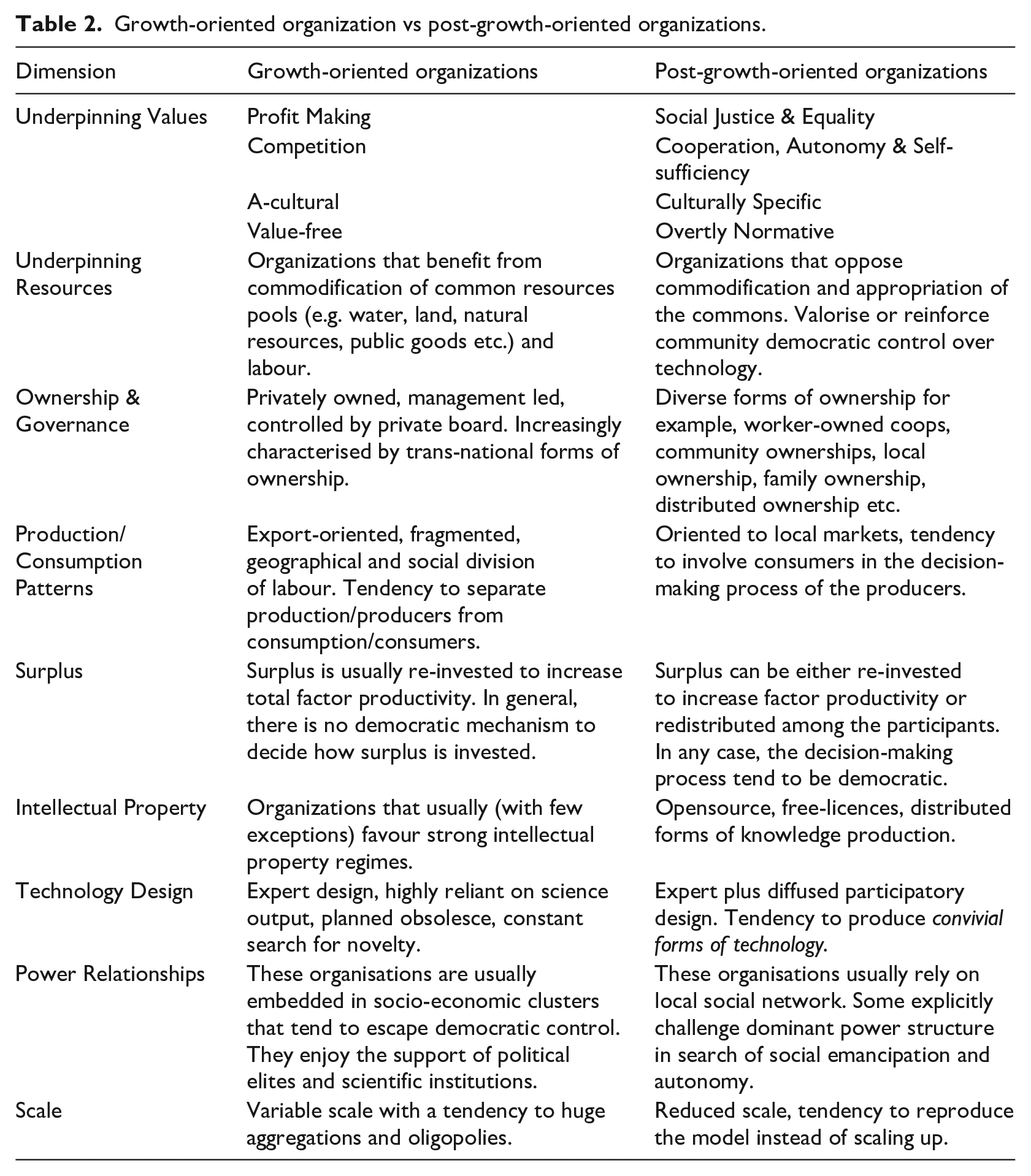
The first distinctive dimension between the cases reported above and conventional capitalist organizations resides in their respective underpinning values. Innovation in capitalism organizations is pursued in a competitive environment and is designed to provide competitive advantages. The ultimate goal is the maximization of profit. Furthermore, despite several attempts to implement Corporate Social Responsibility (CSR) or to challenge the legal framework that regulates profit-oriented enterprises – for example, see the case of B-Corps (Chen and Kelly, 2015) – capitalist organizations remain essentially (at least pretend to be) value-free that is, their models are ideally designed to work in any cultural contexts and independent from the values of their members (Gibson-Graham, 2006). A study conducted on 14 German ‘non-growing’ companies – organizations that deliberately and/or strategically decided not to pursue grow – by the Institute for Ecological Economy Research in Berlin (IOW) suggests that the values and motivations (e.g. motivations can be categorised as organisational structure and related costs, work-life balance, risk aversion and environmental and social motivations) of the managers are crucial to steer an organization towards a ‘growth neutral path’ (Liesen et al., 2015). Similarly, the cases of post-growth organizations considered above, although with different degrees, overtly frame innovation in normative terms for example, technology has to address issues that are primarily social; a feature that is also central in the above-mentioned notion of social innovation. The solutions proposed are generally culturally dependent and strongly based on the idea of social justice and equality. A crucial element is the idea that technology has to enable autonomy as the capacity of people to freely decide their common future (relatedness dimensions) without being subordinated to external pressures such as market-economy or religion (Gorz, 1994). Technology, thus, far to be neutral, becomes an essential element of political contestation and self-determination (Pansera and Owen, 2018b). An emblematic example of ‘repurposing’ innovation skills and capabilities to address social needs was the Lucas Plan, a pioneering effort by workers at the arms-producing company Lucas Aerospace to defend their jobs by proposing alternative, socially useful applications of the company’s technology and their own skills. The plan was a novel response to management announcement in January 1976 that thousands of manufacturing jobs were to be cut in the face of industrial restructuring, international competition, and technological change (Smith, 2014). To avoid redundancy, workers self-organised and, in the course of 1 year, produced designs for over 150 alternative products that were supposed to replace the arms-related products manufactured by the company. The plan included a huge variety of environmentally friendly technology, most of them pioneering solutions for the epoch, and suggested re-organising work into less hierarchical teams that bridged divisions between tacit knowledge on the shop floor and theoretical engineering knowledge in design shops (Smith, 2014). The Plan became symbolic for a movement of activists committed to innovation for purposes of social use over private profit and showed that it is possible to decouple innovation from the imperative of economic expansion by restructuring power relations within the factories. Not surprisingly the plan was rejected by the company and the government of the time. The weakening of unionism in the UK during the Thatcher period drastically reduced the possibility of such initiatives to be replicated and scaled up. Nevertheless, since the 1970s the world has changed and the boom of digital technology and advanced manufacturing have boosted a revival of self-managed and recovered factories (Arvidsson, 2019).
The second dimension is represented by the resources that organizations require or exploit to function. As Polanyi (2001) remarkably showed, industrial capitalism funded its expansion and growth upon the conversion of traditional arrangements involving land and labour into marketable commodities and subject them to economic transactions and calculations. Growth-oriented organizations constantly reproduce this logic by attempting to appropriate common resources pools (e.g. water, land, natural resources, public goods etc.) and labour (Mattei, 2011; Rätzer et al., 2018). In other words, economic growth is only possible through the appropriation and commodification of those resources that were traditionally considered as common goods (Kallis, 2018; Martinez-Alier, 2002). Once the appropriation of material resources reaches its limits, growth can continue by commodifying different aspects of social life in new and more sophisticated ways for example, privatizing care, health and education, knowledge, regimes of intellectual property etc. (Conde and Walter, 2015; Gomez-Baggethun, 2015). In opposition to this trend, the tendency in the cases of post-growth-oriented organizations analysed is to resist commodification in many sectors. Grassroots movements in the North, for instance, call for an autonomous way of deciding the kind of energy or food they want to consume and the way these are produced. Most of the time these alternatives include non-market solutions such as exchange or self-production. Social Coops advocate for the importance of non-marketized forms of care situated outside the profit-oriented logic of the market (Pansera and Rizzi, 2020; Poledrini, 2014). Finally, knowledge in many of these initiatives is framed as a specific kind of common good that is supposed to enable a variety of different forms of collaboration and sharing rather than creating new mechanisms of exclusion (Hess and Ostrom, 2007). Knowledge commodification forms like intellectual property regimes were mostly ignored by Appropriate Technology organizations, opposed by the Social Technology Network and bypassed with alternative open licences by open and collaborative forms of production like the FabLabs, Makerspaces or Open-Source communities (Hielscher and Smith, 2014; Smith et al., 2016). This feature is directly connected to the access dimension of the convivial matrix that favours communal property and the commons over commodification.
Another distinctive feature is the ownership and governance structures of post-growth-oriented organizations that tend to favour worker-owned models and horizontal ways of management. Whereas, growth-oriented organizations usually follow the traditional pyramidal structures that characterised Multi-National Corporation controlled by private board and shareholders quotas. The ownership and governance structures also directly influence the patterns of production/consumption in which organizations operate. Growth-oriented organizations tend to be export-oriented, and thus, operate (at least in principle) at a global scale according to a geographical and social division of labour that seeks to minimise the costs of labour and environmental regulations whilst maximising profits. A direct consequence of this model is the separation of consumption from the production process (Gouveia and Juska, 2002; Ritzer and Jurgenson, 2010). On the opposite side, post-growth organizations tend to rely on local markets and networks of consumption. In many of the cases analysed in the Social Technology Network in Brazil, production and consumption generally overlap for example, producers and consumers are indistinguishable (relatedness dimension). This overlapping is also evident in the cases of collaborative productions for example, Linux developers are also its main users. Another important feature linked to the relation production-consumption is that post-growth organizations tend to experiment with mechanisms to involve consumers in the decision-making process about production (adaptability and access dimensions). The aspiration is to shape production according to the values and worldviews of the consumers and not vice-versa (Anderson, 2012; Von Hippel, 2005).
One of the most evident differences between growth-oriented and post-growth organizations is the way surplus is managed. As Romano (2015) argues, the different patterns of surplus use characterise and distinguish different types of human groups across space and time. In a growth-oriented organization surplus is usually re-invested to increase total factor productivity and/or to distribute dividends to shareholders. As we already discussed above, Piketty (2014) shows how the increase of factor productivity since the 1970s has been unequally distributed between labour and capital. This has coincided with the neoliberal turn in many Western countries and with a loss of bargaining power of unions in virtually all industrialised economies (Western, 1995). This trend has seriously compromised the possibility to implement more democratic mechanisms to decide how surplus is reinvested. In the cases of the post-growth organizations considered, the way surplus is managed does not seem to follow any specific pattern. One of the reasons is that the cases analysed struggle for survival and very occasionally generate relevant surplus. Nevertheless, it can be observed that in the case of social coops surplus can be either re-invested to increase factor productivity or redistributed among the coop members. In any case, the decision about how to reinvest surplus tends to be democratic (Pansera and Rizzi, 2020). The way surplus is conceptualised – as means of economic expansion or rather as an instrument to improve qualitative aspects of life such as reducing working hours – can be seen as a clearly distinctive feature of post-growth organizational forms. The reinvestment of surplus in qualitative improvements, indeed, has the potential of hindering the mechanisms at the basis of rebound effects (Romano, 2015). There is increasing evidence that qualitative improvements like the reduction of working hours often result in smaller rebound effects vis-a-vis those produced by salary increments (Buhl and Acosta, 2016; Nassen and Larsson, 2015).
As we mentioned above, intellectual property is strongly opposed by most of the post-growth organizations analysed. Property rights are generally framed as a form of commodification and a hurdle to the free exchange of knowledge (Bollier, 2008; May, 2015). This is strictly related to the imaginary of technological development that is common among post-growth supporters that tend to favour diffused/distributed forms of technology design over expert-driven innovation (access and appropriateness dimensions) (Kerschner et al., 2018). Whereas growth-oriented organizations generally frame innovation as a process of endless novelty creation, post-growth supporters see technology as a form of social emancipation, a vector with a clear normative direction to be oriented through a process of collective participation (Stirling, 2008). This argument opens up the space for a wider debate about how technological development and, thus innovation, constitutes (and also restructures) power relationships within society. Growth-oriented organizations, in particular Multi-National Organizations such as the fossil fuel industry, the big pharma or the agro-food industry tend to escape democratic control or to interact with democratic institutions through technocratic decision-making processes that are opaque or in any case inaccessible for the general public; the secrecy of the negotiations of the TTIP, CETA, TISA is a classic example (War on Want, 2015). As a consequence, the decisions on technology and innovation taken in these contexts tend to favour growth-oriented organizations and to limit or marginalise the creation of spaces of debate about alternatives. On the contrary post-growth organisations usually rely on local social networks far away from the centres of political and economic power (relatedness and adaptability dimensions). Some explicitly challenge dominant power structures in search of social emancipation and autonomy (Smith and Ely, 2015).
A final distinctive feature is the scale of operation. Growth-oriented organizations are characterised by introducing large scale production to reduce cost and diversification of products with a tendency to create aggregations and oligopolies (Chandler, 1994). On the contrary, post-growth organizations have reduced scale and the tendency to reproduce their models instead of scaling up (adaptability and appropriateness dimensions). Grassroots movements, for examples, tend to replicate their model through knowledge exchange and interactions with other groups. Similarly, social coops prefer replication to expansion that would compromise in many cases the possibility to maintain a functioning internal democracy (Kasmir, 1999). Similar behaviour has been observed in for profit companies that deliberately decide not to scale up their operations and sales to avoid the increase of the costs due to additional hierarchy levels and administrative structures. In these cases, the innovation capabilities are directed towards qualitative improvements of products and services. In their study on ‘non-growing companies’, Liesen et al. (2015) documented a number of examples of organizations that deliberately decide to innovate into improving the quality of their products instead of increasing their sales. These authors, for example, found that the printing company Oktoberdruck has substantially invested in decreasing their production to deliver more valuable products with better quality. Another example is the eco-brewery Neumarkter Lammsbräu that restructured their operations to function only with locally sourced products. The company’s quantitative growth is limited to the amount of ingredients they can source from the region in which they operate.
The dimensions described above, we argue, bring forward a number of important reflections. First, it is evident that the kind of post-growth-oriented organizations that emerge from the analysis remarkably match the definition of community/alternative economy proposed by Gibson-Graham (2006). They identify mainstream economics (market capitalism) as growth-oriented, whereas alternative economies are labelled as ‘vitality oriented’. These alternative forms create diversity ‘in the economic landscape and at the same time calls into question the hegemonic capitalocentric dynamics – mechanistic logics of reproduction, growth, accumulation, commodification, concentration, and centralization – on which capitalism’s naturalness (and naturalized dominance) are grounded’ (Gibson-Graham, 2006: 16). This implies that innovation in a post-growth economy undoubtedly requires questioning capitalism’s forms of production/consumption and the political and scientific institutions constructed around this model (Gorz, 1980; Valenzuela and Böhm, 2017). Second, it is also clear that post-growth/a-growth or even degrowth strategies in the cases considered seem to be more a result of the organizations’ underlying values rather than a voluntary plan. In other words, the organizational forms considered oppose the way technological development is managed and governed rather than economic growth per se. Science and technology development are not rejected in these examples but rather re-oriented towards solving social needs without imposing economic growth as a necessary outcome. Furthermore, many of the organisations that fall under the category exposed above would pursue, under certain circumstances, some form of growth for example, growth in memberships, growth of clients, growth of knowledge and available technological solutions, etc. (Wiefek and Heinitz, 2018). Others, like the cooperatives, can perfectly fit in the mainstream growth-oriented paradigm for example, the case of Mondragon coops in Spain is emblematic in this sense (Storey et al., 2014).
Third, collaborative value creation and its enabling technologies certainly coincide (at least partially) with post-growth objectives but do not lead per se to their attainment (Hankammer and Kleer, 2018). At the same time, work time reduction, coproduction and democracy in the workplace does not necessarily lead to a post-growth society (Fournier, 2008; Gunderson, 2018). Moreover, as the cases of sharing economy like Uber or Airbnb proved, notions such as social/alternative/community economy are permanently under the threat of being co-opted and manipulated by growth-oriented organizations in search of novel ways of making profits (Martin, 2016).
Fourth, all the examples show participatory processes and alternative modes of producing knowledge aimed at learning and experimenting but not necessarily directed to developing new marketable products or profits. This intent is clear in open source initiatives where sharing knowledge as a way to connect with others is a goal in itself (Gauntlett, 2011) or the contribution to a project is motivated by intellectual gratification and not by a monetary reward (Bonaccorsi and Rossi, 2003). In other words, the cases suggest that rather than hampering innovation, decoupling the creation of knowledge and technologies from economic growth has the potential to tap into ‘cognitive surplus’, allowing massive collaborations that can reach faster solutions to social problems (Nielsen, 2012).
Fifth, the kind of change envisioned by the post-growth organisations described in the examples is not compelled to feed a treadmill of production designed to deliver an endless flow of products. Mechanisms such as planned obsolescence, productivity incentives, managers’ bonuses and all the economic drivers that reign in growth-oriented organizations do not play any function in the design of technology in post-growth-organizations. On the contrary, rather than constantly disrupt and replace, the knowledge created by these organizations is directed to repair, maintain, care and re-use material, technologies and even pre-existing knowledge and skills. This tendency clearly contradicts the Schumpeterian notion of creative destruction that underpins most of the conventional ideas about innovation. Creativity remains a central element, whereas the ‘destruction’ is replaced by an ethic and practice of care.
Conclusions and a research agenda
The covid19 pandemic has dramatically shown the fragility of the supply chains that feed global economy. It brought into question the desirability and feasibility of international trade and the need for economic expansion to deliver welfare and wealth. This, in turn, has made even more evident the necessity to create the conditions for the emergence of a post-growth conceptualization of innovation. In this paper, we first advocated new modes of innovations decoupled from the irrational pursuit of endless economic growth, then we provided numerous examples that suggest that this decoupling is already happening in certain organizations. The paper attempted to provide a preliminary map of those organizations that are already experimenting with alternative modes of innovating but also seeking new more democratic ways of dealing with technology. The goal was to explore inductively what organizational forms (and their underpinning values and motivations) are more suitable and more prepared for a transition towards a paradigm of ‘innovation without growth’. As such, our analysis of innovation in post-growth organizations does not provide any specific indication about the type of technology or level of technological advances that would possibly characterise a post-growth society. On the contrary, what strongly emerges from the cases is that post-growth organizations do not necessarily pursue new and innovative technologies per se but rather a ‘different relation’ to technology. A relation based on an ethic and a practice of care instead of a process of creative destruction, which is also the essential message of Illich/Gorz’s notion of convivial tools.
To conclude we propose two general hypotheses that will have to be empirically validated by future research. First, prosperous STI systems in a non-growing economy are probably feasible only through a radical restructuring of scientific, financial and political institutions. This transition would require a reconsideration of the ways science and innovation projects are funded, including mechanisms and incentive to encourage a more reflexive, responsive, democratic, open and inclusive way to innovate (Owen and Pansera, 2019). Moreover, this would certainly also include a new set of indicators and benchmarks to measure the effectiveness and success of an innovation process. The second hypothesis is that there is an unexplored and neglected world composed by a variety of organizational forms that do innovate for a number of different motives that do not necessarily include expansion and growth. As our preliminary analysis suggests, these (convivial) organizations are more likely to function according to more horizontal and democratic mechanisms (e.g. coops, communities, commons resource management etc.). These organizations provide a glimpse into the role of technological and social innovation in a post-growth world: they created technologies – meant as artefacts but also organizational innovations and new social arrangements – that are suitable to reduce ecological impact, enhance autonomy and conviviality, and are structurally available in an egalitarian way based on open access regimes. By doing so they also envision what kind of organizations and power relations need to take shape to move forward towards a new paradigm of innovation without economic growth.
Based on these two working hypothesis, we suggest a tentative research agenda to enhance the scholarship in the field of organizational studies for a post-growth era:
(i) First, we consider absolutely crucial to formulate a robust and coherent theoretical understanding of how the processes, organizations and institutions that emerged around the development of science, technology and innovation need be reconfigured to address the challenges posed by a post-growth era. In order to achieve that, it is important to systematise and combine the academic traditions, scholarships and disciplines – for example, degrowth studies, ecological economics, critical theory and critical management just to mention a few – that have theorised the possibility and necessity to formulate alternative STI modes for a post-growth era. The challenge is to understand how they can be articulated in a coherent manner to conceive sociotechnical imaginaries liberated from the imperative of economic growth.
(ii) Second, it is fundamental to identify the organizational settings – and the conditions needed for their emergence – in which non-growth-oriented science, technology and innovation practices are more likely to flourish, how they self-organise, survive, struggle or prosper. Only timid attempts have been done to understand post-growth organizational settings by management scholars (Rätzer et al., 2018), whereas the community of degrowth studies only recently has started focusing on these topics (Kerschner et al., 2018; Pansera et al., 2019).
(iii) Third, alternative organizations are often threatened by hostile surrounding entrepreneurial ecosystems that tend to isolate and cut them off from conventional supply chains and networks. Since analyses of alternative supply chains have been almost exclusively limited to the study of alternative food networks (Chiffoleau, 2009; Renting et al., 2003), it is key to understand under which conditions non-growth-oriented organizations can create – or reconfigure pre-existing- networks in which knowledge and value are produced outside the logic of maximization of economic growth.
(iv) Finally, since any process of social change to be successful requires mobilization, social support and legitimization, it is crucial to identify what social actors and their related institutions are the most adequate, capable and probable to trigger a transition towards a post-growth mode of innovating; the alliances, the political struggles and the institutional changes that are needed for this change to occur. Such a strand of research might draw on the analysis of social movements as agents of change capable to formulate alternatives imaginaries of development and growth (Escobar, 1992, 2004), but also on the theories of institutionalization and deinstitutionalization of practices, traditions and worldviews (Dacin and Dacin, 2008; see also Joutsenvirta, 2016 for the institutionalization of economic degrowth).
Footnotes
Funding
The author(s) received no financial support for the research, authorship, and/or publication of this article.
