




Abstract
Grounded in an ethnographic study of a US fast food chain, this paper explores how the rising employment polarization under neoliberalism may pose a threat to dignity via the predicament of adults doing youth work. We draw on Axel Honneth’s theory of recognition to develop a tripartite framework of the micro-politics of recognition, aimed as a middle-range construct for guiding empirical studies of work through the lens of dignity. We argue that a study of dignity at work, with the everyday human struggle for recognition as the focal point, may help to illuminate the realities of contemporary work and enable a humanistic critique of contemporary capitalism. We also highlight adulthood as the underarticulated yet morally laden identity signifier in organizational inquiry, which may gain added importance as more adults enter occupations where few institutional supports of adulthood exist.
Introduction
From the beginning of the industrial society, the world of work has been the site par excellence of the human struggle for dignity (Hodgkiss, 2016). On the one hand, the rise of modernity has brought the moral ideal of dignified life through the notions of liberty, equality, and fraternity (Honneth, 2014). On the other hand, it has also unleashed the market forces of capitalism and turned most adults into wage laborers whose dignity depends largely on how they are treated by others at work (Castel, 2003). For the pioneering social thinkers such as Marx, Durkheim, and Weber, the notion of dignity at work thus offers a moral lens from which to contemplate the fate of humanity in the contradictory development of capitalism: all thought modernity had much to offer mankind in terms of justice and progress; all also saw that the capitalist organization of society contained threats to dignity via, for example, the process of alienation, the state of anomie, or excessive bureaucratic rationality (Hodgkiss, 2013).
Over the past decade, rising concerns over the worsening work environment under neoliberalism – ‘a kind of radical capitalism, with no other law than that of maximum profit’ (Bourdieu, 2008: 288) – have brought a renewed attention to the issue of dignity at work (Pfeffer, 2016). As Hodson (2001: 3) puts it, ‘Life demands dignity and meaningful work is essential for dignity.’ He defines dignity as ‘the ability to establish a sense of self-worth and self-respect and to appreciate the respect of others’ (p. 3). Spurred largely by Hodson’s pioneering work, a rich body of literature has addressed the challenges to working with dignity in today’s neoliberal society (e.g. Bolton, 2007; Crowley, 2012), where corporate financial success is frequently juxtaposed with human suffering and toxic workplaces (Pfeffer, 2010).
Although recent works have made great progress in placing the quest for dignity at the center of workplace experiences and relationships, scholarship on dignity at work suffers from two primary gaps. First, there is a tendency to conflate the study of dignity at work with that of meaningful work (Michaelson et al., 2014). For example, paralleling Pratt and Ashforth’s (2003) study of meaningfulness in work and meaningfulness at work, Bolton (2011) has developed a dimensions of dignity framework that links dignity in work to the notion of ‘good work’ (such as job satisfaction and interesting work) and dignity at work to how one is valued as a person in the workplace (such as equal opportunity and just reward). Given its focus on factors linked to individuals and their immediate work contexts, this move, however, risks losing the critical edge of the dignity lens by ignoring the broader social issues related to the transformation of the basic human capacity to engage in meaningful work into a commodity (Sallaz, 2013). As a result, the dimensions of dignity framework has been operationalized into variables that can be used for cost-benefit analysis of organizational performance (Lucas et al., 2017).
Second, there is a tendency to focus on publicly visible threats to dignity such as abuse and bullying and the strategic actions of workers who engage in resistance at work (e.g. Hodson et al., 2006; Roscigno and Hodson, 2004), which creates ‘the unavoidable impression of pre-rational workplaces based on arbitrary, personal power’ (Thompson and Newsome, 2016: 79). Yet, ‘power is at its most effective when least observable’ (Lukes, 2004: 1). Neoliberalism is not merely a set of economic policies that lead to asymmetrical power between labor and capital (Centeno and Cohen, 2012; Piketty, 2014); it is ‘firstly and fundamentally a rationality’, which tends to structure ‘not only the action of rulers, but also the conduct of the ruled’ (Dardot and Laval, 2013: 4). To date, however, scholars have paid little attention to less visible injuries to dignity caused by more subtle forms of domination under neoliberalism, such as the indignation of unemployment and underemployment (Bourdieu, 1999; Dejours et al., 2018) and the ‘hidden injuries of class’ (Sennett, 2004; Sennett and Cobb, 1972), when individuals are held responsible for their failures in accordance with neoliberal rationality.
A broader perspective in studying work through the lens of dignity is needed to yield greater insights about the realities of contemporary work and enable a humanistic critique of contemporary capitalism. Grounded in an ethnographic study of a US fast food chain, we address these gaps by exploring how the rising employment polarization under neoliberalism (Kalleberg, 2011) poses a threat to dignity via the predicament of adults doing youth work, that is, low-wage service jobs commonly perceived as stop-gap youth employment. We argue that dignity is less about the ability we possess as an individual than about ‘a certain way of leading one’s life’ we seek to capture with a concept of dignity (Bieri, 2017: 2) – a dignified life that presupposes a just society, in which all members can be recognized ‘as both autonomous and individuated, equal and particular persons’ (Honneth, 1995: 175). As the moral significance of work lies in the contribution it makes to a dignified human life, dignity at work is better studied by unpacking people’s moral experience of the injustices unleashed by neoliberalism through the myriad ways in which the vital human need for recognition is violated in unequal societies (Smith, 2009).
We pursue our objective by theoretically reframing dignity at work through Honneth’s (1995) theory of recognition and by empirically examining activities adult employees engage in to safeguard dignity in a work setting where their expectation of recognition as full-fledged adult is frequently under threat. Specifically, we situate the predicament of adults doing youth work in relation to the ‘recognition gaps’ that neoliberalism promotes (Lamont, 2018). We draw on Honneth’s theory to develop a broader framework of the micro-politics of recognition at work, aimed as a middle-range construct for guiding empirical studies of work through the lens of dignity via a tripartite analysis of sources of social disrespect, patterns of dignity work, and responses to the moral decline at work. In the process, we advance understanding of the relationships among adulthood, dignity, and recognition, which may gain added importance as more workers enter occupations where few institutional supports of adulthood – stable employment with living wage and work autonomy – exist. After all, there are nearly as many workers employed in five major low-wage service occupations as in all of the knowledge-based occupations combined in today’s US economy (Pietrykowski, 2017).
Situating dignity at work in a polarized world: The case of fast food work
Calling for a wide-angle view of the nature and sources of dignity at work, Sayer (2007) points out that, as an experiential quality in everyday life, to have dignity is first to possess the kinds of capacity (autonomy, self-control, and so on) typically associated with being recognized as an adult, which signal the individual’s standing as a fully-fledged partner worthy of respect in social interactions (Blatterer, 2007). Yet, with the rising employment precarity and the dismantling of the welfare state under neoliberalism, one may achieve dignity or earn respect but its possession is fragile (Sennett, 2004). As Smith (2016) suggests, scholars need to go beyond studying how neoliberal work practices impinge on people’s dignity to study how the transformation of the broader employment environment under neoliberalism may impinge on people’s capacity for developing dignity at work. In this context, fast-food work offers an intriguing setting for exploring how the rising employment polarization under neoliberalism may pose a threat to dignity via the predicament of adults doing youth work.
As the prototypical stop-gap youth employment, fast food work has traditionally been associated with teenagers doing routinized jobs to earn extra income before they are qualified to enter the occupational world of adults. However, driven by the growth in low-wage service jobs at the expense of middle-range manufacture jobs under the globalizing forces of neoliberalism (Autor and Dorn, 2013), about 40% of the US fast food workforce is now 25 years or older. The median age of fast food workers is 29. More than a quarter of fast food workers are parents. Yet, the perception of fast food work as youth work remains persistent (Schlosser and Wilson, 2006). Although existing studies on fast food work have paid much attention to the young workers (Gould, 2010; Leidner, 1993), the adult employees tend to be neglected.
Work is not merely a technical relation of production, but ‘a privileged support by means of which we fit into the social structure’ (Castel, 2003: xv). As a low-pay low-skill service work located near the bottom of the employment hierarchy, the image of fast food work as youth work arises from its status as the opposite of the adult ideal defined against a value standard set by ‘the economic activity of the independent, middle-class, male bourgeois’ (Honneth, 2003: 141). The predicament working-class adults face in fast food work reflects the growing ‘recognition gaps’ – ‘disparities in worth and cultural membership’ (Lamont, 2018: 219) – between upper/middle-class and working-class adults that take place against the background of growing income inequality under neoliberalism (Piketty, 2014; Sayer, 2005). Here recognition is ‘the affirmation of positive qualities of human subjects or groups’ (Honneth, 2012: 80). It is a social and moral act by which an individual’s or group’s worth is affirmed by others. By contrast, the growing ‘recognition gap’ is the result of a cultural process of negatively qualifying individuals or groups in accordance with the neoliberal rationality (Lamont, 2018).
As a new mode of government of human beings, a crucial aspect of neoliberal rationality is the reconfiguration of self as enterprise, which consists in converting each wage-earner into a ‘personal enterprise’ and the labor process into a ‘process of self-valorization’ (Dardot and Laval, 2013: 266). The enterprising self, symbolized by the ‘ideal worker image’ in white-collar workplaces (Williams, 2001), is an autonomous and masculine subject of upper/middle-class origin, who conducts himself as an entity in a competition and makes work the privileged vehicle for self-realization (Lamont, 1992). When the personal enterprise becomes an existential norm, to earn respect, one must not be weak; one must not be needy (Sennett, 2004). People who fail to embody the adult ideal of enterprising self, such as unemployed people, older people, or adults with disabilities, instead of being treated with care and respect, are often stigmatized and relegated to the margins of society (Ainsworth and Hardy, 2008; Riach and Loretto, 2009). As a result, ‘neoliberalism is as much a problem for recognition gaps as it is for economic inequality’ (Lamont, 2018: 424).
One of the many social pathologies of neoliberalism is thus an entrepreneurial ethic that disregards human vulnerability to threats to dignity and human need for social recognition. As a leading figure in the third generation of the Frankfurt School, Honneth (1995) has developed a critical theory of society that locates the diagnosis of social pathologies within people’s moral experience of injustice. Particularly, by placing work and recognition at the core of a dignified human life (Smith, 2009), Honneth makes a profound contribution to the ‘Return of Work in Critical Theory’ (Dejours et al., 2018). There is a growing stream of organizational research that has applied fruitfully Honneth’s idea to studies of, for example, institutional work (Fassauer and Hartz, 2016), reification (Islam, 2012), control and resistance (Meagher, 2000; Tweedie and Holley, 2016), and diversity and performance management (Pless and Maak, 2004; Tweedie et al., 2019).
To make sense of adult employees’ moral experience of the injustice of adults doing youth work, we start by reframing dignity at work through a broader framework of the micro-politics of recognition at work.
Unraveling the micro-politics of recognition: From dignity at work to dignity work
Politics concerns ‘both a source of conflict and a mode of activity that seeks to resolve conflicts and promote readjustment’ (Wolin, 2004: 12). The central task of Honneth’s work is to uncover the ‘moral grammar of social conflicts’ inscribed in the institutions and social relations of modern capitalist societies (van den Brink and Owen, 2007). In studying work through the lens of dignity, our goal is thus to unravel the micro-politics of recognition by identifying the sources of indignation at work, by examining the activities people engage in to safeguard dignity at work, and by delineating people’s responses when their attempts to safeguard dignity fall short. In the process, we seek to uncover the social relations, cultural repertoires, and institutional contexts that condition people’s capacity to develop dignity at work.
The concept of recognition serves to delineate the different ways in which individuals experience injustice and the social relations that structure that experience (Dejours et al., 2018). According to Honneth (2003), all struggles against injustice in modern societies can be viewed as variants of a fundamental struggle for recognition, and all socially caused suffering ‘must be interpretable as expressing the violation of well-founded claims to recognition’ (p. 134). Such moral experiences of misrecognition – the withholding or denial of the recognition people feel they deserve – are what Honneth (2007: 71) calls ‘feelings of social disrespect.’
How deep is the suffering misrecognition can cause? Nothing less than the integrity of the human self is at stake (Smith, 2012a), since human beings need the recognition of others if they are to see themselves as worthy of recognition. Human dignity means human integrity as autonomous moral beings, in the sense that they can relate to themselves ‘in the positive modes of self-confidence, self-respect, and self-esteem’ (Honneth, 2001: 50). The three self-relations represent the three axes of identity formation as morally autonomous subject. They cannot be achieved without the support of the three forms of recognition – care, respect, esteem – through participation in the three spheres of social relations of recognition: intimate relations of love and friendship for care of one’s needs, legal relations of rights for respect of one’s equal status, and communitarian relations of solidarity for esteem of one’s achievement (Honneth, 1995).
At the micro level, recognition can be analyzed in terms of recognitive attitudes, gestures, and actions based on an evaluative perception of others (Ikäheimo and Laitinen, 2007). At the macro level, recognition can be analyzed through the development of modern capitalist societies as institutionalized recognition order (Honneth, 2003). The capitalist social order is normatively structured around the recognition principles of need, equality, and achievement, which provide the moral standard for regulating how individuals are to recognize one another mutually. Since people owe their integrity to recognition from others, misrecognition inflicts moral injury on their self-understandings. The morality of our society thus lies in its ability to provide the social infrastructure – in terms of the ‘quality’ of recognition relations – that enables all members to participate in social life without fear, shame, and anxiety (Honneth, 2004).
Under the premises of recognition theory, a workplace is a sphere of social life endowed with a recognition order (Smith, 2012b). At the meso level, recognition can be analyzed through the structure and quality of recognition relations in which workers are enmeshed and the formal and informal standards of recognition that govern how workers are recognized by employers, customers, peers, and society at large (Dejours et al., 2018). Since social structures of domination can be understood as a pathology of recognition relations, underlying the recognitional view of workplace is also a decentered view of power in that struggles against injustice at work involve a broad network of agents who ‘work to improve conditions of recognition in the name of justice’ (Honneth, 2012: 44). Indeed, when people say a rule or practice or cultural meaning is wrong, ‘they are often making a claim about social injustice’ (Young, 2011: 34).
Expectations of recognition are thus woven into the fabric of everyday work life. When people are denied the recognition they feel they deserve, they generally react with negative moral feelings of shame (Sayer, 2011). On the one hand, as a self-conscious emotion that comes from viewing one’s self negatively through the eyes of others (Scheff, 2003), shame reveals to shamed persons that certain forms of recognition are being withheld from them. On the other hand, to defend dignity at work thus requires work (Sayer, 2011); it consumes time and effort, physically and emotionally. Indeed, the more pathological the relations of recognition are, the harder people must work to maintain a measure of dignity in the malfunctioned workplace.
We define dignity work broadly as the range of activities people engage in to preserve certain levels of positive self-understanding in terms of self-confidence, self-respect, and self-esteem, without which people’s personal integrity and sense of self-worth in terms of their individual existence can be brought to the point of collapse or breakdown in the face of social disrespect. As human dependence on recognition is always shaped by the particular manner in which the granting of recognition is institutionalized within a society (Honneth, 2003), dignity work necessarily involves a morally motivated struggle over the prevailing standards of recognition, where those misrecognized attempt, through symbolic or other practical means, to contest the recognition order in which they feel they are unjustly devalued.
Although the experience of misrecognition can be a source of motivation for resistance at work, the wide latitude that modern societies have for injustice implies that ‘only if the means of articulation of a social movement are available’ can one expect the individual-level dignity work turning into a collective struggle for dignity at work (Honneth, 1995: 139). According to Hirschman (1970), when conditions of recognition deteriorate, workers’ dissatisfaction can lead them to choose either exit (leave the organization) or voice (attempt to change, rather than escape from, the organization), while loyalty (attachment to the organization) ‘holds exit at bay and activates voice’ (p. 78). Since the capitalist labor market can only reproduce itself without resistance ‘if it is also capable of fulfilling non-economic, moral imperatives’ (Honneth, 2014: 189), workers’ reaction to the moral decline is contingent on structural factors such as barriers of organizational entry and exit and normative factors such as sense of solidarity and expectation of loyalty, and cannot be grasped without further empirical analysis of the structure and quality of recognition relations at work.
Armed with the framework of the micro-politics of recognition as a ‘sensitizing concept’ for empirical study (Blumer, 1969), we proceed to unpack adult employees’ moral experience of fast food work. We start with our research methodology.
Methodology
Research setting
The research described here is grounded in an ethnographic study conducted in multiple stores of FoodCo – a US fast food chain – in the neighborhood of a second-tier city in the Northeastern United States over a period of 10 months.
FoodCo is an all-franchise organization. Work at FoodCo stores involves mainly three types of activities – food preparation, customer service, and cleaning – organized around three partially overlapping shifts (morning, lunch and dinner) with ad hoc work groups. There is no strict division of labor. Employees are expected to do whatever work tasks that store managers assigned them. Unlike McDonald’s where customers place order and pay from a standard menu, workers at FoodCo prepare and serve food to customers following their instruction face-to-face across the counter. Work shifts are scheduled by the store manager on a weekly basis contingent on employees’ availability, store needs and anticipated sales. The number of hours per week for each employee ranges anywhere between 10 and 40.
All store managers in our study are veterans of low-wage service work and are paid on a salary basis. Other employees are paid hourly, starting around the minimum wage ($7.25/hour at the time of study). The wage difference between the first-timer and the old-timer is minimal, with few workers earning more than $9/hour in our study. Hiring, firing and quitting occurs frequently, as workers walk away for various personal reasons or get fired from the job for a variety of minor or major offenses. Employees often use the term ‘revolving door’ to describe the high turnover rate and the unstable work setting.
Data source and collection
The data collection consisted of participant observation and in-depth interviews with workers and managers. The first author conducted three sequential rounds of participant observation in three FoodCo stores, moving on to the next store after deciding that there was little more to be gained from staying longer in the present one. At each store, the manager introduced her to the staff as a researcher but otherwise she did everything that was expected of a regular employee. Each week, she was on the work schedule for 10–20 hours, divided among morning, lunch and dinner shifts. After completing fieldwork in each store, she took a few weeks off to reflect upon the work experience and to write memos. Overall, she spent more than 300 hours in the field.
The stores were sampled based on their location to maximize the chance to work with employees from all walks of life, and was guided by the initial observation and analysis of interviews conducted at the first store, which showed clearly that employees’ interpretation of their work at FoodCo depended critically on their social background and life experience outside the workplace. The different store locations are also accompanied by different customer bases, creating different backdrops for studying workplace dynamics. The first store was located in a middle-class suburb, the second store in a busy travel intersection, and the third store in an impoverished downtown area. At each store, the field researcher established rapport with the workers and managers before conducting in-depth interviews at sites and times of their choice. After completing the fieldwork, she also conducted non-participant observation and additional interviews at two suburban FoodCo stores to interact with a more diverse sample of employees.
The interviews were semi-structured and lasted from 45 to 90 minutes. The interview questions revolved around employees’ personal background, work experience, and perceptions about self and relationships at work, but were otherwise open-ended to enable the pursuit of emerging themes. Overall, 48 interviews were conducted. All interviews were recorded and transcribed.
Data analysis
In this paper, we concentrate on the 22 adult employees (aged between 25 and 68) in our sample. Of the 22, 16 have children, while 10 of them are married or share family responsibilities with their partners. The first author had originally intended to study the work-related identities of fast food workers. Early in the field work, she noticed that the workers routinely refer to each other as ‘kids’ or ‘adults.’ A systematic search for general adult-related descriptors (e.g. adult, kid, child, children, baby, mature, maturity, high schooler) verified their frequent usage, occurring more than 230 times in interviews and field observations. Once we recognized the moral subtext of the adulthood language use, we returned to the data and conducted more systematic analysis of the adult employees, which took place in three steps.
We begin the analysis by identifying statements that capture the informants’ account of lived experience via the line-by-line open coding and make comparison across interviews to form first-order concepts, which are either simple descriptive phrases summarizing the relevant phenomena or local terms used by the informants when available. In the second step, we attempt to consolidate first-order concepts by searching for their similarities and differences, which lead to the more abstract second-order categories along with their properties and dimensions. At this stage, we also bring the relevant literature into the iterative process of cycling through the data, emerging themes and categories. In the third step, we attempt to distill second-order categories into core categories by making connections between second-order categories to understand how they can fit together into a coherent picture (Strauss, 1987). The entire procedure is an abductive, iterative process that goes back and forth between data, emerging themes, and relevant literature (Timmermans and Tavory, 2012), and is integrated with the writing/re-writing of the manuscript during its multiple revisions. The framework of the micro-politics of recognition emerges at a relatively late stage and guides the conceptual integration of our findings.
The discourse of adulthood, understood as an interrelated set of practices of adulthood language use that bring one’s adult identity into being (Phillips and Hardy, 2002), forms the bulwark of our data analysis. In modern societies, adulthood is marked by an acquired set of social competence through what Freud calls ‘the capacity to work and love’ (Freud, quoted in Smelser, 1980: 4). As Swidler (1980: 120) points out, Freud’s ideal that an adult must be able to work and love is moral as well as psychological; if this ideal is undermined, ‘the integrity and meaning of adult life are undermined as well.’ To lack adult status is thus to be without recognition in one’s capacity as a contributing member of society.
To see into the most salient moral principles behind adult employees’ usage of adulthood language, we have followed Gee’s (2008: 1) suggestion that the clearest way to see the workings of language is ‘to displace them from the center of attention and to move society, culture, and values to the foreground.’ In this view, the adulthood language is inherently moral in that it incorporates often taken-for-granted views about what constitutes a ‘good’ person and the ‘right’ ways to behave. Each stretch of adulthood usage needs to be examined in view of its functioning as identity kits made out of ‘ways of recognizing and getting recognized as certain sorts of whos doing certain sorts of whats’ through socially accepted ways of using languages, values, and beliefs to identify oneself as a member of a socially meaningful group (Gee, 2008: 156). The discourse of adulthood thus operates as what Mills (1940: 908) calls ‘vocabularies of acceptable motive’ that provide alternative standards of recognition to generate a measure of social worth and personal significance.
In what follows, we unpack adult employees’ moral experience of fast food work through a tripartite analysis of sources of social disrespect, patterns of dignity work, and responses to the moral decline at work.
Experiencing misrecognition at work
Being located at the bottom of the service triangle of employer, employee, and customer (Lopez, 2010), fast food workers are frequently on the receiving end of contempt, derision, and hence moral injuries of shame (Ehrenreich, 2008). Our data suggests that adult employees’ expectation for recognition may be violated at three levels – embodied, interpersonal, cultural – in the forms of status subordination, reversal, and marginalization.
Status subordination refers to the power asymmetry intrinsic to the service encounter in fast food work (Leidner, 1996), which threats one’s self-respect by violating one’s right as an equal partner of social interaction through verbal and even physical abuses. In our study, we find that, although many service encounters can be friendly, especially with regulars, employees are virtually powerless when serving a ‘bad’ or a ‘rude and obnoxious’ customer. James, a former warehouse worker, recounts his experience plainly, When they [customers] call an employee a douchebag, you can’t do nothing about it. So you just apologize. You can’t yell at them, because the customer is technically always right. You’ve got to hold it in, and then maybe go in the back and bitch about it to the other workers. You can’t just dwell on the negative. You’d die.
A ‘good’ customer is ‘one who doesn’t complain and knows what he wants to order.’ By contrast, ‘the most annoying customers’, according to Roy, manager of the fifth store, are ‘those on their cellphone, and you’re trying to take their order. They felt as if they were more important, while talking on the phone.’ In other words, someone who treats the employee as a ‘non-person’ by displaying a blindness to his or her social existence (Goffman, 1959: 151).
Although status subordination is common in service work (Korczynski, 2003), the nature of fast food work as youth work subjects adult employees who feel stuck at low-wage service work to further threat to their sense of self-worth through status reversal and marginalization.
Status reversal refers to the lack of objectified forms of social difference or status signals, such as skill, prestige, or authority, that distinguish the work of adult employees from that of the younger workers. Indeed, in both interviews and casual conversations on the shop floor, many young workers deride their older colleagues for being too ‘serious’ about a job that is good only for a ‘high schooler’. In one case, the field researcher overheard a conversation between the store manager and a young worker about the possibility of someday becoming a manager. The young worker replied, ‘I don’t want to be here forever.’ As gainful employment continues to serve the base of social esteem in our society, the oft-presence of young workers who see fast food work as ‘just good for a high schooler’ threatens adult employees’ self-esteem by reminding them daily that they are not doing adults’ work.
Status marginalization refers to the low standing of fast food work in our society’s value horizon, made worse by the persistent image of fast food work as youth work, which denies the recognition of adult employees as contributing members of society. Jane, the manager of the second store, resents people looking down on fast food workers because of what they do, I don’t like the idea that people think that food service people are beneath them because they’re not. You never know. You could have a college student who’s at Harvard doing medical studies and he’s trying to make some extra money. Doesn’t mean he is a low life or anything like that.
Yet, as a veteran of low-wage work, she acknowledges that ‘It’s just typically people don’t think highly of people in the restaurant business.’ Later in the interview, she admits that ‘There’re 50 million other people out there who can do what you do.’ Eventually the question becomes ‘Are you making yourself worthwhile?’ Brett, a former sales agent, puts it bluntly, ‘in this business you’re dealing mostly with high school kids or college, it’s not like everybody wants to spend the rest of their life here. You’re paying a little more than minimum wage. That’s the kind of people you get that are going to work here.’
Salvaging adulthood at youth work: Patterns of dignity work
Inspection of our data reveals three patterns – parenthood, character, and competence – in which adult employees invoke the discourses of adulthood anchored in other spheres of their lifeworld and weave them into identity claims as ‘good, loving, and competent’ adults (Whitbourne, 1986). With few social and material resources available to support their claims for recognition as full-fledged adults, such rhetoric resources provide adult employees with alternative standards of recognition through which they attempt to generate a sense of self-worth and maintain a measure of dignity at work. In this section, we elaborate on the three patterns of dignity work, situate the context in which the discourses of adulthood are invoked, and locate their usage in relation to the broader working-class milieu and the gendered division of labor in which fast food work is embedded.
‘My full-time job is a mom. Even when I’m here’: The moral significance of parenthood
Marriage and parenthood don’t just mark the passage into adulthood; they are also the primary social institutions that anchor one’s sense of existence as an adult. With the deinstitutionalization of marriage over the past decades (Cherlin, 2004), parenthood has grown in importance; one’s marriage may end, but parenthood is meant to persist. Although parenthood is presumably a private matter outside the sphere of work under the ‘ideal worker norm’ prevailing in white-collar workplaces (Williams, 2001), for the working-class parents in our study, it is a vital part of their sense of self-worth at work. Our data suggests two patterns of parenthood discourse – love and care versus duty and commitment – with distinct moral implications.
Love and care
The scholarship on motherhood often characterizes it as the relational ideal of love and emotional attachment (Arendell, 2000), grounded in the practice of nurturing and caring of dependent children. Although middle-class women tend to delay marriage and motherhood for the sake of career, working-class women tend to become mothers early and often, whether married or single (Edin and Kefalas, 2005; McMahon, 1995).
Consistent with these observations, all working mothers in our study had their first child at a young age, and motherhood is a chief source of their gendered identity. In interviews and casual conversations on the shop floor, they often remark on how loving and caring for their children is essential to their sense of existence. (For example, ‘You don’t worry about what you need. You should have done that before you had kids. Once you have kids, you put whatever you need aside.’) This includes both married mothers who share financial responsibilities with partners and single or divorced mothers who are the primary bread earner of their family.
The moral significance of love lies in its individuality: unlike fast food work where ‘fifty million people can do what you do,’ a person who is loving and is being loved possesses qualities that make him or her irreplaceable. The emotional satisfaction that working mothers may derive from motherhood is a powerful anchor for their sense of self-worth, as work is judged primarily for its instrumental value in fulfilling family needs. This is especially true for married mothers whose careers are often dictated by their child-rearing activity and partners’ financial situation. Illustrative of this work-family boundary drawing is the comment by Rebecca, a married mother who was a manager at a truck stop before having children: ‘My biggest thing is, once they [her children] are old enough, then I’ll pursue something a little more. But for now, part time work is OK for me, because my full-time job is a mom. Even when I’m here.’
For older mothers with adult children, their sense of the caring self, grounded in the practice of raising and training children, may also allow them to recast the workplace relations with the younger workers into the mold of mother-child complex. Beth, a former store manager and a divorced mother who had sent two of her five children to college, describes how she treated younger workers like her children: I think I have done a lot of help for kids. And I always told them, if you fail school, I’m firing you, kind of joking. When they had exams, I’d work around them and have them come in a little later or something. And we had a lot of compliments, and I felt like I was doing a good job.
Such work-family boundary ‘reversal’, where the private experience of mothering is turned into an activity contributing to social goods, can boost one’s self-esteem by attracting social esteem.
Duty and commitment
A traditional feature of working-class masculinity is the paternal image of ‘providing for and protecting the family’ (Lamont, 2000). This is the man who puts family above work and finds greater satisfaction in family than his middle-class counterparts. Underlying this cultural image, however, is the social structural condition of stable blue-collar employment with living wage, which is increasingly beyond reach under neoliberalism (Nixon, 2009). Although working-class fathers in our study still treasure traditional manhood, the low-wage contingent nature of fast food work subjects their sense of fatherhood to an inward turn toward duty and commitment.
Illustrative of this changing subtext of fatherhood is the remark from Brad, a former construction worker who came to work at FoodCo after his body could no longer take the ‘beating’ from the higher-paid but physically demanding construction work, You can have all the money in the world. But if you don’t have anybody to share it with, love you, it ain’t worth nothing. I have to have work to take care of my family, but if there’s an emergency, I’m leaving here in about two seconds to go see what’s going on.
The moral significance of duty lies in the virtue of self-sacrifice ‘in the interests of priorities or persons whose needs we see as more pressing than our own’ (Bahr and Bahr, 2001: 1232). As a gender-neutral virtue, self-sacrifice offers both men and women of low social status an anchor to their sense of self-worth, functioning as a ‘promise I can keep’ when little else is under their control (Edin and Kefalas, 2005; Sennett and Cobb, 1972).
For single mothers who are their family’s primary source of income, the sense of duty and commitment can integrate seamlessly with their nurturing and caring selves to strengthen their assertion of self-worth at work. Jennifer, who became a single mother at 17, exemplifies this sentiment: Just knowing that I have a job, and I have a paycheck. That’s my biggest motivation, knowing that I can come and pick up my check on Wednesday and say, come on Lucy, which is my daughter, let’s go to the movies, or like this Wednesday, we’re going to get a Halloween costume, and she’s really excited, and it’s like, I have the money to do it.
By asserting family as the realm of life in which one’s true self is anchored, the discourse of parenthood can shield the adult employees from threat to their self-esteem by drawing boundaries between who they are and what they do at work. As a moral standard in which one doesn’t have to pit oneself against others to gain recognition, it can be particularly helpful for married mothers who share financial responsibilities with their partners, since they still have a choice in regard to their involvement at work. For the adult employees who don’t have a choice, the quest for dignity at work can turn into a contest for dignity when there is a scarcity of respect at work.
‘You don’t have to like it. You’ve just got to do it’: The moral game of character contest
Under the logic of competition that neoliberalism promotes, to have one’s dignity recognized is also to prove that one is worthy of recognition through the display of such characters as composure, poise, and so on (Sayer, 2007). Character refers to the personal traits that one values and seeks to be valued by others in the performance of social roles or tasks (Sennett, 1998). As evidence of ‘marked capacity to maintain full self-control’ in challenging situations (Goffman, 1967: 217), a strong show of character strengthens one’s self-esteem, while a weak show weakens it.
Unlike personality, character is always judged from a moral perspective as the result of a character contest – a zero-sum moral game in which evidence of one’s character can only be established at the expense of others (Goffman, 1967; Sennett, 2004). Our data analysis reveals two patterns of such character contest: work ethic and self-discipline, in which the adult employees assert self-worth through favorable social comparisons with those they view as morally inferior.
Work ethic
The moral subtext of work ethic is about people asserting moral high ground based on a competitive judgment of comparative worth through work, as the lack of work ethic demeans one’s soul (Lamont, 2000; Sennett, 2004). It tends to be mobilized whenever younger workers’ misbehavior in the workplace can be called out to cast the adult employees in a better light.
James describes his work attitude as emblematic of a high standard of integrity: ‘It wouldn’t matter what job I was working. It would be 100%. I don’t want people to think, oh, he’s doing it half-assed.’ His younger colleagues couldn’t be more different, They just don’t have good work ethic. They don’t believe in being on time. They want to leave early all the time. When you get to be an adult, you can’t be doing that. If you are working, you’re supposed to do something. You don’t have to like it. You’ve just got to do it. I’ve got good work ethic I guess.
In both interviews and informal conversations, the adult employees often called the younger workers ‘sitter’ and ‘slacker’ to portray them as morally unfit to be equal work partners, in a work setting where few other status markers are available.
Disciplined self
By paying fast food workers less than a living wage, our society is sending the adult employees a strong message on their rights to live as adults. One of the constants of the neoliberal discourse in the United States is the evil of welfare dependency (Sennett, 2004). At the very minimum, to have dignity and to be recognized as an adult requires self-sufficiency. Unlike the mutual dependences in the private spheres of family and friendship which tie people together, adult dependence in the public sphere is a shame. Underlying adult employees’ desire of a strong display of character is thus a shame and fear of dependence.
Illustrative of this sentiment is a comment by Shyla, a single mother who received social welfare like food stamps and Medicaid: I think that being self-sufficient is the most important thing because you know, if you can’t depend on yourself, then you’re stuck forever depending on other people, which makes you a leech. And I can’t be like that. I don’t want to teach my daughter to always be dependent on other people. And by the time she gets old enough to know what that is, I plan on not having it.
To earn respect, one must show strength and character as a useful human being, not be a ‘leech’. Yet, without a college degree, the adult employees in our study cannot obtain better jobs. Their sense of self-worth is anchored in their ability to ‘make it through’ – a disciplined self which means not giving up and not letting go (Lamont, 2000).
Although adult employees of all types may invoke the discourse of work ethic to assert moral superiority over the younger workers, the disciplined self tends to be invoked more often by those with direr financial needs. This is especially true for single mothers who often need help just to make ends meet, as child-rearing takes a bigger toll on their ability to ‘hang on’ to their job. Sarah, a single mother who raised four children with some help from her mother, states: I have nothing else to fall back on right now, so it’s a steady job. I mean, the turnover is insane, which makes you nervous sometimes. Is it a stable job? I can’t really say. But I have been here for two years. I guess it’s only as stable as you make it. I’m willing to give as much as I can. Do what I’m told, to the best of my ability.
Unlike the discourse of work ethic which directs at misbehaviors of the younger workers, the discourse of disciplined self can be invoked by the adult employees to draw distinctions between themselves and other moral inferiors, when they contrast their disciplined selves to the ‘lazy’ and ‘dependent’ people who cannot make it on their own. These include the young workers who ‘are working because mommy told them to get a job,’ and other adults who live on welfare. Tonia, a married mother who takes turns taking care of her two children with her husband who works the night shift in a supermarket, takes pride in ‘never being on welfare,’ I don’t like people that just sit there and get money. There’s no reason you can’t work. Like my lady upstairs. She gets welfare. And she doesn’t work, all she does is sit home. I struggle week to week, but you know what? I would rather do that than have welfare pay and be all up in my business. So yes. Not being on social services to help you pay your bills is very important. Otherwise you just get lazy.
The discourses of work ethic and disciplined self function as a honor system that enables the adult employees to assert self-worth independent of their low social status by ‘making a virtue of necessity’ (Bourdieu, 1977: 46), since honor transcends social boundary by drawing demarcation lines against moral inferiors. As an honor system, it proposes a code of conduct. At the same time, for those adult employees who want to move up, the vindication of adulthood through an adult code of conduct also allows them to show to their supervisors that they are worthy of trust, and therefore promotion, in a workplace where they are often under constant surveillance by cameras.
‘Sometimes I feel like I’m babysitting here’: The moral implication of adult competence
In the everyday discourse of human development, being an adult also means that one has acquired certain skills and the mental and emotional qualities of a productive human being. In this context, the presence of the younger workers may be used to justify adult participation in fast food work, since stores cannot operate without adult supervision of ‘kids’. Terri, a married mother who worked at a daycare before joining FoodCo, makes this point clear: ‘I was with the kids all day long, and then I had my own kids at night. I just wanted to get out of the house and have adult time for a while. But now, sometimes I feel like I’m babysitting here [laughing].’
Our data analysis reveals that the adult employees may make claim on adult competence and justify their presence in fast food work despite its low status by invoking either the discourse of professionalism or the folk psychology of maturity.
Professionalism
As a marker of occupational status, a professional image offers an alternative standard of recognition that affords a measure of self-esteem based on what one does at work. Our data show that it can be invoked by either store managers or other adult employees who, at some point in their career, have worked in managerial capacities or in other occupations requiring more specialized knowledge than that in the fast food restaurant. Jane makes this clear as she explains why she is ‘management material’, There’s obviously the hard working. They do need to have a sense of responsibility for themselves and for others. You need self-initiation. You have to have a little bit of a business savvy.
In other words, it is the qualities of hard working, sense of responsibility, and self-initiation – qualities espoused by middle-class professionals (Lamont, 1992) – that differentiate a competent adult like Jane from the ‘kids’.
Professionalism is also vindicated by professional code of conduct, although it may often be embodied in routine practices on the shop floor. During a night shift, Sierra, a married mother who also works part-time in occupational therapy, showed the field researcher the proper way of mopping the floor, Fifteen minutes past 8 p.m., Sierra wanted to start mopping the floor in the dining room. I asked if this is too early; she said it takes 45 minutes to do it. So I swept the floor as she mopped. She told me some high schoolers don’t do it properly and just do a casual mop. I saw her moving every table and chair and reaching every nook and cranny. She later explained what she thinks a good worker is: ‘Someone who works hard and does not need to be told what to do, right on top of the game.’ (Field notes)
In a workplace full of ‘kids’ who must be told constantly what to do, being ‘right on top of the game’ and not needing ‘to be told what to do’ does not just confer a sense of competence, but also justify adults’ participation in youth work.
Maturity
Unlike the young workers who refuse to grow up, being a ‘grown up’ brings mental and emotional maturity, as shown in Beth’s remark: ‘Like the kid that’s there now. How old can he be? 20? But acts like he’s seven or eight. He wants to be the center of attention.’ As Geertz (1983: 85) points out, what we call common sense or folk belief is really a cultural system which represents matters ‘as being what they are in the simple nature of the case.’ Matt, manager of the first store, explains the naturalness of maturity: Not to say that someone that’s a kid like they don’t care, but I think they have less invested in it. And it is also maturity that has a lot to do with it. If someone’s mature enough to realize I got to do these things no matter what, and there’s going to be someone that says I don’t have to do this.
By linking the inherent lack of responsibility and initiative on the part of the younger workers to their position in the natural cycle of human development, Matt makes the adult presence in fast food work both practical and necessary.
Since the process of maturation is not necessarily linear in age, even the younger adults can claim moral superiority if they can justify their maturity claims. For instance, McMahon (1995) shows that middle-class women often delay motherhood until they believe they are mature enough. By contrast, working-class women often believe that motherhood makes them more mature. This is precisely what Tonia claims, Every time a younger person comes in applying for job, I’m like, please don’t hire them. Just because, if they get an older person, they do what they’re supposed to do. They don’t slack. The younger kids, they want to slack and hang out . . . I think it’s because I was a mother at such a young age, and I grew up really quick. I’ve always been very, very mature for my age, even when I was younger.
Although adult employees of all types can in principle claim moral superiority over their younger co-workers by invoking either work ethic or adult maturity, in practice we find that the adult females are more likely to invoke maturity claims to justify the need of adult supervision of youth at work. This is manifested in the frequent usage of ‘babysitting’ in both interviews and informal talks on the shop floor, apparently due to the gendered domestic division of labor. Yet, claims of both work ethic and adult maturity can be a double-edged sword at FoodCo, since their vindication implies proper adult conduct. ‘Babysitting’ the younger workers, for example, carries additional labor in the forms of monitoring their behavior and cleaning up their mess but without receiving the reward of emotional satisfaction. Since there are few incentives for young workers to work harder than they really want to, the boost in adult employees’ self-esteem often goes along with frustration and resentment, when the ‘kids’ refuse to honor the adult code of conduct.
Responding to the moral decline at work
When the conditions of recognition deteriorate at FoodCo, the adult employees may choose either to leave (exit) or to ‘work to improve conditions of recognition’ (voice). Three structural conditions exist in our study that favor the exit option: first, there are abundant FoodCo stores scattered in the region (over 100) that are close enough to be substitutable for one another; second, due to the high turnover rate and the low-skill nature of fast food work, there are few barriers in either organizational entry or exit; third, there are few incentives for loyalty in terms of job rewards or career opportunities.
Although customer abuse is often cited as a major threat to workers’ dignity in interactive service work, it is not a major cause of exit in our study. Instead, nearly all our informants agree that ‘It’s not worth it’ and ‘I’m used to it.’ The comment of Melanie, who has worked at multiple grocery stores and gas stations before joining FoodCo, sheds light on this sentiment, Only if the customers are going to throw everything at me, then I’m going to say something back. Other than that, I don’t say anything back. It’s not worth it. I’m used to it. When I worked at the gas station, I’ve had a guy come into the store and pull his pants down at me, because I won’t sell him cigarettes. So, yeah, I’ve dealt with a lot worse.
Knowing that they are likely to have the same kinds of experience in the kinds of job they are likely to get, our informants have accepted that, as a result of adult socialization in the working-class milieu, low-wage service work is not just service work, but also servile work (Ehrenreich, 2008). Such internalization of degrading standard of recognition is at the core of what Bourdieu calls ‘symbolic violence’ – ‘the violence which is exercised upon a social agent with his or her complicity’ (Bourdieu and Wacquant, 1992: 167).
Our data suggests that it is the treatment of adult employees by supervisors, in the form of workplace civility (Hodson, 2005), that makes or breaks their dignity work. In her prior job in another FoodCo store, Rebecca had suffered harassment from a co-worker. She quit her job after voicing discontent to the owner, I had talked to the owner several times and said, you’ve got to put me on a different schedule than him. I can’t deal. When I’m at work, I bust my butt. I gave him [owner] 110%. But that guy just made it difficult, and he would throw sandwiches at me. And I had talked to the owner about that, too, and I’m like, look. I’m going, because obviously you’re going to keep him, because he can work. He would go in, work however long, and I wasn’t that way. I was limited [on part-time basis].
In this case, the harassment from the co-worker turns into a moral injury to self-esteem after the owner makes the decision based on judgment of her comparative worth. Although Rebecca is paid less in her current job, ‘to me it wasn’t worth it. I didn’t look forward to going to work. Down here, I look forward to coming to work. It’s a good crew of people here.’
Since the store managers are frequently subjected to the same kinds of social disrespect as other workers, workplace civility is dictated mostly by misbehaviors of owners or their close associates, which can place workers’ basic self-confidence in doubt. A case in point is Sarah’s encounter of Ethan, who oversees daily store operation on behalf of the owner, Ethan is mean. Like he looks down at you, he thinks he’s way up here. When I first met Ethan, he made me cry. And I’ve tried to stay clear of him ever since. He comes in, and I’m very nice, because I know he’s corporate management. He makes me very nervous. I probably would have been gone by now [if Ethan is our manager].
Luckily for Sarah, with Terri as her store manager, ‘Everybody gets along, it’s laid back. We work well together.’
Abuse from superordinate can also force exit by undermining loyalty in fast food work. Teresa, the assistant manager in the first store, had worked with Matt (manager and co-owner) for 3 years. They saw each other as a friend. In the words of Matt, ‘this job is Teresa’s number one thing and I don’t see her going anywhere anytime soon.’ Yet, work environment at the store quickly deteriorated when Kevin, the senior co-owner, got into daily operation and started to bully her. On the day before Teresa abruptly quit her job, Teresa told me that in the morning Kevin had yelled at her, ‘It’s not just today, it has been building up. . .I’m sick of it. . .When I lie down at night, I look down and see my heart pumping. . .That’s not right.’ She called her dad during the break time, ‘My voice got higher and higher, my dad said just breath. . .’ (Field notes).
Later Matt told the field researcher about his thought of Teresa leaving, ‘it sucks for me. . .she is my right-hand man.’
When dignity work fails, the adult employees may choose to exit from the individual store when their voices of discontent are disregarded. Yet, without a college education, their career choices are limited in the increasingly segmented labor market, from which there is no exit. Even when their dignity work is successful, there are significant costs associated with having to shield oneself from social disrespect and seek support from subcultures anchored outside work.
The micro-politics of recognition at work: On recognition at the middle-range
In studying work through the lens of dignity, our empirical concern is to ‘penetrate more deeply into the personal and social drama of work’ (Hughes, 1971: 342). As Leidner (2006: 438) notes, the stakes of that drama – ‘workers’ dignity and self-regard’ – are recognitions people consider worth struggling over; ‘Due recognition is not just a courtesy we owe people. It is a vital human need’ (Taylor, 1992: 26). However, when our society singles out only a few for recognition, ‘it creates a scarcity of respect’ (Sennett, 2004: 3). In this section, we develop further the tripartite framework of the micro-politics of recognition at work (Figure 1) as a middle-range guide for studying work through the lens of dignity in unequal societies (Heidegren, 2011; Merton, 1968).
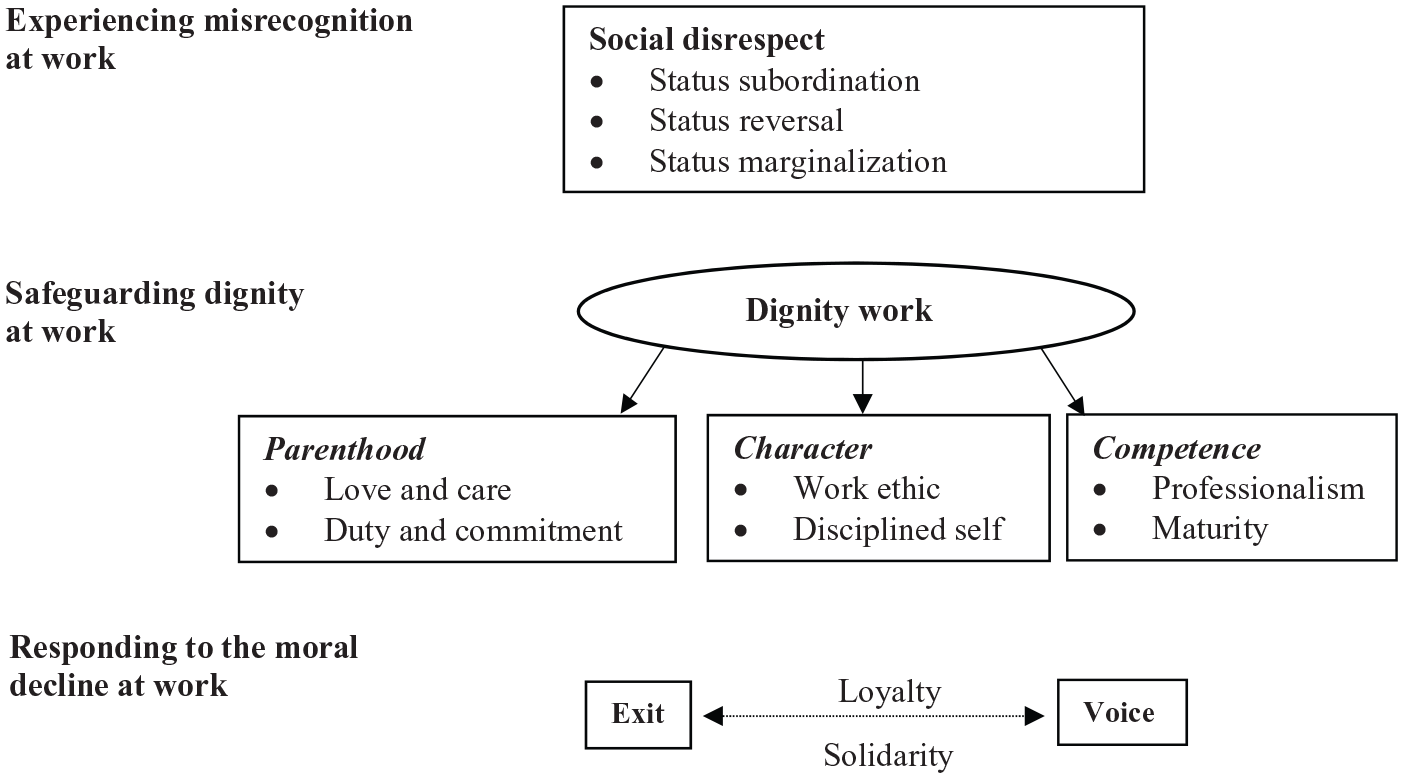
Tripartite model of the micro-politics of recognition at work.
The first part concerns diagnosis of what Bourdieu (1999: 627) calls ‘unexpressed and often inexpressible malaises’ of work that ‘touch on the ideas that people have about their own identity and self-respect’ at the embodied, interpersonal, and cultural levels. Feelings of social disrespect are not idiosyncratic reactions to workplace misbehavior but result from violations of socially accepted standard of recognition in socially structured situations. At the embodied level, abuse can destroy one’s basic self-confidence ‘in the value that one’s own needs enjoy in others’ eyes’ (Honneth, 2007: 136). Although abuse is often viewed as originating in the personality type of individuals, studies of workplaces that tolerate or even encourage abuse show clearly the social forces at play (Roscigno et al., 2009). At the interpersonal level, the conditions of recognition at work can be analyzed through vertical relations with supervisors and customers and horizontal relations among peers (Dejours et al., 2018). The quality of peer recognition shapes conditions of trust necessary for effective coordination of work tasks and workplace solidarity (Barbalet, 1996). Due to the unequal access to power, the quality of supervisor recognition shapes conditions of workplace civility and workers’ sense of loyalty (Hodson, 2005). Here workers’ desire for recognition has to be balanced with the reifying tendency of contemporary management practices (Honneth, 2008; Islam, 2012) that instrumentalize employees as either substitutable human ‘resources’ or strategic human ‘capitals’. In service work (Korczynski, 2013), the quality of customer recognition may also shape powerfully the morality of workplace, particularly when management takes the side of customers, for example, in the form of ‘customers are technically always right.’ At the cultural level, the quality of recognition by society at large shapes individuals’ capacity to give meaning to their work and integrate it into their self-identities (Leidner, 2006). Together the quality of recognition relations at work shapes the moral fabric of organizational life (Harper and Lawson, 2003).
The second part concerns ‘the social and social-psychological arrangements and devices by which men make their work tolerable’ (Hughes, 1971: 342). In management literature, this is often addressed through the lens of identity work, defined as ‘people being engaged in forming, repairing, maintaining, strengthening or revising the constructions that are productive of a sense of coherence and distinctiveness’ (Sveningsson and Alvesson, 2003: 1165). The notion of dignity work offers some advantages for analyzing work and identity in today’s neoliberal society. First, as Brown (2015: 33) warns, there is a tendency to view identity work as ‘an amoral concept or leads to an amoral understanding of identities’ by failing to appreciate the identity questions of ‘who am I?’ and ‘how should I act?’ as fundamentally moral questions. A study of dignity work, with the everyday human struggle for recognition as its focal point, can help to bring into open the affective, evaluative, and embodied aspects of identity work (Gabriel, 2010). Second, since people’s personal integrity can suffer from various acts of misrecognition in everyday work life, all organizations are subjected to a morally motivated critique as ‘existing forms of recognition are inadequate or insufficient and need to be expanded’ (Honneth, 2003: 143). Third, although it is widely held that people’s identity work is driven by desires to cast a positive identity (Dutton et al., 2010), such self-esteem motives are constrained by the ethical value horizon provided by the surrounding society. In a competitive social environment that neoliberalism promotes, the quest for esteem can become a zero-sum contest for esteem. Ironically, although historically the rising concern over dignity coincided with the decline of honor associated with a hierarchical view of society (Berger et al., 1973), in the absence of a social hierarchy on the shop floor, the adult employees in our study have attempted to construct an honor system via the discourses of work ethic and disciplined self, in which they occupy morally superior positions through a favorable judgment of worth.
The third part concerns the analysis of the social conditions under which workers either ‘put up with being the victims of their societies’ or ‘become very angry and try with passion and forcefulness to do something about’ injustice at work (Moore, 1978: xiii), the outcome of which shapes the social reproduction of the capitalist labor market. When conditions of recognition decline, the likelihood of ‘voice’ over ‘exit’ increases with both the degree of individual loyalty and the strength of collective solidarity at work, which help to maintain relationships when they might otherwise collapse and make the challenge of social disrespect easier to handle (Barbalet, 1996). The efficacy of loyalty and solidarity also increases with higher organizational barriers in entry and exit (Hirschman, 1970; Withey and Cooper, 1989). In this context, FoodCo offers a quite different setting from both traditional blue-collar work and other low-status service works where an occupational community exists (Ashforth and Kreiner, 1999). Here the interplay between a diversified workforce, high turnover rates, and the social organization of work give rise to several factors that discourage the formation of solidarity or loyalty. First, the diverse work history among employees implies that they often do not come to FoodCo with the same understanding about work. Second, few employees socialize with each other outside work, unless they are already acquaintances before joining FoodCo. Third, the weekly work schedule makes it difficult to maintain a stable social pattern in terms of who works with whom from shift to shift and from week to week. Fourth, the temporal rhythm of food work, combined with owners’ desire to reduce labor cost, dictate that in most of one day’s work, there is often only two or three employees working in the store besides the manager, and they are usually busy serving customers, doing prep work or cleaning, leaving little time for informal socializing on the shop floor. As Roy’s (1959) classic study on ‘Banana Time’ shows, social bond cannot form on the shop floor without recurrent social interactions in the case of routine labor, which has significant implications on the social reproduction of fast food work without resistance. On the one hand, without a social bond that ‘holds exit at bay’, adult employees have few incentives beside exit when work conditions deteriorate. On the other hand, the low barrier of organizational entry and exit makes it easier to divert the adult employees’ feelings of social disrespect away from voicing discontent into hunting for the next employer who may offer a more civil workplace. Both scenarios make it less likely to form a collective voice of protest as ‘dissatisfaction is more likely to take the form of silent exit’ (Hirschman, 1970: 35).
Discussion and conclusion
In this section, we conclude our study by discussing how the recognitional view can shed further lights on the relationship between meaningful work and dignity at work and by elaborating the notion of adulthood as an ideological form of recognition.
Meaningful work, dignity, and recognition
The longing for meaningful work – work that provides not only a livelihood, but also personal satisfaction – is a persistent theme in contemporary scholarship on dignity at work, which often draws its inspiration from either a context-transcendental Kantian ethics (Bowie, 2019) or a legal discourse of human rights (Misztal, 2013). Despite their significance as key aspects of justice, such approaches remain too far removed from everyday moral experience to foster a sensitivity to what dignity at work means as an experiential quality. By contrast, in posing the question of the social preconditions of living a dignified life in a just society, the recognitional view shifts the focus from considerations about what exactly dignity is, and why all human beings should possess it, to considerations about what it means to live a life with dignity via the moral injuries that arise from the myriad ways in which the vital human need for recognition is violated in unequal societies (Jütten, 2017).
In the negativistic epistemology of recognition theory, the problem of meaningful work is less about what the meaning of work is (Rosso et al., 2010) than about how work can contribute to a meaningful, fulfilled life through the elimination of meaningless work. In studying dignity at work, the moral injury arises from ‘feelings of social disrespect’ in the face of ‘recognition gaps’ caused by social structures of domination. In studying meaningful work, the moral injury arises from ‘the frustration of the desire to realize oneself’ as people don’t feel fulfilled in their work (Dejours et al., 2018: 58). To put it simply, the problem of dignity at work addresses injustice at work, while the problem of meaningful work addresses alienated nature of work.
However, if the division of labor in our society cannot guarantee the equal distribution of meaningful work among all members, many worker will be denied the chance to have satisfying work and the recognition associated with it (Sayer, 2009). In such case, ‘everyone has to have fair equality of opportunity’ (Roessler, 2012: 92). Yet, if the composition of the group of people who shoulder the burden of boring, routine, and ‘dirty’ works is unjustly shaped by class, gender, or race as it is known to be, the problem of meaningful work becomes part of the issue of dignity at work, and the search for meaning in work becomes part of the quest for dignity at work via the search for alternative standards of recognition of who one is and what one does, in, for example, studies of ‘dirty’ work like home care (Stacey, 2005) or cleaning (Tweedie and Holley, 2016).
Adulthood, ideology, and recognition
Modern societies have constructed some of their most important institutions, such as education, employment, and marriage, to ‘take cognizance of the centrality of work and love’ in adult life (Smelser, 1980: 5). Marked by the passage through these institutions, the biological process of human development has turned into a social process of person production, from which adulthood derives its social meaning and moral significance (Blatterer, 2007). The recognition of adulthood as full personhood, symbolized through the ideal of ‘autonomy, self-determination and choice’ (Hockey and James, 1993: 3), is in turn withheld from the conceptions of childhood and old age.
Paradoxically, the centrality of adulthood in social life has led to its marginalization as a topic of interest in organization studies, which have focused on the professional, technical, and managerial workers. Adults constitute the default actors implicit in all inquiries involving these middle-class workers. By contrast, our study has brought into open adulthood as the often taken-for-granted yet morally laden identity signifier that cuts across fault lines of gender, class, and age, the experience of which is contingent on one’s position in the social space marked by these traditional drivers of inequality. The moral dilemma of adults doing youth work also sheds lights on how neoliberalism promotes ‘recognition gaps’ through the ‘infantilization thesis’ – the belief that dependency ‘makes adults behave like children’ (Sennett, 2004: 103) – that derives from adulthood as an ideological form of recognition.
Unlike positive forms of recognition which contribute to the human self-realization of the members of a society, ideological forms of recognition ‘engender a willingness to adopt practices and modes of comportment that suit the reproduction of social domination’ (Honneth, 2012: 90). Indeed, by promoting institutionalized recognition of adulthood as full personhood, neoliberalism has turned the notion of adulthood into an ideology that morally justifies the rolling back of welfare policy and an instrument of domination that motivates people to adopt a self-conception that ‘conforms to the established system of behavioral expectations’ (Honneth, 2012: 76). For example, by asserting their sense of self-worth based on motherhood, the working-class mothers in our study place the unpaid work of caring for children at higher value than the paid work of employment, which may inadvertently contribute to their own marginalization in the labor market. The valorization of work ethic and self-discipline in turn facilitates the social reproduction of fast food work without resistance. Similarly, when the adult employees invoke the discourse of professionalism to justify working in the fast food industry, they tacitly devalue their work in relation to those of middle-class professionals and legitimatize the distribution of social esteem according to the prevailing division of labor.
As our study demonstrates, underlying the ‘recognition gaps’ that the adult employees face in doing youth work is the pathological development of neoliberalism that consists in turning the logic of competition into ‘a behavioral norm’ and the notion of enterprise into ‘a model of subjectivation’ (Dardot and Laval, 2013: 4), while hollowing out the mutual granting of recognition that makes up the moral fabric of everyday work life.
Limitations and directions for future research
The present study is limited in that the data theorized here concern only low-wage service work in one occupational setting; furthermore, the dataset is limited by the study’s choice of location. As is typical of non-metropolitan regions in the US Northeast, the racial makeup of the research site is predominantly white (about 85% white, 10% African-American, and 5% other minorities); race doesn’t play a salient role in our study. Had the field work been conducted in metropolitan settings such as New York City or Los Angeles, we’d expect significantly larger populations of minority or immigrant workers residing in inner-city or ethnic communities, bringing distinct community based cultural dynamics into play (Newman, 2000; Waldinger and Lichter, 2003). A systematic comparative study between our work and other studies of low-wage service work in major metropolitan settings may provide insights into how intersecting inequalities such as race, class, gender, and immigration status shape the micro-politics of recognition at work.
Another limitation is the study’s timing. The field work was conducted before the social movement of $15/hour minimum wage among fast food workers, originated in the major cities of, for example, Seattle, Los Angeles, and New York City, captured national attention. Since then, several states in the US Northeast, including the state in which our study took place, have introduced legislations raising the minimum wage to $15/hour. A follow-up study may provide the groundwork for investigating the dynamics of the micro-politics of recognition at work through an analysis of how the structure and quality of recognition relations may change with improved economic but not necessarily social standings among workers employed in low-wage service jobs.
Conclusion
According to Honneth (2012: 69), if the capitalist organization of labor is just, all subjects would mutually recognize each other as morally autonomous beings who sustain livelihood through the contribution their labor makes to society, and ‘every adult member of society is entitled to make a contribution to the common good and to receive an appropriate living wage in return.’ Based on a case study of adult employees in fast food work, this paper aims to sharpen the critical focus of dignity at work, while situating its study in relation to the social and economic injustices unleashed by the global liberalization of the capitalist market economy. This paper also draws attention to adulthood as an often taken-for-granted yet morally laden construct in organizational inquiry, which may gain added importance as more adults enter jobs where few institutional supports for adulthood exist.
Footnotes
Funding
The author(s) received no financial support for the research, authorship, and/or publication of this article.
