




Abstract
As most scholarly work on the conceptualization of organizational inclusion seems to be implicitly based on contexts of high-wage labor, this article investigates whether the common themes of organizational inclusion as identified by Shore et al. (2018) also align with the low-wage labor context. Our respective analysis identifies several mismatches between the current conceptualizations of organizational inclusion and the needs and interests of low-wage workers. Consequently, we offer suggestions for adapting these conceptualizations: by paying attention to (1) material and physical safety next to psychological safety, (2) opportunities of non-task-oriented involvement in the workgroup and (3) the recognition and accommodation of low-wage workers’ voices and needs. Furthermore, we argue to extend the scope of scholarly work on organizational inclusion by taking into account the broader (historical) social order and different stakeholders who influence the organizational processes of inclusion and exclusion. By engaging with the current “inclusion turn” and providing adaptations, this article contributes to a less “exclusive” conception of organizational inclusion as well as outlines where the organizational inclusion approach might come up against its own limits.
Introduction
The notion of “inclusion” has gained increasing attention both from scholars and practitioners over the last decade (Ferdman and Deane, 2014; Mor Barak, 2014). Concurrently, conceptual work on organizational inclusion is growing – partly complementing, partly replacing research “under the banner” of diversity (Oswick and Noon, 2014); see for example the Special Issue of Equality, Diversity & Inclusion: An International Journal on “Envisioning ‘inclusive organizations’” (Hofbauer and Podsiadlowski, 2014), Ferdman and Deane’s (2014) anthology on the The Practice of Inclusion in the workplace or the Special Issue Call (Adamson et al., 2018) of Organization on Critical Inclusion Studies. While the mainstream of diversity research in management and organization studies predominantly focuses on individual bias and discriminatory attitudes toward historically disadvantaged or minority groups (Jacques, 2016; Zanoni et al., 2010), research related to the notion of inclusion emphasizes the need for creating an organizational context in which individuals from both minority and majority backgrounds can feel as insiders (Jansen et al., 2015; Shore et al., 2011).
Conceptualizations of organizational inclusion often follow Shore et al. (2011) who define inclusion as satisfying employees’ needs of both belongingness (e.g. feeling as an insider) and uniqueness (e.g. feeling valued for “who you are”). Building on that, Shore et al. (2018: 182–185) conducted a comprehensive literature review of studies explicitly dealing with organizational inclusion. Thereby, they identified six main themes, which have proven to be relevant for all of the examined studies: “authenticity,” “feeling respected and valued,” “psychological safety,” “involvement in the workgroup,” “influence on decision-making” and “recognizing, honoring and advancing of diversity”. For Shore et al. (2018: 185), it is those themes that represent the “core” of an(y) inclusive organization, which need to be “constantly shown at all organizational levels.”
However, when taking a closer look at the studies from which Shore and colleagues have retrieved their main themes, we see that they mainly focus on traditional work organizations and high-skilled labor, such as health care professions (e.g. Nembhard and Edmondson, 2006), technical engineering (e.g. Carmeli et al., 2010) and academic personnel (e.g. Bilimoria et al., 2008). In these types of organizations and professions, employees usually perform what are seen as high-skilled and high-prestige tasks, receive relatively high wages, have possibilities for upward career mobility, are quite autonomous in the execution of their tasks and work in a relatively homogeneous workgroup wherein subordinate workers represent the minority (Kalleberg, 2016). This means that a focus on high-wage labor dominates the theorizing of organizational inclusion, thus assuming relatively good working conditions.
Such good working conditions are not part of the experience of many historically disadvantaged groups. Several cross-national studies of Western work contexts show, for instance, how migrant and (migrant) women workers are disproportionately employed in segments of the labor market that are characterized by low wages and low job quality (e.g. Andersson et al., 2019; Jacobs and Padavic, 2015; Wright and Clibborn, 2019). In particular, low-wage labor often entails few career opportunities and little training, requires no or little prior training, is tightly controlled in terms of both work tasks and time schedules, and is often low-esteemed and perceived as low-skilled work (e.g. Acker, 2006b; Jacobs and Padavic, 2015; Ravenswood and Harris, 2016). Against this background, it is a pressing question whether the current conceptualizations of organizational inclusion condensed from high-wage labor contexts are able to capture the experience and working conditions of low-wage workers.
In such low-wage labor contexts, workers are often confronted with physically demanding and potentially hazardous work (e.g. Van Den Borre and Deboosere, 2018); they are considered interchangeable and mostly employed based on temporal (seasonal) contracts (e.g. Benjamin et al., 2015); lastly, members of historically disadvantaged or minority groups are not hired due to their “unique skills,” but rather because they are associated with groups that are (still) willing to do this kind of work (e.g. Refslund and Thörnquist, 2016). Therefore, it is doubtful whether the inclusion themes (Shore et al., 2011) such as, for instance, “psychological safety,” “influence on decision-making” and “recognizing, honoring and advancing of diversity” adequately reflect the experience, needs and interests of low-wage workers.
With that in mind, this article explores whether the current theorizing of inclusion can capture the working conditions of low-wage labor and where it might need respective adaptations. The main research questions of this article are: To what extent do the current conceptualizations of organizational inclusion relate to the low-wage labor context? Whether and how do they need to be adapted in order to suit low-wage labor contexts as well? The article is structured as follows: The first part addresses the paradigm shift from diversity (management) to inclusion as a core approach for dealing with workforce diversity and argues for the need to investigate the substance and limits of conceptualizations of organizational inclusion. In order to do so, the second part of the article elaborates on the low-wage labor context by taking cleaning work as an illustrative example, where work is generally low-waged, precarized and dominated by groups such as migrant and (migrant) women workers. This is followed by an in-depth engagement with the main themes of organizational inclusion research as identified in the recent literature review by Shore et al. (2018) and contrasted with characteristics of the work-self relationship, the employer-employee relationship and the organization-environment relationship in the low-wage labor context. Finally, we outline possible adaptations that could enhance the conceptualizations of organizational inclusion in order to suit low-wage labor contexts and also discuss where the “inclusion approach” might come up against its own limits.
The organizational inclusion turn
Similar to the replacement of “old-fashioned” equal opportunity approaches by diversity management in the 90s, inclusion is currently positioned as the new, improved step from diversity management (Jonsen et al., 2019; see also Oswick and Noon, 2014; Theodorakopoulos and Budhwar, 2015). In order not to end up with a “case of old wine in new bottles” (Nkomo, 2014: 580), both scholars and practitioners aim at clearly distinguishing between diversity and inclusion-related approaches. For example, Nkomo (2014: 588) states that diversity management is often “reduced to incremental change” while inclusion is about imagining organizations that had been developed for the greatest possible variety of human beings from the outset. Consequently, inclusion scholars (Ferdman, 2014; Holvino et al., 2004; Nishii and Rich, 2014; Shore et al., 2018) emphasize that inclusion efforts need to become part of an “organization’s DNA”: ingrained in everyday practices and processes as much as in overarching structures and norms. The simple and simultaneously demanding idea behind this approach is that in an inclusive organization, “no one can say, ‘What about me?’” (Nkomo, 2014: 589). Against this background, we investigate whether the inclusion turn pays attention to the experience, needs and interests of low-wage workers through an in-depth analysis of the main themes which Shore et al. (2018: 18) identified as characteristic of and relevant for organizational inclusion research in general.
The tacit alliance of the organizational “inclusion turn” with high-wage labor
In their literature review of 42 empirical papers on inclusion in the workplace, Shore et al. (2018) identify six main themes – (1) authenticity, (2) feeling respected and valued, (3) psychological safety, (4) involvement in the workgroup, (5) influence on decision-making as well as (6) recognizing, honoring, and advancing diversity – as cross-cuttingly relevant for all of the studies. Subsequently, they develop a model (Shore et al., 2018: 185) of an inclusive organization, which is characterized by the simultaneous focus on both the enhancement of inclusion and the prevention of exclusion by measures such as targeted recruitment or diversity trainings. With respect to the enhancement of inclusion, they position the main themes identified by their literature review as key components of organizational inclusion practices and processes.
The theme of (1) authenticity, similar to the notion of “uniqueness” (Shore et al., 2011), refers to the perception of employees that they are “allowed” to be different from each other. Jansen et al. (2014) even argue that “authenticity” represents a broader notion than “uniqueness” as it allows for valuing both differences and similarities between group members – that is, an employee does not “have to be unique” to be valued. This relates strongly to the theme of (2) feeling respected and valued which refers to the perception of employees that they are appreciated as an individual as well as a member of their group identity. In other words, they can be “an appreciated and esteemed member of the group” (Shore et al., 2018: 182). Also, the theme of (3) psychological safety is connected to the valuing of individuality and different identity groups, referring to the employees’ perceptions of their workgroup and organization in which they “are comfortable being themselves” (Edmondson, 1999: 354). According to Edmondson (1999), in a psychologically safe environment, employees can openly express their views without fearing any repercussions in the workgroup or organization.
The interrelatedness of these three themes is also illustrated in the studies that attempt to measure perceptions of inclusion in high-wage labor organizations. For instance, the link between psychological safety and feeling respected and valued is expressed by Nembhard and Edmondson (2006) who found that when health care professionals felt their input was appreciated, they developed a sense of psychological safety and became comfortable with speaking up and expressing themselves. Furthermore, Carmeli et al. (2010) found that perceived psychological safety of the engineers they studied played an important role in enhancing creativity in the workplace. In these knowledge-intensive, high-wage labor contexts, it seems that indicators for perceptions of organizational inclusion are mostly oriented on the symbolic resources and psychological needs of employees, with the underlying aim to enhance creativity and innovation in the workplace.
The theme (4) involvement in the workgroup is one of the most prominent indicators of employees’ perceptions of inclusion in the literature. Shore et al. (2011) refer to involvement in the workgroup as the central element of “belongingness,” that is, the way employees feel they are accepted and can connect to each other and the organization. Most studies operationalize this theme in terms of the employee involvement in the workgroup related to work tasks (e.g. Mor-Barak and Cherin, 1998; Pelled et al., 1999; Roberson, 2006). For instance, Mor-Barak and Cherin (1998) proposed that the degree to which individuals feel part of the workgroup by being able to influence formal and informal work processes is an important indicator of organizational inclusion. Originally tested on master students in social work organizations (Mor-Barak and Cherin, 1998), their model has been re-tested and further developed in high tech companies (Findler et al., 2007; Mor Barak, et al., 2001). Similarly, Shore et al. (2018: 182) exemplify involvement in the workgroup as: ‘an academic department dominated by tenure track faculty that supports the full sharing of information to full-time clinical faculty.” These examples indicate that involvement in the workgroup, as an indicator of organizational inclusion, is mostly examined in high-wage labor contexts.
The theme (5) influence on decision-making is often mentioned as an important practice of organizational inclusion (e.g. Mor-Barak and Cherin, 1998; Nishii, 2013; Pelled et al., 1999; Roberson, 2006). This asserts that, in order to create organizational inclusion, employees should have the ability to influence decision-making that affects their work, and employers should facilitate their employees’ participation and engagement in decision-making processes. For instance, Nishii (2013) conducted a study among employees in a biomedicine company and found that an important factor of an inclusive work environment is whether employees of all backgrounds can participate in the core decision-making of the organization. However, as Janssens and Zanoni (2008, p. 4) argue, possibilities of influencing decision-making are very much dependent on one’s position in the organizational hierarchy. This indicator may therefore only be suitable to measure organizational inclusion in higher organizational ranks.
The last theme is (6) recognizing, honoring and advancing diversity and is connected to the importance of leadership for the fair treatment of all employees while also “supporting and building a pipeline of talent among members of marginalized social groups” (Shore et al., 2018: 181). Thus, the proposed inclusive practices within the theme of recognizing, honoring and advancing diversity involve both diversity-conscious (e.g. recognizing differences) as well as diversity-blind (e.g. equal treatment, diminishing discrimination) practices (Konrad and Linnehan, 1995). For instance, Sabharwal (2014) used a sample of public managers to study organizational inclusion and found that particularly senior management “must foster an environment that promotes inclusiveness and empowers individuals to achieve their fullest potential” (p. 211). These kinds of diversity-conscious practices seem particularly relevant in high-wage labor contexts such as knowledge-intensive work organizations where the organization benefits from valuing a diversity in terms of different opinions and perspectives.
Zooming in on the papers of the literature review (Shore et al., 2018), from which the main inclusion themes were retrieved, we found that only three of the 42 articles engaged with conceptualizations of organizational inclusion in the context of low-wage labor: food manufacturing, logistics and construction (Janssens and Zanoni, 2008); manufacturing (Pelled et al., 1999); supermarket (Nishii and Mayer, 2009). In contrast, 39 of the 42 papers investigated conditions for and indicators of inclusion in occupations such as technical engineering (Carmeli et al., 2010; Findler et al., 2007; Li et al., 2015; Mor Barak et al., 2001), health care professions (Downey et al., 2015; Hirak et al., 2012; Mitchell et al., 2015; Nembhard and Edmondson, 2006) or academic personnel (Bilimoria et al., 2008; Pearce and Randell, 2004). All of these latter occupations require some educational qualifications, provide a certain professional status and allow a certain degree of job autonomy or control over work tasks and work schedules.
Despite this bias toward high-wage labor contexts in their review sample, Shore et al. (2018: 185) developed a supposedly universal “model of inclusive organizations,” which heavily built on those 42 papers. Consequently, since the basis for the main inclusion themes is almost entirely studied in the context of high-wage labor, we question to what extent they are readily applicable to the inclusion conditions and measures of low-wage labor. We question whether themes such as “authenticity,” “feeling respected and valued” or “psychological safety” are sufficient and/or even suitable for capturing the experience, needs and interests of low-wage workers who are often considered interchangeable by their employers (Forde and MacKenzie 2009). For instance, Berrey (2014) shows that diversity management mainly focuses on high- and mid-level employees, treating low-wage and non-exempt workers as “of lesser value, irrelevant, and disposable” (2014: 364). Similarly, the inclusion themes of involvement in the workgroup, influence on decision-making and recognizing, honoring and advancing of diversity might not be easily transferrable to low-wage labor conditions. For instance, as work can be highly standardized in low-wage labor contexts, workgroups might not play a significant role for task fulfillment and everyday working life as such (e.g. Jehn et al., 1999). Further, taking part in decision-making is highly rank-sensitive and thus less appropriate for the experience of inclusion of low-wage workers (Janssens and Zanoni, 2008). Consequently, we assume that the situation of people with low-wage jobs connected to lower status and less autonomy has largely been neglected by the organizational inclusion turn so far (notable exceptions: Janssens and Zanoni, 2008; Nishii and Mayer, 2009; Pelled et al., 1999).
Although we assume a bias of organizational inclusion theorizing toward high-wage work, we do not dismiss this stream of research but instead thoroughly explore its potential and limits for low-wage labor contexts. In particular, we do this by an in-depth engagement with the main themes of organizational inclusion as identified by Shore et al. (2018) and connect them to the low-wage labor context, with the intention to not only point out potential shortcomings but also provide constructive ideas for their adaptations.
Method
Methodically we enter a “dialectical interrogation” between current conceptualizations of organizational inclusion and the low-wage labor context to “identify, articulate, and challenge central assumptions underlying existing literature in a way that opens up new areas of inquiry” (Alvesson and Sandberg, 2011: 255–256). Only by engaging with and evaluating “concrete ideas about what inclusiveness might mean” (Dobusch, 2014: 230) – that is in this case, what inclusiveness might mean to low-wage workers –, this article can contribute to a less “exclusive” conception of organizational inclusion.
In order to do so, we compare the main inclusion themes (Shore et al., 2018) retrieved from studies explicitly dealing with organizational inclusion with the experience and working conditions of low-wage workers. We use the paper by Shore et al. (2018) because it is the most recent integrated literature review of organizational inclusion studies. To understand the low-wage labor context and how it differs from the high-wage labor context that most of the inclusion studies are related to, this article builds on previous low-wage labor-focused literature in organization and diversity studies.
In particular, for capturing the conditions and experience of low-wage workers, we make use of an illustrative example that can be judged as prototypical for contemporary forms of low-wage labor: the work of cleaning. Cleaning work notably differs from the type of labor that conceptualizations of inclusion commonly focus on: in terms of wage, job autonomy, educational requirements and status. On top of that, cleaning work is increasingly outsourced or subcontracted and is often conducted by the most marginalized groups of society. As such, cleaners represent a subset of precarious workers and stand paradigmatic for new forms of organizing and a globalized workforce (e.g. Alberti et al., 2018; Rubery et al., 2018).
We build our illustrative example using peer-reviewed empirical papers that have examined cleaning work in a given organizational setting. Since our focus was gaining insight into the low-wage labor context, we excluded studies with a primary focus on cleaning work in non-organizational and non-paid settings. We identified the relevant papers through searches of electronic databases such as Worldcat.org, Wiley Online Library, Science Direct and SpringerLink. The search results were limited to articles that (a) were published in English peer-reviewed journals, (b) focused on paid cleaning work in organizational settings and (c) were published between 2009 and 2019. We chose this timeline in order to capture the most current labor market developments revolving around a spreading precarization (Alberti et al., 2018; Rubery et al., 2018). Due to globalization, new technologies, employer risk shifting and a heterogenization of the workforce, precarious work has over the last decade become the new norm in labor markets (Rubery et al., 2018). This means an increase in contractual forms of temporary agency work, zero-hour contracts and subcontracting under multi-employer settings, which highly characterizes paid cleaning work. The above-mentioned criteria led us to a total of 64 papers that have empirically investigated cleaning work(ers) in mostly Western work settings. We do not claim this to be an exhaustive search, yet this gives us an insight into the daily conditions within cleaning work. Of this paper sample, we selected 28 articles that were located in the fields of organization studies, (occupational) health studies, industrial relations and social geography while excluding articles that were, for instance, oriented on technical aspects of cleaning machines (see Table 1).
Selected literature of cleaning work in organizational settings.
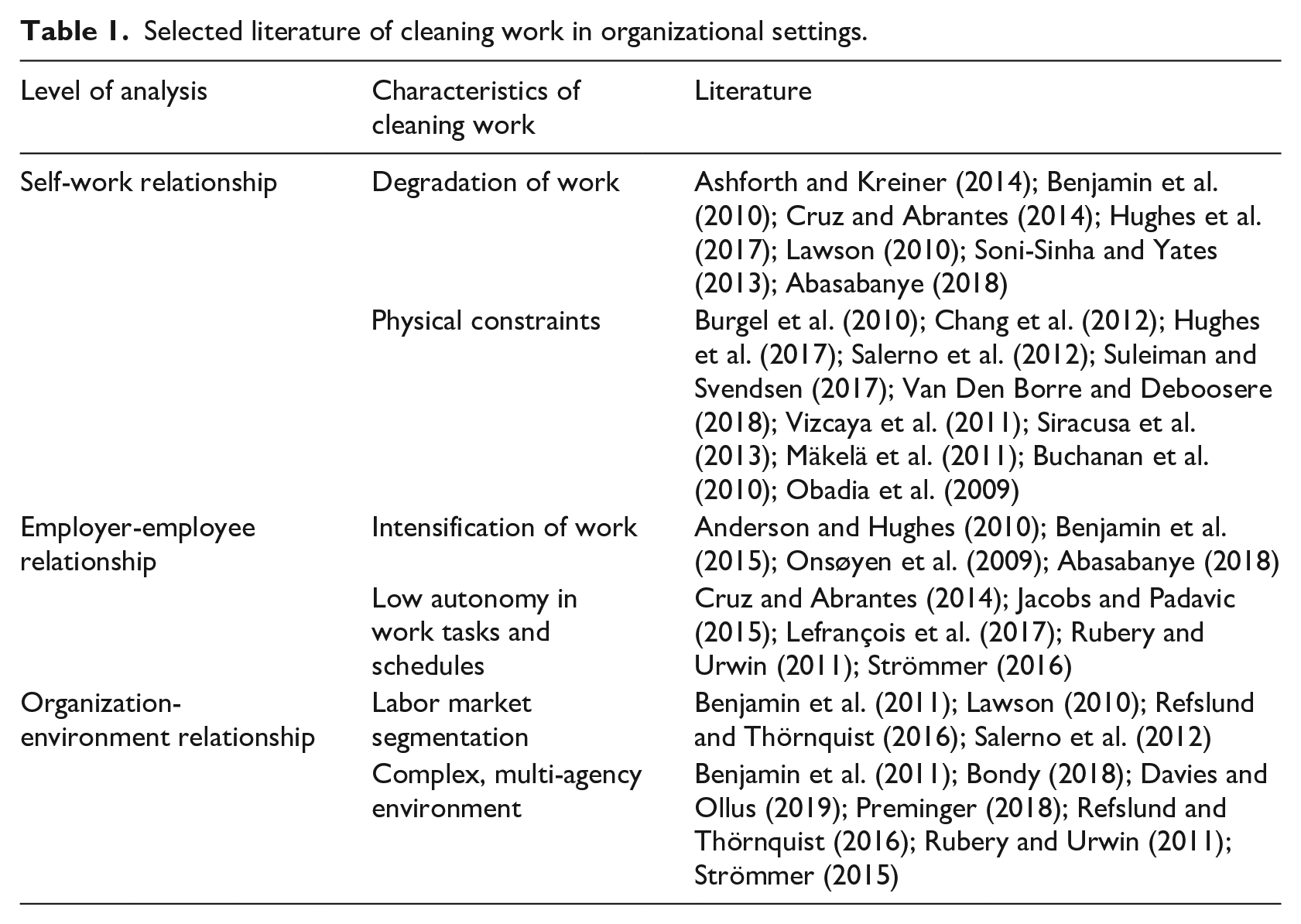
For painting a fine-grained picture of the working conditions and connected experience, needs and interests of cleaners based on our literature search, we particularly focus on three relationships: First, we reconstruct the work-self relationship, thereby looking at the work of cleaning as such, its meaning and embodied consequences for the cleaners as well as the cleaners’ agency in shaping their work. This is of vital importance for examining the applicability of the identified inclusion themes (Shore et al., 2018) to the low-wage labor context as the majority of these themes is situated on an individual level (authenticity, feeling respected and valued, psychological safety, involvement of workgroup). Second, by focusing on the employer-employee relationship, we pay particular attention to the (asymmetrical) power relations underpinning the organizing of cleaning work. This is also highly relevant considering the fact that the two remaining inclusion themes – influence on decision-making as well as recognizing, and advancing diversity – are mainly oriented toward how management involves and treats their employees. Third, we engage with the organization-environment relationship in order to acknowledge the current embedding of work organizations in an increasingly globalized labor market. Such a focus on the organizational environment is lacking in the inclusion themes of Shore et al. (2018), however, we deem it all the more important as social inequalities tend to be reflected in and further fuel organizational inequality regimes (Acker, 2006b; Avent-Holt and Tomaskovic-Devey, 2019) and thus substantially influence the possibilities and limits to create organizational inclusiveness.
The low-wage labor context
Different terms are used in literature that focuses on occupations at the bottom level of the labor market, for instance: blue collar work (e.g. Berrey, 2014), working class or working poor (e.g. Ehrenreich, 2010), dirty work (e.g. Duffy, 2007), “Mcjobs” (Benjamin et al., 2015) and back-room jobs (Glenn, 1992). Although terms vary, they all refer to occupations that are the lowest-paid, tightly controlled and often looked down upon in society. They focus for instance on low-wage service work involving cleaning, caring, catering or laundry and dry-cleaning work. To understand the core aspects of low-wage labor, this article builds on studies that focus on paid cleaning work as it notably differs from the type of labor that conceptualizations of organizational inclusion commonly focus on.
Work-self relationship
Firstly, we zoom in on research that engages with the self-work relationship in the context of cleaning work, where two aspects stand out. On the one hand, studies analyze the “degradation” of cleaning work that is perceived as unworthy, dirty and low of status (Ashforth and Kreiner, 2014; Benjamin et al., 2010; Cruz and Abrantes, 2014; Hughes et al., 2017; Soni-Sinha and Yates, 2013). For instance, Benjamin et al. (2010) examined the experience of cleaning workers and found that they faced degradation due to their cleaning job from their family, community and within the workplace. In their study of refuse collectors and street cleaners, Hughes et al. (2017) indicate how the materiality of work matters in the social degradation of these workers such as disgust toward certain smells and the touch of dirty matter. Furthermore, cleaners experience verbal abuse, physical nudges of impatience, being carefully watched or a lack of eye contact during physical encounters (Hughes et al., 2017: 117–118). Yet, these studies also indicate cleaners’ strategies to disturb their social degradation through a sense of civic pride from creating order through embodied work practices (Hughes et al., 2017: 116) and entering into social relationships and comradeship at work (Benjamin et al., 2010).
On the other hand, another prominent aspect of cleaning work is that it is heavy and physically demanding labor. Especially in the field of health and occupation literature, cleaning work is discussed in relation to occupational hazards, injuries or illnesses due to exposure to chemicals (Suleiman and Svendsen, 2017; Van Den Borre and Deboosere, 2018) and risk to musculoskeletal disorders due to the repetitive physical movements of cleaning work (Burgel et al., 2010; Chang et al., 2012). As a consequence of these working conditions, many cleaners are forced into early retirement or become invalidated because of their profession.
The work-self relationship makes it clear that low-wage workers not only face more psychosocial constraints regarding the low social prestige and low recognition of their work, they are also often confronted with severe material and physical constraints regarding their health and the stability of their job and payment in comparison with high-wage workers.
Employer-employee relationship
Secondly, we look at studies that engage with the employer-employee relationship underpinning cleaning work. Here, it seems that cleaning work is characterized by a drive for greater work efficiency in order to compete in a globalized and neoliberal labor market (Anderson and Hughes, 2010; Onsøyen et al., 2009). This often results in an intensification of the workloads for the cleaners, low payment and an increase in non-standard work arrangements in order to do more (cleaning) work with fewer employees. For instance, in their study of hotel cleaners, Onsøyen et al. (2009) described how the cleaning of hotel rooms prevailed under close and negative supervision, which was guided by the pace and progress of work and less by the quality of cleaning. They reported that cleaners experienced a constant time pressure caused by the high number of rooms that had to be cleaned within increasingly shortened time limits. Furthermore, cleaners were denied access to training, parking or meetings with the manager, who rarely made use of feedback from cleaners regarding the work tasks (Onsøyen et al., 2009). What is more, Strömmer (2016) showed how outsourced cleaners are further isolated from the employer and the work community as communication regarding work tasks and work changes is relayed to intermediaries.
Not only do cleaners often have little control over their work tasks and work pace, they also have less control over their working hours, breaks and scheduling (Cruz and Abrantes, 2014; Jacobs and Padavic, 2015; Lefrançois et al., 2017; Ravenswood and Harris, 2016). Studies focusing on work-life balance found that the combination of low payment and their required “flexibility” despite an inflexible work environment poses a threat to the livelihood of low-wage workers. For instance, whereas women in high-wage jobs often have to deal with too many work hours, those in low-wage flexible jobs often have too few hours to make ends meet (Jacobs and Padavic, 2015) and face more pressure to conform to employer requirements in “24/7” operations (Ravenswood and Harris, 2016). Also, low-wage workers have little leeway getting their personal needs accommodated by their employer, such as the possibility of starting work later due to a family situation. The “extended, rigid, unpredictable and variable work schedules,” with no allowance for personal time needs, influence the ability to manage the work-life balance (Lefrançois et al., 2017: 614). What is more, cleaners - and in particular women cleaners – also need to manage their physical work-life balance in order not to get injured or sick as they cannot as easily “lean on” other women to do the physically demanding care and cleaning tasks at home, compared to high-wage workers (Fraser and Gutting, 2015). Low-wage workers therefore face potentially severe work-life conflicts, impacting both their private lives and their health.
The employer-employee relationship within the low-wage labor context indicates an increasing intensification of work tasks yet also a growing distance between the employer and the employees. Furthermore, high levels of flexibility are required of low-wage workers in terms of availability for work, however, accompanied by high levels of inflexibility when it concerns time off for personal needs.
Organization-environment relationship
Thirdly, we engage with the organization-environment relationship that concerns the way low-wage labor is shaped by its surrounding environment, its politics, history and culture (Acker, 2006b; Tomaskovic-Devey, 2014). In the context of cleaning, it becomes particularly visible that this type of work has (historically) been dominated by subordinate groups: For instance, cleaning work is mainly performed by women (Salerno et al., 2012) and increasingly by migrants (Lawson, 2010; Refslund and Thörnquist, 2016) and other socially marginalized groups (Benjamin et al., 2010; Glenn, 1992). Benjamin et al. (2010), building on the work of Glenn (1992), explain that cleaning work is historically assigned to specific race/ethnic group categories whereby often “racialized women shoulder heavy, dirty, ‘“back-room” chores’ that respectable members of society can avoid” (2010: 339). This occupational segmentation indicates a social order in the environment shaped by societal power relations and asymmetries grounded on class, gender, race and ethnicity that are reproduced in the workplace (Ortlieb and Sieben, 2014).
Another aspect of the organization-environment relationship is the ways in which cleaning work has increasingly become part of a multi-employer landscape through outsourcing and subcontracting (Benjamin et al., 2010; Bondy, 2018; Davies and Ollus, 2019; Preminger, 2018; Strömmer, 2016). These studies indicate that the changing organizational boundaries create a lack of regulatory oversight on the work of cleaning, which leads to the question: Who is responsible for the working conditions of low-wage workers when work is subcontracted or outsourced? Furthermore, the precarious forms of employment in the cleaning sector lead to a further increase in income inequality (Lawson, 2010), a decline in employment security (Rubery and Urwin, 2011) and a growing segmentation in labor markets (Bondy, 2018).
The focus on the organization-environment relationship indicates that low-wage work is often dominated by subordinate groups, resulting in labor market segmentation. Additionally, low-wage work is characterized by a complex, multi-agency environment that blurs the responsibilities over the (precarious) working conditions of low-wage workers.
Concepts of organizational inclusion and low-wage labor: Identifying mis/matches
In the next step, we relate each relationship level and its consequences for central conditions of low-wage labor (see Table 1) to the main inclusion themes identified by Shore et al. (2018). In addition, we outline possible adaptations of those themes to better suit the experience, needs and interests of low-wage workers (see Figure 1 for an overview).
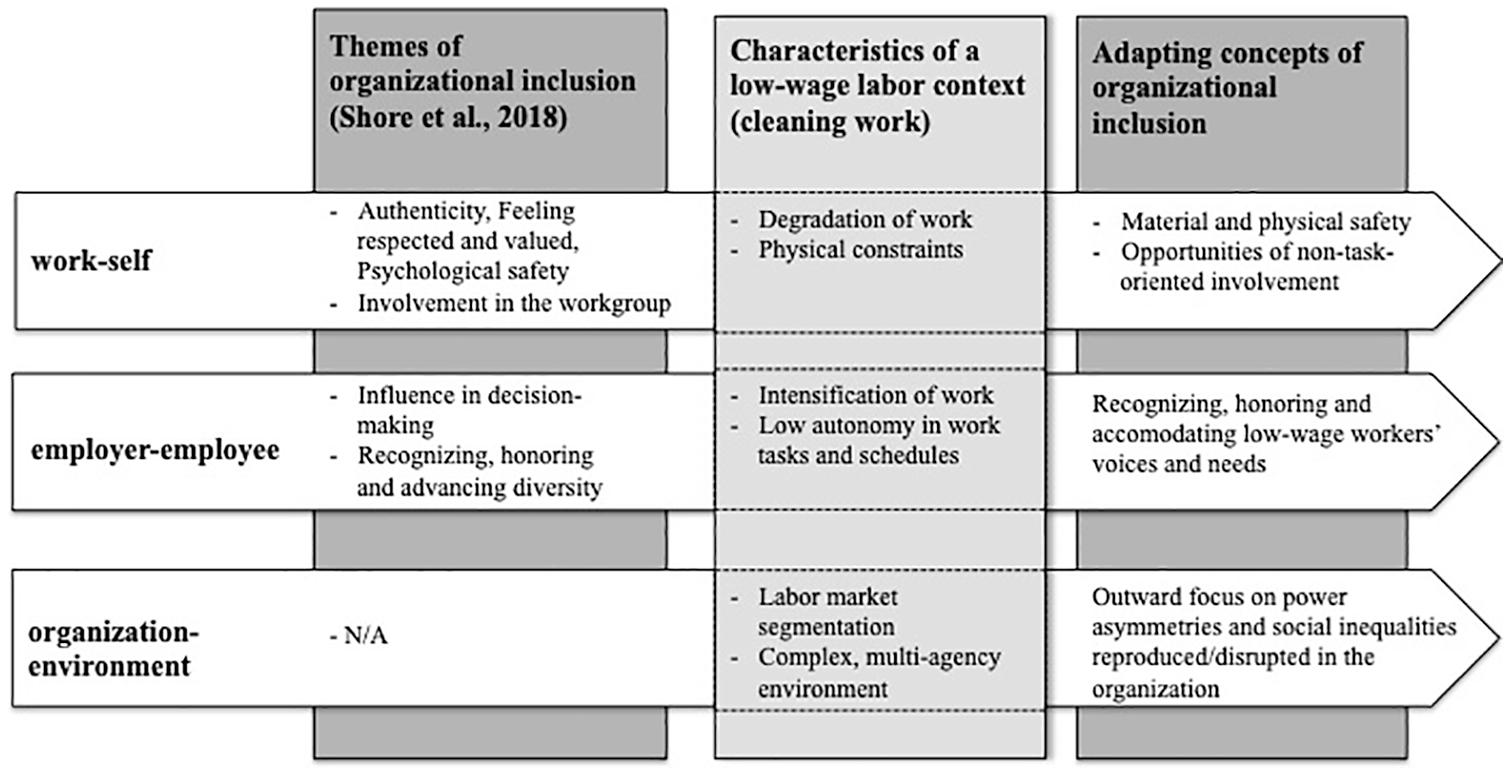
Adaptations to the concept of organizational inclusion.
Low-wage labor and organizational inclusion: Work-self relationship
Most of the inclusion themes identified by Shore et al. (2018) relate to the self-work relationship. They revolve around psychological needs that are mainly used as specific individual indicators to measure employees’ experience of inclusion in their job. In line with our research interest, we question whether these indicators are often (implicitly) oriented toward the experience of high-wage workers and thus might be less appropriate for making sense of the inclusion experience of low-wage workers.
Authenticity, feeling respected and valued, psychological safety
In particular, it is the psychological needs of employees such as authenticity, feeling respected and valued as well as psychological safety that dominate the work-self relationship. Such psychological needs are crucial for assessing inclusion in low-wage labor contexts, where workers often experience degradation (Ashforth and Kreiner, 2014; Benjamin et al., 2010; Cruz and Abrantes, 2014; Hughes et al., 2017; Soni-Sinha and Yates, 2013). However, the sole focus on psychological aspects neglects the material and physical conditions of work. For instance, cleaners experience a lack of inclusion due to employment and payment insecurity or physical pain directly caused by their work activities. As Onsøyen et al. (2009) found in their study of hotel cleaners, cleaners experienced exclusion when they were denied access to a nearby parking space in contrast to those higher up in the hierarchy. One way to interpret the fact that material or physical safety do not seem to play a significant role in current conceptualizations of organizational inclusion is that they are assumed to be already given, which is very likely the case in high-wage labor contexts.
Therefore, we argue that, for the theme of psychological safety to make sense for low-wage workers, it should be complemented by the topics of physical safety and material safety as well. For instance, Rubery and Urwin (2011: 125) studied standard employment protections such as providing security in employment and income as well as protecting employees’ health and safety at work. They found that in domiciliary care and cleaning services, these “basic” securities were mostly lacking as the responsibilities for these securities became increasingly unclear in the subcontracted and fragmented care and cleaning sector (Rubery and Urwin, 2011). While precarious working arrangements increasingly create insecurities for high-wage workers as well, they represent a specific threat to those in low-wage jobs where flexibility of working life means irregular incomes and eventually poverty (Atkinson, 2010; Jacobs and Padavic, 2015). Next to material safety, the core aspect of physical constraints of cleaning work indicates the importance to take into account employees’ physical experience of safety, such as worker’s health or feelings of safety in expressing physical constraints.
This might mean that low-wage workers will “score” very low on material or physical inclusion indicators when assessing their inclusion experience (Janssens and Zanoni, 2008); however, by neglecting these aspects of safety, the everyday experience and perceptions of the inclusion of low-wage workers cannot be adequately captured.
Involvement in the workgroup
Another inclusion theme related to the work-self relationship is the involvement in the workgroup. We question the way this theme plays out for low-wage workers as it is mainly focused on task-oriented involvement. Such a definition of workgroup involvement implicitly assumes a certain nature of task accomplishment, where employees more or less work together on a joint task and simultaneously build, depend on and enjoy social relationships that necessarily develop in these kinds of work settings (e.g. talking, coming up with ideas, discussing etc.). For instance, Carmeli et al. (2010) studied employee involvement in knowledge-intensive organizations focused on developing advanced technological products, a context in which the work itself encourages creativity and social relationships among employees. This is not a given in low-wage work settings such as cleaning work, where (physical) work tasks might also be group efforts but in a highly routinized and repetitive way that does not allow for contributions that enable employees to enact one’s individuality. In fact, this would rather harm the workflow of cleaning that has increasingly become intensified in terms of work pace and fragmented work tasks (Anderson and Hughes, 2010; Benjamin et al., 2015; Onsøyen et al., 2009)
Yet, when looking at the cleaning context, opportunities of involvement in the workgroup exist, albeit in a more non-task-oriented matter. For instance, Benjamin et al. (2010) studied women’s experience of paid cleaning work and found that the daily informal meetings and union activities with co-workers allowed positive social interaction that reinforced respectability, a sense of comradeship and acceptance among cleaners themselves. This is certainly also relevant for high-wage workers, as Mor Barak (2014: 155) emphasizes the importance of informal processes, such as “the water cooler” and lunch meetings where information and decisions informally take place. However, as social relationship building is not “naturally” built into the jobs of low-wage workers, it becomes all the more important that the employer intentionally creates such opportunities. Examples for this include scheduling enough breaks that allow social, non-task-related involvement in the workgroup and providing meeting rooms on site for having lunch together.
Thus, even though involvement in the workgroup is defined both in task-oriented (e.g. integration in organizational processes) as well in non-task-oriented involvement (e.g. connecting to others, feeling accepted in the workgroup), we emphasize that for low-wage workers, it becomes crucial to pay attention to the opportunities of non-task-oriented involvement in the workgroup.
Low-wage labor and organizational inclusion: Employer-employee relationship
In this section, we focus on the inclusion themes relevant for the employer-employee relationship and how they relate to the low-wage labor context. Although less prominent than the work-self relationship, the currently dominant inclusion themes also refer to the relationship between the employer and employee: First and foremost, scholars discuss how an inclusive working environment can be achieved through organizational practices implemented by management (e.g. Mor-Barak and Cherin, 1998; Nishii, 2013; Pelled et al., 1999; Sabharwal, 2014). Important themes that scholars identify in that regard are influence on decision-making as well as recognizing, advancing and honoring diversity. We notice that the current conceptualizations of inclusion connected to the employment relationship have a strong emphasis on the “value” that both majority and minority people bring to the organization and that inclusion is supposed to create a win-win situation for both the employees and the organization (Ferdman and Deane, 2014). However, when looking at the employer-employee relationship in cleaning work, it is highly questionable to what extent employer and employee interests can actually be in harmony (see also Holck and Muhr, 2017; Zanoni, 2011).
Influence on decision-making
Influence on decision-making is assessed as an important practice of organizational inclusion (e.g. Mor-Barak and Cherin, 1998; Nishii, 2013; Pelled et al., 1999; Roberson, 2006). Yet, the practice of influence in decision-making can make great demands of participants in terms of material and “cognitive” resources that low-wage workers might not as easily provide compared to high-wage workers. Similar to the so-called “participation gap” in democratic activities, higher-status individuals are more likely to have the time, the money, the access to political information and the ability to become politically involved (Dalton, 2017). This indicates that participation in decision-making in the organization depends on certain conditions that are more likely present connected to high-wage work but to a much lesser extent in low-wage labor contexts.
First, influence in decision-making is conditional upon having the material resources in terms of time and money: Are workers being paid for the time they have to put in to participate in organizational decision-making? Are opportunities of participating in decision-making during or outside their working hours? For instance, Onsøyen et al. (2009: 93) found that because of lacking material benefits plus the feeling of being undervalued, only few cleaners voiced their opinions at work, which consequently led management to believe that cleaners are not interested in engaging with decision-making in general.
Second, influence in decision-making is conditional upon the types of “voices” that are being heard and being taken seriously as “cognitive resources.” For instance, Scully and Blake-Beard (2006: 442–445) discuss the differences in speech and reasoning styles of high- and low-class workers such as “particular” or “universal” speech as well as styles of reasoning such as referring to specific, recent issues or generalizing issues with broader, abstract categories. These latter types are often the voices that “sound smarter” and are therefore taken into account in decision-making (Scully and Blake-Beard, 2006: 443). Although influence in decision-making is understood as an inclusive practice because “different voices of a diverse workforce are respected and heard” (Pless and Maak, 2004: 131), this often involves a focus on the appreciation of gendered and racialized differences (Helgesen, 1995; Janssens and Zanoni, 2014) and not on class-related ones (Berrey, 2014; Scully and Blake-Beard, 2006). As Scully and Blake-Beard (2006: 443) have noted, “there is not yet a celebration of the working-class way.”
Thus, only offering opportunities of participating in decision-making is not enough to signify as an “inclusive practice.” When taking the low-wage labor context into account, it becomes clear that inclusive decision-making is conditional upon whether or not participants are given the material resources to participate (e.g. being paid and not in their personal time) and whether or not speech styles and lines of reasoning different from established management jargon are taken seriously.
Recognizing, honoring and advancing diversity
Recognizing, honoring and advancing diversity is the last theme that Shore et al. (2018) describe as relevant for conceptualizations of organizational inclusion. As mentioned before, this theme refers to research on “best practices” of inclusion involving both diversity-conscious as well as diversity-blind practices (Konrad and Linnehan, 1995). The diversity-blind practices supporting fairness, equal treatment and diminishing discrimination are particularly important for low-wage workers as their precarious working conditions often hinder them from claiming these rights themselves (e.g. Bondy, 2018). The diversity-conscious focus on the other hand seems to be dominated by the instrumental case of diversity in terms of creating the most value out of employees’ differences. For instance, Nishii (2013: 1754) defined inclusive climates as “integrating diverse cultural identities as a source of insight and skill.” Similarly, Sabharwal (2014: 202) claims that in an inclusive organizational climate, the unique perspectives and skills of a diverse range of members are used, ultimately leading to a “better-performing and successful organization.”
Approaching inclusion in the low-wage labor context through this instrumental recognition of differences means that “inclusion remains conditional upon adding something deemed of value” (Tyler, 2019: 63). This lens to identify inclusive practices for low-wage labor becomes problematic for two reasons. First, the rhetoric of the value and appreciation of diversity is mostly recognized in organizations for what is seen as knowledge-intensive, high-skilled labor (Ortlieb and Sieben, 2010). In the way that low-wage labor is set up as standardized and easily replaceable, the rhetoric of the value and appreciation of unique skills does not seem to be as easily applicable. Second, the instrumental recognition of differences in an “inclusive organization” can become problematic as it might lead to co-optation (Tyler, 2019) or the “making up” of categories of workers (Dahl, 2014). For instance, in their study of migrant workers in a London hotel, McDowell et al. (2009) argue that employers’ stereotypical assumptions about the physical attributes of (migrant) workers is what makes them seen suitable for specific tasks, e.g. front-office work or cleaning. They show for instance how social constructions such as “the purported compliance and deference of Indians” and “the hardworking nature of the new Polish cleaning staff” cause them to be seen as desirable workers for low-wage jobs. Through this rhetoric, practices by which employers hire low-wage workers with particularly marginalized group identities because they are constructed as “willing to work hard for low wages” (Acker, 2006a: 170) can be mistakenly labeled as “inclusive” practices. Furthermore, those who are constructed as unwilling or unable to work hard – for example, older and disabled workers – are in this rhetoric seen as legitimately excluded (Zanoni, 2011).
When there is no benefit from “one’s diversity” other than exploiting this – then we need something else. A different approach has been suggested by Janssens and Zanoni (2014) as well as Holck and Muhr (2017) who both argue that instead of merely valuing employees’ differences, inclusion in low-wage labor requires confronting and countering essentialized identities of subordinate groups (such as “hard-working” or “exotic” minorities) that are dominant in the surrounding society. This already foreshadows the importance of the organizational-environment relationship for organizational inclusion that we will discuss in the next section. According to Janssens and Zanoni (2014) as well as Holck and Muhr (2017), inclusion is about the broadening of norms – both through treating minorities as full subjects beyond stereotypic categorizations as well as through valuing different competences. Yet, the part of recognition of different competences remains problematic as it is only applicable in specific low-wage labor contexts such as the call center that Janssens and Zanoni (2014) studied – where the skill of speaking multiple languages is highly valued. In the standardized and physical labor of cleaning, this “recognition of different ethnic skills” might still reinforce the exploitation of stereotypical differences.
We argue for shying away from an instrumental view on the conceptualization of inclusion to avoid inclusion remaining a managerial tool and conditional upon adding something of value. Instead, we state that a focus on the recognition of difference remains crucial in the context of low-wage labor, yet not related to different competences but related to different needs. This is particularly important in the low-wage labor context, as the specific needs of low-wage employees are often not recognized (Jacobs and Padavic, 2015; Lefrançois et al., 2017; Ravenswood and Harris, 2016), including, for instance, cleaners’ needs regarding the stability and control of working hours in order to manage a healthy work-life balance. This means that the analytical focus of “inclusive practices” in low-wage labor organizations should shift toward practices that fulfill different needs of employees.
To conclude, with respect to analyzing “inclusive practices” in the employment relationship in low-wage labor, the focus on diversity-blind practices – the fair treatment of employees – is crucial for low-wage workers. The same favors a renewed focus on diversity-conscious practices in terms of a non-stereotypical perception of employees and the recognizing, honoring of and accommodating different needs of employees.
Low-wage labor and organizational inclusion: Organization-environment relationship
This section is slightly different from the previous two, as the review of Shore et al. (2018) does not elaborate on the organization-environment relationship relevant for organizational inclusion. We will therefore rely on studies not included in their review that refer to the organization-environment relationship. Furthermore, we will offer adaptations or extensions to the conceptualization of organizational inclusion that acknowledge the importance of an organization’s environment for inclusion (and exclusion).
In general, studies on organizational inclusion have been limited by an inward orientation on single employers and individual perceptions of employees, failing to capture the complexity or organizational embeddedness in a wider national and sector/industry context (Dobusch, 2014; van den Brink, 2017). While Shore et al. (2018) do not explicitly address the relationship between the organization and its environment in their inclusion themes, other scholars do engage with this issue. For instance, Mor Barak (2014: 7–8) introduces “the inclusive workplace model” in which she emphasizes that an inclusive workplace is not only enabled by the organization itself but also by the community and connected state and federal programs that support disadvantaged groups. Similarly, Fujimoto et al. (2014) outline a “Community-oriented Inclusion Framework” in which they argue that the internal focus of workplace inclusion is too narrow and that the concept of inclusion should be extended through a community perspective. An inclusive organization-environment relationship as noted by Mor Barak and Fujimoto implies that organizations have a major role to play in addressing issues of exclusion and inequality in the broader society and community.
Building on these studies, we argue that more attention should be paid to in- and exclusion also taking place outside of “the inner circle” of the organization. As established earlier, organizations do not operate in a vacuum. Processes of inclusion and exclusion within the organization tend to reproduce the hierarchical social order in its environment (Ortlieb and Sieben, 2014; Priola et al., 2018). This is visible in the way that migrants and (migrant) women workers often end up in and are associated with low-wage work such as cleaning (e.g. Benjamin et al., 2010; Glenn, 1992; Refslund and Thörnquist, 2016; Salerno et al., 2012). By only looking at processes of inclusion and exclusion within the company, processes of inclusion and exclusion in terms of who is (not) entering the organization remain invisible. Therefore, conceptualizations of organizational inclusion should also take into account how organizations reproduce or disrupt social orders in the broader context.
Furthermore, organizations are not fixed and stable but rather dynamic and scattered across their environment. Particularly low-wage work has been outsourced and subcontracted, creating a multi-agency environment (Appelbaum and Schmitt, 2009; Davies and Ollus, 2019; Rubery et al., 2018). As a result, responsibilities for inclusion and exclusion outside the “traditional” single-employer organization can become blurry or even lost (e.g. Davies and Ollus, 2019; Rubery and Urwin, 2011). Davies and Ollus (2019) studied the UK food production industry and the Finnish cleaning sector, finding that the increased use of subcontractors and outsourcing within these sectors have the tendency to result in an “outsourcing of responsibility” (2019: 103). They argue that subcontracting and outsourcing enhance the risk of labor exploitation of those lower in the supply chain. Therefore, current conceptualizations of organizational inclusion characterized by an inward focus are insufficient to capture the needs and interests of the most vulnerable workers that are subcontracted or outsourced. Similarly, Benjamin et al. (2015) studied the role-dissonance of low- and mid-level managers who are indirectly in charge of outsourced or subcontracted cleaners. These managers were expected to monitor the quality of the delivered service instead of protecting employees’ rights when violations, such as workplace bullying, occurred (Benjamin et al., 2015: 211). This issue of who is responsible for processes of in- and exclusion thus becomes especially acute in the context of outsourcing cleaning services, where disregarding cleaning employees’ rights has become relatively easy for most organizations (Davies and Ollus, 2019; Benjamin et al., 2015).
Applying a more comprehensive perspective on organizational inclusion allows taking into account social orders and different stakeholders involved in the processes of inclusion and exclusion. In line with Mor Barak and Daya (2014), this means that it will extend the scope of what researchers need to consider as the organization’s domain of inclusion processes and responsibilities.
Conclusion
The aim of this paper was to examine how the low-wage labor context could enrich the current theorizing of inclusion. In order to do so, we extended and developed the framework of Shore et al. (2018) on organizational inclusion. While current conceptualizations of organizational inclusion offer concrete and productive ideas on the possibilities of creating social change toward a more diversity-friendly and inclusive organization (e.g. Ferdman and Deane, 2014; Mor Barak, 2014; Shore et al. 2018), we argue that they are implicitly oriented toward high-wage labor contexts where workers enjoy relatively stable income, a valued job and a certain level of job autonomy. Therefore, we conducted an in-depth analysis of the dominant themes of organizational inclusion research as identified by Shore et al. (2018) and discussed how they can be adapted or extended to better suit low-wage labor contexts. By engaging with these concrete inclusion idea(l)s (Dobusch, 2014), we are able to suggest adaptations to construct a more comprehensive framework for analyzing organizational inclusion (and exclusion) in both high- and low-wage labor contexts.
Our first contribution is connecting the current inclusion conceptualizations to a neglected research context: low-wage labor. Taking cleaning work as an illustrative example, we contrasted the main organizational inclusion themes to the realities within cleaning work such as physical constraints, low levels of job autonomy and high levels of subcontracting and outsourcing (e.g. Burgel et al., 2010; Davies and Ollus, 2019; Rubery and Urwin, 2011). Thereby we found that the organizational inclusion themes (Shore et al., 2018) only partially matched the conditions within low-wage labor and therefore would be less suitable to studying organizational inclusion in these contexts. In particular, we emphasize that inclusion research of low-wage labor contexts needs to pay extra attention to the following issues: First, material and physical safety next to psychological safety, that is, the current sole focus on psychological indicators of safety need to be complemented by material (e.g. access to resources, job security) and physical aspects of safety (e.g. feeling healthy or feeling safe to express physical constraints) in order to fully capture experiences of inclusion (and exclusion) of low-wage workers. This is in line with the turn to materiality in organization studies that engages with the ways that material conditions are entangled with the discursive and how it impacts social and organizational life (e.g. Fotaki et al., 2014; Hughes et al., 2017; Putnam, 2015). Second, extra attention is required regarding the opportunities of non-task-oriented involvement in the workgroup as opportunities for building social relationships are not always “naturally” built into work tasks, such as cleaning work (Anderson and Hughes, 2010; Benjamin et al., 2015; Onsøyen et al., 2009). And third, the accommodation of low-wage workers’ voices and specific needs requires extra attention in order to accurately measure organizational inclusion for all types of workers. This is particularly important in the low-wage labor context, since low-wage workers’ voices are often less valued (Berrey, 2014; Scully and Blake-Beard, 2006) and their specific needs such as keeping a work-life balance not recognized or accommodated (Jacobs and Padavic, 2015; Lefrançois et al., 2017; Ravenswood and Harris, 2016).
In connecting the dominant conceptualizations of organizational inclusion to different relationships relevant in contemporary work organizations – self-work, employer-employee and organization-environment (cf. Avent-Holt and Tomaskovic-Devey, 2019; Tomaskovic-Devey, 2014) – lies our second contribution. Our analysis shows that an organization’s environment hardly plays a role in organizational inclusion research (for exceptions see Fujimoto et al., 2014; Mor Barak, 2014). Yet, we argue that this level of analysis is highly important for conceptualizations of organizational inclusion because organizations are shaped by and shape broader, historically established social inequalities (e.g. Glenn, 1992; Ortlieb and Sieben, 2014) and are increasingly embedded in a scattered multi-agency environment (e.g. Alberti et al., 2018; Rubery et al., 2018). Both of these elements play a major role in the possibilities and limits of how inclusion (and exclusion) take(s) place in work organizations. As our analysis pointed out, an (additional) outward perspective when conceptualizing organizational inclusion allows taking the bigger picture of inclusion and exclusion dynamics in the (subcontracted) segments of the labor market into account. For instance, the fact that low-waged and low-valued cleaning work is currently dominated by migrant and (migrant) women workers should not be assessed as a successful act of aimed inclusion but rather as a form of co-optation (Dahl, 2014; Tyler, 2019). This is because certain gendered and racialized groups are perceived as easily controllable and thus willing to work hard for low wages. An outward focus on organizational inclusion complicates the boundary that is currently – mostly implicitly – drawn by organizational inclusion scholars due to their focus on the inclusion experience of employees already inside the organization and employed directly by it.
As for future research, more insight is needed into how forms of organizational inclusion and exclusion and certain organizational practices labeled as “inclusive” are experienced by low-wage workers themselves. Until now, the voice of low-wage workers has largely been missing in organizational inclusion research. This might also be connected to a latent methodical bias: scholars predominantly use the method of questionnaires in organizational inclusion studies, which might not be a suitable way to reach the most vulnerable workers. For instance, the few inclusion scholars (e.g. Nishii and Mayer, 2009; Pelled et al., 1999) who focused on low-wage labor contexts received either low response rates or had rather homogeneous samples in terms of race/ethnicity and contract status. We propose that qualitative research methods – especially organizational ethnographies – not only provide a more in-depth understanding of experiences of inclusion or exclusion, they will also enable a better capture of the embodied aspects of work itself. Furthermore, they represent a feasible way to reach those workers that so far have rarely been heard in organizational inclusion research.
Furthermore, we acknowledge that the current organizational inclusion turn has a variety of limitations (see also Ashcraft et al., 2012; Dobusch, 2014; Ortlieb and Sieben, 2014; Ponzoni et al., 2017; Prasad et al., 2006; Priola et al., 2018). The most significant of these is that the majority of conceptualizations of organizational inclusion are operationalized in organizational contexts assumed to be pre-existing entities, implying that inclusion research can end up rather “conserving” the status quo. Also, the inclusion turn assumes that the organization into which one is included (or excluded from) is necessarily a desirable one. However, particularly in low-wage labor contexts, the working conditions can have very harmful effects on workers’ health and private lives (e.g. Benjamin et al., 2010; Ravenswood and Harris, 2016). This urges us to constantly be aware of the specificities and conditions of the type of work, organization and context in which someone is included or excluded from. Notwithstanding this limitation, we argue that without engaging with the inclusion turn, we can neither identify its potential benefits nor make its limits explicit.
Footnotes
Funding
The author(s) received no financial support for the research, authorship, and/or publication of this article.
