




Abstract
Do inclusive organizations live up to the term ‘inclusion’? Diversity literature depicts the inclusive organization as an ideal entity that welcomes social minorities who, in turn, feel valued and unique and have a sense of belonging to the organization. Our study offers a critical account of inclusion concepts and practice. We argue that proponents of inclusion overlook that inclusive organizations also may regulate workers’ identities. To examine the relationship between organizational inclusion and identity regulation we conceptualise inclusion as a process involving various organizational actors and practices. Drawing on a multiple-case study of refugees working in Austria we show how organizational practices aimed at inclusion contribute to the forming of refugees as ‘good’, ‘glorious’ and ‘grateful’ subjects. This identity regulation is ambivalent: while it allows refugees to work in inclusive organizations, it also constrains their sense of self.
Introduction
Many books and research articles portray a largely progressive image of the inclusive organization, defined as a place where people of all social identities feel valued, belonging, unique and entitled to participate in organizational decision-making (Ferdman and Deane, 2014; Mor Barak, 2015, 2017; Nkomo, 2014; Özbilgin, 2009; Shore et al., 2011, 2018). However, whereas proponents of the inclusive organization claim that minority individuals working in these places could ‘come as they are’ and retain their unique identity as part of an organizational membership, critical management scholars maintain that organizations always shape workers’ identities, often with problematic consequences (e.g. Alvesson and Willmott, 2002; Harding, 2013).
In this article we argue that existing conceptualisations of inclusion tend to overlook how inclusive organizations impact on workers’ identities because these conceptualisations concentrate on formal management initiatives and programmes and neglect power relations in organizations. In contrast, drawing on the identity regulation framework suggested by Alvesson and Willmott (2002) and recent critical perspectives on inclusion we conceptualise inclusion as a process that involves various actors and practices embedded in organizational power relations and societal discourses. Such conceptualisation enables us to better understand the relationship between organizational inclusion and workers’ identities, defined as individuals’ sense of who they are, were or desire to become (e.g. Alvesson et al., 2008; Brown, 2015).
Our attention on the link between inclusion and workers’ identities – and our hypothesis that this link is more complex than has been commonly described in inclusion literature – originates from our research on refugees working in organizations that strive for inclusiveness. Triggered by the increased presence of refugees in Europe since autumn 2015, we conducted field research in Austria to explore how refugees find employment and what kind of jobs they find. As we were studying the work sites of refugees, we increasingly formed the impression that both formal personnel practices and everyday work activities addressed the refugees’ identities. While organizational members did their best to bring refugees on board, they also set high demands. Repeatedly, the image of a sculptor or wood carver came to mind: in the organizations we studied, various people displayed practices that seemed as if they had to work a piece of material until a previously imagined figure emerged. So in wood carving, the craftsman would cut away surplus matter while preserving some characteristics and then carefully carve out the finer contours or sometimes adding a feature that was not there before. We found, like the wood carver, organizational actors and practices cast figures that fitted their imagination of a refugee working in the organization. This observation brought us to our research question: How are refugees as subjects formed through organizational practices aimed at refugee inclusion?
Focusing on refugees in studying the relationship between organizational inclusion and workers’ identity regulation is fruitful because power plays an important role in this relationship (Priola et al., 2018; Tyler, 2019), and the refugee setting is associated with especially unequal power relations. In addition, while the refugees’ lives are in fundamental transition, so are their identities (Flum and Cinamon, 2011; Wehrle et al., 2018). Thus, this setting enables studying the inclusion–identity link as if under a magnifying glass. Our findings may also apply to any other social minority group, though that may be less obvious. Furthermore, Austria is an interesting context as it was among the countries with the highest refugee shares in the population in Europe in the last years (Eurostat, 2018), and refugees are a prominent topic in societal discourses (Rheindorf and Wodak, 2018; Gruber, 2017).
To examine the inclusion–identity link we adopted a multiple-case study design focused on 12 refugees working in business firms. Based on 52 interviews with the refugees themselves, their co-workers, managers, CEOs, human resource managers and external refugee counsellors we found that the refugees are formed as ‘good’, ‘glorious’ and ‘grateful’ subjects. We theorise this identity regulation in relation to organizational practices aimed at inclusion and societal discourses.
Our study offers a critical account of inclusion concepts and practice that contributes to critical diversity studies in the tradition of Zanoni et al. (2010). By moving from existing conceptualisations of inclusion towards a conceptualisation from a process-oriented, multiple-actors perspective and using comprehensive empirical cases, we provide in-depth insight into how organizational practices aimed at inclusion regulate the refugee workers’ identities.
Furthermore, we contribute to the growing body of refugee research within the organization and management literature, which has concentrated on refugees in roles outside of employment (e.g. De la Chaux et al., 2018; Dykstra-DeVette and Canary, 2019; Kornberger et al., 2018) by illuminating what happens to refugees at workplaces in their new country of residence.
Theorising inclusion and identity
Research on inclusion in organization and management studies has increased in recent years. Not least the conference themes of the Academy of Management in 2019, ‘Understanding the Inclusive Organization,’ and the European Group of Organizational Studies in 2021, ‘Organizing for an Inclusive Society’ have further fuelled scholarly interest in the topic. While there is no common understanding of organizational inclusion to date, with notions referring to different aspects of inclusion and different levels of analysis (Mor Barak 2015, 2019; Shore et al., 2018), they share the commonality that workers’ identities play an important role.
For instance, Nishii suggested the following definition: ‘In inclusive environments, individuals of all backgrounds – not just members of historically powerful identity groups – are fairly treated, valued for who they are, and included in core decision making’ (Nishii, 2013: 1754; emphasis added). Conversely, Mor Barak describes minority individuals at non-inclusive workplaces as those who lack being ‘recognized or appreciated for their true identities’ (Mor Barak, 2015: 83) or who must ‘give up their unique identities’ (Mor Barak, 2015: 85). Also Shore and colleagues assert that in inclusive work groups, individuals are ‘authentically themselves’ (Shore et al., 2018: 177), acting as ‘complete selves’ (Chung et al., 2020: 2). In Shore et al.’s well-known framework, one of the two inclusion dimensions next to belongingness is the need for uniqueness, defined as ‘the need to maintain a distinctive and differentiated sense of self’ (Shore et al., 2011: 1264).
However, as Shore et al. (2011) acknowledge (and it is already laid out in optimal distinctiveness theory, on which the framework is grounded) there are tensions associated with uniqueness and belongingness. Since a high degree of uniqueness may limit belongingness and vice versa, individuals must balance between a personal or ‘self’ facet of their identity and an interpersonal facet (also see Buengeler et al., 2018; Villesèche et al., 2018), thus rendering the link between inclusion and identity more complex than the statements above may suggest.
In addition, critics argue that conceptualisations of scholars such as Mor Barak (2015), Nishii (2013) and Shore et al. (2011, 2018) ignore power asymmetries and thus overestimate the ability of certain marginalised groups to experience inclusion (McCluney and Rabelo, 2019; Zanoni et al., 2010). Moreover, the above quoted scholars seem to assume that identities are pre-given and stable, and that individuals retain their identity at inclusive workplaces. In contrast, critical management scholars emphasise the multifaceted, fluid and fragmented nature of identities, and that these are always contested and negotiated at the individuals’ workplaces (Alvesson and Willmott, 2002; Harding, 2013) – even in the case of ‘resistant selves’ (Collinson, 2003).
In their influential conceptualisation of identity regulation as organizational control, Alvesson and Willmott maintain that discursive practices in organizations, which are ‘more or less intentionally targeted at the “insides” of employees’ (Alvesson and Willmott, 2002: 627), prompt individuals’ identity work which they understand as an ‘interpretive activity involved in reproducing and transforming self-identity’ (Alvesson and Willmott, 2002: 627). In line with these authors, who emphasise that workers are not ‘passive consumers of managerially designed and designated identities’ (Alvesson and Willmott, 2002: 621), researchers using this concept typically are interested not only in how organizations impose pressure on workers’ identities, but also how workers make use of leeway in responding to this pressure, and with what consequences.
Partly drawing on Alvesson and Willmott’s identity regulation framework, a large and still growing strand within the critical diversity literature analyses identity construction along the lines of social minority categories such as gender (Kelan, 2010; Ortlieb and Sieben, 2019), ethnicity (Van Laer and Janssens, 2017; Zanoni et al., 2017), religion (Essers and Benschop, 2009), sexuality (Rumens and Broomfield, 2014; Van Laer, 2018) and dis-/ability (Jammaers and Zanoni, 2020). Furthermore, several studies found that organizational practices aimed at fostering diversity and inclusion such as training and promotion procedures trigger identity work of minority group members (Jammaers and Zanoni, 2020; Villesèche et al., 2018; Yang and Bacouel-Jentjens, 2019; Zanoni and Janssens, 2007). These studies show how organizational practices directly define minority workers, which presents one of the modes of identity regulation discussed by Alvesson and Willmott (2002), thereby also challenging the prevalent assumption that individuals retain their identities in inclusive organizations.
Likewise, recent post-structuralist analyses take a sceptical stance towards the inclusive organization. Priola et al. (2018), in a Foucauldian genealogical analysis, elaborate on the perpetuation of heteronormativity in Italian social organizations that support inclusion. The authors show that ‘efforts to “include” are often grounded on normative principles’ (Priola et al., 2018: 714). Tyler (2019) offers a substantial critique of inclusion, drawing on Butler’s work on recognition. She argues that inclusion as an organizational process ‘exploit[s] our need for recognition’ (Tyler, 2019: 57), and this process is always conditional upon accommodation to dominant norms. In the course of becoming a member of an organization, individuals adopt subject positions that make them intelligible. Thereby, available subject positions not only enable but also restrict an individual’s being.
Despite their slightly different ontological assumptions, both Priola et al. (2018) and Tyler (2019) clearly demonstrate that it is important to conceive of inclusion as an organizational process and concrete activities, rather than a management strategy or a set of formal programmes and initiatives. Following these authors we maintain that processes of inclusion are based not only on management practices, but they involve various actors who consciously or unconsciously contribute to inclusion through either more strategic decisions or everyday interactions. Such an understanding of inclusion theoretically links with Alvesson and Willmott’s (2002) conceptualisation of identity regulation, which as a managerial strategy can be pursued more or less purposefully, and whose ‘[m]edia of regulation may be strategically employed; or they may be produced by actors in their everyday interactions as part of cultural traditions and institutionalized patterns of behaviour’ (Alvesson and Willmott, 2002: 635).
Furthermore, while both Priola et al. (2018) and Tyler (2019) as well as Alvesson and Willmott (2002) highlight discursive practices within the processes of inclusion and identity regulation, they also consider material practices and bodily or emotional aspects, for instance attached to recruitment tools, job design or training programmes. Also recent empirical studies by Jammaers and Zanoni (2020) on identity regulation of ‘disabled’ employees and Lai et al. (2020) on identity regulation in a Chinese multinational corporation demonstrate how discursive and material practices unfold together with their complex interplay to influence workers’ identities. In line with these authors, we maintain that the discursive construction of inclusion and refugees as well as material practices plus bodily and emotional aspects – notions for which we also use the umbrella term ‘organizational practices’ in the following – must be considered in an analysis of the relationship between organizational inclusion and identity regulation. Before we empirically examine this relationship, in the next section we summarise literature concerning the social minority group we focus on in this article, namely refugees.
Refugees at work
Research on refugees at work mainly is a story of exclusion. Many studies found that refugees face particular barriers when they search for a job because they are unfamiliar with the local labour market and common practice, they lack social networks and credentials, plus employers view their education and vocational experience as insufficient (Cheung and Phillimore, 2014; Eggenhofer-Rehart et al., 2018; Pietka-Nykaza, 2015; Verwiebe et al., 2019).
If refugees eventually find a job many experience inferiority, exploitation, (subtle) discrimination and feel an outsider in the workplace (Knappert et al., 2018; Ortlieb and Weiss, 2020; Ponzoni et al., 2017; Tomlinson, 2010). Moreover, they experience threats to their identity through the devaluation of their professional skills and being treated as ‘interchangeable cheap labor’ (Wehrle et al., 2018: 93). Such experiences are especially significant, because flight is associated with substantial loss of identity – who the individual was before and what life was like – and embracing a refugee identity (Abkhezr et al., 2018; Lacroix, 2004). As an important element of the resettling process, searching employment triggers refugees’ identity work, whereby refugees seek to cope with status loss (Hunt, 2008; Jackson and Bauder, 2013; Pietka-Nykaza, 2015; Tomlinson, 2010; Vandevoordt and Verschraegen, 2019; Wehrle et al., 2018).
Overall, the existing literature points out that refugees hold an inferior power position in both organizations and the external labour market. Further, refugees’ identities are shaped by multiple actors and intertwined forces, including societal discourses on refugees and immigration. However, whereas the existing research concentrates on actors outside of organizations, less is known about how concrete practices in the workplace contribute to the refugees’ identity. Moreover, existing research for the most part draws on data from interviews with either refugees only, or with refugees and a few other experts. However, to capture what happens in the workplace the views of other people in the refugees’ work environment need to be considered as well. Accordingly, this study adopts such a more comprehensive design, which we describe in the next section.
Methods
Research context
Our research took place in Austria which has a long history of receiving refugees (Kuzmany and Garstenauer, 2017). Thus, when in the autumn of 2015 tens of thousands of refugees from Afghanistan, Syria and other countries arrived in Austria, the country was able to look back on its success in handling refugees. Between 2015 and October 2018, Austria received 167,000 asylum applications, making the country one of the top five receiving countries in Europe in these years and the country with the highest number of positive asylum decisions per capita in 2017 (BMI, 2018; Eurostat, 2018; 6.4 positive decisions per 1000 heads).
Similar to many other countries in Europe, refugees play a prominent role in political debates and public media in Austria, revolving around topics such as ‘asylum abuse’ or ‘maximum limits’ of new arrivals and conveying images of ‘the Other’ (Rheindorf and Wodak, 2018). In the last decade, the government has established a migration regime based on meritocratic principles and fostering the self-initiative of immigrants and their contribution to society (De Jong, 2016; Gruber et al., 2016). There were also increasingly frequent changes in the law and the administration of asylum procedures to the detriment of refugees in the last few years. On the other hand, numerous NGOs, churches, municipalities and volunteers, along with employers’ associations started initiatives aimed at facilitating refugees’ lives and employment (Gruber, 2017; Kornberger et al., 2018). As we will argue below, these two positions – support and benevolence towards refugees versus authoritarian strength and xenophobia – are reflected in our interviews.
Study design
We adopted a multiple-case study design as described by Eisenhardt and Graebner (2007) and Yin (2018: 54–62). The data are part of a larger research project on labour market integration of refugees. In this article, we consider 12 refugees as the focal analytical unit, drawing on 52 semi-structured interviews with these refugees, their co-workers, managers, CEOs, human resource managers and external refugee counsellors. This design allows for in-depth insight into each case and to identify similarities and contrasts among cases (i.e. literal and theoretical replication; Yin, 2018: 55) across a mid-sized set of refugees and firms. Additionally, we collected documents such as organizational charts, folders, newspaper articles as well as texts and photographs from firms’ websites. We used these documents as background information in the interviews and their interpretation (Yin, 2018: 113–115).
Following Eisenhardt and Graebner’s (2007) as well as Yin’s (2018) recommendations and using personal contacts, we purposefully sampled refugees and firms, striving for similarity in cases and variation in contextual conditions. All cases display various characteristics typical of inclusive organizations as described in the literature (see above). More specifically, the top management is committed to diversity and inclusion, as communicated in mission statements, on company websites and in our interviews. To a varying degree, depending on firm size, they have adopted measures such as formal programmes for hiring and onboarding refugees or intercultural training for all employees. In the smaller firms, CEOs themselves take personal care of the refugee workers’ professional development and well-being. Further, the cases are similar in that the refugees are relatively young men from Afghanistan, Syria and Iran, who work full-time in medium-skilled job settings that also provide opportunity for vocational development (mostly in the form of a 3-year apprenticeship, which is a very common way to enter a vocational career in Austria). Though we were open to all socio-demographic groups at the beginning of data collection it turned out that we had to focus on young men, reflecting the socio-demographics of the refugee working population in Austria at the time (Hosner and Palinkas, 2020). 1
To achieve variation in contextual conditions and to cover a broader spectrum of accounts we sampled firms of different sizes and from different industries, as we assumed that these characteristics are associated with varying practices related to inclusion (Shore et al., 2018). Tables 1 and 2 provide an overview of the study cases and interview partners.
Overview of the 12 study cases.
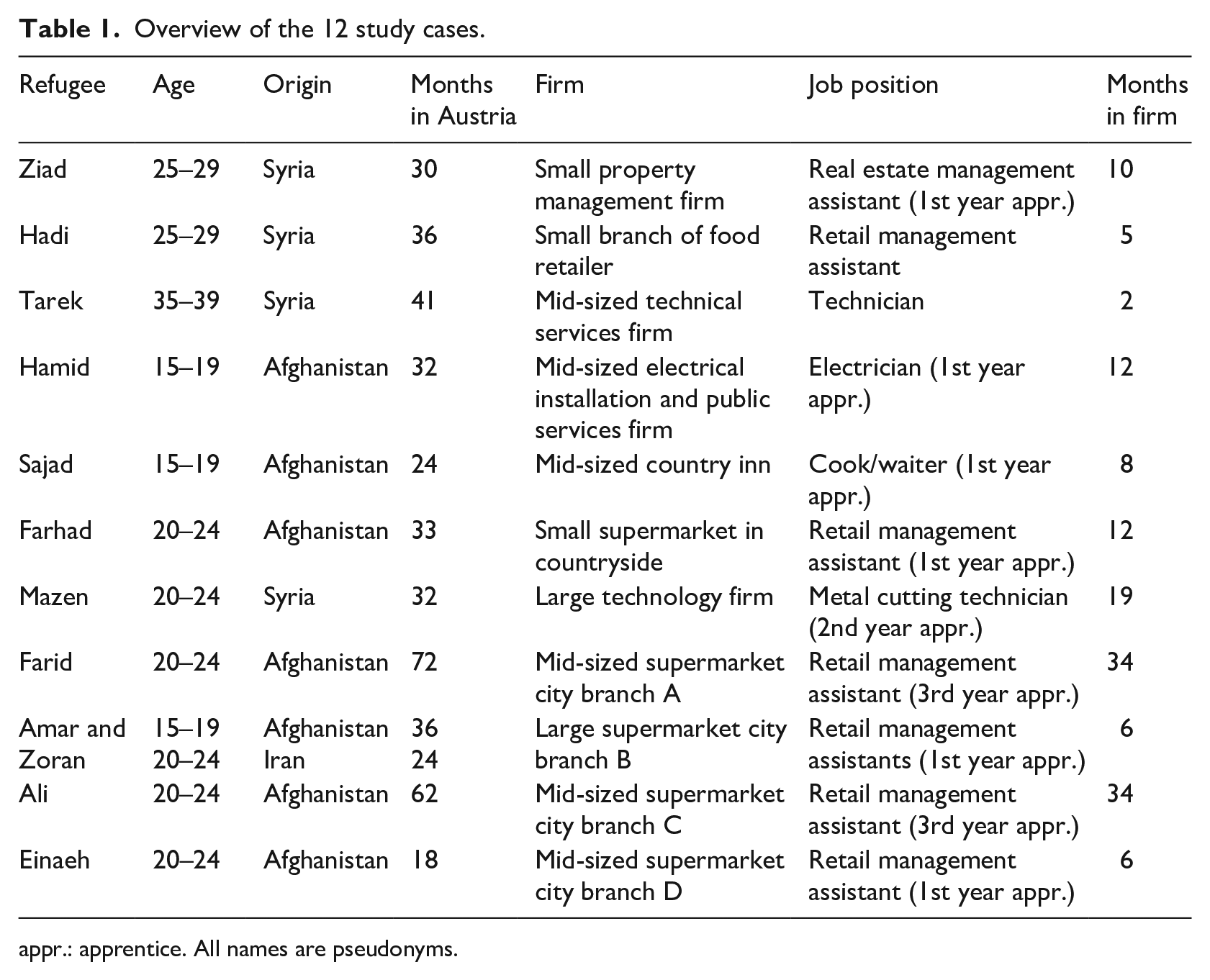
appr.: apprentice. All names are pseudonyms.
Further interview partners.
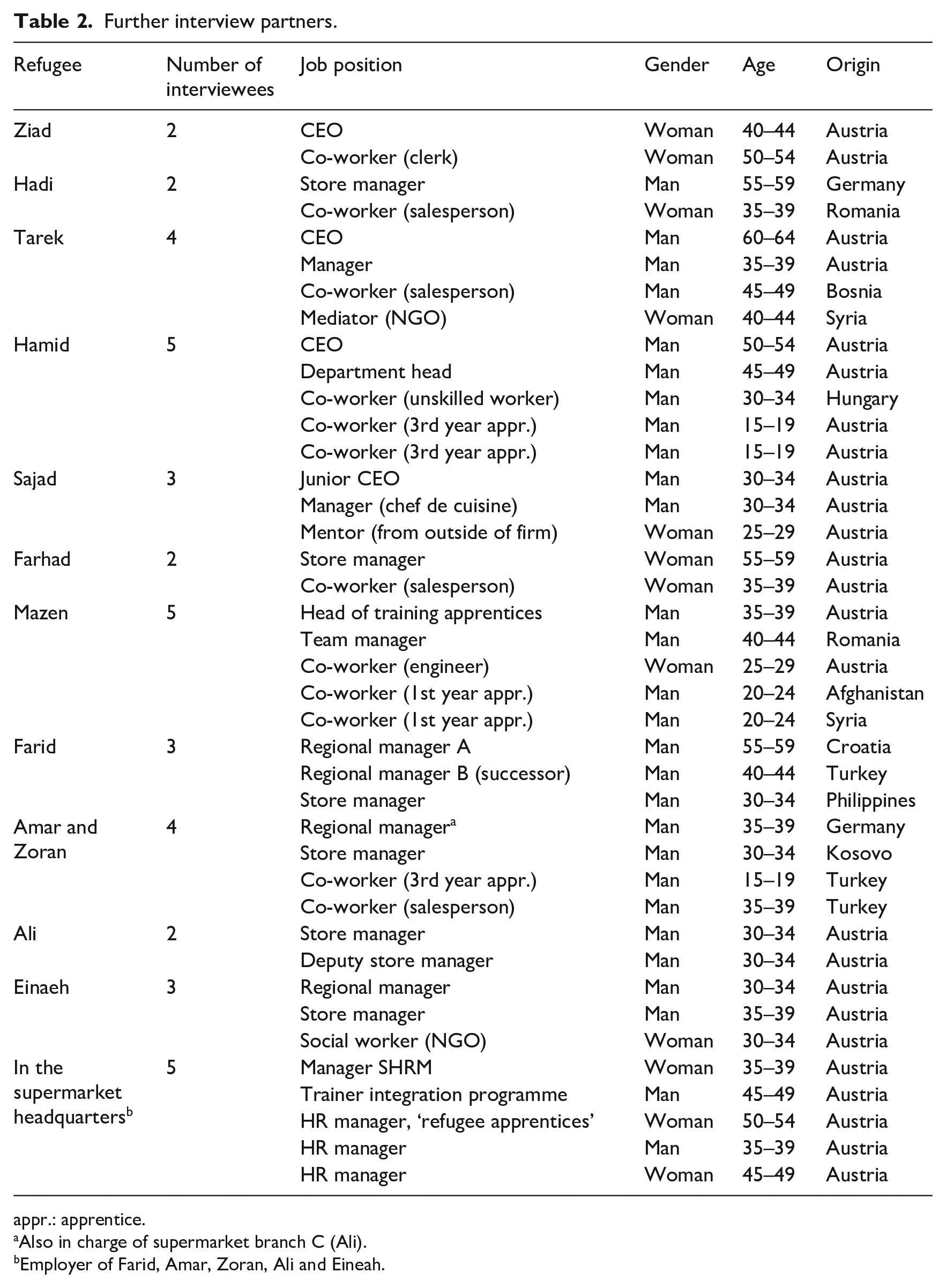
appr.: apprentice.
Also in charge of supermarket branch C (Ali).
Employer of Farid, Amar, Zoran, Ali and Eineah.
The interviews
We chose interviews as a method of data gathering as these are common in identity research, and they have been described as appropriate in refugee research because they invite refugees to actively participate and they give voice to these marginalised individuals (Abkhezr et al., 2018; O’Neill and Harindranath, 2006).
We developed interview guides based on the existing literature on labour market integration of refugees and migrants as well as organizational inclusion (as referenced above). The interviews with refugees centred on topics such as vocational aspirations, experience during job search and organizational entry, work tasks and social relationships at work. We asked CEOs and HR managers in particular about their motives for hiring refugees, the recruiting process, personnel practices addressing refugees and experiences with the refugees. The interviews with supervisors and co-workers focused on work tasks in the team, everyday work and social relations within the team. The interviews with the external refugee counsellors focused on their role in job search and their experiences with the refugees. We asked questions in a way that stimulated longer narratives and we stayed open to unforeseen events and topics.
The interviews were conducted by two of the authors and two research assistants (Austrian, Italian and Syrian backgrounds, aged around 30–40). They took place between December 2017 and August 2018, mostly at the work sites of the interviewees and a few in cafés or school rooms. The interview language was German, as all interviewees were sufficiently fluent, and German also was the language of their work lives. The interviews lasted between 30 and 150 minutes, averaging around 1 hour. They were recorded and transcribed verbatim. We complemented them by memos concerning our observations at the interview sites before, during and after the interviews as well as concerning our relationship with the interviewees. We used these memos together with the above-mentioned documents as background information in our analysis (Yin, 2018: 132–133), and to critically self-reflect on our role as researchers (O’Neill and Harindranath, 2006).
In the course of our research we constantly reflected on methodological and ethical issues. First and foremost, because refugees are a highly vulnerable social group and often unfamiliar with academic research settings, special care is required (Block et al., 2012; Lu and Gatua, 2014). We followed the ethical guidelines issued by the Refugee Studies Centre at the University of Oxford (Refugee Studies Centre, 2007). We obtained informed consent from the interviewees and assured confidentiality and anonymity. We emphasised that participation was voluntary and that the interviewees could cancel the interview at any point in time. Further, we sought to create a climate of trust in the interviews, and we highlighted that the refugees were important to us to understand what happens in work organizations.
Data analysis
We analysed our data following the recommendations by Eisenhardt and Graebner (2007), Yin (2018) and Gioia et al. (2013), using the software MAXQDA. Thereby, in line with Alvesson and Willmott’s (2002) conceptualisation of identity regulation and other research in this tradition we adopted a social constructionist perspective in interpreting the empirical accounts. The procedure comprised the following three stages.
Stage 1: Case descriptions
To familiarise ourselves with the study cases and to structure the complexity of the multiple perspectives we wrote a case description for every refugee (Yin, 2018: 171). We adopted a biographical style focusing on how the refugees started working with the firm, their work behaviour, practices related to inclusion as well as the refugees’ social and work-task related positioning in the organization. The topic of ‘fitting with the norm’ emerged from this exercise. Numerous accounts depicted the refugees as ‘one of us’ or being a member of the work group, respectively but also as being different. Based on this observation we developed our first ideas of refugee images and expectations held by co-workers and managers, which may serve as a template as well as the refugees’ self-definitions. We used these ideas in the next stage of data analysis.
Stage 2: Identification of characteristics of organizational inclusion and refugees’ identities
Informed by the literature on organizational inclusion, we employed open coding and provisional coding to capture the situated meanings of inclusion (Saldaña, 2016: 115, 168). To illustrate, we applied the pre-defined codes ‘belongingness’, ‘uniqueness’ and ‘work group involvement’, representing notions suggested by Shore et al. (2011, 2018). We created new codes emerging from the data that either refined or supplemented the pre-defined codes, for instance ‘feeling like family or friends’ and ‘fun in team’ as aspects of belongingness, and ‘social support’ as a new code. Concerning the refugees’ identities, we applied open coding creating in-vivo codes such as ‘being obedient’ or ‘sharing Austrian values’. We applied the codes to all interviews and continuously refined our analysis through moving back and forth between data and literature, and in particular, within and between the cases. To make sure that the codes were applied in a consistent manner, two of the authors coded the interviews independently, compared their coding and discussed their understanding of the codes until they reached consensus. Further consulting the literatures on inclusion and refugees, we then teased out from the first-order constructs the more abstract second-order dimensions. Figure 1 displays our data structure.
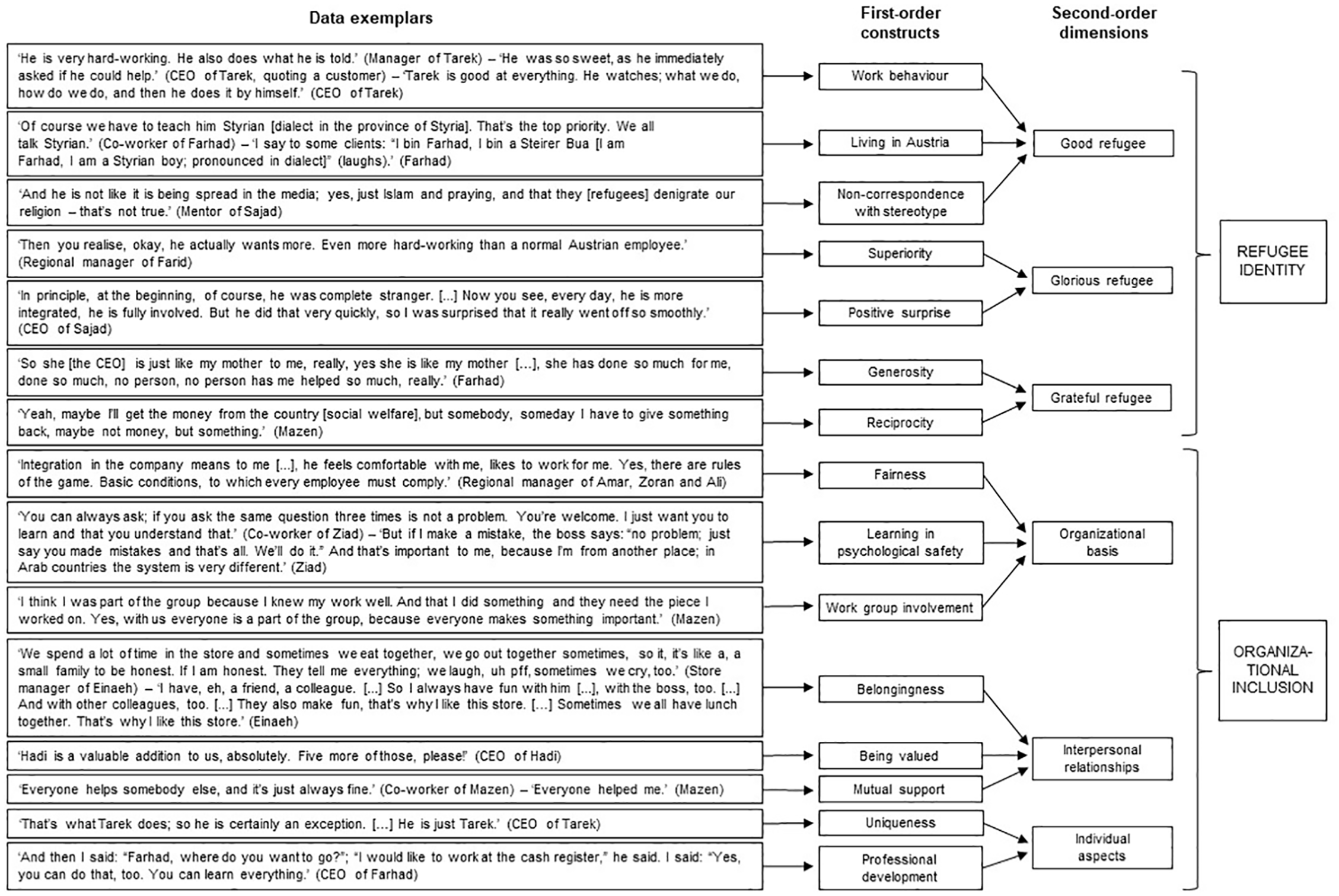
Data structure.
Stage 3: Identification of relations among dimensions
To understand the links between organizational inclusion and the refugees’ identity regulation we went back to our case descriptions. Following a replication logic (Eisenhardt and Graebner, 2017: 25; Yin, 2018: 55–61), we searched for similarities and differences among the cases as regards inclusion and identities, based on the dimensions identified at the prior stage. For instance, comparing Sajad with Farhad, we were able to study two refugees whose work settings were described as relatively inclusive (literal replication). We noted that work group involvement in the form of refugees and non-refugees working shoulder-to-shoulder was related to an image and self-image of a ‘good’ refugee. In a subsequent comparison of Sajad with Zoran, who worked in a less inclusive setting, we checked whether this finding holds under these opposed conditions – what it did (theoretical replication). A series of such cross-case comparisons not only resulted in better understanding of the practices interlinking inclusion and identities but also helped further carving out the specifics of the three refugee identity dimensions.
We collectively decided which interview excerpts to include in the findings section. All presented interview excerpts are translated from German to English by us with the support of a bilingual English native speaker. We stuck to the original language of the interviewees as much as possible but corrected occasional grammar lapses. All names are pseudonyms.
Findings
In examining how work organizations striving for refugee inclusion form these refugees as subjects, we found that the refugees are socially constructed along three dimensions, namely as ‘good’, ‘glorious’ and ‘grateful’ refugees. While these identity dimensions rest on the perceptions and expectations of non-refugee interviewees, the interviewed refugees also engaged with these templates. It is important to note that all three identity dimensions are characteristics or features associated with every refugee, rather than mutually exclusive subject positions among which the refugees had to choose. Still, the extent to which the refugees embraced them varies among our study cases. As we will show below, this extent is linked to the extent of organizational inclusion.
The ‘good refugee’
Resonating with the well-known ‘good worker’ rhetoric concerning migrant workers (Findlay et al., 2013; MacKenzie and Forde, 2009), our interviewees emphasised that the refugees should be – and actually are – ‘good’ in terms of their work behaviour, living in Austria and in relation to stereotypical refugees. Firstly, regarding work behaviour, being ‘good’ means that refugees have professional and German language skills at least at a basic level, social skills, a very high work motivation and a thirst for knowledge. Further, interviewees described the refugees as polite and flexible, doing what supervisors and co-workers tell them.
The interviewed refugees have internalised to be good and work hard, as the following quote from Einaeh exemplifies:
If you’re good on the first day, then good second, then third, then fourth, then a month, a year, then you find a good position. [. . .] It’s about if you’re good or you’re not good – that is it. That’s what I wanted: to be hard-working, good, try my best. And that’s what I do.
Similar to Einaeh in this excerpt, all the interviewed refugees expressed their strategic intend behind being ‘good’ as they are striving for ‘a good position’. Although they describe their work as ‘stressful and hard’ (Sajad) or they suffer from monotony, like Hadi, who says: ‘it gets on my nerves, actually’, they carry on.
Secondly, regarding their living in Austria, the construction of ‘good refugees’ means that refugees share norms and behavioural patterns that are seen as typical for Austrians such as speaking the regional dialect, being punctual and demonstrating obedience. The preferred lifestyle entails participation in local community activities, having a good job, a house, family and a car. Further, refugees are expected to shake hands with both men and women and display neither symbols nor behaviours related to Islam, such as wearing a headscarf or praying during work hours. 2
And whereas most Austrian interviewees explicitly indicate that they respect others’ faith, we also found practices that restricted religious habits. An example presents the CEO of Ziad, who got the refugee to stop fasting during Ramadan. As the CEO recalled:
Where we really had a little problem, and we had a hard time arguing, was with Ramadan. Because I have a lot to do with Arab people and I already know what is in the Koran and what is not, I had only limited sympathy, and I said: ‘That’s not how it works’, yes? So, not even something to drink all day and then almost collapsing here; that reaches my tolerance threshold. But it was nice, because then we had a tenant here, an elderly gentleman from Damascus, who talked to him about it and said: ‘Why are you doing this? Look, how you look. You are looking ill. No one tells you that you have to do that now.’ And from then on, it went well.
This excerpt illustrates the power of Ziad’s CEO, who views herself as someone who is familiar with Muslims and knowing the Koran better than the refugee. She was able to notice the moment when the refugee suffers too much – and consequently her business, too – and found a way to impose her will on the refugee. We also note a pattern in this excerpt that is common in our sample, namely that the CEO on the one hand is empathetic with Ziad and supportive, but on the other hand, she defines the terms of inclusion and sets the limits.
However, speaking of refugees as ‘good Austrians’ does not mean that the interviewees completely ignored the refugees’ biographies. On the contrary, they explicitly made use of the refugee category. As the team manager of Mazen put it, referring to residents of the Austrian province of Styria, where their company was based: ‘I mean, the Styrians are at home here and the refugees are refugees.’ Yet in the course of working with the organization refugees appear to become a special type, which is the third facet of ‘good refugees’ we identified: non-correspondence with the dominant stereotypes of refugees prevailing in Austria. In that sense, ‘good refugees’ obey the law, do not ‘abuse’ the social welfare system and adhere to principles of gender equality and democracy. Furthermore, interviewees described refugees as honest, polite and cheerful despite their fate as refugees. For instance, Farhad recounted how he perceived negative reactions from customers when he started in the supermarket that changed as they got to know him better:
In the beginning it was so difficult, because the customers did not know me [. . .]. They thought I was like other refugees, for example, there are also a lot of refugees who are, em, criminals, or like they say, bad people or those who just violate the law and [. . .] the customers thought that I was such a guy. Then later, they watched a lot and then noticed, and they also talked to me a lot, and later everything went well. Then they said to me: ‘You are a good person and very friendly, too, and also very nice.’
In a similar vein, Ali stated that he did not want to be like those people, who some Viennese complained about, as they assumed that foreigners do not want to work. Mazen described himself as differing from other refugees, who refuse to work but take money from Austrian taxpayers which he perceives as ‘unfair’.
While the interview excerpts indicate that managers, co-workers and customers share normative expectations of the ‘good refugee’, we note various organizational practices aimed at the refugees’ inclusion which prompted the refugees’ affirmative identity work. For instance, the manager of Sajad, in a special effort to enhance Sajad’s work group involvement and professional development as a cook, instructed Sajad in cutting techniques after work in their leisure time, thereby contributing to Sajad’s self-identity as a good worker. Further, Sajad’s mentor invited him to visit the Catholic church, which eventually contributed to an identity as an Austrian as Sajad began to like the church.
Other activities aimed at enhanced belongingness contributed to forming a ‘good refugee’ identity in terms of being Austrian. Examples in our data include invitations to mountain climbing (Mazen), after-work beers (Sajad, Farhad, Hamid and refugees in the supermarket chain), tennis (Ziad) and company Christmas parties or other social gatherings (in all firms). Such group activities are a common mode of identity regulation (Alvesson and Willmott, 2002: 630), which can bring about a sense of belonging to a group – in this case Austrian workers and citizens. Yet often they have the paradox effect of reproducing existing social categories and hierarchies (Jammaers and Zanoni, 2020; Kelan, 2010; Ortlieb and Sieben, 2019; Rumens and Broomfield, 2014; Van Laer, 2018). Likewise, the supermarket chain adopted a programme targeted at refugees that comprised special recruitment activities and so-called ‘integration days’ where refugees learn about the supermarket’s product range as well as eating habits and Christian holidays in Austria – and ‘how to talk with women in Austria; what it means to have a romantic relationship’ (Zoran). While this programme is aimed at inclusion, at the same time it is a forceful tool of identity regulation in the form of directly defining individuals (Alvesson and Willmott, 2002: 629) as it connects the refugee label to an important socio-material practice (Lacroix, 2004; Wehrle et al., 2018) and enables them to become ‘good refugees’.
The ‘glorious refugee’
As a second dimension of the refugees’ identities we identified gloriousness. This dimension refers more to how interviewees perceived refugees rather than how they expected refugees to be. Nevertheless, the verbal descriptions and material practices prompt or reflect refugees’ identity work to a considerable extent. In particular, because they often involve a public audience they may generate new expectations.
Like the ‘good refugee’ dimension, being ‘glorious’ refers to refugees as workers, Austrians and non-stereotypical refugees. Yet being ‘glorious’ exceeds being ‘good’ in every regard. Many interviewees stressed the superiority of refugees, whom they perceive as immaculate, admirable and exemplary. At least five of the refugees in our study were presented in local newspapers, magazines and/or TV shows as being ‘well-integrated’ and model refugees. Farhad is one of them. In a TV report, Farhad and the CEO are filmed in the supermarket, demonstrating that the refugee apprentice is a great asset for the supermarket. Similarly, the CEO enthusiastically described Farhad in the interview with us as follows:
He is right at the centre of things, for sure, because he simply, with him, not even – well, Kathi [co-worker pseudonym] could be jealous of him, but she cannot do even that, because he is just so adorable and so good. You can – he has no edges. No way. He is polite, he is obliging, he is helpful, he is good at school. He has everything, yes. If he only was a nerd and otherwise really uncooperative, then you think – don’t you? But he really is the one who belongs in the centre. Absolutely.
Here, the CEO first struggled with finding the right words to characterise Farhad, whom she perceives as an extraordinary worker. In another passage of this interview the CEO also stated that ‘all of us have to take him as an example’. That already happened in school, where Farhad served as ‘a role model for these pupils all; these spoiled Austrian children’. Our interview with Farhad lends support to the CEO’s report (also see Farhad’s quote describing customers’ reactions above), suggesting that he fully embraced this ‘glorious refugee’ identity.
Also focusing on performance in vocational school, exceptional effort put into learning and resulting excellent grades ‘which could hardly be achieved by a young Austrian’, the CEO of Ziad displayed the refugee’s school report in the office. This way, the entire team – including Ziad himself – has a constant view of how ‘glorious’ he is.
Superiority was also expressed by refugees themselves. Ali, whom the supermarket’s management views as a candidate for a management position, spoke frankly about himself in a very positive way, asserting superiority over his current co-workers:
And if you were the boss, with workers; how should they be?
Yes, like myself. They all should become like me.
When non-refugee interviewees describe ‘glorious refugees’, they often express their positive surprise. For instance, the regional manager of Farid reported on a recruiting event:
It was interesting, of course. [. . .] It was surprising that there were a lot of good ones [refugees]. What shocked most, of course – or, I don’t know, well, actually shocked – was the stories people told.
This excerpt once more reflects a common stereotype of refugees, according to which refugees may not be qualified for higher-skilled jobs and tend to ‘misbehave’ (Gruber, 2017; Rheindorf and Wodak, 2018). In addition, the regional manager’s reported surprise goes along with being ‘shocked’ – or perhaps being moved or stunned – when he learned that the refugees have been through a lot. Hence, given the refugees’ problematic backgrounds, their performance is even more admirable. Further, like in other interviews with non-refugees we note in this quote a tendency to feel bad about having had a poor opinion of refugees, which in turn may lead them to further glorify refugees. And maybe they will never forget what these people have been through as refugees, thus also fixing the refugee category.
While we note markers of being ‘glorious’ for every refugee in our sample, the refugees vary in their self-descriptions. More specifically, we note that those refugees who embraced a ‘glorious refugee’ identity also worked in more inclusive settings characterised by prevailing norms of fairness, work group involvement, mutual support and opportunity for professional development. Thereby, it is always the organizations’ management which defines the terms of ‘gloriousness’ and chooses the communication channel into the public. Hence, although some refugees are depicted as superior (also in their self-descriptions), this superiority is limited to the norms held by the management, always centring on refugees as successful work performers.
The ‘grateful refugee’
As a third identity dimension of the refugees in our sample we identified their gratitude or gratefulness. The interviewed managers and co-workers displayed generosity, emphasising that they like to support refugees. For instance, Tarek’s co-worker explained his motivation for being ‘generous’ as follows:
I come from Bosnia, [. . .] I was a refugee as a toddler. And I know how it is. That’s why it is also very important to me that you give people who really want, yes, [. . .] a chance. Because, I think, every human deserves in life to be a human.
In this extract, along with solidarity we also note some limits to supporting refugees, as Tarek’s co-worker refers to the ‘people who really want’. This is in line with other interviewees who take an authoritarian stance and clearly express their expectations in this regard. An example is the store manager of Einaeh:
So we care very much about this. I made that clear to him: ‘Look what we do for you, how much we work for you; and we, we hope you realise this opportunity and take it.’
The refugees describe themselves as grateful, too. They perceive that working with their current employer is a privilege, given the difficulties refugees face in finding an adequate job in Austria. They acknowledge the perceived generosity of their employers and co-workers as well as mentors, state institutions, NGOs and the Austrian society as a whole for support and the opportunity to work and live ‘in a safe environment in Austria’ (Mazen). In the words of Sajad:
I’m really grateful. I thank [this institution] for my job in Austria – actually, I am thankful here. Very nice everything. I love it.
The refugees’ gratitude is also noted at their workplaces, for instance by Hamid’s supervisor:
What he has over everyone else is just a lot more gratitude. That’s him, you can feel it, he arrives happy to work each morning. He is grateful that he is being integrated, that he has a job, that he is important, that he is a cog in the wheel. I really feel that. So he is extremely grateful, obedient and helpful for the reason that he says: ‘Thank you for allowing me to do this. I’m fine here and thank you.’ He now has his own apartment; he has his own life.
This excerpt also shows how characteristics of an inclusive organization are directly linked with gratitude, in this case work group involvement. And once more we note a hint to the refugee’s independence and his opportunity to live his life.
Like in the excerpts from Tarek’s and Einaeh’s managers presented above, many interviewees suggest that the refugee should take advantage of the opportunities (also) for himself and his own life. Anyhow, refugees have to contribute. Such reciprocity is explained in more detail in the following quote by the regional manager of Farid:
You just have to let people integrate themselves, and you just have to give them the opportunities as well, but on the other hand, as I said, he also has to. . . he must also integrate, and he also has to try, and he has to want it, too.
Whereas this and the previously quoted interviewees (also) refer to the refugees’ lives and broader societal norms concerning ‘integration’, other interviewees directly address work performance and business goals, like the manager and the CEO of Tarek:
He has to make progress because I am one who also thinks entrepreneurially, and I have to look how it works and how this pays off someday. (Manager) However, now he should be integrated in such a way that we get something for what we invest. But I think that this will take half a year, at least. (CEO)
These extracts also illustrate how the ‘grateful’ and the ‘good’ identity dimensions are linked with each other. While gratitude is expected, it also should translate into good work behaviour and living in Austria. Correspondingly, while all refugees in our sample adopted gratitude as part of their identity, we note that this plays a special role for those who are less ‘good’ than their managers and co-workers expected. Tarek is a case in point, as he has fully internalised that he still has to catch up in German and technical skills in order to be able to fully contribute to the firm’s performance.
Thus, although gratitude commonly is associated with positive emotions, there is a dark side in the form of a guilty conscience and a ‘willingness’ to accept poor working conditions (Emmons and McCollough, 2004; MacKenzie and Forde, 2009; Ponzoni et al., 2017; Thompson et al., 2013). Moreover, we note that the same organizational practices aimed at inclusion that form the refugees as ‘good’ and ‘glorious’ also are associated with the ‘grateful’ dimension. Thereby, not only does inclusion lead to gratitude, but vice versa, gratitude is a precondition of further inclusion. Hence, placing pressure on the refugees to subject themselves under the organizational identity regime, the refugees’ gratitude presents a forceful catalyst of organizational identity regulation.
Discussion
Drawing on multiple cases of refugee workers, we examined the link between organizational inclusion and identity regulation. Contrary to the existing literature on the inclusive organization that has put forward the ideal of a place where mixed workers would retain their unique identity, we show that such organizations considerably form refugee workers as subjects.
Proponents of the inclusive organization posit that individuals entering organizations have certain identities, and appropriate management measures help them experience positive states such as belongingness, uniqueness and work group involvement (Ferdman and Deane, 2014; Mor Barak, 2017; Shore et al., 2011, 2018). We depart from prior research focused on formal management initiatives by conceptualising inclusion as a process that entails manifold formal or informal organizational practices, which are performed by a wider range of actors. This perspective enabled us to identify the interlinkage between organizational practices aimed at inclusion, the ideal refugee images held by non-refugee organizational members and the refugees’ self-definitions. We found that the inclusion of refugees is associated with a social construction of refugees as ‘good’, ‘glorious’ and ‘grateful’ subjects. In the following, we theorise on the interlinkages between organizational inclusion and identity regulation of refugees, thereby highlighting power imbalances, ambivalences and constraining effects. We then outline practical implications of our research as well as its limitations and avenues for future research.
Power-laden practices interlinking inclusion and identity
Our finding that refugee workers are socially constructed as ‘good’, ‘glorious’ and ‘grateful’ subjects goes beyond previous research, which has concentrated on the ‘good worker’ (Findlay et al., 2013; MacKenzie and Forde, 2009). First, we found that alongside work-related attitudes and behaviours, also the private sphere in terms of living like a national citizen and being different from stereotypical refugees or immigrants play a role. Second, whereas the ‘good’ and the ‘grateful’ dimensions have also been found in prior work (e.g. Knappert et al., 2018; Ponzoni et al., 2017; Vandevoordt and Verschraegen, 2019) – though not in the context of organizational inclusion – the ‘glorious’ dimension is an especially remarkable finding of our study.
We note here an imprint of societal discourses. The interviewees seek to explicitly oppose the public image of deficient refugees (De Jong, 2016; Gruber, 2017; Rheindorf and Wodak, 2018), emphasising the refugees’ efforts in exemplary hard-working and being an especially good national citizen. Such reasoning is fully in line with the Austrian government’s meritocratic policy approach to immigration (De Jong, 2016; Gruber et al., 2016).
We suppose that both, organizational actors and refugees themselves create the ‘glorious’ refugee in order to make sense of the fact that refugees work with their respective organization. Informed by discourses conveying the image of the deficient, criminal or incapable refugee, they may struggle with the question how it can be that a refugee obtains full organizational membership. Those refugees who outperform their Austrian counterparts in many regards may then viewed acceptable, because their overall superiority helps to compensate possible deficiencies, and it justifies the extra efforts organizational actors put into onboarding and working with the refugees.
Overall, our findings indicate that the refugees’ managers and co-workers perceive the inclusion of refugees as a challenging endeavour. To navigate inclusion, they engage in various activities which in turn trigger the refugees’ identity work. The practices we identified either define refugees directly or indirectly or they address the refugees’ action orientation or they target their social belongingness. Thus, they present forceful modes of identity regulation as suggested by Alvesson and Willmott (2002). Thereby, a particularity of the practices we identified is that they do not aim straight in one direction but oscillate between the poles of three interrelated areas. This oscillating reflects the actors’ intention to foster the inclusion of refugees, for which, however, these actors set specific preconditions. Summarising the practices presented above, we note the following areas in this regard.
First, the organizational practices aimed at inclusion move between enabling and restricting. They contribute to the refugees’ professional development and well-being, also enabling an independent existence in Austria in the long run, but at the same time they limit the refugees’ existence. For instance, the ‘integration days’ organized in the supermarket chain and the off-work training in food cutting techniques provided by Sajad’s manager enabled the refugees to become ‘good’ workers. However, we also found restricting practices such as the fasting stop during Ramadan imposed by Ziad’s CEO.
Second, the practices move between inviting and gatekeeping. While organizational actors welcome refugees as workers, and often at social gatherings or leisure activities, too, always they decide on what activities they invite refugees and overall, on the terms of inclusion.
Third, the practices move between acting in solidarity and acting like a judge. Organizational actors demonstrate generosity and empathy with people in need of protection, but they also define prerequisites for inclusion, using their own standards in assessing the refugees’ ‘deservingness’. This stance is particularly evident in the construction of the ‘grateful’ refugee, as managers and co-workers are keen on supporting refugees but bind this to specific attitudes and behaviours shown by the refugees.
Taken together, while these practices are aimed at the inclusion of refugees, each entails an excluding and limiting counter piece, which also presents a precondition of inclusion. Importantly, all practices result from the relative power positions of the refugees’ managers and co-workers. We notice here what Romani et al. (2019) termed ‘benevolent discrimination’: organizational actors intend to support refugees, but at the same time they construct them as ‘others’, inferior and in need of help, and they expect the refugees to accommodate.
The refugees demonstrate willingness to adopt the available identity templates rather than resist them in the sense of Collinson (2003). Moreover, and different from prior research indicating that ethnic minority professionals often draw on their ethnic background as a resource in their identity work (Essers and Benschop, 2009; Van Laer and Janssens, 2017; Zanoni et al., 2017), the refugees in our study overwhelmingly view their background as handicap.
We explain this consenting identity work which appears even stronger than in the studies of Tomlinson (2010) and Wehrle et al. (2018), by the special existential conditions of the refugees, characterised by overall precarity and fundamentally shattered identities (Lacroix, 2004; Vandevoordt and Verschraegen, 2019). Thus, refugee workers are particularly receptive to influences of organizational practices and actors. However, using our metaphor of the wood carver introduced at the beginning of this article, the refugees are not passive consumers of the organizational practices like the craftsman’s raw material, a wooden block. Rather, they actively and reflectively engage in identity work. Defining oneself as ‘good’, ‘glorious’ and ‘grateful’ also may help refugees dealing with trauma, envisioning their current, though again transient conditions and imagining a future self (Abkhezr et al., 2018; Wehrle et al., 2018). In addition, embracing such an identity can also be interpreted as a strategic act as identified by Zanoni and Janssens (2007) as well as Knappert et al. (2018), because it allows the refugees an existence in the organization, and above all, it promises a ‘good life’.
Nevertheless, there is the danger for refugees of being excluded if they fail to fulfil the expectations of being ‘good’, ‘glorious’ and ‘grateful’. Furthermore, because organizational actors use the refugee label for certain programmes or they use the refugee status as an explanation for certain behaviours and attitudes of refugees, there is the well-known dilemma between on the one hand reifying and essentialising the refugee category and on the other hand being blind towards particularities associated with the refugee status (Ghorashi and Sabelis, 2013). While our study cannot provide answers to the question how this dilemma could be solved, it offers novel insight into the context of refugees and organizational inclusion. Although the refugees are recognised in their uniqueness as in the notional inclusive organization, they tend to get fixed within the refugee category.
Likewise, while our findings indicate that ‘glorious’ refugees can benefit from a superior social status in an organization – and they may also feel valued in their uniqueness in the sense of Shore et al. (2011, 2018) – gloriousness is ambivalent. As for instance research on the un-doing of gender shows, activities challenging existing gender categories often have the paradoxical effect of reaffirming traditional gender regimes (Kelan, 2010; Ortlieb and Sieben, 2019). Thus, the creation of ‘glorious’ refugees also may reinforce the prevailing stereotype of the deficient refugee. Moreover, being a ‘glorious’ refugee and thus, having token status in organizations (Kanter, 1977) can present a burden to the refugees, because other people pay special attention to them, allowing no failures or ‘mis’-behaviour.
Summing up, whereas inclusive organizations are places where refugees and other minority groups should feel valued, belonging and unique, this does not mean that workers’ identities are not regulated. On the contrary, if we understand inclusion as a process involving various actors and practices, it becomes clear that inclusion presupposes and at the same time produces ‘the appropriate individual’ (Alvesson and Willmott, 2002: 619). In that sense, inclusion goes hand in hand with normative organizational control aimed at aligning the refugees’ behaviours with organizational goals. This kind of normative control may differ from those forms described in the literature on identity regulation of other social groups, for example managers (Alvesson and Willmott, 2002), call-centre workers (Fleming and Sturdy, 2011) or employees with impairments (Jammaers and Zanoni, 2020) in that it intervenes more in the private sphere of the workers’ lives. Also, its effects may be stronger because of the refugees’ precarious existential conditions. The most significant peculiarity, however, is that it is based on the benevolent intentions of the members of the inclusive organization.
Practical implications
Previous research has shown that the practical integration of refugees into host societies or labour markets is associated with several challenges. In particular, the frequently called-for mentoring programmes (e.g. Knappert et al., 2018; Wehrle et al., 2018) can be problematic, if mentors and mediators patronise their clients and view themselves as superior to their clients, thereby also reproducing societal discourses in which refugees are deficient and which portray local values as superior to those prevailing in the refugees’ countries of origin (De Jong, 2016; Dykstra-DeVette and Canary, 2019; Ponzoni et al., 2017; Risberg and Romani, 2017). Our study suggests that these challenges apply as well to settings within work organizations with managers and co-workers in the mentoring roles (though sometimes informal). Understanding inclusion as involving various practices of multiple actors implies that organizational decision-makers must be aware of the manifold activities that impact on the refugees’ identities – and especially constraints. Hence, they should scrutinise not only all formal measures aimed at inclusiveness, but also everyday work activities in their organizations, to avoid benevolent discrimination in the sense of Romani et al. (2019).
Further, our findings concerning the ‘grateful’ refugee identity suggest that organizational actors should be aware of possible consequences of demonstrated generosity. In particular, as gratitude can be associated with a guilty conscience and (more or less explicit) norms of reciprocity, it can also reinforce the subjugation of refugees and their dependency on organizations (Emmons and McCollough, 2004). Thus, as our study shows that many refugees benefit a lot from co-workers’ and managers’ generosity, organizational actors should take care in communicating possible reciprocal expectations and also support refugees in achieving independence.
It should be noted, however, that these recommendations in our view not only apply to the refugee setting, but to any kind of workers.
Limitations and avenues for future research
Though we maintain that our study findings are applicable to other contexts – especially to other social minorities and other countries – we acknowledge some specifics of our study. First, all refugees in our sample were relatively young men, mostly apprentices. To take account of the gendered nature of identities and different biographical stages, future research should consider women and workers of varying age groups. Concerning apprenticeships, we noticed that this type of employment offers especially good opportunities for refugee inclusion because apprentices work with professional and experienced trainers and usually they can befriend other apprentices. On the other hand, apprentices may be more malleable than other workers. Thus, future research should consider other types of workers. Relatedly, varying educational levels should be considered, as professions present an important source of identities (Alvesson et al., 2008).
Second, we focused on refugees from Afghanistan, Iran and Syria working in Austria in the years 2017/18. The question arises whether refugees from other countries, especially Black Africans, experience similar identity regulation. Also, practices in Austrian firms striving for inclusion may differ from those in other countries. Societal discourses differ, too, and they change over time (Rheindorf and Wodak, 2018). Hence, more research in other contexts is needed.
Third, our data collection period was limited to a few months. As we highlight the long-term nature of inclusion processes, future research should pay more attention to long-term consequences of organizational inclusion, in both theoretical conceptualisations and empirical research. It seems particularly worthwhile to consider that refugees keep aspects of their former sense of self because identities are multi-faceted and complex entities. Both the refugees’ experiences during their flight and in the workplace are filtered through geographical origin, ethnic background, gender, role as partner in a relationship, parent and the like (Abkhezr et al., 2018; Tomlinson, 2010). Whereas we were not able to cover these aspects in our interviews, we see a need for research addressing more facets of refugee identities and their interplay in the future.
Finally, though societal discourses were not the main focus of our study, we noted interesting connections with organizational inclusion and identity regulation. Investigating societal discourses in more depth, in a more systematical way and perhaps in a cross-country comparative designs would be fruitful. Relatedly, in times when the political landscape concerning migration and refugees is in flux, more research on the policy influence of organizations striving for inclusion of refugees is urgently needed.
Conclusion
This study shows how organizations striving for the inclusion of refugees regulate refugees’ identities. The findings advance our understanding of inclusion as they suggest that organizational practices aimed at inclusion at the same time contribute to identity regulation, forming refugee workers as ‘good’, ‘glorious’ and ‘grateful’ subjects. The metaphorical wood carver – that is, the collective of actors and practices forming the refugees’ identities – proved to be considerably powerful and skilful, but benevolent and generous, too. However, the study findings suggest that this identity construction is ambivalent. This study should motivate both researchers and practitioners to pay more attention to the ambivalences residing in organizational inclusion.
Footnotes
Acknowledgements
The authors would like to thank (in chronological order) Koen Van Laer, Georg Schreyögg, Minna Paunova, Laurence Romani and Bernadette Bullinger for helpful comments on earlier versions of the manuscript as well as the four anonymous reviewers for their constructive comments. Safaa Alfaouri and Michael Fasching provided valuable research support.
Funding
The author(s) disclosed receipt of the following financial support for the research, authorship, and/or publication of this article: This work was partly funded by the Anniversary Fund of the Oesterreichische Nationalbank (project no. 17169) and the Federal State of Styria, Science and Research Unit. Additionally, the authors acknowledge the financial support for Open Access publication by the University of Graz.
