




Abstract
Organizational research has increasingly recognized violence as an instrument for achieving compliance and maintaining the existing order. However, resisters tend to be portrayed as powerless in the face of this violence or engaging in hopeless acts of resistance. In comparison, by examining the context of violent protests, this paper discusses how activists can endure and use violence as part of their resistance. I build on a 15-month ethnography of the gilets jaunes (yellow vest) movement to illuminate the absorptive resisting work involved in deploying resistance to and through violence. This absorptive resisting work included reducing the repressive effects of violent protests and embracing those effects to generate symbolic and discursive resources against police violence, as well as including violent protest tactics in ways that regenerated those resources. Ultimately, my findings reveal that this absorptive work allowed resisters to withstand violent protests in the short term and reframe them in the long term. This paper thus contributes to studies on resistance to violence by showing how people can effectively and collectively catalyze violence to challenge it.
Introduction
Marianne, one of the symbols of the French Republic, sits on a background of blue, white, and red. Her right eye is damaged; she is surrounded by rubber bullets. The national motto that usually encircles her “Liberté, Egalité, Fraternité” has been replaced by “Liberté, Egalité, Flashball.” In January 2019, this image, an appropriation of a work painted by the street artist Obey, went viral on social media and was used as posters in gilets jaunes (yellow vest) demonstrations to denounce violent protest policing, not without a touch of irony. In 2017, Obey had offered a reproduction of the original painting to the freshly elected President Emmanuel Macron, emphasizing his hope for a progressive agenda. Just a couple of years later, this image and slogan would become an emblem to denounce the authoritarian drift of the French government.
As the reappropriation of this image suggests, the question of violence, meaning the “actual or potential physical harm” (Costas & Grey, 2019, p. 1573), has been at the heart of the debates on the yellow vest movement. This is especially due to the spectacular scenes of escalation of violence at their protests, which generated significant and long-lasting media attention. The case of the yellow vests is yet far from isolated, as people have been shocked and moved by the striking images of brutal confrontations between protesters and the police in recent mass demonstrations all over the world, such as the Black Lives Matter demonstrations, pro-democratic protests in Hong Kong, and the 2019 Chilean mobilization against the increase in the price of public services. In fact, movement power and leverage often comes with people’s ability to withdraw their cooperation from major institutions (Piven, 2012; Scott, 2014). In that sense, the deployment of violent protest tactics, through public episodes of arson, material damage, and physical assault, constitutes one of the most visible expressions of that refusal (Juris, 2005; Myers & Caniglia, 2004). At the same time, in many of these instances, the police adapted to these tactics by using increased and undifferentiated physical force against protesters (Fillieule & Jobard, 2020; Maguire, 2015). This response often failed to contain protests or subdue collective violence (Perez, Berg, & Myers, 2003). Instead, some academic analyses have found that significant levels of police violence can increase support among protesters for violent protest tactics and contribute to protests morphing into resistance movements against the police (Maguire, 2021).
These events provide a particularly intriguing setting for analyzing overt and collective resistance in the face of violence. Extensive evidence has demonstrated that dominant actors frequently deploy violence to curb resistance and maintain the existing social order (Banerjee, 2008; Böhm & Pascucci, 2020; Chertkovskaya & Paulsson, 2021; Özen & Özen, 2009; Pina e Cunha, Rego, & Clegg, 2010; Stokes & Gabriel, 2010; Van Lent, Islam, & Chowdhury, 2022), shaping resisting options and dynamics (Ehrnström-Fuentes, 2022; Martí & Fernández, 2013). A prevailing view in organization studies has documented hidden (Scott, 1990) and non-oppositional (Courpasson & Marti, 2019) forms of resistance and explained how individuals may navigate between compliance and resistance to achieve transformation without becoming outcasts (Baikovich, Wasserman, & Pfefferman, 2022). Yet violent protests in western countries invite us to think beyond these cases and delve fully into situations where people collectively challenge violent power relations, and, paradoxically, sometimes even engage in violent protest tactics and use violence in service of their struggle. These dynamics of escalation between policemen and protesters raise the question: how do people deploy resistance to and through violence?
To address this question, this paper examines violent protests as spaces where people are likely to experience police violence, meaning the use of physical force against citizens (Sherman, 1980), as well as where they can directly negotiate or contest power relations with the police (Huët, 2019; Nassauer, 2021) and challenge abusive police work. Building on a 15-month ethnography of the French yellow vest movement, a mobilization marked by recurring intense altercations between protesters and the police, I unpack what I call the absorptive resisting work performed by the yellow vests, a set of mechanisms and activities through which actors generated and developed competencies and resources (Courpasson, Dany, & Clegg, 2012), which allowed them to endure and use violent protests in ways that challenged police violence. Along these lines, absorption here refers to: (a) the reduction of violent protests’ repressive effects; as well as (b) the integration of these effects; and (c) the inclusion of violent protest tactics in the production of symbolic and discursive resources against police violence. My findings show that this specific resisting work played a crucial role in the actors’ ability not only to endure police violence in the short term, but also ultimately to construct and convey meaning regarding violent protests, which then contributed to revealing and reframing their experiences of violence in the long run.
Through this study, I therefore advance the growing body of research discussing how people collectively resist organized violence (Alvinius & Holmberg, 2019; Banerjee, 2011; Banerjee, Maher, & Krämer, 2023; Ehrnström-Fuentes, 2022) by departing from the theorization of violence as an immutable and unilateral phenomenon to which resisters have no possible recourse. I also bring insight to the organizational conversation on the efficacy of resistance by exploring how people creatively adapt to violent contexts.
Researching the Intersection of Violence and Resistance
Violence has always constituted a strategic resource in organizational practices (Rahmouni Elidrissi & Courpasson, 2021; Way, 2023), maintenance of institutions (Crawford & Dacin, 2021; Martí & Fernández, 2013), or expansion of economic and/or political interests (Böhm & Pascucci, 2020). Dominant actors often use violence at the expense of specific groups of people, as a repressive (Özen & Özen, 2009), exploitive (Banerjee, 2008; Van Lent et al., 2022), or oppressive (Clegg, 2006; Kenny, 2016; Martí & Fernández, 2013) method of attaining compliance, suppressing dissent, and securing order and control. If some influential conceptualizations of violence (Galtung, 1969; Žižek, 2009) have highlighted more latent and indirect forms of violence (Derriennic, 1972)
Under these circumstances, researchers have long argued that effective resistance has little chance of happening. This is because the subordinated are likely to either participate in their own domination (Allen, 2008; Willmott, 1993), or to engage in inconsequential forms of resistance, resorting to either “decaf resistance,” subtle and ambiguous forms of resistance without the cost of challenging existing configurations of power (Contu, 2008), or overt forms of institutionalized strikes and negotiated demonstrations which rarely threaten established institutions and elites (Scott, 2014; Seferiades & Johnston, 2012). Departing from this prevalent perspective which suggests little room for agency, a second set of papers has recently provided insight into the multiple ways resisters may work around violence. These articles have described how people can negotiate better outcomes for themselves (Banerjee et al., 2023), (re)create and maintain webs of relations (Courpasson & Marti, 2019; Ehrnström-Fuentes, 2022), navigate between compliance and resistance to achieve change (Baikovich et al., 2022), or structure spaces of emancipation (Fernández, Martí, & Farchi, 2017). This body of work has demonstrated that the context in which resistance takes place matters to define its efficacy and has provided a more granular understanding of resistance effects (Courpasson, Dany, & Delbridge, 2017; Courpasson & Vallas, 2016; Marsh & Śliwa, 2022). Yet, although research has shown that violence shapes people’s lives and their resisting options (Martí & Fernández, 2013), there remain fewer accounts of how actors directly oppose such violence. Besides, in existing analyses, resisters have predominantly been portrayed as trying to avoid or limit physical harm (Fotaki & Daskalaki, 2021; Zwerman & Steinhoff, 2005) and rarely as acting on it or performing it.
This study therefore proposes to expand this body of knowledge by examining the context of violent protests. Research on contentious politics and policing has argued that violent protests answer to patterns of adaptation and interactive diffusion between protest and police tactics (della Porta & Tarrow, 2012). Violent protest tactics, episodes of social interactions coordinated by at least two people which involve inflicting physical damage on objects and/or people through arson, property damage, or physical assaults (Diani, 2012; Tilly, 2003), constitute a valuable symbolic resource for reaching mass media (Juris, 2005; Myers & Caniglia, 2004) and disrupting public order (Piven, 2012). In western democratic countries, the use of these tactics in the late 1990s by the anti-corporate globalization movement led countries such as the United States (Maguire, 2015) and France (Fillieule & Jobard, 2020) to move towards a strict and militarized protest policing model, based on higher levels of physical force against protesters. Generally speaking various military innovations have been employed across the globe for protest policing purposes (Abdelnour, 2023). However, these police strategies usually portray protesters as a homogenous group, frequently causing escalation which tends to fuel protests rather than to dissipate them (Maguire, 2021; Perez et al., 2003). The activists’ perception of protest policing strategies and legal institutions as unfair, illegitimate, or disproportionate has indeed been proven to exacerbate their sense of defiance and rebellion (Maguire, 2015, 2021; Maguire, Barak, Wells, & Katz, 2021; Perez et al., 2003) and to contribute to the overall movement’s solidarity with the activists engaged in increasingly violent tactics (della Porta, 2018). Besides, in the face of this violence, the original focus of the mobilization often shifts towards protesting against the police (Maguire, 2021).
These dynamics have reinvigorated public debates on whether the police undermine democracy through excessive and disproportionate use of force in demonstrations and whether violent protest tactics can be deemed acceptable (Setter & Nepstad, 2022). Research has indeed indicated that public opinion on violent protests is far from uniform, and that people’s responses can be influenced by factors such as gender, race, and class (Baggetta & Myers, 2022; Perez et al., 2003). If, during the civil rights movement, violent outbreaks slightly increased the public perception of grievances as legitimate (Baggetta & Myers, 2022), research on recent mass movements has demonstrated that violent protests could also cause a drop in public support (Muñoz & Anduiza, 2019) or increase public opinion in favour of the movement’s repression (Metcalfe & Pickett, 2022). In fact, violent protests often result in unpredictable, if not damaging, media interpretations of social movements (Gatchet & Cloud, 2013). For instance, scholars have shown that the dominant media were likely to frame these violent episodes as senseless (Juris, 2005), while governments depoliticized the use of violence by protesters through mobilizing a rhetoric around the term “riots” (Murphy, 2011; Tilly, 2003).
Together, these studies indicate that activists are particularly prone to experiencing police violence when protests escalate. This violence then often becomes a core grievance in their struggle. These papers also suggest that although resisters can sometimes use violence or benefit from it, this is not an easy task. Yet despite empirical evidence emphasizing the existence of violent protest tactics in the vast majority of 21st-century movements, resistance and social movement studies has predominantly analyzed recent mobilizations through the logic of non-violence (Case, 2018) or portrayed violent episodes as the separate and short-term by-products of mobilization (Zwerman, Steinhoff, & della Porta, 2000). Consequently, many of the effects of violent protests on movements have remained unexplored (Piven, 2012; Sullivan, 2019). Some studies have provided insight on how activists adopt innovations to reduce violent altercations (della Porta, 2018; della Porta & Tarrow, 2012) or collectively articulate retrospective narratives on violent episodes to explain the relationship between protesters and the police (Wahlström, 2011). However, how protesters simultaneously deploy resistance to and through violence has received less attention.
Informed by this literature, my contention is that for resisters, one key stake is to both endure and (re)frame violent protests. This perspective is important, I argue, because it avoids considering protesters as necessarily powerless in the face of violence and, instead, acknowledges their ability to use violence as a tactic and to withstand violence as well as to construct and convey meaning regarding that violence. Along these lines, this article analyzes the specific resisting work that actors undertake, meaning the various activities through which they build and deploy a set of competencies and generate concrete productions (Courpasson et al., 2012), to absorb violent protests. This work is absorptive in various ways. On the one hand, it involves absorbing the repressive effects of violent demonstrations, the actions directly deployed through law enforcement to increase the cost of protesting. In my study, actors worked to reduce these negative repercussions while, at the same time, integrating and exploiting them in their efforts to challenge police violence. On the other hand, absorption also applies to violent protest tactics, which activists must process and interpret in ways that effectively include these tactics in their struggle. Acknowledging that movements’ actors do not always ban violent tactics from their repertoire of actions, I look at how this absorptive work can contribute to (re)generating discursive resources against police violence and conveying meaning regarding violent protest tactics. Ultimately, I contend that this absorbing resisting work allows protesters to challenge (resistance to) and produce (resistance through) violence.
The Study Context and Methodology
Background: Presentation of the yellow vest movement
The French yellow vest movement emerged in November 2018, after the French government had publicly announced an upcoming taxation on fuel consumption meant to support the funding of environmental reforms. On November 17, thousands of people started to occupy roundabouts, block roads, and open free tolls, especially in rural and suburban areas, and join illegal protests in urban centers every Saturday. The mobilization brought together a heterogeneous group in terms of gender (compared to other movements, the movement included a significant number of women), previous activist experience (from first-time protesters to long-term political activists), age, position on the political spectrum (ranging from far right to far left), and professional background (Fillieule, Hayat, & Monchatre, 2020; Reungoat, Jouhanneau, & Buton, 2020). However, many actors came from the working and lower-middle class, experienced day-to-day economic difficulties, were in debt, and felt excluded from political institutions (Bantigny, 2019). Hence, although initially about opposing the gas tax, the movement’s grievances encompassed broader topics, such as purchasing power, social and fiscal justice, or the implementation of participatory democratic practices and control of representatives (Collectif d’enquête sur les Gilets Jaunes, 2019; Driscoll, 2023; Jeanpierre, 2019). The French government initially answered various yellow vest claims. For instance, the government withdrew the gas tax and implemented measures to increase purchasing power at the beginning of December 2018. Despite this, the movement lasted for several months. From November 2018 to July 2019 (the months during which the movement had the most momentum), the yellow vests planned actions on a weekly basis and reacted to many socio-economic events (Lobbedez & Buchter, 2023). After July 2019, their actions persisted but were less frequent. From December 2019 to February 2020, many still active yellow vests joined the weekly protests and assemblies against pension reform. Although some yellow vest actions took place during the first COVID-19-related lockdown (March 2020), the movement ultimately faded away after the beginning of the pandemic.
The mobilization emerged through online Facebook calls and petitions and quickly congregated in multiple local groups dispersed all over France (Boyer, Delemotte, Gauthier, Rollet, & Schmutz, 2020). The yellow vests refused to have a univocal leader (Hayat, 2022) or a harmonized political program, and aimed to stay decentralized (Jeanpierre, 2019). Local groups developed during weekly city-center protests (and commonly around a Facebook page), around a specific roundabout, or toll. In a given territory, constant interactions connected various local groups and create small “clusters” of mobilized locations (Ravelli, 2020). Over time, many assemblies emerged, either as a local group (assembly of the roundabout, toll, or protest), as several local groups (assembly of local groups around a city or in a region), or at the national level (assembly of the assemblies, gathering representatives from across France). In the assemblies, the yellow vests usually introduced various working teams organized thematically by actors’ interests (communication, organization, treasury, grievances, actions, etc.) and which met on a regular basis. Besides, although not fully representative of the movement, the assemblies of the assemblies (AdAs) became regular meeting points for many local groups (five AdAs in total between January 2019 and March 2020). For more sensitive protest actions, actors organized private meetings based on interpersonal networks that had emerged during previous gatherings. The yellow vests were therefore structured around a combination of online groups and conversations and offline interactions (Ramaciotti Morales, Cointet, & Froio, 2022).
It quickly became clear that the movement was particularly well suited for examining violence at protests. Scholars have described the movement as one of the most violent social conflicts in France since May 1968 (Noiriel & Truong, 2019). Academics have also highlighted the importance and the increase in the use of violence by the French police during the yellow vest protests compared to other European countries (Jeanpierre, 2019) and argued that the movement crystallized the remilitarization of protest police in the past 20 years (Fillieule & Jobard, 2020). In fact, the government eventually deployed the military to protect buildings during the Saturday protests. The state also reinstated motorcycle police units, called the “Motorized Brigades for the Repression of Violent Action” (BRAV-M), which had been disbanded after a student was beaten to death by policemen during a protest in 1986, and, later, engaged in a contested wave of long-term reforms (see Table 1 for examples). However, research has also noted “the interplay of violent and nonviolent actions [which] seem[ed] unique to the French yellow vest[s]” (Shultziner & Kornblit, 2020, p. 6) and their use of violent protest tactics as a “self-presentation strategy” (Moualek, 2022, p. 6). For example, some actors burnt a prefecture and a police station in December 2018, and in March and April 2019 the movement planned two “Ultimatums” that resulted in significant protest escalation in the Champs-Elysées. More generally, the yellow vest protest actions generated significant economic losses for businesses due to blockages and material damages (Mission d’information commune, 2019). Such intense confrontations at protests led actors to perceive the police as antagonistic (Devaux, Lang, Lévêque, Parnet, & Thomas, 2022). Starting in January 2019, police brutality thus became a central issue of the movement (Gunthert, 2020).
Summary of Major Protest Policing Reforms between 2019 and 2021.
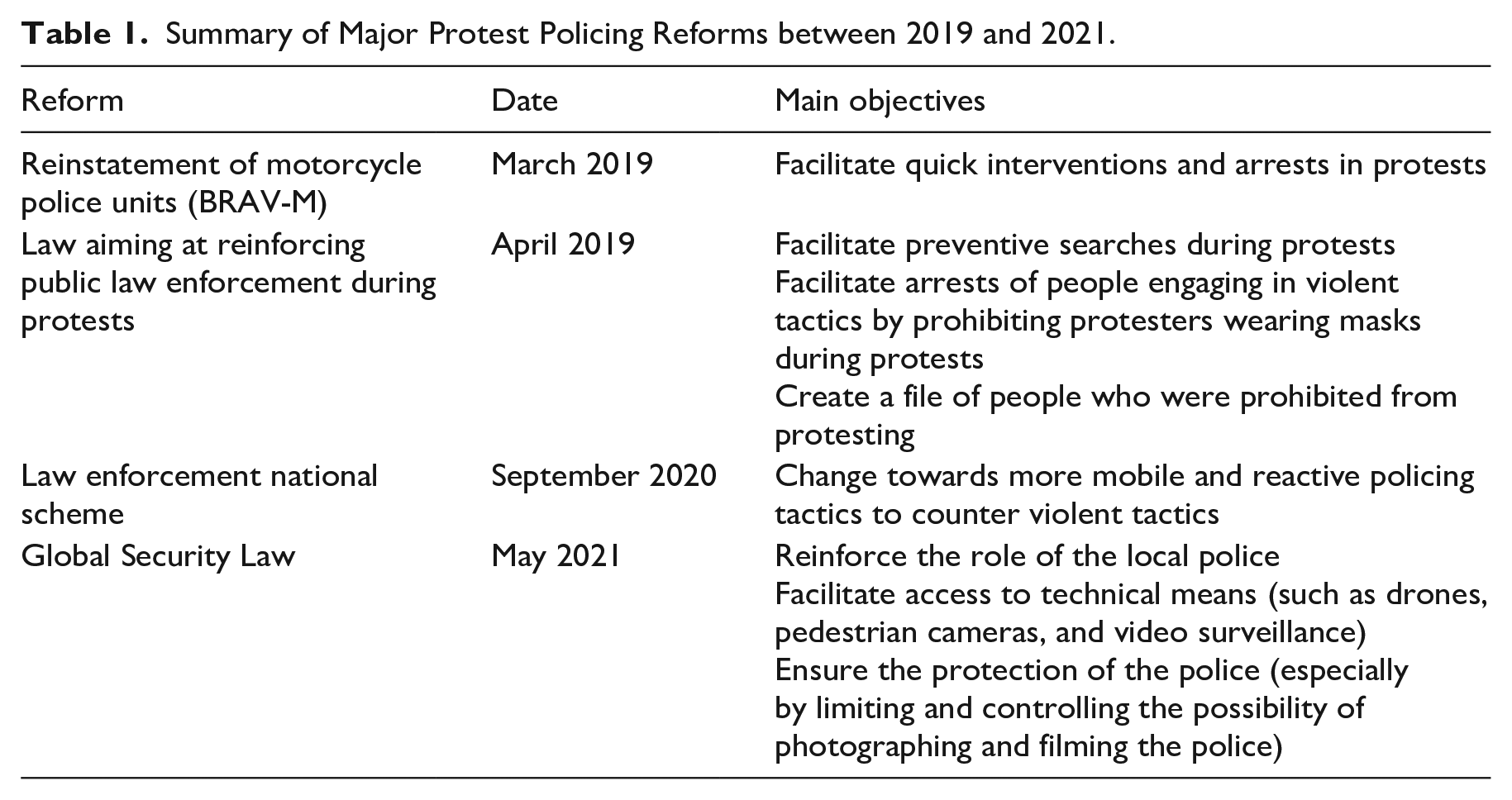
The escalating protests also generated widespread media coverage of the movement for numerous months (Poels & Lefort, 2019). Although the media examined the movement through the lens of the protesters’ violence (Siroux, 2020), the yellow vests received sustained support and sympathy from the public (Noiriel & Truong, 2019). In comparison, the police experienced a significant drop in citizen trust and positive public opinion (CEVIPOF, 2020). The negative perception of policing during these protests accelerated the erosion of confidence of French citizens in the institution of the police (Farde & Labrussiat, 2021). At the national level, the Ministry of the Interior’s compliance officer wrote in his 2019 annual report that he was alarmed about the “misuse of force and abuse of the police.” Parliament initiated a national investigation on violence in policing practices and raised concerns about the potential risks to the freedom to protest (Fauvergue, 2021). In addition, international organizations, including the United Nations, European Parliament, and Amnesty International, publicly raised concerns about the “disproportionate” and “excessive [police] use of force” against protesters. After six months of mobilization, the non-governmental organization (NGO) Reporters sans frontières (Reporters without borders) reported 54 injured journalists while the Ministry of Interior counted 2448 injured protesters, including people with a ripped-off limb, open wounds to the head, and fractured bones.
Research setting and design
My ethnography was mostly located in the area of Lyon and lasted from January 2019 to March 2020. I entered the field by joining public assemblies, working groups, and protests, and progressively accessed “off-the-record” actions and private meetings, and encountered activists who engaged in violent protest tactics or who had been arrested. From September 2019 to March 2020, although yellow vest events became more sporadic, many people I had met kept seeing one another and demonstrating every week through other waves of protests, such as those against pension reform. I therefore continued the fieldwork by following these actors until the beginning of the first lockdown, and when it ended (May 2020) I did not restart a systematic data collection. However, I remained in close contact with numerous actors and met or chatted online with them. A few sent me their own written analyses, while others read excerpts from my fieldnotes, and we discussed some of my analyses. I also joined a few protests in 2020, for the anniversary of the yellow vest movement and against the Security Law project, where I again saw many actors. Informal conversations during these protests or through casual meetings, although not always rigorously documented, have continued to inform my research.
Negotiating a position in the field was initially difficult and raised many moral considerations (Fine, 1993). As for many ethnographers studying intense political commitment (Deschner & Dorion, 2020; Thome, 1979), I was regularly perceived as suspicious and was tested. Besides, the fieldwork was physically and emotionally challenging, not only because of the harmful embodied experience of violent protests, but also because actors shared numerous painful memories and difficult life stories. Being affected (Favret-Saada, 1990) has, however, been crucial to finding a place and to pondering and conciliating some ethical dilemmas. Although I did not enter the field as a militant ethnographer, for whom the goal of research is also to support the movement’s political action (Juris, 2007), I felt increasingly committed “to a personally meaningful and socially relevant topic” (Courpasson, 2013, p. 1243). Informed by critical organization studies (Willmott, 2008) and some of the considerations of activist-ethnographers (Reedy & King, 2019), I became more and more aware that “violent contexts are not ‘normal’ research settings” and that they require particular vigilance and political reflexivity (Abdelnour & Abu Moghli, 2021, p. 1). Therefore, I remained alert to the potential power relationships and forms of violence my presence could (re)produce or that I could experience myself (Farias, 2020). Ultimately, enhancing trust and reciprocity in my interactions with people became an important element of my research, and resulted in building lasting friendships with some actors (Cotterill, 1992; Ortiz Casillas, 2021). These relationships demanded radical reciprocity but allowed me to gain a deep understanding of actors’ experiences (Tillmann-Healy, 2003).
Data collection and analysis
This ethnographic research design allowed me to observe the practices and interactions between people in and around violent protests. The overall data included offline participant observations (over 400 hours), online observations, ethnographic interviews (23 interviews ranging from 20 to 150 minutes), documents produced by the actors, and a press coverage review. I led participant observations at assemblies (assemblies of local groups, assemblies to coordinate at the regional level, and at the national level, an assembly of all the assemblies which took place in Saint-Nazaire in April 2019), protest actions (demonstrations, roundabouts, tolls, and other strategic occupations), law courts, and during casual and informal gatherings—for instance, drinks at a bar or someone’s house. I took notes in a notebook or on my phone when I could; I also jotted down observations with photos or sketches and then wrote them down in more detail at home.
Offline observations were supplemented by online observations and interactions through social media, as I quickly gained access to most of the online groups, email lists, drives, and instant messenger conversations. I also held ethnographic interviews (Beaud, 1996) from June to December 2019 to better understand why people decided to join the movement in the first place, how they experienced their engagement in their everyday lives and on the ground, and how their commitment evolved over time. I held interviews in coffee shops and at actors’ houses, lasting an hour on average, and aimed for variation in the activists’ profiles (age, gender, occupation, habitation location, and tactics used). All the interviews were tape-recorded and transcribed, except for two, which the actors requested for safety reasons. When I could not record, I took extensive notes with the permission of the interviewee, which I transcribed later in the same day. Finally, throughout the research project, I purposefully collected newspaper articles about specific local events—among which were local newsfeeds on weekly protests—and major national events in the main French newspapers (Le Monde, Les Echos, Le Figaro, and Libération). I also gathered multiple forms of documentation produced by the yellow vests, such as meeting minutes, leaflets, and releases, as well as reports from trials and actors’ personal and collective reflections.
I used an inductive and iterative process to analyze the data, informed by grounded theory (Charmaz, 2006; Glaser & Strauss, 1967). The notion of violence quickly emerged from the data as a central feature in individual narratives, assembly interactions, and choices about future actions within the movement. My own embodied experience also led me to investigate this dimension of the field and informed my analysis. As I was physically involved in protests, I regularly reflected on the deep emotions and suffering of my body and how it affected my perception and actions. In fact, almost all the protests I observed (except for 1 or 2 out of more than 20) included episodes of violent confrontations between protesters and the police, as illustrated in Table 2 below.
Expressions of Violence from Protesters and Police.
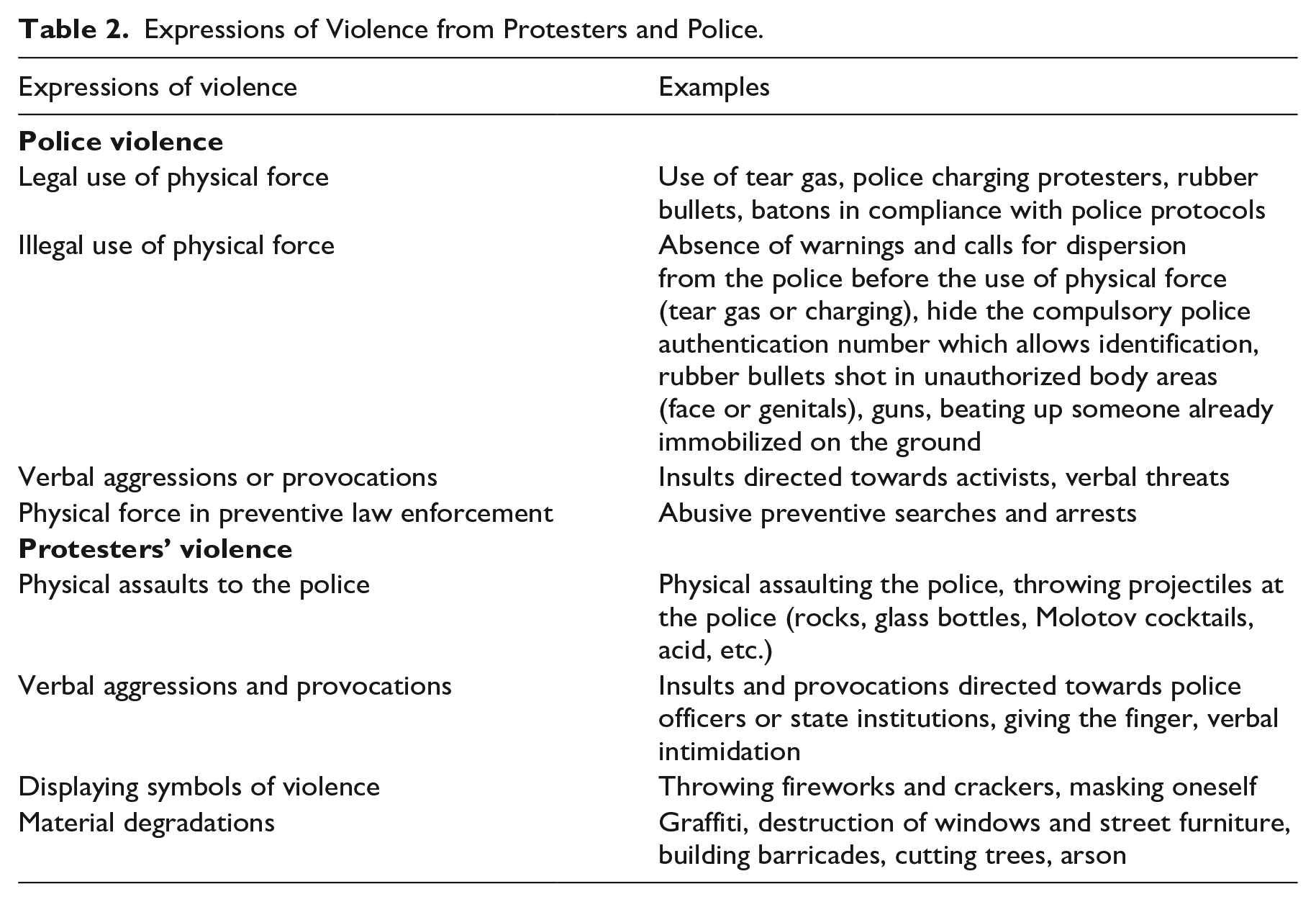
In my early on-going memos (Emerson, Fretz, & Shaw, 1995), I thus started identifying various practices in demonstrations and discourses around violent protests. I later coded the data with the help of the software NVivo, to identify more precisely actors’ collective responses regarding escalation in protests. I focused on the division and allocation of tasks at assemblies and protests, which allowed me to determine how actions were broadly embedded in organizational efforts and what resources were assigned and generated for each task. In addition, I ran an in-depth analysis on the expressions of and discourses on violence. First, I analyzed observational data to identify the various manifestations of violence during protests, from the police and protesters. Second, I analyzed when the term “violence” was used to qualify a situation in discourses. I coded the minutes from trials and went back to main public speeches delivered by the French president or government representatives to determine what was considered violence under the French penal code and for state institutions. For instance, I noticed that the government publicly refused to use the terms “police violence” or “repression.” Then, I coded the interactions and discourses of activists regarding violent protests. Codes such as “experience of war” or “excessive police violence” were opposed to “self-defense,” but also “necessity of collective violence.” By articulating these different rounds of coding, I was later able to detail how the movement’s actors absorbed violent protests.
Findings
My findings present the absorptive resisting work performed by the yellow vests as a result of the sustaining of violent protests. I argue that this work involves enduring and using violent protests in ways that (re)frame them. In my setting, this resisting work relied partly on the combination of three main interconnected activities, namely physical care, paralegal assistance, and publicization of violence, which were embedded in the yellow vest organizational efforts. As the first two sub-sections highlight, these activities constituted important bases through which actors could develop and put in motion various competencies and resources to absorb the repressive effects of violent protests. The first sub-section focuses on absorptive resisting work as: (a) reducing the repressive effects of violent protests, through prevention, protection, and the easing of negative repercussions. The second sub-section examines the absorptive resisting work which took place when protection and prevention failed or did not apply. In these circumstances, actors then absorbed violent protests in the sense of (b) taking in these repressive effects and using them to generate symbolic and discursive resources to challenge police violence. These responses to repression then became tactics of their own. Last, the third sub-section turns to (c) the inclusion of violent protest tactics, meaning processing and interpreting these tactics as serving the struggle. Although violent protest tactics remained subject to disagreements among activists, I show that tensions among actors regarding the desirability of these tactics acted as catalysts through which they restated the asymmetry of violence. By doing so, they were able to (re)generate discursive resources against police violence and reframe, sometimes even reclaiming, protesters’ violence.
Absorbing as reducing the repressive effects of violent protests
As the conflict escalated, protesters collectively acted to respond to the repressive effects of violent protests through actions of prevention, protection, and alleviation of the negative repercussions. They deployed their responses through three main activities—physical care, paralegal assistance, and publicization of violence—which were interrelated and embedded in their organizational efforts.
Physical care
Physical care focused on the protesters’ bodies and involved avoiding, enduring, and healing injuries, as well as attending to wounded people. Specific activists known as “street medics” took on a central role in developing these competencies. Street medics were mostly nursing staff and yellow vests trained to deliver first aid care, but “the level of competencies [was] often variable (from the first aid professional training to healthcare professionals)” (fieldnotes, assembly). They either started dispensing emergency medical procedures during the mobilization or belonged to pre-existing volunteer organizations. Street medic networks existed and some even attempted to organize at the national level. For instance, one street medic mentioned during an assembly that the volunteer network he belonged to deployed around 180–200 people all over France for each protest. Whether or not they considered themselves yellow vests, my fieldwork showed that street medics regularly came to weekly assemblies to listen, pass on information, and, occasionally, coordinate with other working groups.
First, physical care helped to withstand violence during protests through protection and prevention. Many yellow vests regularly referred to “avoiding the blows,” “protecting themselves,” and “getting used to tear gas.” To this end, street medics ensured the collection and redistribution of health supplies. For instance, a street medic once estimated that he had distributed 220,000 saline solution doses in a single Saturday. Protesters created their own “protest kits,” usually including saline solution, Maalox,
1
face masks, and sometimes a ski mask or swim goggles. During assemblies, they also exchanged recipes for sprays which extinguish tear gas pebbles. Many actors reflected on bringing gear as a significant step in enduring and resisting violence, as Anne did in the following description:
I arrived with nothing [. . .] and the next protests, I already had a face mask. [. . .] then you find yourself with your son at Décathlon [a sportswear store] buying a ski mask [. . .] My attitude completely changed. I used to go fresh and joyful [. . .] but now [. . .] I am in resistance. (Interview)
Second, actors were committed to helping injured people. Medics delivered medical care at protests and organized free trainings on how to deal with bleeding, trauma, and suffocation, and how to use stretchers. In addition, actors collected money to pay for medical bills and support financial losses in the case of sick leave from work. During my fieldwork, I noticed people offering other types of assistance depending on their means, ranging from help with everyday tasks to free holidays at a cottage to recover.
Paralegal assistance
Next to physical care, actors organized paralegal assistance to help protesters navigate the judicial system in case of injuries or arrests. In the local assemblies I observed, these practices crystallized around a “justice committee,” a group working exclusively with questions of “repression and justice,” including “prevention, legal training, arrests and trials for injuries” (fieldnotes, assembly). The team relied on more experienced activists, such as Stephane, someone who had been protesting since 1995, or Edith, who had experience with a justice committee in another social movement and started the working group. They organized weekly meetings, communicated their achievements at assemblies, and built external networks of lawyers “friendly to the cause” and existing collectives “organizing against repression” (website from the justice committee).
Through this activity, actors developed competencies and generated various resources relative to the judicial arena. First, some protesters circulated legal advice and juridical knowledge. For instance, they produced and disseminated short memos with procedures to follow in case of arrest or injury (what to tell the police, which doctor to go to, what information to gather for trials, etc.). Second, the justice committee collected evidence and testimonies to engage in trials. For example, they encouraged and helped first-time activists to lodge complaints to obtain reparations when experiencing police violence. They also aggregated a long list of online websites to report police violence and gathered enough proof to lodge a collective complaint to the United Nations. They supported activists who were arrested by going to court and producing minutes of their trials. Last, the yellow vests collectively produced and mobilized financial assistance for activists’ legal procedures. At the local level, the justice committee encouraged people to give €1 at every assembly and reached out to solidarity funds from other organizations. Seven months after its creation, they estimated that they dedicated more than €10,000 to pay for lawyers. Some crowdfunding campaigns raised money at the national level. For instance, €145,000 was gathered in two days to support the boxer Christophe Dettinger, who was arrested after punching policemen during a protest.
It is worth noting the emergence and expansion of the movement’s internal networks to share best practices and engage in legal collective action at a broader level. For instance, at the assembly of the assemblies of Saint-Nazaire, which gathered representatives from about 200 local delegations, actors dedicated a specific group to work on this topic for 3 days. Furthermore, online yellow vest networks shared information when looking for missing people after a protest or when gathering evidence and trying to hold policemen responsible for their actions, as the following Facebook post reveals: “This is the policeman who aggressed me yesterday [. . .] I will lodge a complaint [. . .] I am therefore looking for videos of the event [. . .] I added two other photos, hoping that someone will recognise the place.”
Publicization of violence
As this Facebook post signals, the yellow vests articulated paralegal assistance and physical care with an activity of publicization of violence. They organized the production and circulation of images and narratives of violent protests, for instance, by circulating pictures and identification numbers of policemen enacting violence. During protests, flyers were disseminated calling to “Watch the police!” and specifying what valuable information to gather, such as dates, locations, and the names of victim(s). Various protesters referred to these actions as a disincentive against policemen to limit abusive behaviours—for instance, during arrests. In addition, the yellow vests organized several demonstrations to denounce the disproportionate use of force by police and support injured people. During protests, some actors carried placards with the images of people who had lost an eye or a limb. These photos were aggregated on various websites, such as the Yellow Wall, and displayed on social media. Street medics also kept track of and disseminated the number and types of injuries they healed.
Many activists remained near the police during protests to film confrontations and comment live on what was happening through Facebook or Snapchat. Taking photos and videos became the main role of some activists. For instance, Jocelyn explained that “it was an urge to testify [. . .] to show the reality of protests [. . .] and [that he] had feedback [. . .] from people who said the video helped them [. . .] when they engaged in [legal] procedures” (interview). Eventually, some yellow vests created independent media specializing in documenting protests, such as Media Jaune or Born to be Jaune (translating respectively into Yellow Media and Born to Be Yellow). At the same time, independent journalists expanded the documentation and circulation of the testimonials. For example, the journalist David Dufresne created the Twitter account @AlloPlaceBeauveau to collect yellow vest videos of police abuse and report on those cases by tagging the French Ministry of the Interior on Twitter posts.
Absorbing as taking in the repressive effects and using them
Despite resisters’ efforts to limit arrests and severe injuries, people still experienced significant harm at protests, ranging from enduring intensive tear gas to losing an eye or a limb due to a flash-ball shot or rubber bullet grenade. In addition, numerous protesters were arrested. As an illustration, after a year of mobilization, the Justice Ministry reported 10,852 yellow vest detentions, among which were 3,204 condemnations and more than 20% dismissed cases. Although previous research has predominantly emphasized how the increased costs of collective action tend to lead to demobilization patterns (see, for instance, Boykoff, 2007; Wood, 2007), my analysis shows that actors who remained mobilized reflected on how their suffering could serve their cause.
These considerations emerged when discussing physical care and bruised bodies from protests. For instance, in the following excerpts, some actors explicitly state the idea of using experienced harm as a symbolic resource:
We are always being gassed, anyway. So, during the Saturday protests, we need to consider ourselves as martyrs. (Fieldnotes, speaker in an assembly) Rodriguez [a yellow vest public figure] has this martyr vibe [. . .] He lost an eye and all. I understand that he is put in the spotlight, not for ideas or long discourses, but because he is the very incarnation [. . .] of injustice and police repression. These are the types of things that we must know how to use too. At some point, one needs to be a little bit . . . “marketing,” you know. (Interview, Florence)
These quotes show that the yellow vests considered how to publicize their role as “martyrs,” tortured and persecuted for their convictions, to challenge police violence. Various actors also mentioned purposefully bringing limited equipment during protests to reinforce the asymmetry between the police and protesters. Bruno, for instance, explained that he “wanted to stay himself in front of [the police]” and refused to “put [himself] on their level” even though he knew it would imply “really getting it in the neck more than others, obviously” (interview).
Moreover, protesters mobilized various iconic trials as symbolic resources to show and stage police abuses. The justice committee often reminded people of the importance of not “banalizing police violence” or “normalizing their illegal behaviours” (fieldnotes, assembly). The yellow vests publicized the judicial process through Facebook lives, minutes of trials, and newspapers articles. They used these images to challenge police brutality and denounce the use of legal counter-tactics to avoid facing the consequences of their actions, such as “ly[ing] even though their words were under oath and they were sworn officials” (fieldnotes, assembly). The following fieldnotes refer to an illustrative trial in which actors emphasized the innocence of the yellow vests and police misinformation:
The next speaker reports the case of Leslie and her daughter as such: Leslie was shot in a protest by a flashball and her daughter beaten up while they were helping a protester in a wheelchair in a cloud of tear gas. They later pressed charges for aggravated violence. But ten days later, the police also pressed charges against them, and they were put in custody. The spokesman then told the date and time of the immediate trial to the assembly and encouraged people to come. While he talks, Leslie’s daughter sits with the public, and she films herself and the speaker through Facebook live on her phone. She has tears in her eyes.
Leslie was eventually discharged. Later in the year, various local newspapers also reported on another comparable trial acquittal involving a father and his son in Lyon for “challenging police prosecutions” (Ouest-France) and “being a case with many weaknesses” (Le Progrès).
Last, the yellow vests circulated images of broken cameras through online platforms, explaining that these resulted from reprehensible police actions. Jocelyn described, for instance, how he was almost arrested during a preventive search because he was filming and, therefore, was subject to “specific attention” from the police (interview). Later during the mobilization, Jocelyn received a flash-ball bullet in the elbow as he recorded policemen beating someone. He then publicized on social media a photo of this person with blood in his mouth and missing teeth and reflected on the link between police violence and the destruction of filming materials:
I filmed the violent aggression of Martin Dupont [. . .] before receiving, myself, a few seconds later, a rubber bullet in the elbow [. . .]. Maybe my camera was targeted??? This could explain that. [. . .] I (once again) saw the barbarism of these militiamen of the regime. I say it loud and clear, and I totally stand by it. (Facebook post)
This post indicates that Jocelyn seized the episode to circulate a negative framing of police work. This discourse was found in other press releases, such as one by a street medics group. The group had been arrested and used the event to denounce “methods similar to a totalitarian regime [. . .] and the detention of press agents” (press release).
In line with these quotes, physical care, paralegal assistance, and the publicization of violence turned into more than just responses to repression and became tactics in themselves. Together, they contributed to making police violence visible and producing discursive resources against it, eventually articulating a systemic critique. In fact, various interviewees explained that their experience of violent protests revealed already existing but usually hidden police violence:
[The yellow vests] are actually experiencing what guys living in underprivileged neighbourhoods have been experiencing for 30, 40 years. The repression! So, it’s kind of normal that they rebel, you know (Interview, Jimmy) The national police are the capital militia [. . .] I am convinced about this. Because contrary to what they are letting us think, the police are supposed to protect the population. Well, yes, only a part of the population. The riches, right?! [. . .] But the protection of the protesters, well no. I didn’t see this, no. All I saw was baton blows. (Interview, Véronique)
Similar interpretations were also used as slogans and catchphrases in the yellow vest actions and communications to denounce police violence.
Absorbing as including violent protest tactics
The two previous sub-sections uncovered how the yellow vests absorbed the repressive effects of violent protests in ways that allowed them to endure as well as use those effects to challenge police violence. This final sub-section turns to the absorption of violent protest tactics. As in other movements (see, for instance, Fotaki & Foroughi, 2022), the yellow vests often had concerns about the desirability, morality, and efficiency of violent protest tactics. Yet although these considerations sometimes led to disagreements, they were also opportunities for restating the asymmetry of violence between protesters and policemen. This was the case, for instance, during the assemblies when some participants proposed publicly condemning violent protest tactics:
Someone reads a draft release condemning violence from protesters to the assembly. People become agitated and start shouting. Some commented in the microphone: “Let’s not blend different kinds of violence [. . .] Who has been violent? It is the police!” “I have to admit I am completely surprised by this letter. [. . .] In the end, the release was given up and never appeared in the media. (Fieldnotes)
Similarly, actors regularly mobilized national collective imaginaries, such as the 1848 Paris Commune or the Resistance during World War II, in reference to this asymmetry.
Additionally, tensions regarding violent protest tactics invited some protesters to draw connections between police violence and less visible and indirect forms of violence resulting from exploitative relationships:
“There are two types of violence: the violence of the capital and the violence of the oppressed,” says the first speaker. The second man then adds “Violence comes from the state and policemen, not from protesters. Those who break public services, workers and protesters. We must make no mistake about the real enemy, here.” A bit later, another participant takes stock of workplace suicides, offshoring, and unemployment rates, before contending: “this is the violence of neoliberalism and capitalism.” (Fieldnotes, assembly) Violence generates violence [. . .] when they push people to unemployment and suicide, when they shut factories for money, because they are profitable but not enough for stakeholders [. . .] violence is there, in the background [. . .] [the people in power] [. . .] protect themselves behind more and more repressive police. (Interview, François-Xavier)
In these excerpts, actors condemn police violence as both a policing strategy and an indicator of a hidden violence experienced beyond the state response to the mobilization.
Debates on protesters’ violence thus acted as catalysts to regenerate discursive resources against police violence, later disseminated in the yellow vest actions and communications, while eluding some internal critics on violent tactics. However, restating the asymmetry of violence also constituted a way for activists to provide explanations about their tolerance regarding violent tactics, as illustrated in this quotation from Claire:
I think police violence [. . .] is unworthy of a lawful state. It really shows a conception of power [. . .] As soon as things go slightly beyond their boundaries, they [the people in power] actually freak out about it? [. . .] The controls, the protest interdictions, and all . . . it makes me puke! [. . .] This is the true violence [. . .] you have symbolic violence with the protest interdictions [. . .] the repressive and judicial violence [. . .] In Lyon, what have we broken seriously? A McDonald, a bank, estate agency, a few bus shelters, that’s it! [. . .] So, at some point, people need to stop fantasizing a violence which does not necessarily exist [. . .] Personally, I don’t give a shit about material violence. (Interview)
Later in her interview, Claire explained that although she did not engage in violent protest tactics, her friends did and were “capable of sending a small rock to a cop [. . .] and throwing cobblestones on police trucks” as well as “extracting people who are being arrested” and “engaging in physical battles.”
Actors often contemplated the help of violent protest tactics in enduring police violence. For instance, Véronique similarly expressed that violence from the yellow vests was “only a reply to police violence” and that “those on the frontline, facing the police, [. . .] [were] brave” (interview). Resisters deemed violent protest tactics legitimate when they supported the absorptive work relative to the repressive effects of protests. People engaging in violent tactics employed these narratives equally to justify their actions. For instance, Steven mentioned being arrested when “throwing a few rocks” to “slow down a police charge” (fieldnotes, assembly). In the following quotes, Lucas produced a comparable discourse:
[Violent tactics] inspire fear. Which means [policemen] attack less because they are afraid [. . .] and they repress less everyone [. . .] I’m a scapegoat. And in a sense, it is protecting the others. I take the knocks and they don’t. (Interview) All the mutilated people, the injured people, the deaths of these last months, we cannot close our eyes. We cannot let the State acts this way. We cannot give up, we need to continue fighting [. . .] I totally understand that you are afraid to potentially end up in prison, injured, mutilated or worse and I don’t wish this for anyone in the world [. . .] [But] to truly win, pacifism will not be enough! (Fieldnotes, assembly)
In line with this last quote, almost all my interviewees referred to the idea that there was “no revolution without violence” and some articulated a critique of violence while accepting it as inevitable and necessary. For example, as Sylvie did in the following: “I do not approve violence, I hate violence [. . .] I’m always the first to say that I am against violence [. . .] But unfortunately, we don’t make progress by being the yes man all the time” (interview).
Ultimately, actors tended to assimilate protesters’ violence to their struggle rather than trying to distance themselves from these tactics. They privileged strategies which avoided “delimitating between good protesters and those considered as breakers” (debate on declaring a protest in an assembly). Propositions to tame or exclude violent protest tactics were often rejected by the majority:
Each representative reports to the assembly the discussions they had in their group and their propositions are voted on. “If we have a rioter or someone out of control [during a protest], we should have people to evacuate this person!” says intensely the spokesman holding the microphone. A significant number of people boo him, some yell and stand up. Ultimately, the assembly votes against this proposition at a large majority. (Fieldnotes, assembly)
On other occasions, some actors even reclaimed the labels associated with violent tactics by the state and dominant media and used to justify strict protest policing:
Many people are ready to be martyrs, such as the ultra-yellows that we all are after all. [. . .] I have always considered myself as a pacifist, but since the 14th [reference to a protest], I am tempted to bring my catapult! (Fieldnotes, assembly)
During my fieldwork, I heard some protesters stating similar sentiments, such as “all of us are breakers/terrorists” or “I am a radicalized yellow vest.” Through this absorptive work, they were able to include protesters’ violence, in ways that both: (a) reframed violent tactics by conveying their meaning and reclaiming them as part of the movement; and (b) (re)produced resources to challenge police violence.
Discussion
Increasingly, scholars have been encouraged to make violence visible in organization studies (Costas & Grey, 2019) and theorize further the violent governance relationships between the state, businesses, and civil society over win-win approaches (Böhm & Pascucci, 2020). The organization and management field has historically focused on the construction and maintenance of social order and consensus; hence the few studies engaging with destruction or violence until recently (Bloomfield, Burrell, & Vurdubakis, 2017; Clegg, 2006; Contu, 2019; Stokes & Gabriel, 2010). Answering the call to explore the intersection of violence and organization studies, this article proposes to expand the emergent literature documenting overt and collective forms of resistance to organized violence (Alvinius & Holmberg, 2019; Banerjee, 2011; Banerjee et al., 2023; Ehrnström-Fuentes, 2022; Fotaki & Daskalaki, 2021).
My core contribution is to explain the absorptive resisting work through which resisters act on violence and put it in service of their struggle. I depart not only from analyses which have described protesters as engaging in hidden, subtle, or non-oppositional forms of resistance (for examples, see Courpasson & Marti, 2019; Scott, 1990), but also go beyond the general academic tendency to portray resisters as mere recipients of violence. I am by no means contending that demobilization patterns do not happen as a result of violent protests. However, research has shown that, in many instances, resisters have withstood and faced coercive repression. For instance, some movements in the 1970s, such as the New Left movements (Zwerman & Steinhoff, 2005) or Irish political struggles (O’Hearn, 2009), managed to build a culture of resistance in the courts and prisons. Recent studies on environmental mobilizations have emphasized how activists used and trained their bodies in the face of policing tactics (Fotaki & Daskalaki, 2021; Rahmouni Elidrissi, 2019). This paper pushes this argument further by showing that if these practices help actors endure police violence, protesters can also, at times, consciously take in, publicize, and redirect repressive outcomes to challenge police violence. In other words, the yellow vests responded to violent protests not only by enduring their repressive effects, but also by embracing their effects to resist abusive police work.
In addition, this article helps better understanding how activists include violent protest tactics in their struggle. These tactics are usually a sensitive topic for resisters; debating and making sense of violent episodes can constitute important moments in the internal lives of movements (Fotaki & Foroughi, 2022; Wahlström, 2011). If some scholars have argued that actors can end up taming or publicly distancing themselves from more radical tactics (della Porta, 2018; McCammon, Bergner, & Arch, 2015), my study complements research showing that this is not the only path and that resisters may equally privilege the “diversity of tactics” principle, even if it relies on a frail equilibrium (Juris, 2005). Along these lines, my findings highlight that activists’ tensions and dissensus regarding the appropriateness of violent protest tactics can function as vectors through which they articulate and focus attention on the asymmetry of violence, therefore (re)generating discursive resources to reframe violent protests. As for other movements, such as Occupy (Maguire et al., 2021), my analysis suggests that reinvigorating this perception made actors more likely to endorse violent protests tactics or help them construct meaning regarding these violent episodes, allowing them to endure or sometimes even reclaim violence and overtly challenge it.
This indicates that resistance to and through violence can become closely intertwined. Some anarchist thinkers have already hinted that violence from resisters could be a means to make visible otherwise hidden violence by showing what happens when someone challenges the existing social order (Frazer & Hutchings, 2019). Violence has been proven to constitute an organizing strategy (Way, 2023) that remains unquestioned because it is insidious (Rahmouni Elidrissi & Courpasson, 2021), normalized (Chwastiak, 2015), and legitimized (Van Lent et al., 2022), and people who speak up are often silenced (Fernando & Prasad, 2019). Under these terms, materializing and making violence visible to a broad audience appears to be an important step in questioning it. Yet although this theorizing of violent tactics highlights how being able to use and provoke violence can constitute a useful symbolic resource for resisting violence (Juris, 2005), my findings suggest that these efforts may not stand alone and that their efficacy may be equally dependent on actors’ capacity to collectively endure violence in the short term and construct meaning around violent episodes in the long term.
This study thence joins academic conversations interrogating the impact of resistance (Courpasson, 2016), especially those evaluating efficacy based on the conditions and context under which resistance takes place (Marsh & Śliwa, 2022; Wilhoit & Kisselburgh, 2019). In particular, it shows the limits of considering the efficacy of resistance to violence at protests based solely on actors’ ability to escalate or de-escalate conflicts and encourages scholars to account for how actors also absorb violence. Put differently, this involves looking at how resisters creatively adapt to their evolving context, what they do to cope with violence and make violent protests meaningful, by expressing their seriousness, importance, and signification. In that sense, producing violence is as much a matter of using violence as staging violence (the resisters’ violence as well as that of the dominators).
What is more, my data indicates that, through their absorptive resisting work, actors generated and politicized objects and knowledge unrestricted to the scope of the movement and able to impact future social struggles and everyday life resistance (Courpasson & Vallas, 2016). These constitute key repertoires of knowledge practices (della Porta & Pavan, 2017), which could be reactivated in other contexts and forms of activism, for instance, through the mechanism of social movements’ boundary-spanning (Wang, Piazza, & Soule, 2018). This way, I also restate the meaningfulness of physicality, whether through material objects (Taskin, Courpasson, & Donis, 2023), bodies (Fotaki & Daskalaki, 2021; Rahmouni Elidrissi & Courpasson, 2021), or territories (Courpasson et al., 2017; Fernández et al., 2017), in the expression and impact of resistance.
Finally, this paper speaks to the recent reflections on the methodological implications of studying violence. Using or omitting the word “violence” is highly political, and it is urgent, when researching violent contexts, to develop extensive political reflexivity (Bourgois, 2001). All too often, the organizational and management field has depoliticized these settings, at the risk of normalizing power abuses and sanitizing violence under the veil of scientific neutrality (Abdelnour & Abu Moghli, 2021). Avoiding the term “violence” in situations of physical harm and inequal power relations puts the field at risk of being complicit in dominant violence by normalizing or silencing dominated actors. At the same time, similar considerations apply when qualifying resister actions as “violent,” because we, as researchers, risk nurturing and reproducing the dominant frames which depoliticize acts of resistance and contribute to disempowering certain people (Murphy, 2011). Aware of the sensitive and ethical nature of this question, I have ultimately chosen to use the term “violence” to qualify the actions of both the state and the protesters. In fact, although the yellow vests sometimes showed ambivalence about violence, they still used the term to qualify their protest tactics and often referred to violence as something necessary to achieving change. Using this terminology appears to be the best compromise for acknowledging the violence they experienced without minimizing their unrest and anger and respecting their willingness to be taken seriously and recognized as potential challengers.
Conclusion
In this article, I have detailed the resisting work led by a movement to absorb violent protests. I have uncovered how the yellow vests faced the repressive effects of violent demonstrations. In addition, I have documented how they were able to redirect these effects while including activists’ violence in their struggle in ways that reframed violent protests and regenerated resources against abusive police work. This study thus provides empirical evidence on how protesters can pragmatically and symbolically resist violence rather than simply being subject to it. Looking at the question of resistance to violence in the specific context of violent protests appears particularly important, especially considering studies which have shown that the police tend to engage in more aggressive tactics when they feel threatened at demonstrations, regardless of time period (Soule & Davenport, 2009). This tendency has been proven to hold when threats are symbolic—for instance, when protesters formulate claims against police brutality, as has been the case for the movement Black Lives Matter (Reynolds-Stenson, 2018). As activists have increasingly called into question the societal relevance of the police (Olzak, 2021; Phelps, Ward, & Frazier, 2021), it seems particularly pressing to consider how they deal with violence from the police. In fact, the absorptive resisting work identified in this paper is far from exhaustive or unique to my setting, and future research could investigate its forms and efficacy depending on movements’ claims, targets, and political environments, or analyze how factors such as race or gender play out in these mechanisms. What is more, scholarship could also elaborate on this absorptive resisting work when organized violence is deployed by private actors, such as paramilitary organizations, organized crime, or corporations.
In a context of institutional crises, the resurgence of violent social conflicts, and the sophistication of military systems of surveillance and policing (Abdelnour, 2023), I ultimately align with recent calls and urge scholars to pay further attention to the concrete implications of violence in power and resistance. Condemning certain types of violence, as is often the case for violent protest tactics, can indeed contribute to hiding and normalizing other forms of everyday violence (Žižek, 2009). Besides, resisters, and more generally dominated people, continue to be perceived a priori as agents of an illegitimate and indefensible violence whereas violence from dominant groups tends to be portrayed as legitimate defense (Dorlin, 2017) or to be kept quiet (Abdelnour, 2023). As the possibility of defending oneself has historically remained the privilege of a few (Dorlin, 2017), we thus have a responsibility to consider and expose this double standard. This involves speaking out and further investigating violence profiteering but also processing cautiously and departing from a legalistic standpoint when documenting the possibility for people to fight back.
Footnotes
Acknowledgements
I warmly thank Christof Brandtner, Lisa Buchter, Manon Vignaud, and Dima Younes, the members of the Organizations, Critical and Ethnographic Perspectives research center (OCE) for their early feedback, as well as the PhD community from emlyon business school and from the Marchés, Organisations, Société, Technologies (MOST) research group, at Paris Dauphine, Paris Sciences et Lettres University for their support. A big thank you to the great scholars who offered developmental comments during the 2021 Society for the Study of Social Problems (SSSP) annual meeting, the Organization and Violence sub-theme at the European Group for Organizational Studies (EGOS) in 2021, and from the Critical Management Studies (CMS) division, at Academy of Management (AOM), in 2022. I am particularly grateful to the people I met during the fieldwork for everything we shared, their time, trust, and generosity, as well as to Martin Buthaud for his listening skills, his unconditional support, and patience. Last, thank you to the three anonymous reviewers and senior editor Marianna Fotaki for providing generous guidance and highly constructive feedback throughout the review process.
Funding
The author received no financial support for the research, authorship, and/or publication of this article.
