



Abstract
The Frankfurt School was an interdisciplinary grouping of left-wing thinkers whose contributions to the social sciences and humanities made them one of the most influential groups of scholars from the last century. Their work has inspired decades of critical organizational research. Yet, across this body of thought, few organization theorists have considered the Frankfurt School as an organization. This article argues that we cannot apply Frankfurt School theories to organizations unless we understand how the School managed its own activities. Reading the School’s texts and examining its working practices through historical documents, we show that Frankfurt School thinkers did not ignore everyday organizational tasks, nor did they grudgingly accept them as a practical necessity. Rather, they embraced them as components of a dialectical theory of organizing and society – which we term critical theory-in-use. Defining what it means to be a critical scholar today is, we conclude, not just a matter of reading Frankfurt School theory but also understanding how this research institute endured for so long and had such a significant influence.
Keywords
Introduction
What does it mean to be critical? In organization theory and the wider social sciences, this question has been asked repeatedly since the 1960s. In the more recent literature on organizations, it has been discussed as a question of identity (Reedy, 2008), political affiliation (Rowlinson and Hassard, 2011), tactics (Spicer et al., 2009), institutional location (Bristow et al., 2017), and the rise and fall of labour markets (Parker, 2015). But could it also be what Burrell (2013) calls a style of organizing? Can we define ‘critical’ not only in terms of who you think you are, where you work, or what you think, but also in terms of how your thinking is organized? That is, might critical theory also involve the practices that are necessary to create a context for the generation, development and dissemination of critical thought?
It is no coincidence that the Frankfurt School, a key inspiration for critical organization theory, has an organization in its name. Despite being treated in the organizational literature as a collection of ‘closely related’ writers (Alvesson and Willmott, 1996: 67) with little concern for ‘the mundane world of management and organization’ (Alvesson and Willmott 1992b: 437), it conceived its own project in organizational terms. It described itself as ‘a collective entity and not merely a more or less artificial and haphazard gathering of scientists working in related fields’ (Institute, 1944: 10) and aimed, in the words of its second director, to be ‘a new type of scientific work organization’ (Grünberg, in Jeffries, 2016: 73).
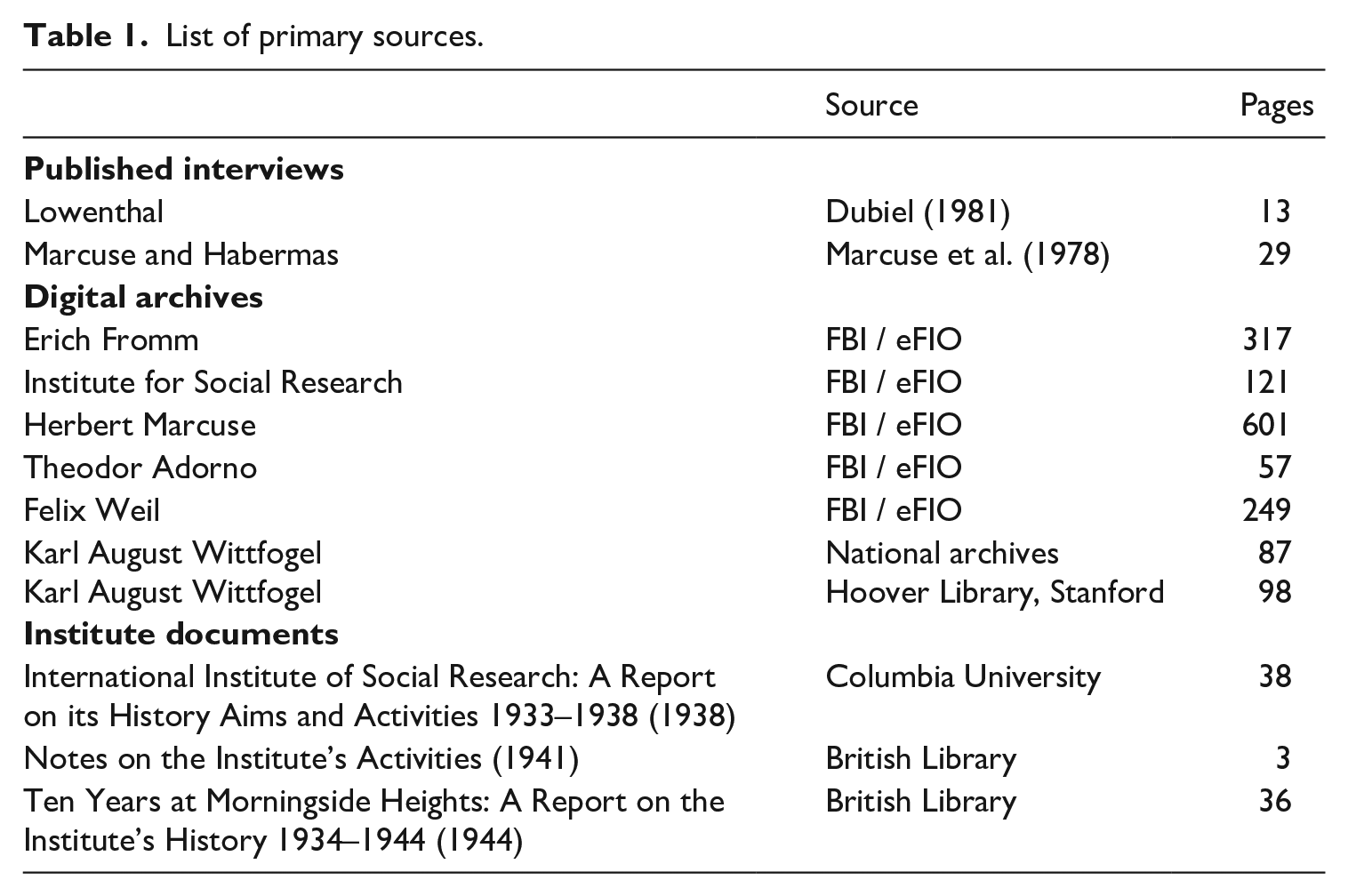
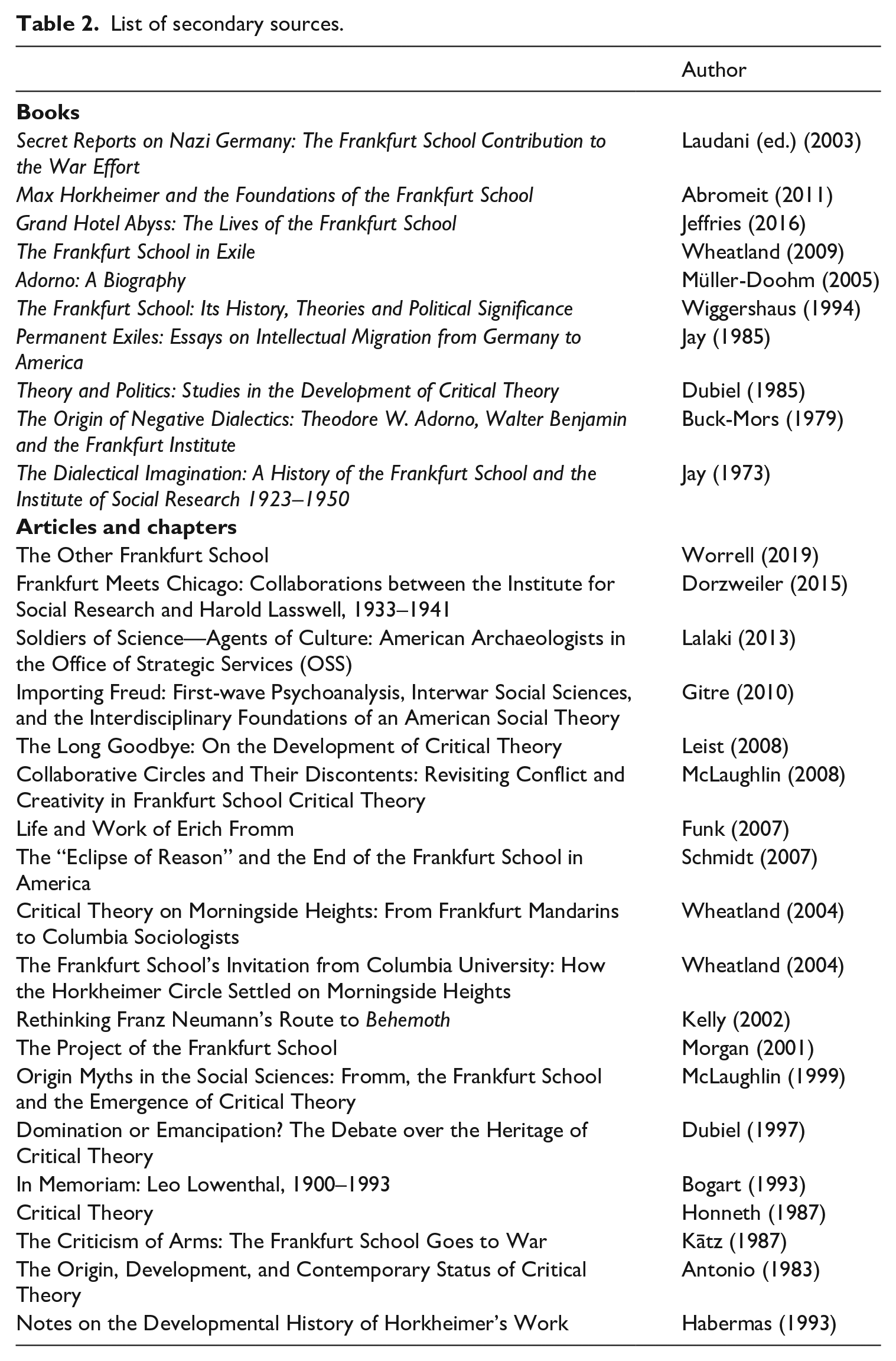
In this sense, the School’s theory of organizing is revealed not only in its written texts but is also embodied in the theories-in-use that shaped what it did. In order to demonstrate this, we return to historical and biographical literature as well as primary historical sources that explore the organization of the School, including declassified FBI records (see Tables 1 and 2). Far from being simply lofty theorists, these reveal that the School’s membership was trained in business and deeply embedded in administrative affairs. In fact, many of the founding salaried members wrote very little theory but spent their time ensuring the smooth running of the organization. It could be said that the School’s practices were focused on organizing and that the production of specific ideas or texts was an outcome of this focus.
List of primary sources.
List of secondary sources.
To make sense of the apparent contradictions of radical critical theorists spending their time discussing investment opportunities and rates of pay for secretarial staff, we develop a theory of organization from Adorno’s (1951, 1973) writing on dialectics. We contend that the School worked with a dialectical theory of organizations based on three premises. First, organizations can be dialectical mechanisms for social progress. Second, organizations can be dominating and emancipatory at the same time. Rather than trying to purify organizations of dominating elements, the route to emancipation involves pushing constraining features of organizing such as hierarchy, contracts and finance ‘to the point where they turn back on themselves’ (Adorno, 1951: 86). Third, organizations can be designed with these processes in mind, and those engaged in a critical project should be self-aware of this. These three principles call for a shift from what critical theory is about to how it is organized.
Underpinning this critical theory of organizing is a theory of the relationship between critical ideas, organizations and social change that has implications for contemporary debates. It is now common to propose that a new world can be found in the present (Spicer et al., 2009) or in the imaginaries of counter-hegemonic and prefigurative organizations (Parker et al., 2014). The lesson we draw from the Frankfurt School is, rather, that we cannot imagine new forms of organizing within existing conditions, nor individually overcome the current moment. We can collectively create the conditions in which new thinking and new forms of organizing may emerge – without being certain what these will look like at the outset.
To support our argument, we begin by outlining the ways in which the School has been understood, both positively and negatively, as a body of theory by critical organization theorists. This leads to a section in which we read Adorno to frame how the School’s organizational theory manifested in its practices. Then, using various historical sources covering the first 25 years of the School’s history, we document a dialectics of leadership and collective labour, administration and research, and independence and alliance. We conclude with reflections on what contemporary critical theories of organization can learn from the practical lesson of the Frankfurt School.
The Frankfurt School and critical organization theory
Spreading through the humanities and social sciences from the 1960s onwards, Frankfurt School thinking was put to use in organization theory from the 1980s. In 1985, for example, setting out the ‘points of departure for a critical organization theory’, Alvesson suggested that ‘critical’ means ‘Frankfurt-inspired’ (1985: 117). Likewise, in the foreword to the edited collection that inaugurates Critical Management Studies (CMS), Alvesson and Willmott (1992a: 9) stated that ‘the primary focus . . . is upon Critical Theory, in the sense of the Frankfurt School and its followers’.
Early CMS inherited from the School a belief in ‘the feasibility and desirability of greater autonomy for individuals, who . . . are able to master their own destinies through collaboration with peers’ (Adler et al., 2007: 139), a negative assessment of positivism, mass production, consumerism and technocratic governance (Alvesson and Willmott, 1996) and a desire to question the ‘adherence to the ideologies of managerialism, technicism and consumption’ within organization theory itself (Alvesson, 1994: 309). It provided early critical theorists of organizations with a body of thought with which to analyse management.
CMS has since developed three broad positions on the Frankfurt School. First, it is used to evidence pluralism. As Granter (2014: 550) points out, the ‘first generation of the Frankfurt School’ such as Adorno, Marcuse and Horkheimer ‘were not the essential touchstone for all’. Rather, Foucault, Laclau and Mouffe, Butler and many other theorists have taken centre stage since. Second, the School has been challenged for overlooking political economy and class conflict (Hassard et al., 2001) and characterized as elitist, needlessly intellectual and pessimistic (King and Land, 2018). In an influential contribution, Spicer et al. (2016: 226) argue that the wave of CMS ‘largely inspired by Frankfurt School critical theory’ is ‘increasingly moribund, offering increasingly little in the way of claims that are academically rigorous, intellectually interesting and practically relevant’. The antagonistic relationship between the School’s ideas and management practice, they argue, impedes the impact of critical organization theory. Nevertheless, recent work has found new value in Frankfurt School concepts (see Granter, 2014, for a review). McCann et al. (2020: 435), for example, turn to Marcuse’s reflections on university administration to make sense of their experiences in higher education. Granter (2017) argues that Adorno and Horkheimer’s ideas about ‘rackets’, a theory they developed to make sense of their experiences with research funding bodies, illuminates the behaviour of corporate and political actors. Summarizing this position, Granter writes: Although the Frankfurt school appear in critical organization studies texts less frequently than they once did, it is the case that they still offer useful critical perspectives . . . critical theory is uniquely positioned to take account of the ways in which capitalism evolves, but this potential is currently under explored. (2014: 555)
Despite these different perspectives, wherever one looks in the literature, critical organization theory has paid very little attention to the organization of the Frankfurt School. In fact, a claimed absence of practical organizational concerns in the School’s work was a starting point for the CMS version of critical organization theory. In their influential Academy of Management Review piece, Alvesson and Willmott (1992: 437) argue that the Frankfurt School theorists’ preference for lofty theorizing and lack of concern for ‘the microdynamics of everyday life, including the mundane world of management and organization’ leave their ideas too obscure for managers to understand or translate into their practices. In response, Alvesson and Willmott (1992b: 437) suggest that bringing management knowledge to critical theory and focusing on micro-practices and micro-emancipations will allow ‘the ideals of CT [to] be fully realized’.
It seems to us that such interpretations of the Frankfurt School risk misrepresenting their work, even though they have profoundly influenced the development of critical organization theory. From the beginning, thinkers associated with the School researched management and organizational issues. The School began by documenting ‘economic history and the development of the labor movement, assembling a unique library of 60,000 volumes and a collection of letters, pamphlets, newspapers and posters on the history of the labor movement in Europe’ (Institute, 1944: 2). Later, it innovated large-scale field research utilizing focus groups, depth interviews, content analyses and questionnaires to understand the political attitudes of German and American workers and contributed major works on the social psychology of authority and leadership; the organizing principles of nazism and hydraulic societies; and the material conditions of cultural production. Frankfurt School historian Thomas Wheatland (2009: 204) tells us: ‘Far from being appendages to the theoretical writings . . . the empirical research projects are inextricable from the social theory that the Institute had been crafting in Europe in the early 1930s’.
Even more compelling for contemporary debates in organization theory is the Frankfurt School members’ own engagements with organizational practice. The Frankfurt School is not merely a label for a collection of thinkers but names a single formal organization: The Institute for Social Research. This organization was not just a salon of aloof and detached aesthetes. It did not run itself. Members had formal, salaried posts and led, managed and administered it. This might seem obvious to organizational scholars but it makes the absence of a sustained organizational analysis of the Frankfurt School in organization studies even more surprising. One consequence of this is that, as we have seen, critical organization theory has divided critical theory and organizational practice. Such an interpretation has not only framed developments in the field but also been used to accuse critical organization theorists of hypocrisy (Willmott, 2006). Critical theory, they say, has no place in contemporary organization and management theory or education because it is not practical. This has been a damaging line of attack against the critical project and it has cost some scholars their livelihoods (Parker, 2021). Looking at the organization of the Frankfurt School, then, not only offers the possibility of a more productive reading of the historical record but also reframing critical theory’s relationship to organizational practice. So, what was the organization theory of the Frankfurt School?
Dialectics and organizing
Piecing together a single account from the School’s written work is very difficult because there were many members over a long period of time and they wrote many things. But, in this section, we use Adorno’s (1951) collection of aphorisms, Minima Moralia: Reflections on a Damaged Life, to guide our thinking. This text was published in honour of Max Horkheimer, the long-time Director of the School, and offers ruminations on everyday life as well as trends in administered societies. Our reading of this text is inspired by Claussen’s (2008) emphasis on the interplay between biography and theory in Adorno’s writing. Based on the idea that Adorno’s theory was constructed with a second meaning – a compositional technique Adorno learned from Alan Berg that ‘conveys an additional meaning to the connoisseur’ (Claussen, 2008: 142) – Claussen argues that references to real experiences and events included in Adorno’s texts conveyed definite meanings to fellow travellers. In particular, Adorno’s texts Minima Moralia and Negative Dialectics can be read as attempts to theorize Frankfurt School members’ intellectual experience. Claussen (2008: 321) notes that Adorno even ‘toyed with the idea of giving Negative Dialectics the title On The Theory of Intellectual Experience’. He tells us that Minima Moralia ‘can be read as a sustained effort to interpret the experience of the human subject as a source of knowledge’ (2008: 241).
Yet, this is not an abstract subject nor an individual subject. Jäger (2004: 169) suggests that Adorno is not ‘identical with the “implied author”’ of the text and it is not meant to offer ‘genuine observations’ of his ‘empirical existence’. Rather, the text refers to ‘an exiled group existence’ shared by members of the School (Claussen, 2008: 239). It ‘begins with a reflection on the role of the intellectual, who is introduced as the son of well-to-do parents – the autobiographical element is barely concealed’ (Jäger, 2004: 167–168). As it develops, we are presented with ‘the bustle of a modern university such as Columbia in New York’, where the Frankfurt School was housed during its exile in America, ‘and the offices of the screenwriters in Hollywood’, where friends and contemporaries of the School took roles in the culture industries (Claussen, 2008: 197). So, although we are not claiming that Adorno’s text was written with an explicit theory of organizing in mind, we believe that it reflects the shared experiences of members of the School and offers an account of the organization of their academic labour.
Organizations as sites of dialectics
The first principle we read in Adorno’s thinking frames organizations through a dialectical theory of society and knowledge. Following Hegel and Marx, members of the Frankfurt School believed that social and philosophical progress occurs when two opposites are combined in a higher totality. Socially, they conceived of progress as a movement towards greater autonomy of thought and action and, philosophically, they saw it as a process of closer identification between conceptual understandings and the true nature of the social world (Adorno, 1973). Their account of progress depends absolutely on understanding theory and practice as being entwined. In both cases, progress (affirmation) depends on opposition (negation). This is why members abhorred ‘anything isolated’ and refused to ‘affirm individual things in their isolation and separateness’ (Adorno, 1951: 16, 71). Indeed, they were highly critical of any form of ‘one-dimensional’ analysis, existence and action (Marcuse, 1964/2013).
Critical theory is, in this sense, not simply critique for the sake of critique. It is a way of achieving affirmation through negation. The critical theorist supports the processes of social and philosophical progress by developing what founding member of the School, Leo Lowenthal, called ‘the negative phase of the dialectical process’ (in Dubiel, 1981: 146). In this regard, critical theory is what Horkheimer called an act of ‘conscious opposition’. It is aware of its social and philosophical purpose. Its aim: . . . is not simply to eliminate one or other abuse . . . its purpose is not . . . the better functioning of any element in the structure. On the contrary, it is suspicious of the very categories of better, useful, appropriate, productive, and valuable, as these are understood in the present order, and refuses to take them as nonscientific presuppositions about which one can do nothing. (Horkheimer, 1937: 207)
For Adorno, an individual may adopt a critical attitude but, as a product of their society, they cannot see beyond the current moment and articulate what a better society should look like. Gestures towards freedom, such as promoting democratic organizations or insisting on intellectual autonomy, affirm one aspect of contemporary understandings by negating another, such as hierarchy or collectivity. Social and philosophical progress can only happen through the negation of the negation, or the refusal of seductive but partial ideas. It is not simply a matter of proposing a better practice but of questioning what ‘better’ might mean.
On this point, Adorno (1973: 32) argues against a ‘bureaucratic way of thinking’ that engages with alternatives as if they were proposals going to a committee for approval. He suggests that when we are dealing with social and philosophical progress, accepting an alternative is an acceptance of the system that made it alternative. Adorno’s view of dialectics postpones such judgements. The legitimacy of a practice or of knowledge, he tells us, only ‘emerge[s] from it at the end’ of a synthesis not at the start. As Adorno wrote to Horkheimer, ‘only if the entire system were to change could change be approved of’ (cited in Claussen, 2008: 357). This is one reason why members of the School were hesitant to advocate particular policies and is also one of the key distinctions between Adorno and Hegel’s dialectical thinking. Instead of seeing a universal truth being revealed through dialectical processes, Adorno’s view is that this itself needs to be negated. This is reflected in one of the most oft-quoted aphorisms in Minimia Moralia: ‘The whole is false’.
Adorno’s treatment of solidarity illustrates this view. He explains that although solidarity appears to represent ‘the most honourable mode of conduct’ in which the individual both finds themselves and rises above themselves, in the version produced in 20th-century Germany, Russia and the USA, it ‘polarized into desperate loyalty’. Far from offering security, solidarity negated itself into a ‘permanent fear’, with the result that ‘the strength that might have been used to test the enemy’s weakness [was] wasted in anticipating the whims of one’s own leaders, who inspire more inner trembling than the old enemy’ (Adorno, 1951: 51–52).
If progress is to be found when contradictory objects combine into a new form, and it cannot be found in the isolated individual nor some declamation about a new future, what hope is there? We think that this is why the Frankfurt School had such an enduring interest in organizations and, as we will demonstrate, why they were so reflexive about their own organization. Organizations are an intermediate category that combines individuals into collectives. They are sites of dialectics between individuals and society. This may help explain Horkheimer’s suggestion that the distinguishing feature of critical theory is its subject, not its object. This subject is not to be understood as: . . . the isolated individual nor of a sum-total of individuals [but] a definite individual in his real relation to other individuals and groups, in his conflict with a particular class, and, finally, in the resultant web of relationships with the social totality and with nature. (Horkheimer, 1937: 212)
Frankfurt School theory emphasizes the importance of organizations as spaces for dialectical processes that allow individuals to combine into new social arrangements and produce new ways of knowing and being. It positions organizations as both objects and subjects of critical theory.
Self-contradiction
The second principle we read in Adorno builds on the School’s idea of ‘one-dimensionality’. Accepting that social forms such as organizations, solidarity and so on are both emancipatory and regressive, Adorno reframes the dialectic as a process based on ‘a potential that waits in the object’ (1973: 14). ‘We are not’, he continues, ‘to philosophize about concrete things, we are to philosophize, rather, out of these things’ (Adorno, 1973: 33). Instead of negating an object from the outside, then, Adorno’s dialectic revolves around the notion of self-contradiction. Adorno writes that we should ‘strive, by way of the concept, to transcend the concept’ (1973: 15). For him, ‘the dialectic advances by way of extremes, driving thoughts to the point where they turn back on themselves’ and this results in ‘fresh concepts not yet encompassed by the general pattern’ (Adorno, 1951: 86, 67–68). This is the basis of Adorno’s (1973) ‘negative dialectics’. Although traditional ‘dialectics meant to achieve something positive by means of negation’, his conception frees ‘dialectics from such affirmative traits’ (Adorno, 1973: xix).
This pushes against any notion that the School operated at a critical distance. Rather, it saw being ‘in the matter’ that you are thinking about and trying to act upon as a precondition for action (Adorno, 1951: 16). Adorno writes:
He who stands aloof runs the risk of believing himself better than others and misusing his critique of society as an ideology for his private interest . . . The detached observer is as much entangled as the active participant; the only advantage of the former is insight into his entanglement . . . His own distance from business at large is a luxury which only that business confers. (Adorno, 1951: 26)
Accepting that organizations can be sites of social progress, the principle of self-contradiction suggests that progress does not come about by denying elements that tend towards domination. It occurs by using them and negating them simultaneously. Attempting to create an organization free from constraint and inequality, for example, is likely to produce organizations that are even more constrained and unequal. Or, refusing to respond to social and historical context in the name of intellectual freedom is likely to make thought even more enslaved to its own history because ‘the very movement of withdrawal bears features of what it negates’ (Adorno, 1951: 26). The second principle we read from Adorno is self-contradiction and working through of constraints. If social progress occurs through organizations, this principle tells us it occurs through the limiting features of organizations as much as their emancipatory ones.
The organization of thought
The third principle we read from Adorno’s thinking emphasizes the construction of knowledge through specific organizations. Generally, Adorno was critical of academic practices which separated the thinking subject from the object of their study. Far from providing objectivity, he believed they obscured the theorists’ view of the object. Prominent in his writing here are thoughts about the organization of academic work.
Adorno criticizes the tendency to formalize knowledge into specialist departments which encourages thinkers to become ever more expert in less and less. For Adorno, ‘those who throw in their lot with salaried profundity are compelled . . . to be at each moment as naïve as the colleagues on whom their careers depend’ (1951: 66). He also criticizes academic rules and conventions that standardize and decontextualize academic practices. The injunction ‘to show explicitly all the steps that have led (to one’s) conclusions, so enabling every reader to follow the process through and, where possible – in the academic industry – to duplicate it’ is, for Adorno, tantamount to the ‘sabotage of thought’ (1951: 80). Genuine knowledge arrives not through the execution of plans and conventions, but through a mixture of ‘prejudices, opinions, innervations, self-corrections, presuppositions and exaggerations, in short through the dense, firmly-founded but by no means uniformly transparent medium of experience’ (Adorno, 1951: 80).
Adorno’s criticism of these practices is not directed at the practices themselves. But towards the idea that a separation of the subject from the object of study is both possible and desirable. Adorno rejects both in typically aphoristic terms: ‘So great is the advancing organization of thought, that those who want to keep outside it are driven to resentful vanity, babbling self-advertisement and, finally, in their defeat, to imposture’ (1951: 67). True autonomy of the thinking subject is only possible, for Adorno, through its integration with the object of study. He writes: The more critically we see through the autonomy of subjectivity . . . and the clearer our awareness of its own mediated nature, the more incumbent is it upon our thinking to take on what lends it the solidity it does not have in itself. (Adorno, 1973: 39)
Here, Adorno’s idea has particular resonance for thinking about organizations as it emphasizes the need for the organization theorist to be aware of the emancipatory and restrictive potential of the organizations they work in. Like Horkheimer (1937), Adorno emphasizes that thinking together with others allows an individual to be ‘in the matter’ of social relations at the same time as viewing them as an object of critique. It provides a sort of specialization that can focus thought as well as the material support necessary for thinking to take place. As Adorno puts it: ‘People who belong together ought neither to keep silent about their material interests, not to sink to their level, but to assimilate them by reflection into their relationships and so surpass them’ (1951: 45). Sharing material interests, and consequently bonding individual interests together into a higher totality such as a formal organization, is a way to support forms of thought that surpass rather than merely reproduce the thinking of any given age.
It is helpful here to turn to Karl Wittfogel, who was at the conference that established the Institute and was a salaried member for decades but is now generally considered part of the outer circle. In his 1957 study Oriental Despotism, he suggests that ‘total alienation’ occurs when one resigns oneself to reality as it exists and cuts oneself off from it. ‘Partial alienation’, in contrast, is neither complete adaptation nor complete isolation. Wittfogel (1957) explains that: an intellectual may feel himself out of tune with his co-nationals, or in times of crises he may completely reject a social order that apparently has no use for him. In such situations he may know loneliness. But as long as he can join with others of like mind, his alienation from society will be only partial. (1957: 156–157)
The difference between total and partial alienation is related to the ability to organize collectively. Partial alienation allows one to be both within and without the object of study, to be simultaneously detached and engaged. Academic organizations can crystallize the definite relations one has with others and, through this, combine theory and practice. We are part of organizations, and at the same time are aware of how they shape our thought.
These three principals – organization as a site of dialectics, dialectic as a process of self-contradiction, and awareness of the organization of thinking – suggest a view of the School that challenges conventional assumptions in critical organization theory. In place of critical distance (Fournier and Grey, 2000) and ‘distal judgement’ (King and Land, 2018: 1536), Adorno calls for theorists to be embedded in the things they are analyzing. Further, his ideas about the mediation of thinking suggests we can embrace formal organizations to support our work to the point where our thinking partly frees itself from them. Far from demanding that theorists speak from positions of personal and organizational purity, Adorno sees critical theory as a practical activity that embraces tension and contradiction as a route to emancipation. In what follows, we use these principles to make sense of the School’s own organizing practices as evidenced in a range of historical sources.
Organizing the Frankfurt School
Substantive discussions of the workings of the School abound in ‘a number of good historical overviews’ (Scherer, 2009: 30), but as Habermas (in Marcuse et al., 1978) points out, such histories rarely centre on its management and organization. To develop a picture of the working of the School in its first 25 years, evidence has been sought from this historical literature as well as written accounts, published interviews with members and reports produced by the School. Additional primary material covering the School’s time in the US comes from declassified FBI records secured through electronic Freedom of Information Requests. Wheatland (2009) notes that the Institute was a frequent target of government investigations as a result of anonymous accusations regarding Communist sympathies among the group’s members. Its members were aware of this. Where primary documents are referenced, accompanying document references are included if possible (see Tables 1 and 2).
These sources have been read through an organizational lens. That is, rather than seek to write an authoritative history of the School, references to organizational practices, working arrangements, decision-making, leadership, personnel, accounting and financial arrangements were identified and compared across sources to reveal features of the School as a formal organization. To illustrate them, we begin with an account of its leadership and collective labour, followed by sections on its administration and research, and relationships with other organizations and the wider environment. For both pragmatic and conventional reasons, we have limited our analysis to the School’s history up to their return to Germany in the 1950s. This limits the scope of the historical material, but also reflects a break in the School’s history.
Leadership and collective labour
The Frankfurt School was originally housed at the University of Frankfurt and was sponsored by a wealthy grain merchant, Hermann Weil, who offered an endowment for equipment, a building and a yearly grant. Frankfurt University was receptive to this offer as ‘the citadel of progressive thought in the German university system’ (Institute, 1944: 1). It was also suffering ‘a period of poverty and financial restriction’ (Wiggershaus, 1994: 19). The details of the new research institute were laid out by Felix Weil, son of the School’s benefactor. He ‘conceived’ the organization ‘in the fall of 1919’ having been politicized by the First World War (Institute, 1944: 2).
Weil insisted that the Institute must have a single leader who had ‘dictatorial control’ (Wiggershaus, 1994: 21). Here, Marcuse tells us that he found the School to be ‘rather hierarchic and authoritarian’ (Marcuse et al., 1978: 127). Yet, although the School was hierarchical, it aimed at interdisciplinarity and collaboration. After the death of the first Director, the second Director Carl Grünberg removed existing academic divisions of labour and staffed the School with political activists and academics from every area of the human sciences (Institute, 1938). They were directed to work collectively on common problems.
In 1927, Grunberg resigned because of ill health and was replaced by Friedrich Pollock, who in turn passed the role to Horkheimer in 1930. Lowenthal reported that for the year prior to Horkheimer’s promotion, ‘a large part of the activity at the institute was devoted to strategic planning, as it were. And we were successful’ (in Dubiel, 1981: 141). Horkheimer stated his desire for the Institute to ‘organize research projects stimulated by contemporary philosophical problems, in which philosophers, sociologists, economists, historians and psychologists [work] together in permanent collaboration’ (cited in Müller-Doohm, 2005: 135). He called for empirical research using statistics, expert reports, content analysis, media studies, close document reading and large-scale field research utilizing observation and questionnaires.
To cement the relationship between the Institute and the University, the Weils funded a professorship for Horkheimer located in the Faculty of Economics and Social Science. This meant the Director not only sat at the top of the School hierarchy but was also the only member with formal connections to the wider academic system. Indeed, according to Wheatland, Horkheimer’s leadership position ‘resembled the type of authoritarian family that occupied the imaginations of so many Institute members’ (2009: 80). Adorno reflects on this in a letter to Horkheimer. ‘You have never denied having patriarchal features, but they were sublimated into an extraordinary flair for power relations, and hence for the ability to ensure that you and yours are in position to assert their rights by resisting’ (cited in Claussen, 2008: 361). Wheatland (2009) cites Daniel Bell’s recollections of the School’s interactions in research seminars: The group assembled around a long rectangular table during the seminars . . . Horkheimer, as paternal authority figure, occupied the table’s center seat and never smiled . . . After each paper, Institute members would address it in turn. Horkheimer would speak first, followed by Pollock, then Adorno, and so it would proceed. (2009: 80–81)
This combination of seemingly opposing tendencies, hierarchy and collaboration, was mirrored in the physical manifestation of the School. A dedicated building, designed by Franz Röckle, a modernist architect, opened in Frankfurt in June 1924. Later described as a ‘Fortress of Science’ (Roesler, 2012), it included a 36-seat reading room, 16 small workrooms, four seminar rooms and a library with space for 75,000 volumes, and combined modern, open spaces and bare materials with classic styling. Rather than seeking to minimize these architectural differences, the building exaggerated them, each style being pushed to its extreme. Hans Eisler, who later wrote Hollywood film scores for Fritz Lang and co-authored a book with Adorno, commented on this building in a personal letter: ‘A stunning building with a large number of rooms in it. It simply cries out for scholarship . . . The ideas that are being produced there are quite different’ (in Claussen, 2014: 70).
Rather than instruct the staff what to research, the Director only insisted that they worked together. Written texts, though attributed to individual authors, were the result of collective labour. As Lowenthal commented: ‘This is how the language of critical theory began. In common theoretical work a collective opinion emerged within our group’ (Dubiel, 1981: 150). Marcuse provides a more concrete illustration: The problems and the selection of articles were discussed more or less in Horkheimer’s office. Anyone who happened to be there participated, Pollock, Lowenthal, they were always there, Adorno came later, I too . . . Every one of the colleagues shared the area here reserved for Horkheimer . . . We discussed it and made the decision. Horkheimer did not dictate: Now you will work on this. (Marcuse et al., 1978: 128)
This sentiment is reflected in a 1944 report produced by the School: From its inception, the Institute has held that overspecialization is an ever-present danger to the social sciences. We therefore have found it necessary to work at an integration and mutual fructification of their various branches. [. . .] It has been a standard practice of the Institute, since the Frankfurt days, to meet regularly for discussion of the various problems arising out of separate branches of investigation. Every contribution by any member of the staff, has, prior to publication, had the advantage of frequent discussion and criticism by members representing different disciplines. Thus the Institute has constantly been a collective entity and not merely a more or less artificial and haphazard gathering of scientists working in related fields. (Institute, 1944: 10)
So, the School might be remembered through individual theorists but its work practices were self-consciously organized as cooperative and empirical, facilitated through a dictatorial leader who did not dictate. Indeed, it is striking to compare the formal structure of the School around a Director with dictatorial control and Marcuse’s insistence that Horkheimer did not dictate in practice. Studies in Prejudice provides a vivid example of this approach in action. Developed with the Berkeley Public Opinion Study Group after the School had moved to California in the late 1940s, it was a deeply empirical project that not only utilized but also innovated quantitative and qualitative social research methods. It resulted in a new construct, ‘the Authoritarian Personality’, measured through the F-Scale. The social psychologist Gordon Allport (1963: 433–434) explains its influence: ‘Literally hundreds of researches have employed the F-scale . . .. The findings have been so timely and so impressive that psychologists have devoted much zeal to analysing, checking, criticising, and modifying both the original scale and the theory involved’. According to Adorno, the School’s collaborative working style was decisive to the project’s success: The conjecture is hardly too far-fetched that whatever The Authoritarian Personality exhibits in originality, unconventionality, imagination, and interest in important themes is due precisely to that freedom. The element of playfulness that I would like to think is essential to every intellectual productivity was in no way lacking during the development of the F scale. We spent hours thinking up whole dimensions, variables, and syndromes as well as particular questionnaire items of which we were all the prouder the less apparent their relation to the main theme was. (Adorno, in Müller-Doohm, 2005: 296)
Although there are now debates about the validity of the study and the precise nature of the Institute’s contribution, there is no doubt that, organizationally, the project would not have happened without the Institute. As Sanford (1986), the study’s main Berkeley contributor noted, ‘Dr. Horkheimer was interested in seeing some of the quantitative methods of American social psychology brought to bear upon the theories developed in this institute. In the fall of 1943 he made funds available to our project’ (p. 211). Institute researchers played an essential role in the research design, data gathering and eventual publication. Sanford, again, writes: Adorno was a most stimulating intellectual companion. He had what seemed to us a profound grasp of psychoanalytic theory, complete familiarity with the ins and outs of German fascism and [. . .] was very helpful when it came to thinking up items for the F-Scale. (1986: 211)
This sentiment is reflected in Adorno’s own comments on the project. Although he was attributed lead authorship of the project, Adorno wrote that ‘everything occurred in consummate teamwork, without any hierarchical aspects’ (in Müller-Doohm, 2005: 292). Pollock confirms this in an interview recorded by the FBI. He stated that the study, although ‘published by one of our members . . . was really written in our Institute’ (FBI 100-106126).
Looking at the structure and working practices of the Frankfurt School, then, we can see that, far from being unconcerned with questions of organization, the School paid a great deal of attention to its own workings. Indeed, when asked whether Horkheimer’s position as leader relegated other members to support roles, Marcuse commented that such an interpretation presents ‘an unthinkable split, a completely undialectical split’ which goes against the way the School worked (Marcuse et al., 1978: 128). In a nice example of self-contradiction, the School embraced authoritarian leadership to promote collaboration. The Director might not tell everyone what to think but could insist they work together across conventional academic divisions.
Administration and research
The Institute was an organization with a salaried membership. Scholars such as Marcuse and Adorno worked for the School for several years before being granted full membership. Erich Fromm was awarded $20,000 in severance payments when he gave up his membership (Wheatland, 2009: 70). As well as its formal members, the School also employed a staff of secretaries. Lowenthal explained that in America the School paid its secretaries $14 a week: ‘This is why we had good secretaries: at that time, in Wall Street, they would have earned only twelve dollars’ (in Dubiel, 1988: 144). It also formally contracted research teams ‘to gather its empirical data’ (Wheatland, 2009: 212). In the 10 years after 1934, for example, approximately $200,000 was distributed among 116 doctoral candidates and 14 postdoctoral researchers. Within the membership, there was a formal division of labour. During the period we are concentrating on, Horkheimer was the Director, Pollock acted as business manager, and Lowenthal organized the School’s journal.
One reason the Institute could work this way was that many members had a grounding in business and administration. Horkheimer’s father was a millionaire who owned several textile factories, and Adorno described Horkheimer’s character as having ‘the duality of a theoretical and practical talent’ (cited in Claussen, 2008: 226). Pollock noted that Horkheimer and he were both ‘originally meant to become businessmen and take over their fathers’ factories’ (in Wiggershaus, 1994: 21). They had undergone commercial training including lengthy tours of factories in England. An anonymous long-time employee of the Institute told the FBI that Herman Weil ‘entrusted POLLOCK with a good deal of financial authority’ and consciously chose Pollock, ‘rather than his son, with the administration of the considerable funds which he gave to the Institute’ (FBI 100-26504). Associates of the School also had administrative experience. FBI reports claim that Julian Gumperz, a research assistant who facilitated the School’s move to America, made investments for Weil and also ‘represents the investments of certain Dutch interests. He is a treasurer and director of Marlow Equipment, Inc . . . which acts as sales agent for a motor-driven exercising machine’ (FBI 437345-42-2).
Crucial to our argument here is that, in executing these administrative functions, the School did not make a strict division between administration and research activities but saw them as part of a dialectical whole, just as Adorno (1951, 1973) saw explicitness about material arrangements as the way of giving thought solidity. Certainly, the School’s research informed one of their most important administrative decisions: the move to America. Their empirical studies of German workers revealed a latent authoritarianism in manual and white-collar workers that led the School to take the threat of nazism more seriously than some contemporaries. In an interview recorded by the FBI in 1944, Pollock explained that this insight led the School to reorganize their financial arrangements. He stated that ‘as a precaution they took [their] funds out of Germany just in time’ – this amounted to ‘six or seven hundred thousand dollars’ (FBI 100-106126).
An FBI report details the administrative work needed to support this move. A new research institute, the International Institute for Social Research, was incorporated ‘pursuant to the statutes of Switzerland’ with an ‘Advisory Committee of American Scientists’ from institutions including Yale, Johns Hopkins, Harvard, Duke, Cornell and Chicago (Institute of Social Research, 1944: 3). The constitution of the new Institute was prepared by a New York based law firm (FBI 100-26504). It prohibited ‘dipping into principal’, meaning that funds had to be secured through investments (Wheatland, 2009: 82). In the late 1930s, these suffered ‘substantial decreases’ - losing ‘approximately four hundred thousand dollars in 1937’ (Wheatland, 2009: 215). This led members to ‘pray to all the saints that the New York stock market will rise again’ (Horkheimer, in Müller-Doohm, 2005: 235). According to Wheatland, Pollock’s ‘office gradually took on the characteristics of a Wall Street analyst’s, and outside financial advisers were consulted to assist’ (2009: 215). The School even commissioned an émigré architect, Ferdinand Kramer, to design two housing estates on land the Institute had purchased (Müller-Doohm, 2005: 256).
Here, the FBI reports provide a glimpse into a little-known side of the Institute’s time in America. A confidential informant stated that Pollock was the head of ‘Socres Corporation’ – described by a second informant as ‘a real estate and investment agency from which funds are derived to carry on the work of the Institute’ (FBI 100-26504). The FBI concluded: ‘Socres Corporation is affiliated with the INSTITUTE FOR SOCIAL RESEARCH for the purpose of trading in securities’. Interviewed by the FBI about the School’s activities in 1944, Pollock explained that when it transferred its funds from Europe, the Institute invested ‘in American bonds and stocks’ through three foundations: Social Studies Association, Incorporated; the Herman Weil Memorial Foundation; and the Kurt Gerlach Memorial Foundation (FBI 100-106126). Pollock was president of all these foundations. He was also the president of several subsidiary organizations: Socres Real Estate Corporation; Great Rock Sound Development Corporation; Sires Realty Corporation; and Greyrock Park-on-Sound, Inc. These formed a network. Sires Reality Corporation, for example, held properties that were assigned to it by Socres Corporation and Greyrock Park-on-Sound, Inc. These arrangements led to suspicions about the financial dealings of the Institute. In 1948, for example, the FBI received an anonymous tip-off which claimed that the Institute, ‘BESIDES HARBOURING COMMUNISTS, IS A COVER-ALL FOR TAX EVASION’.
Perhaps recognizing the inherent instability of finance, a point confirmed in their own research, over time the Institute turned its attention to securing grant income in place of financial speculation. This was a practical necessity. According to an FBI informant, by the 1940s ‘practically all’ of Weil’s inheritance had been spent (FBI 100-30307). In a letter to Lowenthal, Horkheimer wrote that without a grant ‘not only the work but our lives as scholars with specific tasks and responsibilities – and not only our intellectual lives but the material basis of our lives – will be destroyed’ (Jay, 1973: 221). Individuals had some success. Wittfogel, for instance, gained support from the Rockefeller Foundation. But a large grant capable of supporting the organization was needed so that its work could continue. This led the playwright Bertolt Brecht to complain that the Institute had ‘[prostituted] themselves for American foundation support’ (Jay, 1973: 201–202). For Brecht, financial necessity was not a compelling enough reason for what he saw as compromises.
Adorno took on the job of framing the Institute’s views into grant applications. Initial bids were rejected. Horkheimer believed this was because of ‘academic politics’, leading to his speculations about a racket society (in Müller-Doohm, 2005: 264). In response, the Institute sought support from American scholars such as Charles Edward Merriam, then Dean of Political Science at the University of Chicago. During the summer of 1942, contact was made with the American Jewish Committee (AJC) and, in October, Horkheimer had a successful interview with the AJC’s executive vice-president. Following this, the AJC established a Department of Scientific Research with Horkheimer at its head. Finally, in 1943, the Institute secured funding for an antisemitism research project and, in May 1944, a two-day conference marked the launch of the Studies in Prejudice.
When we look at the way the Frankfurt School was administered, then, we see that its members spent a great deal of their time engaged in everyday organizational activities. They sought new sources of income, managed their finances, engaged in human resource management and built networks. Indeed, Claussen (2008) suggests that Lazarsfeld and Merton modelled Columbia’s highly-successful Bureau of Applied Social Research on the School administrative structure. So, it is clear that members were not all the ivory-tower theorists that they have been portrayed but neither were all members engaged in management, administration and finance. A deliberate division of labour meant that some concentrated more on research and writing, and other members such as Horkheimer, Lowenthal and Pollock acted as ‘the Institute’s administrators’ (Wheatland, 2009: 233). Just as the School’s organizational design can be interpreted as a dialectic between hierarchy and collaboration, the School framed administration and research as dependent on each other. This may be one reason why texts such as Minima Moralia and Dialectic of Enlightenment carry dedications to the School’s leading administrators. Without this organizational and material support, the texts would not have been written. It granted their theoretical work what Adorno (1973: 39) called ‘the solidity it does not have in itself’.
Independence and alliance
From its inauguration, independence from the state and other academic institutions was a continuing theme for the School. It was officially launched with a ceremony as an institute ‘at’ (not ‘of’) the university. Claussen (1973) explains: The Weils wanted to secure the survival of the institute both against changes in political majorities and also against any interference by the Faculty of Economics and Social Science, which was far from being well disposed toward the new foundation. (p. 77)
For Jay, this strategic choice, ‘although entailing certain disadvantages, was one of their primary reasons for the [School’s] theoretical achievements’ (1973: 4).
For its first two decades, Weil’s endowment allowed the Institute to be substantially independent from other institutions. But, although formally independent, the School never pursued a strategy of complete isolation. In addition to its research activities, it established its own journal in 1932 – the Zeitschrift für Sozialforschung. It was ‘the mouthpiece of critical theory’ (Lowenthal, in Dubiel, 1981: 149) and helped the School to synthesize its work with that of others. Habermas and Marcuse described it as ‘the organizational centre’ of the School (Marcuse et al., 1978: 129) as it was in editorial meetings for the journal that members engaged in dialogue. As Wiggershaus concludes: ‘Exhaustively evaluated and criticized by the other members of the Institute before they appeared, many articles were almost as much collective productions as individual works’ (1994: 26). Indeed, the journal was designed to promote engagement with wider academic communities. It not only published original contributions, some from people outside the university system such as Walter Benjamin, but also included ‘an unusually large review section’ (Müller-Doohm, 2005: 150).
The School also connected to wider communities through international offices in Geneva, London, Paris and New York – themselves necessitating administration and management. After the School relocated to America, it formed an association with Columbia University, which provided it with a building on 117th Street, utilized its staff for teaching duties and formed research collaboration. However, Horkheimer felt that formally integrating the Institute into Columbia would mean ‘destroying the Institute . . . both materially and theoretically’ (in Müller-Doohm, 2005: 270). Instead, the School built a network of influence. Paul Lazarsfeld introduced the Institute’s studies to luminaries including Robert Merton, David Riesman, C. Wright Mills, Everett Hughes, Alvin Gouldner and Edward Shils. The latter introduced the Institute’s work to Harvard social scientists, most notably Talcott Parsons. In 1945, Horkheimer requested a meeting with Gordon Allport because he had taken an interest in their studies on the psychology of anti-Semitism. According to Wheatland: ‘By May of the same year, this collaboration was formalized. At a meeting on 18 May, accompanied by Robert MacIver and Hadley Cantril, Allport became a codirector of the anti-Semitism project’ (2009: 250).
The Institute put these networks to good use. Recognizing the importance of connections in securing research funding, a recognition that led Adorno and Horkheimer to formulate their racket theory (Granter, 2017), they included testimonials and advisory boards on grant bids. Wheatland observes: The testimonials, in particular, performed the impressive function of highlighting both the importance of the project and the Institute’s capabilities. Especially when one considers the reputations of those being quoted . . . Here were some of the country’s prominent social scientists praising both the Horkheimer Circle and its research plans. (2009: 235)
Likewise, members of the School did not withdraw from their broader social context. During the War, Kircheimer took on a post at the Office of Strategic Service (a forebearer of the CIA); Marcuse worked at the Office of War Information and the Office of Strategic Service; Neuman acted as Chief Consultant to the Board of Economic Warfare. Adorno worked on the Radio Research Project with Lazarsfeld as a part-time research assistant and conducted empirical studies, including a content analysis of NBC Music Appreciation Hour. He was ‘a salaried scholar in an environment with specific performance criteria as well as values and forms of cooperation to which he had to adapt’ (Müller-Doohm, 2005: 172).
There was a similar engagement in cultural matters when the School moved from Columbia to California in the mid-1940s. Members lived in the vicinity of émigré artists including Thomas Mann, Bertolt Brecht and Arnold Schoenberg. Adorno wrote extensive notes for Mann that were later used unattributed, but almost word for word, in the text of Mann’s Doctor Faustus. Through these connections they mingled with other cultural producers. The Adornos, for example, held ‘a large party in honour of Davison Taylor, the director of programming at CBS’ (Müller-Doohm, 2005: 300). They met Charlie Chaplin, then probably the most famous star in the world and who satirized Adorno at a party, and were invited to a private showing of his 1947 film ‘Monsieur Verdoux’ (Claussen, 2008: 165; Müller-Doohm, 2005: 312).
In order to ensure that the School was not isolated from its cultural context it was also willing to self-censor to adapt to its surroundings. The largely Jewish background of its main members was downplayed by editing ‘Jewish-sounding names on the Institute’s roster’ (Jay, 1973: 34), and: . . .the Zeitschrift scrupulously avoided using words like “Marxism” or “communism,” substituting “dialectical materialism” or “the materialist theory of society” instead. Careful editing prevented emphasising the revolutionary implications of their thought. [. . .] These changes were doubtless due in part to the sensitive situation in which the Institute’s members found themselves at Columbia. (Jay, 1973: 44)
The School also modified the presentation of its work during their time in California. The findings of the Studies in Prejudice had painted American workers and society in a negative light and, as early as July 1944, Horkheimer had worried about the reaction of domestic opinion to ‘a bunch of foreign-born intellectuals sticking their noses into the private affairs of American workers’ (in Jay, 1973: 225). Similar fears led Adorno to insist in 1947 that his name was removed from the cover of Composing for the Films – a book that was written with composer Hans Eisler. He did not want to be publicly associated with an ‘orthodox supporter of Soviet Marxism’ (Müller-Doohm, 2005: 314). Horkheimer even embargoed publication of Dialectic of Enlightenment until the 1960s, despite writing it with Adorno in Hollywood in the 1940s (Claussen, 2008).
So, throughout the period we are discussing, the School provided a mechanism through which individual members could exist both separately from wider interests but also engage with them. It was through the School that the members connected with other academic institutions, through the journal that they engaged with wider thinking, and through the branches that they engaged with other academic communities. But they always maintained their organizational and financial independence. They never assimilated fully into other institutions or communities. The organization allowed them, in short, to perform Wittfogel’s partial alienation (1957). Looking at the School’s relation with other organizations and its wider environment, then, we can see this third dialectic at work. The School was set up as an independent organization yet partial connections were engineered with other institutions. It seems that they understood, as Adorno wrote to Horkheimer, ‘not just life’s difficulties but also its entanglements’ (in Claussen, 2008: 355).
Discussion: Critical theory-in-use
Describing the organizational practices of the Frankfurt School helps us view their theories in new ways. The first point to note is the extent to which members of the Frankfurt School were tied, personally, financially and psychologically to the Institute. The Frankfurt School was not simply a pragmatic arrangement that allowed a loose collection of thinkers to pursue their individual interests. From the start, it involved a formal membership that was attentive to the organization’s structure and working relations. Indeed, we could even reframe the Frankfurt School’s theoretical texts as contributions, produced strategically and pragmatically, for the benefit of the organization rather than seeing the organization as a mere background in which individual theorists worked.
This illustrates, for us, that the first premise of our reading of Adorno appears as a theory-in-use in the Frankfurt School (Arygris and Schon, 1974). We call this “critical theory-in-use”. It positions organizations, rather than individual academics, as the subject of critical thinking. This is based on the idea that organizations such as the Frankfurt School are sites for progress because definite social relations and shared material interests between individuals can open up space for new ideas and new values to emerge.
So, although it may be common to attribute Frankfurt School texts to specific authors, our interpretation of the historical record tells a different story. Recognizing that texts were coproduced between members, and that prominent intellectual contributors to the School postponed their scholarly activities to administer it, we suggest that protecting the autonomy and possibility of the School was a primary aim of the School’s activities. This was often difficult and came at a cost to individual academics. They could, for example, have formally integrated into Columbia, with individuals taking tenured positions, but they chose independence even though this brought them into contact with the racket society of research funding.
Leading on from this, the second point to critical theory-in-use revealed in the organization of the Frankfurt School concerns the practicality of critical theory. They did not experience theory and practice as separate realms. Rather, the Frankfurt School embraced the practical challenges of organizing even when this brought them into contact with what they might consider repressive elements of society. This approach was predicated on the idea that self-consciously dialectical organizations can attain a form of autonomy necessary to produce new, progressive social relations – whatever those new relations might look like. Such means might produce unpredictable ends, not the rolling out of some sort of political strategy which has already been determined in advance. As Lowenthal put it, ‘one must always say no to what is happening because it is not happening in freedom . . . the synthesis is to be made by the subjects themselves’ (Dubiel, 1981: 146).
As such, when we consider that critical theorists of culture industries sat alongside Hollywood stars at a private screening, critics of state capitalism joined government agencies, abstract thinkers spent their time worrying about the stock market, and influential analysts of authoritarianism worked under a dictatorial leader, it would be easy to dismiss the Frankfurt School as hypocrites. But these were not experiences they denied, hid or rationalized away. Rather, they reveal a critical theory-in-use that valued potentially repressive elements of organizing as the routes to emancipatory practices. This extended to see theory and practice in a dialectical relationship with each other based on self-contradiction. The Frankfurt School embraced the ‘living paradox’ in the matter of organizing (Adorno, in Claussen, 2008: 355).
Learning from the Frankfurt School here may help contemporary theorists address charges of hypocrisy (Willmott, 2006) and intellectual arrogance (Clegg et al., 2006). Indeed, the Frankfurt School’s organizational practices could suggest a set of organizing principles to guide critical theorists of organizations today. But we do not think critical theory-in-use offers a straightforward blueprint to copy. It is easy to imagine a situation in which such a form of organization could prove highly repressive, especially if its various elements did not work dialectically. Hierarchy, for example, can easily lead to blind loyalty and exploitation. Forced inter-disciplinarily could end up being a cacophony, not collaboration. Independence could become no more than aloofness. It is not enough, in other words, to valorize the Frankfurt School’s practices as ends in themselves.
On this point, our view of critical theory-in-use challenges the grounds for dismissing the Frankfurt School posited within recent organization theory and recent innovations in critical organization theory. In terms of the depiction of the Frankfurt School in organization theory, we are told that Frankfurt School theorists were only interested in radical macro-emancipation (Alvesson and Willmott, 1992b), that they adopted a position of distanced negativity towards mundane organizational practices (King and Land, 2018) and, consequently, that they support ‘little in the way of claims that are academically rigorous, intellectually interesting and practically relevant’ (Spicer et al., 2016: 226). These views are accepted because critical organization theory has, from its earliest interpretations to more recent discussions, largely overlooked the formal organization that produced critical theory. For example, contemporary readers are often told that, to be critical, they should challenge ‘established, mainstream conceptions of management’ by embracing heterdox theories (Adler et al., 2007: 124–125). The problem with this approach is that it fetishizes the theory of critical theory (Cluley, 2014). It assumes that critical scholars can think differently about management and organizations because of a theory, and that their own organizational contexts and working practices are somehow just a background.
Reflecting on his experiences of leading what at the time was a critically-oriented department, Gibson Burrell illustrates the seduction of this sort of position. He concludes that ‘it is always easier to write something that is different, than it is to do something that is different’ (2009: 555, emphasis in original). This, of course, is only true if the two things are not related. The view of critical theory-in-use presented here sees such a split as undialectical. Simply presenting a new theory falls into the trap of aloofness, of being outside the matter of the world. Instead, we need to be aware of the integration of theory and practice in the very organization of thinking and be willing to critique the theories revealed through our own practices. In this regard, a fundamental distinction between the Frankfurt School and contemporary critical organizational theory is not a lack of interest in organizing and management but their focus on their own organization as the outcome of their thinking. The evidence we have presented demonstrates the Frankfurt School theorists’ deep and ongoing reflections on the organization of their work.
Turning to the challenges critical theory-in-use poses for recent innovations in critical organization theory, we can turn first to what is perhaps the most prominent framing of the relationship between critical theory and practice in contemporary thinking: critical performativity. Spicer et al. (2009, 2016) suggest that individual scholars enact social change by engaging specific critical research tactics. They call for ‘active and subversive intervention into managerial discourses and practices’ through the three tactics: circumspect care, progressive pragmatism and present potentialities (Alvesson and Spicer, 2012). Employing these tactics marks a researcher as critical. If we ask the right questions, reflect on the right issues and address the right audiences, we are critical-even if what we do looks like ‘mainstream’ theory and supports existing managerial practices.
Our understanding of the Frankfurt School’s critical theory-in-use leads us to a very different position. Critical performativity reframes critical theory as an individual practice and implies, in turn, a clear distinction between theory and practice. If we look at the tactics set out in the critical performativity literature, they are largely addressed to the individual researcher. There is little reflection on the wider organizational contexts in which academics perform their labour. This is manifest in guidance for ‘would-be critical performativists’ such as the need for them to ‘ask themselves: “Am I addressing an issue of wider public importance?”’ and examples of successful critical interventions cited in the critical performativity literature, such as ‘the publication by one of us of an opinion piece in one of the major national newspapers’ (Spicer et al., 2016: 234, emphasis added).
Ironically, this focus on the individual as enacting critical practices means critical performativity is relatively silent about the organization of academic work. This prompted Fleming and Banerjee (2016) to observe that the ‘silence about CMS’s relationship to its own institutional conditions is a significant oversight’ (p, 268). We would go further. Critical performativity might be performative, but it is not critical in Frankfurt School terms. Assuming that an individual academic can go beyond the constraints of the current moment diverges significantly from the School’s view of their project as a dialectical one and their organizational practices, which aimed at forming a collective voice and protecting an autonomous organization capable of producing new ways of thinking and acting.
Another strand of the CMS literature that has addressed the relation of critical theory and practice is thinking on alternative organizations. This emphasizes that organizations rather than individuals drive social change. It is explained by Parker and Parker (2017), who tell us that ‘the exploration of alternative forms of organization and management, themselves already involved in struggle against a hegemonic present, should be the proper task of a discipline that wishes to engage with the present and remain “critical”’ (p. 1366).
From the point of view of the Frankfurt School, this idea supposes that we can find new social relations that prefigure, or imagine, the future within the current moment, something that this version of critical theory insists is impossible. Indeed, there is much literature on alternative organizing from the 1960s onwards that shows how prefigurative practices that appear to challenge mainstream practices can end up reinforcing them. King and Land (2018), for example, show how supposedly democratic forms of organizing may end up being used to produce highly undemocratic organizations. This finding would not surprise Frankfurt School theorists, who, as we have seen, would prefer to look for autonomy and emancipation within hegemonic practices. For them, the celebration of ‘the alternative’ makes the same mistake as those who seek to import novel theories as the basis for their critical interventions. Whereas the former are limited by existing theory, the latter are limited by current practices. The objective of critical theory is, though, to look beyond the current moment.
So, instead of looking outside the research organization for counter-hegemonic practices, or concentrating on our individual research practices, the School’s critical theory-in-use encourages us to think about how we organize research itself – as both a practical and theoretical matter. This means thinking about the conditions of possibility for the collective development and application of critical theory and engaging with organizations through and within definite social relations.
Here, critical theory-in-use differs from a final theme in contemporary organization theory. Fleming and Banerjee (2016), pushing back against what they see as the co-optation of real critique by critical performativity, argue: . . . to make a meaningful contribution, the CMS community needs to fight for spaces that enable scholars to ‘uselessly’ reflect, imagine inconceivable utopias, take their good time to read and reread the canons, lose themselves in lofty theorising and patiently study minute empirical details and texts in order to ask ‘big’ questions, even those without obvious practical answers. (2016: 273)
The argument in this article suggests that such attempts to isolate theory from context are doomed to fail. As Adorno (1951: 57) explains, ‘thinking in the forms of free, detached, disinterested appraisal’ is ‘unable to accommodate’ the repressive trends that it claims to critique and this ‘annuls such thinking’. Rather, the critical organization theorist must be ‘in the matter’ of the organizations they make and are made by, embracing its constraining elements and using the contradictions it produces to move towards something new, and not theoretically or even materially cutting themselves off from the organization of their work. This suggests that a space that seems hostile to critical concepts, such as the contemporary business school, could prove emancipatory if organized differently (see Hancock and Tyler, 2005; Parker, 2018).
The Institute achieved this by a leadership focused on collective intellectual labour that promoted multi-method empirical projects as well as dense theory. It saw researchers engage in administration and finance. It operated with an autonomy that brought it into contact with networks and constraints in the administered society it sought to understand. All this was shaped by an understanding of dialectics which insisted that the present must be both inhabited and refused in order to produce a different future. Its legacy today is massive, arguably greater than that of any other social science research institute but ironically often understood as a pantheon of lofty individuals. These are theorists we can learn from, and they have been important to those who have built and institutionalized CMS over the past 30 years, but learning from how they organized themselves is arguably the most important lesson the Frankfurt School has for us today.
Footnotes
Acknowledgements
Thanks to the reviewers and editors for their comments on earlier versions of this piece.
Funding
The authors received no financial support for the research, authorship and/or publication of this article.
