




Abstract
Dance with us, on the dance-floor and with words, as we reenact our individual and shared tango autoethnographic experiences to develop an understanding of field inter-corporeality as a phenomenological experience of nakedness empowered by the transformational potential of eros. We write as we dance to discuss how eroticizing through the other’s presence our embodied nakedness, beyond sexual stereotypes, pushes us to meta-reflect on ourselves as organizational ethnographers and writers to reinvent our field and writing interactions as inter-corporeally relational and intersubjective. We problematize the sexual gaze that traditionally associates nakedness with shame and objectified vulnerability to stress the capacity of eroticizing our academic nakedness to enable free, embodied knowledge stripped of the traits of the dominant masculine academic order. In so doing, we join burgeoning autoethnographic and broader debates in the field of organization studies calling for the need to further unveil the embodied, erotic, and feminine aspects of organizational research and writing. Shall we dance?
. . .Just like a dance, danced by two. . .
In social science research, and particularly in immersive ethnographic methodologies, there is “the field” and there is “me”. We try to take on the dramatis persona of “the researcher” or “the ethnographer”, in the field and in our scientific accounts, but behind such rational methodological masks lies an embodied and relational experience (Thanem and Knights, 2019). “Me” will venture into “the field”, and the two will somehow be united for a parenthesis in space and time to share unpredictable encounters that will inevitably affect both. Just like two partners in a tango, who move together, sometimes tread on each other’s feet, improvising and co-creating an unrepeatable dance. Just like us, Emmanouela and Mar, two academics, whose passion for dance bridged the ocean separating our bodies, pushing us to share the keyboard and write this paper. Shortly after being introduced via email by a mutual friend and colleague, we started exchanging diaries of our autoethnographic, often very personal, dancing experiences, partly transcribed below as italicized dialogs of our overseas correspondence. For several months, we knew each other only through our virtual texts until we finally met at the 2018 LAEMOS conference and danced together in Buenos Aires. As we will argue, Me-Field encounters strip off the armours of our objectified researchers’ embodied selves and intentions, making us feel “naked”. Reflecting on our dancing field experiences, we suggest that it is precisely this intense inter-corporeal experience of “nakedness” that makes theorizing possible, and that this must inform our writing.
Dance, nonverbal in nature, involves the kind of movement that binds dancers to each other and to their “field”, providing access to the unspoken, tacit components of culture (Slutskaya, 2006). Dance unlocks dancers’ affective, cognitive, and emotive experiences (Cancienne and Snowber, 2003) enabling embodied forms of introspection about their context. Embodied autoethnographic accounts have used dance as a metaphor to discuss the body as a medium for both reinforcing and transcending order (Mandalaki, 2019; Slutskaya and De Cock, 2008), while insights from salsa (Lucker, 2008) and tango (Davis, 2015) have helped explain the deeply affective, performative, and embodied nature of academic research and autoethnography in particular (Ronai, 1998; Spry, 2001). Indeed, dancing experiences share a performative nature with organizational experiences, which help understand organizational and researcher-field interactions in a novel way (Cornelissen, 2004).
Here, we use our parallel and shared embodied autoethnographic experiences on the dance-floor to discuss the challenges and possibilities of theorizing from field events and draw broader implications for researching and writing organizations. Dancing, literally and symbolically, both in the way our bodies intermingle on the dance floor and in the way our words converse in this paper, made us realize that there is an unavoidable nakedness involved in both going into the field and writing about it. We experience this nakedness as a slippery concept, which slides across the hooks of a metaphor and an analogy while often being sensed literally in the field and in the below-exposed dialogical dancing prose. This nakedness removes the masks of our Me-Field encounters to provide a springboard where our inter-corporeal, sensuous, dreaming, loving, cognitive, and intersubjective experiences cohabit. It surprises us, and shakes our epistemic habits, pushing us to challenge vested understandings of how organizational research and writing must be conducted.
Drawing on the experience of our closed abrazo, 1 we understand nakedness as a relation of erotic inter-corporeality, which transcends the individual naked body, subjected to the normative sexual gaze and connects it to other bodies through eros. We expose this nakedness in our writing, arguing for the need to rethink the potential of our naked researchers’ bodies to engage in affectively erotic relations, which are “not primarily about sex” (Bell and Sinclair, 2014: 276) but about a search for deeper connections of pleasure and love (Lund and Tienari, 2019) enabling them to liberate their embodied knowledge. This challenges the sexual gaze that traditionally associates “being naked” with an objectified inferior position of shame, obscenity, discomfort, and vulnerability (Cover, 2003) to uncover our affective ways of being inter-corporeally together in our field and writing practices (Beavan, 2019). Such an understanding of nakedness gives access not only to what we see as distant observers but also and most importantly to the power of what we feel (Dorion, 2018) and embody when we let our bodies free to eroticize each other in our research encounters. Denying this, ignores the beating life that moves our academic endeavors (Beavan, 2019; Bell and Sinclair, 2014; Thanem and Knights, 2019), rendering them as empty as a tango danced alone.
We adopt a phenomenologically-inspired perspective that considers the primacy of the body in developing consciousness of lived events (Henry, 1975; Merleau-Ponty, 1964) to discuss what nakedness, as an erotic experience of our embodied, living, research, and writing encounters, and as “an embodied method can do” (Thanem and Knights, 2019: 143). We explore the possibilities and impossibilities of writing the naked self (Gannon, 2006) and the naked other in an embodied dialogical italicized writing style (Boncori and Smith, 2018; Helin, 2019a), whose lines set the stage for our written dance and our embodied theorization. In so doing, we contribute to the increasing acknowledgment of how “theorizing is endemically informed by corporeality” (Grosz, 1994; Segarra and Prasad, 2018: 2) problematizing anatomical, phallocentric organizational research approaches that “dress” bodies with overly abstract discourse (Ahonen et al., 2020; Fotaki, 2013; Phillips et al., 2014; Pullen et al., 2020; Thanem and Knights, 2019). Our understanding of nakedness responds to calls to reclaim eros in the academy as an energy source (Bell and Sinclair, 2014; Dorion, 2018; Lund and Tienari, 2019) with a powerful embodied and inter-corporeal potential. This potential, we argue, allows further exposing the affective, emotive, and vulnerable aspects of doing and writing organizational research and autoethnography in particular, as increasingly called for in organizational literature (Beavan, 2019; Boncori and Smith, 2018; Helin, 2019a, 2019b; Höpfl, 2000; Fotaki et al., 2014; Katila, 2019; Pullen, 2018; van Amsterdam, 2015). We add to these organizational debates, discussing how eroticizing, through the other’s presence, our embodied nakedness pushes us to meta-reflect on ourselves as organizational ethnographers and writers, and redefine our field and writing interactions through eros, as inter-corporeally relational and intersubjective. This unleashes the performative and transformational capacity of nakedness as a form of writing and conducting (auto)ethnography, to produce its own aesthetically appealing discourse rooted in the ontological experience of relationally being-in-the-world, naked, with others.
So, dear reader, bear with us in this written dance where we will live, explore and dance these issues with you and for you, while developing our proposal of the experiential, methodological, and theoretical implications of nakedness in three movements. In the first movement of our dance, we discuss the nakedness of bodies as being stripped of the elements of their social construction and repression of their needs, to unveil the potential of embodied knowledge residing in their erotic phenomenological experiences. Second, we disentangle the “nakedness” of writing (Cixous, 1996) as an embodied form of expression (Fotaki et al., 2014; Pullen, 2018) and that of co-writing as an inter-corporeal experience, allowing us to “undress” the data in our eroticized bodies. We end by dance-discussing the liberating possibilities for researching and writing organizations as revealed by the erotic intersubjective and inter-corporeal experience of nakedness.
Shall we dance?
Naked bodies: Coming to terms with erotic embodied research and field inter-corporeality
I could never free my body much in front of others. It might have been due to my image of it, its perfections and imperfections, the politically correct idea of the self and the body that should match it. And it was all turned around now that I was freely disposed to my dancing partners’ corporeal invitations. I felt that I needed to understand this tension: how moving while dancing could motivate a continuous self-and-other-discovery; a sense of “being” rather than having “to be”.
Without names, phone numbers or obligations. All the poetry of the world contained in our abrazo. Violins bring our breath closer together. Then silence separates us. The dance floor reclaims its cathedral-like emptiness, waiting for us to come and re-inhabit it once the music starts again. I feel myself existing not only for you but also with you. I don’t know who you are, or if we’ll meet or dance again. But in that brief eternity, we were one. What does this mean, for me, for us, for those who danced with us that night? Then rationality kicks in: I remember that I’m doing fieldwork.
Oh yes, academic rationality giving more importance to thinking than to becoming. I felt perplexed: how was my body able to star in this playful interplay between these vulnerable other selves searching redemption in the fluidity of dancing?
I remember the feeling of being inhabited by a host, keeping so much of my fieldwork data trapped within my skin, in the pit of my stomach, in the fatigue of my legs, growing inside my womb and not knowing whether the birth of this—thing, dance, text?—would get the better of me.
The data lived in our bodies. . .
Our bodies and those of the subjects that we study in the field are always there, and yet they are not. We take them for granted (Thanem and Knights, 2019), treat them as objects of disciplinary and surveillance practices (Hassard et al., 2000). We censor and cover them up in our interpretations and texts, forgetting the naked body, which lies, literally and symbolically, behind the mask of “the researcher”, “the worker”, or “the manager” (Pérezts et al., 2015).
Due to their messiness, affect, and fragility, embodied accounts are often epistemologically disavowed (Segarra and Prasad, 2018) and methodologically contested as “valid” in organizational studies. Namely, several autoethnographic traditions, like analytic (Anderson, 2006) or realist autoethnography (Barron, 2013) remain skeptical of other autoethnographic approaches such as evocative autoethnography (Bochner and Ellis, 2016; Denzin, 1997), which emphasize the researcher’s post-modernist sensibilities as opposed to more traditional forms of symbolic interactionism (Anderson, 2006). Nevertheless, despite persistent criticism rooted in positivist epistemologies (Probyn, 1993), concerning the lack of “objectivity” and “scientificity” of embodied research accounts, ethnographic approaches have gradually tuned down the taboo.
Proponents of evocative autoethnography advocate the idea of “moments” of qualitative inquiry (Denzin and Lincoln, 2000) involving deep self-reflexivity, personal, emotional, and corporeal engagement in the final narrative (Ellis, 2004; Ellis and Bochner, 2000; Reed-Danahay, 1997; Van Maanen, 1990). Ethnography, and particularly autoethnography, is “a story of the body told through the body” (Langellier, 1999: 208), which becomes the (auto)ethnographer’s meaning-making medium (Ellis, 2004; Pelias, 1999). Embodied accounts can then become the locus of imaginative research methods (Elliott and Culhane, 2017), where culture is materialized and incarnated.
It is important to consider this body “in order to further reflect on and understand ambiguous organizing occurring ‘on the move’”, remarks Huopalainen (2015: 826) in her analysis of how bodily movements become internalized and standardized in fashion shows. In doing so, she also focuses on her own gaze: what she sees and what she does not while moving around the field. We agree and suggest going further by considering how the nakedness of bodies shapes our academic field experiences and the development of knowledge around these.
This is because, albeit deemed a matter of self-consciousness, nakedness becomes salient under the other’s gaze (Cover, 2003), which makes it an inherently relational phenomenon. Indeed, on the dancing stage or in the organizational field we are not alone in a solipsistic reflection. Our bodies are exposed, naked to each other: they retain a muscular, sensorial memory of our field interactions that informs our interpretations (Hammer, 2015). We cannot ignore our aching feet in our high-heeled shoes after a Milonga. 2 Too tired to remove our make-up, we often wake up in the morning to find our faces smudged with mascara, our bodies marked with traces of our partners’ scent (or lack of it). The literal and metaphorical scars that we carry on our naked bodies in the aftermath of our fieldwork give access to levels of awareness that the mind alone cannot conceive and which challenge our cognitive schemas to produce knowledge through pure, uncontaminated inter-corporeal experience.
The nakedness that we experience in our fields is our “qualia”: it is an unfamiliar term to denote that, which could not be more familiar (Dennett, 1988), but which more often than not remains hidden. It is “as raw feels” (Dennett, 1988) on our flesh and our skin (Brewis and Williams, 2019; Cixous, 1996); what our embodied experience seems and feels to be in the organizational contexts that we research, work in, and write about. What Thanem and Knights (2019) express as our unavoidable necessity to engage with the affective richness of the research context, we thus suggest can be further theorized by the concept of nakedness whose erotic inter-corporeality triggers new meanings.
Rethinking nakedness through eros
In the Garden, Adam and Eve were naked but “not ashamed” (Genesis, 2:25). They only realized their state in the presence of each other after having eaten the forbidden fruit: “the eyes of them both were opened, and they knew they were naked” (Genesis, 3:7), and they felt shame and covered themselves with fig leaves. This foundational myth is deeply buried in our Western subconscious (Milton, 1966), which associates being naked with a shameful exposure of genitals, linked to lustful and “improper” sexuality (Jeffreys, 1990). This sexual rather than erotic gaze disregards the utmost expressions of eros, pleasure, and love that we can experience through nakedness during genuinely affective encounters (Cover, 2003). Under the sexual gaze, the naked body is objectified, seen as the sign of vulnerability, obscenity, and shame, which if not correctly treated can lead to dangerous knowledge or a dangerous society (Nead, 2002). The improper sexuality associated with this “unruly” naked body must be tamed, censored, and confined within accepted social conventions (Nead, 2002). Hence, the development of a culture of “context-dependent shared and gazed-upon nakedness” (Bell and Holliday, 2000: 130) and the structuration of a “legitimate” gaze in normed contexts, like marital sex, parent-child/doctor-patient interactions, shared baths or artistic encounters (e.g. advertising, paintings; Cover, 2003; Grosz, 1998).
This policing is also what academic conventions have attempted to do to the (symbolic, but sometimes also literal) unavoidable embodied nakedness involved in our research, theorizing, and writing endeavors. They commodify its erotic potential for love and pleasure through the sexual stereotype, and censor it behind the sexual academic gaze (Bell and Sinclair, 2014). This covers our academic experiences with a disembodied (in fact, masculine) symbolic order (Fotaki, 2011, 2013; Pullen et al., 2020) confining our leaky, bloody, and exhausted bodies to shame (Beavan, 2019) and disavowing the epistemological validity of our inter-corporeal being experiences (Segarra and Prasad, 2018).
However, it is through our naked bodies that we play, share affects and eroticize each other to make sense of our academic field interactions (Bell and Sinclair, 2014; Thanem and Knights, 2019). Thus, we argue that we need to understand the potential of their erotic phenomenological encounters to challenge “sexual fixity” (Brewis and Grey, 1994: 73): the objectification, shame, and vulnerability that we are conditioned to experience when exposed naked to each other. We need to shake the sexual academic norms that subsume eros to violence and domination (Dorion, 2018), suppressing our bodies’ genuine expressions of enjoyment (Bell and Sinclair, 2014).
Following recent accounts, we understand eros as the imagination, prospect and longing for fearless connections of love and pleasure, including sexual attraction, passion, affect, and joy, which depart from stereotypical understandings of sex/sex appeal (Bell and Sinclair, 2014), or de facto sexist interpretations of the erotic (Dorion, 2018). Eros is love for the self and the other but also love of wisdom and the production of knowledge. Eros involves a desire to reconcile long-sustained normative binaries to make sense of our embodied, emotive, and intellectual dispositions (Miller, 1998) through mutual exchanges of care, trust, and respect for and with others (hooks, 2001; Lund and Tienari, 2019). We stress the liberating energy and embodied potential of eros to overturn academic conventions, gendered stereotypes, and dominant discourses (Bell and Sinclair, 2014), to argue for the need to separate our academic nakedness from the sexual masculine order.
Let’s allow our naked bodies to eroticize each other, and in so doing create a space for love in our field and writing encounters: “a space for relating to and acknowledging the “Other” and oneself in ways, which surpasses assigned identity categories and instrumental performance requirements” (Lund and Tienari, 2019: 112). In this way, eros as love can creatively transform our writing practices and convert our exposed vulnerability into courage (Dorion, 2018; Kiriakos and Tienari, 2018).
Tango can teach us how to do so. Because while on the dance-floor, one offers one’s sensual self to the other’s abrazo to experience intersubjective and relational encounters based on inter-corporeal openness, care, and mutual trust that only an eroticized gaze freed from sexual stereotypes can encourage (Bell and Sinclair, 2014; Cover, 2003). The sensuality in tango (Davis, 2015) does not sexually commodify our bodies, liberating us from feelings of shame and obscenity. This brings forward the potential of inter-corporeal nakedness as the purest expression of “being-in-the-world” to enable humanly possible, affectively erotic connections with one another.
Understanding how nakedness, as an erotic inter-corporeal experience, shapes our field and writing experiences counters the ontological duality between body and mind. Instead, it views the ethnographer as a “body-subject” (le corps-propre, Merleau-Ponty, 2013) that continuously reinvents its subjectivity and surrounding environment in a dynamic process of inter-becoming, where consciousness and corporeality co-exist. We start from the principle that theorizing emerges from the “phenomenological parameters of corporeality” (Segarra and Prasad, 2018: 1), which possess “all the explanatory powers of the mind” (Grosz, 1994: 7). We argue that it is not our pre-held beliefs but rather the process of experiencing through the naked body that shapes our ontological and epistemological relationship to the world, to our research fields and to others. Further still, we view the researcher’s naked body as shared in a phenomenological binding that is no longer an affection “perverted by the eye” (Henry, 2011: 800) wearing the sexual gaze, but that which opens us up to the invisible life of erotic self-affection, both for and with others’ naked bodies. This is far from a conscious decision or a well-structured procedure, enabling this surprising process of being with the naked self and the naked other in the field through corporeally informed reflection.
Far from undermining the methodological rigor expected in organizational research methods, the adoption of this phenomenological lens, unveils the potential of nakedness to relationally and organically redefine our field and writing practices and their rigor (Pullen et al., 2020). This adds to the anthropological richness of the data generated from a balance between professional distance and personal involvement (Anteby, 2013). It accords with recent debates stressing the reflexive, emotive, and embodied engagement in the autoethnographic experience (Beavan, 2019; Bell and Sinclair, 2014; Boncori and Smith, 2018; Pullen, 2018; Thanem and Knights, 2019), to emphasize that evocative and emotive narratives (Ellis, 2004) can co-exist with analytical reflexivity (Anderson, 2006; Boncori and Smith, 2019), as they both emerge from researchers’ naked inter-corporeal experiences. It also joins recent attempts to blur long-sustained boundaries between ontological and epistemological research underpinnings, arguing that the construction of knowledge is intersubjective, rooted in the ontological experience of inter-corporeally “being-in-the-world” with others (Segarra and Prasad, 2018), naked.
Sensing what our eroticized naked bodies are together capable of, literally and metaphorically, urges us to put them down on paper. Because our dancing, living, sweating, bleeding, leaking, gendered naked “bod[ies] must be heard” (Cixous, 1996: 338), and because we want to make them heard. This takes us to the second movement of our dance.
Naked writing and co-writing
Urged to put words on this novel experience, I was struggling to find the right academic references to cite, a category to put it in, underestimating its inherent credibility. But I could only live it and sense it, neither understand nor write about it at first.
Words all seemed wrong. It was mainly the sensations in my fingers that once rested on someone’s shoulders. Objectifying Milonga dances as “forms of organizing” never seemed to fit the movements I re-enacted, nor the living memory of the dance, although it was in fact just that: people making sense of each other’s bodies, moving in the dance of an organized community that needs not utter a word for it to function.
And I started wondering why organizational research is largely about writing! So, this was my excuse to dance again. Corporeally “ethno-writing” my experience started to feel more palpable, as “toe-words” were dancing out of my fingers to dress the “data” (or rather “undress” it?). I often had to go back to delete, rewrite, and find better words to describe what I (thought I) wanted to say, particularly as English is not my first language.
Nor is it mine! Indeed, the notes I took were in Spanish: el idioma del tango, mi idioma. It was a triple translation: from music to prose, from body to words, from Spanish to English; a simultaneously liberating and terribly frustrating process. My fingers couldn’t keep up with what my mind was trying to expel, nor could my mind keep up with what my body had experienced.
The whole experience started suffocating me. . .Was I taking a big risk in wanting to register myself forever between the lines of a manuscript? Should I leave the readers with their interpretations or should I suggest mine? Like when I dance: should I follow my partner when I feel uncomfortable with the moves, or not? I realize the almost schizophrenic psycho-synthesis of this (auto)ethnographic process. My naked dancing moments inform the nakedness that I feel in my research practice and before my text’s audience, which I paradoxically seek to create while writing about all this.
Why do we have to dress our nakedness with words, then?
Because “Woman must write herself: must write about women and bring women to writing, from which they have been driven away as violently as from their bodies—for the same reasons, by the same law, with the same fatal goal. Woman must put herself into the text—as into the world and into history—by her own movement” (Cixous, 1996: 875).
Yes, we must! Cixous is right to use the imperative mode so often: it is a programmatic and performative commitment. Not just because we are two women. But because, we need to reincorporate the “Other/Mother/Feminine” (Höpfl, 2000: 103) and the potential for love that resides in our academic bodies (Bell and Sinclair, 2014), too often perceived as polluting the androcentric and heteronormative view of organizational research and writing, in the neoliberal university (Prasad, 2016; Lund and Tienari, 2019; Segarra and Prasad, 2018). Indeed, driven by the neoliberal economic logic of competition (purported as gender neutral; Benschop and Doorewaard, 2012), academic excellence is associated with a universalized and disembodied (masculine) way of conducting, writing and theorizing organizational research, evaluated against external metrics (Fleming, 2020). But, these metrics violently hurt and cover our naked academic bodies and texts, converting them into the surface onto which masculine pedagogies, visible and invisible wounds are painfully inscribed (Bell and King, 2010). We feel the pain. We remember how Burrell posits analysis as a potentially “fearsome weapon of mutilation” arguing that words as conceptualizations, “imprison . . .[what they] seek to address” (Burrell, 1997: 20). Academic rigor tends to dictate institutionalized, rational closure in textual production, pushing us to say what others expect us to say (Pullen, 2018), and depriving our texts of the creative transformational potential of corporeal openness (Martinez, 2014). Yet, this is “a hopeless project, as we limit ourselves and what we are capable of expressing” (Helin, 2019b: 4).
Indeed, we should use all our senses in conducting and writing organizational research, to counterbalance the excessive importance given to discourse (Hammer, 2015; Kostera, 2007). After all, while corporeally writing down thoughts (Helin, 2019b; Pullen, 2018), we do more than bring back tales from the field (Van Maanen, 1988): our skin-texts and naked bodies become the mediation of experience and of its expression (Brewis and Williams, 2019). This is even truer for autoethnographic accounts, which depart from “objective truths”, fusing the subject and the object in the researcher’s subjective, embodied, mental, and emotional experiences (Ellis, 2004; Ellis and Bochner, 2000; Gannon, 2006). Autoethnographic experience converts the authorial autobiographical “I” to an existential “we” (Spry, 2001), whereby the personal “dances” with the social and the theoretical to produce sophisticated and theoretically compelling accounts (Ronai, 1998), often conveyed through unorthodox textual forms, like personal essays, poetry, or dialogs (Beavan, 2019; Boyle and Parry, 2007; Helin, 2019a; van Amsterdam, 2015), as we do here.
Unsurprisingly, at least for us as women, many of these organizational research accounts of naked bodies often translate as: “écriture féminine – a writing of the body and by the body, after Julia Kristeva, Luce Irigaray, Hélène Cixous, and Monique Wittig [. . .which] involves breaking a code of practice where human fluids must be cleansed, suppressed and closeted.” (Pullen and Rhodes, 2008: 255)
This position writes against academic conventions that reflect the masculine traits of a “science of erection” (Höpfl, 2000: 104), and against the cleansing of the abject, irrational Other of the feminine (Fotaki, 2011; Grosz, 1994; Prasad, 2016; Pullen and Rhodes, 2008). In organization studies, écriture feminine is increasingly acknowledged as a space where feeling and thinking dispositions are fecund and interweave to shape embodied texts. These can meaningfully connect us to our readers (Fotaki and Harding, 2017), for instance through multi-vocal writing (Ahonen et al., 2020; Boncori and Smith, 2018), dream-writing (Helin, 2019b), collaborative bricolage (Handforth and Taylor, 2016) or cyborg writing (Mandalaki and Daou, 2020; Prasad, 2016).
Following Cixous, the evocative learning and writing power lies within our skin: “I was born, so to speak, in the skin of writing, and I have writing in the skin” (quoted in Brewis and Williams 2019: 90). Beavan engages with what Cixous calls our “outlawed subjectivity” to be able to write-perform “[her] body and [her] text” (2019: 65) as inseparable. Crucially, writing serves as the epistemological tool to reclaim eroticism in academia by reinventing the relationships between bodies and knowledge, to understand “academic work as embodied practice” (Bell and Sinclair, 2014: 269) that can subvert the dominant order.
Joining these debates in our field, we argue that “naked” writing through eros can and must ever further perform this potential. Because eros drives us with “an uncontrollable and un-cooptable energy and longing [for each other and for knowledge that] exists independently of whether it is recognized, rewarded or appreciated by dominant institutions” (Lund and Tienari, 2019: 98–99). It can therefore enable forms of resistance that can transform the hegemony of the neoliberal university (Ahonen et al., 2020). In challenging the sexual academic gaze, our eroticized bodies heal our wounds enabling us to reinvent our relational inter-corporeal potential to create knowledge that speaks freely with others (Rhodes, 2019; Thanem and Knights, 2019).
So, let’s put the unrepeatable movement of our dancing silhouettes and their erotic aesthetic into the verses that we exchange (Cixous, 1996). Let’s liberate our embodied knowledge from its masculine academic confines (Fotaki, 2011, 2013; Rhodes, 2019), to expose the vulnerability, affects, messiness, and pleasure that we share. We might run the risk of being marked for what we—maybe unintendedly—appear to be in the text; or paradoxically, often feeling guilty for this almost “insidious” purpose of “researching” ourselves and our research subjects to produce a publishable piece (Prasad, 2014) that “looks good” (Beavan, 2019, emphasis in original). Yet, bringing our entire, sweaty, tired, and erotic naked beings to our texts is the only way to not empty our research endeavors from everything alive and meaningful within them, to affectively resonate with others.
To do so, here we adopt an embodied duo-autoethnograhic writing style, whereby we combine “naked” dialogical italicized reflections and common text. Our paper resembles a form of porous palimpsest (Brewis and Williams, 2019), an embodied scriptology (Rhodes, 2019), exposing the intellectual, aesthetic and poetic (Pelias, 1999) capacity of naked writing to liberate our embodied knowledge. In the italicized chunks, we constantly dress and undress the self and the other to produce a naked text that follows the frantic movement of our dance. We unveil our shared blockages and struggles as dancers, researchers, and women writers of organizations, and find comfort in each other’s words. We care for each other, feel, trust, and eroticize our naked dancing bodies through our words, and invite our readers to join the sweaty rhythm of our dance (Ulmer, 2017). We need this “dirtiness” in our writing (Pullen and Rhodes, 2008) to textually expose our inter-corporeal nakedness and its erotic inter-play, with all the affect and vulnerability that they carry, to counter the “penetrative conclusiveness” of academic rigor (Phillips et al., 2014: 316).
Our naked “knowledge is made in our doing together” (Beavan, 2019: 65, emphasis in original); in our naked researcher bodies’ eroticizing “practices of knowing in being” (Barad, 2003: 829): the stage where the epistemological understanding of our ontological (auto)ethnographic experience happens.
Where were you all this time? How could I think I w/could dance/write without you? Dancing, like researching, is a kind of organizing that requires training, but also imagination, allowing oneself to drift, while also remaining present every instant as a body, beyond a persona. And the other, you, Emmanouela, my alter, mirrors my being in the world at this moment where I am with all my baggage, my age, my vulva, my memories, my fears, my dreams, my difference, my place in the various hierarchies.
We called each other to a dance through writing, letting our experiences intermingle like bodies in a dance. We connected from afar very intimately, before knowing each other in “real” life.
And we are aware of the dangers that this might involve for the reviewing and publishing process, given the reproductive and cleansing power of academic organizational discourse (Katila, 2019), that Pullen (2018) goes as far as paralleling with labiaplasty. We know that this naked writing might be perceived as shocking, shameful, lustful, vulnerable, or undisciplined through the lens of the sexual academic gaze. Yet, we cannot but liberate our womanly possible, naked, embodied “cosmos tirelessly traversed by Eros” (Cixous et al., 1976: 889, our emphasis), recognizing the impossibility of containing this cosmos in concrete theories and methodological categories.
Our naked co-writing becomes the site where our first embodied encounter takes place. Next, we discuss our shared inter-corporeal experiences on the Milonga dance-floor to further develop an intersubjective understanding of the potentials of nakedness, as an inter-corporeal erotic process, for conducting and writing organizational research.
Dance-discussion: Theorizing inter-corporeality through nakedness and eros
In the next sub-sections, we textually and visually dance (with) the reader through the process whereby nakedness—in its affective and erotic multiplicities—unfolded in the context of our shared inter-corporeal experiences on the Milonga dance-floor. In doing so, we identify and discuss two implications of nakedness for the way we experience, write, and share our research. First, we ground the possibility of theorizing from field-research, particularly with ethnographic approaches, as rooted in inter-corporeal nakedness. This allows us to revalue the (auto)ethnographer’s embodied self—of which gender is not a mere, secondary variable but a crucial aspect (Moreno, 1995)—from a methodological perspective, to acknowledge how it fosters awareness of inter-corporeal, and intersubjective lived experiences as integral to the knowledge development process. Second, nakedness furthers embodied research and writing through unlocking the relational potential brought by an erotic dimension. This enhances our understanding of intersubjectivity as inter-corporeality by reframing our ontological status as organizational researchers in naked erotic terms.
From “going native” to “going naked” in organizational research interactions
Here we are at last! You and me, together in Buenos Aires. We couldn’t have planned a more perfect place to meet
3
. After months of sharing the disturbing intimacy of the keyboard, I feel the same “butterflies” in my stomach as if I was going on a blind date. Would we “click” in “real life”? Questions, expectations, sweat.
Staring at each other, embarrassed, we did very little talking while strolling around San Telmo. Being in Buenos Aires, we naturally decided to go dancing.
The taxi dropped us off at the corner of Sarmiento and Corrientes. The Milonga took place in an ugly old warehouse that seemed positively abandoned; no sign, no lights, no music, the windowpanes dirty and broken. Only a huge cement stairway leading to the first floor (Figure 1). I tried to conceal my doubts while my feet hesitatingly took me up. . .
I had felt safer knowing you through the utopia of our invisible writing encounters, where you were painlessly present only in words. Now, our “naked” ethnographic selves were mingling with our vulnerable bodies in unpredictable ways.
Once upstairs, the relief, the joy, the surprise! One hundred square meters just for you and me (I was secretly happy that we had inadvertently arrived too early). Modern artworks dangling from the ceiling. The heteroclite ensemble of an enormous portrait of the tango singer Carlos Gardel, Christmas lights, and half-broken chairs, added to the out-of-this-world charm of the place. Slowly people start to arrive, mostly locals. We clearly stood out as the new girls on the block, and it took a while before someone asked us to dance. In the meantime, we were observing and taking field notes in our heads, identifying the various dancer profiles and the group dynamics (Figure 2).
I was first asked to dance by a stranger, Nacho; anxiously making stupid mistakes, feeling your eyes like cameras on my feet, following the footprints that I was leaving behind. Our eyes crossed for a second and you immediately looked away to avoid embarrassing me. But I knew how dependent I was on your silent approval, feeling an unbearable tension: wanting to dance again, while also wanting to see you dance. You move flawlessly, enhancing the space around you in your levitating passage. I see you looking at me, but I continue staring. I am less discreet than you; unable to take my eyes off your breath-taking silhouette.
I love watching you dance and I purposely avoid being continuously invited just to be able to sit there and watch you glide. Later, when most of my view is blocked by my dance partner’s left shoulder, the corner of my right eye is chasing you on the dance floor, while at the same time I try to observe the different dancing couples. Like most ethnographers, I try to blend in. Although when dancing there, I was not one of them, I was—at least for a time—one with them; inhabited by them and by you, who was now one of my subjects!
I resonated with Gannon’s description of “autoethnography as a corrective movement against colonizing ethnographic practices, which erase the subjectivity of the researcher while granting her/him the absolute authority of representing the ‘other’ of the research” (2006: 475). I was now fully immersed in what we call here embodied naked autoethnography; and my “subject” also (in her/his ignorance) shared some of my researcher’s “glory” as she/he turned me into a research subject; conditioning my onto-epistemo-logical reinvention as a female, dancer, and researcher. You were now one of them too. What a mess!

Stairway entrance to the Milonga.
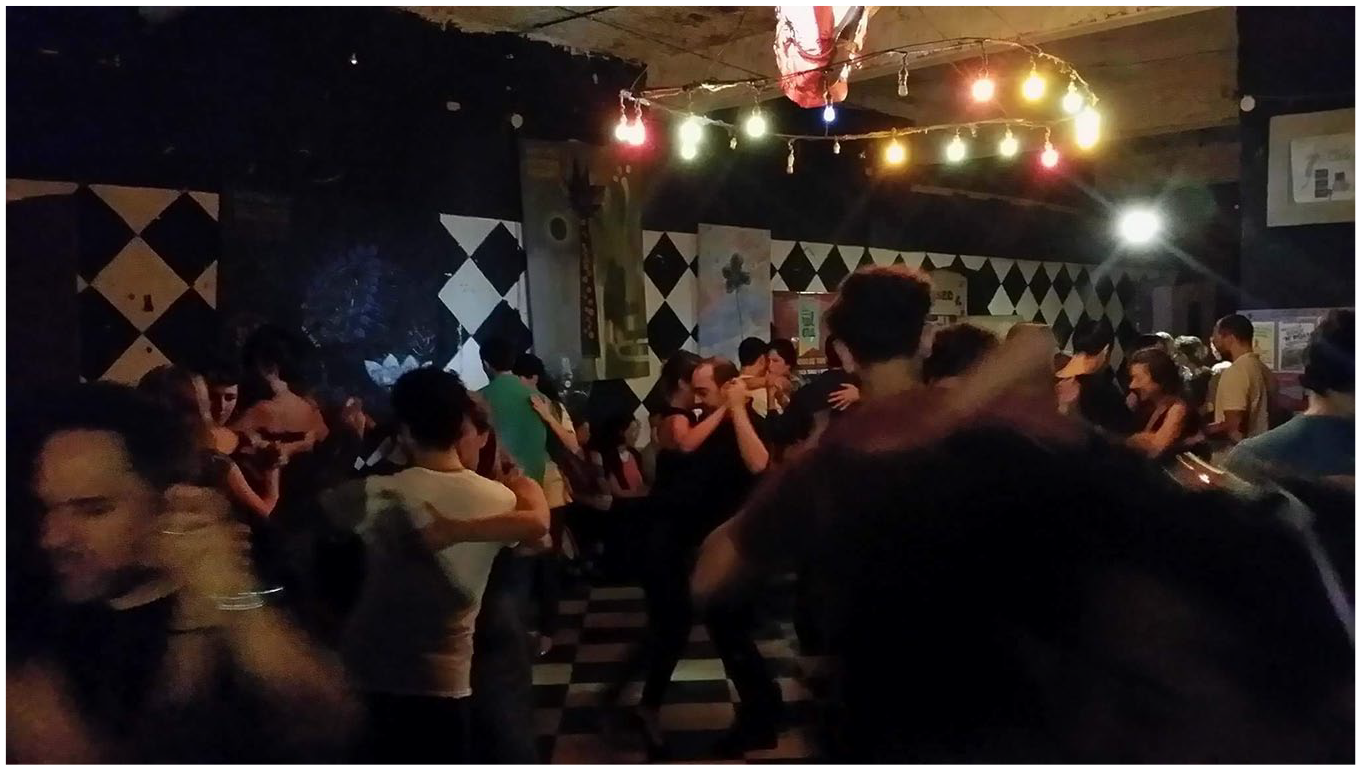
Fluid “naked” dancing bodies under our erotic gaze.
The way we experience organizational field research, and particularly ethnography, is very different from the methodological guidelines that we learn. We think we will go into the field with our comfortable researchers’ boots (or dancing shoes) and everything will eventually make sense. Yet, we often feel lost and clueless. Accepting that our whole being (including the field and personal experiences) is both what we study and the lens through which we study it, is a first step toward untangling the theorizing process. In ethnography, and even more in “naked” autoethnography, the self, much like the other, is a resource (Collins and Gallinat, 2013), since self-and-other awareness and the experience of researchers’ bodies in relation to their field are what make research possible.
In our dance, we felt our lived body (Grosz, 1994) and understood autoethnography as an embodied performance in being and writing, whereby the autobiographical impulse met the ethnographic moment through movement (Spry, 2001). We combined our bodily and sensual awareness with our dancing partners. We coordinated balance, energy, strength and the moving space we both occupied while dancing. We were attentive to each other’s moves to avoid colliding with other couples and to the other’s emotional engagement during the dance, to establish and maintain the connection: it is a shared responsibility. As in Hammer’s (2015) account of sighted and visually impaired cyclists riding tandem: it is not uncommon to “be the eyes” of our dance partners when they close theirs, or have a very limited field of vision due to the close abrazo. It “requires . . . a critical awareness of ‘body-to-body’ presence” (Hammer 2015: 515). It all becomes blurred kinaesthetically and synaesthetically while “being with” others’ bodies in the field.
Our naked dancing body becomes the site of intersubjective and inter-corporeal experience, which we argue is true of any immersion in the field and in organizational life (Bell and Sinclair, 2014; Fotaki et al., 2014; Thanem and Knights, 2019). This brings us to nuance the overemphasis on sight and observation as one of the main gateways to ethnographic field techniques. While we rely heavily on observation and the evocative visual capacity of writing down our tales, our observations are more often “quick than thick” (Wolcott, 1995: 90) and rarely live up to their promise (Bate, 1997). Ethnography is not just about getting a glimpse into others’ worlds and writing about them. It is about making sense of these worlds that are no longer just theirs but have become affectively ours as well (Fotaki et al., 2017), imbued with feelings, impressions, and struggles, all constructed through our shared, embodied, multi-sensory experiences (Spry, 2001). We share the idea that data is not out there waiting to be objectively evaluated and collected. It is instead relational, co-created (Riach et al., 2016), co-enacted and co-embodied. Ethnography involves collective reflection in situ; not in the aftermath of data generation (Gilmore and Kenny, 2015), but emerging in corpus at the intersection of cognitive, affective, intersubjective, and co-embodied power dynamics continuously evolving in the research field.
Beyond “going native”, which bodily-detached, anthropological and ethnographic perspectives consider a necessary step in the research process (Van Maanen, 2011), we thus argue that it is also about “going naked”. As we immerse in our field, we discover our incapacity to separate our researcher’s body from the actual body we inhabit, urging us to take off the researcher’s mask and expose ourselves naked to all who take part in our research life. Such “naked” ethnographic moments lead us to open up, and intersect with life beyond distant observation, making it impossible to understand intersubjectivity without considering its inter-corporeal dimensions. Our nakedness shapes our experiences and writing practices and should thus not be hushed or cleaned up, but should be welcomed and engaged with, including its unavoidable, gendered dimension: Who are you dancing with? Are you enjoying it? I am so jealous. I would so much like to make you dance like that. We decide, laughing nervously, to dance together. I switch from my traditional female role to offer you my male abrazo. Desperately trying to recall some male-role steps, my embodied female habitus fights against me, and I find it difficult to “lead” in a clear, fluid way. With shy smiles, we start moving, letting our inhibited muscles loosen up. I feel so embarrassed to move-dance with you. All my years of practice vanished in your beautiful presence.
Anxious; I didn’t want to make mistakes knowing that male partners often blame themselves for the female’s “inability” to follow their lead.
We try several things, stopping and starting again. We finally manage to dance for several minutes without stumbling or giggling. Your body merges with my husband’s body, my unnamed partners’ bodies, my own female body seeking an echo in your silhouette and rhythms.
Our tango movements bring us both into a deep sensual binding that is rarely shared with strangers.
Bodies performing a role play (Butler, 1988). It is generally only while dancing that I willingly submit to the female follower role that I am prescribed to perform, not only without protesting, but in fact enjoying it down to the last bone. They say the tango, and most Latin dances are macho practices, reinforcing patriarchal mechanisms. But while I’ve felt bodily harassed in other dances, I’ve never felt that with the tango.
As Davis (2015) argues, tango is so inherently bound with the passion making life meaningful, that feminists should not be an exception to that. Very hard to describe, yet fascinating to study.
How does it work?
I feel naked in front of me/you/her/him, again, as we step in the crescendos and the silences. Just like in the classroom as a woman academic (Bell and Sinclair, 2014).
We can escape no more in dancing than in teaching, than in writing, than in our moonlike cyclical existence as women.
As Moreno puts it: “In the field it is not possible to maintain the fiction of a genderless self. In the field, one is marked” (1995: 246–7). Moreover, our naked texts become crowded places, where invisible authors and readers intersect, ready to mark each other’s identities in transformative ways (Probyn, 1993; Stanley, 1992). We are haunted by others’ interpretations and discriminations of our sexualized nature (Beavan, 2019; Brewis, 2005; Dworkin, 1981; Thanem and Knights, 2019) in our field and writing encounters, and this is even truer when we are exposed naked, literally and symbolically. We cannot ignore this process of moving as sexualized females and males on the dance floor if we want to make sense of our field encounters.
When we dance, we experience passion and eros, which unsettle critical paradigms, creating a rift between politics and experience, and shaking normative understandings of gender and power dynamics (Davis, 2015). Exposing our gendered nakedness to each other on the dance floor appears as the condition for experiencing gender not as discrimination within the limits of heterosexual normativity and its violence (Dorion, 2018), but as the potential of our sensual, erotic, affective, relational and intersubjective becoming. This compels us to recognize that our material, gendered, leaky, erotic bodies are sites of knowing, understood within a relational epistemology. They are the springboard from which academic knowledge not subjected to instrumentality can then emerge, as a crystallization of the shared naked experience, before we “dress it up” with academic conventions, including masculine (supposedly universal and rational), gendered imperatives. Despite these conventions, the porosity of our texts (Brewis and Williams, 2019) exposes us naked to our co-authors, reviewers and wider audiences.
Finally, the Editor’s letter arrives. We sweat like when we first danced together. . . So much insecurity in our academic practice, like the insecurity, exposure and nervousness that we experience when we cannot follow the steps on the dance floor. Is there space for our nakedness, and its erotic inter-play, in our academic text?
This is where our ethnographic life takes place: in the classroom, in our field encounters with unknown others, as much in the arms of our dancing partners and on the screens of our readers, editors, reviewers and co-authors. All of these condition our methods. All of these sexualize, eroticize and mark our (gendered) identities in their different ways (Stanley, 1992), thereby deeply affecting what knowledge generation means and how it happens (Fotaki, 2011). Our autoethnographic nakedness, as experienced in this process, allows us to reinvent theorizing in our conflated personal and professional dancing, research, and co-writing practices intersubjectively, through the generating power of an erotic dimension, as is further disentangled and discussed next.
The potential of inter-corporeal nakedness as erotic intersubjective experience for researching and writing organizations
We were already a four-handed monster ruthlessly pounding on our keyboards. Now we had also merged into a four-legged chimera. Our feet chased each other on the dance floor like our words danced on the screen. While dancing with you, that night, I felt a deeply bisexual, erotic proximity, which I was so much enjoying. I was concerned that you might find it awkward or disturbing, but I hoped that you wouldn’t.
A psychological stress was blurring my steps, and part of me was secretly hoping for something to interrupt this tension. Yet, feeling our movements sweeping the dance floor was so wonderful; a complete surrender.
Dance-performing our naked eroticized embodied selves, and writing about it without asking permission or apologizing, seemed a relentless necessity. We are unable to research-live-write otherwise.
As we parted ways that night in Buenos Aires, I felt that we had been closely bound with a rare intimacy. We were now new “partners in words, steps, music, and laughter” (extract from Mar’s text-message that night); almost like lovers. The next day on the plane, I revived all these moments and anxiously wrote down “field” notes from our “shared life”, attempting not to forget anything important. Immersing myself in this process with all my senses acted as an anesthetic to the otherwise painful corporeal experience of my tight economy class seat. My heartbeats released all the corporeal joy and suffering carried in our abrazo.
You kept me up at night and clouded my thoughts during the day, while tango songs, asking questions about life, love, death, identity, solitude, and “desencuentro” (missed/failed encounter), were resounding in my head. I remembered Ernesto Sábato (1968), who recounts how one of the greatest lyricists calls the tango “a sad thought that is danced”. Dancing a thought means that the thought cannot exist without its inter-corporeal manifestation. So metaphysical, indeed! The poetry, the melancholy, the passion, the eros and anguish, even the failed (or successful) encounters can only appear in the moves we make together with our naked bodies.
By writing this together, our dancing autoethnography becomes an embodied dialog, a text like a tango-duet, performed jointly by our eroticized naked bodies.
Our tale ends but the story goes on.
As established in the above sections, the nakedness that we experience in tango enhances our awareness of how our bodies shape our connections with the material and immaterial environment, to which we are naturally bound with flesh and bone (Merleau-Ponty, 1964). It appropriates inter-corporeal research and writing practices (what Henry calls corpspropriation), which appear to us not only in the “light of the world”, but in the affective, subjective, and corporeal “light of life” (Henry, 1975) at the inter-corporeal level of “being with” others (Pérezts et al., 2015).
Dancing with as “being naked with” teaches us how to affectively relate and be sensitive to other bodies, how to synchronize our moves in our academic practices to the rhythms of our interactional repertoires and to theorize from a conflation of shared eroticism. Further, as any metaphor, tango simultaneously highlights and hides (Lakoff and Johnson, 1980). We dress our bodies in glittery clothes, we cover our faces with masks, and we edit our words with academic conventions. But our feet often hurt inside the high heels, we feel nervous about getting the moves wrong, our fingers dissolve from the cleansing writing norms. Errors, (im)perfections, affective and cognitive fragility and messiness are inscribed on our naked bodies, in our embodied research performances and relations with others, disguised by the synchronized moves that we make together, overshadowed by the stage lights, unheard below the music volume. Nakedness simultaneously exposes, covers, and transforms our shared vulnerabilities, inner affective dispositions, the cognitive and corporeal joy and suffering that we carry with us in our living researchers’ bodies.
Far from the experience of shame and vulnerability of the sexually-gazed upon naked body (Cover, 2003), this experience of nakedness immerses us in a humanly possible, erotic, inter-corporeal sharing, which gives place to effervescent expressions of love; the pleasure and awe of dancing in closed abrazo. We reflect our nakedness and its erotic interplay as we have lived it in our text. We purposefully write as we dance, experiencing our feminine, eroticized dancing bodies’ dialog as the only written gateway for revealing what is often shamed, unspoken, unwritten, but by no means unreal (Cixous, 1996); and without which our dance-text and our autoethnography of dancing would be meaningless.
We argue that only by liberating our naked academic bodies from the sexual gaze (Bell and Sinclair, 2014; Fotaki, 2011), only by rethinking our unavoidable nakedness as an enabler of genuine connections and becomingness with one another, can we access a space of truly affective relational academic exchanges (Lund and Tienari, 2019), like those we experience on the dance floor. Eroticizing our academic nakedness allows for a “reflexive un-doing” (Riach et al., 2016: 2071), which enables us to approach our research context with “openness and curiosity about the social world” (Spicer et al, 2009: 549, cited in Riach et al., 2016) to escape the nets of colonizing (masculine) epistemic superiority. This process includes our co-authors and even our editors, reviewers and readers, as the “ghosts” behind our pages—with whom we make collective sense of our inter-corporeal experiences—but also the subjects that we encounter in the field. Through nakedness, we can all bind together with the power of eros to redefine our academic subjectivities, research, and writing practices in purely relational, intersubjective, and inter-corporeal terms. These subvert the disembodied discourses imposed upon our bodies by a distant academic intellect (Lund and Tienari, 2019; Thanem and Knights 2019), to allow our embodied knowledge to experiment with its own aesthetically appealing freedom (Rhodes, 2019) through an academic co-writing that touches (Pullen and Rhodes, 2008) and performs new possibilities (Cixous, 1996).
Our account responds to and extends recent organizational literature debates stressing the need to understand how eros can create a space that includes the self and the other in body, heart, and mind to creatively transform our writing and broader academic practices (Bell and Sinclair, 2014; Dorion, 2018; Kiriakos and Tienari, 2018; Lund and Tienari, 2019). We also contribute to recent organizational autoethnographic accounts on writing differently (Beavan, 2019; Bell and King, 2010; Brewis, 2005; Brewis and Williams, 2019; Boncori and Smith, 2018; Helin, 2019b; Katila, 2019; Pullen, 2018; Thanem and Knights, 2019) by highlighting the relational potential of temporally, spatially, and materially situating and eroticizing academic nakedness from within and between bodies. We echo Van Maanen’s articulation (2011) that ethnography—and particularly naked autoethnography experienced through eroticized bodies—is not associated with specific research techniques, but remains open to improvisation and the situated experiences of the researcher.
Understanding what naked bodies can do in their erotic, inter-corporeal encounters, also joins recent attempts in pushing the potentials of embodied organizational research methods (Thanem and Knights, 2019) broadly, beyond the autoethnographic method that we employ here. It aims to uncover what the politics of regulation—regarding the naked, affective, and embodied aspects of doing and writing organizational research—have historically strived to censor and contain by making them a signifier for what is obscene, vulnerable, shameful, and opposed to reason. Writing through nakedness participates in efforts to subvert the academic status-quo that confines our bodies in the straightjacket of academic conventions, and stands against the widespread shadow of methodological rigor, defined and assumed as abstract and disembodied objective detachment (Ahonen et al., 2020; Mandalaki and Daou, 2020; Phillips et al., 2014; Rhodes, 2019; Thanem and Knights, 2019). Nakedness embraces and defends the vulnerable and the inter-corporeally erotic, instead of objectifying and denying it, pushing us to challenge traditional conceptions of who the researcher should be or how organizational research must be conducted.
Following Cixous (1996), we have to name the silenced; to reveal the sweat and blood of what has been cleansed and mutilated (Pullen, 2018; Pullen and Rhodes, 2008); to unshame shame (Beavan, 2019), in order to understand eroticizing our academic nakedness as an empowering act of courage and love (Dorion, 2018; Kiriakos and Tienari, 2018). Through love for knowledge and for each other, we can then access that much needed “moment of rapture, of recognition where we can face one another as we really are, stripped of artifice and pretense, naked and not ashamed.” (hooks, 2001: v).
Regardless of the method, future papers could thus explore how this erotic potential of nakedness might play out in other research practices such as interviews or shadowing, as well as how it might inform our interpretations of the contexts that we study.
Final steps, final words
Embracing our nakedness with eros as love allows us to fluidify our words through our moving bodies, and draw the epistemological understanding of our methods from our ontological erotic being-in-and-with-the-field experiences. This pushes us to reinvent the transformational potential of our inter-corporeal encounters to create new possibilities for dancing, living, loving, researching and writing together in academia. Such possibilities are neither the sign of diminished academic rigor nor mere resistance to the dominant academic order. They instead offer space for transformation toward a new academic world (Lund and Tienari, 2019), where we can build genuine, interpersonal relationships based on affect, care, and relationality, with heightened ethical (Fotaki et al, 2014; Pérezts et al. 2015; Pullen and Rhodes, 2014) and aesthetical possibilities. These will be particularly needed in a pandemic and post-pandemic era, where social bodies are restricted to confining, covering and cleansing their nakedness from fear of pollution and contagion. Reinventing our capacity to openly expose and eroticize each other’s naked bodies beyond sexual stereotypes, might enable us to truly relate again to shape hopeful futures in academia and society more broadly.
Much like dancing, living, researching, and writing do not just “happen”. They require intention: an invitation expressed through an open body, exposed, naked. . . It is about celebrating our naked being and writing, in all their corporeally shared mystery.
One, two, three, four. . .
the tango rhythm still resounding in my head. . .
I write like I dance.
Only completely with you. . . or not at all.
Shall we?. . .
Footnotes
Acknowledgements
We would like to thank the Editor and the Reviewers for their support and a particularly rich reviewing experience. We would also like to thank Alison Pullen for introducing us to each other as well as our colleagues and friends who provided friendly and helpful feedback throughout the whole process.
