




Abstract
Digital transformations have significant consequences for organizational attempts to shape their environments. Our focus is on how corporate political activity evolves in ways that require us to pay more attention to how information gets structured in digital spaces, and on how information ecosystems operate and shape strategic communication activities in organizational settings. We outline these digital transformations, offer a focus on corporate political activity as informational and develop a typology of datafied corporate political activity techniques to illustrate how the workings of digital spaces shape political issues more concretely. This serves to highlight the necessity of extending the focus of informational corporate political activity beyond the contents of overt and direct messages to include the more covert and subtle forms of influence made possible through the strategic structuring of information itself. This also contributes to our understanding of the political significance of corporate political activity, which is less about influencing political issues by composing appealing messages and distributing them to relevant audiences, and more about influencing political issues by organizing digital information and feeding algorithms. We suggest that such datastructures and algorithmic forms of sorting will become as important as message contents, and that datafied advocacy will become a central component of corporate political activity and other organizational activities.
Keywords
Introduction
This article sets out an avenue of research for critical scholars of organization by uniting and operationalizing debates about the digitalization and datafication of social life with broader concerns about the political dominance of corporations in society. Digitalization and datafication mark our present era (Beer, 2016; Mayer-Schönberger and Cukier, 2013; Van Dijck, 2014) with information processed through multiple digital platforms, different ways of sourcing and aggregating data, and advanced algorithms and visualization techniques which may be used to target, profile and manipulate people in opaque ways. These developments have been an issue of mounting public concern in a number of Western liberal democracies, manifest in inquiries about the manipulation of democratic processes and outcomes by law-makers in the United States and the United Kingdom, and in scholarly debates about the rise of ‘data capitalism’ (West, 2019) or ‘surveillance capitalism’ (Zuboff, 2019) and ‘algorithmic governance’ (Kitchin, 2017). The centrality of digital information systems in social life means that processes of datafication and associated algorithmic operations shape cultural developments (Striphas, 2015), affect decisions about what we consider relevant in social settings (Gillespie, 2014) and even reconfigure how we ‘work and think’ (Mayer-Schönberger and Cukier, 2013). In short, digital transformations have enabled new kinds of strategic action (Flyverbom and Madsen, 2015) and created a ‘pressing need for critical attention across the social sciences and humanities to be focussed on algorithms and forms of algorithmic governance’ (Kitchin, 2017: 13).
We propose that one way scholars of organization can attend to these technological and societal issues is through the study of how digital transformations create novel conditions for corporate political activity (CPA). There have been numerous calls for scholars to examine corporate attempts to shape their field of action (King and Walker, 2014), cultivate support for their role in society (Barley, 2007) and grapple with the democratic significance of CPA more broadly (Barley, 2010; Nyberg et al., 2013). That corporations engage in strategic efforts to frame issues and peddle interpretations is well established in the literature (Livesey, 2002; Nyberg et al., 2013; Oreskes and Conway, 2010), but such accounts are limited to a focus on the contents of information, that is, how corporate actors frame issues in particular ways through messages, and neglect changes in the structure of information, that is, the underlying infrastructure that renders particular messages visible and invisible to different audiences. This is particularly pertinent at present because recent digital transformations have brought about substantial changes in information infrastructures, evident in controversies (such as emerging forms of computational propaganda) that are not captured with existing approaches. These developments motivate our ambition to articulate how CPA takes a very different shape in digital and datafied information environments.
The line of inquiry that we set out addresses a shortcoming in our understanding of how corporate dominance of the political sphere is increasingly produced through information infrastructures, and enables organizational scholars to advance our understanding of societal changes associated with digitalization and datafication. This contributes to the literature on informational CPA by conceptualizing and illustrating corporate advocacy efforts that depend on structuring information and thereby extends the existing focus on information contents such as frames (Hall and Deardorff, 2006; Livesey, 2002; Nyberg et al., 2013). It also attends to how programming and design decisions in technology companies shape information environments, thereby adding a socio-material dimension to critical research that has emphasized how deliberative arenas lend credibility to the political claims of corporations (Nyberg and Murray, 2020). And beyond CPA, we contribute an analytical vocabulary for organization studies scholars wanting to do research on the hidden, technical structures of digital data as well as the workings and conditions of digitalization and datafication.
In the remainder of the article, we focus on ‘datafied CPA’ as an informational and communicative phenomenon that works through digitalized/datafied information infrastructures, what we term datastructures. Datastructures are defined as ‘configurations of digital traces that are organized and ordered in ways that allow for analysis, value extraction and connection to different forms of social activity’ (Flyverbom and Murray, 2018: 2), an idea that we elaborate in the following section. We subsequently review the literature on CPA, and highlight the potential benefits of paying attention to the structure of information in CPA, as distinct from the contents of information in the form of issue frames and messages. In turn, we develop our conceptualization of datafied CPA through a typology of datastructuring techniques that we illustrate with empirical examples. We conclude with a discussion of the broader significance of datafied CPA and the implications for research in organization and management studies.
Digital and datafied spaces as datastructures
Our article starts from a conception of a set of technical transformations associated with digitalization that, in turn, create new conditions for a wide range of communication activities. As Edwards et al. (2009: 365) suggest, ‘digital convergence is rapidly integrating most media, melding data processing and text editing with audio, video, and images’, and ‘information handling in many areas has shifted decisively from individual computers and local networks to more distributed grid or cloud paradigms dependent on ubiquitous links to and through the global Internet’. These and other digital transformations create novel conditions for how we produce, organize and circulate digital information. We refer to these socio-material entanglements as ‘datastructures’ that connect and shape human interactions (Flyverbom and Murray, 2018). Datastructures represent the culmination of several trends which involve (i) the emergence of social media platforms and monopoly-like technology companies, (ii) datafication in the form of a growing reliance on data as a resource for commercial and strategic processes and (iii) multiple forms of automated sorting and other technical solutions arising from the scale, speed and variety of digital information. As a result of these developments, many parts of social life are now mediated and structured through digital technologies and data: ‘the World Wide Web has become a sine qua non of commerce, government, and social life across much of the world’ (Edwards et al., 2009: 365).
Datastructures are ways of sorting and circulating information, and are both structured and structuring forces in the making of social realities and forms of ordering (Flyverbom and Murray, 2018). Datastructures are at play when Google (2019a) organizes the world’s information, when Facebook uses fine-grained personal data to target information to tailored audiences (Bond et al., 2012), when Netflix recommends a new series based on data patterns of users (Flyverbom and Murray, 2018), and as we show in this article, when corporations engage in novel strategic efforts to influence policy issues. Such work requires that multiple kinds of data are brought together, their formats made commensurable and readied for algorithmic sorting (Alaimo and Kallinikos, 2017; Gillespie, 2017). In more practical terms, this includes the use of mechanisms for sharing, tagging, liking, aggregating and connecting digital traces in ways that make them valuable as resources for targeting, measurement, mapping and many other purposes. As such, datastructures are the culmination of design choices (e.g. by software engineers about the operation of, and data sources for, an executable script), forms of sorting (e.g. the algorithmic operations executed by computer programs) and other socio-material forces (e.g. the recursive learning of computer programs based on the interactions of producers and consumers of information through the program interface) at work in digital spaces (Flyverbom and Murray, 2018). Social media platforms are a prototypical example of a datastructure, where user activities are translated into data points and aggregated into patterns showing, for instance, similarity and popularity (Alaimo and Kallinikos, 2017). Such ‘infrastructural, backstage datawork’ (Alaimo and Kallinikos, 2017: 175) is what we seek to highlight via the concept of datastructures. By attending to socio-material aspects of program design and recursive learning based on the monitoring of user interactions through the interface, the datastructures concept extends the more technical focus in emergent research on algorithms, platforms and digital infrastructures, which explores how data are sorted out and turned into knowledge, insights and intelligence that shape commercial, political and other social activities (Alaimo and Kallinikos, 2017; Beer, 2016; Kitchin, 2017). These developments have paved the way for dominant social media platforms and the disruption of existing business models in different industries, but also given rise to emergent concerns, challenges and problems in need of attention. Through their execution of technical operations, datastructures create affordances for particular ways of organizing and reworking data that may be used to target individuals, to manipulate online personas and to make particular types of information more visible than others.
Many scholars have noted how changes in datastructures raise matters of political concern, albeit without attending to CPA. Across a number of disciplines, considerable effort has been dedicated to unpacking the new nexus between states, citizens and technology companies. For example, in the aftermath of the Snowden revelations, one stream of research has examined the abuse of information technology by government agencies for the purposes of surveillance, including ‘delegated surveillance’ performed by technology companies (DeNardis, 2014: 13). This involves a move from targeted to ‘panspectron’ surveillance (Braman, 2003), a form of generalized and constant monitoring through which individuals become constantly visible. Concern with technology companies providing data to governments is also manifest in concern with more precise and granular opportunities for ‘algorithmic governance’ (Kitchin, 2017) through, for example, ‘social analytics’ (Davies, 2015) and ‘hypernudges’ (Yeung, 2017). A separate stream of research has tracked the use of technology in computational propaganda efforts to affect voter behaviour and election outcomes. Because digital information travels fast, can be organized in automated ways, and can be targeted at audiences with great precision, there are rising concerns about filter bubbles (Pariser, 2011) and echo-chamber effects (Krasodomski-Jones, 2016). In a similar vein, scholars have examined how the technologies themselves foster forms of harassment that potentially have a chilling effect on participatory democracy (Citron, 2014; Massanari, 2017). Such work captures the changing relationships between citizens and states, and the unethical motives of ‘big tech’ prioritizing growth and profit over responsibility and protection. Changes in datastructures are a political concern, and illustrate how a rapidly growing information technology industry modifies long-standing relationships within democratic societies.
We approach these concerns by exploring how datastructures fundamentally change possibilities for social action by illustrating these developments in the context of CPA as an organizational phenomenon. Digital transformations, we suggest, downplay the importance of the actual contents and human networks involved in communication, and instead make backstage issues of data curation and amplification central. As Gillespie (2017) stresses in his discussion of how digital spaces shape communication, ‘those interested in having their information selected as relevant will tend to orient themselves toward these algorithmic systems, to make themselves algorithmically recognizable [.] in the hopes of being amplified by them’ (p. 64). Our use of datastructures seeks to capture such novel conditions for communication and to highlight how the infrastructural, technical configuration of digital spaces condition practices of CPA. The premise of this article is that beyond worthy concerns with political manipulation and privacy violations, there is much to be gained by adding an additional line of inquiry to which organizational scholars can contribute. We seek to extend the above literature to consider how these changes more broadly create novel conditions for corporate influence.
CPA
CPA is defined as ‘any deliberate firm action intended to influence governmental policy or process’ (Getz, 1997: 32–33). CPA is understood to be mutually beneficial for firms and politicians, as a means to subsidize participation in electoral politics through the provision of goods, such as money (e.g. through donations), voter support (e.g. through constituency building) and information (e.g. through lobbying) that political decision-makers need to design public policy (Hall and Deardorff, 2006; Hillman et al., 2004). Mainstream research has focussed on the outcomes of CPA in terms of the financial performance of firms (Hadani and Schuler, 2013; Lux et al., 2011), contextual factors that relate to the likelihood of success for firms (Bonardi and Keim, 2005) and the range of strategies available to firms (Hillman and Hitt, 1999). Our concern is rather the broader impact of CPA on democratic politics, with a particular focus on strategies for channelling information from corporations into deliberations in civil society. We review the research literature on informational strategies of CPA and stress that most research focusses on strategies of influence in terms of the contents of information, that is, how corporate actors frame issues in particular ways through messages. What is largely neglected are forms of influence that rely on or are embedded in the structure of information. Building from our discussion on datastructures, we underline the necessity of developing a conception of datafied CPA which can attend to aspects, such as the control of information, problem definition and discursive terrain shaping.
Informational CPA strategies such as lobbying are directly relevant to our argument. In general terms, how corporate actors channel information and policy preferences to decision-makers remains the least investigated aspect of CPA (Rajwani and Liedong, 2015). This has been attributed to the fact that neither lobbyists nor the lobbied benefit from the disclosure of the specific nature of information exchanged (Drutman and Hopkins, 2013). Previous studies of information exchange between firms, their lobbyists and political decision-makers that are available have looked at the types of firms (e.g. firm size and sector) that engage in lobbying as well as antecedents for engagement (Lux et al., 2011; Walker and Rea, 2014). We do know that messages from lobbyists disproportionately target legislators who support their position, rather than try to persuade neutrals or opponents (Hall and Deardorff, 2006; Mahoney and Baumgartner, 2015; Schnakenberg, 2017). This curious finding suggests that the purpose and success of informational strategies depends on messages which frame the policy preferences of political decision-makers and relevant interest groups as shared or aligned. That is, the contents of messages sent by lobbyists to political decision-makers are designed to target the needs of overburdened legislative staff and facilitate legislators to arrive at their own (coincident) objectives (Hall and Deardorff, 2006). This recognizes that lobbyists and legislators work together on particular issues (Mahoney and Baumgartner, 2015), and that legislators are capable of communicating with each other (Schnakenberg, 2017). Political allies are potential issue champions who are provided with information on potential reactions and polls as well as procedural advice (Hall and Deardorff, 2006), targeted messages which frame alignment.
There is ample evidence that corporations also engage in informational CPA strategies that try to pressure political decision-makers by persuading the general public to adopt a particular position on a policy issue (Kollman, 1998). This has prompted scholars to call for more focus on the cultural and ideological work by firms to garner support for their causes (Walker and Rea, 2014), such as the techniques employed by and on behalf of corporate actors to seed doubt and manufacture controversy over the existence of climate change (Dunlap and McCright, 2011) to ‘undermine regulation by challenging the scientific foundation on which it was built’ (Oreskes and Conway, 2010: 148). Again, these studies focus on discursive strategies and the message contents embedded therein. For example, in their research on corporate attempts to influence the public debate on climate change in Australia, Nyberg et al. (2013) suggest this is achieved through corporate messaging that is analogous to framing alignment: crafting common identities with other civil society actors and synchronizing corporate interests with broader societal principles of economic and environmental good. Nyberg et al. (2013) provide a useful step towards understanding the political significance of informational strategies beyond private exchanges between lobbyists and the lobbied. Our ambition is to extend this focus on corporate political communication by developing a conceptualization of the conditions set by underlying digital ecosystems and ways of structuring information.
The critical scholarship we seek to extend makes clear that informational strategies are inherently political. To date, the focus in studies of informational CPA has been on the political significance of message contents, either in terms of framing alignment between corporations and civil society actors (Nyberg et al., 2013) or between interest groups and political decision-makers (Hall and Deardorff, 2006). The inattention given to structural aspects of information, the underlying guide rails that channel what is made visible and to whom, is problematic in light of the increasing importance of digital and datafied ecosystems in social life. These developments do not substitute for messaging or framing as an informational strategy, but present additional ways that CPA can be undertaken, including in conjunction with framing. These informational strategies represent a new challenge for conceptualizing the cultural and ideological work of CPA. To this end, we shift the attention to the machineries, infrastructures and other socio-material foundations that facilitate datafied CPA and supplement more visible forms of influence.
Developing a typology of datafied CPA
Organization theory has a long tradition of developing typologies that have identified variable features of organizations (e.g. organizational structure), facilitated the generation of hypotheses about variable outcomes (e.g. organizational performance) as well as increasingly complex intervening variables (e.g. organizational environment). These typologies involve the development of ideal types which condense environmental features and corresponding organizational adaptations in a stylized manner (Doty and Glick, 1994). Our approach speaks to such concerns in organization studies, through both conceptual articulation and empirical illustration. Due to data limitations, our typology has not been derived through a process of exhaustive empirical observation and classification based on commonalities that we formulate as decision rules, motivating us to undertake the construction of the typology analytically (Doty and Glick, 1994). In our case, this proceeded from the specification of environmental features (i.e. changes in digital information environments) and organizational adaptions (i.e. forms of strategic communication). With these two factors, we began working with a limited number of known empirical examples to conceptualize different ideal types. We did this by mapping CPA and organizational communication activities onto specific environmental changes as datastructure affordances, expanding and collapsing the number of ideal types until we exhausted the affordances we had identified. In turn, we substantiated each of the ideal types analytically through the identification of commonalities with other CPA and organizational communication activities that correspond with datastructures, grouping ideal types with common patterns of correspondence into definitions. We present these definitions as different techniques in turn. Although we illustrate these datastructuring techniques through empirical examples, the typology has been derived analytically as an attempt to offer a vocabulary for talking and thinking about the consequences of digitalization and datafication for CPA.
With datafied CPA, we want to highlight the practical ways organizations seek to shape issue definitions in ways that benefit their goals. Such activities tend to play out well in advance of what we normally associate with informational CPA. We outline a range of techniques and mechanisms at work in a series of illustrative cases used to extend and substantiate our conceptualization of CPA through datastructures. While we make an analytical distinction between the content and structure of information, we do not suggest that one supersedes the other in importance or that we witness a shift from one to the other. The point is rather that contents and structures are entangled in datafied CPA, and that a stronger focus on datastructures will enhance our understanding of CPA in a digital era. The logical presentation of how datastructures facilitate CPA might imply that these are discrete steps which can be taken in turn. This is a product of the way we logically break down the concept, rather than a representation of how datafied CPA works. Datafied CPA may relate to any or indeed all of the techniques that we develop, and may also co-exist with framing. Our point is that changes in datastructures create affordances for these techniques, and do so in in subtle and hidden ways that need to be understood.
Building political issues by exploiting how datastructures extract and display information
There are a number of ways of creating and feeding datastructures which can impact on whether an issue is considered to be a policy problem. Where lobbying provides information in messages to receptive political decision-makers about issues already on the agenda, CPA can also involve getting ahead of issues by defining problems and directing attention in attempts to set the agenda. This involves (i) the production, extraction and circulation of data which create an issue and (ii) conditioning how those data are found and made available for consumption. We term such work a matter of ‘building issues’. For example, through the creation of issue websites, interest groups publish and present their own data in reports, offer visualizations that purport to represent an issue and influence what data are available and how they are evaluated. Building issues also involves conditioning how data are received through practices such as tagging (e.g. connecting data with the issue definition) that promote (or demote) the discoverability of information by exploiting how algorithms read and rearticulate information (Gillespie, 2017). While any interest group can employ such tactics, corporations in particular have the motivation, resources and network capacity to provide data for public discussions across a range of settings in ways that condition whether an issue is considered important and subtly shape the limits of the discussion by defining what data are relevant. These extend the more traditional types of political activity set out by Barley (2010), such as when corporations enrol consultants and sponsored think tanks to produce reports on unnoticed issues – what Garsten and Sörbom (2018) similarly refer to as ‘discreet power’. These practices are enhanced through affordances in digital spaces, which allow the unfettered production, publication and circulation of data in ways that shape how users encounter information.
Building issues can be achieved through the provision of visualizations which purport to mirror reality itself. Visualizations are a portable format of information that is easily detached from context and circulated context-free, such as when the impact of policies is discussed in incomprehensible monetary terms like ‘trillions of dollars’. This facilitates the construction of an issue through identification and comparison against arbitrary or implied benchmarks. Such benchmarks are often hidden ways of connecting problems to solutions. In contrast to other forms of informational CPA, such as official statements and overt positioning on a given issue, the provision of seemingly neutral, factual and undisputable numbers, and data allow companies to remain out of sight and establish themselves as sources of information rather than actors with vested interests. Programmed interfaces, such as visualizations illustrate this form of issue building particularly well as they offer the appearance of ‘raw’ data that users can understand by operating toggles and switches. Through their representation of reality, visualizations render data as natural while contributing to the constitution of the issue. An illustrative example of this kind of data-based issue building through visualizations is the publication of transparency reports by technology companies, such as Google (2019b) and Facebook (2019), which provide data on how governments block, filter and take down information on the Internet around the world. Such reports nominate various threats to the continued existence of an open Internet and a broader vision about increased openness and transparency in societies and politics, for instance, in the shape of free flows of and access to information. At the same time, they direct attention away from the role of technology companies in the shaping of digital spaces through their design and programming decisions. Data visualizations, like numbers and photographs, appear to be ‘superior in objective reality than “mere” words’ (Hansen and Mühlen-Schulte, 2012: 455) or messages. In this case, building issues through the provision of structured data (rather than direct messages) provides the basis for public deliberation over the evaluation and significance of a given issue as well as the scope and orientation of possible policy responses.
Building issues also involves practices that condition which data users encounter through datastructures. Such practices involve attempts to direct traffic towards favourable data and away from unfavourable data. It also includes well-known techniques associated with forms of search engine optimization (SEO), such as promoted search, campaign websites, content farms and link farms, all tagged with hooks designed to catch and lead readers towards particular kinds of information. The significance of Internet platforms and digital technologies relying on algorithmic sorting procedures is that they gain the ‘power to grant visibility and certify meaning’ (Gillespie, 2017: 76). As a result, those in need of visibility or striving to stabilize particular meanings must make their information ‘algorithmically recognizable’ (Gillespie, 2017). We tend to think of algorithms and other mechanisms used to sort data out as automated, technical procedures. But like all other technical systems, they have been created for particular purposes, are based on distinct assumptions, and value some kinds of information over others. Actors seeking to shape opinions will be more successful if they provide content that fits the criteria recognized as relevant and valuable by digital platforms. By circulating particular kinds of information and strategically structuring how people encounter them, organizations can intervene and shape opinions in subtle, yet powerful ways.
Efforts by UC Davis to bury negative news coverage about an incident on campus offer an illustrative example of such datastructuring work. The original 2011 incident, in which graphic images of a police officer’s excessive use of pepper spray in response to a sit-in by student protestors, had become synonymous with UC Davis in search results (Stanton and Lambert, 2016). The reputational solution sought by the university was to try to demote the position of the offending images in the database. To do this, they engaged SEO consultants to ‘expedite the eradication of the pepper spray incident in search results’ (Stanton and Lambert, 2016) through tactics such as strategic content placement. It is worth noting that we know about this example due to UC Davis being a public institution with obligations to make disclosures in response to information requests. Ironically, in this case, the subsequent publicity of the attempt to manipulate search results only reinforced the links within the network that UC Davis sought to break. Apart from reports on the growing size of the SEO consulting industry, we have limited knowledge of this type influencing activity being done, which is again suggestive of the subtle ways in which datafied advocacy can take place and reinforces the need to conceptualize how it works. The capacity to teach networks to promote or demote particular information has political significance, and suggests that political issues are built by providing or denying particular data prominence in public debate through the manipulation of networks.
Representing political credibility by exploiting how datastructures draw associations
Datastructures can also facilitate favourable evaluations of issues through the suggestion that there are credible third-party groups who verify the claims of corporate actors. This is one way that datafied CPA can be employed to verify truth-claims through particular networks of actors, portraying support for political claims and so increasing pressure on political decision-makers. For example, due to their capacity for recursive learning based on reading patterns of information, datastructures can be taught to form associations between particular issues and desirable spokespeople. Tobacco and fossil fuel industries have an extensive history of deploying front groups and think tanks to manufacture doubt and undermine policy action (Oreskes and Conway, 2010). For example, Moodie et al. (2013: 674) point to the example of Philip Morris’ ‘Whitecoat’ project to hire doctors to author ghost-written studies purporting to negate links between secondhand smoke and harm, a form of informational CPA intended to confuse matters and thereby forestall policy action. For our purposes, the digitalization and datafication of information significantly reduces the costs for the creation of such front groups, enables rapid distribution and reduces the likelihood of detection. The low costs associated with digital transformations and the reliance on datastructures also enable extensive duplication, increasing the scale and reach of such organizations and enable timely resurrection should detection occur.
Representing credibility works through the creation and promotion of seemingly authoritative groups and specifically nominated spokespeople. This creates voices in civil society which appear to offer third-party validation for preferences consistent with corporate interests, a kind of political laundering and may also involve discrediting opposition voices. This is similar to the kind of textual mobilization referred to as a ‘hall of mirrors’ by (Murray et al., 2016) in their analysis of an informational CPA campaign by the Australian mining industry. In their study, statements by civil society actors were offered as verification for the claims of the mining industry, even though the claims originated from the industry themselves. Modern public relations firms promote the use and efficacy of taking this approach in a datafied environment. A leaked presentation by Berman and company, for example, explains the ease and importance of establishing doubt, coupled with the importance of channelling funding through not-for-profits to avoid detection (Lipton, 2014). The leaked presentation identifies previous campaigns, issues websites and front groups. In many ways, this kind of datafied CPA involves the migration of political dark arts into the digital environment. The effect is to validate particular political claims as credible, thus rendering corporate-backed issues legitimate for deliberation.
Similar phenomena include efforts to rig the outcomes of online polls and surveys, and the provision and circulation of fake reviews and consumer recommendations (Malbon, 2013). As commerce and marketing increasingly relies on digital platforms where products cannot be seen or touched directly, the views and experiences of other consumers have become a primary way to assess quality and build trust. But it is very difficult to assess the authenticity of online reviews, and consumers may act on information that is fabricated or strategically structured (Malbon, 2013). Furthermore, because individual reviews and comments are often aggregated and combined into numbers-based recommendations and visualizations, the origin of a review quickly becomes opaque, regardless of whether it is produced by an actual person or a ‘bot’. Some of these issues are about false information, for example, when companies pay agencies to improve their reviews and rankings, or pay someone to write fake reviews or endorsements (Malbon, 2013). But they also take more subtle shapes. In line with our focus on CPA exploiting datastructures, it is important to keep in mind that much of the activity underpinning online reviews is largely opaque to consumers: Built into the tools themselves are filters, assumptions, biases, and outright distortions that never can be factored into a user’s credibility decision (Friedman et al., 2006). This point is completely missed in nearly all examinations of how users make credibility decisions (Lankes, 2007: 104).
Where earlier forms of informational CPA like ‘outside lobbying’ (Kollman, 1998) focus on persuasion through the promotion of problem definitions and solutions, datafied CPA shifts the emphasis to circulating plausible digital traces and facilitating their entry into relevant contexts and aggregations of information. Political claims can quickly transform into credible issues for deliberation when they are presented as a shared understanding of reality by third parties, regardless of whether the third parties themselves can be verified.
Choreographing publics by exploiting how datastructures track user activity
Issues can also be manipulated through datastructures in ways that suggest interest groups or publics are actively engaged with the issue and seek change as a priority. Distinct from the portrayal of acceptance of problem definitions, this involves the portrayal of broader support for proposed solutions. For example, the recursive learning of software that reads patterns in datastructures can be used to aggregate and disaggregate the characteristics of users in different ways, enabling the creation of credible fake users and user-groups. With these strategies, interest groups or publics are amassed and attached to issues, sometimes independent of whether these groups actually do support these positions, and sometimes independent of whether these groups exist. Broadly, this involves attempts to shape perceptions by portraying very narrow positions and special interests as having greater importance than, and/or support from, general interests or social movements. Informational CPA typically features an explicit or implicit claim to represent a broader public (Nyberg et al., 2013) and so ‘astroturf’ campaigns are not necessarily new (Walker, 2015), but turbocharged by developments in digital technology. Tactics such as digital astroturfing have been facilitated by the emergence of datafied communication environments where it is even more difficult to ascertain the authenticity of supporters and advocates.
As Stohl et al. (2016) stress, tools such as ‘persona management software’ make it cheap and easy to create fake internet protocol (IP) addresses and users that can act like humans to mobilize and manipulate datastructures in digital spaces – comment, click and otherwise support the circulation of particular arguments or statements. Such ‘bots’ or ‘sockpuppets’ are increasingly central in advocacy efforts. Technology companies have been among the most aggressive users of similar tactics. One example from the ‘ride-sharing’ taxi-service provider Uber illustrates this well. Faced with a proposed regulatory reform which would slow the amount of new licences granted to for-hire vehicles in New York City, Uber modified their application with a (city mayor) ‘De Blasio mode’ for users in New York (Tepper, 2015). When activated, De Blasio mode would alternatively display that there were no cars available or list 25-minute wait times, and then prompt users to ‘take action’ with an ‘email now’ button. Here, the political action of emailing a representative is embedded in the application, collapsing the distinction between user and supporter and communicating that people care about this issue in the way that the company does. Uber claimed that 20,000 users emailed City Hall in the first 5 days of their campaign against the proposal (Smith, 2015) which was soon taken off the agenda while the city conducted a study (Lapowsky, 2015). In this example, choreographing publics depends on building issues. Uber created its own data projections about the impact of the new policy to inform and prompted users to signal support for Uber’s position, even though it is nonsensical to argue that slowing the rate of additional for-hire licences would mean that existing for-hire cars disappear. Because digital technologies make such campaigns possible on a large scale and in such short timeframes, it is possible to dominate discussions and overwhelm decision-makers and opponents by flooding sites with messages and other forms of interaction. In this type of datafied CPA, rather than channelling helpful information to receptive political decision-makers, platforms become tools for the expression of corporate interests by publics.
Fuelling political polarization by exploiting how datastructures target audiences
By recursively channelling information to different audiences, datastructures can influence whether and how participants engage in deliberation over particular issues. Although some have focussed on the potential for particular modes of sharing content (e.g. online harassment; Citron, 2014; Massanari, 2017) to have a chilling effect on democratic participation, our emphasis here is on how datastructures enable this content to flow to discrete audiences and facilitate the formation of ‘echo chambers’ (Krasodomski-Jones, 2016) or ‘filter bubbles’ (Pariser, 2011) that contribute to increasing polarization and so hinder deliberation (Sunstein, 2017). Here the contents and structure of information work in tandem. This type of CPA depends on the use of advanced big data techniques to profile audiences at the level of individuals, and to use such fine-grained insights to target them very precisely and directly through datastructures. The proliferation of private companies engaged in the aggregation and correlation of digital traces (Crain, 2016; Federal Trade Commission, 2015) for purposes of profiling – so-called data brokers – are central to these emergent forms of political activity. Social media platforms can be scraped and other types of data can be compiled through online quizzes and similar ways of getting people to disclose their preferences, reactions and patterns of behaviour, while also sharing information about all their friends and connections. Data brokers thrive by harvesting thousands of data points on millions of individual users through a variety of sources (Crain, 2016; Federal Trade Commission, 2015). Based on these sources, data brokers are able to develop very fine-grained profiles for targeting purposes. Such techniques make it possible to focus on large numbers of individuals, each with their own profile and receptiveness to particular information. Couple with the ease and speed with which digital information can be distributed, it is possible to target individuals with so-called ‘dark posts’ that reach only the selected person and are attuned to the exact needs or soft spots of that individual. Feeding people particular kinds of information, without telling them directly what to buy or what to vote for, can be forceful ways of guiding their attention and behaviour. The individual and micro-targeted nature of such forms of influence gives little possibility for alternative viewpoints or debate about the truth-value of the information. This type of advocacy has the potential to work on a more epistemological level: rather than contending groups with opposing world views seeking solutions to commonly acknowledged problems, those holding opposing world views may be seen as brainwashed victims of manipulation and false claims. New affordances in datastructures may increase the likelihood of building successful advocacy strategies predicated on keeping audiences apart and preventing broader engagement, thereby privileging dominant actors.
Fuelling polarization depends on the use of datastructures to sort and target information differently for discrete audiences. The Facebook manipulation experiment by Bond et al. (2012) illustrates the datastructuring aspect of this well. In their experiment, the same message was framed in different ways, the control group receiving a message with informational cues and the test group receiving the same message with social cues (that they were participating in an experiment was hidden from users). In their results, Bond et al. (2012) suggest that framing the message as social rather than informational positively impacted the likelihood of acting on that message. To some extent this is a simple story of framing effects (i.e. information contents), variability among audiences in response to having the same information presented in different ways. However, the findings also speak directly to our focus on datastructures. The variability between control and test group also depends on the capacity of datastructuring to separate these two groups, and further, on the capacity of the control and test groups to share information among their own networks. That is, the story is incomplete without attention to the socio-material entanglement of these social activities with the underlying datastructures that control information flows.
Much of what we receive in our social media feeds is selected and curated, and only parts of what we share on digital platforms reach our followers or audience. One in three Facebook posts, for instance, does not reach the audience (Gessler, 2017), and this raises questions about how social media platforms control information and guide our attention in largely covert ways (Gillespie, 2018). The focus on datafied CPA invites us to push beyond questions about the freedom to express opinions and invites us to also consider what you can think of as the freedom to receive information (Flyverbom and Whelan, 2019). All these activities speak to our concern to unite datastructures with CPA.
Datafied CPA and organization studies
The techniques that we have conceptualized within organizations are influenced by and dependent on developments in other organizations, predominantly technology companies. The digital, datafied ecosystems presently reformatting the public sphere represent a deliberate project by technology companies. The data they extract from the provision of platforms for the circulation of information are the most valuable resource in their business model. We now shift our focus to consider technology companies to surface the socio-material aspects of design choices and data extraction based on tracking users (West, 2019) and draw out some of the broader consequences of datafied CPA in democratic societies. This implies a conceptualization of datastructures as a form of ‘epistemic architecture’ that conditions the circulation of information (Costas and Grey, 2016: 115). With this broader analysis, we dive into questions about how datastructures are part of the emergence of rather different information ecosystems that create novel conditions that extend beyond datafied CPA and have effects on social issues and political discourse more broadly.
Two issues emerge from our focus on datafied CPA. First, the technology companies that design datastructures emerge as agents to and technicians of power. 1 This is touched on in scholarship about ‘delegated surveillance’ (DeNardis, 2014), ‘social analytics’ (Davies, 2015) and ‘hypernudges’ (Yeung, 2017) where technology companies work for governments to monitor or influence citizens. We extend these concerns by highlighting that corporations (as well as states) are well placed to gain political (not only commercial) advantage from these changes. Datafied CPA depends on the capacity to structure information, and the techniques we have illustrated range from the production and publication of data, teaching datastructures through tags and links to other data, issue definitions and desirable spokespeople, to forms of digital astroturfing that involve the coordination of networks of users. By enabling new ways to draw associations between different data, technology companies contribute subtly to the definition and constitution of issues, and promote some forms of expertise over others in a manner analogous to ‘techno-politics’ (Mitchell, 2002). Beyond becoming vehicles for corporations to engage in new forms of informational politics, the primary forms of expertise recognized in technology companies (e.g. software engineers, ‘data scientists’) and their underlying value systems (commercial and cognitive) become more central to how societal debates unfold. For example, the commercial values of technology companies privilege expertise in forms (e.g. entertaining, shocking) that elicit user engagement and demote diverse other forms. In this sense, technology companies play host to a value-laden struggle over what constitutes expertise where their own values are a factor. As social life is increasingly formatted through datastructures, political power corresponds to the ability to exploit their operation. With datafied CPA, corporations are able to produce new forms of political influence.
Second, the socio-material aspects of datastructures point to further implications of datafying private speech for commercial purposes. Again, these are distinct from problems with how users connect to one another through the platform such as harassment (Citron, 2014; Massanari, 2017), and instead relate to how users and information are shaped by design choices in digital contexts. As more user activity produces more data, algorithms are designed to read, predict and connect users to the information most likely to keep them engaged. Beyond the likelihood that users encounter information that advertisers have deliberately placed in their path, users also learn about themselves through recommendation algorithms. For example, based on data, algorithms open information pathways based on the analysis of what ‘people like you’ want. With this, users are offered a choice from the prefabricated political identities on offer, based on their previous and potentially formative experiences, rather than allowed the time and space to develop a political identity in private. The notion that social media companies offer a political-identity-in-waiting that users gradually grow into through recommendation algorithms is suggestive of the unwitting cultural and political power that has been realized in the hands of social media giants.
Datastructures have broader commercial and cultural consequences as these epistemic architectures condition how we come to see and engage with both physical and cultural products. These developments invite us to return to fundamental questions about the role of editing and curation of information when it comes to shaping how we view the world (Lippmann, 1922) and how power gets institutionalized (Foucault, 1977). As we have suggested throughout this article, digital ecosystems create new dynamics and conditions for social ordering. Another way to conceptualize these developments is to stress that digital ecosystems seem to turn metacommunication into communication (Boellstorff, 2013), and form into action (Easterling, 2015). That is, messages and contents – and the way they are framed – may become less important than the way information is organized, and comes to act as a primer for particular kinds of interpretations and influence. Datafied CPA is a way to think about such novel forms of advocacy that are technological and infrastructural rather than cognitive.
Discussion and conclusion
This article has identified what we coin ‘datafied CPA’ – new, informational forms of CPA that exploit specific affordances of digital communication spaces. Our articulation of datafied CPA is distinct from yet reinforces broader public and scholarly concern about societal changes associated with datafication (Beer, 2016; Kitchin, 2017; Mayer-Schönberger and Cukier, 2013; Zuboff, 2019) such as the misuse of these technologies for mass surveillance (Braman, 2003; DeNardis, 2014) and challenges for democratic participation (Citron, 2014; Massanari, 2017). Our approach highlights new forms of CPA that depend on the production and circulation of digital data and require that we look beyond the messages and frames offered by contending interest groups and also attend to how information is structured to facilitate issue discoverability, manage issue salience and undermine deliberation. The datafied CPA tactics we have elaborated have the potential to pre-determine issue definitions and so subtly shape the discursive terrain of deliberation, even bypass deliberation altogether. To articulate our conceptualization, we have relied on illustrations of corporate attempts to shape political issues. This is motivated by a concern that corporations can and do employ these tactics, often in hidden ways. These illustrations and our conceptualization suggest the need for more research on the infrastructural and conditioning foundations of communication in digital spaces – what we can think of as an increasing importance of metacommunication (Boellstorff, 2013; Jensen and Helles, 2017).
Our focus on new forms of datafied CPA enabled by changes in digital environments is specific and there are limitations to our approach. First, the political activities that we identify are not restricted to digital environments. The forms of datafied CPA that we identify are only new as far as they are digital variations of old forms of political activity (see Table 1). Nevertheless, they are effective modes of CPA and, through our typology, we provide an approach to their study. Second, the datastructured types of CPA that we identify are often already entangled in some way with contents and messages. We have argued that the distinction between contents and structures is significant for understanding changes in CPA information strategies which go beyond messages and frames to consider the structuring of information. The separation between contents and structures of information is analytical, and in our typology, messaging and structuring tactics can complement one another. Making this analytical distinction between messaging and structuring further helps to identify and unpack relationships between different techniques in future studies. Third, we have limited the discussion to CPA specifically. We believe that CPA is one of the most significant illustrations of the importance of attending to changes in the information environment because corporations have the capacity, resources and motivation to employ these techniques. These tactics are not the exclusive domain of corporations, and other interest groups are able to exploit the hidden and opaque nature of information infrastructures to shape issues in a manner favourable to their own political agendas.
Typology of datafied CPA techniques.
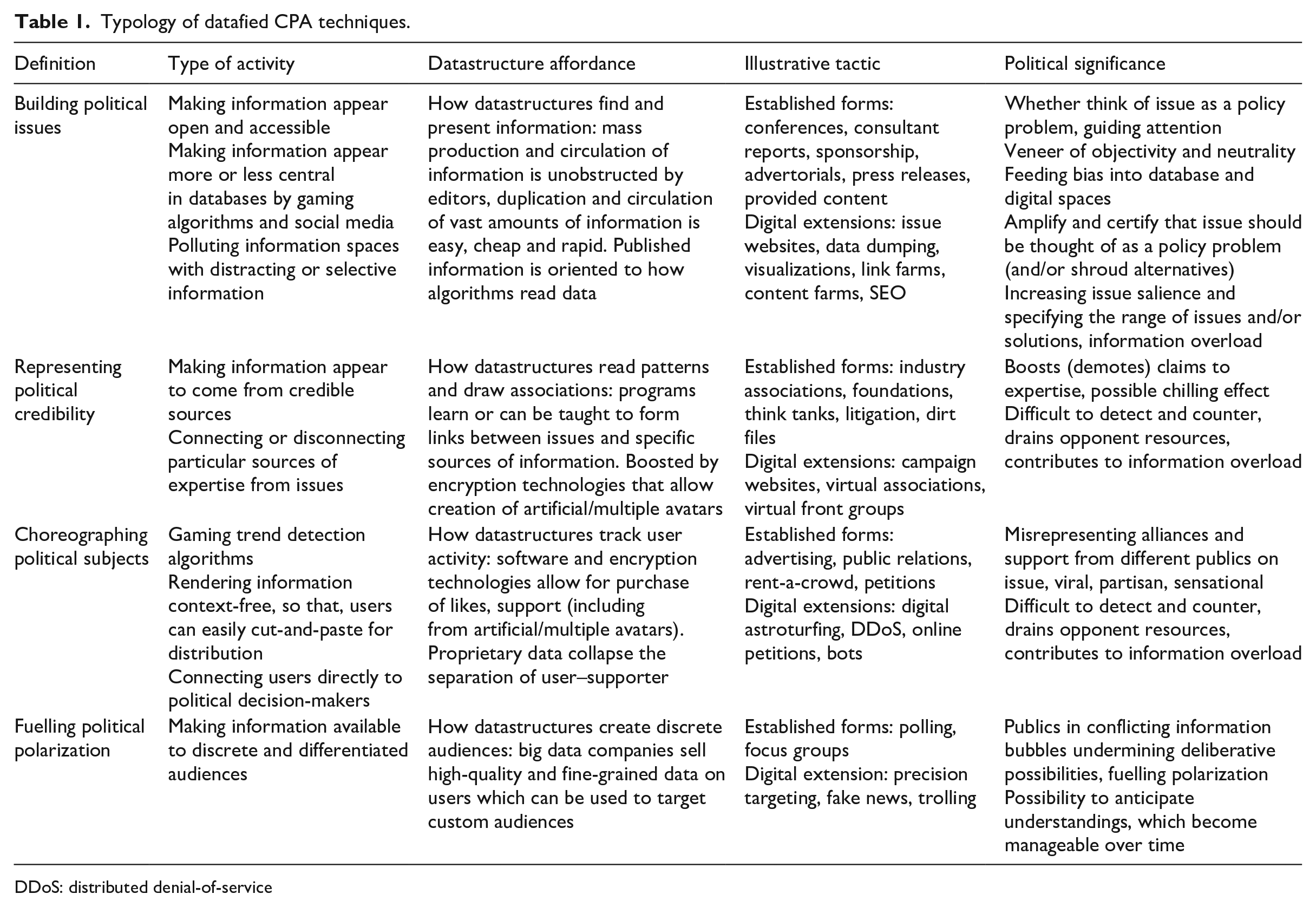
DDoS: distributed denial-of-service
That any interest group can exploit the working of datastructures points to the significance of our typology. An optimistic reading would suggest that because these affordances are open to all interest groups, the shape and workings of datastructures are fundamentally democratic and therefore harmless. We are more pessimistic, and our focus on CPA seeks to draw out specific aspects of how datastructures facilitate an unequal opportunity for issue definition. This is coupled with the observation that much deliberation is hosted on social media platforms, with unequal access to deliberation. Unequal access to deliberation over unequally defined issues suggests civil society groups may be outmanoeuvred before contention. Competition between interest groups is not a solution when the discursive terrain for the competition is itself shaped by one side. In this way, we can think of datastructures as both reflective of existing power relations and generative of new forms of power. They constitute a new resource that emergent or critical actors can engage with in their efforts to counter corporate strategies and dominance, but one that is also productive of corporate dominance in ways that allow already powerful actors to strengthen their positions and impact.
The emergence of datafied CPA raises broader concerns. We have developed a typology analytically rather than through exhaustive empirical observation, which may undersell the significance of our argument. The emergence of bots posting as if they were humans, fabricated reviews and the pollution of online spaces with data deluges that make it difficult to navigate and distinguish between different kinds of information, are all episodic illustrations of the opportunities that are created by datastructures. But these episodic examples can have aggregate effects. Practices of salience manipulation may undermine public trust in a wide range of organizations: if NGOs are considered to be front groups for other interests, if resistance groups are dismissed as false flag operations, and companies are able to alter their online review scores as they please, it becomes more difficult for all of these types of organizations to maintain their authority and credibility. The only winners, it seems, are the industries developing and supporting these kinds of datastructuring services. In many ways, the fabrication of such forms of infrastructural metacommunication around issues and publics create distortions and illusions that propel organizations into new terrains, where categories such as true/false and real/representation no longer make sense (Flyverbom and Reinecke, 2017). The point is not that popular views and outcries problematize expert forms of knowledge, but that the very foundation of relying on information as a source of action and insight is challenged. At an aggregate rather than episodic level, the effects of datafied CPA appear to be corrosive on democracy itself.
Our article makes several contributions. First, we invite organization studies scholars to engage with questions about digital transformations by articulating the workings and importance of new communications environments for organizations. This speaks to emergent concerns about the political significance of technological developments (Kitchin, 2017; Zuboff, 2019) and positions them as organizational phenomena by specifying how datastructures shape practices both within organizations and in inter-organizational practices that contribute to the assembly of political influence. Rather than approach digital transformations merely as channels for new digital forms of distribution and modes of engagement, or in terms of their macro-effects on society and politics, we suggest that a focus on datastructures may be useful for scholars seeking to make sense of how the changing nature of advocacy and influence is organized. Engaging with datastructures raises new questions about traditional concerns in organization studies in relation to power and politics, how new forms of representation construct social worlds and legitimize particular voices and forms of expertise within organizations and society.
While we focus on political communication, the techniques that we conceptualize also contribute to strategic communication more broadly. In operational and strategic terms, the ability to create issues through the manipulation of datastructures can be an effective and durable way of shaping perceptions. In times where political uproar seems to erupt and disappear instantaneously, organizations and individuals may consider the possible value of alternative approaches to advocacy, such as those we have articulated here. By structuring information to exploit how information is made available, organized and associated with other information, it is possible to have much more far-reaching and long-standing impact. As Durham Peters (2015) puts it, media are ‘agents of order’, not just transmitters of information. For corporations and others seeking to shape public opinion and political agendas, the power of doings things with information without having to speak out is an overlooked aspect of communication and an important avenue for future research and strategizing in corporate and political advocacy. Although these can be applied by organizations, our ambition by articulating them is to enable further scholarly analysis and critique.
To this end, we have developed and illustrated a typology of datafied CPA which is our second contribution. Our conceptualization of datafied CPA highlights the role of datastructures in advocacy, as well as how changes in datastructures enable new forms of political communication (see Table 1). This conceptualization extends and complements the existing focus on messages and frames in the literature on informational CPA. Where the existing scholarship on informational CPA strategies emphasizes the contents of messages (Hall and Deardorff, 2006; Livesey, 2002) such as how they construct and align identities with other civil society actors and representations of common goods (Nyberg et al., 2013), we suggest that informational CPA can be advanced through an additional sensitivity to how datastructures circulate information. This analytical distinction between the contents and structure of information allows scholars to account for the ways that messages flow to discrete audiences without subtracting from the analytical insights that can be derived from analysing forms of political strategic communication as messages. Our illustrations hint at the ubiquity of these information structuring practices which presently go unexamined, in part due to the absence of a conceptual language – which we offer – to explore their workings and political significance. If, as we argue, digital transformations will make datastructures more important, such developments will have ramifications for many parts of organizational life beyond strategic communication. Cast in slightly grandiose terms, discussions about datastructures may enter organizational research in all the same areas where more general questions about knowledge production have played a role.
Finally, our conceptualization of datafied CPA extends research in CPA more broadly through the development of an explicitly political type of information strategy. This substantially expands CPA beyond the traditional focus on the provision of goods such as money, votes and information to political decision-makers (Hillman et al., 2004). Datafied CPA is more than a new form of CPA, it is also a new, discreet form of power (Garsten and Sörbom, 2018). Where existing studies tend to focus on whether CPA ‘pays off’ for the firm in economic terms, such as returns on investment, our conceptualization highlights CPA in the inescapably political terms, the absence of which has been repeatedly nominated as a deficiency of CPA research (Barley, 2010; Nyberg et al., 2013). These political terms involve tactics that shape the definition of the issue around which interests are formed, even the discursive terrain on which particular issues are debated, and our conceptualization allows scholars to attend to these tactics in future studies. Our conceptualization highlights a neglected socio-material aspect of this literature in that this discursive terrain is organized by particular forms of expertise, such as computer programmers and software engineers within technology companies. This supports recent critical scholarship that has emphasized how particular arenas of contestation lend credibility to the political claims of corporations (Nyberg and Murray, 2020) and is suggestive of how CPA can influence the arena in which political contestation takes place (Nyberg et al., 2017).
Our focus on CPA has attended to resourceful, motivated actors with the capacity to exploit affordances in digital information environments. With datafied CPA, we invite an examination of how organizational actors influence the broader terrain of deliberation, and of how digital spaces shape issue definition in ways that boost or demote issues or voices in public debate. This agenda presents an opportunity to advance a uniquely organizational perspective on how the ongoing transformation of information systems in society is disrupting democracy itself.
Footnotes
Funding
The author(s) disclosed receipt of the following financial support for the research, authorship and/or publication of this article: John Murray thanks the Tore Browaldhs foundation for funding which facilitated the research for this article.
