



Abstract
Community supported agriculture schemes are a prominent example of localized alternatives to the global food system. They are presented as alternative nodes of food production, where the consumer experiences a much closer relationship to the produce they are consuming and to the labour involved in producing it. They lift the commodity veil by inviting the consumer into the world of production – of labour. However, there has been little analysis of labour undertaken in the setting of community supported agriculture, particularly the labour of community supported agriculture consumers, or members. Marxian analysis of the food system at the macro level has underpinned powerful critiques of its shortcomings and highlighted inequalities of land and labour, but has rarely been employed to understand the possibilities of alternative food networks at a more micro level. In this article, I draw on Marx’s concept of alienation to explore the experience and organization of labour within a community supported agriculture scheme in the United Kingdom. In doing so, I present a case study of how labour in a community supported agriculture scheme counteracts experiences of alienation created by capitalism and consider how this might inform (re)organization of labour in the food system, more generally.
Introduction
Value organizes labour (Harvie and Milburn, 2010), defining the conditions and experience of labour. In the global food system, the organizing logic of capitalism prevails, as a result, agriculture in the United Kingdom has become increasingly mechanized and takes place on fewer, yet larger farms with bigger fields, less hedgerows and less workers. This trajectory has been determined by a continuing need to realize profit in the production of food and do so through ever more efficient methods. Judged by the organizational logic that follows from a capitalist value system, community supported agriculture (CSA) schemes are an aberration. However, a growing literature on alternative and local food has sought to question capitalist organization of the food system and put the case for organizations of labour that do not prioritize profit over other considerations (Cleveland et al., 2015; Klassen and Wittman, 2017).
Thompson and Coskuner-Bali (2007) single out CSA as a distinctive organizational form of alternative and local food. They position CSA as a countervailing response to the failings of the conventional or global food system in comparison to other forms of alternative and local food, which are not substantively different to the mainstream food system that they purportedly resist (Smith Maguire et al., 2017). CSAs offer an alternative and unconventional model of exchange, which involves paying in advance for a ‘share’ of produce, usually for a season or year, which typically takes the form of a weekly vegetable box (Schnell, 2013). In contrast to seemingly unlimited consumer choice and uniformity, CSA members narrow their options and accept a degree of unreliability and unpredictability, in both the quantity and quality of food they receive. This arrangement inverts the conventional structure of market exchange: Consumer sovereignty and freedom of choice are supplanted by an arrangement whereby consumers and producers share the ‘risks and rewards’ of food production (Soil Association, 2011). Producers benefit from having a guaranteed market for their produce and consumers may receive bumper shares, when the harvest is good.
There has been scant attention to the particularity of CSA as an organizational form and even less consideration of different types or models of CSA in the literature (see Chen, 2013 for an exception). Notwithstanding the broad definition provided earlier, there are a range of models of CSA, their particularities determined by specific contexts (Feagan and Henderson, 2009). However, there is a key distinction to be made between distributive CSA share models and working CSA share models. A distributive share involves paying for a CSA share, with no commitment to undertake any of the labour involved in producing the food. In contrast, a working share entails some contribution of labour as part payment of a CSA share. This distinction is particularly important for this case study, which explores how labour in a CSA scheme, constituted of almost exclusively working shares can address the alienating tendencies of capitalism that separate production from consumption and play out in the food system and beyond (Harvey, 2018).
CSA speaks to a desire to reconnect consumers to the world of food production (Dowler et al., 2009) and in doing so, creates labour practices that are more meaningful and less alienated than those experienced in wage labour under capitalism. These practices can also be considered ‘prefigurative’ in their attempt to construct alternative organizations of labour guided by different value priorities, while also addressing the alienating consequences of capitalist organizations of labour (Kokkinidis, 2015; Vieta, 2014). The main contributions of the article are to highlight how CSA as a particular alternative organization of labour can counter alienation, reflect on what this case study can tell us about organization of labour in the food system in a wider sense, and to consider how Marx’s theory of alienation can inform understanding of alternative organizational practices. The article is comprised of three main sections which are as follows: The ‘Introduction’ section discusses literature on CSA and alienation, setting out the definition of alienation that informs the methodology and analysis of the empirical data; the ‘Community supported agriculture: An organization of non-alienated production’ section describes the organization and experience of labour in CSA drawing on interviews with CSA members, using alienation as an analytical frame of reference; and the ‘Discussion: countering alienation through the production of use value’ section discusses these findings, considering how labour in the food system might be re-organized more widely, putting the case for use value as key organizing principle to counter alienation.
Community supported agriculture as an alternative organization of labour
A growing body of literature has drawn attention to alternative organizations that question ‘capitalocentric’ logic, which suggests capitalism is the best or only way of organizing labour (Cheney et al., 2014; Parker, 2017; Safri, 2015). While this literature has highlighted the benefits of non-capitalist organizational forms, it has emphasized negative critique at the expense of articulating positive alternative visions (Parker, 2017: 419). Similarly, alternative food is typically framed by what is not, rather than what it is (Renting et al., 2012: 291). Discussion of alternative food and alternative organizations have highlighted that non-capitalist organizations do not exist in a vacuum, but co-exist alongside capitalism (Cumbers et al., 2017). Furthermore, so-called alternatives have been critiqued for their complicity with capitalism, and a lack of genuine alterity. While CSA is rarely explicitly identified, some critics have turned their attention towards this alternative organization of production, suggesting that it is not as community minded as the name suggests (Pole and Gray, 2013).
Pole & Gray’s critical evaluation of CSA derives from the North American context, where CSA literature and practice has focussed predominantly on distributive CSA models that have moved away from more idealistic models of agricultural production undertaken in collaboration with the local community (Lang, 2010). Unsurprisingly then, studies evaluating these kinds of CSAs have underlined consumer benefits – access to healthy, nutritious food produced using sustainable methods (Perez et al., 2003). However, studies also point to social benefits arising from social interaction around distribution points, events and visits to CSA farms (Brown and Miller, 2008; Hayden and Buck, 2012). CSA also offers people the opportunity to enact their values and opposition to the global food system by supporting more socially and ecological responsible food production (Cox et al., 2008). Both distributive and working share models of CSA reduce the gap between producer and consumer and this is an important dimension of their appeal and the perceived benefits (Schnell, 2013). However, the working share model of CSA marks a significant departure, redefining consumers’ role by engaging them in the act of production, rather than just bringing them closer to it.
Analysis of work within CSA is rare and has been predominantly confined to labour undertaken by CSA growers. Such studies have drawn attention to the tendency of self-exploitation among growers, in order to make CSA viable, in contrast to the relative security of CSA members and consumers (Galt, 2013). Notwithstanding these contributions, the labour that members of CSA undertake is important precisely because this feature of CSA is what marks it out as an alternative organization of labour. The role of labour in constructing alternative social relations (Cumbers et al., 2017; Figueroa, 2015) and providing more meaningful work (Schoneboom and May, 2013) has received little attention (Mincyte and Dobernig, 2016). However, literature on alternative food and alternative organizations more generally has underlined the need to think more carefully about how organizational form defines the experience of labour (Allen et al., 2003: 64).
Marxist critique of the food system and alienation
Marxian analysis has formed the basis for critical analysis of the food system. Food regime analysis, which brings ‘a structured perspective to the understanding of agriculture and food’s role in capital accumulation across time and space’ (McMichael, 2009: 140; see also Friedmann, 2005) is one example of structural critiques of the role of capital in organizing the food system. Such critiques underline how food, as a commodity and tool of capital accumulation (Gunderson, 2013) has defined consumption and production relations in the food system and the associated negative consequences of this (Luis and Pol, 2017). While structural critique makes a valuable contribution in understanding labour in the food system generally, it can be limiting, as McMichael (2009) acknowledges (p. 162), because of its focus on the negative consequences of capitalist organization of production and consumption rather than alternatives. The danger is that capital appears as a totalizing force squeezing out all other possibilities, subjugating potential alternatives to its own ends (Safri, 2015).
Marx’s concept of alienation points to spaces outside of capital, as non-alienated ‘reservoirs of “non-economic” normativity . . . pregnant with critical-political possibility’ (Fraser, 2014: 69), while retaining Marxian critique. Rarely deployed as an analytical framework in the study of alternative food, the idea of alienation is reflective of the disconnect that consumers and producers experience in the context of the global food system, with its complex and lengthy supply chains (Hvitsand, 2016). Within the organizational literature, there is a more well-established body of work drawing on alienation, notably Braverman’s seminal study which highlights the increasingly impoverished and alienated experience of work under capitalism (Braverman, 1974). Braverman’s work builds on Marx’s theory of Labour Process, which has given rise to an extensive body of literature (see Böhm and Land, 2012 for a brief review), but others have extended research more explicitly centred on the theme of alienation in Braverman’s work (Shantz et al., 2015; Chiaburu et al., 2014). Even so studies drawing on alienation are relatively rare and focus on its manifestation in capitalist spaces of work and production, rather than those resisting it.
Authors utilizing alienation in the study of food highlight how community food projects can resist alienation, locating critique and potential in the social praxis of everyday life (Figueroa, 2015). Other work has identified urban agricultural initiatives as a force of de-alienation that re-establishes the connection between humans and their natural environment through manual labour and active production of food for self-consumption (McClintock, 2010; Mincyte and Dobernig, 2016). Alternative and local forms of food have been understood as the manifestation of dissatisfaction with the global food system and a means of transforming it. However, critics have ‘shown how labor practices, including waged and contracted labor arrangements traditionally associated with conventional agriculture, still undergird “alternative” production’ (Besky and Brown, 2015: 24). Alienation provides a framework that can shed light on everyday food practices that facilitate de-commodification and de-alienation, but without losing sight of the global processes of capitalist accumulation that shape these experiences (Harvey, 2018).
Marx’s conception of alienation is explicitly defined and tied to the critical analysis of capitalism expounded throughout his work, although, some have argued Marx’s thoughts on alienation are not consistent with his later work (Althusser, 1969; Musto, 2015). Althusser claims an ‘epistemological break’ separates Marx’s early work, written up to 1844 from Marx’s later work, from 1845 onwards. I do not address this debate directly, but it is important to note, particularly because structural analysis of capital/ism that does not look to understand alternatives overlooks the contribution of alienation in this regard. Moreover, it is linked with different interpretations of how Marx understood human nature, and therefore how we understand alienation (Byron, 2016).
The different dimensions of alienation are unpacked using the data in sections ‘Community supported agriculture: An organization of non-alienated production’ to ‘Social work and constructing community’, which describe the organization of labour in the CSA and experiences of CSA members. However, in order to orientate the reader a brief overview of alienation is necessary. Marx specifies four dimensions of alienation (Marx, 1959: 29–32): (1) The estrangement or alienation of labourer from the product of their labour, (2) alienation from the activity of labour itself, (3) alienation from ‘species being’, and finally (4) alienation from one another as social beings. Although these dimensions are closely linked, the third is most crucial, because here Marx invokes a particular account of human nature or species being that positions the other aspects of alienation as damaging to this human nature, in capitalism. This view of human nature entails another kind of alienation that was important for Marx, ‘the separation of social production from its natural biological base’ (McMichael, 2009: 161). Since labour defines our interaction with nature, alienated labour means alienation from extra-human nature.
Marx (1959) considered the organization of labour according to capitalism to be antithetical to human nature or species being and therefore alienating: Man’s species-being, both nature and his spiritual species-property, [is turned] into a being alien to him, into a means of his individual existence. (p. 32)
The way in which labour is organized by capitalist relations of production is considered alienating because labour is so fundamental to human nature in Marx’s (1959) view: For labor, life activity, productive life itself, appears to man in the first place merely as a means of satisfying a need – the need to maintain physical existence. Yet the productive life is the life of the species. (p. 31)
In capitalism, the purpose of existence is reversed as Marx puts it, man’s consciously chosen life activity is merely a means to his existence, it is not his existence (i.e. he labours for wages rather than to meet his needs directly).
When food is produced as a commodity, exchange value is elevated above use value (McMichael, 2009: 155); its function in realizing profit drives the organization of production and consumption. This dual nature of labour in capitalism is fundamental in defining it as alienating species being. However, those spaces outside capital present themselves as non-alienated and capable of affirming human’s species being through the production of use value without subjugation to exchange value. The foreclosure of the opportunity to realize human needs through capitalist structures of labour means that leisure time and activity provide opportunities to realize capabilities that ‘lie fallow elsewhere’ (Lefebvre, 2002: 212; see also Ravenscroft et al., 2013). In this light, CSA schemes can be seen as spaces in which everyday practices are constitutive of a de-commodification of food through labour and exchange that is de-coupled from capitalism and therefore non-alienated (McClintock, 2010; Wilson, 2013). This understanding of CSA as a place of production not guided by the need to produce profit and characterized by non-alienated labour is fundamental in enabling this research to address the central research question: How does the experience and organization of labour in CSA counter alienation?
Methodology
The findings presented in this article form part of a larger research programme underpinning a PhD thesis. The research was carried out through ethnographic methods of in-depth, semi-structured interviews and participant observation as a member of the CSA scheme, enabling a detailed understanding of the organization of labour in the CSA. Interviews were carried out with 10 CSA members and one director of the CSA and a further 16 surveys that included open-ended questions were carried out. This is close to half of the CSA membership, which was comprised of approximately 60 shares at the time the research was conducted. I also attended the CSA as a member and took part in events during the course of data collection which took place from June 2013 to February 2015, noting observations in a research diary. Any quotes used are followed by an identifier to distinguish individuals, real names are not used.
Contextual analysis is essential to the study of food systems, particularly to distinguish more progressive initiatives from market-based approaches that simply invoke local and alternative for marketing purposes (DeLind, 2010). The selection of this CSA was guided by the need to explore an organization of labour that contrasted with food production according to the logic of capital. Participation in CSA invites people to grow some of their own food and ‘get their hands dirty’, in contrast to weaker forms of alternative food ‘which tend to position people as end-product consumers of food’ (Turner, 2011: 510). Thus participation engages the body along with other material elements of producing food, such as soil, weeds and weather. An ethnographic approach enables the researcher to experience the embodied practices and reality of participants in the CSA, thereby understanding ‘non-representational forms of knowledge . . . based in experience’ (Hayden and Buck, 2012: 333). A contextual approach provides space for the subjective views of research participants, but also an awareness of the systemic structures that shape these views acknowledging that any analysis cannot be ‘values-free’ (DeLind, 2010: 274).
The position of the researcher – be it detached observer or collaborative companion – has an impact on the way the research is carried out and the data generated (Berger, 2015). In the case of this research, it was very difficult for me to adopt a position of detached observer as I gained access to the CSA to conduct the research through prior relationships that originated in a local Transition group 1 where I met the CSA initiator. My role as CSA member and active participant gave me insider status and inevitably informed my approach to the research. However, all research is coloured by the background of the researchers who undertake it, whether it is their theoretical leanings or their experience of and/or attachment to an empirical setting. Furthermore, insider knowledge can be regarded as an advantage, certainly it facilitated to research participants and informed the research aims, but it also meant the practices I observed were more likely to be unguarded presentations of self. Involvement prior to and during the research might be considered to create bias, but as Laura B. Delind’s (1999) account of her involvement in a CSA attests, ethnographic study is as likely to emphasize the negative aspects as the positive (see also Hayden and Buck, 2012).
The interview approach taken was semi-structured and not defined by the analytical framework of alienation, but an understanding of the benefits of CSA derived from the literature. The relevance of alienation as an analytical framework emerged as a result of ethnographic fieldwork, through reflexive consideration of how the empirical material could be interpreted (Alvesson, 2003) rather than being imposed a priori. The topic guide, which provided some structure to the interviews and influenced the content, was divided into the following five broad areas: Personal backgrounds and motivations for joining the CSA; describing the experience of participation; natural environment, work and agency; social aspects of participation; and involvement and organization in how the project is run. These areas allowed latitude for the interviewees to describe their involvement in their own terms and although participants talked frequently about the benefits of CSA participation each interviewee was also asked explicitly about negative aspects.
The aim was not to generate data that simply confirmed my interpretation of the experiences of participating in a CSA, but to present a credible reality: [the] critical issue is not the determination of one singular and absolute ‘truth’ but the assessment of the relative plausibility of an interpretation when compared with other specific and potentially plausible alternative interpretations. (Mishler in Roulston, 2010: 202)
The range of data and the qualitative approach taken provide a rich picture of how labour is organized in a particular CSA and how it is experienced by those participating, with space for participants to construct their responses in terms of what they feel is relevant to the researcher (Alvesson, 2003). In contrast, quantitative methods with fixed response categories close down opportunities for social actors engaged in practices being researched to describe their own realities. Furthermore, the aim is not to generalize from the data, this would be to misread the intentions and possibilities of collecting qualitative research. With this data, I explore the extent to which labour in the CSA is non-alienated, that is runs counter to the alienation Marx describes in capitalist labour.
Community supported agriculture: an organization of non-alienated production
CSA is an emergent form of agricultural production that has been around in the United Kingdom since the mid-1990s, since the mid-2000s growth in CSA numbers has been more marked and recent estimates suggest there are around 80 CSAs in operation in the United Kingdom (Soil Association, 2011; Volz et al., 2016). Established in 2012, The Oak Tree Low Carbon Farm (hereon referred to as OTLCF) evolved out of plans for a market garden, growing vegetables using sustainable methods (Figure 2). The challenges of realizing this possibility in the conventional marketplace combined with strong interest from the local community led to the establishment of the CSA instead. The CSA imitator had been predominantly interested in sustainable food production, but the transition from market garden to CSA broadened the aims of the organization: this [the market garden] clearly wasn’t sustainable to the point I wasn’t making any money . . . I wanted to make this a successful business and then people started coming and volunteering and people started showing a lot of interest . . . the community to my mind is a way of making the sustainable stuff work, it’s a lovely side effect, it’s not just me anymore, other people are involved, for some people that connection, the community is the purpose of it. (CSA initiator and grower)
The CSA is now constituted as a Community interest company (CIC) – a limited company whose primary aim is to deliver benefits for the community (Department for Business, Energy & Industrial Strategy [BEIS], 2016: Ch. 1). The CIC is run by four directors and membership of the CSA does not constitute anything more formal than an agreement to exchange labour and money for a weekly box of vegetables. Members are expected to work 2 hours per week (although there is flexibility in how this is fulfilled, for example 8 hours once every 4 weeks) throughout the busier Spring/Summer period (March–October) and 1 hour a week for the rest of the year. Members also pay a weekly price for their veg box, set on a yearly basis at an Annual General Meeting (AGM) and paid either monthly or yearly in advance. 2
The CSA also had two paid ‘growers’, who were also CIC directors, but OTLCF members are significantly involved in the growing of their food and not just consumers. Growers co-ordinated the growing of vegetables and managed the CSA, providing guidance for members, but members were also trusted to work independently. Every Saturday at the farm a ‘working party’ was co-ordinated, whereby tasks were listed and allocated to CSA members. Most CSA members chose to fulfil their work commitment on working party days, but all were given the gate code to access the farm at any time, signalling the degree of trust the farm operates on. Longer serving members who felt confident and competent were most likely to fulfil work tasks outside of the usual Saturday working party. A working list of tasks that needed doing on the farm were kept updated by the paid growers and noted in a book that members could refer to if they needed guidance on what jobs needed doing. This list would then form the basis of work tasks on Saturdays.
Figure 1 represents an example of weekly work tasks on farm.
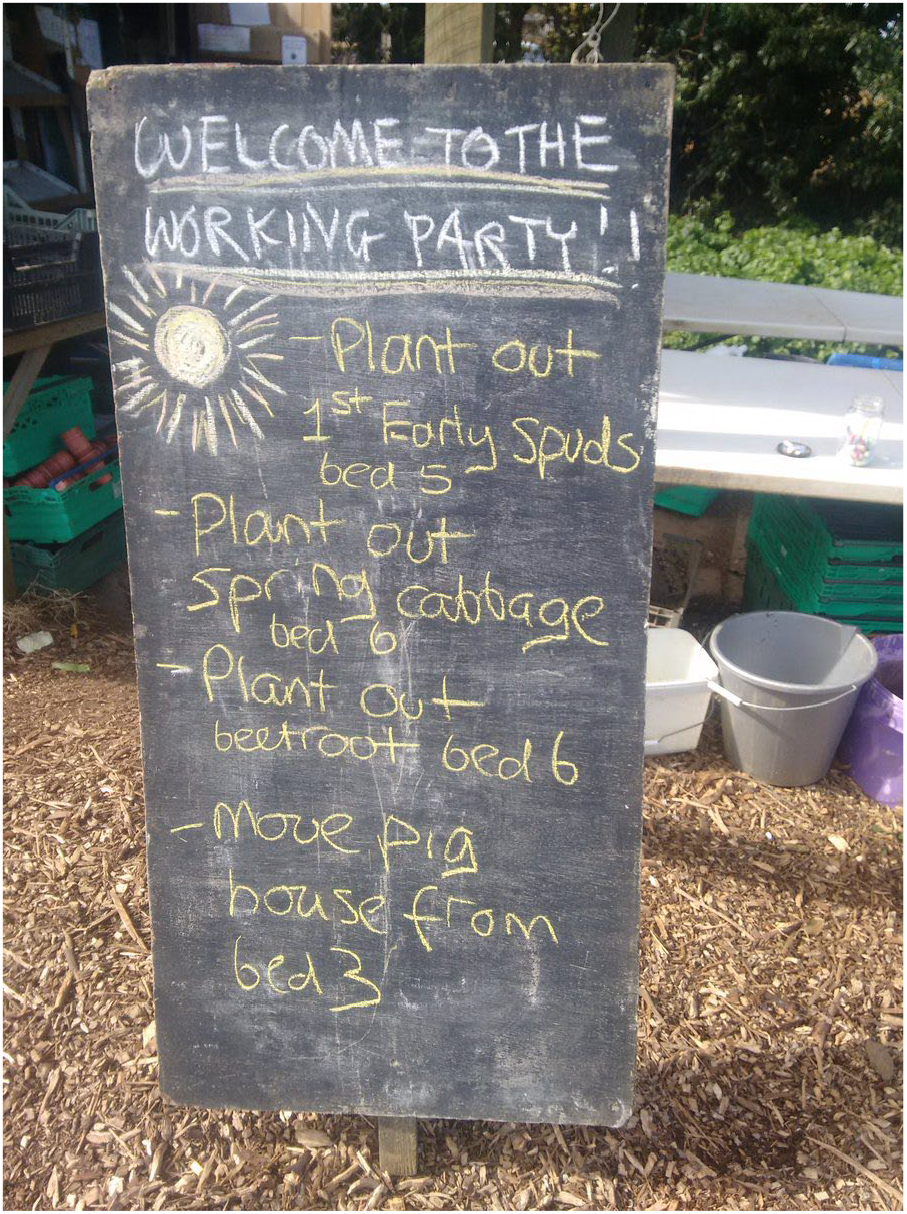
Example of weekly work tasks on farm.
The farm consists of a 12-acre field situated on the margins of a large county town, although it appears more rural than its urban proximity might suggest. Most of growing activity takes place in a patchwork of vegetable beds around three polytunnels used to raise seedlings and extend the growing season. A covered area next to a small cluster of sheds serves as the main space for the CSA members to relax during tea breaks. Bicycle parking and makeshift store houses and chicken runs made from re-purposed pieces of ‘junk’ reflect the CSA’s sustainable ethos. Animals are used as a means of cultivating the soil by keeping weeds down and soil fertility up, but also produce meat and eggs for CSA members as an optional extra to their vegetable box.
Literature examining alternative and local food practices, including participation in CSA, suggests that it is predominantly a middle-class pursuit (Renting et al., 2012: 292; Luetchford and Pratt, 2011: 89). To some extent, members of OTLCF conformed to this stereotype, the majority of those surveyed and interviewed were well educated, holding either a graduate or postgraduate degree. However, the average income was not high and although there were a significant proportion of retired members there were also a number on lower incomes who were not retired. Almost all members interviewed or surveyed identified as White British, only two identified as a different ethnicity or did not provide data. Qualitative data also suggested a political aspect of participation, which is perhaps unsurprising given the origins of the CSA in a local Transition group and the aims of the project, which aligned with a sustainable or ‘green’ political awareness. 3
A direct and meaningful relationship with the products of labour
On Saturdays, CSA members would typically wander into the farm at different times and identify a job they could do or wanted to do from the list, sometimes with some guidance from whoever was co-ordinating the work party. There was not a clear distinction between those organizing the labour and those engaging in it, since growers and members sometimes ran the work parties and everybody contributed labour. Regular work commitment meant members had a familiarity and more tangible relationship with the food they received from the CSA, creating a different sense of value: So there’s a sort of like, almost like seeing old friends, a real feeling of connection and I’m far less critical in that you know if something is a bit wonky or small or whatever . . . you’re a lot less judgemental more forgiving and you value it more . . . I think you expect different values, you have a different set of judgements from something that is a product, you’ve just got a cash transaction not a connection with. But I think if it’s something like The Oak Tree veg box you know what’s gone into it in terms of the blood sweat and tears and time, everything and it’s more than just the product . . . (CSA member 4)
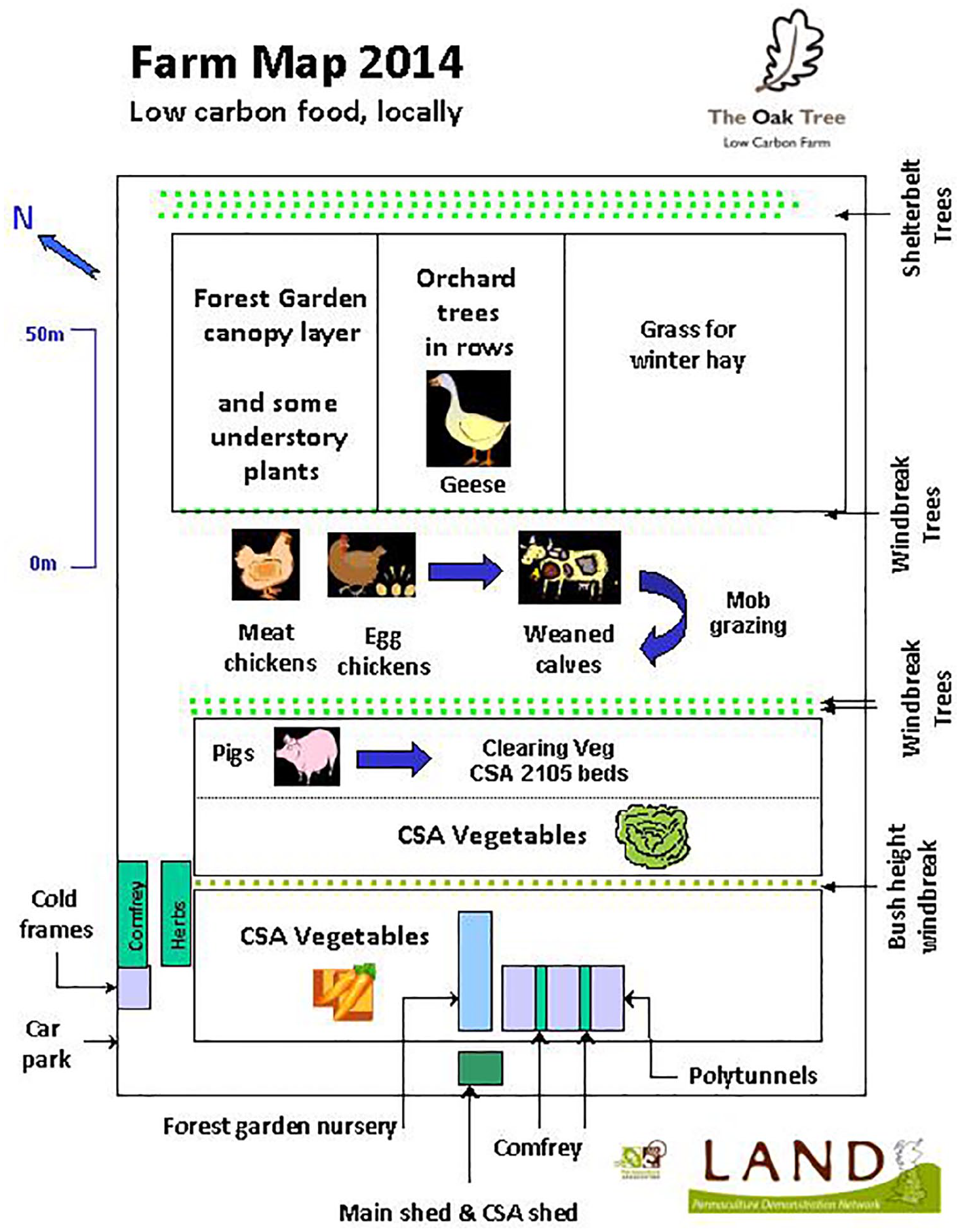
Oak tree farm map.
The very explicit and material connection described earlier contrasts with the way in which products of labour are estranged from the worker under capitalist relations of production (Marx, 1959: 29). Although food produced as a commodity remains an assemblage of material and social relations, these relationships are estranged from the consumer who therefore encounters the product as an abstract thing (Sayers, 2011). Although CSA members valued the physical and tangible qualities of the food they received, such as its nutritional quality and freshness, it was their relationship to the products through their labour that defined much of the value they derived from it. Residues of labour were evident in the material characteristics of the food, in terms of their shape, size and the soil still clinging to them. These characteristics, which might be regarded as deficiencies, are overlooked because they speak of the context of production contrast with food sourced through the conventional food system which appears sanitized and less real (Schnell, 2013).
Nost (2014) observes the difference between different CSA members’ expectations and their willingness to accept produce is affected by their level of knowledge and involvement in CSA production. This means that CSA members who are involved in growing food are more likely to overlook the size and quality of produce they are offered. However, this is not to suggest that they are happy with yields that are low or inferior produce, but when CSA members talked about this, it was always qualified with an appreciation of how difficult it was to produce good food and why there had been failures. Members were willing to overlook the seasonal variation and the challenges this posed because of their direct role in production, although this did cause a degree of angst and guilt when managing a glut of vegetables proved difficult and food was wasted. While in leaner times, the imbalance or quantity in a box was still frustrating even if members were willing to accept some variation in the supply of vegetable boxes.
Figures 3 and 4 represent examples of July and December vegetable boxes.
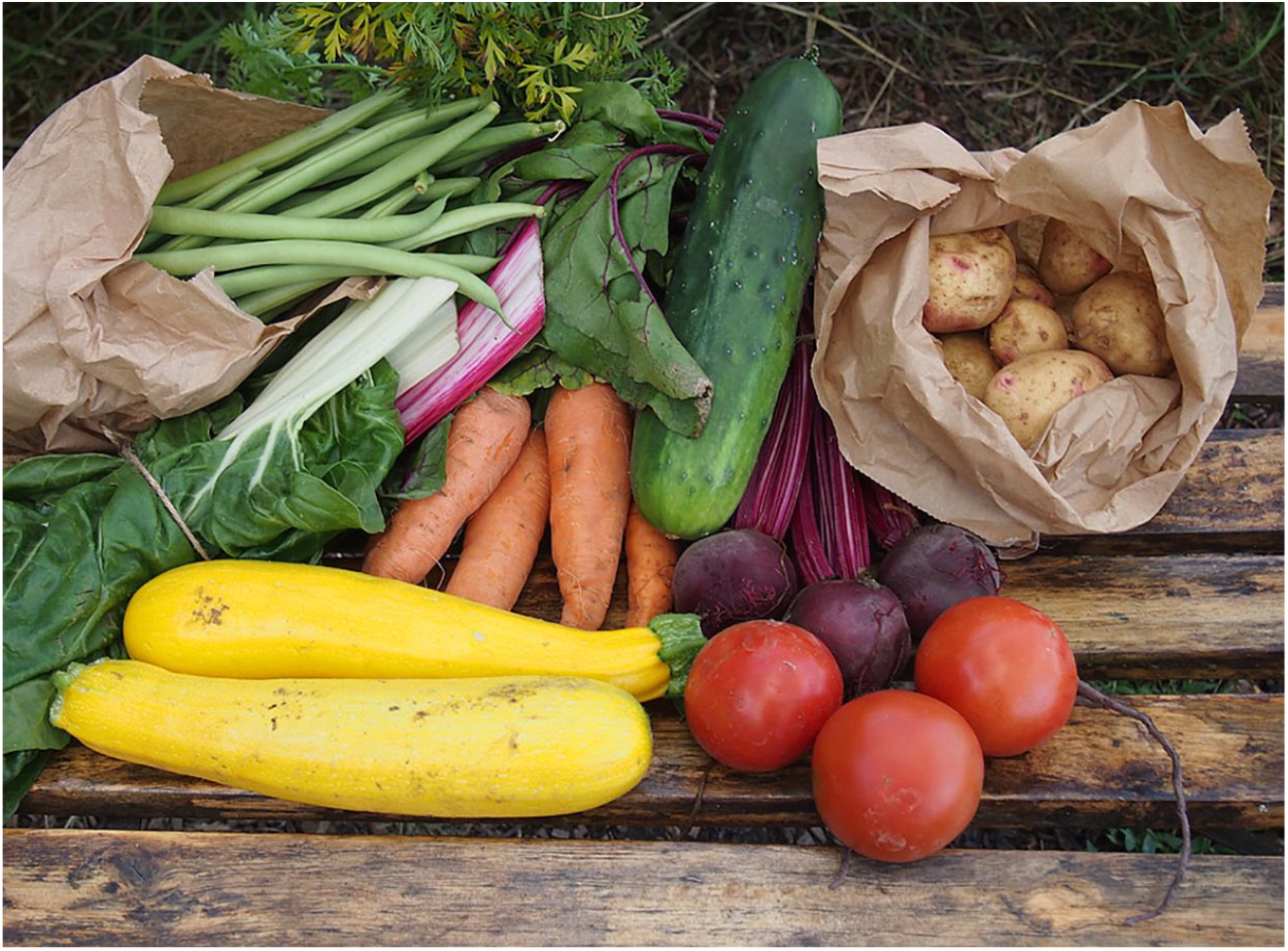
Example of July vegetable box.
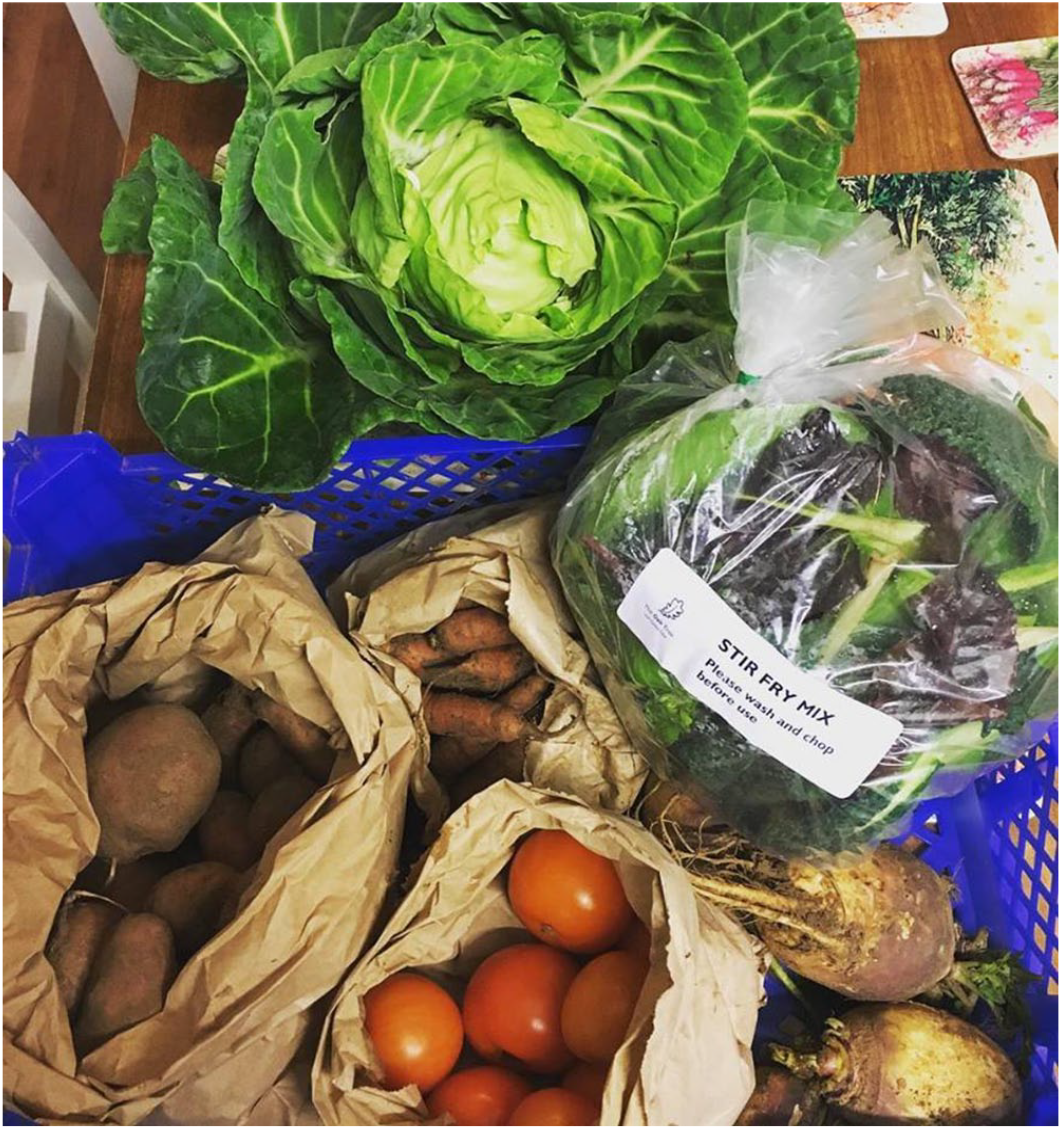
Example of December vegetable box.
Non-alienated labour in CSA
The involvement of CSA members in labour embeds them in the relations of production and consumption revealing food as an ensemble of relations (Figueroa, 2015: 502). This involvement means that labour undertaken at the CSA is non-alienated having a clearly defined purpose and outcome, in contrast to labour in capitalism, which Marx understands as the activity of alienation (Marx, 1959: 31): . . . in modern office life you do some problem solving, but it’s never as quite as immediate or obvious, with planting seeds you’ve got a tangible effort to outcome. There’s lots and lots of other jobs where the outcome has no bearing on how much effort you’ve put in. So you can sit and you answer a million emails and you leave at the end of the day and you think, what on earth have I done? (CSA member 3)
This depiction of wage labour is evocative of Graeber’s concept of bullshit jobs. Like Marx, Graeber (2018) argues that work is an end itself rather than being productive, therefore it seems to produce very little by way of tangible use value to the worker or society at large. In wage labour, the reward for work is not a specific product but wages. Whereas in working at the CSA, members can see a direct connection between the labour they put in and the product that they will eventually receive.
While the equivalent monetary value that CSA members receive for labour they contribute is likely to be smaller than what they receive for an hour of labour in their paid job, the use value of the CSA labour is more apparent. This is not to suggest that wage labour produces no use values, although some argue this is increasingly the case (Graeber, 2018), but use value is secondary to the primary purpose of capitalist labour – to produce exchange value. Capitalism appropriates use values, thereby removing them from the workers who have laboured to produce them and alienate them. In contrast, use value produced in working at the CSA is directly appropriated by members when they consume the contents of their vegetable box. Moreover the organization of labour is broadly determined by the goal of producing use value not exchange value.
Not only is the relevance of labour much more obvious to those doing it, but the manner in which it is organized can be influenced by CSA members. The way work was allocated and managed at the CSA was fairly flexible. Members could work independently and were not closely supervised, members could also be selective to some extent about what tasks they undertook, but also how they went about them: It’s up to you, you know, they say can you go and do this but it’s up to you how it’s done and if you don’t want to do it you can do something else there’s no you have to do this job, there’s no management really as well like, to fuck it all up which is usually what happened in real life work. (CSA member 5)
In capitalism, the tendency towards division and specialization of labour along with large organizational structures lead to a sense of powerlessness, meaninglessness and self-estrangement in labour (Braverman, 1974). This is not to suggest that all wage labour is completely devoid of meaning or satisfaction, but certainly its central function is not to provide enjoyable and meaningful activity. Although work undertaken at the CSA could also be arduous and repetitive. Much like members’ attitudes towards the products of their labour, the negative aspects of labour were balanced against the positive aspects and often fed into a sense of satisfaction gained from adversity, particularly when collectively experienced. Again, the organization of labour shaped a different interpretation of their experience of it. The arduous nature of labour that CSA membership involved would likely have been viewed quite differently if it was undertaken as an agricultural day labourer and was their main source of income.
The realization of human nature and species being
The relation of individuals to the products of their labour and the way in which labour relations are structured comprise the structural conditions that realize the alienation of species being or human nature under capitalism. Alienation of species being rests on the idea that the human species’ essential characteristic is labour, defined as free and conscious life activity to meet human need (Byron, 2016; Marx, 1959: 31). This important third dimension of alienation does not so much follow from the first two, but rather is realized through them. Marx does not set out his conceptualization of species being particularly clear (Ollman, 1976); however, it is clear labour is central in defining a human nature as intrinsically social and continuous with extra-human nature. Marx describes labour as productive life activity that creates use value and defines the character of humanity as a species, he intends this activity must be undertaken freely and consciously to be in accordance with species being (Marx, 1959: 31; see also Byron, 2016; Ollman, 1976: Ch. 9). The problem in capitalism for Marx (1972) is the way in which use value becomes dominated by the need to produce exchange value alienating human beings from their species being. The creation of use value is an inescapable condition of existence, whereas the creation of exchange value is socially constructed and imposed (Meszaros, 1970: 89–90).
Those undertaking labour in the CSA have a very direct relationship with the products of labour and retain some control over them through their membership of the CSA, but does this alternative organization reverse the alienation of species being seen in capitalist organization of labour? Certainly, it seems evident that participants are engaging in productive life activity, through growing food and producing a use value for themselves and others in the form of weekly produce shares. The extent to which this might be considered free labour is less clear. The freedom to participate in CSA relies on some resources, both time and money that in the case of most members, are secured through conventional paid jobs. Describing this labour as simply non-alienated also seems to ignore the full range of what is considered beneficial about participating in labour at OTLCF. We might instead describe it as labour that enables human beings to realize their species being, but this raises questions for alienation conceptually, in that it suggests a much more developed notion of human nature than Marx provides.
CSA membership also addresses alienation of species being by entailing a deeper connection to extra-human nature: Holywells park like I absolutely love, I spend a lot of time in it you know . . . but we have very little input and very little responsibility. Whereas, with the farm it’s exciting because you feel part of quite a small group that are involved in this piece of land. (CSA member 6)
The appreciation of a local park is viewed as passive by this CSA member in comparison to the active experience of nature through working at OTLCF. The opportunity to spend time in nature has been cited as important for well-being (Brook, 2010; Haybron, 2011), but the connection experienced through cultivating the land to produce food is much more active. This active engagement with nature through the physical labour of weeding, sowing and other embodied practices of food production facilitates interaction with nature (Turner, 2011), which fosters a deeper relationship (Brook, 2010).
For Marx, the idea of disconnection from nature invokes a dualism that is not consistent with the view of human nature he outlines, whereby humanity is not just dependent on extra-human nature but continuous with it (Marx, 1959: 31). This view of human nature was shared by some CSA members, while many others simply highlighted the benefits of spending time outdoors and how their work commitment scheduled time where they had to be outside. While this also meant being exposed to inclement weather, members tended to view this like the arduous work sometimes required. The organization of work was also crucial in facilitating social interaction around the CSA, which was also viewed as a key benefit of participation and another facet of species being (Marx, 1959: 32).
Social work and constructing community
The social aspects of OTLCF were highly valued and the shared labour commitment acted as a medium for social relationships in a way that individual self-sufficiency through a home, or allotment garden cannot: I can talk to people down at the allotment, but it’s not the same cos they’re all doing their own things, it’s not all sort of co-mingled, like it is at the CSA . . . Some people planted the parsnips and other people weeded them and other people will harvest them. (CSA member 1)
The common activity and goals of work as well as the shared products meant that food created a framework for social interactions, forming a community organized around the production of food. Marx does not intend that capitalist labour relations can completely disconnect people in a social sense. His conception of human nature understands humans as inherently social, viewing labour and production as expressive of this social nature, but within capitalism social relations become alienated and commodified, expressed through purely financial relationships (Holloway, 2010: 95; Sayers, 2011: 94). Wage labour necessitates social interaction, but these exchanges can be quite instrumental. The reduction of social relationships to transactional exchanges is well exemplified by changing practices of food shopping, such as the use of the self-service checkout or online shopping, which obviate meaningful social interaction. The contribution of CSA members’ labour gives the products of that labour a social meaning, in contrast to conventional consumption that ‘tends to offer only material comforts and tangible consolations as sources of satisfaction for the unmet needs of the spirit’ (Soper, 2008: 576). For a number of the CSA members, their involvement provided an important social support network, regular social events and a basis for friendships. In the case of some interviewees who were experiencing a major change in their life circumstances, or going through a period of depression, the CSA was described as a lifeline.
Figure 5 is a picture of CSA members.
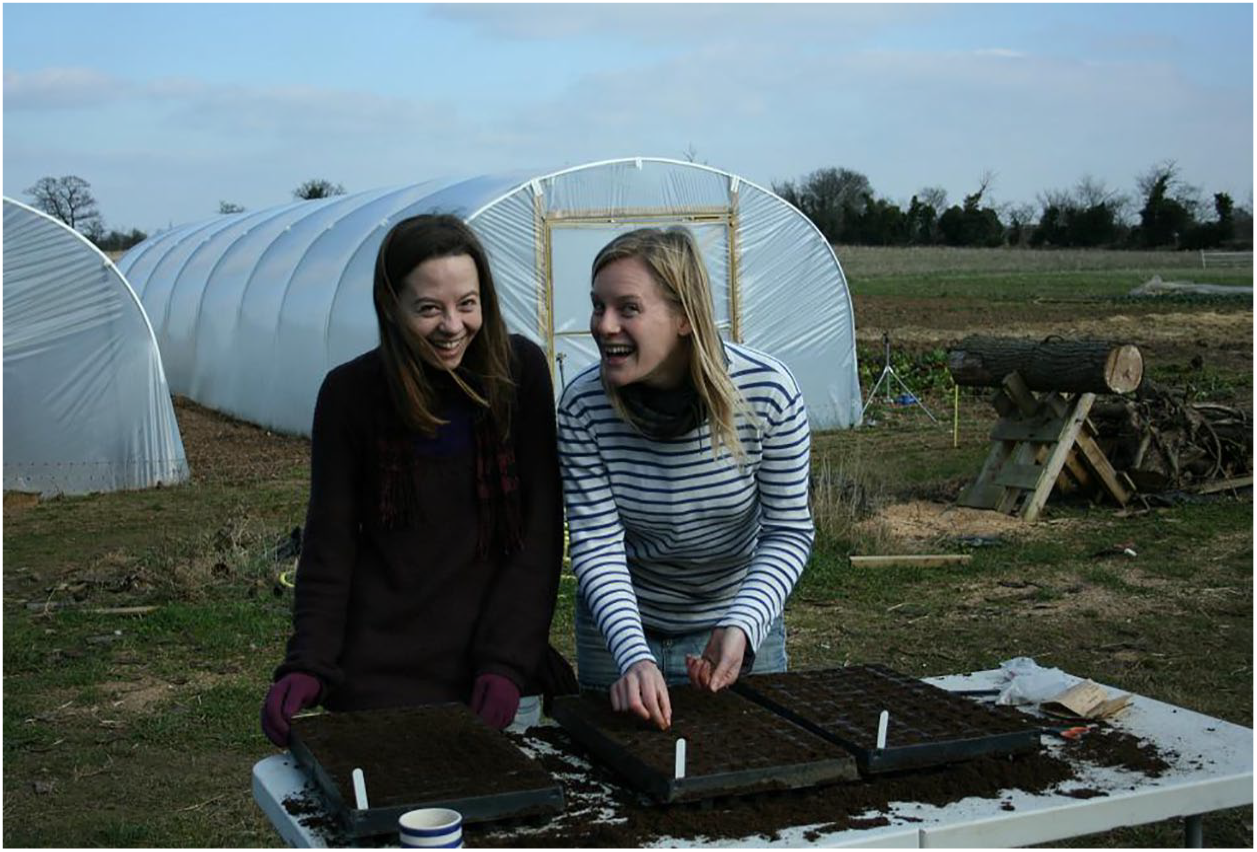
CSA members.
Discussion: countering alienation through the production of use value
In important ways, labour within CSA seems to address alienation. However, in many ways the CSA and its members remain embedded in capitalist relations of production and dependent on wage labour, questioning how free and de-alienated labour undertaken at the CSA really is. The ‘freedom’ with which CSA members undertake labour at the CSA is made possible by their ability to dedicate time and money to participation. Most members either worked a regular job or had retired from one, although there, some were on low incomes and some worked primarily for organizations that were not profit making businesses, for example, charities and the public sector. The wider political economic context determines a range of inequalities in health, wealth and education, and the position of those who are able to and do engage with CSA is influenced by this. To some extent participants of OTLCF conformed to the middle-class stereotype of those engaging with local and alternative food and the argument could be made that members of the CSA are privileged. However, the more pertinent issue is whether or not the practices they engage in through the CSA reinforce and broaden this privilege, to whatever extent it exists. Luetchford and Pratt (2011) observe that class differences do not always exist as antagonistic and common political ground can be found between middle-class consumers and peasant/working class producers. It is the extent to which the practices of the CSA counter or reify the capitalist mode of production which is at issue not just the identity of those participating in these practices.
It could also be argued that non-alienated labour and production in people’s leisure time does not challenge the relations of production in a wider sense and is in fact dependent on it. While CSA members receive a significant proportion of their food through the farm they also remain engaged in more conventional consumption practices to source the rest. The wage labour relationship is not completely eradicated in the context of the CSA, since not all labour is provided by CSA members. Paid growing staffs are essential to the operation of the CSA and receive wages for their work. Low paid labour undertaken in the context of CSA and small agro-ecological farms has been critiqued as both farmer self-exploitation (Galt, 2013) and exploitation of free or low paid labour in the form of farm interns (Ekers, 2018). The land on which the vegetables are grown and the animals raised is the fundamental material basis for the OTLCF, yet despite the collective aims and work of the farm, the land is rented from private owners. This property relationship suggests a contradiction and also underlines a major vulnerability for the CSA in its dependence on private ownership. These apparent limitations of the CSA bring into focus the central question: How can the practices described in this case study be considered to counter alienation and also question how effective a framework alienation is for understanding these practices?
It should be recognized that CSA and other community based food production sits within a much wider context, where the logic of capitalist production exerts a strong influence (Crossan et al., 2016; McClintock, 2014). However, while acknowledging critical reflection is important, to read neoliberal logics and subjectivities into initiatives like the CSA close down understanding of their alterity and possibilities for change (Harris, 2009: 55; see also Gibson-Graham, 2006a, 2014). We should not see the interweaving of alternatives with the dominant mode of production as inevitably leading to their co-optation and subsumption (Galt et al., 2014), rather this is the ongoing tension between use value and exchange value. This tension can be seen in the setting of CSA vegetable box prices that are compared with supermarket prices or organic farming co-operatives that must find a market for their produce at an acceptable price to both producer and consumer (Luetchford and Pratt, 2011: 101). This tension is also evident in the CSA member who compares the use values they produce and will subsequently appropriate through their farm work commitment with exchange value earned during their paid labour. However, when we account for the multiple use values produced through CSA labour and the externalized costs of capitalist production, this comparison may look more favourable for labour time spent at the CSA. However, we should not overlook problematic aspects of CSA or other alternatives.
Gibson-Graham argue for a diverse reading of the economy accounting for the heterogeneous range of economic practices, including volunteering, household work, self-provisioning, co-operatives and gifting (Gibson-Graham, 2006a, 2006b, 2014). Within this diverse economy capitalism exerts a marked effect, OTLCF and the people involved in it are necessarily shaped by this context. However, Gibson-Graham caution against capitalocentric approaches to understanding economic practices that frame analysis in reference to capitalism even when they are against it (Gibson-Graham, 2014). The concept of alienation is clearly capitalocentric by this definition, but this article has sought to understand how the organization and experience of labour within the CSA is not alienated and therefore not capitalist. However, capitalism remains the reference point for alienation, this criticism extends to wider literature on alternative food, which is defined by its opposition to the conventional food system (Holloway et al., 2007). It is only by starting to expand on what is meant by non-alienated that we can get away from a capitalocentric framings “to produce a performative rethinking of economy centered on the well-being of people and the planet” (Gibson-Graham, 2014: 147).
Fundamental to alienation is Marx’s concept of human nature or species being (Byron, 2016; Fromm, 1967; Ollman, 1976). The conception of human nature not only gives alienation its normative force, but also raises questions. Marx’s account of human nature has invited criticism as an essentialist account (Harvey, 2018). Any universal account of human nature is hard to square with Marx’s ontological position and the method of historical materialism that underpins his critique of capital (Harvey, 2018). Byron (2016) addresses this criticism by interpreting Marx’s writings to provide an essential concept of human nature with a fluid understanding of how this is expressed in particular socio-historical contexts. This approach narrows an essential human nature to a very tight definition centred on labour: What remains trans-historical, though, are humans’ creative laboring capacities and their need to labor. (Byron, 2016: 383)
It is hard to see how alienation can provide us with a way of understanding the positives of alternative organizations of labour with such a narrow conception of what non-alienated labour might realize. If labour and productive relations that realize human nature is the positive counter to alienated relations of capitalist production, an important question is left hanging: What does it mean to produce in a non-alienated way, ‘in a uniquely human way?’ (Byron, 2016: 389).
To answer this question and to think about how alternatives to capitalism might be constituted, we need to consider not only what it means to produce in a non-alienated way, but also what this kind of production should realize. Labour to produce use value – to satisfy human need – is understood to define human nature or species being according to Marx. The form of use value and the way in which it produced changes over time, but by orientating the food system towards the production of use value rather than exchange value we can radically re-organize it. This re-focuses attention on how use value is defined and achieved, to consider what organizations of labour enable us to produce use values without compromising human needs and nature. This does not mean constituting food production purely around organizations like CSAs or abolishing exchange. CSAs like OTLCF are a clear reminder that not everything that is exchanged is created to realize exchange value. It is also clear that the CSA creates multiple use values: Food, friendships, exercise, learning, meaningful work, community. When we understand use value in a much broader sense to be the result of productive human activity to meet human needs and desires this moves us towards an economy guided by producing well-being or public goods as opposed to private profit. Of course, the essential characteristic of use value is dominated and warped in capitalism, such that desires are created and manipulated to realize profit (Böhm and Batta, 2010). Capitalism produces a great many use values, but this is not its driving force, and if exchange value and profit can be realized without producing use value then this is no concern for capital.
The CSA provides an example of how non-alienated labour can be organized around the production of use values. It does not impose a specific definition of how labour that is non-alienated and guided by the production of use value should be organized, or place limits on what use values should guide production. CSAs that bring consumers into the world of production through working shares are distinctive, but that is not to say they are independent from or entirely incompatible with other institutional forms within the economy. The diversity of economic practices was reflected in CSA members own accounts of food sourcing outside of the CSA, which included the use of supermarkets alongside forms that might be considered part of the alternative spectrum, such as food co-operatives. The organization of labour at OTLCF is animated by a collective interest and realized through co-ordinated collective working practices. We can see trends in ethical consumption and the shortening of food value chains as potential mechanisms for rebalancing the agri-food system towards use value as opposed to exchange value. However, they often remain hostage to the need to produce profit, even if not motivated by it, because of their institutional form. If consumers and producers are to be re-defined as citizens who play an active role in shaping the food system, agency is key, not just individual agency but collective agency and a re-orientation from utilitarian private goods to common goods (Renting et al., 2012: 304).
CSA is not the only way non-alienated labour can be realized and wage labour does not necessarily alienate workers. For example, worker owned co-operatives typically provide a wage, workers retain control over the labour process and product through joint ownership of the means of production. In the agricultural sector, producer co-operatives are traditionally more prominent than worker co-operatives. In the European context, these producer co-operatives are typically aligned with the values of the conventional agri-food system, consisting of vehicles to advance and protect the interests of individual farmer members (Ajates Gonzalez, 2017). However, this is not always the case, Luetchford and Pratt (2011) examine ‘an example of an organization that both provides an alternative food chain and is seriously “oppositional” in its politics’ (p. 102), in the form of an organic farming co-operative. The farmers in this case study eschew wage labour and the use of chemical inputs permitted by EU regulations for organic growers, preferring to use natural inputs like manure. Ajates Gonzalez (2017) notes the emergence of multi-stakeholder co-operatives as an open form that brings consumers and producers together to more progressively challenge the capitalist food system. CSA shares many of the features of co-operatives, particularly producer-consumer co-operatives where there is a clear overlap in form (Parker, 2005; Schermer, 2014). A potential strength of the co-operative model is the democratic governance structure. While OTLCF members were able to informally influence decisions and define work, there was a lack of formalized structure to ensure democratic participation. Alternative organizations like co-operatives can lose sight of social values, particularly in times of recession and economic crisis when market forces exert a strong influence (Cheney et al., 2014). This underlines the need to address structural conditions in the economy and recognize that the policy and regulatory environment is also key to alternatives being able to produce the (use) values they seek to and flourish (Klagge and Meister, 2018; Schermer, 2014: 125).
In a practical sense, CSAs and similar organizations face major obstacles. The policy environment and access to land in the United Kingdom are major constraining factors, the case study discussed here was heavily reliant on individual investment to provide the community access to farm collectively, and received none of the benefits that are available to larger land owners. The opportunity to reformulate agricultural policy as the United Kingdom withdraws from the European Union (EU) does constitute an opportunity to redress some of these issues as organizations representing smaller farms and community growing initiative have pointed out (Land Workers Alliance (LWA), 2018). The historical trend in the United Kingdom or agricultural policy more generally, has favoured a productivist model (Devlin et al., 2014) despite recent indication that public and environmental goods will be prioritized (DEFRA, 2018). The withdrawal of the United Kingdom from the EU also represents considerable risks (Cohen et al., 2018; Lang and Schoen, 2016), particularly as the EU policy has more explicitly recognized environmental and public goods produced by the food system than UK food and farming policy (Devlin et al., 2014).
Much more could be done to organize the food system around the production of use values for public goods by explicitly recognizing and supporting these goods instead of supporting the production of surplus value. The current UK subsidy system financially rewards land ownership and scale more than responsible farming practices (LWA, 2018) completely ignoring farms less than 5 hectares in size (such as OTLCF). A system that bases support payments on the basis of social and environmental goods, such as the type and level of inputs used in food growing, employment conditions and community involvement would recognize the use values created by CSA schemes alongside other ecological and socially responsible agriculture. CSA members experienced work as more meaningful than their paid work, but this is a small proportion of labour in the food system. If labour in the food system was guided by the production of use values, it could have a transformative effect creating institutional forms like working share CSAs that create space for non-alienated labour guided by use values. The prioritization of use value could also be better reflected in food quality standards and their enforcement, and the support of research and development for different models, particularly those that bring consumers and producers together.
Conclusion
CSA constitutes alternative organizations of labour that are prefigurative, providing insight into a post-capitalist future. Alienation provides a theoretical framework for distinguishing these particular organizations of labour from a broad swathe of initiatives that can be regarded as complimentary. However, alienation can only be a jumping off point in this sense because it does not provide us with a theoretical framework for fully understanding alternatives and non-alienated labour, or move us away from capitalocentric thinking. Here we can turn to use value as the basis for an economy based on human well-being/need, and echo the calls for constructive dialogue that can enhance the emancipatory and transformative potential of prefigurative movements, rather than simplistically dismissing them.
There is more to do both theoretically and empirically in fleshing out the positive vision, which is intimated in Marx’s concept of alienation. To address the problems of the mainstream food system, then we need a broad framework capable of developing a food system that produces human and environmental well-being, through food production. The question then is what kind of use values do we want this system to produce and what organizations of labour can realize them? The CSA described in this case study provides one example of how this might be realized and how this counters alienation, but it is not definitive. We must remember that many organizations of labour produce use value, but institutional forms that de-alienate labour giving producers and consumers’ genuine agency are vital. Alternative organizations of labour in the food system and beyond are not above critique, this remains important, but we need to turn our attention to more seriously envisioning alternative organizations of labour and developing theoretical frameworks that can help us to make sense of these, as well as the mainstream food system.
Supplemental Material
Working_the_fields_-_confidential – Supplemental material for Working the fields: The organization of labour in community supported agriculture
Supplemental material, Working_the_fields_-_confidential for Working the fields: The organization of labour in community supported agriculture by David J. Watson in Organization
Supplemental Material
Working_the_fields_-_Demographic_information – Supplemental material for Working the fields: The organization of labour in community supported agriculture
Supplemental material, Working_the_fields_-_Demographic_information for Working the fields: The organization of labour in community supported agriculture by David J. Watson in Organization
Footnotes
Acknowledgements
The author would like to acknowledge the support and input of my two PhD supervisors, Professor Steffen Böhm and Dr Jane Hindley in contributing to the research. He would also like to thank Professor Mike Goodman, members of Red-Green study group, the editors of this special issue and those who attended a developmental workshop, all of whom provided invaluable feedback on earlier drafts of this article. Finally, he would like to thank the three reviewers whose constructive comments helped shape the final article and above all, the members of the Oak Tree Low Carbon Farm who participated in the research.
Funding
The author(s) disclosed receipt of the following financial support for the research, authorship, and/or publication of this article: This research was funded by grants from the East of England Co-operative Society and the Economic and Social Research Council, Grant No. 1232249. Neither funder influenced the design of the study, but the broad area of inquiry – local food and well-being – was determined by the grant funding.

Supplemental material
Supplemental material for this article is available online.
Notes
Author biography
References
Supplementary Material
Please find the following supplemental material available below.
For Open Access articles published under a Creative Commons License, all supplemental material carries the same license as the article it is associated with.
For non-Open Access articles published, all supplemental material carries a non-exclusive license, and permission requests for re-use of supplemental material or any part of supplemental material shall be sent directly to the copyright owner as specified in the copyright notice associated with the article.
