



Abstract
This article provides a critical re-view of the literature and studies of mindfulness at work. It offers a constructive and sympathetic yet also reflective and critical problematisation of the field. The re-view documents and examines the contributions of four different orientations towards mindfulness at work. These are as follows: individual mindfulness, collective mindfulness, individual wisdom and collective wisdom. Drawing on these contributions, the article makes the case for an ‘anti-anti mindfulness’. It argues for the self-critical promotion of mindfulness as a vehicle for extending and promoting the insights of organisational studies.
Keywords
Introduction: the mindfulness question
Most proponents and critics of mindfulness at work have already made up their mind about it. Firmly held and deeply established narratives about mindfulness guide our thoughts and inform our prejudices. This is somewhat ironic given mindfulness fosters reflection on what ‘makes up our mind’ and seeks to free us up from unwitting and undesirable entrapments. The narrative entrapments are clearly identifiable and remarkably seductive. Many supporters adhere to a breathless narrative of a fast-paced modernity, with mindfulness deployed as a ‘magic bullet’ to help us adapt (Chaskalson, 2014; Goleman, 2013; Hougaard and Carter, 2018; Weick and Sutcliffe, 2015 [2007]). Numerous critics view mindfulness as superficial hype or insidious intrusions into our sense of self (Cederstrom and Spicer, 2015; Davies, 2015; Purser, 2019; Segal, 2017; Whitehead et al., 2018; Zizek, 2001). Others are more ambivalent. They celebrate the potential of mindfulness yet are critical of its crass commercialisation (McCown et al., 2010; McMahan, 2008; Wilson, 2014). Whichever narrative is drawn upon, opinions about mindfulness are most often the result of looking through rather than looking at one of these perspectives.
There is, however, a richness and diversity in the many interpretations and views of mindfulness that goes beyond such restricted viewpoints. The purpose of this deliberately worded ‘re-view’ is to develop and apply a framework that captures this range and depth. The aim is to open up rather than close off discussion of its potential for organisational studies. Over the last few decades, the various ‘turns’ in organisational studies have highlighted the importance of paying attention to context, construction and critique. In this article, we endeavour to show that the study of mindfulness at work has the potential to make a significant contribution to such a broad agenda. This may be somewhat surprising for many, obvious to some and contested by others. Yet this very debate is part of the phenomenon. Our aim is to assist in making it an informed and considered one.
The re-view
The dominant trend within previous reviews of mindfulness and its role in organisations has been to create disciplinary-based reviews that adopt a ‘gap spotting’ overview of the research (e.g. psychological measures of individual mindfulness as trait or state), provide a general trend report on directions, noting weaknesses and limitations (e.g. identified concepts, empirical research guided by these concepts, quality of empirical studies) and conclude with an argument for additional research to help overcome the limitations. In recent years, we have had at least 14 special issues or dedication of sections of academic journals to mindfulness and at least 11 handbooks compiled by psychologists, Buddhologists and business researchers (King and Badham, 2018b). This has included a number of comprehensive reviews of mindfulness within organisations (Bartlett et al., 2019; Eby et al., 2019; Glomb et al., 2011; Good et al., 2016; Jamieson and Tuckey, 2017; Sutcliffe et al., 2016). Despite this proliferation, however, these reviews have in the main been restricted by a narrow disciplinary focus and a tendency to work within one of the main narratives of mindfulness. The trend has also been to substitute academic precision for relevance and comprehensiveness. The focus of previous reviews on leading academic journals has excluded the many major contributions to debates over mindfulness made in books, blogs, e-journals and in the press.
In contrast, the current, deliberately titled, ‘re-view’ adopts an alternative approach. Rather than accepting a particular disciplinary approach and reviewing the level of analytical precision and empirical support in the literature within the field it defines, we are interested in surfacing and critically assessing the ways these approaches define the field itself. This approach is similar to what has been described as a ‘crisis’ approach to conducting a review (Badham, 1984), and akin to what is currently described, following Alvesson and Sandberg (2011), as ‘problematising’ a topic or field of inquiry.
In defining problematisation, Alvesson and Sandberg (2011) draw on Foucault in presenting it as an ‘endeavor to know how and to what extent it might be possible to think differently, instead of what is already known’ (p. 32). This activity is not an ‘end in itself’ but rather ‘a means to identify and challenge assumptions underlying existing theory’ and to create ‘an opportunity for critical insights and new ideas’ (Alvesson and Sandberg, 2011: 33). As a method of inquiry, problematisation is concerned with exposing the partiality of what is often taken for granted, identifying how and why something is defined as a ‘problem’ and exploring the effects that this has (Garnett, 2015). The current ‘re-view’ adopts such an approach in exposing how mindfulness has been constructed in various ways by different intellectual perspectives and from diverse political viewpoints. In particular, we explore how perspectives differ over whether mindfulness is an ‘individual’ or ‘collective’ phenomenon, and involved in an ‘instrumental’ or ‘substantive’ enterprise. As we seek to show, these decisions reflect disciplinary biases and different political and ideological perspectives.
In accord with such an approach, we present mindfulness as a popular and contested concept, a multi-dimensional and evaluative term, embodying multiple elements and criteria for evaluation. Accepting and working with this state of affairs requires a re-view that appreciates not only its narrower intellectual interpretations but also the broader cultural fault-lines that divide its different uses and communities. It also means exploring how the tensions play out, how they are and might be addressed, and the value of more integrated or counter-perspectives. In so doing, our aim is to exemplify the kind of ‘polymorphic’ approach advocated by Alvesson et al. (2017). In the process, we also hope to balance rigour against broader appeal and practical and policy relevance.
For the purposes of such a re-view, we have identified two main areas of tension and debate around mindfulness. These tensions and debates dominate contemporary academic research, programme development and cultural and political controversies, and they concern what mindfulness is of and what mindfulness is for (Brazier, 2002, 2012). These primary differences and tensions surround whether mindfulness is viewed as an individual or collective experience and whether it is for instrumental or substantive purposes. All the usual qualifications apply to the use of these dimensions to help us explore different orientations and trends. They are deployed to help generate reflection and dialogue, not to pigeon-hole individuals or perspectives into restrictive categories.
Keeping this generative approach in mind, we characterise mindfulness perspectives as more individual in character when they are directed towards immediate personal experience, emphasising awareness and attention to the present moment, stress reduction, emotion regulation, overcoming habitual thought, behaviour and so on. They have a more collective focus when addressing the minor importance of the individual self and the corresponding reality of interdependence, group mind, relational mindfulness and organisational support for cooperative and careful thought and action. Mindfulness perspectives are characterised in instrumental terms to the degree they are focused on how individual performance and well-being might be improved through mindful thought and behaviour, and how organisational sustainability and success might be enhanced. Mindfulness has a more strongly substantive focus when the viewpoint is mindful consideration of and reflection on purpose, the value of transcending self-centred concerns of individuals and organisations and attending to the meaning of individual action and collective endeavours.
As illustrated in Figure 1, different answers to these two questions can be combined to help characterise differences and tensions within and between different forms and approaches to mindfulness. The figure deliberately includes ‘two-way’ arrows indicating movement between these different discursive arenas, as authors, texts and practices may combine and shift their dominant area of focus over time. To repeat, the focus is to facilitate dialogue and synergy in order to overcome disciplinary and narrative prejudices, not to reinforce them. We will reflect on the implications of our own ‘meta-narrative’ in the conclusion!
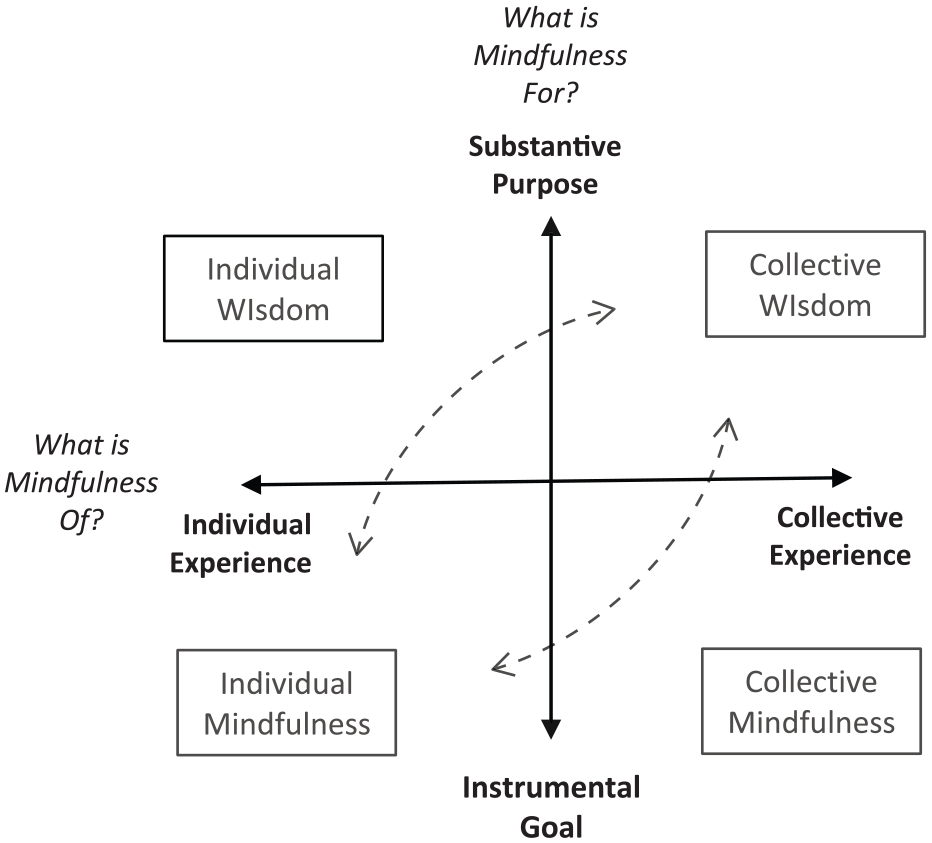
Four orientations of mindfulness.
As a general trend, images of mindfulness at work have tended to be dominated by individual-instrumental approaches. These approaches focus on individual performance and well-being, and the therapeutic value of meditation-based programmes in developing the states and traits required to achieve these ends. This dominant orientation is in strong contrast to increasingly influential alternatives. Collective-instrumental approaches focus on relational, group and institutional mindfulness as a key to organisational reliability, adaptability and resilience. Individual-substantive approaches include within mindfulness a questioning of the ethical and political foundations of such instrumental approaches. The concerns of both of the latter two approaches are combined and further developed by those who focus attention onto the collective-substantive nature and forms of mindfulness. These focus on issues of corporate governance and social, economic and political responsibility and sustainability.
In order to contrast the more instrumental and more substantive forms of mindfulness, the former are characterised as individual and collective mindfulness, and the latter as individual and collective wisdom. Wisdom is used in a general sense to refer to a concern with knowledge of what is right and true coupled with just judgement in action (Dunne, 1997; Macintyre, 2007). It captures the focus of some strands of mindfulness on its substantive ethical and philosophical dimensions, and their critique of instrumentality in how mindfulness is defined and deployed. This focus explicitly aligns with wisdom traditions critical of narrowly scientific, instrumental and materialist forms of thought and action (Forbes, 2019), and similar critiques from the standpoint of professional practice (Kinsella and Pitman, 2012). These traditions range widely from non-dualistic Buddhist philosophy and ethics (Dunne, 2011), through classical Greek and contemporary concerns with practical judgement, ‘phronesis’ or ‘wisdom in the doing’ (Tsoukas, 2005) to radical discursive ontologies and politics (Badham et al., 2012; Forbes, 2019; Purser et al., 2016). We do not use the term to imply that there is no ‘wisdom’ in more instrumentally focused mindfulness thought and practice. A key shared characteristic of proponents of individual and collective wisdom is, however, their critique of the epistemology and neglect of ethics in the views of knowledge embedded in the more instrumental forms of mindfulness (Forbes, 2019; Purser, 2019). Whether or not practical and ethical ‘wisdom’ is included or excluded from definitions of mindfulness is itself part of the controversy, and the reason for our inclusion of the term here to refer to proponents of the view that valuable or ‘true’ mindfulness incorporates these elements.
We use the term ‘re-view’ to describe our development and application of this framework for three main reasons. First, it highlights that while we introduce and analyse the established literature in the field, we do so in a way that focuses on the partiality and prejudice that informs different ways of defining the field, that is, what is taken to be the ‘real’ nature and significance of mindfulness. Second, it questions the limited view of the phenomena provided by those who operate within such restricted perspectives. Collins and Rainwater (2005) use the term re-view to describe their re-analysis or ‘sideways view’ of dominant narratives of change. We are similarly concerned with destabilising single-voice and authoritative accounts, giving voice to muffled or silenced voices and points of view, and supporting a more polyphonic and polysemic approach. The bulk of the mindfulness literature, both in academic content and popular understanding, continues to adopt a more individual and instrumental view of mindfulness. The purpose of our re-view is to help shift the balance of attention by highlighting the range, depth and significance of the relatively less well-represented collective and substantive views. But we do not do so in a way that dismisses the more established points of view. We seek to open up rather than close off perspectives and debate, and to do so in a way that accommodates diversity rather than feeding a backlash (Alvesson and Sandberg, 2011: 259). Third, and finally, we use the term re-view as a reflexive reminder that the integrative perspective we adopt is also a partial view, an approach that Alvesson and Sandberg (2011) describe as a requirement for a ‘real’ (as opposed to a ‘pseudo’) problematisation of a field.
In order to support this re-view, a broad view of mindfulness is employed, one firmly established since the 13th century, and which goes beyond the narrower disciplinary definitions that are often currently on offer. As the Oxford English Dictionary (OED, 1979) defines it, mindfulness is ‘the state or quality of taking thought or care of; heedful of; keeping remembrance of’ (p. 1801). This long-standing common-sense view of mindfulness highlights the importance to attending to experience, context and purpose. In what follows, we attempt to sympathetically and constructively document the four main orientations that have dominated contemporary discourse on mindfulness and its application to the workplace.
Individual mindfulness
It just doesn’t matter. (Wilson, 2015: 112)
Individual mindfulness in the workplace is promoted as a means for improving individual performance, well-being and the relationships required for bringing these about. It is individualistic, psychological and therapeutic in nature and origin. As an individual capacity, mindfulness is identified with a dispositional trait or an experiential state that involves an intertwining and overlapping of awareness, attention to and acceptance of present-moment experience. Awareness is a broad and deep cognitive, emotional and embodied awareness of self, others and context. Attention involves regulation and control of attention, disciplined attention to unproductive ruminations that distract from present-moment experience, and meta-cognition of how the frames we habitually adopt structure our awareness, attention and evaluation of experience. Furthermore, it involves how our narrative self imposes dramatised interpretations of what our experiential self is confronting. Acceptance is a deliberate and intentional attitude or approach to what we are aware of and attend to. Acceptance ranges from an attitude of openness and non-judgement to care and compassion, with curiosity towards what is experienced as a ‘half-way’ house between the two.
The radical nature and implications of the combination of these elements in what has been described as a process of ‘re-cognition’ (Carmody, 2009), ‘attunement’ and ‘discernment’ (Siegel, 2007) or ‘re-perceiving’ (Shapiro et al., 2006; 2015) is difficult to convey in such brief summaries (for a more extensive discussion see King and Badham, 2018a; 2018b). Within organisational studies, Kudesia (2019) has emphasised the cognitive dimensions of attentional sufficiency, the virtue of monitoring and the map-terrain differentiation. In broad psychological terms, individual mindfulness is identified with capabilities for meta-awareness, dis-identification from internal experience and reduced reactivity to thought content (Hadash et al., 2017). What it means in traditional Buddhist pictorial imagery is developing one’s capacity to act as a ‘gatekeeper’, noticing (or being alert to) unsuitable and unwelcome thoughts and emotions (‘guests’) and keeping them from entering, and avoiding the ‘twin arrows’ of suffering. Those twin arrows are being hit by initial painful experiences (arrow 1) and the suffering created through our reflex reactions to them (arrow 2).
As a set of interventions designed to bring about such states or develop such traits, the most commonly used mindfulness programmes are workplace modifications of psychological-therapeutic meditation-based programmes such as Mindfulness-Based Stress Reduction (MBSR), Mindfulness-Based Compassion Therapy (MBCT) and Acceptance and Commitment Therapy (ACT). These primarily use a blend of ‘focused attention’ and ‘open awareness’ meditation and practices, with varied amounts of attention to compassionate ‘loving-kindness’ meditations and practices (Eby et al., 2019; Jamieson and Tuckey, 2017; Kreplin et.al., 2018; Lutz et al., 2008; Valk et al., 2017). Exemplary programmes include Search Inside Yourself (Google), Mindful Leadership (General Mills), Mindfulness in Eight Weeks (Ashridge Business School) and Corporate-Based Mindfulness (Potential Project). The main exception to this dominant influence is the work and experiments of Ellen Langer, who seeks to bring about and examine the effects of a non-meditative, more cognitive or information processing approach to mindfulness (Langer, 2014). Her insights have, however, mainly been taken up by proponents of collective mindfulness and may be drawn on in corporate mindfulness programmes rather than in individual mindfulness workplace programmes.
Within the individual psychological literature, the established ways of providing general descriptions of the content of mindfulness programmes, as well as the measurement of mindfulness as a trait or state using a variety of self-report scales, are questionable and controversial. Some call for more precise investigations of separate elements of the multi-dimensional quality and set of practices and programmes for its development (Eby et al., 2019; Jamieson and Tuckey, 2017; Van Dam et al., 2018). Others disagree over what features should be included in the core definition of mindfulness (Shapiro et al., 2016; Valerio, 2016; Van Dam et al., 2018). For some, the agreed equation of mindfulness with awareness of and attention to experience implies a degree of intentionality (‘attending to’) and a particular non-judgemental attitude towards what is experienced. For others, such an attitude is an additional defining element. For many mindful leadership programmes, however, mindfulness is simply viewed as effective when in combination with other qualities and activities. One example is where mindfulness, hope and compassion are identified as the key features of ‘resonant leadership’ (McKee and Boyatzis, 2005). Another is where mindfulness, selflessness and compassion are seen as central components of the successful ‘mind of the leader’ (Hougaard and Carter, 2018). Hougaard and Carter (2018), in particular, go beyond anecdotal evidence to provide a range of secondary empirical research and primary survey and interview data to support their claimed benefits. There is, however, no attempt to clarify whether selflessness and compassion should be regarded as a core experience that should be mindfully attended to in order to obtain the outcomes they document or whether they should be viewed as separate qualities with partial, different or synergistic effects.
Exemplary studies have been carried out on individual mindfulness at work. Hülsheger et al. (2013) explored the effects of mindfulness as a trait, state and intervention on indicators of well-being (e.g. sleep, stress-response, work-life balance, emotional exhaustion, job satisfaction, psychological need satisfaction and work engagement). Dane and Brummel (2013) reviewed performance (e.g. job performance, task performance, organisational citizenship behaviours, deviance), while other studies suggest that mindfulness improves relationships (e.g. Reb et al., 2014) and increases resilience beyond a short-term ability to ‘bounce back’ (Fraher et al., 2017; Reitz et al., 2016). Some attention has also been paid to effects on creativity, innovation, absenteeism, turnover, readiness for change and so on (see Chaskalson, 2014; Gondo et al., 2013; Hyland et al., 2015). Notable examples are empirical studies carried out by Hülsheger et al. (2013), with 219 participants from various professions and 101 participants from the health and education sector. Hülsheger et al. (2014) also worked with 121 participants from the professions, Dane and Brummel (2013) with 102 service workers from 7 fast food outlets, Leroy et al. (2013) with 68 participants from 6 organisations and varied professions and sectors, Reb et al. (2014) with 134 employees and supervisors from varied industries and Reb et al. (2015) with 231 employees from varied industries. There have been more recent studies on the role of leadership in complexity by Reitz et al. (2016) working with 57 senior leaders from varied industries; Roche et al. (2014) studying 697 junior, middle and senior managers and entrepreneurs from varied industries and King and Haar (2017) with 120 senior managers from a global engineering firm. In addition to such investigations (Choi and Leroy, 2015), there have been a number of studies undertaken on health sector workers and professionals, and increasingly in education (for an overview see Jamieson and Tuckey, 2017).
The mechanisms proposed within such studies for the impact of mindfulness on well-being and performance are varied but overlapping. Glomb et al. (2011: 119) emphasise the degree to which mindfulness, as ‘receptive attention to and awareness of present events and experiences, without evaluation, judgement and cognitive filters’ contributes to self-regulation, of thoughts, emotions, behaviours and physiological reactions. They stress, in particular, the significance of the decoupling of the self from events, experiences, thoughts and emotions; a decrease in automaticity of mental processes in which past experiences, schemes and cognitive habits constrain thinking; and awareness and regulation of physiological responses. Hülsheger et al. (2013) adopts a similar approach, particularly in studying the role of mindfulness in alleviating the strain of surface acting as a dimension of emotional labour, while drawing on additional research (e.g. Weinstein et al., 2009) to emphasise other mechanisms such as the creation of adaptive rather than negative coping strategies, improvements in vitality and sleep quality, and greater positive affect. Good et al. (2016), in contrast, emphasise the central effects of the stability, control and efficiency of attention and its impact on cognition, emotion, behaviour and physiology. Reb et al. (2014) embody and elaborate on this view. They present mindfulness as improving the cognitive ability to perform better in general (through less unproductive ruminations) and in dynamic environments (through its cognitive flexibility, alertness, attentional breadth and guarding against distractions and blunders).
Recent comprehensive overviews of such studies, and indeed overviews of previous overviews, are provided by Allen et al. (2015), Bartlett et al. (2019), Eby et al. (2019), Glomb et al. (2011), Good et al. (2016), Hyland et al. (2015), Jamieson and Tuckey (2017) and Van Dam et al. (2018). These reviews respect the established evidence of the benefits of mindfulness in improving well-being, addressing mental problems and improving intimate relationships in both clinical and non-clinical populations, supported by insights from neuroscience (e.g. Glomb, 2011). However, they also point out that in the case of mindfulness at work, in-depth research lags significantly behind the documented proliferation of programmes (Van Dam et al., 2018). They regularly assert that the field is still in its ‘infancy’ (Eby et al., 2019: 3; Jamieson and Tuckey, 2017: 182; Reb and Atkins, 2015: 90, 101, 220; Van Dam et al., 2018:13). While some overviews such as that provided recently by Good et al. (2016) offer the reader a compilation and integration of claimed positive benefits, many others are highly critical of the quality and veracity of the evidence provided (Jamieson and Tuckey, 2017; Van Dam et al., 2018).
For our present purposes, however, two elements are crucial to note.
First, there is a distinctive focus on a present-moment therapeutic form of individual mindfulness, concentrating on awareness of and attention to present experience, and strongly focused on attention control and emotion regulation for enhancing individual well-being and performance. However, for some psychologists, mindfulness incorporates an attitude of acceptance and compassion, and for some mindful leadership practitioners, it is combined with attitudes of hope, selflessness and compassion (Hougaard and Carter, 2018; McKee and Boyatzis, 2005). Moreover, various mindfulness programmes include forms and levels of loving-kindness meditation as well as training in focused attention and open awareness (Lutz et al., 2008). Such elements are, as we shall see, further extended, focused on and prioritised in the discursive arena identifying mindfulness with individual wisdom.
Second, while general claims are made for universal and wide-ranging benefits of individual mindfulness in the literature, this is accompanied by an appreciation among many researchers (Dane and Brummel, 2013) and practitioners (Hougaard and Carter, 2018) that ‘workplace mindfulness’ has a collective dimension. Hougaard and Carter (2018) point to the importance within their programmes of group support and dynamics for individual learning and application. Both Hülsheger et al. (2013) and Dane and Brummel (2013) emphasise and explore the significance of mindfulness as a capability especially relevant for enhancing performance and well-being in highly dynamic, stressful and emotionally exhausting organisational contexts and stressful environments. Reb et al. (2014) extend such analyses. They find that organisational constraints (e.g. poor equipment, inadequate training and conflicting job demands) and task routineness reduced employee awareness and increased absentmindedness. Organisational support (particularly supervisor support) was conducive to enhancing employee awareness. Dane and Brummel (2013) also point to the particular effect of organisational conditions in determining specifically how mindful individuals will be at work, emphasising in particular the role of accrued workplace experiences, contextual conditions that may ‘cue’ mindfulness or distract from it, and the existence of practice and training. While there is some acknowledgement of such conditions and circumstances in studies of individual mindfulness, such insights are elaborated further by exponents emphasising the central significance of the collective nature of mindfulness at work.
Collective mindfulness
To connect
Turning to collective mindfulness, the focus shifts from individual to organisational development. This field of study was initiated by Weick and Roberts (1993) in their study of the accomplishment of ‘collective mind’ through ‘heedful interrelating’ on flight decks. It was subsequently extended by Weick et al. (1999) and further by Weick and Sutcliffe (2015 [2007] [2001]). Drawing on Ellen Langer’s cognitive definition, mindfulness here is defined in terms of engagement with the present, noticing new things, reflexivity about established categories and limited perspectives, and sensitivity to context (Weick and Putnam, 2006). In contrast to individual approaches, however, this perspective views mindfulness as a state of collective (rather than individual) mind and relational (rather than individual) capabilities.
Individual mindfulness programmes are known to incorporate notions of compassion, attentiveness to others and improving relationships. They address and foster such qualities through ‘meta’ or ‘kindness meditation’ and reflections on the illusory nature of the individual ‘self’. Collective mindfulness, however, goes beyond such extensions of individual mindfulness in presuming the essentially interactive, relational and dialogic character of how individuals make sense of themselves, others and the world around them. As such, collective mindfulness ‘is not an intrapsychic process or an aggregation thereof. Rather, it is an organizational attribute [and] a social process’ (Vogus and Sutcliffe, 2012: 724). Collective mindfulness involves ‘vigilant sensemaking’ (Weick, 2009: 219) and ‘prideful wariness’ (Weick et al., 1999) in inherently social processes and practices of ‘heedful interrelating’ (Weick and Roberts, 1993).
Collective mindfulness has been conceptualised and explored at the level of the organisation through ‘mindful organising’ and ‘organisational mindfulness’ (Sutcliffe, Vogus and Dane, 2016), the group as in ‘collective mind’ (Carlo et al., 2012), and leadership, noting ‘relational mindfulness’ or ‘relational intelligence’ (Van Beekum, 2016; Gauthier, 2014). At the organisational level, the most publicised research and programmes are those utilising and exploring five key principles of mindful organising, drawn from observation of processes that support a productive, safety-enhancing wariness in high-reliability organisations (HROs) (Weick et al., 1999; Weick and Sutcliffe, 2015 [2007]). At this level, mindfulness refers to a ‘joint capability to induce a rich awareness of discriminatory detail and a capacity for action’ (Weick et al., 1999: 36–7). It incorporates three ‘principles of anticipation’ and two ‘principles of containment’. The principles of anticipation are preoccupation with failures rather than successes, reluctance to simplify interpretations and sensitivity to operations. The two ‘principles of containment’ are commitment to resilience and deference to expertise rather than authority when making important decisions. These five principles are taken as a complementary bundle, providing a ‘social infrastructure of reliability’ within HROs (Weick et al., 1999: 123) and a set of principles for resilience and ‘sustained performance’ in an era of uncertainty and facing the challenges of a complex world (Weick and Sutcliffe, 2015 [2007]).
At the group level, research on collective mindfulness views organisational and relational mindfulness as interacting with and implemented through group qualities. Those qualities include the possession of a heedful collective mind (Weick and Roberts, 1993), conversational processes of collective minding (Carlo et al., 2012; Cooren, 2004) and cognitive states of shared or team mindfulness (Krieger, 2005; Yu and Zellmer-Bruhn, 2016). As exemplified in studies of mindful teams, this involves comfort with uncertainty and chaos manifested in mindfulness in action (Fraher et al., 2017) and responding and reshaping events and situations in conditions of adversity through a collective resilience-in-action (Barton and Sutcliffe, 2017).
Traditional theories of group development define maturity in terms of concepts such as shared purpose, established behaviours, shared mental models, commitment to each other and the value of the group. Research on collective mind, however, does not identify development with group ‘maturity’ through the creation of shared purpose and beliefs but with group ‘intelligence’. Group intelligence or collective mindfulness refers to a set of ‘heedful interrelations’. These include wariness about the limitations of and divergences between different views of the group purpose and individual responsibilities within it, and ongoing attentiveness to unpredictable emergence in the conditions to be faced and the tasks to be achieved (Weick and Roberts, 1993). In this way, mindfulness refers to a collective capacity and its application to collective issues. It is created and fostered in and through social interactions. When such collective mindfulness is absent, ‘people still may act heedfully, but not with respect to others’ (Weick and Robers, 1993: 371). As Weick and Roberts (1993: 373) to on to emphasise, group interactions ‘can’t be careful unless they take account of others and unless others do the same. Being careful is a social not an individual act’ (emphasis added).
This structural and cultural focus of organisational-level mindfulness as well as group-level minding is supplemented by literature that draws on the cognitive approach of organisational mindfulness in exploring leadership capabilities (Aviles and Dent, 2015), and, most interestingly, the nature of relational mindfulness (Van Beekum, 2016), or relational intelligence (Gauthier, 2014). Relational mindfulness, focusing on interpersonal relationships, is a key theme within collective mindfulness literature in therapy (Surrey and Kramer, 2016), adaptive and relational leadership (Cunliffe and Eriksen, 2011; Reitz, 2014; Reitz and Chaskalson, 2016; Reitz et al., 2016) and active processes of ‘mindful organizing’ (Vogus and Sutcliffe, 2012). It includes such activities as ‘savoir relier’ (‘relational intelligence’) in being sensible of and sensitively responding to others and relations with them, as well as making sense (sensemaking) and building sense (sensegiving or sensebuilding) of, with and for others (Gauthier, 2014). It also incorporates recognising established and changing mindsets and handling the emotions and interpersonal dynamics that surround adaptive transformation (Heifetz and Laurie, 1997) and appreciating and enhancing social dialogue through crucial conversations, surfacing undiscussables and so on (Reitz, 2014). It is important to emphasise that in so doing, collective minding extends the analysis of interpersonal relations to encompass understanding and improving interpersonal relations as the key component of mindfulness (Hosking, 2011).
In contrast to individual mindfulness, research on collective mindfulness is smaller, more focused and structured and informed by established sensemaking, processual and decision-making approaches within organisational studies. As documented in the review by Sutcliffe et al. (2016), its proponents have been increasingly successful in extending and elaborating on this approach in top-tier organisational studies journals. Their key focus has been on collective mindfulness in so-called ‘HROs’ operating with complex and dangerous technological systems. They also focus on ‘reliability-seeking organisations’ (RSOs) tightly coupled to dynamic markets. Current research refines and extends the five principles of mindful organising. More processual and multi-levelled accounts have also been provided of the micro-dynamics of mindful organising and the interrelation of individual and collective mindfulness. Further attention is also given to contextual variations in the nature and application of the five principles, and their ambiguous character as enabling routines and a mind-set that questions and challenges routines. This research provides a richer analysis of the different forms of collective mindfulness. These range from drawing contrasts between, for example, ‘top–down’ and ‘bottom–up’ mindfulness, to a deeper questioning of the degree to which its cognitive ‘Western’ definition of mindfulness should be complemented by further attention to the ‘greater wisdom’ of Eastern approaches (Barton and Sutcliffe, 2017; Becke, 2014; Fraher et al., 2017; Sutcliffe et al., 2016; Vogus and Welbourne, 2003; Weick and Putnam, 2006; Weick and Sutcliffe, 2015 [2007]).
This proliferation, extension and increasing richness of collective mindfulness research has, however, remained largely within the primarily instrumental focus dominant within much of the individual mindfulness literature. Little reflective (‘mindful’) attention is paid to the substantive nature of the collective goals being pursued. The collective mindfulness approach tends to concentrate attention on developing and supporting forms of thought and action that enhance collective performance and survival through safety and reliability (Weick and Sutcliffe, 2015 [2007]), market adaptation, innovation and sustainability (Vogus and Welbourne, 2003), resilience (Barton and Sutcliffe, 2017) and responsiveness to crisis (Fraher et al., 2017). In simple terms, this was illustrated in Weick and Sutcliffe’s (2015 [2007]) praise for Von Braun’s mindfulness in creating a team and organisational culture in which mistakes and errors were acknowledged and reported, without consideration or evaluation of his work for the Nazis in developing the V-rocket in World War II (p. 50). Exemplary case studies offered of collective mindfulness have been in nuclear power plants and US aircraft carriers (Weick and Sutcliffe, 2015 [2007]), and more recently team resilience in extreme environments, most notably the US Navy SEALs (Fraher et al., 2017). Unlike proponents of individual and collective wisdom, development of collective mindfulness theory has not extended into consideration of the purposes of such endeavours. Nor has the effect that these regimes and purposes have on the individuals involved nor the social, political and ecological responsibilities of the organisations of which they are a part been a focus.
Individual wisdom
Pull on the tiger’s tail of mindfulness and out leaps the tiger of wisdom awareness that may consume assumptions about our science and ourselves. (Rosch, 2007: 264)
Individual wisdom in the workplace is achieved by extending and deepening individual mindfulness beyond instrumental present-moment ‘here-and-nowism’ (Brazier, 2016: 70). From within this discursive arena, individual wisdom is an explicitly ‘mindful mindfulness’ (Purser et al., 2018). It draws variously on workplace spirituality, critical management studies and integral leadership in identifying individual wisdom with attentiveness to what mindfulness is of and for. Its key preoccupation is with the nature, meaning and purpose of work and life in late modern societies and what is involved in facing up to the conditions and controls of cognitive capitalism and the attention economy. The three forms that this preoccupation has taken are considerations of mindfulness as a form of workplace spirituality, a developed critical mindfulness and an integrative ‘post-conventional’ form of leadership.
Workplace spirituality
As a form of workplace spirituality, proponents of individual wisdom challenge and seek to transcend mindless preoccupations with instrumental and materialistic pursuits and their grounding in a mindless attachment to an independent self. This approach aligns with a form of spiritualism at work that attends to self-actualisation, the search for meaning and purpose in life, and the development of a sense of transcendence or interconnectedness with others and the world around us (Case and Gosling, 2010; Gunther-Brown, 2017). Much of the appeal of this approach to mindfulness lies in its grounding in what has been termed ‘Buddhist modernism’ (McMahan, 2008). This is a long-standing, popular and yet selective and controversial construction and appropriation of ‘Eastern spirituality’ (King, 2016; Wallis, 2011).
The culture of modernism is characterised by a long-standing angst about the loss of community and purpose brought about by modernity’s rampant individualism and instrumentalism. The resonance of mindfulness as a form of workplace spirituality lies in its promise to provide a non-religious basis for resolving this angst, one that is compatible with Western scientific celebrations of ‘experience’ and romantic quests for self-expression through a return to ‘nature’. As King (2016: 40) notes, however, within contemporary mindfulness programmes this ‘solution’ takes two very different forms. On one hand, it is celebrated as a customizable ‘spirituality’ for the contemporary entrepreneur of the self in a neo-liberal social context. On the other hand, it is promoted as a counter-cultural resistance to ‘Western materialism’ and consumerism within what has become known as ‘Engaged Buddhism’.
Proponents of the first view promote pragmatic and avowedly scientific and secular individual mindfulness programmes as a subtle and effective form of Stealth Buddhism (Brown, 2014), acting as a Buddhist Trojan Horse (Batchelor, 2012) or a Dharma-based portal (Williams and Kabat-Zinn, 2011). While the surface commitment of such programmes is instrumental, medical and therapeutic in content, their intention is not to stop there. The aim is to use the provision of techniques for stress relief as a vehicle for stimulating reflection on broader Buddhist concerns with the nature and sources of human ‘suffering’ (Kabat-Zinn, 2011). In support of this view, and after reviewing anecdotal and research-based evidence that such programmes can have such effects, Brown (2016) argues that the MBSR programme that underlies a majority of workplace mindfulness initiatives is ‘infused at every level – concept, structure, teacher training, and graduate resources – with carefully camouflaged Buddhist content’ (p. 90).
Proponents of the second counter-cultural and engaged Buddhist view of workplace spirituality are highly critical of the above ‘Trojan Horse’ approach (Forbes, 2019; Purser, 2019). Rather than contributing to individual wisdom, such programmes are seen as extending rather than challenging a corporate ‘colonisation of the self’ or ‘governance of the soul’ (Purser et al., 2016). In this view, mindfulness is peddled as a performance enhancing drug or a psychologised religion of the self (Purser et al., 2016; Wilson, 2014), offering a truncated form of technical spirituality, variously described as spiritual narcissism, spiritual bypassing or spiritual materialism (Carrette and King, 2004; Driscoll and Wiebe, 2007; Masters, 2010; Tourish and Pinnington, 2002; Trungpa, 2002).
Proponents of this critique identify individual wisdom with adoption of the philosophy and practices of Buddhist spirituality (Batchelor, 2015; Bodhi, 2006) and socially engaged Buddhism (Brazier, 2002; Hahn, 1987; Purser et al., 2016). This approach extends the definition of mindfulness beyond awareness of present-moment experience and attitudes of non-judgement and onto (1) the remembering of the existential, spiritual and moral purposes of mindfulness practices (Brazier, 2002, 2013) and (2) a form of ethical discernment that promotes an explicit morality of kindness, gratitude and compassion towards oneself and others grounded in an ethic of social engagement and mindful interbeing (Batchelor, 2015; Brazier, 2002; Hahn, 1987; Purser and Milillo, 2015; Samuel, 2015; Shonin et al., 2015; Wallace, 2006, 2011). Within society, these values and interests are reflected in such initiatives as the Contemplative Education movement (Rosch, 2015). Within the workplace, such concerns are an explicit component of a number of ‘second generation mindfulness programmes’ in the workplace (King and Badham, 2018b; Shonin et al., 2015). One such programme is the Buddhist-Derived Intervention (BDI) of Meditation Awareness Training (MAT), combining meditative insight, ethical awareness and wisdom concepts and practices (Shonin et al., 2014).
Critical management studies, critical mindfulness
Critical traditions of thought and practice seek to expose reification and challenge alienation and repression in the constitution of knowledge, self and society (Costas and Fleming, 2009; Spicer et al., 2016). Within critical management studies, individual wisdom in the workplace is identified with a radical freedom and care of the self (Ng, 2016) that challenges unreflective subordination to modern and neo-liberal power-discourses of the ideal self and their associated disciplinary technologies (Cederstrom and Spicer, 2015; Davies, 2015; Zizek, 2001). It includes critical reflection on mindfulness as a problematic form of knowledge within a set of repressive societal regimes and constraints, and equates individual wisdom with a reconstitution of this knowledge and these societal conditions (Purser et al., 2016).
As a critical form of knowledge, the problematic nature of individual mindfulness is seen to lie with its lack of reflection on its partial nature and the purposes for which it is employed. The problem lies not in its failure to produce knowledge or lack of potential value, but with its unreflective instrumentality and use as a means for domination and control (Walsh, 2018). In order to overcome such restrictions and challenge such outcomes, individual mindfulness is re-defined and extended as a form of ‘critical mindfulness’ (Purser et al., 2016). This incorporates or combines with an ethico-political commitment to social justice (Moore, 2017) in creating what has been variously termed as a radical mindfulness, civic mindfulness or socially engaged mindfulness that is demystified, critical-relational, critical-constructive and response-able (Goto-Jones, 2017; Healey, 2013; Ng, 2016; Purser et al., 2016; Stanley, 2012; 2014; Walsh, 2018).
As a social critique, individual wisdom highlights the problematic political and economic context in which contemporary mindfulness occurs, a context that mobilises and channels individual and personal subjectivity or ‘attitudinal energy’ for the mindless pursuit of further commoditisation and endless growth (Cederstrom and Spicer, 2015; Purser et al., 2016) as part of ‘conscious capitalist’, ‘attention economy’ and ‘neo-liberal’ regimes (Hougaard and Carter, 2018; Whitehead et al., 2018). The result is an internally self-policing ‘neo-liberal subject’, personally responsible for coping with rather than collectively challenging neo-liberal conditions, and with no ‘response-ability’ to engage in politics and mindfully attend to collective suffering, social justice and solidarity with others (Walsh, 2018).
This critical approach to the intertwining of the personal and the political is embedded within existing programmes and practices that challenge inequalities of power, systems of domination and sources of repression. The Mindfulness Allies Project has introduced mindfulness into low-income groups and communities, the Lineage and Alternatives to Incarceration Projects into prisons and among youth, the Strategy-Organisation-Leadership (SOL) initiative into unions, the Mindful Justice Initiative into the legal system, and Mindful Anti-Oppression Pedagogy into higher education (Barrett, 2017; Berila, 2016; Blum, 2014; Krause, 2018; Reveley, 2015; Rowe, 2016). Much as MBSR programmes are praised by supporters of workplace spirituality for their role in translating pragmatic interests in ‘stress relief’ into existential concerns with human ‘suffering’ (dukkha), critical mindfulness programmes are celebrated for intertwining the concern with ‘existential’ suffering into removing ‘surplus repression’. In each case, the personal and the political, existential and social, intertwined in what could be described as ‘Mindfulness+’ initiatives.
Integrative and integral leadership
Mindfulness as individual wisdom has also been identified and promoted in a very different literature as a key component of ‘post-conventional’ leadership development (Reb et al., 2015). This perspective is grounded in views of leadership as distinct from conventional management in being aware of, and attending to, irreducible complexity and lack of control, diversity and perspective taking, and ongoing triple-loop learning (Harris and Kuhnert, 2008; Reb et al., 2014; Sinclair, 2016). The contribution of mindful awareness to the development of such forms of leadership is the support it provides for self-reflection, challenging rigid ideas of the self, fostering a more processual and observing sense of self and assisting managers in transitioning from more conventional to more post-conventional understandings of the world and their role within it (Atkins and Styles, 2015; Reb et al., 2015).
Exponents of mindful leadership development are often explicit in integrating more narrowly defined views of individual mindfulness with other capabilities, activities and concepts. McKee and Boyatzis (2005), for example, identify ‘Resonant Leadership’ as combining ‘mindfulness’ with ‘hope’ and ‘compassion’, and Hougaard and Carter (2018) equate the ‘Mind of the Leader’ with a combination of ‘mindfulness’, ‘selflessness’ and ‘compassion’ (‘MSC’ model). For others, however, this added breadth remains compromised by an undesirably restrictive view of mindfulness. Sinclair (2016), for example, advocates a more ‘sceptical’ approach to ‘leading mindfully’. Her coaching, education and MBA programmes combine reflexivity and experiential learning with deeper consideration of the identities of contemporary leaders, the purposes of leadership and the way in which these are currently constructed and limited by embedded power relations in organisations.
Proponents of constructive-developmental and integral leadership combine the development of mindfulness with advancing through a series of stages of ego development or meaning systems. This advance involves movement from pre-conventional (dependent), through conventional (independent) to post-conventional (interdependent) understandings of the leader’s self and role within the world (Boiral et al., 2014). Mindful awareness and attention are regarded as a means for stimulating reflection on the stage at which managers are, in particular, providing both support and challenges in increasing self-reflexivity, recognition of multiple perspectives, interdependence, system complexity and uncontrolled emergence (Baron et al., 2018; Harris and Kuhnert, 2008). It supports successful transitions by making what was a previously unreflexive ‘subject’ to become a reflectively considered ‘object’ within a constructive ‘holding environment’ (Baron and Cayer, 2011; Heifetz and Laurie, 1997; Kegan and Lahey, 2016). This approach is exemplified in the 17-day-year long Complexity, Consciousness and Management programme developed and delivered by Cayer and Baron (2006). This programme combines experiential practice using MBSR meditation, Bohm dialogue (free flowing and non-judgemental conversation) and the formation of learning communities with theoretical insights into personal mastery, mental models and emotional intelligence, and achieving increases in mindfulness and movement towards ‘post-conventional’ forms of understanding (Baron et al., 2018). The value of bringing about such successful transitions has been confirmed in recent research on personal developmental support for environmental leadership (Boiral et al., 2014).
For integral leadership theories, the stages of leadership development are similarly grounded in stages of development, but this is now embedded within Wilber’s (2016) comprehensive and highly prescriptive framework, a framework that combines ‘inner’ and ‘outer’, ‘individual’ and ‘collective’ awareness (Forbes, 2016). For Wilber (2016), the value of mindfulness is its ability to help unclutter the mind, focus attention and expand ‘flow’ experiences in reflectively considering the ‘hidden maps’ we employ at different stages of what he terms ‘Growing Up’. This framework has informed the ‘Consciousness-in-Action’ programmes in liberation psychology, social work, social justice education and counselling in the US and Latin America (Rosado, 2007). Forbes (2016) has also argued for its radical potential as ‘prophetic critique’, and the value of such ‘critical integral’ educational programmes in schools and communities (Forbes, 2016). Drawing on interviews with 10 organisational leaders experienced with mindfulness practice and workplace interventions, Jeanrenaud and Jeanrenaud (2018) argue and illustrate how the ‘mindful promise’ of such programmes is their potential to draw out the links between personal mindful practices and wider systems change by integrating self, organisation and natural and social systems.
Collective wisdom
Shakimuni left the palace but we are trying to make the palace more comfortable. (Brazier, 2015, ‘Dialogues’, Mindfulness and Compassion Conference, 3 June)
In contrast to individual and collective mindfulness, proponents of collective wisdom focus attention onto mindful consideration of contemporary forms of socio-economic and political governance, and the effect that they have in shaping our collective endeavours and individual experiences. All forms of mindfulness regard it as a state or quality of mind that attends to experience by giving full and proper attention to presence, context and purpose. Advocates of collective wisdom, as defined here, focus on full and proper attention to collective purpose. A key focus is on the dysfunctional effects of organisational irresponsibility, and the divergence that exists between short-term economic interests and long-term social-ecological values. There is, however, a sharp polarisation between different interpretations of the source of these problems and how to address them. On one hand, it is a centrepiece of those who argue for a direct linkage between personal social responsibility and the creation of a socially responsible corporate capitalism (see Schneider et al., 2010). On the other hand, in the hands of critics of neo-liberal political regimes and governmental use of behavioural psychology techniques in ‘neuro-liberal’ forms of government, it takes a very different form (Whitehead et al., 2018). The latter argue for a radically alternative ethos and set of practices to those embodied in capitalist regimes that inevitably shape commercial mindfulness programmes into a form of therapeutic and corporatized McMindfulness (Forbes, 2019; Loy, 2015; Purser, 2019; Purser and Loy, 2013).
The former literature on corporate social responsibility has been dominated by proponents of mindful leadership. This is seen in proposals for ‘firms of endearment’ (Sisodia and Sheth, 2014), ‘conscious capitalism’ (Mackay and Sisodia, 2013), ‘compassionate capitalism’ (Bartlett and Melzer, 2016) and ‘system leadership’ (Scharmer and Kaeufer, 2013; Senge et al., 2015). These involve descriptions and advocacy for the attainment of a new level of consciousness (Wilber, 2001) within ‘second tier’ (Beck and Cowan, 2014), ‘teal’ (Laloux, 2014) and ‘deliberately developmental’ organisations (Kegan and Lahey, 2016). Laloux (2014), for example, elaborates what he terms ‘teal’ organisation principles, in organisations such as Patagonia and Sun Hydraulics, based on self-management, wholeness and evolutionary purpose, while Kegan and Lahey (2016) focus on deliberately developmental organisations such as Next Jup and Bridgewater. Both literatures suggest the arrival of a new stage of consciousness, and its implementation in a new type of organisation that unites economic interests with social values.
Adopting this approach, organisations, conferences, programmes and literature on mindful leadership and conscious capitalism presume and promote mindful organisational forms characterised by recognition of long-term consequences of actions, simultaneous awareness of inner self, external reality and work impacts, and commitment to authenticity, truth and responsibility. These forms are seen to possess a broader interest in corporate governance and stakeholder models of the firm, and pursue a ‘triple bottom line’ within more long term, sustainable and socially responsible forms of capitalism. Four key organisational elements are identified: a sense of higher purpose (meaningful contribution, supportive mission and vision); stakeholder integration (customers, employees, investors, suppliers and dealers, communities, environment); conscious leadership (social intelligence, values-driven ‘servant leadership’, integrity, compassion); and a conscious culture (meaningful purpose, care for multiple stakeholders).
For Senge, Scharmer and their colleagues at the MIT Presencing Institute, system leadership is associated with changing our collective habits of thought and action, understanding complex systems, initiating reflection and generative conversations, and moving from reactive problem-solving to co-creating the future. In terms of Scharmer’s (2009) ‘Theory U’, this involves broadening contemplative awareness by releasing participants from established habits and categories of thought (‘letting go’) and facilitating embodied and creative emergence of ways to respond to such experiences (‘letting come’). A crucial role is played by activities to enhance ‘sensing’, ‘presencing’ and ‘realizing’ (Senge et al., 2005) within ‘deep learning cycles’, broad ‘eco-system awareness’ and a dynamic ‘inversion journey’ (Scharmer and Kaeufer, 2013).
Radical critics of mindful leadership and conscious capitalism argue that a more fundamental challenge is required to counter the workings of neo-liberal capitalism and the workings of biopower (Walsh, 2018) and the ‘neuro-industrial complex’ (Davies, 2015). This approach is inspired, in part, by radical social, environmental and political commitments of various forms of ‘socially engaged’ Buddhism (King, 2009), in particular, their critique of materialism and commercialism, and recognition of the central significance of collective interdependence and interbeing (Brazier, 2002; Hahn, 1987; Ng, 2016). The aspirations of conscious capitalism, it is argued, are undermined by the embedded conflicts between the multiple stakeholders involved (Wang, 2013). It is also marked by a tendency to ignore the inherent tensions between restrictive and more radical discourses and practices of reform (Aschoff, 2015; Fyke and Buzzanel, 2013). In contrast to supporters of system leadership and conscious capitalism, it is argued that such aspirations are not achievable without transforming existing economic and institutional conditions.
In addition, advocacy for collective wisdom is solidly grounded in democratic-political critiques of neo-liberal economic strategies and political regimes (Aschoff, 2015; Davies, 2015). This approach highlights, questions and challenges the ways in which contemporary governance strategies are exercised through the disciplining of ‘bodies’ (‘biopower’) and the extension of surveillance and control in a deeply intrusive and embodied form within the mind and body of the individual (Purser et al., 2016; Walsh, 2018). As an extension of discursive critiques of individual wisdom, therapeutic and commercialised forms of mindfulness are condemned as an expression of a mindless conventional wisdom. For Zizek (2001), commercialised forms of mindfulness promote an ethic of cynical self-concerned withdrawal. It acts as an ‘opiate’, ‘safety valve’ or ‘fetish’ which either insidiously adjusts people to the stressful challenges of an insecure and high-velocity capitalism, or creates a self-defeating hyper-anxious governance of the soul that is dictated to by a ‘superego injunction to enjoy’. This generates all the anxiety, guilt and shame that comes from holding ourselves personally responsible for being (un)able to achieve a positive, happy and healthy self (Cederstrom and Spicer, 2015). In contrast, more collective and radical forms of mindfulness are advocated that ‘response-ably’ (Walsh, 2018) address systemic sources of pain and suffering, are concerned with ‘making refuges’ that create cultures and communities dedicated to creating well-being (Purser et al., 2016), and pursue ‘radical happiness’ through social movements that create ‘collective joy’ (Segal, 2017). In advocating such initiatives, there is often little faith in creating corporate programmes as effective vehicles for collective wisdom, and more hope is placed in socio-political and environmental initiatives in social movements, the public sector and by non-profit organisations (Purser et al., 2016).
Conclusion: anti-anti mindfulness
The critic is not the one who debunks, but the one who assembles. The critic is not the one who lifts the rugs from under the feet of the naive believers, but the one who offers the participants arenas in which to gather. (Latour, 2004: 232)
This re-view of mindfulness at work has identified the partial nature of the dominant orientation towards mindfulness (individual, instrumental and therapeutic) and documented the contributions made by more collective (relational, group and institutional) and substantive (critical, ethical, and political) orientations. In so doing, it enables the discussion to move beyond the exemplary yet reductionist view of mindfulness as a set of meditation-based programmes and the ensuing seductive, yet restricted, debates over mindfulness as either an effective and desirable, or ineffective and despicable, ‘Buddha Pill’ (Farias and Wikholm, 2015).
But, where does this allow us to move to? We wish to draw out four implications of this analysis for future organisational studies research on mindfulness at work. Two of these are supportive of potential use of mindfulness ideas and practices. Two of them are self-critical about this potential and use.
Supporting the ‘turns’
This comprehensive approach to mindfulness allows us to move the focus of concern with mindfulness at work away from studying the effect of measurable individual psychological traits/states and outcomes of meditation-based programmes, and onto the various facets of individual and organisational mindfulness and their relevance in the modern workplace. Mindfulness, in all its forms, highlights the nature and value of thought and action based on attending to context, construction and critique – phenomena that the various ‘turns’ in organisational studies have emphasised as crucially significant for understanding and intervening in organisational life. If the various contributions to mindfulness are taken into full consideration, then what mindfulness provides is fourfold, namely:
A popular and accessible introduction to meta-cognition and critical reflection on abstract and artificial narratives of organisations and the self;
An appreciation of the collective, dialogical and relational nature of reflective thought and action;
A focus on including within rational reflection, the act of attending to the substantive ethical and political issues that surround the contested advocacy of different forms of self-improvement and organisational development;
A diverse set of practical educational programmes and initiatives to stimulate cognitive and embodied, individual and collective, thought and action grounded in these insights.
Providing a cultural vehicle
This ‘re-viewed’ approach to mindfulness arguably also provides a resonant cultural vehicle for disseminating organisational studies insights into organisational life. This is grounded in two sets of critiques of overly rational and managerialist views of organisations:
Pragmatic recognition of the limitations of rigid, narrow and authoritarian forms of instrumental, comprehensive, technical, strategic and bureaucratic rationality. This draws on popular awareness of the nature and value of reasonable action based on more flexible, pragmatic, situational and bounded forms of rationality. It includes, for example, what Donald Schon describes as ‘reflective professional practice’, Karl Weick as ‘contextual rationality’, Bent Flyjberg as ‘phronesis’, James Scott as ‘metis’ and so on (Badham, 2017). Individually and collectively instrumental orientations towards mindfulness highlight, in particular, its pragmatic relevance in addressing the challenges of an attention economy (Hougaard and Carter, 2018; Worley et.al., 2014) or VUCA world (Nandram and Bindlish, 2017).
Cultural critiques of the iron cage of late or high modernity pointing to the conflict between the instrumental and hierarchical nature of modernity with counter-cultural critiques embedded within competing orders of worth (Boltanski and Thevenot, 2006), social imaginaries (Taylor, 2003) or axes of resonance (Rosa, 2013).
Mindfulness achieves such alignment by highlighting the importance of attending to personal experience, criticising the meaningless pursuit of individualistic atomism and commercial self-interest, and condemning the destructive undermining of community through bureaucratic hierarchy and economic and social inequality. Individual and collective wisdom orientations in particular address modernism’s broader concern with meaningless instrumentalism and unsustainable social, political and ecological irresponsibility. Mindfulness of purpose – or its opposite ‘mindlessness’ – acts as a potential rallying cry for those concerned with the same critical issues that preoccupy many anti-managerialist proponents of the various ‘turns’ within organisational studies. Using the ‘four orientations’ approach adopted in this article may help to capture these observations, concerns and programmes in a form that stimulates and supports further dialogue and development.
Anti-anti mindfulness
A significant intellectual barrier to such uses of a comprehensive view of mindfulness at work is the narrowness of conventional established ideas about what mindfulness at work involves. Despite alternatives and critiques, an individual-instrumental, meditation-based and narrowly commercial view of mindfulness remains strongly entrenched. As a result, any attempt to broaden understanding and debate may be condemned to irrelevance by either failing to shift the embedded frame or generating confusion about what an expanded view implies. Rather than naively pressing our approach as a ‘solution’, therefore, we prefer to adopt what could be termed an ‘anti-anti-mindfulness’ approach. This involves recognising the performative implications of whatever position we take, and advocating attempting to realise a ‘critical performative’ approach (Spicer et al., 2016) to implementing an agenda.
A ‘false positive’
Finally, an important practical and political barrier is created by the very real challenge of introducing more comprehensive and critical forms of mindfulness into organisations as managerial programmes. Supporters of mindfulness have tended to make one of two arguments, either that:
The ambiguity and variability surrounding what mindfulness stands for, allows for practical ‘interpretive flexibility’ when implemented in practice (Cook, 2016; Islam et al., 2017)., or
Mindfulness acts like a desirable ‘Trojan Horse’, using more managerial and instrumental forms of mindfulness as ‘Dharma-based portals’ (Williams and Kabat-Zinn, 2011) for introducing more extensive considerations and changes.
Critics of such optimistic interpretations argue, however, that such arguments are problematic and politically naive. Mindfulness is viewed as simply providing a contemporary version of superficial and managerialist humanisation programmes (Barley and Kunda, 1992) or a revamped ‘instrumentalization of spirituality’ (Case and Gosling, 2010; Purser et al., 2016).
Our response here is that a healthy and mindful dose of scepticism is desirable, even essential, in any attempt to broaden the scope of understandings of mindfulness or programmes for expanding its role in the workplace. We do, however, side with James March in responding to such scepticism, with a preference for encouraging an at least partially self-fulfilling ‘false positive’ over an equally self-fulfilling yet self-defeating ‘false negative’ (March, 1986). This is accompanied by a significant degree of appreciation and respect for the creativity, energy, motivation and political nous of many experienced mindfulness practitioners, both inside corporatized bureaucracies and outside in various social initiatives and political movements. We would argue that to assist them and seek to inform and extend their role in organisations is, at the minimum, a practical example of the kind of social experimentation that a critical performative approach to organisational studies should take.
Footnotes
Funding
The author(s) received no financial support for the research, authorship, and/or publication of this article.
