




Abstract
Based on the evidence found in two case studies of intensive agriculture in Southern Spain, this article analyses the impact of business strategies aimed at devaluing packaging plant work in the competitive integration processes currently taking place in the global agri-food value chain. The article explores three business strategies: the feminisation, segmentation and deskilling of labour, along with ethnic substitution and labour recruitment outsourcing mechanisms. Although it acknowledges the importance of the dynamics of global competition, the article focuses mainly on how firms articulate their strategies in packaging plants within the political, family and sociocultural frameworks of specific local contexts. The analysis uses a qualitative methodology based on in-depth interviews and participant observations.
Introduction
Within the framework of the new international division of agricultural labour, which is hierarchically structured into different chains, packaging plants have become key elements. To understand their current significance, it is important to bear in mind the changes undergone by the global agri-food system over recent decades. Early on, Friedmann and McMichael (1989) linked these changes to different capital accumulation strategies and identified a series of ‘food regimes’ which have existed in the last 150 years (Friedmann, 2005; McMichael, 2013). According to these authors, in each of these regimes, relationships are established between the State and the market, with the aim of guaranteeing the stable accumulation of capital in agriculture and ensuring the satisfaction of consumption demands in accordance with the different diets of each social class (McMichael, 2013). The colonial–imperial (1870–1914) and commercial–industrial food regimes (1945–1973) were followed, from the 1980s onwards, by an increasingly consolidated transition towards a new corporative (McMichael) or corporative–environmental (Friedmann) food regime. In this regime, food production is based on: greater market internationalisation and competitiveness; advances in the field of electronics, micro-computing, biotechnology and biogenetics; the concentration of power in transnational corporations, particularly as regards large-scale distribution and a new spatial organisation of production itself centred around networks and the implementation of flexible production systems capable of adapting to the new differentiated consumption standard (Friedland, 1994, 2004; McMichael, 2009).
Given the need to respond to both the diversified demand of middle-class consumers, who are increasingly concerned about their health and the quality of the food they eat, and the criteria imposed by large-scale distributors (Burch and Lawrence, 2009; Busch and Bain, 2004), packaging plants have become a strategic link in the new globalised food regime. They have also become an ideal place for analysing the logic and practices underlying global agri-food chains. In packaging plants, fruit and vegetables are processed, labelled and packaged so as to adapt their size, colour, shape and presentation to the quality and food safety standards required by both supermarkets and consumers.
The aim of the article is to examine the business strategies involved in the devaluation of agricultural work in said plants. By the devaluation of agricultural work, we mean the social construction of a type of work to which very little value is attached, and which is therefore poorly paid and underappreciated. Our conception of value and valuation goes far beyond mere economic considerations. The devaluation of work is social in nature, insofar as (as we shall argue in this article) the business strategies designed to bring it about necessarily require that the people performing the work be socially devalued also. In other words, the process seeks to deny their social value (Honneth, 2006, 2011).
Despite the technological innovations of recent decades, packaging plants still require intensive, routine manual labour, for which no specific qualifications are required or recognised. We argue that these business strategies are based on the construction of the categories ‘woman’ and ‘immigrant’ as vulnerable categories intrinsically intertwined with the political, organisational and sociocultural context in which they exist.
This article aims to contribute to the study of organisations, as well as increasing our understanding of the global agri-food system in three different ways. First, by analysing a key element of the functioning of the agri-food system which has, nevertheless, received much less attention than the work of farmers and day labourers working in the fields. Second, by incorporating a feminist perspective which, unlike the androcentrism so present in most studies on organisation, reveals the role of gender inequality in the devaluation of agricultural work and the maintenance of the globalised agri-food system. And third, by linking the devaluation of the work carried out by women in packaging plants to the environment in which it occurs, complete with all its different rules and norms, including labour regulations, laws regulating worker mobility, the economic strategies employed by households and the local labour culture. Hence the importance of analysing not only the role played by the business sector, but also that of the State, households and local communities. We will also focus on the way in which these stakeholders manage the cultural and subjective elements aimed at maintaining control and domination, both inside and outside the organisation.
Below, after outlining the theoretical framework of the article and describing the methodology used to gather and analyse our empirical data, we offer an analysis of the principal strategies used to devalue the agricultural work carried out by women in Huelva and Murcia.
Devaluation at work
The organisation of production and work in packaging plants reveals the effort made by local owners to introduce numerous technological, organisational and production-oriented innovations aimed at improving their competitive position in the global agri-food system. Thus, our analysis, while recognising the growing concentration of power in large supermarket chains, strives to avoid overestimating their capacity to unilaterally impose their conditions on producers.
This relative autonomy of local producers and suppliers has been recognised by several experts in connection with the different approaches adopted in the literature on value chains (Coe and Yeung, 2015; Gereffi, 1994; Gereffi et al., 2005). Going beyond Gereffi’s (1994) distinction between buyer and producer-driven chains, Gereffi et al. (2005) himself and his team later proposed that the key to the different forms of chain governance lies in the fact that the positions in the chain are open to permanent dispute, and local suppliers and producers compete with each other and with leading companies by deploying upgrading strategies aimed at improving their position in global value chains (GVC).
Several authors have analysed these value disputes in the agricultural global value chain (AGVC), exploring both the strategies used by distributors to maintain their hegemonic dominance (Burch and Lawrence, 2009), and the production and technology-based upgrading strategies employed by local businesses to try to improve their competitive and strategic position (Bain, 2010; Konefal et al., 2005).
Nevertheless, one of the main problems with analyses conducted using the GVC approach is that they tend to focus almost exclusively on the business environment and pay little attention to the social context in which firms operate. Hence, our analysis does not aim to understand the strategies used from a solely business-based perspective, but rather to take into account also the domestic groups and social–cultural context in which they are employed.
The connection between the strategies implemented in companies and the social context has been analysed from several different perspectives. The global production network (GPN) approach (Coe and Yeung, 2015) has managed to inject a territorial element into value chain literature by attempting to understand how the competitiveness of the economic stakeholders in the chain can be improved through their embeddedness in the local area (in other words, their ability to establish relationships and alliances with other local stakeholders, including public institutions, associations, workers and households, among others). Nevertheless, the approach adopts a firm-centred and economistic perspective, locating companies at the centre of this dense network of economic and non-economic stakeholders and emphasising the capacity of national and local institutions and civil society to improve their competitiveness (Selwyn, 2012). For their part, feminist studies on organisations (Acker, 2011; Holvino, 2010) have also analysed the link between the social processes occurring inside and outside organisations, with the aim of highlighting the fact that inequalities inside firms are only made possible by gender, class and ethnic inequalities in the extra-organisational context. These authors argue that organisational practices contribute to reproducing these inequalities and, therefore, to devaluing the work performed by those most affected by them. Similarly, some Foucauldian studies (McCarthy and Moon, 2018) have analysed how subjects (firms, employees, etc.) may do or undo gender and gender inequality through their everyday practice. In this sense, our analysis also pays attention to how business strategies designed to devalue women’s work feed off and contribute to reproducing existing gender inequalities in the two regions studied.
The management of work is a clear example of the need to include a territorial perspective in the analysis of business strategies in value chains. Despite the efforts of local businesses to innovate, work management strategies, which are geared towards containing labour costs with the consequent devaluing of work, continue to play a decisive role (Baglioni, 2018; Cavalcanti and Bendini, 2014; Robinson and Rainbird, 2013; Selwyn, 2007, 2009). Indeed, agricultural workers have become a key element of the production process, onto which local business owners can shift the pressure to which they themselves are subjected by distributors (Corrado et al., 2017; Gertel and Sippel, 2014).
In the case of the AGVC, many studies have shown how firms have implemented diverse recruitment strategies targeted specifically at those who are most vulnerable within the social organisation of agricultural work, mainly immigrants and women (Barrientos, 2014; Deere, 2005; Hellio, 2017; McGrath, 2013; Werner, 2016). This means that the devaluation of work also depends on the recruitment of specific socially and institutionally vulnerable groups, who are more likely to accept harsher working conditions and whose social composition may vary from region to region. In this sense, social studies of agriculture have analysed the various political and institutional dimensions of recruitment processes, exploring how they depend on the enactment of certain kinds of labour and immigration laws, as well as on the institutions, which enforce them (Lee, 2010; Pedreño, 1998; Thomas, 1985; Wells, 1996).
From a different angle, feminist political economic theory has highlighted the fact that the trend towards the feminisation of work in GVC constitutes one of the facets of the new gendered political economy (Allen and Sachs, 2012; Figueroa, 2015; Lara, 1998; Preibish and Encalada, 2010), in which class, gender and ethnicity work to naturalise the social hierarchies present in each context (Anthias, 2014; Lee, 2010; Mohanty, 2005). Studies in this field have questioned the naturalisation of dominance relations and sexual and ethnic inequalities, something which other studies have done also from a post-colonial perspective within the field of organisation studies (Prasad, 2003).
Nevertheless, the devaluation of female and immigrant agricultural work is not only a cost containment strategy that contributes to reproducing gender and ethnic inequalities in different regions but also a strategy through which firms mobilise a cultural framework imbued with sexual ideologies and beliefs and adapt it to their own ends. Consequently, seeking inspiration from critical management studies (CMS; Alvesson and Willmott, 2012; Grey and Wilmott, 2005; Wilmott, 1993), our article also aims to draw attention to the importance of cultural dimensions in the analysis of business strategies designed to devalue work. CMS highlights the importance of the active and systematic management of the cultural and subjective elements linked to the corporate culture of new managerialism in the control and domination processes taking place both within and outside organisations. Along these same lines, our analysis aims to underscore how agricultural companies actively use local cultural frameworks to build a vulnerable workforce.
Moreover, our article also strives to analyse the influence of gender ideologies within this same local cultural framework. Benería (1991) points out that the gender segmentation of labour is legitimated by the naturalisation of historically constructed gender ideologies in households and on the labour market and is supported by processes which seek to devalue and deskill female work. To explain how the workforce is ‘created’, and not ‘given’, Elson and Pearson (1981) warn that it is not there, ‘ready and prepared, waiting to be called’ by the export industry. Hence, the importance of exploring, as the authors note, the diversity of techniques used by industries and the processes involved in the construction of the workforce. As in other industries studied by Elson and Pearson (1981) and Mills (2005), in the agri-food industry also, it is found that ‘nimble fingers make cheap workers’.
Research methods and design
The analysis is based on case studies carried out in two emblematic areas of Mediterranean agriculture in Southern Spain: fruit production (peaches, grapes, apricots) in the Murcia region and the cultivation of strawberries and other berries in the province of Huelva. Both production enclaves are relevant as case studies not only due to their high production and export levels and the number of jobs 1 they create, but also because they exemplify the process of agricultural restructuring which has spread throughout all areas of Spanish agriculture since the 1980s (Etxezarreta et al., 2015), as the sector sought to become part of the global agri-food chain.
The fieldwork was carried out between 2006 and 2007 in Huelva and between 2012 and 2015 in Murcia. Semi-structured interviews were the principal technique used for data collection. Interviewees were selected by structural sampling based on their professional profile, with the aim being to analyse the discourses of a range of stakeholders occupying different positions in the production chain. In the case of agricultural workers, the variables sex and nationality were also included, since the labour market is sexually and ethnically segmented. Specifically, and as shown in Table 1, interviews were held with representatives from agricultural organisations, producers, field workers and packaging plant employees, trade unions, public administrations and technological institutes. Initial contact was made through agricultural worker and producer organisations, and further participants were recruited using the snowball sampling technique, with the aim of covering all the profiles defined in the structural sample.
Profile of the interviews carried out during the fieldwork.
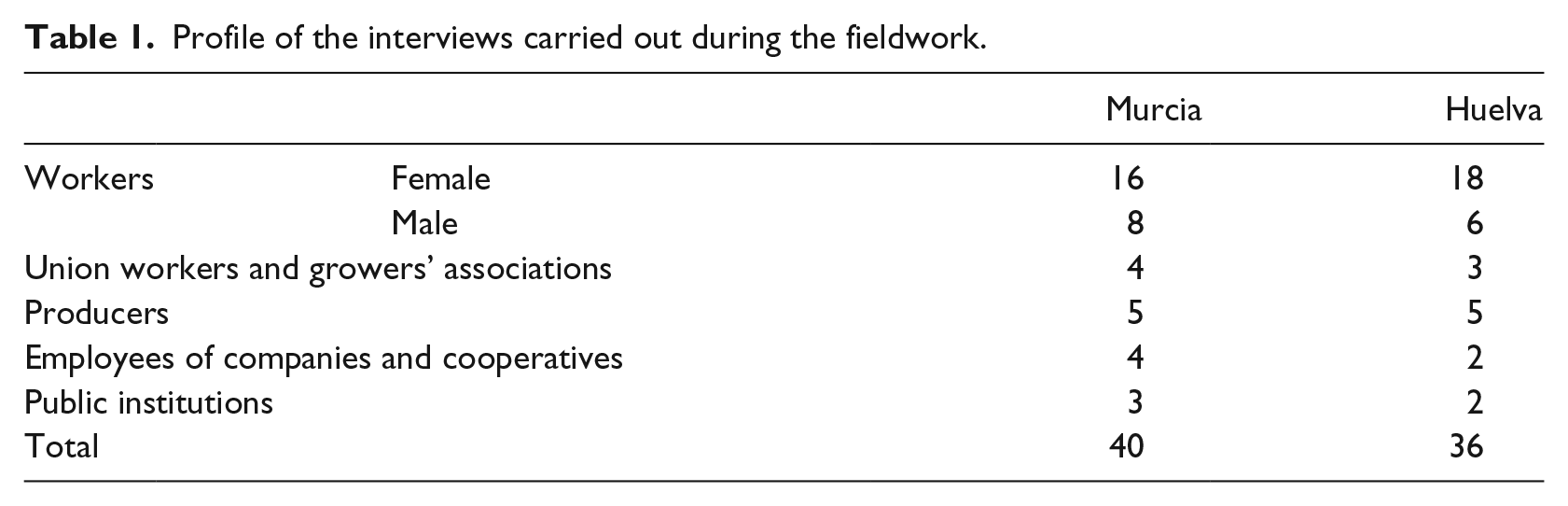
The number of interviews held per category was decided in accordance with the saturation criterion (Alonso, 1998; Bertaux and Bertaux-Wiame, 1993; Flick, 2014). In other words, when the basic aspects of the discourses in a given profile began to repeat themselves, this category was deemed to be ‘saturated’, and no more interviews were considered necessary. In relation to less central positions (technical experts, politicians, NGOs), previous interviews held enabled us to keep the number of interviews required to a minimum. Given the focus of this present article, special attention has been paid here to the interviews held with female packaging plant employees, employers and plant managers, as well as representatives from agricultural organisations. A total of 40 such interviews were held in the Murcia region and 36 in the province of Huelva, of which 34 were held with local and immigrant women (16 in Murcia and 18 in Huelva). Interviews (45–70 minutes) were voice-recorded and professionally transcribed.
The interviews were analysed from a socio-hermeneutic perspective, which views analysis as a means of capturing discourses to determine the effective meaning of the subjects’ actions, and always attempts to connect discourses with their social spaces of enunciation (Alonso, 1998; Fairclough, 2010). More specifically, socio-hermeneutic analysis is conceived as a model for representing and understanding a specific text in its social context and in light of the historicity of its approaches. It is based on the reconstruction of the interests of those stakeholders involved in the discourse, as well as on the reconstruction of the meaning of the discourses in the micro- and macrosocial – situation in which they were expressed (Alonso, 1998: 188). Figure 1 shows the delimitation of the space of enunciation.
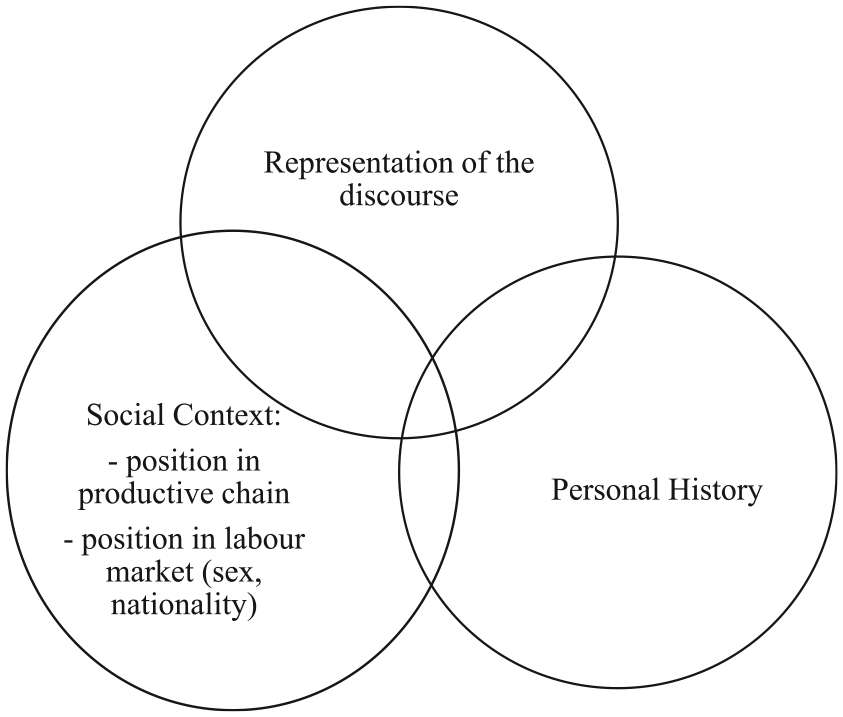
Socio-hermeneutic perspective and the place of enunciation.
By doing this, we managed to identify the discursive elements used by business owners and business organisations to justify their production strategies, and by female plant workers to make sense of their jobs within the framework of the socioeconomic strategies employed by households and local labour cultures.
The devaluation of work in packaging plants
Packaging plants bring together field production, product transformation and commercialisation under the same economic unit. Inside packaging plants, agricultural products become food products suitable for consumption, thanks to the incorporation of a series of characteristics related to the product itself (quality, durability and normalisation) and its mobility and presentation (accessibility and differentiation through different formats). This transformation is carried out using what are known as post-harvest technologies (Pedreño et al., 2014; Segura and Pedreño, 2006).
The technological transformations implemented by business owners have been accompanied by a series of labour management strategies oriented towards ensuring ever lower labour costs and the devaluation of work. These strategies have resulted in agricultural workers becoming the main productive element onto which local employers shift the pressure to which they themselves are subjected by distributors. The feminisation, segmentation and deskilling of labour play a key role in these labour management strategies, along with ethnic substitution and the outsourcing of recruitment. As illustrated below, these strategies cannot be fully understood by analysing the business environment alone. Rather, it is vital to also take into account households and the sociocultural and political context in which they are implemented.
Packaging plants as places of feminised, complementary and deskilled work
The construction of packaging plants as places of feminised work is a historical process that is intrinsically intertwined with the development of the production enclaves on which this article focuses. The presence of women in fruit handling work dates back to the origins of intensive agriculture. In the case of Murcia, many local women from rural families began working in packaging plants as the result of the development of the fruit export business at the beginning of the 20th century and, above all, the boom in the canning and processing industry during the 1960s (Pedreño et al., 2014; Gadea et al., 2017). In the strawberry farming industry in Huelva, which is rooted in a model based on family-owned smallholdings, the products were originally prepared in garages and warehouses located on the farms themselves. Moreover, the work was mainly carried out by women from the household itself, or from fishing families or groups otherwise related in some way to the industry (Reigada, 2017; Hellio, 2014).
In both regions, the 1980s (when Spain joined the European common market) was a decisive decade as regards the consolidation and modernisation of the industry, the expansion of fresh fruit production for export and the establishment of a feminised labour market linked to the handling of agricultural products which, little by little, became characterised by high number of international female migrants. 2
A comparison between the evolution of salaried packaging plant work and that of day labour in the fields reveals the strong ties which exist between the agricultural sector and the local region and community. While the demand for day labour in the fields was covered by workers migrating from nearby areas and, from the 1980s onwards, by international migrants, work in the packaging plants remained closely linked to local, female labour (Reigada, 2012; Segura et al., 2002).
Labour contracting practices, which traditionally prioritised family, neighbourhood and local ties, often resulted in several generations of women working in the same packaging plant. This system helped establish social and economic bonds between the local area and fruit-growing companies, thereby giving rise to territorial identities closely linked to these production industries. As a result of this decades-long link between the local towns and villages and employment in packaging plants, many women living in these regions have direct experience working as fruit packagers. Many women’s grandmothers, mothers and sisters were all employed in the plants at some point in their lives, and this work has become a fundamental element in the local female identity. Furthermore, the fact that, for many young female students, working in the plants during the summer holidays constituted (and continues to constitute today), a kind of rite of passage, which indicates that packaging plants form an integral part of the working trajectories of many local women (Moraes et al., 2012; Gadea et al., 2017; Reigada, 2009).
Gender ideologies and complementary work
Both the economic structure of the regions themselves and the way family life is organised contribute to the creation of a pool of female labour and a gender-segmented labour market, which respond extremely well to the needs of the companies operating in the area. Of the various factors that may help explain the makeup of the specific labour force found in these packaging plants, one which deserves special attention is the cultural belief system which underpins the gender division of labour and which associates this kind of work with qualities considered inherent to women. Discourses centred on the delicacy, care and attention required to handle fresh fruit destined for sale to select consumers on select markets are deeply rooted (and are still reproduced today) in both regions: For handling the fruit, well, women’s hands are not the same as men’s hands; we have a different sort of sensitivity. (Pedro, head of a strawberry cooperative in Huelva) Women do the refined work . . . in fact, they are more delicate when working, more . . . more select. (Martín, producer from Murcia)
These ideologies inform companies’ employment policies and are forged and reproduced in both local households and the local culture from which this female labour stems, as well as in the work environment. Despite the changes generated by the generalised incorporation of women into the labour market, a gender division of labour continues to predominate in the strategies of local households, along with cultural frameworks which make a hierarchical distinction between ‘men’s work’ and ‘women’s work’.
Moreover, within these frameworks, ‘women’s work’ tends to be defined as a source of supplementary income, a little extra money to help boost the main salary earned by the male breadwinner. In the case of both female plant workers and female day labourers in the fields, their work is perceived as ‘helping out’, as a secondary occupation totally dependent on the life cycle of their families: Because perhaps I am here at home, with my husband and son, and for me to stay at home my husband and son have to work, right? I stay at home now. I’m at home for perhaps two months, or a month and a half, during the season when there’s no work, and since they are working, well I stay at home. I’m very happy here at home. And then, when the first strawberries start, that’s when we women start working. [. . .] and then later on the Romanians and Polish women come . . . (Dolores, Andalusian day labourer working in the Huelva fields). When the school term starts in September, mothers with young children stop working. Because you can’t be both with your children and working, and so when things get a bit shaky, they say, ‘right well, that’s it until next year. I’ve worked hard over the summer and that’s it till they ring me again next year’. (Violeta, packaging plant worker from Murcia)
For female pioneers in the agricultural industry and other women who live in households in which the man is viewed as the main breadwinner, their job at the packaging plant continues to be seen, even today, as a complementary activity, despite the fact that it occupies an increasing amount of their time and is a vital ingredient in their family’s domestic economy. This attitude is rooted in a labour culture in which female plant employees, despite being workers, are first and foremost viewed as women–mothers–spouses. Although the dominant social-gender worldviews continue to prevail in the construction of women’s work in packaging plants, some people do strive to contest this, as it is evident in some of the ambivalent and questioning discourses found in this space. This is the case with María and Tania (respectively), two packaging plant workers from Murcia: Before, we were all housewives. Now, many women have some kind of qualification, but since there’s no other work, they end up there anyway. Besides, the mums get married and have kids, and when they are a little older, they go back [to work at the plant]. (María, packaging plant worker from Murcia) Well, working women who just do it to help their husbands, to bring some extra money in, they take their holidays, go off to the beach and have a great time. But those of us who are the main breadwinners in our household, who depend solely on the wage we earn . . . well, I couldn’t afford to do that. (Tania, packaging plant worker from Murcia)
Deskilled
If we analyse the labour environment, a marked gender differentiation can be observed in the internal organisation of work within packaging plants between manual work, on one hand, and planning, conception, control and marketing activities on the other. Most women are concentrated in the first of these categories, and only a very few are charged with the second type of tasks. In other words, women carry out the most work-intensive activities. However, this dividing line also represents a difference in salary and working conditions, with those responsible for designing, planning and control having permanent contracts with higher salaries and a greater degree of job stability, while those engaging in manual tasks mainly have temporary contracts, extremely flexible contractual relationships, hourly wages and greater job instability.
Moreover, there is also a clear gender division of labour within the sphere of manual work itself. The principal tasks carried out by men include loading and unloading, crate transportation and machinery maintenance, whereas women tend to be responsible for preparation, packaging and product selection and calibration. Thus, the internal organisation of packaging plants reflects a situation in which work is masculinised when it requires physical effort (loading, unloading, etc.) or the handling of machinery or modes of transport, and is feminised when socially defined as meticulous and dexterous, with the rhythm being set by the movement of conveyor belts: It’s mostly women [. . .] Handling the food, the fruit, it’s women. Men are there to stack pallets, load the trucks and get rid of the pallets [. . .] put the boxes down, then carry them away, all that sort of stuff. (Lucía, packaging plant worker from Murcia) [The owners] get the women to pick the fruit and the men to get rid of the wires, the plastic covers, etc. The jobs involving physical effort are given to the men, while the women do the harvesting. And it’s the same here at the cooperative. It’s true that on the strawberry punnet line it’s all women, no men work on the line; they don’t like it. They don’t think packing punnets is a job for them, and normally I don’t have any cases of men wanting to work on the punnet line. And yet, the electric pallet jacks are driven by both a man and a woman; putting the 10-kilo boxes on the belts two at a time, though, that’s done by a man. It’s only natural because men are physically stronger than women, so it’s just common sense. (Miguel, manager of a cooperative)
Work in packaging plants is tedious and monotonous, designed for a type of worker considered to be patient and hardy (Mingo, 2013). In this sense, the handling tasks carried out by women are more closely linked to certain qualities considered to be inherently female than to any specific professional qualification, despite the changes that have occurred thanks to the introduction of new post-harvest technologies: [Our qualifications] aren’t recognised because we work in a highly feminised industry, because our category is still considered to be ‘unskilled’, despite the fact that, in reality, any kind of handling requires both training and knowledge. [. . .] Women have even [. . .] had to change the packaging, adapt the image of how the product is presented to the market. We’ve gone from 20-kilo crates to small trays on which every piece of fruit can be clearly seen, so customers can check the colour and shape . . . This evolution has meant that the women and men who handle the fruit have had to become more specialised and be trained, there’s no doubt about it. But we’re still considered auxiliary staff, packers, unskilled packaging workers. (Elisa, trade union representative, Murcia)
Allusion is also made to qualities which reference the semantic field of religious–moral virtues: obedience, patience, effort, endurance and stamina. The capacity to endure long working hours, repetitive tasks and painful postures, as well as women’s double burden (i.e. their paid job and their work in the home), has become female packaging plant workers’ hallmark of labour quality: Why women rather than men? It’s very simple. First, women have much more stamina than men. Women have a much greater tolerance for suffering than men. And they are also much more docile. Women are more selective than men. They are neater. You’re simply better than us! (Francisco, producer and head of a family packaging plant, Huelva) My colleagues and I basically live on Nurofen, because it’s the only way [to endure] [. . .]. And then we need relaxants to sleep. I got to the point at which my mouth, well I couldn’t even talk, I was just so groggy from all the pills I was taking. And then I thought I might have had a stroke or something, which is why I went to the doctor’s. [. . .] I’ve left work more than once in absolute agony . . . needing, I don’t know, an injection or something, and then gone back again the next day. We’re like mules. And I only have myself to blame. Or necessity. Necessity is to blame too. (Lola, packaging plant worker, Murcia) I don’t know, I don’t think youngsters could stand this job, because it’s really tough. Although it’s not so much the physical toughness any more, it’s more the monotony, the having to be there all day, doing the same old thing. If they at least let us put the radio on, time would go quicker. But they don’t, they don’t let us; it would give us something to listen to, to make the day go faster. And you can’t really chat to your colleagues either, because even though there are women either side of you, you can’t have a conversation; and besides, you’d really have to shout because there’s so much noise. If they see you chatting for more than a moment you get told off. (Manuela, packaging plant worker, Huelva)
Alongside the local dynamics, the structure of local households and the internal organisation of the plants, another key factor for understanding the devaluation of packaging plant work is the laxness of labour regulations, particularly in the case of women. Working with no contract, and therefore without Social Security payments, used to be common practice in the industry, which traditionally had very high levels of shadow economy activity.
It is important to highlight here the role played by the State in the (de)regulation of labour relations, as well as in the construction of agricultural work as a ‘special’ kind of employment. Labour relations in the agricultural industry have always been subject to special regulations which have fostered seasonality and job flexibility, two aspects which are very helpful for the labour cost containment strategies set in motion by companies. One example of these regulations is what are known as permanent seasonal [fijos discontinuos] contracts, 3 which establish the company’s obligation to employ workers during the growing season in order of seniority. While this type of contract helped break away from the informal regulations that had previously characterised recruitment, and formally recognised job classification seniority, it also served to normalise seasonality in an industry in which, as a result of production diversification and greenhouse or plastic crop protection technologies, this characteristic had undergone a notable decrease. Moreover, the latest 2012 labour reforms increased temp agencies’ room for manoeuvre, thereby further fostering seasonality and high employee turnover rates. In short, these special regulations have served only to reinforce the idea that agricultural and agri-industrial work is a sui generis type of work, different from ‘normal’ employment.
Ethnic substitution and the outsourcing of labour recruitment as a guarantee of availability
Ethnic substitution in the fields and in the packaging plants
From the 1980s onwards, and particularly after the turn of the new millennium, increasing labour needs, demands for better working conditions and salaries and the shift of the local population towards other economic sectors have meant that both regions analysed here have undergone processes of ethnic substitution and segmentation of labour. These processes affected work in the fields first, and subsequently work in the packaging plants also.
At the end of the 1980s and the beginning of the 1990s, the labour force employed in the fields in the Murcia region began to be replaced by foreign migrant workers from (initially) the Maghreb and (later) Latin America. On the strawberry farms in Huelva, these processes (which began during the mid-1990s) followed similar patterns, with internal migrations by day labourers from Andalusia gradually giving way to international migrations from the Maghreb and (some years later) sub-Saharan Africa. These migrations were mainly masculine and followed the harvest circuit, with workers often being illegal migrants without the proper paperwork (Author et al., 2017; Avellá and García, 1995; Sempere, 2004). It should be noted that the greater vulnerability of foreign workers during the initial period of the migratory process is extremely advantageous for business strategies aimed at containing labour costs.
The ethnic substitution of labour processes occurred later and more slowly in the packaging plants. In the case of Murcia, only a small percentage of women from neighbouring provinces have been replaced by migrant women from Morocco and Ecuador (Moraes et al., 2012). In Huelva, local workers have begun to be replaced by women from Eastern Europe and Morocco (Reigada, 2012). As stated above, this shift is linked, on one hand, to the fact that local female workers are leaving in search of other, more attractive jobs; however, on the other, it is important not to ignore the pressure exerted by companies themselves, which seek to accelerate these ethnic substitution processes: There are a lot of Romanian women at La Castillería [a cooperative located in Bonares], and they work for half the price [. . .] They all have houses and everything there, really nice ones too, detached houses, and they work at the handling plant and cost us half as much. Because, of course, the company has to make a profit too, right? [And at this cooperative in Moguer would you also consider replacing local workers with female immigrants?] Replacing them here? Why look for trouble with the town? And we’d have big trouble. They are almost all from Moguer, although there are some from San Juan, from Huelva . . . And they only come here so they can get the dole later and then they start with ‘ow, my leg hurts!’. By the end [in May, at the end of the season] forty or fifty are off sick. It’s not right! And none of the Romanians take sick leave. The only thing they want is to earn money to take home with them. (José, agricultural businessman from Huelva) In this cooperative they almost prefer to employ immigrant women because they are always nearby. They put them up in bunkhouses [prefabricated industrial units] and they know they’ll be there on time and will never let them down, while the women from the town want to be with their kids during the Easter holidays, during the religious processions or when they take their First Communion. Or their daughter gets sick or their grandma has a problem and they quit in the middle of the season. Or their husband gets ill. I guess we’re more problematic, we make more problems for them. (Yolanda, packaging plant worker from Huelva)
Although we previously referred to female work as a flexible type of employment designed to complement the main salary earned by the male breadwinner without neglecting domestic and family responsibilities, it is important to note that the intensification of production and the ever-increasing demands of globalised markets have resulted in the need for an even more flexible and constantly available labour force. The answer is a foreign labour force made up of women who are more willing to put the demands of their job before their domestic and care-related responsibilities. It should be remembered that the social status and position bestowed on immigrants is often accepted as an inevitable reality (‘it’s all there is’), and this has an impact on migrant workers’ expectations regarding access to the labour market. It also informs the decisions they make regarding the working and living conditions they are willing to accept and the possible trajectories of labour mobility: As foreigners, we come here to do basically the hardest jobs in the country [. . .]. Here, in Spain, I suppose that all of us who have come do the hardest jobs there are, whether it be in the fields, in construction, in domestic service, whatever . . . But it’s all there is. (Lidia, Ecuadorian worker, Murcia. Italics added)
Temp agencies and seasonal agricultural worker programmes
Spanish and European legislation, in this case, immigration law, plays a key role in the construction of this devalued workforce. Under a model of ordered, regular immigration, Spanish migratory policies have striven to combine the needs of the agricultural labour market with the State’s interest in controlling the entrance of foreign citizens. Immigration law 4 establishes foreign workers’ legal stability as being dependent on their employment situation, since the decision to grant or renew permits is usually linked to the person in question having a job or an employment contract. Moreover, contracting depends on the national employment situation, since the law states that work permits shall only be granted for those occupations in which the local workforce is insufficient to cover demand. To this end, two basic procedures were established in Spain: the General Regime and the Quota Regime. The first of these enables employers to hire foreign workers in their countries of origin, once it has been ‘proven that the job in question cannot be filled by any unemployed person registered in the national territory’ (Torres, 2011: 23). Due to the difficulties inherent in applying this procedure in practice, the Quota Regime was introduced in 1993. This system establishes an annual quota, set by the government, which indicates the number of jobs, sectors and regions in which foreign workers can be hired. Both mechanisms have given rise to the concentration of immigrants in certain professions, thereby generating employment niches in which agriculture and domestic service have a very strong presence. 5
Agricultural employers have skilfully used this discriminatory institutional framework not only to develop ethnic substitution strategies, but also to set in motion diverse recruitment plans. Companies have mainly focused on outsourcing labour recruitment through the use of informal intermediaries, programmes designed to enable the hiring of foreign workers’ in their countries of origin and temp agencies. In the case of Murcia, the most common form of recruitment consists of activating local networks both in and outside the region. To this end, employers often ask supervisors or company bus drivers to spread the word to their acquaintances, friends and family members. Recently, however, packaging plants have increasingly used the services provided by temp agencies to recruit their employees, especially since the 2012 labour reform (Author et al., 2017): Then there are the temp agencies. When the temp agencies come the number of staff triples because they bring three coaches full of female Ecuadorian workers. In the temp agencies . . . well, this year Spaniards have entered through the temp agencies because instead of hiring temporary workers directly, the company did it through the temp agency. Local women who had previously been hired directly were hired this year through the temp agencies. But temp agencies used to hire only Ecuadorian women. (Tania, packaging plant worker from Murcia)
In Huelva, although networks and intermediaries also play an important role, the strategy that does the most to foster the entrance of migrant female workers into both the plants and the fields is the female seasonal agricultural worker programme. This programme, which in Spain is known as the contracting in country of origin system [contratación en origen], has become increasingly consolidated and widespread since 2001, with the number of contracts signed doubling every year, increasing from 6500 in the 2001–2002 season to over 20,000 in 2003–2004, 32,000 in 2005–2006 and around 40,000 in 2007–2008. Poland and Romania initially became the main countries supplying the labour required for the growing season, although this trend was drastically disrupted during the 2006–2007 season with the emergence of new supplier countries such as Morocco. This system was severely affected by the economic recession and the return of Andalusian day labourer families to the fields. 6 Over recent years, it has regained some of its former weight, with a total of 19,179 contracts being signed with Moroccan female workers during the 2019 season. The programme establishes the occupational categories in which posted female workers can be employed, along with a maximum quota of workers per category and year, the type of contract permitted and the national origin, age and gender of those affected. It also limits their geographical mobility during their stay and establishes their commitment to return to their country of origin once the growing season is over. 7
The selection criteria used in this programme are not limited to establishing a preference for hiring women. Rather, they are also oriented towards a profile of what is considered to be the ideal female worker (Reigada, forthcoming): middle-aged women from impoverished rural areas with family responsibilities: The profile is that of a middle-aged person, neither too young nor too old. The ideal candidate would be a 35-year-old with a family who simply wants to earn money, nothing else. A 21-year-old may come to earn money but if they can have a good time too, so much the better. It’s totally understandable [. . .] [The fact of having children] makes it easier when the time comes for them to go back, because they have roots in their country of origin, they have a family, so they’ll go back. You feel confident that this person will go back because their family is there, because their family is financially dependent on them and in some cases, even, the family depends entirely and exclusively on the money they earn when they come here to work. You therefore have a guarantee they will go back and you have a guarantee they will work hard. (Jesús, technical expert in an agricultural organisation, Huelva) Well, the selection process is carried out by the employers and I believe that women adapt better to the work, especially when they are hired in their country of origin, because it is important to ensure their commitment to return at the end of the season. Women normally have more family ties than men, and are more likely to go back, and this means that more women than men are usually selected. (Assistant Government Representative in the province of Huelva)
Discussion and conclusion
The analysis conducted here reveals that a fundamental part of the adjustments carried out by the production industry to enable it to withstand the pressure exerted by large-scale distributors and become part of the global agricultural supply chain is linked to methods of managing the workforce in packaging plants. Thus, in line with mainstream literature on value chains, our article highlights the margin of autonomy enjoyed by local producers for improving their competitive position in the value chain. However, contrary to this mainstream, it also shows that the strategies employed by producers are not aimed solely at implementing productive, organisational and commercial innovations, but also at devaluing work. Specifically, the results highlight the functioning and role of three business strategies of devaluation: the deskilling of women’s labour, the feminisation and segmentation of labour and the ethnic substitution and labour recruitment outsourcing mechanisms.
First, the analysis of the internal organisation of work within packaging plants reveals the strict gender differentiation which exists between manual work and planning, conception, control and marketing activities. This division explains the concentration of women in less socially valued manual jobs, which are characterised by being highly temporary and unstable, with very flexible contractual relationships and lower salaries. To this, we must also add the sexual division of labour within the range of manual jobs available, which associates meticulous (and tedious and monotonous) tasks with female workers, who are seen as being more patient and hardy (Mingo, 2013). This is evident in the tendency to emphasise female packaging plant workers’ ability to put up with repetitive tasks, painful postures and long working hours, or to view their capacity to cope with their double burden as a guarantee of good performance.
Second, the article shows that the segmentation and feminisation of work are linked to the deskilling of labour. This confirms the conclusion drawn by previous research, which hold that female work is associated with repetitive activities for which employers require no specific qualifications, but rather a set of certain qualities which are considered feminine (Barrientos, 2014; Fernández-Kelly, 1984; Hirata and Kergoat, 1997; Pedreño, 1998).
Third, the case studies of Murcia and Huelva reveal the changes made to recruitment systems and the composition of labour, changes that are based on the mobilisation of vulnerable social groups and are geared towards ensuring greater availability and reduced production costs. This is evident in the feminisation and ethnicisation of work resulting from the outsourcing of labour recruitment processes, particularly the use of informal intermediaries and temp agencies (as in Murcia), and contracting in country of origin programmes (like the one used in Huelva).
Our contribution here is not merely to point out that the devaluation of work is a strategy for increasing productivity by reducing salaries or a means of strengthening the link between feminisation, flexibility and job insecurity in the globalised agricultural industry (Allen and Sachs, 2012; Figueroa, 2015; Lara, 1998; Preibish and Encalada, 2010). Rather, what we aim to show is that economic devaluation also depends on the social reproduction of vulnerable social groups. Our analysis reveals that business strategies directly contribute to the establishment of an unequal social structure, with vulnerable positions which, in both the regions studied, have, over the years, been occupied by different groups willing to accept extremely low salaries.
Our analysis also shows that the devaluation of agricultural work cannot be understood by taking into account only the production process organisation and labour force management strategies employed in packaging plants. Rather, it is also necessary to bear in mind the environment in which these strategies are deployed, which is characterised by a number of different rules pertaining to the local labour culture, labour laws, immigration laws and the economic strategies employed by households themselves.
Firms do not only operate in a context with a specific cultural framework, but they are also forced to use these cultural elements to achieve their aim of enhancing their competitiveness. In this sense, our article shows that devaluation is not only an economic, but also a cultural and political strategy. CMS offers a range of valuable analysis instruments which, with some notable exceptions (e.g. Ramamurthy, 2011; Werner, 2016), tend to be overlooked by studies on value chains due to their overly economistic outlook. Our principal contribution here is to point out that agricultural firms actively use cultural elements stemming not from the corporate culture of new managerialism, as CMS argues (Alvesson and Willmott, 2012; Grey and Wilmott, 2005; Wilmott, 1993), but rather from local labour cultures. Our analyses show that these local labour cultures, which define female packaging workers primarily as women–mothers–spouses, and only afterwards as workers; which mobilise cultural qualities and beliefs such as delicacy, care, attention and endurance; and which promote the link between territory, the agricultural industry and female work, foster the reproduction of a constantly available female labour force. Furthermore, the empirical analysis reveals how agricultural companies actively use local cultural frameworks to build a vulnerable workforce.
Finally, our analyses demonstrate how the devaluation of work is also a political strategy, in that, local business owners need to be able to mobilise the institutional framework also to achieve their ends. This institutional framework is, as we have seen, defined by the laxness of its labour regulations and immigration laws, which foster an instrumental view of immigrants subject to the needs of the agricultural labour market. In short, it is an institutional framework that business owners use to their advantage in their efforts to deploy diverse work devaluation strategies. Hence, a slight reform of labour and immigration laws oriented towards upgrading the protection of workers and immigrants would lead to an improvement of working and living conditions.
Footnotes
Authors’ note
C.d.C., E.G. and A.R. contributed equally.
Funding
The author(s) disclosed receipt of the following financial support for the research, authorship and/or publication of this article: This article has been possible thanks to the project ‘Governance of quality in global agrifood chains. A comparative analysis of the agro-export territories in Spain’ (CSO2017-85507), financed by the Ministry of Science and Innovation of Spain (2018–2021).
