




Abstract
Recently, there has been a proliferation of alternatives to the global food system. Yet, there is still an ongoing debate on their potential to transform the food system and challenge its globalization. This research introduces institutional analysis to the food system literature in order to comprehend actors’ efforts to scale up alternatives and transform the food system at the local level. Such efforts are explored from an inductive research of the organization called M-Local Food Project, which gathers a range of diverse actors to work on expanding alternative food and transforming the food system in eastern France. Based on this organization’s analysis and its collaborative institutional work, this research highlights how to organize collective agency from the collaboration of multiple actors to co-build an alternative food system and extends the debate on alternative food potential to challenge the dominant global food system. It also provides an emerging model of collaborative institutional work that enriches the institutional analysis on the coalition for institutional changes and offers practical advice on tensions for alternative organizations that cannot be overcome.
Introduction
What do community-supported agriculture (CSA), community gardens, groceries run by citizens or farmers have in common? They are all alternative food (AF) initiatives, which create a new link between producers and consumers and which offer a new paradigm in contrast to the agriculture intensification and exploitation from powerful multinational corporations (Ericksen, 2008; Lang and Heasman, 2004). Those micro-level initiatives have multiplied over the last decade with increasing food crises and safety scandals (Labatut et al., 2016), and yet, their impact on the global food system is open to debate (Deverre and Lamine, 2010). Most AFs occupy a small niche or become part of the dominant system with their scaling-up (Beacham, 2018; Mount, 2012). The local development of AFs triggers greater difficulty in affecting the broader global food system (Borras et al., 2015; Pretty, 2002). Pretty (2002) and Allen et al. (2003) notice that most AFs are disparate while it is from their connection into a system that a powerful social change can occur.
This article aims to explore such efforts on scaling up AFs into an AF system 1 from the micro level. Ericksen (2008) notes that previous scholars have tackled food transformations from the macro perspective while exploring it from the micro perspective requires further investigation. The new institutional theory (Klein, 2017), and, in particular, the institutional work approach, is meaningful in addressing big issues like the future of food from a local dynamic perspective (Hampel et al., 2017; Lawrence et al., 2009). This approach focuses on local dynamics involved with actors’ effortful practices directed at creating, maintaining, and disrupting institutions (Lawrence et al., 2009) and provides numerous insights into the collective process of multiple actors to affect rules, norms, and values (Hampel et al., 2017). Thus, it helps at investigating the micro dynamics from which AFs can be scaling up and affect food transformation (e.g. the connection of local AFs and their collaboration to become powerful, Allen et al., 2003; Pretty, 2002).
Nascent institutional research focuses on the collaborative work between heterogeneous actors to affect institutional changes (e.g. Delacour and Leca, 2017; Helfen and Sydow, 2013; Van Wijk et al., 2013; Wijen and Ansari, 2007; Zietsma and Lawrence, 2010). Such collaboration can facilitate the diffusion process among different audiences (Delacour and Leca, 2017) and overcome conflicting interactions between actors to evolve the social system (e.g. Helfen and Sydow, 2013; Wijen and Ansari, 2007). Nevertheless, collaboration among heterogeneous actors remains difficult due to different worldviews, languages, and perspectives (Hampel et al., 2017). Further investigating such difficulties could help researchers comprehend the complexity of an AF system co-construction and its impact on the globalized food system. Consequently, this study explores how the collaboration of multiple actors occurs in order to implement an AF system at the local level. It also strives to determine the tensions emerging from this collaborative institutional work that explain the limits of AF potential at the micro level.
This particular interest in collaborative institutional work and its tensions emerged from the inductive exploration of a case study called the ‘M-Local Food Project’ (M-LFP), with the mission of making local and healthy food affordable to anyone in the territory. The qualitative analysis of this case identifies a collaborative institutional work based on common ground efforts, boundaryless work to create interactional openness, and efforts to diffuse AFs. The interplay between those efforts also generates tensions based on interaction, temporality, and space that threaten AFs’ key tenets: the democratic process that sustains AF organizations, the degree of alternatives when diffusing practices, and the relocalization of food. The three tensions bring to light the dilemma that the AF system faces with its scaling-up.
Hence, the main contribution of this study is to extend the analysis of the AF system potential from a micro-agency perspective. The study describes in more depth local efforts to co-build an alternative to the global food model and also its limited impact regarding the main tension between serving a niche market and becoming part of the dominant system. Moreover, it introduces the concept of collaborative institutional work and the value of the institutional work approach to further investigate food system transformation using both micro and collective lenses. Finally, it contributes to the comprehension of the importance and complexity of uniting the diverse range of AFs while balancing main tensions for alternative organizations.
Exploring AF using the institutional work approach
AF systems
The CSA model, grocery stores run by farmers, or community gardens are examples of alternatives to the dominant food system. As a part of and a main characteristic of the capitalism regime (McMichael, 2009), one can characterize this dominant system by globalizing food from its production to its distribution and consumption (e.g. Dahlberg, 2001; Ericksen, 2008; Lang and Heasman, 2004; McMichael, 2009). A growing body of literature has been exploring the development of AFs in response to the excesses of the globalized dominant food system and scholars converge on three AF characteristics (e.g. Borras et al., 2015; Cleveland et al., 2014; Deverre and Lamine, 2010; Mount, 2012). First, AFs promote the ‘localization’ of food and abandon the global approach (Allen et al., 2003; Feagan, 2007) as they recreate some of the connections between farmers and consumers (Pretty, 2002). Second, AFs rely on social justice and environmental sustainability goals in addition to economic viability (Allen et al., 2003; Cleveland et al., 2014). It challenges the negative effect of industrialization on consumption (with excesses of meat, sugar, and oil, Ericksen, 2008) and production models (with depeasantization through intensive farming, McMichael, 2009). Third, it relies on democratic and civic gestures (Pretty, 2002) opposed to authoritative governance and human exploitation. From this perspective, AFs are a way to exert pressure on the dominant system (Deverre and Lamine, 2010).
Nevertheless, there is an ongoing debate on the extent to which AFs can really transform the food system. AFs have a great potential to promote equity (e.g. Pretty, 2002), positively affect the environment (e.g. Beacham, 2018), and empower consumers and producers (e.g. Guptill, 2009). Nevertheless, Mount (2012) and Beacham (2018) direct attention to AF embeddedness in a context dominated by capitalism with industrialized and globalized food actors. With their diffusion, some AFs are distorted by dominant actors taking possession of it (e.g. labels for local production) and others are overprotected and remain niches with little impact (Mount, 2012). To comprehend such debate on AFs’ potential to scale up and affect the food system, it requires further investigation on the micro process and individuals’ agency (Ericksen, 2008; Mount, 2012).
Many scholars have depicted how AFs have emerged locally and acknowledge how they are limited by their smaller scale to affect food transformation (e.g. Cleveland et al., 2014, study on local hubs). The relocalization of food systems has helped consumers, producers, and food social entrepreneurs to control the system at the local level (Deverre and Lamine, 2010; Pretty, 2002). However, the local scale of AFs also implies more difficulties in diffusing those new practices and their values (Mount, 2012; Pretty, 2002). This is a matter not only of volume but also of maintaining the foundation of local AFs based on social and environmental purposes as they fight to survive given the dominant global food system (Borras et al., 2015; Mount, 2012). Regarding the limited impact on the globalized food system, Pretty (2002) and Allen et al. (2003) notice that most AFs are disparate while it is from their connection into a system that a powerful social change can occur.
Further investigation on actors’ efforts to collaborate and connect disparate AFs into a whole system could help researchers understand in more depth the dilemma of AF potential because of the tensions that emerge from implementing them. The institutional work approach provides a lens on individual actors and their agency to affect social change.
Bringing institutional work to AF systems
This institutional work approach (Lawrence et al., 2009) depicts in greater depth the complex interaction between structure and agency that occurs with food transformation (Ericksen, 2008) from local and collective efforts. Lanciano and Saleilles (2011), for instance, use this approach to focus on actors’ activities to implement the French CSA model. Lawrence et al. (2009) define institutional work as physical or mental efforts aimed at affecting (creating, maintaining, or disrupting) an institution or a set of institutions. In particular, this approach provides rich insight on the collective dimension of social transformation with multiple actors participating (Hampel et al., 2017). This includes the connection among multiple AF initiators (Allen et al., 2003; Pretty, 2002) to transform the local food system.
According to Wijen and Ansari (2007: 1080), collaboration and a collective logic of action is ‘the only route to achieve change’. While most institutional studies have been exploring collaborative dynamics among homogeneous actors (‘40 of the 53 studies’ reviewed by Hampel et al. fell into this category), a group of scholars have emphasized the importance of collaborative efforts between heterogeneous actors. First, it shows the potential of collaborative work between groups of opponents to overcome obstacles and achieve social transformation (Helfen and Sydow, 2013). This includes discursive efforts to create a dialogue between activists and pro-genetically modified organisms (GMOs) (Audebrand and Brulé, 2009). Second, it emphasizes the importance of various actors to form a coalition (beyond opposition) in order to enrich ideas and action strategies and facilitate diffusion among different audiences (Delacour and Leca, 2017). Previous scholars provide a lens on key characteristics and conditions of the collaborative dynamic to effect change. It requires a free space (Zietsma and Lawrence, 2010), large enrollment (Wijen and Ansari, 2007), and co-building on common rules and practices (Nicholls and Huybrechts, 2016; Wijen and Ansari, 2007). Nevertheless, those studies have paid little attention to the complexity of such dynamics from the micro-lens on collaboration.
According to Hampel et al. (2017), collaboration between heterogeneous actors is a significant part of institutional work that requires further investigation. Thus far, researchers have developed very little about the tensions and difficulties to agree regarding the micro interactions with different worldviews, languages, and priorities. Consequently, this study aims at extending this nascent body of research on collaborative efforts by heterogeneous actors (Hampel et al. 2017) with attention to local agency and the tensions emerging from it. Such a perspective can reveal the efforts needed to gather diverse (and disparate) actors and create an AF system, and the main difficulties that explain why some researchers criticize AF potential. Therefore, this research investigates how the collaboration of multiple actors occurs to implement an AF system at the local level. It also answers the following question: What are the tensions emerging from this collaborative institutional work that comprises the AF dilemma regarding its potential at the micro level?
Empirical setting
This research relies on a case study of the M-LFP organization, located in the eastern part of France within the territory called M. The M-LFP has gathered a diverse range of actors (experts, institutional and elected representatives, professional and social associations, and owners of food projects). The goal is to transform the food system at territory level by developing, supporting, and connecting local food projects that provide an alternative solution to the global dominant food system. Project initiators do not expect to change the situation largely, but they do expect to be part of a collective movement, which could advance AFs and change the local system. According to one member of the M-LFP organization, ‘Ultimately, the M-LFP can help to inflect the food system. It represents a great opportunity to be part of a dynamic that entails doing things differently’. Doing things differently means providing healthy organic food for everyone. Note that the M-territory suffers from one of the highest poverty and obesity rates in France and local organic food can feed only 4–8% of its population. Consequently, an AF system that brings social justice and environmental sustainability priorities is of great importance for this territory.
The organization began in 2014 with two initiatives: one from the private foundation of a mutual company called ‘CIMAF’ to support projects connecting health and food and another initiative of the Metropolitan Authority (M-Authority) to connect local farmers and catering actors. The two organizations faced important issues in connecting those local food actors. Then, Anna, the project manager for the CIMAF foundation, and Laura, who supervises M-Authority’s sustainability department, decided to join forces and hired two experts (a social scientist and a territorial project developer) to investigate the lack of local food expansion in 2016. They noticed that an increasing number of actors are involved in local AFs, but most of them remain isolated instead of helping each other. Consequently, Anna and Laura organized a plenary session in November 2016 to present the results, bringing together 44 participants from diverse universes (e.g. food operators, producer representatives, members of social associations, local politicians, social entrepreneurs) who expressed their willingness to pursue this type of collaboration to connect and expand AFs. As a result, the participants formalized a collective organization and adopted the name M-LFP a few weeks later in reference to the ‘Local Food Project’ (LFP) certification that the French government developed in 2014. The certification covers all types of projects that ‘put producers, food-processors, distributors, regional governments and consumers closer; and develop regional agriculture and food quality’ (Articles L1-III and L 111-2-2 from the rural legislation). They obtained the LFP certification in 2016, and they used this new label to structure further their collaboration.
The ‘management committee’ is the center of the collaborative dynamic, with a low number of participants who meet regularly and closely collaborate. Laura (from the M-Authority) and Anna (from CIMAF) put together this management committee, which comprises approximately 15 ‘key actors’, including experts, regional institutional representatives (from the agricultural and food ministry, the department of climate change, and the regional authority), representatives of farmers’ associations (the main farmers union, the alternative farmers’ association, and the organic farmers association), and one AF project owner (also a CSA chairman, see Appendix 1). Committee members work together in regular monthly meetings to build the collective dynamic based on timely collaboration with two other groups. First, they interact with elected CIMAF and M-Authority representatives within the advisory board to report happenings and obtain their support. Second, and most importantly, the management committee organizes the largest collaboration on an ad hoc basis (2 to 3 times a year) through plenary sessions and working groups, with AF project owners and all actors concerned with local food who volunteer to participate. This allows them to co-build a local alternative solution to the dominant global food system at the territory level. Table 1 summarizes the main steps and this study further investigates the collaborative institutional work that helps one understand actors’ efforts to affect the food system from alternative projects.
Main events at the national and organizational levels.
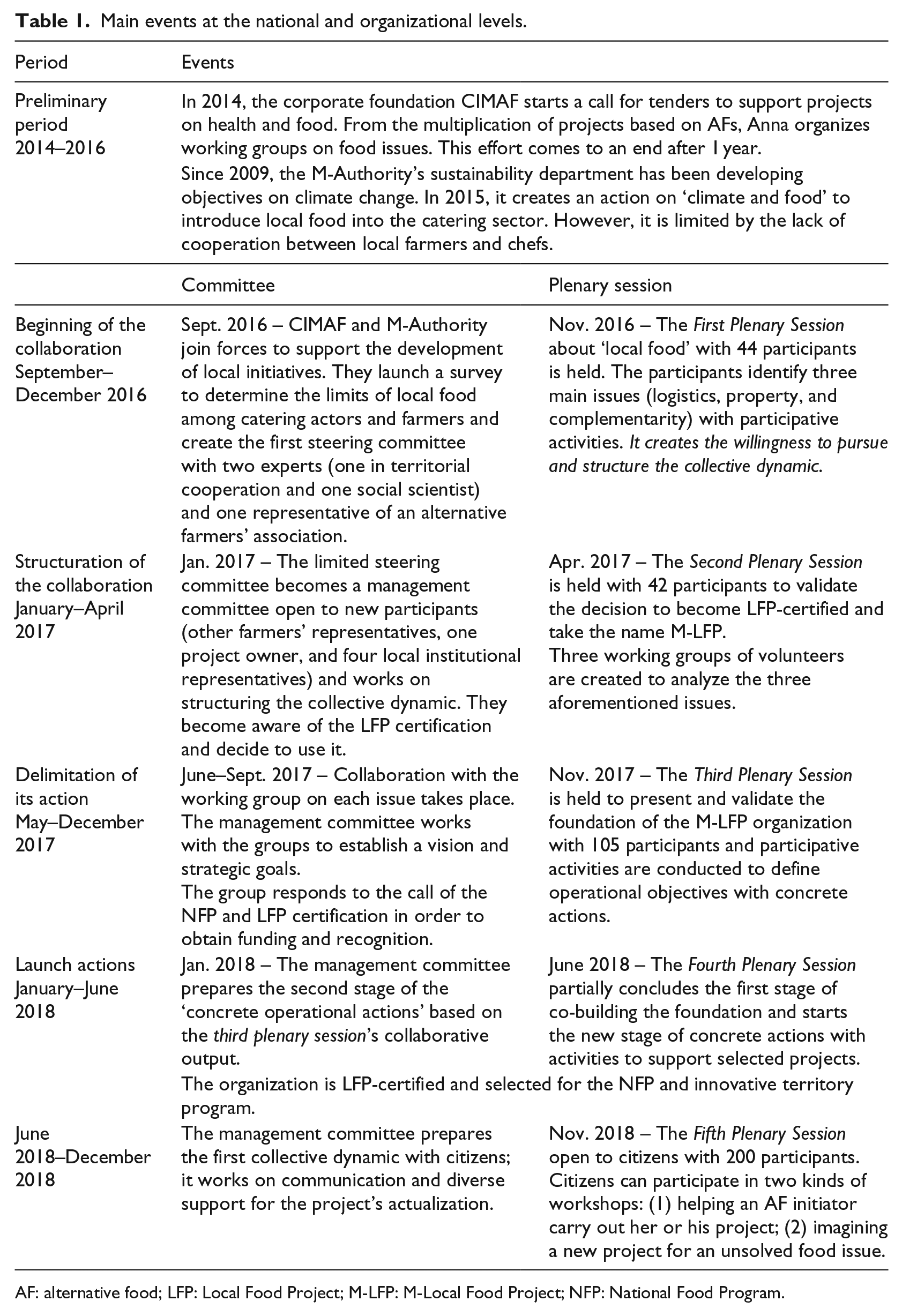
AF: alternative food; LFP: Local Food Project; M-LFP: M-Local Food Project; NFP: National Food Program.
Data collection and analysis
This research is based on an embedded longitudinal case study that is particularly suitable to explore complex processes that are based on multiple levels and units of analysis (Yin, 2003). The M-LFP case study comprises multiple units with the management committee and the larger interaction during (ad hoc) plenary sessions. The entire procedure involved an iterative process of simultaneously collecting and analyzing the data and seeking new informants and documents based on information that prior informants deemed important (Corley and Gioia, 2004).
Data collection
The data collection relied on three techniques triangulated to each other to consolidate the richness of information and gain additional perspectives on key issues (Miles and Huberman, 1991).
The first technique is semi-structured interviews with 21 organization members directly or indirectly involved in the M-LFP. I audio recorded all interviews, which lasted between 1 and 2 hours. During the first round (May–October 2017), I collected broad information about the M-LFP’s history and process of development with eight actors who were directly involved from the beginning. Then, I looked for information about the collaborative dynamic with a second round of 13 interviews with committee members and food project owners. Appendix 1 summarizes this sample and its heterogeneity.
The second technique employed is participant observation of 19 events. I collected 50 hours of observation (June 2017–November 2018) at the different collaborative levels. In addition to increasing opportunities to collect new interviews and access-restricted documents, it was significant for observing social interactions (during the management committee meetings, plenary sessions, and working groups) and gathering insightful data about the content and form of the collaborative dynamic.
The third technique is documentation. I started with documents that resulted from the M-LFP’s collaborative work as primary data. Then, I collected documents related to diverse aspects of the organization (e.g. executive memos, meeting reports, and press releases) as secondary data and traced the organization’s dynamics and history. In addition, I collected external documents about the context from press articles and reports with the help of local government representatives.
Analysis
The analysis for this study is interpretative and abductive and is inspired by the Gioia method. This approach provides the basis for clearly delineating themes and aggregate dimensions and connecting them in inductive modeling in accordance with the empirical setting (Gioia et al., 2013). The analysis process began with the preliminary phase of writing an outline (Zietsma and Lawrence, 2010) of the M-LFP organization in order to improve understanding of the case and refine the research question on actors’ effort with the institutional work approach.
The analytical process included three coding steps to achieve the final data structure in Figure 1. First, I began open coding with the NVivo software questioning actors’ efforts to implement AFs. During this stage, I selected first-order coding describing collective dynamic regarding its importance for the M-organization, such as ‘overcoming prejudgment to include actors’ or ‘opening to gather all kinds of actors’. Labels were as close as possible to the participants’ statements while the abstraction process began with the second phase of axial coding (Strauss, 1987). At this second stage, gathering first-order categories drove the coding into types of efforts that characterize this collaborative dynamic to implement a local AF system. For instance, the first-order codes were connected through ‘undermining boundaries’ efforts. From this inductive analysis also emerged various limitations that I interpreted as types of tensions.
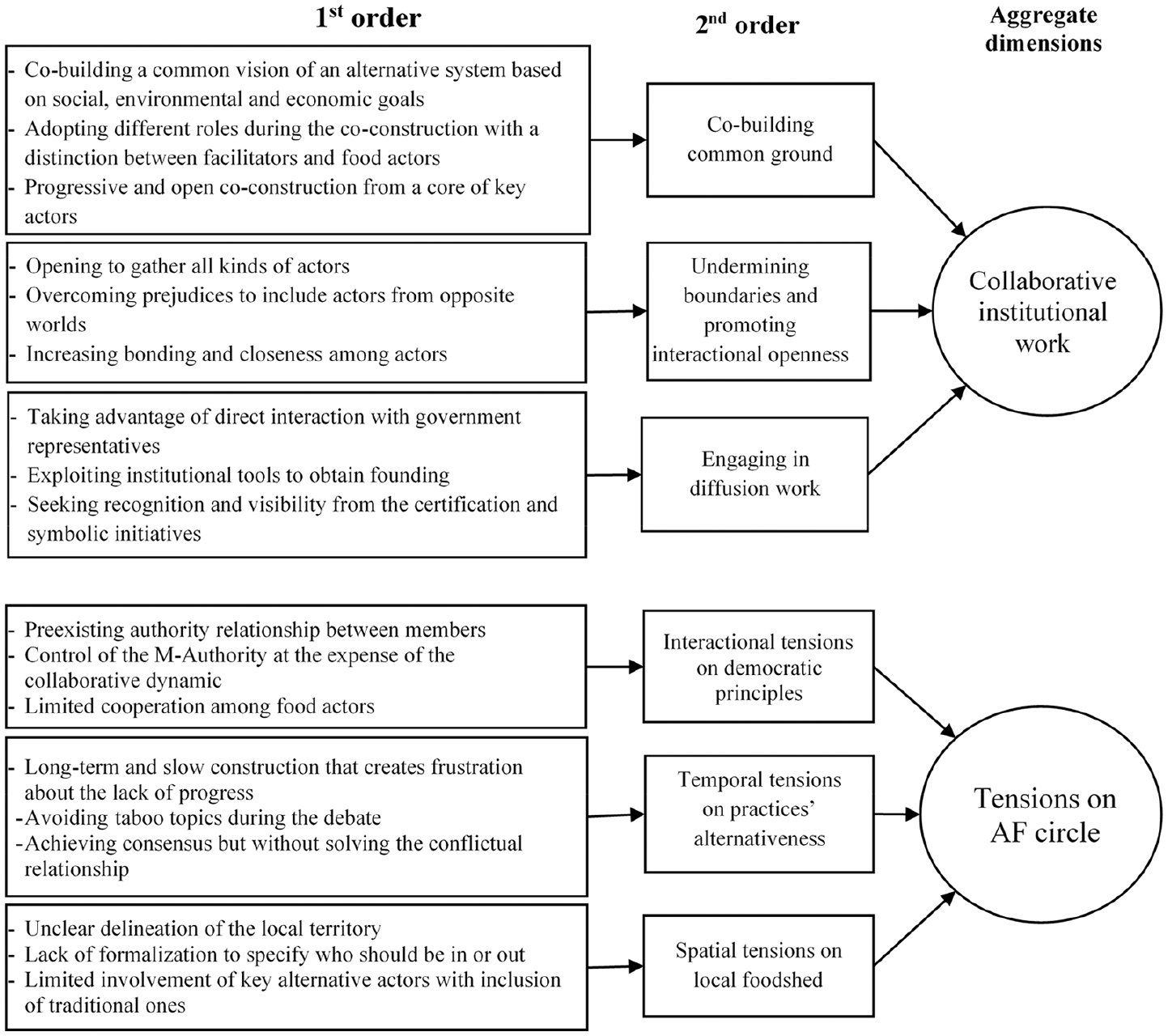
Data structure.
During the last coding step, I interpreted those different types of efforts and tensions in light of the literature to achieve aggregate dimensions (Corley and Gioia, 2004). The label ‘collaborative institutional work’ emerged from the conversation with previous scholars who explored coalition among multiple actors to trigger institutional change. For instance, ‘co-building common ground’ (second-order code), inspired by Wijen and Ansari’s (2007) study, characterizes both the collaborative dynamic and institutional work of ‘co-building the vision of an alternative system’ (first-order code). Similarly, I revised interpretations on tensions with the help of AF studies and current debates on AF potential. For instance, the label ‘spatial tensions on the local foodshed’ has been refined based on debates on how to locally connect space and place (Allen et al., 2003; Feagan, 2007). Those second-order category labels were modified with the delimitation of the ‘AF food circle’ final aggregate dimension (Corley and Gioia, 2004).
This concept of ‘food circle’, representing efforts to connect actors in the (alternative) food system (Hendrickson and Hefferman, 2002), has inspired the emerging model in Figure 2. This model depicts the interplay between the collaborative institutional efforts and the tensions emerging during those efforts, as the findings will describe.
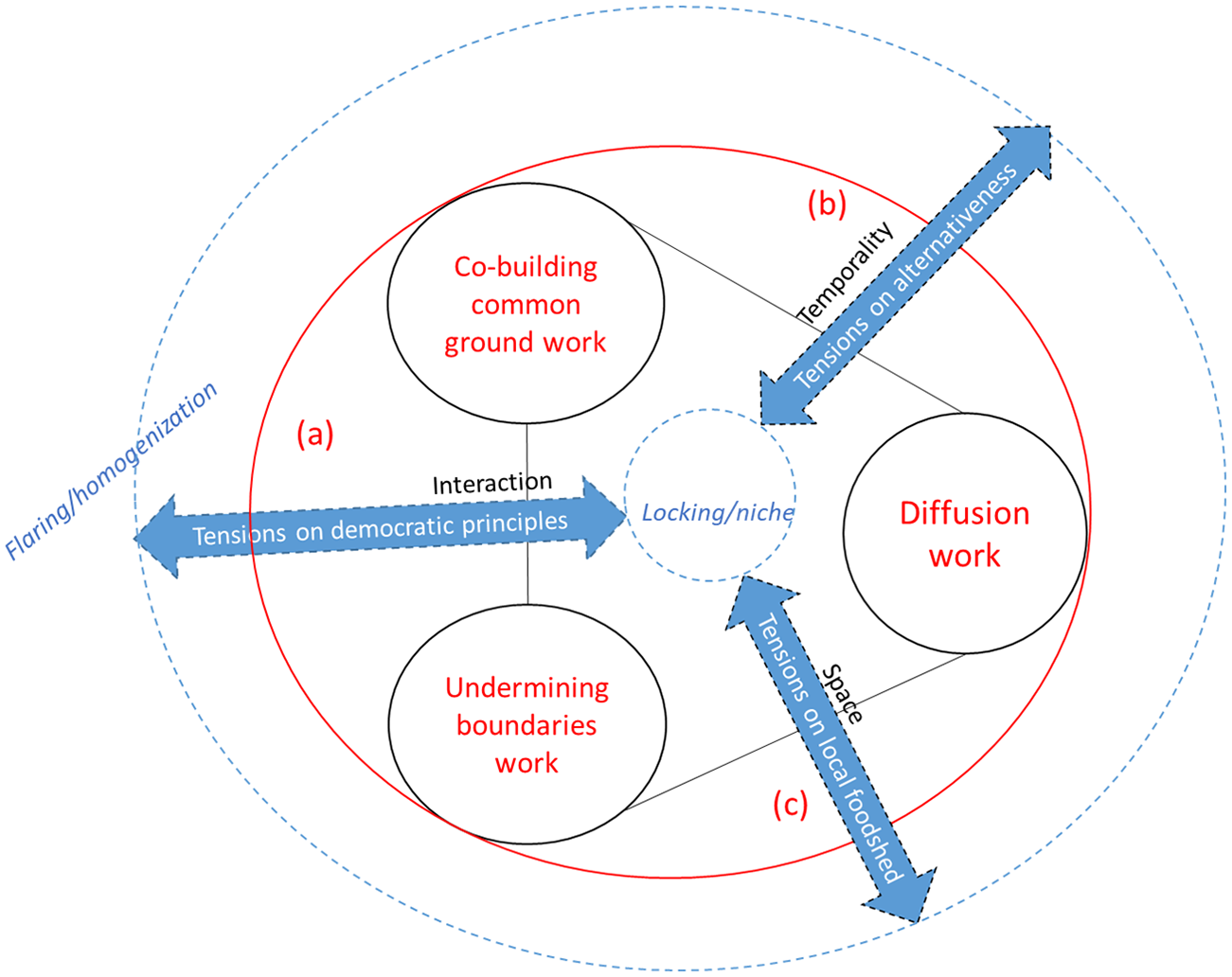
Collaborative institutional work for AFs.
Findings
This research aims at exploring the micro foundations of the AF system and its limitations.
The emerging model represented in Figure 2 depicts the interplay between three types of efforts that constitute the collaborative institutional work. The common ground effort to create a shared vision and build a consensus (Wijen and Ansari, 2007) on key tenets of their local AF system relies on simultaneous efforts to undermine boundaries (Zietsma and Lawrence, 2010) and promote the greatest interaction (Schüssler et al., 2014) between the multiple actors (Figure 2(a)). Both efforts have been essential to achieve the diffusion work that objectivize and legitimize AFs (Greenwood et al., 2002) with a collective agreement on arguments to convince (Figure 2(b)) a large number of participants (Figure 2(c)).
However, this interplay also generates tensions based on interaction, temporality, and space. Those tensions, represented by perpendicular arrows, threaten AFs’ key tenets (its democratic principles, localization, and degree of alternativeness in regard to the dominant logic). At the end of each arrow, we can see inner and outer circles representing the risk of locking their local food system into a niche (Figure 2, small circle inside) or of excessive opening toward its homogenization with the dominant system (Figure 2, large circle outside).
Co-build common ground and boundaryless work: tension on democratization
Key efforts to create cooperation and collectively define the local AF system
Common ground and boundaryless works are constitutive elements of the collaboration of diverse actors to shape the project of an AF system. They aim at connecting isolated actors and defining the AF system’s key elements.
First, co-building the common ground of the definition and main characteristics of an alternative to the dominant system is essential: all members agreed about the purpose to transform the food system, but not all agreed how to define an AF system. According to David, an expert economist and M-LFP member, he posed the essential questions: ‘What do we want? Do we want to contribute to ethics, equity, and access to qualitative products for food banks? Do we want more organic production?’ That is why the group has been working for more than 1 year on constructing the following vision statement: [M-LFP] is a
The committee members have defined explicitly each underlying word and depicted their willingness to co-build an AF system (see Table 2). First, they relocalize food through delineating a territory system with the priority on local food. Second, they encompass the two main goals of social justice and environmental sustainability with a focus on fair, healthy, and environmentally friendly food. Third, they aim at respecting democratic principles with a collective and participative initiative. The vision statement leads to specify the five strategic goals: food self-sufficiency, the lowest carbon footprint, the greatest access to local qualitative food, the increase in employment within the local food system, and fair income for farmers.
An alternative to the dominant global food system.
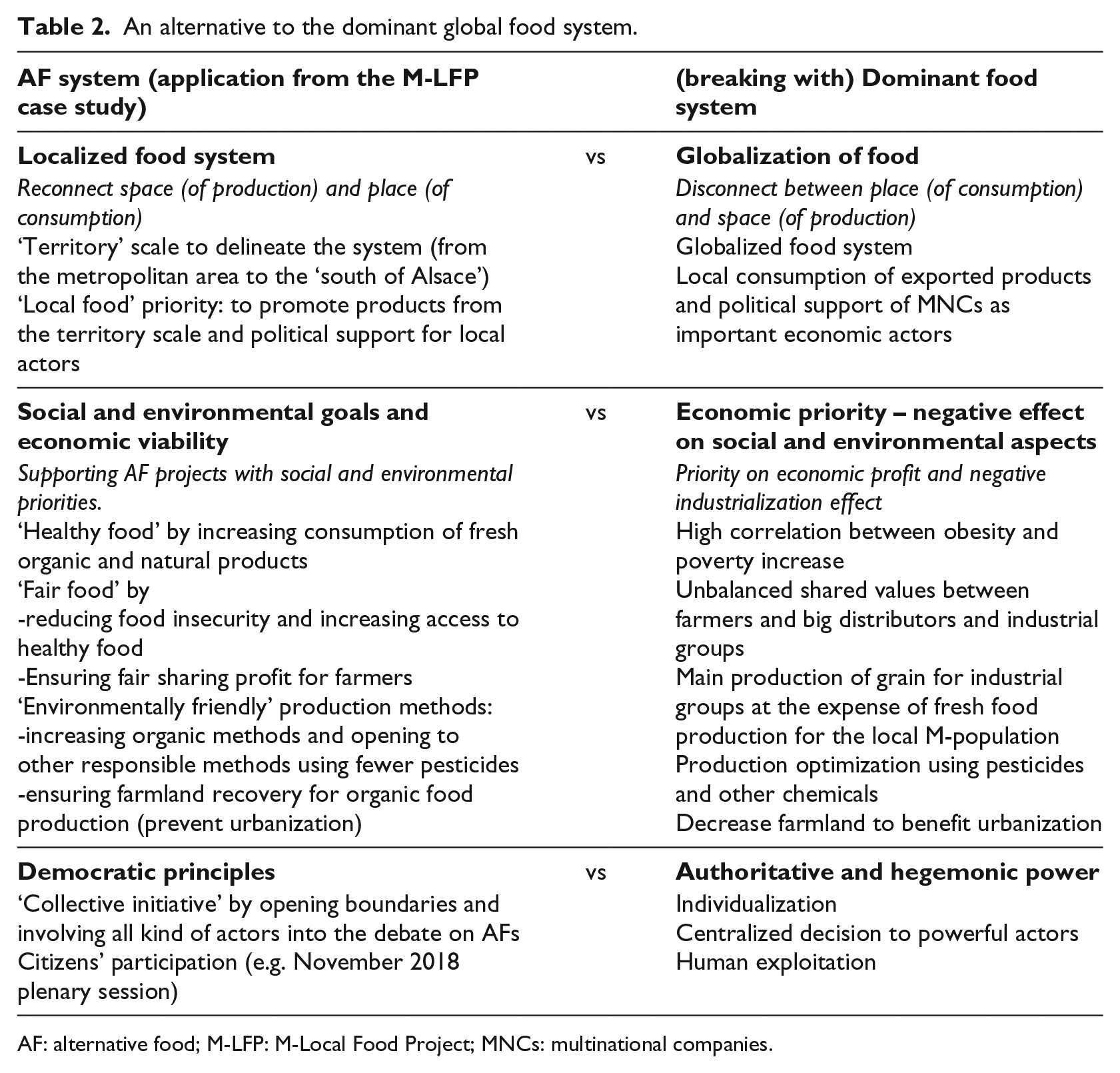
AF: alternative food; M-LFP: M-Local Food Project; MNCs: multinational companies.
The involvement of experts and farming representatives has been critical to ensure the priorities on social justice, environment, and economic viability. For instance, with their vision on fair food, the social scientist stressed the importance of affordability for vulnerable people, while the economic expert emphasized issues on economic viability with farmers’ revenues. Both are management committee members, along with governmental representatives and the CIMAF and M-Authority managers. Management committee members have been the key actors to run the co-construction of the shared vision and of the largest collaborative dynamic with food actors. David emphasizes the role of facilitators to ‘support, set the right conditions, create networks and facilitate things’, while food actors are essential to implement the AF system. However, since the latter ‘do not have the culture of cooperation with each other’ (Anna, CIMAF), facilitators have played a key role to ensure the collective production of their AF system. The collaborative project expert named Franck has led the co-generation of ideas on their vision and goals among the 50 to 100 food actors who participated in the plenary sessions. The management committee facilitated formalizing this vision and ensured that food actors and local elected representatives would support it.
Second, undermining boundaries and promoting interactional openness is essential to achieve a local system, while AF actors in the M-territory are disparate and lack interaction with each other. For instance, the citizens-run cooperative food store project has been limited by lack of contact with local organic farmers. The M-LFP organization has been a place to facilitate such interaction and cooperation with plenary sessions open to all kind of actors interested in a local food system. It includes a stronger connection of AF actors with others groups from different worlds, like politicians (see Appendix 2) and traditional food actors with the main farmers’ union: During the first meeting, the main farmers’ union came with a large number of members to act tough. Finally, there were all types of people: organic defenders, nonorganic defenders and people from different universes. (David)
They did not initially invite traditional farmers, but they welcomed them when they came to the first meeting, in line with their efforts to undermine boundaries. This can be a way to reach their environmental goal, since many traditional farmers are considering local and organic production as a way to move away from big distributor and industrial groups’ price pressures. Then, the M-LFP organization is a place to create new bonds with AF actors and persuade traditional farmers to convert to organic farming. However, welcoming such actors is a challenge that requires overcoming prejudices like did Alice, the Alternative Farming Association (AFA) representative, who worked with the main farmers’ union: ‘I don’t want to be against the main farmers’ union just out of contrariness’. From such efforts, the M-LFP organization provides a neutral space encouraging closeness between actors: There was also a new discussion between organic and traditional farmers. It helped them overcome some prejudices. As I said, it was about closeness between actors. (M-Authority, elected representative)
Overall, this interactional openness has facilitated increasing bonding between actors, in particular the management committee members 2 and their sense of belonging to the M-LFP’s collective action. However, tensions have also emerged from this interplay.
Tensions on AFs’ democratic principles
The M-LFP, in line with AF, offers a democratic process from which any actors can participate in co-constructing their AF system. This relies on efforts to undermine boundaries in order to involve all kinds of participants in the common ground work (see Figure 2(a)). This is how the main farmers’ union representative has become a member of the management committee and has extended the definition of ‘environmentally friendly’ methods toward ‘responsible farming’ using less pesticide (see Table 2). However, there are also tensions emerging from such efforts on the democratic principles they attempt to implement.
Tensions exist between complete transparency and equal voice versus control, and the unequal relationships related to power control. Because power is relational (Dahlberg, 2001), efforts to create interactional openness complicate the power relationship when members are co-constructing their AF vision. For instance, the CIMAF and M-Authority try to take over to ensure decisions will be in favor of alternative actors. Such control relies implicitly on financial support of alternative associations, such as the two AFAs that Alice and Hector represent (see Appendix 1). The CIMAF and M-Authority have appointed both associations to work on related missions that include implicitly their involvement in the M-LFP action with a privileged position compared to traditional actors.
This control also exists between the two founders. The M-authority has a centralized culture that is ‘threatening the participative dynamic’, according to Franck. This is why CIMAF maintains a leadership position to control the M-Authority and ensures a collaborative open democratic system: I want to ensure that everything we have been doing for this spirit of cooperation with citizens, politicians and operational actors will remain in the hands of the collective . . . Anna warned us about the M-Authority manager because she wants to control the group. (Elected representative, CIMAF)
The CIMAF and M-Authority’s implicit control distorts the democratic system based on transparency and equal voice (e.g. Alice’s or Hector’s opinion is more valuable than traditional farmer representatives). Yet, some food actors can feel this control and are resistant to the M-LFP democratic system: Even if they pretend to be able to leave the M-LFP, the M-Authority and CIMAF, they are still there to control. (Project owner 3)
Such tensions within their democratic system also rely on the unequal relationships between food actors. Some project owners have a privileged position at the expense of smaller projects. For instance, Ivan (with his local food hub) is the only food actor who has been invited to the management committee, and his project is placed at the forefront during plenary sessions. As Franck explained, ‘He puts himself at the forefront’ by volunteering for each collaborative action (e.g. leader of a working group), but ‘there are other operational actors’. Such unequal positions among food actors lead to frustration and dissuade some of them from participating in the M-LFP organization. 3 Moreover, this situation can create competition between project initiators at the expense of the common goal to fight against dominant actors. For instance, Ivan attempted to marginalize a local farmer’s participation (and his project of organic orchards with educational activities) since the latter had beaten him in a tender 2 years before. Thus, there are tensions on the democratic principles emerging from the interplay between interactional openness and common ground efforts.
Common ground and diffusion work: temporal tension on alternativeness
Diffusion work and its interplay with common ground efforts
M-LFP members strive to transform the local food system by making AFs ‘taken for granted’, to use Ivan’s words. Consumers in the M-territory should purchase local and organic products at a cooperative store, rather than buying industrial products at a superstore. Farmers should look for contacts with cooperative stores and citizens, the same as they do with industrial and big distributor groups from the dominant global food system. Such an ambition involves diffusion work in order to objectivize AF initiatives, determine their connections, and legitimize the emerging localized food system.
For this purpose, the M-LFP has involved local government representatives, such as Jacy from the Regional Agency for Food. Jacy informs them on key institutional tools available and how to gain more visibility and legitimacy for their actions. First, Jacy encouraged the group to apply for national grants such as the National Food Program’s (NFP) grant for territory initiatives promoting social and environmental stakes (see Table 1). They succeeded in January 2018 and used the grant to fund a collective action coordinator who would facilitate AF projects, and also an experimental laboratory on social entrepreneurship. Thus, the M-LFP used those institutional tools to ensure the collective actualization of AFs through new expertise and political support. Second, M-LFP members also work on their recognition and visibility with Jacy’s help. For example, Jacy provided positive feedback on the M-LFP organization ‘as one of the most exemplary LFPs’ to the ministry of agriculture. The NFP selected M-LFP as one of the only 24 organizations out of hundreds. The M-LFP also has more visibility after obtaining the national LFP certification. This is an exemplary initiative and provides credibility to the organization looking for the local support of elected and government representatives. Hector, the representative of an organic farmers association, describes this advantage in gaining political support for organic agriculture: Talking about organic food regarding environmental and health topics was not enough to motivate local authorities. An approach based on organic and territory dimensions with the LFP certification is much better for obtaining their involvement.
This recognition also relies on ‘symbolic projects’ (elected representative, M-Authority) in order to legitimize the realness of an alternative to the globalized food system. Ivan’s local hub for sustainable food and Ulrich’s local organic vegetable processing facility, publicly display the LFP certification award that they received on behalf of the M-LFP organization during the April 2018 annual agricultural show. Both accepted the award because they are convinced that those symbolic projects can show citizens their duty to affect the food system. It can ‘trigger a snowball effect’, according to Ivan, and per Ulrich, ‘it provides a frame of reference that can help citizens find bearings’.
Finally, this diffusion effort goes along with co-building a common ground on their AF system (Figure 2(b)). Common ground efforts have been essential to define what kind of alternative system to legitimate and what kind of food initiatives should be included and objectified with diffusion work. Conversely, diffusion efforts have underpinned common ground efforts to organize the collective dynamic. For instance, ‘the LFP certification was helpful to structure our thoughts and see what to include in our initiative’ (David) while they started the collaboration without any kind of structuration. Nevertheless, it also produces tension on their alternativeness.
Tension on practices’ alternativeness
At the interplay of the two types of common ground and diffusion efforts, the results highlight tensions created on the degree of alternativeness. Such tensions result from the contrasting temporality between the long-term co-construction and agreement on AF and the short-term pressures of food project owners and institutional tools. It took more than 1 year to co-build a shared vision of the AF system while priority actions were still in the making. However, ‘time is dragging’ for food actors, according to Alice (an alternative farmers’ representative). Ivan shares this vision and criticizes other members’ long-term perspective. He finds it ‘clearly frustrating’ when elected representatives assign importance to the long-term transformation: I cannot talk about ‘phases’. I see this project in the long term. I don’t like this kind of subdivision in phases. For me, it is an in-depth work of long duration. (Elected representative 1, CIMAF)
Institutional tools have also generated time pressures. For instance, they were notified during the summer 2017 about the NFP’s grant with an application deadline of November 2017. In just a few weeks, they had to gather all members to formalize each food initiative that was part of the M-LFP and to finalize the common ground of their local food system. Such time pressure has affected the quality of the debate on key aspects of alternative practices, such as organic products. Through consensus, the committee agreed to make organic agriculture the priority while also including some nonorganic responsible methods. However, the definition of those responsible methods remains a gray area. Such persistent taboos might affect the collective dynamic regarding concrete actions, as Alice notes: This first year was based on consensus . . . As a co-facilitator with the main farmers’ union, we succeeded in making a PowerPoint presentation together, but we couldn’t do more than the consensus . . . For now, there is no tension, but once we find agricultural lands, we might fight for our farmers.
Moreover, because of time constraints, members had superficial and poorly planned events. For instance, the June 2018 plenary session was rushed because of pressure to meet a second grant deadline on Innovative Agriculture. Hence, participants’ feedback pointed out disappointing results with the lack of preparation and with the focus on only five food initiatives.
The M-LFP selected the five food projects in accordance with the Innovative Agriculture grant. This also put into perspective the degree of alternativeness of food initiatives that the M-LFP supported. Such grants rely on economic criteria, in spite of promoting original alternatives based on social and environmental innovations. Food actors who do not embrace this economic logic and do not share this business language are not able to demonstrate the value of their project. This has been the case for two projects for vulnerable people. One involved social coffee and the other a community garden, which the M-LFP excluded from the Innovative Agriculture grant proposal. In contrast, the M-LFP selected another more economically viable local food project despite the M-Authority’s doubt about the owner’s commitment to collective dynamics and engagement in social and environmental aspects. This can distort the alternativeness of their collective initiative by selecting projects and practices that could facilitate legitimization at the expense of other initiatives that may be stronger in terms of social justice and environmental impact.
Boundaryless and diffusion work: tension on the local foodshed
The interplay between undermining boundaries and diffusion work might be the most apparent interaction (see Figure 2(c)). The more it gains recognition and visibility, the more it attracts food actors for interactional openness, as a cooperative store member describes it: My colleagues who participated in the LFP came back quite optimistic and enthusiastic. They appreciated this new space to meet actors, and they think it is important to be part of it because they are looking for institutional visibility. (Project owner 3)
Conversely, the more the group undermines boundaries and increases interaction, the more widely the M-LFP can legitimate the AF system to a larger public. It started with openness to local traditional farmers and agro-industrials (e.g. one with a fruit jam project from a local organic orchard), and, finally, resulted in citizens’ involvement in the last November 2018 plenary session (see Table 1). The purpose was not only to raise citizens’ awareness about AFs but also to involve them in their development. Citizens participated in workshops that helped food actors realize their alternative projects. Other workshops addressed unsolved issues and allowed participants to brainstorm new initiatives. For instance, two citizens have developed a new project on local fresh food for students who suffer from food insecurity in the M-territory 4 and are now part of the M-LFP organization.
Such implication of citizens during interactional openness reinforces a local AF system’s diffusion. It also illustrates the intent to connect local space (lands of production) with local place (in terms of people) in contrast to the global food system (see Table 2). This AF system’s local dimension is a core priority and also an important tension.
Spatial tensions on local foodshed
The M-LFP case illustrates the tensions involved in delineating the geographic space and the collaborative place, emerging from efforts on boundaries and diffusion. First, there is a tension on the territory’s borders to ‘relocalize’ their food system. This localization is moving from the metropolitan area to the south of Alsace ‘according to new opportunities and needs’, per the Vision document. However, ‘this territory scale has never been clear’, according to Alice. Hence, within the M-LFP, there are tensions. One group is defending a larger territory delineation (required to feed the local population). Another group is defending a more restricted area (to facilitate citizens’ participation, focus on food insecurity within the metropolitan area, and ensure political support from the M-Authority). This lack of formal delineation has been a way to balance between a restricted local space that allows a more concrete connection with people and an extended area that expands the potential of organic production and diffusion of AFs.
Second, there is a tension about who should be in or out of the local AF system emerging from their efforts to undermine boundaries and open their action to conventional actors. However, some members remain cautious regarding the risk of AF tenets dilution with such involvement, like the local industrial fruit jam entrepreneur, given his lack of commitment to the collaborative project: ‘I felt he was more self-interested. He gave the impression that his state of mind is not in line with the M-LFP’ (Jacy). A state of mind in line with the M-LFP relies on the shared vision and its act as a charter to define who should be in: This is not about closing the door to anyone, but people who want to integrate the M-LFP should respect the charter. But for now, we do not communicate enough about it. (David)
The group has not yet formalized the charter that David mentions. This lack of formal agreement can produce confrontation among members about involving traditional actors, but it is also a way to balance between openness for diffusion and closeness to protect their key tenets. They also find two strands for this balance—open plenary sessions and a restricted management committee.
Nevertheless, efforts to promote openness and awareness among traditional food actors may discredit the actions in the eyes of alternative actors. For instance, Chris is an organic farmer specializing in growing cereals with nonplowing methods and is very active in legitimating organic methods. Despite his optimism upon arrival to the first plenary session, he left very disappointed: ‘I left thinking it was not for me’. Chris expected to meet organic farmers instead of the main farmers’ union.
I don’t want to get more involved because it includes big producers. I went there to share my ideas and meet potential producers. However, most of the participants were not good ones to develop projects. (Chris)
The loss of Chris was a major concern for the M-LFP members who were aiming at involving more organic farmers. Thus, they are endlessly looking for a balance between opening to new actors and giving priority to alternative actors such as Chris, Ivan, and Ulrich. Certainly, the M-LFP has not yet achieved this balance, but members believe in their ongoing collective organization to achieve ‘transforming the food system in the years to come’ (David).
Discussion
AF system potential with collaborative institutional work
This study explores and describes the collaborative dynamics between heterogeneous actors to co-build a local alternative response to the global food system. The institutional work approach provides insights on local and collective agency (Hampel et al., 2017) to complete the previous macro lens on food system transformation (Ericksen, 2008). From this approach, this article developed an emerging model on collaborative institutional work responding to the call for further investigation of AF scaling-up (Beacham, 2018; Borras et al., 2015; Mount, 2012). This provides a guideline on key interconnected efforts to gather AFs into a local system. It suggests specific efforts to undermine boundaries (Zietsma and Lawrence, 2010) and gather actors into a local alternative system, as well as efforts to co-build common ground (Wijen and Ansari, 2007) on the key tenets of this system, and to diffuse this system (Greenwood et al., 2002) with alternative initiatives’ actualization and legitimacy. Most importantly, it describes the interplay between those efforts to grasp the complexity of AF scaling-up agency that goes beyond diffusion and requires achieving collective agreement and protecting values and tenets (Mount, 2012). This study describes the interplay of diffusion work with common ground efforts in order to achieve this agreement on key tenets, and the interplay with boundary work to control the balance between opening and protecting it from traditional actors.
More specifically, our study reinforces arguments that AFs need to be connected to become powerful (Allen et al., 2003; Pretty, 2002). First, we illustrate how to achieve such connection of AFs from very different kinds of actors, such as farmers, social entrepreneurs, diverse nonprofit organizations (charities, professional groups), and citizens. It completes previous studies describing the collective dynamic of one kind of AFs (e.g. Beacham, 2018; Cleveland et al., 2014) to depict the collective dynamic among multiple heterogeneous AFs. Second, this connection also includes ‘facilitators’, such as experts, elected representatives, and institutional representatives. Political and institutional actors are essential to further develop AFs (Pretty, 2002). However, institutional actors do not listen nor understand local actors, as most AFs usually exist outside the agency of institutions (Borras et al., 2015). The M-LFP case illustrates how to achieve the involvement of both institutional and political actors (e.g. Jacy’s involvement in the management committee) into their collaborative institutional work.
Nevertheless, this study also addresses the limitation of such involvement of political and institutional representatives that triggers more competition for political power (Dahlberg, 2001). Beyond a moral imperative that gathers AF actors to challenge the dominant food system, one can find traces of competition and political power from the dominant system. More tensions for AFs emerged from the in-depth analysis of collaborative institutional work, which the following section addresses.
Tensions on building AF System
The emphasis on tensions is not new to organization theory (Dougherty, 1999), but previous scholars, with the exception of Allen et al. (2003), have not discussed it much. This study contributes to the ongoing debate on AF potential (e.g. Deverre and Lamine, 2010; Mount, 2012) regarding tensions that are inherent to the dynamic of organizing and cannot be overcome. In contrast, tensions can empower actors’ efforts when they find a balance (Dougherty, 1999). Figure 2 depicts this balance with the intermediate circle, between falling into a niche (smaller circle) and into the dominant system (larger circle).
First, the findings illustrate spatial tensions on the local foodshed that extends the debate on global–local food systems (Feagan, 2007). The study depicts AF systems as an opportunity for local ‘respatialization’ in order to resist to market hegemonies (Bellows and Hamm, 2001) and connect the production space with the consumption place (Feagan, 2007; Winter, 2003). Local foodshed (Kloppenburg et al., 1996) is a central notion to discuss what is local regarding the embeddedness of socio-geographic place encompassing human activity in a natural geographic space (Allen et al., 2003). The M-LFP case illustrates such efforts on local respatialization and also tensions between a larger ‘space’ (necessary for organic supply) and a narrower ‘place’ (related to food insecurity and consumers’ direct participation). Our case exhibits the local foodshed’s complex construction, and also the value of permeability to delineate space and place (Feagan, 2007) and manage tensions. For instance, there is a border porosity (Feagan, 2007) to map the south Alsace territory. There is also permeability regarding the two places of collaboration (with the restricted management committee and open plenary sessions) and the lack of formal charter about ‘who should be in’. This provides a balance between openness to a larger public and restriction to AF actors only. Further studies could extend this debate on permeability and tensions with the local foodshed.
Second, our study describes temporal tensions regarding the degree of alternativeness of food initiatives. Loss of alternativeness is a core criticism of researchers regarding AF with homogenization to the dominant system (e.g. Dahlberg, 2001; Deverre and Lamine, 2010). This study further details such risk regarding temporal pressures between the long-term process of food system transformation (Feagan, 2007; McMichael, 2009) and the short-term pressure that AF actors face to actualize food projects. This study reveals the negative consequences of such tensions that damage the quality of the debate about AF systems’ key aspects (e.g. issues on organic methods) or marginalize projects for social justice. In line with Allen et al. (2003) and Cleveland et al. (2014), the M-LFP case study illustrates the decline of social justice goals for the benefit of economic viability. It raises awareness about how AFs’ actualization from using institutional tools that are part of the capitalism system drive them toward economic criteria at the expense of environmental and social goals (Cleveland et al., 2014).
Finally, the last tension on interaction affects democratic principles. Food issues go beyond the scope of individual actors and require collective actions based on democratic principles (Lang and Heasman, 2004) in contrast to authoritative and hegemonic power. Democratization of the debate promotes the quality of the decision, whether or not there is a consensus (Mount, 2012). Nevertheless, food democracy is a complex process (Dahlberg, 2001) that does not prevent strategic control. In line with Borras et al.’s (2015) study on democratic allocation of lands, the M-LFP case study illustrates the attempt for strategic control (e.g. M-Authority) to ensure a democratic process. The findings also depict a privileged position emerging from this strategic control in order to prevail upon alternative actors participating over traditional ones. Such control has been relying on opacity, rather than transparency, in order to protect the AF organization without questioning its democratic participative system. Then, this study extends the importance of democratic principles for AF organizations (e.g. Bellows and Hamm, 2001; Mount, 2012; Pretty, 2002) and depicts the complex implementation of such principles.
Mechanisms of collaboration for institutional change
Despite a larger number of research on collective agency from homogeneous groups, collaboration among a range of different actors is also critical for institutional change (Hampel et al., 2017; Wijen and Ansari, 2007). Previous scholars on institutional change have explored field-level interactions (Battilana and Casciaro, 2012) and demonstrate the value of coalition among different actors to develop collaborative solutions and generate different inputs (e.g. Delacour and Leca, 2017; Helfen and Sydow, 2013; Van Wijk et al., 2013; Wijen and Ansari, 2007). With an emerging model on collaborative institutional work, this study extends this perspective regarding the complexity of such dynamics from the micro level, as Wijen and Ansari (2007) assert. In addition to the aforementioned tensions, this study allows one to discuss in more depth key mechanisms regarding the complex dynamics of collaboration for institutional change.
First, the M-LFP case study further describes the complex collaborative institutional work regarding the degree of connection among actors. Delacour and Leca (2017) described how a loosely coordinated coalition can develop a range of strategies to target different audiences. However, Van Wijk et al. (2013) insist on the power of tight relationships to reinforce the bonding among diverse actors and avoid the risk of key tenets’ dilution from a range of different strategies. This debate on tight and loose coupling for institutional change is not new (Battilana and Casciaro, 2012), but it is of great importance when it is about connecting disparate actors to make them work together on building an alternative system. This study illustrates how to combine those different degrees of connection within the same collective of heterogeneous actors. It combines dynamics based on loose coordination among a large number of participants to create a diverse range of ideas (e.g. plenary sessions) with tight relationships to transform those ideas into practices and ensure a long-term action from increased bonding (e.g. management committee). We encourage further studies on the multiple degrees of connection for collaborative institutional work.
Second, the study extends the perspective on common ground efforts as a key condition to achieve institutional change from multiple actors (Wijen and Ansari, 2007). Common ground effort is not a major concern for homogeneous actors who share worldviews, objectives, and languages, but the lack of a common ground might be a major impediment to heterogeneous collaboration (Wijen and Ansari, 2007). The findings reinforce the importance of active production and acceptance of arguments to affect institutions (Taupin, 2012) with common grounds on a local AF system. Nevertheless, it also depicts the complexity of such efforts through its interplay with other works, like interactional openness to enroll a large number of other participants (Wijen and Ansari, 2007). It is from the two combined efforts that the diversity of members from different worlds stimulate exchanges for institutional change (Schüssler et al., 2014), but it also generates tensions. This study extends the investigation of common ground efforts as one important condition for collaborative institutional work and also its complex interplay with other conditions.
Third, this exploration of collaborative institutional work provides insight on the complexity of free space for collective agency. Drawing on social movement, previous scholars highlight the value of creating a free space to affect social change (e.g. Delacour and Leca, 2017; Nicholls and Huybrechts, 2016; Zietsma and Lawrence, 2010). This space (even in the form of multiple spaces) helps to co-create rules and practices without hierarchical or conflictual relationships (Schüssler et al., 2014). The M-LFP organization depicts a free space to co-build alternative sense and frames to challenge the dominant logic as well as its role for inclusion (Kellogg, 2009) through the boundary and interactional openness work. Nevertheless, free space is not always successful in institutional change and can generate difficulties (Kellogg, 2009) like the competition and political power emerging from the M-LFP as a space of free and complex interactions. Future studies could explore in more depth how those free spaces release and limit collaborative institutional work.
Finally, researchers could expand the emerging model of collaborative institutional work by another empirical investigation on a local coalition that breaks with the global food system. Organizational studies could also explore other types of challenges to capitalist regimes.
Conclusion
To conclude, this study explores the collective dynamics of heterogeneous actors to aggregate alternative initiatives at the local level and to provide an alternative to the dominant global food system. By exploring the M-LFP organization, this study describes the interplay among three types of efforts and the tensions within them that explain in more depth the dilemma of AF potential. These efforts and tensions reflect key aspects of AF organizations. In addition, this case offers an exemplary picture of actors’ work to transform the food regime during a transition period when AFs remain marginal but do increase (McMichael, 2009). However, this case is also limited to considering the long-term impact on food transformation. This requires overcoming the current perspective on the ‘semi-institutionalization’ stage to explore full institutionalization (Greenwood et al., 2002). Further studies could adopt a longitudinal and even historical approach to explore this phenomenon and enrich our understanding of AFs’ potential to challenge the global food system.
Footnotes
Appendix
Illustrative data.
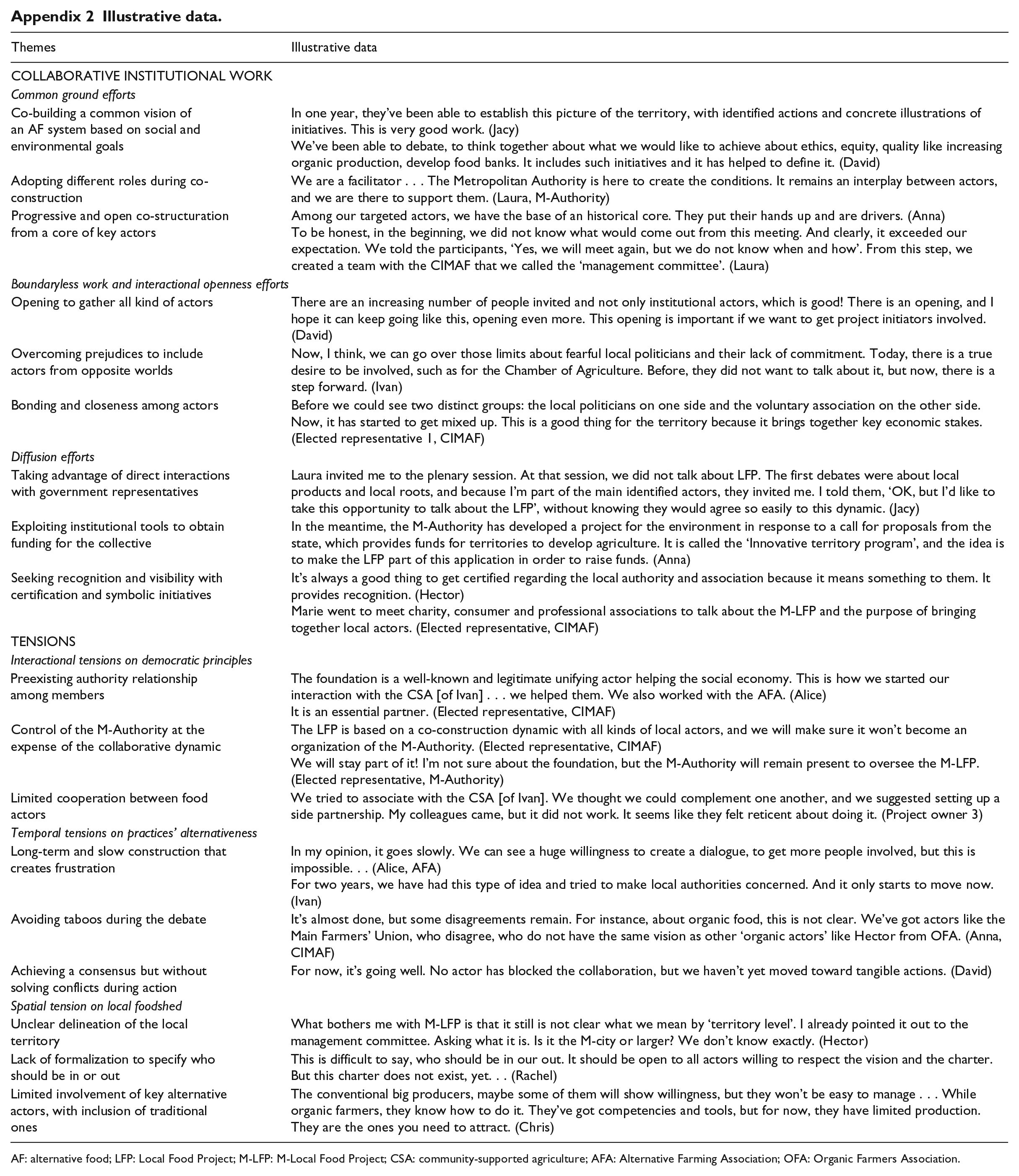
| Themes | Illustrative data |
|---|---|
| COLLABORATIVE INSTITUTIONAL WORK | |
| Common ground efforts | |
| Co-building a common vision of an AF system based on social and environmental goals | In one year, they’ve been able to establish this picture of the territory, with identified actions and concrete illustrations of initiatives. This is very good work. (Jacy) We’ve been able to debate, to think together about what we would like to achieve about ethics, equity, quality like increasing organic production, develop food banks. It includes such initiatives and it has helped to define it. (David) |
| Adopting different roles during co-construction | We are a facilitator . . . The Metropolitan Authority is here to create the conditions. It remains an interplay between actors, and we are there to support them. (Laura, M-Authority) |
| Progressive and open co-structuration from a core of key actors | Among our targeted actors, we have the base of an historical core. They put their hands up and are drivers. (Anna) To be honest, in the beginning, we did not know what would come out from this meeting. And clearly, it exceeded our expectation. We told the participants, ‘Yes, we will meet again, but we do not know when and how’. From this step, we created a team with the CIMAF that we called the ‘management committee’. (Laura) |
| Boundaryless work and interactional openness efforts | |
| Opening to gather all kind of actors | There are an increasing number of people invited and not only institutional actors, which is good! There is an opening, and I hope it can keep going like this, opening even more. This opening is important if we want to get project initiators involved. (David) |
| Overcoming prejudices to include actors from opposite worlds | Now, I think, we can go over those limits about fearful local politicians and their lack of commitment. Today, there is a true desire to be involved, such as for the Chamber of Agriculture. Before, they did not want to talk about it, but now, there is a step forward. (Ivan) |
| Bonding and closeness among actors | Before we could see two distinct groups: the local politicians on one side and the voluntary association on the other side. Now, it has started to get mixed up. This is a good thing for the territory because it brings together key economic stakes. (Elected representative 1, CIMAF) |
| Diffusion efforts | |
| Taking advantage of direct interactions with government representatives | Laura invited me to the plenary session. At that session, we did not talk about LFP. The first debates were about local products and local roots, and because I’m part of the main identified actors, they invited me. I told them, ‘OK, but I’d like to take this opportunity to talk about the LFP’, without knowing they would agree so easily to this dynamic. (Jacy) |
| Exploiting institutional tools to obtain funding for the collective | In the meantime, the M-Authority has developed a project for the environment in response to a call for proposals from the state, which provides funds for territories to develop agriculture. It is called the ‘Innovative territory program’, and the idea is to make the LFP part of this application in order to raise funds. (Anna) |
| Seeking recognition and visibility with certification and symbolic initiatives | It’s always a good thing to get certified regarding the local authority and association because it means something to them. It provides recognition. (Hector) Marie went to meet charity, consumer and professional associations to talk about the M-LFP and the purpose of bringing together local actors. (Elected representative, CIMAF) |
| TENSIONS | |
| Interactional tensions on democratic principles | |
| Preexisting authority relationship among members | The foundation is a well-known and legitimate unifying actor helping the social economy. This is how we started our interaction with the CSA [of Ivan] . . . we helped them. We also worked with the AFA. (Alice) It is an essential partner. (Elected representative, CIMAF) |
| Control of the M-Authority at the expense of the collaborative dynamic | The LFP is based on a co-construction dynamic with all kinds of local actors, and we will make sure it won’t become an organization of the M-Authority. (Elected representative, CIMAF) We will stay part of it! I’m not sure about the foundation, but the M-Authority will remain present to oversee the M-LFP. (Elected representative, M-Authority) |
| Limited cooperation between food actors | We tried to associate with the CSA [of Ivan]. We thought we could complement one another, and we suggested setting up a side partnership. My colleagues came, but it did not work. It seems like they felt reticent about doing it. (Project owner 3) |
| Temporal tensions on practices’ alternativeness | |
| Long-term and slow construction that creates frustration | In my opinion, it goes slowly. We can see a huge willingness to create a dialogue, to get more people involved, but this is impossible. . . (Alice, AFA) For two years, we have had this type of idea and tried to make local authorities concerned. And it only starts to move now. (Ivan) |
| Avoiding taboos during the debate | It’s almost done, but some disagreements remain. For instance, about organic food, this is not clear. We’ve got actors like the Main Farmers’ Union, who disagree, who do not have the same vision as other ‘organic actors’ like Hector from OFA. (Anna, CIMAF) |
| Achieving a consensus but without solving conflicts during action | For now, it’s going well. No actor has blocked the collaboration, but we haven’t yet moved toward tangible actions. (David) |
| Spatial tension on local foodshed | |
| Unclear delineation of the local territory | What bothers me with M-LFP is that it still is not clear what we mean by ‘territory level’. I already pointed it out to the management committee. Asking what it is. Is it the M-city or larger? We don’t know exactly. (Hector) |
| Lack of formalization to specify who should be in or out | This is difficult to say, who should be in our out. It should be open to all actors willing to respect the vision and the charter. But this charter does not exist, yet. . . (Rachel) |
| Limited involvement of key alternative actors, with inclusion of traditional ones | The conventional big producers, maybe some of them will show willingness, but they won’t be easy to manage . . . While organic farmers, they know how to do it. They’ve got competencies and tools, but for now, they have limited production. They are the ones you need to attract. (Chris) |
AF: alternative food; LFP: Local Food Project; M-LFP: M-Local Food Project; CSA: community-supported agriculture; AFA: Alternative Farming Association; OFA: Organic Farmers Association.
Acknowledgements
The author wish to thank the very helpful comments from Amélie Boutinot, Célia Lemaire, and colleagues of the Research Centre HUMANIS and from Gazi Islam on a previous version of the article. She is also grateful to the guest editors and the three anonymous reviewers for their helpful suggestions, guidance, and encouragements.
