




Abstract
Since the early 2000s the business sector has, as a matter of both professional and academic concern, repeatedly advocated the transfer of artistic practices, especially those deemed exemplary forms of creativity, to a management world grappling with new challenges – a claim we here call the ‘transferability thesis’ in order to consider the responses made to what Boltanski and Chiapello define as an artistic critique of capitalism. Drawing on the wide range of relevant academic literature, this article critically examines the plausibility of the ‘thesis’. To this end, we review analytical literature advocating artistic transfers alongside empirical work that examines art interventions within organizations. Both are important components of a broader organizational aesthetics approach even though, we contend, neither strands of research provide a plausible argument for meaningful transferability. We then draw on arts-based literature, management theory and psychology to compare notions of creativity at both ends of the proposed transferral process. We highlight convergence and variance in art and business thinking, noting fundamental mismatches with regard to utility, rationalization and heteronomy – three levels of incompatibility that make a genuine transplantation of art ideas highly unlikely. Finally, we discuss our critical contribution in relation to the specious status of the ‘thesis’ and the centrality of Boltanski and Chiapello’s triadic model of capitalism to our investigation. By way of a conclusion, we suggest that further research is needed to examine the symbolic nature of appeals to artistic creativity by management.
Introduction
Creativity is not a new concept in management, where it has long been associated with advertising and R&D activities. However, from the early 2000s onwards, given a business environment perceived as increasingly uncertain, turbulent and competitive, creativity has come to be understood as a key factor in the success, or even survival, of organizations (Williamson, 2001). In this context, not only have most organizational processes been imbued with the demand for creativity, but it has also come to be considered a cornerstone of team performance, individual motivation and self-realization (Weaver, 2000). Regardless of role or position, individuals are expected to be creative, and leaders asked to ‘energize the […] creativity of their workforce’ (Bennis, 1999: 4).
These discourses have triggered research into managerial creativity, 1 both in established scholarly publications and in new journals dedicated to the topic. 2 Two decades later, several handbooks account for the importance of creativity research – for example, Kaufman and Sternberg (2005) or Sawyer (2012). In this article, we focus on the streams of research which, adopting a normative stance, have claimed that the arts could and should be a source of inspiration for management. Namely, we examine selected works from the ‘organisation aesthetics’ school of thought that address the instrumental claim that organizations would benefit from lessons learned from the artistic field. We target literature making general (i.e. applied to any type of business) claims. Considering the way these claims are expressed – positing the fields of the arts and management as separate entities – we will not integrate in our corpus research focusing on themes explicitly combining both fields, such as management practices in creative industries or the management of art – which would make the issue both more complex and less general. 3
Our understanding is that, beyond their strategic justifications, such artistically inspired appeals to creativity in management can be understood in the context of the late 20th century as an answer to the artistic critique then addressed to capitalism (Boltanski and Chiapello, [1999] 2005). According to these authors, in answering, thus disarming, criticism, capitalism maintains its attractiveness towards present and future managers, thereby ensuring their adhesion to its ideology. Over time, such answers change the ‘spirit of capitalism’, that is, ‘the set of beliefs associated with the capitalist order that helps to justify this order and in legitimating them [sic] to sustain the forms of action and predispositions compatible with it’ (Boltanski and Chiapello, [1999] 2005: 10). Such beliefs are inscribed in normative management literature 4 that, beyond its technical content, exhibits a ‘high moral tone’ (Boltanski and Chiapello, [1999] 2005: 58). The dynamics of the triad capitalism-spirit of capitalism-critique explains change in management methods and discourses over time.
Boltanski and Chiapello ([1999] 2005) distinguish between two types 5 of critique: the social critique, inspired by Socialism and Marxism and traditionally voiced by unions and the artistic critique that has gained importance since the 1968 contestation movements. The artistic critique, 6 which is of more central concern to the present study, points to both ‘disenchantment and inauthenticity’ as products of capitalism, and the ‘oppression characterizing the bourgeois world associated with the rise of capitalism’ (Boltanski and Chiapello, [1999] 2005: 38). It emphasizes the loss of meaning, and, more specifically, ‘the loss of the sense of what is beautiful and valuable, which derives from the standardization and generalized commodification’ affecting everyday objects, artworks and human beings (Boltanski and Chiapello, [1999] 2005: 38). The artistic critique highlights ‘the objective impulse of capitalism and bourgeois society […] to dominate human beings […] and subject them to work that is prescribed for the purpose of profit’. To this, it ‘counterposes the freedom of artists, their rejection of any contamination of aesthetics by ethics, their refusal of any form of subjection in time and space, and in its extreme forms, of any kind of work’ (Boltanski and Chiapello, [1999] 2005: 38, emphasis added). The emergence and recurrence of discourses, from the early 2000s onwards, advocating the idea that managerial creativity should take inspiration from the arts may thus be seen as capitalism’s answer to the artistic critique. This hypothesis finds some support in the creativity discourses used by business leaders, such as the one reported by Adler: ‘our market-driven system is under attack […]. The only way to respond to this new wave of anti-business sentiment is for business to take the lead and to reposition itself clearly and convincingly as part of society’ (Schwab, 2003, quoted in Adler, 2006: 493).
In this article, we label the claim that management should ‘import’ ways of being creative from the artistic field as the ‘transferability thesis’. However, as we will demonstrate, this general claim has not been supported by a systematic study of ‘what’ precisely from artistic creativity should be transferred to the management field, and, a fortiori, of whether the transfer could be both possible and successful. Indeed, as we shall explain below, artistic creativity is a complex concept with varied facets; moreover, the fields of the arts and management are, in some respects, very dissimilar. Quite generally, importing methods from elsewhere (be it another country or another field of knowledge) may prove unsuccessful if the original space (here, the arts) and the importing one (here, management) do not share enough in common. Indeed, success is generally the outcome of the consistency of methods with the field’s local characteristics (Ansari et al., 2010). Too much dissimilarity can simply make importation impossible. The objective of this article is thus to assess the plausibility of the transferability thesis – that is, to examine the rationale underlying the set of claims that management should draw inspiration from artistic creativity. To this end, we will analyse the notion of artistic creativity and gauge the congruence of the concept with the field in which it unfolds – the arts – before turning to management to verify whether artistic creativity would make sense in this field. In Boltanski and Chiapello’s ([1999] 2005) terms, hypothesizing that the transferability thesis is an answer brought by capitalism to its artistic critique, we aim, in turn, to criticize the answer by showing that, beyond its appealing façade, it is not soundly substantiated.
To this end, we embarked on a multidisciplinary boat, gathering two scholars in organization studies, one of them having a background in interdisciplinary research and one in fine art practice. The latter was a pioneer of interventionist exhibition-making in the 1970s and has, throughout his career, explored the negotiatory role of the experimental artist within various institutional frameworks, most notably those of non-art museums. We met by chance in an interdisciplinary conference in the 2000s, devoted to ‘reframing organisational performance’, and explicitly meant as a meeting place for management and art scholars. At that time, transferability discourses began to bloom, and each party had an interest in knowing more from the other one – to illuminate paradoxes both in art schools (where students are urged to let their creativity flourish while being graded at the end of the period) and in organizations (where appeals to creativity coexisted with intensified control over and measurement of performance). This article is thus an interdisciplinary outcome in that it proactively 7 integrates both disciplines as the result of many and in-depth interactions. We strongly believe that our management research question could not have adequately answered without an artist’s expertise and voice.
Our demonstration is structured as follows. First, we review the body of literature claiming that management should import principles of artistic creativity, showing that, beyond analytical claims, most such literature tends to focus on artistic interventions when it comes to specifying concrete applications, while very little addresses ‘ordinary’ management situations. Then, we present the key features of artistic creativity – which leads us to conclusively argue that this conceptualization of creativity makes sense specifically in a field, like the arts, infused by core ideas of non-instrumentality and autonomy. In the next section, we turn to management, contrasting the field with that of the arts, presenting the concept of managerial creativity and showing how it is aligned with the core ideas of utility and heteronomy prevailing in the field. By repeating the structure used to unpack the artistic framing of creativity, this analysis also enables us to mirror both conceptualizations of creativity, shedding light on their similarities and differences while examining their consistency within their respective fields. On this basis, we argue that the principles of artistic creativity cannot be directly transferred to management, given the radically divergent logics that hold in the two fields. Finally, we conclude our analysis by discussing our contribution and its limitations, and presenting future avenues for research.
The transferability thesis: importing creativity from arts into management
In this section, we shall review the abundant literature that normatively claims that management should import the principles of artistic creativity. According to a recent inventory, there have been no less than 137 scientific articles published in refereed scientific journals from 1973 through 2015 acknowledging that ‘the combination of formal and informal dimensions that artists see can provide valuable insights for modern entrepreneurs and business managers’ (Ferreira, 2018: 348). In addition, the 23 articles of the recent special issue of the Journal of Business Research devoted to ‘the arts as sources of value creation for business: theory, research, and practice’ (2018) demonstrate the breadth of related research. In this section, we offer an overview of the topic 8 by, first, contextualizing this literature within the broader stream of organizational aesthetics, then focusing on texts developing the ‘lessons for management from the arts’ (Taylor and Hansen, 2005: 1217), among which creativity appears as a core concept, before, finally, turning to works reporting and analysing concrete examples of practices inspired by the arts.
Organizational aesthetics
This stream of research, which has bloomed since the turn of the century, gathers a variety of works and authors that, in one way or another, address the aesthetic dimension of, and in, organizations. Strati (1999) conceptually defines the aesthetic approach to organizations as the prioritization of the aesthetic element in organizational life – ‘aesthetic’ being defined as the entire range of sensory and perceptive faculties and sensible experiences. According to Taylor et al. (2012: 2), who introduce the inaugural issue of the e-journal of the community, Organizational Aesthetics, 9 the journal is ‘about how the five senses and artistry inform business, non-profit, and government organizations’ – a very broad definition also. Organizational aesthetics may be structured as follows in Table 1.
Categories of organizational aesthetics research (Taylor and Hansen, 2005: 1217).
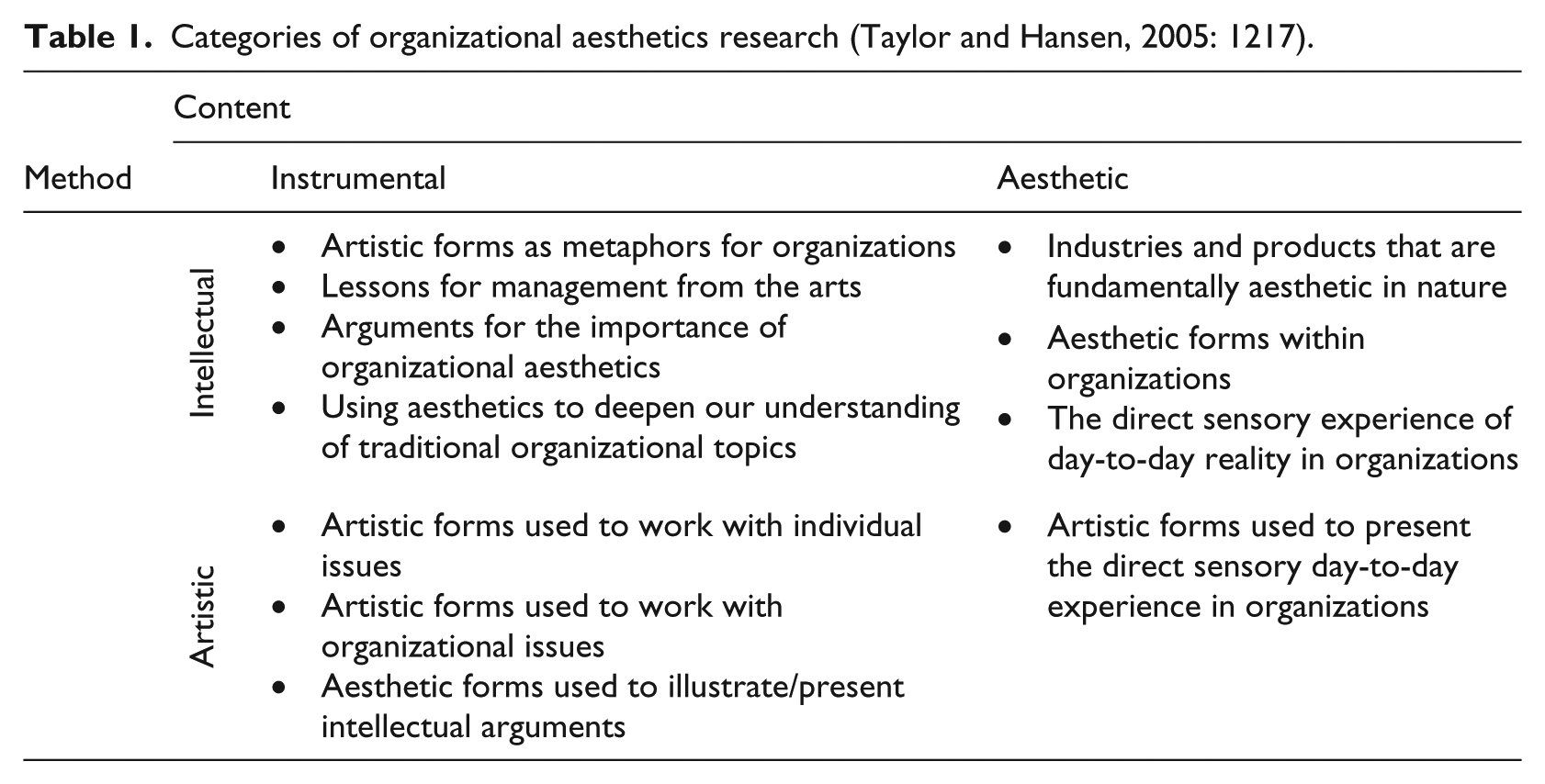
Space is too limited here for an extensive review of the whole stream. 10 Among these topics, only three appear to directly address the transferability thesis, namely the ‘lessons for management from the arts’ and their various applications in terms of ‘artistic forms used to work with’ both ‘individual [and] organizational issues’, all three located in the first (‘instrumental’) column in the table below.
Lessons from the arts
Management must learn from the arts, argues Adler (who has first-hand experience of artistic practices), because the existing forms of management have become obsolete in the face of 21st-century challenges, and the new business landscape requires ‘skills that creative artists have used for years’ (Adler, 2006: 489). Her rationale is summarized in Table 2.
Twenty-first century trends and their consequences on management (summarized from Adler, 2006).
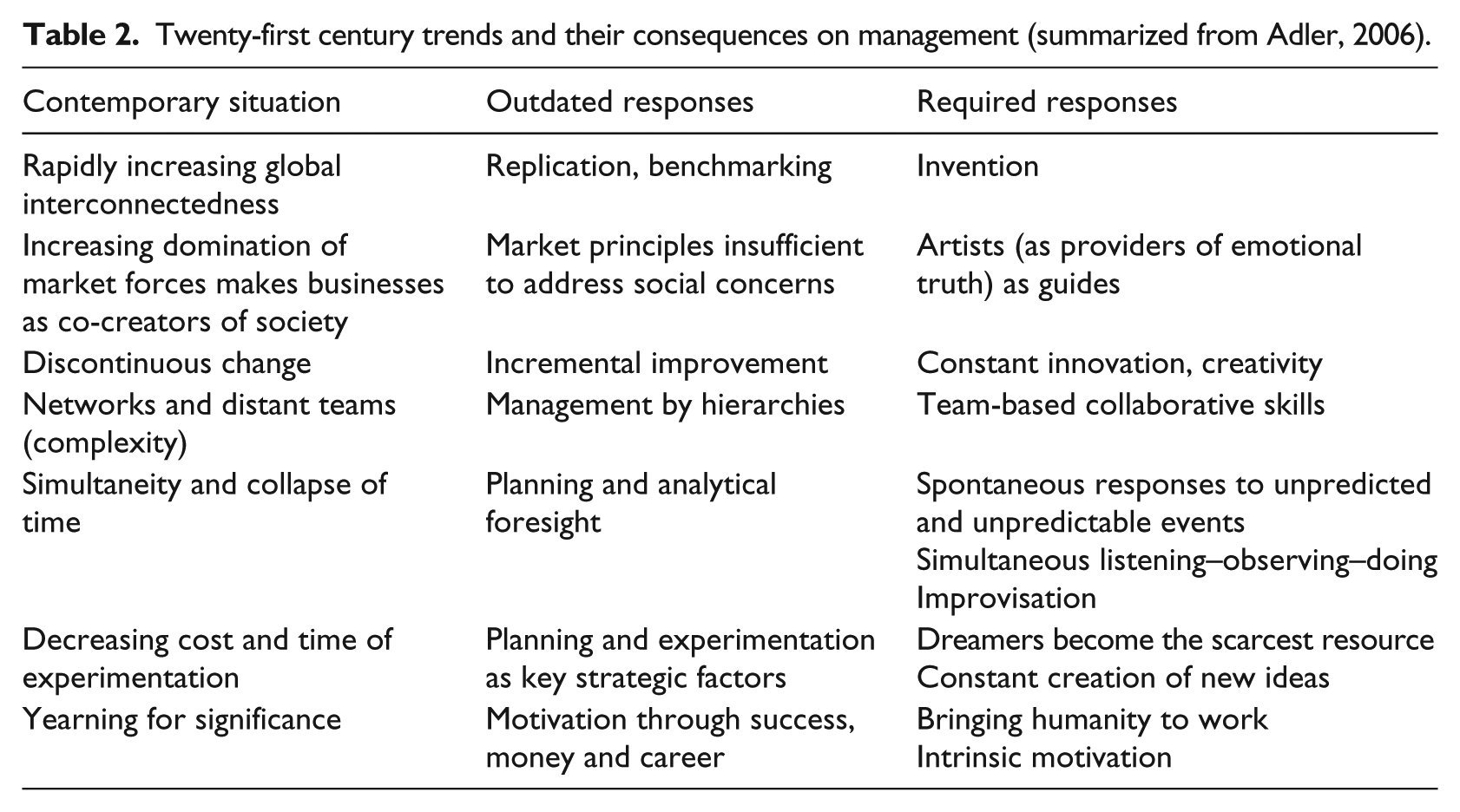
The third column points to skills or processes that Adler (2006: 490) identifies at work in the arts. She repeatedly emphasizes that ‘creativity has been the primary competence of artists, not managers’.
Some years later, drawing on the idea that ‘arts are becoming the new competitive advantage’, Seifter (2012: 12–13) argued that ‘many artists possess […] [the] qualities of creative leaders able to handle a highly volatile, increasing complex business environment’ – among which invitation to disruptive innovation, encouragement towards balanced risks, openness to drastic change, comfort with ambiguity and experimentation, courage and vision. In brief, artists ‘[master] the universal language of creativity’ (Seifter, 2012: 13).
Taking a more general and subjective stance, Schein (2013: 1–3) – who also has experience as an artist – identifies six ‘functions’ of artists and the arts that could be beneficial to managers. First, art and artists stimulate us to use our senses to ‘experience more of what is going within [and] around us’, so as to better manage situations. Second, art ‘does and should disturb, provoke […] and inspire’, and should force us to look at what we normally disregard and avoid. Third, artists can stimulate the expansion of ‘our skills and behavioral repertory’ and our ‘flexibility of response’ through fostering mindfulness of feelings or habits. Fourth, art and artists ‘stimulate and legitimize our own aesthetic sense’, and, as such, can contribute to the beauty of consulting interventions. Fifth, analysis of artists’ training and work can produce insight into ‘what is needed to perform and what it means to lead and manage’, in particular regarding improvisation. And sixth, artists ‘put us in touch with our creative self’, and grant us an awareness that ‘reality is perpetually constructed through our own daily creative activities’.
A further step has been made by authors who posit that taking inspiration from art will make management (or business) an art. Thus, Austin and Devin (2003: 2) argue that ‘[business] work becomes more like art’, with organizations switching from an ‘industrial-making’ to an ‘artful-making’ paradigm – a general formulation corresponding to most of the trends Adler highlights. When management (or business) becomes an art, the manager (or the business person) turns into an artist. As early as 1987, the ‘creative manager’ figure enabled the portrayal of the ‘manager as an artist’ (Dégot, [1987] 2007) – see also Hatch et al. (2005).
Strikingly, similar arguments are still developed today: Carlucci and Schiuma (2018b: 344), for instance, draw on ‘an outline of the main managerial issues of the postmodern management agenda’ to advocate for ‘the power of the arts in business’.
Concrete applications: arts-based interventions in organizations
We turn now from analytical claims to concrete modalities through which management has obtained inspiration from the arts, namely under the forms of artistic interventions in organizations. Art-based methods have also been extensively used in education 11 – see, for example, Statler and Guillet de Monthoux (2015), Zeitner et al. (2015) or Chemi and Du (2018). We acknowledge that education is a way to ultimately change management and business, and that there may be few differences between artistic training interventions in organizations (in general) and in universities. However, to keep our line of argument focused, we will only develop below interventions in organizations, letting aside educational ones.
Artistic interventions in organizations – or art-based interventions (ABIs; Schiuma, 2009) – have been broadly defined as ‘when people, products or practices from the world of the arts enter the world of organizations’ (Berthoin Antal, 2009: 4). Reversing the usual ‘artwork’, Barry and Meisiek (2010: 1507) use the term ‘workarts’ to designate ‘making or collecting art for the workplace’.
There is no ‘typical artistic intervention’ (Berthoin Antal and Strauss, 2013). The category encompasses interventions of very different time frames (from a few hours to days, months or even years) that can involve one or several artists, and engage just one or two members of the organization or hundreds. The artists can come from any domain, and they may or may not use their habitual art form in their intervention (Berthoin Antal and Strauss, 2013). Artistic interventions have diverse objectives as well as impacts on three different but interconnected levels – individuals, groups/teams and organizations; less frequently, they also target the public domain (Schiuma, 2009).
Taylor and Ladkin (2009) have identified four processes at work when art is used for managerial development. The first is ‘skill transfer’ – that is, the carrying-over of skills developed in relation to art, such as listening, paying attention to one’s perceptions or ‘seeing more and differently’, to the field of management. In this regard, depending on the objective, various types of arts can be used – see, for example, Feltham (2012) on theatre, Spencer (2010) on music, Zeitner et al. (2015) on dance and Johansson Sköldberg et al. (2015) for a recent synthesis. Art may also be used as a ‘projective technique’ (Taylor and Ladkin, 2009: 58), likely to enhance capabilities for understanding through engagement with the multiplicity and complexity of meanings encapsulated in an artwork. Next, ‘making’ can constitute ‘a deep experience of personal presence and connection’ (Taylor and Ladkin, 2009: 66), contributing to generic long-term objectives such as health at work. Finally, art can provide an ‘illustration of essence’, thereby offering renewed views on leadership.
Drawing on 268 publications reporting artistic interventions, Berthoin Antal and Strauss (2013: 12) have documented 29 types of their interconnected and mutually reinforcing effects at the individual, group or organizational levels – that they organize into eight groups, namely, by decreasing order of importance: ‘seeing more and differently, activation, collaborative ways of working, personal development, organizational development, artful ways of working, relationships and strategic and organizational impact’. More recently, scholars have also documented specific effects of artistic interventions – such as their making participants accept contradictory demands (Parush and Koivunen, 2014) or deal with identity tensions and with the conformity-versus-creativity paradox (Berthoin Antal et al., 2016).
ABIs are not always successful – see Berthoin Antal and Strauss (2014) or Berthoin Antal et al. (2019) for examples of interventions with mixed success. The latter of these cases evidences the fact that top management behaviour matters for success, a point which has also been corroborated by Zambrell’s (2015: 188) observation that ‘a relatively high interest in arts’ could explain managers’ openness to artistic interventions.
In summary, unlike the analytical arguments for the transferability thesis, that have not seen much development since the early 21st century, ABI studies have developed significantly – to the extent that they now represent a specific research stream and community. Their various findings are in line with the analytical claims above: generally, ABIs are reported to produce benefits meeting the needs identified by the proponents of the transferability thesis.
However, a serious issue needs to be raised with regards to ABI studies. In general, they rely on participants’ interviews and self-assessments – raising the possibility of bias. Indeed, benefits can be overestimated in proportion to the pleasure taken during the intervention. In addition, there may be biases of desirability – towards the researcher, the artist or the intervention organizers: consciously or not, participants may wish to avoid disappointing them or discouraging further interventions. Furthermore, it is questionable whether some benefits, such as say, a heightened perception of the surrounding world, are lasting over time. Most often, the ‘ordinary’ organizational environment is very different from the artistic one created for the intervention, and it might resist efforts to reproduce attitudes learnt during the intervention. Unfortunately, there is no evidence that ABIs produce effects in the long term – which would admittedly be very difficult, if not impossible, to demonstrate.
As such, the question of the plausibility of the transferability thesis remains unsolved. Our guess is that its supporters miss the ‘big picture’ – artistic creativity is realized and embedded within a complex set of interrelated elements, and it is the coherence of these elements within the artistic field which is key to artistic performance. To what extent are the features of artistic creativity coherent with the artistic field and what kind of coherence would they have with the management field? We engage with these questions in the two next sections.
The nature of creativity in the arts
This section presents key features of artistic creativity using aesthetics, art theory, and the expertise of the artist co-author. We also touch upon psychology research and educational theories when these echo artistic views; however, at this stage, we shall keep this particular commentary to a minimum, given that we shall provide an extensive presentation of creativity research in the field of psychology in the next section of this study. This choice reflects the observation that our overall discussion is, strategically speaking, more aligned to the proximity between psychology and organization scholars (who sometimes work on the boundary between both fields – see, for instance, Amabile’s works in the bibliography below, published in both psychology and management journals or books) than to the, admittedly long-standing, assimilation of psychological ideas by arts specialists.
In the arts, the concept of creativity is so embedded in the historical development of the term ‘artist’ that there is little reason to draw it out and examine its independent status. For example, practitioners describe a seamless relationship between creating artworks and the process of creativity itself. Recent arts-based research confirms that ‘art creation and creativity form a circular process’ (Rizky et al., 2017: 18) – a practitioner makes an artwork, receives feedback from the art world, and then uses these ideas to make new works. Here the artist co-author (a professor of fine art) cautions that, within this circularity, it is not just ‘impossible to give a simple definition of creativity’ (White, 1995: 88), there is also little intellectual merit in promoting theoretical formulae that cannot keep pace with the ever-expanding feedback loops generated by contemporary artists – consider, for example, the difficulty of theorizing the seemingly unlimited range of ‘social practices’ described by the writer Kraus (2018) in her demythologizing commentaries on present-day artistic lives. Therefore, for the purposes of our study, the best option has been to identify an array of ideas that, for the artist co-author, match the intellectual legacy of artworks rather than art texts. To organize this array, we have pressed into service the classical categorization of creativity research in psychology, known as ‘the four P’s of creativity’ (Stein, 1969): respectively, the creative Person, the creative Product, the creative Process and the creative Place. We are aware that these categories might lead to an oversimplification of complex issues; however, we propose that this structure remains the most efficient way to synthesize the various, often divergent, views of art theorists, aestheticians and artists.
The creative person
Creativity is a property attached to a subject – to someone who is creative. As such, for every instance of creativity, it should be possible to ask: who is the creator? A ‘religious-mythological’ answer to this question would evoke ‘narratives of the origins of the world’ (Steiner, 2002: 13). For example, a key cosmogonic scenario is that ‘a High Being creates the world by thought’ (Eliade, 1977: 83). Among theologians, this is known as creation ex nihilo, meaning that the creativity of God has used no prior materials to create something from nothing (Robson, 2008). This lineage possibly accounts for creativity’s positive value-laden flavour (White, 1995), although historically the ex nihilo doctrine, in referring to actions ‘radically unlike human creation’ (Robson, 2008: 171), has also run the risk of making artistic achievement seem blasphemous (Steiner, 2002). In uncoupling the idea of creativity from a transcendent creator, aestheticians have stressed the figure of a creative genius whose originality is demonstrated, according to the philosopher Kant, through a ‘talent for producing that for which no definite rule can be given’ (White, 1995: 89). Reflecting the ascendance of arts figureheads such as Picasso in the mid-20th century, educational theorists have promoted a pantheon of exemplary creators (Winch and Gingell, 1999).
By contrast, recent views are inclined to treat creativity as a fundamental part of human life. Then the achievements of a recognized genius, say Mozart, can be framed within a continuum that includes other creative fields such as popular music (White, 1995: 89). Ultimately, this train of thought has attenuated the definition of artistic genius to such a degree that even conscious experience can be modelled on creative excellence. Thus, if the self is an autobiographic invention, then ‘we are all virtuoso novelists’ (Dennett, 1988: 1029). While appropriate concerns are raised by Rizky et al. (2017: 15) about the universalizing application of ‘European, white, middle class’ notions of artistic endeavour, nevertheless the idea that everybody is potentially creative has long been central in educational theory – see, for instance, Read’s (1943) advocation of the idea of child education through art. As a result, within the democratic framework of contemporary culture, it is now common for creativity to be understood as a mode of free expression that unlocks ability in all fields. It seems that it is humanity, not God, who now creates something from nothing (Mould, 2018).
Consequently, a creative person gains status as a creative practitioner when the human capacity to conceive and realize ‘something’ operates as one. This is a well-established idea. In his 1937 inscriptions on the Parisian Palais de Chaillot walls, the poet Valéry celebrated the creative equivalence of bodily action and mental activity (‘… the artist’s marvellous hand / Equal and rival of his mind / The one is nothing without the other’). Indeed, a correspondence of thought and action remains germane in contemporary art even when technical assistants take over the final stages of production (common in large-scale sculptural works) or when the creative endeavour stops short of a commodified artefact (as in conceptual art). Thus, the emphasis that artists put on their achievements as ‘practitioners’ is not unsurprising.
The creative product
In relation to aesthetics, two schools of thought, objectivists and subjectivists, disagree on the criterion for creativity (White, 1995: 90). For the former, it is the product (which we consider in this section), while, for the latter, it is the process (which we examine next, below). If the criterion for creativity is the exceptional ‘newness’ of a tangible outcome, then Krauss’ (1979) essay ‘Sculpture in the Expanded Field’ demonstrates an important debate about creative products. A key component in Krauss’ thinking was a rejection of historical precedent in relation to the sculptural innovations of the 1960s. Her point was that the newness of ‘land art’ and ‘site-specific installations’ were diminished if these experiments were seen as part of a long history of apparently similar ‘creations’ (prehistoric earthworks and archaeological structures). The principle was that the new must not be seen simply as the old in disguise, it must break free from the past (Robson, 2008: 164). This promotion of historically untethered newness launched the concept of ‘expanded practices’, a term that has become synonymous with avant-garde experimentalism, particularly in fine art and architecture (Papapetros and Rose, 2014), as well as in disciplines across the creative industries (Torres, 2017). As a result, exhibition curation is deemed to be ‘expanded’ when it radicalizes the exhibition visitor’s ‘ongoing demand for an end product that coheres around an exhibition, around the act of revealing and concretizing’ (Rogoff, 2013: 44). It follows that, with this particular ‘expansion’, the ahistorical product is the audience’s alienation from a ‘smooth unfurling of previously existing things’ (Robson, 2008: 166).
These views emphasize the role of the audience as the central assessor of creativity. If the function of the art critic has been to enrich art exhibitions with post facto reviews (Nelson, 2009), then the contemporary task of ‘inducing audiences to engage intellectually and emotionally with philosophical, social, or broadly theoretical matters’ (Irvin and Dodd, 2017: 379) becomes, in its expanded form, an open-ended and disruptive ‘invitation to think along certain lines’ (Wolfendale, 2015: 7).
An abiding view in aesthetics is that audience engagement involves not only an acquired appreciation of an artist’s skill, but also includes an ability to integrate complex elements into a satisfying whole (White, 1995). A radical account of this ability describes an ‘interpretive community’ that does all the sense-making by itself using group-level structures of understanding (Fish, 1980). On this view, public recognition of creative success is not the achievement of an individual creator, but the frequency of interpretive agreement occurring within a particular community that shares certain aesthetic predilections. It is not a big step from this concept to a fully sociological analysis of creative products. Childress (2017) describes bestselling novels as multi-authored artefacts involving the collusion of a writer’s friends, family and professional associates. Despite this egalitarianism, it should be noted that social utility is not a defining feature of any of the creative products discussed in this section – an absence that, as we shall see, sharply contrasts with the management view.
The creative process
As discussed above, the subjectivist view on artistic creativity posits that the process, not the product, decides creativity. There is, for example, a long-standing theory that a creative subject purposely blends normally unrelated entities (Koestler, 1964) using processes that are mechanistic enough to be equated with ‘computational models derived from Artificial Intelligence’ (Boden, 1990: 29 and 41). However, for artists, the most sustained involvement with the reduction of creativity to a set of highly conscious mechanisms is probably 20th-century ‘systems’ art (Glimcher et al., 2005) and the contender for the least reductive version is surely Bourriaud’s (2002) ‘relational aesthetics’, which holds that only the artist’s social interactions count as a meaningful outcome – an approach that makes process itself an art object.
In contrast, it has long been routine to associate these mechanisms with the workings of the unconscious mind. This was particularly evident in ‘outsider art’, which was applauded by mid-20th century artists, attracting Freudian and Lacanian speculations about a ‘cauldron of creativity’ situated outside mainstream cultural life (Jagodzinski, 2005: 288). Given that Freud considered art to be a method of therapeutic self-management (Adams, 1993), there are other instances of mid-20th-century practices that excavate the depths of Freudian psychoanalytic theory in order to escape ‘mainstream’ standards of creative success. For instance, Metzger’s ‘auto-destructive art’ of the 1950s has been celebrated, 50 years on, as a psychodynamic process of ‘self-cancellation’ (Morton, 2008). Such negations are not uncommon. The 1970 artwork ‘Dropout Piece’ was created by the conceptual artist Lozano in order to quit the art world (Applin, 2018). At a less extreme level, gallery statements often seem to cancel the possibility of a ‘finished map’ of the artistic themes explored by an exhibitor (Wolfendale, 2015: 7). For the playwright Beckett, these celebrations of incompleteness would never be incomplete enough if a creator had to ‘fail again, fail better’ in order to keep creating (Dorsett, 2017). Thus, from the post-war modernists to the present, it seems that progressively minded artists have had to adopt radically non-incremental approaches to ensure that, from their perspective, artistic production keeps an irreducible sense of unknownness at its centre (Robson, 2008: 165).
Long ago, the aesthetician Collingwood (1965) promoted the idea that all artistic creation is an indeterminate mental event, unavailable to scrutiny. Accordingly, there is no complete inward experience preceding its embodiment in an artwork. So strong is this connection of creativity with the unconscious and unknowable that Jarvie (1981) argues that if science does eventually explain how this kind of interior process operates, the concept of creativity will have been explained out of existence. These positions, emphasizing the mysterious and inexplicable dimension of artistic procedures, reveal the theological undercurrents at work in creativity analyses, seemingly indicating the degree to which creation ex nihilo still has allure and credibility. Certainly, writers on art such as Rawson (2005) dedicated their careers to celebrating the ‘numinous’ mystery generated by traditional artistic techniques. Even in recent experimental performance art, other-worldly magic and ritualistic practices have been utilized because, for contemporary artists, they remain potent enough to survive urban living and secular industrial environments (Chinnery, 2016).
The creative place
Bourriaud’s (2002) ‘relational aesthetics’ is one example of a reorientation within modern and contemporary art towards, not just the procedural, but also the contextual dimensions in which creative practices come to fruition (Irvin and Dodd, 2017). Creative individuals do not exist in complete social isolation. Csikszentmihalyi (1988) has mapped the artists’ socio-cultural sphere as ‘a system of related memes’ (333), units of imitation that change through time as they are transmitted from one generation to the next. Creators propose variations in memes, which are then filtered by the field-like social organization of the system, with retained variants contributing to gradual change in the ‘sphere’ as a whole. Along similar lines, Best (1992) argues that individual artists change the criteria of what counts as good art, but these changes must remain recognizable within the existing horizons of knowledge of their socio-cultural sphere in order to be accepted (White, 1995).
These models foreground the widespread idea that we rely on artists to create intelligible and valuable world views. The poet and essayist Hyde (1999) qualified these contributions to our socio-cultural sphere by acknowledging that artistic creation has a voluntary character in which labour is often freely given. For Hyde, art responds to two economies: that of the commodity market and that of a gift-exchange culture. He draws on anthropologists Mauss ([1925] 1967) and Sahlins (1972) to show how social cohesion in pre-modern societies was brought about by gift exchange. Against this background, the creative spirit is framed as ‘the inner gift that we [artists] accept as the object of our labour, and the outer gift that become[s] a vehicle of culture’ (Sahlins, 1972: xi). Here the artist is a representative, in the midst of high capitalism, of an ancient value system. In Hyde’s view, the market economy may have disenfranchised the gift economy but, in financing artworks, the artist can maintain a protected gift sphere in which to create art. When moving between this sphere and the marketplace, artists ‘[convert] market wealth [back] into gift wealth’, giving the creative practitioner an almost ‘providential’ role in society (Hyde, 1999: 274).
Finally, there is a more general point to make about the social environments in which artists live. Csikszentmihalyi (1988) analysed the contribution of the city of Florence to the genesis of the Renaissance and Elias (1993) identified the role played by the Salzburg court in the refinement of Mozart’s musical abilities. However, these apparently creative locations, dominated by powerful merchants or political and church leaders, generated little of the social autonomy 12 we today associate with the notion of a fully independent artist. In fact, the ‘high art’ paradigm required to promote this independence was actively located within civic life after the industrial revolution, when it helped facilitate a political and moral critique of ‘modern’ society (Ruskin, 1856). This critique of aesthetic degradation still inspires Grizedale Arts, a contemporary organization that openly models its socially engaged activities on Ruskin’s view that the desperately uncreative spaces generated by industrialization need the transformative presence of art (Lack, 2015). Anthropologically speaking, a visual art tradition is not necessary to the valuing of visual aesthetics (Coote, 2005), nevertheless the development we have outline here gave ‘art’ a far-reaching monopoly over aesthetic value, and this specificity was applied where ‘forms of general use and intention […] were not determined by immediate exchange’ (Williams, 1983: 42). Consequently, in contrast to applications of terms such as ‘craftsmen’ and ‘skilled worker’, then later ‘scientist’ and ‘technologist’, the concept ‘creative artist’ has evolved, in industrialized cultures at least, through an openly non-utilitarian engagement with social environments.
Overall, this review of the concept of creativity in the arts has demonstrated the evolution of the concept over time, from being attributed to geniuses under former social arrangements (when art served power), to being identified with ‘ordinary’ creators in our contemporary societies. Although creativity is not the artists’ privilege, their place in society gives them a prominent role – that of changing cultural norms and of preserving an island of gift exchange in a society ruled by utility. We also highlighted debates regarding whether creativity and the artist is determined by outcomes or processes, while noting consensus on the non-utilitarian dimension of creative products and a general recognition of the mysterious nature of creative procedures. All in all, artists experience a paradoxical status. Though they do enjoy a form of independence and autonomy in that they define their work processes, including time aspects and outcomes, such freedom remains subject to their recognition as creators by audiences, meaning that, in one way or another, their work has to be connected ‘enough’ to existing norms to be perceived as art.
Management: another planet with radically different views on creativity
We now turn to the domain of management. First, we shall consider sociological views of the artistic critique of capitalism that emphasize the radical divergence between the arts and management. Then, we offer an overview of the concept of managerial creativity. Finally, we enumerate the similarities and differences between the conceptualizations of managerial and artistic creativity, and show that each concept is aligned with the conflicting respective principles of its field.
Arts and management
Chiapello (1998) has documented the development of the artistic critique since its emergence in the 19th century, concurrently with the rise of the bourgeoisie, the emergence of a modern conception of art and the development of management as a field. The history of management, she says, can be understood as ‘[the history] of a continuous sophistication of means of mastering what happens in the company and its environment’ (Chiapello, 1998: 48–49) with two traits common to all sub-disciplines of management. First is the idea that control over human beings serves ‘economic orientation’ and economic wealth. Second is the prevalence of teleological rationality – that is, ‘the choice of the most efficient means to meet the profit objective’ and, going further, ‘any type of objectives when the principles of management will be applied to all human activities’. She proposes to contrast art and management on four 13 dimensions, as displayed in Table 3.
The fields of art and management compared (adapted and translated from Chiapello, 1998: 59).
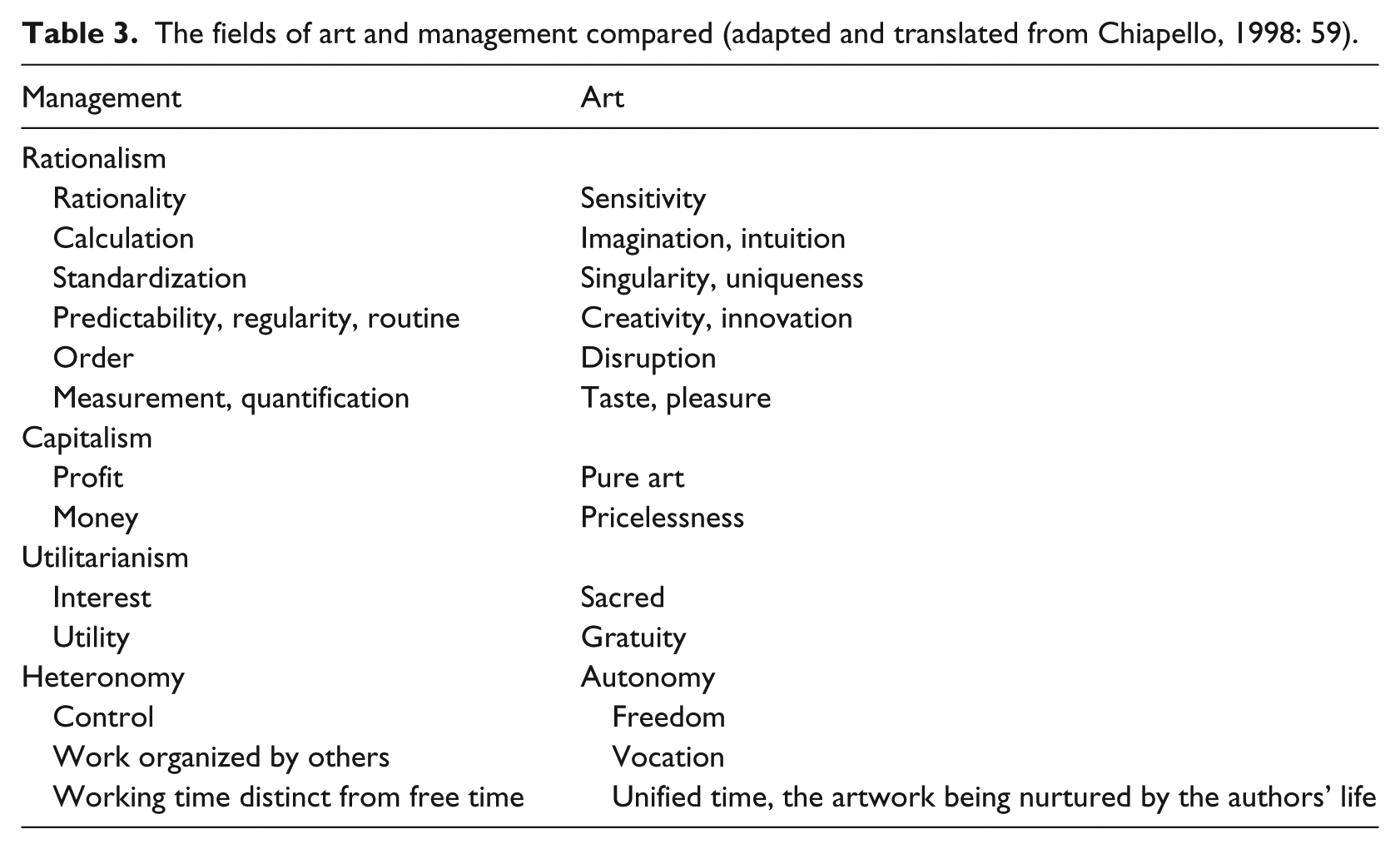
Chiapello (1998: 212) recognizes the fact that management has recently ‘[opened] up to rationalities, modes of thoughts and behaviours that were alien to it (for instance forms of autonomy in industries, […] project management forms that question bureaucratic principles etc.), while, in other situations keeping use of traditional rules’. She also acknowledges transformations in the artistic field – with artists being increasingly involved in markets, the democratization of art consumption and the ‘crisis of romantic representations of art and artists’ (Chiapello, 1998: 230) – so that the picture of the arts and management as divergent fields should be nuanced. Twenty years later, appeals to creativity and artistic interventions in organizations are likely to further blur borders. In order to support such a hypothesis, we should identify traces of the system of values associated with the arts in the concept of managerial creativity.
The nature of managerial creativity
In this section, we present the main features of creativity as it has been discussed in management and psychology literature. Indeed, although some psychologists have studied artistic creativity (e.g. Csikszentmihalyi, 1988, see also the journal Psychology of Aesthetics, Creativity, and the Arts), our literature reviews suggest that most psychology research on creativity has been integrated into management research, whereas aesthetics is fairly silent about it – so that it makes sense to present together management and psychology. Rather than providing a comprehensive overview of the existing literature – a daunting task given the amount of extant research – we aim to capture the main features of the concept, to both gauge whether the picture of art and management as radically divergent fields should be nuanced and offer a comparison between artistic and managerial creativity. To this end, reporting both conceptual and empirical works, the text is organized along the same structure as the previous section, that is, according to the four Ps of creativity.
As in the arts, defining creativity in management and psychology is not easy: Rouquette (1997) noted that, by 1959, psychologists already had more than a hundred definitions for creativity. However, management scholars agree that ‘creativity’ should be distinguished from ‘innovation’, a distinct (Shalley and Zhou, 2008), even if closely linked, concept. 14 Innovation, as ‘the successful implementation of creative ideas’, is the materialization of creativity, defined as ‘the production of novel and useful ideas in any domain’ (Amabile et al., 1996: 1155).
The creative person
Like artistic discourse, social psychology has long cultivated a ‘genius’ view of creativity (e.g. Guilford, 1950), which assumes that ‘truly creative acts involve extraordinary individuals carrying out extraordinary thought processes’ (Weisberg, 1988: 148). However, recent views, both in psychology and management, have shifted towards the belief that everybody has creative potential which can be developed through education (see education theorists already cited above) and actualized if the situation is adequate (Thompson, 2018). This perspective results in attention being paid to the environmental conditions facilitating creativity – a point we shall consider below.
Alternative views, occupying an intermediate position between the genius and the democratic ones, posit that the creative potential of individuals is variable and depends upon the presence of certain attributes in the individual. According to Tardif and Sternberg’s (1988: 433–37) synthesis of such views, these attributes include cognitive characteristics such as intelligence and imagination, metaphorical thinking, flexibility in decision-making, coping with novelty, finding order in chaos, processing styles involving wide categories, non-verbal communication, questioning norms and alertness to gaps in knowledge. Other characteristics of the creative person include a willingness to confront hostility and to take intellectual risks, perseverance, curiosity, openness to the new and a prevailing ‘aesthetic sense’ allowing the recognition of ‘good’ problems. Tardif and Sternberg further report additional characteristics – such as motivation and focus, a rejection of externally imposed limits, self-organization and self-regulation, a tolerance for ambiguity and unconventionality in behaviour and a lack of fit within their environment set against a drive for recognition – the underlying theme of which is that the creative individual is in conflict.
Management research also acknowledges that creative individuals face external conflicts in advancing their creative ideas. Given that sponsoring new ideas in organizations is a risky endeavour, individuals pursuing new ideas risk sacrificing customary rewards and exposing themselves to punishment (Barron et al., 1997). Thus, risk-seeking, independence, nonconformity and courage are paramount traits of creative individuals (Feist, 1999). Moreover, in a counterpoint to the general agreement that creativity is also dependent on environmental factors, empirical research on the relation between knowledge and employee creativity has shown that if an individual’s creative ability is high, their creativity level remains the same even when under unfavourable contextual variables (Choi et al., 2009).
The creative product
In psychology and management, almost all definitions of creativity 15 include the idea of an outcome satisfying different conditions – as such, these perspectives can be categorized as objectivist. For instance, Johnson-Laird (1988: 203) uses Reber’s (1985) definition of creativity as ‘mental processes that lead to solutions, ideas, conceptualisations, artistic forms, theories or products that are unique and novel’. Here, novelty is connected to the idea of creation ex nihilo, and uniqueness refers to difference and separation from what exists. As with the concept of artistic creativity, this raises the question of the evaluation of novelty and uniqueness: where do they begin and on which criteria are they assessed?
In addition, in management, a creative product also entails relevance, usefulness and value (Ford, 1996; Oldham and Cummings, 1996; Woodman et al., 1993). Thus, ‘a product or response will be judged creative to the extent that […] it is both a novel and appropriate, useful, correct and valuable response to the task at hand’ (Amabile, 1983: 33). Again, ‘usefulness’ and ‘value’ raise the question of evaluation: who determines them and on what basis?
It is generally accepted that only an external observer is entitled to assess creativity: ‘a product or response is creative to the extent that appropriate observers independently agree it is creative. Appropriate observers are those familiar with the domain in which the product was created or the response articulated’ (Amabile, 1983: 31). According to the psychologist Bruner (1962), a creative outcome produces ‘effective surprise’ in the observer, as well as a ‘shock of recognition’ resulting from the fact that the product, though novel, appears entirely appropriate. Kaufman and Baer (2012) distinguish experts and quasi-experts who could provide a good practical compromise for the assessment of creativity. In practice, due to the risks and costs of product development, assessment is often made by a manager in the early phases of the development of a creative idea, before the commitment of resources is escalated (Mainemelis, 2010).
Despite the already noted objectivist perspective of most understandings of creativity in the management domain, research has not provided abundant knowledge regarding what, in practice, would constitute a creative product. This highlights both the exclusively cognitive understanding of creativity embraced within the domain and the difficulty and complexity of assessing creative outcomes.
The creative process
As an exception to the rule of the objectivist slant to creativity research in management, Drazin et al. (1999: 287) define creativity within the subjectivist frame as ‘the process of engagement in creative acts, regardless of whether the resultant outcomes are novel, useful or creative’. The authors underline the difficulty of modelling the creative process, stating that engagement (or disengagement) in creative acts is mediated by the individual’s intrasubjective frame of reference.
Despite this difficulty (see also Courpasson and Younes, 2018), scholarly attempts to elucidate creativity have a long tradition in psychology, where interest in the subject has notably grown since the 1950s (Rhodes, 1961). In management, research has emphasized intrinsic motivation for engaging in creative processes, such as expressing and enhancing one’s identity and imagination (Gabriel, 2009), while also underlining the point that creativity can be undermined by extrinsic motivators (e.g. monetary rewards) or other elements (e.g. deadlines, evaluation) leading to a sense of external control (Hennessey and Amabile, 1988) upon the individual.
For Csikszentmihalyi (1997), the creative process consists of five clear-cut steps: (1) preparation, or immersion in problematic matters arousing the individual’s interest; (2) incubation, or the conscious or unconscious processing of information; (3) insight, that is, the emergence of a new idea; (4) evaluation, that is, the assessing of the new idea and the decision regarding whether it is worth pursuing; and (5) elaboration, or the development and refinement of the new idea. However, recent scholarship (e.g. Castañer, 2016) disputes the inclusion of ‘elaboration’ as part of the creative process, attributing it instead to the domain of innovation.
According to Gruber and Davis (1995), the creative process is non-linear and recursive, a nonorderly back-and-forth movement between steps – perhaps because, as Gabriel (2009) argues, the creative process engages both conscious and pre-conscious mental processes, thinking and suspension of thinking and combines not only intelligence and logic but also emotions and instincts. Similarly acknowledging the fluidity and indeterminacy of fleeting moments of creativity, Hargadon and Bechky (2006) identify four interrelated processes (help-seeking, help-giving, reflective reframing and reinforcing) that assist in generating creativity, while potentially taking place accidentally, as a result of serendipitous interactions.
Such interactions are the focus of Thompson’s (2018) processual model of creativity, which unfolds in four moments: (1) forming perceptions of shared environment, (2) converting subconscious imaginings into conscious images, (3) enacting creative expression by representing them and (4) sensing participants’ creative expression by integrating them into an emergent shared image (the manifestation of the creative outcome).
Management research has shown that going through the hurdles of a creative process is an uncertain endeavour, which offers no guarantee of a successful outcome or of its acceptance within the work context (Drazin et al., 1999; Ford, 1996; Mainemelis, 2010). Whereas in some fields, such as that of theoretical science (e.g. the evolutionary mechanisms proposed by Darwin or the contributions to mathematical physics made by Poincaré), a new idea can be worked through before being evaluated by the social domain to which it pertains (Campbell, 1960), in management a new idea is often evaluated in its nascent stage so as to decide about the allocation of resources for its further development (Hargadon, 2008).
The creative place
The functionalist view on creativity and the idea that everybody is potentially creative have led to research into the contextual factors that enhance creativity. It has long been recognized that social surroundings have an impact upon creative behaviour, and that the individual, group and organizational levels interact in establishing the conditions for creativity (see, for instance, Amabile, 1996; Amabile et al., 1996; Ford, 1996). Drazin et al. (1999: 291) contrast individual creativity (‘the engagement of an individual in a creative act’) with organizational creativity (‘a process that maps when creative behaviour occurs and who engages in creative behaviour’, original emphasis) – a perspective which questions the widely held assumption that organizational creativity is the accumulation of individual or small-group creative actions.
Studies have also demonstrated that organizational policies and climates (Baer and Frese, 2003), structures (Bucic and Gudergan, 2004), top managerial communication (Lee et al., 2004), ‘serious play’ initiatives (Sørensen and Spoelstra, 2011), job requirements (Unsworth et al., 2005), rewards (Eisenberger and Rhoades, 2001), office design (Alexandersson and Kalonaityte, 2018), psychological safety (Baer and Frese, 2003) and training (Basadur et al., 1986) all affect creative output. Creativity has also been positively related to teams’ cohesiveness, diversity and organizational tenure, as well as to the degree of cooperation among members (Payne, 1990), job design (Oldham and Cummings, 1996), supervision style and feedback (Carson and Carson, 1993; West, 1989). 16
Alongside these developments, which, additively, encourage creativity (Mainemelis, 2010), a work environment and occupational subculture supposedly favourable to creativity could have heterogeneous effects (e.g. enthusiasm or boredom) on individuals depending on their perception of the situation (Drazin et al., 1999). These authors also discuss other factors influencing creativity, such as balances of power between communities, negotiations and crises. Crises influence creativity by forcing the involved organizational groups to find new interpretative frames and to move into the limelight in order to enact creative behaviours.
Finally, Unsworth (2001: 293) distinguishes between situations according to whether the driver for creative engagement is external (creativity on demand) or internal (spontaneous creativity). When the driver is external, creativity is said to be ‘expected’ (open problem) or ‘responsive’ (closed problem). Internal drivers induce ‘proactive’ (open problem) and ‘contributory’ (closed problem) creativity. Responsive creativity, Unsworth argues, is the most prevalent form of creativity studied in management, while proactive and contributory creativity have not been given much attention.
Comparing artistic and managerial creativity
Although they share commonalities, the concept of creativity in management appears significantly different from the one prevailing in the arts. Similarities and differences between the conceptualization of creativity in the two fields are summarized in Table 4.
Managerial and artistic creativity: similarities and differences.
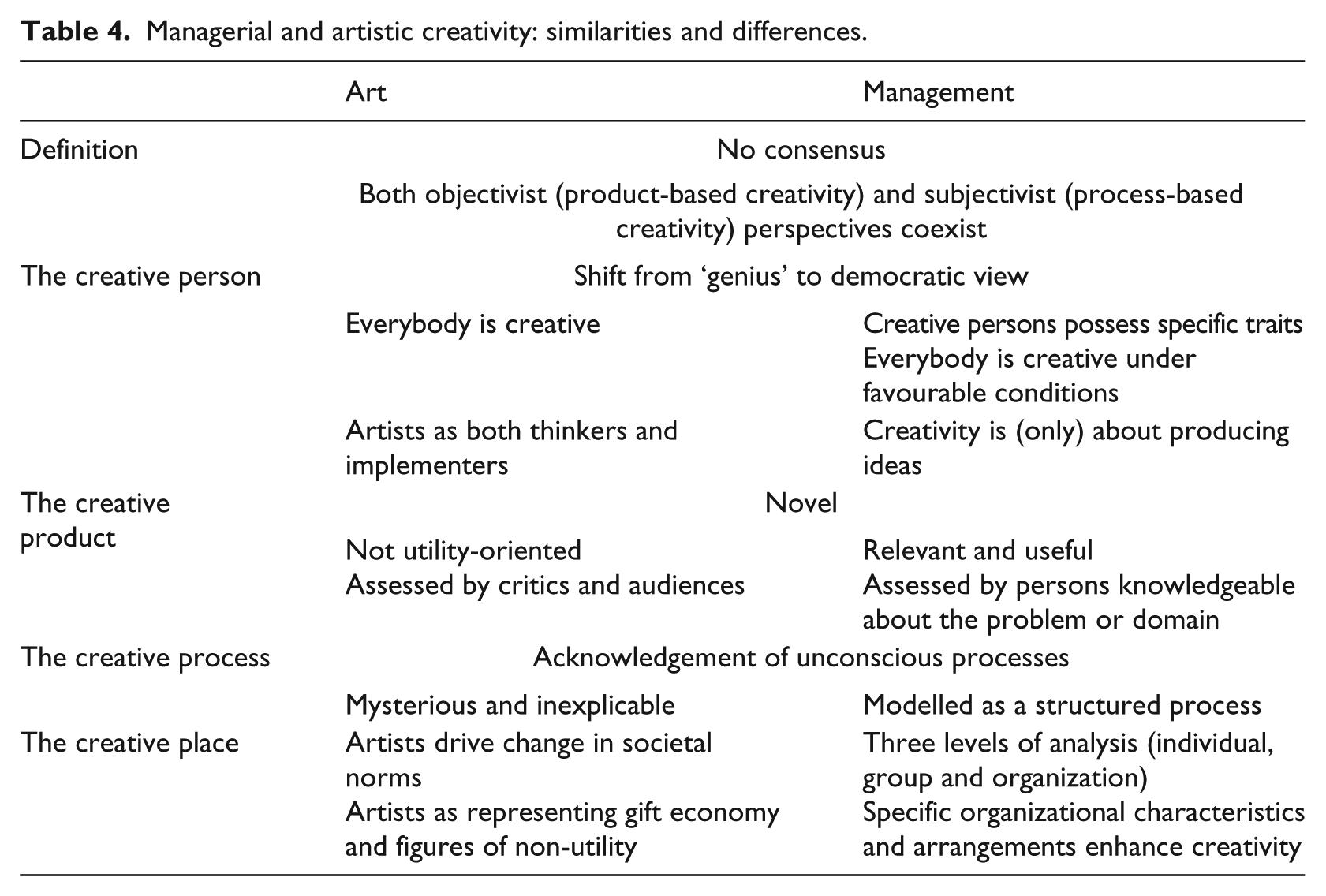
The two understandings of creativity share common points – namely, the idea of novelty, the presence of both objectivists and subjectivists in each field (even if subjectivists remain exceptional in management), the acknowledgement of unconscious processes and the shift from the genius view to the democratic perspective.
Their differences may be organized according to a threefold categorization. First, most of the differences may be attributed to the attempts, in both management and psychology, to elucidate various aspects of creativity – which are not found in the arts. The underlying assumption in management is that knowledge should contribute to opening up functionalist paths likely to foster creativity.
The second category includes the divergence regarding the utility dimension of creativity. The product of managerial creativity has to be relevant and useful; on the other hand, non-utility is a core value in the arts. We can associate this second category with the first one: management’s utilitarian orientation explains the drive to understand, and control, creativity, while the arts’ reluctance to elucidate creativity is consistent with their non-utilitarian orientation.
The third category addresses the fundamental difference between a creative manager and an artist – the former only produces ideas, whereas the latter also implements them. This divergence can be associated with the Taylorian tradition, namely the divide between conception and realization. This divide is a matter of utility (organizations are supposedly more efficient if work is specialized) and it assumes heteronomy: those who realize follow plans defined by others. More generally, heteronomy is the rule in organizations where, to a certain extent, workers have leeway to shape their activities, as long as they are teleologically directed towards organizational objectives. Heteronomy and utility are mirrored in Drazin et al.’s (1999) note that most creative situations studied in management are externally driven and directed towards the resolution of closed problems. Conversely, although artists’ level of autonomy is a matter for debate, their activities remain, at least putatively, undirected to a very large extent.
As a conclusion, we can draw a parallel between these three categories and Chiapello’s above-mentioned points of divergence between the arts and management. It is because management is infused by utilitarianism (and, going further, by capitalism) that it needs rationalization and heteronomy. Conversely, the arts nurture autonomy and deny any idea of utility and rationality.
Above, we referred to Chiapello’s views that late 20th-century changes in management could lead to a nuancing of the field – see Table 2 above. However, our review has demonstrated that, despite claims that management should take inspiration from the arts, managerial creativity is still infused with the traditional management principles – utility, rationalization and heteronomy. Artistic creativity, conversely, is aligned with the principles informing art, which remain opposed to those informing management. As such, as regards the transferability thesis, it seems very unlikely that artistic views on creativity can be directly transferred to management.
Discussion and conclusion
In this concluding section, we present the contributions and limitations of our analysis and suggest paths for further research.
Drawing on a systematic comparison informed by bodies of literature from various fields (aesthetics, art theory, philosophy, psychology, management, educational theory, etc.), we have analytically reviewed the conceptualizations of creativity in the arts and management. On this basis, we have then critically assessed the plausibility of discourses urging management to take inspiration from artists and the arts. We have shown that proponents of the transferability thesis generally miss the point that the arts and management are so radically opposed in terms of the privileging of utility (vs gratuity), rationalization (vs inexplicability) and heteronomy (vs autonomy), that such a transfer is unlikely to occur. We have also pointed out that there is little evidence that, despite the interest that has been taken in them, artistic interventions in organizations have substantially changed the big picture.
Our analysis was premised on the reasoning that the transferability thesis was an answer brought by capitalism to its artistic critique. We have analysed this answer and shown that it was unlikely to concretely meet its promises, that is, making management less utility-, heteronomy- and rationality-oriented. Coming back to the Boltanski and Chiapello’s ([1999] 2005) triadic model (capitalism-spirit of capitalism-critique), we analyse this implausible answer as an expression of the spirit of capitalism. Indeed, transferability claims and artistic interventions make capitalism more attractive – but they do not fundamentally change capitalism and its practices. That capitalism, through the voices of CEOs or consultants, disseminates facade discourses intended to mislead critique, is something commonplace. It is less frequent, however, for research voices to be in the same direction – as we have shown here. We hypothesize that this complicity is involuntary and that it results from several factors. On one hand, legitimacy in academia is based on the production of original ideas, or even better, on the creation of schools of thought (such as organizational aesthetics). On the other hand, researchers involved in artistic interventions may honestly see them as subtle forms of resistance to capitalism. Finally, associated artists have an obvious interest in new economic opportunities. Thus, our critique sheds light on the facade dimension of the transferability thesis and is again of the artistic type: we conclude that, despite arguments to the contrary, there is not enough art in managerial creativity for the latter to provide a convincing answer to the original critique.
In the course of our analysis, we have also provided a synthesis of aesthetics-informed organizational research that, despite its necessary conciseness, organizes and evidences relationships between streams of research that are often kept separate (for instance, analytical claims regarding the transferability thesis and artistic interventions in organizations). We have also offered an overview of the concept of creativity in management that is seldom presented in all its aspects. Finally, we hope to have introduced the concept of artistic creativity in all its complexities to a lay audience.
The limitations of our analysis are the following. First, given the overabundance of literature on creativity, especially in management and psychology, we could not quote all relevant contributions within the limits of this article, though we hope our selection gives a faithful enough account of current knowledge and debates. Our review was also limited because our research object was discourses about creativity, not creativity per se. Bibliometric and meta-analysis techniques could be employed to provide a more comprehensive account of this body of literature and to map its evolution. Second, our sources regarding artistic creativity are heterogeneous (philosophy, aesthetics, art criticism, etc.) and thus may not provide a conceptually consistent framework. However, we believe that this diversity has also enriched our analysis by granting us access to a variety of perspectives. Third, presenting works originating in conceptual domains as significantly different as the arts and management mirrors the difficulties of the transferability thesis. In particular, we are aware that the style of writing may not be perfectly homogeneous throughout the text: we have tried to smooth out the differences, but only partly since we found it important that each of us could recognize herself in the final outcome of our collaborative work. Fourth, although it does not impinge on the artist co-author’s sense of ownership of this final outcome, we acknowledge that the way we have organized and tabulated our analysis follows the conventions of management research. The same arguments in an arts-based publication would have taken a drastically different form, especially so if a self-reflexive engagement with creative practice was the central mode of enquiry. This ‘practice as research’ approach is more likely to involve theoretical debates derived from thinkers, such as Deleuze, Bourdieu and Heidegger than, say, the ruminations on creativity we have drawn upon from the field of aesthetics (Barrett and Bolt, 2007). Finally, we are aware that, for the purpose of the demonstration, we have come to use synthetic devices (such as tables) or make associations that ineluctably reduce the complexity of the concepts studied.
Our general portrayal of the management field as utility-, rationality- and heteronomy-dominated disregards the variety of organizational contexts. For instance, non-profit or public organizations might not be as utility-oriented as for-profit organizations, while the degree of heteronomy may vary according to leadership styles. Our conclusion, then, requires nuancing according to the specific context and its distance to the general picture analysed above. To investigate this point, it would be useful to analyse case studies of organizations in which the transferability thesis has been explicitly advocated, as well as those having benefitted from artistic interventions. What initial cultural norms held sway, especially regarding utility, rationalization and heteronomy? How, and to what extent, have practices and norms changed some years later – which would not only evidence how far transfer is possible and the related thesis relevant, but also the fact that art has the power to change norms, in organizations as in society?
Such case studies could also provide rich material on the rise and decline of transferability discourses and artistic interventions. Again, Boltanski and Chiapello ([1999] 2005) suggest a general, macrosocietal explanation which would need contextualization in particular organizational cases. When, and why, did such discourses and interventions emerge? Is there any coincidence with societal concerns and discourses or with internal (organizational, political) or external (market) changes? When do the voices advocating creativity fade? What new ‘mantras’ replace them and how can we explain the substitution?
Finally, our analysis suggests that, in management, there could be a symbolic appeal to creativity. Creativity encompasses some crypto-theological characteristics that are seldom made explicit but which, nevertheless, have a highly symbolic flavour – such as the idea of the omnipotent power of a creator. In the same vein, other critical scholars have noted that portraying the archetype of the ‘manager as artist’ was motivated by the seductive image of business people being as creative and refined as an avant-garde artist (Lindqvist, 2008), and thus projecting a form of distinction linked to the aristocracy (Bourdieu, 1984). Accordingly, this article also opens more critical paths for research into managerial creativity, in that appeals to creativity may be interlinked with more general social, rather than simply economic, trends. For instance, Reckwitz (2017) has recently used a genealogical approach to demonstrate how the taste for the new has gradually emerged as the organizing principle of modernity. Organization-level research would fruitfully complement such macrosocietal analyses.
In conclusion, despite recurrent claims about the benefits of transferring creativity from the arts into the management field, the idea does not seem to have made – nor have the potential to make – a significant positive impact on daily organizational life, given current management practices. Although we have demonstrated the implausibility of these claims, and, thus, that artistic creativity seems largely ‘lost in translation’, we hope that, by identifying and comparing the logics of the arts and management fields, we have also helped open new vistas for creativity research and, more generally, for interdisciplinary transfers.
Footnotes
Acknowledgements
The authors are grateful to the three anonymous referees and to the Editor for their constructive comments.
