




Abstract
This article explores the presence of noise in processes of communication and organisation in social movements. While the concept of noise has always had a role in discussions of communication, it is in light of the influence and use of social media that it comes to the fore as crucial in terms of how we understand communication. Rather than being a factor that interferes with effective communication, we will argue that noise is in fact inseparable from the experience of receiving information and organising through social media. Furthermore, the emergence of different ‘nuances’ of noise tells us something about different dynamics of self-organisation via social media. This article analyses the online forms of organisation of the 15M movement and the experiences of Dutch radical left activists to inform a better appreciation of the radical potential of a certain variant of noise: pink noise.
Introduction
2011 represents a crucial moment in contemporary social movement history. A series of protests – against austerity, neoliberalism, social inequality and lack of democracy – emerged in different countries, in a year that Time magazine dubbed ‘the year of the protestor’. In the first 3 months of 2011, the Arab Spring saw movements emerge in Tunisia, Egypt, Bahrain, Libya and Syria, through which millions took part in demonstrations against dictatorship and for democracy. In May and June, millions of people in Spain and Greece participated in a series of protests, against austerity and for new forms of political accountability and transparency, that traversed the countries. In September, in the United States, the Occupy protests – which began in New York and spread throughout the country and then the world – contested the power of finance over the lives of the so-called ‘99%’. Each of these movements expressed, in their different ways, a crisis of political legitimacy that emerged at a specific historical juncture following the financial crash of 2008. A common feature, which characterised the protest repertoires of these movements, was the occupation of town and city squares. This wave of struggles, demonstrations and occupations was significantly influenced by the role of digital technologies and social networks in organising and coordinating political practice.
In responding to the polemic accounts of spontaneity and horizontality that accompanied the uprisings of 2011, Rodrigo Nunes calls for a description of these movements and their organisational dynamics that goes beyond simplification of their ideal form, on one hand, and vilification for their ineffectiveness, on the other hand. He writes of the need for determining ‘what balances to strike between openness and closure, dispersion and unity, strategic action and process and so forth’ (Nunes, 2014: 13, italics in original). It is in this spirit of trying to find a space between polemics, a space that allows us to see the reality of social movements and how they organise rather than a dogmatic and simplistic ‘for or against’, that we attempt in this article to approach the question of noise in communication networks. One of the defining features of the debates around the 2011 uprisings is the inclusion of social media platforms and other forms of supposedly horizontal communication as key factors in facilitating how these movements were organised; or, rather, how they were self-organised. Starting from an acceptance of the proposition that social movements, and here we focus on the 15M movement and Occupy, are or at least tend towards being self-organising, we examine the presence of noise in their communication networks. Doing so suggests that this can provide an indicator of some form of collective action that can be described as self-organisation. In this article, we identify specific characteristics of noise in networks enabled by social media platforms such as Facebook and Twitter and highlight the view that noise is a core problematic of social media. However, we suggest that noise ought to be reappraised, both in light of how it is experienced in social media and by social movements and as to how it takes on quantitatively different forms in relation to qualitatively different self-organising practices.
What we characterise here as the problematic of social media comes across strongly in the following quotation from an interview conducted with an activist involved in the Occupy Amsterdam protest camp in 2011: You could devote every waking moment and every spare ounce of energy and brain cells to Occupy, because a million things were going on and it was all fascinating and interesting and you didn’t want to miss anything important and all of this, so I know from myself I really tapered off how much attention I was paying to everywhere else but I just couldn’t do it, stay focussed. […] Yeah, so the dispersed nature of it all is again a strength but also a weakness I think because it just means it’s hard to know where to go. […] it felt to me like in the end it became just so much noise it was hard to filter what was going on.
The problem identified by this activist pertains to the volume of potentially ‘fascinating and interesting’ information and things going on. While not restricted to the impact of social media – as the activist in question points out, the ‘distributed nature’ of Occupy’s democratic organisation itself created noise – this quotation does highlight how noise can be a hindrance to effective organising in social movements. However, as we will argue in this article, noise is not a unitary phenomenon but occurs in three distinct forms, white, brown and pink, not all of which are a hindrance to effective self-organisation.
We begin with an overview of the literature on communication, noise and self-organisation, anchoring this discussion in early work on information theory. We then turn to empirical research conducted with the 15M DatAnalysis group and Dutch social movement activists in two separate, but thematically connected, studies. Through reading this empirical data and its analysis as speaking to a common problem – that of noise in communication networks and social media platforms – we conclude the article by suggesting how a nuanced understanding of noise can potentially aid social movement activists in effective self-organisation.
Communication, self-organisation and noise
Communication and self-organisation
Cybernetics (Beer, 1994 [1981]; Wiener, 1961 [1948]) was one of the first scientific fields to identify the intimate connection between communication and organisation. Early cyberneticians even suggested that organisation is nothing but communication, with individual units in a system only being said to be organised when linked by lines of communication (Duda, 2012: 78). During this early period of cybernetics, there was a close relationship between the work of Norbert Wiener (among others) and information theory (Kline, 2015; Pickering, 2010). Claude Shannon and Warren Weaver, who developed and popularised information theory (Shannon, 1948; Shannon and Weaver, 1949), took a similar starting position to that of early cyberneticians, applying insights with regard to communication and organisation in mechanical, biological and social systems to the fields of electronics and computing. If cybernetics suggests that self-organisation relies on effective communication, information theory points towards what effective communication entails. While information theory was developed with electrical engineering in mind, there are some generalisable insights that apply to the kind of messages that are conveyed through social organisation. Indeed, although information theory was not originally intended to apply to human communication, it has been used extensively in this area (see Kline, 2015, for a comprehensive historical overview). However, when considering social organisation in this context, it is not the technical account of information that is important but the more colloquial account that focuses on the issue of information as involving some content that is understandable; what Shannon and Weaver described as the ‘semantic’ or ‘influential’ side of communication (Shannon and Weaver, 1949: 28).
While information theory might not seem immediately relevant to radical politics, the concepts it introduced and developed allow us to explore in detail how social movements, such as 15M and Occupy, communicated and organised. Through such exploration, self-organisation comes to the fore as a particularly important theme (Ashby, 1962; Duda, 2012; von Foerster, 2003 [1960]). For considering social organisation and for thinking about social movements, self-organisation is understood as something that emerges from how the system organises itself (Umpleby, 1987). In these contexts, it is not something that can be determined from outwith the system but rather is a property of how the system organises, that is, how the people in the system (or organisation) go about organising. In social movement organisations, when the individuals involved collectively determine how the organisation functions, in a democratic and participatory way, then it is self-organised. Self-organisation refers to ‘bottom-up processes in which simple beginnings lead to complex entities, without there being any master plan or central intelligence planning it’ (Escobar, 2009: 395). This is echoed by both Alexander Galloway (2014), who proposes that in self-organisation ‘each agent is endowed with the power of local decision according to the variables and functions within its own local scope’ (p. 114), and John Duda (2013), who views self-organisation ‘as radical democracy and horizontal self-determination’ (p. 57). In so far as radical social movements are committed to self-organisation, democracy and autonomy, the communication practices they engage in can be seen as a central factor in how they envisage and work for radical social change (Swann, 2014; Swann and Husted, 2017; on activism and social media see, for example, Fenton and Barassi, 2011). As such, their communication networks ought to be as participatory and self-organised as the movements themselves.
Thus, it is with these issues and considerations in mind that information theory can be introduced into discussions around radical social movements. However, information theory and related fields such as cybernetics have received criticism – some of it in this very journal – for their functionalism; a functionalism that, critics argue, precludes the radical democracy that lies at the heart of the social movements we focus on here (see, for example, Burrell and Morgan, 1979; Tiqqun 2010; Ulrich, 1981; Willmott, 1997). Instead, so the critique goes, they reduce organisation to a technical reproduction of an effective model or blueprint. Werner Ulrich, for example, describes the actualisation of cybernetics in real-world organisation as tending towards a ‘managerial fascism’ (Ulrich, 1981: 55). These critiques are somewhat uncharitable and side-line the historical and theoretical connections between information theory and its adjacent fields and radical accounts of democracy (see, for example, Duda, 2013; Swann, 2018). The way we draw on information theory here, in line with this more radically democratic reading, has less in common with the strict functionalism of some strands of these traditions and instead picks up on how cybernetics (and we would extend this to information theory) is articulated by, among others, Andrew Pickering. Following Pickering, we would suggest that information theory can be understood as a heuristic to help facilitate emergent performance. Pickering (2010) describes cybernetics as a ‘performative epistemology’: ‘a vision of knowledge as part of performance rather than as an external control of it’ (p. 25, italics in original; see also Harnden, 1989). This conception, of an epistemology that links performance and control, may also be applied to information theory. Thus, the conclusions of Shannon and Weaver concerning what constitutes effective communication can be applied to instances of self-organisation, seen not from the outside, objectively, but from the inside, (inter)subjectively, from the perspective of those performing the communication and organisation. It is on this proposition that we base our argument below.
Noise in communication networks
Early information theorists were concerned with how signals in systems, that is, communication, could be disrupted. Ensuring that communication operates as the actors in the system intend it to is of central importance. For information theorists like Shannon and Weaver, noise is defined as that which involves any ‘statistical and unpredictable perturbations’ (Shannon, 1949: 11) in a signal. It is irregular and requires effort to identify in relation to the intended signal and to ultimately remove. When we talk about removing noise in a system, we are talking about something analogous to trying to minimise white static to get a clearer television signal. A signal has been transmitted between certain parts of the system and noise is the distortion that stops the signal from being properly understood by the parts receiving it.
In the case of social media, instead of the receiver trying to tune in to an intended signal, the social media user is presented with a stream of content with respect to which the user must determine for themselves what is sensible and what is noise. On Twitter or Facebook, users are presented with a large volume of potential content that they can scroll through, choosing to stop and actualise content when something seems important or interesting to them. While this might seem more like information overload than noise, it cannot be characterised as such, for it is not the case that everything presented on someone’s Twitter or Facebook feed is content they want to consume. Until the user makes choices and picks bits and pieces out of the stream of potential content, it is all experienced in the same way: as noise. Unlike with previous forms of communication technology, on social media, users are not trying to reduce random interference to receive an intended signal but are instead engaged in determining for themselves what is sensible content and what is noise that can be ignored.
It should be noted that such processes are increasingly augmented, to varying degrees, by the algorithms deployed by social media platforms, which present users with only a portion of the content transmitted by their Facebook friends or those they follow on Twitter. These algorithms, in effect, try to pre-empt the filtering process by deciding for the user what is noise and what is sensible content (on the political economy of social media see, for example, Beverungen et al., 2015; Sandoval and Fuchs, 2010). Nonetheless, the rise and prevalence of social media do call for a rethink of how signal, noise and content are understood and realised in communication practices. As Alan Shapiro (2012) asks, ‘Now that we are in the age of social media like Facebook, Wikipedia, Twitter, and blogs, how should sociology redefine what information is?’ (p. 19).
Critical accounts of information and noise
The two broad lines of critique levelled at information theory’s understanding of noise in communication (and also at cybernetics, in ways that apply to our discussion here; Ulrich, 1981) are, first, that it fails to consider how human communication is an interactive process and, second, that it reduces communication to a functional activity accompanied by a ‘totalising logic’.
Following Barthes (1977), Díaz Nafría and Al Hadithi (2009) argue that communication ought to be understood as an interactive activity through which meaning is co-produced by author and audience. This critique, primarily levelled at Shannon and Weaver’s model of information, contends that factors other than a linear transmission of information play important roles in determining how meaning is negotiated. The Shannon-Weaver model, it is argued, is a ‘reductionist view of human communication’ and a ‘linear topdown pattern of communication’ (Resnyansky, 2014: 56) (as noted above, while information theory was not originally intended to apply to human communication, it has been utilised in this sphere, much as we do here). Similarly, Díaz Nafría (2010) argues that reducing communication to a syntactical transmission of meaning (i.e. logical structure) makes it impossible to show how a message can be distinguished from noise. The ability to determine semantic content is required for separating noise from a meaningful message. Yet the account of information and communication underwriting the understanding of noise that is presented above brackets this off from the transmission of a message in a system or organisation. If the involvement of an audience in determining the meaning of information is restricted, then it is questionable how such an account of information can be fruitfully applied to democratic, participatory self-organisation. Such critique suggests that in this account of information, there is no role for agency on the part of those receiving messages; they are simply required to eliminate noise and process the correct interpretation of the information. An understanding of communication that would be appropriate for radical social movements and their commitment to democracy and participation is thus potentially undermined by a reliance on reducing those receiving information to passive processors in a system.
The second critique of the account of information presented above is one that challenges the apparent ‘totalising logic’ of Shannon and Weaver’s information theory. Mark Nunes (2010) argues that these kinds of linear models of communication reflect a ‘culture increasingly dominated by a logic of maximum performance’ (Nunes, 2010: 4). This frames communication as akin to giving orders or dictating a message. Noise, according to this understanding of information theory, is something that decreases the likelihood of accurate reception of what is a pre-determined message. Noise is characterised as an error in a pre-programmed control system: ‘Error, in effect, communicates information without a purpose – or at crosspurposes to programmatic control’ (Nunes, 2010: 12–13). ‘As a control system “communication” [is reduced] to a binary act of signal detection [that] demands a rationalization of all singularities of expression within a totalizing system’ (Nunes, 2010: 5). Nunes draws on Umberto Eco (1989) and Deleuze and Guattari (1987; Deleuze, 1992) in conceiving of noise as a potential site of resistance in these systems, in so far as it creates a space in the system that has not been determined by the controller but is open to interpretation and articulation. Michel Serres makes a similar case for viewing noise as a site of potentiality rather than something to be reduced or eliminated (Serres, 1983). If self-organisation is central to radical social movements, as we have suggested above, then understandings of communication that serve to restrict such autonomy by ensuring that messages are defined in advance and received correctly (i.e. in line with this pre-defined meaning) should be rejected.
Reconciling noise and self-organisation
This overview of the literature on information theory and noise leaves us with something of a conundrum. On one hand, information theory presents us with an account of communication and noise that suggests that if social movement organisations want to operate effectively and construct communication networks that allow them to do so, then they need to find ways of reducing noise so that activists can process potentially valuable information. As noted above, the way social media has changed the communication landscape of social movements – and indeed of life more generally – means that social media users are presented with a wall of noise that they have to spend time and energy sifting through. A position informed by information theory would suggest that we ought to find ways of reducing noise with respect to social media platforms to allow for meaningful information to come through. If effective organisation depends on effective communication, then anything that disrupts communication, such as noise, is a challenge to organisation. On the other hand, such attempts to reduce noise and focus communication on successful transmission of a message from a transmitter to a receiver risk undermining the democratic and participatory principles of radical social movement organising. A simple reduction of noise and narrowing of the transmitted message may also reduce spaces for autonomy and freedom of expression, factors vital to democratic and participatory organisation.
What we intend to illustrate in the remainder of this article is that there is a more nuanced account of information, communication and, importantly, noise than either of these takes on the debate suggest is possible. If noise is an unavoidable presence in communication systems and networks, then how can it best be approached by those involved in radical social movement organisations? Below, we focus on a discussion of social media data analysis conducted by activists involved in the 15M movement that took place in Spain in 2011, bringing this research into conversation with an empirical study of Dutch social movement activists conducted in 2012. Combining these two sites of study will allow us to present an account of noise in communication networks and social media that is conducive to social movement organising based on democratic and participatory principles.
15M and occupy
Following an anti-austerity demonstration called by the Democracia Real Ya platform (Real Democracy Now), in Madrid on 15 May 2011, a group of around 40 activists decided, in a spontaneously organised assembly, to occupy Puerta del Sol (one of the main squares in Madrid). Through the resulting movement – 15M, named after the date of the first mobilisations – there emerged a new way of thinking about and experimenting with the process of self-organisation, with the movement acting as a laboratory for novel methods of organising (Sanchez Cedillo, 2012). At the time and in academic writing since, 15M and the transnational ‘Occupy’ movement along with the Arab Spring and later protests have been grouped together as ‘the movement of the squares’ (Gerbaudo, 2017). As well as the (re)appropriation of public space, through turning squares into popular assemblies, one of the key ways that questions of interaction and (self-)organisation were addressed by 15M was through the use of technology in communication, deliberation and decision making. These means of communication, such as text messaging, email and social media, allow us to reconstruct the self-organisation of 15M in ways that highlight how participants experimented with new forms of relating to one another.
In the Netherlands, the movement of the squares had limited but not insignificant reach, with Occupy camps springing up in Amsterdam and other large cities. While not having the impact, either locally or globally, of 15M or the Arab Spring, the situation in the Netherlands in and just after 2011 is important because of the historical background of the Dutch radical left scene. Broadly influenced by the radicalism of the 1960s and the anarchism and autonomism of the German radical left in the 1980s and 1990s, the Dutch radical left has been rooted in the squatting movement and in the social centres and collectively-run cafes, bars and restaurants associated with this movement (e.g. Katsiaficas, 2006). While there was some overlap between established radical left groups and movement scenes, on one hand, and Occupy, on the other hand, the Dutch Occupy camps also saw participation from constituencies new to political action and many that were involved came with less explicitly political environmental and inequality concerns.
As we have discussed above, the use of digital technologies, particularly social media platforms such as Facebook and Twitter, bring with them the issue of noise. Some have argued that corresponding problems, as to the fleeting and unfocussed nature of social media, ought to lead us to abandon them for more traditional forms of communication (Lovink, 2011). Others see in the phenomenon of noise both the signs of totalisation of control and the prospect of resistance and the rearticulation of meaning. In what follows, we aim to highlight a more nuanced approach to noise as it presents itself in the communication technologies utilised by 15M. While we focus here on 15M, we suggest that there are important lessons that can not only be applied to similar movements but to discussions of self-organisation and communication in radical politics more generally.
Perhaps unconventionally, the empirical research discussed below comes from two separate doctoral projects conducted by each of the authors of this article, respectively. The research on the 15M DatAnalysis group takes the form of an analysis of a research paper produced by a group of activist scholars, supported by in-depth qualitative interviews with three of the members of the group. This allows us to examine this account of noise and self-organisation as a singular knowledge product that can inform broader debates around noise. The second body of research involved in-depth qualitative interviews with 18 Dutch social movement activists. This interview data is taken as providing a snapshot of how these activists approach the problem of noise in communication networks. In both cases, we are not applying any particular social science method of data analysis and instead take an ‘informal approach’ (Peräkylä and Ruusuvuori, 2011: 530; see also Seale, 1998: 127–31) to the data, attempting to treat it as contributions to academic debate and bringing it into conversation with the literature discussed above. This way of dealing with empirical data could broadly be defined as akin to what Gordon (2007) describes as ‘participatory political philosophy’ and our use of interviews and secondary data is intended to advance a conceptual understanding of noise and communication, rather than provide a social scientific account of certain phenomena.
Gordon’s (2007) ‘participatory political philosophy’ aims to identify ‘what tools and methods can be offered for facilitating the collective production of reflective political philosophy’ (p. 276). For Gordon (2007), this process involves three stages: immersion, with the philosopher becoming ‘native’ in a particular social movement setting; absorption/participation, which brings ‘a constant influx of ideas into the philosopher’s emerging framework, and [involves] a continuous process of refining the way in which ideas are positioned and connected in the researcher’s own mind’ (p. 281); and, finally, integration, a stage of private reflection in which the philosopher brings the conceptualisations identified and developed at previous stages into conversation with academic literature and performs a more in-depth analysis than the social movement setting itself allows for. As Gordon writes of the process overall (Gordon, 2007: 278), The role of the philosopher is to partake in and facilitate the reflexive process of theorising among activists, functioning as a clarifier, organiser, and articulator of ideas, an activity that takes place with and for activists. Her or his goal is to address in theoretical form the issues that activists face in their everyday organising, to assemble ideas so they can be discussed carefully, to lay open hidden assumptions and contradictory statements, and in general to advance activists’ thinking by transposing it from the fragmented terrain of brief and informal debate to a dimension where a more structured and ‘high-definition’ discussion can be undertaken: on the written page.
While designed for use in anarchist philosophy (for similar approaches see, for example, Jeppesen et al., 2017), here we apply the approach Gordon outlines in relation to radical social movement theory more generally. The data collected in our respective research projects constitute the outcomes of approximations of the first two stages (immersion and absorption/participation), with the work presented here representing an aspect of the third stage (integration).
Signals, pink noise and the rejection of social media
In the months after the 15M protests, a group of researchers dedicated themselves to an analysis of the 15M experience. The 15M DatAnalysis group was formed in 2012 and includes researchers with backgrounds in data science, philosophy, sociology, psychology and network sciences. These were all activists in the movement and their interest was as much political as it was academic. Given the centrality of social media platforms to the development of 15M, the 15M DatAnalysis group had access to a wealth of data, with platforms such as Twitter acting as a dataset from which the events of the movement and, importantly, the dynamics of how it self-organised can be assembled. 15M and other encampments in the movement of the squares have provided a rich volume of data that serves to illustrate the events and dynamics of the day-to-day development of social movements – a level of detail previously only available through ethnographic practices (e.g. Graeber, 2009; Maeckelbergh, 2009). In this section, we take the analysis produced by the 15M DatAnalysis group as a secondary source outlining the social media activity of the movement.
The 15M DatAnalysis group addressed questions concerning spontaneous complexity and order and concerning patterns of self-organisation by beginning with the most accessible data available to the researchers: the online traffic that populated Twitter during the movement: Unlike previous studies of network analysis of the 15M movement and the similar uprisings, the focus […] is on characterising more global aspects of self-organisation processes and exploring indicators of the kind of emergent communication patterns. […] Since this type of self-organisation into a coherent dynamic unit is hypothesised to be the core of mental life and neural organisation, we want to explore the possible analogy with social life and political consciousness. (Aguilera et al., 2013: 396)
The primary method that developed out of this approach was ‘fractal scaling’: One of the greatest challenges for the understanding of cognitive and social systems is finding formalisms to understand how complex activity emerges from processes of multi-scale organisation. (Aguilera et al., 2013)
Fractal scaling is used in neuropsychology to assess the stability of a system and the emergence of properties within that system: Fractal scaling is characteristic of critically self-organised systems. In these systems we can find an interesting mix between stability and instability creating complex structures of the variability of the system’s activity. […] The analysis of the fractal coefficients of a system’s activity has been widely used in neuropsychology for characterising different states of interactivity among the components of a cognitive system, as well as to predict the emergence of new cognitive structures. (Aguilera et al., 2013)
It is through this process of fractal scaling that the 15M DatAnalysis group were able to propose a nuanced understanding of noise that is highly insightful as to how information and communication operate in networks and in relation to the self-organisation of radical social movements like 15M. Fractal analysis leads to an appreciation of three distinct forms of noise in a communication network or system:
1
white noise, brown noise and pink noise. White noise ‘describes fully random fluctuations with no correlations in time […]. White noise processes display fast changes in their activity but are unable to maintain structured and coherent patterns’ (Aguilera et al., 2013). In contrast, Brown noise resembles a diffusion process with no correlation between increments, but with strong dependencies between the position of one sample and the next […]. Brown noise processes are able to maintain stable structural patterns, but they are unable to flexibly modify their activity when fast changes are required. (Aguilera et al., 2013).
Pink noise, on the other hand, ‘describes processes in which an equilibrium is found between the influence of short, medium and long timescales’: It finds an equilibrium between disordered states with high informational content (white noise) and states with strong memory but low informational content (brown noise). Pink noise processes display dynamics which can maintain stable patterns of activity while being able to flexibly regulate their level of activity. (Aguilera et al., 2013)
For the 15M DatAnalysis team, fractal scaling highlights how different types of noise in communication networks act in different ways on the organisational forms of those networks. For complex networks like the brain and, they would argue, the social movement, the ability of the network to self-organise autonomously, free from direct, external control, correlates with the type of noise that is found to be dominant in its communication network. If the noise in a network is characterised as white noise (i.e. as random and quickly changing), then the network will be unable to maintain stability and function in the ways desired. If the noise can be characterised as brown noise (i.e. the noise is strongly regular and fixed in its variations), then the network will be capable of stability but will experience rigid structural control and offer little in the way of flexibility or autonomy to the nodes of the network. In conditions where brown noise is prominent, a network will be highly predictable and regularised. However, under conditions where pink noise dominates (i.e. an equilibrium between irregular, unpredictable noise and regular, predictable noise characteristics), a network will remain stable but will also possess the capacity for flexibility and autonomy. This allows for a regulation of activity in ways that eschew both the chaotic complexity associated with white noise and the rigid simplicity associated with brown noise. Rather than focus on the mathematical distinctions between white, brown and pink noise entailed by fractal scaling, here we are concerned instead with the qualitative differences and how these relate to processes of self-organisation. Pink noise, according to this line of thinking, is ‘an indicator of distributed self-organisation in a coherent whole: different parts of the system (with their characteristic frequencies) appear globally coordinated in a reciprocally influencing manner’ (Aguilera et al., 2013: 397).
Thus, the 15M DatAnalysis team identified three different kinds of political process, three different kinds of noise and three different qualitative matrixes of categorisation that underline the existence of three different kinds of pattern. Utilising these identifications and patterns, the methods of the group were applied to the communication processes related to the Spanish 15M movement. The task here was to test whether fractal scaling analysis can provide a good quantitative index for these qualitatively different degrees of self-organisation of communication and coordination as expressed through Twitter. The basic idea is that different processes of mobilisation produce different kinds of noise and, through the noise analysis made possible in each case, the qualitative elements in the form of synchronisation can be identified. This is analogous to putting a microphone in a protest camp, but here the microphone is put into Twitter as an expression of that camp. The microphone does not record content, but rather the ways in which signals exist and how they produce different relationships.
Utilising the approach pioneered by the 15M DatAnalysis researchers, it is possible to translate the data gained from an analysis of Twitter activity into conclusions about the qualitative features of the network concerned: with respect to different processes of coordination in a network, different forms of noise will be visible in the communication flows of that network relating to each of the processes. In practice, the 15M DatAnalysis group collected Twitter traffic data from different 15M protests taking place during May 2012, 1 year into the movement’s existence. This time frame was chosen because of the high density of mobilisations during that time. The aim was to identify different organisational processes taking place during this period through measuring noise on Twitter. Downloading around 385,000 tweets based on a set of 20 different hashtags (hashtags chosen as representative following discussion with activists involved in the movement) which constituted activities of around 1 million Twitter users, they analysed the underlying dynamics of the communication networks using the tools repurposed from neuroscience and mathematical systems analysis. In this way, a graphical representation of the movement was created, with nodes in the network representing Twitter users and the data collected being used to map the relationships and flows of information between them.
This resulted in a picture of social movement organisation whereby the white, brown and pink noise found in their communication networks correspond to spontaneous or reactive mobilisations, hierarchically structured mobilisations and self-organised mobilisations respectively. Pink noise represents a middle ground between the chaotic spontaneity of white noise and the restrictive stability of brown noise (see Figure 1). 2 The 15M DatAnalysis group measured fractal scaling as the relation between the amount of variability of the system at different temporal scales, obtaining a parameter that describes the fractal relations between the amounts of activity in the system at different times. Measuring other parameters, such as the temporal scope of the fractal scaling and properties of the network underlying the communicative activity, they discovered that, when a process of self-organisation (represented for them by pink noise) reaches an equilibrium between independent and interdependent dynamics, it spans into much larger temporal timescales. That is, independent of the real duration of the communication process, pink noise processes present correlations that reach much further in time, maintaining a coherence that can last for days. Pink noise, therefore, reflects the fact that such processes are robust enough to endure, but at the same time fast enough in terms of successfully propagating information.
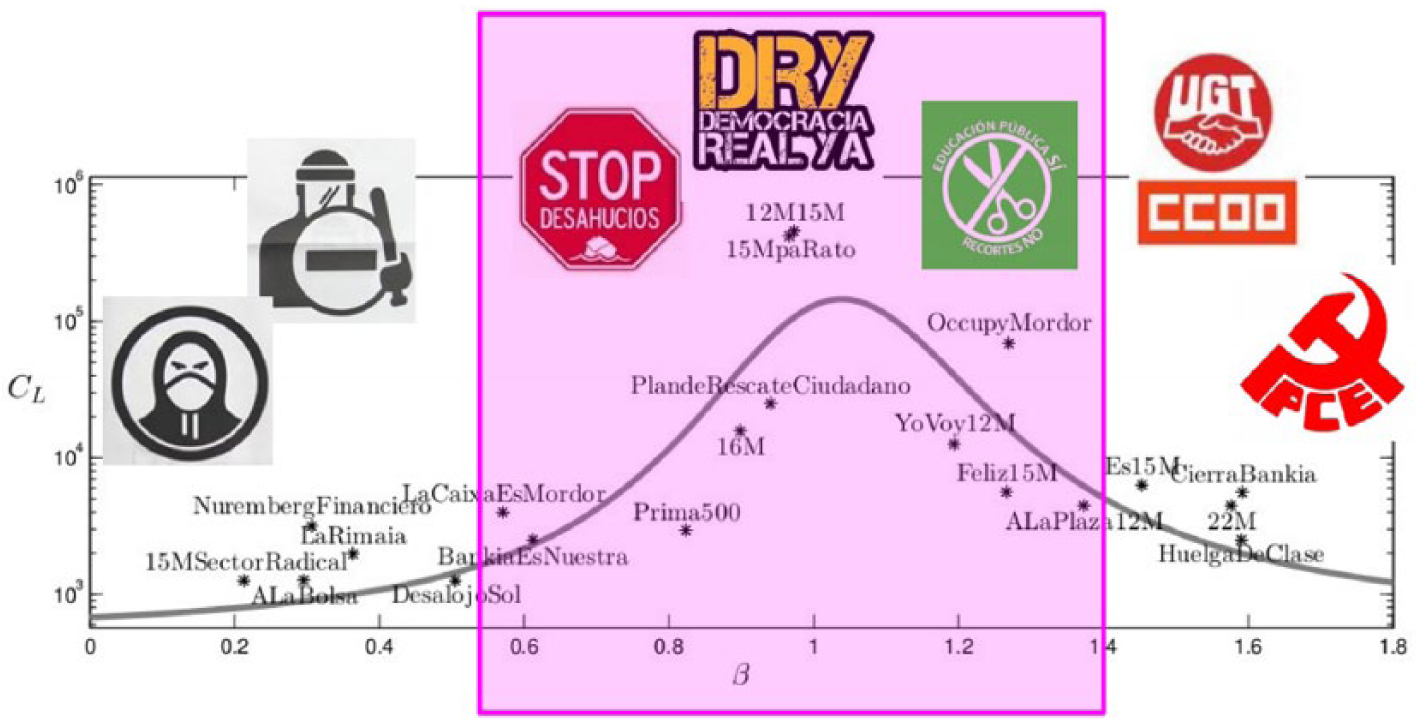
A graphical representation of the movement.
One activist researcher involved in the analysis, Antonio, noted that instances of pink noise ‘are processes capable of a great creativity but at the same time able to make a route; to produce meanings’ (Antonio, interview). Another activist from the group, Toret, commented similarly, linking the presence of different types of noise to specific kinds of political action: […] white noise shows a great velocity of reaction – chaotic because here everyone is speaking at the same time. They are very important processes, fundamental to resist an eviction or answer to a repressive action. Brown noise is much more produced inside campaigns and processes that can be more assimilated with the traditional left: totally predictable and slow, with a hierarchical structure of mobilisation and, moreover, incapable of connection with emergent new elements. The capacity of pink noise […] can be defined as a capacity to generate a path, with its goals and targets but, at the same time, capable of being strongly affected from the emersion of new configurations. (Toret, interview)
This quotation is important in so far as it further highlights the connections between the type of noise found in a communication network and the specific kinds of political process that are dominant in the corresponding actions of that network. White noise is linked to reactive action that responds instantly to events and where everyone involved is acting and speaking at once without any coordination. Brown noise corresponds to the kind of organisation common in the more mainstream sectors of left-wing politics, such as trade unions and political parties, which feature hierarchical control infrastructures that attempt to rigidly prescribe the actions to be undertaken by those under their influence (i.e. party or union members). Pink noise, however, is linked by Toret to political formations and actions that possess both the ability to determine goals and targets (an element of stability and forward-planning found in brown noise action but lacking in white noise action) as well as the ability to allow for emergent forms of organisation and action that influence the overall form of the activity (something found in white noise action but not in brown noise action). What this suggests, according to the 15M DatAnalysis group, is that the very nature of the noise in a network can serve to signal whether self-organisation is present, in terms of the political processes.
The analysis of pink noise tells us something about the constitution of self-organisation, understood as both a process capable of defining goals, achieving a temporal continuity and being capable of being affected by the active participation of the people involved. The campaigns Stop Desahucios (Stop Evictions) and Education Pùblica Si – Recortes No (Yes to Public Education – No Cuts) are good examples of self-organisation. They show the power of pink noise in that they were able to involve thousands of people in the organisation of a series of mobilisations (mass demonstrations, strikes, occupations, civil disobedience actions, legal proposals and public assemblies) through participatory processes facilitated by different online platforms. While such processes may be possible in situations characterised by white or brown noise, what the presence of pink noise in the communication networks highlights is how campaigns can effectively involve both participatory democratic forms of decision-making and the capacity for long-term goal achievement. While the presence of white noise might be linked to processes that are participatory and democratic, they lack the longevity required to meet more strategic goals. Similarly, the presence of brown noise may correlate with processes that are able to set and achieve long-term goals, but they will struggle to do so in a participatory and democratic way. It is when participatory democracy and the capacity for long-term goal achievement are combined that, we suggest, processes can be described as examples of self-organisation that will be characterised by the presence of pink noise.
For these activist researchers, however, the point is not to construct practices and organisational structures in such a way that self-organisation and thus pink noise will be guaranteed, to the extent that this would even be possible. Instead, as one activist, Lotta, put it, ‘it is more efficient to share practices, tools and processes to create what could be called a network ecosystem’. Lotta went on to explain further: […] such an ecosystem will function as a latent network that is capable of emerging when needed – and to adopt and replicate ideas with more virality. [… This] consists of enabling the quick sharing of strategies and methodologies that are found to be efficient. By creating memes out of these strategies and methods, the struggles in different areas can easily become familiar with the ‘source code’ of a certain form of action and replicate it locally – possibly improving it and adapting it to their local needs. In this sense, the construction of an a priori container between subjects does not match the way the networks work. Instead, we want to create places for sharing and exchanging practices, ideas, languages and tools. This way we can push for aggregation around ideas and empowerment. (Lotta, interview)
By proliferating and experimenting with practices that are considered to be conducive to self-organisation and pink noise, social movement activists, it is suggested, can build more effective (self-)organisation than would be possible through applying a blueprint for a pre-defined structure.
To complement this overview of the analysis conducted by the 15M DatAnalysis group, we turn to reflections on communication from activists in another context that, while possessing a different focus and emerging from more general discussions of political practice and communication, provide an insight into what different forms of noise might mean in practice. Importantly, as we will discuss towards the end of this article, this will also allow us to suggest how an understanding that differentiates between white, brown and pink noise can be used in identifying where and how communication processes are inhibiting self-organisation.
While not specifically focused on social media (in the sense of platforms like Twitter and Facebook), the general thrust of how the Dutch activists interviewed considered noise came through in the following comment about email: a lot of people are experiencing that email lists have their restrictions because there’s a lot of communication going over it and it’s difficult to filter out what’s important and what’s not. […] With email all the different things just stack up on each other. (Tommy, interview)
Others expressed similar concerns about how ‘email boxes get filled up so quickly’ (Timon, interview). On email listservs, problems of noise arise when users send huge amounts of email (some of which might have little or no relevance to the topic of the list) often over a short space of time, leading to difficult to cope with inboxes full of emails that mix activism and other communications, especially when allied to the amount of email communication that can be required to arrive at even small decisions (i.e. a constant back and forth between members of a listserv signalling agreement, suggesting alternative proposals or asking questions). Here, noise becomes a concern as unimportant emails swamp inboxes making it difficult for activists to identify emails that are relevant to them. As one activist put it, If you have ten people in a group and you’re sitting all together and you say, ‘okay, this is the proposal’, and everybody nods, ‘yeah, that’s okay’, then you’ve sorted it. [With email there’s] people who have to say, ‘yeah, I agree’, ‘yeah, I agree but …’, ‘I don’t agree ’cause …’, and then … Like, if ten people send five emails you have fifty emails. (Marien, interview)
Specifically in relation to social media, Facebook and Twitter in particular, the Dutch activists interviewed had similar concerns, with one commenting that ‘people get too much information through these two channels [Facebook and Twitter] that they hardly have time to react’ (Paul, interview). One who was involved in running a group’s Facebook page also noted that it’s quite difficult because there are a lot of posts coming up on the wall […] Hundreds and hundreds of invitations which is very difficult to keep track of so I don’t even try. (Jay, interview)
Echoing this, another activist rejected live streaming (where events such as talks and, in the case of Occupy for example, general assemblies and even protest marches are broadcast live online) as something genuinely useful to activism, saying that ‘it’s hard to follow because there’s so much going on, it’s really like an overload of things’ (Joost, interview). Activists reported sometimes feeling strong emotions of frustration and annoyance with social media, with one explicitly highlighting noise as a problem: […] there’s the problem of too much noise, you know. There’s so much out there it’s often hard to know how to navigate it. […] I hate it. I can’t bring myself to tap into another source of just more info and opinions and stuff coming at me. (Mark, interview)
While our focus here is on social media, and indeed the analysis of the 15M DatAnalysis researchers emerged out of a consideration of noise on Twitter, it is worth noting that the concerns of the Dutch activists around noise apply to communication in social movements more generally, from digital and social media communication through to the everyday communication in the protest camps that characterised the movement of the squares. We conclude this section of the article by returning to the quotation from the Introduction, now contextualised by the analysis that has followed: You could devote every waking moment and every spare ounce of energy and brain cells to Occupy [Amsterdam], because a million things were going on and it was all fascinating and interesting and you didn’t want to miss anything important and all of this, so I know from myself I really tapered off how much attention I was paying to everywhere else but I just couldn’t do it, stay focussed. […] Yeah, so the dispersed nature of it all is again a strength but also a weakness I think because it just means it’s hard to know where to go. […] it felt to me like in the end it became just so much noise it was hard to filter what was going on. (Mark, interview)
As this overview of Dutch social movement activists’ opinions and emotions with respect to noise suggests, the appreciation of the potential benefits of noise, flowing from the research of the 15M DatAnalysis group, might not commonly resonate as obvious or beneficial with activists in the broader movement milieu. This is not to say, however, that the accounts of noise from these two groups contradict one another. In the following section, we aim to show how these can be read together and, importantly, how doing so can help us better understand the role of noise in social movement communication networks.
Democracy, self-organisation and pink noise
The account of noise presented by the 15M DatAnalysis researchers is a nuanced one that, drawing on neuroscience, identifies three different types of noise – white, brown and pink – and calls into question more established radical responses to the perceived problems of noise in information networks. As outlined in this article’s earlier discussion, the core concern for theorists of information, on one hand, and their critics, on the other hand, was the reduction or elimination of noise from a signal or communication process. In early work on information theory, noise was treated as a technical problem. Noise was considered to be any disruption in a signal that made correct receipt impossible. In order to restore the original, intended message, noise had to be removed. More recently, this technical account of noise has been subject to two broad and related critiques. First, that this approach to noise and communication eliminates the roles of interpretation and negotiation of meaning in human communication. Communication is never a simple case of a message being received as intended, rather the meaning of a signal or message is always co-constructed by the sender and the receiver. Second, and drawing on this first line of critique, is the argument that by eliminating this interpretive, negotiated aspect of communication information theorists are calling for a totalitarian form of communication, in which a central sender of information dictates to receivers precisely how messages should be received and meaning interpreted.
Such a critique of information theory contends that resistance to totalitarian control can be situated in instances of noise, as these provide for scope, outside of pre-determined meanings, where autonomous articulation and negotiation of meaning can take place. How politically productive this might be for radical politics and, more specifically, for social movements is, however, questionable and much of the work building on this account of noise can be found in artistic practice rather than politics (e.g. Ballard, 2010; burrough, 2010; O’Dwyer, 2013). 3 As suggested by both the analysis conducted by the 15M DatAnalysis group and the complaints of Dutch radical social movement activists, a simplistic, binary approach to noise and communication is perhaps unhelpful in terms of effective political (self-)organising. On one hand, for activists like those quoted above, there remains a desire to reduce noise. In their political practice, the level of noise in the communication networks they use and the way in which information is available and received lead to paralysis and frustration. Noise, in these cases, undermines the ability of these activists to self-organise effectively. On the other hand, for the 15M DatAnalysis group, the questions concern what types of noise we find in communication networks and how different types of noise indicate different forms of organisation, some of which we might see as more aligned to self-organisation than others. As noted above, for 15M DatAnalysis, this means finding a balance between types of noise that are constitutive of political organisational forms radical movements want to, in general, avoid. What, then, does this mean for a general account of noise in social movements and their use of social media platforms?
By appealing to the work of the 15M DatAnalysis group, we can try to shed some light on the problems faced by the Dutch activists in relation to noise. As noted, for the Dutch activists interviewed, noise was experienced singularly, as something that prevents them from organising effectively. We might propose that the noise experienced by these activists in their communication networks is something akin to what the 15M DatAnalysis group has characterised as white noise. While we cannot repeat the analysis of the 15M DatAnalysis group on the instances of communication linked to noise by the Dutch activists, their recollections of noise and its effects do, we argue, reinforce this account. The noise they found to be dominant on email listservs, social media platforms and even offline was unpredictable, random, chaotic and lacking any intelligible coherence, all hallmarks of white noise as described by the 15M DatAnalysis researchers.
The fractal scaling proposed and applied initially to the 15M movement in Spain can help describe and diagnose the different forms of organisation present in social movements. In the case of the Dutch activists’ experience of noise, the rapidly changing and unpredictable nature of the noise on the communication networks they spoke of potentially reflects a corresponding lack of the kind of self-organisation we have outlined above. It may be significant in light of the effects of not recognising a nuanced approach to noise, that many of them, rather than finding ways of making noise a constructive force in relation to self-organisation, chose to withdraw from these communication networks. Several spoke of returning to small face-to-face meetings for (self-)organising and refusing to engage with at least some of the core aspects of relevant social media, rejecting digital infrastructures, in significant part due to their attendant phenomena of noise (see, for example, Lovink, 2011 for an elaboration of this strategy of refusal).
The analysis of different types of noise, conducted by the 15M DatAnalysis researchers, suggests that instead of this refusal to engage with social media and other communication networks due to the prevalence of noise, activists ought to consider how to ensure that the networks they use are characterised by pink noise. As such, this more nuanced understanding of noise can provide activists with useful tools to better understand their contexts and how to (self-)organise more effectively. Rather than seeking a communication network with no noise, as the refusal approach suggests they are doing, the Dutch activists interviewed could, according to this analysis, seek out practices where pink noise is dominant.
Crucially, this also leads us to reassess core points of the literature on noise, both in the field of information theory and from those authors levelling critiques at this field. For information theory, noise is approached as an engineering problem to be solved by finding ways of reducing or eliminating noise in a network. While the experiences of Dutch activists may reinforce this approach to noise, the research conducted by the 15M DatAnalyis group highlights the nuanced difference between types of noise; findings that support the alternative claim that noise should not be eliminated but, assuming self-organisation is a goal of those using a communication network, rather that ways should be found of trying to ensure, to the extent possible, that pink noise is dominant in communication signals. As we have seen with the analysis conducted by the 15M DatAnalysis group, pink noise serves to highlight both the generative power of noise and the generative power of self-organisation.
In a similar manner, the critiques of information theory discussed above can be reassessed in light of the findings of the 15M DatAnalysis group. First, the arguments that theories of noise in communication networks ignore the interactive and interpretive does not apply to theory that proposes attempts to ensure pink noise in a network. Aiming for the presence of pink noise does not negate an interpretive and interactive approach to communication but instead draws on a framework within which such processes can be understood. While the 15M DatAnalysis group relies on broadly similar mathematical models to those of information theory, they do not reduce successful communication to a noise-free transmission of meaning. Instead, they recognise that a mathematical understanding of noise and communication can be consistent with self-organisational practices of interaction and interpretation. Their account of pink noise does not reduce communication to a technical, engineering question but acknowledges that a comprehensive understanding of communication will always have a technical, mathematical side to it. An analysis of these aspects of communication can aid us in creating and maintaining effective interactive and interpretive communication practices. Second, the critiques that are focused on proposing ways to reduce and eliminate noise serve to constitute or reinforce totalitarian logics of top-down control – and thus again, cannot be applied to the approach to noise outlined above. While the argument put forward by the 15M DatAnalysis researchers may be utilised in attempts to design communication networks or promote their use in certain ways, these are not focused on ways to determine a set meaning that is accurately transmitted between people in these networks. On the contrary, the self-organising processes characterised by pink noise focus on enabling those involved to co-create meaning and action in ways that are goal-directed and structured but that do not follow diktats or commands from a hierarchical structure.
This suggests an innovative approach to understanding social movements. The 15M DatAnalysis researchers focus their work on the political process of self-organisation and on the ways in which this process itself is constituted through communicative activities of interaction. For activists like those in the Netherlands, this points towards a need to ensure self-organisation and the constructive presence of pink noise in communication networks, rather than a blanket rejection of noise and a subsequent refusal to engage with the networks in question. However, as suggested by the 15M activist Lotta, this cannot be achieved by creating fixed structures that are aimed at producing self-organisation. Rather, movements should focus on ‘enabling the quick sharing of strategies and methodologies that are found to be efficient’ (Lotta, interview) and adapting them to local circumstances. In practice, this might come down to processes of experimentation, attempting to find correlations between forms of organisation that are democratic and participatory and that at the same time display the presence of pink noise in their communication networks. It is beyond the discussion here to suggest what these could be, but, as Lotta suggests, inspiration could come from the practices common to the 15M movement, as well as other mobilisations in the movement of the squares and other instances of self-organisation more broadly. 4
Conclusion
In this article, we have argued that the nuanced understanding of noise that emerges from the work of the 15M DatAnalysis group of activist researchers can help us in better understanding how communication relates to self-organisation. In early work on noise, information and communication, the issue of noise in a communication network is one focused on reduction and elimination. For many radical left activists, such as the Dutch activists quoted in the paper, this is echoed in how they experience noise in social media and in their response; a response characterised by refusal and disengagement. Even in critiques of information theory, this account of noise is maintained, while the focus is shifted from it being something that needs to be reduced or eliminated to something that can be inhabited as a site of resistance against attempts at totalitarian control. For the 15M DatAnalysis group, noise as a phenomenon can be disentangled and considered as three distinct types: white noise, brown noise and pink noise. Each type indicates a different organisational practice in the communication network in which the noise is found. White noise indicates chaotic, spontaneous disorganisation and brown noise indicates rigid, overly-structured control. Pink noise, on the other hand, is seen by these researchers as being a sign of dynamic self-organisation; that is, in a movement replete with participatory democratic practices and effective autonomy, pink noise will tend to be dominant in the movement’s communication network. This is an important contribution to debates around noise and social media and, indeed, social media and activism more generally. It suggests that rather than trying to eliminate or inhabit noise as a singular phenomenon, social movement organisations and activists need to think about the type of noise in their communication networks and how they can experiment with and promote practices that are associated with pink noise rather than either white or brown noise.
What does it mean, then, to think of social movement activism through the concept of pink noise? The fact that pink noise cannot be artificially created through a pre-configured blueprint should not be neglected – indeed, anything but. The analysis presented and discussed above does not suggest any a priori conditions that can guarantee self-organisation and, in turn, the emergence of pink noise. Crucially, pink noise can only be observed as an output after the fact. However, this does not mean that such an observation is irrelevant. On the contrary, paying attention to the presence or absence of pink noise in a communication network demands that we rethink three common positions with respect to the political and organisational practices of social movements, like 15M.
First, the discussion of pink noise suggests that attempts at strictly controlling or pre-defining processes of self-organisation are not productive. Self-organisation and pink noise are predicated on unpredictable fluctuation, in patterns of organising and in signals, respectively. They are both built on a dynamic of emergence that cannot be wholly defined in advance. Indeed, as with the case of brown noise, such an attempt at rigid organisation results in predictable, sluggish and, ultimately, centrally controlled processes. Second, the discussion presented here calls into question the requirement for complete consensus among social movement activists as a precondition for effective action. While consensus over core principles and even ultimate goals may be beneficial (Kinna et al., 2019; Seeds for Change and Anarchy Rules, 2017), the experimental nature of self-organisation points towards a need for independent autonomy and agonistic dissensus as forces that create the change and fluctuation that becomes visible in pink noise. Again, complete consensus on all positions and courses of action risks creating the conditions of brown noise and the predictable, unchanging forms of organisation associated with it. Third, an appreciation of the characteristics of self-organisation and pink noise undermines claims that social movement organising does not require defined goals, targets, plans and, overall, strategies (e.g. May, 1994). Such a purely ‘tactical’ politics can be situated in the realm of white noise and while appearing to embody autonomy and self-organisation serves in practice to reduce the effectiveness of both, through the creation of unstructured and reactive practices. Of central importance is the fact that pink noise sits between this sporadic unpredictability of white noise and the rigid control associated with brown noise. It is in this in-between space that, we argue, self-organisation can be found. This ‘acting in between’, as situated in the middle of a spectrum ranging from unpredictability to predictability, opens up processes and practices of a distributed self-organisation imbued with the emergence of new forms of acting and new meanings.
