




Abstract
Brexit and the election of Donald Trump can be interpreted as the culmination of a chain of events beginning with neoliberalism. This certainly appears to be the position we critical scholars have adopted. We readily paint neoliberalism as our ideological nemesis and cite it as the reason the developed world faced austerity measures in the late 2000s and early 2010s. And it is austerity, we tell ourselves, that led to the electoral surprises of 2016. In this article, I invoke the epistemological nuance found in Kierkegaard, Nietzsche and Weber to re-evaluate this linear cause-and-effect logic. Linear thinking is borne of a broader epistemological bias, a bias which the world of physics, for example, has long abandoned. However, linear thinking continues to pervade critical management studies, especially where it yields results consistent with our leftist inclinations. As critical management theorists, our ontological predisposition to continually rationalise macrosociological shifts in respect of oversimplified linear thinking reveals crude ideological conviction, political prejudice and identity anxiety. This article suggests that we can usefully reflect on the events of 2016 such that critical management studies can (1) dislodge itself from its ideological biases; (2) move away from overly simplistic cause-and-effect thinking and instead pay greater attention to nonlinear logic including, in particular, the pedagogical potential of paradox; (3) actively engage across disciplinary boundaries; and (4) breathe new life into truly ethnographic endeavours to better understand the sorts of factors that contributed to Brexit and Trump’s election in the first place.
Keywords
Introduction
Although there is undoubtedly merit to exploring how critical management studies (CMS) can contribute to public and intellectual discourses in the wake of the Brexit and Trump votes, in this article, I take a different approach and speculate instead on the ways in which CMS might gainfully redefine its own remit and objectives in reflecting on these events. For the most part, the liberal media and the academy have reacted to the events of 2016 with a frantic attempt to rationalise. We liberal scholars have tended to regard these electoral results as the culmination of a linear chain of events beginning, typically, with neoliberalism. We readily paint neoliberalism as our ideological nemesis and imply – without much analytical reflection – that it is the reason the developed world faced austerity measures in the late 2000s and early 2010s. And it is austerity, we tell ourselves, that led to the electoral surprises of 2016: Brexit and the election of Donald Trump as US president. In this article, I draw on the epistemological nuance found in Kierkegaard, Nietzsche and Weber to help us re-evaluate this cause-and-effect logic. Linear thinking is borne of a broader epistemological bias, a bias which the world of physics, for example, has long abandoned. However, while CMS is more than capable of invoking complex analytics (such as dialectics, social construction, sensemaking and discourse analysis) where more straightforward linear thinking yields results contrary to the leftist CMS orthodoxy, cause-and-effect linear logic is left unchallenged where the results flatter that preconfigured ideological position. Furthermore, as critical management theorists, our ontological predisposition to perpetually rationalise macrosociological shifts in respect of oversimplified linear thinking reveals a more general sense of political prejudice and identity anxiety. Why is it that we habitually invoke the works of Marx, Braverman and Foucault (for example), but typically ignore the contributions of Burke, Durkheim and Hayek (again, for example)? Are we genuinely content to conflate critical scholarship with left-wing politics? Yes, we critical scholars are politically prejudiced. Through an intellectual echo chamber, we have fashioned a critical consensus. The sooner we accept this, the sooner we will begin to recognise the extent to which we ourselves habitually misrepresent the Other. We are constructing straw men and women. We liberals are, paradoxically, entrenched conservatives. In deliberately appealing to those people on the margins (migrants, LGBTQ (lesbian, gay, bisexual, transgender, and questioning), ethnic minorities and the precariously employed) the political right has been silenced, caricatured or left out. Surely, this slice of society should not be ignored by CMS on the basis that we liberal academics find their beliefs difficult to stomach. On the contrary, it is probable that genuinely interesting data will be realised by focusing on these long ignored sections of the demographic. I argue that we must expand our remit in a bid to understand – and perhaps even empathise with – the emotions, fears and insecurities of white, working class conservatives. In this article, I suggest that we can usefully reflect more broadly on the events of 2016 such that CMS can (1) dislodge itself from its ideological biases; (2) move away from overly simplistic cause-and-effect thinking and in so doing pay greater attention to nonlinear reason including, in particular, the pedagogical potential of paradox; (3) actively engage across disciplinary boundaries; and (4) breathe new life into truly ethnographic endeavours as a means of better acknowledging and understanding the sorts of factors that contributed to Brexit and the Trump vote in the first place.
Of course, the suggestion that we might step outside of politics lacks credibility. Instead, I explore the dynamics associated with collective identity that have been influential co-constructors of the 2016 events. In so doing, the ideological contradictions and paradoxes at the very heart of the debates are revealed. This complexity includes, for example, the dynamics of faith, belief and identity (Thomas, 1957), ethnomasochism (Putnam, 2007; Vine et al., 2018), the paradoxes of politics (Bartle, 2015; Faye, 2002; Mouffe, 2000), and the paradoxes of economics (Morris and Salamone, 2011; Wachtel, 1989).
This article is unusual. In accordance with the call for papers, and unlike most contemporary scholarly work, it is principally polemical rather than empirical. It therefore departs from convention. I see this as a strength, not least in enabling a fresh perspective unimpeded by the obligation to retrofit data to correspond to what is ordinarily an arbitrary belief system anyway. Notably, Nietzsche (1989 [1887]: Preface/2) was a self-proclaimed polemicist. This article follows in that tradition. Finally, a word of warning. This article will make uncomfortable reading. As Kienzler (2001: 325) suggests, critical thinking ought to involve risk. However, for the most part, critical thinking has instead become hackneyed, predictable and risk-free. I wish to reassert it as a provocative and audacious enterprise. In arguing that we need to acknowledge our political biases irrespective of how noble our aims have been, I am going against the grain. This is risky. Like it or not, we liberals contributed to the Brexit result; we liberals contributed to Trump’s victory.
One final point in the interests of clarity: given the controversial nature of this article, rather than singling out specific CMS authors for reproach (I have no desire to make enemies), I have focused instead on challenging my own leftist inclinations. I consider myself a ‘CMS insider’ and have been enculturated by the field. I am part of the liberal consensus. I present this article not because I believe the argumentation contained herewith is ‘right’ and the CMS orthodoxy is ‘wrong’ (although I stand by my assertion that the conclusions presented better reflect the macrosociological data we have at our disposal), but because it is time to represent a truly alternative voice, a new radical.
Organisation as the cornerstone of linear cause-and-effect thinking
The very concept of organisation both infers and implies cause-and-effect thinking. It is especially challenging, therefore, to urge scholars of organisation to think beyond such logic. The emergence of CMS in the 1990s might reasonably be regarded – to some extent at least – to have challenged this mentality. Unfortunately, it has not. Although there has certainly been some interesting work in niche fields, such as anti-organisation theory (Burrell and Morgan, 1979), proximal perspectives of organisation (Cooper and Law, 1995) and retro organisation theory (Burrell, 1997), CMS has constructed straw men and women: mainstream management academics and practitioners. This is not to say, of course, that this was not warranted. It was. To this end, CMS has generated some pertinent critique. However, in my mind, it has now gone beyond what is warranted. It now resides in the catty world of Othering. While on the surface, CMS purports to demonstrate complexity, diversity, controversy and incongruity, this multi-vocality is usually limited to topic. In terms of ideological position, it remains stubbornly mono-vocal. Indeed, it remains ‘a largely left-wing … approach to management and organization studies’ (see www.criticalmanagement.org). Such is the canonical status of certain texts within the field including, among others, Hardt and Negri’s (2000) Empire, an autonomist Marxist worldview remains a guiding principle for the whole field. Despite the rhetoric, CMS has had very little traction in terms of dislodging the epistemological biases associated with cause-and-effect. On the contrary, it has readily embraced these biases where the results suit its ideological convictions.
Concerns about CMS are not new. In 2009, Spicer et al. argued that (1) CMS has become institutionalised; (2) despite their preaching, CMS scholars are remarkably effective at profiting from the modern economy; (3) CMS scholars have hitherto been anti-performative; and (4) CMS must develop a sense of performativity. Notwithstanding the counter critiques this article has attracted (for a summary, see Parker and Parker, 2017), others have built on this argument. Most recently, Bristow and Robinson (2018) have commented that it is now time that CMS ‘learns to apply the same critical scrutiny to ourselves as we do to others’ (p. 5). Reflecting on the events of 2016 represents an excellent opportunity for CMS to do just this.
Kierkegaard, Nietzsche, Weber and paradox
Our kneejerk response to the events of 2016 has been to rationalise. Typically, this involves retreat to the comfort of cause-and-effect linear thinking. However, rationality is more complex than this. For Kierkegaard, rationality is subjectivity. As McCombs (2013) writes, … Kierkegaard often seems to reject reason, but in fact he affirms it … First, his conception and use of reason, which he calls subjectivity, is so different from conventional versions of rationality that it often seems irrational, especially at first sight. Second, and more importantly, Kierkegaard does not attempt to correct his misleading appearance of irrationalism, but instead deliberately cultivates it, precisely because he thinks that he needs such deception in order to assist his readers to become more rational. Thus it might be said that Kierkegaard pretends to be irrational in order to communicate rationality. In his own colourful words, he is a spy ‘in the service of the truth’ with the absurd or irrational as his incognito. (p. 2, original emphasis)
Kierkegaard marshalled his methods to lend credence to his Christianity but the methodological paradox inherent to his arguments transcends religion. Nietzsche follows in a similar vein but with very different application. Nietzsche is often charged with accusations of ambiguity (see, for example, Kaufman, 1989 [1887]: 6). However, this very ambiguity can be seen as a pedagogical strength in that it requires us to think independently, for ourselves, rather than following – slavishly – some arbitrary moral or intellectual calculus, irrespective of how seductive such frameworks might first appear. Nietzsche is not new to the pages of journals read by critical management scholars. However, typically the Nietzsche we consume is the one mediated and repurposed by Foucault. Inevitably, such explication tends to focus on Nietzsche’s proto-postmodernist credentials. This comes at the expense of Nietzsche’s ideas which might usefully be invoked to challenge the critical consensus. Certain of these strands of Nietzsche’s philosophy can help us understand the events of 2016 with greater clarity in at least four ways. First, he challenges the efficacy of cause-and-effect. Second, he questions the binary of good and bad. Third, he outlines what he sees as the utility of ‘the evil man’. Finally, he recognises the predisposition for ideological – and intellectual – closure. I examine each in turn, below.
Of cause and effect, Nietzsche begins by asking himself the following question: ‘From where do I get the concept of thinking? Why do I believe in cause and effect?’ (Nietzsche [1886: 1/16; 1989: 24). He concludes thus, One should not wrongly reify ‘cause’ and ‘effect’ … according to the prevailing mechanical doltishness which makes the cause press and push until it ‘effects’ its end; one should use ‘cause’ and ‘effect’ only as … conventional fictions for the purpose of designation and communication – not for explanation. (Nietzsche, 1886: 1/21; 1989: 29)
For Nietzsche, cause and effect are fictive; they help us construct our personal narratives and live our lives in accordance with a semblance of order. As he suggests, however, this does not validate them as explanatory devices. Scholars determined to ‘explain’ the events of 2016 in accordance with the aforementioned linear logic would do well to acknowledge this. In respect of good and bad, Kaufman (1989 [1887]: 11) suggests that Nietzsche shows us ‘how moral valuations, phenomena, and ideals that are usually not questioned have their bad or dark side. Ordinarily, we see the foreground only; Nietzsche shows us the background’. This represents a more familiar Nietzsche, one for whom good and bad are flawed categories, not least because they are obscurant. In Nietzsche’s own words: ‘… whoever has at some point built a new heaven has found the power to do so only in his own hell’ (Nietzsche, 1887: Third essay/10; 1989:115). In this sense, it is from the hellish (the bad) that the heavenly (the good) is expected to unfold. In respect of ‘the evil man’, Nietzsche writes, [O]ne has hitherto never doubted or hesitated in the slightest degree in supposing ‘the good man’ to be of greater value than ‘the evil man’, of greater value in the sense of furthering the advancement and prosperity of men in general … But what if the reverse were true? What if a symptom of regression were inherent in the ‘good’, likewise a danger, a seduction, a poison, a narcotic, through which the present was possibly living at the expense of the future? Perhaps more comfortably, less dangerously, but at the same time in a meaner style, more basely? So that precisely morality would be to blame if the highest power and splendor actually possible to the type man was never in fact attained? So that precisely morality was the danger of dangers? (Nietzsche 1887: Preface/6; 1989: 20; original emphasis)
Here Nietzsche draws attention to another aspect of the paradoxical relationship between the categories of good and bad. Notably, I am not using Nietzsche glibly to defend Donald Trump. The point is subtler. We too readily render Trump in a negative light ignoring the mediating inferences of the social and cultural context. And we do so because we do not yet have access to a retrospective view of history. History will likely regard his presidency as a catalyst – of both ‘good’ and ‘bad’. I add another point to this: for those of us determined to cast Donald Trump as a nemesis, might we inadvertently be painting him in a truly positive light? The more we draw attention to his supposedly undesirable characteristics, the more we add fuel to the fire of his supporters; these are usually the very characteristics his supporters value most.
Of intellectual closure, Nietzsche writes (presciently, in respect of CMS scholars), Under an invisible spell they always revolve once more in the same orbit; however independent of each other they may feel themselves with their critical or systematic wills, something within them leads them, something impels them in a definite order, one after the other – to wit, the innate systematic structure and relationship of their concepts. (Nietzsche 1886: 1/20; 1989: 27)
Furthermore, our intellectual endeavours have ‘got stuck in moral prejudices and fears; [they have] not dared to descend into the depths’ (Nietzsche 1886: 1/23; 1989: 31). And it is in the depths we will discover nuance, subtlety and more sophisticated argumentation. Nietzsche recognises the tendency for us to develop self-serving convictions. Thinkers, he argues, more often than not have made their minds up before thinking. They have a preconfigured ideological position: ‘… today … we suspect every thinker who “wants to prove something” – that the conclusions that ought to be the result of their most rigorous reflection were always settled from the start’ (Nietzsche 1886: 5/188; 1989: 101, original emphasis). In this sense, CMS scholars and readers of The Guardian newspaper (and I am, admittedly, both) are just the latest in a long line of ‘thinkers’ who do not think. But, of course, to challenge ethical norms requires courage: ‘Towards new philosophers; there is no choice; toward spirits strong and original enough to provide the stimuli for opposite valuations …’(Nietzsche 1886: 5/203; 1989: 117, emphasis added). And, of course, the truth is not always convenient: I hope from my heart that these [scholars] … have trained themselves to sacrifice all desirability to truth, every truth, even plain, harsh, ugly, repellent … immoral truth. For such truths do exist. (Nietzsche 1887: First essay/1; 1989: 25).
Although relatively clear to see in the work of both Kierkegaard and Nietzsche, the concept of paradox in Weber’s work is trickier to discern. Indeed, and as Symonds and Pudsey (2008) observe, the paradox motif in Weber’s work is typically neglected by commentators and where it is acknowledged it is regarded as ‘just one facet of Weber’s theoretical landscape’ (Symonds and Pudsey, 2008: 224). However, as the authors go on to demonstrate, paradox is marbled throughout Weber’s works: it comes in the form of the paradox of self-interest (comparable to Adam Smith’s infamous observation about benevolence), the paradox of rational asceticism (in which the avoidance of indulgence creates the very wealth it rejects), the paradox of charisma and routine (in which success borne of charisma can only be maintained through routinisation) and the paradox of bureaucracy (in which bureaucracy, as a necessary component of the administrative means of the nation-state or any organisation, will itself become such a dominant force that it begins to threaten the very aim of that state or organisation). However, for our purposes, it is Weber’s idea of the paradox of unintended consequences which is most relevant. This is the idea that the outcomes of social action ‘often diverge from, or even contradict, its intention, because of the responses it induces in other social agents who are affected by it’ (Beetham, 1987: 66). In this way, paradox is considered a universal human experience whereby intentions are betrayed by actual events (Symonds and Pudsey, 2008: 226). ‘[A]t every turn, at the end of every path in the modern world, lies the final embrace of paradox’ (Symonds and Pudsey, 2008: 237).
Cause-and-effect, obsession and organisation
Recounting poet-philosopher-scientist Wolfgang von Goethe’s reservations about 19th century science, Briggs and Peat (1985: 165) suggest science was ‘too engrossed in explaining cause-and-effect relationships on the surface of things and missed the dynamic creative activity beneath’. In this sense, linear systems are really just approximations. They continue, Not all systems are linear … in fact, very few real ones are – but physicists could assume that, provided systems stayed very close to equilibrium, a linear approximation would be a good one. Because linear equations were so well understood and because linear systems behaved as they could be broken apart into independent units, scientists throughout the nineteenth century grew increasingly confident about a linear world. Of course, there were problems that remained stubbornly nonlinear, but, wherever possible, mathematical physicists would attempt to ‘linearize’ a system and treat the nonlinear parts as corrections. (Symonds and Pudsey, 2008: 186)
Social scientists very quickly followed suit. This cause-and-effect approach to thinking led to what became known as ‘The law of contradiction’ (perhaps better understood as the law of noncontradiction). Of this principle, Barbour (2000) says, quite simply, ‘every effect must have a cause’ (p. 86). This became the default analytical frame of reference throughout our education systems. And this is a problem. In Paradoxes of Progress, Stent (1978) writes, Provided that the questions one asks of nature are not too deep, satisfactory answers can usually be found. Difficulties arise only when … the questions become too deep and the answers that must be given to these questions are no longer fully consonant with rational thought. (p. 148)
Where analysis remains shallow, cause-and-effect ontologies (or ‘narratives’) tend to operate effectively; it is where we dig a little deeper that paradox emerges. As a result, we become fearful of deeper analysis. Of course, the arguments presented by Briggs and Peat are rather abstract, at least for the non-physicist. Readers will, however, be more familiar with Einstein’s contributions. Tiller (1982) offers a good summary and provides excellent context for positioning paradox as something we experience at the extremes: The theoretical work of Einstein showed that time and the three dimensions of space are intimately connected, such that they form a space-time manifold in our experiential frame of reference. He showed that, in certain domains of our experiental variables such as very high velocities, very large energy densities and very large mass densities, the observable behaviour of nature meaningfully departs from expectations based upon linear extrapolation of our common experience; i.e. clocks slow down, measuring sticks shorten, everything becomes heavier etc. (p. 139–140)
Ferguson (1982: 23) points out that ‘everyone but the physicists – who know better – apply linear, logical thought processes to a nonlinear dimension’. And CMS scholars are among other social scientists who continue to prioritise this cause-and-effect thought processing, particularly where the results yielded support their firmly held ideological convictions. It is somewhat ironic that while it was social scientists who ‘borrowed’ cause-and-effect thinking from physicists, it is the latter who are pioneering the alternatives.
Re-interpreting Brexit and Trumpism
The pervasive critical interpretation of the 2016 events can be represented as follows:
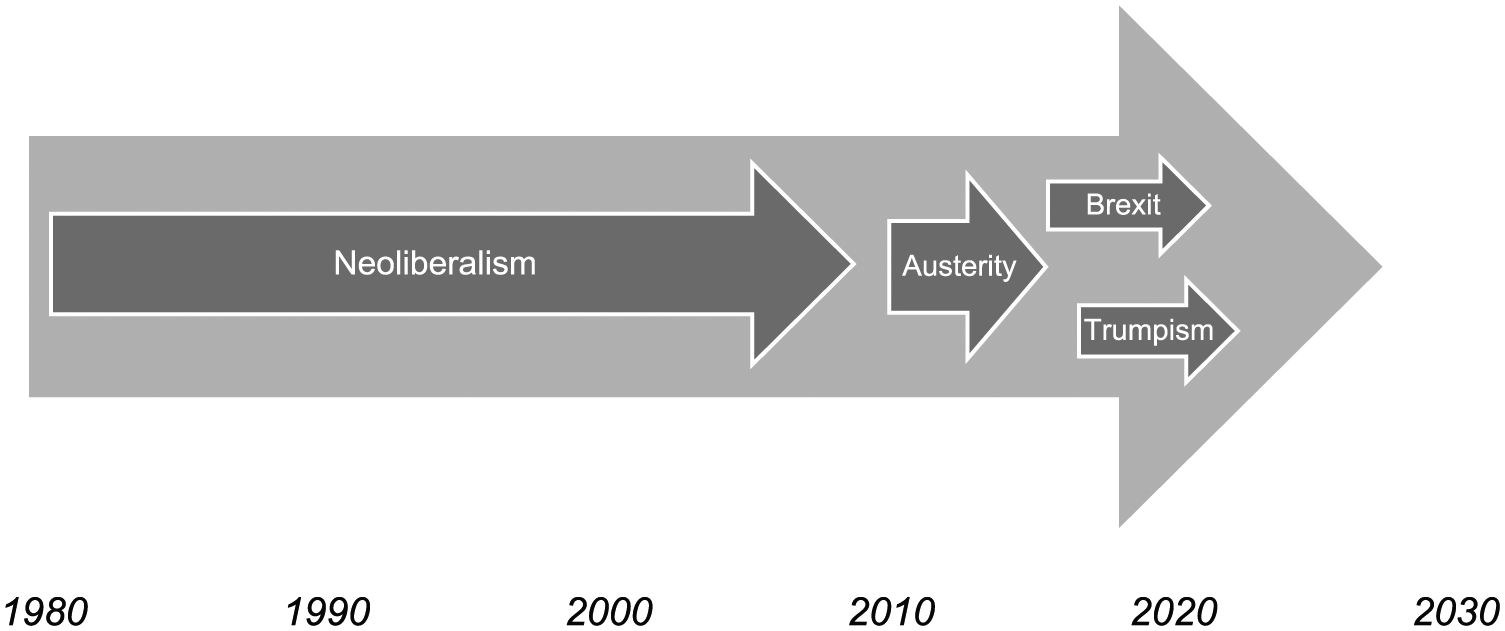
Admittedly, this pictogram most likely overly simplifies the position occupied by the critical consensus. And clearly, in taking steps to demonstrate how critical management scholars are making straw men and women of the Other, I do not wish to make straw men and women of critical management scholars! However, I do not think it is unreasonable to suggest that most of us are, to some degree at least, wedded to the rationale depicted in this diagram. This is the narrative we are sold. This is narrative we readily embrace. This is the narrative we impart to our students.
Interestingly, scholars beyond the field of management and organisation do ascribe a greater deal of complexity to the concept of neoliberalism. At the outset of his 2010 text, Peck (2010), for example, comments that ‘[t]he form of market fundamentalism that we have come to know as neoliberalism has been the work of many hands, a lot of them hidden’ (p. xi). Certainly, the rationale depicted in the diagram betrays what is, in all likelihood, a much more complex situation. It ignores the possibility that there might be – or likely are – myriad reasons for the scenario. It strikes me as rather convenient that in defeat, we liberal-minded academics uncritically assume that the ‘cause’ of Brexit and Trumpism is a phenomenon we have long lambasted, that is, neoliberalism. Why are we ignoring arguments pertaining to belief and identity? Why are we ignoring the fact that the liberal media and critical scholars have for a generation now engaged in what can be described as ethnomasochism? And why are we ignoring the paradoxes of politics and economics? Each of these is examined in turn below.
Faith, belief and identity
The German philosopher, Johan Georg Hamann (1730–1788), was a firm opponent of the Enlightenment. For Thomas (1957: 54) ‘[Hamann’s] contention quite simply is that belief is more important than knowledge or understanding’: Our own existence and the existence of all objects without us must be believed, and can in no other way be made out … What a man [sic] believes, therefore, does not need to be proved, and a proposition may be proved ever so incontrovertibly without on that account being believed. Faith is no operation of the Reason, because faith comes as little through argument as tasting or seeing. (Hamann, cited in Thomas, 1957: 54–55).
In short, Hamann suggests faith underlies reason. In this sense, it is faith and belief – not knowledge – that produce our actions. So caught up in the efficacious elegance of our own knowledge systems (in our case, the critical management consensus), we liberal scholars have ignored the faith and belief systems of the Other. And it is these alternative belief systems that have to a large extent determined the electoral outcomes of 2016.
The role of identity has also been overlooked in our default interpretation of the 2016 events. I usually begin my working day at Costa Coffee in Diss, a small town in the English county of Norfolk. In the run up to Brexit, I discussed voting intentions with my cappuccino comrades. Did any of the ‘leavers’ mention neoliberalism or austerity (or use more familiar synonyms to describe the same)? No. Time and again, I heard the same arguments. ‘I just don’t know what being British means anymore’. ‘I feel like a stranger in my own town’. ‘There has been too much change, too quickly’. This last comment reminded me of Toffler’s (1970) Future Shock. Toffler was no conservative; his ideas better represented, perhaps, as form of radical centralism (Satin, 2004). In Future Shock, he argued that rather than describe change in and of itself in good or bad terms, it is the pace at which change takes place that determines the likelihood of acceptance. Fast-paced change is almost always unsettling; where the pace of change is slower we acclimatise more readily. Compared to that of previous generations, in many respects, the British electorate have endured fast-paced change on unprecedented levels in many aspects of their lives.
Of course, a good part of this change can legitimately be attributed to the neoliberal agenda: for example, the fact that fewer and fewer jobs are secure, permanent and full time. However, the changes my coffee shop companions referred to were not those of shifting organisational geographies, but to the changing demographics of their locale. This is subtlety but significantly different. Why are critical management theorists (including myself) more than happy to take shots at the economic shortcomings associated with neoliberalism, while simultaneously ignoring the lived experiential effects of the fast-changing ethnic and cultural makeup of our social fabric? Nearly 50 years ahead of the events, Toffler’s book anticipated both Brexit and Trump. Why have we liberals been unable to take stock? The short answer: we are ethnomasochistic.
Ethnomasochism
The concept of ethnomasochism warrants rigorous analysis, if only to save it from extremist obscurity. The concept is new, so much so that the Oxford English Dictionary has yet to list it. Indeed, it was only during the revision stages of this article that Wiktionary included a definition: self-loathing on the grounds of one’s own race quotations. Ethnomasochism is just that: our tendency to self-flagellate. The academy has yet to properly engage with the concept. To do so is tricky, not least because it must make an assumption regarding positionality. I am assuming a Western, white, male, heterosexual ‘we’, and this – of course – is problematic. While many of us would acknowledge that critically oriented management conferences, for example, are often ‘whiter’ and less international than their mainstream counterparts, they are not exclusively so. Moreover, postcolonialist literature within our field has of course been produced by ‘non-white’ as well as ‘white’ authors. Finally, there have been some excellent exposés of male critical management scholars who, unwittingly or otherwise, reinforce masculine power structures and privilege (see, for example, Harding et al., 2017). Nonetheless, as part of its self-conscious affirmation of its liberal credentials, this ‘critical white we’ likes to think of itself as firmly aligned with postcolonialist, feminist and LGBTQ causes. It is in this sense, then, that I tentatively speak of ethnomasochism. Notably, for Vine et al. (2018), a reflection on ethnographic anxiety unexpectedly led them to consider the prospective potential of the idea: Are we so anxious to reinforce our progressive credentials that we do so at the expense of our scholarship? Perhaps conscious of anthropology’s colonial legacy, are we as 21st century ethnographers all too keen to damn our own cultures? To date, the concept of ethnomasochism appears to have been addressed only by ultra conservative commentators as a means of chastising what they perceive to be the tendency for liberal-minded Westerners to celebrate cultures distinct from their own while concurrently condemning their own culture. Might ethnography have an opportunity to rescue the concept from these ultra conservative commentators? If so, in what ways? […] And let us not overlook the timeliness of our publication. We are living in the post-Brexit era, and one in which – against all odds – Donald Trump has secured victory in the US presidential election. Has ethnography – like the liberal arts more generally – for too long focussed on those we have chosen to ‘construct’ as victims? (p. 305)
The right-wing media has of course recognised this for some time. The term ‘politically-correct’, for example, often appears on the pages of The Daily Mail, a right-wing British tabloid newspaper. Far be it from me to advocate reading this newspaper; nonetheless, our intellectual snobbery has prevented us from engaging with these accusations and we have paid the price. Multiculturalism and tolerance are the preserve of the economically secure and educationally privileged. Do we economically secure and educationally privileged self-flagellate by way of reinforcing our own progressive credentials as part of some absurd form of one-upmanship? The irony here is that political and ideological allegiance is rarely about conviction; it is about identity. And we are not immune from this.
Paradoxes of politics
Paradoxes of politics manifest themselves in respect of allegiance, identity and the perennial misalignment between public mood and psephological data. These interrelated paradoxes are examined below.
It is easy to conflate both Brexit and Trumpism with the political right wing. Indeed, this is essential if the cause-and-effect interpretation of the events of 2016 is to appear compelling. It is conveniently overlooked that many left wingers voted for Brexit: so many, in fact, that the term ‘Lexiteer’ was coined to describe them. Leader of the British Labour Party, Jeremy Corbyn, was at one point a Eurosceptic. When I presented an early version of this article at the CMS conference in Liverpool, a member of the audience explained that on the morning of the Brexit result, he had taken to social media to vent his frustrations. Interestingly, he commented that one or two of the responses he received from individuals whom he had automatically assumed would have voted against Brexit had done the opposite. Their justification – like that which inspired Corbyn’s original position – was solidarity with working-class Britons. During another of the sessions at the conference (a workshop called ‘Brexit, Populism and Implications for CMS’), an Australian member of the audience commented that she could not quite understand how some British ‘Critterz’ – an affectionate term for critical management scholars – had the ‘audacity’ to vote leave. The panel did not directly address the question, but their responses suggested that they too were surprised at these inclinations. And according to political scientist, Brian Schaffner, many American left wingers voted for Trump too (NPR, 2017: online). These included ex-Bernie Sanders supporters disillusioned with the carefully choreographed presidential showmanship for which US presidential races had become known for. It was not so much the political allegiance that they represented, rather it was that they opposed what had become stale and consensual.
As Einstein noted in respect of paradoxes in physics, the most interesting political contradictions are usually found at the extremes. Andrew Anglin is editor of alt-right online publication, The Daily Stormer, and gained notoriety in the aftermath of Far Right demonstrations in Charlottesville. The demonstrations resulted in the death of anti-Nazi campaigner, Heather Heyer. Responding to her death, Anglin described Heather Heyer in The Daily Stormer, as a ‘fat, childless 32-year-old slut’, and argued that her death would benefit society. Although plainly abhorrent, it is interesting to note that Anglin was originally a Marxist. Only recently had he found solace in the world of Far Right politics. Anglin’s profile illustrates the fickle nature of political allegiance. This sort of observation lends further credence to the argument that politics appears to be more about carving out an identity, and less a reflection of ideological integrity. In this sense, what is important is having a sense of any political allegiance. Conventional discussions of politics tend to reflect what has become known as the political spectrum, typically rendered as a horizontal spectrum (from left to right). But such a rendering ignores the fact that the extremes of Left and Right tend to resemble one another. A more sophisticated approach to ideological difference tends to invoke not a linear spectrum but a horseshoe-shape. Why? Well, the further left an ideology is plotted, the more it tends to resemble those ideologies of the extreme right (and vice versa). The extremes both have totalitarian tendencies. A recent example of just this is the symbiotic relationship observed between Islamic extremism and Far Right activism. Even news outlets (see BBC, 2019) have picked up on this.
Of course, not all of us are as fickle as Anglin. But for those of us who remain committed to a particular political position, the rationale is comparably complex and tainted by contradiction. Commitment (in this case ideological commitment) is mediated through identity. To illustrate this, Salancik (1977: 37–38) reflects on research by Kiesler et al., in which some residents of New Haven, Connecticut, were given an opportunity to sign a petition, while others were not. A day later, half of each of these groups was delivered with a broadside attacking the position taken in the petition. On the third day, attitudes were measured and the individuals were asked to volunteer to do work for organisations supporting the petitioned position. The attitudes of residents committed by signing a petition were more favourable than those of residents not given an opportunity to sign the petition. Moreover, the petition signers who were sent the attack volunteered three and a half times as often as all other residents (42 vs 12%). What is especially noteworthy about this study is that with so little effort (an innocuous petition on one day, a counter-argument slipped under the door the next), one can turn quiet New Haveners into ready activists. Interpreting this data, Salancik suggests that … the attack acts to remind individuals of their previous behavior and the implications of that behavior in light of present circumstances, presenting them with a challenging test of their newly committed position. When the attack comes, the new information is assimilated into the previous position and the person becomes even more bound to the position because he actively rejects some aspect of the alternative. (ibid. p. 38)
This is vital if we are to realise a more nuanced understanding of political conviction. Political conviction, it seems, is not a reflection or vindication of free will. There is no ‘essence’ to it; perhaps this helps us understand why it is that paradoxes arise so easily.
And what of identity politics? In The Disuniting of America, Schlesinger (1998) argues that minority groups such as, for example, LGBTQ, paradoxically further marginalise minorities from forming part of an integrated community. And identity politics becomes even more complex when we consider the concept of choice. Over the past few years, I have delivered guest lectures at various universities in Indonesia. While at Ciputra University in Surabaya, one of the lecturers explained to me that trying to encourage many Indonesians to accept LGBTQ lifestyles was extremely challenging because heteronormative traditions of marriage and procreation are seen as a responsibility to the community. In the West, of course, starting a family is typically regarded as a choice. Indeed, both heteronormal and LGBTQ lifestyles are to some degree enabled by the articulation of ‘free market choice’ in the West. This is interesting because while most CMS scholars will fervently defend LGBTQ causes, they might also be expected to express concern at the realisation that free market mentalities are encroaching ever further into social domains.
Finally, the paradox of politics manifests itself in the perennial misalignment between the public mood and psephological data. Psephology, the statistical study of electoral behaviour, is a niche field, but yields some intriguing data in respect of human behaviour. As Stent (1978) implies, the left and right characterization of politics is self-sustaining because the existence of a left-wing society creates a backlash towards the right, and then back again (and vice versa). This sentiment is echoed by Bartle (2015), who reports that public opinion tends to be the polar opposite of the elected government. The two political positions should thus be distinguished not ideologically, but temporally. In what echoes early social theory (especially that associated with Pareto), Stent subscribes to a cyclical understanding of political conviction, a sort of neo social cycle theory. Commenting in respect of British politics, Bartle explains how the political centre invariably moves against the government of the day. He suggests that from 1964, the average left-right position generally tracked rightwards until 1980, the year after Margaret Thatcher came to power. Public attitudes then gradually moved left during the 1980s and remained there for the duration of the Major premiership. The mood shifted rightwards from 1997 under New Labour and left under the Coalition. In this way, he argues that those governments that achieve their parties ‘preferred policies, in effect, initiate their own downfall’. Voting behaviour is notoriously difficult to predict. Why? Because it does not conform to straightforward cause-and-effect linear thinking. It is representative of a nonlinear system. Indeed, for Bartle, despite efficacious intentions, when interpreted retrospectively, we often appear to vote against our own interests. And this is by no means peculiar to British politics. The pattern is pervasive, perhaps none more so than in American politics and – in particular – in respect of Trump’s presidency. Ultimately, politics eludes rationality. Indeed, and as Graeber (2016) reminds us: ‘who claims to base their politics on rationality – and this is true on the left as well as on the right – is claiming that anyone who disagrees with them might as well be insane’ (p. 38).
So, to what degree has the CMS field acknowledged any of this? Encouragingly, Parker and Parker (2018) have drawn upon the work of Chantal Mouffe in presenting the concept of agonism as an alternative to the default – antagonistic – approach typically embraced by most critical management scholars. This is something that calls for reconceptualising the political Other as a legitimate position, rather than something to be damned: ‘For Mouffe, conflict will not disappear either because it can be managed away or because struggle will eventually produce a world without contradictions’ (Parker and Parker, 2017: 1376). Herein lies the key to my own position. The political left and political right are not hugely dissimilar, despite their ideological differences. However – and perhaps conscious that they do not wish to be accused of accommodating mainstream management – the tone of Parker and Parker’s paper implies that they retain a broadly leftist position. Personally, I believe we should make a greater effort to avoid this. In making this claim, I am not compromising my critical credentials; on the contrary, I am resisting ideological closure. Encouragingly, Parker and Parker do hint at this when they say, ‘So, if we begin with this fluid ontology of the political it becomes impossible to articulate some particular group or practice as being unambiguously and timelessly “good” or “bad”’ (Parker and Parker, 2018: 1377). Of course, it would be erroneous to confuse moral contingency with moral relativism but – and as Bristow and Robinson (2018) note – CMS should not assume, unreflexively, that it occupies the moral high ground. In all probably, it does not.
Paradoxes of economics
There are two areas of complexity in the field of economics that warrant comment. First, an intergenerational paradox. Second, a broader concern that economic metrics continue to preoccupy each of us, irrespective of ideology. Both render economics much more complex than the default cause-and-effect logic implies. For Morris and Salamone (2011), for example, a paradox of prosperity is revealed as we monitor levels of economic advancement between generations. If one generation is characterised by hard work, that very generation will produce its opposite in the generation that follows. A diligent generation tends to yield a licentious one since the progeny who are the very beneficiaries of the prosperity ‘develop a diminished capacity to produce wealth’ (Morris and Salamone, 2011: 54). ‘[W]e live with a constant, unrelenting paradox: the more prosperous we become, the more susceptible we are to abandoning the very values, principles and conduct that created the prosperity in the first place’ (Morris and Salamone, 2011: 51).
Of the tendency to prioritise economic metrics irrespective of ideological position, Wachtel (1989) makes the following observations: There do seem to be a number of features of contemporary capitalism that are particularly closely linked with the problems addressed here – for example, the preponderant emphasis on the profit motive; the deliberate generation of needs; the apparent requirement of growth to keep the system running at all well; the encouragement of greed and the rationalizations about self-reliance that discourage mutual aid … But a change in who owns the means of production without a concomitant change in values and consciousness – is clearly not a panacea … As Philip Rieff has put it, ‘Both [Left and Right] are essentially variants of the same belief in wealth as the functional equivalent of a high civilization’ … The answer to all questions of ‘what for’ is ‘more’. (p. 146)
In the preamble to his book, Wachtel says ‘So long as we persist in defining well-being predominantly in economic terms and in relying on economic considerations to provide us with our primary frame of reference for personal and social policy decision, we will remain unsatisfied’. Electors voting for Brexit believed that doing so would improve their economic position. Electors voting for Trump believed that doing so would improve their economic position. But so too did those who voted with the opposition. Our discourses are saturated by an over-arching concerns for economics. And, notably, both Left and Right reinforce this preoccupation with economics. Consciously or otherwise, those on the right and those on the left continue to regard economics as the primary metric of happiness. So what is the solution? Well, interestingly, Wachtel (a liberal) quotes Friedman (a conservative) and in so doing reaches across the left-right divide. He stresses, ‘the importance of the intellectual climate of opinion, which determines the unthinking preconceptions of most people and their leaders, their conditioned reflexes to one course of action or another’ (Wachtel, 1989: 145). Part of the reason both Brexit and Trump’s victory are so difficult to stomach is that the results fly in the face of both expectation and the intellectual climate of opinion. Although there were question marks in respect of the effectiveness of its marketing, the Remain campaign conveyed logical, robust arguments for remaining part of the European Union (EU). Indeed, by almost every economic metric you care to consider, it was a convincing position. But it failed because this was not a vote contested on the basis of rationality, but a vote contested on the basis of emotion. Once again, the problem here is in applying linear logic to nonlinear systems. Voting behaviour is notoriously complex and, by implication, difficult to anticipate.
Discussion
Looking ahead, CMS scholars must re-examine what it means to be critical. In so doing, we must (1) dislodge ourselves from ideological closure; (2) move away from overly simplistic cause-and-effect thinking; (3) actively engage across disciplinary boundaries; and (4) breathe new life into truly ethnographic endeavours.
Distancing ourselves from ideological closure
We can take steps to actively distance ourselves from our ideological proclivities. We are all too eager to critique what we perceive to be the libertarian consensus, but all too often ignore completely the critical consensus. Both are ideologically entrenched. An acknowledgement of, and analytical sensitivity to, paradox is imperative here: By recourse to synonym, then, paradox refers to a manifestation of contradiction or conflict. [However,] I would like to deemphasise these aspects, not to deny their relevance but to reconstruct paradox as something with unique pedagogical potential. Put simply, in assuming an ideological position (either consciously or implicitly), we automatically open ourselves up to unintentionally lending support to the opposite position. In this sense, we are better off taking steps to distance ourselves from ideology, and incorporating this as part of our methodological framing. There is, perhaps, a lesson here: where we seek to occupy a particular ontological and epistemological position, perhaps we ought to convey to the reader the preventative steps we are taking to ensure such a framing doesn’t descend into ideological conviction. (Vine, 2018: 276)
We can establish dialogues with those we detest. We must not ignore them, whether they are white supremacists, Islamic Fundamentalists, Burke, Hayek or – heaven forbid – mainstream management academics. We must be resolute in our determination to intuit scholarly balance. And I do not simply mean balance between left and right, good and bad. The world is clearly far more complex than these binaries would suggest. I am referring instead to a fresh ontology in which scholars write from multiple ideological positions obliging themselves to engage with the Other. We must marshal a greater sensitivity to nuance, complexity and – in my mind – paradox, not to solve, resolve or dissolve paradoxes, but to celebrate them as an immanent part of our existence, without which our lived experience would be reducible to a predetermined calculus.
For Bristow and Robinson (2018), scholars who lay claim to a genuinely critical inclination must position themselves such that they are ‘always directing critique against the dominant vectors of power’ (p. 9). Until such time as this is achieved, we will remain doggedly subservient to the political left. If we can successfully move away from the trappings of critical ideologies, a new radical potential is revealed. Critical management scholarship has done little more than chew the fat. Candidly, it has not really made much progress in recent years. We can make a difference. A sensitivity to nuance, complexity and paradox has the potential to help us better understand agency, for example. Our understanding of agency has hitherto been framed by our attempts to plot it between binary opposites, that is, voluntarism and determinism. However, while a hypothetical world without paradox could feasibly be inhabited by non-conscious life in which straightforward cause-and-effect reflexes maintain existential bearing, a world characterised by paradox requires us to maintain contradictory positions and beliefs; it necessitates ongoing ontological re-adjustment and an ability to maintain some semblance of balance. And these, it would seem, are only possible by recourse to conscious agency. Agency is just one example of the sorts of big questions scholars of organisation might begin to examine from fresh vantage points if they actively resist ideological closure, and focus instead on seeking out the nuance.
Moving away from cause-and-effect thinking
For Battista (1982: 150), the future of physics lay in interdependent, parallel and simultaneous processing of information, rather than in linear cause-and-effect thinking. Once we take that leap of faith and move away from linear cause-and-effect, suddenly we see the analytical potential to paradox. For Sorensen (2003) ‘… traditional paradoxes … are normally cited in attacks against established beliefs’ (p. 163–64). And, furthermore, ‘Devout philosophers used paradoxes as foci in their meditations, just as philosophy teachers use paradoxes to stimulate class discussion’ (Sorensen, 2003: 168). So, the potential for paradox in our field is twofold. First, paradox is a useful tool in critical thinking especially if we are to reassert the critical cause that Bristow and Robinson describe: attacking established beliefs (including of course the critical consensus). Second, there is clearly untapped pedagogical potential for paradox in the classroom. Philosophers have recognised this. Perhaps it is time that we do too. Sorensen recounts a pertinent anecdote about philosopher Bertrand Russell: While at Cambridge University, noted mathematician and, later, philosopher Bertrand Russell believed ‘the vast majority of [Cambridge] mathematicians seemed narrow and uncultured. Students crammed to pass the Tripos examination, a marathon of tricky mathematics. To make a respectable showing, you had to train intensively. So teachers and students focused on competitive, time-sensitive problem-solving. This shallow regime did not encourage ruminations on the philosophical difficulties posed by infinitesimals, continua, and infinity. But when Russell encountered mathematicians in France, Germany, and Italy, he no longer pictured the whole profession as hurriedly sweeping its contradictions under a rug’. (Sorenson 2003: 318).
In my mind, CMS scholars are guilty of the same. In the overriding interests of both ideological and intellectual elegance, we have for too long swept our contradictions and ‘inconvenient truths’ under the rug. Encouragingly, there is evidence that things are beginning to change as the wider field of management and organisation shows signs of engaging meaningfully with the concept of paradox (see, for example, Smith et al., 2017).
Branching out across disciplinary boundaries
We are living in a period in which specialisms are tainted. Indeed, this is something the BBC pondered earlier this year: http://www.bbc.co.uk/news/magazine-40865986. Unable to quote an economist who would back Brexit in the run up to the election, Lord Chancellor, Michael Gove (who supported British withdrawal from the EU), famously said, ‘people in this country have had enough of experts’. A shrewd response? Perhaps. Notably, the most successful CMS scholars are, essentially, specialists and they typically restrict their critical faculties to business and organisational concerns, rather than actually critiquing the practice of CMS itself. But is it wise to reinforce a pedagogical culture which encourages ever greater specialisation? I have actively sought to reach across disciplinary boundaries in this article, and I am doing this elsewhere too. One reservation I regularly hear from other scholars about doing likewise is time and workload: ‘how can I possibly be expected to familiarise myself with other academic disciplines? I’m exhausted enough!’ One potential solution is for the academy to evolve to lessen the expectations for all scholars to produce empirical data. We need organisational scholars dedicated to thinking big, in pursuit of polymathic objectives. In physics, there is a traditional division of labour between experimental and theoretical professionals. It seems unlikely that the staggering insights generated in the field of physics over the course of the 20th century would have been possible had all physicists been required to work empirically. Is there potential to do the same in respect of the study of organisation? Organisation theorists, on one hand, and organisation empiricists on the other? Arguably, the expectation that all academics in our field must engage empirically is limiting our conceptual reach and rendering us short sighted. At best, we end up retro-fitting data to meet both ideological agendas and editorial expectations. A true departure from empirics may enable those who do wish to think more broadly to do so without being castigated. Empiricists will then be free to ‘test’ their theories, much as experimental physicists do with the work of theoretical physicists. This special paper series is, in my mind, a step forward in this respect.
The potential for ethnography
We are probably some way off delineating organisation studies between theorists on one hand and empiricists on the other. And – let’s face it – theoretical physicists have a persuasive and beguiling medium through which they work: mathematics. Their numerical talent constitutes a convincing case for being left alone to pursue fresh and – potentially groundbreaking – avenues of enquiry. Advanced mathematics is not terrifically helpful to organisation theorists. However, there is an alternative. Notwithstanding the reservations cited earlier in respect of the tendency for ethnographers to focus on a relatively small slice of the demographic potential, the method itself holds extraordinary possibilities. Once we accept the limitations of cause-and-effect, the true extent of the potential for ethnographic methods may well be realised. It is hoped that this brief paper (which might tentatively be described as polemical auto/ethnography) has persuaded you that over-reliance on linear logic and conventional methods is misplaced: recall the fact that those who had financially benefitted most from the EU were those most likely to have voted to leave the EU. It does not make ‘sense’. Perceptions are paradoxically more important and more ‘real’ than reality. For Nietzsche (1989 [1887]) ‘Strictly speaking, there is no such thing as science without any presuppositions’ (p. 151). Rather, there is only a perspective seeing; only a perspective knowing; and the more affects we allow to speak about one thing, the more eyes, different eyes, we can use to observe one thing, the more complete will our ‘concept’ of this thing, our ‘objectivity’, be. (Nietzsche, 1989 [1887]: 119)
Ethnographers are best placed to be the myriad eyes Nietzsche describes, each – in turn – contributing by way of a unique perspective to the collective ethnographic record. In this way, truths can legitimately and productively be described as something subjective, something emotional (Bochner and Ellis 2016: 85). This is not to suggest that ‘subjective truth’ is right while ‘objective truth’ is wrong; more accurately, subjective truths can both challenge and enhance objective truth. Ethnographers can articulate – polemically, where appropriate – a cacophony of alternative voices representing all demographics; not just those we have chosen to construct as victims. In so doing, ethnographers might lay legitimate claim to an effective form of truth-seeking.
Concluding thoughts: from critical to polemical?
Perhaps we should dispense with the word critical. It seems to have lost its potency. On one hand, all scholars are expected to be critical; all students are expected to be critical. On the other, critical theory (particularly where mediated through the field of CMS) has become a one-stop shop for all things leftist. This is unhelpful, especially in times such as this. Is there an alternative? I was always attracted to both critical theory and CMS because they refused to yield to the status quo. Was I naïve? Was CMS just left wing? Either way, CMS is itself now the status quo and seems hell-bent on exhausting its intellectual resources reaffirming and defending its position, rather than evolving to meet new power nexuses. So is there an alternative to critical? Kierkegaardian scholar, Frithiof Brandt, has commented on the word ‘polemical’ thus, To be polemical does not only mean L’esprit de contradiction, to protest intellectually, … the word has a darker meaning and implies a nihilistic point of view, a personal nihilism, if you will. A man [sic] who is completely polemical has a negative relation to, or is in opposition to, the established forms of life … (Cited in Thomas, 1957: 7).
As a guiding principle, polemical may well prove to be preferable to critical. It certainly presents less in the way of ideological baggage. Through polemic, we are free to protest intellectually in the face of the dominant vectors of power, irrespective of their political progeny. The liberal consensus has become the dominant vector of power in politics. The critical consensus has become the established intellectual position in the academy. My suspicion is that the ideological proclivities of the CMS scholar prominent in the 1990s and 2000s have had their time. It is time to take stock, to move on. The enemy is us.
