




Abstract
While scholars have examined how micro-textual argumentative strategies are used to (de)legitimize contested corporate practices, less attention has been given to the role of ideologies or broader belief systems, underlying discursive (de)legitimation. Analyzing newspaper articles published after the announcement of two highly debated corporate restructurings in Belgium during the Great Recession, we identify the ideologies underlying (de)legitimizing statements and examine the discursive strategies through which social actors reproduce elements of these ideologies in legitimacy struggles. We show how the ideologies of ‘neoliberal capitalism’ and ‘humanistic capitalism’ shape framings of the restructurings, identity constructions of actors involved and propositions for government measures to prevent future restructurings from happening. Apart from predictable patterns of reproduction, we discern four creative reproduction strategies: ‘refutation of elements of ideological representations’, ‘appropriation of key vocabularies’, ‘hybridization of ideological representations’, and ‘ideological pioneering’. Our study contributes by (1) providing novel insights into how ideologies function as discursive resources for (de)legitimation of contested corporate undertakings, (2) reconsidering the political nature of (de)legitimizing statements, and (3) reflecting on the (im)possibility of resistance against globalization-driven restructurings in multinational corporations and the neoliberal ideological project in general.
Keywords
Introduction
Legitimacy—a sense of ‘social acceptability bestowed upon a set of activities or actors’ (Washington and Zajac, 2005: 284)—currently attracts considerable research attention within the field of management and organization studies (MOS) (Suddaby et al., 2017). At a time of growing interest in sustainability and corporate social responsibility, much of this scholarly attention is driven by inquiries into the social construction of (il)legitimacy for controversial business activities such as mergers and acquisitions (Vaara et al., 2006; Vaara and Monin, 2010), investments with negative environmental effects (Joutsenvirta & Vaara, 2009, 2015; Livesey, 2001, 2002), and restructurings involving layoffs (Erkama and Vaara, 2010; Hosfeld, 2018; Vaara and Tienari, 2008; Vuontisjärvi, 2013). Emphasizing the discursive nature of (de)legitimation, these studies have significantly enhanced our understanding of how social actors employ particular argumentative and micro-textual rhetorical strategies to (de)legitimize a contested activity.
Surprisingly, this rich and fast-growing body of research has not yet taken the role of ideologies or broader belief systems in (de)legitimation processes into full consideration (cf. Meyer et al., 2009; Zhu and McKenna, 2012)—although legitimation is one of the main social functions of ideologies (Chiapello, 2003; Eagleton, 1991; Van Dijk, 1998). Rather, studies restrict their consideration of ideology to merely acknowledging that (de)legitimizing statements are never neutral in terms of ideological content (Joutsenvirta, 2013; Vaara et al., 2006). They hereby overlook how social actors can employ ideologies as discursive resources or as Van Dijk (1998: 257) claims, how ideology can be an ‘instrument’ to justify or challenge the social position of a group or actor.
The aim of our study is thus to advance our understanding of discursive (de)legitimation by attending to the role of ideologies. Following Van Dijk (2006), this study understands ‘ideologies’—a heavily contested concept throughout the social sciences—as foundational or axiomatic belief systems that organize and control the discourses (i.e. communicative acts, either written or spoken) and other social practices of the members of various kinds of social groups with related goals and interests. Our overall research question of how processes of (de)legitimation are related to ideologies is important for two reasons. First, ideologies are a crucial discursive resource for social actors. As a ‘sociopolitical act’ (Rojo and Van Dijk, 1997: 528), (de)legitimation is discursively realized through not only the use of argumentative schemes and micro-textual strategies of persuasion but also collective belief systems such as ideologies. Without analyzing the ways in which ideologies are reproduced in (de)legitimizing statements, we cannot fully understand the discursive realization of business practices’ (il)legitimacy. Second, ideology is a crucial concept to grasp the political nature of discursive (de)legitimation. The notion ‘political’ refers here to the mobilization of material and symbolic resources to influence authoritative decision-making in accordance with social actors’ perceived interests and values (Stryker, 2000). Without analyzing the inherent ideological nature of (de)legitimizing statements, we cannot fully understand how social actors enhance broader sociopolitical projects of domination, resistance, and emancipation when (de)legitimizing corporate actions (cf. Van Dijk, 2006).
The empirical context of our study is corporate restructuring involving mass layoffs. Restructuring has become an institutionalized management practice to increase shareholder value (Hirsch and De Soucey, 2006; Jung and Mun, 2017), yet is also very controversial (Erkama and Vaara, 2010) because of its negative impact on individual lives, local communities and national economies, and expected decreases in employee commitment and job satisfaction (Aalbers et al., 2014; Lee and Teo, 2005; Probst, 2003). In particular, we examine the restructurings of two Belgian production facilities during the ‘Great Recession’: the automobile factory of Ford in Genk and the steel plant of ArcelorMittal in Liège. Both restructurings stirred intense public debate and our empirical analysis draws on the extensive media coverage of these two restructurings in three leading Belgian quality newspapers, as mass media are considered a principal arena of legitimacy struggles in wider society (Bitektine and Haack, 2015; Fairclough, 1995). Following our research interest in ideology, the analysis is guided by the following questions: (1) How do ideologies function as discursive resources to (de)legitimize the restructurings? (2) How do social actors reproduce or challenge these ideologies when (de)legitimizing?
Our study contributes to the organizational literature on discursive (de)legitimation of contested corporate practices by (1) providing novel insights into how ideologies function as discursive resources for (de)legitimation of contested corporate undertakings, (2) reconsidering the political nature of (de)legitimizing statements, and (3) reflecting on the (im)possibility of resistance against globalization-driven restructurings in multinational corporations (MNCs), and the neoliberal ideological project in general.
Theoretical background
The micro-textual focus within discursive (de)legitimation research
Our main argument is that studies of discursive (de)legitimation of contested corporate practices have undertheorized ideologies as discursive resources in (de)legitimation processes. Although acknowledging the importance of ideology (cf. Vaara et al., 2006; Zhu and McKenna, 2012), they tend to primarily highlight the role of argumentation patterns and micro-textual persuasive strategies. In particular, we observe that Van Leeuwen and colleagues’ ‘grammar of legitimation’ (Van Leeuwen, 2007; Van Leeuwen and Wodak, 1999) and various rhetorical frameworks (e.g. Aristotle, 1954; Perelman and Olbrechts-Tyteca, 1969) have been the most popular theoretical resources—also Boltanski and Thévenot’s (2006) theory of justification begins to gain some traction (e.g. Gond et al., 2016; Nyberg et al., 2017; Patriotta et al., 2011).
The work of Vaara and his colleagues is exemplary in building on Van Leeuwen’s grammar of legitimation and rhetorical frameworks. For example, in their in-depth analysis of the shutdown of a Finnish marine engine factory, Vaara and Tienari (2008) illustrated the importance and functioning of Van Leeuwen’s four argumentation schemes (authorization, rationalization, moralization, and mythopoesis). Similarly, Erkama and Vaara (2010) analyzed the legitimacy struggle over the shutdown of a Finnish manufacturing unit of the Sweden-based Volvo Bus Corporation. They relied on persuasive strategies derived from classical Aristotelian rhetoric (Aristotle, 1954) and Suddaby and Greenwood’s (2005) seminal study of rhetorical legitimation, to highlight the importance of five argumentation patterns: dynamics of logos, dynamics of pathos, dynamics of ethos, autopoietic narratives, and cosmological arguments.
The prominent place of Van Leeuwen and colleagues’ ‘grammar of legitimation’ and rhetorical theory has the significant implication that corporate (de)legitimation research is almost exclusively focused on the use of (micro-)textual strategies of persuasion. The possibility that (de)legitimizing statements and argumentation patterns are linked with and reproduce ideologies is only rather briefly acknowledged (e.g. Joutsenvirta, 2013; Joutsenvirta & Vaara, 2009, 2015; Nyberg et al., 2017; Vaara et al., 2006; Vaara and Tienari, 2008; Zhu and McKenna, 2012). For example, Vaara and Tienari (2008) mention the prominence of a ‘neoliberal’ or ‘global capitalist’ ideology underlying discursive legitimation of MNCs, hereby assuming that this ideology ‘rationalizes’ certain contested MNCs’ corporate practices. Similarly, they mention nationalistic, Marxist, or radical humanist ideologies that are assumed to play a role in the delegitimation of MNCs.
Yet, an in-depth analysis of how ideologies may function as discursive resources is missing. Furthermore, the notion of ideology remains undertheorized. Ideology is sometimes used interchangeably with discourse (Vaara and Tienari, 2008) or the term ‘metadiscourses’ is used to refer to underlying collective meaning systems that ‘are generally approved or promoted in society’ (Vaara and Monin, 2010: 6). Thus, while discursive legitimation scholars appear to be aware of the ideological nature of (de)legitimizing statements, they remain largely silent about how they understand the contested concept of ideology, with its many definitions. Furthermore, they do not examine how ideologies are used and reproduced by social actors to (de)legitimize corporate practices. In this study, we aim to address the role of ideology and articulate in the following section the ways in which ideology is understood within the tradition of critical discourse analysis (CDA), especially focusing on Van Dijk’s (1998, 2006, 2013) conceptualization of ideology which guides our empirical analysis.
Ideology in post-structuralist discourse analysis and CDA
In his review of ideological analysis throughout the social sciences, Maynard (2013) claims that studying ideologies can be ‘disorienting’ (p. 299). Not only are ideologies studied in various academic communities that are fairly isolated and largely unaware of each other, the concept is also generally considered ‘elusive’ and ‘confusing’ (Chiapello, 2003; Eagleton, 1991; Heywood, 2017; Maynard, 2013). Because of the proliferation of so many distinct and sometimes even contradictory interpretations of ideology, a prominent organizational discourse scholar characterized the term as ‘theoretically slippery and rather intractable’ (Mumby, 2004: 241). Therefore, it comes as no surprise that the concept is not so frequently evoked in MOS (Alvesson and Kärreman, 2016; Maclean et al., 2014), although recently published studies may indicate a revival (e.g. Gupta et al., 2019; Kwon and Constantinides, 2018; Maclean et al., 2018). In particular, in a recently published special issue on ideology in Journal of Business Ethics, it is advocated that the so-called ‘Great Recession’ reveals the insufficient scholarly attention to the role of ideologies in the design of socio-economic policies, markets and corporate decisions, and in how MNCs understand and conduct business (Haase and Raufflet, 2017).
Several scholars have noticed that the use of ‘opposition’ (like ‘Marxist’ vs ‘culturalist’) runs all the way through the many different conceptualizations of ideology (Alvesson and Kärreman, 2016; Chiapello, 2003; Purvis and Hunt, 1993). Based on the Marxist interpretation, ideology is often pejoratively used to refer to the notion of ‘false consciousness’, that is, a distorted representation of reality or a set of false beliefs that disguise the existing power relations in society and naturalize the privileges of the elites. Almost diametrically opposed to this traditional Marxist conceptualization, anthropologists have presented a broader, more positive and much less polemical ‘culturalist’ understanding of ideology as a set of social representations shared by a large number of people within a given group or a socially shared system of ideas and values. Whereas the classical Marxist conceptualization emphasizes distortion and manipulation, the culturalist conceptualization mainly stresses group integration and identity preservation (Chiapello, 2003).
Conceptualizations of ideology also differ significantly between distinct discursive approaches, which are the most prominent types of empirical ideological analysis within the social sciences nowadays (Maynard, 2013). A first approach can be found in post-structuralist (also called post-Marxist or Laclauian) discourse theory. Here, the conceptualization of ideology is ‘practically empty’ (Jørgensen and Phillips, 2002: 18) since it abandons and opposes the classical Marxist conceptualization of ideology as a form of false consciousness (Howarth, 1995; Laclau, 1996, 2006). Inspired by the central post-structuralist claims that the meaning of every concept is open-ended and contestable, and that discourses constantly strive to fix meaning by placing each concept in a specific relation to several other concepts, ‘ideology’ refers to the discursive attempts of political projects to establish a total closure or stop of the fluctuations in the meaning of particular concepts (Howarth, 1995, 2000; Jørgensen and Phillips, 2002; Sutherland, 2005). The deconstruction or exposure of such attempts to hide alternative meanings and naturalize certain aspects of social reality is one of the central aims of post-structuralist discourse analysis. In that sense, it can be considered as a somewhat unconventional form of ideology critique (Howarth, 1995, 2000).
A second approach can be found within the tradition of CDA, which mainly builds on the writings of Norman Fairclough, Theo van Leeuwen, Ruth Wodak, and Teun van Dijk (Maynard, 2013; Montesano Montessori et al., 2012). Here, conceptualizations of ideology rely much more on classical Marxist and culturalist understandings and some of the most prominent CDA-scholars even consider it a significant concept for discourse theories (Fairclough, 1992; Van Dijk, 1998; Wodak and Meyer, 2016). Especially Fairclough and Van Dijk have dealt extensively with how discursive utterances and texts may be ideologically invested. In this study, we rely on Van Dijk’s conceptualization because of its more elaborated understanding compared to Fairclough’s interpretation, which we discuss first.
Inspired by a Marxist intellectual fascination, Fairclough (2010) considers ideology as a theoretical category that is especially useful to study capitalist societies characterized by class conflict, relations of domination and hegemonic struggle. He defines ideologies as ‘representations of aspects of the world which can be shown to contribute to establishing, maintaining and changing social relations of power, domination and exploitation’ (Fairclough, 2003; 9). Discursive practices are then seen as ideological in so far as they sustain or undermine relations of power in society (Fairclough, 2010). As Fairclough acknowledges and emphasizes himself, his conception of ideology focuses on the social effects of ideologies (i.e. reproducing or challenging relations of domination), but provides no further guidance on how one should understand his description of ideologies as ‘representations of aspects of the world’ (Fairclough, 2003: 9), or ‘constructions of reality’ (Fairclough, 1992: 87), which we more clearly see in Van Dijk’s conception.
Van Dijk’s conception of ideology can be considered as some kind of compromise between the descriptive and critical views of ideology. His definition primarily emphasizes the socio-cognitive nature of ideologies as belief systems of social groups, but also focuses on their social effects and their influence on relations of power in society. In various writings, Van Dijk (2006) describes ideologies as ‘foundational beliefs that underlie the shared social representations of specific kinds of social groups’, largely ‘acquired, expressed, enacted and reproduced by discourse’ (pp. 120 and 124). As general systems of basic ideas shared by a social group, they influence group members’ interpretation of social events and control or shape their discourses and other social practices.
Furthermore, Van Dijk makes a distinction between social groups (sharing ideological beliefs, although not all members identify with the ideology to the same extent) and cultural communities (sharing non-ideological beliefs). Social groups have ideological beliefs, that is, beliefs about which there are differences of opinion in society and which are related to their goals and material interests in relation to other social groups. In contrast, cultural communities share general or non-ideological beliefs such as knowledge, norms, and values which are uncontested and largely taken for granted in society (Van Dijk, 2013). This strong emphasis on the link between ideologies, the conflicting interests of social groups, and social struggles is a remarkable similarity with critical conceptualizations of ideology inspired by Marxism. Similar to Fairclough, Van Dijk (2006) associates ideologies not only with the legitimization of particular systems of domination but also with the articulation of resistance and opposition against oppressive social structures.
One of the most crucial aspects of Van Dijk’s conceptualization is that individuals as members of social groups largely acquire, express, and reproduce ideologies by means of discourse, that is, through text and talk, and that a ‘discourse analytical approach is crucial to understand the ways ideologies emerge, spread and are used by social groups’ (Van Dijk, 2013: 176). Conceptually, however, he does not fully reduce ideologies and their study to discourses and discourse analysis—as certain scholars in the field of discursive psychology have done (e.g. Edwards and Potter, 1992). As socially shared belief systems, ideological projects of dominance or resistance are primarily formulated through text and talk, but also expressed by non-verbal semiotic codes, practices, and social interactions (Van Dijk, 1998). Furthermore, Van Dijk (2006) does not always consider discursive utterances as completely ideologically transparent, since people may not always express their ideological beliefs in situations in which the dissimulation or suspension of explicit ideological statements may benefit them (e.g. in bargaining situations or by using ‘politically correct’ discourse).
Although Van Dijk’s (1998) conceptualization of ideology attempts to offer a ‘comprehensive framework for detailed theoretical and empirical studies of ideology’ (p. 318), weaknesses remain—as he himself repeatedly acknowledges (Van Dijk, 1998, 2006, 2013). He primarily mentions a paucity of knowledge on the exact contents/structure of ideologies (i.e. What are the building blocks of ideologies? Which group beliefs are really foundational or axiomatic and which are more derivative or non-foundational?) and the social basis of ideologies (i.e. What kinds of social groups or collectivities share an ideology? Is this limited to classes, social movements, and/or professional groups, or not? Who belongs to a certain ideological group and why? To what extent does one need to identify with the fundamental beliefs of the group to be considered as a group member?) and how social groups employ ideologies in important domains such as politics and the mass media. Yet, despite these unresolved issues, his conceptualization addressing both the nature and the social effects of ideologies is—to our knowledge—the most elaborated theoretical starting point in the tradition of CDA to examine empirically how ideologies may function as an important discursive resource for social actors.
Methodology
The restructurings of Ford Genk and ArcelorMittal Liège
To study the importance of ideologies in discursive legitimation processes, we analyzed the heated public debates that were stirred during the Great Recession in Belgium by the shutdown of the Ford automobile plant in Genk (announced in October 2012) and flared up again with the downsizing of the production facilities of steel giant ArcelorMittal in Liège (announced in January 2013).
Ford Motor Company, an American multinational carmaker, announced to close its automobile plant in the city of Genk (Genk Body & Assembly, commonly known as ‘Ford Genk’) on 24 October 2012—by coincidence the 50th anniversary of the laying of the foundation stone of the plant—and to move the production of the car types manufactured in Genk to Valencia (Spain). While employment at Ford Genk—once the largest automobile factory in Europe—had already significantly decreased from 14,000 workers in 1993 to approximately 4800 workers in 2012, the factory was still the largest employer in the region at the time of the shutdown announcement. Approximately 5969 people lost their jobs either at the factory itself or at one of the factory’s suppliers. The closure was part of a larger restructuring program for Ford Europe, which also included the downsizing of the production facilities in Southampton and Dagenham (UK) involving another 1400 layoffs. Despite an earlier large-scale restructuring of Ford Genk in October 2003, when the production of the cargo van ‘Transit’ was moved from Belgium to Turkey and 3000 workers were dismissed, the shutdown came as a surprise, since the MNC had an agreement with the labor unions to continue production in Genk at least until 2020. The last vehicles produced at Ford Genk rolled off the assembly line on 18 December 2014.
ArcelorMittal, the world’s largest steel producer, announced the closure of 7 out of 12 production lines—6 finishing lines and a coke plant—at its steel factory in Liège (a supplier of Ford Genk) on 24 January 2013. At the time of the restructuring announcement, the production facilities in Liège employed approximately 2700 workers, of which 1300 would be made redundant. This downsizing can be seen as part of a long and ongoing sequence of disinvestments and capacity reductions in the factory, which has a long history going back to the first half of the 19th century when the region leaped in the forefront of the industrial revolution on the European continent. Steel production volumes have been steadily declining in Liège since the early 1980s, while unemployment rates in the region have been rising. By the beginning of the 21st century, the blast furnaces in Liège were already threatened with closure, but a takeover of Arcelor by the Mittal Steel Company of the Indian steel magnate Lakshmi Mittal in 2006 seemed to bring some relief. After the takeover, however, multiple restructurings and closures of production facilities have taken place at the factory of ArcelorMittal Liège. In October 2011, for instance, the MNC had announced to permanently idle its liquid phase in Liège and to lay off 795 workers. The number of redundancies caused by the restructuring of January 2013 was slightly limited in December 2013 when management and labor unions reached an agreement over the restructuring, but the downsizing was eventually implemented in 2014.
The Belgian public debate over the restructurings of Ford Genk and ArcelorMittal Liège is a particularly suitable empirical case for our purpose. Restructurings related to mass layoffs and the transfer of production facilities are among the most controversial aspects of MNC-driven globalization (cf. Ahonen, 2009; Erkama and Vaara, 2010; Vaara and Tienari, 2008), contributing to society-level inequality in the industrialized countries as they affect workers in lower- to middle-income occupations in manufacturing industries that had traditionally paid good wages (Cobb, 2016). Especially in a country like Belgium, where corporate behavior has traditionally been governed by institutionalized social dialogue between employers and organized labor, relatively strong implicit cultural norms, and an extensive legal framework, the practice of downsizing involving mass layoffs receives harsh criticism or delegitimation in the public debate, which consequently creates a special need for extensive legitimation of all corporate restructuring decisions (cf. Ahonen, 2009; Hirsch and De Soucey, 2006; Hirsto and Moisander, 2014). Furthermore, the large number of layoffs involved, the broader context of the Great Recession and the fact that both factories could be considered as ‘iconic’ for the region where they were located, created a great need in Belgian society to make sense of what was happening, resulting in an exceptional prominence of the layoffs in Belgian mass media reporting. The case thus provides ample material for an analysis of discursive (de)legitimation processes and their underlying ideological nature.
Media texts as empirical material
We turned to media texts to analyze the discursive (de)legitimation of the restructurings of Ford Genk and ArcelorMittal Liège. Media text represents suitable empirical material as mass media are central fora for public debates over all kinds of issues that are politicized (especially corporate scandals and organizational crises), giving voice to multiple and often conflicting legitimacy judgments of various prominent social actors (Bitektine and Haack, 2015; Höllerer et al., 2018). Furthermore, since newspapers are not only mirrors of the social mainstream discourse(s) (Mautner, 2008) but also active shapers of the public opinion by staging particular actors, and selecting and editing their judgments and messages (Luyckx and Janssens, 2016; Patton and Johns, 2007; Vaara, 2013), we selected news media with different ideological backgrounds. In particular, we examined three Belgian quality newspapers with a distinct editorial stance: the Flemish daily newspapers De Standaard (DS, known for its politically centrist orientation), De Tijd (DT, a leading business newspaper), and De Morgen (DM, an independent and progressive newspaper). We consulted the electronic archives on the websites of De Standaard (http://www.standaard.be) and De Tijd (http://www.tijd.be), representing all articles on the news website and in the printed edition. To search for articles in De Morgen, we used the database GoPress Academic (http://academic.gopress.be), which gave us access to articles in the printed edition.
Based on a first exploration, the crucial period for the purpose of this study started 1 day before the public announcement of the restructurings, when the first rumors appeared, and ended 4 weeks after the announcement, when the number of articles on the restructurings had decreased significantly. Within this time frame, we searched all newspaper articles that included the words ‘Ford Genk’ or ‘ArcelorMittal’. As a result, our sample included 639 articles reporting on the shutdown of Ford Genk (271 derived from the archives of De Standaard, 250 from De Tijd, 118 from De Morgen) and 246 articles reporting on the downsizing of ArcelorMittal Liège (103 from De Standaard, 93 from De Tijd, 50 from De Morgen).
Data analysis
We analyzed our media data through an inductive and interpretive process (Hammersley, 2013; Lee, 1999). Our first step in analyzing the newspaper articles was to read them in chronological order to identify all the text fragments that we saw as implicitly or explicitly legitimizing or delegitimizing the restructurings. With legitimizing, we refer to creating ‘a sense of positive, beneficial, or otherwise acceptable picture’ for attitudes, behaviors, and social arrangements. Delegitimizing, on the other hand, entails the creation of ‘a sense of negative, unbeneficial, or otherwise unacceptable picture of a certain action or issue’ (Joutsenvirta, 2011: 59).
Our second step was to identify the various socially shared—but simultaneously contested—sets of ideas underlying the (de)legitimizing data segments, in line with Van Dijk’s conceptualization of ideology. For that purpose, we read and re-read the selected data segments to inductively identify two prevalent themes in the public debate over the restructurings: framings of the restructurings, and identity constructions of the actors involved in and/or affected by the restructurings. Both themes appeared to be closely associated with a third prevalent theme: propositions for government measures that would prevent restructurings in the future or smooth their impact for the affected employees and local communities. We further noticed that each of the three themes were sites of intense discursive struggle between different social actors and groups of actors.
Interpreting the commonalities and differences between the ways in which these (groups of) social actors talked about the three prevalent themes, we inductively identified two socially shared sets of ideas providing coherence between particular framing(s) of the restructuring, particular identity constructions, and related propositions for government measures. Inspired by existing social scientific studies on economic ideologies, we labeled these sets of ideas ‘neoliberal capitalism’ (mainly shared by corporate executives and various representatives of capital owners) and ‘humanistic capitalism’ (mainly shared by employees and various representatives of citizens dependent on income from wage labor). While neoliberal capitalism is often considered a vague and all-embracing notion (Dean, 2014; Flew, 2014), we follow Overbeek and Van Apeldoorn’s (2012: 5) description as ‘a mix of liberal pro-market and supply-side discourses (laissez-faire, privatization, liberalization, deregulation, competitiveness) and of monetarist orthodoxy (price stability, balanced budgets, austerity)’ aiming ‘to restore capitalist class power in the aftermath of the economic and social crises of the 1970s’ (see also Streeck, 2014). The term humanistic capitalism refers to a belief system resisting the American type of capitalism which is characterized by financial and corporate governance models prioritizing shareholder value creation at the expense of other stakeholders and the environment (cf. Harman, 1974; Sayeg and Balera, 2013). Since we deliberately avoid referring to these ideologies as all-embracing belief systems, our analysis focuses on how both ideologies appear in (de)legitimizing statements regarding the three main themes in the public debate over the restructurings.
Table 1 provides an overview of how the two ideologies shape the public debate over the restructurings. Despite the different editorial stances of the three newspapers, each of the two ideological representations strongly featured throughout their reporting on the restructurings. We suspect that the reason for this was the intensive discursive struggle over the two cases, ‘forcing’ a newspaper to give voice to all different actors involved in the restructuring. Only in the published editorials and opinion pieces, we noted ideological representations that were in line with the editorial stance.
Ideological representations of the restructurings in the newspapers.
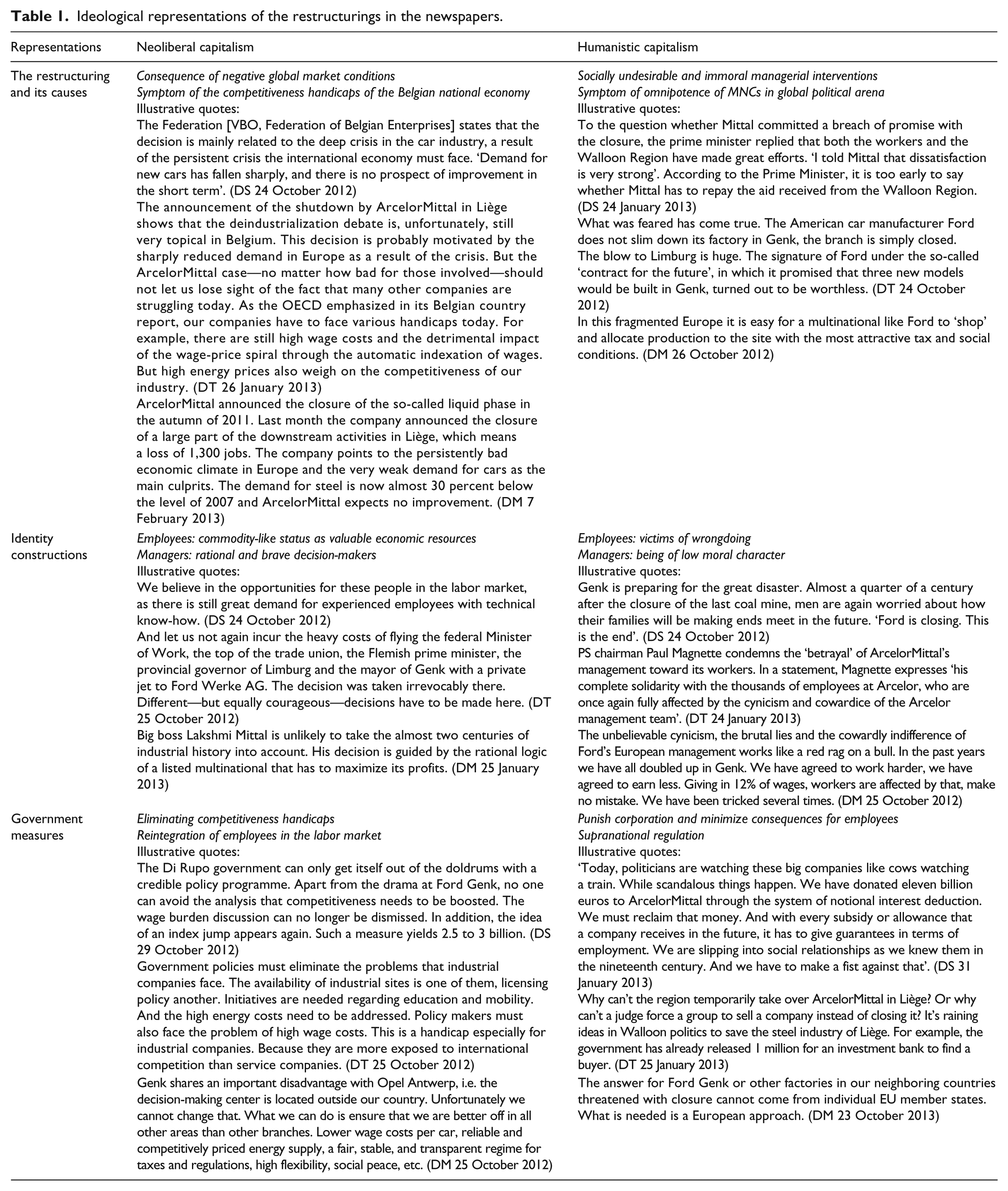
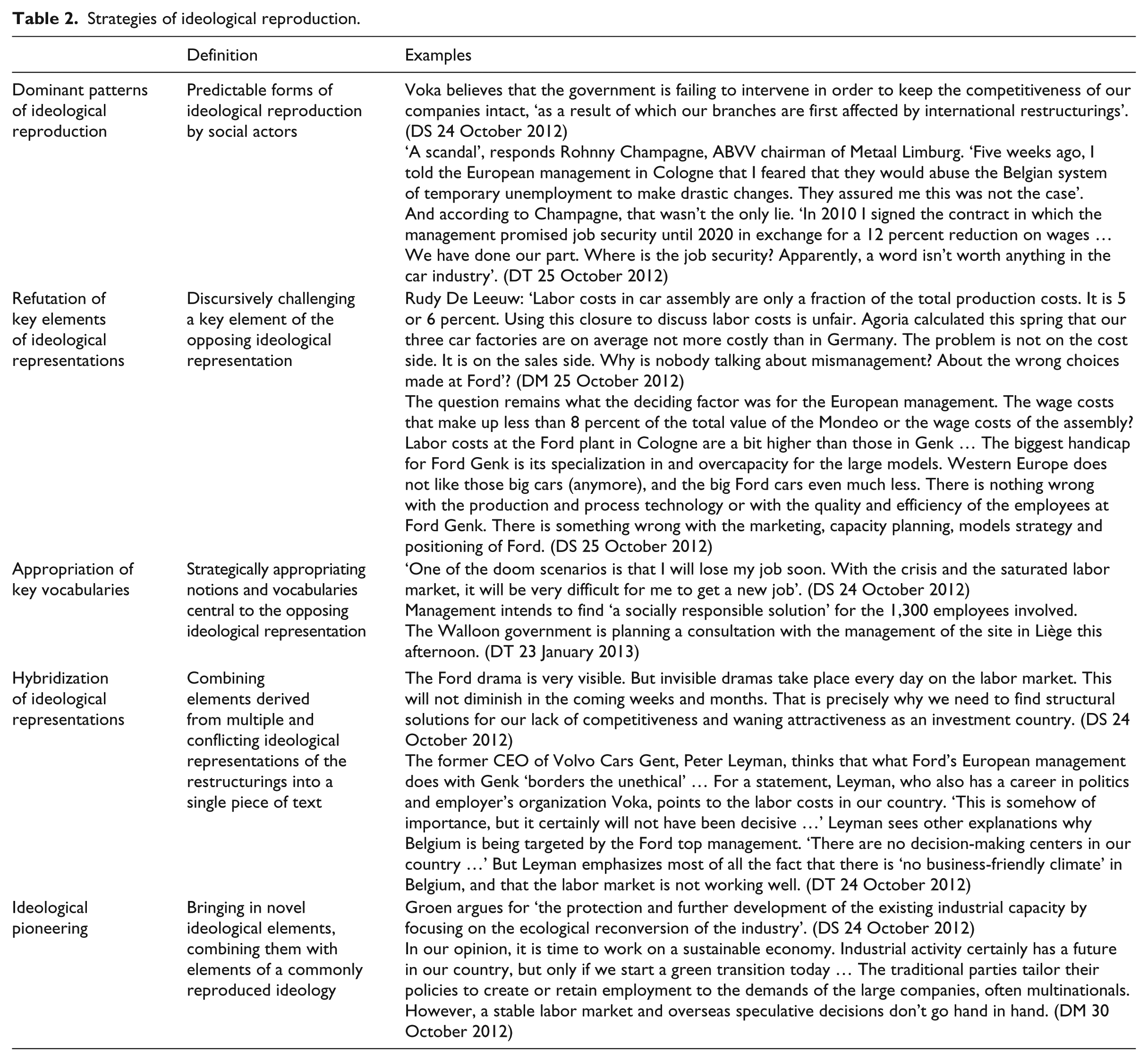
Our third and last step was to inductively analyze the ways in which these ideologies were reproduced to legitimize or delegitimize the restructurings. Overall, the two ideologies were predominantly reproduced by social actors according to recurring patterns: neoliberal capitalism was primarily used to legitimize the restructurings, humanistic capitalism to delegitimize the restructurings. We noticed, however, that there was not always a one-to-one relation between particular actors and an ideology, but that there were ‘inconsistencies’. More closely examining these inconsistencies, we noticed that they were discursive strategies to further affirm the (il)legitimacy of the restructurings. Social actors challenged truth claims from the opposing ideology, borrowed elements from the opposing ideology, combined elements from both ideologies, and made attempts to integrate ‘exogenous’ ideological elements into the dominant ideological representations. We labeled these four discursive strategies of ‘creative’ reproduction (cf. Fairclough, 1992, 2010): ‘refutation of elements of ideological representations’, ‘appropriation of key vocabularies’, ‘hybridization of ideological representations’, and ‘ideological pioneering’. Table 2 presents illustrations of the strategies of reproduction.
Strategies of ideological reproduction.
The type of analysis we performed is methodologically challenging. In that regard, Van Dijk (2006) claimed that ‘the relation between ideology and discourse is complex and often quite indirect’ and ‘needs special indirect or other unobtrusive methods to be studied empirically’ (p. 124). Identification of ideologies underlying discursive (de)legitimation is a matter of interpretation of language use in a particular social context, and text fragments are often ambiguous and allow for multiple interpretations (Joutsenvirta and Vaara, 2015). Furthermore, our own background as critical researchers inevitably entered into the analysis. Ideological discourse analysis and interpretation never take place in a neutral or value-free way (Alvesson and Sköldberg, 2009; Jørgensen and Phillips, 2002), which in turn implies that our interpretation should be considered as a political act, reproducing and/or challenging the current political status-quo through the (re)articulation of particular ideologies, discourses, and rhetorical strategies (Alvesson and Sköldberg, 2009; Vuontisjärvi, 2013).
The use of ideologies in (de)legitimation of corporate restructuring
Addressing our two research questions on the ideologies underlying discursive (de)legitimation of restructuring, we first present how the two ideologies of neoliberal capitalism and humanistic capitalism are commonly used as discursive resources. We then discuss the ways in which the ideologies are reproduced within the (de)legitimation accounts.
Neoliberal capitalism as ideological resource for discursive legitimation
The ideology of neoliberal capitalism underlies legitimizing statements of senior executives of the restructuring firms, captains of industry, employer organizations, editorialists of the business newspaper, and conservative-liberal and centrist politicians. It manifests itself in and provides coherence between these actors’ framings of the restructuring, their identity constructions of the actors involved in the restructurings, and the government measures they advocated.
Framing of the restructuring and related government measures
Within the neoliberal capitalist representation, the restructurings are portrayed as rational and unavoidable—and thus legitimate—business decisions, guided by unfavorable external market conditions. The following quote illustrates, With the shutdown decision, Ford aims to offer a solution to the current overcapacity, which is a result of declining demand—with more than 20 percent since 2007—on the Western European car market. ‘Sales of new cars this year has reached its lowest point in nearly 20 years and is expected to remain at this level next year, or may even go further down’, says Ford (DS 24 October 2012).
1
In particular, the communication of Ford emphasizes that a lack of sufficient demand on the European market forced them to protect the future profitability of the MNC by adjusting the production capacity to the imperatives of the market. The downsizings and the related mass layoffs are legitimized on instrumental grounds, primarily through referring to their utility as improving the MNCs’ future (financial) performance, as the following quote from Stephen Odell, CEO of Ford Europe, illustrates, ‘The proposed restructuring of our European production operations is an essential part of our plan to strengthen Ford’s activities in Europe and to return to profitable growth’ writes the CEO of Ford of Europe, Stephen Odell, in the press release. (DS 24 October 2012, also mentioned in DT, 24 October 2012)
Such instrumental legitimization of the mass layoffs explicitly defines corporate restructuring as a necessary process of reorienting and adjusting assets, resources, and staff in order to comply with the logic of investment and profit-making, which ultimately prioritizes the interests of shareholders.
Furthermore, an important issue addressed by the neoliberal capitalist representation is the question why the production facilities of Ford and ArcelorMittal in Belgium were struck by restructuring whereas other subunits of the MNCs in Europe and elsewhere were left untouched. While the media texts referred in a few cases to classical managerial logic, that is, the poor financial performance of ArcelorMittal Liège and the limited factory capacity utilization rate of Ford Genk compared to the other subunits, the most prominent explanation referred to the Belgian political-economic system. The Belgian employers’ associations, captains of industry, editorialists of the business newspaper De Tijd, and politicians from centrist and right-wing parties all framed both restructurings as a symptom of the maladjustment of the Belgian government policies and institutions to the current global economic reality. The following quote illustrates, Just like the other organizations, VBO [a Belgian employers’ association] stresses the ‘urgent’ need for fundamental reforms in areas such as wages, work organization, taxation and legal certainty. According to VBO, our handicaps are highlighted even more by the crisis. That is why our companies increasingly lose the battle against their foreign colleagues, decides VBO. (DT 24 October 2012, also mentioned in DM 25 October 2012)
The quote includes the often-heard claim that Belgium is increasingly unattractive for foreign direct investments (FDI) by MNCs, compared to other potential host countries, because of various ‘competitiveness handicaps’, including excessive labor costs (Belgian newspapers reported labor costs to be 42% lower in Spain), inordinate energy costs, an instable fiscal regulatory framework, slow and bureaucratic government administration, uncompromising labor unions, and rigid employment legislation which obstruct the development of a flexible labor market. With this explanation, capital-as-actor takes advantage of the legitimacy struggle over the restructurings to elicit a legitimacy crisis of the Belgian political-economic system (i.e. a strong welfare state) and divert public attention from debates over the social unacceptability of corporate restructuring involving mass layoffs as an institutionalized managerial practice.
In line with this explanation, the neoliberal capitalist representation advocates government measures that are claimed to improve the national ‘business climate’ by eliminating particular institutional handicaps as well as (further) developing a typical or new national asset (cf. quotes with neoliberal government measures in Table 1). In particular, employers’ organizations and politicians from centrist and conservative-liberal parties strongly emphasized the necessity of a reduction of labor costs and the abandoning of automatic wage indexation. Furthermore, captains of industries, and newspaper editorialists, and politicians from different political parties promoted new government incentives for high-tech innovation and additional government budgets for technology-oriented education (primarily in line with the needs of business). In general, the neoliberal capitalist representation seems to be grounded on a foundational belief that the principal role and responsibility of national governments is shaping the most favorable conditions for corporate profit making in a highly competitive global economy. In other terms, national governments are responsible for the protection of the profitability and the competitiveness of the MNC subsidiaries on their territory.
Identity construction of the actors involved and related government measures
Within the neoliberal capitalist representation, the identities of the social actors involved in the restructuring are mainly implicitly articulated. In corporate communication, corporate decision makers appear as rationally acting agents of the MNCs’ shareholders (cf. quotes with neoliberal identity constructions in Table 1), while the laid off employees appear as resources or corporate assets that are to be managed according to a logic of investment (cf. Hirsto and Moisander, 2014). In other terms, employees have a commodity-like status as potentially disposable assets (cf. Ferraro et al., 2005). In the debate over the shutdown of Ford Genk, the dismissed employees were even explicitly staged as valuable resources that are still able to play an important part in the national economy. The statement from Federal Minister Alexander De Croo, member of the Flemish conservative-liberal party Open VLD, in the following quote illustrates this: At the same time there is a discussion within the federal government about early retirement with bridging pension [unemployment benefit systems with additional financial compensation paid by the employer for older employees]. Minister of Employment Monica De Coninck (SP.A [the Flemish social-democratic party]) wants to leave open the possibility of a bridging pension at 50 for people who have already had a long career behind them. Minister for Pensions Alexander De Croo (Open VLD [the Flemish conservative-liberal party]) calls an early retirement of fifteen years ‘irresponsible’. ‘It is impossible that such skilled workers have no future’. (DS 26 October 2012, also mentioned in DT 26 October 2012)
Such identity construction of the laid-off employees as valuable economic resources is in line with and enhances the calls of captains of industry, politicians, and editorialists from all three newspapers for government measures facilitating re-employment of the laid-off employees through outplacement and reactivation policies (while simultaneously rejecting calls for unemployment benefit systems with additional financial compensation paid by the employer for older employees). This kind of policy recommendations is in line with the logic of the global neoliberal ideological project of a lean welfare state, adapted to the demands of the international economy, with a balanced budget and a limited amount of guaranteed social rights for citizens dependent on wage labor (cf. Beck, 2008; Streeck, 2014).
Humanistic capitalism as ideological resource for discursive delegitimation
In contrast, the ideology of humanistic capitalism underlies delegitimizing statements of laid-off employees, labor union representatives, politicians having strong ties with the regions affected by the restructuring, and intellectuals with left-wing sympathies. It manifests itself and provides coherence between these actors’ framings of the restructuring, their identity constructions of the actors involved in the restructurings, and the related government measures they advocated.
Framing the restructurings and related government measures
Within the humanistic capitalist representation, the restructuring programs of Ford and ArcelorMittal are portrayed as socially undesirable and immoral managerial interventions, leading to a huge social crisis in the regions where the targeted factories are located. Local politicians and labor union representatives literally claim that the mass layoffs are a ‘breach of promise’, ‘breach of contract’, or ‘treason’, as the restructuring companies fail to meet various social and cultural expectations concerning reciprocity, fairness, and transparency toward its employees, as well as formal engagements with the labor unions and the regional governments. The following public reaction of Flemish Minister Ingrid Lieten, member of the left-wing Flemish social-democratic party SP.A, illustrates, Minister Ingrid Lieten responded stunned at the news of the closure. ‘I’m furious. This is so unfair to the employees of the Ford plant and the employees of the supplying companies’ … ‘Ford has broken its contract with society and with Limburg’ … Lieten also finds that Ford must be reminded of its responsibilities. (DS 24 October 2012)
Her reaction seems to draw on a more foundational belief that MNCs have certain moral responsibilities beyond formal employment contracts and labor regulation for the effects of their actions on the lives of their employees, and the local economies and communities in which their production facilities are embedded. These moral responsibilities flow from the claim that there is some kind of implicit social contract between corporations and society which prescribes that in return for employee loyalty, dedication, and full-time work, employers are required to offer a relatively permanent employment contract and a predictable income (cf. Hirsto and Moisander, 2014; Jung and Mun, 2017; Vuontisjärvi, 2013).
In line with this explanation, the humanistic capitalist representation gives rise to the advocacy of government measures that intend to punish the MNCs for their immorality and untrustworthiness and political projects to minimize the negative consequences of current and future restructurings for the employees and the local community by securing as much employment as possible (cf. quotes with humanistic capitalist government measures in Table 1). For instance, immediately after the announcement of the restructurings, opposition leaders and members of the federal and regional governments were expressing the desire to reclaim the subsidies and tax benefits which the MNCs had received in the previous years. The left-wing social-democratic party of Wallonia PS further argued for legislation that would force restructuring MNCs to accept decent takeover bids on the production facilities they intend to shut down. In a similar vein, the labor unions argued for legislation that would make the practice of restructurings involving mass layoffs more difficult to implement by expanding the employer’s obligations regarding dismissal payments and sharing strategic information with the employees council. Desires to punish the restructuring MNCs and to secure as much employment also took shape in the government measure of nationalization, which was not only advocated by the small Marxist party PVDA+/PTB but also by several prominent politicians from the parties in power who maintain strong ties with the affected region, especially in the case of ArcelorMittal Liège.
With regard to the question why corporate morally irresponsible corporate behavior under the form of downsizings can take place in Western-European countries nowadays, intellectuals and journalists with left-wing sympathies and politicians from social-democratic and Marxist parties refer to the omnipotence of MNCs in today’s global political arena as well as the appalling weakness of the nation-state governments in controlling and regulating business activities. In the case of Ford Genk, where the production moved from Genk to a factory in Valencia with significantly lower labor costs, the restructuring program is represented as a consequence of an ongoing and socially devastating global competition between nation-states to attract and retain FDI of MNCs (which are generally considered as of crucial importance for economic growth, innovation, and employment). This global dependency of the nation-state on FDI is considered to allow MNCs to play off states against one another to receive the best corporate welfare package in exchange for their investments—the key assumption of the so-called ‘race to the bottom’ theory (Gould, 2010; Whelan, 2012). The following excerpt from an opinion piece of State Secretary John Crombez, member of the Flemish social-democratic party SP.A, illustrates this explanation: But to continue submitting to the hostage-taking and blackmailing by multinationals, will cost the EU member states dearly in the next twenty years, and will even pose a threat to their prosperity. And it’s not just about corporate taxes, but also about subsidies for wages, legislation against tax abuse, … you name it. It’s about everything businesses can use to their advantage or disadvantage, everything they abuse to play countries off against each other. Divide and conquer. Why doesn’t Europe demand any justification from multinationals before they shut down a subunit in a particular member state? Why don’t we ask multinationals to justify whether such a scenario is economically defensible? I would love to see such a report from General Motors, Ford or Arcelor. (DM 5 February 2013)
Such claims regarding the erosion of nation-state governmental power in the current era of economic globalization are not only used to advocate new industrial policies which are more beneficial for small- and medium-sized enterprises but also to make pleas for supranational policy initiatives and regulation, preferably at the European Union level, which need to impose rules and standards of conduct on MNCs to prevent future globalization-driven corporate restructurings from happening (cf. quotes with humanistic capitalist government measures in Table 1). By advocating this latter type of policy measures, politicians and intellectuals representing the class of wage laborers attempt to use the legitimacy struggle over the restructurings to subvert the legitimacy of restructurings involving mass layoffs as an institutionalized managerial action and elicit a legitimacy crisis of the existing international political-economic order. However, the desired policy initiatives and regulations are often left unspecific, articulated in vague terms, or even corresponding to a certain extent with the logic of the neoliberal capitalist representation of the restructurings. The latter can be illustrated through the following reaction of Kathleen Van Brempt, member of the European Parliament for the Flemish social-democratic party SP.A: Kathleen Van Brempt (sp.a) also foresees a more substantial role for the European Commission in cases of mass layoffs. ‘Any company with a European Works Council that decides to restructure should not only inform its Works Council, but also the European Commission’. According to the member of the European Parliament, their task is to screen every restructuring in terms of ‘objectivity’. ‘This should ensure fair competition between subsidiaries in different member states’. (DT 24 October 2012)
The reaction contains a plea for a more assertive way of acting of the European Commission in future cases of downsizing by MNCs, but also suggests that mass layoffs are a legitimate practice when the restructuring decision is based on managerial theories of optimal financial investment, cost analysis, and organizational efficiency.
Identity construction of the actors involved and related government measures
Within the humanistic capitalist representation, the negative representation of the restructurings as immoral business decisions is strongly reflected in the articulation of managers’ and dismissed employees’ identities. Not surprisingly, the corporate executives behind the shutdown decisions are staged as being of incredibly low moral character, which delegitimizes their way of acting. The following quote illustrates, Mayor of Seraing and parliamentarian Alain Mathot (PS) doesn’t ponder his words in his reaction to the job losses announced by ArcelorMittal, including in his city. ‘I am not ashamed to say that we are dealing with thugs, with a swindler’, as he describes Lakshmi Mittal, the chief executive of the steel group. (DT 24 January 2013, also mentioned in DS 24 January 2013 and DM 25 January 2013)
The harsh language in the quote reflects the intensity of the public debate that was stirred by the announcements of the restructuring of Ford and ArcelorMittal. In their public reactions, labor union representatives and politicians from the affected regions regularly associated the corporate executives of Ford and ArcelorMittal with terms such as ‘swindlers’, ‘crooks’, ‘cowards’, and also ‘cynics’, taking advantage of subsidies and fiscal benefits, or ‘squeezing employees like lemons’ to make quick profits, before closing the factories and investing elsewhere. Accordingly, the laid-off employees are portrayed as victims of serious managerial wrongdoing (cf. quotes with humanistic capitalist identity constructions in Table 1). This victim identity is strongly emphasized by quoting employees and labor union representatives expressing negative emotions such as fear, despair, suffering, and sorrow, but also indignation and anger. Such identity construction legitimizes the workers’ and organized labor’s resistance of the restructurings through factory blockades and strike actions, and buttresses their demands for substantial financial compensation from the MNCs for their loss of income, job security, and career perspectives, as well as a government approval for the institutionalized practice of granting bridging pensions in Belgium (i.e. unemployment benefit agreements with additional financial compensation paid by the employer for older employees in cases of mass layoffs).
Discursive reproduction of ideological representations
Social actors engaging in (de)legitimation of the restructurings drew on the ideologies of neoliberal capitalism and humanistic capitalism in different ways. In addition to the dominant pattern of reproduction, elements of the underlying ideological representation were reproduced in a more unconventional or ‘creative’ way (Fairclough, 1992, 2010) through four discursive strategies: refutation of key elements of an ideological representation, appropriation of ideological framings, hybridization of ideological representations, and ideological pioneering.
Dominant pattern of ideological reproduction
Our above analysis of the ideological representations underlying (de)legitimizing statements of the restructurings simultaneously showed a recurring pattern in the ideological reproduction of social actors. Corporate executives, captains of industry, employers’ organizations, right-wing politicians, and editorialists of the business press tend to rely mainly on the framings, identity constructions, and related government measure recommendations derived from the neoliberal capitalist ideology to legitimize the restructurings. They hereby advocate a political project that primarily serves shareholder and business elite interests. In contrast, dismissed employees, labor union representatives, left-wing academics and intellectuals, social-democratic and Marxist politicians, as well as politicians from the regions affected by the restructurings, primarily rely on the humanistic capitalist ideology to delegitimize the restructurings. They defend policy initiatives that are in line with the interests of the class of wage-dependent citizens through elements from the humanistic capitalist representation.
Creative strategies of ideological reproduction
Refutation of elements of ideological representations
Ideological refutation entails social actors’ frequent attempts to discursively challenge a key element of the opposing ideological representation. In the case of Ford Genk’s shutdown, for instance, the neoliberal capitalist framing of the restructuring as a response to a lack of demand caused by unfavorable market conditions was refuted. Instead, it was claimed that this lack of demand was a consequence of strategic management errors at the MNCs’ headquarters. Similarly, the framing of the layoffs as being caused by competitive handicaps of the Belgian economy (and excessive labor costs in particular) was heavily contested and repeatedly refuted by influential voices in the public debate. The following quotes illustrate, According to De Grauwe, labor costs played no role. ‘All the figures I have seen show that the direct labor costs in Genk are relatively low’, says the professor. He immediately points out that our country has high labor costs, but also a high productivity. (DT, 24 October 2012, also mentioned in DS 24 October 2012 and DM 25 October 2012) Vice prime minister Johan Vande Lanotte (sp.a) [the social-democratic party in Flanders] … gave the example of Audi Vorst, which ‘produces cheaper in Belgium than in Germany’. ‘Labor costs have already been heavily reduced’, emphasized Vande Lanotte. According to this member of sp.a, Ford makes no commercial considerations, but rather chooses ‘the path of least resistance’ by investing in a small country with a small market. ‘Despite many investments made in Ford Genk by the government’. ‘It would be very cynical if Ford would close the factory in Genk now’. (DT 23 October 2012, also mentioned in DM 24 October 2012 and DS 23 October 2012)
The quotes both illustrate how influential voices in the public debate refute the key arguments underlying the neoliberal framing of the main cause of the restructuring (i.e. excessive Belgian labor costs as the main cause of the restructurings) by articulating elements (i.e. labor productivity, power dynamics between EU-member states) derived from classical economic and management sciences in the chain of signification of the contested ideological representation. Such refutations by influential social actors and voices prevent that certain key elements of the contested representation become fully institutionalized (i.e. generally considered as a part of objective reality), which would ensure a high level of isomorphism and conformance in individuals’ legitimacy judgments throughout society (cf. Bitektine and Haack, 2015).
Appropriation of key vocabularies
Appropriation of key vocabularies refers to social actors’ attempts to (de)legitimize the restructuring by strategically appropriating vocabularies and notions which are central to the opposing ideological representation(s), thereby undermining the logic of this antagonistic ideology and redefining the meaning of this notion. Especially the notion of corporate (social) responsibility, which is one of the key elements of the humanistic capitalist representation was repeatedly appropriated in corporate communication of Ford and ArcelorMittal to legitimize mass layoffs. The following legitimizing statement of Ford executive Stephen Odell illustrates how discursive attempts were made to disconnect the notion of (corporate) responsibility from the humanistic capitalist representation and to redefine the meaning that is commonly attributed to it: Besides, I can only emphasize that Ford is very aware of its social responsibilities, and accepts the consequences that come with them. (DS 15 November 2012, similar quote in DT 25 October 2012)
This quote legitimizes the shutdown of Ford Genk by representing exercising corporate responsibility toward society as being potentially fully compatible with the managerial decision to restructure, thereby undermining the humanistic capitalist basic claim that organizational restructurings involving mass layoffs are always acts of socially irresponsible corporate behavior. In other terms, this discursive strategy does not only legitimize the shutdown, but may also weaken the credibility and influence of delegitimation efforts based on the humanistic capitalist ideology, as it suggests that this basic claim is at least partly invalid.
Hybridization of ideological representations
Ideological hybridization—closely related to Fairclough’s (1995) concept of interdiscursivity—entails the combination of elements derived from multiple and conflicting ideological representations of the restructurings into a single piece of text. Especially newspaper editorialists from the centrist and progressive newspaper make their own creative connections between framings, identity constructions, and governmental recommendations emerging from the two different ideologies. This is likely due to the high level of institutional complexity that they face as their editorials target multiple audiences with potentially conflicting interests. The following excerpt from an editorial on the shutdown of Ford Genk in the centrist newspaper De Standaard illustrates, Barely a month ago, bad tidings about employment security at the car manufacturer Ford Genk appeared to be unfounded. Not only did dreaded layoffs fail to appear, because the factory was promised that it could also build the next generation of the Mondeo. It was even assigned the production of two other car types. For the 4500 Ford workers, this was a big relief. Hence, it is particularly bitter that the joy appears to have been premature a few weeks later. That a promise may be revoked so fast, indicates how little it was actually worth. Apparently, market data change so dramatically that the only option left is to tear up the plans and hastily draw up new ones. (DS 23 October 2012)
By referring to notions such as ‘dramatically changing market data’ and ‘revoking a promise’, this quote simultaneously creates both a sense of legitimacy and illegitimacy for the restructuring, although the legitimizing efforts clearly prevail here. Such ambiguity and contradiction through playing with multiple perspectives and contrasting rationalities is not an exceptional phenomenon in our data, and in journalism in general (Vaara et al., 2006). Referring to different points of view is something that audiences of quality newspapers appear to expect and increases the credibility of the editorialist’s arguments, while not limiting his or her capacity to influence the legitimacy evaluations of the audience and support/resist certain policy measures (e.g. the quoted editorial supports reducing labor costs, a key element in the neoliberal capitalist ideological project). Quotes like this are in line with Vaara and colleagues’ (2006) observation that journalists often seem to play around with the negative and morally questionable aspects of industrial restructuring only to conclude that, in the ‘bigger picture’, the restructuring is fully legitimate. This later shows that the discursive strategy of ideological hybridization can be employed to create some kind of hierarchy in the explanatory power and credibility of competing ideological representations.
Ideological pioneering
Social actors relying on the strategy of ideological pioneering attempt to (de)legitimize the restructuring by bringing in novel ideological elements, combining them with elements of one of the commonly reproduced ideologies. In our study, novel ideological elements referring to ecology and sustainability were brought in to sustain particular political interests. For example, members of ‘Groen’, the Flemish political party based on green politics, repeatedly combined elements from the neoliberal capitalist ideology (e.g. national competitiveness logic) with the advocacy of government measures stimulating sustainable and ecofriendly investments and innovation (cf. quotes with ideological pioneering in Table 2). In one of the most sophisticated examples of this rather uncommon strategy in our data, Paul Magnette, the chairman of the French-speaking social-democratic party PS, delegitimizes the restructuring of ArcelorMittal Liège through combining the identity constructions from the humanist capitalist ideology—the ‘employee as victim’ and ‘managers as crooks’, with ideas and concepts (i.e. short supply chains, low carbon economy) which are broadly perceived as elements belonging to the ‘green’ ideology (which is sensitive to discourses of climate change and de-globalization): Now that transport costs start to rise again, Belgium and the EU should reconsider the industrialization of the economy. In time, short distance transport of industrial goods will become important again and it would be wrong now to give up our know-how in a strategically important industry such as the steel industry. This material [steel], which overcomes the test of time, is also a factor for the sustainable health of our economy and the continuity of our daily lives. Can you imagine our cities without trams, trains, buildings, cars or electrical appliances? All that requires steel. Moreover, the steel industry, is a modern industry, in the heart of the low carbon economy. (DS 25 January 2013)
Such delegitimation efforts in which ‘exogenous’ ideological elements are brought in can be considered as part of a search for alternative sets of ideas to successfully challenge corporate restructurings as an institutionalized managerial practice. They may be neglected and disappear, or stir the public debate and eventually become a driving force in discursive, institutional, and social change.
Discussion
Examining the ideological nature of discursive (de)legitimation in the context of corporate restructurings involving mass layoffs, we advance the literature on discursive (de)legitimation of contested corporate practices in two ways. First, we show how ideologies function as discursive resources for social actors, which manifests itself in the reproduction of ideologically laden contents in conventional and more creative ways. Second, we reconsider the political nature of (de)legitimation, interpreting how (de)legitimizing statements may contribute to institutionalization processes and affect power relations between social groups at the societal level. Furthermore, from a desire to engage in social science research which is meaningful for academics as well as a broader societal audience (cf. Alvesson et al., 2017), we engage with the broader intellectual debate on the possibility of social resistance against restructurings (Erkama and Vaara, 2010) and the ideological movement of neoliberalism in general (cf. Achterhuis, 2010; Klein, 2007; Streeck, 2014; Žižek, 2011).
Ideologies as discursive resources for (de)legitimation
Our study adds to existing knowledge on discursive (de)legitimation of contested corporate practices (Erkama and Vaara, 2010; Joutsenvirta, 2013; Vaara et al., 2006) by highlighting and examining the importance of ideologies as discursive resources for (de)legitimation. While current research acknowledges the existence of ‘a close link between legitimation and sociopolitical struggles which involve (re)production of ideologies’ (Joutsenvirta, 2013: 462), it shows a tendency to limit its empirical focus to the analysis of micro-textual argumentative strategies and remains largely silent on how ideologies are reproduced by social actor for the purpose of (de)legitimation. In contrast, our study shows that ideologically laden contents reproduced in (de)legitimizing statements are as relevant for understanding processes of (de)legitimation as the micro-textual argumentative strategies that are employed. From our empirical study, we propose that these ideologically laden contents revolve around three main themes. In particular, ideologies (1) guide interpretations and understandings of corporate actions as reflected in the different framings of the restructurings, (2) shape preferred conceptions of social actors as reflected in particular identity constructions, and (3) provide a horizon for political action as reflected in propositions for government measures.
It remains unclear, however, whether these three content-related themes are more or less unique to the context of our study or could be generalized to other legitimacy struggles. Van Dijk (2006, 2013) also indicated that it is very difficult to define the general categories that organize ideologies as belief systems, but his ‘ideology schema’ that structures ideology into six categories (i.e. identity, activities, goals, norms and values, group relations, and resources) shows resemblance with the three themes in our study. The theme of framing of corporate restructuring is closely related to the categories of ‘norms and values’ (referring to questions such as ‘what is good/bad?’) and ‘activities’ (referring to the questions ‘what do we usually do as a group? what is our task?’). The theme of identity constructions of the actors involved in the restructurings refer to the categories ‘identity’ (which refers to questions such as ‘who are we as a group?’ and ‘who belong to us?’) and ‘group relations’ (referring to the question ‘who are the group’s allies and opponents?’). The theme of propositions for government measures corresponds to the category ‘goals’ (which refers to the question ‘what does the group wants to obtain?’). We therefore suggest that both Van Dijk’s ‘ideological schema’ and our three themes may function as theoretical frameworks to empirically examine how ideologies shape the content of (de)legitimizing statements.
Our study further draws attention to the complex nature of ideological reproduction in (de)legitimizing statements, illustrating how ideologies ‘are not only being “applied,” “implemented” or passively “used,” but at the same time constituted and reconstituted, as well as gradually changed’, as Van Dijk (1998) has claimed (p. 228). In particular, our analysis emphasizes that social actors engaging in legitimacy struggles do not solely reproduce the available ideological representations in a predictable way. Rather, our findings highlight four discursive strategies through which social actors reproduce ideologies more unexpectedly or creatively: refutation of key elements of ideological representations, appropriation of ideological framings, hybridization of ideological representations, and ideological pioneering.
Each of these four strategies of creative reproduction puts existing ideological elements together in unconventional combinations and serves a different purpose. Relying on refutation of key elements of ideological representations, social actors develop sophisticated (often science-based) argumentations in an attempt to show how the key assumptions, claims, or framings of the opposite ideology are at least partly invalid. Relying on appropriation of key vocabularies, actors subtly integrate a key framing of the opposite ideology in their communication, thereby undermining and/or redefining this ideology’s main assumption or logic. Employing hybridization, actors simultaneously refer to the framings of different ideological representations within a single (de)legitimizing statement. Such a discursive ‘balancing act’ is expected to enhance the credibility of a social actor’s plea for a particular ideological project (cf. Vaara et al., 2006), hereby targeting multiple audiences with a single statement and/or creating a hierarchy between the truth claims of opposing ideologies. Employing ideological pioneering, actors articulate ‘exogenous’ ideological elements into dominant ideological representations in an attempt to develop alternative ways to (de)legitimize corporate actions and reach a potentially broader audience.
The appearance of these four strategies in (de)legitimizing statements confirms the assertion of Fairclough (1992) that ‘subjects are ideologically positioned, but they are also capable of acting creatively to make their own connections between the diverse practices and the ideologies to which they are exposed …’ (p. 91). By employing such more creative discursive strategies of ideological reproduction, the social actors in our study often manifested themselves as sophisticated language users, ‘telling the right kind of stories to the right audiences at the right moment’ (Alvesson and Kärreman, 2000: 1132) when engaging in legitimacy struggles to sustain the material interests of the social group to which they belong or identify with, instead of being constrained by a small number of available ideologies. We hope that this study stimulates future research on the currently undertheorized topic of creative discursive strategies of ideological reproduction, and in particular the examination of how discursive (de)legitimation of a contested corporate practice may change over time as ideologies are gradually updated or radically reconstituted.
The political nature of discursive (de)legitimation
Our study further contributes to the literature on discursive (de)legitimation of contested corporate practices by reconsidering the political nature of (de)legitimizing statements. Previous studies related the political dimension of discursive (de)legitimation to the potential social effects that micro-textual argumentative strategies may have: ‘it is through subtle textual strategies that particular interests and voices are reproduced and others silenced’ (Vaara and Tienari, 2008: 991). This latter is considered as affecting the power relations between social actors involved in legitimacy struggles (Joutsenvirta, 2013). Furthermore, previous research has linked processes of (de)legitimation with (de)institutionalization and institutional change at the societal level (Harmon et al., 2015; Hoefer and Green, 2016; Vaara, 2014; Vaara and Tienari, 2008). These two frequently mentioned political aspects of (de)legitimation have been summarized by Vaara (2014) as follows: ‘in legitimacy crises, legitimation not only deals with specific issues, decisions or actions, but is also related to the power positions of actors and broader social structures – in other words, to institutions’ (p. 503). This latter relationship between (de)legitimizing statements and institutions is however rarely made explicit.
Our study reveals two ways in which actors engaging in MNC-related legitimacy struggles affect institutions (and thereby simultaneously impact the existing power relations between social groups in society). First, legitimation or delegitimation of specific ‘downsizing events’ such as the shutdown of Ford Genk or ArcelorMittal Liège appears to primarily sustain or subvert the institutionalization of the contested corporate practice of restructuring involving mass layoffs in the contemporary global economy. This is illustrated in our study by the delegitimizing statements of certain social-democratic politicians. Some of their statements drawing on the humanistic capitalist representation can be seen as not so much aiming to prevent the layoffs at Ford Genk and ArcelorMittal Liège from actually happening, but rather as attempts to discursively challenge the institutionalized nature of restructurings involving mass layoffs as a common managerial technique to improve corporate financial performance. In particular, they seem to engage in the legitimacy struggle to sustain the interests of wage-dependent citizens by advocating legislation that needs to impede as much future implementations of this managerial practice as possible.
Second, social actors appear to engage in (de)legitimation of corporate restructurings to elicit an institutional legitimacy crisis of the current socio-political system (cf. Vaara, 2014). Such crises need to highlight the necessity of government measures that primarily serve the (de)legitimizing actor’s interests. This is illustrated in our study by the legitimizing statements of the Belgian employers’ organizations, engaging in the legitimacy struggle over the restructurings to sustain the interests of citizens controlling and managing large amounts of capital. When providing acceptable motivations for the shutdown of Ford Genk through references to the Belgian competitiveness handicaps, they did not so much intend to support or facilitate the actual implementation of the shutdown, but rather to discredit the Belgian socio-political system as ineffective and advocate the necessity of government policies leading to a significant reduction of labor costs or the temporal or permanent abandoning of the system of automatic wage indexation.
We believe that such political dimensions of (de)legitimation can be revealed by means of empirical analysis of the ideologies underlying (de)legitimation of corporate actions or practices, rather than by means of empirical analysis of micro-textual argumentative strategies employed in (de)legitimizing statements. By reproducing ideologically laden framings of contested corporate actions, identity constructions, and propositions for government measures that are in line with their interests, social actors engaging in legitimacy struggles over contested corporate actions contribute to shaping, maintaining, or disrupting institutionalized managerial practices and regulative socio-political institutions at the societal level. We hope that our study will stimulate analysis of the ideological nature of (de)legitimizing statements in other MNC-related controversies, in order to further our understanding of how social groups from all over the world may clash over issues related to (global) economic (in)equality and environmental sustainability.
The possibility of social resistance against the neoliberal project
We conclude this study with a more ‘practical’ contribution by engaging with the broader intellectual debate on the possibility of successful discursive resistance against corporate restructuring as an institutionalized managerial practice (Erkama and Vaara, 2010) and the ideological movement of neoliberalism in general (cf. Achterhuis, 2010; Klein, 2007; Streeck, 2014; Žižek, 2011). We hereby take into account the policy initiatives that were actually taken at the national and supranational levels in the aftermath of the restructurings of Ford and ArcelorMittal.
In their study on a restructuring of the Volvo Bus Corporation in Finland, Erkama and Vaara (2010) provided a rather pessimistic view on resisting downsizings in the current era of globalization, apart from helping the laid-off employees to maintain self-identity and a sense of dignity. To a certain extent, our study indicates otherwise, as both the neoliberal capitalist representation and the humanistic capitalist representation were influential in terms of generating certain political outcomes. Nonetheless, our study raises doubts over the current potential of the humanistic capitalist ideological movement to be or become a strong countermovement against the neoliberal socio-political agenda.
The actual policy initiatives taken after the restructurings seem to indicate the dominance of the neoliberal capitalist representation. The discursive representation of the restructurings as being a consequence of competitive handicaps of the Belgian national economy had a significant impact on the federal government’s labor policies. Within 1 month after the announcement of the shutdown of Ford Genk, the federal government Di Rupo I (2011–2014) decided to implement a wage freeze of several years in Belgium. This policy of wage restraint was deliberately continued by the current federal government Michel I (2015–…), by means of an ‘index jump’—a temporary blocking of the Belgian automatic wage indexation system—in 2015. During the period 2015–2017, Belgian wages went up with only 1%, one of the lowest increases in the EU (with only the more weakly performing economies of Greece, Italy, Malta, and Spain ranking lower). In contrast, the humanistic capitalist demands to nationalize the production facilities of Ford in Genk and ArcelorMittal in Liège or to vote legislation that would force restructuring MNCs to accept takeover bids faded soon after the announcements of the restructurings.
Yet, also the humanistic capitalist representation led to certain material outcomes. Its discursive representation of ‘a victim’ identity for the laid-off employees had a significant impact on the financial settlement between the workers and the MNCs. In both cases, the laid-off employees received substantial financial compensation, an institutionalized practice also appearing in previous cases of corporate restructurings in Belgium (e.g. the shutdowns of the automobile factories of Renault in Vilvoorde in 1997 and Opel in Antwerp in 2010). Ford estimated the social costs of its restructuring program in Europe (i.e. the shutdown of the factories in Genk, Southampton, and Dagenham) to be around 900 million dollar. Furthermore, about 2000 employees of Ford Genk and 350 of ArcelorMittal Liège being over 52 years old eventually got access to bridging pensions (i.e. non-degressive unemployment benefits with additional financial compensations paid by the employer). This government initiative was highly contested within the neoliberal capitalist representation, which stressed the importance of ‘activation’ and outplacement.
Nonetheless while the human capitalist representation was highly successful in shaping the direct material outcomes of the restructurings, that is, financial compensation for the employees, it was far less successful than the neoliberal capitalist representation in influencing regulative institutions, that is, broader economic and labor market policies (even if we consider the promulgation of the non-legally binding ‘European Pillar of Social Rights’ by the European Commission in November 2017). This failure has, in our opinion, many causes. First, the desired (supra)national policy initiatives and regulations advocated by the humanistic capitalist representation were often left unspecific, articulated in vague terms, and very divergent, while the neoliberal capitalist representation was much more oriented toward a single and simple message, that is, lower labor costs in Belgium. Second, the advocates of the neoliberal capitalist’s government measures (employer organizations, captains of industry, politicians in office, …) had likely more authority to speak on matters of economic policy-making than those advocating the humanistic capitalist measures (politicians with strong ties with the affected region, labor unions, left-wing politicians, labor unions and intellectuals, …). Third, the neoliberal policy recommendations were primarily oriented toward the nation-state level, while the human capitalist representation mainly desired policy initiatives on the supranational level. This latter level is of course less likely to be influenced by Belgian public debates than the former, especially because member states often have conflicting interests with regard to supranational social policies. The government of the Valencian autonomous Community, for instance, considered the relocation of production of Ford vehicles from Belgium to Spain as good news. Furthermore, the EU-level seems to have rather been a lever of the de-politicization of the economy and the political expropriation of the European citizens than a facilitator of a democratic re-embedding of the globalizing economy and corporate activity in recent decades (Rendueles, 2017; Streeck, 2014).
Calls for strong social policy initiatives at the European level that will prevent competition between member states for the retention of FDI may therefore be perceived as utopian and unachievable, rather than as a realistic progressive alternative for and resistance of the neoliberal capitalist ideological movement. Left-wing politicians and parties, intellectuals, labor unions, and activists representing the class of wage-dependent citizens will need to face the enormous challenge of shaping strategies for a much stronger collaboration over the European borders and articulate a joint and strongly visible progressive political agenda at the EU-level which reconciles conflicting interests between member states, in order to overcome this skepticism and become a real political alternative.
Footnotes
Acknowledgements
The authors would like to thank Anselm Schneider, Koen Van Laer, Matt Vidal, Antonio Gelis-Filho and Eero Vaara for their valuable feedback on earlier drafts of the manuscript. We are also grateful to associate editor Sierk Ybema and three anonymous reviewers for their supportive and insightful comments throughout the revision process. Finally, we wish to express our gratitude to Koen Gheuens for his advice on the translation of newspaper excerpts from Dutch to English.
Funding
The author(s) disclosed receipt of the following financial support for the research, authorship, and/or publication of this article: This project received research funding from Research Foundation Flanders - FWO (12Y1518N) and KU Leuven Onderzoekstoelagen (OT/13/022).
