




Abstract
Hubris has become a popular explanation for all kinds of business failure. It is often reduced to the one-dimensional notion of ‘over-confidence’, particularly on the part of CEOs. There is a need to clarify the extent to which other attitudes and behaviours constitute hubris, and how they are affected by such organisational dynamics as the struggle for power, status and material rewards between actors. This article explores these issues within the finance and banking sectors. It uses the Critical Incident Technique to identify behaviours associated with hubris and probes the interaction between them and the organisational contexts in which they occur. Five categories of behaviour based on an analysis of 101 incidents are described, as are a series of ‘inflection dynamics’ that reinforce the behaviours in question and constitute a social field conducive to hubris. I challenge the reductionist views that hubris is primarily a psychological state consisting mainly of ‘over-confidence’. This article seeks to complexify the term hubris and to develop an organisational rather than purely psychology theory of its emergence and institutionalisation within finance and banking.
Introduction
The world economy suffered long-term damage from the effects of the Great Recession that took place in 2008. An analysis of its effects in 23 countries concluded that ‘The losses in potential output range from almost nothing in Australia and Switzerland to more than 30% in Greece, Hungary, and Ireland; the average loss, weighted by economy size, is 8.4%’ (Ball, 2014: 1). However, as Starkey (2015) has noted, ‘management and management research seem strangely lacking in the voluminous literature on the crisis’ (p. 652). Yet, management within the finance and banking sectors was clearly implicated in what Kerr and Robinson (2011) characterise as the ‘auto-destructive behaviours’ that led previously successful organisations to ruin, inflicting widespread societal damage as they did so. Failure to address such behaviours harms our ability to guard against similar crises in the future.
This article focuses on hubris, generally defined in terms of excessive self-confidence, over-optimism, exaggerated self-esteem, pride and arrogance (Hayward, 2007; Hayward and Hambrick, 1997; Sadler-Smith et al., 2017). It has become a popular explanation for organisational failures in general. Indeed, Bollaert and Petit (2010) argue that in ‘corporate finance and strategic management, the idea of executive hubris has come to dominate the perceptions of the psychology of top managers’ (p. 362). Despite this, we lack a systematic understanding of how hubris emerges, how management systems and organisational contexts underpin it and how we might act to limit its worst effects.
I begin by defining hubris and highlight the limitations of many attempts to discuss it. In particular, I argue that the term is often used as a simplistic synonym for over-confidence, thereby neglecting its other dimensions. Hubris may already have become a cultural meme whose overuse short circuits our ability to understand the boundary conditions within which it operates. To address this, the article explores the organisational dynamics that encourage hubris. I argue that hubris is the result of repeated interactions between actors within particular organisational contexts that facilitate its emergence. My contribution develops the view that hubris is much more of an organisational than a psychological phenomenon, and certainly more so than conventional accounts are inclined to acknowledge.
I draw on interviews with 27 people from a wide variety of levels within the banking and finance sectors in the United Kingdom to identify behaviours associated with commonly accepted diagnostic criteria for hubris. These are used to develop a typology of behaviours that indicate emergent hubris and the management practices and inflection dynamics that facilitate them. Building on this understanding, steps are suggested that can ease these problems in the future. The research objective, therefore, is as follows:
To identify the behaviours, organisational dynamics and contextual influences that actors deem consistent with hubris within the finance and banking sectors.
The exploratory research questions that flow from this are the following:
How, if at all, do these behaviours interact to determine hubris?
What contextual and organisational factors are associated with its emergence?
What are the relational dynamics among actors that help to produce hubris?
What, if anything, distinguishes confidence from over-confidence, and reckless decisions from those that have simply led to unfavourable outcomes?
Problems of definition, measurement and attribution
Our notions of hubris have their origins in Ovid’s story of how Icarus and his father Daedalus acquired the power of flight. Icarus’ infatuation with flying led him ever higher. Eventually, The scorching rays of the sun grew closer and softened the fragrant wax which fastened his plumage. The wax dissolved; and … Icarus flapped his naked arms deprived of the wings which had caught the air that was buoying them upwards. (Ovid, 2004, Metamorphoses, Book 8, lines 221–230)
Here, hubris is but the prelude to nemesis depicted as the inevitable consequence of humans straying beyond the limits of their natural condition. The association of hubris with nemesis endures to this day (Ronfeldt, 1994). In addition, in his Rhetoric, Aristotle drew attention to how hubris involves doing and saying things that inflict harm, gratuitous insults to demonstrate one’s superiority over others and greed that leads to the perpetuation of injustice. Drawing on this tradition, Button (2011) suggests that hubris is a branch of moral cruelty. Hubris entails the assertion of superiority through the exuberant, unabashed, and contemptuous violation of another person’s equal moral standing, often through … forms of ill-treatment designed to denigrate or diminish others. Hubris is marked by a settled disposition to reduce, shame, or humiliate others as a means of asserting, consolidating, or relishing in one’s own relative pre-eminence. (p. 312)
The Ancient Greeks were alert to its damaging effects. Demosthenes was quoted in the 4th century BC as follows: ‘There is nothing, nothing at all men of Athens, more intolerable than hubris, or more deserving of your anger’. In contrast to the classical tradition of thought on hubris (see Cairns, 1996, for overview), the concept has become more narrowly defined in recent years. Some researchers tend to discuss hubris exclusively in terms of over-confidence (e.g. Tang et al., 2015). This often reduces it to little more than an indiscriminate term of abuse for failure. An emphasis on individual pathology may also be taken to imply that systemic organisational changes are unnecessary. Rather, the vilification of a few ‘bad apples’ may suffice. It is part of the purpose of this article to promote a more organisational understanding of this complex phenomenon.
Viewed purely in psychological terms, hubris has been depicted as having much in common with narcissism, the latter defined as encompassing those ‘who have very inflated self-views and who are preoccupied with having those self-views continuously reinforced’ (Chatterjee and Hambrick, 2007: 351). Kets de Vries (1990) has described hubris as ‘a predictable offshoot of unbridled narcissism’ (p. 755). It leads individuals to prioritise their own needs over those of the organisations that they lead (Rosenthal and Pittinsky, 2006). This suggests that narcissism may be a disposition that assumes otherwise latent hubristic forms under certain conditions.
Owen and Davidson (2009) list 14 key characteristics of hubris, and how they correspond to features of Cluster B personality disorders in the American Psychiatric Association’s Diagnostic and Statistical Manual of Mental Disorders (5th ed.; DSM-5). They argue that five of these are unique to hubris and help to distinguish it from such notions as narcissism. These are as follows:
A tendency to view their interests as identical to those of the nation or organisation;
Tendency to speak in the third person or use the royal ‘we’;
An unshakeable belief that they will ultimately be vindicated by, for example, history or God;
Restlessness, recklessness and impulsiveness;
Tendency to allow their vision and belief about the appropriateness of a course of action to obviate the need to consider its practicality, cost or outcome.
Other characteristics include excessive confidence in one’s own judgement, a messianic manner of talking and a disproportionate concern with image and presentation. However, many of these are difficult to operationalise or to observe unambiguously (Craig and Amernic, 2014). It is far from clear how observers can determine when confidence shades into ‘excessive’ confidence, when a concern for image and presentation becomes ‘disproportionate’, or precisely what constitutes ‘recklessness’. This puts a question mark over the extent to which it can be viewed purely as a psychological state, since the vagueness of the DSM criteria lends itself to indiscriminate attribution and diagnosis.
In addition, while hubris is often seen in terms of an increased propensity to take risks, ‘opportunity’ and ‘risk’ within organisations tend to be coterminous (Power, 2014). Uncertainty signals the possibility of both success and failure (Drummond, 2014). While it may be easy to decide in retrospect that too many risks were taken, it is not clear how such a determination can be made a priori rather than post hoc (Rosenzweig, 2007). Often, if an action or decision succeeds, it is characterised as justified confidence. However, if the same action fails, it is viewed as hubris (Reina et al., 2014). At a minimum, the notion of hubris requires ‘further refinement’ (Russell, 2011: 144).
The negative effects of hubris
Despite conceptual and measurement problems, researchers have argued that hubris has multiple negative effects (e.g. Haynes et al., 2015; Sadler-Smith, 2015). These include leading decision makers to exaggerate the advisability of acquisitions (Roll, 1986), to inaccurately believe that they have complete knowledge of their operating environment (Stein, 2003), to over-pay for potential assets (Hayward and Hambrick, 1997), to over-estimate their own talents and abilities (Kahneman et al., 1982) and in consequence to favour seemingly simple formulas for success that actually damage performance (Picone et al., 2014). Much of this literature focuses on CEOs (e.g. Bianchi and Mohliver, 2016; Petit and Bollaert, 2012), on the assumption that their position of power makes them more inclined to develop hubris than the general population (Hiller and Hambrick, 2005). Researchers have argued that hubristic CEOs ‘develop an overambitious vision’ (Kroll et al., 2000: 454), pay insufficient attention to strategy formulation and sustainability (Grant and Visconti, 2006), cause greater losses for shareholders from hubris driven acquisitions (McManus, 2016), prefer their own intuitive judgements over relevant information (Claxton et al., 2015) and are more likely to engage in financial misreporting (Cormier et al., 2016). In short, hubristic individuals are depicted as paragons of vice.
Emphasising hubris at the level of CEOs is also consistent with the tendency to view it as ‘a disorder of the possession of power, particularly power which has been associated with overwhelming success, held for a period of years and with minimal constraint on the leader’ (Owen and Davidson, 2009: 1397). But studying it only at this level limits our ability to identify early onset behaviours and the deeply embedded organisational dynamics that facilitate its gradual emergence in individuals and their rise to leadership positions.
The positive effects of hubris
Moreover, some behaviours associated with hubris may be beneficial. Paulhus and Williams (2002) have stressed that ‘no personality trait is universally adaptive or maladaptive’ (p. 561). In relation to hubris, Owen and Davidson (2009) acknowledge that ‘Charisma, charm, the ability to inspire, persuasiveness, breadth of vision, willingness to take risks, grandiose aspirations and bold self-confidence … are often associated with successful leadership’ (p. 1396). Over-confident people are more likely to become CEOs than their more measured counterparts (Goel and Thakor, 2008), while ‘positive illusions’ help people cope with adversity, develop resilience in the face of setbacks and show more creativity (Taylor and Brown, 1988). This is distinct from mindless optimism, or the view that a positive attitude can invariably compensate for objectively difficult circumstances. As Hayward et al. (2010) concluded, Hubris theory may rush to the erroneous conclusion that overconfidence necessarily hurts actors, their organizations and societies … In practice, there may be many situations where heedful and risk conscious actors should be highly confident, and at risk of overconfidence, because the longer term benefits of such confidence overwhelm any concern for an error of judgement. (p. 576)
Such confidence, like other strengths, may only be harmful when it is over-exercised – that is, when it is applied indiscriminately to multiple situations (Kaiser et al., 2015). In summary, this review suggests that hubris is a multi-faceted construct that has much in common with narcissism. In line with this, Sadler-Smith et al. (2017) describe hubris as an acquired disorder and stress its situation-specific (i.e. organisational) antecedents. Moreover, some environments – such as finance and banking – may provide a more hospitable climate for its emergence than others.
Hubris and the 2008 banking crisis
To what extent was the banking crisis of 2008 at least partly caused by hubris? This question has been explored directly and indirectly in some accounts of what occurred (e.g. Hargie et al., 2010; Knights and McCabe, 2015; Lawrence et al., 2011; Martin, 2013; Tourish and Hargie, 2012). Galbraith (2014) discusses what he terms ‘the great delusion’, namely, that technical innovations had so removed risk from the system that continued expansion was assured. This belief promoted a culture of entitlement, intense self-belief, risk, infectious greed and excess (Palermo et al., 2017). The notion of a ‘great delusion’ echoes the words of Alan Greenspan, the then-Federal Reserve Board chairman in the United States, who spoke of ‘irrational exuberance’ during the dot-com bubble of the 1990s. 1 Jean-Baptiste Karr’s famous aphorism is surely pertinent: ‘Plus ça change, plus c’est la même chose’ (‘The more things change, the more they remain the same’). Greenspan’s words remind us that hubris is not unique to the immediate past. It may now be an organic feature of at least some social fields within modern capitalism that are intrinsically oriented to short-term calculation and risk, in the expectation that great rewards can be reaped.
Bourdieu and social fields
Bourdieu’s (2011: 40–41) notion of social fields stresses the importance of relationships, interaction and context. It, therefore, helps to open up a deeper organisational conception of hubris. Bourdieu defined a social field as a structured social space, a field of forces, a force field. It contains people who dominate and people who are dominated. Constant, permanent relationships of inequality operate inside this space, which at the same time becomes a space in which various actors struggle for the transformation or preservation of the field. All the individuals in this universe bring to the competition all the (relative) power at their disposal. It is this power that defines the position in the field and, as a result, their strategies.
He viewed each field as ‘an autonomous universe, a kind of arena in which people play a game which has certain rules, rules which are different from those of the game that is played in the adjacent space’ (Bourdieu, 1991a: 215). The suggestion that social fields are constituted via ‘games’ is particularly pertinent here. As Bourdieu and Wacquant (1992) stressed, actors invest in the game, illusio (from ludus, the game): players are taken in by the game, they oppose one another, sometimes with ferocity, only to the extent that they concur in their belief (doxa) in the game and its stakes; they grant these a recognition that escapes questioning. Players agree, by the mere fact of playing, that is ‘worth the candle’, and this collusion is the very basis of their competition. (p. 98)
Put differently, various behaviours become normalised through processes of repetition, and the social field(s) that they create are naturalised in the minds of the actors concerned. I argue that banking can be viewed as a particular social field, where interactions, transactions and events create a power and status saturated world that produces, rewards and institutionalises hubristic behaviours. The ‘game’ is to acquire as much power, wealth and status as possible. Of course, this often puts the occupants of the given space in opposition to each other. As with many games, competition can be ferocious. Thus, The social space is a multi-dimensional space, an open set of fields that are relatively autonomous … Within each of these sub-spaces, the occupants of the dominated positions are constantly engaged in struggles of different forms (without necessarily constituting themselves into antagonistic groups. (Bourdieu, 1985: 736)
This is connected to his notion of habitus, which explores how individual agency can be reconciled with social structure. Bourdieu (1977) stresses how habitual states, predispositions, tendencies and inclinations become systematically organised and acquired through, for example, our responsiveness to the actions of others. They, therefore, become durable over time and are transposable since they become active in many theatres of social action (Maton, 2012). Thus, our membership of a social field helps constitute our habitus, and our habitus helps to constitute the social field.
Such an understanding draws attention to relationships, context, situation and the dynamic interaction between them and is more consistent with an organisational orientation to hubris (Parlett, 1991). Thus, Hilgers and Mangez (2015) argue that ‘the structure of the relations between the individual and the environment is central – the former is a function of the latter and vice versa. The behaviour thus depends on the configuration of the psychological field at a given moment’ (p. 3). Hubris can be understood as the result of relationships, manifest in particular games and behaviours, that are displayed and strengthened by organisational contexts in which such behaviours and relationships are highly valued. We can view hubris as a positional game within organisations, an attempt to dominate the field, and a power play to accumulate social and, ultimately, financial capital. I return to these themes in the empirical sections of this article.
Methods
The Critical Incident Technique (CIT) was employed to gather examples of incidents, stories and sense-making around key experiences that were sufficiently vivid for people to recall and that were consistent with the criteria commonly used to define hubris. The CIT was initially summarised by Flanagan (1954) as ‘a set of procedures for collecting direct observations of human behaviour in such a way as to facilitate their potential usefulness in solving practical problems and developing broad psychological principles’ (p. 327). The CIT does not require the researcher to specify a list of potential incidents or behaviours a priori (Gremler, 2004). Rather, the researcher and the participants discover an understanding of the participants’ experiences together (Keatinge, 2002), by encouraging respondents to tell their story and enabling them to choose the incidents that are most important to those who lived through them (Cunha et al., 2009).
As with stories in general, the literal accuracy of the events in question is less important than the significance that actors attribute to them (Gabriel, 2000). The CIT thus illuminates the issues that people see as important to their experiences of organisational life, by bringing the experiences and behaviours of multiple actors to the fore. In doing so, Bott and Tourish (2016) suggest that the technique has inherent inductive properties, as it does not force the respondent into a particular framework, does not require a hypothesis, and is relatively culturally neutral … these characteristics are particularly useful as a means of theory problematization, and facilitate the discovery of multiple ‘surprises’ in empirical material through the development if thick description. (p. 278)
Interviewees
This project was funded by the Daedalus Trust, a charitable body established to promote research into hubris. The Trust invited me to present at a major event on hubris in London, attended by approximately 150 people, which led to some participants volunteering their involvement. Several of these had held prominent positions in the banking and finance sectors. These contacts were particularly important for the identification of other senior figures who were willing to discuss their experiences. This sample then directed me to other participants, while presentations at subsequent events elsewhere attracted further expressions of interest. Through such snowball sampling (Goodman, 2011), an eventual total of 27 interviewees was obtained, encompassing 3 people who had held CEO positions, 13 people with senior-level experience, 8 with middle-level experience and 3 who were either at a junior level when interviewed or who had left the sector after less than 5 years’ experience (see Table 1).
Interviewee profile.
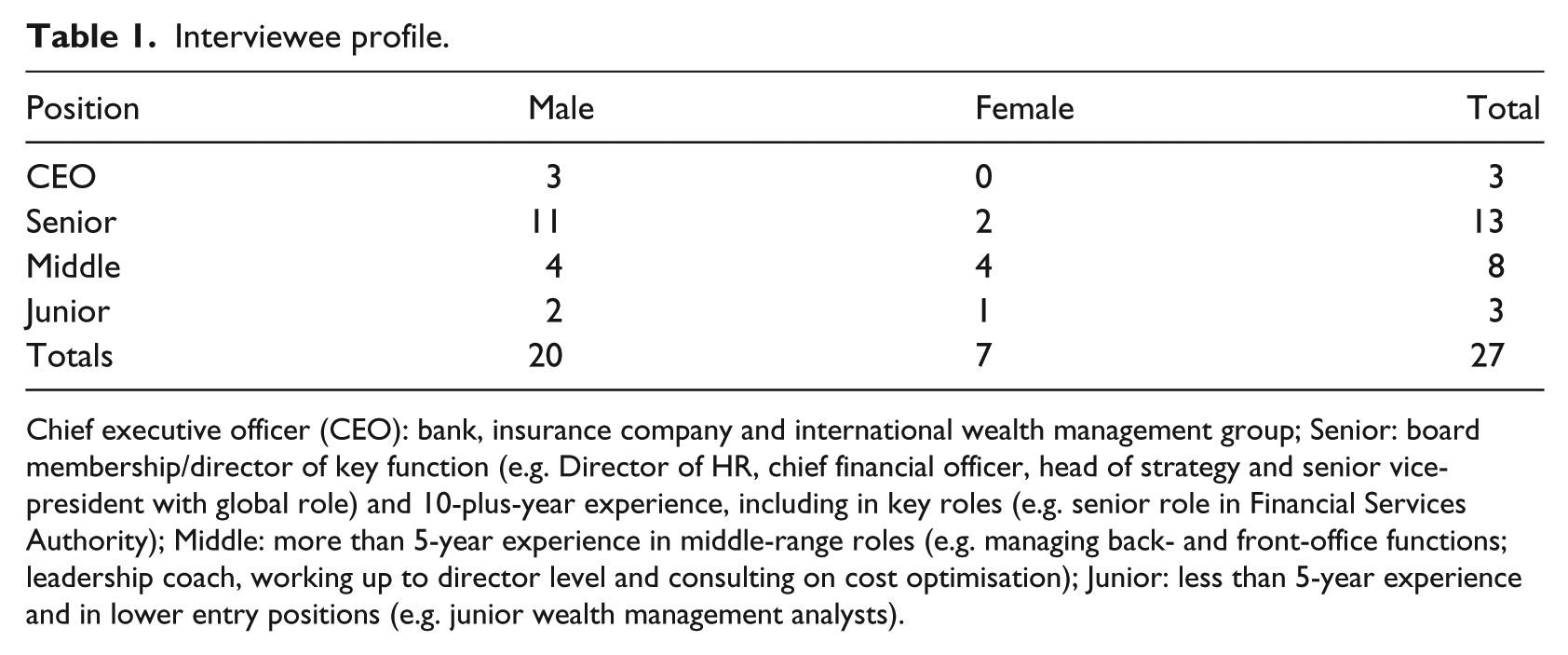
Chief executive officer (CEO): bank, insurance company and international wealth management group; Senior: board membership/director of key function (e.g. Director of HR, chief financial officer, head of strategy and senior vice-president with global role) and 10-plus-year experience, including in key roles (e.g. senior role in Financial Services Authority); Middle: more than 5-year experience in middle-range roles (e.g. managing back- and front-office functions; leadership coach, working up to director level and consulting on cost optimisation); Junior: less than 5-year experience and in lower entry positions (e.g. junior wealth management analysts).
The interview schedule is contained in Appendix 1. It is adapted from Owen and Davidson’s (2009) diagnostic criteria for identifying hubris, with a focus on the identification of specific behaviours associated with the criteria in question. This approach sought specific incidents associated with hubris rather than requiring interviews to speak of hubris in a generic sense, or to infer its presence by working backwards from specified organisational outcomes. All interviewees were assured of confidentiality. Interviews were conducted face-to-face where possible or preferred – for example, all three of the CEOs requested that they be interviewed directly. Alternatively, to suit the preferences of respondents, interviews were conducted by telephone or Skype. All were audio recorded and transcribed for analysis. The transcripts were then sent to each interviewee to check for accuracy and to ensure further anonymisation.
Data analysis
I used thematic analysis, viewed as a ‘method for identifying, analyzing, and reporting patterns (themes) within data’ (Braun and Clarke, 2006: 6). Thematic analysis looks for patterns of repetition. This means that sometimes themes ‘pervade much of the data, cross-cutting many or all of the other thematic clusters’ (King, 2012: 452). Such was the case in this analysis. Initially, the categories identified by Owen and Davidson (2009) were regarded as themes and formed the basis for coding the data. This was a process of what Lee (1999) described as ‘selective coding’ (p. 49) – that is, I began with categories in mind (reflecting both the diagnostic criteria for hubris, and the research questions animating this study) and then coded the data accordingly. Each transcript was read on numerous occasions to extract clear incidents. A post-doctoral research fellow read them independently until agreement was reached about what constituted actual incidents. Where agreement could not be reached, the possible incident was deleted from analysis. A final total of 101 incidents were identified. Common types of incidents recurred across the criteria proposed by Owen and Davidson (2009) to identify hubris – for example, abusive behaviour, rash acquisitions and the prioritising of personal rewards.
The 101 incidents were coded and organised afresh in terms of themes that expressed where common types of incident occurred. I sought to give primacy to how interviewees understood their experiences. This resulted in ‘a back and forth’ iterative process between pre-existing categories and respondent accounts of incidents that is characteristic of qualitative research, in search of synergies, differences, similarities, insights and what Klag and Langley (2013) describe as ‘conceptual leaps’. Eventually, five key themes emerged that cut across the diagnostic criteria for hubris identified earlier in this article and which guided the interview protocol that had been developed.
The analysis that follows is, therefore, concerned with illuminating patterns of interacting behaviours that interviewees associated with various categories of hubristic behaviours. Through focusing on behaviours and what these tell us about relationships and organisational contexts, the intention is to illuminate the ‘systems of dispositions (that actors) have acquired by internalising a determinate type of social and economic condition, and which find a definite trajectory within the field under construction a more or less favourable opportunity to become actualised’ (Bourdieu and Wacquant, 1992: 104–105).
In addition, while interviewees provided incidents as asked, they also went beyond them to offer general observations about their industry and about hubris. Using the same approach, the material was repeatedly read and observations that illuminated the research questions guiding this project were extracted. I draw from these in the analysis that follows.
Results
Five themes were identified that captured the most common types of incidents that remained in analysis: namely, over-confidence and over-persistence, recklessness, self-interested behaviours and isolation from reality, contempt for critical feedback and for regulators, and abusive behaviour. These are shown in Figure 1, where N is the total number of incidents associated each of the behaviours. The figure suggests that each behaviour reinforces the other. Figure 1 also summarises the defining characteristics of hubris that guided the interview protocol and suggests that the behaviours concerned feed directly into the creation of hubristic mind-sets and behaviours. The discussion that follows unpacks these relationships.
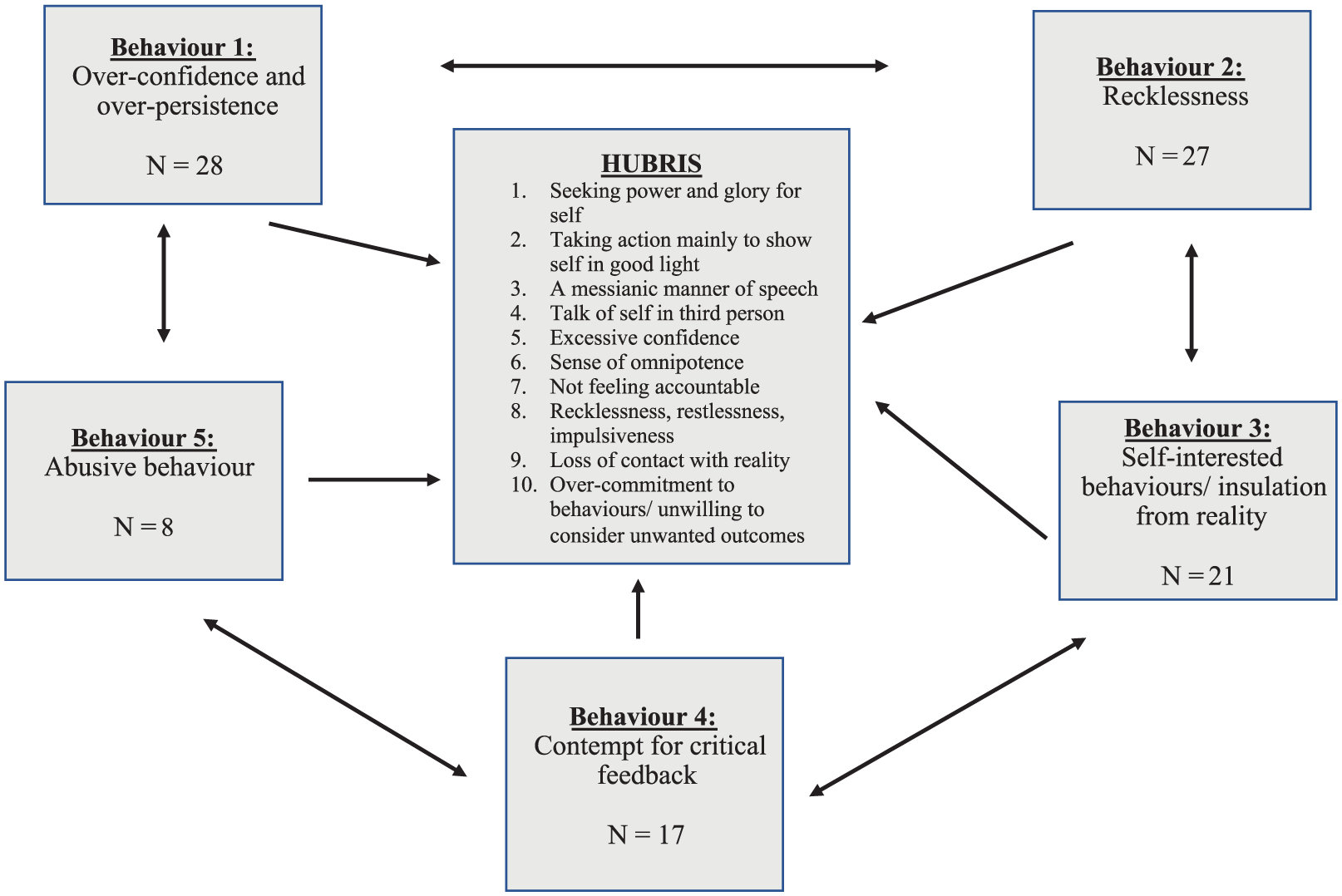
A behaviour-based view of hubris.
Here, I discuss the five categories of incidents, in terms of descending order of frequency.
Over-confidence and over-persistence
A total of 28 incidents were related to this. A note of ambiguity was evident in many accounts. For example, a male former CEO said, (I) saw X standing on a platform talking to his troops about what they were going to do. It was very sophisticated. It reinforced their belief in themselves as participants in this transformation that was going to be wrought, and it very much reinforced their belief in him as their leader. Now, from his point of view, all these were desirable. And actually to endow people with internal rivalries with a sense of common purpose was not an easy thing. It’s a performance. This is a highly theatrical business. And having people feel that they’re part of some great wave, it’s messianic.
The idea of ‘a performance’ echoes Bourdieu’s (1991a) notion of a social field as ‘a game’. In common with any game, or performance, the actor does not have to mean it, at least initially. However, their mastery of the game may have two effects. First, like a method actor over immersed in a part, they can come to internalise the essence of their performance, so that (1) the regular performance of optimism becomes wedded to who they are, and who they are perceived to be and (2) they ‘self-persuade’ themselves of the optimistic messages they are communicating. The game owns the player rather than the player owning the game. Second, they role model a spirit of over-optimism for others, who have a need for the reassurance that this offers, and who then become inclined to emulate the optimistic behaviours and attitudes of the performer in question. Increasingly, the social field becomes dominated by a habitus characterised by public demonstrations of (excessive) optimism. In the process, hubris is co-constructed through the dynamic interactions of actors who expect certain performances from each other and then reinforce such performances in numerous ways (e.g. through conformity enacted in group rituals that discourage questioning and dissent, and via the exchange of material rewards).
The interviewee acknowledges that a great deal of confidence is required to do the job (or play the game) of rallying people behind a common sense of purpose, and, in that respect, it is an organisational imperative that is seen as positive. It remains difficult to determine when it becomes harmful. Likewise, a male Senior Manager described a prominent banker as follows: … incredibly charming. Who hates the bankers the most? I would place a bet that that person within ten minutes they would be charmed by X. Always, even you could have flooding going on in here and he’d say, this restaurant is brilliant. It’s going to be great, we’ll have this sorted in two minutes. This is going to take off. I, me, it’s all about them. There’s no sense of we, or we are accomplishing. It’s I this, I’m going to do this. I’m incredibly positive, I’m incredibly optimistic about the future. I, I, I.
Such charm is hard to resist but is also useful to those seeking to build positions of power within organisations (Keltner, 2016). However, the interviewee is describing here a level of super-confidence in all situations. This suggests that confidence might be viewed as over-confidence when it becomes an indiscriminate reflex that is relatively indifferent to the actual circumstances being faced. It may be that banking and finance represent an organisational context that is particularly conducive to the emergence of such behaviours. For example, Storey (2011) explores how business owners looking for financial support are habitually overoptimistic about their prospects of success and play down the influence of chance on business outcomes. This may constitute another organisational dynamic tempting banker into over-optimism: in a further instance of co-construction, a key part of their client base displays it for them, and welcomes it in return.
While all leaders may exhibit dangerous levels of over-confidence at times, many correct themselves by observing the impact they have on others and by checking their strategies and expectations against what is happening in the outside world. Without such reflexivity, fantastically unreal visions, strategies and expectations can be developed. A female middle manager recounts one such incident as follows: The CEO rang me up … and asked me to create a market for this toxic rubbish that was being devalued every day … And she thought, because we were a market operator, we could trade the stuff. So the reality was we couldn’t, because each stock was unique … Now, for me, the element of hubris here was the arrogance of which she was actually, for good reasons, good intentions, thought that she could provide a market solution to a situation that was broken.
A male senior manager who worked as a regulator showed how exaggerated confidence led to boasting about possibly illegal activities and, therefore, risked prosecution: He thought he was above the law. There’s another chairman of another bank who I have evidence of doing almost exactly the same. I don’t have enough evidence to prosecute him, he doesn’t know, but I know. So I’ll be looking at him. And these are senior people. So it tends to be the senior people. The people … the kind of more organised crime people that I deal with, you know, they have throw-away mobile phones, they’re not thinking they’re above the law. They know what the law is, and they’re trying to avoid it.
These problems were reinforced by the out-sourcing of risk assessment to rating agencies who then sold ‘fantasy’ back to the sector by under-stating credit risks (Wolf, 2014). A male senior manager highlighted the effects on key people within the industry: The argument increasingly became ‘hang on guys, let the rating agencies (assess credit risk) … They’re experts’. They pushed that concept rigorously to banks and institutions and they won. Everybody accepted that they were the authorities on credit rating. Now, they’re fucked because they’re discredited through the collapse of the mortgage backed securities market.
Misplaced faith in ratings agencies bred confidence in decisions that were ultimately shown to be flawed. Risk assessment became little more than an empty game that organisational actors used to comfort themselves and reassure others. The result was greater recklessness.
Recklessness
A total of 27 incidents fitted this category. Accounts of over-hyped acquisitions were common. A male senior manager recalled a particular acquisition as follows: (We) spent about I think 775 million dollars … on buying a small retail bank in Russia. The then chief executive of the global retail and consumer banking side … was determined to, in his phrase, ‘plant flags in new territories’. So one of the things you’ll find with some chief execs is glory through acquisition … He ignored everybody and bought it. We bought an absolute dog of a bank. It was I mean, literally the Russian mafia owned it. Saw us coming, and X have since sold it back … last year. So five years later for about £25 million.
Interestingly, many other interviewees reported that similar warnings were expressed but ignored. This calls to mind the wider organisational phenomenon of silence, in which actors either minimise their expression of concern and dissent or face such discouragement when they do so that they gradually self-censor their views (Tourish and Robson, 2006). The lack of critical feedback, when combined with people having a vested financial interest in successful outcomes, ensured that many became over-committed to whatever strategy they were pursuing. A male former CEO recalled, I remember a particular deal where the chief executive (was) coming under pressure from the chairman to complete this deal. And it was at a moment when one could have walked away from the deal. But I remember the chief executive thinking that if he did not go forward with the deal, it could be a career-limiting decision, and in the event, we went ahead with the deal. Q: And was it a good deal or a bad deal? A: Bad. Very bad.
Pressure was also applied from those whose fees depended on the completion of acquisitions. A social field was being constructed that embraced more actors and blurred boundaries between what may once have been less porous organisational configurations. One senior male interviewee said, In the old days, corporate financiers who gave you advice lived by giving you a bill for that advice. It was, in relative terms, modest. If you then say, ‘well actually not only am I giving you this advice, but we will issue the securities, distribute the securities, do the loan financing, underwrite the deal, etcetera’, that hundred has now become a thousand. So the scale of these transactions (has) meant that they simply cannot give you dispassionate advice.
In the process, borderline or outright illegality may occur. The male senior manager who was a regulator spoke of an incident as follows: We fined a guy, of X investment bank for disclosing what we call inside information. In a nutshell, he’d written such-and-such company has just discovered oil, and it wasn’t disclosed to the market place. And we found it, and it was improper disclosure, and he was fined £X … He is the chairman of one of the most venerable investment banks in the country, and he was doing it to show off.
While Boards are supposed to exercise a check on reckless behaviours, several interviewees doubted their ability to do so. Their comments reinforce the findings of Oehmichen et al. (2017). They conclude that the benefits from having prestigious individuals on Boards (e.g. access to social capital) can be undermined by forms of ‘elite cohesion and … elite exclusiveness’ that may generate nepotism between directors and managers. For example, a senior male manager argued that People want to become a non-executive director, because you can get four or five of them for ten to 15 days of work a year. Your job is to ask awkward questions. So the executives would come in, present their strategy, or plans. But you learn as a non-executive director, you don’t want to challenge too hard, because if you challenge too hard, the chairman brought you in for a little chat, and I saw this happen a number of times, so that’s not how you do business here. The word would go round the chairmen of different institutions that you were trouble.
This ‘cosiness’ is likely to prevent vigilant monitoring. Moreover, the absence of critical feedback reinforces excessive self-confidence in a never-ending and mutually reinforcing loop of delusional beliefs leading to reckless behaviour, and reckless behaviour further strengthening delusional beliefs.
Self-interested behaviours and insulation from reality
I identified 21 incidents that fit this category. These highlighted a culture of extreme privilege which the interviewees felt prevented those affected from forming a realistic understanding of their own organisations, and the world beyond them. A male senior manager spoke of a Board Chairman as follows: The chairman of X … was Lord Y. … And you’d go occasionally to lunch with (him) and you’d walk up to the reception desk, they obviously didn’t know who you were, and the moment you said I’ve got lunch with Lord Y, they ushered you into a roped-off lift that went straight up to the Nth floor where you were met by a sort of liveried butler, ushered into Lord Y’s private lunchroom … And at the end of lunch once … he offered me the car to go back to the office, the car being a chauffeur-driven Roller. You know, what happens to these tycoons is they surround themselves, not deliberately, with yes men, but that’s how they become.
A male senior manager gave an account of behaviour which borders on eccentricity, but of a particularly self-inflated kind: (The CEO) had a Starbucks built inside (the) office because he only liked Starbucks coffee. He didn’t like having to go out for it, or send one of his runners to go out and get coffee so he had one, a small thing set up in the corner of his floor which was Starbucks, just for him. They would bring his coffee to him in a cup. It had to be done in a certain way and if the cup was laid down, it had to be, the Starbucks logo had to be pointed towards him.
A female middle manager offered a further striking example: The chief executive wouldn’t engage with her staff, but that wasn’t a new behaviour; that was her behaviour from the day she joined. So she had a key to the lifts, and she would key the lifts off so that staff couldn’t travel in the same lift as she did. And there was one example when she forgot to key the lift off, and it opened at a floor and one of my colleagues got in, and she asked the person to leave the lift.
She then went on to provide this example: And I used to have a good working relationship with her (the CEO). I happened to be in the same queue as she was buying groceries at Marks and Spencer’s, and I had the audacity to turn round to her and say good morning, and I was reprimanded for … Not by her, but by my director, for having spoken to her in a queue in the shop.
Bourdieu (1991b) highlighted how The structure of social space manifests itself, in the most diverse contexts, in the form of spatial oppositions, appropriated physical space functioning as a spontaneous metaphor for the social order … The stake of these struggles is the construction of spatially based homogeneous groupings, that is, segregation that is both cause and effect of the exclusive usage of a space. (p. 106)
The incidents I describe here showcase precisely these processes. They suggest that architecture and buildings (including private dining rooms, specially tailored offices and adapted lifts) were a means for powerful individuals to acquire social capital. This contributes to a social field conducive to hubris in at least two senses. First, elite actors become more divorced from reality, as they enter a world where their ever more eccentric whims are indulged by compliant subordinates and peers. A habitus of entitlement and an awareness of occupying an environment that is very different to the ‘outside’ world loom large. Second, it seems likely that other actors will aspire to similar levels of affluence and influence and emulate the behaviours of those that have already succeeded in achieving them. Thus, the social field of what I characterise as hubristic banking exists in the immediately observable behaviours and relationships of various actors. But it is also a process of becoming, as others comply with the demands of hubristic mind-sets, seek to emulate them and are rewarded for doing so by a gradual progression to leadership positions.
At some level, there can be an awareness of how damaging much of this is. One of my interviewees, himself a senior manager, spoke of a top banker as follows: ‘Someone asked once how his wife would describe him, and he just turned around in all seriousness and said, “lost”’. None of this seems likely to produce a balanced view of oneself, of one’s place within the wider world or of what might be appropriate relationships with other powerful actors and agencies.
In terms of social fields and organisational processes, an additional dynamic is also evident in these accounts. Lounsbury and Ventresca (2003) have noted that much field theory research ‘explicitly focalizes overt forms of power by analysing the origins of logics and other cultural meaning systems that constitute actors and “valorise” certain dimensions of inequality over others’ (p. 465). However, valorisation is a complex concept. On the surface, the stories of hubristic leaders that I provide here are a form of mockery, perhaps intended to bring hubristic leaders down to size, upset power relations and distance the story teller from the object of ridicule. But these dysfunctional power relations are also being affirmed rather than negated, in at least two ways. First, to coin a phrase, the interviewees live in ‘the real world’ rather than an imaginary idyll of workplace perfection. Despite criticisms of the present, there was little suggestion that another reality could be brought into existence by human action. Second, as Gabriel (1997) has observed, ‘To many people in the lower echelons of organizations, top leaders do not appear altogether human, not at least in the sense that colleagues or immediate superiors are’ (p. 316). But narratives focusing on leaders who have supreme power also implicitly minimise the possibility of resistance, for who can be expected to resist such all-powerful beings? They thus reinforce imbalanced power relationships even as they purport to subvert them. The dominant social field of hubristic banking is thereby strengthened.
Contempt for critical feedback
In total, 17 incidents reflected this. These data are consistent with issues of over-confidence and recklessness (see above). They reinforce a view of hubris as being produced by the interaction of multiple behaviours and contextual influences. Many interviewees spoke of warning signs ignored in the rush to pursue particularly harmful courses of action, driven by people’s excessive faith in the quality of their judgement. This example from a male senior manager is typical of many: A major financial services takeover was going down. A friend of mine … was in a meeting with the acquisition team, was running the takeover, and he sort of felt, you know, what’s going on here? And the guy said … we just don’t think this deal should be done. We think it’s getting too expensive, it’s getting too complex, the market’s changing, we shouldn’t be doing this deal. So this chum of mine said, well, have you told the chief executive or the chairman? No. So he told them, I’m having breakfast with him tomorrow morning. Shall I say there’s concerns in the team about this? Anyway, so (they) are having breakfast, talking through what they need to go through. And (he said) there’s a lot of concern about this deal in the team. So there was a bit of a pause, chief executive: clear your desk, get out, you’re fired … And if you open your mouth about this I will sue you to hell and back.
As Bourdieu and Wacquant (1992) express it, ‘To think in terms of fields is to think relationally’ (p. 96). Thus, there are plentiful claims in the leadership literature that effective leaders set a powerful example that others then emulate (e.g. Goodwin, 2018). But the notion of mirroring can also be applied to ineffective leaders and destructive leadership behaviours, not least because their ineffectiveness and destructiveness may not be as evident at the time as they appear in retrospect. An organisational perspective on hubris explores how hubristic leaders set a particular kind of example that is also imitated and institutionalised. Thus, I suggest that the above incident is one of many where leaders role model hubristic behaviours. Actors cannot fail to notice that compliance offers a route to advancement. Increasingly, they copy the hubristic behaviours of those at the top. Yet, without critical feedback, the social field becomes dominated by a monocultural habitus that is supportive of the ever greater exercise of power, since overt challenges to convention and power are discouraged. As Sadler-Smith (2019) argues, ‘… hubristic leadership is more likely to emerge when there is a co-existence of a hubristic leader with collusive followers in a conducive context’ (p. 7). Hubristic leaders do not stand apart from complex processes, exerting various forms of influence on actors while remaining themselves relatively immune to the influencing actions of others. Rather, they are themselves part of, and are relationally constituted by, complex adaptive systems (Tourish, 2019). A hubristic social field is co-constructed through the interactions of multiple actors, each with different forms of relational power at their disposal. Thus, the collusion of followers fuels ever greater levels of confidence on the part of leaders. In turn, it can lead to grotesque displays of arrogance. A male CEO offered an example of precisely such arrogance towards someone with an international reputation: I went to a dinner once in Berlin with Gerhard Schröder when he’d recently become Chancellor. Even if you didn’t like him, he was the Chancellor of a major country. And he had this group of bankers for dinner from London. And under the leadership of one of them they spent the evening insulting him effectively. ‘Why did you do something so dumb?’ ‘What was going through your head?’ ‘Why did it seem smart to take this action?’ ‘Do you realise what the markets think of you?’ … I mean, they had completely forgotten who they were talking to. It was grotesque.
The acquisition and cultivation of power is here clearly indicated as a facilitator of hubris: the powerful individuals highlighted in these incidents combined an exaggerated sense of self with a diminished sense of the value of others. In essence, as a group or mini-organisation, they appear to have developed a collective form of hubris.
Accounts of a contemptuous attitude to regulatory authorities are particularly alarming. The following illustration comes from a male senior manager: We had to do a presentation to what was then the FSA. So we went to this meeting and … these two, what looked like children walked in. I found out both were one year out of College. Shaking, they were so nervous about coming into a big office like ours, the chief executive, the whole works and I was sitting there thinking, this is ridiculous. They just said, ‘I have a couple of questions for clarification on the material that we had sent. Thank you ever so much. We’ll see you again in a year’. It was known through the 2000s, if you couldn’t get a job in a bank you’d get a job at the FSA.
Abusive behaviour
Eight incidents fell into this category. A male senior manager offered a particularly interesting example, since it includes an implication at the very least of physical violence: I was privy to X literally threatening another executive with a baseball bat. Y was the group head of marketing and brand, and therefore wanted to spend some of the group budget on brand and marketing, on stuff that would impact the brand across the whole group, including X’s world of capital. Y had his evidence, both in terms of brand strategy, the positive analysis that said what X was planning to do in marketing and brand was not optimum. In his youth, he was a boxer. X was his usual charming, wonderful self. I’m sure we can sort this out. It’s going to be fine, let me explain what I want to do. Y came back with his counter-arguments and I could see X was getting angry and then (he) used the lines of … you don’t understand. We’re going to do it my way. Y said no, and in the end, X started to yell at him. He would yell and scream literally, and then the yells and screams turned into personal insults, F word, C word, the whole lot. Now that’s not uncommon for those guys. You effing little C, you effing do that now, I’m going to come by yours and kick your effing head in. So he was yelling and screaming and Y, quite rightly, was just sitting there calmly, he said, … calm down. X had two baseball bats in his office and he just got up and picked up a baseball bat. Just said to Y, if you don’t do what I’m telling you to do, you’re going to regret it. Y just very calmly went, if you lay one finger on me, I’m going to put you in hospital. X just put it down and, hey, you know I’m only joking. Of course Y just left the meeting and said, you’re an idiot. Went straight to the then chief executive’s office with me in tow. Explained what had happened to the then chief exec and I guess in my mind, I thought X’s on his way.
Instead of being ‘on his way’, the person responsible for the behaviour in question became the Bank’s CEO and achieved an international profile. It illustrates how ‘the structure of the organizational field is constituted by the actual power relations among actors, which are characterised by an ongoing power struggle for attaining a dominant position in the field’ (Van Aaken et al., 2013: 368). This suggests that hubris is nurtured over an extended period within banking. Rather than suddenly afflict people who acquire leadership roles (as some research appears to suggest), a tolerance of misdeeds (as in the example above) reinforces hubristic behaviours at various stages of an actor’s career. If it can be said that a social field of hubristic banking has become well established, it may even be that people acquire leadership positions precisely because of hubristic inclinations rather than in spite of them, since it is assumed they will proceed to deliver positive financial results.
Discussion
The data discussed above point to a dynamic view of hubris, in which behaviours interact with each other within a given organisational context to produce a social field that I have characterised as hubristic banking. This suggests that hubris emerges through a number of what I term ‘inflection dynamics’ – that is, organisational forces that impact on individuals such that they decisively reinforce the behaviours and attitudes that Figure 1 suggests indicate the presence of hubris. I suggest that five such dynamics can be identified in those data above, namely: (1) a systematic pressure for success; (2) high levels of reward; (3) the acquisition of power; (4) perks of office; and (5) the failure to punish transgressions, and instead often reward them.
I view these as a series of interlocking and mutually reinforcing dynamics rather than stand-alone phenomena. In Bourdieu’s terms, they create a social field that is especially conducive to hubris. Thus, systemic pressure for success was a frequent theme in my interviews. The culture described was one of incessant pressure to achieve results that required hard work and a total immersion of people in the norms of banking and finance. Many responded positively to this imperative. In the process, they convinced themselves of the spectacular value of the work that they did and of their own extraordinary importance in doing it. Some even went so far as belittle an elected head of state. High levels of reward for those who succeeded further inflamed a growing sense of confidence, a determination to do more to obtain ever greater rewards and a feeling that these were merited. This, of course, necessitated the gradual acquisition of power. The downsides of this that I have documented in the analysis above is consistent with much other research on power and the dark side of leadership more widely (e.g. Lipman-Blumen, 2005; Tourish, 2013). It bred a sense of entitlement and difference that seems innately conducive to hubris, as in the example of a CEO using her own elevator key to avoid interaction with others. Other perks of office (e.g. the ability to construct one’s own Starbucks coffee area in a private office) signalled a growing detachment from the work norms exhibited by other people. However, given the pressure for success, those seen as delivering could find their transgressions unpunished/rewarded. I offered the particularly striking example of a senior manager who appeared to threaten physical violence, but went on to become his bank’s CEO, until a variety of well-publicised events brought his career to an unhappy conclusion. In this instance, at least, nemesis did indeed flow from hubris. Nevertheless, these incidents speak to out of control individuals with a strong sense of self-importance, and the status to have their behaviours tolerated. They are consistent with a toxic organisational culture. When such behaviours are rewarded, fully fledged hubris is likely.
This is supported by Scott’s (1991) view of ‘organizational fields’, which he defined as ‘a community of organizations that partakes of a common meaning system and whose participants interact more frequently and fatefully with one another than with actors outside the field’ (p. 56). Organisations and the social fields they inhabit develop partly because behaviours, attitudes and cultural norms are drawn from options that acquire legitimacy through modelling by influential actors within the organisation and within the wider sector that it inhabits (Hoffman, 1999). Organisational boundaries in banking and finance are porous as actors switch their allegiance from one brand to another. This lends itself to organisational isomorphism (DiMaggio and Powell, 1983): actors carry learned attitudes and behaviours with them when they change jobs or roles. They then go on to select, reward and promote those who draw from well-established behavioural and attitudinal norms, while at the same time not selecting, punishing, stalling and terminating the careers of those who do not.
An organisational perspective resists pathologising individuals, a favourite media pastime, and suggests the need for action at individual, organisational and social levels if the problem of hubris is to be reduced. This poses a further challenge to the usefulness of the Diagnostic and Statistical Manual of Mental Disorders (DSM) diagnostic criteria discussed earlier in this article. They may offer a useful starting point for the further study of hubristic behaviours. But the finding that certain behaviours crisscross the DSM categories suggests that the categories have less explanatory value than purely psychological perspectives tend to assume. A more embedded and organisational perspective is required.
This invites a greater appreciation of how multiple factors interact with each other over extended time periods to produce complex hubristic outcomes. Hubris is best conceived as a series of interacting behaviours. These are precipitated by organisational dynamics that intensify imbalanced power relationships, leading people to prioritise self-interest and diminish the importance of robust debate and dissent. Hubris is thus rooted in a gradual acclimatisation to toxic organisational cultures, the obtaining of high rewards for success, a consequent sense of entitlement and an untethering of people’s egos from any measure of sustainable achievement. As many studies of the banking and finance sectors have shown, and as the data in this article illustrate, the performative norms that prevail within this sector seem to perfectly facilitate the development of hubris.
Implications for practice
Many commentators have observed that the behaviours which led to the 2008 crash remain substantially in place (e.g. Luyendijk, 2015). A major report on the culture of retail banking concluded that ‘cultural changes in major banks remains fragile … Our over-arching conclusion us that it will take a generation to create a new culture in UK retail banks’ (Spicer et al., 2014: 9–10). If little has changed, it may be that further crises are inevitable, perhaps even on a greater scale than that of 2008. This surely poses an urgent question: what, if anything, can be done, and done rapidly, to ease the effects of hubris? Specifically, I suggest that
The data suggest that a derogatory attitude to regulators was a key ingredient of the hubristic behaviours that led to malpractice. Some novice regulators themselves felt intimidated by those they were supposed to regulate. This lack of confidence and expertise seems to have hindered rigorous investigation. Thus, Green (2015) criticised the United Kingdom’s Financial Conduct Authority’s predecessor institution, the Financial Standards Authority, for failing to investigate malpractice when the statutory threshold test for such investigations had been met. At a minimum, regulators must have the resources, expertise and experienced personnel to be credible deterrents of malpractice. This draws attention to the quality of regulation, rather than the often tired debate about whether we need more or less of it.
A recurring theme in these data is that Boards failed to exercise restraint on overambitious CEOs and their plans. One factor was that members were anxious not to offend powerful CEOs. In contrast, Haldane’s (2014) analysis of decision making at the Bank of England’s Monetary Policy Committee is explicit in recognising the positive role of dissent and highlights how often members opposed a majority view. The data also suggest that the culture of the banking and finance sectors often pressurises even senior people to conform to the demands of powerful CEOs, in the interests of retaining their places on various Boards. Yet groups, particularly Boards, require exposure to multiple different opinions if they are to avert hubris. Key decision makers need more awareness of the techniques for ensuring that this occurs. Board members may well benefit from more training. In addition, systemic reforms could seek to prevent the emergence of cartels of individuals who have too many over-lapping relationships to effectively discharge their fiduciary responsibilities.
The data repeatedly showed a cavalier attitude to risk management, driven by the expectation of high rewards when the risks pay off. Hubris is endemic to such calculations. The Turner Report (2009) urged incentive schemes to avoid rewarding undue risk taking and to integrate risk management decisions into the remuneration process. Despite this advice, a more balanced approach to this has proven elusive. In the longer run, it is vital.
Performance management systems need to change in multiple ways. My data highlight toxic behaviours as a manifestation of hubris and suggest that they are often not dealt with through appropriate disciplinary procedures. As in other spheres of working life, a zero tolerance approach to threats of violence and abusive language, the clear articulation of acceptable standards of behaviour and robust action against offenders seems appropriate.
Conclusion
More open-ended forms of inquiry into hubris than can be found in conventional approaches to researching this issue are called for. It is important to avoid using the terms ‘over-confidence’ and ‘recklessness’ as inaccurate and simplistic post hoc rationalisations for organisational failure. In line with Bourdieu’s theory of social fields, we also need to pay more attention to how behaviours, dispositions and organisational contexts interact and are facilitated by inflection dynamics to produce hubris.
When banks fail, they cause damage far beyond themselves. While this could be said of all organisational failures, the finance sector is particularly well placed to inflict systemic harm on our society. In adding to our understanding of hubris and what we can do to reduce its effects, this article seeks to improve our ability to avoid potentially catastrophic financial shocks in the future.
Footnotes
Appendix 1
Acknowledgements
I wish to acknowledge the role of the Daedalus Trust in providing the financial support that made this project possible, and for facilitating access to many fascinating people who worked in the banking and finance industries. I also want to thank Professor Russell Craig for reading an earlier version of this paper, and offering invaluable criticisms. Above all, my grateful thanks to the 27 interviewees who generously offered their time, and my appreciation for their candour. Thanks also to Dr Naheed Tourish for her assistance with the data analysis phase of this project. Lastly, my thanks to the editor and anonymous reviewers for their helpful feedback.