




Abstract
In this article, I draw upon interviews with 30 Nepali returned women migrant workers to elucidate how the gendered institutional logics of both the Nepali state and for-profit manpower companies synergistically function to constrain women’s mobility. In particular, I focus on women migrant workers who migrate illegally to Gulf countries to work as domestic laborers, as this constitutes one of the largest channels of women’s labor migration from Nepal. To illuminate the particulars of Nepali women migrant workers’ experiences, I employ two theoretical frameworks, both developed by feminist political economists within the context of feminized workplaces broadly and global factory floors specifically. The first framework presents a logic of female disposability as shaping the feminized workforce of the global South. The second framework presents a logic of gendered control as doing the same. In this article, I show how these dual logics can be applied to women’s foreign labor migration in Nepal, and argue that these logics operate simultaneously through the various institutions that Nepali women navigate during migration. The Nepali case shows how both logics serve ultimately to limit women’s mobility and bolster the authority of institutions and organizations historically controlled by men—for example, the family, the state, transnational corporations—over women migrants. By bringing these two logics to bear on a case of women domestic workers’ migration from the global South, this article offers new insights into the functioning of institutions central to this large-scale, transnational movement of people.
Keywords
Understanding Nepali women’s labor migration
Labor migration from Nepal has been a typical livelihood strategy for over a century. However, it is only in the past 30 years that Nepali women have joined this migration stream in significant numbers. The sparse scholarship on this newer migrant population has revealed the particular challenges that Nepali women migrant workers (WMWs) face throughout the migration process including economic exploitation, unsafe working conditions, sexual harassment, and violence (Gurung, 2015; Sijapati et al., 2014). In this article, I draw upon interviews with 30 returned WMWs to elucidate how the gendered institutional logics of both the Nepali state and for-profit manpower companies synergistically function to constrain WMWs’ mobility. In particular, I focus on WMWs who migrate illegally to Gulf countries to work as domestic laborers, as this constitutes one of the largest channels of women’s labor migration from Nepal (Department of Foreign Employment (DoFE), 2014).
To illuminate the particulars of Nepali WMWs’ experiences, I employ two theoretical frameworks, both developed by feminist political economists within the context of feminized workplaces broadly and global factories specifically. The first framework presents a logic of female disposability as shaping the feminized workforce of the global South (Chang, 2016 [2000]; Wright, 2006). The second framework presents a logic of gendered control as doing the same (Fernández-Kelly, 1994; Lynch, 2007; Salzinger, 2003). In this article, I show how these dual logics structure women’s foreign labor migration in Nepal and argue that these logics operate simultaneously through the various institutions that WMWs navigate during migration.
The ‘disposability’ framework argues that the momentum of global capitalist accumulation works on and with local systems of gendered stratification to mark poor, proletariat women’s bodies as disposable components of capitalist production. In this framework, women’s embodied labor, and women’s bodies, are disposable inputs with planned obsolescence in various stages of use—both economic productivity and biological (re)productivity. The ‘control’ framework argues that states, international capitalist enterprises, and individual capitalists work to maximally control the embodied labor of women workers in order to efficiently extract value and accumulate capital. In this framework, particularly gendered forms of control are used as various stakeholders attempt to manage, discipline, and constrain women workers.
At first glance, the logics of disposability and of control may seem antithetical. After all, why attempt to minutely control something that is disposable and imminently replaceable? As the case of Nepali WMWs illustrates and, as I elaborate upon in the ‘Discussion’ section, rather than counter each other, they function synergistically. This case demonstrates how both logics serve ultimately to limit women’s mobility and bolster the authority of institutions and organizations historically controlled by men—for example, the family, the state, transnational corporations—over women migrants. By bringing these two logics to bear on an instance of women foreign workers from the global South, this article offers new insights into the functioning of institutions central to large-scale, transnational movements of people via labor migration. This analysis furthers the project identified by Townsley (2003) and Harding et al. (2013) for the study of gender in organizations, and takes seriously Townsley’s (2003) exhortation to consider ‘the complexities of gender relations when “the organization” is a global, inter-organizational network of supranational alliances, multinational corporations, nation-states, and local and regional communities’ (p. 630).
In the following section, I discuss the literature I draw upon to analyze the institutional/ized logics shaping Nepali WMWs’ migration experiences. Following this, I briefly describe data collection and analysis. The next two sections provide an overview of the socio-cultural context and the history of women’s migration in Nepal, respectively. After providing context, the next section focuses on where and how the logic of disposability operates within institutions that facilitate Nepali women’s labor migration. The subsequent section analyzes where the logic of gendered control functions in these same institutions. The final section discusses how this case study may contribute to a richer understanding of the specific phenomenon of Nepali WMWs and to broader discussions in migration studies, feminist political economy, and organization studies about the gendered valences of transnational labor migration.
Dual logics: feminist political economy and migration
Research on migrant women domestic workers from the global South have clearly illuminated the issues of exploitation and abuse that are endemic to this sector (Ehrenreich and Hochschild, 2003; Parreñas, 2001). The hidden nature of the work, the intimate setting in which labor is conducted, and the explicit power differentials that are emboldened in in-home domestic work place women domestic workers in precarious and vulnerable situations (Chang, 2016 [2000]). Scholars have further shown that mistreatment of migrant domestic workers is exacerbated if they are, like my own informants, working through informal channels and without documentation (Brennan, 2014; Oishi, 2005).
Research on WMWs from Nepal has been limited and discussion of migration has tended to view Nepali women as ‘left behind’ by male migrants (Adhikari and Hobley, 2015; Maharjan et al., 2012). Furthermore, scholarship about Nepali women’s labor migration patterns has favored accounts of higher status occupations and migration to the global North (Adhikari, 2013; Gurung, 2015). Existing research shows that poor labor migrants are especially vulnerable to exploitation and harm in the migration process (Thieme and Müller-Böker, 2010: 117, Department of Foreign Employment, 2014: 12). Due to gender-discriminatory laws limiting women’s labor migration opportunities and difficult bureaucratic procedures, poor women often turn to local recruiters and manpower agencies to help them migrate through informal channels (Sijapati and Limbu, 2017). This population is vulnerable to sexual exploitation and potential trafficking due to the opaque nature of illicit channels (Abramsky et al., 2018). In addition, illness and injury from unsafe working conditions is a common occurrence while working abroad (Simkhada et al., 2018). The informal nature of WMWs’ migration to Gulf states for domestic labor has made this population particularly hard to study, and there is a corresponding dearth of empirical research on this population (International Labor Organization (ILO), 2015).
To partially address this gap in the scholarship, I analyze the operation of multiple institutions that organize the movement of Nepali WMWs abroad. I explicate how institutions aid and abet the exploitative conditions commonly found in Nepali women’s labor migration pathways. To better understand the organizational logics that contribute to the poor working conditions faced by domestic laborers, I turn to work by feminist political economists on feminized labor sectors. For several decades, feminist political economists have produced a vibrant scholarship that explicitly queries the gendered logics of workplaces and the impact of these logics on gendered bodies at work (Elson and Pearson, 1981; Fernández-Kelly, 1983; Freeman, 2001; Lynch, 2007; Wolf, 1992). Over the last 40 years, transnational feminist political economy has opened up discussions of gender in organizations, particularly as organizations become increasingly globalized—spread over multiple geographic areas, reliant on ‘flexible’ and informal labor, and subject to rapid fluctuations in consumer-driven demand (Caraway, 2007; Lee, 1998). The focus of much of this research has been on the explosion of export-oriented production and the concomitant feminization of the global factory floor (Bair, 2010; Salzinger, 2003). Many intriguing analytical approaches emerged out of this scholarship, but I focus on just two frameworks below.
Logics of gendered control in the global workplace
Control over women’s bodies, comportment, and workplace behavior is not limited to proletariat workers of the global South. Mechanisms of gendered control are enacted in elite organizations in the global North as well (Bowman and Cole, 2014; Coltrane, 2004; Ecklund et al., 2012). Nevertheless, transnational feminist political economists have developed especially nuanced insights into how young, poor women from communities across the global South have experienced gendered regimes of control in transnational labor networks (Lan, 2006; Ngai, 2005; Ong, 2010; Safa, 1981). In this research, scholars articulate and elaborate upon various mechanisms used to control the laboring bodies of women workers including surveillance, limiting mobility, and economic coercion. Pun Ngai’s (2005) monograph on export-oriented production factories in China and Caitrin Lynch’s (2007) monograph on garment factories in Sri Lanka are both especially insightful in explicating how a logic of gendered control operates to maximize profitability for the managers and transnational contractors employing a primarily young, female workforce. Although neither Ngai nor Lynch name a logic of gendered control per se, their fine-grained ethnographic accounts of women’s labor point toward this concept.
Ngai’s (2005) ethnography of export-oriented factories in China examines the gendered forms of control used to discipline the poor, rural, Chinese women workers who make up the majority of the workforce in China’s Special Economic Zones. Ngai argues that male supervisors reference gendered tropes of women’s docility and naiveté to justify techniques of surveillance and management that reinforce power differentials between women workers and men overseers. The forms of control identified by Ngai are used by management to maximize the productivity of the feminized workforce and contain—to the extent possible—resistance by this workforce. As Ngai notes, ‘the body, especially the female body, is especially important to global capital … it is the means by which the production machine can extract labor power’ (p. 77). In Ngai’s case study, to control the female body, managers subject workers to invasive regulation over their appearance and comportment, daily movements, and socialization. The management techniques elucidated by Ngai are just one example of how the logic of control is operationalized on women’s bodies and embodied labor.
In Lynch’s (2007) ethnography of Sri Lankan women working in a state-sponsored export-processing zone, the author describes how both the state and factories synergistically work together to manage and control the poor, young women who make up the majority of the workforce. As Lynch (2007) notes, although there were some men workers, the organizational structure of the factories ‘served less to discipline a generic rural citizenry than to monitor and discipline a female-gendered rural citizenry whose behavior—which [Sri Lankans] in general perceive to be central to the nations moral fiber—became the focus of the program’ (p. 86). The monitoring and disciplining of Sri Lankan women workers took various forms, from paternalistic moralism to overt regulation of the quotidian movements of bodies. Along the spectrum of management tactics, Lynch points out an underlying logic of control, which is rooted in an ideological commitment to male dominion over women’s bodies and mobility.
Transnational logics of disposability
Melissa Wright’s (2006) comparative monograph on young women workers in export-processing factories in both Mexico and China brings attention to ‘disposability’ as a central logic of global production. In particular, Wright (2006) focuses on ‘female disposability’ as a pervasive, transnational discourse that organizes the processing, recruitment, retention, and dismissal of poor, young women into export-oriented global commodity chains (p. 27). In Wright’s ethnography, she starts in Chinese factories that employ primarily young women. Through her engagement with factory managers, she is able to reveal how Chinese managers use culturally significant tropes of kinship to justify high rates of turnover. Managers position themselves as ‘fathers’ who see when it is time for their ‘daughters’ to move on from their position. When a workers’ production slows down, managers dismiss them paternalistically by asserting that they are helping the worker move from the productive to the reproductive phase of their life. The invariable degradation of worker productivity under punishing factory labor conditions is framed by management as beneficial for ensuring turnover and for regulating women’s natural shift from daughter to wife and mother.
Wright (2006) compares how the logic of disposability operates in Chinese factories to how it operates in maquiladoras on the US–Mexico border. Similar to Wright’s field site in China, management in the Mexican factories frames workers as disposable input necessary to production. In the Mexican factories, disposability is enacted through managers who approach workers as ‘a brainless female laboring body that functions according to signals sent to it by a bodiless and free-floating male, supervisory head’ (Wright, 2006: 47). Women’s bodies are dehumanized and re-interpreted as inert material necessary to production but imminently replaceable and exchangeable. In both the Chinese and Mexican field sites, the logic of disposability is not a glitch in the system but rather a purposeful approach to extracting maximum value from the embodied labor of young, poor women workers from the global South.
Encountering WMWs
To explicate how the frameworks of control and disposability function in the case of Nepali WMWs, this article draws on 30 interviews conducted in collaboration with my long-term research partner, the WMWs’ rights organization, Suraksheet Yatra (SuYa). 1 In 2014–2015, I spent 8 months at SuYa’s central office in Kathmandu, Nepal, during which time I observed SuYa’s staff and programming. SuYa runs safe migration programs throughout Nepal and was founded by Nepali returned WMWs. SuYa also provides legal advocacy to migrants and their families, lobbies government bodies on behalf of WMWs’ rights, and runs an emergency shelter for returned workers. Working with SuYa brought me into daily contact with WMWs, who frequently recounted the challenges they faced in Nepal and abroad. In consultation with SuYa and drawing on my conversations with WMWs, in summer 2016, I collected 30 structured interviews from returned WMWs in their home communities.
Interviews were conducted in two distinct regions that represent some of the geographic, caste, and ethnic diversity in Nepal. All potential participants were screened using the inclusion criteria of 18 years or older, current resident of the district, and a history of migration for work outside of Nepal and India in the last 15 years. The first interview site, Mul Paani, is a peri-urban town located in the Sindhupalchowk district of Nepal’s central region. This district is impoverished and has struggled to create viable local economies and infrastructure. In addition, in Mul Paani, the majority of residents are ethnically Tamang, which is an historically marginalized minority group (March, 2002). A long history of migration, socio-cultural marginalization, and limited local economic opportunities have all promoted a steady flow of foreign labor migration from this area. The second interview site, Tulsi, is also a peri-urban town, but it is located in the southern tropical plains region of Nepal, which abuts India’s northern border. Tulsi has more infrastructure and is generally more prosperous than Mul Paani. Nevertheless, there is still high under- and unemployment in the local economy. In addition, many of the foreign workers departing from Tulsi are from historically oppressed low-caste and ethnic minority communities. Although Mul Paani and Tulsi informants differ in their ethnic and religious background, they share similarly low socio-economic status and, for the most part, come from marginalized populations. Table 1 shows the ethnic and caste background of informants disaggregated by location.
Ethnicity and caste.
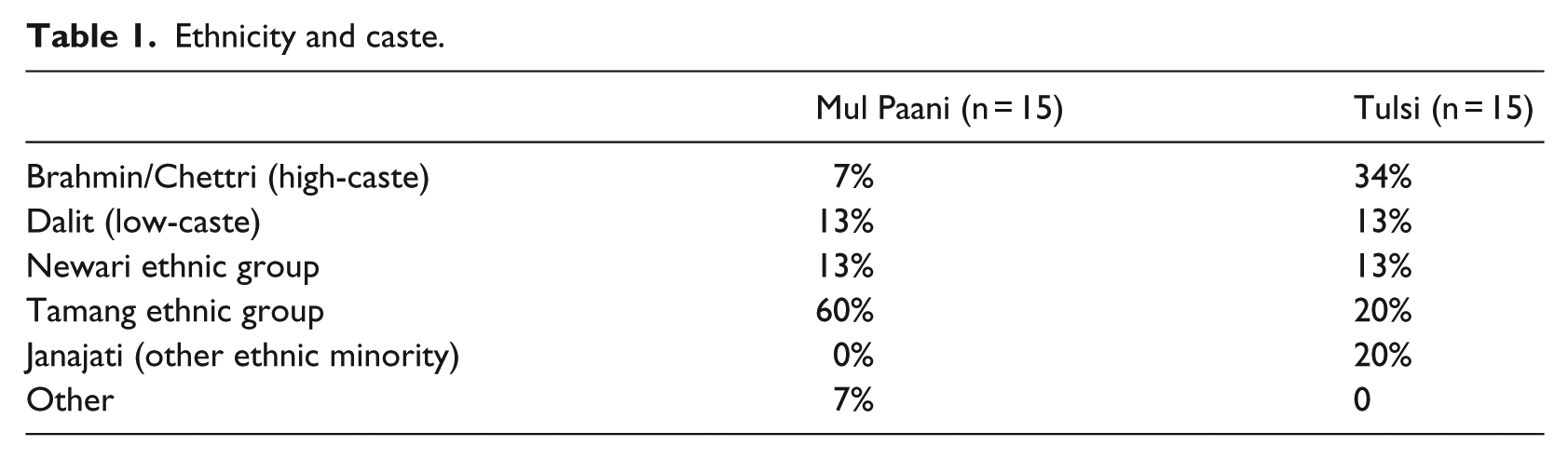
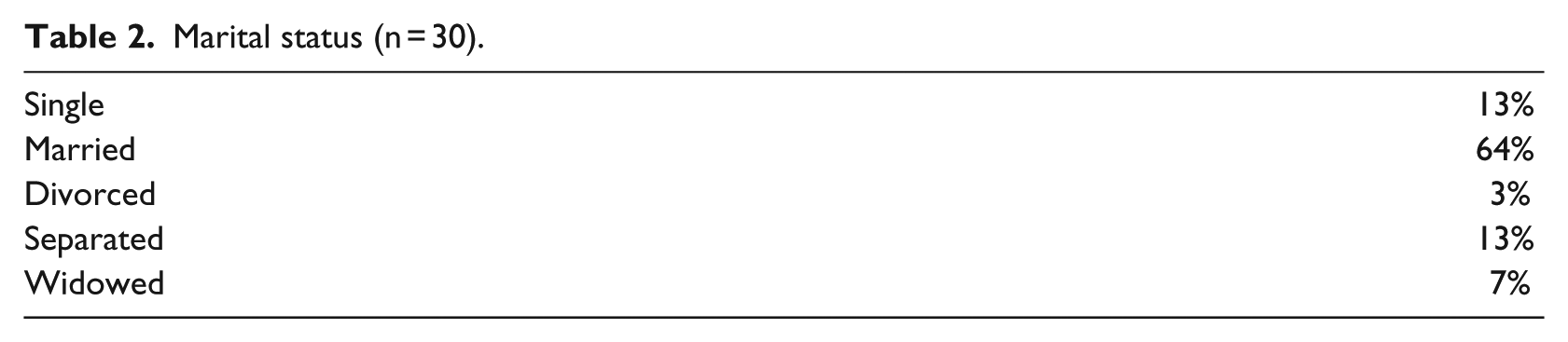
The majority of informants (26/30) migrated illegally to either Kuwait, Dubai, Saudi Arabia, Lebanon, or Oman. All but two women did in-home domestic labor while abroad. The overall educational attainment of the informants was quite low with the majority of women having little formal schooling and low literacy. Across their regional, caste, and ethnic differences, the informants all reported household economic insecurity. For the poorest women, migration was initiated because of food shortages within their respective households. For the comparatively better-off participants, migration was described as an opportunity to pay for education and hopefully provide class mobility to their children. Thus, although all the informants had a low socio-economic status, there was some variation in the severity of their financial strain. Tables 2 to 4 show aggregated information on the marital status, formal education levels, and migration destination of informants. Data were kept aggregated for these tables because there was little variance between sites across these indicators.
Marital status (n = 30).
Formal education (n = 30).

Migration destination (n = 30).

Households with returned WMWs were first identified and contacted by SuYa office staff from local office branches to request their voluntary participation. After completing a first round of interviews, participants were asked to refer other potential participants and purposive snowball sampling was used thereafter. If candidates agreed to participate, interviews were conducted either at the participant’s house or the local SuYa office. Interviews were conducted in Nepali and lasted 30 minutes to an hour and a half. The interview protocol asked participants to discuss their migration history with particular attention to their use of legal or illegal migration channels.
Once participant interviews were collected, they were transcribed in Nepali then translated and transcribed into English. Translated interviews were analyzed using NVivo software. To analyze the data, I used a deductive approach in order to focus on major themes that emerged through my work at SuYa. To move from the data to my findings, I first went through my transcripts and field notes using a system of ‘open coding’ as described in Charmaz’s (2014) grounded theory approach. I then narrowed the list of initial codes into major themes including mobility, recruitment, safety, violence, work conditions, remuneration, stakeholders, institutions, and resistance, among others. I did not use an orthodox grounded theory approach with the data set, as my time at SuYa clarified that violence and mobility were key themes I wanted to explore. Nevertheless, I did allow flexibility in my first and second rounds of coding, which elucidated a variety of emergent links between these themes. Once initial relationships between violence and mobility were identified, I returned to the data for another round of coding focused particularly on how informants articulated these connections. Through this iterative process, I employed what Wolf (1992) calls a ‘subject focused approach’ (p. 25). This is in line with recent studies of gender in organizations (Duberley et al., 2017; Thanem and Wallenberg, 2016), in which the foci of discussion proceed from themes that emerge in the narratives of informants.
Historicizing women’s mobility in contemporary Nepal
Nepal was founded as a Hindu kingdom and until quite recently was governed by laws and policies reflecting a high-caste Hindu cosmological understanding of gender that subordinated women’s economic, social, and political rights to men’s. Nepal is incredibly diverse and the day-to-day lives of Nepali women vary considerably according to caste, ethnicity, class, and geography among other axes of social difference. Nevertheless, the state has historically been ruled by high-caste Hindus of the mid-hills region who practiced and implemented high-caste hill Hinduism (HCHH) as law. The gender ideology of traditional HCHH promotes limited mobility for women outside the domestic realm, particularly young women. Within this gender ideology, women’s social role is understood as tied to their reproductive stage and to their attachment to a male authority figure(s) (Bennett, 1983). Historically, while the majority of Nepali women could not practically follow these cultural narratives and norms, they retained discursive power (Cameron, 1998; Rankin, 2004). Such norms have loosened considerably over time, yet the ideal of female domestic seclusion remains a strong cultural script (Grossman-Thompson, 2017).
Major challenges to the historically dominant HCHH gender ideology arrived in the form of the 1990 ‘people’s movement’. This movement broadly sought democratization and a loosening of monarchical rule, and energized concomitant campaigns for caste and gender equity. The success of this movement forced government reforms that made meaningful strides toward eliminating gender-discriminatory legislation. Between 1996 and 2006, a 10-year civil war fought between the Hindu monarchy and Maoist guerrillas further challenged public perceptions of women’s social roles. Throughout the insurgency, the Maoists overtly promoted gender equity as a critical component of their platform. The Maoist party also relied heavily on the use of female combatants during their sustained campaigns (Pettigrew and Shneiderman, 2004). The image of heavily armed women fighters was common in popular media throughout the insurgency and introduced a new vocabulary of images to describe the contemporary Nepali woman (Tamang, 2009). The Maoists emerged victorious with the signing of a peace accord in 2006 and this political victory carried forward a more socially progressive stance toward women’s rights. The monarchy was officially dissolved in 2008 and with the forming of the new secular, Federal Democratic Republic of Nepal under Maoist party leadership, women made further strides toward equal standing in the eyes of the state. Gender equity was championed in the interim constitution of 2007, which granted women unprecedented rights.
In the last decade, indicators measuring the status of women in Nepal have consistently risen (United Nations Development Programme (UNDP), 2016). Although the ideals of female domesticity are still held in many households and communities, young women are increasingly entering the public arenas historically reserved for men such as institutions of higher education, the political field, and the wage labor market (Brunson, 2013, 2014; Liechty, 2003; Linder, 2017). In light of these major socio-cultural and political shifts, HCHH norms are still powerfully present in public discourse and lingering gender-discriminatory laws. Tellingly, the most recent constitution, promulgated in 2015, has actually rolled back rights granted to women in the 2007 constitution. Furthermore, as I discuss later, gender-discriminatory migration laws have been passed as recently as 2016 and remain on-the-books today. Thus, although both legislation and norms regarding women’s mobility have significantly liberalized, optimism should be tempered by real evidence of what scholar of gender in Nepal Seira Tamang calls ‘state patriarchy’, or the continued normative and institutional dominance of HCHH ideology (Tamang, 2000).
Nepal’s migration context
Nepal has been a top migrant sending country due to long-standing labor connections with the global North as well as chronic domestic economic instability. Nepal’s economy has been beset by centuries of autocratic rule and cronyism, decades of civil and political unrest, and an exceedingly difficult geography for infrastructure development and industrialization (Whelpton, 2005). Foreign labor migration has thus served as a common earning strategy in Nepal for over a century and is central to the contemporary economy. Approximately 7% of Nepal’s population is currently working outside of the country (World Bank, 2011). In addition, remittances from foreign labor migration account for over a quarter of Nepal’s gross domestic product (GDP) (World Bank, 2015). Nepal is consistently ranked in the top five countries in the world for remittances as percentage of GDP.
While internal and international migrants in Nepal have historically been men, this is rapidly changing due to a variety of geo-political and socio-cultural shifts that have facilitated women’s increased mobility domestically and internationally. Important changes in Nepal’s demographic profile have also made international labor migration a viable livelihood strategy for more Nepalis, both male and female. Throughout the 1990s and 2000s, millions of individuals and families migrated internally from the rural countryside to major cities in the central and southern regions. The rapid expansion of major cities and the concomitant urbanization of previously semi-agrarian areas precipitated the creation of infrastructure networks capable of transporting large numbers of Nepalis to and from major points of embarkation. Furthermore, the concentration of millions of more people in cities contributed to the significant under- and unemployment which continues to serve as a primary push factor for foreign labor migration.
The idea of women working as waged-laborers outside the home has slowly percolated into popular consciousness as a tolerable option for some women even as it is at variance with culturally dominant HCHH gender ideologies described above (Grossman-Thompson, 2013). Yet, despite the social and legal gains of the past decades, laws concerning women’s migration still hold a particularly regressive gender politics. While Nepali men over 18 have very few restrictions on which countries they can legally migrate to or what types of labor they can perform, women have been subject to a confusing and constantly shifting assortment of policies and laws. In 2003, women were first subject to policies necessitating the approval of both their local government and their families to obtain a foreign labor work permit. In 2008, foreign employment bans for all women were put in place for Malaysia and Gulf countries. This ban was lifted in 2011, but reinstated in 2012. The August 2012 ban stated that women under 30 could not migrate to Gulf countries to work as domestic workers, which effectively halted the largest stream of female foreign workers from Nepal. 2 In 2014, a total ban on women migrating as domestic workers was again enacted. In 2015, a revised partial ban stated that only women over the age of 24 could migrate to Gulf countries as domestic workers, provided all of their children were above 2 years of age. A total ban is now back in place.
The age ban is representative of a conservative gender politics that perceives young women as wards of the state even beyond the age of majority. The 2012 ban was implemented in response to several high-profile cases of abuse against Nepali women working as domestic workers in the Gulf, and was intended to do two things. First, the law was meant to protect women under 30, who were deemed to be particularly vulnerable to sexual exploitation due to both their own naiveté and their supposed heightened vulnerability to sexual assault. At least in the eyes of the state, women over 30 had gained sufficient maturity to know how to migrate safely and were no longer as attractive to would-be sexual predators (ILO, 2015: 7). Second, though not explicitly promoted as such, the age ban aligned with culturally dominant HCHH gender norms on women’s domestic and procreative roles. The implicit message of the age ban was that women under 30 should undertake reproductive labor and only consider foreign labor migration after these tasks were complete.
As a result of gender-discriminatory migration laws, the majority of WMWs from Nepal migrate illegally (ILO, 2015). The illegal nature of most WMWs’ migration means that they are frequently subject to unpredictable and dangerous migration channels. Even in the best of cases, where contracts are honored and work placements are dignified and safe, WMWs are still in the precarious situation of working illegally with no recourse should anything go wrong. Due to the clandestine nature of migration between Nepal and the Gulf, there is very little empirical scholarship on women’s migration experiences (Sijapati et al., 2015). Existing research suggests that this population is vulnerable to various forms of exploitation during the migration process as a result of the illegal nature of most of their travel and a lack of policies in receiving countries that protect workers’ rights (ILO, 2015). In the two most common destinations for my informants, Kuwait and Saudi Arabia, the controversial Kafala system is used for legal workers, while undocumented workers are subject to immediate arrest. Under the Kafala system, a worker’s right to be in-country is tied to a single employer/sponsor. A worker’s right to leave the country or switch employers is contingent on permission from the original employer (Bajracharya and Sijapati, 2012). This system immediately disempowers workers from attempting to leave unfair, exploitative or abusive work situations as their employer may immediately expel them from the country. Thus, while this article is not focused on labor conditions within domestic labor placements as such, the conditions of their work provide important contextualization of their vulnerability as global workers.
Disposable domestics in the Nepali context
The age bans have not curtailed poor women from pursuing viable sources of income, rather it has pushed labor migration as a livelihood strategy out of the formal economy and into informal pathways that offer little worker protection. The ubiquity of illegal migration is reflected in the narratives of my informants, who all migrated and returned to Nepal before the implementation of the 2015 revised age ban and mostly (26/30) migrated through informal channels to Gulf countries. In response to intense criticism of the ‘under 30’ age ban, Nepal’s DoFE, the government agency responsible for the ban, publicly acknowledged that the ban was not effective (DoFE, 2014: 21). Nevertheless, a total ban was again implemented in 2017 and remains in place. The various iterations of migration bans reveal that the state reads women through the same logic of disposability that Wright (2006) identifies as at the heart of global production.
Just as the labor performed by women in Wright’s (2006) ethnographies of Mexican and Chinese factory workers is essential to the functioning of the state and capitalist networks of accumulation in which they are embedded, so too are Nepali WMWs critical to the functioning of the Nepali state and economy. Like Wright’s (2006) informants, Nepali WMWs are also understood as having ‘an intrinsic quality of disposability’ by the state and their employers (p. 150).
At the state level, the logic of disposability is apparent in the continuation of age and gender-discriminatory bans despite the DoFE’s acknowledgment of such policies’ lack of efficacy. In continuing to promote the discriminatory bans, the state positions women who sidestep the bans and their implied conservative gender politics as outside the protection of the state. The remittances of illegal labor migrants are accepted but their bodies are left to the devices of the notoriously exploitative sector. The particular revisions of the ‘over 24’ ban lends credence to this interpretation. In the new ‘over 24’ age ban, only once women have completed their reproductive labor—that is, given birth to and raised children through the age of 2—will the state allow them to legally participate in foreign labor migration. This suggests that the bans are, in part, designed to keep Nepali women in Nepal until their reproductive labor can be extracted by the state.
The illegal migration channels between Nepal and the Gulf, which have historically been and remain the most popular path for WMWs, are controlled through an organized network of brokerage firms and manpower agencies (Kern and Müller-Böker, 2015). Issues with these firms have been well detailed in a number of reports (Endo and Afram, 2011; World Bank, 2017), yet the Nepali state has not adequately intervened to address the malpractices. Like state policy toward illegal WMWs, the institutions that comprise these migration channels operate with a logic of disposability in which women’s embodied labor is an infinitely replaceable input. WMWs who decide to migrate illegally to Gulf countries participate in a highly organized route that involves the coordination of multiple institutions all working to extract maximum value from the worker. The migration pathway usually starts with a local recruiter (dalal) who combs his region for potential migrants. Alternatively, a woman or her family may directly approach a manpower agency in the city. From there, she progresses through an organizational structure that moves from agent/recruiter to broker to transporter to placement agent(s) and finally to their work placement.
Once a woman contracts with a recruiter or agent to find work abroad, she usually pays an exorbitant administration and placement fee. Because the migration is illegal, the women are first transported across the open border between Nepal and India where counterfeit documents can be acquired allowing the migrant to depart from one of India’s major international airports. Upon arrival in their destination country, they are either ferried to an office to await placement or taken directly to a home. In receiving countries, individual families pay placement agencies to procure domestic workers. Exploitative work conditions are the norm. The most frequent issues cited by informants included having their passport and paperwork seized by employers, being asked to continuously work 14–16 hour days, being verbally berated, and not being allowed to leave their employer’s house or call their families. Some combination of these conditions were reported in a large majority of the interviews.
Placement agencies are not responsible for the behavior of their clients, but they are culpable in assigning a constant rotation of new workers to houses that are consistently reported as abusive. Several informants recounted this occurrence in their own migration narratives. In this common scenario, the agents manage abused workers like worn out or damaged products in need of replacement by fresh stock. This closely mirrors the discourse of ‘disposability’ and planned obsolescence eschewed by managers in Wright’s (2006) description of factory work in China and Mexico.
The narrative of Radhika, a 44-year-old women from a low-caste background shows how the logic of disposability shapes WMWs’ experience through the migration process. She describes how upon arriving to Saudi Arabia she was kept in an office with other Nepali workers by a placement agent until an employer selected her for a contract. During this time, she and the other workers ‘would sleep on the floor like animals’. Once placed, Radhika was subject to abuse in her household and she complained repeatedly to the placement office. She recounted to the office that the employers worked her for 16-hour shifts, did not allow her to contact her family for months, and made her bathe or wash her clothes only in the middle of the night. The agent did not address these issues but did attempt to extort additional money from Radhika in return for giving her family in Nepal her current contact information. While this is just one individual example of malfeasance, Radhika’s story is a common one. In another example, Sita, a 38-year-old woman from a low-caste background, was not given any food in her placement for the entirety of the 2 months she stayed there. To survive, Sita surreptitiously stole food at night. She recounts telling her placement agent, ‘The employer would not give me food. Not even a piece of bread (roti). They would make me sleep in the bathroom. I slept in the bathroom for two months’. The agent intervened by moving Sita to another house and placing a different woman in the abusive household.
Pyari, a 33-year-old woman from a low-caste background, recounts how the placement offices served as a revolving door for young women leaving problematic placements only to be given to another potentially dangerous employer: ‘I went [to the office] one morning, and went to another house in 1–1.5 hours. People constantly come there looking to hire people. I never spent the night in the office in any of my migrations’. For placement agencies, there is very little incentive to change their practice of rotating WMWs from house to house. There is a constant flow of young women who are deeply in debt and thus willing to work in difficult conditions. If a woman deserts her placement or complains of abuse, there are both ample new households to absorb her labor—because she can’t leave without first paying off debts incurred to travel abroad—and ample new migrants to take her place.
When viewed through a logic of disposability, the behavior of the state and placement agents toward WMWs is coherent. As in the case of global factories, there are innumerable poor proletariat women who constitute surplus labor waiting to fill vacated positions and pay high recruiting fees to brokers. For the Nepali state, interpreting WMWs through a logic of disposability upholds normative ideals about which types of women’s bodies are valuable and which are not. For the for-profit institutions that organize WMWs’ labor, operating with a logic of disposability is a sound practice that promotes profitable turnover.
Gendered control in the Nepali context
Throughout Nepal’s migration process, and within the institutions that constitute migration channels, a logic of gendered control operates. Specifically, this logic affirms control of girls and women by men at all organizational levels. Gender and age discriminatory migration bans position some women as disposable, but they also position all women as needing oversight by the state to determine their suitability for particular types of work. The age ban is the state’s mechanism for sorting women into categories for more or less control. As previously mentioned, women who are deemed suitable for (re)productive labor are kept within the state and under state, and, presumably, family stewardship. Women who are outside this narrow population, who are either assumed to have fulfilled their (re)productive duties or who defy the ban and are thus outside the state’s paternalistic protection, are left to grapple with the nexus of institutions that similarly rely on a logic of gendered control to manage women migrants.
Much like Ngai (2005) describes in her ethnography of factory floor managers in China, migration brokers maximize the physical control over migrants once they enter into a labor contract with them. Like factory managers, the migration brokers depend upon the lack of economic, political, and social capital of the women to enhance workers dependence on the agent. Typically, a small group of women are escorted through the Nepal–India border by one or two of the broker’s assistants, who are almost always male. The women are instructed on how to avoid detection by immigration control. Radhika describes her own experience of following a broker’s instructions in order to enter India and then depart for Saudi Arabia to work illegally as a domestic laborer: [The broker] said we’ll go to make your passport tomorrow. We went the next day, and made the passport with his money. He asked for two months’ salary to cover the cost of making the passport. I said yes to that. He took us via India. He paid for our meals. Even on the train, we were not allowed to speak to anyone. If anyone asked us where we were going we were told to say ‘we are going to India, we have relatives there’. (Radhika, 44)
In Radhika’s narrative, she is a willing participant in human smuggling and it makes sense that the broker would dictate the terms of her travel. Nevertheless, this scene is representative of the control the mostly male brokerage system leverages over WMWs who are given little if any detail about their own migration path.
Once in India, the women are typically taken to apartments and held for several days or weeks while their final work and immigration papers are prepared and their contracts finalized. Radhika’s narrative is again representative of what many other informants described: [The broker] kept me in India for a long time almost 1–1.5 months. Four of us had gone from [Nepal]. The broker sent us one by one. … There were lots of groups who go from [India]. They are kept in the same room [in India]. If 4 cooked in the morning, another 4 would cook in the evening, and 2–3 others would clean the dishes. That’s what the agent would instruct us to do. In that manner we cooked and stayed. Even if we wanted to, we were not allowed to go outside for sightseeing. The agent would say the police would take us all. (Radhika, 44)
Like Radhika, Sancha Maya, a 30-year-old woman from the Tamang ethnic group, describes how she contacted a broker in the hopes of finding a way to go abroad and earn money to help her impoverished family. Once she made contact with a broker, she was also led across the Nepal–India border and housed for an extended period of time under constant supervision: Even as I was [in India] for 15–16 days, [the other migrants] left. Only 4–5 were left by the time I left. They would say [Indians] would look down upon Nepalis and not allow us to go outside the room. The agents would leave at 8 in the morning to arrange for tickets and all. There was a small boy of about 15 years to look after us. He would remain in the room and not allow us to leave. We would tell him if we were hungry or if our food supplies were in shortage. He would bring everything. He would lock the room from outside and go out to shop. (Sancha Maya, 30)
The complete control that brokers had over the movements of Radhika and Sancha Maya are repeated in the narratives of many other informants. In addition to being locked in a room for an extended period of time, nearly all the informants reported having their passports and papers held by the brokers. In the migrant–broker relationship, the broker exercises near total control in facilitating the migration process and this control is usually exacerbated by the exorbitant fees that migrants pay for brokerage services. Once this fee is paid, migrants are locked in to working at least long enough to pay back the loans taken to finance their migration. These loans often come with 60%, 80%, or even 100% interest on the principal, creating further pressure for WMWs to work regardless of the dignity or safety of their placement.
To enhance the control they have over WMWs, brokers often tell women that if they leave the confines of their room, they may be arrested, beaten, and/or raped by the local police force. Creating the specter of sexual violence is a particularly gendered form of control that plays off of widespread rumors circulating in Nepal about the mistreatment of WMWs in the Gulf. This control tactic is not unique to the Nepali case and scholars such as Parreñas (2001) have noted how it is particularly effective when used against WMWs from the global South who have often had limited exposure to, or knowledge of, their destination country. Several informants recounted that they did not attempt to leave the broker office even after weeks of being held in a cramped room because they feared their treatment at the hands of foreign officials. One informant, after deciding she had to escape an abusive work placement and seeking to return to Nepal, described how she turned herself directly in to a Kuwaiti police station first thing in the morning to avoid potential rape. She had heard that if the police picked you up in the evening or on the street, they would take you somewhere secluded, assault you, and then only return you to jail when they were done.
At the most extreme end of gendered control tactics is direct sexual exploitation of WMWs by brokers. Due to the sensitive nature of this topic, informants were not asked directly about sexual abuse. However, one informant did allude to the fraught power dynamics between WMWs with low social, economic, and cultural capital, and the primarily male brokers who facilitate their journeys to earn abroad. Hira, a 24-year-old woman from a low-caste family, recounts a story of traveling to Kuwait and finding that her employers would not pay her. After 5 months without pay, she recounts, ‘I ran away at night. There was a grill in the window, and I got down from the window and they (her employers) didn’t find out’. Once on the street, alone and with no documentation, Hira continued, Two or three boys came. They hadn’t come to catch me; they asked, ‘where are you going sister’, and I told them I was going to the office and I went to the Nepali office in a taxi. I didn’t know which office, so he took me to the Nepali manpower office he knew. I didn’t go to the office I had departed from; I went to another and that office sent me to work in a household for a month at a time. In that office they also didn’t pay me; they said, ‘you were brought here from the streets, we didn’t bring you from Nepal’. So they used to send me for a month of household work and I used to return to the office and stay 2 or 3 days and another house used to come looking for a maid and I had to go. They also didn’t pay me. (Hira, 24)
After 8 months of working monthly contracts with no pay, Hira demanded to at least be sent home. The brokers of the second office refused and also refused to help her retrieve her paperwork from her original agency. Desperate, she turned to the advice of another Nepali woman working illegally in Kuwait. According to Hira, ‘She (her friend) had made a boyfriend and she also said I need to make a boyfriend who would help me in times of need and so I also made a boyfriend’. When Hira was pressed as to why she needed to make a boyfriend, it became clear that her boyfriend facilitated Hira’s return to Nepal by buying her ticket and taking her to the Nepali embassy to be processed for repatriation. In Hira’s case, she felt that her best option for returning home was to leverage an intimate relationship into assistance.
In Hira’s narrative, the full extent of gendered control is visible. Hira’s initial complaints were rejected by her first broker. A second broker recognized Hira’s incredibly vulnerable situation and extracted 8 months of free labor. In the end, Hira drew on the limited forms of capital she did have, including her social network with other WMWs and her sexual capital, to get the information and resources she needed to return to Nepal. Hira recognized her story as one of economic exploitation, yet, in the course of the interview, Hira also asserted that she was currently hoping to return to a Gulf state for an additional contract as a domestic worker. This time, she asserted, she would have sufficient knowledge to avoid the dangerous situations she previously encountered.
Discussion
In this article I rely on two frameworks developed by feminist political economists, each explicating how a particular logic functions within global capitalism to reinscribe gender hierarchies and extract value from the embodied labor of women workers. In the case of Nepali WMWs migrating informally to Gulf states, two seemingly contradictory gendered logics—one of disposability, the other of control—function as multi-scalar ideological regimes that overlap and constitute layered mechanisms of power that limit women’s mobility before, during, and after foreign labor migration. However, Nepali women are not irrevocably trapped nor convinced by these logics. Rather, WMWs are participants who do the best they can with their minimal resources and knowingly enter potentially dangerous work situations.
Evidence of resistance to these logics were ubiquitous in the data. Individual moments of resistance occurred when WMWs found ways to survive exploitative conditions and leave abusive households. In Ngai’s (2005), Lynch’s (2007), and Wright’s (2006) monographs, a key commonality is that there is an imagined docility to poor, young women workers in global factories that is not borne out in their actual work experiences. Ngai (2005) notes that in her own field site as well as other loci of export-oriented production, the organizations that recruit and manage women workers do so under the pretense of ‘a feminine body that is imagined as more obedient, tolerant and conforming to the factory machine’ (p. 15). While Ngai, Lynch, and Wright validate the very real oppressive practices their informants navigate, they also note workers’ resistance to management, surveillance, and control at every turn. As in global factories, the institutions that facilitate Nepali women’s informal migration operate with the assumption of a compliant, docile worker. As in global factories, this assumption is proven wrong by Nepali WMWs’ continuous acts of resistance. Whether it is in stealing food, switching households, or running away, WMWs refused to allow a logic of gendered control or a logic of disposability to totally constrain their agency. Instead, they continue to act in their own best interest within the limited opportunities available to them.
Exploring women’s migration in Nepal from an organizational perspective is helpful to avoid some of the gaps found in scholarship that relies either on primarily quantitative assessments of migration flows (Lokshin and Glinskaya, 2009) or on essentially descriptive accounts of migration experiences. An organizational approach adds meso-level theorizing that locates both the macro flow of people and micro narrative of individuals within the actual structures and institutions that shape and facilitate the movement of WMWs across the globe.
The case of Nepali WMWs illustrates that feminist political economy has much to gain from an organizational perspective. Bair (2010), in her own review of feminist political economy’s approach to gender in export-oriented production, notes that more attention must be paid to ‘how and why difference matters for the globalization of production’ and how, ‘these forms of difference are brought within a particular social relation, which is capitalist production, and mobilized for a specific purpose, which is the creation of profit’ (p. 224). By ‘difference’, Bair means gender and other intersectional markers of social location. Her exhortation to explore the relationships between difference and capital is especially suited to an organizational approach such as the one I use here, which looks to the institutions at the core of capital accumulation.
Furthermore, in return, feminist political economy has much to offer an organizational perspective in terms of analyzing and understanding how institutions function and how workers function within institutions. Feminist political economy frameworks avoids what Townsley (2003) refers to as ‘gender as body counting’ in organization studies by moving beyond merely noting the presence of women in particular institutions and moving toward an analysis of how gender is in fact constitutive of those institutions (p. 619). The case of Nepali WMWs offers two scholarly interventions into the study of gendered migration from an organizational perspective. First, it centers the processes of migration as a flexible but cohesive set of actors and institutions that form the type of transnational organizations that organization studies, as a discipline, must grapple with in an ever-more global economy. As Townsley (2003) notes, a global perspective is critical because ‘research in this perspective not only situates our analyses within the socio-historical, economic, and cultural conditions that constitute New (global) Times, but also makes connections between multiple scales of organizing’ (p. 630). This globality is certainly apparent in the case of Nepali WMWs. By framing migration as a set of moments in which transnational and historically situated institutions, laws, and norms converge to create regular challenges for workers, migration is itself revealed to be an object of organizational study. While this case is quite limited in its scope, further research on similar migration channels could expand this insight.
Second, Yu (2015) points out the need to recognize the operation of multiple institutional logics in shaping the labor market. Yu (2015) goes on to assert that a recognition of such ‘institutional pluralism’ will help better address how bodies differentiated along lines of sex, gender, race, and class are variously marginalized or subordinated within organizations and institutions (p. 465). This article draws on feminist political economy’s long-term engagement with gendered labor regimes to enrich ongoing discussions of institutional pluralism and particularly gendered institutional logics in organization studies. Starting with an assumed ‘institutional pluralism’, this article suggests that two seemingly incommensurable logics first identified by feminist political economists—the logic of disposability and the logic of gendered control—can contribute to future research on gender and labor.