




Abstract
International labor mobility holds the promise that one can become a cosmopolitan citizen of the world. But this interpretation of mobility rarely features in research and media focused on Asian women who travel and engage in sex work. In both arenas, the dominant narrative is that migrant sex workers are poor, the victims of sex trafficking, and pose a risk to public health. This narrative is laced with Orientalist overtones of the Asian sex worker as the alluringly exotic ‘other’, passive and particularly vulnerable, and in need of rescue. However, the interviews of 11 Korean women sex workers based in Sydney, Australia, challenge this narrative. These women engaged in a transnational quest to become cosmopolitan citizens of the world, albeit making logical choices from structurally limited options shaped by their multiple identities as women, sex workers, and Korean, and their relative precarious position in the Australian labor market. Their stories highlight how migration and work can be an agentic process of self-expression and self-actualization of identity. This identity has emerged against the backdrop of shifting meanings and practices of social reproduction in Korea, a country that has experienced a highly compressed transition from developing, to modern capitalist state. Theoretically, the article draws on post-colonial feminist theory to shed light into the conflicting views on migrant sex workers in existing research, by focusing on the women’s voices, which have been neglected or silenced.
Introduction
International labor mobility holds the promise that one can become a cosmopolitan citizen of the world. But this interpretation of mobility rarely features in research or media that focuses on Asian women who travel and engage in sex work. In both arenas, the dominant narrative is that migrant sex workers are poor, the victims of sex trafficking, and pose a risk to public health (Agustín, 2007; Weitzer, 2005a). This narrative is laced with neo-colonial Orientalist imagery of Asian women as alluringly exotic, ‘other’, passive, and particularly vulnerable and in need of rescue (Alcoff, 1991; Ehrenreich and Hochschild, 2004; Kempadoo et al., 2015). A common feature of this narrative is that it fails to give voice to female migrant sex workers themselves, and in this way, it has been complicit in constructing ‘facts’ about migrant sex workers’ interests and motivations. Based on interviews with 11 Korean women sex workers in Sydney, Australia, and drawing from post-colonial feminist approaches, we shed light on women’s agency in both the migration and work process, providing stark contrast to the representation of Asian women sex workers, including Korean workers, in the Australian media. This article first explores the use of the term sex work. It then examines how Korean migrant sex workers’ experiences of work in Australia emerge out of a larger set of structurally determined employment options, limiting their choices to work that is inherently precarious. We then examine the Australian media and entertainment representations of Asian women sex workers and compare these portrayals with what Korean sex workers shared about their motivations and experiences. We conclude with a discussion that aims to shed light on Korean migrant sex workers’ experiences of migration and work and its relationship with their position in the Australian labor market.
Many researchers use the term sex work because of its moral neutrality and thus avoid evoking the various meanings and images associated with the culturally loaded term ‘prostitution’. The term prostitution has strong heteronormative overtones (‘the prostitute’ is conventionally pictured as a woman, and the buyer of her services a man), and as McDonald (2004) argues, prostitution invokes ‘one of the most powerful symbols in the pantheon of Western imagery, the innocent, young girl dragged off against her will to distant lands to satisfy the insatiable sexual craving of wanton men’ (p. 158). It is these symbols that have led to centuries’ worth of negative connotations and prejudice that have stigmatized sex workers in many societies. Under the banner of work, the term ‘sex work’ has united sex workers on a global scale, around a range of issues, including campaigns directed at decriminalization and access to health and social services. In embracing the term, sex workers use moral reasoning to create new meanings that give them greater ‘dignity at work’ (Hodson, 2001; Sayer, 2007; Yu, 2016). As Yu (2016) explains, moral reasoning is a strategy often adopted by stigmatized workers to enable them to confront and discount negative views about their occupation by constructing identities and meanings that restore their sense of dignity. While we accept that the term sex work is preferable to any other and therefore use it in this study, we do acknowledge that this term is still not completely neutral. The adoption of the term has led to a discursive shift whereby sexual encounters for payment are sometimes viewed purely in economic terms. Sex work, like all work, is a complex culturally embedded social practice; it shapes, but is also shaped by, those who perform that work.
Korean migrant workers in Australia
Various studies have found that sex work experiences depend on the legal, socio-economic and political environment from which participants are recruited (Deering et al., 2013; Ehrenreich and Hochschild, 2004; Shannon et al., 2009; Weitzer, 2007). In Australia, few dedicated temporary labor migration visas are issued and most of Australia’s temporary migrant workers are on temporary graduate workers visas (TGWs) and, if aged between 18 and 30 years, on Working Holiday Maker (WHM) visas. And despite being framed as a cultural program (Department of Immigration and Border Protection, 2015; Joint Standing Committee on Migration (JSCM), 1997: xv), WHMs account for a significant number of participants in low-skilled work in Australia. The majority of Korean migrant workers in Australia are on student or WHM visas and this visa status shapes and often effectively limits employment options, resulting in Korean migrant workers generally securing work that is inherently precarious.
In recent years, Australia has become the most popular destination for Korean WHMs, ahead of Japan, Canada, and New Zealand (Lee and Lee, 2013: 457–459). This is consistent with data on Korean national migrant workers in Australia that show that WHMs form the largest group of Korean temporary migrants, and their numbers have been increasing, from 1769 in 1998–1999 to 34,780 in 2009–2010, although falling to 22,412 in 2016–2017 (Department of Immigration and Border Protection, 2015). Reilly (2015) argues that the program is not adequately regulated. There is growing evidence of the extent to which WHMs have been underpaid, expected to work excessive hours, or experienced sexual and other forms of harassment and sub-standard living conditions. In their 2009 study, Tan and Lester (2012) found that 36% of WHMs were paid below the national minimum wage. A report by Australia’s Fair Work Ombudsman (2014) found that while migrant workers make up 6% of the Australian workforce, 18% of the workplace disputes involved a visa holder, and that half of these were WHMs. These migrant workers are principally employed in the agriculture, construction, cleaning, hospitality, meat works, and manufacturing industries. There have been several studies and widespread media coverage on the exploitation and underpayment of migrant workers, particularly on farms and in the food industry (Clibborn and Wright, 2018; Doherty, 2016; Farbenblum and Berg, 2017; Hatch, 2016). For Korean workers, several instances of exploitation in the Australian agricultural sector have come to light, where many Korean WHM visa holders are eligible to apply for a second 1-year working holiday visa by carrying out specified work in rural Australia for a total period of at least 3 months.
Another factor adding to migrant worker vulnerability to exploitation at work is a lack of English language skills. This can make it difficult for them to understand safety requirements, to ascertain employment protections, or subject them to discriminatory work hiring practices. For this reason, many Korean WHM visa holders have found it easier to work in Korean-owned businesses, but some have encountered a form of co-ethnic exploitation, particularly in Korean-run restaurants and cleaning companies. A Fair Work Ombudsman audit of 59 Korean-run cleaning businesses in 2016 found that 33% were paying workers incorrectly (Hatch, 2016). It is reported that there had been ‘persistent’ underpayment of Korean workers in Australia, mainly in New South Wales, with at least 24 Korean businesses sanctioned in the past 2 years (Doherty, 2016).
For some Korean WHM visa holders, sex work may be one of the few employment options available. Given the stigmatized and clandestine nature of the industry, it is not possible to accurately ascertain the number of Korean sex workers in Australia. However, a federal government audit report on visa management in Australia found that the number of Korean nationals on WHM visas working in the Australian sex industry was 63 in 2003/2004 and 222 in 2004/2005 (Australian National Audit Office (ANAO), 2006). However, research, mainly in the Sydney City area, suggests that migrants (largely from Thailand, China, and South Korea) make up a substantial proportion of workers in the sex industry (Donovan et al., 2012).
The legal setting and common employment practices are also likely to shape Korean migrant workers’ experience of sex work. The State of New South Wales has decriminalized all forms of sex work, with the regulations for brothels placed with the local planning and development authorities. For this reason, Koreans traveling on WHM visas can legally work in the sex industry. Operating indoors, in a more benign legal environment, and in a society with arguably less conservative views of sex work, and relative social anonymity, may influence the respondents’ experience of sex work in Australia. On the other hand, Korean sex workers face not only limited work options but also contractual arrangements that are far from ideal or often exploitative. Most sex workers, including migrant sex workers, are generally engaged as independent contractors. However, Adams (2014) and Orchiston (2016) argue that given the level of control managers have over when sex workers work and the services they provide, actual employment arrangements more closely resemble those of an employer and employee, and thus these arrangements are an example of ‘sham contracting’ (Adams, 2014). This includes fines for being late to work, not being allowed to sell sex services independently outside the workplace, and control over the nature of the services sex workers provide, as well as fees and work hours (Orchiston, 2016).
Feminist perspectives of sex work and representations of Asian women and the post-colonial feminist critique
Research on female sex workers is often done through feminist theory and focuses on gender relationships and the experience of oppression and/or agency. However, the bulk of research on female migrant workers highlights much more undesirable outcomes of mobility. In the fields of migration and diaspora studies on women migrant workers, the dominant narrative is that they are from poor countries and motivated to travel to rich countries to earn money, often to remit to support their families back home. They typically end up working in the ‘serving classes’, specifically as maids, nannies, and nurses (Lim and Oishi, 1996). Studies that view migrant women workers solely through the prism of the exploited economic migrant fail to explore women’s agency in participating in the migration act. The dismissal of women’s agency is no more pronounced than in the research on migrant sex workers, especially if these women are from Asia. Studies of Asian female migrant sex workers feature a form of resurrected Orientalism where Asian female sex workers are viewed as docile, obedient, and helpless victims needing to be rescued. According to Ehrenreich and Hochschild (2004), migrant women, especially Asian women, are constructed as possessing the ‘traditional feminine qualities of nurturance, docility and eagerness to please’ (pp. 9–10).
Agustin (2006, 2007) points out that after migrating, sex workers disappear from the migration literature only to reappear in the reserach literature of criminology, women’s, social work and health studies. Despite the many factors driving migration and the high degree of interest from so many disciplines, a common narrative emerges, one that is dominated by a ‘rescue ideology’ that often reduces migrants in sex work as universally being victims of sex trafficking (Kapur, 2003: 8). This rescue narrative is highly problematic. As Agustin (2006) argues, the ‘significant diversity among migrant projects is effectively totalized as “trafficking” by those anxious to protect exploited women, and offer an analysis of campaigns to define all migrant women selling sex as victims’ (p. 31). Andrijasevic (2010) argues that this frame does not allow for the complexity of motivations, decisions, and careful planning that women invest into their migration projects.
Another driver of the rescue frame is research that treats sex work as a public health issue. Concern over the spread of Sexually Transmitted Disease (STDs), in particular HIV/AIDS, dominates the health literature. A search of the phrase ‘prostitution and Sexually Transmitted Disease’ through ProQuest’s Health & Medicine database generated 5930 peer reviewed articles, with many of these studies incorporating the sex trafficking narratives (a search for ‘prostitution and HIV and sex trafficking’ generated 625 articles). This focus implies that the occupational risk of contracting and spreading STDs, and AIDS in particular, is a high if not probable occupational and public health risk. However, at least in the case of Australia, research by the Kirby Institute (2016) has found that the prevalence of sexually transmitted infections (STIs) among brothel-based sex workers in Sydney and Perth was at least as low as the general population. This ‘danger to public health’ frame further marginalizes and stigmatizes sex workers and effectively legitimizes criminalizing policies and interventions in the name of public safety.
A common feature of much of the research that adopts the rescue frame is that it downplays, or even excludes, the voices of sex workers themselves. Kempadoo (2015) calls for a post-colonial feminist approach that recognizes the extent to which migrant research has been motivated by a 21st-century version of the ‘white man’s burden’ that is supported by ‘contemporary western, neoliberal interests that maintain boundaries between the haves and the have-nots, while bolstering an image of a compassionate, benevolent West’ (p. 8). Kempadoo et al. (2015) note that in much of the research on migrant women sex work, the migrant woman is taken up—explicitly or not—to express a growing unease with an array of social injustices… but her silence is overwhelming. In the outpouring of outrage, condemnation and claims to human rights, she is spoken for and represented, but rarely does she find voice. (p. ix)
In the case of Asian women, the saving of the ‘yellow lady’ by white feminists or in Kempadoo’s (2015) words ‘the modern white (wo)man’s burden’ (p. 8) has become a dominant narrative. Similarly, Alcoff (1991) argues that white women need to rethink speaking for Asian women as it is ‘arrogant, vain, unethical, and politically illegitimate’ and carries the risk of ‘speaking across differences of race, culture, sexuality, and power’ (p. 6).
Studies on migrant women sex workers have become the site for competing claims and theories, where women sex workers are spoken for by those preoccupied with either, or a combination of, concerns relating to human rights, criminology, some feminist perspectives, and/or public health (Kempadoo et al., 2015). Post-colonial feminist perspectives call researchers not to arms but to ears, urging us not to act, but rather to stop and listen to the stories that others have to tell, on their own terms and in their own ways. Kempadoo (2015) calls for greater ‘respect for subaltern experience and knowledge’ (p. 80).
Methodology: ethical considerations interviewing sex workers and media analysis
The research was initiated as commissioned research from a charitable foundation in Korea, the Bombit Women’s Foundation. 1 The Foundation had funded scholars to prepare reports on Korean migrant sex workers in Japan, the United States, as well as in Australia. When discussing funding this research with us, the founder made her motivations clear, namely, that she wanted to rescue Korean women from the plight of sex trafficking and support them (Kim, 2007, personal communication, Meeting at the Bombit Foundation, Seoul, Korea, August 2007 (name is a pseudonym at respondents’ request)). We too started the research process with this framework in mind. However, upon spending a significant amount of time with the interview participants, our assumptions were tested. These women stressed to us that their decision to engage in sex work was out of their will and not forced. This led us to reflect on whether, as researchers, we had naively been recruited to serve the aims of a larger ‘rescue project’. It should also be noted that one author of this article is not Korean, although a Korean speaker, post-colonial feminist literature, has highlighted the tendency of white feminists to characterize Asian sex workers as helpless victims in need of rescue from barbaric cultures by a compassionate and benevolent white (Alcoff, 1991; Kempadoo, 2015). Sensitized to these assumptions and tendencies, and working closely with the Korean co-author and listening carefully to our interviewees, we have endeavored throughout the research, to adopt a critical view, in particular to be alert to paternalistic approaches to understanding the experience of Korean sex workers. At each stage of the research process, we have asked ourselves, are we speaking for/about Korean women sex workers, or respectfully allowing these women to speak for themselves?
To attempt to avoid misrepresentation of the experiences of women, we have adopted the method recommended by Stanley and Wise (1993), which is to allow women to ‘tell their own stories’. Our interviews focus on migrant narratives to enable the exploration of the multiple motivations, interpretations of, and possible resistance to, dominant discourses.
Over 14 months (February 2007 to April 2008), two strategies were used to allow the researchers to approach potential interview participants. First, we enlisted the support of organizations (sex worker advocacy groups, health and social services providers, and Korean community organizations) that had a high level of contact with migrant sex workers. They were asked to make initial contact with potential interviewees and some agreed to distribute leaflets to their Korean service users. Second, we placed advertisements in local Korean language newspapers and on Internet websites. As a result, we conducted interviews with 11 Korean women engaged in sex work, all of whom were based in Sydney, which is often the gateway for Koreans to enter Australia. Five worked at massage parlors and six at brothels. The women had been employed in a range of other jobs, including as cleaners, sales assistants, waitresses, teachers, and nurses, prior to moving into the sex sector, and had been working in Australia as sex workers for between 6 and 15 months. Most of the participants did not want to show their identity fully to the researcher and came to meetings wearing a face mask or sunglasses to hide their face, in particular, from the Korean-speaking researcher from the same Korean community in Sydney. We use pseudonyms to protect their privacy and confidentiality.
Before presenting our findings, an important caveat, the experience of migration and sex work is highly varied from relatively positive to highly exploitative. The range of difference is not covered in the handful of cases that follow. Nor should the stories of these few women be considered typical of the many which are not reported.
To compare popular representations of Asian migrant sex workers with lived experiences and women’s narratives collected through interviews, we conducted a content analysis of media coverage of the major Australian media outlets over the 10-year period 01 January 2007 to 01 December 2016 using the media database Factiva. We also examined a popular fictionalized account of sex workers in a popular TV drama. There is a discrepancy in the data collection periods—interviews with sex workers were carried out 2007–2008—and the media content analysis 2007–2016. We extended the period adopted for the media analysis to allow us to test whether the style of media reporting on Asian sex workers has persisted over time.
Representations of Asian women migrant sex workers in the Australian media and entertainment
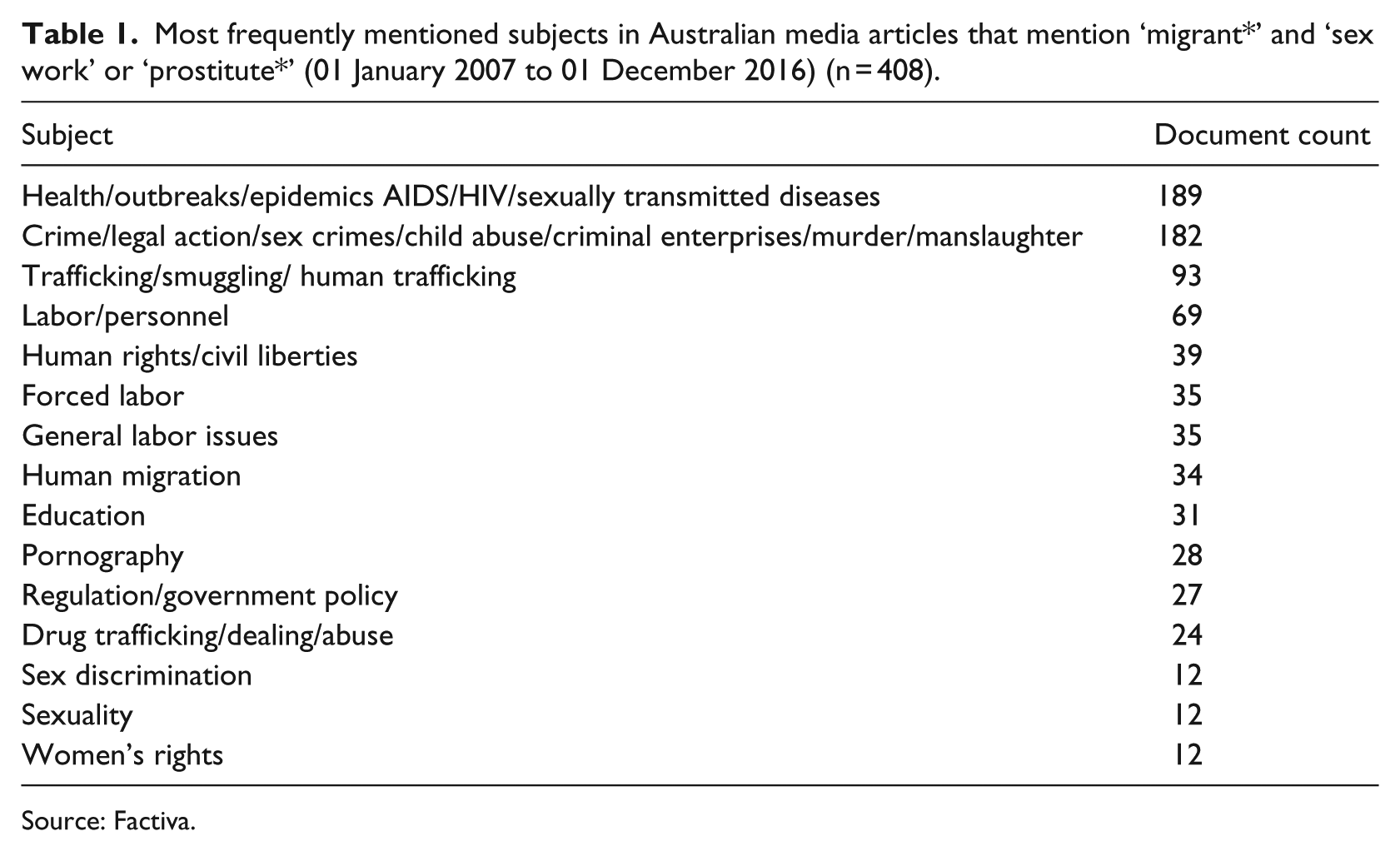
The discourse of Asian migrant sex work in Australian media is characterized by the conflation of all sex work performed by migrants with sex trafficking and all trafficking with sex trafficking. Using Factiva, a search of all Australian media outlets over the period 01 January 2007 to 01 December 2016 using the search words ‘sex work’ or ‘prositut*’ and ‘migrants’ generated 822 articles. Table 1 presents the most mentioned subjects in these articles in the order of frequency.
Most frequently mentioned subjects in Australian media articles that mention ‘migrant*’ and ‘sex work’ or ‘prostitute*’ (01 January 2007 to 01 December 2016) (n = 408).
Source: Factiva.
As Table 1 shows, the most frequent theme of the articles was health, followed by crime and trafficking-focused articles. It is clear that the work was regularly associated with being a risk to public health and criminal activities, themes that serve to further marginalize and stigmatize sex workers.
From this sample, we also generated a list of the most frequently mentioned words. One of the most frequently used words were variants of ‘slavery’. The term also features in various headlines, for example, ‘Sexual slavery is rife and there have been alleged cases in Australia involving Asian female victims’ (Fitzpatrick, 2010); ‘Eleven sex slaves targeted by migrant taskforce’ (Canberra Times, 27 October 2016); and ‘Treated no better than slaves’ (The Sydney Morning Herald, 20 August 2017). This aligns with the findings of Andrijasevic and Mai (2016) who argue that ‘modern slavery’ has become a recurring theme in Western media portrayals of migrant, particularly Asian, sex workers.
Andrijasevic (2007) also highlights how media coverage of sex work can often appear in the form of stories that present formulaic, sensationalized morality tales of sexual abuse, highlighting lurid or disturbing details focused on specific cases, and presents them as typical. A feature length story on Korean sex workers appeared in 2014 in the weekend magazine of the national paper The Australian. Headlined ‘Asian Slaves to the Australian Sex Industry’, it tells the story of the Korean sex worker ‘Ji-min’: Slowly, the young Korean relaxes her hands, revealing sparkling pink nails which clutch nervously at a pack of tissues …. How does one begin to describe her life as a sex slave in Australia? Where to start? The false promises? The debt bondage? The callous brothel manager? Or the drunken men who threw her against the wall like a rag doll, assaulting her every orifice until she bled and couldn’t walk? … Shadowy sponsors paid for her flight to Melbourne … ‘They forced me to work in the brothel’, she says, fixing her coal-brown eyes on me. ‘They didn’t care, they said you owe us money, you will work for us’ …. I ask Ji-min what her plans are now that she has escaped her captors. She falls silent for a long time before a single tear rolls down her right cheek. ‘I want to live in Australia’, she says. ‘But I want to live here without stress. I need a friend’. (Stewart, 2014)
We note how Ji-min is presented as a victim of ‘shadowy’ ‘captors’, but also as sexualized and Orientalized with ‘sparkly pink nails’, ‘coal brown eyes’, and as passive and infantilized, ‘thrown like a ragdoll’.
Such stereotypes are also reinforced in portrayals of Asian women that appear on Australian television screens. Recently, Asian migrant sex work was the subject of a popular television series ‘Top of the Lake: China Girl’, created by one of Australia’s most celebrated feminist filmmakers, Jane Campion.
2
Produced by the United Kingdom’s BBC, the show aired in Australia in August 2017 on the Australian national broadcaster the ABC. The show is based on the investigation into the murder of a young Asian sex worker in Sydney. Campion said she wanted to do the show as sexual tourism in Sydney from Asia has always really annoyed [her] because [she] feel[s] it’s so exploitative of people who don’t have the choices that we have and [she] felt like it should be something we should talk about or bring out. (Ellis-Petersen, 2017)
The show has been criticized by reviewers and Australian sex workers. Reviewing the show Gilbert (2017) writes, China Girl’s biggest failing is how it treats its female characters of color …. It’s obvious that Campion is perturbed by the legalized sex industry in Sydney, staffed overwhelmingly by migrants from Asia …. the Thai characters are never given the opportunity to become more than window dressing. China Girl offers no context on their histories or feelings or dreams, beyond emphasizing that they mostly hate their jobs. In seeking to expose the ethical failures in how the West profits from foreign labor, Campion unwittingly perpetuates the cycle, giving short shrift to women whose presence merely embellishes the stories of her white characters.
The Australian sex worker advocacy group, the Scarlet Alliance, has been critical of Jane Campion on the basis that she used unethical and covert ‘methods’ to access brothels, only to misrepresent them afterwards. In an interview with the United Kingdom’s Guardian, Campion shared her research methods: ‘We made up a very feeble story [to enter the brothel] that I was his aunt and that he was confused about his sexuality and didn’t know whether he was into women or not’, the film-maker said. ‘We said he was a virgin as well. The story got more ridiculous but they were all very kind’ (Ellis-Petersen, 2017). In response, Melbourne-based sex workers handed out letters to attendees of a talk about the drama at the Melbourne International Film Festival. The letter noted, ‘In her “research” for this show, Campion undermined sex workers’ screening processes in order to “sneak into” a brothel and fictionalize the stories of sex workers without their knowledge or consent’. It continued, ‘Campion “consulted” the Scarlet Alliance, our national peer-run association, about the plot of the show, only to completely ignore its concerns’ (The Evening Standard, 2017). In a subsequent letter sent to the BBC, the Scarlet Alliance wrote, ‘By prioritizing her own desire to tell a specific story about migrant sex workers, Campion is complicit in reinforcing harmful, stigmatizing stereotypes about sex workers and Asian women’ (Lo Dico, 2017).
The representation of Asian sex workers in the Australian media and popular culture as victims/slaves, and as exotic, docile, and vulnerable, serves to entrench racialized narratives and the rescue ideology. By presenting anecdotal horror stories as examples of what usually happens in sex work and generalized statistics in order to ‘confirm’ the inherent violence of sex work, the media has been complicit in constructing ‘facts’ about migrant sex workers’ interests and motivations. The voices of sex workers are effectively silenced in discussion about them and this reinforces assumptions and images of the female sex worker as ‘passive, subordinate and submissive, in contrast to an assertive and sexually-dominant man’ (Shrage, 1994: 134). These portrayals are also influenced by a neo-colonialist worldview, what Kempadoo (2015) has described as a 21st-century version of colonialism the ‘white (wo)man’s burden’ (p. 8).
Korean women’s experiences of migration and working in the Australian sex sector
Over the course of our meetings with 11 Korean sex workers based in Sydney, it became apparent that there are a range of complex and inter-related situations and motivations that lead Korean women to travel to Australia and then, at some point, work as sex workers.
The best way to make decent money
Often the decision to get involved in sex work is made after one has weighed the pros and cons regarding the different work opportunities available (Jeffrey and MacDonald, 2006). As discussed, Korean migrant workers in Australia face limited employment options between various low paid and precarious work choices. In this context, our respondents said that the opportunity to make money was important, but the choice was seen in relative terms, in that it was a more lucrative alternative to lower paid, difficult, and/or dirty jobs. For example, ‘Shin’ contrasts her previous experiences of employment with sex work: I grew up in a rural area and graduated from high school there. My parents got divorced and I lived with my mother and an older brother until he went off to the army. I then went to Seoul because there are better chances of getting a job. But I could only find poorly paid, hard work. Living in a tiny ‘gosiwon’ unit, I worked seven days a week, two different jobs as a waitress and shop assistant, but always had to worry about rent and bills. I managed to send some money to my mother and brother, but never had money for myself. One day I was talking with my neighbor. I found out she made good money working part-time as a hostess at a karaoke bar. She was the one who got me into this business. One day I went to her workplace and joined her work for fun. What I earned that night was more than I had earned for the whole week.
‘Ahn’ also found sex work preferable to other lower paid jobs: I learned that this job was far more profitable than any other of the occupations available for young women like me who don’t have a university degree. I worked in karaoke bars and then moved to work in several room salons in Seoul. After a year in the industry, however, I decided to quit and started to work as a sales assistant at a big department store. The work at the department store was physically demanding and I was paid much less. After one month, I only earned 750,000 won (US$750). I was seriously disappointed. It was then that my other sex worker colleagues told me about the opportunity to work overseas.
Others viewed the work as a way to earn extra cash to support them while they studied. According to ‘Choi’, ‘This job is a high-paying part-time job for me that brings in some extra pocket money to supplement my daily spending and support me through my English course’.
Some had hoped to find other forms of employment in Australia. ‘Oh’ said that ‘when I left for Sydney I had no intention to work in the sex industry, but then I couldn’t find a job, so I responded to an advertisement in a Korean magazine’.
In addition to the money, ‘Park’ was partly influenced by the flexibility of the role: I have never previously been involved in the sex industry. However, I decided that working at the brothel would suit me because the working hours are flexible, I could work whenever I wanted, I did not need to be fluent in English, and I was able to earn a substantial amount of money quickly (around $130 per client) as opposed to working in a Korean restaurant for $6 or $7 per hour. That way I won’t have to dig into my savings.
Some found that in some respects, the working conditions in Korea were better.
‘Hong’ said, ‘Some foreign customers (Australians) demand kinky services or smell bad. I found the work to be much easier back in Korea as the customers were much cleaner and less demanding’.
‘Ahn’ said, The massage work was physically harder than I thought it would be and so I moved to a Korean-owned brothel. I earned money, but not as much as I expected. On a bad day, I was only able to see 3-4 paying customers a day. Sometimes I was pressured (but not threatened) by the brothel owner to provide services that would make me stand out from the other sex workers. For instance, he often told me: ‘when having oral sex, why don’t you try to go natural [oral sex without condom]’. As there was always a quiet competition to get popular with customers, although I was reluctant, I did it. I am sick of hard work in Australia and plan on going back to Korea soon.
Sex work may be a choice among different revenue-generating possibilities, but as Ahn’s statement about the hard work and the pressure to not use condoms makes clear, these choices are structurally limited to the types of work that make these women vulnerable to exploitation. This is a clear example of the power imbalance in precarious work arrangements where women feel they have little choice, but to do things against their will.
Social and legal environment for sex workers in Korea and Australia
Country-specific institutional and structural variables give greater emphasis to sending countries and analyze migration as part of broader global processes and socio-economic changes (Weitzer, 2005b). Sex workers make choices in the context of a massive global sex industry that is driven by an enormous global demand, in particular, demand from white men for Asian women sex workers. This was Hong’s experience, as she put it succinctly, ‘Australian men are crazy for Korean women’.
The steady demand in Australia for Asian female sex workers allowed participants in this study to secure work quickly and it also presented opportunities to travel to other parts of the country. ‘Kim’ said, Many workers tend to stay only a few weeks or months in a site and then move on. I have worked in Melbourne and for a few weeks I went to Perth. The brothel owners paid for the tickets. There is always a demand for new Korean faces.
Sex work has always been illegal in Korea. The enactment of the Anti-Prostitution Law in 2004 was followed by an aggressive campaign targeting brothels, prostitutes, and their clients (Kim, 2007). The Korean government also sought to bring Koreans working as sex workers overseas, including Australia, back to Korea for prosecution.
3
‘Moon’ said, It [the new law] in fact made many working girls come to Australia. Although there are a lot of businesses still operating, it certainly became a little harder to make money there [in Korea].
All of our participants entered Australia under the Australian Working Holiday (WH) Program, which allows young people between 18 and 30 years from certain countries to enter and stay in Australia for an extended holiday (normally up to 12 months), and to supplement their funds by incidental employment, and also undertake study. For some, the ability to secure a visa was central to their decision to choose Australia. ‘Ko’ said, ‘Actually, I had no special feelings about coming to Australia and I chose Australia over the US as it was easier to get a visa’.
Participants also referred to the relatively easy application process. ‘Hong’ said, Compared to the US and other countries, it is very easy to get a visa for travel to and work in Australia due to the Working Holiday visa. You can do it online. Some countries like Japan and Canada, although also offering WH visas, require some kind of language test.
Our research participants also talked about how sex work is legal in New South Wales.
4
According to ‘Ahn’, A broker and the owner of a brothel told me that I could come to Australia on a working holiday visa. He told me that I could do this without risk, since prostitution is legal in Australia, and that I could make big money. He, along with a private language school and farm owners, made a false certificate proving that I was working or studying.
Increased access to effective recruitment and post-settlement employment and support networks
Mobility often entails ‘having somewhere to go’. Securing housing and employment and ‘settling in’ can be greatly facilitated if one has access to social networks. These networks can also lead to self-sustaining and cumulative migration flows of Asian women (Massey, 1990). According to Lim and Oishi (1996), access to supportive social networks is a key attribute of Asian women migrants: Asians are known for maintaining strong social relationships and networks of obligations, and it was through these that information was transmitted, contacts established, employment opportunities for new migrants created and grasped, social supports provided. Women, especially young women, are more likely to move as a result of chain migration. They also rely more than men on informal social networks. (p. 100)
The women talked about how they accessed networks to seek advice on where was a good place to work, to secure introductions to new employers and help in finding housing. They also accessed online communities of sex work ‘insiders’ to find work. According to ‘Choi’, ‘To find work I responded to one of the ads online in the Korean community magazines and arranged a job working at a Chinese-owned massage parlor in Sydney’.
Co-ethnic networks may be so efficient in facilitating the recruitment process into sex work that they may have acted as an impediment to exercising individuals’ preferences to do other work. ‘Park’ said, The place was already lined up for me and I only had one day in the country before I started working. I had no time to look for another type of job and did not know how to find one.
The pursuit of a cosmopolitan lifestyle as a pathway to global citizenship
One major effect of Korea’s rapid transformation of its economy has been the change to what is perceived as necessary to maintain class position or gain upward social mobility. Park and Abelmann (2004) observe that ‘the idea of what it means to be South Korean is transforming: increasingly, to be South Korean means to be South Korean “in the world”’ (p. 649). Campbell (2015) writes of the emergence of a new South Korean nationalism that has ‘globalised cultural characteristics’, and that among younger Koreans ‘the new globalised cultural ideas of nation and nationalism are based in the concepts of modernity, cosmopolitanism and status’ (p. 484). In this context, the mastery of the English language is increasingly seen as a proxy measure of one’s cosmopolitan credentials, and millions of Koreans have come to embrace the potential of living abroad to improve their fluency (Kang and Abelmann, 2011; Park, 2009).
The possibilities of mobility were a major theme in the stories of the Korean women we interviewed, in particular that migration offered the possibility to become a cosmopolitan Korean woman. The women talked at length about how coming to Australia allowed them to pursue other goals related to a range of cosmopolitan aspirations, in particular, to learn English and experience international travel. ‘Ahn’ said, I grew up in a city where I went to a two-year college. As a college student, I lived alone away from my parents, but I needed a lot of money, not only for my studies, but also for entertainment and shopping. Through a job advertisement on the internet, I started to work as a hostess at a room salon. I worked at a number of room salons before moving into a red light district. While continuing to work, I was able to finish college and was admitted into a four-year university degree. Before starting university, I really wanted to have an opportunity to learn English as my major at college was English literature. I first went to the Philippines to enroll in a short-term English course and then learnt about English courses in Australia. With a WH visa, I arrived in Queensland with my friend, where we both attended a full-time English course. Soon I started to run out of money and found it hard to survive without working. I knew that there were limited employment opportunities for non-English speaking females like me, so I chose to move to Sydney and continue my former occupation. It was one of the few ways in which I knew I could make a living. I simply thought that it was the only way I could earn good money relatively quickly.
Ahn’s story highlights how she made instrumental calculations through education, employment, and migration to make money, but also further her education.
‘Hong’ said, I learned from an immigration broker in Korea about an opportunity to learn English and make money in Australia. I knew I was going to perform sexual services, but the chance to travel and learn English was the main attraction.
For some women, Australia formed part of a larger project of global exploration. Hong and Lee both said they had been involved in sex work in another foreign country (Japan for both cases), while Hong, Moon, Bae, and Ahn said that they had been involved in other activities, such as waitressing and translating work in Guam, New Zealand, China, and Spain.
Another theme to emerge was striving to embody cosmopolitanism through dress, conspicuousness, and cosmetic surgery. According to Turner (1996: 2–6, 56) the body changes with economic and social change, from a reproductive body in pre-industrial society, to a laboring body in the industrial period, and finally to a consuming body in the post-industrial stage. We argue that such a transition is currently playing out in North Korea (Dalton et al., 2017). In modern South Korea, Kim (2003) argues that a woman’s body itself has become a site of global culture, signifying her elite status as a member of the cosmopolitan global community by participating in the main activity of global culture: consumption of global products.
‘Yang’ confirmed this when she said ‘For all that, there are some girls who would rather spend their money on luxury shopping. But I understand them. They may be trying to get what they were never able to get’. Many feel that they moved from the bottom to the top, from being marginalized because of social status to being admired because they can afford status symbols (perfect feminine beauty enhanced by plastic surgery and cosmetics, luxurious clothing and accessories) often reserved for the upper class. These findings are in line with the findings of other research on migrant sex workers (see Vogel, 2009).
During our conversations with participants, we saw how much care they devoted to their appearance. Many of their clothes and accessories were clearly labeled, Fendi, Chanel, and Hermes. They also wore what appeared to be expensive jewelry. ‘Shin’ seemed aware of how well-known brands can symbolize prosperity: ‘because of my designer clothes and expensive jewelry, the other students in my English class used to think that I came from a very wealthy family’. We also asked about plastic surgery, a common practice among Korean women, and increasingly men. Most said they had undergone either double eye lid surgery or other procedures. Some said that cosmetic procedures are the ‘must thing’ to do for sex workers in Korea as an investment that results in higher earnings. As ‘Hong’ described it, ‘Surgery increases the chance of getting you noticed by high end brothels or parlors, which pay and treat you better’. These are examples of the practice Mai (2012) describes as the embodiment of cosmopolitanisms.
Conclusion
Our analysis of media and popular culture in Australia shows how the trope of migrant sex workers has circulated as a sign of otherness, non-western migrant and helpless victims of trafficking, and therefore as a site of intervention. In particular, certain themes repeatedly emerge: sex workers are poor economic migrants; sex workers are victims of sex trafficking; sex work is a public health issue, and the exotic Asian female needs being rescued by White men or White feminists. However, the stories of a group of Korean sex workers in Australia bear little resemblance to this narrative and their statements highlight their adherence to alternative frames that reinforced their positive identities as independent women of the world.
One key motivation was to secure financial rewards, but they do not resemble the characterization of the economic migrant. They made logical choices in a social and legal environment that limited their options. Their migration and employment in Australia were facilitated through accessing employment and support networks, and strong demand for their services. Significantly, these factors exist at a time of changing attitudes in Korea regarding how individuals can enhance their employability, social status and personal fulfillment through learning English and pursuing a cosmopolitan lifestyle.
In her ethnography of sex workers in rural New Guinea, Wardlow (2002) highlights how ‘modern forms of identity can emerge in response to the shifting meanings and practices of social reproduction’ (p. 5). Similarly, we find that the story of Korean migrant sex workers is closely intertwined with individuals’ responses to emerging practices of social reproduction in the context of new conceptualizations of what it means to be a cosmopolitan Korean woman. Sex work is a form of work they can exploit to gain the social goods that improve the chances of successful participation in globalization, both at home and abroad. In sum, cultural capital is acquired from the migration and work experience, and women have agency in both.
Our study also shows how sex work performed by Korean migrant workers is intimately connected to the treatment of temporary migrant workers in Australia. These women’s status as both sex workers and as temporary migrant workers means that they exercise agency, but only in the context of having highly structurally limited employment options. Nevertheless, women engaged in a transnational quest to become cosmopolitan citizens of the world, albeit involving making logical choices from an array of available yet structurally limited options, is in stark contrast to the poor, helpless Oriental sex trafficked victim that needs to be rescued.
Footnotes
Funding
The author(s) disclosed receipt of the following financial support for the research, authorship, and/or publication of this article: Part of our data collection was supported by the Bombit Foundation (Seoul, South Korea). Our special thanks go to the late Haewon Jung, director of the Foundation, for her generous support for the research. The writing of this article was also supported by the Laboratory Program for Korean Studies through the Ministry of Education of the Republic of Korea and the Korean Studies Promotion Service of the Academy of Korean Studies [AKS-2018-LAB-2250001].
