




Abstract
This article problematises sexual inclusion in the workplace by theorising the social and historical processes that underpin heteronormativity in organisations. Drawing on a genealogical analysis of sexuality and inclusion in four Italian social firms that support the work and social integration of disadvantaged individuals, the article provides an in-depth analysis of the historical conditions affecting the management of sexualities in organisations. The analysis exposes the fragility and contradictory character of the notion of inclusion by illustrating how efforts to ‘include’ are often grounded on normative principles. It also shows how heteronormativity works, in practice, to moderate different modalities of lesbian, gay, bisexual, transgender and queer inclusion, recreating hierarchies and binaries within lesbian, gay, bisexual, transgender and queer individuals. The article discusses how the power of heteronormativity produces specific meanings of inclusion within which some lesbian, gay, bisexual, transgender and queer workers are included and normalised, and others remain excluded because they do not conform to normative conventions and flaunt their ‘diversity’. The necessity of taking a queer perspective on ‘inclusion’ that scrutinises the heteronormative logic is also discussed. The article concludes by shedding light on how, within a heteronormative regime shaped by neoliberal predicaments, ‘inclusive’ organisations might continue to exclude lesbian, gay, bisexual, transgender and queer individuals.
Introduction
Research focusing on sexuality in the workplace has recently moved away from investigating formal discriminatory processes and homophobic practices and behaviours (e.g. Humphrey, 1999; Levine and Leonard, 1984), to exploring the informal interactions through which heteronormativity, intended as the pervasive and invisible norm of heterosexuality, restricts the possibility of diverse sexualities to be part of the organisational discourse (e.g. Bowring and Brewis, 2009; Ozturk and Rumens, 2014; Priola et al., 2014; Rumens and Kerfoot, 2009; Ward and Winstanley, 2003).
As highlighted by several scholars (Colgan et al., 2007; Colgan and McKearney, 2012; Özbilgin and Tatli, 2008), legal, social and organisational changes have, in recent decades, legitimised equal opportunity discourses and their demands to engage more effectively with the interests of LGBTQ 1 (lesbian, gay, bisexual, transgender and queer) workers. However, the inclusion of the interests of minority groups within national neoliberal citizenship agendas has resulted in politics that continue to maintain substantive inequalities, often grounded on heteronormative principles and practices. In fact, while liberal political norms of inclusion have normalised gay and lesbian identities and allowed LGBTQ people to carve out social spaces for expressing their rights, on the other hand they have also fostered new kinds of conformism that exclude or marginalise others (Drucker, 2015).
Within this scholarly context, this article seeks to advance understanding of the discursive assumptions underlying the concept of inclusion of LGBTQ individuals in organisations by theorising the socio-historical processes that influence organisational practices within the Italian context. It draws upon empirical research that was conducted in four Italian privately owned social firms; 2 these are business organisations that have been founded to pursue the mission of sustaining the social inclusion of disadvantaged people (e.g. people experiencing drug addiction, detention or mental health issues), through the provision of commercial services. Specifically, the research explores how these social firms manage the organisation of sexualities and whether and how heteronormativity influences their interpretations of inclusion of LGBTQ individuals, who do not belong to a disadvantaged category, but have been traditionally discriminated against and/or silenced in the workplace.
In attempting to further understand these issues, we have formulated the following research questions: (a) What are the discursive strategies used by managers in these organisations to engage with sexuality in their relational practices at work (how is sexuality managed)? (b) Which are the social epistemes that frame the organisations’ policies and practices in relation to sexuality and work? and (c) How do specific organisational meanings and practices of inclusion act to reinforce or disrupt (hetero)normative models of sexuality? In order to address these questions, the analysis focuses on organisational practices (the daily management of sexuality) and the intersection between these practices and society. In this respect, the concept of episteme, which refers to knowledge as ‘the justified true belief’, in contrast with ‘common belief and opinion’, helps us to connect organisational practices with social discourses. Foucault (1970) refers to episteme as ‘the historical a priori’ that underpins a society’s knowledge; specifically, it is what ‘defines the conditions of possibility of all knowledge, whether expressed in a theory or silently invested in a practice’ (p. 168). In his later work, he defines it as ‘the “apparatus” which makes possible the separation, not of the true from the false, but of what may from what may not be characterised as scientific’ (Foucault, 1980a: 197).
Theoretically, the article draws on poststructuralist scholarly developments that have been influenced by Foucault’s work, including queer theory and feminist theory. Specifically, it focuses on a conceptualisation of sexuality as a discourse embedded in cultural processes which conditions the possibilities of bodies and subjectivities. Methodologically, we ground the analysis on a Foucaultian genealogical approach in order to understand how organisational practices are rooted in social discourses that evolve from the historical a priori. The study’s contribution, thus, lies on its theoretical and empirical positioning at the intersection between organisations and their socio-historical context, which is brought to life by the genealogical analysis presented. This supports the examination of the dynamics and the contradictory practices that characterise the experiences of LGBTQ individuals within organisations that are directly focused on social inclusion. Responding to a call for more theoretically embedded empirical work inspired by queer theory (Ozturk and Rumens, 2014), this article problematises the notion of inclusion by suggesting that efforts to ‘include’ are often grounded on normative principles. It also shows how heteronormativity works, in practice, to moderate different modalities of LGBTQ inclusion, recreating hierarchies and binaries within LGBTQ individuals. In fact, the power of heteronormativity produces specific meanings of inclusion within which some LGBTQ workers are included and normalised, and others remain excluded because they do not conform to normative conventions and flaunt their ‘diversity’.
In relation to the national context of this research, this article offers a methodological and empirical contribution into the effects of specific cultural and historical influences on organisational practices. In particular, while the influences of the Catholic Church as well as fascism have been at the centre of socio-historical analyses of the Italian context, currently other tensions and contradictions are emerging within the Italian society and the effects of these on people and organisations are still underexplored. For example, Di Feliciantonio (2015) highlights the contradictions between ‘the homophobic national denial of rights to LGBT people’ (e.g. adoption) with entrepreneurial and neoliberal pressures and interventions aimed at protecting LGBTQ people’s rights as citizens and customers (pp. 1013–1014). Furthermore, in view of the fact that the concept of heteronormativity cannot be discriminately applied across Western countries (see also Eng et al., 2005), a focus on Italy provides an insight on how heteronormativity is affected by context-specific political and cultural narratives located outside most of contemporary queer scholarship, which is based on US and UK national movements and institutions.
The article is organised as follows. First, it examines the literature on sexuality within (and outside) the workplace to frame its theoretical focus. Second, it outlines the foundations of the genealogical approach adopted, arguing that an organisational analysis of sexuality cannot be rescinded from considerations of the sociological conditions that influence the construction of organisational discourse. Third, the article describes the organisational context and the research methodology, before paving the way for the data analysis. Finally, the discussion argues that the dynamics of inclusion/exclusion are entwined with multiple ideologies, both within the overall Italian context and the specific organisational context, and contribute to sustain (hetero)normative principles and practices.
Sexualities at work
The study of sexuality has traditionally been confined to disciplines other than management and organisation studies, grounded on the assumption that sexuality is not a workplace matter. It has only been in the last few decades that organisation scholars (e.g. Burrell, 1984) have started to question the neutrality of the workplace in relation to sexuality and have endeavoured to show how the development of management and formal organisations in the last two centuries has attempted to desexualise organisations. In recognising that the eradication of sexuality from organisational processes is neither achievable nor desirable, scholars (e.g. Burrell and Hearn, 1989; Colgan and Rumens, 2015; Hearn and Parkin, 1995) have contributed to the development of a body, albeit still modest and fragmented, of organisational scholarship on sexuality in the workplace.
In mapping the literature on LGBTQ individuals’ experiences in the workplace, Colgan and Rumens (2015) highlight how the dominance of research on gay and lesbian discrimination since the 1970s (e.g. Levine, 1979; Levine and Leonard, 1984) has been enriched by studies exploring issues of LGBTQ identities within a range of different workplaces (e.g. Humphrey, 1999) and by research focusing on equality and inclusion of diverse sexualities in organisations (e.g. Bell et al., 2011; Cohen et al., 2013; Ozturk and Rumens, 2014; Priola et al., 2014; Schilt and Westbrook, 2009). Recently, authors have also started to consider sexualities as embedded in an organisation’s political processes (Fleming, 2007; Sullivan, 2014) and to scrutinise the practices of ‘gay-friendly’ workplaces (Rumens and Broomfield, 2014; Williams et al., 2009;Williams and Giuffre, 2011) in supporting the further understanding of practical implications associated with a heteronormative logic.
Recent applications of queer theory to management and organisation studies have been an important development in interrogating heteronormativity (see, for example,Bendl et al., 2009; Parker, 2002, 2016; Rumens, 2013, 2016) and in contributing to better understand what are considered inclusive workplaces for LGBTQ workers. However, the notion of inclusion, and the different permutations within the continuum inclusion–exclusion, still remains underexplored. The concept of inclusion supports political attempts to address the discriminatory experiences of LGBTQ individuals; however, the concept itself is embedded within a normative logic according to which sexual subjects (e.g. male or female, married or single, heterosexual or homosexual) are included within institutional mechanisms of state power (Eng et al., 2005). The queering of inclusion allows the exploration of how demands for ‘inclusion’ and legal rights tend to converge with the promotion of heteronormative institutions. In problematising the notion of inclusion, this article advocates the continuous revision of the term so to discard its normative status and de-anchoring it from the binaries that divide what is acceptable, and hence included, and what is not.
Understanding heteronormativity
Recent research that highlights the centrality of sexuality to workplace relations often reflects current social concerns relating to inclusion and diversity. While, on one hand, there is certainly greater openness to LGBTQ rights, social research shows how heteronormative beliefs that are founded on the mimetic relationship between sex, gender and sexuality still exercise pressures on all to conform or to hide sexualities that do not conform to the heteronorm (Valocchi, 2005). The assumption of heterosexuality as the norm is evident in ‘the common understanding of what gender differences means […]. The logic of sexual order is so deeply embedded by now in an indescribably range of social institutions, and is embedded in the most standard accounts of the world’ (Warner, 1991: 6). According to Brewis et al. (2014: 306), not only is the ‘categorisation, classification and hierarchical ordering’ of sexuality regulated within power relations and social institutions, but the management of sexuality within organisational settings is highly controlled within context-specific regimes of exclusion and inclusion.
When scrutinised under the heteronormative lenses, organisational sexuality takes on an important political significance because organisational processes, through formal arrangements and informal interactions and behaviours, converge to reproduce a cultural system that disciplines relationships according to heteronormative standards (Giuffre et al., 2008; Hearn and Parkin, 1995;Pringle, 2008; Ward and Winstanley, 2003). Heteronormativity acts as a silencing and marginalising tool that configures as ‘other’ any ‘non-heterosexual’ desire and behaviour and regulates it accordingly to the heteronorm (Pringle, 2008). As Butler (1990) asserts, ‘the heterosexualization of desire requires and institutes the production of discrete and asymmetrical oppositions between “feminine” and “masculine,” where these are understood as expressive attributes of “male” and “female”’ (p. 17). This limits those individuals who do not fit within the binary gender divisions and the normative heterosexual model (Butler, 1997).
Cultural practices that influence organisational members’ behaviours and the interactions between workers often contribute to shape sexuality discourses to meet the needs of organisations (Fleming, 2007). As highlighted by some authors (e.g. Giuffre et al., 2008; Williams et al., 2009; Williams and Giuffre, 2011), even the cultural practices of those workplaces that formally include diverse sexualities within their processes are characterised by tensions and contradictions. These centre around the fact that efforts to achieve sexual equality are still realised within the heterosexual/homosexual binary, which precludes fluidity and excludes any other form of alternative sexuality (Colgan and Rumens, 2015; Rumens and Broomfield, 2014). Queer theory offers a theoretical possibility for disrupting a heteronormative logic by questioning (i.e. queering) the categories of gender and sexuality and their comprehension with reference to the realm of naturalness (De Lauretis, 1991). Rather than being viewed as essential and fixed individual features, gender and sexuality are considered as products of historical and cultural contingencies (Halperin, 1990). Queer theorists (e.g. Bersani, 1995; Halperin, 1997; Warner, 1991) deconstruct the dualisms (e.g. masculine/feminine, homosexual/heterosexual) in which identities have been caged and that disrupt (or trouble) the ‘gendered norms of cultural intelligibility by which persons are defined’ (Butler, 1990: 17) and ‘that congeal over time to produce the appearance of substance’ (Butler, 1990: 33). As asserted by Eng et al. (2005), in fact, mechanisms of normalisation have attempted to organise not only gay and lesbian politics but also the internal workings of the field itself, attempting to constitute its governing logic around certain privileged subjects, standards of sexual conduct, and political and intellectual engagement. (p. 4)
By queering assumptions about sexual behaviours, queer theorists, thus, reject the essentialist views of gender and sexuality and challenge heteronormativity as a system of power relations (Rumens, 2016).
Within management and organisation studies, an increasing number of scholars have attempted to queer organisational knowledge to enhance understanding of work practices that (could) disrupt heteronormativity and social binaries (e.g. Bendl et al., 2008; Rumens, 2016, 2017; Tyler and Cohen, 2008). In so doing, they develop an understanding of management knowledge or practices that ‘always refuse the common sense of the day … [and] positively encourage anti-institutional thinking’ that harbour disruptiveness (Parker, 2016: 73). In applying queer theory to diversity management, Bendl et al. (2009) have exposed the fragility of categories associated to organisational discourses of diversity (gender, ethnicity, class, age, disability and sexual orientation), by showing how their embeddedness in power structures reinforces heteronormative identity constructions and does not lead to more inclusive organisations. They argue that only a queer organisational analysis that breaks away from categorisation can help to problematise inclusion and diversity.
Michel Foucault’s contribution has been fundamental to the understanding of how discrete and asymmetrical categories of gender and sexuality have produced a normative heterosexual model. The Foucaultian’s view that sexuality is not a natural feature of human life but a constructed category of experience that has social, historical and cultural origins has been assimilated by queer theorists who aim at disrupting normativity by locating a social analysis within these origins. The section that follows discusses the Foucaultian genealogical approach and highlights how genealogy can support a queer-inflected analysis of organisational practices.
Why a genealogical analysis?
The work of Michel Foucault is one of the most influential in the analysis of sexuality in Western countries. Central to his theoretical reflections is the analysis of power relations between institutional practices, bodies and systems of thought (Foucault, 1977, 1978). Foucault’s interest is in the historical, social and political circumstances that constitute the ‘a priori’ of discourses, which is meant as the conditions of their reality. Foucault’s (1972) analysis of discursive practices aims to reveal the set of rules (archives) which, at a given period and for a specific society, establish the limits and the forms of what can be said on any social object or practice. Such focus has been pivotal in the development of queer theory, which, starting from the level of intimate relationships and the changes that can be impelled by a variety of different queer tactics, offers a politics of alternatives and dissent from the heteronorm (Drucker, 2015).
While some queer theorists distance themselves from a Foucaultian perspective (e.g. Edelman, Halberstam), others (e.g. De Lauretis, Butler, Sedgwick, Halperin) have embraced Foucault’s work and in particular his conceptualisations of power. Even Bersani (1995: 81), who rejects many aspects of Foucault’s contribution, recognises that ‘power in our societies functions primarily not by repressing spontaneous sexual drives but by reproducing multiple sexualities’; processes of classification, distribution and moral evaluation of these sexualities, subsequently, generate approval, marginalisation, discipline or normalisation for the individuals who practise them.
In his analysis of the development of sexuality, Foucault argues that discourses and practices on sexuality make it possible to control human subjects and define, with the complicity of scientific disciplines, their bodies and their behaviours. He contends that from approximately the 18th century onward, ‘sex was driven out of hiding and constrained to lead a discursive existence’ (Foucault, 1978: 33) as a ‘codification’, and enforcement of sexual behaviour took place through the impingement of state law into the realm of private desire. This was made possible by strategies of social control such as ‘general politics’ and ‘regimes of truth’, which resulted from scientific discourse and institutions, and led to the examination of ‘peripheral sexualities’ 3 (Foucault, 1978).
In relation to research methodology, in his early works, Foucault (1964, 1970, 1973) adopts an archaeological method for understanding the historical emergence of systems of knowledge in the modern human sciences, and to illustrate that a given system of thought (e.g. the modern concept of mental illness) is the product of contingent historical changes, rather than the outcome of rationally inevitable trends. While the archaeological method provides a tool for analysing the archive that ‘defines the mode of occurrence of the statement-thing’ (Foucault, 1972: 129), the genealogical method, developed in Foucault’s middle period (Foucault, 1977, 1978), mainly focuses on the relationships between power, knowledge and the body. It shifts from the rules that govern discourses to the power dynamics that are embodied in the relationships between institutional practices and systems of knowledge. Foucault’s (1977) genealogical analysis is grounded on the premise ‘that there is no power relation without the correlative constitution of a field of knowledge, nor any knowledge that does not presuppose and constitute at the same time power relations’ (p. 27).
Genealogy helps us to understand how the contemporary discourse of sexuality assumes its position within Italian society and to examine the traces left by historical and cultural developments on organisational practices. The genealogical approach has been used to great effect in management and organisational history (see, for example, Jacques, 1996; Knights, 2002; Knights and Morgan, 1991); however, only a limited number of studies (see Ozturk, 2011, among the exceptions) have applied genealogy to investigate sexualities in ‘non-Anglo-Saxon’ organisations. The application of genealogy to the study of sexuality in organisations adds theoretical strength to the argument and brings greater sensitivity and deepening insights into the workings of organisational practices as embedded within deeper and enduring social structures (Barratt, 2008).
The research context: the Italian landscape of social firms
Over the last two decades, there has been an increase in the number of organisations that have an explicit social aim. While the sector in most European countries is fragmented, Italy has developed a formal system of public support set out by Law n. 381 of 1991. Social firms have a long tradition in Italy and, historically, their developments can be traced back to different cultural/political roots that found inspiration within socialism, Catholicism or liberalism (Borzaga and Santuary, 2001). Many social cooperatives were funded in the 1980s, following the psychiatric reform of 1978, 4 and had as an initial focus the work and social integration of psychiatric patients into the wider community (Davidson et al., 2010; Prior, 2005). In subsequent years, most of them extended their scope, adopting a broader focus to include other typologies of physical and social disadvantages (namely, people affected by a physical or mental disability, by addictions and by other social disadvantages including criminal detention).
In 1991, the social sector was legally formalised by the association of local governments to social firms that employed disadvantaged individuals. The legislation stipulates that social firms have a preferential priority as tenders for public service contracts (Borzaga and Tortia, 2009). While social firms are often reported as examples of inclusive organisations for their focus on social disadvantage, in relation to LGBTQ issues, there is no evidence in the literature about their supportive stance. Similar to most small Italian organisations, they do not have equality policies, and their inclusive practices are constructed around ‘the development of marginalised individuals’ social capabilities and aimed at supporting the development of a positive personal identity’ (informal conversation with a senior manager).
Research methodology
Data collection
In order to achieve the aims of the research, we worked with four social cooperatives where we carried out participant observations of formal and informal meetings and activities, had informal talks with several organisation members, conducted formal interviews and one focus group, and examined company documents. The four participant service organisations worked in various sectors (see Table 1), and their sizes ranged between 15 and 110 members. We initially made contact with the president of the regional consortium (which acts as an umbrella organisation and consists of a board of seven members) who supported the project and advised us to contact the director of each of the four organisations who had decision-making authority over the research access to their organisations. 5 Within each company, we interviewed all senior managers and a small sample of supervisors and workers (see Table 1). In total, we conducted 13 semi-structured in-depth interviews with senior managers and LGBTQ workers (three individuals who volunteered to talk to us included one gay manager, one lesbian manager and a transgender worker) and one focus group with seven supervisors from the four organisations. The extent to which individuals responded to our request for participation could be described as self-selecting, and we have no control over its effects. Data collection lasted for approximately 7 months. The field notes helped us with the interpretations of the data that emerged from the interviews and enabled us to better understand the organisations’ practices. In conducting this research, we were aware that we were engaging with a topic area which is neither political nor morally neutral and that we might have privileged certain views over others. To limit prioritisation of certain facets, all authors have engaged in the data collection and data analysis processes, bringing different perspectives, which are also influenced by their different gender and sexualities, to the interpretation of the data.
Participant organisations.
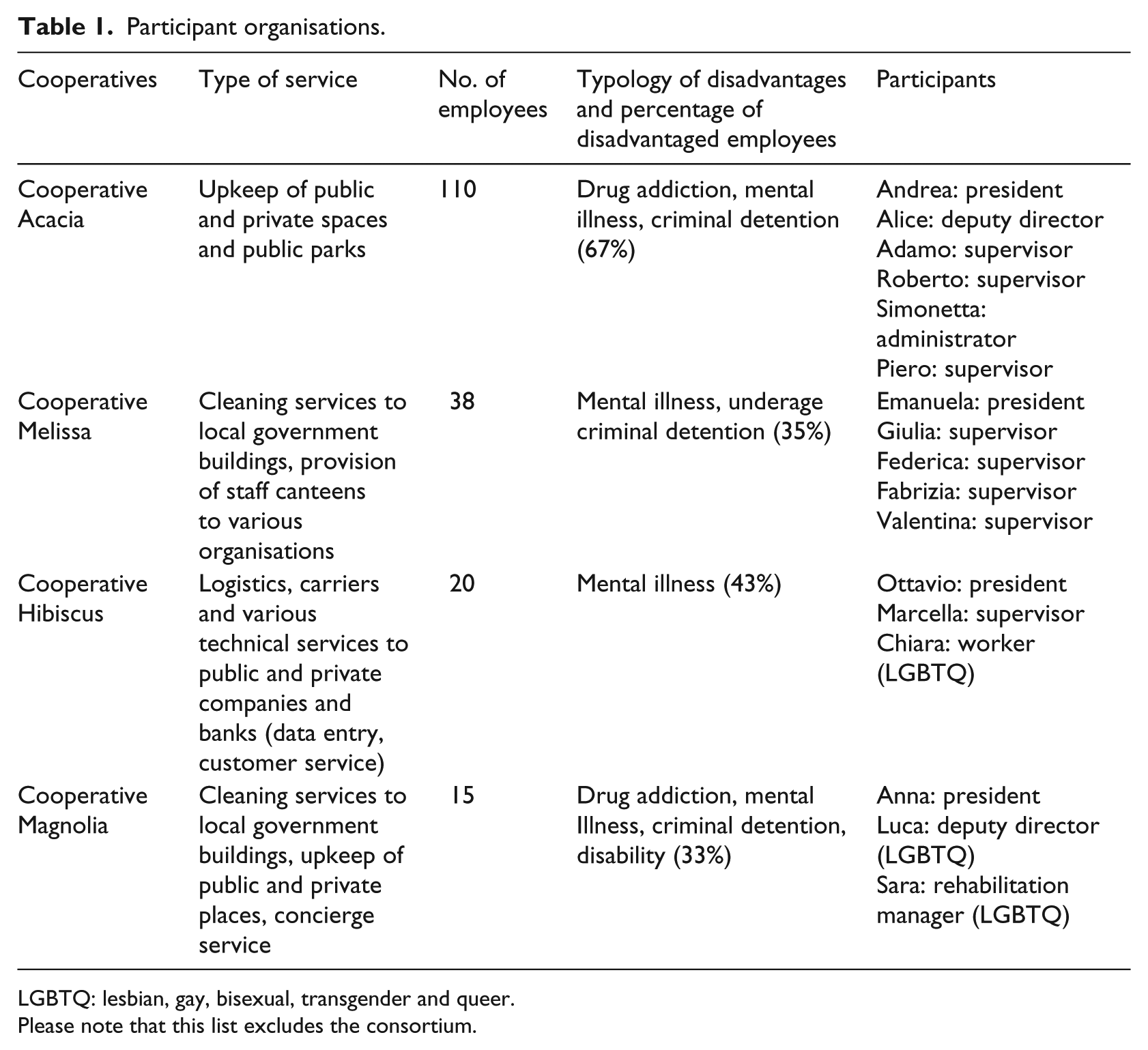
LGBTQ: lesbian, gay, bisexual, transgender and queer.
Please note that this list excludes the consortium.
During the interviews, we asked participants to reflect on the relevance of sexual orientation in the workplace, to discuss any direct or indirect experience of discrimination against LGBTQ people, to share their views on the meaning of inclusive workplaces, and to reflect on the benefits of taking into account sexual orientation in organisational practices and policies. The interviews and the focus group lasted between 1 and 2 hours, they were transcribed verbatim and all the authors independently examined the transcripts for emerging themes. As sexuality and inclusion was the central topic of the conversations, what participants chose to disclose to us was influenced by their perception of our views regarding the topic as well as by their perception of our sexualities. As researchers, we are mindful that we exercised power in reproducing specific versions and interpretations. Equally, we are aware that participants’ discursive practices are both a condition and a consequence of the power relations that characterise the setting (Hardy and Phillips, 2004). The empirical data analysis that follows reflects such relations.
Data analysis
The epistemological premises of the study reside within a poststructuralist approach centred on understanding subjective realities constructed through a meaning-making process. Such epistemology follows a non-essentialist and non-totalising ontology, and its aim is to problematise, contextualise and explain multiple, and often conflicting, realities. Methodologically, a thematic analysis sustained the uncovering of particular narratives concealed in the participants’ talks and the exposing of discursive practices that are both a condition and a consequence of the power relations that characterise the setting (Hardy and Phillips, 2004).
The process of data analysis was iterative, with the first stage aimed at identifying broad interpretative categories, which were later reconnected to the two epistemes of (a) separation between the private and the public and (b) the denial of discrimination. These epistemes formed the basis of the analysis as we identified how more specific social discourses emerged within these broader categories. These discourses were then explored in relation to cultural dimensions and to more specific organisational dimensions (see Table 2). Discourses are often entwined within the same extract, and both social and organisational dimensions sometimes overlap in both epistemes.
Dimensions of heteronormativity.
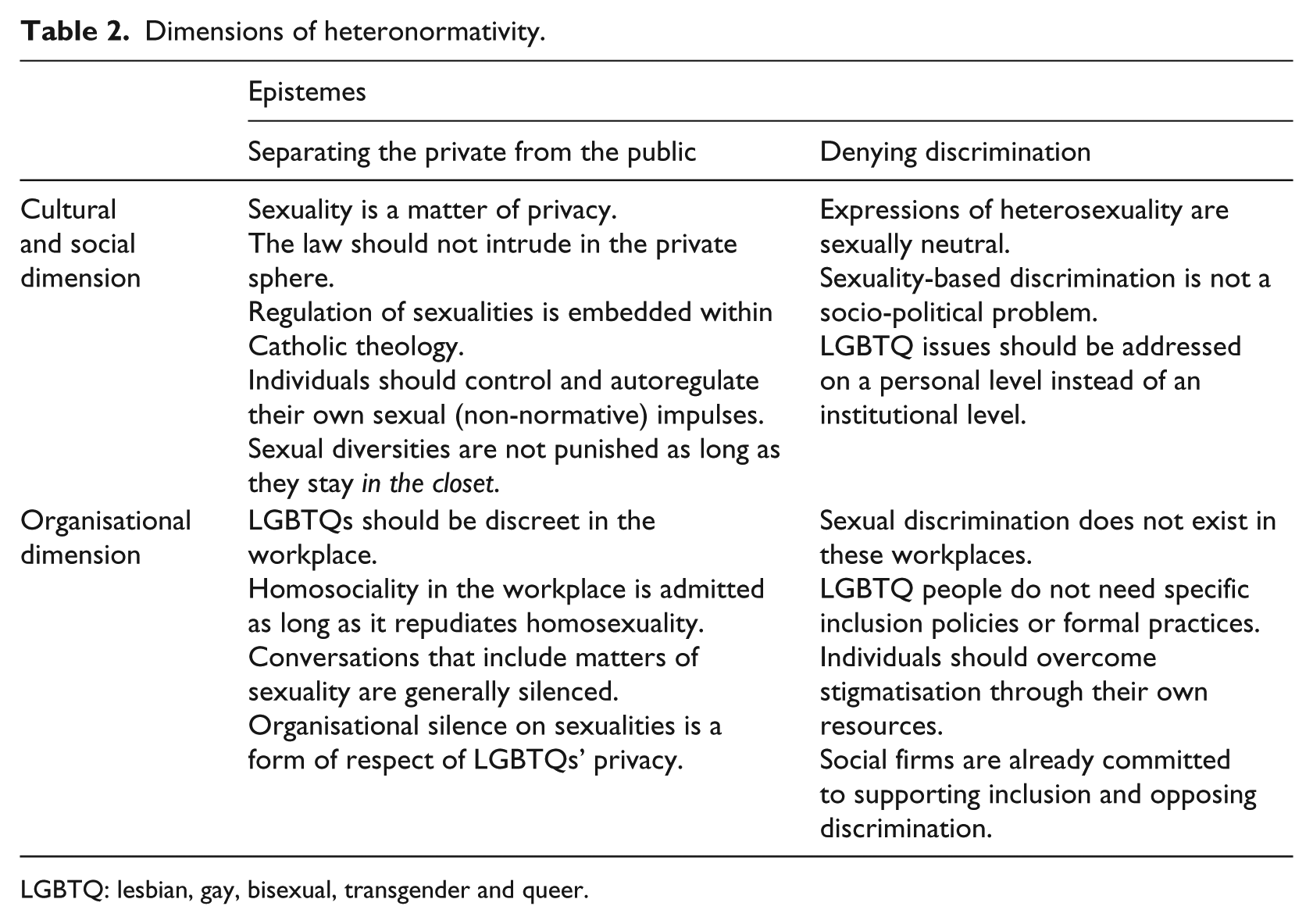
LGBTQ: lesbian, gay, bisexual, transgender and queer.
Separating the private from the public
During the observations and talks with different members of the four organisations, it emerged that their principles and their general mission were centred on what was defined as an inclusive ethos. Inclusion efforts are linked to the specific conditions identified in the Italian legislation (e.g. physical or mental disability, drug and alcohol addiction, criminal behaviours) and associated to social disadvantage. These require interventions aimed at including the individuals within a regime of ‘normality’. In view of the fact that sexuality itself is not considered a cause of disadvantage, it was excluded from any specific policy or intervention focusing on discrimination. Participant observations and the analysis of company documents revealed a conceptualisation of inclusion that was constructed around the provision of a job and the development of behaviours and expressions that respected social norms.
This section explores discursive practices that contribute to maintaining and reinforcing heteronormativity as the regime of normality by appealing to the separation between private lives and work/public lives. Within this episteme, several different accounts were given to create the conditions that exclude sexuality from being considered a possible source of discrimination. These accounts were constructed around the fact that sexuality is a private matter that should not be part of the organisational discourse because it is irrelevant to work processes (see also Woods and Lucas, 1993).
As highlighted by Sedgwick (1990), the public/private binary is central to the distinction between homo- and heterosexual that is used within Western culture. The normativity of heterosexuality depends on and is asserted on the basis of the stigmatisation of homosexuality (Sedgwick, 1990). Being in or out of the closet of privacy is a fundamental metaphor since diverse sexualities have been constructed as identities. In Sedgwick’s (1990) words, ‘The image of coming out regularly interfaces the image of the closet, and its seemingly unambivalent public siting can be counterposed as a salvational epistemologic certainty against the very equivocal privacy afforded by the closet’ (p. 71).
A genealogical analysis shows that the episteme of public/private is embedded in the broader socio-historical-institutional context. By constructing sexuality as a private matter and discouraging any expression of sexualities that did not conform to the heterosexual regime and the institution of the traditional family, Italy has always sustained a heteronormative society. The historical legislative archives of modern Italy (since the unification of 1861) show the absence of any reference to sexuality. Instead of the legal repression and punishment of same-sex acts present in most European countries, Italy chose to be silent. The penal code of the newly established Italy (the 1889 Zanardelli code) stated that the law should not intrude upon what belongs to the field of morality (Camera dei Deputati, 1887: 213–214). Similarly, in spite of the active repression of any ‘scandalous attitude’ by the fascist regime, no reference was made to same-sex acts in the 1930 Rocco penal code because, as stated in the ministerial report, ‘the filthy vice is fortunately not common in Italy’ (Manzini, 1936: 218).
While on one side the fascist regime renounced legally condemning homosexuality, on the other side the totalitarian fascist vision aspired to control every aspect of life, public as well as private, by shortening the distance between public morals and the private sphere (Benadusi, 2004). The project of controlling sexualities was pursued by juxtaposing social morality and private behaviours, thus not requiring explicit repressive actions of ‘deviated’ sexualities. As a result, LGBTQ individuals were always caught in between their private freedom and the public control of their acts/identities, so that the only admissible choice became that of inaction and self-repression. Such legacy continues to influence contemporary society.
LGBTQ individuals should be discreet
In our organisations, the use of discretion as a rhetorical device was the condition for acceptance of LGBTQ employees. This was further complicated by the expectation that LGBTQ employees will shape their own repression: When people are sexually different, in my opinion what is important is being discreet. I don’t mean that no one should know it. As well as in a heterosexual relationship, if during work we always kiss, obviously I create an annoying situation. (Alice, senior manager)
Through the formulation of an extreme and unrealistic case (Pomerantz, 1986) of someone who spends her time kissing her partner while at work, Alice echoed the philosophy that inspired the Italian legislation that relegated LGBTQ persons to the closet. By referring to the need of LGBTQ people to be discreet, and expecting them to appear indistinguishable from ‘straight’ people (Williams and Giuffre, 2011), participants demonstrate how heteronormativity works as a self-disciplinary mechanism to control the expression of one’s identity and desires so to realise ‘the disciplinary society’ (Foucault, 1977: 209).
Not recognising that sexualities are expressed in multiple ways, Alice attempts to desexualise the workplace, denying the hegemonic and pervading strength of heteronormativity and the suppressed and invisible position of diverse sexualities. As Foucault (1978) highlights, sexuality is anything but a private matter; rather it is the result of public, institutionalised regimes of truth. What participants failed to realise was that in their everyday work, their own behaviours expressed heteronormativity in several ways (e.g. we observed ‘traditional family’ photographs, wedding rings, talks about social and family events), which generally preclude LGBTQ individuals from expressing themselves because of fears of disapproval (Berlant and Warner, 1998).
A genealogical analysis reveals the promotion of the Catholic doctrine of the distinction between sexual tendencies and sexual actions. Indeed, the Catholic Church’s archives 6 separate the personal/intimate condition (sexual orientation and/or identity) from the act/action (sexual behaviour), thereby constructing the path to salvation as dependent on an individual choice. The ‘potential sinners’ are, thus, absolved as long as they choose not to act out their desires. Catholicism continue to have a special influence on Italian political and cultural life (Garelli, 2007; Santos, 2013) as a consequence of historical events 7 that formalised the special relationship between the Vatican and the Italian Government, including the formal release of the moral and ethical education of the country to the Church.
Homosociality and heterormativity
Although participants repeatedly emphasised that the sphere of sexuality did not belong in the workplace, public expressions of sexuality were evident and considered in a positive light on the condition that they confirmed heteronormativity. During the focus groups, it emerged that behaviours expressing macho camaraderie were common in men-only work sites: For example, several times when I go on site I feel that someone is touching me on my bottom, another man I mean. […] and I generally turn slowly and I tell him ‘oh, then you like me this morning?’ and we laugh. There is a specific person that, when others did this to him, I say this now that I know [he is gay], […] you could see that he got all rigid. This made me thinking that one couldn’t even make a joke or, but, possibly that he wasn’t 100% man, I mean […] it is just a fun gesture among colleagues, friends. (Adamo)
This form of male homosociality, meant as same-sex focused social bonds (Bird, 1996), serves to establish masculine social hierarchies (Flood, 2008) and to reinforce alliances between men. Homosociality supports the subordination of women (Connell, 1995) and is intertwined with the repudiation of erotic ties between men, the stigmatisation and disparaging of alternative sexualities and the construction of normative masculinity (Sedgwick, 1985), as shown in the extract above. Teasing gestures such as touching each other’s backside contribute to containing the ‘homosexual panic’ (Sedgwick, 1985: 90) by defining the limits of what is admissible in homosociality and avoiding turning it in an erotic or even romantic relationship. Adamo’s camaraderie asserted workplace masculinity and reinforced heteronormative rules by identifying, delegitimising and disciplining the ‘diverse’ employee who found such behaviours uncomfortable. The reference to an essentialist model of sexuality, constructed on the basis of the overlapping of sex, gender and sexuality, led him to define the colleague as a lesser man (not 100% man) on the basis of the fact that his (supposed) sexuality did not coincide with what is expected and accepted by a man (in the biological sense). Indeed, a man who is sexually attracted to women would engage in shop-floor banter with the confidence that his masculine sexuality would remain intact.
Justifying exceptions to the inclusive ethos
The clear demarcation between private and public spheres serves to justify exceptions to the inclusive ethos. Indeed, even when participants showed awareness of the restrictions imposed on the expressions of LGBTQ workers’ sexualities and the discriminations that beset them, they chose to be complicit in their relegation to the private realm. The consequent contradiction between the silencing of diverse sexualities and the organisational ethos was solved by returning to the rhetorical device of ‘respecting’ individuals’ privacy in order not to give rise to their suffering.
They [LGBTQ people] are afraid of being judged, they are afraid of maliciousness, of being isolated. I can understand it very well, because that can happen and we cannot deny it. I figure out that annoying quips hurt a lot and clearly they try to protect themselves by not coming out to those people known to have a specific view of things.
Is it possible in your opinion to encourage more visibility in the workplace?
I wouldn’t feel to force them [to be more visible] because I don’t know which reactions are possible and I do not want to be the cause of a profound uneasiness in a person. So it’s clear why I wouldn’t be enthusiastic to force them, for the fear that others might have negative reactions and the person can suffer from it.
In spite of the organisational rhetoric of ‘inclusion of the person as a whole’ (hence affections and sexuality), the necessity to protect employees from sexuality-based discriminations justifies the silence. By asserting that ‘they [LGBTQ people] are not ready to talk explicitly about their sexual orientation’, Anna justifies exceptions to the organisational inclusive ethos. As a result, the sexual dimension has completely disappeared from concrete inclusion efforts that were instead developed around those needs that are permitted to be publicly expressed (such as the ones listed in Law n. 381/91).
The episteme that separates the private from the public upon which the knowledge of sexuality is culturally and historically founded, supports, on one hand, the organisational inaction and, on the other, controls the display of sexual desires in LGBTQ employees. This episteme affects the possibilities of knowing and expressing alternative sexualities within the Italian context. Equally, organisational norms, as verbally expressed and/or acted in practice, interact, as parts of the system of power and knowledge within the specific cultural context (Foucault, 1980b), to repress alternatives to the dominant sexuality.
Denying discrimination
The second episteme that contributes to maintaining and reinforcing heteronormativity is the denial of sexual discrimination and of the relevance of sexuality at work. When participants were asked whether they knew cases of sexuality-based discrimination in their organisations, they mostly denied injustice and discrimination. Specifically, what emerged was the denial of the different conditions that afford heterosexuals but not ‘others’ the possibility of expressing their sexuality. The following exchange was recorded during the focus group.
I’m heterosexual, but I never talk about my sexual relationships, I say nothing about my love life at work, it’s a matter of privacy.
Do you think there’s any difference between Simona’s choice of not talking about her sexuality at work and a LGBTQ person who doesn’t talk about it?
No differences.
By desexualising the workplace (Burrell, 1984) in their accounts, Simona and Federica failed to recognise that ‘heteronormative forms of intimacy are supported not only by overt referential discourse such as love plots and sentimentality but materially, in marriage and family law, in the architecture of the domestic, in the zoning of work and politics’ (Berlant and Warner, 1998: 562). Participants were not aware of the different experiences that LGBTQ individuals might have of their work environment and in this they were legitimised by the absence of organisational policies related to sexual discrimination.
The irrelevance of sexuality in the workplace
The denial of the inequalities that can derive from sexuality reflects the wider national political context where, in spite of several law proposals submitted over the last 40 years, public policies and legislation are still inconsistent. This is the case, for example, of the law on same-sex civil unions (Law n. 76/2016) that was approved only on the condition that any reference to lesbian and gay parenting would be deleted (Lasio and Serri, 2017). The law on homophobic crimes has never been approved in spite of several rounds of amendments. Similarly, the legislation against employment discrimination based on sexual orientation (Law n. 216 of July 2003, amended in 2008, which transposed the European Union Directive 2000/78) still allows differential treatment if sexuality ‘affects the performance of work or constitutes decisive requisites for its carrying out’. Such difficulties to legally recognise LGBTQ rights in Italy have been ascribed to the influence of the Vatican on the political decisions regarding family life and sexualities (Bernini, 2008; Santos, 2013). This has led several governments, including those with a centre–left majority, to postpone or censor controversial issues that appear to attack the essence of the family as a ‘natural institution’.
Emanuela, president of the Cooperative Melissa, stressed that sexuality is not an issue that requires a specific consideration, thus enshrining the irrelevance of sexuality in the workplace.
Have you ever considered someone’s sexuality as a source of discrimination that can lead to disadvantage?
Well, this has never happened … actually it has happened but only because we discovered it afterwards, for me and for the others this is not an issue, nothing has changed, it was just normal, it is not something we need to consider specifically: It was like this and that’s all […] we haven’t been intrusive.
Reflecting wider institutional views reproduced at different level within the country (including in the legislation), Emanuela constructed sexuality as a personal characteristic that does not affect work dynamics; one’s sexuality is not a self-evident disadvantage and therefore should not be considered in specific terms. Emanuela, referring to an individual case, emphasised that sexuality is a matter of fact that should not elicit specific inclusion policies or formal practices, thus denying the different conditions that LGBTQ people may experience and the unequal distribution of opportunities that may derive from the act of expressing their own sexuality (Reingardë, 2010). The refusal of the relevance of sexuality showed that ‘one of the most powerful mechanisms supporting oppressive practices is the denial that any such oppressive practices exist’ (Kitzinger, 1999: 53).
‘It’s an individual matter’
As previously illustrated, many participants rejected the possibility of allowing diverse sexualities to be part of the organisational discourse because they should be either acted away from public view or not acted at all. In some instances, they attributed organisational silence in relation to sexuality to LGBTQ people themselves, who were constructed by participants as responsible for their own oppression because of their ‘choice not to talk about it’ (Anna, senior manager). The absence of an historical explicit coercion by the state, as highlighted above, contributed to the construction of silence as the result of a personal choice (Halperin, 1997). The following exchange was recorded during the focus group.
In my opinion, behind the relationship between … let me say normal persons and homosexual persons there is the fact that being different implies troubles in your head, troubles like …
Many times they don’t accept themselves
Sometimes they don’t accept themselves because those close to them don’t accept them, or they accept them but not as they wish to be accepted
They are not able to accept themselves
Sure
To accept their own diversity
Here, participants acknowledged the difficulties that LGBTQ individuals experience as result of social prejudice but hide the political and social origin of the problem behind individual inadequacies (‘troubles in the head’) and suffering. By using individualistic explanations, participants depoliticised oppression and shifted the focus from the oppressor to the victim of oppression. ‘Individualised explanations are routinely used … to obscure structural and institutional power’ (Kitzinger, 1999: 58).
In some cases, participants recognised the role of institutions in constructing diverse sexualities as problematic; however, they individualise the problem and its solution, thus preventing any organisational action. During the focus group, Adamo underlined the role of Catholic theology in influencing the difficulties that LGBTQ people are supposed to have in accepting themselves, while attributing the responsibility to deal with the problem to the individual: The problem is the amazing closure of these people. […] It’s a closure due to their problem, it’s a deeply rooted problem linked to religion, to some taboo that are transmitted during childhood, when they tell you ‘a man is man and a woman is woman’. These are problems that a person must solve. (Adamo)
By individualising the solution of the problem, Adamo failed to recognise that the discrimination of LGBTQ people should be addressed as a social and institutional problem. Participants seemed to adhere to an individualistic view that tends towards rewarding those individuals who overcome adverse circumstances through their own resources. As a result, institutionalised forms of discrimination are stripped of their political value, and those who produce a story of ‘individual overcoming – rather than one of institutional or political transformation’ (Butler, 1996: 82) – will prevail. On this ground, participants justify the absence of organisational sexual discrimination policies. This mechanism of individualisation is so strong that even LGBTQ individuals can sometimes attribute experiences of discrimination to themselves. Sara, the lesbian manager we interviewed, felt conflicted for not contributing to the possibility of creating a more open climate within her organisation: If personally I’d have done something to create a different context, probably now I would feel more serene. I don’t think that it is only the responsibility of those who don’t accept or don’t speak, but I, myself, have done nothing to change this situation.
Heteronormativity maintains its power through the individualisation of the responsibility to overcome oppression, leading to immobility and to the preservation of the status quo. ‘The institution, under the guise of applauding the individual character and fortitude required to overcome adversity without institutional assistance, thus extends its institutional power (and paternalism) by offering that very reward’ (Butler, 1996: 81).
The problematic tension existing between the organisational discourse of inclusion and the lack of a proactive position towards a fluid conceptualisation of inclusion leads to the inability of organisations (and their senior members) to take a clear ideological and operative positioning. This leads to a vicious circle where no one shows willingness to take on responsibility for the change, and most give the responsibility of the actual situation, and the possibility of a different condition, to someone who occupies a higher hierarchical position. Roberto, for instance, a supervisor, suggests that ‘the fish stinks from the head’, meaning that sexuality issues are not included in organisational policies or practices because of the top managers’ lack of interest (the organisation ‘stinks’ because the top ‘stinks’).
Discussion
In problematising the notion of inclusion, as theoretically and empirically employed in organisational settings, this article has explored organisational discursive practices of heteronormativity as related to two epistemes: ‘Separating the private from the public’ and ‘Denying discrimination’. These, we argue, form part of a wider cultural discourse that characterises the Italian society, within which the organisations studied operate. In order to address the study’s research questions, we set out to do a Foucaultian genealogical analysis that embeds organisational practices within their social and historical a priori. The analysis highlights how research participants, in constructing sexuality as being irrelevant to work activities, controlled and resisted the recognition of LGBTQ individuals and anchored organisational practices to discourses that underpin Italian society’s knowledge of sexualities. Central to the work of the examined organisations is the notion of inclusion, which is entangled within their mission of (re)integrating disadvantaged individuals into work and society. Sexual discrimination, however, is largely overlooked by these social firms’ policies and practices, and this reflects how the Italian society (and the country’s legislation) has charted an ambiguous course against the discrimination of LGBTQ people.
The study findings highlight that participants construct sexuality as a private matter and reveal the discursive ambivalence of the separation between private and public desires and the fragility of a desexualising logic. The separation between public work and private sexuality is not new and was present in the early studies focusing on the closet (Sedgwick, 1990; Seidman, 2002); however, as Floyd (2009) highlights when referring to contemporary civil rights, what we continue to observe is the ‘privatizing isolation of the sexual from the social’ (p. 200). As he suggests, even public campaigns against homophobia tend to speak of desexualised citizens and are generally constructed as ‘a fight for a sanitized, innocuous right to privacy’, which reinforces the discourse of sexuality as belonging to the private sphere of life. For the organisations studied, the confinement of sexuality to the private is functional to the reification of their inclusive ethos: if sexuality belongs to the private, there cannot be sexual discrimination in the workplace, and policies addressing discrimination would be worthless. Inclusion is constructed as focusing on the whole person, regardless of their sexual orientation. However, as emerged in the study, LGBTQ employees continue to be demeaned because they violate normative expectations about gender roles. Equally, they are the subject of censorship, enforced through the rhetorical devise of discretion. As revealed by the genealogical analysis, institutional and historical social developments buttress a hegemonic heteronormative order that sustains the silencing and self-regulation of LGBTQ workers.
The organisational ‘inclusion’ of those LGBTQ workers who do not flaunt their diversity is one of the aspects that testified their participation into the neoliberal regime of gay normality (Drucker, 2015). Such regime implies an adaptation of gay and lesbian individuals to the heteronormative conformity model, and the marginalisation of those who are recognisably members of queer subcultures. As queer critiques (e.g. Bell and Binnie, 2000; Drucker, 2015; Duggan, 2003; Eng, 2010) highlight, in recent decades neoliberal privatisation and deregulation have promoted the growth of new gay and lesbian niche markets, which testified that sexual restrictions have been, to some extent, overcome but have also fostered new kinds of conformism. Economic participation of market-friendly gay and lesbian citizens and their adhesion to dominant norms and values are the key conditions of their social inclusion (Bell and Binnie, 2000). As Duggan (2003) asserts, such neoliberal homonormativity ‘does not contest dominant heteronormative assumptions and institutions, but upholds and sustains them, while promising the possibility of a demobilized gay constituency and a privatised, depoliticised gay culture anchored in domesticity and consumption’ (p. 50). Homonormativity derives its strength from the normalisation of queer subjectivities, which include some LGBTQ people in neoliberal institutions and exclude or marginalise others because they have ‘the wrong bodies, the wrong clothes, the wrong sexual practices, the wrong gender or the wrong colour skin [and] are viewed as bad for branding and marketing’ (Drucker, 2015: 20).
The findings of this research revealed how fragile and contradictory the notion of inclusion of LGBTQ individuals can be within these (hetero)normative regimes. In fact, while participants emphasised their organisations’ openness to include any person, regardless of their sexual orientation, they endorsed different forms of inclusion in relation to the individuals’ capability to fit with the neoliberal (hetero)normative principles. As a result, neoliberal politics, which absorbs LGBTQ subjectivities into the heteronormative order, leads to the exclusion of those individuals who do not conform to the hegemonic regime, even in organisations whose primary purpose is the inclusion of marginalised individuals. Within these organisations, in fact, we observed the paradox that when sexuality is intersected with other categories of social disadvantage, its salience in relation to inclusion becomes amplified. Inclusion, in these contexts, designates different degrees of recognition of LGBTQ identities according to their possibility of being warped (Drucker, 2015) so to fit within the normative predicaments related to sexuality but also to class and social status.
By referring to the notions of private and personal responsibility, participants also manage to shift the attention from the structural and institutional conditions that banish those visible LGBTQ individuals, to the role of the individual in determining their own marginalisation or emancipation. LGBTQ employees were described as fragile, too sensitive and with ‘troubles in their heads’; however, such fragility is an individual issue, rather than a social issue. Privatisation and individual freedom against the excessive intervention of the public are essential requisites of the neoliberal political agenda, even if the State continues to pursue direct interventions (Richardson, 2005). As highlighted in the analysis, the historical archives of Italy show how the reference to the private sphere of life and to personal responsibility justifies the State’s withdrawal from the direct and explicit social governance of sexuality, while allowing it to remain in control of its discursive regimentation. The positioning of Italian politics, thus, corresponds to the refutation of a direct control over issues related to sexuality, and, simultaneously, to the reaffirmation of the superiority of the heterosexual order.
Similarly, in the organisations we studied, the interventions aimed at reducing social hardship related to certain conditions of social disadvantage (i.e. resulting from poverty, addiction, disability) are positioned at the centre of their activities, while policies and actions to contrast sexuality-based discrimination remain unconceivable. These social firms operate a clear demarcation between conditions that can be subject to public intervention (implemented via their activities) and other conditions in which private/self-regulation is the individual’s responsibility. As a result, LGBTQ employees who regulate themselves to fit in the normative standards are included, while those who fail in self-censuring their diversity remain under-included or even excluded. By leaving the management of their inclusion to the individual responsibility into the regime of normality, sexuality-based discrimination is abstracted from the social, cultural and institutional superstructures in which it occurs. Diverse sexualities are pushed to the private and individualised sphere, meaning that they remain excluded from organisational policies and wider institutional inclusion efforts: The institution thus signals that those who receive special consideration will be those who describe their suffering as the result of economic disadvantage, unwholesome family life and declining neighbourhoods, thus regurgitating the tropes that defend racial and sexual normativity within public discourse, but doing so in a way that never explicitly mentions those terms. (Butler, 1996: 81)
As the analysis shows, while participants’ efforts are focused on representing their workplaces as a-sexual, the workplaces are actually characterised by heteronormativity in their insistence to maintain the closet. The construction of a diachronic process of strategies of social control (general politics and regimes of truth evidenced in the epistemes analysed) underlies the dynamic of power between those fitting with the heteronorm and those who do not (Foucault, 1978, 1984b) The emergence of the historical and cultural roots of the alleged ‘epistemological privilege’ of one dominant sexuality on anything that deviates from the heterosexist norm (Butler, 1990, 1997; Halperin, 1997) was evident in the study. Here, the dynamics of power sustain a construction of inclusion as nuanced and imbedded within neoliberal normative principle. By providing genealogical empirical evidence exposing the dynamics of sexual inclusion and how these are regulated by (Italian) social institutions, this study extends current research (e.g. Brewis et al., 2014) that suggests that, in spite of the greater presence of LGBTQ matters within public discourse, there is also greater institutional control, regulation and a hierarchical ordering of which expressions of sexuality are socially and organisationally accepted and acceptable. As Duggan (2003) suggests, ‘state policies reflect and enact identity and cultural politics invested in hierarchies of race, gender, and sexuality as well as class and nationality’ (p. 14). By queering inclusion, this article disrupts a conceptualisation of LGBTQ rights, intended as liberal equality rights assimilated to normative principles, and has shown the nuanced articulations of what it means to be included or excluded.
Conclusion
The study showed how a genealogical approach (Foucault, 1977, 1978, 1984a, 1984b) can contribute to the understanding of the complexities and contradictions that characterise organisational practices, as well as the illumination of the different ideologies that influence workplace practices and processes. By placing organisations within their socio-historical context, this analysis contributes to the current understanding of the iterative development of organisational discourses of inclusion. It also shows organisational members specifically construct heteronormative meanings of inclusion that have the power to account for the representation of organisations as desexualised (Pringle, 2008).
In integrating the organisational-level analysis with the historical a priori, the article has theorised inclusion as embedded within heteronormative dynamics, and has showed the different nuances that the notion of inclusion assumes when confronted with LGBTQ subjectivities. Queer theorists who focus on gay-friendly organisations (Rumens and Broomfield, 2014; Williams et al., 2009) show how the inclusion of LGBTQ people is still constrained by the heterosexual/homosexual binary and the stereotypes about how gays and lesbians (other sexual identities continue to remain marginalised) are expected to look, act and work. Our study extends queer theory research by showing how organisations that support the social inclusion of marginalised individuals produce varying degrees of inclusion of LGBTQ individuals according to their fitting with the heteronorm. Even in the contest of work settings involved in supporting the inclusion of marginalised people, LGBTQ employees who do not fit with neoliberal standards of gay normality are not given the opportunity to express their subjectivities, while their marginalisation is denied or considered a problem they have to solve on their own.
Such organisations should be better equipped to deal with queerness (intended as ‘all which is at odds with the normal, the legitimate and the dominant’) and ‘anyone who feels marginalized in relation to any normative behaviour’ (Halperin, 1997: 62); instead, they reproduce normative influences and individuals are admitted to formal processes of inclusion as long as they fit within narrow categories of normality and behave in ways that respect social norms. The contradictions we witnessed inside these organisations reflect, and to an extent reproduce, the contradictions that exist at a national level. In Italy, in fact, alongside a shared and deeply rooted ethic of equality, there exist relations of power among opposed ideologies which prevent minorities, and sexual minorities in particular, from expressing themselves and achieving social and political equality.
Footnotes
Acknowledgements
We wish to thank the editor Craig Prichard and the anonymous reviewers for their generous feedback on the various versions of the manuscripts. We also wish to thank David Knights, David Wilson, Diane Preston and Peter Bloom for their comments on an earlier version of this work. Finally we thank all research participants who have shared with us their thoughts and experiences with honesty and openness.
Declaration of Conflicting Interests
The author(s) declared no potential conflicts of interest with respect to the research, authorship, and/or publication of this article.
Funding
The author(s) received no financial support for the research, authorship, and/or publication of this article.
